
Showing 699 items matching "various industries"
-
 Sunshine and District Historical Society Incorporated
Document (item) - Water Use In Industry, Kenneth S. Missen JP, unknown
... ...various industries...Water various industries Water Use In Industry A spiral bound orange colored book with black & white text, tables, sketches & photos. ...Water Use In Industrywater, various industries -
 Bendigo Historical Society Inc.
Document - DAVID BANNEAR, THE GOLDFIELDS LANDSCAPE - PROPOSED TALK, 2/11/2023
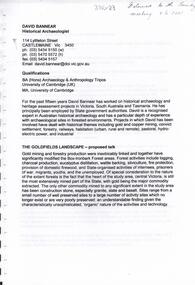
... An 8 page document by David Bannear about the various industries of the Bendigo Goldfields and their effects on terraforming the local environment ...David Bannear Central Goldfields An 8 page document by David Bannear about the various industries of the Bendigo Goldfields and their effects on terraforming the local environment Document DAVID BANNEAR, THE GOLDFIELDS LANDSCAPE - PROPOSED TALK ...The goldfields resulted in the almost complete denuding of trees for access to the gold bearing land, for firewood and for the tanning industry. The need for wood further increased with the advent of deep quartz mining that required timbers for shoring up the shafts and tunnels. At some point in time it became necessary for timber to be carted long distances to fulfil the need. Between 1878 and 1884, the government set up 5 nurseries to try and rectify the shortage of native softwoods and encouraged the growth of State plantations and the thinning of trees to encourage growth of those remaining. 1907 - Creswick School of Forestry and Forest Management was started 1919 Establishment of the Forests Commission and the planting of many pine plantations 1924 Establishment of the first fire spotting towers Forest management tasks became a main project for "Susso" recipients during the Great Depression and again for internees during WWII.An 8 page document by David Bannear about the various industries of the Bendigo Goldfields and their effects on terraforming the local environment david bannear, central goldfields -
 Marysville & District Historical Society
Book, Clive Turnbull, Liquid Gold-Australia, 1960
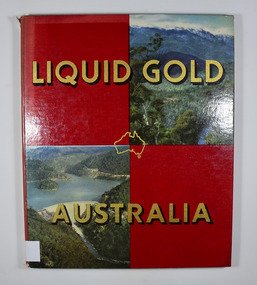
... A book that outlines the importance of irrigation and water usage used in various industries in the Goulburn Valley and North Eastern Victoria....Marysville & District Historical Society 39 Darwin Street Marysville yarra-valley-and-the-dandenong-ranges A book that outlines the importance of irrigation and water usage used in various industries in the Goulburn Valley and North Eastern Victoria. water industry irrigation australia A book that outlines the importance of irrigation and water usage used in various industries in the Goulburn Valley and North Eastern Victoria. ...A book that outlines the importance of irrigation and water usage used in various industries in the Goulburn Valley and North Eastern Victoria.Front cover has two photographs. On of a treed valley leading up to snow covered mountains and on of a water reservoir surrounded by bushland.non-fictionA book that outlines the importance of irrigation and water usage used in various industries in the Goulburn Valley and North Eastern Victoria.water, industry, irrigation, australia -
 Federation University Historical Collection
Book, Prospectus of the School of Mines and Industries, Bendigo, 1914, 1914
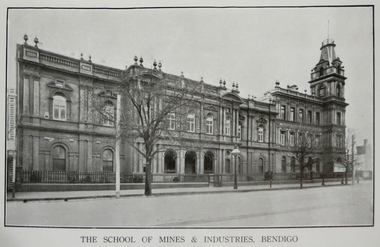
... The Bendigo School of Mines was established in 1872 for the purpose of providing instruction and training in the principles of science with their application to the various industries. ...The Bendigo School of Mines was established in 1872 for the purpose of providing instruction and training in the principles of science with their application to the various industries. bendigo school of mines l. lansell r.h.s. abbott john veale george davey a.e. thorne john quick w.c. vahland o. penfold j.r.v. anderson w.h. walter john e grant woodcarving arthur t. woodward bendigo junior technical school university concessions carola cohn schools of mines pharmacy school of design and applied art geoffrey abbott Brown soft covered book of 62 pages. ...The Bendigo School of Mines was established in 1872 for the purpose of providing instruction and training in the principles of science with their application to the various industries. Brown soft covered book of 62 pages. Contents include: Office Bearers, Art Department, Board and Residence, Certificate Courses, Examination Results, Employment, Graduates, Laboratory Work, Library, Pharmacy, Railway concessions, Rules, Scholarships and Prizes, University Concessions An photographic image of the building, Turning and Fitting Workshop, Woodwork, and the Science Laboratory are reproduced. bendigo school of mines, l. lansell, r.h.s. abbott, john veale, george davey, a.e. thorne, john quick, w.c. vahland, o. penfold, j.r.v. anderson, w.h. walter, john e grant, woodcarving, arthur t. woodward, bendigo junior technical school, university concessions, carola cohn, schools of mines, pharmacy, school of design and applied art, geoffrey abbott -
 Bendigo Historical Society Inc.
Document - AILEEN AND JOHN ELLISON COLLECTION: BENDIGO HISTORICAL INFORMATION
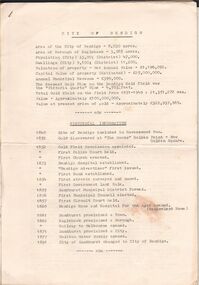
... The following 8 pages dig deeper in the history starting with the find of the first gold nugget and describing the various industries that developed in the city. A description of the climate, agricultural activities, prominent people and buildings is also given....The following 8 pages dig deeper in the history starting with the find of the first gold nugget and describing the various industries that developed in the city. A description of the climate, agricultural activities, prominent people and buildings is also given. ...9 pages document City of Bendigo historical information. After a brief description of the area, population, dwellings, city revenues, amount of gold and value of gold mined there is a timeline of the history of Bendigo starting in 1840 when the site of Bendigo was included in the Ravenswood run to 1891 when the city of Sandhurst changed to City of Bendigo. The following 8 pages dig deeper in the history starting with the find of the first gold nugget and describing the various industries that developed in the city. A description of the climate, agricultural activities, prominent people and buildings is also given.bendigo, history, city history -
 Vision Australia
Photograph - Image, QBIC Industries staff, 1996-2000
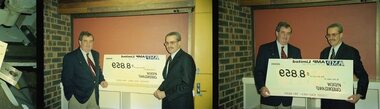
... 17 col. photographs and transparencies of QBIC Industries staff + various negatives at the back of the album...QBIC Industries Anne-Marie O'Connell Jaina Unmoepa Selwyn Brown Les Gregory Henry Chichowski Wayne Suffolk 17 col. photographs and transparencies of QBIC Industries staff + various negatives at the back of the album QBIC Industries staff Photograph Image ...Pictures taken of QBIC Industries staff, including Anne-Marie O'Connell, Jaina Unmoepa, Selwyn Brown, Les Gregory, Henry Chicowski and Wayne Suffolk.17 col. photographs and transparencies of QBIC Industries staff + various negatives at the back of the albumqbic industries, anne-marie o'connell, jaina unmoepa, selwyn brown, les gregory, henry chichowski, wayne suffolk -
 Vision Australia
Photograph - Image, QBIC staff working on factory floor, 1998
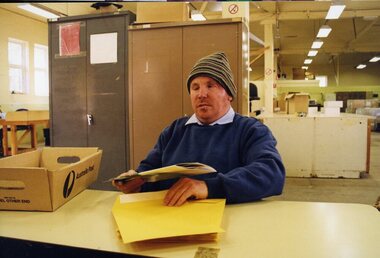
... Factory line processes are demonstrated by various QBIC Industries employees, including Alan Nemeth and Greg Bond....Vision Australia 454 Glenferrie Road Kooyong melbourne Factory line processes are demonstrated by various QBIC Industries employees, including Alan Nemeth and Greg Bond. ...Factory line processes are demonstrated by various QBIC Industries employees, including Alan Nemeth and Greg Bond.43 col. photographs of QBIC Industries workersqbic industries, alan nemeth, greg bond -
 Warrnambool and District Historical Society Inc.
Flyer - Warrnambool Exhibition Notices (2), Charles Cramer, President of Warrnambool Mechanics' Institute, 1879
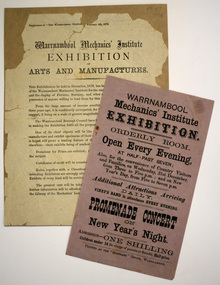
... The exhibition aimed to encourage local industries and to stimulate young people to manufacture and exhibit specimens of their skills in the various industries and arts. The admission was one shilling for adults and half price for children under 14. ...The exhibition aimed to encourage local industries and to stimulate young people to manufacture and exhibit specimens of their skills in the various industries and arts. The admission was one shilling for adults and half price for children under 14. ...These two flyers concern the Warrnambool Mechanics' Institute Exhibition of Arts and Manufactures held in the Orderly Room over eight days in 1879-1880. The exhibition aimed to encourage local industries and to stimulate young people to manufacture and exhibit specimens of their skills in the various industries and arts. The admission was one shilling for adults and half price for children under 14. The exhibition was not very profitable with only seven pounds going into the Mechanics' Institute funds. These two flyers are of some interest as mementoes of a minor exhibition of arts and manufactures held in Warrnambool in 1879-1880.1 a single sheet of paper with black printing on a faded pink background .2 a single sheet of paper with black printing pasted on a piece of lightweight cardboard. The edges of the sheet of paper are torn.warrnambool exhibition 1879-1880, mechanics institute, warrnambool exhibition 1880, nullawarre state school -
 Sunshine and District Historical Society Incorporated
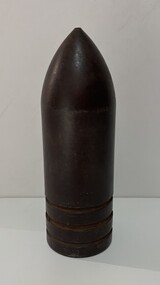
Weapon - Projectile (Reject) Armour Piercing
... 2nd World War - Various industries through Defense Department set up manufacturing facilities for Armaments - McKAY MASSEY HARRIS had one such facility. ...2nd World War - Various industries through Defense Department set up manufacturing facilities for Armaments - McKAY MASSEY HARRIS had one such facility. ...2nd World War - Various industries through Defense Department set up manufacturing facilities for Armaments - McKAY MASSEY HARRIS had one such facility. Corner Hertford & Hampshire Rds, for manufacture of Armour Piercing Shells. Materials: Steel Production Method: Shell Lathe & Heat Treatment When made: 1943 When used: 1943 - 45 Where made: Australia, Victoria, Sunshine Where used: Australia, Victoria, War zonesProjectile (Reject) Armour Piercingprojectile, h.v. mckays massey harris, sunshine harvester works, manufacturing -
 Federation University Historical Collection
Document - Document - Design, E J Barker: University of Melbourne: Bachelor of Mechanical Engineering; Machine Design Assignments, 1947
... Reports on visits to various industries: Bristo Plastic Industries. b. ...Reports on visits to various industries: Bristo Plastic Industries. b. ...Four folders of Machine Design projects. No.1: a. Reports on visits to various industries: Bristo Plastic Industries. b. Australian Iron and Steel. c. Olympic Cable Factory No 2: Medium Duty Centre Lathe Head Stock No.3: Vertical Multitubular Double Effect Evaporator No.4: Design and Drawings of 120 HP Diesel Engine Jack chose to do Engineering while still at Footscray Technical School as it gave access to Diploma Courses and tertiary studies. This enabled him to enter the University of Melbourne and do a Bachelor in Mechanical Engineering - 1945, 1946, and 1947. In 1948 he did a Diploma in Education at Melbourne University. From this path he was able to follow a career in teaching and his first appointment was at the School of Mines in Ballarat, (SMB) 1949. He became the first Vice Principal of SMB in 1960 and then Principal in 1964 to 1976. From 1976 to his retirement in 1987, he was the Foundation Director of Ballarat College of Advanced Education (BCAE). The Library building at Mount Helen Campus is named after him.Manila folders with design assessments. Written descriptions and detailed drawings.e j barker, jack barker, melbourne university, engineering, diploma of mechanical engineering, diploma of electrical engineering, school of mines ballarat, smb, diploma in education, vice principal, principal, foundation director, ballarat college of advanced education, bcae, bachelor of mechanical engineering, library, mount helen campus, engineering drawing, design, specifications, manufacture, bristo plastic industries, australian iron and steel, olympic cable factory, centre lathe head stock, multitubular double effect evaporator, 120 hp diesel engine -
 Linton and District Historical Society Inc
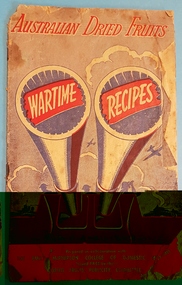
Recipe book, Australian Dried Fruits Wartime Recipes
... Produced during World War II by the Dried Fruits Publicity Committee (acting on behalf of various Australian dried fruits industry bodies) "to assist the housewife in the preparation of attractive cakes, puddings etc", at a time when supplies of foodstuffs were restricted through rationing. ...Produced during World War II by the Dried Fruits Publicity Committee (acting on behalf of various Australian dried fruits industry bodies) "to assist the housewife in the preparation of attractive cakes, puddings etc", at a time when supplies of foodstuffs were restricted through rationing. ...16-page recipe booklet, no illustrations. Produced during World War II by the Dried Fruits Publicity Committee (acting on behalf of various Australian dried fruits industry bodies) "to assist the housewife in the preparation of attractive cakes, puddings etc", at a time when supplies of foodstuffs were restricted through rationing. Prepared in collaboration with the Emily McPherson College of Domestic Economy. Pages 16recipe books, cookery books, recipes, dried fruits, world war 1939-1945, rationing -
 Vision Australia
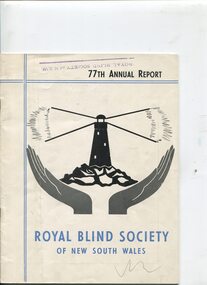
Administrative record - Text, 77th Annual Report Royal Blind Society of N.S.W. (1957), 1957
... Articles in the annual report include: the coming opening of the Alexis Albert Hostel for Aged Blind Men in Culdees Road, a property purchased in Burwood Road for Aged Women and Couples, a list of prize winners at the Royal Easter Show for various handicrafts by people who have learned their skill from the Occupational Therapy department, continued output of mats, baskets, brooms and matting in workshops requires demand by conscious consumers, appeal to employ skilled blind people in various industries as switchboard operators, piano tuners, stenographers, etc., aim to create a Youth Hostel due demand, best known of the Society's activities the library continues to provides reading material in Braille and Moon as well as Talking Books, awareness that gramophone discs are no longer being made and investigating the alternatives including tape recorders, regular musical concerts are held in the Society's hall and some musicians compete in the blind category and open category sections in the City of Sydney Eisteddfod, the outpatients clinic continues to provide regular and continuing treatment, families of children at the Victor Maxwell House are encouraged to visit the nursery, take their children home for holidays and weekends or each night - as considered the most beneficial by the Panel, work has begun on a new centre in Newcastle, social cricket matches and usually a bi-annual trip to Brisbane keep the NSW Blind Cricket and Athletics Club in shape, the NSW Blind Bowling Club play both indoor and outdoor bowls with the Balmain Bowling Club helping to organise trips to various clubs, the William Street Womens Bowlers Club invited 4 members from each club to play on the green at Five Dock, next year they intend to organise a similar indoor competition, the Victor Maxwell Nursery benefited greatly from the 2UW Blind Appeal for Blind Babies, Helen Keller Annual Fete, Blind Artists Concert with special guest artists who volunteer their time, thank you to Nellie Sweeney for training the Waimea Singers (Helen Keller hostel choir), '...Articles in the annual report include: the coming opening of the Alexis Albert Hostel for Aged Blind Men in Culdees Road, a property purchased in Burwood Road for Aged Women and Couples, a list of prize winners at the Royal Easter Show for various handicrafts by people who have learned their skill from the Occupational Therapy department, continued output of mats, baskets, brooms and matting in workshops requires demand by conscious consumers, appeal to employ skilled blind people in various industries as switchboard operators, piano tuners, stenographers, etc., aim to create a Youth Hostel due demand, best known of the Society's activities the library continues to provides reading material in Braille and Moon as well as Talking Books, awareness that gramophone discs are no longer being made and investigating the alternatives including tape recorders, regular musical concerts are held in the Society's hall and some musicians compete in the blind category and open category sections in the City of Sydney Eisteddfod, the outpatients clinic continues to provide regular and continuing treatment, families of children at the Victor Maxwell House are encouraged to visit the nursery, take their children home for holidays and weekends or each night - as considered the most beneficial by the Panel, work has begun on a new centre in Newcastle, social cricket matches and usually a bi-annual trip to Brisbane keep the NSW Blind Cricket and Athletics Club in shape, the NSW Blind Bowling Club play both indoor and outdoor bowls with the Balmain Bowling Club helping to organise trips to various clubs, the William Street Womens Bowlers Club invited 4 members from each club to play on the green at Five Dock, next year they intend to organise a similar indoor competition, the Victor Maxwell Nursery benefited greatly from the 2UW Blind Appeal for Blind Babies, Helen Keller Annual Fete, Blind Artists Concert with special guest artists who volunteer their time, thank you to Nellie Sweeney for training the Waimea Singers (Helen Keller hostel choir), ' Royal Blind Society of New South Wales Annual Report Victor Maxwell Kindergarten Helen Keller Hostel Alexis Albert Hostel Employment Black and White Committee Cricket Bowling William Street Blind Women's Bowling Club Goodie Reeve Fundraising Blind musicians Nellie Sweeney Waimea Singers Justice Maxwell Wilfred Reed David Hornibrook Richard Underwood Rotary Club of Burwood 1 volume of text and images 77th Annual Report Royal Blind Society of N.S.W. (1957) Administrative record Text ...Articles in the annual report include: the coming opening of the Alexis Albert Hostel for Aged Blind Men in Culdees Road, a property purchased in Burwood Road for Aged Women and Couples, a list of prize winners at the Royal Easter Show for various handicrafts by people who have learned their skill from the Occupational Therapy department, continued output of mats, baskets, brooms and matting in workshops requires demand by conscious consumers, appeal to employ skilled blind people in various industries as switchboard operators, piano tuners, stenographers, etc., aim to create a Youth Hostel due demand, best known of the Society's activities the library continues to provides reading material in Braille and Moon as well as Talking Books, awareness that gramophone discs are no longer being made and investigating the alternatives including tape recorders, regular musical concerts are held in the Society's hall and some musicians compete in the blind category and open category sections in the City of Sydney Eisteddfod, the outpatients clinic continues to provide regular and continuing treatment, families of children at the Victor Maxwell House are encouraged to visit the nursery, take their children home for holidays and weekends or each night - as considered the most beneficial by the Panel, work has begun on a new centre in Newcastle, social cricket matches and usually a bi-annual trip to Brisbane keep the NSW Blind Cricket and Athletics Club in shape, the NSW Blind Bowling Club play both indoor and outdoor bowls with the Balmain Bowling Club helping to organise trips to various clubs, the William Street Womens Bowlers Club invited 4 members from each club to play on the green at Five Dock, next year they intend to organise a similar indoor competition, the Victor Maxwell Nursery benefited greatly from the 2UW Blind Appeal for Blind Babies, Helen Keller Annual Fete, Blind Artists Concert with special guest artists who volunteer their time, thank you to Nellie Sweeney for training the Waimea Singers (Helen Keller hostel choir), '1 volume of text and imagesroyal blind society of new south wales, annual report, victor maxwell kindergarten, helen keller hostel, alexis albert hostel, employment, black and white committee, cricket, bowling, william street blind women's bowling club, goodie reeve, fundraising, blind musicians, nellie sweeney, waimea singers, justice maxwell, wilfred reed, david hornibrook, richard underwood, rotary club of burwood -
 Flagstaff Hill Maritime Museum and Village
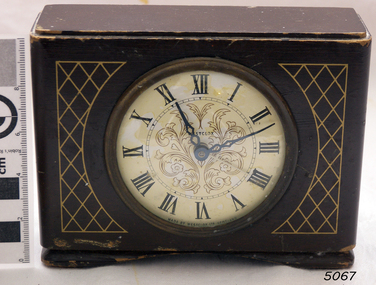
Clock, 1950
... In 1968 General Time was bought out by Talley Industries, which was best known as a manufacturer of timing equipment, such as factory time clocks to various industries. Westclox in Scotland enjoyed several boom years under the then Managing Director, John Santos. ...In 1968 General Time was bought out by Talley Industries, which was best known as a manufacturer of timing equipment, such as factory time clocks to various industries. Westclox in Scotland enjoyed several boom years under the then Managing Director, John Santos. ...Westclox had a highly successful factory in Scotland situated in the Vale of Leven Industrial Estate, in Dumbarton, around twenty miles from the City of Glasgow. Westclox had originally planned to start production in Scotland in 1939 but the War intervened and it was not until 1948 that they were able to fully commission their factory in Dumbarton. Westclox Scotland produced its first clock on the 21st September 1948; a spring wound alarm with a 4 inch dial. The Westclox factory in Scotland was a full manufacturing plant with all their clocks assembled from start to finish with only the basic raw materials being brought in by outside suppliers. 95% of the staff were local people and the firm trained their employees from scratch to a high level of skill and had an annual apprenticeship for toolmakers and classes in horology. By 1949 Westclox Scotland were making 10,000 clocks a week, and by 1950, 1,000,000 clocks had been produced since its opening. No home in the Dunbartonshire Vale was without at least one Westclox clock, nor any raffle complete without a clock as one of the prizes! Many of these clocks are still around today. So successful was the Dumbarton factory that in the mid 1950’s Westclox had to expand into adjoining buildings. The factory then added watches to what they made as well as timing devices for other sectors. By the mid 1960’s, employment levels at the Scottish plant were around 1100. Over a third of the clocks manufactured in Scotland were exported to some 110 countries across the globe. Difficult times came in 1967/68 when 400 workers were laid off and the future of the plant was in doubt primarily due to cheap clocks from the then communist countries. However, strong petitions to the UK Government produced the passing of an anti-dumping law allowed production from the factory to pick up. In 1968 General Time was bought out by Talley Industries, which was best known as a manufacturer of timing equipment, such as factory time clocks to various industries. Westclox in Scotland enjoyed several boom years under the then Managing Director, John Santos. Westclox Scotland in October 1974 hosted a Space Seminar for the Astronaut, Neil Armstrong and British Astronomer, Sir Patrick Moore. Both visited the Scottish factory to promote the introduction of Quartz time-keeping. In 1976 the Westclox plant in Dumbarton became the Headquarters of General Time (International Operations) Ltd. John Santos retired from General Time and Westclox in the early 1980s and by 1988 the future of Westclox in Scotland was almost over. The advent of Quartz clock technology, developed largely by General Time for use in the Apollo 11 Command Module, resulted in the reduction of mechanical clock production and sales, and the factory fully closed in 1988.The Westclox factory building in Dumbarton has been converted and is now home to many thriving small businesses. The item marks a time when clock production in the United Kingdom was at it’s peak producing clocks for sale in over a 110 countries, they were keenly priced and available to all. The company had many innervation's during it’s life regards clock and later wrist watch making. In 25 years the factory had produced over 50 million clocks, yet it was perhaps inevitable with the advent of Quartz technology that was ironically evolved, largely by General Time for use in the Apollo 11 Command space Module, that would ultimately herald the end of the mechanical clock.Wooden bedroom alarm clock small painted brown with a criss cross pattern in gold and a white enamel face roman numerals & a glass front, clock case is of a fancy design. Inscribed on face "Made by Westclox Ltd Scotland" .flagstaff hill, warrnambool, shipwrecked-coast, flagstaff-hill, flagstaff-hill-maritime-museum, maritime-museum, shipwreck-coast, flagstaff-hill-maritime-village, clock mantle, clock, mantle clock, westclox ltd, horology, clock industries -
 Ballarat Tramway Museum
Book, "Ballarat Illustrated", 1972
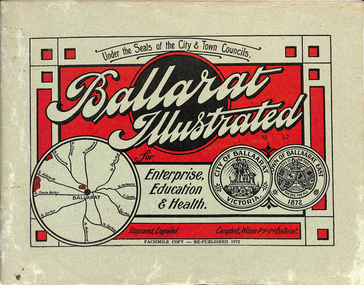
... Original features photos of Ballarat City and Town, its buildings, parks and the various industries and organisations that were in Ballarat at the time of publication, including ESCo. ...Original features photos of Ballarat City and Town, its buildings, parks and the various industries and organisations that were in Ballarat at the time of publication, including ESCo. ...Original c 1914 (see below), facsimile copy - re-published 1972. Original features photos of Ballarat City and Town, its buildings, parks and the various industries and organisations that were in Ballarat at the time of publication, including ESCo. Many photos features ESCo trams. Photos sepia toned. Has some red colour block printing on the front cover and rear, for Star Oil Engines. On inside back cover is a map with the places of interest and tram route map, marked in red. Pages are un-numbered. Original published by Ballarat East Town Council and Ballaarat City Council. On cover has number stamped in black in, "No. 87" (assume facsimile copy No.). Photos with publication show tram No. 21, built 1913 and ESCo photo page shows Mr. Pringle as Manager. Mr Pringle became manager in January 1911, As there is no photos of the "Avenue of Honour", or other mention of the first world war, assume original published about 1913 or 1914. Original shows Engravings and printing by "Campbell Wilson Prop Ltd, Ballarat". See Other Information as well for more listing details. High Resolution image added 31/8/2012 of i2 of ESCo page and i3 for Ballarat identies and sheet i4 extracted for Mr Pringle. PDF scan of full document added 21/5/2019 - see images btm633-1i.pdf and btm633-2i.pdf Notes on "Ballarat Illustrated" Reg. Item No. 733 From notes made by Neville Gower 12/1/1997 Cover: Inside front cover: Last paragraph, "Facilities for Travelling" - Electric trams serve all parts of Ballarat. Page 3: Street Scene, Municipal Town Hall, showing tram wiring Page 7: Street Scene, Lydiard St. North, intersection and tramway centre, with ESCo tram No. 21 in the bottom photo. Other photos features trams as well in Sturt St and Lydiard St. North. Page 9: Street Scene, Top photo of Sturt St. from Lydiard St. looking east, shows piles on right-hand side of road. Car parked by Post Office has a car registration number "9007". Bottom photo, an tram climbing hill, shows double trolley in the street, with early English type of pull offs. Page 13: Street Scenes and Historic Buildings: One of five photos, shows Victoria St. looking East, with tram track prominent in photo and how stone work was set up about the rails and overhead poles. Page 23: Street scene, Gardens North Entrance gates, shows details of gates near St. Aidans Drive. Note double trolley wire on poles, and style of insulators. No trams in photo, three ladies walking down the track. Page 37: Street Scene; Lydiard St views, top left hand photo, shows Railway station and railway gates with signal gantry and horse drawn vehicles. Tram tracks apparent. Bottom left hand photo shows Lydiard St. North, near Post Office, double track with centre poles - Single wire per track. Top right hand photo, showing Cemetery gates in background. Bottom right hand photo - from north end of Lydiard St. South, looking north, with an ESCo tram in background. Also has a parked car on left hand side. Page 45: Street Scenes - Bridge St; top photo at west end of Bridge St. with ESCo No. 11 with possibly double trolley wire in photo. Bottom photo at east end of Bridge St. with tram in background, shows junction. Double trolley heading out to Mt. Pleasant, single trolley for Victoria St. Page 45: Street Scenes - Bridge St; top photo at west end of Bridge St. with ESCo No. 11 with possibly double trolley wire in photo. Bottom photo at east end of Bridge St. with tram in background, shows junction. Double trolley heading out to Mt. Pleasant, single trolley for Victoria St. Page 61: Street Scenes and Historic Buildings - Public Institutions Ballarat - top left hand photo of the Hospital shows some tram track in foreground, with double trolley wire. Top right photo is of the Orphanage, the name of the tram terminus for many years. Page 68: Electric Supply Co. of Victoria's pages - top photo showing powerhouse in background, across the lake, can hardly see anything for the trees, except for the chimney. Bottom photos of the steam Turbo Generators and the switchboard. Gives Mr. P.J. Pringle as Chief Engineer and General Manager. He took over in Jan. 1911. Page 69: Ballarat East Views - features photo of Black Hill open cut, Ballarat East Railway Station, Ballarat Fire Station and "Victoria St. looking East", repeat of photo printed on page 12, but slightly darker. Image on system includes fire station and railway station, - Ballarat East. Page 78: Series of photos of various Ballarat VIP's of the era, fourth one in on top line features "P.J.Pringle, Electric Supply Co." Inside Back cover - map of Ballarat including tram lines and places of interest marked in red. Gives a detailed photographic presentation of Ballarat in 1914.80 page book with, in addition, light green card covers, titled "Ballarat Illustrated". Loose copy of page 9 and 10 held.trams, tramways, ballarat, local history, heritage buildings, esco -
Moorabbin Air Museum
Document (item) - Roland Jahne Collection - See Description for details
... Manilla folder Various Austalian Aircraft Industries. Aviation News April 1999. ...Manilla folder Various Austalian Aircraft Industries. Aviation News April 1999. ... -
Moorabbin Air Museum
Document (item) - Roland Jahne Collection - See Description for details
... Manilla folder Various IAR.80/81 Manilla folder Various Astra SPX Manilla folder Various Jabiru Manilla folder Various Israel A/c Industries - Westwind. Manilla folder No date Irwin Meteorplane Manilla folder Various IPTN. ...Manilla folder Various IAR.80/81 Manilla folder Various Astra SPX Manilla folder Various Jabiru Manilla folder Various Israel A/c Industries - Westwind. Manilla folder No date Irwin Meteorplane Manilla folder Various IPTN. ... -
 Warrnambool and District Historical Society Inc.
Booklet, Warrnambool Manufacturers Index & Services Guide, C 1982
... various goods in the 1980's . They are listed under the many different trades in the first part of the booklet and then a services guide is located in the second part of the booklet. It contains many names of local people who were involved in the businesses at the time. This is a useful directory of businesses which were operating in the early 1980's and as such provides a historical and social perspective of the city at that time. It also gives an overview of the types of manufacturing and service industries ...This booklet contains a directory of businesses which operated and manufactured various goods in the 1980's . They are listed under the many different trades in the first part of the booklet and then a services guide is located in the second part of the booklet. It contains many names of local people who were involved in the businesses at the time.This is a useful directory of businesses which were operating in the early 1980's and as such provides a historical and social perspective of the city at that time. It also gives an overview of the types of manufacturing and service industries prevalent at the time.Small 40 page booklet with blue and white soft card cover. Text on front cover is white on blue background. Back cover has outline of State of Victoria in blue on white background.It has a table of contents at the front with some black and white photographs.Warrnambool Promotion and development Board. Warrnambool Premier Town 1979-1982. Philprintwarrnambool, warrnambool businesses 1980's, directory warrnambool -
 Warrnambool and District Historical Society Inc.
Document - Instruction manual, Details of component parts for Broadbent suspended steam driven Hydro Extractors, C 1926
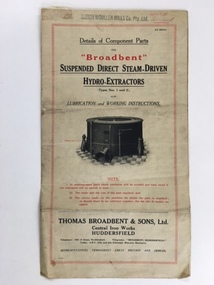
... industry. Some of these machines operated for upwards of 50 years Today Broadbent is a leading world designer in the manufacture and maintenance of advanced centrifuges. This document is a manual for a suspended direct steam driven hydro extractor. It shows the various...industry. Some of these machines operated for upwards of 50 years Today Broadbent is a leading world designer in the manufacture and maintenance of advanced centrifuges. This document is a manual for a suspended direct steam driven hydro extractor. It shows the various ...Thomas Broadbent $ sons Ltd was established in 1864 in Huddersfield England. They are an engineering firm , specialists in heavy duty engineering products. By 1893 Broadbent had progressed to steam powered engines for the textile industry. Some of these machines operated for upwards of 50 years Today Broadbent is a leading world designer in the manufacture and maintenance of advanced centrifuges. This document is a manual for a suspended direct steam driven hydro extractor. It shows the various parts , maintenance instructions and erection and working instructions. While it is stamped as Albion Woollen mills which were situated at Geelong, it is likely to have connections to the Warrnambool Woollen Mills.This document is a good example of machinery manual. It is possibly linked to the Warrnambool Woollen Mill. The fact that the company which manufactured these items is still in existence today after 150 years is testament to the quality of the items produced.Cream coloured document with mainly black text with some red text for headings contained in the document. It is printed front and back and is folded in three sections.Stamp at top "Albion Woollen mills Pty Ltd" .4H x 4 in red pencil in top RHC. Printed on front page. Thomas Broadbent & Sons Ltd Central Iron Works Huddersfield. warrnambool, warrnambool woollen mill, broadbent direct steam driven hydo extractors,, broadbent centrifuge -
 Warrnambool and District Historical Society Inc.
Work on paper - Booklets Fletcher Jones, 001143.1 Project Book 001143.2 Booklet:Plusites 001143.3 Flyer, Mid 20th century
... It tells of the royal visit of 1954 and other social events and items of interest around the various shops. 001143.3 Flyer :The text on this flyer also tells the story of the development of the Fletcher Jones brand to the point where there in the year2000 retail expansion was still happening but the Warrnambool workforce had shrunk from over 1000 at the peak to approximately 200. The company had commenced importing a range of clothing by this time These three items present different views of a company which was an important part of industry ...Fletcher Jones Clothing Factory was a key industry in Warrnambool from 1948 to its closure in 2005. The business was founded by David Fletcher Jones (1897-1977), a clothing manufacturer and retailer who worked as a hawker in the Western District following service with the A.I.F. in World War One. In 1924 Fletcher Jones opened three shops in Liebig Street selling men’s wear, hosiery and linen and operating a small tailoring business. He moved his shop to another location in Liebig Street and began to concentrate on men’s trousers production. In 1946 he opened a shop in Collins Street in Melbourne and eventually had stores and factories all over Australia. In Warrnambool he opened his factory at Pleasant Hill in Flaxman Street in 1948 and became a major Warrnambool employer, with over 1000 employees at one time. He transformed his business into a co-operative, with the name, ‘Fletcher Jones and Staff’ registered in 1947. The business diversified into other ranges of clothing for men and women but failed to compete with cheaper overseas clothing imports and the factory and shops were closed in the early 21st century. 001143.1 Project Book. This project book tells the story of the establishment and development of the Fletcher Jones company across the various stores which were established in Melbourne, Adelaide, Sydney, Geelong and Hobart. It explores the philosophy behind the business and milestones achieved and the factory gardens. The book itself provides an example of schoolwork completed in the mid 20th century. 001143.2 Booklet: Plusites: This is a staff booklet which has items of interest relating to staff such as births deaths and marriages. It tells of renovations and happenings in regard to the various shops around the country as well as trading figures. It tells of the royal visit of 1954 and other social events and items of interest around the various shops. 001143.3 Flyer :The text on this flyer also tells the story of the development of the Fletcher Jones brand to the point where there in the year2000 retail expansion was still happening but the Warrnambool workforce had shrunk from over 1000 at the peak to approximately 200. The company had commenced importing a range of clothing by this time These three items present different views of a company which was an important part of industry in Warrnambool for over 60 years in the latter part of the 20th century. The founder was one of Warrnambool’s most well respected people and many district people had connections to the firm. 001143.1 Project Book. Brown mottled card cover with cream insert for personal details. Back cover plain cream. It contains a student’s project work on the Fletcher Jones company. Some is handwritten and also contains a number of black and white photographs throughout the book. A coloured map of Australia is in the middle pages. 001143.2 Booklet: Plusites. White light card cover with dark blue text and diagram. Bottom left of page has a map of the coastline of Victoria. 20 pages. 001143.3 Flyer. Advertising Flyer re factory direct sales at Warrnambool. Black text with maroon border and Fletcher jones logo at the bottom and 4 photographs at the top. 001143.1 Project Book. T Cronin 4B WHS 001143.2 Booklet: Plusites. Vol 1 No 1 June 1954. 001143.3 Flyer fletcher jones, warrnambool history, fletcher jones and staff pty ltd -
 Warrnambool and District Historical Society Inc.
Textile, Fletcher Jones, Mid 20th century
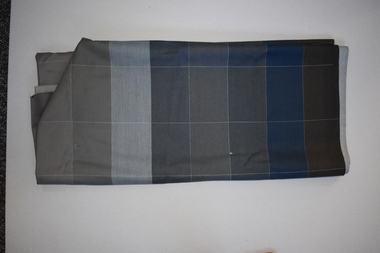
... The Fletcher Jones clothing company, known Australia-wide, was one of the important industries based in Warrnambool in the 20th and early 21st century Fletcher Jones Clothing Stores Warrnambool history of warrnambool This is piece of check material in grey and blue tonings. It is stained in various ...This piece of cloth came from the Fletcher Jones factory in Warrnambool. David Fletcher Jones (1895-1977) served in the First World War and in the 1920s set up as a travelling hawker selling drapery in the Western District of Victoria. In 1924 he leased three shops in Liebig Street, Warrnambool and in 1928 he moved to the Koroit/Liebig Streets intersection with his Man’s Shop. He manufactured men’s clothing on site. In 1931 he moved the business into a new two-storeyed building on the site. He opened a Fletcher Jones shop in Melbourne in 1946 and in 1948 a factory was established in Warrnambool. In 1951 the business of Fletcher Jones and Staff was established. The company expanded and became known Australia- wide, firstly for the production of men’s trousers and later both men’s and women’s clothing. By 2011 the Warrnambool factory was sold and the company was dissolved. This piece of material is of interest as an example of the cloth used in the Fletcher Jones factory in Warrnambool. The Fletcher Jones clothing company, known Australia-wide, was one of the important industries based in Warrnambool in the 20th and early 21st centuryThis is piece of check material in grey and blue tonings. It is stained in various places.fletcher jones clothing stores, warrnambool, history of warrnambool -
 Warrnambool and District Historical Society Inc.
Functional object - Portable lamp, Lucas Industries, c 1900
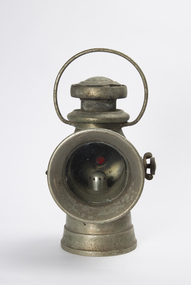
... Industries LUCAS No. 722 KING OF THE ROAD JOS. LUCAS LTD. This is a brass lantern with a circular glass piece in the middle front, and a top metal mechanism with a handle. Inside the circular opening is a domed jet with holes for lighting the lamp. On the sides there are various ...This portable lamp was manufactured by the Lucas Industries, a company in Birmingham, England that first produced lamps after 1875. It could have domestic use or be attached to cars or bicycles early in the 20th Century to provide light at night. The lighting fluid was oil. This object is an interesting example of lighting for cars and bicycles and in the home in the late 19th and early 20th Centuries.This is a brass lantern with a circular glass piece in the middle front, and a top metal mechanism with a handle. Inside the circular opening is a domed jet with holes for lighting the lamp. On the sides there are various mechanisms for turning the light up and down, opening the front glass and opening the bottom to allow filling of the lighting fluid. The item is corroded on the exterior. The top has air vents to permit the vapours to escape. On the side is the maker's name LUCAS No. 722 KING OF THE ROAD JOS. LUCAS LTD. vintage lighting, lucas industries -
 Warrnambool and District Historical Society Inc.
Mugs, Newlyne Mfg. Co Pty Ltd, Warrnambool Fabric Blankets, Mid 20th century
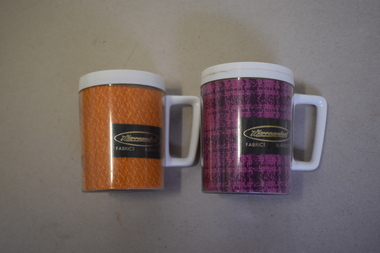
... various companies owned the plant. In the year 2000 the mill was closed and the equipment was sold. The buildings were sold to a private developer and the first residents moved into the new housing estate in 2009. These mugs are of interest as mementoes of the Warrnambool Woollen Mill, a key industry ...These mugs are souvenirs of the Warrnambool Woollen Mill. They were either sold as souvenirs or given to clients of the mill. The Warrnambool Woollen Mill in South Warrnambool was opened in 1910 with the first manager being John Bennett, an Englishman who recruited skilled weavers and bought mill equipment from his home country. At the height of production the mill was employing up to 700 people. In 1958 the mill became the first in Australia to manufacture electric blankets. In 1968 the mill was sold to the Dunlop company and in the ensuing years various companies owned the plant. In the year 2000 the mill was closed and the equipment was sold. The buildings were sold to a private developer and the first residents moved into the new housing estate in 2009. These mugs are of interest as mementoes of the Warrnambool Woollen Mill, a key industry in the development of Warrnambool and one that operated for 90 years. .1 This is an insulated plastic mug with a mottled orange-coloured body and a white rim on the top opening and a white handle. On the side of the mug is a printed name with gold lettering on a brown background. The maker’s name is etched into the base of the mug. .2 This is an insulated plastic mug with a purple and black mottled body and a white rim on the top opening and a white handle. On the side of the mug is a printed name on a brown background with gold lettering. The maker’s name is etched into the base of the mug. .1 & .2 Warrnambool Fabrics Blankets Steditemp Insulated Ware Made in Australia by Newlyne MFG Co Pty Ltd Division of J. Glaser & Co Melbourne warrnambool woollen mill -
 Warrnambool and District Historical Society Inc.
Badge - Badges x 8, Collection of various badges
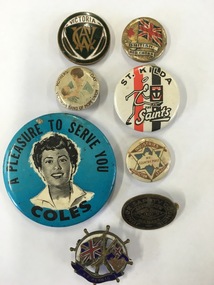
... These badges reflect various aspects of life in Australia and the many allegiance which people have to organisations from the Country Womans Association, to football clubs, with groups such as the Industries Protection league and Temperance groups such as the Band of Hope Union espousing interests and ideas in the early to mid 20th century...Industries Protection League. Small cream plastic badge with outline of Australia inside a star. Brown boomerangs top and bottom. 001048.7 Junior safety Council. Oval metal badge. Black with brass text and artwork. 001048.8 S.S. Persis. Three dimensional with ship’s wheel at back in white and Australia and British flags in foreground with S.S. Persic on banner below flags. Collection of various ...These badges reflect various aspects of life in Australia and the many allegiance which people have to organisations from the Country Womans Association, to football clubs, with groups such as the Industries Protection league and Temperance groups such as the Band of Hope Union espousing interests and ideas in the early to mid 20th centurySocial significance001048.1 CWA badge Round metal badge with dark green rim surrounding monogrammed shield and gum leaf on either side. Victoria in bronze at top of shield. Stokes **** Melb on rear. 001048.2 British Red Cross. Round tin badge with Union Jack flag and red cross on left with text in banners below flag. 001048.3 Victorian Badge of Hope Union. Small button badge with cream background, brown text around edge with image of mother and child in blue tones in the centre 001048.4 St Kilda Football badge. Round tin plastic coated. White background with image of saint emblem on front on background of club colours. 001048.5 Coles Badge. Large button badge with bright blue background with image of lady in black and white in the centre. Text in black. 001048.6 Industries Protection League. Small cream plastic badge with outline of Australia inside a star. Brown boomerangs top and bottom. 001048.7 Junior safety Council. Oval metal badge. Black with brass text and artwork. 001048.8 S.S. Persis. Three dimensional with ship’s wheel at back in white and Australia and British flags in foreground with S.S. Persic on banner below flags. warrnambool history, industries protection league badge, band of hope union badge, s s persic badge -
 Warrnambool and District Historical Society Inc.
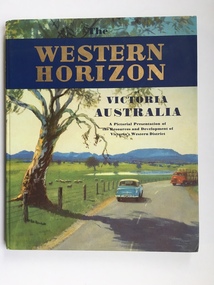
Book, Western Horizon, C 1960
... various scenic spots around the district. The publishers of this book , the Australian publicity Council is dedicated to publicising the state of Victoria and its natural resources in an effort to attract overseas investment and industry....various scenic spots around the district. The publishers of this book , the Australian publicity Council is dedicated to publicising the state of Victoria and its natural resources in an effort to attract overseas investment and industry. ...This book presents a pictorial history of the western District of Victoria. It explores various aspects of the Western District such as water supply,architecture,ports,produce,and agriculture. It also presents the various scenic spots around the district. The publishers of this book , the Australian publicity Council is dedicated to publicising the state of Victoria and its natural resources in an effort to attract overseas investment and industry.This book provides a snapshot of the Western District in the 1960 's both with the information and the photographs contained within, including some which were taken by Ralph Illidge who was one on Warrnambool's best known photographers. Coloured hard board cover with country scene with road with two vehicles on a road which continues to the back cover.. A large gum tree sits beside the road. The title is gold on a navy blue banner. Thereis a small blurb on the back cover. 112 pages.Australian Publicity Council. Henry Bolte Premier of Victoria.history of warrnambool, western horizon, western victoria, ralph illidge, warrnambool 1960's -
 Warrnambool and District Historical Society Inc.
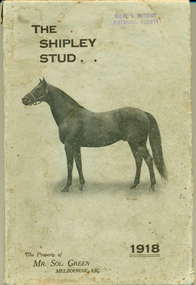
Booklet, The Shipley Stud 1918, 1918
... various fronts. Shortly before his death in 1948 he donated 47000 pounds to five Melbourne hospitals. This catalogue has significance firstly on a local level in that Shipley was an important farm in the district and secondly that it was owned by Mr Sol Green who was a person of standing within the racing industry as a bookmaker but also as a stud owner and owner of the 1910 Melbourne cup winner. ...Sol Green came to Australia as a penniless migrant who made his fortune as a bookmaker. He was inducted into the Australian Racing Museum Hall of fame in 2002. He purchased the Shipley stud from George Rolfe about 1905 and set about turning the Ayrford cattle property into a successful horse stud. His horse Comedy King won the Melbourne Cup in 1910 and was retired to stud in 1912. He became one of the top 10 Australian Stallions in the ensuing years. He dispersed his stud at Shipley in 1918 and this catalogue lists the stock sold that day. The property remained in the Green family and continued as a dairy farm with cheese factory and piggery by his son Bob Green. Sol Green was known for his philanthropic gestures extending help where needed on various fronts. Shortly before his death in 1948 he donated 47000 pounds to five Melbourne hospitals.This catalogue has significance firstly on a local level in that Shipley was an important farm in the district and secondly that it was owned by Mr Sol Green who was a person of standing within the racing industry as a bookmaker but also as a stud owner and owner of the 1910 Melbourne cup winner. This catalogue lists the stock which he had established at Shipley in a relatively short period of time.Light grey card cover with horse in brown. The title is in top left corner in brown text with the date 1918 in bottom right. Compilers details on back cover. 164 Pages. It has black and white plates of two horses, Comedy King and White Star* Mallinson Pomborneit 9/1/18. Light paper pasted inside front cover “Colac and District Historical Society, Donor Miss Betty Mallinson 1960. There are purchasers’ names and the purchase price paid, written at the base of each page. warrnambool, allansford, shipley, sol green, comedy king, white star 1918, shipley dispersal sale, shipley stud -
 Warrnambool and District Historical Society Inc.
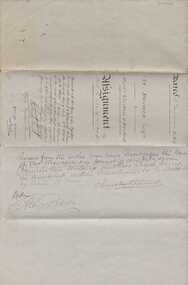
Document, Indenture A Bostock Esquire to Messrs Aitkin & Bostock( Ernest), 1865
... industry. This document is dated 5th July 1865 and is an assignment of stock by way of mortgage. Augustus Bostock is the mortgagor with James William Manifold Aitkin and Ernest Bostock as mortgagees. At various...industry. This document is dated 5th July 1865 and is an assignment of stock by way of mortgage. Augustus Bostock is the mortgagor with James William Manifold Aitkin and Ernest Bostock as mortgagees. At various ...The Bostock, Manifold and Aitkin families were all pioneering families in the Western District of Victoria almost from the time of settlement. They leased and owned vast tracts of land and operated businesses around the district, often associated with the farming industry. This document is dated 5th July 1865 and is an assignment of stock by way of mortgage. Augustus Bostock is the mortgagor with James William Manifold Aitkin and Ernest Bostock as mortgagees. At various times they were involved in running businesses together, in particular the Aitkin and Bostock store and flour mill. Three of the Bostock men were married to three of the Aitkin sisters. The amount in question is £2157/3/2 and surety is 8000 sheep and their increase, presently running at Coomete. The penciled in details on the document refer to Robert Brand Paterson who was later in business with Aitkin This is one of a number of documents which relate to the Bostock family who were one of the most important pioneering families of the Western District. They owned and leased various properties around Warrnambool and were involved in many aspects of social and business life. The document itself is indicative of its time and provides an insight into the details and terms of such documents at the time.Large grey coloured, lined hand written document over four pages. Folded in four with date and details on one section. Red wax seal on page 3. There are extra entries written in black lead pencil in areas relating to the money and surety of the agreement.Signed by the following George Barber Warrnambool, Thomas Sunderland Deputy Registrar General, and Augustus Bostock. Hingston & Co, Chancery Lane Melbourne hand written in top left hand corner. warrnambool, bostock,augustus bostock james william manifold aitkin,robert brand paterson, coomete, -
 Warrnambool and District Historical Society Inc.
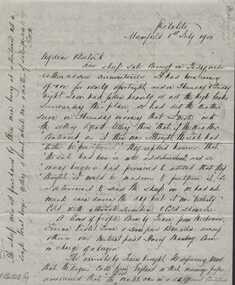
Letter, E H MaCartney to Augustus Bostock July 1, 1900, 1900
... They owned and leased various properties around Warrnambool and were involved in many aspects of social and business life. The document itself is indicative of its time and provides an insight into the importance of the wool industry, social contacts and customs at the time. augustus bostock e h maccartney delatite marramook warrnambool Delatite Mansfield 1st July 1900. ...Augustus Bostock was the 9th child of Robert & Rachael Bostock of Vaucluse Epping Forest, Van Diemen’s Land. He was only 4 years old when his mother died. He was inspired by his father to seek his fortune in the Western District of Victoria. He arrived around 1850. He married Margaret Aitkin in July 1865. Augustus owned several properties in the district and leased others. He sat on the court of Warrnambool, Mortlake or Hexham as required. He resided at Marramook in Hawkesdale and later moved to Vaucluse in Hopetoun Road Warrnambool, where he died in 1920 at the age of 87. He was involved in many aspects of life in the Western District, racing, cricket, and social activities to name a few. This letter is concerned about the price and numbers of sheep sold at the time and is one of a number of letters between A Bostock and E H MaCartney who was manager of Delatite station Mansfield.This is one of a number of documents which relate to the Bostock family who were one of the most important pioneering families of the Western District. They owned and leased various properties around Warrnambool and were involved in many aspects of social and business life. The document itself is indicative of its time and provides an insight into the importance of the wool industry, social contacts and customs at the time.Cream lined paper written front and back in black pen. Notes added vertically down one side of front and back.Delatite Mansfield 1st July 1900. Signed G Macartney. augustus bostock, e h maccartney, delatite, marramook, warrnambool -
Port of Echuca
Audio - Oral History - Geoff Evans, Oral History of Geoffrey Thomas Evans of Echuca b1924 d 2007
... The industry created alongside the Murray River in various places was very unique given the nature of red gum not floating and ingenuity and making use of local resources was required. ...Geoff Evans was the third generation to run Evans Brothers Sawmills that operated from the northern end of the Echuca Wharf from 1923 to 1983. His grandfather Richard James Evans orig. of England, settled in Victoria at a young age. He first worked as a butcher and later cut firewood in the Heathcote and Bacchus Marsh area. ‘R.J.’, as he was known established a sawmill at Barmah in the 1890s, before relocating to this site in 1923. It became known officially as the Evans Bros. Echuca Red Gum Sawmill. This site proved more economical due to its position at the railhead. Paddlesteamers towed barges carrying the logs from the surrounding forests to this mill. The Steamers that were owned by the Evans family were the Edwards (built 1875) and the Melbourne (built 1912). The Edwards was the main towing vessel. Outrigger barges at this mill were the Impulse (1885), Alison (1907), Clyde (once a paddlesteamer, built in 1884). Insider barges at the mill were old wool barges with iron topsides, the J.L.Roberts (1894), ADA (1899) and the Whaler which was of wooden construction. The Evans Mill cut both red gum and Murray pine. There was a main mill for the red gum and a second one for the pine on this site. Two new Marshall steam engines had been purchased by the family, one was used in the P.S. Edwards and the other for the Barmah mill and later this site. The Evans Bros. Mill was very much a family concern with it being owned and operated firstly by R.J., then his son Frederick. R. Evans and later grandson Geoff Evans. The mill employed 18 workers and operated until the 1980s, only briefly was it in the hands of other owners before the construction on part of the site of a tourist-oriented building known as the Red Gum Works which eventually made way for the Port of Echuca Discovery Centre in 2014.Knowledge of the redgum timber milling industry and associated mechanisms such as log slips is scant with little photographic representations to be found. The industry created alongside the Murray River in various places was very unique given the nature of red gum not floating and ingenuity and making use of local resources was required. Geoff Evans had firsthand knowledge of much of this process and how the Echuca Wharf area used to be in past decades. Geoff was also a popular musician and mayor of Echuca so had much knowledge of the local history and community.Digital recording of oral history interview with Geoff Evans of Evans Brothers Sawmill Echuca. evans bros, evans bros saw mills, evans' sawmill, geoff evans, log slip, log skid, p.s. edwards, p.s. melbourne, impulse barge, allison barge, clyde barge, j.l. roberts barge, ada barge, whaler barge, murray pine, redgum, marshall engines, r.j evans, f.j. evans, discovery centre, p.s. marion -
4th/19th Prince of Wales's Light Horse Regiment Unit History Room
Amplifier Audio Frequency AM-1780/VRC, 1980's
... 4th/19th Prince of Wales's Light Horse Regiment Unit History Room 4/19 PWLH Regiment, Building 78 Simpson Barracks Macleod melbourne radio equipment 1780 box Serial No 33765 Solid metal radio harness control box with 10 cable sockets around sides and various control switches and line connections on face Amplifier Audio Frequency AM-1780/VRC Raven Industries Inc ...Solid metal radio harness control box with 10 cable sockets around sides and various control switches and line connections on faceSerial No 33765radio equipment, 1780 box -
 Kiewa Valley Historical Society
Meter Ammeter Recorder, Circa 1950
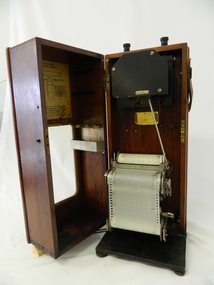
... This mobile voltage recorder is very significant to the Kiewa Valley because it highlights the difficulties that can occur in maintaining a power supply that experiences fluctuating power demands by the rural industries that it supplies. The requirement of a mobile testing apparatus to cover the various sections in the Kiewa Valley and other rural areas in the northeast region is one of necessity as electricity once connected to a rural property is a labour saving supply as generators on rural properties require a higher degree of maintenance an ultimately at a higher cost. ...This testing voltmeter recorder was last certified by SEC Vic laboratories on the 17/4/77. It was used extensively as mobile recorder placed for periods of one month at locations experiencing unacceptable fluctuations of power. These locations would cover the North East regions of Victoria. They cover voltage drops at domestic and business properties especially those that were experiencing regular fluctuations(daily) at approximately the same time of the day. As the electrical network is required to operate within a set level of voltage, fluctuations outside of this has to be investigated and necessary remedial action taken. This is especially so for rural properties where power "drainage" can occur through animal/bird and tree interference. It can also be the result of defective wiring and overloading at peek operational times (milking machines).This mobile voltage recorder is very significant to the Kiewa Valley because it highlights the difficulties that can occur in maintaining a power supply that experiences fluctuating power demands by the rural industries that it supplies. The requirement of a mobile testing apparatus to cover the various sections in the Kiewa Valley and other rural areas in the northeast region is one of necessity as electricity once connected to a rural property is a labour saving supply as generators on rural properties require a higher degree of maintenance an ultimately at a higher cost. The testing of the SEC Vic supplied electricity to rural properties,those who had previously run on generators, had to be quick and unassuming with certainty of correct supply levels.The mechanism of this voltage recorder has been installed(by the manufacturer) into its own protective wooden box. This box has a front (swing open) lockable section which permits direct access to the installed measuring equipment (for servicing and data collection). The top section of the box has two screw on terminals for access to the machine being tested. This tester has its own inbuilt ink supply facilities and a mechanical clockwork device that unwinds a roll of paper onto a second roll at a rate of 10 mm per hour. The recording chart is marked with time slots against voltage. There is a recording arm which has an ink pen at the end. Both arm and pen carry the ink supply from the ink reservoir, located on the left side of the cabinet door in specially constructed bottle holder( three small bottle capacity). To record a suspect power problem to a home or business establishment the voltmeter is connected to a power supply outlet being tested and wind the recording clockwork mechanism (gives a four week running time). Before leaving the recorder in situ the electrician checks to see if the chart is recording the correct voltage and that the clock mechanism is advancing correctly.On the front of the access "door" at the top a metal label "RECORDING AMMETER" below this "MURDAY SYSTEM" below this "ALTERNATING CURRENT" and below this the manufacturer's registered number "No. 139156" Below this is a metal tag with State Electricity Commission of Victoria Electrical Engineer's Section equipment number "338" Below these tags and above the viewing window is the manufacturer's dtails "EVERSHED & VIGNOLES Led LONDON"sec vic kiewa hydro scheme, alternate energy supplies, alpine feasibility studies temperature, rainfall, power outages
