
Showing 906 items matching "victoria local government"
-
 Port Melbourne Historical & Preservation Society
Newspaper - Newspaper, Port South and St Kilda News, John THWAITES, MP for Albert Park, 1994
... Victoria...Local Government - City of Port Melbourne...State Government Victoria Local Government - City of Port Melbourne John THWAITES The Port South and St Kilda News printed by John THWAITES MP for Albert Park. ...The Port South and St Kilda News printed by John THWAITES MP for Albert Park. Plus insert 1/2 page Emerald Hill and Sandridge Timesstate government victoria, local government - city of port melbourne, john thwaites -
Port Melbourne Historical & Preservation Society
Book - Victorian Government Gazette, 1866
... Victoria...Local Government - Borough of Sandridge...State Government Victoria Local Government - Borough of Sandridge Government Printer John FERRES Victorian Government Gazette. 1866 - red book, very large Book Victorian Government Gazette John Ferres, Government Printer ...Victorian Government Gazette. 1866 - red book, very largestate government victoria, local government - borough of sandridge, government printer, john ferres -
Whitehorse Historical Society Inc.
Article, City council a victim of circumstances|Bureaucracy bogs down conference|Talks soon on council plan, 1972
... ...Victoria. Local Government Department...An unreported move by the Local Government Department has led to appeals against flats in McGhee Avenue not being delivered to the Department. The Municipal Association of Victoria has said it cannot discuss Nunawading's motion for a tripartite conference between federal, state and local government. ...Photocopy of three articles concerning Nunawading Council:|An unreported move by the Local Government Department has led to appeals against flats in McGhee Avenue not being delivered to the Department.|The Municipal Association of Victoria has said it cannot discuss Nunawading's motion for a tripartite conference between federal, state and local government....City of Nunawading Victoria. Local Government Department Municipal Association of Victoria City of Box Hill City of Camberwell City of Ringwood City of Knox City of Waverley McGhee Avenue Mitcham Photocopy of three articles concerning Nunawading Council: Photocopy of three articles concerning Nunawading Council:|An unreported move by the Local Government Department has led to appeals against flats in McGhee Avenue not being delivered to the Department. ...Photocopy of three articles concerning Nunawading Council:Photocopy of three articles concerning Nunawading Council:|An unreported move by the Local Government Department has led to appeals against flats in McGhee Avenue not being delivered to the Department.|The Municipal Association of Victoria has said it cannot discuss Nunawading's motion for a tripartite conference between federal, state and local government.|Discussions will be held on a regional council including Box Hill, Camberwell, Knox, Waverley and Nunawading councils.Photocopy of three articles concerning Nunawading Council:city of nunawading, victoria. local government department, municipal association of victoria, city of box hill, city of camberwell, city of ringwood, city of knox, city of waverley, mcghee avenue, mitcham -
Whitehorse Historical Society Inc.
Article, New Koornung City, 1994
... ...Local Government...Victoria...City of Nunawading City of Box Hill City of Koornung Amalgamations Local Government Victoria. Local Government Board Burke Leonie Neighbouring cities, Box Hill, Nunawading to amalgamate under the name of Koornung. ...Neighbouring cities, Box Hill, Nunawading to amalgamate under the name of Koornung.Neighbouring cities, Box Hill, Nunawading to amalgamate under the name of Koornung.Neighbouring cities, Box Hill, Nunawading to amalgamate under the name of Koornung.city of nunawading, city of box hill, city of koornung, amalgamations, local government, victoria. local government board, burke, leonie -
Whitehorse Historical Society Inc.
Article, Koornung best option - Mayor, 1994
... ...Local Government...Victoria...City of Box Hill City of Nunawading City of Koornung Spurr Noel Mayors Councillors Local Government Victoria. Local Government Board Amalgamations Box Hill - Nunawading will have improved service if they amalgamate into the proposed City of Koornung. ...Box Hill - Nunawading will have improved service if they amalgamate into the proposed City of Koornung.Box Hill - Nunawading will have improved service if they amalgamate into the proposed City of Koornung.Box Hill - Nunawading will have improved service if they amalgamate into the proposed City of Koornung.city of box hill, city of nunawading, city of koornung, spurr, noel, mayors, councillors, local government, victoria. local government board, amalgamations -
Whitehorse Historical Society Inc.
Document, Proposed City of Koornung, 1994
... Local government...Victoria...Local Government Board - Middle and Outer Melbourne Interim report discussing advantages of the proposed City and discussing objections raised by City of Box Hill. Local government Victoria ...Proposal 16. City of Koornung - Box Hill - Nunawading.Proposal 16. City of Koornung - Box Hill - Nunawading. Local Government Board - Middle and Outer Melbourne Interim report discussing advantages of the proposed City and discussing objections raised by City of Box Hill.Proposal 16. City of Koornung - Box Hill - Nunawading.local government, victoria. local government board, city of nunawading, city of box hill, amalgamations -
Whitehorse Historical Society Inc.
Article, Mayor pushes for council talks, 1994
... Local government...City of Nunawading...City of Box Hill...Victoria...Local government City of Nunawading City of Box Hill Victoria. Local Government Board Amalgamations Councilors from both City of Nunawading and City of Box Hill met with Local Government Board members last week to discuss the recommended merger of the two cities. ...Councilors from both City of Nunawading and City of Box Hill met with Local Government Board members last week to discuss the recommended merger of the two cities.Councillors from both City of Nunawading and City of Box Hill met with Local Government Board members last week to discuss the recommended merger of the two cities. It has been suggested by the Board that both Nunawading and Box Hill councillors meet as soon as possible to discuss the proposed merger.Councilors from both City of Nunawading and City of Box Hill met with Local Government Board members last week to discuss the recommended merger of the two cities. local government, city of nunawading, city of box hill, victoria. local government board, amalgamations -
Whitehorse Historical Society Inc.
Article, For Nuna Council it's steady as she goes, 1994
... Local government...City of Nunawading...Victoria...Local government City of Nunawading Victoria. Local Government Board Amalgamations Nunawading Council was divided last week over how it should proceed in the wake of the release of the Local Government Board's interim report recommending its merger with Box Hill. ...Nunawading Council was divided last week over how it should proceed in the wake of the release of the Local Government Board's interim report recommending its merger with Box Hill.Nunawading Council was divided last week over how it should proceed in the wake of the release of the Local Government Board's interim report recommending its merger with Box Hill.Nunawading Council was divided last week over how it should proceed in the wake of the release of the Local Government Board's interim report recommending its merger with Box Hill.local government, city of nunawading, victoria. local government board, amalgamations -
Whitehorse Historical Society Inc.
Article, Two cities to go into the blender, 1994
... Local government...Victoria...Most of the amalgamation will be undertaken by Commissioners (to be appointed by the State Government) Nunawading City Manager, Warwick Dilley, believes to develop a corporate plan. Local government Victoria. Local Government Board City of Nunawading City of Box Hill Dilley Warwick Port Ian Amalgamations After a year's speculation the Local Government Board has recommended in its interim report that the two municipalities be merged to form the new City of Koornung. ...After a year's speculation the Local Government Board has recommended in its interim report that the two municipalities be merged to form the new City of Koornung.After a year's speculation the Local Government Board has recommended in its interim report that the two municipalities be merged to form the new City of Koornung. Most of the amalgamation will be undertaken by Commissioners (to be appointed by the State Government) Nunawading City Manager, Warwick Dilley, believes to develop a corporate plan.After a year's speculation the Local Government Board has recommended in its interim report that the two municipalities be merged to form the new City of Koornung.local government, victoria. local government board, city of nunawading, city of box hill, dilley, warwick, port, ian, amalgamations -
Whitehorse Historical Society Inc.
Document, Middle and Outer Melbourne Review, 30/10/1994
... ...Victoria Local Government Board...Amalgamations Victoria Local Government Board Abbott Kevin Local Government Board, Middle and Outer Melbourne Review (a) Final Report (b) Appendices (c) Executive Summary October-November 1994 Middle and Outer Melbourne Review Document Document ...Local Government Board, Middle and Outer Melbourne Review (a) Final Report (b) Appendices (c) Executive Summary October-November 1994amalgamations, victoria local government board, abbott, kevin -
Whitehorse Historical Society Inc.
Pamphlet, Greater Melbourne Council: proposed legislation, 1951
... Victoria...Local Government...Clubs and associations Municipal Association of Victoria Local Government Amalgamations Copy of a pamphlet compiled by the Municipal Association of Victoria. ...Copy of a pamphlet compiled by the Municipal Association of Victoria.Copy of a pamphlet compiled by the Municipal Association of Victoria on proposed legislation for a Greater Melbourne Council - date stamped 26 April 1951.Copy of a pamphlet compiled by the Municipal Association of Victoria. clubs and associations, municipal association of victoria, local government, amalgamations -
Kew Historical Society Inc
Archive (series) - Subject File, Local Government Restructure, 1986
... local government -- victoria...Subject file containing information about Local Government Restructure in Victoria. The file includes Government reports - Restructure of Local Government in Victoria: Options paper for Eastern Melbourne segment ((June 1986) - flyers, and correspondence from and to KHS and the City of Kew and Prue Sibree....Typically files will contain primary and secondary sources. local government -- victoria local government restructure local government -- kew (vic.) prue sibree city of kew council amalgamations Subject file containing information about Local Government Restructure in Victoria. ...Kew Historical SocietySince its foundation in 1958, members of the Kew Historical Society have been compiling and storing information about subjects relating to the history of Kew and its environs, of which this file is an example. Arranged by Secondary Values (value of records to users)Subject file containing information about Local Government Restructure in Victoria. The file includes Government reports - Restructure of Local Government in Victoria: Options paper for Eastern Melbourne segment ((June 1986) - flyers, and correspondence from and to KHS and the City of Kew and Prue Sibree.local government -- victoria, local government restructure, local government -- kew (vic.), prue sibree, city of kew, council amalgamationslocal government -- victoria, local government restructure, local government -- kew (vic.), prue sibree, city of kew, council amalgamations -
Broadmeadows Historical Society & Museum
Document, City of Broadmeadows Council, Meeting of Council to be held on 3rd May 1982 at 7.30p.m, 1982
... Local government...municipal administration...council meetings...council agendas...notice papers...civic administration...local governance...public administration...municipal decision making...councils and councillors...community governance...twentieth century local history...Broadmeadows (Vic.)...Victoria...Local government municipal administration council meetings council agendas notice papers civic administration local governance public administration municipal decision making councils and councillors community governance twentieth century local history Broadmeadows (Vic.) Victoria ...This item forms part of the documentary record preserved by the Broadmeadows Historical Society, contributing to the understanding of local history, social activity, and institutional development in Broadmeadows and surrounding regions.Of historic and research significance as part of the archival record relating to Broadmeadows. While individually modest, its value derives from its role within a broader documentary context, contributing to the evidentiary base used to interpret local history.Paper-based item setting out the agenda and business to be considered at a council meeting. Text is typewritten and arranged in a formal notice format.RECTO: Typed text including meeting details and date. VERSO: yellow catalogue adhesive label affixed above other labels: WI-3073 : white catalogue adhesive label affixed above other labels: WI-0584 (struck through) local government, municipal administration, council meetings, council agendas, notice papers, civic administration, local governance, public administration, municipal decision making, councils and councillors, community governance, twentieth century local history, broadmeadows (vic.), victoria local government, administrative documents -
Broadmeadows Historical Society & Museum
Document (collection) - Reports, Unknown, Documents relating to City of Broadmeadows Library Service, 1964/65, 1963-65
... Victoria...Local government — Broadmeadows...Victoria • Dependence on Free Library Service Board subsidy requirements • Strong community advocacy, particularly via organised women’s groups • Transition from regional cooperation attempts to independent municipal action This archive is historically significant as evidence of the early development of public library services in Broadmeadows. It demonstrates the interaction between community advocacy, government policy, and municipal decision making. The records are socially significant for documenting the role of civic organisations—particularly women’s groups—in advocating for educational and cultural infrastructure. The archive has research value for understanding mid 20th century suburban development, municipal planning, and public service provision in Victoria. Public libraries — Victoria Local ...Created and accumulated by multiple related entities involved in library establishment efforts, including: • Free Library Service Board of Victoria (survey report) • Broadmeadows Library Promotion Committee • Community representatives and advocacy groups (including women’s organisations) • City of Broadmeadows Council (contextual administrative records) The documents were brought together through shared purpose and subject (library establishment).Created to document the planning, advocacy, and municipal decision making processes relating to the establishment of a public library service in the City of Broadmeadows. The records include: • A formal library survey and planning recommendations • Community advocacy and deputations to Council • Documentation of Council responses and financial considerations • Supporting speaking notes representing organised civic groupsArranged chronologically to reflect the development of the library proposal.Sub collection comprises four typed documents: Library Survey Report (1963) outlining staged development of a municipal library service; Council report and Library Promotion Committee statement (1964–1965) discussing funding and failed regional cooperation; Deputation to Council (15 March 1965) advocating urgent action and increased funding; Speaking notes by Mrs. D. A. Pyke representing women’s organisations (c. 1965)public libraries — victoria, local government — broadmeadows, community advocacy, urban development, education and information access, women’s organisationspublic libraries — victoria, local government — broadmeadows, community advocacy, urban development, education and information access, women’s organisations -
Port Melbourne Historical & Preservation Society
Document - VicRoads ad re weekend truck curfews, Weekend Truck Curfews, 2018 - 2019
... State Government Victoria...VicRoads...Local...These items were collected by a PMHPS member during 2018-19 and they have been retained as a group of ephemera Beach Road State Government Victoria VicRoads Local Government - City of Port Phillip Various ephemera of local interest showing changes in community. .10 VicRoads ad regarding weekend truck curfews. ...These items were collected by a PMHPS member during 2018-19 and they have been retained as a group of ephemeraVarious ephemera of local interest showing changes in community. .10 VicRoads ad regarding weekend truck curfews. Advising the community that truck curfews on Beach road are now permanent from early 2019beach road, state government victoria, vicroads, local government - city of port phillip -
Canterbury History Group
Book, Cr. W.D. Vaughan, Kew's Civic Century, 1960
... Kew (Victoria) - History...Local government...Ken Lyall was a well known local identity. Kew (Victoria) - History Local government A book on the history of the suburb of Kew emphasising civic developments. ...A book on the history of the suburb of Kew emphasising civic developments. Includes foreword by R.G.Menzies and mayors message has list of mayors and Chairmen 1860-1960208 pages including black and white plates non-fictionA book on the history of the suburb of Kew emphasising civic developments. Includes foreword by R.G.Menzies and mayors message has list of mayors and Chairmen 1860-1960kew (victoria) - history, local government -
Whitehorse Historical Society Inc.
Pamphlet, From citizen to councillor Are you ready?, 1/12/1996 12:00:00 AM
... A personally enriching experience awaits citizens who will lead and develop Victoria's system of local government....City of Whitehorse Electoral rolls Local government elections A personally enriching experience awaits citizens who will lead and develop Victoria's system of local government. ...A personally enriching experience awaits citizens who will lead and develop Victoria's system of local government.A personally enriching experience awaits citizens who will lead and develop Victoria's system of local government.A personally enriching experience awaits citizens who will lead and develop Victoria's system of local government.city of whitehorse, electoral rolls, local government elections -
Federation University Historical Collection
Book, The Australian Assistance Plan in the Central Highlands Region (Masters Thesis), 1979
... Victoria...ballarat...ararat...local government...Frank Hurley thesis Central Highlands of Victoria ballarat ararat local government politics strategy Blue hard covered thesis undertaken at LaTrobe University Melbourne The Australian Assistance Plan in the Central Highlands Region (Masters Thesis) Book ...Thesis (M.A.) - La Trobe University, 1979. Submitted to the Politics Dept. This thesis is an analysis of the Australian Assistance Plan as a substantive policy. Framed to achieve regional coordination of social develpment and social welfare, the key elements in the policy were participation, comunity develiopment and regional accountability. Blue hard covered thesis undertaken at LaTrobe University Melbourne frank hurley, thesis, central highlands of victoria, ballarat, ararat, local government, politics, strategy -
 Sunshine and District Historical Society Incorporated
Archive - Australian Placenames
... CD Rom Australian National Placenames Survey|Typed Report Australian national Placenames Survey|Typed List Abbreviations Code Description|Typed Report Australina National Placenaes survey ANPS Data Entry Instruction Brief for Research Friends|Typed List Contact Details|Typed Placename Data Entry Form|Map for Victoria Local Government Areas|Newsletter March 2003 Placenames Australia...CD Rom Australian National Placenames Survey|Typed Report Australian national Placenames Survey|Typed List Abbreviations Code Description|Typed Report Australina National Placenaes survey ANPS Data Entry Instruction Brief for Research Friends|Typed List Contact Details|Typed Placename Data Entry Form|Map for Victoria Local Government Areas|Newsletter March 2003 Placenames Australia Collection of documets relating to Australian Place Names Archive Australian Placenames ...CD Rom Australian National Placenames Survey|Typed Report Australian national Placenames Survey|Typed List Abbreviations Code Description|Typed Report Australina National Placenaes survey ANPS Data Entry Instruction Brief for Research Friends|Typed List Contact Details|Typed Placename Data Entry Form|Map for Victoria Local Government Areas|Newsletter March 2003 Placenames Australia -
 Greensborough Historical Society
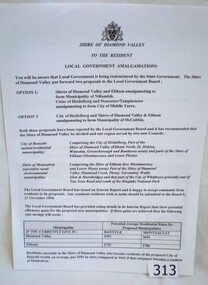
Document - Letter, Shire of Diamond Valley, Local Government Amalgamations 1994, 1994_
... In 1994 the state government of Victoria proposed local government amalgamations. ...In 1994 the state government of Victoria proposed local government amalgamations. ...In 1994 the state government of Victoria proposed local government amalgamations. This letter to residents of the Shire of Diamond Valley outlines proposals for this area.Letter to residents of Shire of Diamond Valley. 2 pages.shire of diamond valley, local government amalgamation 1994, greensborough, diamond valley -
Glenelg Shire Council Cultural Collection
Book, Borough of Portland - Acts of Council, 1864
... Contents are acts of Parliament of Victoria relating to Local government...local government Victorian History council Two volumes. Volume 1 & 2 Red leather bound spine and cover corners. Light red textured covers. Red leather label on centre of front cover with gold text. Gold graphics on spine. Hand written contents page. Contents are acts of Parliament of Victoria ...Two volumes. Volume 1 & 2 Red leather bound spine and cover corners. Light red textured covers. Red leather label on centre of front cover with gold text. Gold graphics on spine. Hand written contents page. Contents are acts of Parliament of Victoria relating to Local governmentlocal government, victorian history, council -
 Sunshine and District Historical Society Incorporated
Film - City of Sunshine Mayor Cr. George Parnis Video, John Willaton, 1994
... George Zachary Parnis became a councillor of the former City of Sunshine (Victoria), active in local government before the council’s amalgamation in 1995. ...George Zachary Parnis became a councillor of the former City of Sunshine (Victoria), active in local government before the council’s amalgamation in 1995. ...George Zachary Parnis migrated to Melbourne from Malta in 1964, arriving with his brother Manny. George was 19 years old at the time. The family later became well-established in Melbourne’s western suburbs. George Zachary Parnis became a councillor of the former City of Sunshine (Victoria), active in local government before the council’s amalgamation in 1995. He was the Mayor of City of Sunshine for one term 1993 - 1994. This video records Mayor Cr. George Parnis term of being the Mayor of the City of Sunshine. The video also captures the role of the City of Sunshine Town Clerk Mr. John Willaton performing his public civic duties.This video provides a rare recording of City of Sunshine Mayor Cr. George Zachery's term in office. The video also contains rare scenes of Sunshine's Hampshire Road, Devonshire Road and including many images of Sunshine residents. Swearing in of the 1993 City of Sunshine Councillors. Election of 1993 - 1994 Mayor Cr. George Parnis. Mayor Cr. George Parnis maiden speech, after party gathering, speeches and toast. Gift given to former Cr. Marion Marton for her term as mayor 1992 - 1993. Council Meeting 31st August 1993. Gifts to retired Councillors Marion Martin and Charles Sidmore. Mayoral office scene. Council Meeting 22nd September 1993. Swearing in the new Councillors, Australian Citizenship Ceremony and Supper gathering. Council Function 4th November. Recognition to members of the Sunshine Ladies Benevolent Association after its disbandment in 1993. Sunshine Private Nursing Home tour 19th November 1993. Mytle's 100th Year Birthday party. Sunshine Festival Street Parade 20th November 1993. Sunshine City Band, Sunshine and District Historical Society, 1st Sunshine Scout Group, Pilipino Cultural Group. Carols By Candlelight Christmas celebrations 19th December 1993 R. T. Pollard Gardens Corio Street. Selwyn Park 24th December 1993 Sunshine United Cricket Club Christmas Party. Mayoral presentation 23rd January 1994 to Rick and Eva Cramere of the Friends of the Kororoit Creek for the establishment of Buckingham Reserve. Australian Citizenship Ceremony 28th January 1994, one held in a shopping centre and one in the Council Chambers. Maribyrnong and Maidstone RSL 17th April 1994 ANZAC Service. Robert Bruce Reserve Sports Albanvale Football Club and Albion Cricket Club Rooms 16th July 1994 opening function.Sunshine District Historical Society Mayor 1993 - 94 Cr. G. Parnis This video has been digitised.city of sunshine, maribyrnong maidstone rsl, marion martin, john willaton, george zachary parnis, charles sidmore, sunshine ladies benevolent association, gwen goedecke, sunshine private nursing home, sunshine city band, sunshine salvation army, selwyn park, friends of the kororoit creek, buckingham reserve, eva cramere, rick cramere, albanvale football club, john hyett, albion cricket club -
 Victoria Police Museum
Police Stations (Ascot Vale)
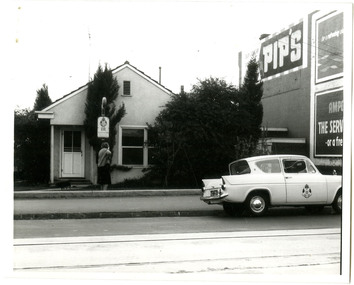
... Ascot Vale is an inner suburb 6 km north-west of Melbourne, Victoria, Australia in the local government area of the City of Moonee Valley. ...Ascot Vale is an inner suburb 6 km north-west of Melbourne, Victoria, Australia in the local government area of the City of Moonee Valley. ...Ascot Vale is an inner suburb 6 km north-west of Melbourne, Victoria, Australia in the local government area of the City of Moonee Valley. Ascot Vale police station was opened on 31 October 1887 in the Melbourne Police District. From 1900-1905 it was located at 54 Parade, Ascot Vale; from 1910-1925 at 71 St Leonards Road; from 1930-1953 at 37 St Leonards Road. In 1953 it was relocated to government owned premises at 111 Union Road until the police station closed on 1st May 1970 and the Sub-district was divided between Flemington and Moonee Ponds police stations. The former police station was used by the Crime Car Squad until about 1987 when the premises were damaged by fire. The police station at 37 St Leonards Road was described as a six-roomed brick dwelling with slate and iron roof on land measuring 150' x 50'. There was also a bathroom and W.C., wash-house, office and lock-up with one cell. It was staffed by one second-class sergeant and four foot constables. The purpose-built police station at 111 Union Road included a four-roomed residence with the exterior clad in rough cast Conite and a tile roof. There was also a kitchen, bathroom, laundry and separate garage. 4 black and white photospolice stations; ascot vale police station -
 Flagstaff Hill Maritime Museum and Village
Equipment - Rocket set, John Dennett, ca. 1860s
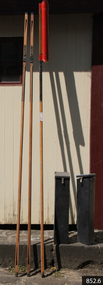
... Victoria has had over 600 shipwrecks and many lost lives; even in Warrnambool’s Lady Bay there were around 16 known shipwrecks between 1850 and 1905, with eight lives lost. In 1859 the first Government-built lifeboat arrived at Warrnambool Harbour and a shed was soon built to house it, followed in 1864 by a rocket house to safely store the Rocket Rescue equipment. In 1878 the buildings were moved to the Breakwater area, and in 1910 the new Lifeboat Warrnambool arrived with its ‘self-righting’ design. For almost one hundred years the lifeboat and rocket crews, mostly local...Victoria has had over 600 shipwrecks and many lost lives; even in Warrnambool’s Lady Bay there were around 16 known shipwrecks between 1850 and 1905, with eight lives lost. In 1859 the first Government-built lifeboat arrived at Warrnambool Harbour and a shed was soon built to house it, followed in 1864 by a rocket house to safely store the Rocket Rescue equipment. In 1878 the buildings were moved to the Breakwater area, and in 1910 the new Lifeboat Warrnambool arrived with its ‘self-righting’ design. For almost one hundred years the lifeboat and rocket crews, mostly local ...This rescue line-throwing rocket set was made for the Dennett rocket system, which was used by the Rocket Rescue crews in South West Victoria from around the 1860s to the 1890s. John Dennett - John Dennett was from Carisbrooke, in the Ilse of Wight, UK. In 1826 he invented, patented and demonstrated an improved method of rocket powered, line firing rescue equipment for saving lives. The rockets had a longer range than the mortars being used, they were lighter, needed less preparation time, only needed one line for repeated shots, and fewer people were needed to move the equipment. Very favourable reports of Dennett’s rockets were received by those in charge of His Majesty’s Naval and Military services. In 1832, Dennett’s rocket-thrown line was sent out to the wreck of the ‘Bainbridge’, and was responsible for nineteen survivors coming ashore in two boatloads, along the fired line. Dennett’s rocket received national fame, and a one-year contract to supply rockets to the Coastguards. He became known as ‘Rocket Man’ and his rockets were used in rescues at least until 1890, when his son Horatio was running the business. A rocket weighing 23 lb would have a range of about 250 yards (228 metres), on average. Saving lives in Warrnambool – The coastline of South West Victoria has had over 600 shipwrecks and many lost lives; even in Warrnambool’s Lady Bay there were around 16 known shipwrecks between 1850 and 1905, with eight lives lost. In 1859 the first Government-built lifeboat arrived at Warrnambool Harbour and a shed was soon built to house it, followed in 1864 by a rocket house to safely store the Rocket Rescue equipment. In 1878 the buildings were moved to the Breakwater area, and in 1910 the new Lifeboat Warrnambool arrived with its ‘self-righting’ design. For almost one hundred years the lifeboat and rocket crews, mostly local volunteers, trained regularly to maintain and improve their skills, summoned when needed by alarms, gunshots, ringing bells and foghorns. Some became local heroes but all served an important role. By the end of the 1950s the lifeboat and rescue equipment had become obsolete. Rocket Rescue Method - The first use of a lifesaving rocket rescue system is often credited to Captain Manby and his invention of a life mortar, first used in 1808 to fire a line onto a ship to rescue lives. Henry Trengrouse’s invention of 1820 was the first to use a sky rocket’s power to throw a line, and his invention included a chair for carrying the shipwrecked victims to shore. In 1832 John Dennett invented a rocket specifically for shore to ship rescue. It had an iron case and an 8 foot pole attached and could shoot the line as far as 250 yards (about 230 metres). From the 1860s the rocket rescue apparatus was in use. It comprised a breeches buoy and traveller block that was suspended on a line and manually pulled to and from the distressed vessel carrying passengers and items. Colonel Boxer, who had invented an early line-thrower, designed a rocket in 1865 with a range from 300 to 470 yards. It was the first two-stage rocket, with two rockets placed one in front of the other in a tube that carried the rescue line. The hemp line was faked, or coiled, in a particular way in a faking box to prevent twists and tangles when fired, and the angle of firing the rocket was measured by a quadrant-type instrument on the side of the rocket machine. Schermuly invented the line-throwing pistol around 1920, which used a small cartridge to fire the rocket. Victoria’s Government adopted lifesaving methods based on Her Majesty’s Coast Guard in Great Britain, which used Colonel Boxer’s rocket apparatus rescue method. The British Board of Trade published instructions in 1850 for both the beach rescue crew and ship’s crew. It involved setting up the rocket launcher on shore at a particular angle measured by the quadrant, inserting a rocket that had a light-weight line attached, then firing it across the stranded vessel. A tally board was then sent out with instructions in four languages. The ship’s crew would haul on the line to bring out the continuous whip line and attach the whip block to a mast or sturdy part the ship. The rescue crew on shore then hauled out a heavier hawser line, which the ship’s crew fixed above the whip block. The hawser is then tightened using the block on the shore end of the whip. The breeches buoy and endless whip are then attached to the traveller block on the hawser, allowing the shore crew to haul the buoy to and from the vessel, rescuing the stranded crew one at a time. The rocket system could also be used from one ship to another.The Dennett rocket set is quite rare - there are not many examples in existence and little information is available. This Dennett's rocket set is significant for its connection with local history, maritime history and marine technology. Lifesaving has been an important part of the services performed from Warrnambool's very early days, supported by State and Local Government, and based on the methods and experience of Great Britain. Hundreds of shipwrecks along the coast are evidence of the rough weather and rugged coastline. Ordinary citizens, the Harbour employees, and the volunteer boat and rescue crew, saved lives in adverse circumstances. Some were recognised as heroes, others went unrecognised. In Lady Bay, Warrnambool, there were around 16 known shipwrecks between 1850 and 1905. Many lives were saved but tragically, eight lives were lost.A Dennett rocket set in six parts; the rocket head, three shafts (poles) and two rocket-head toting boxes. The rocket head, mounted on one of the shafts, is a long, red painted, iron tube with rounded ends and a protruding fitting around each end. The wooden rocket shafts are octagonal, with a metal sheath at the ends, carved elongated slots towards each end, and a scribed channel above the black foot. The rocket head toting boxes are thick timber, covered in fabric and painted black. They have a hinged wooden lid that slants downwards from back to front, and a metal closure. Small deliberate holes, in groups of four, on the box’s sides, indicate missing attachments, likely to have been handles. Impressed one a shaft "8"flagstaff hill maritime museum & village, flagstaff hill, maritime museum, maritime village, warrnambool, great ocean road, shipwreck, life-saving, lifesaving, rescue crew, rescue, rocket rescue, maritime accidents, shipwreck victim, rocket crew, beach rescue, line rescue, rescue equipment, rocket firing equipment, rocket rescue equipment, rocket apparatus, beach apparatus, petticoat breeches, breeches buoy, rocket house, rocket shed, lifeboat men, rocket equipment, rocket machine, rocket head, rocket launcher, rocket line, marine technology, william schermuly, line-firing pistol, line throwing gun, schermuly pistol, pistol rocket apparatus, beach rescue set, traveller, block, running block, pulley, hawser, faking, faking box, faked line, rescue boat, lifeboat, lady bay, warrnambool harbour, port of warrnambool, tramway jetty, volunteer lifesavers, volunteer crew, breakwater, lifeboat warrnambool, rocket rescue method, rocket rescue apparatus, captain manby, mortar, henry trengrouse, sky rocket, john dennett, shore to ship, colonel boxer, two-stage rocket, italian hemp, quadrant, schermuly, line-throwing pistol, line throwing cartridge, rocket apparatus rescue, stranded vessel, tally board, light line, whip line, endless whip, petticoat buoy, traveller chair, traveller block, her majesty’s coast guard, harbour board, line thrower, line throwing, beach cart, hand barrow, sand anchor, hawser cutter, life jacket, faking board, irish hand barrow, rocket head toting box, explosives, rocket shaft, rocket pole -
 Flagstaff Hill Maritime Museum and Village
Equipment - Rocket Launcher, John Dennett, 1860s
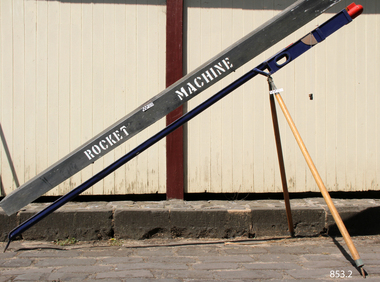
... local heroes but all served an important role. By the end of the 1950s the lifeboat and rescue equipment had become obsolete. Rocket Rescue Method - The Government of Victoria...Government-built lifeboat arrived at Warrnambool Harbour and a shed was soon built to house it. In 1858 the provision of rocket and mortar apparatus was approved for lifeboat stations in Victoria, and in 1864 a rocket house was built to safely store the rocket rescue equipment. In 1878 the buildings were moved to the Breakwater area, and in 1910 the new Lifeboat Warrnambool arrived with its ‘self-righting’ design. For almost a hundred years the lifeboat and rocket crews, mostly local ...This rocket launching machine is used in conjunction with the Dennett Rocket Set. Both are part of the rocket rescue equipment that launches the line-throwing rescue rockets. A light line is threaded through the carved holes in the 8 foot long shaft and attached to the scribed channel at the base of the shaft. The rocket head is fitted to the shaft and inserted into the machine. The machine is set at an angle determined by the person in charge of the rescue crew, and the legs and base of the machine are adjusted accordingly with the use of the quadrant, or protractor, and plumb-bob on the side of the machine. The rocket is then ignited and fired across the vessel in distress. John Dennett - John Dennett was from Carisbrooke, in the Ilse of Wight, UK. In 1826 he invented, patented and demonstrated an improved method of rocket powered, line firing rescue equipment for saving lives. The rockets had a longer range than the mortars being used, they were lighter, needed less preparation time, only needed one line for repeated shots, and fewer people were needed to move the equipment. Very favourable reports of Dennett’s rockets were received by those in charge of His Majesty’s Naval and Military services. In 1832, Dennett’s rocket-thrown line was sent out to the wreck of the ‘Bainbridge’, and was responsible for nineteen survivors coming ashore in two boatloads, along the fired line. Dennett’s rocket received national fame, and a one-year contract to supply rockets to the Coastguards. He became known as ‘Rocket Man’ and his rockets were used in rescues at least until 1890, when his son Horatio was running the business. A rocket weighing 23 lb would have a range of about 250 yards (228 metres), on average. Saving lives in Warrnambool – The coastline of South West Victoria is the site of over 600 shipwrecks and many lost lives; even in Warrnambool’s Lady Bay there were around 16 known shipwrecks between 1850 and 1905, with eight lives lost. In 1859 the first Government-built lifeboat arrived at Warrnambool Harbour and a shed was soon built to house it. In 1858 the provision of rocket and mortar apparatus was approved for lifeboat stations in Victoria, and in 1864 a rocket house was built to safely store the rocket rescue equipment. In 1878 the buildings were moved to the Breakwater area, and in 1910 the new Lifeboat Warrnambool arrived with its ‘self-righting’ design. For almost a hundred years the lifeboat and rocket crews, mostly local volunteers, trained regularly to maintain their rescue skills. They were summoned when needed by alarms, gunshots, ringing bells and foghorns. Some became local heroes but all served an important role. By the end of the 1950s the lifeboat and rescue equipment had become obsolete. Rocket Rescue Method - The Government of Victoria adopted lifesaving methods based on Her Majesty’s Coast Guard in Great Britain. It authorised the first line-throwing rescue system in 1858. Captain Manby’s mortar powered a projectile connected to rope, invented in 1808. The equipment was updated to John Dennett’s 8-foot shaft and rocket method that had a longer range of about 250 yards. From the 1860s the breeches buoy and traveller block rocket rescue apparatus was in use. It was suspended on a hawser line and manually pulled to and from the distressed vessel carrying passengers and items. In the early 1870s Colonel Boxer’s rocket rescue method became the standard in Victoria. His two-stage rockets, charged by a gunpowder composition, could fire the line up to 500-600 yards, although 1000 yards range was possible. Boxer’s rocket carried the light line, which was faked, or coiled, in a particular way between pegs in a faking box to prevent twists and tangles when fired. The angle of firing the rocket to the vessel in distress was measured by a quadrant-type instrument on the side of the rocket machine. Decades later, in about 1920, Schermuly invented the line-throwing pistol that used a small cartridge to fire the rocket. The British Board of Trade published instructions for both the beach rescue crew and ship’s crew. It involved setting up the rocket launcher on shore at a particular angle measured by the quadrant, inserting a rocket that had a light-weight line threaded through its shaft, and then firing it across the stranded vessel, the line issuing freely from the faking board. A tally board was then sent out to the ship with instructions in four languages. The ship’s crew would haul on the line to bring out the heavier, continuous whip line, then secure the attached whip block to the mast or other sturdy part the ship. The rescue crew on shore then hauled out a stronger hawser line, which the ship’s crew fixed above the whip block. The hawser was then tightened using the block on the shore end of the whip. The breeches buoy and endless whip are then attached to the traveller block on the hawser, allowing the shore crew to haul the breeches buoy to and from the vessel, rescuing the stranded crew one at a time. This rocket launcher machine is significant for its connection with local history, maritime history and marine technology. Lifesaving has been an important part of the services performed from Warrnambool's very early days, supported by State and Local Government, and based on the methods and experience of Great Britain. Hundreds of shipwrecks along the coast are evidence of the rough weather and rugged coastline. Ordinary citizens, the Harbour employees, and the volunteer boat and rescue crew, saved lives in adverse circumstances. Some were recognised as heroes, others went unrecognised. In Lady Bay, Warrnambool, there were around 16 known shipwrecks between 1850 and 1905. Many lives were saved but tragically, eight lives were lost.Rocket launcher, named a Rocket Machine, and storage box. Launcher has a long open metal channel with a spike at the base, and narrow, rectangular device, which is the line-firing rocket machine, at the top, all painted blue. Two hinged wooden legs are attached where the channel and machine meet. The side of the machine has an oval cut-out window and an attached quadrant, or protractor, with a plumb-bob on it. The quadrant has angles marked in degrees. The long protective box has white stencilled letters along the side. Its lid has three hinges and is fastened with two metal latches.On box “ROCKET MACHINE” On quadrant “10” “20” “30” “40”flagstaff hill maritime museum & village, flagstaff hill, maritime museum, maritime village, warrnambool, great ocean road, shipwreck, life-saving, lifesaving, rescue crew, rescue, rocket rescue, maritime accidents, shipwreck victim, rocket crew, beach rescue, line rescue, rescue equipment, rocket firing equipment, rocket rescue equipment, rocket apparatus, beach apparatus, petticoat breeches, breeches buoy, rocket house, rocket shed, lifeboat men, rocket equipment, rocket machine, rocket head, rocket launcher, rocket line, marine technology, william schermuly, line-firing pistol, line throwing gun, schermuly pistol, pistol rocket apparatus, beach rescue set, traveller, block, running block, pulley, hawser, faking, faking box, faked line, rescue boat, lifeboat, lady bay, warrnambool harbour, port of warrnambool, tramway jetty, volunteer lifesavers, volunteer crew, breakwater, lifeboat warrnambool, rocket rescue method, rocket rescue apparatus, captain manby, mortar, henry trengrouse, sky rocket, john dennett, shore to ship, colonel boxer, two-stage rocket, italian hemp, quadrant, protractor, schermuly, line-throwing pistol, line throwing cartridge, rocket apparatus rescue, stranded vessel, tally board, light line, whip line, endless whip, petticoat buoy, traveller chair, traveller block, her majesty’s coast guard, harbour board, line thrower, line throwing, beach cart, hand barrow, sand anchor, hawser cutter, life jacket, faking board, welsh hand barrow, rocket set -
 Flagstaff Hill Maritime Museum and Village
Equipment - Hand Barrow, 1860s
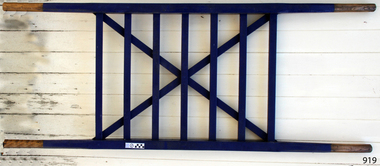
... Victoria’s Government responded to the need for lifesaving equipment and, in 1858, the provision of rocket and mortar apparatus was approved for the lifeboat stations. In 1859 the first Government-built lifeboat arrived at Warrnambool Harbour and a shed was soon built for it on the Tramway Jetty, followed by a rocket house in 1864 to safely store the rocket rescue equipment. In 1878 the buildings were moved to the Breakwater (constructed from 1874-1890), and in 1910 the new Lifeboat Warrnambool arrived with its ‘self-righting’ design. For almost a hundred years the lifesaving and rescue crews, mostly local...Victoria’s Government responded to the need for lifesaving equipment and, in 1858, the provision of rocket and mortar apparatus was approved for the lifeboat stations. In 1859 the first Government-built lifeboat arrived at Warrnambool Harbour and a shed was soon built for it on the Tramway Jetty, followed by a rocket house in 1864 to safely store the rocket rescue equipment. In 1878 the buildings were moved to the Breakwater (constructed from 1874-1890), and in 1910 the new Lifeboat Warrnambool arrived with its ‘self-righting’ design. For almost a hundred years the lifesaving and rescue crews, mostly local ...This hand barrow, sometimes called a Welsh hand barrow, was used to transport a load of marine rescue equipment from the beach cart to the rescue site, particularly over hilly, uneven or rough terrain. Hand barrows were in common use in the 19th century. Saving lives in Warrnambool – The coastline of South West Victoria is the site of over 600 shipwrecks and many lost lives; even in Warrnambool’s Lady Bay there were around 16 known shipwrecks between 1850 and 1905, with eight lives lost. Victoria’s Government responded to the need for lifesaving equipment and, in 1858, the provision of rocket and mortar apparatus was approved for the lifeboat stations. In 1859 the first Government-built lifeboat arrived at Warrnambool Harbour and a shed was soon built for it on the Tramway Jetty, followed by a rocket house in 1864 to safely store the rocket rescue equipment. In 1878 the buildings were moved to the Breakwater (constructed from 1874-1890), and in 1910 the new Lifeboat Warrnambool arrived with its ‘self-righting’ design. For almost a hundred years the lifesaving and rescue crews, mostly local volunteers, trained regularly to rehearse and maintain their rescue skills. They were summoned when needed by alarms, gunshots, ringing bells and foghorns. In July 1873 a brass bell was erected at Flagstaff Hill specifically to call the rescue crew upon news of a shipwreck. Some crew members became local heroes but all served an important role. Rocket apparatus was used as recently as the 1950s. Rocket Rescue Method - Rocket rescue became the preferred lifesaving method of the rescue crews, being much safer that using a lifeboat in rough seas and poor conditions. The Government of Victoria adopted lifesaving methods based on Her Majesty’s Coast Guard in Great Britain. It authorised the first line-throwing rescue system in 1858. Captain Manby’s mortar powered a projectile connected to rope, invented in 1808. The equipment was updated to John Dennett’s 8-foot shaft and rocket method that had a longer range of about 250 yards. From the 1860s the breeches buoy and traveller block rocket rescue apparatus was in use. It was suspended on a hawser line and manually pulled to and from the distressed vessel carrying passengers and items. In the early 1870s Colonel Boxer’s rocket rescue method became the standard in Victoria. His two-stage rockets, charged by a gunpowder composition, could fire the line up to 500-600 yards, although 1000 yards range was possible. Boxer’s rocket carried the light line, which was faked, or coiled, in a particular way between pegs in a faking box to prevent twists and tangles when fired. The angle of firing the rocket to the vessel in distress was measured by a quadrant-type instrument on the side of the rocket machine. Decades later, in about 1920, Schermuly invented the line-throwing pistol that used a small cartridge to fire the rocket. . The British Board of Trade regularly published instructions for both the beach rescue crew and ship’s crew. It involved setting up the rocket launcher on shore at a particular angle, determined by the Head of the crew and measured by the quadrant, inserting a rocket that had a light-weight line threaded through its shaft, and then firing it across the stranded vessel, the line issuing freely from the faking board. A continuous whip line was then sent out to the ship’s crew, who hauled it in then followed the instructions – in four languages - on the attached tally board. The survivors would haul on the line to bring out the heavier, continuous whip line with a tail block connected to it. They then secured the block to the mast or other strong part the ship. The rescue crew on shore then hauled out a stronger hawser line, which the survivors fixed above the whip’s tail block. The hawser was then tightened by the crew pulling on it, or by using the hooked block on the shore end of the whip and attaching it to a sand anchor. The breeches buoy was attached to the traveller block on the hawser, and the shore crew then used the whip line to haul the breeches buoy to and from the vessel, rescuing the stranded crew one at a time. The rescue crew wore scarlet, numbered armbands and worked on a numerical rotation system, swapping members out to rest them. This hand barrow is significant for its connection with local history, maritime history and marine technology. Lifesaving has been an important part of the services performed from Warrnambool's very early days, supported by State and Local Government, and based on the methods and experience of Great Britain. Hundreds of shipwrecks along the coast are evidence of the rough weather and rugged coastline. Ordinary citizens, the Harbour employees, and the volunteer boat and rescue crew, saved lives in adverse circumstances. Some were recognised as heroes, others went unrecognised. In Lady Bay, Warrnambool, there were around 16 known shipwrecks between 1850 and 1905. Many lives were saved but tragically, eight lives were lost.Hand barrow; a transporting device carried between two people walking one in front of the other. A wooden ladder-like frame with two handles at each end, blue painted body with unpainted handles. Seven equal-length slats are joined at equal distance between two parallel poles, and two longer slats are attached diagonally between the first and last slats as a brace. flagstaff hill maritime museum and village, flagstaff hill, maritime museum, maritime village, warrnambool, great ocean road, lady bay, warrnambool harbour, port of warrnambool, tramway jetty, breakwater, shipwreck, life-saving, lifesaving, rescue crew, rescue, rocket rescue, rocket crew, lifeboat men, beach rescue, line rescue, rescue equipment, rocket firing equipment, rocket rescue equipment, maritime accidents, shipwreck victim, rocket equipment, marine technology, rescue boat, lifeboat, volunteer lifesavers, volunteer crew, life saving rescue crew, lifesaving rescue crew, rocket apparatus, rocket rescue method, shore to ship, rocket apparatus rescue, stranded vessel, line throwing mortar, mortar, rocket rescue apparatus, line thrower, line throwing, lifeboat warrnambool, hand barrow, manual transport, welsh hand barrow -
 Flagstaff Hill Maritime Museum and Village
Book - Reference/Legal Acts, John Ferres, Government Printer, The Victorian Statutes Vol 2 Collectors of Customs, 1866
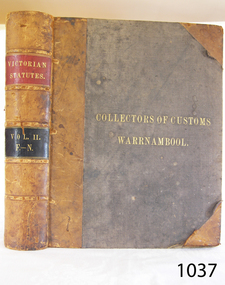
... This mechanical leap forward revolutionised local news production, allowing him to help issue the very first eight-page newspaper in the colony. In late 1851, the newly independent Colony of Victoria abruptly dismissed its first official government printer, Edward Khull, for alleged incompetence right as the state desperately needed to print its official financial Estimates. ...This mechanical leap forward revolutionised local news production, allowing him to help issue the very first eight-page newspaper in the colony. In late 1851, the newly independent Colony of Victoria abruptly dismissed its first official government printer, Edward Khull, for alleged incompetence right as the state desperately needed to print its official financial Estimates. ...Because the subject item is a book of law, it would not traditionally have a singular author, but rather a corporate author, specifically the Colony of Victoria and, more precisely, the Parliament of Victoria. The Victorian Statutes of 1866 is an official compilation of the statute law of the Colony of Victoria, Australia, 'Published by Authority', and printed by John Ferres, who was the Victorian Government Printer at the time. Ferres was the printer/publisher, not an author or editor in the usual sense, as this is a government publication rather than an individually authored work.Hard cover book, The Victorian Statutes Vol 2 Author: Corporate Author “The Colony of Victoria” Publisher: John Ferres Government Printer Melbourne. Date: 1866 Three quarter leather, Olive Front Cover, Brown Spine with Gold embossed Title on spine & front cover "Collector of Customs Warrnambool"non-fictionBecause the subject item is a book of law, it would not traditionally have a singular author, but rather a corporate author, specifically the Colony of Victoria and, more precisely, the Parliament of Victoria. The Victorian Statutes of 1866 is an official compilation of the statute law of the Colony of Victoria, Australia, 'Published by Authority', and printed by John Ferres, who was the Victorian Government Printer at the time. Ferres was the printer/publisher, not an author or editor in the usual sense, as this is a government publication rather than an individually authored work.flagstaff hill, warrnambool, shipwrecked-coast, flagstaff-hill, flagstaff-hill-maritime-museum, maritime-museum, shipwreck-coast, flagstaff-hill-maritime-village, the victorian statutes vol 2 collectors of customs, book -
 Flagstaff Hill Maritime Museum and Village
Award - Certificate of Service, F. W. Strahle, James Patten, 23-08-1907
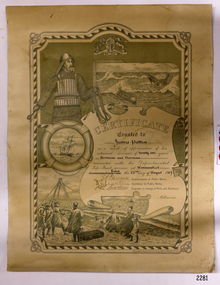
... Victoria saved 260 lives. Amazingly, some of the volunteers could not even swim. This certificate shows the State and Local Government's appreciation for the years of service spent by in the endeavour to save lives in peril in and on the local waters in the early 20th Century. ...This certificate acknowledges 21 years of service given by James Patten, one of the original 1859 Lifeboat Warrnambool as a boatman and bowman. At the time, all retiring Volunteer lifeboatmen were honoured with this award. It was made as a lithograph that was created by F. W. Strahle at the request of the Department of Lands & Survey, Melbourne, Victoria. During his time of service, James Patten was awarded a medal and certificate by the Royal Humane Society of Australasia for his bravery. Patten and his friend Joseph Lowe, who couldn't swim, were with their friend James Ferrier in a boat on the Hopkins River, Warrnambool, when their boat capsized. Ferrier made it to shore, and Patten tried unsuccessfully to hold onto Lowe and bring him to shore. The event occurred on 18th April 1890. The images on the Certificate show a collage of rescue events performed by the lifesavers; a shipwreck rescue in progress, lifeboat conveying five boatmen using two oars each, and a bowman standing at the bow, a linesman wearing a life jacket and holding a rescue line, a lifesaver ring with images of three sailing ships inside it, a shipwreck near shore, a woman and girl in shallow water, a rescue using a breeches buoy on the lifeline, two rescuers walking towards the survivor, rescue crew wearing waterproof clothing, a rocket machine with a pulley to bring the survivor in a breaches buoy to shore, and a rescue crew member holding a flare. Volunteers at the time received a small payment, or 'retainer'', for their practices and a payment of gratitude for the rescues they attended. Across the years between 1856 to 1979 the combined service in Victoria saved 260 lives. Amazingly, some of the volunteers could not even swim.This certificate shows the State and Local Government's appreciation for the years of service spent by in the endeavour to save lives in peril in and on the local waters in the early 20th Century. The lithographed design depicts the many skills and services performed by the lifesavers of the era.Certificate of Service, unframed, awarded to James Patten on 23rd August 1907, recognising his 21 years of service with the original Warrnambool Life Boat Service as a Boatman and Bowman. Certificate is on rectangular, cream paper, lithographed design, printed and handwritten. Letterhead with the Royal Coat of Arms of the United Kingdom and a French motto. Images depict lifesaving crew, lifeboat, rescue equipment and a rescue in progress. The border is waves inside of frame of looped rope. Signatures of Commissioner of Public Works, Secretary of Public Works, and Engineer in charge of Ports and Harbours, Melbourne. Printed from a lithograph produced by F.W. Strahle on 23rd June 1907.MOTTO: "Dieu Droit Et Mon, Ni Soit Qui Mal y" TREXT: "Certificate granted to James Patten as a mark of appreciation of his esteemed services of 21 years as Boatman and Bowman connected with the Departmental Life-Boat service at Warrnambool - dated the 23rd day of August 1907." SIGNATURES: [Commissioner of Public Works], [Secretary of Public Works], [Engineer in charge of Ports and Harbours Melbourne] "Lithographed at the Dept of Lands & Survey - Melb/ by F.W. Strahle, 23.6.07"flagstaff hill, warrnambool, flagstaff-hill, maritime museum, maritime village, shipwreck-coast, flagstaff hill maritime museum & village, james patten, life-saving, lifesaving, rescue, bravery, drowning, joseph lowe, james ferrier, hopkins river, boat accident, certificate of service, 1890, 1907, bowman, boatman, departmental life-boat service, life-boat service, lifeboat service, august 1907, commissioner of public works, public works, ports and harbours melbourne, lands & survey melbourne, f w strahle, lithograph, 1856-1979, 260 lives saved, victorian volunteers, lifeboatmen, retired lifeboatmen -
 Flagstaff Hill Maritime Museum and Village
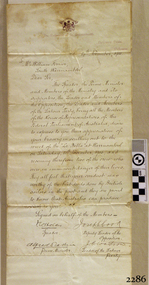
Letter - William Ferrier, 14th November 1905
... This original congratulatory letter sent to William Ferrier by the Prime Minister and Government of Australia demonstrates the importance attached to his efforts for Victoria and to Australia. The letter is part of the La Bella Collection and is significant at both a local and state level. ...The letter to William Ferrier of South Warrnambool from the Prime Minister and the Parliament of the Commonwealth recognised the significance of William’s brave and courageous lifesaving act to the people of Australia; “They all feel that your conduct was worthy of the best deeds done by British sailors in the past and they are proud to know that Australia can produce such as you.” The story of that brave rescue follows on below … The ship from which the sailors were rescued was the three-masted, iron and steel barquentine the La Bella, built in Norway in 1893. She was one of two iron and steel ships by Johan Smith, The company was one of the leading shipping families in Tvedestrand, Norway. She was significant to Norwegian shipping, being one of only 27 iron and steel ships ever built in Norway. She was registered in New Zealand and engaged from 1902 in inter-colonial trading of timber in the Pacific, between New Zealand and Australia and was often in Port Phillip Bay, Victoria. On 5th October 1905, the twelve-year-old La Bella left Lyttleton, New Zealand carrying a cargo of timber bound for Warrnambool, Australia. She was manned by a crew of twelve: the Master, (Captain Mylius, previously 1st Mate of La Bella, appointed Captain to La Bella on 6th February 1903) 2 Mates, Cook, six able seamen, one ordinary seaman and a boy. Bad weather en route caused her to shelter at Burnie on Tasmania's North West coast. On November 10th, the 37th day of her journey, La Bella approached Warrnambool. Captain Mylius steered her towards Lady Bay Channel in heavy south-west seas and evening mist. He ordered the helmsman to steer for the light. As the ship came round, a tremendous sea struck her on the port quarter, causing her to breach broadside in a north-westerly direction into breakers. The helm was brought round twice more, but each time heavy seas broke over her, the third time throwing the La Bella on to a submerged reef in Lady Bay now known as La Bella Reef (about 100 yards from the Warrnambool breakwater). The sea was so rough that it even wrenched a one-and-a-half ton anchor from its fastenings and into the sea. As Captain Mylius headed to the steel wheelhouse, intending to send up a rocket flare, a huge sea slammed the steel door into him (resulting in massive bruising front and back) Despite his injuries he still managed to set off a blue light, which he held up in his hands. La Bella’s lifeboats were filled with seawater and broke up on their chocks. The blue light was the first indication to people on the shore that there was a ship in distress. The Harbour Master, Captain Roe (who lived in the Harbour Master’s House opposite Flagstaff Hill), organised a group of volunteers to crew the lifeboat because the trained crew was unavailable; the crewmen were working on a steamer in Port Fairy at the time. He then poured oil onto the water to try and smooth the sea. At around 11 pm three of the crew took shelter in the steel forecastle but the sea crashed into it and broke it up. While the rest of the crew and onlookers watched helplessly in the moonlight the bodies were washed away into the sea, never to be seen again. Some of the crew lashed themselves to the weather rail to keep from being washed away. Watson, the ordinary seaman, became tangled in the rigging lines and was too weak to move, so the 2nd Mate, Robertson, put a line onto him so that he wouldn’t wash off. Around 11 pm three of the crew were unconscious from exhaustion. The situation on La Bella was becoming dangerous. The 2nd Mate moved to the ‘house’ and soon afterwards the ship slipped in the heavy sea. The lashings of the 1st Mate and the ‘boy’ Denham had kept them safe until about 2 am when they were washed overboard; no one was able to help. One by one, the exhausted crew were being washed overboard, too weak to hold on any longer. During the night the La Bella had broken into two and the deckhouse ran out towards the sea. Two more men drowned when trying to reach the lifeboat. By sunrise, the only survivors of the twelve were the Master, 2nd Mate and three seamen. Early in the morning, Captain Roe used the rocket apparatus on shore to try and shoot a line to the ship for a safer rescue but each attempt fell short of the target. Several attempts were made by the lifeboat to rescue the stricken sailors, but the rough conditions made this difficult for the boat to get close enough to the ship and the lifeboat had to return to shore. During a final attempt to reach the ship Captain Mylius ordered his men to jump into the sea. Leonard Robertson, 2nd mate, jumped and swam towards the lifeboat, taking hold of the boat hook offered to him. Oscar Rosenholme managed to reach the boat floating on a piece of timber from the ship’s load and a third survivor, Noake, also made the boat. Along with the lifeboat rescue crew, 25-year-old William Ferrier rowed his small dingy through the heavy seas and managed to rescue the Captain, whom he landed on the breakwater. Ferrier then returned to the ship to attempt a final rescue, losing his oars and rowlocks into the high sea. Using just a spare paddle he skulled towards the La Bella, reaching her stern in time to cut loose the lone surviving sailor, Payne, from the lashing that held him to the ship; the terrified sailor dropped from the ship and into the dingy. Shortly after the last man was rescued, the La Bella was lifted by a huge wave and crashed back down on the reef; she broke up and sank. The ordeal had lasted ten hours. The survivors were taken to the nearby Bay View Hotel and gratefully received warm food and clothing, medical attention and a place to sleep. In the following days, an unidentified body of a young person has washed ashore; it was either Watson or Denham. The body was buried in the Warrnambool cemetery with an appropriate gravestone and inscription. William Ferrier became a national hero as news of the daring rescue spread. In recognition of his bravery in the two daring rescues, he was awarded the Silver Medal for Bravery by the Royal Humane Society and was honoured in the letter from the Prime Minister and the Parliament of the Commonwealth, telegrams and a cheque for £20 from the Governor-General, over £150 subscribed by the public, including Warrnambool and district and readers of The Argus, and a gold medal from the Glenelg Dinghy Club of South Australia. Ferrier’s rescue efforts are one of the most heroic in Victoria’s shipwreck history. (William Ferrier’s son, Frank, received a similar award almost fifty years later when he helped rescue four members of the crew on the yacht Merlan after it ran on to a reef near the Point Lonsdale Lighthouse. ) The wreck of La Bella now lies on her port side in 13 metres of sheltered water inside the reef she struck. The bow section is relatively intact and part of the stern has drifted north-easterly towards the mouth of the Hopkins River. The reef the La Bella struck now bears its name. Those five rescued from the La Bella were Captain George Mylius, Leonard Robertson (2nd Mate, 21 years old), R. Payne, Oscar Rosenholme and Jack Noake. Those seven who lost their lives were Mr Coulson (1st mate), Charles Jackman (cook) Gustave Johnson, Pierre Johann and Robert Gent (all able seamen), Harry Watson (ordinary seaman) and Jack Denham (ship’s boy), Captain Mylius was found guilty of careless navigation; he had sailed into the bay without the services of a pilot. His Master Certificate was suspended for twelve months. Later he was also charged with the manslaughter of one of the crew who had died when the La Bella was wrecked but found not guilty. The event’s adverse publicity and damage to his career took a toll on his health and he died of a heart attack six months after the wreck; he was only thirty-seven. His body was buried in the Melbourne General Cemetery. The La Bella was “the best documented of all sailing ships owned in New Zealand”. Her record books, ship logs, correspondence and supporting papers are still available. At the time of the tragedy, she was owned by Messers David C.Turnbull and Co. of Timaru, New Zealand timber merchants and shipping agents, who had purchased her on 13th December 1901. A detailed account of the last journey of La Bella can be read in “Leonard Robertson, the Whangaroa & La Bella” written by Jack Churchouse, published in 1982 by Millwood Press Ltd, Wellington, NZ. As well as this letter, Flagstaff Hill’s La Bella Collection includes a photograph of the wrecked La Bella, a brass rail holder and a postcard of William Ferrier with four of the survivors. Some 15 – 17 ships are believed to have sunk in Lady Bay, but only two have been discovered on the seafloor; the “La Bella” and the “Edinburgh Castle”. Both wrecks are popular diving sites and are preserved as significant historical marine and marine archaeological sites. This original congratulatory letter sent to William Ferrier by the Prime Minister and Government of Australia demonstrates the importance attached to his efforts for Victoria and to Australia. The letter is part of the La Bella Collection and is significant at both a local and state level. Its connection to the La Bella shipwreck and the rescue of five survivors highlights the dangers of Victoria’s Shipwreck Coast. The letter to William Ferrier from the Australian Government acknowledges the bravery of ordinary Australians who risked their lives to save victims of shipwrecks along the coast. The letter is significant to the history of Warrnambool as it honours William Ferrier, a local fisherman whose descendants continue to live in the area. It highlights the way of life of people who lived in coastal towns in 19th century Victoria and the effects of shipwrecks upon them. The letter connects to the postcard of William Ferrier with four of the five rescued crew, the photograph of the wreck of the La Bella and the artefact from the wreck, the rail holder. This letter is significant because of its association with the sailing ship “La Bella”. The “La Bella” is of local and state and national significance. It is one of the only two shipwrecks discovered in Lady Bay, Warrnambool, out of the 15-17 shipwrecks in the bay. Letter to William Ferrier of South Warrnambool from the Prime Minister and Members of Parliament commending him on his bravery. The printed letterhead includes a coat of arms in the top centre and the official address. The letter is very neatly hand written in black pen and includes 4 signatures of Members of Parliament. The rectangular paper is cream coloured with some yellow/brown discolouring. It has the letterhead on the right hand side of it and the written letter begins below the letterhead. The paper has been folded so that the right side becomes the cover page of the letter. The writing is continued onto the inside right hand page of the folded paper and the writing ends here. There is more recent writing on the bottom right hand corner of the back page. The paper has been officially folded in half a total 3 times and there is heavy discolouration on the sections that form the front and back of the folded letter. There is a 4th fold line that is less pronounced that the other folds and would make the paper the size to fit into a pocket. At several fold creases the paper has worn through. The edges of the paper have minor tears. The printed coat of arms is that of the House of Representatives. Underneath is printed “The Parliament of the Commonwealth, / Parliament House / Melbourne”. The hand written, letter is dated “14th November, 1905” and addressed to “Mr. William Ferrier / South Warrnambool” The letter begins “The Speaker, the Prime Minister and Members of the Ministry and its supporters, the Leader and Members of the Opposition, the Leader and Members of the Labour Party, being all the Members of the House of Representatives of the Federal Parliament of Australia” … It continues “desire to express to you their appreciation of your bravery in skulling out to the wreck of the “La Bella” at Warrnambool on Saturday, 11th November, 1905, and recovering therefrom two of the crew who were in imminent danger of their lives. They all feel that your conduct was worthy of the best deeds done by British sailors in the past and they are proud to know that Australia can produce such as you.” The letter is “Signed on behalf of the Members – Speaker (Frederick Holder ), Deputy Leader of the Opposition (Joseph Cook ), Prime Minister (Alfred Deakin), Leader of the Labour Party ( J.C. Watson)” On the back of the letter is blue ink handwriting “OWNER / G. FERRIER / TO. BE. PHOTOGRAPHED / 27-4-76”la bella, william ferrier, bill ferrier, lady bay, 1905, 10th november 1905, 11th november 1905, parliament of the commonwealth, prime minister, australian government, new zealand, flagstaff hill, warrnambool, shipwrecked coast, flagstaff hill maritime museum, maritime museum, shipwreck coast, flagstaff hill maritime village -
 Flagstaff Hill Maritime Museum and Village
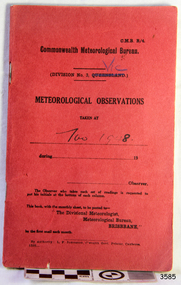
Book - Record Book, Commonwealth Meteorological Bureau, Meteorological Observations, November 1948
... Government Printer, Canberra. It was originally printed for Division 3, Queensland but has been overwritten with 'Vic' [Victoria] and used for Warrnambool. Readings were recorded daily for barometric pressure, temperature, rain and wind velocity. At the end of each month, they were posted to the central Branch in Melbourne. These Meteorological Observations are an important accurate record of the local ...This book of Warrnambool's meteorological observations is dated November 1948. The book was published by the Commonwealth Meteorological Bureau, Victora Division. It was printed by L. F. Johnston, Commonwealth Government Printer, Canberra. It was originally printed for Division 3, Queensland but has been overwritten with 'Vic' [Victoria] and used for Warrnambool. Readings were recorded daily for barometric pressure, temperature, rain and wind velocity. At the end of each month, they were posted to the central Branch in Melbourne.These Meteorological Observations are an important accurate record of the local weather since the decades. They are part of Flagstaff Hill's Meteorological Observations collection of over seventy record books dating from the late 19th century. The collected information gives a picture of the weather patterns for the months and seasons, which then allows for warnings of events out of the normal or extreme, such as forecasting floods or droughts.Meteorological Observations record book. Recordings were taken at Warrnambool in November 1948. Small red cardboard printed cover with printed pages prepared for adding records. Published by the Commonwealth of Australia. The book was printed for Queensland; the cover has been altered by hand to read Vic [Victoria], but the fly page has not been altered.Printed cover text includes "Central Meteorological Bureau" "METEOROLOGICAL OBSERVATIONS DIVISION No. 3 QUEENSLAND" Handwritten on cover "VIC" "Nov 1948."flagstaff hill, flagstaff hill maritime museum and village, warrnambool, maritime museum, maritime village, great ocean road, shipwreck coast, meteorological observations, commonwealth meteorological bureau, weather readings, weather records, weather history, weather measurement, weather record, division no 3 queensland, victoria, november 1848
