
Showing 65 items matching "victoria racing club"
-
 Koroit & District Historical Society
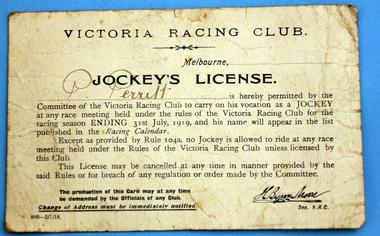
Victoria Racing Club Jockey's License, Victoria Racing Club Jockey's License P Perritt 1919
... Victoria Racing Club Jockey's License ...Victoria Racing Club Jockey's License P Perritt 1919......Victoria Racing Club...P Perritt 1919 Victoria Racing Club license VRC Victoria Racing Club Jockey's License P Perritt 1919 Victoria Racing Club Jockey's License ...p perritt, 1919, victoria racing club, license, vrc -
 Australian Racing Museum
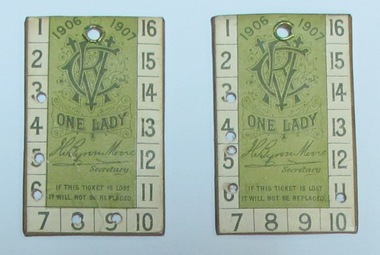
Ticket: Victoria Racing Club Member's Tickets in leather ticket holder, 1906-1907
... Ticket: Victoria Racing Club Member's Tickets in leather ticket holder...Leather ticket holder containing two Victoria Racing Club lady's tickets for the 1906-1907 season, issued to Mrs L. ...Leather ticket holder containing two Victoria Racing Club lady's tickets for the 1906-1907 season, issued to Mrs L. ...Leather ticket holder containing two Victoria Racing Club lady's tickets for the 1906-1907 season, issued to Mrs L. J. Blyth. -
 Bendigo Historical Society Inc.
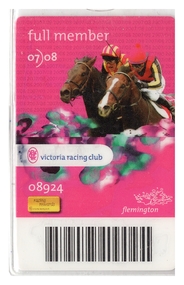
Ephemera - Victoria Racing Club Flemington Full Member Badges/Pass, 1999 to 2011
... Victoria Racing Club Flemington Full Member Badges/Pass......victoria racing club flemington...Some are attached to a lanyard, Ephemera Victoria Racing Club Flemington Full Member Badges/Pass ...Barry Lyons owned and managed the Windemere Hotel in Kangaroo Flat along with his wife Betty. Barry was a long time member of the Lions Club of Kangaroo Flat. Barry served as a Bendigo City Councillor from 2008 to 2016, and as Mayor in 2013 - 2014. Three Passes collected and owned by Barry Lyons of Bendigo. Some are attached to a lanyard,bendigo, barry and betty lyons, windemere hotel kangaroo flat, victoria racing club flemington -
 Australian Racing Museum
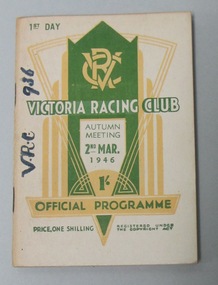
Racebook, Victoria Racing Club, 1946
... Racebook, Victoria Racing Club...Un-numbered page race programme for the Victoria Racing Club Autumn Meeting First Day Saturday 2 March 1946. ...Racebook, Victoria Racing Club ...Un-numbered page race programme for the Victoria Racing Club Autumn Meeting First Day Saturday 2 March 1946. Front cover has a white background with green and white writing, and a green and yellow 1930s art deco design with the VRC insignia in the middle top. Back cover has a white background with green writing, and a yellow border, explaining the railway arrangements. -
 Heidelberg Repatriation Hospital
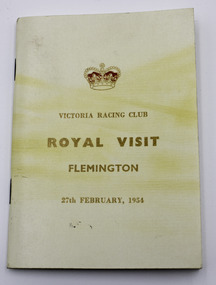
Booklet - Race Meeting Programme, Victoria Racing Club, Royal Visit Flemington 27th February 1954, 27/02/1954
... Victoria Racing Club...Book produced to detail Race Day for Royal Visit at Flemington Racecourse, February 1954 Limited number of copies available Race Day Royal Visit Flemington 1954 Victorian Racing Club Royal Visit Flemington February 27 1954 Printed booklet with two staple fastening, approx. 40p. Royal Visit Flemington 27th February 1954 Booklet Race Meeting Programme Victoria Racing Club ...Book produced to detail Race Day for Royal Visit at Flemington Racecourse, February 1954Limited number of copies availablePrinted booklet with two staple fastening, approx. 40p.Victorian Racing Club Royal Visit Flemington February 27 1954race day, royal visit, flemington, 1954 -
 Warrnambool and District Historical Society Inc.
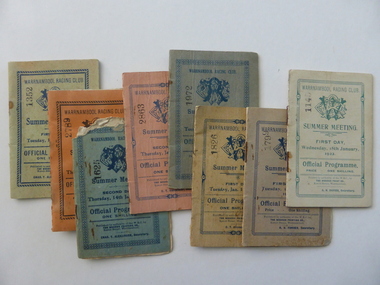
Document - Warrnambool. Woodford. Winslow. Purnim Race Books, Modern Print, W’Bool, Victoria, 1920's and 1930's
... racing club...winslow racing club...woodford racing club...purnim racing club...victoria...They relate to Warrnambool, Woodford, Purnim, Winslow and Victoria Racing Club meetings in the period 1922 to 1931. ...club in Tobin’s paddock to a splendid race course on the property, “Green Hills” owned by Mr. John O’Keefe about one mile north of the Winslow township.. The annual meetings held on New Year’s Day drew crowds of seven to eight thousand people. All of these books contains family names which in some cases are still strongly linked to horse racing in the district. These booklets are a tangible link to a great sporting and social event in the Western District. warrnambool warrnambool racing club winslow racing club woodford racing club purnim racing club victoria ...The Warrnambool Amateur Turf Club was first formed in September 1859, but didn't become a properly constituted club until April 1873, when a meeting was held at the Commercial Hotel, now the Whaler's Inn, and a committee was elected.Part of the present racecourse of 100 acres was set aside as a racing and recreation reserve in August 1855. It is one of the finest racecourses in Australia, ringed by the gentle slopes of a huge basin.The first race meeting was held on the course in August 1858. The Warrnambool Racing Club has managed racing at Warrnambool since it was formed on 5 April 1873.Apart from a number of smaller meetings held throughout the year, the feature of racing in the district is the Grand Annual Steeplechase. The first steeplechase over the now famous cross-country course was run on 13th June 1872 then known as the Grand Annual Steeplechase. The paddocks now know as Brierly and Granters were first used on that date. The course, over four miles, was made up of different kinds of jumps including a stone wall, a log fence, a ditch and parapet, a paling fence and numerous post and rails. The name Grand Annual was first used for this steeplechase in May 1895. It is the longest horse race in Australia, and the thirty three fences of the course, the most of any steeplechase in the world is raced over 5,500 metres. The three day May racing carnival is the major racing event on the horseracing and social calendar. Many of these race booklets relate to those May meetings. The Warrnambool Racecourse has been the home of district racing clubs such as Woodford, Purnim and Koroit over the latter part of the 20th century. The Woodford Racing club holds their annual meeting after Christmas each year. The Winslow races were held from approximately mid-19th century to around 1946. It began as a small picnic race club in Tobin’s paddock to a splendid race course on the property, “Green Hills” owned by Mr. John O’Keefe about one mile north of the Winslow township.. The annual meetings held on New Year’s Day drew crowds of seven to eight thousand people. All of these books contains family names which in some cases are still strongly linked to horse racing in the district.These booklets are a tangible link to a great sporting and social event in the Western District. A collection of programmes for race meetings. They relate to Warrnambool, Woodford, Purnim, Winslow and Victoria Racing Club meetings in the period 1922 to 1931. All are soft card covers with approximately 16 pages in each in white paper. They are numbered as follows: 001250.1 WRC Soft green cover with blue text 01/05/1923 001250.2 WRC Mauve cover with blue text 03/05/1923 001250.3 WRC fawn cover with red text 06/05/1924 001250.4 WRC Orange cover with blue text 08/05/1924 001250.5 WRC Soft green cover with light brown text 05/05/1925 001250.6 WRC Soft green cover with red text 07/05/1925 001250.7 WRC fawn cover with brown text 04/05/1926 001250.8 Woodford racing Club soft pink cover, Blue text 01/04/1922 001250.9 Woodford racing Club green cover, Blue text 07/04/1923 001250.9 Woodford racing Club grey cover, Blue text 05/04/1924 001250.10 Woodford racing Club grey cover, Blue text 05/04/1924 001250.11 Woodford Racing Club green cover, Blue text 22/11/1924 001250.12 Woodford Racing Club green cover, brown text 04/04/1925 001250.13 Woodford Racing Club orange cover, blue text 10/04/1926 001250.14 Woodford Racing Club pink cover, green text 10/04/1926 001250.15 Warrnambool Racing Club pink cover, blue text 18/11/1922 001250.16 Warrnambool Racing Club pink cover, red text 13/11/1926 001250.17 Warrnambool Racing Club cream cover, brown text 15/11/1924 001250.18 Warrnambool Racing Club cream cover, green text 18/01/1922 001250.19 Warrnambool Racing Club grey cover, blue text 15/01/1924 001250.20 Warrnambool Racing Club cream cover, blue text 13/01/1925 001250.21 Warrnambool Racing Club pink cover, blue text 15/01/1925 001250.22 Warrnambool Racing Club olive green cover, blue text 12/01/1926 001250.23 Warrnambool Racing Club blue cover, blue text 14/01/1926 001250.24 Warrnambool Racing Club soft green cover, blue text 13/01/1931 001250.24 Warrnambool Racing Club orange cover, black text 16/01/1930 001250.25 Warrnambool Racing Club orange cover, black text 16/01/1930 001250.26 Purnim Racing Club green cover, blue text 19/05/1924 001250.27 Winslow Racing Club pink cover,black text 21/04/1923 001250.28 Winslow Racing Club green cover,black text 06/12/1924 001250.29 Victoria Racing Club cream cover,green text 11/07//1923 001250.30 Victoria Racing Club cream cover, red text 14/07//1923 Most of the booklets have markings with place getters and jockeys marked in pencil. Warrnambool Racing club books have R U Forbes, C T Alexander A H Davies and William White as secretaries. Woodford club has Thomas Gleeson as secretary, Winslow 's secretary is W Latta and Purnim is P J Kelly. The local booklets are printed by The Modern Print Co Koroit St Warrnambool.warrnambool, warrnambool racing club, winslow racing club, woodford racing club, purnim racing club, victoria racing club -
 Glen Eira Historical Society
Document - Cantala
... ... Victoria Racing Club...Miller Septimus Miller Henry Money Mattinson Elizabeth Bell Clara Johnstone Stewart Gwendoline Henderson Helen Muriel Miller Ronald Nevil Damian Salway William Hart T J Miller Helen Pirera M T Fetter A Bullock Hilary Landells Rosalind Redleap Cantala Caulfield Caulfiled North Dandenong Road Wiora Waiora Road Alma Road Brighton Cemetery Caulfield Racecourse Findon Avenue Cantala Avenue Olgita Rivoli Caulfield Historical Society Victoria Racing Club Horse Racing Italianate style Art deco Architectural styles Architectural features Balconies Towers Stairs Bay windows Mansions Stables Land subdivisions Monuments and Memorials Gothic (revival) architecture Drawing rooms Walking trails Parks and reserves Gardens Flats Document Cantala ...Various documents and correspondence detailing the history of the house and land on the corner of Dandenong and Waiora Roads, Caulfield, known as Cantala before being demolished and the land subdivided. The first document is a typed 3 page history from Caulfield Historical Society dated 02/1974, describing the owner of the property, Septimus Miller, as well as architectural features of the house Cantala. The second document is one page of typed correspondence from T J Hart to the editor of Southern Cross, dated 01/11/1973, describing the architectural features and history of Cantala. The file also includes a copy of a typed letter from Brighton Historical Society concerning research conducted about Cantala and the subdivision and detailing the owners and occupiers of flats erected where Cantala stood. Accompanying this document is a one page handwritten note providing the same details. Finally, the file includes a one page photocopy, undated, of an entry in Who’s Who in the World of Women of Mrs Septimus Miller (Muriel), the second wife and widow of Septimus Miller.miller septimus, miller henry money, mattinson elizabeth, bell clara johnstone, stewart gwendoline, henderson helen muriel, miller ronald nevil damian, salway william, hart t j, miller helen, pirera m t, fetter a, bullock hilary, landells rosalind, redleap, cantala, caulfield, caulfiled north, dandenong road, wiora, waiora road, alma road, brighton cemetery, caulfield racecourse, findon avenue, cantala avenue, olgita, rivoli, caulfield historical society, victoria racing club, horse racing, italianate style, art deco, architectural styles, architectural features, balconies, towers, stairs, bay windows, mansions, stables, land subdivisions, monuments and memorials, gothic (revival) architecture, drawing rooms, walking trails, parks and reserves, gardens, flats -
 Glen Eira Historical Society
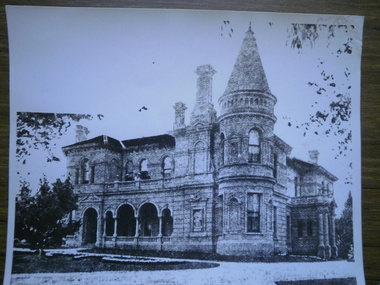
Article - Cantala
... ... Victoria Racing Club...Miller Septimus Salway Mr Miller Mrs Lauderdale Mr Redleap (horse) Echo (sculpture) Sleeping Ariadne (sculpture) Cantala Caulfield Caulfield North Dandenong Road Kooyong Road Wiora Australasian Punch Victoria Racing Club Photographs Towers Italianate style Mansions Balconies Stairs Drawing rooms Bay windows Architectural features Architecutral styles Gates Gardens Stables Art Sculpture Statutes Racehorses Horses Horseracing Business people Commerce Miller Helen Miller Damien garden parties social life and customs Article Cantala ...Two photocopied articles, including 3 original prints of photographs, all unattributed, about the house and property known as Cantala, owned by Septimus Miller. 1/The first article is from the Australasian newspaper, dated 18/03/1893, including two original prints (from 6 photographs in the article). The article is accompanied by one page of handwritten notes, undated and unattributed, detailing and summarising the Australasian article. 2/The second article (2 copies) is from Punch, dated 29/10/1903 and includes one original print (from 7 photographs in the article).miller septimus, salway mr, miller mrs, lauderdale mr, redleap (horse), echo (sculpture), sleeping ariadne (sculpture), cantala, caulfield, caulfield north, dandenong road, kooyong road, wiora, australasian, punch, victoria racing club, photographs, towers, italianate style, mansions, balconies, stairs, drawing rooms, bay windows, architectural features, architecutral styles, gates, gardens, stables, art, sculpture, statutes, racehorses, horses, horseracing, business people, commerce, miller helen, miller damien, garden parties, social life and customs -
Friends of Ballarat Botanical Gardens History Group
Work on paper - William Cross Yuille (28/3/1819 - 19/7/1894), Life, Work and Legacy, 20/11/2011
... ...Victoria Racing Club...John Garner Doctor John Garner Lake Wendouree Yuille's Swamp Black Swamp Ballarat Botanic Gardens Friends of Ballarat Botanical Gardens William Cross Yuille Grazier Explorer Pioneer Scot Horse Trainer Victoria Racing Club Squatter Gardens Ballarat John Garner Collection None 2 pages of print Life, Work and Legacy. ...The Black Swamp in western Ballarat frequently ca to be called Yuille's Swamp and in time, Lake Wendouree.William Yuille had a station, south of the Swamp, which became part of the gold rush settlement of Ballarat in 1838.2 pages of printNonejohn garner, doctor john garner, lake wendouree, yuille's swamp, black swamp, ballarat botanic gardens, friends of ballarat botanical gardens, william cross yuille, grazier, explorer, pioneer, scot, horse trainer, victoria racing club, squatter, gardens, ballarat, john garner collection -
 Bendigo Historical Society Inc.
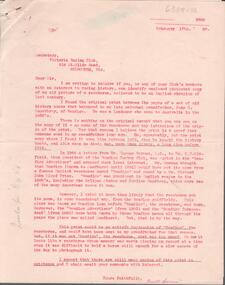
Letter - Bendigo the Racehorse, 17th Fabruary 1968
... Two letters: red text carbon copy of letter sent to Secretary, Victoria Racing Club, 418 St. Kilda Road, Melbourne, February 17th, 1968 by Harold Curnow. ...Second letter from Victoria Racing Club, Melbourne to Mr. Harold Curnow, P.O. ...William Abednego Thompson (11 October 1811 – 23 August 1880), also known as Bendigo Thompson, was an English bare-knuckle boxer who won the heavyweight championship of England from James Burke on 12 February 1839.[3] He was inducted into The Ring magazine Hall of Fame in 1955, the International Boxing Hall of Fame in 1991[3] and the Bare Knuckle Boxing Hall of Fame in 2011. His nickname of "Bendigo" lives on in the name of a city and creek in Australia. (Wikipedia)Two letters: red text carbon copy of letter sent to Secretary, Victoria Racing Club, 418 St. Kilda Road, Melbourne, February 17th, 1968 by Harold Curnow. Harold discusses the original print of the racehorse 'Bendigo', that he found 'between the pages of a set of old history books that belonged to my late maternal grandfather, John G. Sauerbray, of Bendigo'. Second letter from Victoria Racing Club, Melbourne to Mr. Harold Curnow, P.O. Box 96, Bendigo. Vic. regarding 'Bendigo' the racehorse and his inability to identify the horse in question. Written in pencil on fleft hand side: 'Question for B'go Ad?'abednego thompson, william thompson, naming of bendigo, harold curnow, racehorse -
Glen Eira Historical Society
Article - Freedman, Harold
... An ‘Age’ newspaper article dated 9/10/1985, about painter Harold Freedman, photographed with his mural about the history of racing, commissioned by Victoria Racing Club....An ‘Age’ newspaper article dated 9/10/1985, about painter Harold Freedman, photographed with his mural about the history of racing, commissioned by Victoria Racing Club. Freedman Harold Murals Painting Art Artists Racecourses Horse Racing Article Freedman, Harold ...An ‘Age’ newspaper article dated 9/10/1985, about painter Harold Freedman, photographed with his mural about the history of racing, commissioned by Victoria Racing Club.freedman harold, murals, painting, art, artists, racecourses, horse racing -
 Victorian Harness Racing Heritage Collection at Lord's Raceway Bendigo
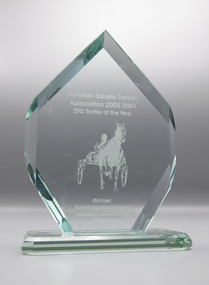
Memorabilia - Glass trophy, Sumthingaboutmaori, 2000-2001 Victorian Square Trotters Association 2yo Trotter of the Year
... Victorian Square Trotters Association 2000-2001 / 2yo Trotter of the Year / Winner / Sumthingaboutmaori / Donated by Victoria Harness Racing Club...Won on 9 Tracks: Moonee Valley (10) Bendigo (5) Maryborough (5) Kilmore (3) Geelong (3) Shepparton (2) Cranbourne (1) Horsham (1) Globe Derby SA (1) 2000-2001 Victorian Square Trotters Association 2yo Trotter of the Year Trophy won by Sumthingaboutmaori. 2yo Season record 4 wins 1 second 2 thirds 8 starts $14,505 2.05.4 trotting harness racing sumthingaboutmaori 2yo trotter of the year victorian square trotters association 2000-2001 award trophy gavin lang g lang br healy bryan healy r healy ric healy b healy r mcd healy Victorian Square Trotters Association 2000-2001 / 2yo Trotter of the Year / Winner / Sumthingaboutmaori / Donated by Victoria Harness Racing Club Glass plaque Sumthingaboutmaori, 2000-2001 Victorian Square Trotters Association 2yo Trotter of the Year Memorabilia Glass trophy ...Sumthingaboutmaori (Pine Chip Imp Tr 1.51.0 - Maori Princess Vic Tr 2.45 (Entrepreneur)) Bay Mare. Foaled 1998 (4th Foal). Breder/Owner: R McD Healy. Trainer BR Healy. Sumthingaboutmaori raced from 2001 (2yo) through to 2006 (7yo). Career: 31 wins 8 seconds 8 thirds 75 starts $461,499 2.00.9 Winning Drivers: Gavin Lang (26) BR Healy (3) DK Douglas (1) JJ Caldow (1). Won on 9 Tracks: Moonee Valley (10) Bendigo (5) Maryborough (5) Kilmore (3) Geelong (3) Shepparton (2) Cranbourne (1) Horsham (1) Globe Derby SA (1)2000-2001 Victorian Square Trotters Association 2yo Trotter of the Year Trophy won by Sumthingaboutmaori. 2yo Season record 4 wins 1 second 2 thirds 8 starts $14,505 2.05.4Glass plaqueVictorian Square Trotters Association 2000-2001 / 2yo Trotter of the Year / Winner / Sumthingaboutmaori / Donated by Victoria Harness Racing Clubtrotting, harness racing, sumthingaboutmaori, 2yo trotter of the year, victorian square trotters association, 2000-2001, award, trophy, gavin lang, g lang, br healy, bryan healy, r healy, ric healy, b healy, r mcd healy -
 Eltham District Historical Society Inc
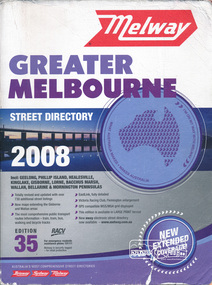
Book, Melway Greater Melbourne street directory 2008 : including Geelong, Phillip Island, Healesville, Kinglake, Gisborne, Lorne, Bacchus March, Wallan, Bellarine & Mornington Peninsulas; Edition 35, 2008, 2007
... Eastlink fully detailed, Victoria Racing Club, Flemington enlargement, GPS compatible WGS/MGA Grid displayed, This editon is available in LARGE PRINT format, new eway electronic street directory now available - www.melway.com.au Special feature: New Hierachy of Roads ...Eastlink fully detailed, Victoria Racing Club, Flemington enlargement, GPS compatible WGS/MGA Grid displayed, This editon is available in LARGE PRINT format, new eway electronic street directory now available - www.melway.com.au Special feature: New Hierachy of Roads streets,roads,melbourne,map,melway Street directory, coloured maps, indexes, 1201 pages Melway Greater Melbourne street directory 2008 : including Geelong, Phillip Island, Healesville, Kinglake, Gisborne, Lorne, Bacchus March, Wallan, Bellarine & Mornington Peninsulas; Edition 35, 2008 Book Melway Publishing ...Edition 35. 2008 Coloured detailed maps accessed by a street or location index. Cover: Totally revised and updated with over 730 additional street listings, new maps extending the Gisbourne and Wallan areas. The most comprehensive public transport routes information - train, tram, bus, walking and bicycle tracks. Eastlink fully detailed, Victoria Racing Club, Flemington enlargement, GPS compatible WGS/MGA Grid displayed, This editon is available in LARGE PRINT format, new eway electronic street directory now available - www.melway.com.au Special feature: New Hierachy of Roads Street directory, coloured maps, indexes, 1201 pagesstreets,roads,melbourne,map,melway -
 Flagstaff Hill Maritime Museum and Village
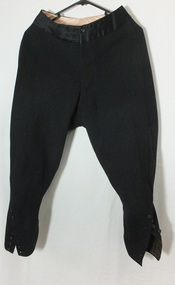
Clothing - Riding Habit, Jodhpurs, 1920s
... Though an offer to build public baths to commemorate the Queen Victoria Jubilee in 1897 was not proceeded with, the town acquired a hospital, a reserve on Mount Leura, a clock tower and a cricket pavilion, as well as notable donations from the Manifolds to St Paul's Church and the grammar school. Edward was a keen polo player and racing man. He was also a successful owner of steeplechasers and a committeeman of the Victoria Racing Club...Though an offer to build public baths to commemorate the Queen Victoria Jubilee in 1897 was not proceeded with, the town acquired a hospital, a reserve on Mount Leura, a clock tower and a cricket pavilion, as well as notable donations from the Manifolds to St Paul's Church and the grammar school. Edward was a keen polo player and racing man. He was also a successful owner of steeplechasers and a committeeman of the Victoria Racing Club ...The Manifolds were a significant pioneering pastoral family in Western Victoria. The donated riding jodhpurs originally belonged to Mrs Edward Manifold, formally Beatrice Mary Synnot Anderson. Beatrice was Edward Manifold’s cousin once removed whom he married in 1900. Edward, the son of John Manifold, was born on 15 November 1868 and educated at Geelong and Melbourne Grammar schools and at Trinity Hall, Cambridge (B.A., 1891). He chose the Danedite portion of land at Purrumbete, and on the death of his bachelor brother Thomas Peter (1863-1895), after a hunting accident, he took over his allocation, Wiridgil. He also owned Boortkoi, near Hexham and on these properties, he ran merino sheep, a Lincoln stud which dated back to 1870, and Shorthorn cattle. 3000 acres were also leased to dairy farmers. Edward was a member of Hampden Shire Council in 1909-31 and three times president at Camperdown. The town was largely bordered by Manifold land and partly dependent upon the local pastoral dynasties, which benefited the local area from the families’ various business interests. Though an offer to build public baths to commemorate the Queen Victoria Jubilee in 1897 was not proceeded with, the town acquired a hospital, a reserve on Mount Leura, a clock tower and a cricket pavilion, as well as notable donations from the Manifolds to St Paul's Church and the grammar school. Edward was a keen polo player and racing man. He was also a successful owner of steeplechasers and a committeeman of the Victoria Racing Club for many years. He was also a member of many Western District racing clubs. On the 16 July 1900, Edward had married his sixteen-year-old cousin Beatrice Mary Synnot Anderson by whom he had three sons Thomas Peter, Andrew and Robert Edward Manifold. Edwards's estate at his death was valued for probate at nearly £500,000. Edward died following an operation on 14 February 1931 at a private hospital in Yarra Vale Melbourne. Beatrice passed away in 1954, aged 79 in Ballarat where she was born in 1874. Contextual historic Family background: The Manifold brothers Thomas (1809-1875), John (1811-1877) and Peter (1817-1885) were the fourth, fifth and sixth sons of William Manifold and Mary, nee Barnes, of Courthouse Farm, Bromborough, Cheshire, England. The family had decided to emigrate to Van Diemen's Land. Thomas was sent ahead, arriving in Hobart Town on 23rd January 1828 with £1500 and a letter of recommendation from the Colonial Office. Thomas acquired 1280 acres on the west bank of the Tamar River. John and Peter, with their parents and three sisters, arrived on 8th July 1831. Land grants by then had finished but William brought ninety acres next to his son Thomas’ land and on the combined properties the family built Kelso House. The Manifolds’ properties were comparatively poor and when news of the Port Phillip District, in Victoria reached Thomas, he lost no time in coming to see for himself in February 1836. He was impressed with what he saw and hurried back to Tasmania to buy lambs and ewes. With one of his brothers, on July 9th he landed his stores at Point Henry and proceeded to occupy both sides of the Moorabool River. Thomas, at the end of the year, returned to Tasmania and left Peter and John to run the new property. Thomas, however, returned to Victoria for several visits and on one of these visits he, along with his brothers, examined the country near Ballarat. In December 1838 they managed to penetrate the Stony Rises, and Peter and John reached Lake Purrumbete and the Mount Leura country. During this time, on 4th July 1838, Thomas married Jane Elizabeth, eldest daughter of Captain Walter Synnot, formerly of Ballinate, County Armagh, Ireland, and then of Van Diemen's Land. Thomas joined his brothers, and they occupied the Purrumbete run in January 1839. On the journey to Purrumbete they could not take their stock and drays through the Stony Rises, so went north of Lake Corangamite, to the neck of land between it and Lake Gnarpurt. By April the move from Moorabool area was complete. As yet they had no hut and were working day and night, but their delight in their new run was unbounded. John wrote to his mother: “We are at last got to the land we wished for it is a beautiful place, and cannot be surpassed by any I have ever seen”. The three brothers occupied Purrumbete together, breeding both sheep and cattle until Thomas went to Grassmere run on the Merri River near Warrnambool in 1844. John and Peter soon gave up breeding sheep but retained the well-known '3M' brand for the cattle. These were Shorthorns, derived from four bulls originally imported by the Boldon brothers and later improved by further importations, and were renowned for size and quality. By the time of the gold rush in 1851, John and Peter were breeding over 1000 head a year, as well as fattening stores. The diggings at this time had disorganised Grassmere by drawing away Thomas's men, and his wife decided to take her two sons and two daughters to Europe for their education. Thomas gave up the property next year, went to England to join his family, and eventually brought the family back to live in Melbourne. At Purrumbete things were different. The brothers, John and Peter, preferred black stockmen to white, so the discovery of gold upset them very little while providing the very market they required. John was on his second visit to England when the rush started, and Peter went in his turn soon after John returned. On 2 September 1856 John married Marion Thomson, at Cormiston, Van Diemen's Land. They had four daughters and five sons, from three of whom, William Thomson, James Chester and Edward, the later generations of the family descend. Through the years the brothers had to contend with the scab, fluke and footrot, depression, rabbits, bush fires and pleuro-pneumonia. In 1861 they appointed as manager Henry Manifold Matson, their nephew, who had already been with them for five years. Thomas died in Melbourne on 7 November 1875, John at Purrumbete on 3 January 1877 and Peter at Purrumbete on 31 July 1885. Devout members of the Church of England, John and Peter, during their lives, gave generously towards building St Paul's Church, Camperdown, and guaranteed part of the vicar's stipend. Peter was a member of the Hampden and Heytesbury Roads Board from 1859 and carried on into the Hampden Shire Council when it was formed in 1864. However, it was not for public works that they were known, but for their personal example. In a new land where speculators and adventurers were all too common, the Manifold brothers were among those who intended it to be their home and their children's home. Industrious, unpretentious and hospitable, they were respected in their community as men of the highest integrity. This riding habit is a characteristic example of the type and style of riding clothes that well-dressed ladies wore in the 1920s. It highlights the changes that were beginning in society for women. Prior to 1918 ladies still had to ride side-saddle with skirts over Jodhpurs. Society of the time regarded women riding astride as unseemly and just not done. This riding habit is particularly significant on a number of levels, it shows the beginnings of change in society's attitudes through women's fashion after the First World War. A change that was to bring a start to a more liberating societal attitude towards women after the successful establishment of the Representation of People Act 1918 that gave women the right to vote. This garments provenance is linked to one of Victoria's important pioneering families the Manifolds, one of the first families that came from Van Diemen's land to settle the Western District of Victoria in 1844. Originally the garment belonged to the wife of the great-grandson of pioneer William Manifold, Edward Manifold who married Beatrice May Synnot Anderson, Edwards Cousin in 1900. The garment was made by the Mayfair tailors J. Busvine & Co. in the early to mid-1920s (estimate) who at the turn of the century were tailors to the Courts of Europe. Their clothing is highly collectible today and examples can be found in a number of significant museum collections around the world, notably the Metropolitan Museum of Art in New York and the FIDM in Los Angeles. Jodhpurs, part of a three-piece, side saddle riding habit tailored for Mrs Edward Manifold, with four buttons to the front material black woolen twill the legs are cuffed below the knee with 8 buttons holes which are reinforced to the inside with fabric. Cream Satin waistband and removable chamois lining to the seat makers label Busvines Co. tailored for Mrs Edward Manifold.Embroidered in blue on a Satin Cream label to Jodhpurs "Busvine Ltd / 4, Brook St, London. W. No." Hand written in black ink script "523/ Mrs Edward Manifold"flagstaff hill, warrnambool, shipwrecked coast, flagstaff hill maritime museum, maritime museum, side saddle riding habit, side saddle riding outfit, breeches, mrs edward manifold, beatrice manifold, shipwreck coast, flagstaff hill maritime village, great ocean road -
 Flagstaff Hill Maritime Museum and Village
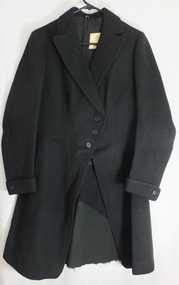
Clothing - Riding Habit, jacket, Early 20th Century
... Though an offer to build public baths to commemorate the Queen Victoria Jubilee in 1897 was not proceeded with, the town acquired a hospital, a reserve on Mount Leura, a clock tower and a cricket pavilion, as well as notable donations from the Manifolds to St Paul's Church and the grammar school. Edward was a keen polo player and racing man. He was also a successful owner of steeplechasers and a committeeman of the Victoria Racing Club...Though an offer to build public baths to commemorate the Queen Victoria Jubilee in 1897 was not proceeded with, the town acquired a hospital, a reserve on Mount Leura, a clock tower and a cricket pavilion, as well as notable donations from the Manifolds to St Paul's Church and the grammar school. Edward was a keen polo player and racing man. He was also a successful owner of steeplechasers and a committeeman of the Victoria Racing Club ...The Manifolds were a significant pioneering pastoral family in Western Victoria. The donated riding jacket originally belonged to Mrs Edward Manifold, formally Beatrice Mary Synnot Anderson. Beatrice was Edward Manifold’s cousin once removed whom he married in 1900. Edward, the son of John Manifold, was born on 15 November 1868 and educated at Geelong and Melbourne Grammar schools and at Trinity Hall, Cambridge (B.A., 1891). He chose the Danedite portion of land at Purrumbete, and on the death of his bachelor brother Thomas Peter (1863-1895), after a hunting accident, he took over his allocation, Wiridgil. He also owned Boortkoi, near Hexham and on these properties, he ran merino sheep, a Lincoln stud which dated back to 1870, and Shorthorn cattle. 3000 acres were also leased to dairy farmers. Edward was a member of Hampden Shire Council in 1909-31 and three times president at Camperdown. The town was largely bordered by Manifold land and partly dependent upon the local pastoral dynasties, which benefited the local area from the families’ various business interests. Though an offer to build public baths to commemorate the Queen Victoria Jubilee in 1897 was not proceeded with, the town acquired a hospital, a reserve on Mount Leura, a clock tower and a cricket pavilion, as well as notable donations from the Manifolds to St Paul's Church and the grammar school. Edward was a keen polo player and racing man. He was also a successful owner of steeplechasers and a committeeman of the Victoria Racing Club for many years. He was also a member of many Western District racing clubs. On the 16 July 1900, Edward had married his sixteen-year-old cousin Beatrice Mary Synnot Anderson by whom he had three sons Thomas Peter, Andrew and Robert Edward Manifold. Edwards's estate at his death was valued for probate at nearly £500,000. Edward died following an operation on 14 February 1931 at a private hospital in Yarra Vale Melbourne. Beatrice passed away in 1954, aged 79 in Ballarat where she was born in 1874. Contextual historic Family background: The Manifold brothers Thomas (1809-1875), John (1811-1877) and Peter (1817-1885) were the fourth, fifth and sixth sons of William Manifold and Mary, nee Barnes, of Courthouse Farm, Bromborough, Cheshire, England. The family had decided to emigrate to Van Diemen's Land. Thomas was sent ahead, arriving in Hobart Town on 23rd January 1828 with £1500 and a letter of recommendation from the Colonial Office. Thomas acquired 1280 acres on the west bank of the Tamar River. John and Peter, with their parents and three sisters, arrived on 8th July 1831. Land grants by then had finished but William brought ninety acres next to his son Thomas’ land and on the combined properties the family built Kelso House. The Manifolds’ properties were comparatively poor and when news of the Port Phillip District, in Victoria reached Thomas, he lost no time in coming to see for himself in February 1836. He was impressed with what he saw and hurried back to Tasmania to buy lambs and ewes. With one of his brothers, on July 9th he landed his stores at Point Henry and proceeded to occupy both sides of the Moorabool River. Thomas, at the end of the year, returned to Tasmania and left Peter and John to run the new property. Thomas, however, returned to Victoria for several visits and on one of these visits he, along with his brothers, examined the country near Ballarat. In December 1838 they managed to penetrate the Stony Rises, and Peter and John reached Lake Purrumbete and the Mount Leura country. During this time, on 4th July 1838, Thomas married Jane Elizabeth, eldest daughter of Captain Walter Synnot, formerly of Ballinate, County Armagh, Ireland, and then of Van Diemen's Land. Thomas joined his brothers, and they occupied the Purrumbete run in January 1839. On the journey to Purrumbete they could not take their stock and drays through the Stony Rises, so went north of Lake Corangamite, to the neck of land between it and Lake Gnarpurt. By April the move from Moorabool area was complete. As yet they had no hut and were working day and night, but their delight in their new run was unbounded. John wrote to his mother: “We are at last got to the land we wished for it is a beautiful place, and cannot be surpassed by any I have ever seen”. The three brothers occupied Purrumbete together, breeding both sheep and cattle until Thomas went to Grassmere run on the Merri River near Warrnambool in 1844. John and Peter soon gave up breeding sheep but retained the well-known '3M' brand for the cattle. These were Shorthorns, derived from four bulls originally imported by the Boldon brothers and later improved by further importations, and were renowned for size and quality. By the time of the gold rush in 1851, John and Peter were breeding over 1000 head a year, as well as fattening stores. The diggings at this time had disorganised Grassmere by drawing away Thomas's men, and his wife decided to take her two sons and two daughters to Europe for their education. Thomas gave up the property next year, went to England to join his family, and eventually brought the family back to live in Melbourne. At Purrumbete things were different. The brothers, John and Peter, preferred black stockmen to white, so the discovery of gold upset them very little while providing the very market they required. John was on his second visit to England when the rush started, and Peter went in his turn soon after John returned. On 2 September 1856 John married Marion Thomson, at Cormiston, Van Diemen's Land. They had four daughters and five sons, from three of whom, William Thomson, James Chester and Edward, the later generations of the family descend. Through the years the brothers had to contend with the scab, fluke and footrot, depression, rabbits, bush fires and pleuro-pneumonia. In 1861 they appointed as manager Henry Manifold Matson, their nephew, who had already been with them for five years. Thomas died in Melbourne on 7 November 1875, John at Purrumbete on 3 January 1877 and Peter at Purrumbete on 31 July 1885. Devout members of the Church of England, John and Peter, during their lives, gave generously towards building St Paul's Church, Camperdown, and guaranteed part of the vicar's stipend. Peter was a member of the Hampden and Heytesbury Roads Board from 1859 and carried on into the Hampden Shire Council when it was formed in 1864. However, it was not for public works that they were known, but for their personal example. In a new land where speculators and adventurers were all too common, the Manifold brothers were among those who intended it to be their home and their children's home. Industrious, unpretentious and hospitable, they were respected in their community as men of the highest integrity. This riding habit is a characteristic example of the type and style of riding clothes that well-dressed ladies wore in the 1920s. It highlights the changes that were beginning in society for women. Prior to 1918 ladies still had to ride side-saddle with skirts over Jodhpurs. Society of the time regarded women riding astride as unseemly and just not done. This riding habit is particularly significant on a number of levels, it shows the beginnings of change in society's attitudes through women's fashion after the First World War. A change that was to bring a start to a more liberating societal attitude towards women after the successful establishment of the Representation of People Act 1918 that gave women the right to vote. This garments provenance is linked to one of Victoria's important pioneering families the Manifolds, one of the first families that came from Van Diemen's land to settle the Western District of Victoria in 1844. Originally the garment belonged to the wife of the great-grandson of pioneer William Manifold, Edward Manifold who married Beatrice May Synnot Anderson, Edwards Cousin in 1900. The garment was made by the Mayfair tailors J. Busvine & Co. in the early to mid-1920s (estimate) who at the turn of the century were tailors to the Courts of Europe. Their clothing is highly collectible today and examples can be found in a number of significant museum collections around the world, notably the Metropolitan Museum of Art in New York and the FIDM in Los Angeles. A riding jacket, part of a three-piece, side saddle riding habit tailored for Mrs Edward Manifold. Knee length English woolen jacket black in colour, seamed and fitted to the female client's figure, fastening from the waist with three bone buttons to rather high lapels. The sleeves are long with closely fitted cuffs and one button and lined with cream satin. The jacket is fitted to the waist and flared to below the hips with a 35 cm vent to the back. Lower back to the jacket is reinforced with removable fabric and the jacket is lined with black twill cotton, there is a cream satin label, with makers' emblem Busvine. Circa 1920s Label to Jacket Embroidered in gold with a Royal logo on a Cream Satin label “By Special /Appointment” “To Her Majesty/The Queen”, “Busvine / Ltd / London 4 Brook St. W. / No” “hand written in purple ink 315 / Mrs Edward Manifold”flagstaff hill, warrnambool, shipwrecked coast, flagstaff hill maritime museum, maritime museum, side saddle riding habit, mrs edward manifold, edward manifold, busvines, shipwreck coast, flagstaff hill maritime village, great ocean road -
 Flagstaff Hill Maritime Museum and Village
Clothing - Riding Habit, Skirt, 1920s
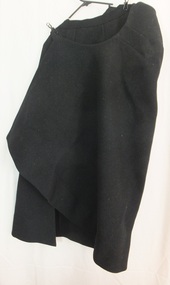
... Though an offer to build public baths to commemorate the Queen Victoria Jubilee in 1897 was not proceeded with, the town acquired a hospital, a reserve on Mount Leura, a clock tower and a cricket pavilion, as well as notable donations from the Manifolds to St Paul's Church and the grammar school. Edward was a keen polo player and racing man. He was also a successful owner of steeplechasers and a committeeman of the Victoria Racing Club...Though an offer to build public baths to commemorate the Queen Victoria Jubilee in 1897 was not proceeded with, the town acquired a hospital, a reserve on Mount Leura, a clock tower and a cricket pavilion, as well as notable donations from the Manifolds to St Paul's Church and the grammar school. Edward was a keen polo player and racing man. He was also a successful owner of steeplechasers and a committeeman of the Victoria Racing Club ...The Manifolds were a significant pioneering pastoral family in Western Victoria. The donated riding skirt originally belonged to Mrs Edward Manifold, formally Beatrice Mary Synnot Anderson. Beatrice was Edward Manifold’s cousin once removed whom he married in 1900. Edward, the son of John Manifold, was born on 15 November 1868 and educated at Geelong and Melbourne Grammar schools and at Trinity Hall, Cambridge (B.A., 1891). He chose the Danedite portion of land at Purrumbete, and on the death of his bachelor brother Thomas Peter (1863-1895), after a hunting accident, he took over his allocation, Wiridgil. He also owned Boortkoi, near Hexham and on these properties, he ran merino sheep, a Lincoln stud which dated back to 1870, and Shorthorn cattle. 3000 acres were also leased to dairy farmers. Edward was a member of Hampden Shire Council in 1909-31 and three times president at Camperdown. The town was largely bordered by Manifold land and partly dependent upon the local pastoral dynasties, which benefited the local area from the families’ various business interests. Though an offer to build public baths to commemorate the Queen Victoria Jubilee in 1897 was not proceeded with, the town acquired a hospital, a reserve on Mount Leura, a clock tower and a cricket pavilion, as well as notable donations from the Manifolds to St Paul's Church and the grammar school. Edward was a keen polo player and racing man. He was also a successful owner of steeplechasers and a committeeman of the Victoria Racing Club for many years. He was also a member of many Western District racing clubs. On the 16 July 1900, Edward had married his sixteen-year-old cousin Beatrice Mary Synnot Anderson by whom he had three sons Thomas Peter, Andrew and Robert Edward Manifold. Edwards's estate at his death was valued for probate at nearly £500,000. Edward died following an operation on 14 February 1931 at a private hospital in Yarra Vale Melbourne. Beatrice passed away in 1954, aged 79 in Ballarat where she was born in 1874. Contextual historic Family background: The Manifold brothers Thomas (1809-1875), John (1811-1877) and Peter (1817-1885) were the fourth, fifth and sixth sons of William Manifold and Mary, nee Barnes, of Courthouse Farm, Bromborough, Cheshire, England. The family had decided to emigrate to Van Diemen's Land. Thomas was sent ahead, arriving in Hobart Town on 23rd January 1828 with £1500 and a letter of recommendation from the Colonial Office. Thomas acquired 1280 acres on the west bank of the Tamar River. John and Peter, with their parents and three sisters, arrived on 8th July 1831. Land grants by then had finished but William brought ninety acres next to his son Thomas’ land and on the combined properties the family built Kelso House. The Manifolds’ properties were comparatively poor and when news of the Port Phillip District, in Victoria reached Thomas, he lost no time in coming to see for himself in February 1836. He was impressed with what he saw and hurried back to Tasmania to buy lambs and ewes. With one of his brothers, on July 9th he landed his stores at Point Henry and proceeded to occupy both sides of the Moorabool River. Thomas, at the end of the year, returned to Tasmania and left Peter and John to run the new property. Thomas, however, returned to Victoria for several visits and on one of these visits he, along with his brothers, examined the country near Ballarat. In December 1838 they managed to penetrate the Stony Rises, and Peter and John reached Lake Purrumbete and the Mount Leura country. During this time, on 4th July 1838, Thomas married Jane Elizabeth, eldest daughter of Captain Walter Synnot, formerly of Ballinate, County Armagh, Ireland, and then of Van Diemen's Land. Thomas joined his brothers, and they occupied the Purrumbete run in January 1839. On the journey to Purrumbete they could not take their stock and drays through the Stony Rises, so went north of Lake Corangamite, to the neck of land between it and Lake Gnarpurt. By April the move from Moorabool area was complete. As yet they had no hut and were working day and night, but their delight in their new run was unbounded. John wrote to his mother: “We are at last got to the land we wished for it is a beautiful place, and cannot be surpassed by any I have ever seen”. The three brothers occupied Purrumbete together, breeding both sheep and cattle until Thomas went to Grassmere run on the Merri River near Warrnambool in 1844. John and Peter soon gave up breeding sheep but retained the well-known '3M' brand for the cattle. These were Shorthorns, derived from four bulls originally imported by the Boldon brothers and later improved by further importations, and were renowned for size and quality. By the time of the gold rush in 1851, John and Peter were breeding over 1000 head a year, as well as fattening stores. The diggings at this time had disorganised Grassmere by drawing away Thomas's men, and his wife decided to take her two sons and two daughters to Europe for their education. Thomas gave up the property next year, went to England to join his family, and eventually brought the family back to live in Melbourne. At Purrumbete things were different. The brothers, John and Peter, preferred black stockmen to white, so the discovery of gold upset them very little while providing the very market they required. John was on his second visit to England when the rush started, and Peter went in his turn soon after John returned. On 2 September 1856 John married Marion Thomson, at Cormiston, Van Diemen's Land. They had four daughters and five sons, from three of whom, William Thomson, James Chester and Edward, the later generations of the family descend. Through the years the brothers had to contend with the scab, fluke and footrot, depression, rabbits, bush fires and pleuro-pneumonia. In 1861 they appointed as manager Henry Manifold Matson, their nephew, who had already been with them for five years. Thomas died in Melbourne on 7 November 1875, John at Purrumbete on 3 January 1877 and Peter at Purrumbete on 31 July 1885. Devout members of the Church of England, John and Peter, during their lives, gave generously towards building St Paul's Church, Camperdown, and guaranteed part of the vicar's stipend. Peter was a member of the Hampden and Heytesbury Roads Board from 1859 and carried on into the Hampden Shire Council when it was formed in 1864. However, it was not for public works that they were known, but for their personal example. In a new land where speculators and adventurers were all too common, the Manifold brothers were among those who intended it to be their home and their children's home. Industrious, unpretentious and hospitable, they were respected in their community as men of the highest integrity. This riding habit is a characteristic example of the type and style of riding clothes that well-dressed ladies wore in the 1920s. It highlights the changes that were beginning in society for women. Prior to 1918 ladies still had to ride side-saddle with skirts over Jodhpurs. Society of the time regarded women riding astride as unseemly and just not done. This riding habit is particularly significant on a number of levels, it shows the beginnings of change in society's attitudes through women's fashion after the First World War. A change that was to bring a start to a more liberating societal attitude towards women after the successful establishment of the Representation of People Act 1918 that gave women the right to vote. This garments provenance is linked to one of Victoria's important pioneering families the Manifolds, one of the first families that came from Van Diemen's land to settle the Western District of Victoria in 1844. Originally the garment belonged to the wife of the great-grandson of pioneer William Manifold, Edward Manifold who married Beatrice May Synnot Anderson, Edwards Cousin in 1900. The garment was made by the Mayfair tailors J. Busvine & Co. in the early to mid-1920s (estimate) who at the turn of the century were tailors to the Courts of Europe. Their clothing is highly collectible today and examples can be found in a number of significant museum collections around the world, notably the Metropolitan Museum of Art in New York and the FIDM in Los Angeles. Safety skirt/apron, part of a three-piece, side saddle riding habit tailored for Mrs Edward Manifold. This side saddle skirt is made from black woolen material fixing at the waist with two metal hooks and three buttons to the front opening. One internal concealed pocket lining to the top part of the apron made of cotton the seat is shaped for side saddle riding and the skirt wraps around the body the longer side draped over the leg that is in the stirrup. flagstaff hill, warrnambool, shipwrecked coast, flagstaff hill maritime museum, maritime museum, side saddle riding habit, side saddle safety skirt, side saddle apron, mrs edward manifold, beatrice manifold, female riding habit 1920s, shipwreck coast, flagstaff hill maritime village, great ocean road -
 Flagstaff Hill Maritime Museum and Village
Craft - Ship Model, Whaleboat, Wally St John (ship model maker), New Bedford, 1988
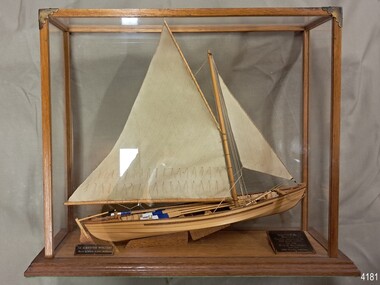
... racing began in 1805 with a race between America and Britain. The City of Warrnambool Rowing Club started the whaleboat race in 1986 as part of the Wunta festival, and a Whaleboat Club was soon formed. The race is held on the Hopkins River. The ship model of the whaleboat, New Bedford, is significant because it represents vessels used in the early industry of whaling in southwest Victoria ...The whaleboat model was built for the 1988 Warrnambool Wunta Festival by Wally St John, of Melbourne. Its name comes from the port of New Bedford in Massachusetts, America. Coastal whaling in the area began in the 17th Century, and by the mid-18th century, it was performed on a large scale. The town is renowned for the author, Herman Melville, who sailed out on the whaler "Acushnet" in 1841. When he returned, he published his book about the great white whale "Moby Dick". The Wunta Festival began in 1985. In 1988, it was sponsored by the Warrnambool City Council and Mr. Alan Lane, a Warrnambool businessman who served on the Council for 18 years. The festival is held on the first weekend in February and involves the whole community. One of the activities is the Whaleboat Race. International whaleboat racing began in 1805 with a race between America and Britain. The City of Warrnambool Rowing Club started the whaleboat race in 1986 as part of the Wunta festival, and a Whaleboat Club was soon formed. The race is held on the Hopkins River. The ship model of the whaleboat, New Bedford, is significant because it represents vessels used in the early industry of whaling in southwest Victoria. It is also representative of the centuries-old craft of ship model making. It is important for its connection to the Wunta Festival, a Warrnambool community event. It is connected to Mr. Alan L Lane, whose estate generously funded the Alan Lane Foundation for the continuous support and funding of local community events and activities. Ship model of a whaleboat. The boat has two fabric sails, a tiller, and four wooden oars with blue and white sections painted on the blades. The model is mounted on a wooden stand inside a glass case with a wooden frame. Two gold embossed black plaques are on the base of the case, on the front. The plaques have decorative borders and inscriptions. The model of the New Bedford Whaleboat, built by Wally St John, Melbourne, was made for the 1988 WUNTA Festival in Warrnambool. Left plaque: "THE NEW BEDFORD WHALEBOAT / Built by Wally St John Melbourne" Right plaque: "]Logo of a Triangle with "WUNTA festival" "Proudly sponsored by Mr. ALAN LANE for the City of Warrnambool and 1988 Wunta Festival"flagstaff hill, flagstaff hill maritime museum and village, warrnambool, maritime museum, maritime village, great ocean road, shipwreck coast, whaleboat, ship model, vessel, 1988, wunta, wunta festival, wally st john, melbourne, new bedford, massachusetts, america, coastal whaling, herman melville, acushnet, alan lane, alan lane foundation, councillor, whaleboat race, warrnambool rowing club, hopkins river -
 Flagstaff Hill Maritime Museum and Village
Document - Framed Poster, Borough of Warrnambool, Victoria, Australia, after 30/06/1875
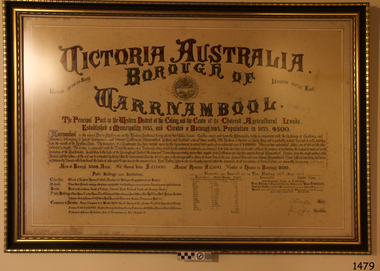
... Victoria, National Bank, Colonial Bank and Savings Bank. Public Buildings. Court house, Custom house, Post & Telegraph Offices, Survey & Land Offices, Shire £, Town Hall, Mechanics Institute, Volunteer Orderly Room, Odd Fellows Hall, Hospital & Benevolent Asylum, Temperance Hall &c. Companies & Societies. Steam Navigation Co, Woolen Mill Co, Gas Co, Racing Club...Victoria, National Bank, Colonial Bank and Savings Bank. Public Buildings. Court house, Custom house, Post & Telegraph Offices, Survey & Land Offices, Shire £, Town Hall, Mechanics Institute, Volunteer Orderly Room, Odd Fellows Hall, Hospital & Benevolent Asylum, Temperance Hall &c. Companies & Societies. Steam Navigation Co, Woolen Mill Co, Gas Co, Racing Club ...This document, also referred to as a word picture or Tablet, is framed in glass and timber with gilt trim, is handwritten with colour highlights. The penned letters rest on ruled guide lines, decorated where the lines intersect. The writing gives a description of the state of Borough of Warrnambool around 1875; its location, the area it covers, its population, Harbour and facilities, public buildings and institutions, imports and exports, financial worth, number of houses, connection with other areas of the Colony. A possible reason and origin for the document is found in an article ‘Link with US Exhibition’ from the Warrnambool Standard of December 19, 1981, written by local historian Bruce Morris. The writer mentions that the Warrnambool Borough Council met on 15th June 1875 and recorded a letter from G.C. Levey , secretary to the Melbourne group of commissioners representing the Colony, and Victoria in particular, for the Philadelphia Centennial Exhibition of 1876. The letter asks Council to provide “statistics as to the population, social condition and commercial and industrial state of the district in and around Warrnambool.” A sub committee was formed for the project. The Mayor, Cr. Thomas King, wrote and signed a Report, presented to the council on July 14, 1875, in which “The Committee … begs to recommend that a Tablet be prepared setting for the particulars respecting the following matters relating to the Borough”. The matters included area, population, annual income, churches, schools, other public buildings, societies and companies, general description of houses erected, and returns of exports and imports for 1874. The minutes note that the Report was adopted. The article above also notes the opinion of Warrnambool printers who have examined the document; it is almost certainly to be an old lithograph, which means there could be several copies. It is possible that there may be a copy in Melbourne and another in Philadelphia. It is interesting to note that (1) the quoted location co-ordinates are for an “Unnamed Road, Packsaddle NSW 2880, Australia”, and that the DMS co-ordinates for Warrnambool’s Council Offices differ, being 38.23.9.12 South, 142.28.52.887. (2) the date for “Exports and Imports for the Year Ending 30th June 1875” is different to the period mentioned by Cr. King in the sub committee’s Report of recommendation “returns of exports and imports for 1874”. The information required to have the figures for the end of June 1875 would need to have been compiled very quickly for the Tablet to be ready for the opening of the Philadelphia Exhibition on 10 May 1876. The document/certificate shows the following – - - - - - - - - - - - - - - -- - - - - - - - - - - - - - -- - - - - - - - - - - - - - -- - - - - - - - - - - - - - - “Victoria Australia, Borough of Warrnambool. Latitude, 30.24.50 South, Longitude 142.32 East The Principal Port in the Western District of the Colony and the Centre of its Choicest Agricultural Lands. Established a Municipality in 1855, and Created a Borough 1863. Population in 1875 4,500. Warrnambool is the nearest Port to Melbourne on the Western Seaboard, being about 160 miles distant. Coaches run to and from the Metropolis daily, in connexion [connection] with the Railway of Geelong and Steamers belonging to Local Companies sail between Melbourne, Warrnambool, Belfast [renamed Port Fairy], and Portland several times weekly. The Harbour is known as Lady Bay, and is partially protected by a reef of rocks stretching from the mouth of the Hopkins River. The formation of a Breakwater has been decided upon by the Government, to extend 600 yards, at an estimated cost of £100,000. There are two substantial Jetties, one of 800 and the other of 600 feet in length. The former is connected with the Town by means of a Tramroad, along which Goods, inwards & outwards, are conveyed, & the latter has been constructed solely for the purpose of facilitating the transit of material for the formation of the Breakwater. In addition to the trade of the Borough and District, the principal Townships up country receive their supplies from Melbourne and ship their exports through Warrnambool. Potatoes form the staple produce of the district, and the richness of the soil can be estimated by the fact that the Government Statistics for 1875 give as the average yield a return of Seven Tons to the acre. Several thousand acres between Warrnambool and Tower Hill are now being laid down in Potatoes by Tenants who have leased the lands at rates up to £5 per acre for the season 1875-6. Wool, Tallow, hides &c are also largely exported, while the shipments of all descriptions of Farm Produce are annually increasing. Area of Borough, 3362 Acres. Net Annual Value £27,000. Annual Revenue £5,500. Number of Houses in Borough 800. Public Buildings and Institutions Churches. Church of England, Roman Catholic, Presbyterian, Wesleyan, Congregational and Baptist. Schools. Three State Schools, average attendance nearly 1000. New Building in course of erection. Several private establishments. Banks. Bank of Australasia, Bank of Victoria, National Bank, Colonial Bank and Savings Bank. Public Buildings. Court house, Custom house, Post & Telegraph Offices, Survey & Land Offices, Shire £, Town Hall, Mechanics Institute, Volunteer Orderly Room, Odd Fellows Hall, Hospital & Benevolent Asylum, Temperance Hall &c. Companies & Societies. Steam Navigation Co, Woolen Mill Co, Gas Co, Racing Club, Amateur Turf Club, Agricultural Society, Farmers’ Club, Cricket Club, Anglers’ Society, Building Society, Freemasons Odd Fellows, Foresters, Druids, Hibernians. Protestant Alliance, Rechabites, Sons of Temperance, &c, Fire Brigade &c. --- Exports and Imports for the Year Ending 30th June 1875 –-- --Exports Total Tonnage 27,800 (Calculated at the Current Warrnambool Market Prices) Potatoes Wool Wheat Barley Hides Skins Fowls Butter Cheese Eggs Tallow Leather Ale Pigs Sheep Sundries --Imports 13,000 Tons Of the Estimated Value of £520,000 Total Tonnage of Exports and Imports 40m900 Tons, Value £806,627 Passenger Travels, to ad from Warrnambool during year, 10,000 persons Revenue from all sources paid through Warrnambool Sub Treasury From 1860 to June 1875 £1, 292, 300 Thomas King [signed] Mayor Henry T Read [signed] Town Clerk” - - - - - - - - - - - - - - -- - - - - - - - - - - - - - -- - - - - - - - - - - - - - -- - - - - - - - - - - - - - - The document is of historical, social, economic and local significance in that it summarises activities, business, community, trade, travel and government at a point in time in Warrnambool’s history – 30th June 1875.Document, also referred to as a ‘word picture’ or ‘tablet’. Document is framed in glass and timber with gilt trim, handwritten with colour highlights. The penned letters rest on ruled guide lines, decorated where the lines intersect. Document outlines the establishment of Warrnambool as a Municipality in 1855 and Borough in 1863, with a population of 4,500 in 1875. It states geographic location, public buildings and institutions, harbor facilities and imports and exports for the year ending 30th June 1875. Two signatures "Thomas King" Mayor and "Henry T Read" Town Clerk. It shows the Coat of Arms of the Borough of Warrnambool.Signatures - "Thomas King" Mayor and "Henry T Read" Town Clerk. Warrnambool Coat of Arms; “British Coat of Arms, above sailing vessel and sheaf of wheat in sun, motto “By these we flourish” and around circumference “Borough of Warrnambool 1855”flagstaff hill, warrnambool, shipwrecked coast, flagstaff hill maritime museum, maritime museum, shipwreck coast, flagstaff hill maritime village, great ocean road, borough of warrnambool, municipality of warrnambool, document borough of warrnambool 1875, word picture of warrnambool 1875, tablet of borough of warrnambool 1875, statistics borough of warrnambool 1875, lithograph borough of warrnambool 1875, coat of arms warrnambool, warrnambool city motto – in these we flourish, establishment of warrnambool, warrnambool history, thomas king mayor of warrnambool, henry t read town clerk of warrnambool, warrnambool breakwater, warrnambool jetty, warrnambool imports and exports 1875, warrnambool agriculture 1875, warrnambool business 1875, warrnambool population 1875, centennial exhibition philadelphia 1876, framed certificate -
 City of Moorabbin Historical Society (Operating the Box Cottage Museum)
Transport, Bicycle 'Bastide' 1909, c1909
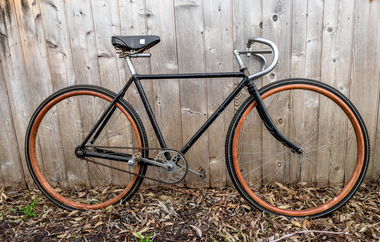
... Bastide was the bike that changed the style for road bikes in England for ever more after the First World War 1914-18 and this bicycle was used by Mr L Forde in Moorabbin Shire c1910 paris-bordeaux cycling road race, bicycles, bastide bicycles paris, birmingham small arms company uk , meredith leon jack , olympic cycling, road races, cycling clubs, cheltenham, moorabbin, victoria, geelong, werribee, whitehead clarice, whitehead eric, world war 1914-1918, early settlers, moorabbin shire, bentleigh, Frame Bastide Frame Stem ; Perfect / BUILT BY / CANADA CYCLES / & MOTOR Gear wheel ; BSA A Racing Bicycle c1909 'BASTIDE" Transport, Bicycle 'Bastide' 1909 BSA ( Birmingham Small Arms Company) Engineering ...1891 Paris - Bordeaux Cycle Race started in the Place du Pont Bastide in Bordeaux. So the name Bastide was already known to cycle enthusiasts even before the cycle manufacturer made its first iconic bicycle.The Bastide frame was built from top quality English Reynolds tubing with lugs and fittings provided by BSA. (Birmingham Small Arms Company ). Bastide, was based at Boulevard de Clichy, Paris and turned these fittings into a totally superb racer. Leon (Jack) Meredith,UK Olympic Cycling Champion, of the Constrictor Tyre Company, was responsible for importing the first Bastides and displaying them at the 1913 Olympia Cycle show where they were the sensation of the show. The Bastide, though almost as expensive as top range cycles, was fitted with a single brake and gear and no trimmings and was lighter, slimmer and faster Weight 15lb. ( 6.8Kg) Bastide stopped making frames in 1936. Bastide was the bike that changed the style for road bikes in England for ever more after the First World War 1914-18 and this bicycle was used by Mr L Forde in Moorabbin Shire c1910A Racing Bicycle c1909 'BASTIDE"Frame Bastide Frame Stem ; Perfect / BUILT BY / CANADA CYCLES / & MOTOR Gear wheel ; BSAparis-bordeaux cycling road race, bicycles, bastide bicycles paris, birmingham small arms company uk , meredith leon jack , olympic cycling, road races, cycling clubs, cheltenham, moorabbin, victoria, geelong, werribee, whitehead clarice, whitehead eric, world war 1914-1918, early settlers, moorabbin shire, bentleigh, -
 Orbost & District Historical Society
black and white photograph
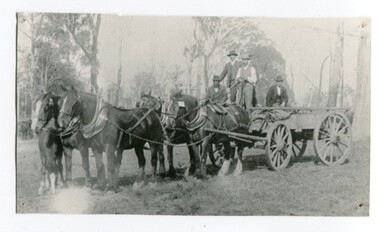
... Victoria and interstate. He was a shire councillor for 30 years and president several times. He took a great interest in the sporting clubs of the town and played cricket until late in life. He was goal umpire for the local football team for many years, judged for the Orbost Racing...Victoria and interstate. He was a shire councillor for 30 years and president several times. He took a great interest in the sporting clubs of the town and played cricket until late in life. He was goal umpire for the local football team for many years, judged for the Orbost Racing ...This photograph shows Sam Lynn with his team of Clydesdales. Samuel James Lynn was born in 1865 in Coleraine, Northern Ireland. His father was James Lynn and his mother was Mary Jane Keith. Sam, as he was known, was the second of three brothers, his older brother being William and his younger brother was John Wilson Lynn. (info. Margaret Hollands) Samuel Lynn was a well-known Orbost pioneer. He owned much property throughout the district , bred Clydesdale horses and fattened about 600 cattle. He was in great demand as a judge of both cattle and horses at agricultural shows in Victoria and interstate. He was a shire councillor for 30 years and president several times. He took a great interest in the sporting clubs of the town and played cricket until late in life. He was goal umpire for the local football team for many years, judged for the Orbost Racing Club and was the first president of the Orbost Bowls Club. He was also a member of the first municipal band. Sam Lynn was a well-known Orbost pioneer. The Lynn family has a long historic connection with the Orbost agricultural history.A small black / white photograph of four men, two standing and two sitting, in a horse draw buggy. Four large horses are harnessed to it.lynn-sam transport-horse-drawn clydesdale-horses -
 Orbost & District Historical Society
black and white photograph, late 19th century
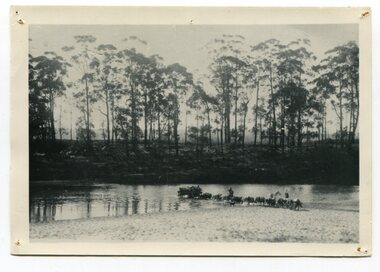
... Victoria and interstate. He was a shire councillor for 30 years and president several times. He took a great interest in the sporting clubs of the town and played cricket until late in life. He was goal umpire for the local football team for many years, judged for the Orbost Racing...Victoria and interstate. He was a shire councillor for 30 years and president several times. He took a great interest in the sporting clubs of the town and played cricket until late in life. He was goal umpire for the local football team for many years, judged for the Orbost Racing ...This is a photograph of Dave Hawkless crossing the Snowy River at Bete Bolong with a wagon load of maize from the farm of Sam Lynn. David Hawkless was married to Mary Downey in 1906. They had five children. Samuel James Lynn was born in 1865 in Coleraine, Northern Ireland. His father was James Lynn and his mother was Mary Jane Keith. Sam, as he was known, was the second of three brothers, his older brother being William and his younger brother was John Wilson Lynn. (info. Margaret Hollands) Samuel Lynn was a well-known Orbost pioneer. He owned much property throughout the district , bred Clydesdale horses and fattened about 600 cattle. He was in great demand as a judge of both cattle and horses at agricultural shows in Victoria and interstate. He was a shire councillor for 30 years and president several times. He took a great interest in the sporting clubs of the town and played cricket until late in life. He was goal umpire for the local football team for many years, judged for the Orbost Racing Club and was the first president of the Orbost Bowls Club. He was also a member of the first municipal band.This is a pictorial record of the transporting of maize in the Orbost district in th late 19th century. It is associated with Sam Lynn, a prominent citizen of early Orbost.A small black / white photograph of wagons crossing a river. There is a man on a horse beside what appears to be a team of bullocks pulling a loaded wagon.hawkless-david agriculture-maize transport -
 Orbost & District Historical Society
ticket, 1880's
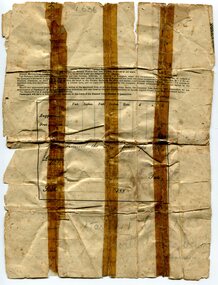
... Victoria and interstate. He was a shire councillor for 30 years and president several times. He took a great interest in the sporting clubs of the town and played cricket until late in life. He was goal umpire for the local football team for many years, judged for the Orbost Racing ...The Potosi was built in Scotland in 1873 by John Elder and Co.It was a cargo/passenger iron screw steamer and sailed from 1880-1887 under the Orient Line Australia service. Samuel James Lynn was born in 1865 in Coleraine, Northern Ireland. Sam left his home in Coleraine in 1883 at the age of 17. (More information in O.D.H.S. newsletter No. 91 September, 2012 by Margaret Hollands) Samuel Lynn was a well-known Orbost pioneer. Ho owned much property throughout the district , bred Clydesdale horses and fattened about 600 cattle. He was in great demand as a judge of both cattle and horses at agricultural shows in Victoria and interstate. He was a shire councillor for 30 years and president several times. He took a great interest in the sporting clubs of the town and played cricket until late in life. He was goal umpire for the local football team for many years, judged for the Orbost Racing Club and was the first president of the Orbost Bowls Club. He was also a member of the first municipal band. A paper passenger's contract ticket for Samuel Lynn on the Steam Ship Potosi from Royal Albert Dock, Liverpool, United Kingdom to Melbourne, Australia. It is white with black print and hand-written details.front - signed "Samuel Lynn"lynn-samuel potosi-steamship -
 Phillip Island and District Historical Society Inc.
Photographs, 1920/1930
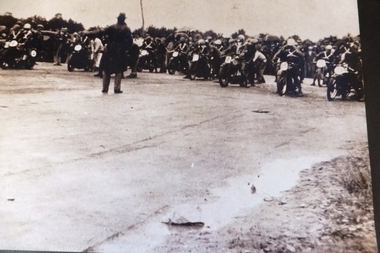
... Three Black & White & Sepia photograph enlargements of Motorcycle Grand Prix racing on the road circuit on Phillip Island. 335-12 - The Start of the race. 335-13 - The Start of the race with a crowd watching. 335-14 - A crowed gathered around for the presentation after the Motorcycle Grand Prix, showing resultson the Scoreboard of Victoria Motor Cycle Club and the winner being carried on peoples' shoulders. ...Three of a collection of photographs purchased from Photo First, Thompson Avenue, Cowes, when it closed in June, 2014. motor cycle racing grand prix road circuit phillip island photo first phillip island Three Black & White & Sepia photograph enlargements of Motorcycle Grand Prix racing on the road circuit on Phillip Island. 335-12 - The Start of the race. 335-13 - The Start of the race with a crowd watching. 335-14 - A crowed gathered around for the presentation after the Motorcycle Grand Prix, showing resultson the Scoreboard of Victoria Motor Cycle Club and the winner being carried on peoples' shoulders. ...Three of a collection of photographs purchased from Photo First, Thompson Avenue, Cowes, when it closed in June, 2014.Three Black & White & Sepia photograph enlargements of Motorcycle Grand Prix racing on the road circuit on Phillip Island. 335-12 - The Start of the race. 335-13 - The Start of the race with a crowd watching. 335-14 - A crowed gathered around for the presentation after the Motorcycle Grand Prix, showing resultson the Scoreboard of Victoria Motor Cycle Club and the winner being carried on peoples' shoulders. Advertisement for Shell Motor Oils on the board.motor cycle racing, grand prix road circuit phillip island, photo first phillip island -
 Warrnambool and District Historical Society Inc.
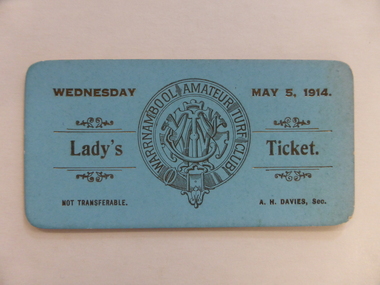
Ticket, Warrnambool Amateur Turf Club, 1014
... Club is a pass for a lady for the meeting of 5th May 1914. This day was part of the three-day 1914 May Racing Carnival which featured the Warrnambool Cup and the Grand Annual Steeplechase. The first organized horse race in Warrnambool was held in 1848 at Jetty Flat and the Warrnambool Racecourse was first in use in 1858 with the Warrnambool Racing Club established in 1873. The Warrnambool Amateur Turf Club was established in 1859 and was the only Amateur Turf Club in Victoria...Club is a pass for a lady for the meeting of 5th May 1914. This day was part of the three-day 1914 May Racing Carnival which featured the Warrnambool Cup and the Grand Annual Steeplechase. The first organized horse race in Warrnambool was held in 1848 at Jetty Flat and the Warrnambool Racecourse was first in use in 1858 with the Warrnambool Racing Club established in 1873. The Warrnambool Amateur Turf Club was established in 1859 and was the only Amateur Turf Club in Victoria ...This card from the Warrnambool Amateur Turf Club is a pass for a lady for the meeting of 5th May 1914. This day was part of the three-day 1914 May Racing Carnival which featured the Warrnambool Cup and the Grand Annual Steeplechase. The first organized horse race in Warrnambool was held in 1848 at Jetty Flat and the Warrnambool Racecourse was first in use in 1858 with the Warrnambool Racing Club established in 1873. The Warrnambool Amateur Turf Club was established in 1859 and was the only Amateur Turf Club in Victoria. It no longer exists This card is of interest as it is a memento of the Warrnambool Amateur Turf Club, an important early sporting club in Warrnambool. It is also an early memento of the Warrnambool May Racing Carnival, today a premier sporting event in the city and beyond and it is officially a Victorian Major Event. This is a small piece of light cardboard, blue on one side and white on the other. The card has rounded edges. On the blue side it has the emblem of the Warrnambool Amateur Turf Club and gold printing. The card has gilt edging. ‘Wednesday May 5 1914, Lady’s Ticket, Not Transferable, A.H.Davies Sec.’horse racing in warrnambool, warrnambool amateur turf club, history of warrnambool -
Queenscliffe Maritime Museum
Vehicle - Yacht hull
... Club of Victoria based at Williamstown. The Albert Park Yacht Club also began on the newly improved lagoon in 1872, other clubs soon followed and inter-club regattas were organised. In the 1880s the popularity of larger yachts built for cruising, as well as for racing...Club of Victoria based at Williamstown. The Albert Park Yacht Club also began on the newly improved lagoon in 1872, other clubs soon followed and inter-club regattas were organised. In the 1880s the popularity of larger yachts built for cruising, as well as for racing ...Seen as an excellent recreation for a maritime power, racing or cruising in purpose-built vessels became increasingly popular in Britain from the beginning of the 19th century. Some immigrants brought their enthusiasms to Port Phillip Bay, holding the first regatta in 1838. The Devil Afloat, the first unequivocal pleasure yacht, arrived a year later. Regattas were organised intermittently, featuring wagers on both rowing and sailing races. The Victoria Yacht Club, founded in 1856, soon folded, but another club of that name was established in 1872 and became the Royal Yacht Club of Victoria based at Williamstown. The Albert Park Yacht Club also began on the newly improved lagoon in 1872, other clubs soon followed and inter-club regattas were organised. In the 1880s the popularity of larger yachts built for cruising, as well as for racing, increased. Sailing in smaller boats consolidated in the first three decades of the 20th century, with several more clubs formed. After the great storm of 1932 destroyed many yachts the fleet was rebuilt with new designs such as Charles Peel's Jubilee One-Design Class dinghies.Jubilee yachts were popular in Port Phillip between 1930 to 1970. In later years, they were later made of fibreglass.Timber hull of a Jubilee class yacht J82 named FLASH. jubilee yacht, timber hull -
 Warrnambool and District Historical Society Inc.
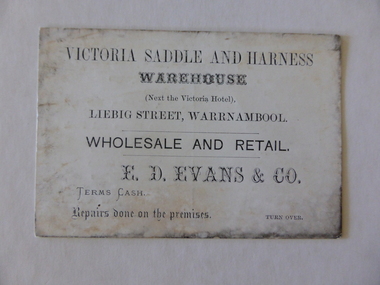
Work on paper - Document, Victorian Saddle & Harness Warehouse, C 1900
... Victoria Hotel. This business operated in Liebig Street from 1872 to the last known date of 1911. Edward David Evan's saddlery business was prominent in Warrnambool but he also had a similar business in Lonsdale Street, Melbourne. He was a Warrnambool Councillor from 1875 to 1878 and from 1884 to 1888. He was also heavily involved with the Warrnambool Racing Club...Victoria Hotel. This business operated in Liebig Street from 1872 to the last known date of 1911. Edward David Evan's saddlery business was prominent in Warrnambool but he also had a similar business in Lonsdale Street, Melbourne. He was a Warrnambool Councillor from 1875 to 1878 and from 1884 to 1888. He was also heavily involved with the Warrnambool Racing Club ...This is an advertising card for the business of E.D.Evans & Co., the Victoria Saddle and Harness Warehouse situated in Liebig Street Warrnambool next to the Victoria Hotel. This business operated in Liebig Street from 1872 to the last known date of 1911. Edward David Evan's saddlery business was prominent in Warrnambool but he also had a similar business in Lonsdale Street, Melbourne. He was a Warrnambool Councillor from 1875 to 1878 and from 1884 to 1888. He was also heavily involved with the Warrnambool Racing Club being President for some time. This is an interesting card because it comes from the saddlery business of E.D. Evans and Co., a prominent business in Warrnambool in the 19th and early 20th Centuries . A white card with black printing on both sides.The card is stained particularly around the edges.VICTORIA SADDLE AND HARNESS WAREHOUSE E.D. EVANS & CO.e.d.evans, saddler of warrnambool, saddlery in warrnambool, edward david evans -
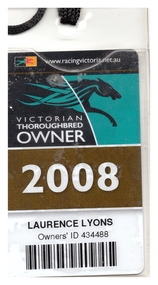 Bendigo Historical Society Inc.
Ephemera - Victorian Thoroughbred Owner Passes for Victoria, 2008, 2011, 2012
... Barry served as a Bendigo City Councillor from 2008 to 2016, and as Mayor in 2013 - 2014. bendigo barry and betty lyons windemere hotel kangaroo flat lions club kangaroo flat victorian horse racing victorian thoroughbred owners Four passes collected and owned by Barry Lyons of Bendigo. Plastic passes attached to a lanyard. Ephemera Victorian Thoroughbred Owner Passes for Victoria ...Barry Lyons owned and managed the Windemere Hotel in Kangaroo Flat along with his wife Betty. Barry was a long time member of the Lions Club of Kangaroo Flat. Barry served as a Bendigo City Councillor from 2008 to 2016, and as Mayor in 2013 - 2014. Four passes collected and owned by Barry Lyons of Bendigo. Plastic passes attached to a lanyard.bendigo, barry and betty lyons, windemere hotel kangaroo flat, lions club kangaroo flat, victorian horse racing, victorian thoroughbred owners -
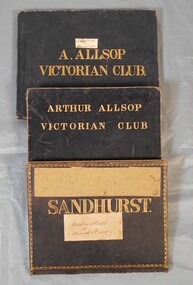 Bendigo Historical Society Inc.
Administrative record - Arthur Allsop Collection: Race record books
... racing Bookmaker Arthur Allsop Kelly and Allsop Three record books used by Bookmaker Arthur Allsop. Dark coloured leather covers. One has SANDHURST printed in gold lettering, one has A ALLSOP VICTORIAN CLUB and one has ARTHUR ALLSOP VICTORIAN CLUB. All books have ruled columns for record keeping. The three books cover the period January 1982 - December 1893, January 1892 - July 1894 and October 1888 to March 1889. The books contain handwritten records of races across Victoria ...Arthur Allsop went into the business office at Bendigo (Vic.) of the late Mr. Alfred Joseph. He later operated as an independent bookmaker. Arthur Allsop was a partner in the firm of Kelly and Allsop and was involved in mining and speculation in Bendigo. He was elected as a member of the Bendigo Stock Exchange in 1906. He started his athletic career at picnic sports and was a fine athlete winning many foot races. For 15 years he acted as secretary of the Sandhurst City Fire Brigade, he was captain of the Bendigo lacrosse team. He was a fair cricketer, and played against the English and Australian Elevens. He played football, and acted as secretary to the Bendigo Football Club. In later years he played bowls and captained pennant teams. He was a Past District- Grandmaster in the M.U.I.O.O.F. Allsop eventually moved to Melbourne and then Sydney working as a bookmaker. He died in Sydney in 1921. His wife Belle died in Bendigo in 1914 and is buried in the Bendigo Cemetery.Three record books used by Bookmaker Arthur Allsop. Dark coloured leather covers. One has SANDHURST printed in gold lettering, one has A ALLSOP VICTORIAN CLUB and one has ARTHUR ALLSOP VICTORIAN CLUB. All books have ruled columns for record keeping. The three books cover the period January 1982 - December 1893, January 1892 - July 1894 and October 1888 to March 1889. The books contain handwritten records of races across Victoria including names of horses and betting records.horse racing, bookmaker, arthur allsop, kelly and allsop -
 Bendigo Historical Society Inc.
Administrative record - Arthur Allsop Collection: Day book
... Club. In later years he played bowls and captained pennant teams. He was a Past District- Grandmaster in the M.U.I.O.O.F. Allsop eventually moved to Melbourne and then Sydney working as a bookmaker. He died in Sydney in 1921. His wife Belle died in Bendigo in 1914 and is buried in the Bendigo Cemetery. Horse racing Bookmaker Arthur Allsop Kelly and Allsop Day book used by Bookmaker Arthur Allsop as a ledger. The paper covering of the cover has been worn off on most of the book. Pages have ruled columns. The book contains handwritten records of races across Victoria ...Arthur Allsop went into the business office at Bendigo (Vic.) of the late Mr. Alfred Joseph. He later operated as an independent bookmaker. Arthur Allsop was a partner in the firm of Kelly and Allsop and was involved in mining and speculation in Bendigo. He was elected as a member of the Bendigo Stock Exchange in 1906. He started his athletic career at picnic sports and was a fine athlete winning many foot races. For 15 years he acted as secretary of the Sandhurst City Fire Brigade, he was captain of the Bendigo lacrosse team. He was a fair cricketer, and played against the English and Australian Elevens. He played football, and acted as secretary to the Bendigo Football Club. In later years he played bowls and captained pennant teams. He was a Past District- Grandmaster in the M.U.I.O.O.F. Allsop eventually moved to Melbourne and then Sydney working as a bookmaker. He died in Sydney in 1921. His wife Belle died in Bendigo in 1914 and is buried in the Bendigo Cemetery.Day book used by Bookmaker Arthur Allsop as a ledger. The paper covering of the cover has been worn off on most of the book. Pages have ruled columns. The book contains handwritten records of races across Victoria including names of horses and betting records. Handwritten entries contain names and payment records.horse racing, bookmaker, arthur allsop, kelly and allsop -
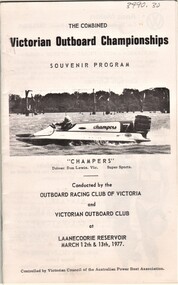 Bendigo Historical Society Inc.
Document - AULSEBROOK COLLECTION: VICTORIAN OUTBOARD CHAMPIONSHIPS 1977 PROGRAM, 1977
... ...Outboard Racing Club of Victoria...Aulsebrook Collection: The Combined Victorian Outboard Championships -Conducted by the Outboard racing Club of Victoria and Victorian Outboard Club at Laanecoorie Reservoir: March 12th - 13th, 1977 -Extensive booklet for a racing program: ads, information for event, lists of drivers and events taking place and images of drivers. ...Victorian Outboard Cahmpionship Laanecoorie Reservoir Victorian outboard club Outboard Racing Club of Victoria Aulsebrook Collection: The Combined Victorian Outboard Championships -Conducted by the Outboard racing Club of Victoria and Victorian Outboard Club at Laanecoorie Reservoir: March 12th - 13th, 1977 -Extensive booklet for a racing program: ads, information for event, lists of drivers and events taking place and images of drivers. ...Aulsebrook Collection: The Combined Victorian Outboard Championships -Conducted by the Outboard racing Club of Victoria and Victorian Outboard Club at Laanecoorie Reservoir: March 12th - 13th, 1977 -Extensive booklet for a racing program: ads, information for event, lists of drivers and events taking place and images of drivers. -A5 booklet, 14 pages, typed and photographsvictorian outboard cahmpionship, laanecoorie reservoir, victorian outboard club, outboard racing club of victoria
