
Showing 29 items matching "victorian barracks (melbourne)"
-
 Returned Nurses RSL Sub-branch
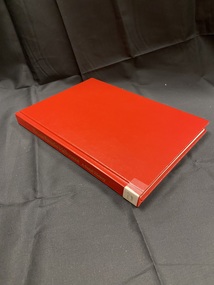
Book - Hardcover book, Australian Defence Force Journal, Victoria Barracks Melbourne: a social history, 1995
... ...Victorian Barracks (Melbourne)...Australian Army - barracks and quarters - history Barracks Victorian Barracks (Melbourne) After Federation, Victoria Barracks Melbourne continued to hold a key position in Australia's defence. ...After Federation, Victoria Barracks Melbourne continued to hold a key position in Australia's defence. It was here that the Australian involvement in the Boer War, both World Wars and the war in Korea was planned by the Government and the Service Chiefs. [taken from Trove]Red hard cover book with title in gold print down the spine.non-fictionAfter Federation, Victoria Barracks Melbourne continued to hold a key position in Australia's defence. It was here that the Australian involvement in the Boer War, both World Wars and the war in Korea was planned by the Government and the Service Chiefs. [taken from Trove]australian army - barracks and quarters - history, barracks, victorian barracks (melbourne) -
 8th/13th Victorian Mounted Rifles Regimental Collection
Document - Kings banner, 11 October 1904
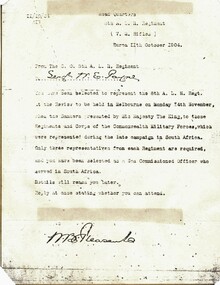
... The Banner presented to the 8th Light Horse is now on display at the history Room of the 8/13 Victorian Mounted Rifles Simpson Barracks Melbourne....The Banner presented to the 8th Light Horse is now on display at the history Room of the 8/13 Victorian Mounted Rifles Simpson Barracks Melbourne. Provides linking information between other significant objects in the collection. letter payne w e pleasents w b King's banner Photocopy of letter to Sergeant Walter Edward Payne 8th Australian Light Horse (VMR) from the commanding officer, Lieutenant Colonel William Benjamin Pleasents inviting him to be one of the representatives to the review of the King's Banners on 14 November 1904. ...Following the South African campaign 1899-1902, King Edward VII presented Banners to Australian regiments and corps which were represented in South Africa. The Banner presented to the 8th Light Horse is now on display at the history Room of the 8/13 Victorian Mounted Rifles Simpson Barracks Melbourne.Provides linking information between other significant objects in the collection.Photocopy of letter to Sergeant Walter Edward Payne 8th Australian Light Horse (VMR) from the commanding officer, Lieutenant Colonel William Benjamin Pleasents inviting him to be one of the representatives to the review of the King's Banners on 14 November 1904.letter, payne w e, pleasents w b, king's banner -
 8th/13th Victorian Mounted Rifles Regimental Collection
Photograph - Sergeant Payne, 1904 circa
... The Banner is now on display in the History Room of the 8/13th Victorian Mounted rifles, Simpson Barracks , Melbourne....The Banner is now on display in the History Room of the 8/13th Victorian Mounted rifles, Simpson Barracks , Melbourne. Strong connections to other objects in the 8/13 VMR collection. payne w e 8th australian light horse south africa king's banner uniform Black and white photograph of soldier wearing helmet and holding mace. ...Sergeant Payne was selected as one of three representatives from the 8th Light Horse to a review of the King's Banners presented to Australian regiments following the South African campaign. The review was held 14 November 1904. The Banner is now on display in the History Room of the 8/13th Victorian Mounted rifles, Simpson Barracks , Melbourne.Strong connections to other objects in the 8/13 VMR collection.Black and white photograph of soldier wearing helmet and holding mace. He is wearing both Queens South African medal and King's South African medal. Soldier is thought to be Sergeant Walter Edward Payne who served as Private No 1116 with the 5th Victorian Mounted Rifles contingent and following Federation with the 8th Light Horse (VMR).payne w e, 8th australian light horse, south africa, king's banner, uniform -
 Waverley RSL Sub Branch
R.A.A.F. Long Service Medal
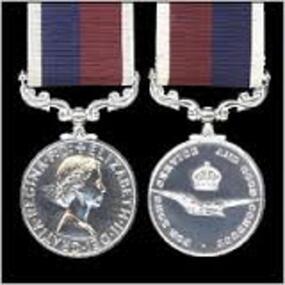
... As personnel numbers were still relatively small, Rosenbrock was also responsible for the dental care of all Victorian RAAF units, which involved treating members at 1AD Laverton, as well as Air Force Headquarters at Victoria Barracks in Melbourne. ...Awarded to Alan Bowers (A236814) who was a R.A.A.F. dental mechanic who serverd during WWII including service in Darwin, and then continued in the R.A.A.F. for some years after the end of WWII The Royal Australian Air Force (and all Commonwealth Air Forces) Long Service and Good Conduct Medal: Awarded to NCOs and ORs of the RAAF (RAF, RCAF etc) for 15 years service. A cupro-nickel plated medal, the obverse features the sovereign's head, the reverse features the crown and eagle emblem of the RAAF (and RAF). Officers are eligible for the award provided they have served a minimum 12 years in the ranks. The riband is dark blue and maroon with white edges. This medal ceased to be awarded in Australia in 1975 when it was replaced by the National Medal (and sbsequently the DFSM and DLSM) in the Australian system of honours and awards. http://www.heritagemedals.com.au/medals-1/service-long-service/air-force-long-service-and-good-conduct-medal.html History of the RAAF Dental Branch It took six years following the formation of the RAAF in 1921 for the first Dental Clinic to be established at Point Cook, Victoria. On 10th June 1927 Flying Officer James Carl Rosenbrock commenced work as an RAAF Dental Officer for the FlyingTraining School at Point Cook. As personnel numbers were still relatively small, Rosenbrock was also responsible for the dental care of all Victorian RAAF units, which involved treating members at 1AD Laverton, as well as Air Force Headquarters at Victoria Barracks in Melbourne. As Army Dental Officers were currently caring for RAAF personnel at Richmond, NSW, the Senior Dental Officer of the 3rd Military District in Victoria (SDO 3MD) requested through the military board that a similar arrangement be established, where that the newly appointed RAAF Dentist provide part time dental services to the Army units stationed at Queenscliff. This was seen as an effective reciprocal arrangement, with both units having a Dental Officer in attendance for, in total, around 3-4 weeks a year. Rosenbrock continued to serve as the sole RAAF Dental Officer until the middle of 1933, when the Air Board asked for his service to be terminated following ‘behaviour unbecoming of a RAAF officer'. He had borrowed several sums of money, of around 40 Pounds or so, from junior ranks on base (as well as from the Regimental Sergeant Major) and had failed to pay the money back. He was replaced by a fellow Victorian, FLGOFF Norman Henry Andrews, on the 18th Sep 1933, who went on to become our first Director of Dental Services, and was instrumental in establishing the organisations and conditions of the Branch that are still present today. Through a fair amount of persistence and hard work on the part of Norman Andrews, the RAAF Dental Branch began to expand from 1937, with the introduction of 2 additional positions, at RAAF station Richmond, and at the FlyingTraining School at Point Cook. This gave the RAAF 3 uniformed Dental Officers, which was expanded to 5 in the months leading up to WW2. 4 of these Dental Officers were based in Victoria and 1 at Richmond, with the other two RAAF units being cared for by the Army (as in the case of Pearce in WA) or by civilians (as in Darwin). With the sudden increase in RAAF personnel required at the outbreak of WW2, the number of RAAF Dental Officers increased dramatically, from 5 in 1939, 28 in 1940, 64 in 1941, 147 in 1942, 193 in 1943, 219 in 1944, and peaking at 227 in 1945. RAAF Dental Officers were required to work in a variety of locations, both in and out of Australia. Between 1940 and 1942 a massive construction programme occurred, with new dental clinics being established around Australia. Priority was given to aircrew training units in order to get these personnel dentally fit for operational deployment, but Dental Officers could equally find themselves posted to recruit depots, fixed stations, medical clearance stations, mobile dental sections, and RAAF and civilian hospitals. RAAF Dental Officers were posted to the large dental centres at Ascot Vale (Vic) and Bradfield Park (NSW) when first appointed, where they received military and clinical training, before being deployed to their needed location. Mobile Dental Units When Japan entered the war in 1941, the rapid deployment of troops to northern operational areas with less than ideal dental fitness was extremely high. As a result, the RAAF deployed a range of mobile dental units, either alone or with medical sections, to support the increasing number of isolated deployed personnel within Australia and overseas. There were three types of mobile unit used: a. Mobile Dental Unit – relied on using either a semi-trailer to get around or by building a surgery directly on to the truck chassis, and installing hydraulic chairs, units, x-rays, and laboratory equipment. They were able to move around between small units, such as RAAF radar stations, where they could plug into the local power supply and work immediately. b. Transportable Dental Units – used for stops of longer duration, where field equipment was carried in panniers from one unit to another by road or rail and housed in whatever accommodation was available at the destination. They were often carried within Australia on Tiger Moths and Dakota aircraft. c. Itinerant Dental Units – in some areas, the dental equipment was installed at the RAAF unit and the Dental Officer and their staff would travel from unit to unit, using the equipment available at each location. RAAF Dental BadgeAs the war developed in Europe, it soon became obvious that the RAF Dental support was not capable of supporting the increasing numbers of RAAF aircrew that were being sent for service with the RAF, with only enough Dental Officers available to provide one to every 2000 men ( instead of the preferred 1 to 600). As a result, the RAAF provided a mobile dental unit, fitted out in a caravan and pulled by a Ford V8 Coupe, to travel around England in support of RAAF personnel at various squadrons. Some degree of tact was needed to ensure that the RAF did not take this as a comment on the treatment they were providing, but it proved successful in maintaining a satisfactory state of dental fitness in RAAF personnel, and a second mobile unit was soon dispatched. They were also set up with a laboratory on board as well as the surgery, which was a major difference between the RAF and RAAF, as the RAF did not provide dentures for their troops (the RAAF would, providing they had served for 6 years). In 1943 the RAF was no longer able to provide Dental support to Australian troops in the Middle East, which resulted in the need for a transportable dental unit to be deployed from Australia. It functioned in a similar manner to the RAF, by moving from one squadron to another. It served in the Middle East and Africa, from Cairo across North Africa, to Italy, and eventually back to England to treat returned prisoners of war. GPCAPT Norman Andrews The growth and development of the RAAF Dental Branch owes a debt to one man in particular, GPCAPT Norman Andrews. As the second RAAF Dental Officer to enlist on 18 Sep 1933, Andrews became the principal architect of the structure and organisation of the RAAF Dental Branch leading up to and during WW2. Until early 1940, the RAAF Dental Branch was administered by the Director of Medical Services (Air), which placed it under the control of the Army Medical staff. The Army would provide their Inspector of Dental Services for advice whenever needed. In April 1940, the RAAF Medical service separated from the Army, resulting in the control of the RAAF Dental Branch shifting back to the RAAF. Andrews became the first Director of Dental Services, when the position was created in 1943 as recognition of the higher profile the Dental Branch was now playing in the RAAF Medical service. Until this time, Andrews's title had been as the Dental Staff Officer to the RAAF Medical Service. Andrews was responsible for the establishment of the war-time structure of the Dental service, establishing new dental centres at all major bases, creating mobile and transportable dental units, ensuring the continual growth of the Branch, maintaining professional development of staff through the establishment of a professional journal, and by organising renowned lecturers to speak at RAAF bases. He also believed in visiting as many dental units as possible to see for himself what conditions were like and to talk first-hand to staff in remote units. His itinerary during the war years, both in and out of Australia, shows a large number of trips in a variety of modes of transport in order to reach remote areas where units were serving. He was promoted to GPCAPT in July 1944, as the numbers of Dental Officers soon peaked at 227 towards the end of the war (1 GPCAPT, 9 WGCDRs, 60 SQNLDRs, and 157 FLTLTs). After the war, with the reduction in RAAF personnel required in uniform, the Dental Branch also reduced its numbers significantly. By 1947 there were only 18 Dental Officers serving (many part-time), with 1 GPCAPT, 1 WGCDR, 10 SQNLDRs, and 6 FLTLTs, and only 13 by 1950. With the decrease in Branch personnel numbers, the ‘powers to be' saw fit to reduce the Director of Dental Service rank to WGCDR, and as a result Norman Andrews found that in order to continue serving in the RAAF he would have to wear a reduced rank. This appears to have been a contributing factor in his decision to discharge at the relatively early age of 43 and accept an administrative job as Director of the Victorian Government's School Dental Service. Norman Andrews holds the proud honour of being the founder of the RAAF Dental Branch, which during the war was instrumental in educating servicemen of the importance of dental health and maintaining the dental fitness of troops in a variety of areas. Dental Orderlies (Assistants) The dental orderly mustering was first introduced in 1937. Until that time, medical orderlies were assigned to assist the Dental officer with their duties. As early as 1931 it had been noted by both RAAF and Army Dental Officers working in Victoria and Richmond that a lot of the troubles they were having would be solved by appointing a permanent Dental Orderly. Often they would find that the medical orderly they were assigned was a different one each day, and as a result the administration and work in general was very inefficient. By 1937, with the increase in Dental Officers to 3, it was realised that a Dental Orderly mustering needed to be created. Dental Mechanics/Technicians Before WW2, dental laboratory work was provided by civilian laboratories, as most RAAF units were stationed around metropolitan areas. At this time, service personnel were still required to pay for their own dentures, unless they had served for six years or had their dentures damaged during performance of their duties. In July 1940, mainly in response to the development of more remote RAAF dental units and the increasing demand for dental prostheses, the Dental Mechanic mustering was established. Unfortunately there was a very limited pool of civilian dental mechanics to recruit from, and as a result the RAAF set up a training school at Laverton (which was later moved to Ascot Vale) in June 1941 which conducted an intensive 6 month course in Dental mechanics. Dental mechanics were quickly in demand. In all fixed and mobile dental units at least 1 Mechanic was supplied for each Dental Officer, and indeed the RAAF supplied Dental Mechanics throughout all its deployments, something the RAF were unwilling, or unable, to do. Two grades of dental mechanic existed: the Senior Mechanic (with the rank of NCO), who was competent in all phases of laboratory work; and the Junior Mechanic, who could only handle routine work and not more advanced denture work. The progression to Senior required a further trade test in techniques including setting up, clasp-forming, casting and backing teeth. During the course of the War, two special courses were held for Mechanics. The first, directed at senior mechanics so that they could instruct others, was in 1942 when Acrylic Resin was first introduced as a denture base material, as an alternative to the current option of vulcanite. Later, towards the end of the War, a ‘refresher' course was provided for those that had served for the greatest period of time in order to allow them retraining in techniques that they had not practised during their service and which were common in civilian life. This included cast base dentures, crowns and bridges, partial dentures, and retainers. Towards the end of the War, a course was held with WAAAF trainees to train them as Mechanics. However, as the War was soon to end they never had the opportunity to progress within the mustering to become Senior Mechanics. The RAAF Dental Branch has survived 75 years of turbulence, with reviews of its viability occurring regularly every few years from as early as 1937. The Branch continues to provide excellent service to the ADF community and, despite reduced manpower, will continue to play an important role in Air Force Health operations. http://www.defence.gov.au/health/about/docs/RAAFDental.pdf40cm cupro-nickel plated medal, the obverse features the sovereign's head, the reverse features the crown and eagle emblem of the RAAF (and RAF). A23814 BOWERS.A. A. F.r.a.a.f long service medal, r.a.a.f good conduct, r.a.a.f. dental service medal -
 Bendigo Historical Society Inc.
Newspaper - LONG GULLY HISTORY GROUP COLLECTION: BENDIGO'S CENTURY VOLUME SEVEN: 1960 - 1969
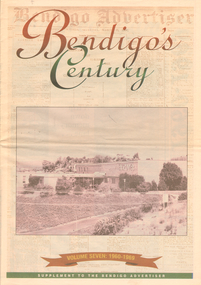
... Victorian Football League... Bendigo Police Barracks... Camp Hill State School... State Electricity Commission... The Country Party... The Labor Party... Transport Regulation Board... Stuart Anderson... Grose FAmily... Jean Theodore De Ravin... Kyneton Shire... Sir William McDonald... Mines Department... The Loddon Hospitals Region group Laundry and Central Linen Service... Kevin Wynne... Albert Vivian Gray... Bradford Cotton Mills Ltd... Bradmill Industries Ltd... Victoria Hill... Bendigo and District Tourist Association... Professor Brian Lewis... Melbourne...Dispensary Gillies Famous Pies William Basil Ashman Golden Gate Hotel Grieves Family Bendigo Town Hall Mr R R Anderson Mr E H Brown Cr Neville Oliver Cr Tom Flood Traffic Commission Lansell FAmily ABEV-1 Bendigo Ordnance Factory ACTU Bendigo Trades Hall Council The Ramsay Report Bendigo Benevolent Home Bendigo Home and Hospital for the Aged Princess Theatre Amoco Lake Eppalock Bendigo Training Prison Bendigo Police Station Lock-up Shamrock Hotel Rifle Brigade Hotel Hopetoun Hotel ANZ Bank Marong Shire Offices Sir Rohan Delacombe St Paul's Church Que O'Hoy Waldron Family Windermere Hotel Aids & Appliance Shop Anne Caudle Centre E C Thompson Mayfair Hams Sandhurst Guest House Lyric Theatre Chinese Joss House Ordnance Factory Sir John Jenson Bridge Street Chinese Quarter Bendigo City Hall Cr R F Turner Cr Tom Flood Victorian Inland Meat Authority New Zealand Insurance Co Mrtropolitan Security Service Bendigo Easter Fair Society Golden Square High School Eaglehawk High School Bendigo Technical College Mr Ralph W Birrell Bendigo Fountain Plaza The Bethlehem Home for the Aged Dick Hazeldene Victorian Egg Board Bendigo United Cricket Club South Bendigo United Cricket Club Western Mining Corporation Les Priest Alexandra Fountain Bendigo Advertiser Cr W Cambridge Bendigo Council Eaglehawk Council Strathfieldsaye Shire Huntly Shire Marong Shire David Thomas Senator John Gorton Bendigo's College of Advanced Education Bank of New South Wales Harp and Shamrock Hotel The Honorable Leslie William Galvin Kurmala Cain Government Hanro Knitting Mills Myer Store Sidney Myer Davey Brothers Grocery Store National Trust Myer Emporium Myer's Ltd Cox Bros (Australia) Ltd Dame Merlyn Myer Baillieu Myer Frank Greenaway Institute of Technology Gas & Fuel Corporation Bendigo Railway Station ANZ Bank City Family Hotel TAB Branch Senior Constable Alfred Herbert Wright Senior Constable Allan Raymond Brown Victorian Football League Bendigo Police Barracks Camp Hill State School State Electricity Commission The Country Party The Labor Party Transport Regulation Board Stuart Anderson Grose FAmily Jean Theodore De Ravin Kyneton Shire Sir William McDonald Mines Department The Loddon Hospitals Region group Laundry and Central Linen Service Kevin Wynne Albert Vivian Gray Bradford Cotton Mills Ltd Bradmill Industries Ltd Victoria Hill Bendigo and District Tourist Association Professor Brian Lewis Melbourne University Victorian Chinese Community Loong Sun Loong Stafford Ellinson Coles' Store North Deborah Mining Company NL Noel Beaton MHR Durham Ox Hotel Taylor Family Supplement to the Bendigo Advertiser, December 15, 1999 Volume Seven: 1960-1969 titled Bendigo's Century. ...Supplement to the Bendigo Advertiser, December 15, 1999 Volume Seven: 1960-1969 titled Bendigo's Century. The front has a photo of the BCV 8 Studio. Contains photos and local news, council matters, planning, Who's Who, Weather, Sport and Business and some Advertisements. Photos include Early stages in the construction of the Eppalock tower and bridge pillars, Christine Wiseman, TV8's first news reader Ron Alderton, Dr Albert L Beischer, Advertiser buiding, fire at the Advertiser building, Oscar Flight, Bendigo Town Hall, William Basil Ashman, Lake Eppalock, Premier Henry Bolte, Que O'Hoy, Sandhurst Guest House, The Lyric Theatre, E C Thompson, The elm tree in Market Square, Leslie Galvin, The original Myer Store, The Joss House, Sidney Myer, Bendigo Police Barracks, Bunratty Castle, Albert Vivian Gray, The Victoria Hill site, Architects drawing of the new council administrative offices and Noel Beaton MHR.bendigo, history, long gully history group, the long gully history group - bendigo's century volume seven: 1960 - 1969, bendigo advertiser, bcv 8, eppalock dam, premier henry bolte, the criterion hotel, mccarthy family, teachers training college, bendigo original teachers college, long gully state school, stramit, bendigo university site committee, mrs christine wiseman, bendigo city council, the broadcasting control board, general television pty ltd, bendigo central victoria telecasters pty ltd, mr davidson, bennett's arcade, woolworth's, white hills swimming pool, herb elliott, sailor's guide, toni riley pharmacies, rising sun hotel, ron alderton, dr albert l beischer, channel 8, melbourne herald, 3bo, bendigo advertiser officeslyceum theatre, junior technical school white hills, mount alvernia hospital, most reverend dr b d stewart, sisters of the franciscan missionaries of the divine motherhood, lazarus family, bendigo's tramways, state electricity commission, george pethard, lance pethard, bendigo advertiser fire 29/7/1962, riverine herald, the herald and weekly times, bendigo art gallery, oscar flight, hollands foundry, eaglehawk u.f.s. dispensary, gillies famous pies, william basil ashman, golden gate hotel, grieves family, bendigo town hall, mr r r anderson, mr e h brown, cr neville oliver, cr tom flood, traffic commission, lansell family, abev-1, bendigo ordnance factory, actu, bendigo trades hall council, the ramsay report, bendigo benevolent home, bendigo home and hospital for the aged, princess theatre, amoco, lake eppalock, bendigo training prison, bendigo police station lock-up, shamrock hotel, rifle brigade hotel, hopetoun hotel, anz bank, marong shire offices, sir rohan delacombe, st paul's church, que o'hoy, waldron family, windermere hotel, aids & appliance shop, anne caudle centre, e c thompson, mayfair hams, sandhurst guest house, lyric theatre, chinese joss house, ordnance factory, sir john jenson, bridge street chinese quarter, bendigo city hall, cr r f turner, cr tom flood, victorian inland meat authority, new zealand insurance co, mrtropolitan security service, bendigo easter fair society, golden square high school, eaglehawk high school, bendigo technical college, mr ralph w birrell, bendigo fountain plaza, the bethlehem home for the aged, dick hazeldene, victorian egg board, bendigo united cricket club, south bendigo united cricket club, western mining corporation, les priest, alexandra fountain, bendigo advertiser, cr w cambridge, bendigo council, eaglehawk council, strathfieldsaye shire, huntly shire, marong shire, david thomas, senator john gorton, bendigo's college of advanced education, bank of new south wales, harp and shamrock hotel, the honorable leslie william galvin, kurmala, cain government, hanro knitting mills, myer store, sidney myer, davey brothers grocery store, national trust, myer emporium, myer's ltd, cox bros (australia) ltd, dame merlyn myer, baillieu myer, frank greenaway, institute of technology, gas & fuel corporation, bendigo railway station, anz bank, city family hotel, tab branch, senior constable alfred herbert wright, senior constable allan raymond brown, victorian football league, bendigo police barracks, camp hill state school, state electricity commission, the country party, the labor party, transport regulation board, stuart anderson, grose family, jean theodore de ravin, kyneton shire, sir william mcdonald, mines department, the loddon hospitals region group laundry and central linen service, kevin wynne, albert vivian gray, bradford cotton mills ltd, bradmill industries ltd, victoria hill, bendigo and district tourist association, professor brian lewis, melbourne university, victorian chinese community, loong, sun loong, stafford ellinson, coles' store, north deborah mining company nl, noel beaton mhr, durham ox hotel, taylor family -
 Sunshine and District Historical Society Incorporated
Photograph - Australian Defence Force Victorian Sites
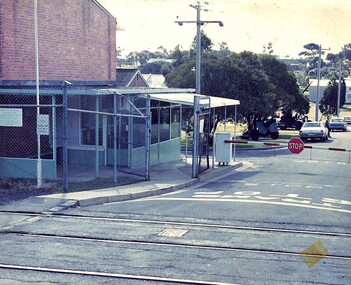
... Barracks North Gate St. Kilda Road Melbourne 3866.06 - Australian Defense Industries - Victoria Barracks South Gate St. Kilda Road Melbourne 3866.07 - Australian Defense Industries - Victoria Barracks Wells Street Entrance 3866.08 - Australian Defense Industries - Victoria Barracks Defence Signals St. Kilda Road Melbourne 3866.09 - Australian Defense Industries - Government Aircraft Factory Lorimer Street Fishermans Bend 3866.10 - Australian Defense Industries - Aeronautical Research Labs Lorimer Street Fishermens Bend 3866.11 - Australian Defense Industries - Defence Centre 350 St. Kilda Road Melbourne Collection of 11 color photographs mounted on card Photograph Australian Defence Force Victorian ...These photographs appear to come from an exhibition as they were mounted on a larger card. The photographs appeared to have been torned off a larger sheet. The damaged area of the sheets have been trimmed off3866.01 - Australian Defense Industries - Maribyrnong Explosive Factory Cordite Avenue Entrance Opposite Wests Road Maribyrnong 3866.02 - Australian Defense Industries - Maribyrnong Explosive Factory Main Entrance Cordite Avenue Maribyrnong 3866.03 - Australian Defense Industries - Ammunition Factory Gordon Street Footscray 3866.04 - Australian Defense Industries - Maribyrnong Immigration Detention Centre Williamsons Road Maribyrnong 3866.05 - Australian Defense Industries - Victoria Barracks North Gate St. Kilda Road Melbourne 3866.06 - Australian Defense Industries - Victoria Barracks South Gate St. Kilda Road Melbourne 3866.07 - Australian Defense Industries - Victoria Barracks Wells Street Entrance 3866.08 - Australian Defense Industries - Victoria Barracks Defence Signals St. Kilda Road Melbourne 3866.09 - Australian Defense Industries - Government Aircraft Factory Lorimer Street Fishermans Bend 3866.10 - Australian Defense Industries - Aeronautical Research Labs Lorimer Street Fishermens Bend 3866.11 - Australian Defense Industries - Defence Centre 350 St. Kilda Road Melbourneaustralian defense industries, adi, maribyrnong explosive factory, footscray ammunition factory, maribyrnong immigration detention -
 8th/13th Victorian Mounted Rifles Regimental Collection
Photograph - VMR Officers with Philip, 1954 circa
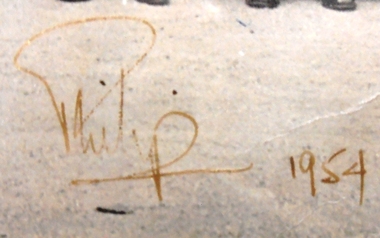
... Barracks Albury till 1991 when they were relocated to the Regimental Collection. Rare record of an historic gathering during the Royal Visit to Victoria in1954. 2nd armoured brigade prince philip duke of edinburgh fogarty tom lieutenant colonel martin arch warrent officer class 1 royal visit 1954 Signed at lower centre of photograph "Philip 1954" Framed black and white photograph of large gathering of soldiers in uniform standing on steps of Government House, Melbourne. The group is the officers of the 2nd Armoured Brigade, Royal Australian Armoured Corps (RAAC). Lieutenant Colonel Tom Fogarty, Commanding Officer 8/13 Victorian ...This and another photograph (Catalogue 3393) was taken at a gathering of Officers and NCOs of the 2nd Armoured Brigade (RAAC) to meet Prince Philip at Government House, Melbourne during the Royal Visit 1954. The two photographs were framed and hung on the wall of the Headquarter Building at Buna Barracks Albury till 1991 when they were relocated to the Regimental Collection.Rare record of an historic gathering during the Royal Visit to Victoria in1954.Framed black and white photograph of large gathering of soldiers in uniform standing on steps of Government House, Melbourne. The group is the officers of the 2nd Armoured Brigade, Royal Australian Armoured Corps (RAAC). Lieutenant Colonel Tom Fogarty, Commanding Officer 8/13 Victorian Mounted Rifles, is standing on HRH Prince Philip Duke of Edinburgh's right. Signed at lower centre of photograph "Philip 1954"2nd armoured brigade, prince philip duke of edinburgh, fogarty tom lieutenant colonel, martin arch warrent officer class 1, royal visit 1954 -
 8th/13th Victorian Mounted Rifles Regimental Collection
Photograph - Parading guidons
... Barracks Wangatarra and included wide ranging patrols in Ferret Scout Cars throughout north east Victoria. A regimental parade was held at the close of the camp and the regimental guidons paraded. This was the last camp before the National Service Scheme (1951-59) was abandoned. The 8th/13th Victorian Mounted Rifles was raised as a regiment of the Royal Australian Armoured Corps on 1 May 1948 with Headquarters in Melbourne...Barracks Wangatarra and included wide ranging patrols in Ferret Scout Cars throughout north east Victoria. A regimental parade was held at the close of the camp and the regimental guidons paraded. This was the last camp before the National Service Scheme (1951-59) was abandoned. The 8th/13th Victorian Mounted Rifles was raised as a regiment of the Royal Australian Armoured Corps on 1 May 1948 with Headquarters in Melbourne ...The 1959 regimental camp was based on Beersheba Barracks Wangatarra and included wide ranging patrols in Ferret Scout Cars throughout north east Victoria. A regimental parade was held at the close of the camp and the regimental guidons paraded. This was the last camp before the National Service Scheme (1951-59) was abandoned. The 8th/13th Victorian Mounted Rifles was raised as a regiment of the Royal Australian Armoured Corps on 1 May 1948 with Headquarters in Melbourne and squadrons in Sale, Benalla/Wangaratta and Albury. In 1955 Regimental Headquarters moved to Wangaratta and a second squadron was located at Albury. The Sale squadron transferred to 4th/19th Prince of Wales’s Light Horse. In 1977 8/13 VMR Regiment was reduced to an independent squadron A Squadron 8th/13th Victorian Mounted Rifles and in 1991 was linked with 4th/19th Prince of Wales’s Light Horse forming the VMR Squadron of that regiment.Large coloured mounted photograph of Parading the Guidons 8/13th Victorian Mounted Rifles annual Camp 1959. Pineboard mounted.Parading the Guidons 8/13th Victorian Mounted Rifles Annual Camp 1959 Beersheba Barracksmilitary, vmr, ferret, wangaratta, guidon -
 8th/13th Victorian Mounted Rifles Regimental Collection
Book - History 8/13 VMR, The history of 8th/13th Victorian Mounted Rifles 1048-1982
... Barracks, added. An addendum has been included covering the period 1983-1991. The addendum includes Major Robert Morrison’s account of his time as Officer Commanding 1988-1990. VMR history CMF Army Reserve Hunter The 8th/13th Victorian Mounted Rifles was raised as a regiment of the Royal Australian Armoured Corps on 1 May 1948 with Headquarters in Melbourne and squadrons in Sale, Benalla/Wangaratta and Albury. ...The 8th/13th Victorian Mounted Rifles was raised as a regiment of the Royal Australian Armoured Corps on 1 May 1948 with Headquarters in Melbourne and squadrons in Sale, Benalla/Wangaratta and Albury. In 1955 Regimental Headquarters moved to Wangaratta and a second squadron was located at Albury. The Sale squadron transferred to 4th/19th Prince of Wales’s Light Horse and an additional troop of the Wangaratta squadron was raised at Cobram. In 1977, 8/13 VMR was reduced to an independent squadron, A Squadron 8th/13th Victorian Mounted Rifles, and in 1991 it was linked with 4th/19th Prince of Wales’s Light Horse forming the VMR Squadron of the new regiment.Book with colour cover and 82 pages with photographs, perfect bound.non-fictionThe 8th/13th Victorian Mounted Rifles was raised as a regiment of the Royal Australian Armoured Corps on 1 May 1948 with Headquarters in Melbourne and squadrons in Sale, Benalla/Wangaratta and Albury. In 1955 Regimental Headquarters moved to Wangaratta and a second squadron was located at Albury. The Sale squadron transferred to 4th/19th Prince of Wales’s Light Horse and an additional troop of the Wangaratta squadron was raised at Cobram. In 1977, 8/13 VMR was reduced to an independent squadron, A Squadron 8th/13th Victorian Mounted Rifles, and in 1991 it was linked with 4th/19th Prince of Wales’s Light Horse forming the VMR Squadron of the new regiment. vmr, history, cmf, army reserve, hunter -
 8th/13th Victorian Mounted Rifles Regimental Collection
Photograph
... Melbourne and squadrons in Sale, Benalla/Wangaratta and Albury. In 1955 Regimental Headquarters moved to Wangaratta and a second squadron was located at Albury. The Sale squadron transferred to 4th/19th Prince of Wales’s Light Horse. In 1977 8/13 VMR Regiment was reduced to an independent squadron A Squadron 8th/13th Victorian Mounted Rifles and in 1991 was linked with 4th/19th Prince of Wales’s Light Horse forming the VMR Squadron of that regiment " Lt Docking, Lt Hartung, Lt Farralley, Lt Short Black and white photograph of four 8/13 Victorian Mounted Rifles officers at Buna Barracks, Albury c. 1968 Photograph ...The 8th/13th Victorian Mounted Rifles was raised as a regiment of the Royal Australian Armoured Corps on 1 May 1948 with Headquarters in Melbourne and squadrons in Sale, Benalla/Wangaratta and Albury. In 1955 Regimental Headquarters moved to Wangaratta and a second squadron was located at Albury. The Sale squadron transferred to 4th/19th Prince of Wales’s Light Horse. In 1977 8/13 VMR Regiment was reduced to an independent squadron A Squadron 8th/13th Victorian Mounted Rifles and in 1991 was linked with 4th/19th Prince of Wales’s Light Horse forming the VMR Squadron of that regimentBlack and white photograph of four 8/13 Victorian Mounted Rifles officers at Buna Barracks, Albury c. 1968" Lt Docking, Lt Hartung, Lt Farralley, Lt Short -
 8th/13th Victorian Mounted Rifles Regimental Collection
Photograph
... Melbourne and squadrons in Sale, Benalla/Wangaratta and Albury. In 1955 Regimental Headquarters moved to Wangaratta and a second squadron was located at Albury. The Sale squadron transferred to 4th/19th Prince of Wales’s Light Horse. In 1977 8/13 VMR Regiment was reduced to an independent squadron A Squadron 8th/13th Victorian Mounted Rifles and in 1991 was linked with 4th/19th Prince of Wales’s Light Horse forming the VMR Squadron of that regiment. " 2 Tp ready to move.' Black and white photograph of Humber 1 Ton truck ready to depart Buna Barracks ...8/13 VMR was issued with Humber 1 Ton truck to train in an Armoured Personnel Carrier role.The 8th/13th Victorian Mounted Rifles was raised as a regiment of the Royal Australian Armoured Corps on 1 May 1948 with Headquarters in Melbourne and squadrons in Sale, Benalla/Wangaratta and Albury. In 1955 Regimental Headquarters moved to Wangaratta and a second squadron was located at Albury. The Sale squadron transferred to 4th/19th Prince of Wales’s Light Horse. In 1977 8/13 VMR Regiment was reduced to an independent squadron A Squadron 8th/13th Victorian Mounted Rifles and in 1991 was linked with 4th/19th Prince of Wales’s Light Horse forming the VMR Squadron of that regiment.Black and white photograph of Humber 1 Ton truck ready to depart Buna Barracks Albury on weekend manoeuvres. In foreground is Troop Sergeant Lou Madjeric." 2 Tp ready to move.' -
 8th/13th Victorian Mounted Rifles Regimental Collection
Photograph - 8/13 VMR group
... Victorian Mounted Rifles was raised as a regiment of the Royal Australian Armoured Corps on 1 May 1948 with Headquarters in Melbourne and squadrons in Sale, Benalla/Wangaratta and Albury. In 1955 Regimental Headquarters moved to Wangaratta and a second squadron was located at Albury. The Sale squadron transferred to 4th/19th Prince of Wales’s Light Horse. In 1977 8/13 VMR Regiment was reduced to an independent squadron A Squadron 8th/13th Victorian Mounted Rifles and in 1991 was linked with 4th/19th Prince of Wales’s Light Horse forming the VMR Squadron of that regiment. military migrant vmr armour buna barracks ...Hartung and Madjeric both served with German forces during WW11, Harris served with British army. All migrated to Australia post-war and joined 8/13 VMR. The 8th/13th Victorian Mounted Rifles was raised as a regiment of the Royal Australian Armoured Corps on 1 May 1948 with Headquarters in Melbourne and squadrons in Sale, Benalla/Wangaratta and Albury. In 1955 Regimental Headquarters moved to Wangaratta and a second squadron was located at Albury. The Sale squadron transferred to 4th/19th Prince of Wales’s Light Horse. In 1977 8/13 VMR Regiment was reduced to an independent squadron A Squadron 8th/13th Victorian Mounted Rifles and in 1991 was linked with 4th/19th Prince of Wales’s Light Horse forming the VMR Squadron of that regiment.Black and white photograph of seven 8/13 Victorian Mounted Rifles soldiers at Buna barracks , Albury c. 1968." Boots Roberts, Bill Cameron, John Doyle, Jack Harris, Harry Barnes, Lou Madjeric, Peter Hartung. "military, migrant, vmr, armour, buna barracks -
 8th/13th Victorian Mounted Rifles Regimental Collection
Photograph - Tewson
... Victorian Mounted Rifles was raised as a regiment of the Royal Australian Armoured Corps on 1 May 1948 with Headquarters in Melbourne and squadrons in Sale, Benalla/Wangaratta and Albury. In 1955 Regimental Headquarters moved to Wangaratta and a second squadron was located at Albury. The Sale squadron transferred to 4th/19th Prince of Wales’s Light Horse. In 1977 8/13 VMR Regiment was reduced to an independent squadron A Squadron 8th/13th Victorian Mounted Rifles and in 1991 was linked with 4th/19th Prince of Wales’s Light Horse forming the VMR Squadron of that regiment. dinner Tewson VMR Buna Barracks ...The 8th/13th Victorian Mounted Rifles was raised as a regiment of the Royal Australian Armoured Corps on 1 May 1948 with Headquarters in Melbourne and squadrons in Sale, Benalla/Wangaratta and Albury. In 1955 Regimental Headquarters moved to Wangaratta and a second squadron was located at Albury. The Sale squadron transferred to 4th/19th Prince of Wales’s Light Horse. In 1977 8/13 VMR Regiment was reduced to an independent squadron A Squadron 8th/13th Victorian Mounted Rifles and in 1991 was linked with 4th/19th Prince of Wales’s Light Horse forming the VMR Squadron of that regiment.Colour photograph of chief steward, Corporal Tewson, inspecting table arrangement for a formal dinner at Buna Barracks 25th May 1991dinner, tewson, vmr, buna barracks, military -
 8th/13th Victorian Mounted Rifles Regimental Collection
Photograph - Cooks Muller & Robinson
... Melbourne and squadrons in Sale, Benalla/Wangaratta and Albury. In 1955 Regimental Headquarters moved to Wangaratta and a second squadron was located at Albury. The Sale squadron transferred to 4th/19th Prince of Wales’s Light Horse. In 1977 8/13 VMR Regiment was reduced to an independent squadron A Squadron 8th/13th Victorian Mounted Rifles and in 1991 was linked with 4th/19th Prince of Wales’s Light Horse forming the VMR Squadron of that regiment. VMR Cook Muller Robinson military Colour photograph of Sergeant Cooks Kurt Muller and Jim Robertson cooking for Formal Dinner at Buna Barracks ...Sergeant Cook Muller had WWii service in the German Navy.Post- War he migrated to Australia The 8th/13th Victorian Mounted Rifles was raised as a regiment of the Royal Australian Armoured Corps on 1 May 1948 with Headquarters in Melbourne and squadrons in Sale, Benalla/Wangaratta and Albury. In 1955 Regimental Headquarters moved to Wangaratta and a second squadron was located at Albury. The Sale squadron transferred to 4th/19th Prince of Wales’s Light Horse. In 1977 8/13 VMR Regiment was reduced to an independent squadron A Squadron 8th/13th Victorian Mounted Rifles and in 1991 was linked with 4th/19th Prince of Wales’s Light Horse forming the VMR Squadron of that regiment.Colour photograph of Sergeant Cooks Kurt Muller and Jim Robertson cooking for Formal Dinner at Buna Barracks 25 May 1991. Both were members of 8/13 Victorian Mounted Rifles.vmr, cook, muller, robinson, military -
 8th/13th Victorian Mounted Rifles Regimental Collection
Photograph - Gay and Jackel
... Melbourne and squadrons in Sale, Benalla/Wangaratta and Albury. In 1955 Regimental Headquarters moved to Wangaratta and a second squadron was located at Albury. The Sale squadron transferred to 4th/19th Prince of Wales’s Light Horse. In 1977 8/13 VMR Regiment was reduced to an independent squadron A Squadron 8th/13th Victorian Mounted Rifles and in 1991 was linked with 4th/19th Prince of Wales’s Light Horse forming the VMR Squadron of that regiment. dinner jackel gay vmr Colour photograph of Major J.Gay and Captain L. Jackel of 8/13 Victorian Mounted Rifles at Formal Dinner at Buna Barracks ...The 8th/13th Victorian Mounted Rifles was raised as a regiment of the Royal Australian Armoured Corps on 1 May 1948 with Headquarters in Melbourne and squadrons in Sale, Benalla/Wangaratta and Albury. In 1955 Regimental Headquarters moved to Wangaratta and a second squadron was located at Albury. The Sale squadron transferred to 4th/19th Prince of Wales’s Light Horse. In 1977 8/13 VMR Regiment was reduced to an independent squadron A Squadron 8th/13th Victorian Mounted Rifles and in 1991 was linked with 4th/19th Prince of Wales’s Light Horse forming the VMR Squadron of that regiment.Colour photograph of Major J.Gay and Captain L. Jackel of 8/13 Victorian Mounted Rifles at Formal Dinner at Buna Barracks 25 May 1991.dinner, jackel, gay, vmr -
 8th/13th Victorian Mounted Rifles Regimental Collection
Document - Dinner April 88, April 1988
... Victorian Mounted Rifles was raised as a regiment of the Royal Australian Armoured Corps on 1 May 1948 with Headquarters in Melbourne and squadrons in Sale, Benalla/Wangaratta and Albury. In 1955 Regimental Headquarters moved to Wangaratta and a second squadron was located at Albury. The Sale squadron transferred to 4th/19th Prince of Wales’s Light Horse. In 1977 8/13 VMR Regiment was reduced to an independent squadron A Squadron 8th/13th Victorian Mounted Rifles and in 1991 was linked with 4th/19th Prince of Wales’s Light Horse forming the VMR Squadron of that regiment. VMR anniversary dinner Buna Barracks ...This Dinner commemorated the 40th Anniversary of the raising of 8th/13th Victorian Mounted Rifles Regiment which linked 8th, 13th, and 20th Light Horse Regiments. The 8th/13th Victorian Mounted Rifles was raised as a regiment of the Royal Australian Armoured Corps on 1 May 1948 with Headquarters in Melbourne and squadrons in Sale, Benalla/Wangaratta and Albury. In 1955 Regimental Headquarters moved to Wangaratta and a second squadron was located at Albury. The Sale squadron transferred to 4th/19th Prince of Wales’s Light Horse. In 1977 8/13 VMR Regiment was reduced to an independent squadron A Squadron 8th/13th Victorian Mounted Rifles and in 1991 was linked with 4th/19th Prince of Wales’s Light Horse forming the VMR Squadron of that regiment.Coloured placemat and autographed menu card for 8/13 VMR Regimental Dinner 30 April 1988vmr, anniversary, dinner, buna barracks, albury -
 8th/13th Victorian Mounted Rifles Regimental Collection
Document - Invitation to parade April 1988, April 1988
... Victorian Mounted Rifles was raised as a regiment of the Royal Australian Armoured Corps on 1 May 1948 with Headquarters in Melbourne and squadrons in Sale, Benalla/Wangaratta and Albury. In 1955 Regimental Headquarters moved to Wangaratta and a second squadron was located at Albury. The Sale squadron transferred to 4th/19th Prince of Wales’s Light Horse. In 1977 8/13 VMR Regiment was reduced to an independent squadron A Squadron 8th/13th Victorian Mounted Rifles and in 1991 was linked with 4th/19th Prince of Wales’s Light Horse forming the VMR Squadron of that regiment. VMR anniversary parade Buna Barracks ...‘A’ Squadron 8/13 Victorian Mounted Rifles conducted a parade at Buna Barracks, Albury on Sunday 1 May 1988 to mark the 103rd Anniversary of the formation of the Victorian Mounted Rifles and the 40th Anniversary of the linking of the 8th (Indi), 13th (Gippsland) and 20th (Victorian Mounted Rifles) Light Horse Regiments to form the 8th/13th Victorian Mounted Rifles. Colonel G K Howard, Director of the Royal Australian Armoured Corps was the Reviewing Officer. The Pipes and Drums of the 5th/6th Battalion Royal Victorian Regiment provided the music for the occasion. Following the parade Colonel Howard officially opened the Regimental Museum. The 8th/13th Victorian Mounted Rifles was raised as a regiment of the Royal Australian Armoured Corps on 1 May 1948 with Headquarters in Melbourne and squadrons in Sale, Benalla/Wangaratta and Albury. In 1955 Regimental Headquarters moved to Wangaratta and a second squadron was located at Albury. The Sale squadron transferred to 4th/19th Prince of Wales’s Light Horse. In 1977 8/13 VMR Regiment was reduced to an independent squadron A Squadron 8th/13th Victorian Mounted Rifles and in 1991 was linked with 4th/19th Prince of Wales’s Light Horse forming the VMR Squadron of that regiment.Invitation card to the Ceremonial Parade to commemorate the linking of the 8th ( Indi ) 13th ( Gippsland ) and 20th ( Victorian Mounted Rifles ) Light Horse Regiments to form 8/13 Victorian Mounted Rifles Regiment. " Colonel & Mrs. J. Neale "vmr, anniversary, parade, buna barracks, albury -
 8th/13th Victorian Mounted Rifles Regimental Collection
Photograph
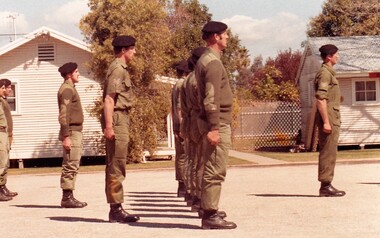
... Melbourne and squadrons in Sale, Benalla/Wangaratta and Albury. In 1955 Regimental Headquarters moved to Wangaratta and a second squadron was located at Albury. The Sale squadron transferred to 4th/19th Prince of Wales’s Light Horse. In 1977 8/13 VMR Regiment was reduced to an independent squadron A Squadron 8th/13th Victorian Mounted Rifles and in 1991 was linked with 4th/19th Prince of Wales’s Light Horse forming the VMR Squadron of that regiment. Colour photograph of soldiers of ' A ' Squadron 8/13 Victorian Mounted Rifles on parade at Buna Barracks ...The 8th/13th Victorian Mounted Rifles was raised as a regiment of the Royal Australian Armoured Corps on 1 May 1948 with Headquarters in Melbourne and squadrons in Sale, Benalla/Wangaratta and Albury. In 1955 Regimental Headquarters moved to Wangaratta and a second squadron was located at Albury. The Sale squadron transferred to 4th/19th Prince of Wales’s Light Horse. In 1977 8/13 VMR Regiment was reduced to an independent squadron A Squadron 8th/13th Victorian Mounted Rifles and in 1991 was linked with 4th/19th Prince of Wales’s Light Horse forming the VMR Squadron of that regiment.Colour photograph of soldiers of ' A ' Squadron 8/13 Victorian Mounted Rifles on parade at Buna Barracks, Albury, 1986. Squadron Sergeant Major Paech has taken post on right of front rank. -
 8th/13th Victorian Mounted Rifles Regimental Collection
Photograph
... Melbourne and squadrons in Sale, Benalla/Wangaratta and Albury. In 1955 Regimental Headquarters moved to Wangaratta and a second squadron was located at Albury. The Sale squadron transferred to 4th/19th Prince of Wales’s Light Horse. In 1977 8/13 VMR Regiment was reduced to an independent squadron A Squadron 8th/13th Victorian Mounted Rifles and in 1991 was linked with 4th/19th Prince of Wales’s Light Horse forming the VMR Squadron of that regiment. Colour photograph of two officers of ' A ' Squadron 8/13 Victorian Mounted Rifles on parade at Buna Barracks ...The 8th/13th Victorian Mounted Rifles was raised as a regiment of the Royal Australian Armoured Corps on 1 May 1948 with Headquarters in Melbourne and squadrons in Sale, Benalla/Wangaratta and Albury. In 1955 Regimental Headquarters moved to Wangaratta and a second squadron was located at Albury. The Sale squadron transferred to 4th/19th Prince of Wales’s Light Horse. In 1977 8/13 VMR Regiment was reduced to an independent squadron A Squadron 8th/13th Victorian Mounted Rifles and in 1991 was linked with 4th/19th Prince of Wales’s Light Horse forming the VMR Squadron of that regiment.Colour photograph of two officers of ' A ' Squadron 8/13 Victorian Mounted Rifles on parade at Buna Barracks Albury, 1986. Squadron Second-in-Command, Captain Peter Martin, is handing over the parade to Squadron Commander Major Ian Docking -
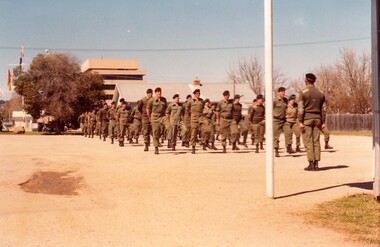 8th/13th Victorian Mounted Rifles Regimental Collection... Melbourne and squadrons in Sale, Benalla/Wangaratta and Albury. In 1955 Regimental Headquarters moved to Wangaratta and a second squadron was located at Albury. The Sale squadron transferred to 4th/19th Prince of Wales’s Light Horse. In 1977 8/13 VMR Regiment was reduced to an independent squadron A Squadron 8th/13th Victorian Mounted Rifles and in 1991 was linked with 4th/19th Prince of Wales’s Light Horse forming the VMR Squadron of that regiment. Colour photograph of ' A ' Squadron 8/13 Victorian Mounted Rifles moving on parade at Buna Barracks ...The 8th/13th Victorian Mounted Rifles was raised as a regiment of the Royal Australian Armoured Corps on 1 May 1948 with Headquarters in Melbourne and squadrons in Sale, Benalla/Wangaratta and Albury. In 1955 Regimental Headquarters moved to Wangaratta and a second squadron was located at Albury. The Sale squadron transferred to 4th/19th Prince of Wales’s Light Horse. In 1977 8/13 VMR Regiment was reduced to an independent squadron A Squadron 8th/13th Victorian Mounted Rifles and in 1991 was linked with 4th/19th Prince of Wales’s Light Horse forming the VMR Squadron of that regiment.Colour photograph of ' A ' Squadron 8/13 Victorian Mounted Rifles moving on parade at Buna Barracks Albury 1986 under command of Squadron Sergeant Major Paech.
-
 8th/13th Victorian Mounted Rifles Regimental Collection
Photograph
... Melbourne and squadrons in Sale, Benalla/Wangaratta and Albury. In 1955 Regimental Headquarters moved to Wangaratta and a second squadron was located at Albury. The Sale squadron transferred to 4th/19th Prince of Wales’s Light Horse. In 1977 8/13 VMR Regiment was reduced to an independent squadron A Squadron 8th/13th Victorian Mounted Rifles and in 1991 was linked with 4th/19th Prince of Wales’s Light Horse forming the VMR Squadron of that regiment. Colour photogtraph of ' A ' Squadron 8/13 Victorian Mounted Rifles parading at Buna Barracks ...The 8th/13th Victorian Mounted Rifles was raised as a regiment of the Royal Australian Armoured Corps on 1 May 1948 with Headquarters in Melbourne and squadrons in Sale, Benalla/Wangaratta and Albury. In 1955 Regimental Headquarters moved to Wangaratta and a second squadron was located at Albury. The Sale squadron transferred to 4th/19th Prince of Wales’s Light Horse. In 1977 8/13 VMR Regiment was reduced to an independent squadron A Squadron 8th/13th Victorian Mounted Rifles and in 1991 was linked with 4th/19th Prince of Wales’s Light Horse forming the VMR Squadron of that regiment.Colour photogtraph of ' A ' Squadron 8/13 Victorian Mounted Rifles parading at Buna Barracks Albury 1986. Lieutenant W. Russell is marching off parade ground. -
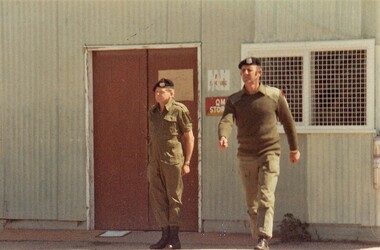 8th/13th Victorian Mounted Rifles Regimental Collection
Photograph
... Melbourne and squadrons in Sale, Benalla/Wangaratta and Albury. In 1955 Regimental Headquarters moved to Wangaratta and a second squadron was located at Albury. The Sale squadron transferred to 4th/19th Prince of Wales’s Light Horse. In 1977 8/13 VMR Regiment was reduced to an independent squadron A Squadron 8th/13th Victorian Mounted Rifles and in 1991 was linked with 4th/19th Prince of Wales’s Light Horse forming the VMR Squadron of that regiment. olour photograph of two soldiers of ' A ' Squadron Victorian Mounted Rifles on parade at Buna Barracks Albury. ...The 8th/13th Victorian Mounted Rifles was raised as a regiment of the Royal Australian Armoured Corps on 1 May 1948 with Headquarters in Melbourne and squadrons in Sale, Benalla/Wangaratta and Albury. In 1955 Regimental Headquarters moved to Wangaratta and a second squadron was located at Albury. The Sale squadron transferred to 4th/19th Prince of Wales’s Light Horse. In 1977 8/13 VMR Regiment was reduced to an independent squadron A Squadron 8th/13th Victorian Mounted Rifles and in 1991 was linked with 4th/19th Prince of Wales’s Light Horse forming the VMR Squadron of that regiment.olour photograph of two soldiers of ' A ' Squadron Victorian Mounted Rifles on parade at Buna Barracks Albury. Squadron Sergeant Major Paech has just handed over the parade to Squadron Second second - in - Command Captain P. Martin. -
 8th/13th Victorian Mounted Rifles Regimental Collection
Photograph
... Melbourne and squadrons in Sale, Benalla/Wangaratta and Albury. In 1955 Regimental Headquarters moved to Wangaratta and a second squadron was located at Albury. The Sale squadron transferred to 4th/19th Prince of Wales’s Light Horse. In 1977 8/13 VMR Regiment was reduced to an independent squadron A Squadron 8th/13th Victorian Mounted Rifles and in 1991 was linked with 4th/19th Prince of Wales’s Light Horse forming the VMR Squadron of that regiment. military VMR CMF Army Reserve uniform parade Two colour photographs of an Administrative parade of ' A ' Squadron 8/13 Victorian Mounted Rifles at Buna Barracks Albury 1986. ...The 8th/13th Victorian Mounted Rifles was raised as a regiment of the Royal Australian Armoured Corps on 1 May 1948 with Headquarters in Melbourne and squadrons in Sale, Benalla/Wangaratta and Albury. In 1955 Regimental Headquarters moved to Wangaratta and a second squadron was located at Albury. The Sale squadron transferred to 4th/19th Prince of Wales’s Light Horse. In 1977 8/13 VMR Regiment was reduced to an independent squadron A Squadron 8th/13th Victorian Mounted Rifles and in 1991 was linked with 4th/19th Prince of Wales’s Light Horse forming the VMR Squadron of that regiment.Two colour photographs of an Administrative parade of ' A ' Squadron 8/13 Victorian Mounted Rifles at Buna Barracks Albury 1986.military, vmr, cmf, army reserve, uniform, parade -
 Wodonga & District Historical Society Inc
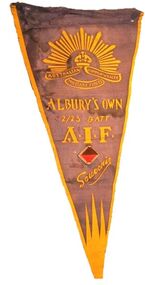
Banner - Souvenir Banner 2/23rd Battalion - Albury's Own
... Established at Victoria Barracks, in Melbourne, in June 1940, the 2/23rd Battalion was raised as part of the all-volunteer Second Australian Imperial Force and assigned to the 26th Brigade. Under the command of Lieutenant Colonel Bernard Evans, a small cadre of experienced personnel drawn from Victorian Militia units were concentrated at Victoria Barracks prior to the battalion headquarters being relocated to Albury, New South Wales, where a large number of volunteers were completing their recruit training at the 4th Recruit Training Battalion. ...Established at Victoria Barracks, in Melbourne, in June 1940, the 2/23rd Battalion was raised as part of the all-volunteer Second Australian Imperial Force and assigned to the 26th Brigade. Under the command of Lieutenant Colonel Bernard Evans, a small cadre of experienced personnel drawn from Victorian Militia units were concentrated at Victoria Barracks prior to the battalion headquarters being relocated to Albury, New South Wales, where a large number of volunteers were completing their recruit training at the 4th Recruit Training Battalion. ...Established at Victoria Barracks, in Melbourne, in June 1940, the 2/23rd Battalion was raised as part of the all-volunteer Second Australian Imperial Force and assigned to the 26th Brigade. Under the command of Lieutenant Colonel Bernard Evans, a small cadre of experienced personnel drawn from Victorian Militia units were concentrated at Victoria Barracks prior to the battalion headquarters being relocated to Albury, New South Wales, where a large number of volunteers were completing their recruit training at the 4th Recruit Training Battalion. Upon the conclusion of this course, the recruits were posted to the 2/23rd and the battalion – over 900 strong– moved to Bonegilla, Victoria, just across the border, where more complex collective training was completed prior to departure overseas. A large majority of the battalion's initial intake of volunteers came from the Albury–Wodonga region and as a result, the 2/23rd became known as "Albury's Own"This item is part of a collection of items owned by Arthur Lock, a member of the 2/23rd Battalion, an all-volunteer Second Australian Imperial Force which served as part of the garrison during the Siege of Tobruk, then at El Alamein, New Guinea and Borneo. It has particular local significance as the battalion was know as "Albury's Own" because a large majority of the battalion's initial intake of volunteers came from the Albury–Wodonga region.A souvenir banner representing the 2/23rd Battalion - Albury's Own. The banner incorporates the insignia of the Commonwealth of Australia Military Forces. It also includes the Unit colour patch which is a lozenge shape, divided into brown over red, with a grey trim. This patch was used from 1940 to 1942 when the patch representing service at Tobruk was introduced. world war 11, 2/23rd battalion, albury's own, arthur lock -
 Wodonga & District Historical Society Inc
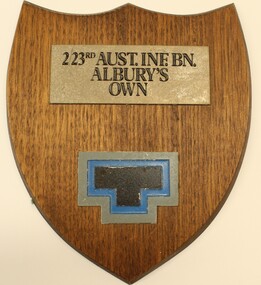
Plaque - Plaque 2/23rd Battalion - Albury's Own
... Established at Victoria Barracks, in Melbourne, in June 1940, the 2/23rd Battalion was raised as part of the all-volunteer Second Australian Imperial Force and assigned to the 26th Brigade. Under the command of Lieutenant Colonel Bernard Evans, a small cadre of experienced personnel drawn from Victorian Militia units were concentrated at Victoria Barracks prior to the battalion headquarters being relocated to Albury, New South Wales, where a large number of volunteers were completing their recruit training at the 4th Recruit Training Battalion. ...Established at Victoria Barracks, in Melbourne, in June 1940, the 2/23rd Battalion was raised as part of the all-volunteer Second Australian Imperial Force and assigned to the 26th Brigade. Under the command of Lieutenant Colonel Bernard Evans, a small cadre of experienced personnel drawn from Victorian Militia units were concentrated at Victoria Barracks prior to the battalion headquarters being relocated to Albury, New South Wales, where a large number of volunteers were completing their recruit training at the 4th Recruit Training Battalion. ...Established at Victoria Barracks, in Melbourne, in June 1940, the 2/23rd Battalion was raised as part of the all-volunteer Second Australian Imperial Force and assigned to the 26th Brigade. Under the command of Lieutenant Colonel Bernard Evans, a small cadre of experienced personnel drawn from Victorian Militia units were concentrated at Victoria Barracks prior to the battalion headquarters being relocated to Albury, New South Wales, where a large number of volunteers were completing their recruit training at the 4th Recruit Training Battalion. Upon the conclusion of this course, the recruits were posted to the 2/23rd and the battalion – over 900 strong– moved to Bonegilla, Victoria, just across the border, where more complex collective training was completed prior to departure overseas. A large majority of the battalion's initial intake of volunteers came from the Albury–Wodonga region and as a result, the 2/23rd became known as "Albury's Own"This item is part of a collection of items owned by Arthur Lock, a member of the 2/23rd Battalion, an all-volunteer Second Australian Imperial Force which served as part of the garrison during the Siege of Tobruk, then at El Alamein, New Guinea and Borneo. It has particular local significance as the battalion was know as "Albury's Own" because a large majority of the battalion's initial intake of volunteers came from the Albury–Wodonga region.A wooden plaque in the shape of a shield commemorating the 2/23rd Battalion known as "Abury's Own". It incorporates a representation of the 2/23rd Battalion colour patch worn after the Siege of Tobruk. At top of plaque "2/23RD AUST.IN.BN./ALBURY'S/OWN"world war 11, rats of tobruk, tobruk, arthur lock -
 Wodonga & District Historical Society Inc
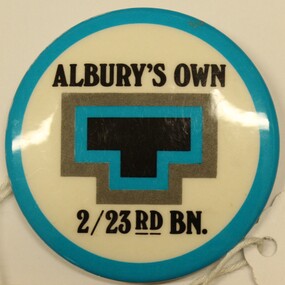
Badge - 2/23rd Battalion - Albury's Own
... Established at Victoria Barracks, in Melbourne, in June 1940, the 2/23rd Battalion was raised as part of the all-volunteer Second Australian Imperial Force and assigned to the 26th Brigade. Under the command of Lieutenant Colonel Bernard Evans, a small cadre of experienced personnel drawn from Victorian Militia units were concentrated at Victoria Barracks prior to the battalion headquarters being relocated to Albury, New South Wales, where a large number of volunteers were completing their recruit training at the 4th Recruit Training Battalion. ...Established at Victoria Barracks, in Melbourne, in June 1940, the 2/23rd Battalion was raised as part of the all-volunteer Second Australian Imperial Force and assigned to the 26th Brigade. Under the command of Lieutenant Colonel Bernard Evans, a small cadre of experienced personnel drawn from Victorian Militia units were concentrated at Victoria Barracks prior to the battalion headquarters being relocated to Albury, New South Wales, where a large number of volunteers were completing their recruit training at the 4th Recruit Training Battalion. ...Established at Victoria Barracks, in Melbourne, in June 1940, the 2/23rd Battalion was raised as part of the all-volunteer Second Australian Imperial Force and assigned to the 26th Brigade. Under the command of Lieutenant Colonel Bernard Evans, a small cadre of experienced personnel drawn from Victorian Militia units were concentrated at Victoria Barracks prior to the battalion headquarters being relocated to Albury, New South Wales, where a large number of volunteers were completing their recruit training at the 4th Recruit Training Battalion. Upon the conclusion of this course, the recruits were posted to the 2/23rd and the battalion – over 900 strong– moved to Bonegilla, Victoria, just across the border, where more complex collective training was completed prior to departure overseas. A large majority of the battalion's initial intake of volunteers came from the Albury–Wodonga region and as a result, the 2/23rd became known as "Albury's Own"This item is part of a collection of items owned by Arthur Lock, a member of the 2/23rd Battalion, an all-volunteer Second Australian Imperial Force which served as part of the garrison during the Siege of Tobruk, then at El Alamein, New Guinea and Borneo. It has particular local significance as the battalion was know as "Albury's Own" because a large majority of the battalion's initial intake of volunteers came from the Albury–Wodonga region.Circular tin lapel button with pin back fastening. The front is made of paper and covered with clear plastic. The printed design on the front shows the post 1942 T-shaped colour patch of the 2/23 Battalion surrounded by the words "ALBURY'S OWN 2/23RD BN." There are 3 similar badges in our collection. Above colour patch "ALBURY'S OWN" Below colour patch "2/23RD BN."world war 11, rats of tobruk, tobruk, arthur lock -
 Wodonga & District Historical Society Inc
Plaque - Albury's Own 2/23rd Battalion 9th Division
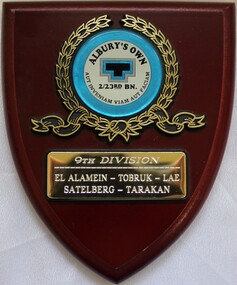
... Established at Victoria Barracks, in Melbourne, in June 1940, the 2/23rd Battalion was raised as part of the all-volunteer Second Australian Imperial Force and assigned to the 26th Brigade. Under the command of Lieutenant Colonel Bernard Evans, a small cadre of experienced personnel drawn from Victorian Militia units were concentrated at Victoria Barracks prior to the battalion headquarters being relocated to Albury, New South Wales, where a large number of volunteers were completing their recruit training at the 4th Recruit Training Battalion. ...Established at Victoria Barracks, in Melbourne, in June 1940, the 2/23rd Battalion was raised as part of the all-volunteer Second Australian Imperial Force and assigned to the 26th Brigade. Under the command of Lieutenant Colonel Bernard Evans, a small cadre of experienced personnel drawn from Victorian Militia units were concentrated at Victoria Barracks prior to the battalion headquarters being relocated to Albury, New South Wales, where a large number of volunteers were completing their recruit training at the 4th Recruit Training Battalion. ...Established at Victoria Barracks, in Melbourne, in June 1940, the 2/23rd Battalion was raised as part of the all-volunteer Second Australian Imperial Force and assigned to the 26th Brigade. Under the command of Lieutenant Colonel Bernard Evans, a small cadre of experienced personnel drawn from Victorian Militia units were concentrated at Victoria Barracks prior to the battalion headquarters being relocated to Albury, New South Wales, where a large number of volunteers were completing their recruit training at the 4th Recruit Training Battalion. Upon the conclusion of this course, the recruits were posted to the 2/23rd and the battalion – over 900 strong– moved to Bonegilla, Victoria, just across the border, where more complex collective training was completed prior to departure overseas. A large majority of the battalion's initial intake of volunteers came from the Albury–Wodonga region and as a result, the 2/23rd became known as "Albury's Own"This item is part of a collection of items owned by Arthur Lock, a member of the 2/23rd Battalion, an all-volunteer Second Australian Imperial Force which served as part of the garrison during the Siege of Tobruk, then at El Alamein, New Guinea and Borneo. It has particular local significance as the battalion was know as "Albury's Own" because a large majority of the battalion's initial intake of volunteers came from the Albury–Wodonga region.A plaque commemorating "Albury's Own" - the 2/23rd Battalion. It incorprates the Unit badge and a a list of battlefronts they served in as part of the 9th Brigade. The Latin in the centre of the badge translates as "I will either find a way or make one". In circular badge "ALBURY'S OWN/ 2/23 RD BN. AUT VIAM INVENIAM AUT FACIAM " On metal oblong "9th DIVISION /EL ALAMEIN -TOBRUK- LAE/ SATELEBERG - TARAKAN"world war 11, 2/23rd battailon, albury's own -
 Wodonga & District Historical Society Inc
Memorabilia - 2/23rd Battalion logo transfer on card
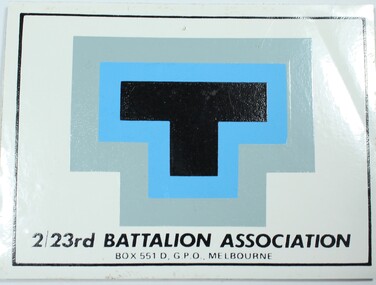
... Established at Victoria Barracks, in Melbourne, in June 1940, the 2/23rd Battalion was raised as part of the all-volunteer Second Australian Imperial Force and assigned to the 26th Brigade. Under the command of Lieutenant Colonel Bernard Evans, a small cadre of experienced personnel drawn from Victorian Militia units were concentrated at Victoria Barracks prior to the battalion headquarters being relocated to Albury, New South Wales, where a large number of volunteers were completing their recruit training at the 4th Recruit Training Battalion. ...Established at Victoria Barracks, in Melbourne, in June 1940, the 2/23rd Battalion was raised as part of the all-volunteer Second Australian Imperial Force and assigned to the 26th Brigade. Under the command of Lieutenant Colonel Bernard Evans, a small cadre of experienced personnel drawn from Victorian Militia units were concentrated at Victoria Barracks prior to the battalion headquarters being relocated to Albury, New South Wales, where a large number of volunteers were completing their recruit training at the 4th Recruit Training Battalion. ...Established at Victoria Barracks, in Melbourne, in June 1940, the 2/23rd Battalion was raised as part of the all-volunteer Second Australian Imperial Force and assigned to the 26th Brigade. Under the command of Lieutenant Colonel Bernard Evans, a small cadre of experienced personnel drawn from Victorian Militia units were concentrated at Victoria Barracks prior to the battalion headquarters being relocated to Albury, New South Wales, where a large number of volunteers were completing their recruit training at the 4th Recruit Training Battalion. Upon the conclusion of this course, the recruits were posted to the 2/23rd and the battalion – over 900 strong– moved to Bonegilla, Victoria, just across the border, where more complex collective training was completed prior to departure overseas. A large majority of the battalion's initial intake of volunteers came from the Albury–Wodonga region and as a result, the 2/23rd became known as "Albury's Own"This item is part of a collection of items owned by Arthur Lock, a member of the 2/23rd Battalion, an all-volunteer Second Australian Imperial Force which served as part of the garrison during the Siege of Tobruk, then at El Alamein, New Guinea and Borneo. It has particular local significance as the battalion was know as "Albury's Own" because a large majority of the battalion's initial intake of volunteers came from the Albury–Wodonga region. This 2/23rd Battalion Association transfer has been laminated and attached to a card. This logo became the colour patch for the unit after their service in Tobruk. Below colour patch "2/23rd BATTALION ASSOCIATION/ BOX 551D, G.P.O. MELBOURNE"world war 11, rats of tobruk, 2/23rd battalion -
 Bendigo Military Museum
Photograph - CANBERRA 1954, Herald Sun Melbourne, c.1954
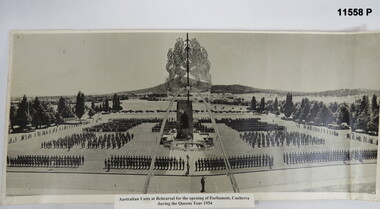
... Victorian Regiment along with a number of other Australian Units paraded in Canberra for the opening of Parliament during the Queens Tour 1954. Passchendaele Barracks Trust PBT47 Photograph Australian Units in rehearsal for the opening of Parliament, Canberra during the Queen's Tour 1954. Forecourt photograph of Australian Units at rehearsal for the opening of Parliament, Canberra during the Queens Tour 1954 with Mt Ainslie in background, trees either side of Parade Ground, Officers taking salute in foreground. Officer taking Salute in foreground. Photograph CANBERRA 1954 Herald Sun Melbourne ...38th Battalion Northern Victorian Regiment along with a number of other Australian Units paraded in Canberra for the opening of Parliament during the Queens Tour 1954.Forecourt photograph of Australian Units at rehearsal for the opening of Parliament, Canberra during the Queens Tour 1954 with Mt Ainslie in background, trees either side of Parade Ground, Officers taking salute in foreground. Officer taking Salute in foreground.Australian Units in rehearsal for the opening of Parliament, Canberra during the Queen's Tour 1954.passchendaele barracks trust, pbt47, photograph
