
Showing 57 items matching "victorian italianate style"
-
 Federation University Historical Collection
Black and white photograph - copy, Ballarat Post Office and Academy of Art on corner of Sturt and Lydiard Streets - c1890, c1890
... victorian italianate...victorian italianate style...Built in the Victorian Italianate style. Arched headed windows on the ground floor originally formed a colonnade. ...Built in the Victorian Italianate style. Arched headed windows on the ground floor originally formed a colonnade. ...First section of the Post Office built 1864. Second section which included a tower was built in 1885. Built in the Victorian Italianate style. Arched headed windows on the ground floor originally formed a colonnade. These were filled in later to provide more internal space. Black and white photograph - copy of the original. Shows former Ballarat Post Office. Horse drawn carriages outside. Another building shown is "Academy of Art" with name above. This cannot be determined.former ballarat post office, colonnade, victorian italianate, victorian italianate style, arched windows, sturt street, lydiard street -
Federation University Historical Collection
Photograph - Photograph - Black and White, Ballarat Post Office, 1938, 1938
... ...victorian italianate style...Victorian Italianate design. Arched headed windows on the ground floor originally formed a colonnade. These were filled in to give additional space inside. The tower - a feature of the building. Top has a cast iron balustraded widow's walk. The Post Office building is now part of Federation University Ballarat Camp Street Campus - Arts Academy. The official opening of the Arts Academy, by Steve Bracks, Premier of Victoria, was on 11 October 2002. Classes commenced at the Arts Academy in 2002. sturt street lydiard street post office anniverary centenary william parker victorian italianate style ...The first section of the Post Office was built in 1864. During 1865 the second section and tower were built. Building is of a Victorian Italianate design. Arched headed windows on the ground floor originally formed a colonnade. These were filled in to give additional space inside. The tower - a feature of the building. Top has a cast iron balustraded widow's walk. The Post Office building is now part of Federation University Ballarat Camp Street Campus - Arts Academy. The official opening of the Arts Academy, by Steve Bracks, Premier of Victoria, was on 11 October 2002. Classes commenced at the Arts Academy in 2002.Black and white photograph showing the Ballarat Post Office on corner of Sturt and Lydiard Streets. Banner across building "1838-1938 POST A SOUVENIR"sturt street, lydiard street, post office, anniverary, centenary, william parker, victorian italianate style -
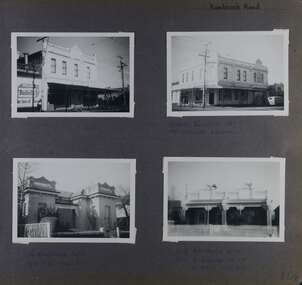 Glen Eira Historical Society
Album - Album page, Kambrook Road, Circa 1972
... ...victorian italianate style...Victorian Italianate villa distinguished by its parapeted window bays either side of a small verandah with encaustic tiled floor. The parapets are balustraded with console enrichment and glazed tiles, the stuccoed surfaces being unpainted. Ornamentation is in other respects undistinguished. https://www.gleneira.vic.gov.au/services/planning-and-building/heritage/heritage-management-plan - re 9-11 Kambrook Road ... they demonstrate most of the commonly employed aesthetic devices characteristic of the Italianate Style including patterned brickwork, patterned slate roofs, cast iron lace verandahs, ornamental stucco work and ashlar boards......The row of attached pairs at 5-11 Kambrook Road and 53-67 Kambrook Road is especially significant in this respect in that the narrow allotments are indicative of the owner/developer’s determination to maximise profits at the height of the Land Boom in 1891... trevor hart kambrook road victorian caulfield north parapets wybar's buildings 1887 caulfield bakery 1887 architectural features painted bricks balaclava road victorian italianate style houses bay windows verandahs glazed tiles shops george wybar builders james yorston dickson and yorston j n hirst l a buckland n e atkins patterned slate roofs patterned bricks cast iron work attached houses Handwritten: Kambrook Road [top right] / WYBAR'S BUILDING 1887/ INC CAULFIELD BAKERY / [under top right photo] / 16 KAMBROOK ROAD / 1970 HIRST MRS J.N. ...This photograph is part of the Caulfield Historical Album 1972. This album was created in approximately 1972 as part of a project by the Caulfield Historical Society to assist in identifying buildings worthy of preservation. The album is related to a Survey the Caulfield Historical Society developed in collaboration with the National Trust of Australia (Victoria) and Caulfield City Council to identify historic buildings within the City of Caulfield that warranted the protection of a National Trust Classification. Principal photographer thought to be Trevor Hart, member of Caulfield Historical Society. Most photographs were taken between 1966-1972 with a small number of photographs being older and from unknown sources. All photographs are black and white except where stated, with 386 photographs over 198 pages. https://vhd.heritagecouncil.vic.gov.au/places/43737 - re 26 Kambrook Road and 345 Balaclava Road corner building: A prominently situated two-storeyed complex of late Victorian buildings consisting of "Wybar's Buildings" occupying the Balaclava Road/ Kambrook Road corner and the "Caulfield Bakery" facing Kambrook Road, separated by a driveway from a single storeyed shop. The main building has a comer splay and balustraded parapet with curved pediments, the words "Wybar's Buildings 1887" having been obliterated but "Caulfield Bakery 1887" with the characteristic wheatsheaf surviving in raised cement work. The walls are stuccoed and richly ornamented with bracketed cornices and keystones with masks extending to the Bakery. The main building is further distinguished by the Masonic symbol of the mason's dividers in the pediment whilst the upper level of the bakery is in overpainted brickwork. The single storeyed shop incorporates the bracketed cornice and consoles characteristic of the main buildings and is in other respects a utilitarian structure. https://vhd.heritagecouncil.vic.gov.au/places/35413 - re 16 Kambrook Road A small late Victorian Italianate villa distinguished by its parapeted window bays either side of a small verandah with encaustic tiled floor. The parapets are balustraded with console enrichment and glazed tiles, the stuccoed surfaces being unpainted. Ornamentation is in other respects undistinguished. https://www.gleneira.vic.gov.au/services/planning-and-building/heritage/heritage-management-plan - re 9-11 Kambrook Road ... they demonstrate most of the commonly employed aesthetic devices characteristic of the Italianate Style including patterned brickwork, patterned slate roofs, cast iron lace verandahs, ornamental stucco work and ashlar boards...https://vhd.heritagecouncil.vic.gov.au/places/43737 - 345 Balaclava and 26 Kambrook Roads HO91 in City of Glen Eira "Wybar's Buildings" at the corner of Balaclava Road and Kambrook Road are important as a prominent late Victorian commercial development incorporating a variety of activities including a bakery and possibly a coffee palace, the latter understood to be unique within the municipality, but characteristic of the period. It is a rare complex of its type in Caulfield and is important also as evocative evidence of the late Victorian Land Boom and the creation of a small now defunct commercial centre at this location by the George Wybrow. https://vhd.heritagecouncil.vic.gov.au/places/35413 - 16 Kambrook Road HO121 in City of Glen Eira ''Hollywood'' at 16 Kambrook Road is of architectural interest for its pavilions which retain their unpainted parapets and ornamental tiles in the manner of other less imposing examples in the immediate locality possibly linked with the builder George Wybar and his son, who undertook substantial projects nearby. Its association with James Yorston, presumably is Yorston of Dickson and Yorston, important builders and estate developers at Caulfield during the Inter war period is of interest. https://www.gleneira.vic.gov.au/services/planning-and-building/heritage/heritage-management-plan - re 9-11 Kambrook Road HO152 Normanby Road/Kambrook Road, Caulfield North Statement of Significance: The Precinct is historically significant for its capacity to demonstrate standards of design and building construction in this part of the municipality during the late Land Boom years and especially just prior to the bank collapse of 1891. The housing stock is representative of the standards of amenity excepted by the middle classes of Melbourne society at the time, including artists, (horse) trainers, jockeys, managers, travellers, journalists and the like, also having a functional link with the activities of the Caulfield Racecourse which forms an important element in the history of the Municipality. The row of attached pairs at 5-11 Kambrook Road and 53-67 Kambrook Road is especially significant in this respect in that the narrow allotments are indicative of the owner/developer’s determination to maximise profits at the height of the Land Boom in 1891...Page 104 of Photograph Album with four photographs (landscape) of three different properties on Kambrook Road.Handwritten: Kambrook Road [top right] / WYBAR'S BUILDING 1887/ INC CAULFIELD BAKERY / [under top right photo] / 16 KAMBROOK ROAD / 1970 HIRST MRS J.N.[under bottom left photo] / 11-9 KAMBROOK ROAD / 1970 9-BUCKLAND MRS L.A / 11- ATKINS MRS N.E. [under bottom right photo] / 104 [bottom right]trevor hart, kambrook road, victorian, caulfield north, parapets, wybar's buildings 1887, caulfield bakery 1887, architectural features, painted bricks, balaclava road, victorian italianate style, houses, bay windows, verandahs, glazed tiles, shops, george wybar, builders, james yorston, dickson and yorston, j n hirst, l a buckland, n e atkins, patterned slate roofs, patterned bricks, cast iron work, attached houses -
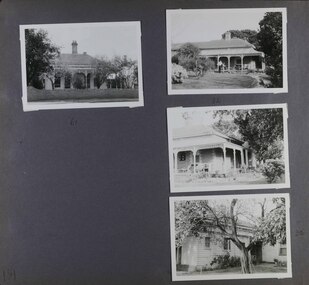 Glen Eira Historical Society
Album - Album page, Seymour Road, Circa 1972
... victorian...italianate style...This is not yet finalised. trevor hart elsternwick seymour road late victorian italianate style verandahs cast iron work gardens Handwritten: 61 [under top left photo] / 32 [under top right photo] / 32 [beside bottom right photo] / 191 [bottom left] Page 191 of Photograph Album with four photographs of two different properties on Seymour Road. ...This album was created in approximately 1972 as part of a project by the Caulfield Historical Society to assist in identifying buildings worthy of preservation. The album is related to a Survey the Caulfield Historical Society developed in collaboration with the National Trust of Australia (Victoria) and Caulfield City Council to identify historic buildings within the City of Caulfield that warranted the protection of a National Trust Classification. Principal photographer thought to be Trevor Hart, member of Caulfield Historical Society. Most photographs were taken between 1966-1972 with a small number of photographs being older and from unknown sources. All photographs are black and white except where stated, with 386 photographs over 198 pages. As at 22/08/2021, 61 Seymour Road is included in the HO179 Beemery Park Precinct which C204glen Amendment seeks to add to the Glen Eira Planning Scheme (amongst others). This is not yet finalised.Page 191 of Photograph Album with four photographs of two different properties on Seymour Road. One photo on the left, with the other three all on the right. Handwritten: 61 [under top left photo] / 32 [under top right photo] / 32 [beside bottom right photo] / 191 [bottom left]trevor hart, elsternwick, seymour road, late victorian, italianate style, verandahs, cast iron work, gardens -
Canterbury History Group
Ephemera - Shrublands, 16 Balwyn Road Canterbury, 1/10/2004 12:00:00 AM
... ... Victorian Italianate style...Canterbury Balwyn Road Shrublands Victorian Italianate style Verandahs Real estate advertisement for the sale by auction of the historic mansion "Shrublands" 16 Balwyn Road Canterbury on 5 October 2002. ...Real estate advertisement for the sale by auction of the historic mansion "Shrublands" 16 Balwyn Road Canterbury on 5 October 2002. Includes coloured photographs of the exterior of the house and floor plans for both floors and site plans.canterbury, balwyn road, shrublands, victorian italianate style, verandahs -
Glen Eira Historical Society
Article - Maysbury, Maysbury Avenue, 1, Elsterwick
... ... Victorian Style... Italianate...Maysbury Elsternwick Maysbury Avenue South Road Labassa Gatsby Burreel Avenue Grimwade House Glenhuntly Road Glenmayne Biggin and Scott Real Estate Mansions Architectural Features Flats Bedrooms Living Rooms Kitchens Bathrooms Arches Ceilings Fireplaces Architects Land Titles Gardens Sheds Victorian Style Italianate Style Article Maysbury, Maysbury Avenue, 1, Elsterwick ...An article in Melbourne Bayside Weekly, October 20, 2010 by architect Neil Clerehan giving the history of Maysbury and describing some of its architectural features, also a description of the building and grounds subdivision into individual houses in the newly created Maysbury Avenue and the building into seven individual flats and subsequent addition of seven more apartments. Included in the article are three coloured photographs of one of the exterior of the building and two of individual rooms in apartment No.7. Also three real estate advertisements including three coloured photographs, one of interior of apartment and two external views of Maysbury dated 2009 and 2010.maysbury, elsternwick, maysbury avenue, south road, labassa, gatsby, burreel avenue, grimwade house, glenhuntly road, glenmayne, biggin and scott real estate, mansions, architectural features, flats, bedrooms, living rooms, kitchens, bathrooms, arches, ceilings, fireplaces, architects, land titles, gardens, sheds, victorian style, italianate style -
Canterbury History Group
Ephemera - 16 Balwyn Road, Canterbury, 1/05/2003 12:00:00 AM
... ... Victorian and Italianate Style...Canterbury Balwyn Road Shrublands Victorian and Italianate Style Real estate advertisement for the sale by auction on 3 May 2003 of "Shrublands" 16 Balwyn Road Canterbury, with the potential for developement. ...Real estate advertisement for the sale by auction on 3 May 2003 of "Shrublands" 16 Balwyn Road Canterbury, with the potential for developement. Includes coloured photographs of the exterior of the mansion and entrance hall, and floor and site plans.canterbury, balwyn road, shrublands, victorian and italianate style -
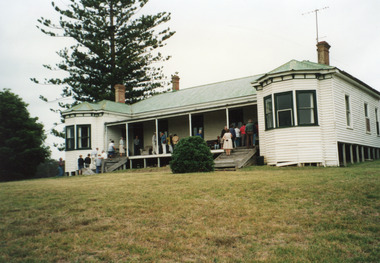 Lakes Entrance Historical Society
Photograph - Lake Tyers House 1995
... Colour photograph taken at Lake Tyers House, a large timber dwelling built in Victorian Italianate style with two projecting faceted bay windows, corrugated iron roof. ...Accommodation Guesthouses Colour photograph taken at Lake Tyers House, a large timber dwelling built in Victorian Italianate style with two projecting faceted bay windows, corrugated iron roof. ...Lake Tyers House built 1886 by R Krokel of Bairnsdale as guest house and stop over being on the coastal road to Orbost and Merimbula. Guest house from 1886 to 1960's.Colour photograph taken at Lake Tyers House, a large timber dwelling built in Victorian Italianate style with two projecting faceted bay windows, corrugated iron roof. Three internal brick chimneys visible through roof. Situated on a prominent headland with a view of Lake Tyers. Lakes Tyers Victoriaaccommodation, guesthouses -
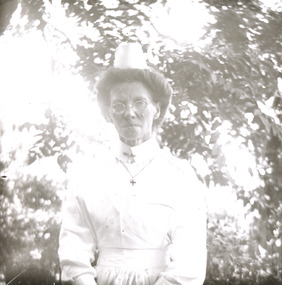 The Beechworth Burke Museum
Photograph - Lantern Slide, c1900
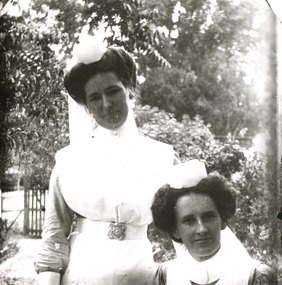
... Victorian Heritage Register...Italianate style...It is listed on the Victorian Heritage Register as being architecturally significant. The extensive complex of buildings are examples of Italianate-style, which is strongly associated with asylums of the 1860s - the period in which construction of this particular asylum began. ...Burke Museum Beechworth Lantern Slide Slide Glass Slide Plate Burke Museum Collection Photograph Monochrome Mayday Hills Mayday Hills Mental Asylum Beechworth Asylum Beechworth Asylum Nurses Psychiatric nurses Psychiatric care 1900 Mayday Hills Victorian Heritage Register Italianate style 19th century asylums Asylums Victoria Thin translucent sheet of glass with a portrait image printed on the front. ...Taken in approximately 1900, this glass slide captures an image of a Mayday Hills Mental Asylum nurse. Also known as the Beechworth Lunatic Asylum, Mayday Hills was officially opened on the twenty-fourth of October 1867 and was commissioned following lobbying from Beechworth Municipal Council concerning a need for better living conditions for certain individuals confined to the town's gaol. These individuals, as well as many others who were brought from surrounding institutions, exhibited behaviours that were deemed to be unfit for mainstream society. At its peak, the asylum consisted of sixty-seven buildings and housed over twelve-hundred patients and five-hundred staff. At the time of Australian Federation in 1901 - just a year after this photograph was taken - the patient population numbered six-hundred and seventy-four. The designated site of the institution was chosen due to its scenery and altitude. It was argued that these picturesque surroundings would assist in curing the hospital's patients of their ailments. The asylum was officially closed in 1996. It is listed on the Victorian Heritage Register as being architecturally significant. The extensive complex of buildings are examples of Italianate-style, which is strongly associated with asylums of the 1860s - the period in which construction of this particular asylum began. Today the asylum offers tours to visitors: both daytime history tours and night-time ghost tours. Lantern slides, sometimes called 'magic lantern' slides, are glass plates on which an image has been secured for the purpose of projection. Glass slides were etched or hand-painted for this purpose from the Eighteenth Century but the process became more popular and accessible to the public with the development of photographic-emulsion slides used with a 'Magic Lantern' device in the mid-Nineteenth Century. Photographic lantern slides comprise a double-negative emulsion layer (forming a positive image) between thin glass plates that are bound together. A number of processes existed to form and bind the emulsion layer to the base plate, including the albumen, wet plate collodion, gelatine dry plate and woodburytype techniques. Lantern slides and magic lantern technologies are seen as foundational precursors to the development of modern photography and film-making techniques.This glass slide is socially and historically significant as it is representative of the lives of the nurses who worked at Beechworth's Mayday Hills Asylum in the early twentieth century. Thin translucent sheet of glass with a portrait image printed on the front. It is held together by metal strips to secure the edges of the slide.burke museum, beechworth, lantern slide, slide, glass slide, plate, burke museum collection, photograph, monochrome, mayday hills, mayday hills mental asylum, beechworth asylum, beechworth asylum nurses, psychiatric nurses, psychiatric care, 1900 mayday hills, victorian heritage register, italianate style, 19th century asylums, asylums victoria -
 The Beechworth Burke Museum
Photograph - Lantern Slide, c1900
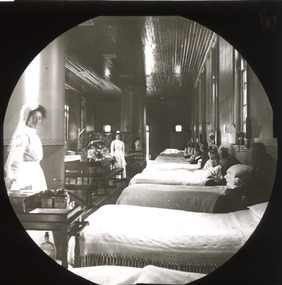
... Victorian Heritage Register...Italianate style...It is listed on the Victorian Heritage Register as being architecturally significant. The extensive complex of buildings are examples of Italianate-style, which is strongly associated with asylums of the 1860s - the period in which construction of this particular asylum began. ...Burke Museum Beechworth Lantern Slide Slide Glass Slide Plate Burke Museum Collection Photograph Monochrome 1900 Mayday Hills Mayday Hills Beechworth Mental Hospital Beechworth Mental Asylum Beechworth Asylum Nurses Psychiatric nurses Psychiatric care Victorian Heritage Register Italianate style 19th century asylums Asylums Victoria Thin translucent sheet of glass with a portrait image printed on the front. ...Taken in approximately 1900, this glass slide captures an image of two Mayday Hills Mental Asylum nurses. Also known as the Beechworth Lunatic Asylum, Mayday Hills was officially opened on the twenty-fourth of October 1867 and was commissioned following lobbying from Beechworth Municipal Council concerning a need for better living conditions for certain individuals confined to the town's gaol. These individuals, as well as many others who were brought from surrounding institutions, exhibited behaviours that were deemed to be unfit for mainstream society. At its peak, the asylum consisted of sixty-seven buildings and housed over twelve-hundred patients and five-hundred staff. At the time of Australian Federation in 1901 - just a year after this photograph was taken - the patient population numbered six-hundred and seventy-four. The designated site of the institution was chosen due to its scenery and altitude. It was argued that these picturesque surroundings would assist in curing the hospital's patients of their ailments. The asylum was officially closed in 1996. It is listed on the Victorian Heritage Register as being architecturally significant. The extensive complex of buildings are examples of Italianate-style, which is strongly associated with asylums of the 1860s - the period in which construction of this particular asylum began. Today the asylum offers tours to visitors: both daytime history tours and night-time ghost tours. Lantern slides, sometimes called 'magic lantern' slides, are glass plates on which an image has been secured for the purpose of projection. Glass slides were etched or hand-painted for this purpose from the Eighteenth Century but the process became more popular and accessible to the public with the development of photographic-emulsion slides used with a 'Magic Lantern' device in the mid-Nineteenth Century. Photographic lantern slides comprise a double-negative emulsion layer (forming a positive image) between thin glass plates that are bound together. A number of processes existed to form and bind the emulsion layer to the base plate, including the albumen, wet plate collodion, gelatine dry plate and woodburytype techniques. Lantern slides and magic lantern technologies are seen as foundational precursors to the development of modern photography and film-making techniques.This glass slide is socially and historically significant as it is representative of the lives of the nurses who worked at Beechworth's Mayday Hills Asylum in the early twentieth century.Thin translucent sheet of glass with a portrait image printed on the front. It is held together by metal strips to secure the edges of the slide.burke museum, beechworth, lantern slide, slide, glass slide, plate, burke museum collection, photograph, monochrome, 1900 mayday hills, mayday hills, beechworth mental hospital, beechworth mental asylum, beechworth asylum nurses, psychiatric nurses, psychiatric care, victorian heritage register, italianate style, 19th century asylums, asylums victoria -
Federation University Historical Collection
Booklet, Report on the Viability of Establishing a Post Secondary Education Facility Located at the Aradale Traininf Centre, Ararat, Victoria, 1993, 12/1993
... Aradale was designed in 1864 in the Victorian Italianate style by John James Clark of the Public Works Department, Victoria. ...Aradale was designed in 1864 in the Victorian Italianate style by John James Clark of the Public Works Department, Victoria. ...Aradale is located 3 km from the centre of Ararat and covers approximately 101 hectares. It consistes of an impresive group of mainly heritage buildings of national significance surrounded by open farmland. Aradale was designed in 1864 in the Victorian Italianate style by John James Clark of the Public Works Department, Victoria. A three storey nurses quarters was built in the 1930s and the Forensic Psychaitry Centre was established in the 1980s. The design of asylums as a specific building type orginated in England in the mddle of the 19th century when it was decided that 'pauper lunatics' would be better cared for in a separate institution rather than being house within the workhouses. Some of the early purpose built asylums were based on the radiating principle of prisons but the arrangement of separat wings at right angles used in hospitals and whorkhouse design soon came to be seen as the most appropriate. The largest 19th century asylum in England was built at Colney Hatch. Kew, Beechworth and Ararat Asylums closely followed the Colney Hatch model. In victoria the population rose due to the gold rushes resulting in severe housing shortages, and additional pressure on asylums. The first asylum in Melbourne was established at Y arra Bend. In 1862 a new asylum was established at Kew. Ararat Asylum and Beechworth Asylum were designed in 1864. Ararat was opened on 19 October 1867, with Beechworth Asylum opening five days later. Soft covered bookletararat regional development board inc., aradale training centre, aradale, grano street ararat, alfred st ararat, ivar nelson, john christie, jon duggan, wes matthews, peter helfer, michael burke, john grant, asylum, lunatic asylum, colney hatch asylum, ararat asylum, fever tents, sunbury asylum, kew asylum, beechworth asylum, wine industry training -
 The Beechworth Burke Museum
Photograph - Lantern Slide, c1900
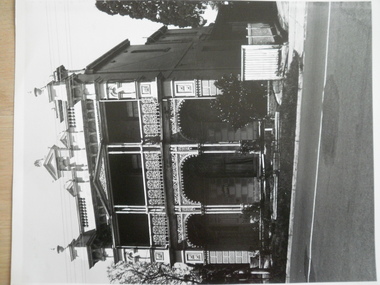
... Victorian Heritage Register...1900...1900 Mayday Hills...Italianate style...It is listed on the Victorian Heritage Register as being architecturally significant. The extensive complex of buildings are examples of Italianate-style, which is strongly associated with asylums of the 1860s - the period in which construction of this particular asylum began. ...It is listed on the Victorian Heritage Register as being architecturally significant. The extensive complex of buildings are examples of Italianate-style, which is strongly associated with asylums of the 1860s - the period in which construction of this particular asylum began. ...This glass slide captures a scene from a male hospital ward at Mayday Hills Mental Asylum. Also known as the Beechworth Lunatic Asylum, Mayday Hills was officially opened on the twenty-fourth of October 1867 and was commissioned following lobbying from Beechworth Municipal Council concerning a need for better living conditions for individuals confined to the town's gaol. These individuals, as well as many others who were brought from surrounding institutions, exhibited behaviours that were deemed to be unfit for mainstream society. At its peak, the asylum consisted of sixty-seven buildings and housed over twelve-hundred patients and five-hundred staff. At the time of Australian Federation in 1901 - just a year after this photograph was taken - the patient population numbered six-hundred and seventy-four. The asylum was officially closed in 1996. It is listed on the Victorian Heritage Register as being architecturally significant. The extensive complex of buildings are examples of Italianate-style, which is strongly associated with asylums of the 1860s - the period in which construction of this particular asylum began. Today the asylum offers tours to visitors, including daytime history tours and night-time ghost tours. Lantern slides, sometimes called 'magic lantern' slides, are glass plates on which an image has been secured for the purpose of projection. Glass slides were etched or hand-painted for this purpose from the Eighteenth Century but the process became more popular and accessible to the public with the development of photographic-emulsion slides used with a 'Magic Lantern' device in the mid-Nineteenth Century. Photographic lantern slides comprise a double-negative emulsion layer (forming a positive image) between thin glass plates that are bound together. A number of processes existed to form and bind the emulsion layer to the base plate, including the albumen, wet plate collodion, gelatine dry plate and woodburytype techniques. Lantern slides and magic lantern technologies are seen as foundational precursors to the development of modern photography and film-making techniques.This glass slide is socially and historically significant as it is representative of the lives of the nurses and patients at Beechworth Mayday Hills Asylum in the early twentieth century. It is also historically significant as it is representative of the changing style of treatments and attitudes towards mental illness. Thin translucent sheet of glass with a circular image printed on the front and framed in a black backing. It is held together by metal strips to secure the edges of the slide.Obverse: h /lantern slide, slide, glass slide, plate, burke museum collection, photograph, monochrome, mayday hills, mayday hills hospital, mayday hills asylum, beechworth lunatic asylum, beechworth mental asylum, psychiatric hostpital, beechworth, burke museum, beechworth municipal council, beechworth patients, psychiatric patients, victorian heritage register, 1900, 1900 mayday hills, italianate style, 19th century asylums, asylums victoria, male ward mayday hills -
 Glen Eira Historical Society
Letter - Lisbon House
... ... Italianate style... Victorian...Reeves E M Hart T Ward Andrew Brown Mary Brown Walter Weigall Reginald Brown EM Mould Arthur Symons George Read M Tonkin Ray Kons A&A Caulfield Elsternwick Orrong Road Lisbon House Glenhuntly Road City of Glen Eira Verandahs Cast iron work Architectural styles Italianate style Victorian Style Caulfield Historical Society Caulfield North Letter Lisbon House ...Copy of a notification letter from National Trust of Australia to the owner Mrs EM Reeves that Lisbon House been classified. Dated 26/03/1994 Photocopy of conservation study of Lisbon House by Andrew Ward in October 1994. Includes brief description and history and photograph of the house. Letter from the Historic Buildings Council to owners of the Lisbon House advising on the application to review and include the house in the Historic Buildings Register. Letter dating 31/03/1995. Letter dated 18/09/1995 from the HBC to the owners of the house advising them that the house will not be added to the register. One page description of Lisbon House with sketch of facade. Date and source unknown. Photograph of Lisbon House. Date unknown, black and white, photographer unknown.reeves e m, hart t, ward andrew, brown mary, brown walter, weigall reginald, brown em, mould arthur, symons george, read m, tonkin ray, kons a&a, caulfield, elsternwick, orrong road, lisbon house, glenhuntly road, city of glen eira, verandahs, cast iron work, architectural styles, italianate style, victorian style, caulfield historical society, caulfield north -
Glen Eira Historical Society
Document - Lovell House, Alma Road, 389 – 393
... Italianate Style... Oram William... Independent Schools... Victorian...Lloyd Bruford Elizabeth Adamsdown Grice John Lovell House Gilbert Edith Schools Italianate Style Oram William Independent Schools Victorian Style Mansions Gawler & Drummond Macdonald Hector Architectural Styles Church of England Girl’s Grammar School Document Lovell House, Alma Road, 389 – 393 ...A photocopy of a typed extract from the Caulfield Conservation Study dated January 1995 by Andrew Ward regarding the history and architectural features of Lovell House in 389 – 393 Alma Road, Caulfield. A poorly copied photo of the exterior of the house is included.alma road, bagatelle, small major, caulfield, caulfield north, myoora, bruford martha, atta vista, cannon. m., small.c.h., bella vista, o’neil. lloyd, bruford elizabeth, adamsdown, grice john, lovell house, gilbert edith, schools, italianate style, oram william, independent schools, victorian style, mansions, gawler & drummond, macdonald hector, architectural styles, church of england, girl’s grammar school -
Glen Eira Historical Society
Document - Lord Lodge, Booran Rd 30 – Andover (1899) Moidart (1910)
... Victorian Amateur Turf Club... Historic Buildings Register... National Estate Register... Caulfield Cup... Horses... Stables... Horse Racing... Racehorses... Outbuildings... Racehorse Trainers... Depression 1890s... Brick houses... Mansions... Towers... Verandahs... Stained Glass... Italianate Style...Leek John Merrill Alfred Macdonald Leslie Arthur John Robertson John Ward Andrew Ingliston Sobar Havelock Proud Future Lord Andover Moidart Lord Lodge Grace Darling Caulfield East Booran Rd Glen Eura Rd Neerim Rd Caulfield Racecourse Reserve Victorian Amateur Turf Club Historic Buildings Register National Estate Register Caulfield Cup Horses Stables Horse Racing Racehorses Outbuildings Racehorse Trainers Depression 1890s Brick houses Mansions Towers Verandahs Stained Glass Italianate Style Victorian Style Architectural Features Architectural Styles Document Lord Lodge, Booran Rd 30 – Andover (1899) Moidart (1910) ...A photocopy of a 4 page extract from the Caulfield Conservation Study of the house and stables at 30 Booran Rd, conducted January 1995 by Andrew Ward. This document details the history of the property, including its 3 names Andover (1899), Moidart (1910) and Lord Lodge and lists previous owners. It also describes in detail the architectural features of Lord Lodge. Three photocopies of photographs are included. The front view of the house, the external view of the stables and an internal view of the stables.leek john, merrill alfred, macdonald leslie, arthur john, robertson john, ward andrew, ingliston, sobar, havelock, proud, future, lord, andover, moidart, lord lodge, grace darling, caulfield east, booran rd, glen eura rd, neerim rd, caulfield racecourse reserve, victorian amateur turf club, historic buildings register, national estate register, caulfield cup, horses, stables, horse racing, racehorses, outbuildings, racehorse trainers, depression 1890s, brick houses, mansions, towers, verandahs, stained glass, italianate style, victorian style, architectural features, architectural styles -
Glen Eira Historical Society
Document - Maysbury, Maysbury Avenue, 1, Elsterwick
... Italianate Style... Mansions... Verandahs... Morris John... Sandham Street... Orrong Road... Glenhuntly Road... Watson Alexander... Victorian...Includes references and a black and white photocopy of a photograph of the exterior Ward Andrew Maysbury Avenue Maysbury Maysbury Flats Elsternwick Caulfield Conservation Study Architectural features Italianate Style Mansions Verandahs Morris John Sandham Street Orrong Road Glenhuntly Road Watson Alexander Victorian Style Bedwell E.P Document Maysbury, Maysbury Avenue, 1, Elsterwick ...A Caulfield Conservation study report by Andrew Ward dated August 1994 on 1 Maysbury Avenue, Elsternwick including a description, history and statement of the building’s significance. Includes references and a black and white photocopy of a photograph of the exteriorward andrew, maysbury avenue, maysbury, maysbury flats, elsternwick, caulfield conservation study, architectural features, italianate style, mansions, verandahs, morris john, sandham street, orrong road, glenhuntly road, watson alexander, victorian style, bedwell e.p -
Glen Eira Historical Society
Document - Fairfield Hall, North Road, 225, Caulfield South
... ... Italianate style... Victorian...North Road Manair Fairfield Hall Caulfield South Caulfield Italianate style Victorian style Architectural styles McCombie T Keys R Kooyong Road Curwan Frederick Wallis Knight C Aitkin Whiting and Aitkin Solicitors Wall Henry Wragge and Hearne Younger Alexander Younger family Younger Avenue Fairfield Grove Mansions Ward Andrew Document Fairfield Hall, North Road, 225, Caulfield South ...A three page photocopy from the Caulfield Conservation Study by Andrew Ward in 01/1995, on Fairfield Hall at 225 North Road, Caulfield South. The study provides a brief description of the building, its history, a statement of significance and includes two photographs (99mm x 152mm) of the exterior of the building.north road, manair, fairfield hall, caulfield south, caulfield, italianate style, victorian style, architectural styles, mccombie t, keys r, kooyong road, curwan frederick wallis, knight c, aitkin whiting and aitkin solicitors, wall henry, wragge and hearne, younger alexander, younger family, younger avenue, fairfield grove, mansions, ward andrew -
Glen Eira Historical Society
Article - Archibald Street,|1,|Elsternwick
... Victorian Style... Architectural Features... Rogers Mark... Kelly Juanita... Italianate...Archibald Street Elsternwick Victorian Style Architectural Features Rogers Mark Kelly Juanita Italianate Style Nicholson ceramics Buxton Estate Agent Outbuildings Article Archibald Street,|1,|Elsternwick ...Newspaper article on forthcoming sale of 1 Archibald St, Elsternwick, includes one coloured photograph. Gives brief description of interior features. Newspaper article on forthcoming sale of 1 Archibald St, Elsternwick, includes one coloured photograph. Article describes house interior and details of house exterior and outbuildings.archibald street, elsternwick, victorian style, architectural features, rogers mark, kelly juanita, italianate style, nicholson ceramics, buxton, estate agent, outbuildings -
 Glen Eira Historical Society
Album - Album page, Booran Road, 30, Circa 1972
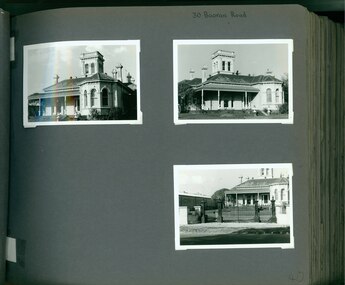
... victorian amateur turf club...historic buildings register...national estate register...caulfield cup...horses...stables...horse racing...racehorses...outbuildings...racehorse trainers...depression...1890s...brick houses...mansions...towers...verandahs...stained glass...italianate style...The house has many Victorian Italianate or Boom Style features although it is more modest than many villas of its style. ...This photograph is part of the Caulfield Historical Album 1972. This album was created in approximately 1972 as part of a project by the Caulfield Historical Society to assist in identifying buildings worthy of preservation. The album is related to a Survey the Caulfield Historical Society developed in collaboration with the National Trust of Australia (Victoria) and Caulfield City Council to identify historic buildings within the City of Caulfield that warranted the protection of a National Trust Classification. Principal photographer thought to be Trevor Hart, member of Caulfield Historical Society. Most photographs were taken between 1966-1972 with a small number of photographs being older and from unknown sources. All photographs are black and white except where stated, with 386 photographs over 198 pages. From Glen Eira Heritage Management Plan 1996 by Andrew Ward: In 1888, John Leek, a trainer, owned Lot 15, measuring one and three quarter acres, in Booran Road, north side between Glen Eira and Neerim Roads. The land backed onto the Caulfield Racecourse Reserve. NAV was £45. In 1890 Leek built for his residence, a ten roomed brick house on the site. NAV was £200. Leek was the owner/trainer of "Ingliston" who won the Caulfield Cup in 1900. Upon the horse's death in 1901, Leek is understood to have defied tradition by spending £20 on boots for the "ragged urchins in Bourke Street" instead of "shouting" at the bar. By 1899, the property was owned and occupied by Alfred Merrill, a dentist and was known as "Andover". NA V had decreased to £ll0. By 1910, Leslie Macdonald, a gentleman had purchased the property and renamed it "Moidart". In 1910-11 Macdonald sold it to John Robertson. The property had extensive wood stables on its north-east boundary and several other outbuildings. The house continued to be described as "Brick, ten rooms" as it was in 1926 when it was owned and occupied by John Arthur, a managing director. The land measured la.2r.31p. and had a NAV of £235. Nine people lived there. In 1926, Arthur also owned the adjoining Lot 16. Other racehorses of note, known to have been stabled here include Sobar, Havelock, Proud, Future and Lord.Victorian Heritage Register https://vhd.heritagecouncil.vic.gov.au/places/13532 What is significant? Lord Lodge is a thoroughbred racehorse training complex adjacent to Caulfield Racecourse, established in 1890. The area immediately around the racecourse has been associated with horse racing activities and businesses servicing the industry since the development of the racecourse in late the 19th century. Lord Lodge was named by the present occupants after the champion racehorse Lord who was stabled there in the 1950s. In the early 20th century the property was known as 'Andover' and subsequently 'Moidart'. The site consists of a single storey brick Italianate villa, jockeys' quarters, stables and open day yards with direct access to Caulfield racecourse from the rear of the property. The villa of 10 rooms on bluestone foundations was constructed in 1890 by John Leek, a horse trainer who purchased the newly subdivided land in 1888. The house has many Victorian Italianate or Boom Style features although it is more modest than many villas of its style. It has an asymmetrical facade with a faceted bay window and a prominent central tower with low pitch pyramidal roof that provides a clear view of the racecourse. Other characteristic features include stilted segmented arches, bracketed eaves, stucco wall finish and cast cement ornamentation. A room has been added on the north-facing verandah in sympathetic style and finish. Internally the rooms are substantially intact with original marble fireplaces and intricate ceiling roses and cornices. An entrance toward the rear of the southern side of the house is said to be where the stable hands, jockeys and other staff lined up for their meals. In the southeast corner of the property, backing directly on to Caulfield racecourse, is a substantial late Victorian timber stable, probably constructed in the 1890s but first appearing on the property title in 1910. The stable has 12 stalls, a loft and brick pavement and jerkin head roof form with varnished pine-lined ceiling carried on a chamfered timber frame. It has an original roof lantern. The doors of the stalls are not the original sliding doors but swing doors obtained from a barn at Epsom Racecourse in Mordialloc prior to demolition. Outside the gambrel roof has fretted barges but the building is otherwise utilitarian. Timber throughout the stalls has been worn by chewing and rubbing of horses over the century of its use. In the southern half of the property are open day yards where the racehorses are kept during the day. The red brick, single storey jockeys' quarters to the rear of the villa were probably built around 1950. A small brick, possibly late Victorian structure on the eastern boundary thought to have originally been a gardening shed, has been converted to a stable of two stalls. Modern concrete brick stables fill the northeast portion of the property. At the front of the property two Moreton Bay Figs (Ficus macrophylla), probably planted in the late 19th century, provide shade for horses in the day yards. In the 1890s John Leek sold the property, relocating his training facility to one of the newly established racecourses at Mentone or Mordialloc (Epsom). By 1899, the property was owned and occupied by Alfred Merrill, a dentist, who named the property 'Andover'. In 1910 it was purchased by Leslie McDonald, a gentleman, and renamed 'Moidart'; sold in 1910-1911 to John Robertson; and again in 1926 to John Arthur, a racehorse owner. The Victorian Amateur Turf Club purchased the property in the late 1930s and since this time has been leased to racehorse trainers. It is unclear whether the property operated as a training facility between 1899 - 1926. Several notable trainers and jockeys are associated with Lord Lodge. The best known is Arthur 'Scobie' Breasley, Australia's most successful jockey who was apprenticed to trainer Pat Quinlan at Lord Lodge (then 'Moidart') from 1928 - 1935. Breasley rode winners of the Caulfield Cup in four successive years 1942-45 and again in 1952. John Leek, the original owner of Lord Lodge trained Ingliston, the 1900 Caulfield Cup winner. Along with 'Lord' a number of well known racehorses including Sobar, Havelock, Proud and Future were trained at Lord Lodge .....Page 40 of Photograph Album with three landscape photographs of the exterior of this house.Handwritten: 30 Booran Road [top right hand corner] / 40 [bottom right]trevor hart, jenny o'donnell, booran road, mansion, caulfield east, ingliston, sobar, havelock, proud, future, lord, andover, moidart, lord lodge, grace darling, caulfield racecourse reserve, victorian amateur turf club, historic buildings register, national estate register, caulfield cup, horses, stables, horse racing, racehorses, outbuildings, racehorse trainers, depression, 1890s, brick houses, mansions, towers, verandahs, stained glass, italianate style, victorian style, architectural features, architectural styles, john leek, leslie macdonald, john arthur, john robertson, alfred merrill, jenny odonnell -
 Glen Eira Historical Society
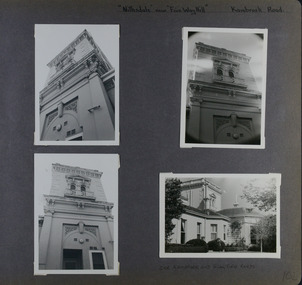
Album - Album page, Nithsdale now Five Way Hill, Kambrook Road, Circa 1972
... Caulfield's Building Heritage by Dr Geulah Solomon, Vol 1 p49 records it as a small Victorian mansion home on bluestone foundations of Italianate style with a tower. ...Caulfield's Building Heritage by Dr Geulah Solomon, Vol 1 p49 records it as a small Victorian mansion home on bluestone foundations of Italianate style with a tower. ...This photograph is part of the Caulfield Historical Album 1972. This album was created in approximately 1972 as part of a project by the Caulfield Historical Society to assist in identifying buildings worthy of preservation. The album is related to a Survey the Caulfield Historical Society developed in collaboration with the National Trust of Australia (Victoria) and Caulfield City Council to identify historic buildings within the City of Caulfield that warranted the protection of a National Trust Classification. Principal photographer thought to be Trevor Hart, member of Caulfield Historical Society. Most photographs were taken between 1966-1972 with a small number of photographs being older and from unknown sources. All photographs are black and white except where stated, with 386 photographs over 198 pages. Glen Eira Heritage Management Plan (1996) by Andrew Ward and Associates - Vol 3 "Nithsdale", built for J.S. Crouchin 1858 and extended in 1885 with a tower and associated rooms, survives as testimony to the nineteenth century occupation of the vicinity of the Kambrook/Glen Eira Road intersection. Caulfield's Building Heritage by Dr Geulah Solomon, Vol 1 p49 records it as a small Victorian mansion home on bluestone foundations of Italianate style with a tower. Built for J S Chambers circa 1860, it was built in stages and then the land subdivided in the 1920s. Other owners include Adolph F Brockhoff (of Brockhoff Biscuits company). Names used besides Nithsdale have been Bundoora and Five Way Hill. Page 102 of Photograph Album with four photographs (three landscape and one portrait) of Nithsdale, now known as Five Way Hill. Three views of the tower and one of the house.Handwritten: "Nithsdale" now "Five Way Hill" Kambrook road [top right] / CNR KAMBROOK AND GLENEIRA ROADS [under bottom right photo] / 102 [bottom right]trevor hart, north caulfield, victorian, mid victorian, late victorian, tower, j.s. crouchin, 1850's, 1880's, italianate, rendered, five way hill, nithsdale, slate roof, plaster arches, ornamental columns, triangular pediment, ornamental parapet, cast iron balconies, kambrook road, glen eira road, t crouch, j s crouchin, mansions, j s chambers, bluestone foundations, land subdivision, adolph f brockhoff, bundoora, house names -
Bendigo Historical Society Inc.
Document - Fortuna - Health, Reports and Risk Assessments of the Site, 2008
... The Villa is built in a number of architectural styles, namely Victorian Italianate and Victorian Free Classical, with Federation influences. ...The Villa is built in a number of architectural styles, namely Victorian Italianate and Victorian Free Classical, with Federation influences. ...Theodore Ballerstedt originally purchased the Fortuna site from the Crown in 1857. The firstimprovements at Fortuna were undertaken by the Ballerstedt family and consisted of a small mill and house. At the peak of the mining era (c.1860s) Fortuna was central to the deep alluvial gold mining operations of Bendigo. In 1871 Theodore Ballerstedt sold the house, mine and associated works to George Lansell 'The Quartz King'. During his time at Fortuna, Lansell owned 13 mines and directed a further 73 in Bendigo. The primary building on the site is the Fortuna Villa. With the wealth Lansell generated from gold mining he funded the continuous expansion of the Villa and surrounding grounds. The Villa is built in a number of architectural styles, namely Victorian Italianate and Victorian Free Classical, with Federation influences. The surrounding landscape featured up to seven decorative lakes in the early 1870s, including one larger lake which still remains today. The former lakes were originally used as disposal points for tailings produced in the gold processing activities at the site. Fortuna was occupied by the Department of Defence from 1942 and was compulsorily acquired for Army use in 1957. Since that time Fortuna has been occupied by the Army and other various Defence organisations. During Defence's ownership, additional buildings were constructed and existing buildings were modified for re-use. In 1992 Defence purchased the adjoining undeveloped property, commonly known as the Bush Block. This parcel of land adjoins the main Fortuna landholding. It is approximately 0.8 hectares in size and is predominately covered in vegetation regrowth. Heritage investigations note that the uniqueness of Fortuna lies in the mixture of architectural styles of the Villa. The relationship between mining and domestic areas and the. close proximity of the two is considered rare to Australian domestic building of that time.Fortuna - Health, Reports and Risk Assessments of the Site This item contains the following documents: 11217.75a Fortuna Defense Site - Health Risk Assessment Final Report - 50 pages and appendices A to M - Contact the BHS for details 11217.75b Fortuna Defense Site - Structural inspection and report on various buildings, Department of Defence, Fortuna Site, 30 Chum Street Bendigo - Contact the BHS for details 11217.75c Fortuna Defense Site - Department of Defence Summary Report on Property Disposals Bendigo - Contact the BHS for details 11217.75d Fortuna Defense Site - Department of Defence Report on unexploded ordnance - Contact the BHS for details 11217.75e Fortuna Defense Site - Department of Defence Phase 1 Summary Report on Property Disposals Bendigo - Contact the BHS for details 11217.75f Fortuna Defense Site - Health Risk Assessment Final Report - 50 pages and appendices A to M - Contact the BHS for details 11217.75g Fortuna Defense Site - Environmental Site Assessment - Contact the BHS for detailsnon-fictionbendigo, fortuna, george lansell -
 Bendigo Historical Society Inc.
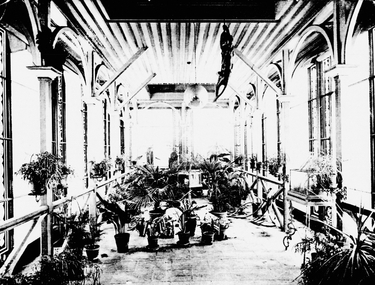
Photograph - Fortuna - Photos (Photo-copies) of Furnished Rooms, Abt 1900
... The Villa is built in a number of architectural styles, namely Victorian Italianate and Victorian Free Classical, with Federation influences. ...The Villa is built in a number of architectural styles, namely Victorian Italianate and Victorian Free Classical, with Federation influences. ...Theodore Ballerstedt originally purchased the Fortuna site from the Crown in 1857. The firstimprovements at Fortuna were undertaken by the Ballerstedt family and consisted of a small mill and house. At the peak of the mining era (c.1860s) Fortuna was central to the deep alluvial gold mining operations of Bendigo. In 1871 Theodore Ballerstedt sold the house, mine and associated works to George Lansell 'The Quartz King'. During his time at Fortuna, Lansell owned 13 mines and directed a further 73 in Bendigo. The primary building on the site is the Fortuna Villa. With the wealth Lansell generated from gold mining he funded the continuous expansion of the Villa and surrounding grounds. The Villa is built in a number of architectural styles, namely Victorian Italianate and Victorian Free Classical, with Federation influences. The surrounding landscape featured up to seven decorative lakes in the early 1870s, including one larger lake which still remains today. The former lakes were originally used as disposal points for tailings produced in the gold processing activities at the site. Heritage investigations note that the uniqueness of Fortuna lies in the mixture of architectural styles of the Villa. The relationship between mining and domestic areas and the. close proximity of the two is considered rare to Australian domestic building of that time.Fortuna - Photos (Photo-copies) of Furnished Rooms This item contains the following 12 documents: 11217.76a Black and White photo of the Gymnasium, a man standing between the horizontal bars and another behind sitting on the exercise bench 11217.76b Black and White photo of a living room with chairs and small table 11217.76c Black and White photo of the conservatory with pot plants 11217.76d Black and White photo of a music room with piano, chairs and a coffee table 11217.76e Black and White photo of a bedroom with sofa, chair and iron framed bed 11217.76f Black and White photo of the games room complete with Billiard Table 11217.76g Black and White photo of the living room, the walls adorned with painting and photographs 11217.76h Black and White photo of the family bedroom, with a child's bed and a large four-poseter with curtains 11217.76i Black and White photo of possibly the function or ballroom 11217.76j Black and White photo of a small room or elcove for quiet conversations 11217.76k Black and White photo of the staircase and statue 11217.76l Black and White photo of the conservatorynon-fictionbendigo, fortuna, george lansell, fortuna furnishings -
 Bendigo Historical Society Inc.
Drawing - Fortuna - Drawing Presented to Brian McLachlon, abt 2000
... The Villa is built in a number of architectural styles, namely Victorian Italianate and Victorian Free Classical, with Federation influences. ...The Villa is built in a number of architectural styles, namely Victorian Italianate and Victorian Free Classical, with Federation influences. ...Theodore Ballerstedt originally purchased the Fortuna site from the Crown in 1857. The firstimprovements at Fortuna were undertaken by the Ballerstedt family and consisted of a small mill and house. At the peak of the mining era (c.1860s) Fortuna was central to the deep alluvial gold mining operations of Bendigo. In 1871 Theodore Ballerstedt sold the house, mine and associated works to George Lansell 'The Quartz King'. During his time at Fortuna, Lansell owned 13 mines and directed a further 73 in Bendigo. Fortuna was occupied by the Department of Defence from 1942 and was compulsorily acquired for Army use in 1957. Since that time Fortuna has been occupied by the Army and other various Defence organisations. During Defence's ownership, additional buildings were constructed and existing buildings were modified for re-use. In 1992 Defence purchased the adjoining undeveloped property, commonly known as the Bush Block. This parcel of land adjoins the main Fortuna landholding. It is approximately 0.8 hectares in size and is predominately covered in vegetation regrowth. Heritage investigations note that the uniqueness of Fortuna lies in the mixture of architectural styles of the Villa. The relationship between mining and domestic areas and the. close proximity of the two is considered rare to Australian domestic building of that time. The primary building on the site is the Fortuna Villa. With the wealth Lansell generated from gold mining he funded the continuous expansion of the Villa and surrounding grounds. The Villa is built in a number of architectural styles, namely Victorian Italianate and Victorian Free Classical, with Federation influences. The surrounding landscape featured up to seven decorative lakes in the early 1870s, including one larger lake which still remains today. The former lakes were originally used as disposal points for tailings produced in the gold processing activities at the site. Heritage investigations note that the uniqueness of Fortuna lies in the mixture of architectural styles of the Villa. The relationship between mining and domestic areas and the. close proximity of the two is considered rare to Australian domestic building of that time.Fortuna - Drawing Presented to Brian McLachlon This item contains the following documents: 11217.77a Six copies Black and White drawing by Jason Nickson (cleaner) presented to Brian McLachlon on his transfer to the USA. Drawing shows Brian on a motor bike being farewelled by the Fortuna Villa (holding a baby named DIGO) and welcomed by the Statue of Liberty and the US flagnon-fictionbendigo, fortuna, george lansell, jason nickson fortuna cleaner, brian mclochlon fortuna -
Bendigo Historical Society Inc.
Plan - Fortuna - Survey Unit Layouts, April 1982
... The Villa is built in a number of architectural styles, namely Victorian Italianate and Victorian Free Classical, with Federation influences. ...The Villa is built in a number of architectural styles, namely Victorian Italianate and Victorian Free Classical, with Federation influences. ...Theodore Ballerstedt originally purchased the Fortuna site from the Crown in 1857. The firstimprovements at Fortuna were undertaken by the Ballerstedt family and consisted of a small mill and house. At the peak of the mining era (c.1860s) Fortuna was central to the deep alluvial gold mining operations of Bendigo. In 1871 Theodore Ballerstedt sold the house, mine and associated works to George Lansell 'The Quartz King'. During his time at Fortuna, Lansell owned 13 mines and directed a further 73 in Bendigo. Fortuna was occupied by the Department of Defence from 1942 and was compulsorily acquired for Army use in 1957. Since that time Fortuna has been occupied by the Army and other various Defence organisations. During Defence's ownership, additional buildings were constructed and existing buildings were modified for re-use. In 1992 Defence purchased the adjoining undeveloped property, commonly known as the Bush Block. This parcel of land adjoins the main Fortuna landholding. It is approximately 0.8 hectares in size and is predominately covered in vegetation regrowth. Heritage investigations note that the uniqueness of Fortuna lies in the mixture of architectural styles of the Villa. The relationship between mining and domestic areas and the. close proximity of the two is considered rare to Australian domestic building of that time. The primary building on the site is the Fortuna Villa. With the wealth Lansell generated from gold mining he funded the continuous expansion of the Villa and surrounding grounds. The Villa is built in a number of architectural styles, namely Victorian Italianate and Victorian Free Classical, with Federation influences. The surrounding landscape featured up to seven decorative lakes in the early 1870s, including one larger lake which still remains today. The former lakes were originally used as disposal points for tailings produced in the gold processing activities at the site. Heritage investigations note that the uniqueness of Fortuna lies in the mixture of architectural styles of the Villa. The relationship between mining and domestic areas and the. close proximity of the two is considered rare to Australian domestic building of that time.Fortuna - Survey Unit Layouts This item contains the following documents: 11217.84a Layout of workspace and equipment used by the Army Survey Group 11217.84b Layout of workspace and equipment used by the Army Survey Group 11217.84c Layout of workspace and equipment used by the Army Survey Groupnon-fictionbendigo, fortuna, george lansell -
 Glen Eira Historical Society
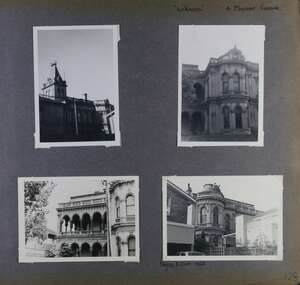
Album - Album page, Labassa, 4 Manor Grove, Circa 1972
... style...l-shaped arcaded verandah...bluestone plinths...balustraded parapet...flat topped mansard roofs...conical roof...elaborate cornices...corinthian columns...caryatid consoles...marble panels...imitation marble...scagliola...tower...conservatory...stables...tennis pavilion...mouldings...decorative glass...caryatids...swagged columns...ornamental cresting...trompe l'oeil ceiling...embossed imitation leather...oak parquetry...stained glass...tripartite window...triple window...ferguson and urie...1870's...flats...1920's...electric wiring...1860's...verandahs...curved windows...arched windows...italianate...terraces...gargoyles...ornamentation...ornate entrance...la bassa...manor grove...st kilda east...victorian...[Online Data Upgrade Project 2004] trevor hart bracketed eaves slate roof bay windows decorative brackets caulfield north labassa richard a. billing balaclava road orrong road sylliott hill william lyall crouch and wilson alexander william robertson ontario 1880's john a. b. koch mansion john boyd watson labassa grove french renaissance style l-shaped arcaded verandah bluestone plinths balustraded parapet flat topped mansard roofs conical roof elaborate cornices corinthian columns caryatid consoles marble panels imitation marble scagliola tower conservatory stables tennis pavilion mouldings decorative glass caryatids swagged columns ornamental cresting trompe l'oeil ceiling embossed imitation leather oak parquetry stained glass tripartite window triple window ferguson and urie 1870's flats 1920's electric wiring 1860's verandahs curved windows arched windows italianate terraces gargoyles ornamentation ornate entrance la bassa manor grove st kilda east victorian cast iron work john koch richard billing architects electrification john mickle land subdivision mrs watson labassa estate robert hannon national trust of australia (victoria) sculpture Handwritten: "Labassa" 4 Manor Grove [top right] / Neg 232 8 Oct 1966 [under bottom right photo] / 128 [bottom right] Page 128 of Photograph Album with four photographs (two portrait and two landscape) of Labassa. ...This photograph is part of the Caulfield Historical Album 1972. This album was created in approximately 1972 as part of a project by the Caulfield Historical Society to assist in identifying buildings worthy of preservation. The album is related to a Survey the Caulfield Historical Society developed in collaboration with the National Trust of Australia (Victoria) and Caulfield City Council to identify historic buildings within the City of Caulfield that warranted the protection of a National Trust Classification. Principal photographer thought to be Trevor Hart, member of Caulfield Historical Society. Most photographs were taken between 1966-1972 with a small number of photographs being older and from unknown sources. All photographs are black and white except where stated, with 386 photographs over 198 pages. HISTORY:-- From Victorian Heritage Database citation for Labassa https://vhd.heritagecouncil.vic.gov.au/places/278 as at (26/10/2020) Labassa, Caulfield is one of Melbourne's most lavishly decorated nineteenth century mansions. It resulted from the extensive remodelling in 1890, of an earlier house, known as Sylliott Hill, which was begun in 1862-3 for lawyer, Richard A. Billing. The land at the corner of Balaclava and Orrong Roads was first acquired in 1854 by William Lyall, transferred to his partner, John Mickle, in 1859, who also acquired the adjoining allotment in Balaclava Road, and the three allotments were conveyed to Billing. His first eight-roomed house was extended significantly in 1873 into a twenty-roomed house by architects Crouch and Wilson, who were possibly also responsible for the first house. This reflected Billing's success as a barrister, and he resided at this property until his death in 1882. In 1883 prominent Melbourne businessman, Alexander William Robertson, leased the Sylliott Hill property from Billing's widow, and in 1885 he purchased the adjoining allotment in Balaclava Road. He purchased the Billing's property in 1887 and renamed the 6.31 hectare property, Ontario. In 1889-90, Robertson commissioned the German born architect, John A. B. Koch, to extensively remodel the house into a thirty-five roomed mansion. The existing house was extended and altered, largely resulting in the nineteenth century mansion as it now appears. After Robertson's death in 1896, the house was tenanted until it was eventually sold to the mining millionaire, John Boyd Watson, in 1904. He renamed the property Labassa and carried out repair and re-decoration work to the house. In the early twentieth century, many large estates were subdivided into smaller allotments as the demand for land grew and it became difficult to maintain such large estates. After Watson's death in 1911, portions of the Labassa estate were offered for sale, with Mrs Watson retaining a 1.73 hectare portion containing the house. In 1913 forty-six allotments were auctioned at Labassa Estate, with the formation of Labassa Grove and Ontario Street to the east of the property. Labassa was first recorded as containing flats in 1923 and in the late 1920s, the owner, Robert Hannon, built a red brick block of flats adjacent to the house. Subdivision continued, until the National Trust of Australia (Victoria) purchased the house in 1980 and subsequently purchased adjoining sites, one to the south-east in 1984 (house demolished in 1988) and to the west in 1988. Labassa as it now stands is substantially as it appeared when Koch completed the work in 1890. The original two storey house was transformed into a French Renaissance style mansion, with the addition of a two level L-shaped arcaded verandah and two prominent terminating bays to the south and the east. The building is of unpainted cement render with dressed bluestone plinths, balustraded parapet and steep, slate covered, flat topped mansard roofs behind. A truncated conical roof is a feature of the south bay and a helmeted head is incorporated in the parapet over the east bay. The main south and east facades incorporate many cast cement details, including sculptures, elaborate cornices, swagged Corinthian columns and caryatid consoles flanking the entrance porch, as well as pink marble panels and imitation marble, or scagliola, on curved surfaces. At the rear of the building is a two storey wing and a single storey cottage, the former being connected to the main house by a tower. This section of the house was constructed in 1873. The estate at its peak included stables (1873), conservatory (probably 1890) and a tennis pavilion (probably 1890). All of these outbuildings survive, with the stables and conservatory being converted for residential use after 1922. Internally a range of decorative treatments remain from the late nineteenth century and the early twentieth century, both from the Robertson and Watson periods of occupancy. These include wallpapers, ceiling decoration, chimney pieces, mouldings, joinery and decorative glass. From Victorian Heritage Database citation for H0135 Labassa 2/2A Manor Grove Caulfield North https://vhd.heritagecouncil.vic.gov.au/places/278 as at (26/10/2020) HOW IS IT SIGNIFICANT? Labassa, Caulfield is of architectural, aesthetic and historical significance to the State of Victoria. WHY IS IT SIGNIFICANT? Labassa, Caulfield is of architectural significance as the most prominent example of a small number of houses built in Australia in the French Renaissance style. It is of further note due to the German interpretation of the style and the use of Hellenistic sources, via Germany. It is exceptional for its lavish treatment externally, including marble, scagliola, caryatids, swagged columns, mansard roofs and ornamental cresting. Labassa is of architectural significance as the most important surviving example of German architect, John Koch's domestic work. He undertook a large variety of work in Melbourne, including a number of houses, however Labassa is the most lavish example of his work. Labassa is of aesthetic significance for its outstanding assemblage of late nineteenth and early twentieth century European style interior decoration, which remain remarkably intact. These include a trompe l'oeil ceiling, painted ceilings, embossed imitation leather and other papers, chimney pieces, ceramic tilework, oak parquetry and stained glass, including a tripartite window by Ferguson and Urie, probably dating from the 1873 period. Labassa is of historical significance as an illustrative example of the wealth acquired by a number of prominent Victorian families in the second half of the 19th century. The early development of the property, Sylliott Hill, was due to the wealth acquired by Richard Billing, barrister and fifth Victorian to be appointed Queen's Counsel in 1878. The significant development in 1890 of Ontario, is illustrative of the wealth of Alexander Robertson, a partner in Cobb and Co., a director of Goldsborough Mort & Co., and a pastoral speculator. John B. Watson, whose father had acquired great wealth from the goldfields of Bendigo and subsequently invested in city and country properties, was the third resident to impact on the house, particularly the interiors. The Labassa estate is of historical significance as an illustrative example of the development that occurred in such suburbs as Caulfield in the 1880s due to the land boom, its proximity to Melbourne and the establishment of the Melbourne to Gippsland railway in 1879. It is also illustrative of an estate which succumbed to the pressures of subdividing in the early twentieth century, as properties became difficult to maintain and demand for land close to the city grew. It was typically divided into flats in the 1920s and was used as such for about sixty years. It is of historical significance for its associations with the remnants of the earlier estate which remain extant. These include the stables, conservatory (H2005) and tennis pavilion which all remain on separate sites. Also significant are the remains of early electrical wiring and fittings. Labassa was one of the first houses in Caulfield to be electrified and some of the original wires remain. [Online Data Upgrade Project 2004]Page 128 of Photograph Album with four photographs (two portrait and two landscape) of Labassa.Handwritten: "Labassa" 4 Manor Grove [top right] / Neg 232 8 Oct 1966 [under bottom right photo] / 128 [bottom right]trevor hart, bracketed eaves, slate roof, bay windows, decorative brackets, caulfield north, labassa, richard a. billing, balaclava road, orrong road, sylliott hill, william lyall, crouch and wilson, alexander william robertson, ontario, 1880's, john a. b. koch, mansion, john boyd watson, labassa grove, french renaissance style, l-shaped arcaded verandah, bluestone plinths, balustraded parapet, flat topped mansard roofs, conical roof, elaborate cornices, corinthian columns, caryatid consoles, marble panels, imitation marble, scagliola, tower, conservatory, stables, tennis pavilion, mouldings, decorative glass, caryatids, swagged columns, ornamental cresting, trompe l'oeil ceiling, embossed imitation leather, oak parquetry, stained glass, tripartite window, triple window, ferguson and urie, 1870's, flats, 1920's, electric wiring, 1860's, verandahs, curved windows, arched windows, italianate, terraces, gargoyles, ornamentation, ornate entrance, la bassa, manor grove, st kilda east, victorian, cast iron work, john koch, richard billing, architects, electrification, john mickle, land subdivision, mrs watson, labassa estate, robert hannon, national trust of australia (victoria), sculpture -
 Glen Eira Historical Society
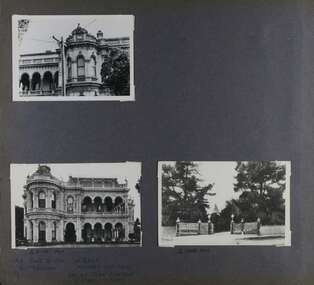
Album - Album page, Labassa, 4 Manor Grove, Circa 1972
... style...l-shaped arcaded verandah...bluestone plinths...balustraded parapet...flat topped mansard roofs...conical roof...elaborate cornices...corinthian columns...caryatid consoles...marble panels...imitation marble...scagliola...tower...conservatory...stables...tennis pavilion...mouldings...decorative glass...caryatids...swagged columns...ornamental cresting...trompe l'oeil ceiling...embossed imitation leather...oak parquetry...stained glass...tripartite window...triple window...ferguson and urie...1870's...flats...1920's...electric wiring...1860's...verandahs...curved windows...arched windows...italianate...terraces...gargoyles...ornamentation...ornate entrance...la bassa...manor grove...st kilda east...gates...cast iron work...richard billing...architects...john koch...electrification...victorian...[Online Data Upgrade Project 2004] trevor hart bracketed eaves intricate lacework slate roof bay windows decorative brackets caulfield north labassa richard a. billing balaclava road orrong road sylliott hill william lyall crouch and wilson alexander william robertson ontario 1880's john a. b. koch mansion john boyd watson labassa grove french renaissance style l-shaped arcaded verandah bluestone plinths balustraded parapet flat topped mansard roofs conical roof elaborate cornices corinthian columns caryatid consoles marble panels imitation marble scagliola tower conservatory stables tennis pavilion mouldings decorative glass caryatids swagged columns ornamental cresting trompe l'oeil ceiling embossed imitation leather oak parquetry stained glass tripartite window triple window ferguson and urie 1870's flats 1920's electric wiring 1860's verandahs curved windows arched windows italianate terraces gargoyles ornamentation ornate entrance la bassa manor grove st kilda east gates cast iron work richard billing architects john koch electrification victorian style drives john mickle land subdivision mrs watson labassa estate robert hannon national trust of australia (victoria) sculpture Handwritten: 4 JUNE 1910 / SALE JUNE 28 1910 "LA BASSA' / "AUSTRALASIAN" FORMERLY "ONTARIO"/ RES OF JOHN B WATSON / 15 ACRES 3 ROADS [under bottom left photo] / 4 JUNE 1910 [under bottom right photo] / 129 [bottom left] Page 129 of Photograph Album with three landscape photographs of Labassa. ...This photograph is part of the Caulfield Historical Album 1972. This album was created in approximately 1972 as part of a project by the Caulfield Historical Society to assist in identifying buildings worthy of preservation. The album is related to a Survey the Caulfield Historical Society developed in collaboration with the National Trust of Australia (Victoria) and Caulfield City Council to identify historic buildings within the City of Caulfield that warranted the protection of a National Trust Classification. Principal photographer thought to be Trevor Hart, member of Caulfield Historical Society. Most photographs were taken between 1966-1972 with a small number of photographs being older and from unknown sources. All photographs are black and white except where stated, with 386 photographs over 198 pages. HISTORY:-- From Victorian Heritage Database citation for Labassa https://vhd.heritagecouncil.vic.gov.au/places/278 as at (26/10/2020) Labassa, Caulfield is one of Melbourne's most lavishly decorated nineteenth century mansions. It resulted from the extensive remodelling in 1890, of an earlier house, known as Sylliott Hill, which was begun in 1862-3 for lawyer, Richard A. Billing. The land at the corner of Balaclava and Orrong Roads was first acquired in 1854 by William Lyall, transferred to his partner, John Mickle, in 1859, who also acquired the adjoining allotment in Balaclava Road, and the three allotments were conveyed to Billing. His first eight-roomed house was extended significantly in 1873 into a twenty-roomed house by architects Crouch and Wilson, who were possibly also responsible for the first house. This reflected Billing's success as a barrister, and he resided at this property until his death in 1882. In 1883 prominent Melbourne businessman, Alexander William Robertson, leased the Sylliott Hill property from Billing's widow, and in 1885 he purchased the adjoining allotment in Balaclava Road. He purchased the Billing's property in 1887 and renamed the 6.31 hectare property, Ontario. In 1889-90, Robertson commissioned the German born architect, John A. B. Koch, to extensively remodel the house into a thirty-five roomed mansion. The existing house was extended and altered, largely resulting in the nineteenth century mansion as it now appears. After Robertson's death in 1896, the house was tenanted until it was eventually sold to the mining millionaire, John Boyd Watson, in 1904. He renamed the property Labassa and carried out repair and re-decoration work to the house. In the early twentieth century, many large estates were subdivided into smaller allotments as the demand for land grew and it became difficult to maintain such large estates. After Watson's death in 1911, portions of the Labassa estate were offered for sale, with Mrs Watson retaining a 1.73 hectare portion containing the house. In 1913 forty-six allotments were auctioned at Labassa Estate, with the formation of Labassa Grove and Ontario Street to the east of the property. Labassa was first recorded as containing flats in 1923 and in the late 1920s, the owner, Robert Hannon, built a red brick block of flats adjacent to the house. Subdivision continued, until the National Trust of Australia (Victoria) purchased the house in 1980 and subsequently purchased adjoining sites, one to the south-east in 1984 (house demolished in 1988) and to the west in 1988. Labassa as it now stands is substantially as it appeared when Koch completed the work in 1890. The original two storey house was transformed into a French Renaissance style mansion, with the addition of a two level L-shaped arcaded verandah and two prominent terminating bays to the south and the east. The building is of unpainted cement render with dressed bluestone plinths, balustraded parapet and steep, slate covered, flat topped mansard roofs behind. A truncated conical roof is a feature of the south bay and a helmeted head is incorporated in the parapet over the east bay. The main south and east facades incorporate many cast cement details, including sculptures, elaborate cornices, swagged Corinthian columns and caryatid consoles flanking the entrance porch, as well as pink marble panels and imitation marble, or scagliola, on curved surfaces. At the rear of the building is a two storey wing and a single storey cottage, the former being connected to the main house by a tower. This section of the house was constructed in 1873. The estate at its peak included stables (1873), conservatory (probably 1890) and a tennis pavilion (probably 1890). All of these outbuildings survive, with the stables and conservatory being converted for residential use after 1922. Internally a range of decorative treatments remain from the late nineteenth century and the early twentieth century, both from the Robertson and Watson periods of occupancy. These include wallpapers, ceiling decoration, chimney pieces, mouldings, joinery and decorative glass.From Victorian Heritage Database citation for H0135 Labassa 2/2A Manor Grove Caulfield North https://vhd.heritagecouncil.vic.gov.au/places/278 as at (26/10/2020) HOW IS IT SIGNIFICANT? Labassa, Caulfield is of architectural, aesthetic and historical significance to the State of Victoria. WHY IS IT SIGNIFICANT? Labassa, Caulfield is of architectural significance as the most prominent example of a small number of houses built in Australia in the French Renaissance style. It is of further note due to the German interpretation of the style and the use of Hellenistic sources, via Germany. It is exceptional for its lavish treatment externally, including marble, scagliola, caryatids, swagged columns, mansard roofs and ornamental cresting. Labassa is of architectural significance as the most important surviving example of German architect, John Koch's domestic work. He undertook a large variety of work in Melbourne, including a number of houses, however Labassa is the most lavish example of his work. Labassa is of aesthetic significance for its outstanding assemblage of late nineteenth and early twentieth century European style interior decoration, which remain remarkably intact. These include a trompe l'oeil ceiling, painted ceilings, embossed imitation leather and other papers, chimney pieces, ceramic tilework, oak parquetry and stained glass, including a tripartite window by Ferguson and Urie, probably dating from the 1873 period. Labassa is of historical significance as an illustrative example of the wealth acquired by a number of prominent Victorian families in the second half of the 19th century. The early development of the property, Sylliott Hill, was due to the wealth acquired by Richard Billing, barrister and fifth Victorian to be appointed Queen's Counsel in 1878. The significant development in 1890 of Ontario, is illustrative of the wealth of Alexander Robertson, a partner in Cobb and Co., a director of Goldsborough Mort & Co., and a pastoral speculator. John B. Watson, whose father had acquired great wealth from the goldfields of Bendigo and subsequently invested in city and country properties, was the third resident to impact on the house, particularly the interiors. The Labassa estate is of historical significance as an illustrative example of the development that occurred in such suburbs as Caulfield in the 1880s due to the land boom, its proximity to Melbourne and the establishment of the Melbourne to Gippsland railway in 1879. It is also illustrative of an estate which succumbed to the pressures of subdividing in the early twentieth century, as properties became difficult to maintain and demand for land close to the city grew. It was typically divided into flats in the 1920s and was used as such for about sixty years. It is of historical significance for its associations with the remnants of the earlier estate which remain extant. These include the stables, conservatory (H2005) and tennis pavilion which all remain on separate sites. Also significant are the remains of early electrical wiring and fittings. Labassa was one of the first houses in Caulfield to be electrified and some of the original wires remain. [Online Data Upgrade Project 2004]Page 129 of Photograph Album with three landscape photographs of Labassa. One of the photographs is of Labassa's drive and gates.Handwritten: 4 JUNE 1910 / SALE JUNE 28 1910 "LA BASSA' / "AUSTRALASIAN" FORMERLY "ONTARIO"/ RES OF JOHN B WATSON / 15 ACRES 3 ROADS [under bottom left photo] / 4 JUNE 1910 [under bottom right photo] / 129 [bottom left]trevor hart, bracketed eaves, intricate lacework, slate roof, bay windows, decorative brackets, caulfield north, labassa, richard a. billing, balaclava road, orrong road, sylliott hill, william lyall, crouch and wilson, alexander william robertson, ontario, 1880's, john a. b. koch, mansion, john boyd watson, labassa grove, french renaissance style, l-shaped arcaded verandah, bluestone plinths, balustraded parapet, flat topped mansard roofs, conical roof, elaborate cornices, corinthian columns, caryatid consoles, marble panels, imitation marble, scagliola, tower, conservatory, stables, tennis pavilion, mouldings, decorative glass, caryatids, swagged columns, ornamental cresting, trompe l'oeil ceiling, embossed imitation leather, oak parquetry, stained glass, tripartite window, triple window, ferguson and urie, 1870's, flats, 1920's, electric wiring, 1860's, verandahs, curved windows, arched windows, italianate, terraces, gargoyles, ornamentation, ornate entrance, la bassa, manor grove, st kilda east, gates, cast iron work, richard billing, architects, john koch, electrification, victorian style, drives, john mickle, land subdivision, mrs watson, labassa estate, robert hannon, national trust of australia (victoria), sculpture -
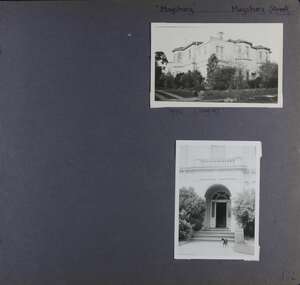 Glen Eira Historical Society
Album - Album page, Maysbury, Maysbury Avenue, Circa 1972
... victorian...1880's...maysbury...maysbury mansions...flats...decorative brackets...double storey...italianate...cast iron stair balustrading...cast iron balustrading...bay window...protruding rooms...bluestone fence...elsternwick...maysbury avenue...mansion...victorian style...All photographs are black and white except where stated, with 386 photographs over 198 pages. trevor hart windows victorian 1880's maysbury maysbury mansions flats decorative brackets double storey italianate cast iron stair balustrading cast iron balustrading bay window protruding rooms bluestone fence elsternwick maysbury avenue mansion victorian style arches entrances Handwritten: "Maysbury" Maysbury Street/Avenue [top right] / 1972 Neg 47 [under top photo] / 132 [bottom right] Page 132 of Photograph Album with two photographs (one landscape, one portrait) of "Maysbury". ...This photograph is part of the Caulfield Historical Album 1972. This album was created in approximately 1972 as part of a project by the Caulfield Historical Society to assist in identifying buildings worthy of preservation. The album is related to a Survey the Caulfield Historical Society developed in collaboration with the National Trust of Australia (Victoria) and Caulfield City Council to identify historic buildings within the City of Caulfield that warranted the protection of a National Trust Classification. Principal photographer thought to be Trevor Hart, member of Caulfield Historical Society. Most photographs were taken between 1966-1972 with a small number of photographs being older and from unknown sources. All photographs are black and white except where stated, with 386 photographs over 198 pages. Page 132 of Photograph Album with two photographs (one landscape, one portrait) of "Maysbury".Handwritten: "Maysbury" Maysbury Street/Avenue [top right] / 1972 Neg 47 [under top photo] / 132 [bottom right]trevor hart, windows, victorian, 1880's, maysbury, maysbury mansions, flats, decorative brackets, double storey, italianate, cast iron stair balustrading, cast iron balustrading, bay window, protruding rooms, bluestone fence, elsternwick, maysbury avenue, mansion, victorian style, arches, entrances -
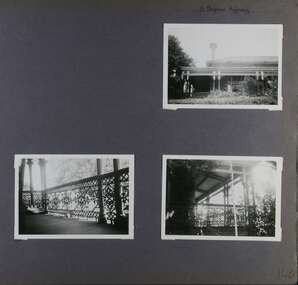 Glen Eira Historical Society
Album - Album page, 31 Nepean Highway, Circa 1972
... italianate...1870's...elsternwick...cast iron work...victorian style..."Roseneath" compares with "Cumbernauld" (pre 1872) at 504 Hawthorn Road and "Glenmoore" (1870) at 1 St Georges Road. trevor hart verandah chimneys porch decorative brackets single storey cast iron columns return verandah garden nepean highway roseneath italianate 1870's elsternwick cast iron work victorian style polychrome bricks william millar slate roofs brick houses house names Handwritten: 31 Nepean Highway [top right] / 140 [bottom right] Page 140 of Photograph Album with three (landscape) photographs of Roseneath on Nepean Highway. 31 Nepean Highway Album Album page ...This photograph is part of the Caulfield Historical Album 1972. This album was created in approximately 1972 as part of a project by the Caulfield Historical Society to assist in identifying buildings worthy of preservation. The album is related to a Survey the Caulfield Historical Society developed in collaboration with the National Trust of Australia (Victoria) and Caulfield City Council to identify historic buildings within the City of Caulfield that warranted the protection of a National Trust Classification. Principal photographer thought to be Trevor Hart, member of Caulfield Historical Society. Most photographs were taken between 1966-1972 with a small number of photographs being older and from unknown sources. All photographs are black and white except where stated, with 386 photographs over 198 pages. Victorian Heritage Database - HO48 - 31 Nepean Highway Elsternwick https://vhd.heritagecouncil.vic.gov.au/places/35531 (at 15/08/2021) "Roseneath" at 31 Point Nepean Road is a bi-chromatic Italianate villa built for William Millar in 1874. It is aesthetically and historically important. "Roseneath's aesthetic value derives from its survival as a substantially intact bi-chromatic brick villa, distinguished by the symmetrical north and south facing bays and by its spacious grounds. Its historical value rests on its comparatively early date and link with Shire councillor William Millar. The choice of bi-chromatic brick, which was highly fashionable at the time, is also of note. "Roseneath" compares with "Cumbernauld" (pre 1872) at 504 Hawthorn Road and "Glenmoore" (1870) at 1 St Georges Road.Page 140 of Photograph Album with three (landscape) photographs of Roseneath on Nepean Highway. Handwritten: 31 Nepean Highway [top right] / 140 [bottom right]trevor hart, verandah, chimneys, porch, decorative brackets, single storey, cast iron columns, return verandah, garden, nepean highway, roseneath, italianate, 1870's, elsternwick, cast iron work, victorian style, polychrome bricks, william millar, slate roofs, brick houses, house names -
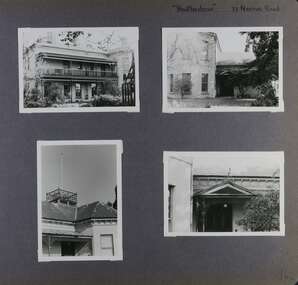 Glen Eira Historical Society
Album - Album page, Heatherbrae, 73 Neerim Road, Circa 1972
... italianate...iron roofed balcony...cast iron balustrade...balcony...ornamented pediment...mosaic tiles...cast iron lookout...flagpole...george f griffiths...mcgowan...tower...caulfield...heatherbrae...cast iron work...victorian style...Its social value rests on its ability to demonstrate a past lifestyle. trevor hart verandah chimneys decorative brackets cast iron columns return verandah garden 1870's intricate lacework neerim road booran road 1880's 1890's mansion john c. holland bluestone foundations italianate iron roofed balcony cast iron balustrade balcony ornamented pediment mosaic tiles cast iron lookout flagpole george f griffiths mcgowan tower caulfield heatherbrae cast iron work victorian style john holland porte-cochere porches lead lights george griffiths mansions stables councillors outbuildings Handwritten: "Heatherbrae" 73 Neerim Road [top right] / 142 [bottom right] Page 142 of Photograph Album with four photographs (three landscape, one portrait) of Heatherbrae on Neerim Road. ...This photograph is part of the Caulfield Historical Album 1972. This album was created in approximately 1972 as part of a project by the Caulfield Historical Society to assist in identifying buildings worthy of preservation. The album is related to a Survey the Caulfield Historical Society developed in collaboration with the National Trust of Australia (Victoria) and Caulfield City Council to identify historic buildings within the City of Caulfield that warranted the protection of a National Trust Classification. Principal photographer thought to be Trevor Hart, member of Caulfield Historical Society. Most photographs were taken between 1966-1972 with a small number of photographs being older and from unknown sources. All photographs are black and white except where stated, with 386 photographs over 198 pages.From Victorian Heritage Database citation for Heatherbrae HO46 https://vhd.heritagecouncil.vic.gov.au/places/120933 (as at 28/10/2020) "Heatherbrae" at 73 Neerim Road, Glenhuntly, is a substantial Victorian residential complex made up of two principal construction stages (pre 1876 and c. 1890) and outbuildings including stables. It is aesthetically, historically and socially significant. Its aesthetic value is demonstrated by the manner in which the two periods of construction survive, the earliest being of greater architectural interest on account of its tower and facade treatment, the latter phase adopting a common villa form. The importance of the complex is heightened by its intact state and surviving outbuildings. "Heatherbrae's" historical significance lies in its link with locally known business man and Shire of Caulfield councillor, John Charles Holland. Its social value rests on its ability to demonstrate a past lifestyle.Page 142 of Photograph Album with four photographs (three landscape, one portrait) of Heatherbrae on Neerim Road.Handwritten: "Heatherbrae" 73 Neerim Road [top right] / 142 [bottom right]trevor hart, verandah, chimneys, decorative brackets, cast iron columns, return verandah, garden, 1870's, intricate lacework, neerim road, booran road, 1880's, 1890's, mansion, john c. holland, bluestone foundations, italianate, iron roofed balcony, cast iron balustrade, balcony, ornamented pediment, mosaic tiles, cast iron lookout, flagpole, george f griffiths, mcgowan, tower, caulfield, heatherbrae, cast iron work, victorian style, john holland, porte-cochere porches, lead lights, george griffiths, mansions, stables, councillors, outbuildings -
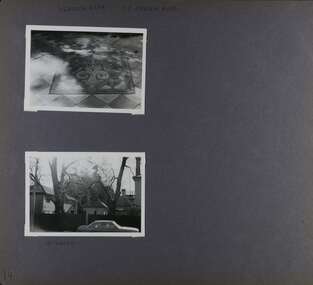 Glen Eira Historical Society
Album - Album page, Heatherbrae, 73 Neerim Road, Circa 1972
... italianate...iron roofed balcony...cast iron balustrade...mosaic tiles...cast iron lookout...flagpole...george f griffiths...residential villa...caulfield...heatherbrae...victorian style...Its social value rests on its ability to demonstrate a past lifestyle. trevor hart chimneys cast iron columns return verandah garden 1870's neerim road booran road 1880's 1890's mansion john c. holland bluestone foundations italianate iron roofed balcony cast iron balustrade mosaic tiles cast iron lookout flagpole george f griffiths residential villa caulfield heatherbrae victorian style cast iron work stables outbuildings john holland george griffiths councillors mansions Handwritten: "HEATHERBRAE" 73 NEERIM ROAD [top] / STABLE [under bottom photo] / 143 [bottom left] Page 143 of Photograph Album with 2 landscape photographs of Heatherbrae on Neerim Road - paving insignia and side view. ...This photograph is part of the Caulfield Historical Album 1972. This album was created in approximately 1972 as part of a project by the Caulfield Historical Society to assist in identifying buildings worthy of preservation. The album is related to a Survey the Caulfield Historical Society developed in collaboration with the National Trust of Australia (Victoria) and Caulfield City Council to identify historic buildings within the City of Caulfield that warranted the protection of a National Trust Classification. Principal photographer thought to be Trevor Hart, member of Caulfield Historical Society. Most photographs were taken between 1966-1972 with a small number of photographs being older and from unknown sources. All photographs are black and white except where stated, with 386 photographs over 198 pages.From Victorian Heritage Database citation for Heatherbrae HO46 https://vhd.heritagecouncil.vic.gov.au/places/120933 as at (28/10/2020) "Heatherbrae" at 73 Neerim Road, Glenhuntly, is a substantial Victorian residential complex made up of two principal construction stages (pre 1876 and c. 1890) and outbuildings including stables. It is aesthetically, historically and socially significant. Its aesthetic value is demonstrated by the manner in which the two periods of construction survive, the earliest being of greater architectural interest on account of its tower and facade treatment, the latter phase adopting a common villa form. The importance of the complex is heightened by its intact state and surviving outbuildings. "Heatherbrae's" historical significance lies in its link with locally known business man and Shire of Caulfield councillor, John Charles Holland. Its social value rests on its ability to demonstrate a past lifestyle. Page 143 of Photograph Album with 2 landscape photographs of Heatherbrae on Neerim Road - paving insignia and side view.Handwritten: "HEATHERBRAE" 73 NEERIM ROAD [top] / STABLE [under bottom photo] / 143 [bottom left]trevor hart, chimneys, cast iron columns, return verandah, garden, 1870's, neerim road, booran road, 1880's, 1890's, mansion, john c. holland, bluestone foundations, italianate, iron roofed balcony, cast iron balustrade, mosaic tiles, cast iron lookout, flagpole, george f griffiths, residential villa, caulfield, heatherbrae, victorian style, cast iron work, stables, outbuildings, john holland, george griffiths, councillors, mansions
