
Showing 8 items matching "village belle"
-
 Melbourne Tram Museum
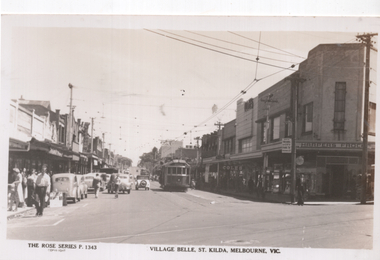
Postcard, Rose Stereograph Co, "Village Belle, St Kilda, Melbourne Vic", early 1950s
... "Village Belle, St Kilda, Melbourne Vic"......Village Belle...Rose Series postcard P.1343, titled "Village Belle, St Kilda, Melbourne Vic" showing W2 568 (Moreland Route 15) at the St Kilda Beach terminus in Acland St. ..."Village Belle, St Kilda, Melbourne Vic" Postcard Rose Stereograph Co. ...Rose Series postcard P.1343, titled "Village Belle, St Kilda, Melbourne Vic" showing W2 568 (Moreland Route 15) at the St Kilda Beach terminus in Acland St. Another W2 is further behind. A uniformed tramway employee is walking across the road, underneath a MMTB sign advising of Trams to the City and a Fare of 5d and child fares of 2d. In the background is the Coles store and Harpers Frocks. In the foreground are tram tracks for the Victorian Railways St. Kilda to Brighton Beach line in Barkly Street.Yields information about Acland St, St Kilda early 1950s.Postcard - printed real photograph with Rose Stereograph Co. name on the rear.trams, tramways, village belle, route 15, st kilda, w2 class, tram 568, acland st, barkly st, st kilda brighton tramway, rose series -
 St Kilda Historical Society
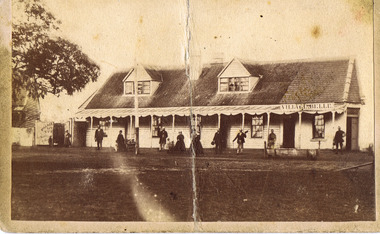
Photograph, Village Belle Hotel, c.1860?
... Village Belle Hotel...The building has a sign: Village Belle. No resemblance to present building in Barkly Street...The building has a sign: Village Belle. No resemblance to present building in Barkly Street sepia photograph mounted, poor condition Village Belle Hotel Photograph ...sepia photograph mounted, poor conditionHandwritten on the back: Mrs Carrero(?) The building has a sign: Village Belle. No resemblance to present building in Barkly Street -
 St Kilda Historical Society
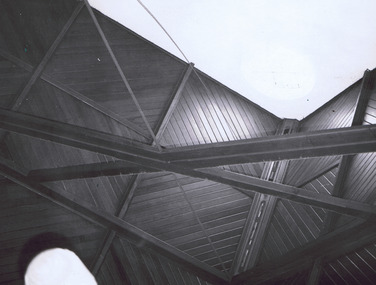
Photograph
... St John’s Congregational Church was established in 1888 on the corner of Barkly and Mitford Streets, near the Village Belle Hotel in South St Kilda. The building has now been demolished. ...St John’s Congregational Church was established in 1888 on the corner of Barkly and Mitford Streets, near the Village Belle Hotel in South St Kilda. The building has now been demolished. ...St John’s Congregational Church was established in 1888 on the corner of Barkly and Mitford Streets, near the Village Belle Hotel in South St Kilda. The building has now been demolished. The photograph was taken at the final service. The church closed in 1974 and gave its hymn books, carpets and curtains to its sister church, East St Kilda Congregational Church at the corner of Hotham and Inkerman Streets (later East St Kilda Uniting Church and now Trinity-St Nicholas Church).black and white photographPortion of ceiling of St John Cong. Church South S Kilda. Closing Service 31 Dec 1973st kilda, churches, st john's congregational church, congregational churches -
 Melbourne Tram Museum
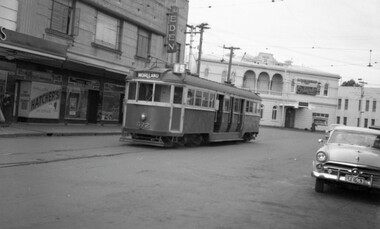
Negative - MMTB Tram W4 class 672 at the Acland St St Kilda terminus, Hugh Ballment, late 1950s
... In the background is Hatcher's dry cleaning, the Eden, and the Village Belle Hotel. Photo late 1950s....In the background is Hatcher's dry cleaning, the Eden, and the Village Belle Hotel. Photo late 1950s. Yields information about Acland St and W4 class No. 672. tramways St Kilda W4 class tram 672 Acland St Negative - 127 film black and white. ...The photograph shows MMTB tram, W4 class No. 672 at the terminus in Acland St St Kilda. The return destination of Moreland and route 15 is set. In the background is Hatcher's dry cleaning, the Eden, and the Village Belle Hotel. Photo late 1950s.Yields information about Acland St and W4 class No. 672.Negative - 127 film black and white.tramways, st kilda, w4 class, tram 672, acland st -
 Melbourne Tram Museum
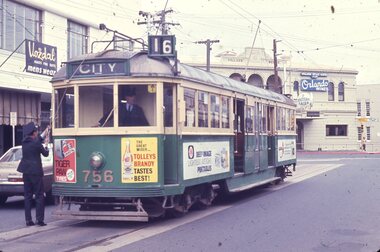
Slide, Les Fordham, Dec. 1963
... In the background the Village Belle Hotel, advertising Orlando Wines and Fosters Lager and Vozdal Mens wear shop....In the background the Village Belle Hotel, advertising Orlando Wines and Fosters Lager and Vozdal Mens wear shop. ...hanimount light brown 35mm slides - December 1963 taken by Les Fordham of W5 756 (Route 16 City) at the Acland St, St Kilda terminus, with the conductor tying down the trolley pole, while the driver readies for the next trip. The tram has adverts fore Tiger Paw Tyres, Tolleys Brandy, Deep Image Lightest Weight Portables? In the background the Village Belle Hotel, advertising Orlando Wines and Fosters Lager and Vozdal Mens wear shop.trams, tramways, w5 class, acland st, route 16, st kilda, tram 645 -
 St Kilda Historical Society
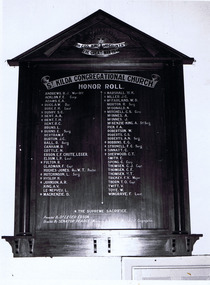
Photograph, 31 December 1972
... St John’s Congregational Church was established in 1888 on the corner of Barkly and Mitford Streets, near the Village Belle Hotel in South St Kilda. The building has now been demolished. ...St John’s Congregational Church was established in 1888 on the corner of Barkly and Mitford Streets, near the Village Belle Hotel in South St Kilda. The building has now been demolished. ...St John’s Congregational Church was established in 1888 on the corner of Barkly and Mitford Streets, near the Village Belle Hotel in South St Kilda. The building has now been demolished. The photograph was taken at the final service. The church closed in 1974 and gave its hymn books, carpets and curtains to its sister church, East St Kilda Congregational Church at the corner of Hotham and Inkerman Streets (later East St Kilda Uniting Church and now Trinity-St Nicholas Church). black and white photographHonour board of Sth St Kilda Cong ch. Closing Service 31 Dec 1972. First World War 1914-18. SKHS 00771st kilda, churches, congregational churches, wwi, world war i, great war, honour roll, st john's congregational church -
 Melbourne Tram Museum
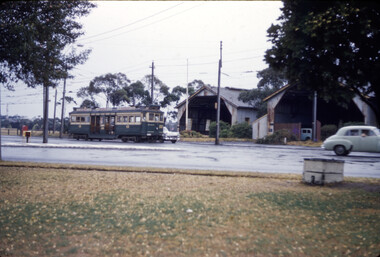
Slide - MMTB and VR tramway operations set of 12, Hugh Ballment, 1950s to 1980s
... In the background is the Eden, and the Village Belle Hotel with an Orlando wine sign. ...In the background is the Eden, and the Village Belle Hotel with an Orlando wine sign. ...Set of 12 photos by Hugh Ballment, unless noted, of VR and MMTB trams: HBM104 - VR Tram 35, 1950s, Elwood depot, In front of the depot, with a FJ Holden on the right side of the photo. HBM105 - VR Tram 35, 1950s, Broadway, at Glenhuntly Rd, with people passing behind the tram. In the background is a Chemist, Morley Auctioneers, State Savings Bank, and a motor dealer advertising Standard Cars HBM106 - MMTB Trams 463, 467, 466, c1960, Leeds St, waiting for time to depart to Russell St, Ballarat Road, and Williamstown Road respectively. Note the group of trammies on the left gossiping by the Bundy Clock. In the background are Appleton & Wright Men's Wear store. HBM107 - MMTB Tram 672, 1950s, Acland St, with the destination of Moreland, Route 15, and an auxiliary board saying "Connecting with East Coburg Tram. The tram is lined out. In the background is the Eden, and the Village Belle Hotel with an Orlando wine sign. HBM108 - MMTB Tram 8, 1960s, Kew depot, Scrubber later 8W, after modifications that were done in 1961 HBM109 - MMTB Tram 985, c1970?, St. Kilda Rd, Moomba crowd, with a large "Moomba" sign over the tracks made by Claude Neon. The Arts Centre is in the background. HBM110 - MMTB Tram 977, 26/05/1954, Preston Workshops, Resilient wheels, carbon inserts, dynamic brakes. The tram is lined out. HBM111 - VR Tram 29, 28, 1950s, Elwood depot, Trams in the shed HBM112 - MMTB Tram 500, cMay1968, Dandenong Rd Windsor, Track and works in the distance to relocate tram tracks from Wellington St to Queensway. HBM113 - MMTB Tram 1024, 1970s, Hawthorn Rd, Turning into Dandenong Rd. Tram has an all-over advertising for Clifton Bricks, which occurred either Feb. 1974 or June 1978. HBM114 - MMTB Tram 980, 26/05/1954, Preston Workshops, Tram is lined out HBM115 - MMTB Tram 7, 10/06/1982, Preston Workshops, Flusher - shows a side-on view of the tram. Yields information about Melbourne tram operations, with 1950s or 1960s photos of Melbourne tramways.Kodachrome cardboard and plastic mounts, with notes - set of 12tramways, new tramway, track work, vr, elwood depot, tram 35, glen huntly road, tram 464, tram 467, tram 466, leeds st, footscray, tram 672, tram 8, tram 985, moomba, kew depot, tram 977, tram 29, tram 28, preston workshops, tram 500, dandenong road, tram 1024, hawthorn road, tram 980, tram 7, acland st -
 Flagstaff Hill Maritime Museum and Village
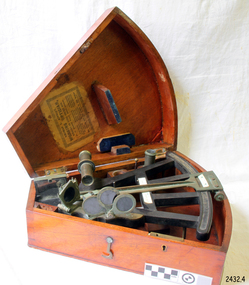
Instrument - Octant, mid 1800's
... Belle-Jones nee Chisholm, who lived in Camperdown in the earlier part of her life). The octant, the forerunner of the sextant, was a significant step in providing accuracy of a sailors latitude position at sea & his vessels distance from land when taking sightings of land-based landmarks. flagstaff hill warrnambool shipwrecked-coast flagstaff-hill flagstaff-hill-maritime-museum maritime-museum shipwreck-coast flagstaff-hill-maritime-village maritime navigation navigation instrument migration captain chisholm farquhar chisholm sailing ship the elizabeths thomas l. ainsley l. simons shields england octant john hadley chisholm Label inside case "Thomas L. ...An Octant is a doubly reflecting navigation instrument used primarily by sailors to measure the angular distance between two visible objects and was a forerunner of the sextant. The name comes from the Latin octo, or "one-eighth of a circle," for the Octan'ts arc which spans 45°, or one-eighth of a circle. The primary use of an Octant is to measure the angle between an astronomical object and the horizon for celestial navigation. The estimation of this angle, is known as sighting or shooting the object, or taking a sight. The angle, and the time when it was measured, can be used to calculate a position line on a nautical chart (latitude), for example, sighting the Sun at noon or Polaris at night (in the Northern Hemisphere) gives an angle by which the latitude can then be estimated. Sighting the height of a landmark on land can also give a measure of distance. This fine octant once belonged to Captain Farquhar Chisholm and was donated by his granddaughter, Margaret Ruth Greer (nee Chisholm, born 1914). The label inside the Octant's box reads “Thomas L. Ainsley, Instrument Maker … etc”. Farquhar Chisholm was born in 1832 in Inverness, Scotland. He regularly sailed on perilous voyages between Quebec, Canada and the Baltic ports of Europe. In 1854 he migrated to Australia during the Gold Rush, to a place called Fiery Creek (near Beaufort Victoria) where he was fairly successful in his quest for gold. In the years of the Great Gold Rush, it was said that there were over 40,000 diggers in the goldfields of the Beaufort area! In 1857 having made sufficient money, he hired another crew and returned to Clachnacuddin, Inverness shire, Scotland and in that same year, he studied and obtained his Master Mariner Certificate (which would have included the use of an octant for navigation). He was appointed to Mr George (or James) Walker, as commander of his sailing ship, the 3-masted ELIZABETH, built 1859 and known as “The Walker barque”. In 1870 he married, then in 1887 returned to Australia with his wife and children (Kenneth Chisholm (1871), Mary Bremner Chisholm (1873), Margaret Hood Chisholm (1874), Farquhar Chisholm (1878)). They arrived in Port Melbourne, Victoria and sadly, only six weeks after landing, his wife Caroline passed away (in Geelong,1888). In 1900 Capt. Chisholm lived in Camperdown (Victoria) and not long after this his daughter Margaret died of consumption. In his later years, he went to live in the manse of St. Paul’s Presbyterian Church, Wangaratta, with his son, Rev. Farquhar Chisholm. He died there on Sat, 23rd March 1912, 80 years old. He was known as “… quiet, unobtrusive and competent, respected by all with whom he came in contact”. Some other members of Captain Chisholm’s family are; his older son Kenneth Chisholm, who was a contractor in Camperdown; a nephew Donald Macintosh (of 23 Douglas Row, Inverness); a grandson Brian Jones (son of Caroline Belle-Jones nee Chisholm, who lived in Camperdown in the earlier part of her life).The octant, the forerunner of the sextant, was a significant step in providing accuracy of a sailors latitude position at sea & his vessels distance from land when taking sightings of land-based landmarks.Octant, once belonging to Captain Farquhar Chisholm. Wedge shape (the size of an eighth of a circle), made of wood, glass and metal. Used in the 1880s. Maker’s name across centre “L. SIMON - - - SHIELDS”. Three (3) light filtering, coloured glass shades. Two (2) eyepieces. Scale attached for measuring angles. Label inside the fitted, wedge-shaped case "Thomas L. Ainsley, Optician"Label inside case "Thomas L. Ainsley, Optician" Maker’s name across centre “L. SIMON - - - SHIELDS”.flagstaff hill, warrnambool, shipwrecked-coast, flagstaff-hill, flagstaff-hill-maritime-museum, maritime-museum, shipwreck-coast, flagstaff-hill-maritime-village, maritime navigation, navigation instrument, migration, captain chisholm, farquhar chisholm, sailing ship, the elizabeths, thomas l. ainsley, l. simons, shields england, octant, john hadley, chisholm
