
Showing 28 items matching "volunteer arms"
-
 Port Fairy Historical Society Museum and Archives
Photograph
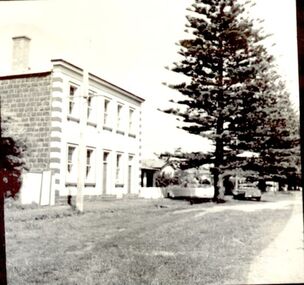
... ...volunteer arms...The license having been granted he opened the Volunteer Arms there, which he operated for two years whilst he had built, the two storied stone building next door, to take advantage of the fact that a livestock sale yards was operating on the opposite side of William street, hence the name Market Inn. ...Image of the building as it presents today hotel building william street market Osmond volunteer arms black and white photograph of Two story bluestone market hotel with rendered front and checkered quoins Photograph Photograph ...William and Emma Osmond with two small children arrived in Belfast in 1852 as assisted migrants assigned to R. H. Woodward . Two years later William was rated for a two room stone house in William street. By 1868 William Osmond was in business as a Butcher and was the holder of a Beer and Colonial wine license for his home which now numbered eight rooms. The license having been granted he opened the Volunteer Arms there, which he operated for two years whilst he had built, the two storied stone building next door, to take advantage of the fact that a livestock sale yards was operating on the opposite side of William street, hence the name Market Inn. William died in 1876 and his sons continued to run the hotel until 1916, when the building was sold and the license transferred to Harold Revell, a retired farmer. The license was revoked in 1918. and the building became a private dwelling . The building is still standing although the market for which it was named is long gone. It is now a private home and Art Gallery. Image of the building as it presents todayblack and white photograph of Two story bluestone market hotel with rendered front and checkered quoinshotel, building, william street, market, osmond, volunteer arms -
 Port Fairy Historical Society Museum and Archives
Photograph
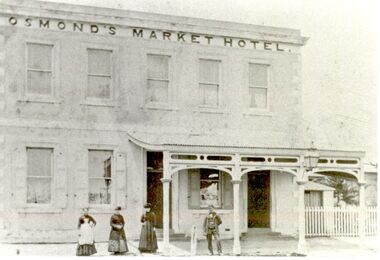
... The licence having been granted he opened the Volunteer Arms there which he operated for two years whilst he had built, the two storied stone building next door to take advantage of the fact that a livestock sale yards was operating on the opposite side of William Street hence the name Market Inn. ...The licence having been granted he opened the Volunteer Arms there which he operated for two years whilst he had built, the two storied stone building next door to take advantage of the fact that a livestock sale yards was operating on the opposite side of William Street hence the name Market Inn. ...Market Inn William Street Port Fairy. William and Emma Osmond with two small children arrived in Belfast in 1852 as assisted migrants assigned to R.H.Woodward. Two years later William was rated for a two room stone house in William Street. By 1868 William was in business as a butcher and was the holder of a Beer and Colonial wine licence for his home which now numbers eight rooms. The licence having been granted he opened the Volunteer Arms there which he operated for two years whilst he had built, the two storied stone building next door to take advantage of the fact that a livestock sale yards was operating on the opposite side of William Street hence the name Market Inn. William died in 1876 and his sons continued to run the hotel until 1916 when the building was sold and the licence transferred to Harold Revell a retired farmer. The licence was revoked in 1918 and the building became a private dwelling. Black and white Photograph of Two story market hotel with verandah over right side 3 females and a male on footpathhotel, william street, h revell, william osmond, emma osmond, market, inn -
 Port Fairy Historical Society Museum and Archives
Photograph, Market Inn
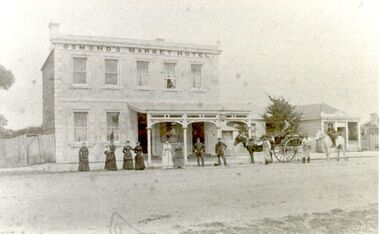
... The license having been granted he opened the Volunteer Arms there, which he operated for two years whilst he had built, the two storied stone building next door, to take advantage of the fact that a livestock sale yards was operating on the opposite side of William street, hence the name Market Inn. ...The license having been granted he opened the Volunteer Arms there, which he operated for two years whilst he had built, the two storied stone building next door, to take advantage of the fact that a livestock sale yards was operating on the opposite side of William street, hence the name Market Inn. ...William and Emma Osmond with two small children arrived in Belfast in 1852 as assisted migrants assigned to R. H. Woodward . Two years later William was rated for a two room stone house in William street. By 1868 William Osmond was in business as a Butcher and was the holder of a Beer and Colonial wine license for his home which now numbered eight rooms. The license having been granted he opened the Volunteer Arms there, which he operated for two years whilst he had built, the two storied stone building next door, to take advantage of the fact that a livestock sale yards was operating on the opposite side of William street, hence the name Market Inn. William died in 1876 and his sons continued to run the hotel until 1916, when the building was sold and the license transferred to Harold Revell, a retired farmer. The license was revoked in 1918. and the building became a private dwelling . The building is still standing although the market for which it was named is long gone. It is now a private home and Art Gallery. Image of the hotel with its verandah intact and buildings to the rightBlack and white photographhotel, building, william street, osmond family, market, inn -
 Port Fairy Historical Society Museum and Archives
Photograph
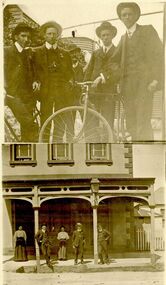
... The license having been granted he opened the Volunteer Arms there, which he operated for two years whilst he had built, the two storied stone building next door, to take advantage of the fact that a livestock sale yards was operating on the opposite side of William street, hence the name Market Inn. ...The license having been granted he opened the Volunteer Arms there, which he operated for two years whilst he had built, the two storied stone building next door, to take advantage of the fact that a livestock sale yards was operating on the opposite side of William street, hence the name Market Inn. ...William and Emma Osmond with two small children arrived in Belfast in 1852 as assisted migrants assigned to R. H. Woodward . Two years later William was rated for a two room stone house in William street. By 1868 William Osmond was in business as a Butcher and was the holder of a Beer and Colonial wine license for his home which now numbered eight rooms. The license having been granted he opened the Volunteer Arms there, which he operated for two years whilst he had built, the two storied stone building next door, to take advantage of the fact that a livestock sale yards was operating on the opposite side of William street, hence the name Market Inn. William died in 1876 and his sons continued to run the hotel until 1916, when the building was sold and the license transferred to Harold Revell, a retired farmer. The license was revoked in 1918. and the building became a private dwelling . The building is still standing although the market for which it was named is long gone. It is now a private home and Art Gallery. the 4 people in the photograph are probably the Osmond sonsPhotograph of an earlier time when a verandah existed on the front and the butcher shop was attachedBlack and white photograph 2 photos exposed togetherhotel, osmond, william street, market -
 Mission to Seafarers Victoria
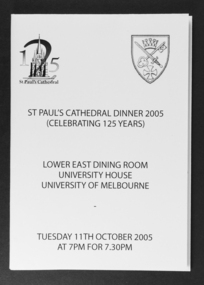
Document - Menu, St Paul's Cathedral dinner 2005, 2005
... Many volunteers at the Mission also are involved at the cathedral and this object seems to be a record of either a Mission representative or a volunteers attendance at this special dinner. cathedral st paul's cathedral, melbourne university house university of melbourne Printed folded A4 white paper/card menu front. St Paul's 125 year celebration dinner menu/ St Paul's Cathedral celebration logo TL corner/ Coat of arms TR corner/ St Paul's 125 year celebration dinner /University house Melbourne Tuesday 11 October 2005 St Paul's Cathedral dinner 2005 Document Menu ...Celebrating 125 years St Paul's cathedral MelbourneThis object reflects the close associations of the Mission with the Anglican Diocese. Many volunteers at the Mission also are involved at the cathedral and this object seems to be a record of either a Mission representative or a volunteers attendance at this special dinner.Printed folded A4 white paper/card menu front. St Paul's 125 year celebration dinner menu/ St Paul's Cathedral celebration logo TL corner/ Coat of arms TR corner/ St Paul's 125 year celebration dinner /University house Melbourne Tuesday 11 October 2005 cathedral, st paul's cathedral, melbourne, university house, university of melbourne -
 Glenelg Shire Council Cultural Collection
Photograph - Photograph - Marine Discovery Centre Portland, Victoria, 14/10/1999
... volunteer? employee?) wearing dark blue polo shirt with MDC logo, standing behind the jaw of the whale skeleton, his arms wide, measuring its length...volunteer? employee?) wearing dark blue polo shirt with MDC logo, standing behind the jaw of the whale skeleton, his arms wide, measuring its length Photograph Photograph - Marine Discovery Centre Portland, Victoria ...Coloured photograph: MDC, inside. Young man (volunteer? employee?) wearing dark blue polo shirt with MDC logo, standing behind the jaw of the whale skeleton, his arms wide, measuring its length -
 Orbost & District Historical Society
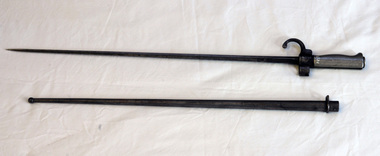
sword
... Pardew in about 1893. sword weapon arms dress-sword On blade- Proo Rifle Volunteers Mole A silver dress sword and scabbard. ...Owned by Captain J. Pardew and brought out from England by his son, Mr E.J. Pardew in about 1893.A silver dress sword and scabbard. It has a large metal handle and hand guard. The blade is engraved with a crown and other decorations.On blade- Proo Rifle Volunteers Molesword weapon arms dress-sword -
 Flagstaff Hill Maritime Museum and Village
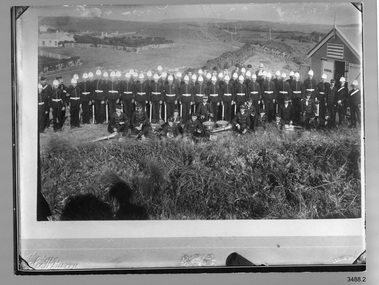
Photograph - Military
... flagstaff hill warrnambool shipwrecked-coast flagstaff-hill flagstaff-hill-maritime-museum maritime-museum shipwreck-coast flagstaff-hill-maritime-village photograph volunteer corps band Painted on the building "GENERAL" (3488.1) Stamp, purple ink; "Flagstaff Hill Maritime Village" (3488.2) Impressed below the copy and photographed with the copy: Coat of Arms in centre [Lion and Unicorn], pulse impressed script on the left and impressed text on the right. ...Photograph; black and White group photograph of the Volunteer Corps and Band in dress uniform with white pith helmets, the the band members wearing caps. Band instruments are in the foreground on the ground. There is a hut on the right with the word GENERAL painted on the door. There is a road and some buildings on the left, another road on the right with tall posts, and hills in the background. One of the instruments is a Rope Tensioned Bass Drum. 3488.1 is unmounted, and has two stamps on the back 3488.2 is a copy of a mounted photograph, with impressed inscriptions below Painted on the building "GENERAL" (3488.1) Stamp, purple ink; "Flagstaff Hill Maritime Village" (3488.2) Impressed below the copy and photographed with the copy: Coat of Arms in centre [Lion and Unicorn], pulse impressed script on the left and impressed text on the right.flagstaff hill, warrnambool, shipwrecked-coast, flagstaff-hill, flagstaff-hill-maritime-museum, maritime-museum, shipwreck-coast, flagstaff-hill-maritime-village, photograph, volunteer corps band -
 Bendigo Military Museum
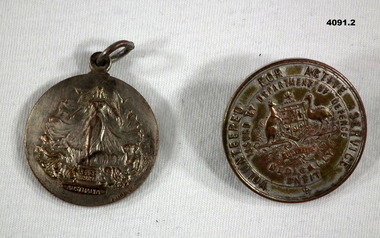
Accessory - MEDALLION & MEDAL, 1) 1919
... The Peace 1918 Volunteered medically unfit .1) On front, “”Victory, The triumph of Liberty and Justice, The Peace 1918” On reverse, “Peace 1919 Australia” .2) On the front, “Volunteered for Active Service - Medically unfit”, On reverse, “65066” .1) Medallion, round with ring at top, etched raised figures front and back. .2) Medal, round, with etched raised Australian Coat of Arms on the front. ....1) These medallions were issued to School children in 1919. .2) After a call was made to have something to show you had volunteered for Active service but were rejected on medical grounds..1) Medallion, round with ring at top, etched raised figures front and back. .2) Medal, round, with etched raised Australian Coat of Arms on the front..1) On front, “”Victory, The triumph of Liberty and Justice, The Peace 1918” On reverse, “Peace 1919 Australia” .2) On the front, “Volunteered for Active Service - Medically unfit”, On reverse, “65066”the peace 1918, volunteered, medically unfit -
 Bendigo Military Museum
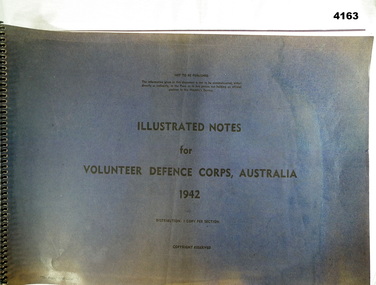
Manual - VOLUNTEER DEFENCE NOTES, 1942
... Spiral bound gloss paper illustrated notes for the Australian defence Corp Volunteers, 32 pages, subjects covered, camouflage, stalking, self defence, small arms, aircraft ID, reconnaissance reporting and general information on enemy forces....volunteers defence corp Spiral bound gloss paper illustrated notes for the Australian defence Corp Volunteers, 32 pages, subjects covered, camouflage, stalking, self defence, small arms, aircraft ID, reconnaissance reporting and general information on enemy forces. ...Spiral bound gloss paper illustrated notes for the Australian defence Corp Volunteers, 32 pages, subjects covered, camouflage, stalking, self defence, small arms, aircraft ID, reconnaissance reporting and general information on enemy forces.volunteers, defence corp -
 Bendigo Military Museum
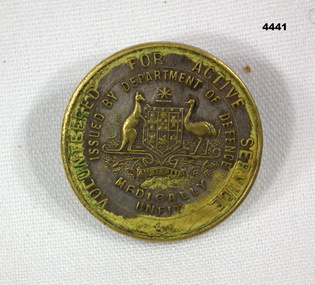
Badge - BADGE, VOLUNTEER, Aust Dept of Defence
... Arms. Around the circumference are the words "Volunteered for Active Service" "Issued by Department of Defence" Medically Unfit. ...Arms. Around the circumference are the words "Volunteered for Active Service" "Issued by Department of Defence" Medically Unfit. ...This badge was found in a garden in Arnold Street, Bendigo. Not clear if WW1 or WW2, more likely WW1.Brass Badge. It has some evidence of writing that was originally on it. Moulded onto the front is the Aust Coat of Arms. Around the circumference are the words "Volunteered for Active Service" "Issued by Department of Defence" Medically Unfit. The rear has two loops welded in.On rear "Badge 60369."aust dept defence, badge -
 Bendigo Military Museum
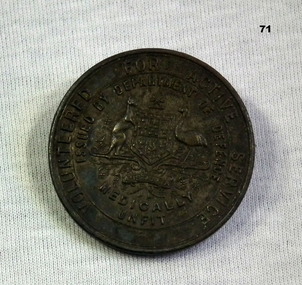
Badge - BADGE MEDICALLY UNFIT, Post 1914-1918
... On rear - No. 3511 Centre of badge has the Australian Coat of Arms. Around the outside are words - Volunteered For Active Service. ...Volunteered For Active Service. Inside that at top section are words - Issued by Dept of Defence. Below Coat of Arms are words - Medically Unfit. ...These badges were issued from July 1st 1915. The number on the rear pertains to a register of persons who volunteered for active service but declared medically unfit. This badge was issued to W S SMITH.Badge: Volunteered for Active Service. On rear - No. 3511 Centre of badge has the Australian Coat of Arms. Around the outside are words - Volunteered For Active Service. Inside that at top section are words - Issued by Dept of Defence. Below Coat of Arms are words - Medically Unfit.numismatics - badges, military, commemorative -
 Bendigo Military Museum
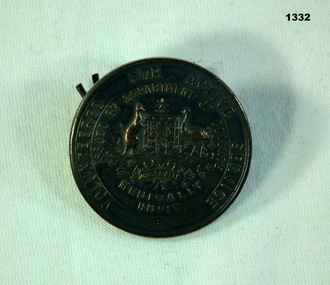
Badge, 1916-1918
... arms in centre. Issued by Department of Defence to those who volunteered for service but were medically unfit. ...Numbered on rear. numismatics-badges-military metalcraft On front: "Volunteered for Active Service, Medically Unfit, Issued by Department of Defence" On rear: "57824" Round blackened metal badge with lugs on rear for attaching to uniform. Text around outside with Australian coat of arms ...Issued by Department of Defence to those who volunteered for service but were medically unfit. Numbered on rear.Round blackened metal badge with lugs on rear for attaching to uniform. Text around outside with Australian coat of arms in centre. Issued by Department of Defence to those who volunteered for service but were medically unfit. Numbered on rear.On front: "Volunteered for Active Service, Medically Unfit, Issued by Department of Defence" On rear: "57824"numismatics-badges-military, metalcraft -
 Bendigo Military Museum
Literary work - BOOK SET, Australian War Memorial Set of 20, 1) 1919; .2) & .6) 1942; .3) & .12) 1943; .4), .7), 8), &.16) 1953; .5), .9) & .14) 1945; .10) 1941; .11) & .20) 1954. .13) & .14) 1944;
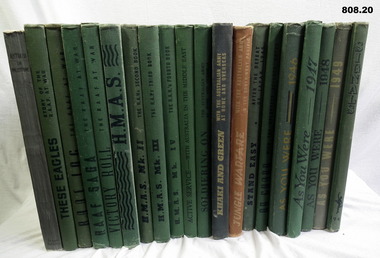
... arms outstretched, smiling. Illustrated with photos, maps, paintings, & drawings. .15 On Guard with the Volunteer Defence Corps. ...arms outstretched, smiling. Illustrated with photos, maps, paintings, & drawings. .15 On Guard with the Volunteer Defence Corps. ...Set of Books commonly called 'As You Were' from WW1 and WW2. Green cloth. .1) Australia in Palestine (WWI) Book, hard cover, cardboard in centre of cover is silhouette of a Light Horseman & horse. Print is black ink, 153 pages. Illustrated with photos, drawings & maps. .2) These Eagles. Story of the RAAF at War. Book, green hard buckram cover, 200 pages. Front cover has black print with outline drawing of an eagle. Illustrated with photos, drawings. .3) RAAF Log - The RAAF at War. Book, green buckram hard cover. Front has profile of a pilot, black print, 200 pages, illustrated with photos, maps. paintings & drawings. .4) RAAF SAAG - The RAAF at War. Front cover has drawing of 2 Fighter Pilots in black ink, black print. 200 pages, illustrated with photos, drawings & paintings. Book, green buckram hard cover. Front cover has drawing of 2 Fighter pilots, black print, 200 pages, photos, drawings & paintings. .5) Victory Roll - The RAAF at War. Book, green buckram, black print, 200 pages, photos, drawings & charts. .6) HMAS Green buckram hard cloth cover, cloth cover with black text. 200 pages, black & white print, black text on white paper. .7) HMAS Mk II. Book, green buckram hard cover, black & white text on white paper. 200 pages, illustrated colour prints. .8) HMAS Mk III Book , green buckram hard cover, black text on white paper. 200 pages, illustrated colour prints. .9) HMAS Mk IV Book, green buckram hard cover, black text on white paper. Illustrated colour prints. .10) Active Service with Australia in the Middle East. Book, green buckram hard cover, black text on white paper, 129 pages. .11) Soldering on the Australian Army at Home & Overseas. Book, green buckram hard cover, black text on white paper, 200 pages. Rising Sun badge at bottom right hand corner. Illustrated with black & white photos, paintings, maps & drawings. .12) Khaki & Green with the Australian Army at Home & Overseas. Book, green buckram hard cover, black text on white paper, 204 pages. Front cover has a layout of words khaki & green, 2nd tone in light yellow. Illustrated with black & white photos, paintings, & drawings. .13) Jungle Warfare with the Australian Army in the South West Pacific. Book, brown buckram hard cover, light brown ink. Image at bottom of Australian soldier in jungle, 208 pages. Illustrated with photos, paintings, maps & drawings. .14) Stand Easy. After the Defeat of Japan, 1945. Book, light green buckram hard cover, black text on white paper, 208 pages. Image of soldier, both arms outstretched, smiling. Illustrated with photos, maps, paintings, & drawings. .15 On Guard with the Volunteer Defence Corps. Book, green & black buckram hard cover, black text on white paper, 172 pages. Illustrated with colour prints, & black & white photos. .16) As You Were. A Cavalcade of Events with The Australian Services from 1788 to 1946. Book, green buckram hard cover, tan & black text on white paper, 202 pages. Illustrated with black & white photos & colour prints. .17) As You Were. A Cavalcade of Events with The Australian Services from 1788 to 1947. Book, green buckram hard cover, black text on white paper, 202 pages. Illustrated with black & white photos & colour prints. .18) As You Were. A Cavalcade of Events with The Australian Services from 1788 to 1948. Book, green buckram hard cover, black text on white paper, 202 pages. Illustrated with black & white photos & colour prints. .19) As You Were. A Cavalcade of Events with The Australian Services from 1788 to 1949. Book, green buckram hard cover, green text on white paper, red & green diagram, 194 pages. Illustrated with black & white photos & colour prints. .20) Signals. Story of the Australian Corps of Signals. Book, green buckram hard cover, black text on white paper, 196 pages. In the corner of the front cover is the badge with motif of the Australian Corps of Signals. Illustrated with photos & drawings..1) 4214 TPR J E Neilson Year 1919 F E Addlem 1962 .books-military, museums, history -
 Bendigo Historical Society Inc.
Article - Devils Own Cricket Club Established Bendigo Advertiser Article
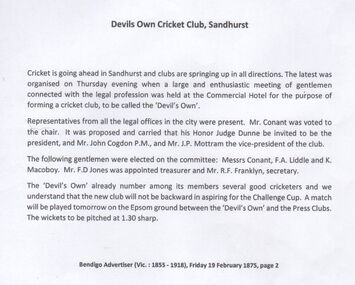
... During a review by King George III in Hyde Park in 1803, the King used his dislike for lawyers – particularly ones carrying arms – to name the massed ranks of the Law Association as "The Devil's Own".[5] "It is understood that the King was in high health and excellent spirits at the time. The Bloomsbury and Inns of Court Volunteers...During a review by King George III in Hyde Park in 1803, the King used his dislike for lawyers – particularly ones carrying arms – to name the massed ranks of the Law Association as "The Devil's Own".[5] "It is understood that the King was in high health and excellent spirits at the time. The Bloomsbury and Inns of Court Volunteers ...The Devils' Own Cricket Club was also referred to as the Law Cricket Club and the Law (Devils' Own) Cricket Club. The club was formed in 1875 from members of the local legal fraternity and business people in Sandhurst (Bendigo). In addition to the Devils' Own Cricket Club, there were many male cricket clubs formed in Bendigo in the 1870's, for example, the Bendigo United Cricket Club; Epsom Cricket Club; All Trades Cricket Club; New Chum Cricket Club; California Gully Cricket Club; Long Gully Cricket Club; Butchers' Cricket Club; View Point Cricket Club; Myers Street Cricket Club; Australian Natives Association Cricket Club; View Point Cricket Club; Beehive Cricket Club; Advertiser Cricket Club; Kangaroo Flat Cricket Club; Golden Square Cricket Club; North Bendigo Cricket Club; Crusoe Cricket Club; City Cricket Club; Bohemians Cricket Club and the Happy Valley Cricket Club. Where did the name 'Devils' Own' come from? The Inns of Court Regiment, London, has a unique place in history as a result of its ancient and intimate connection with the Law and lawyers. It recruited and 'officered' almost exclusively from the legal profession, drawn from barristers, attorneys, notaries and their clerks and students practising in the area of the Inns of Court comprising Middle Temple, Inner Temple, Lincoln’s Inn and Gray’s Inn. During Napoleonic Wars all Inns raised companies. During a review by King George III in Hyde Park in 1803, the King used his dislike for lawyers – particularly ones carrying arms – to name the massed ranks of the Law Association as "The Devil's Own".[5] "It is understood that the King was in high health and excellent spirits at the time. The Bloomsbury and Inns of Court Volunteers was reformed in 1797 during the Napoleonic Wars. It was shortly afterwards that the regiment gained its enduring nickname. During a review by King George III in Hyde Park in 1803, the King used his dislike for lawyers – particularly ones carrying arms – to name the massed ranks of the Law Association as "The Devil's Own". "It is understood that the King was in high health and excellent spirits at the time. When the 'Temple companies' had defiled before him, his Majesty enquired of Lord David Erskine, who commanded them, as lieutenant colonel, what was the composition of that corps? 'They are all lawyers, Sire,' said Erskine. 'What! What! 'exclaimed the King, 'all lawyers? all lawyers? Call them the Devil's Own, call them the Devil's Own!" "And the Devil's Own they were called accordingly." ( Norton, F.C., A short history of the military & naval services of the Inns of Court and the members of the Bench and the Bar, 1886, William Clowes & Sons, Stamford Street and Charing Cross, London) Did Bendigo’s legal fraternity name themselves DOCC with the intent that they would reflect the distinguished pedigree and qualities of the Devil’s Own regiment? Details of one the players in the 'Devils'Own' CC : Pelling Hugh Gough Pigott Stainsby Conant, solicitor, born Hampshire, England 1846. Arrived Australia 1871. Pelling was the son of Francis Pigott Stainsby Conant Esq., Lieutenant Governor of the Isle of Man. He married Catherine Anne Drummond. In 1874, his practice was in the Albion Chambers, Sandhurst, given as 'Pelling H.G.P.S. Conant, Solicitor'. Organisation-Club/society-sportA transcript of the Devils Own Cricket Club article in the 19th February, 1875 edition of the Bendigo Advertiser docc, devils own cricket club, sandhurst, bendigo advertiser, pelling h.g.p. s. conant, solicitor, barrister -
 Kyneton RSL Sub Branch
Badge, Medically Unfit, c1915
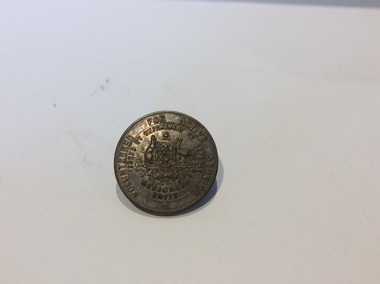
... Around circumference of badge, Volunteer for active service , below coat of Arms, Medically Unfit. ...History / Summary This badge was issued to people of military age who had volunteered for active service outside Australia since 1 July 1915, but had been certified by an authorised Medical Officer as medically unfit to do so. ww1 badge Around circumference of badge, Volunteer for active service , below coat of Arms, Medically Unfit. ...History / Summary This badge was issued to people of military age who had volunteered for active service outside Australia since 1 July 1915, but had been certified by an authorised Medical Officer as medically unfit to do so.Circular badge with two loops on back. Pin missing.Around circumference of badge, Volunteer for active service , below coat of Arms, Medically Unfit. Next line , Issued by Department of Defence. Back, 58682ww1, badge -
 Warrnambool and District Historical Society Inc.
Photograph - Framed Photograph of Victoria Challenge Shield, George Edward & Sons, Glasgow, 1888
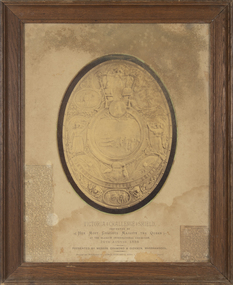
... volunteer militia groups were strong in Victorian country towns ( from the 1860s to the beginning of the First World War). Cramond & Dickson Warrnambool Victoria Challenge Shield Garrison Artillery Groups in Victoria Victoria Challenge Shield inspected by Her Most Gracious Majesty the Queen at the Glasgow International Exhibition 24th August 1888 presented by Messrs Cramond & Dickson Warrnambool This is a framed oval photograph of the Victoria Challenge Shield. The photograph is of poor production and fading. The shield details include images of War and Peace, Coat of Arms ...This framed photograph is of the Victoria Challenge Shield which was presented in 1888 by the Warrnambool firm of Cramond and Dickson for competition among the Victoria Garrison Artillery members in Victoria. There were 8 garrison groups in Victoria at that time. The shield was 22 inches wide and two feet six inches high.The quality of the shield can be gauged by that fact that it was exhibited at the Glasgow International Exhibition of 1888 and was one of the items inspected by Queen Victoria. The stipulation by the donors was that the competition had to be held in Warrnambool. The Warrnambool artillery group won the trophy in 1898 and this is noted in one of the newspaper cuttings included with the photograph of the shield. The Cramond and Dickson general store in Warrnambool was founded in 1855 by John Cramond and James Dickson and was a prominent business in Warrnambool until it closed in 1973. This photograph is of considerable interest as it is a reminder of the Victoria Challenge Shield that was a competition prize for competing groups of the Victoria Garrison Artillery in the times when volunteer militia groups were strong in Victorian country towns ( from the 1860s to the beginning of the First World War). This is a framed oval photograph of the Victoria Challenge Shield. The photograph is of poor production and fading. The shield details include images of War and Peace, Coat of Arms, militia figures and guns and a rifle match (in the centre). There are two newspaper cuttings included in the frame and a handwritten date. The photograph has a beige background and is under glass in a wooden frameVictoria Challenge Shield inspected by Her Most Gracious Majesty the Queen at the Glasgow International Exhibition 24th August 1888 presented by Messrs Cramond & Dickson Warrnambool cramond & dickson warrnambool, victoria challenge shield, garrison artillery groups in victoria -
 Ballarat and District Irish Association
Image, Gratton's Parliament, 1782
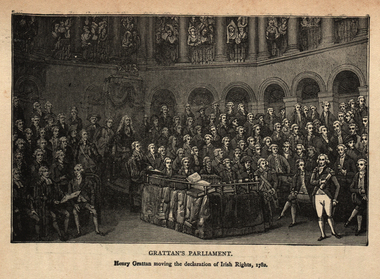
... It was through ranks of Volunteers drawn up outside the parliament house in Dublin that Grattan passed on 16 April 1782, amidst unparalleled popular enthusiasm, to move a declaration of the independence of the Irish parliament. "I found Ireland on her knees," Grattan exclaimed, "I watched over her with a paternal solicitude; I have traced her progress from injuries to arms, and from arms to liberty. ...It was through ranks of Volunteers drawn up outside the parliament house in Dublin that Grattan passed on 16 April 1782, amidst unparalleled popular enthusiasm, to move a declaration of the independence of the Irish parliament. "I found Ireland on her knees," Grattan exclaimed, "I watched over her with a paternal solicitude; I have traced her progress from injuries to arms, and from arms to liberty. ...Calls for the legislative independence of Ireland at the Irish Volunteer Convention at Dungannon greatly influenced the decision of the government in 1782 to make concessions. It was through ranks of Volunteers drawn up outside the parliament house in Dublin that Grattan passed on 16 April 1782, amidst unparalleled popular enthusiasm, to move a declaration of the independence of the Irish parliament. "I found Ireland on her knees," Grattan exclaimed, "I watched over her with a paternal solicitude; I have traced her progress from injuries to arms, and from arms to liberty. Spirit of Swift, spirit of Molyneux, your genius has prevailed! Ireland is now a nation!" After a month of negotiation the claims of Ireland were conceded. The gratitude of his countrymen to Grattan was shown by a parliamentary grant of £100,000, which had to be reduced by half before he would accept it. Grattan then asked for the British House of Commons to reconfirm the London government's decision, and on 22 January 1783 the final Act was passed by parliament in London, including the text: Be it enacted that the right claimed by the people of Ireland to be bound only by laws enacted by his Majesty and the Parliament of that kingdom, in all cases whatever shall be, and is hereby declared to be established and ascertained for ever, and shall at no time be questioned or questionable. In September of the same year, Grattan became a member of the Privy Council of Ireland. He was expelled in 1798, but was re-admitted on 9 August 1806. [http://en.wikipedia.org/wiki/Henry_Grattan, accessed 14/12/2014]An image of a number of men in Parliament. It is Henry Gratton's Parliament. The man standing is Henry Gratton moving the declaration of Irish Rights in 1782.ballarat irish, henry grattan, grattan, irish rights -
 Box Hill Historical Society
Photograph - Box Hill Library
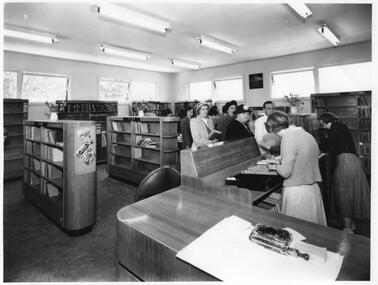
... Mrs.Phoebe Simberg, with books in her arms, was a well known volunteer at the Box Hill Hospital. ...Mrs.Phoebe Simberg, with books in her arms, was a well known volunteer at the Box Hill Hospital. ...Mrs.Phoebe Simberg, with books in her arms, was a well known volunteer at the Box Hill Hospital. ...Photograph of interior of Box Hill Library. Mrs.Phoebe Simberg, with books in her arms, was a well known volunteer at the Box Hill Hospital. Photograph of interior of Box Hill Library. Mrs.Phoebe Simberg, with books in her arms, was a well known volunteer at the Box Hill Hospital. libraries, box hill library, simberg> phoebe -
![Photograph - Colour, William Collard Smith Memorial, Ballarat Town Hall [detail], c1892, 15/09/2017](/media/collectors/57a00a4fd0cdd1210422a51e/items/59c8caf221ea740dac0b6d51/item-media/59c8cb0a21ea740dac0b7b59/item-fit-380x285.jpg?cb=6) Ballarat Heritage Services
Ballarat Heritage ServicesPhotograph - Colour, William Collard Smith Memorial, Ballarat Town Hall [detail], c1892, 15/09/2017
... arms...sword...volunteer...ballarat town hall sculpture coat of arms william morris rifles city of ballarat coat of arms sword volunteer rifles In Memoriam Lt. Col. William Collard Smith M.L.A. ...Photograph of the City of Ballarat Coat of Arms on a marble memorial in the Ballarat Town Hall dedicated to William Collard Smith.In Memoriam Lt. Col. William Collard Smith M.L.A. Ballaarat West Member of the Municipal Council of Ballaarat From 1856 until 1892 Chairmand 1860-1. Mayor 1874 and 1887 Obiit 20th Ovtober 1894.ballarat town hall, sculpture, coat of arms, william morris, rifles, city of ballarat coat of arms, sword, volunteer rifles -
![Photograph - Photograph - Colour, William Collard Smith Memorial, Ballarat Town Hall [detail], c1892, 15/09/2017](/media/collectors/57a00a4fd0cdd1210422a51e/items/59c8cb3c21ea740dac0b8e24/item-media/59c8cbab21ea740dac0bbbef/item-fit-380x285.jpg?cb=6) Ballarat Heritage Services
Ballarat Heritage ServicesPhotograph - Photograph - Colour, William Collard Smith Memorial, Ballarat Town Hall [detail], c1892, 15/09/2017
... arms...william morris...volunteer...Sculpture of William Collard Smith. ballarat town hall sculpture coat of arms william morris volunteer rifles In Memoriam Lt. Col. ...Sculpture of William Collard Smith.Photograph of sculptural portrait of William Collard Smith on a marble memorial in the Ballarat Town Hall..In Memoriam Lt. Col. William Collard Smith M.L.A. Ballaarat West Member of the Municipal Council of Ballaarat From 1856 until 1892 Chairmand 1860-1. Mayor 1874 and 1887 Obiit 20th October 1894.ballarat town hall, sculpture, coat of arms, william morris, volunteer rifles -
![Photograph - Colour, William Collard Smith Memorial, Ballarat Town Hall [detail], c1892, 15/09/2017](/media/collectors/57a00a4fd0cdd1210422a51e/items/59c8cbbf21ea740dac0bc27b/item-media/59c8cbd021ea740dac0bcbc6/item-fit-380x285.jpg?cb=6) Ballarat Heritage Services
Ballarat Heritage ServicesPhotograph - Colour, William Collard Smith Memorial, Ballarat Town Hall [detail], c1892, 15/09/2017
... arms...william morris...volunteer...ballarat town hall sculpture coat of arms william morris volunteer rifles In Memoriam Lt. Col. ...Photograph of sculptural portrait of William Collard Smith on a marble memorial in the Ballarat Town Hall..In Memoriam Lt. Col. William Collard Smith M.L.A. Ballaarat West Member of the Municipal Council of Ballaarat From 1856 until 1892 Chairmand 1860-1. Mayor 1874 and 1887 Obiit 20th October 1894.ballarat town hall, sculpture, coat of arms, william morris, volunteer rifles -
 Whitehorse Historical Society Inc.
Clothing - Shirt, 2004
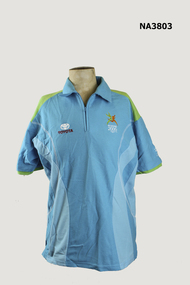
... volunteer at the 2006 Commonwealth Games. Bob was a Silver Medalist at the 1970 Edinburgh Commonwealth Games and is also a member of this Historical Society costume male Toyota Male shirt with collar and zip-up neck. Green panel on shoulder; pale blue panels down front and back. Embroidered on left front, 'Melbourne 2006' and bird logo. Red embroidered Toyota on right front. The back is stamped, 'Melbourne 2006'. Short sleeves are embroidered with 'Victoria the place to be' and 'Red hard yakka', and piped in green. Coat of arms ...Shirt worn by Bob Gardiner; volunteer at the 2006 Commonwealth Games.Part of the uniform worn by Bob Gardiner, a volunteer at the 2006 Commonwealth Games. Bob was a Silver Medalist at the 1970 Edinburgh Commonwealth Games and is also a member of this Historical SocietyMale shirt with collar and zip-up neck. Green panel on shoulder; pale blue panels down front and back. Embroidered on left front, 'Melbourne 2006' and bird logo. Red embroidered Toyota on right front. The back is stamped, 'Melbourne 2006'. Short sleeves are embroidered with 'Victoria the place to be' and 'Red hard yakka', and piped in green. Coat of arms and 'Australian Government' also stamped on sleeve.|See also NA3802 - hatToyotacostume, male -
 Ballarat RSL Sub-Branch Inc.
Australian Service Medal 1939-1945
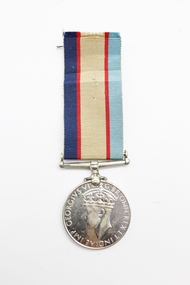
... volunteer defence corps for their service during WWII. Created by King Geroge IV, this was the first distinctive Australian medal in the British system of honours and awards. medallion medal australian service medal service medal ww2 world war two Medallion attached to a navy blue, light blue, red and beige striped ribbon. The medallion depicts an effigy of King George IV of Great Britain and the commonwealth with the words: "GEORGE IV S VI (obscured component) G. BR. OMN. REX ET INDIAE IMP" in relief on one side. The others side depicts the Australian Coat of Arms ...The Australian Service Medal 1939-1945 was awarded to armed Australian forces and volunteer defence corps for their service during WWII. Created by King Geroge IV, this was the first distinctive Australian medal in the British system of honours and awards.Medallion attached to a navy blue, light blue, red and beige striped ribbon. The medallion depicts an effigy of King George IV of Great Britain and the commonwealth with the words: "GEORGE IV S VI (obscured component) G. BR. OMN. REX ET INDIAE IMP" in relief on one side. The others side depicts the Australian Coat of Arms and the words: "The AUSTRALIA SERVICE MEDAL 1939-1945".medallion, medal, australian service medal, service medal, ww2, world war two -
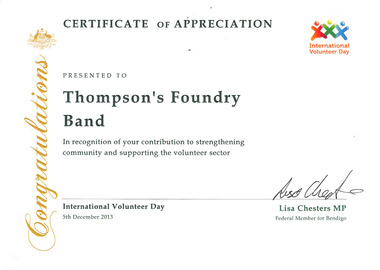 Thompson's Foundry Band Inc. (Castlemaine)
Document - Certificate, 5 December 2013
... Volunteer Day in red/green/blue. On the left a golden Congratulations and top left Australia's coat of arms also in golden colour. ...Volunteer Day in red/green/blue. On the left a golden Congratulations and top left Australia's coat of arms also in golden colour. ...White rectangular paper document with printed black text. On the top corner is the logo of International Volunteer Day in red/green/blue. On the left a golden Congratulations and top left Australia's coat of arms also in golden colour. The document is signed by Lisa ChestersCertificate of Appreciation Presented to Thompson's Foundry Band In recognition of your contribution to strengthening community and supporting the volunteer sector International Volunteer Day 5th December 2013 Lisa Chesters MP Federal Member for Bendigoinernational volunteer day, lisa chesters, thompson's foundry band, mp, bendigo -
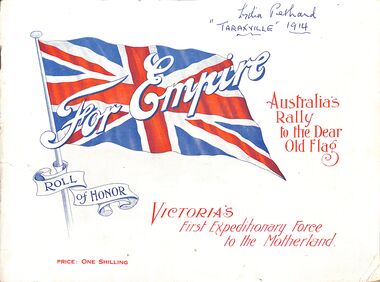 Bendigo Historical Society Inc.
Book - "For Empire. Australia's Rally to the Dear Old Flag.", 1914
... Around 6,700 men volunteered within three weeks to take part in an "expeditionary force", and gathered at a camp at Broadmeadows in preparation for sailing on one of 26 troopships being sent by Australia. The booklet was produced as a souvenir to the "gallant men who responded so readily to the call to arms...Around 6,700 men volunteered within three weeks to take part in an "expeditionary force", and gathered at a camp at Broadmeadows in preparation for sailing on one of 26 troopships being sent by Australia. The booklet was produced as a souvenir to the "gallant men who responded so readily to the call to arms ...Booklet issued in September 1914 containing a complete roll of the first Victorian Contingent to "the Motherland", documenting Australia's offer to send troops to Great Britain after the declaration of war, and the response by Victoria. Around 6,700 men volunteered within three weeks to take part in an "expeditionary force", and gathered at a camp at Broadmeadows in preparation for sailing on one of 26 troopships being sent by Australia. The booklet was produced as a souvenir to the "gallant men who responded so readily to the call to arms. Theirs is the spirit that has built up the greatness of England's empire." The wish that they have a "speedy and safe return to sunny Australia" underlines the naivety or innocence of the times. ON the declaration of war the Commonwealth Government immediately cabled the Imperial Authorities, offering to send an Expeditionary Force of 20,000 men to assist the Empire in this the greatest struggle in history. The offer was gratefully accepted by the mother country and immediately the enrolment of volunteers was begun, officers and men enthusiastically rallied to the call, and in the course of two or three weeks the whole of the contingents were in camp. The offer was made on the 3rd August, 1914, and before the end of September the troops were ready for the front. The command of the Expeditionary Force has been entrusted to Brigadier-General Bridges, who is ably assisted by the best officers in Australia. To transport the troops to England twenty-six of the largest and best liners that come to Australian waters have been engaged as troopships. The whole of the cost (estimated at more than £5,000,000) of equipping and maintaining the troops during the war will be borne by Australia, and even if the cost should be treble the amount it will be cheerfully and readily responded to in aid of the Empire. A Second Expeditionary Force is now in course of enrolment. Our Victorian First Contingent comprises some 6,700 officers and men, and this booklet is issued as a souvenir of Victoria's complement and to serve as a record and memento of the gallant men who responded so readily to the call to arms. Theirs is the spirit that has built up the greatness of England's Empire—the spirit that will support it while empires last. May Providence guide them to speedy victory and a safe return to sunny Australia. September, 1914. The booklet also mentions that a secondary expeditionary force is being assembled, so may have also functioned as an inducement to enlist. "For Empire. Australia's Rally to the Dear Old Flag." Roll of Honor. Victoria's First Expeditionary Force to the Motherland. Soft cover. Front cover contains image of Union Jack. Title in white, and subtitles in red . Stapled in spine. Publisher's name and address on back cover to bottom right. Contains black and white images. Index of soldiers names listed by Divisional Headquarters and Battalions. 16 pages. soldiers, world war one, british empire, first expeditionary force -
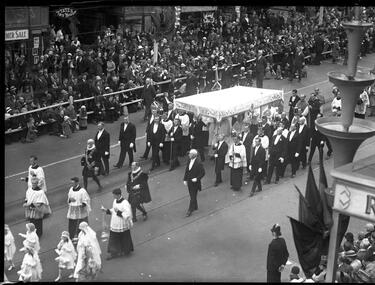 City of Melbourne Libraries
Photograph, Bull, Hugh Jones, 1897-1993, Eucharistic Congress Procession, Collins Street, Melbourne
... arms from which spring a trophy of flags.” – Australian Home Beautiful Featured in "Newsworthy: Melbourne in photographs 1933-1936" exhibition at East Melbourne Library, October to December 2023. Exhibition caption by project volunteer...arms from which spring a trophy of flags.” – Australian Home Beautiful Featured in "Newsworthy: Melbourne in photographs 1933-1936" exhibition at East Melbourne Library, October to December 2023. Exhibition caption by project volunteer ...Published: The Age 10 December 1934 Published title: RELIGIOUS PAGEANTRY AND FERVOR MARKED CLOSE OF EUCHARISTIC CONGRESS. Published caption: Thousands of men and women marched in the Eucharistic procession yesterday which brought the Congress to a close. The picture above shows the procession headed by the Children of Mary in Bourke-street and turning into Spring-street, in front of Parlia ment House. Right (top) — The procession leaving the starting point at St. Patrick's Cathedral and below, the Papal Legate carrying the Host under a canopy borne by a guard of laymen and preceded by white-clad girls scattering rose leaves, incense bearers and the Papal Chamberlains in their Spanish uniforms. The end of the procession in front of Mount St. Evin’s Hospital from which the final benediction was given by Cardi nal MacRory from an altar on the bal cony. The Papal Legate carrying the Host is passing through the assemblage of surpliced priests. On the left is an aerial picture taken just as the Children of Mary at the head of the procession are taking up their places for the final assembling. In the left top corner of the picture is St Patrick's Cathedral, from which the procession started, and in the right lower corner is Mount St. Evin’s Hospital. The space immediately in front of the hospital was reserved for the processionists while on either side is the crowd that assembled to take part in the final service. Trove article identifier: http://nla.gov.au/nla.news-article205067634 Religious pageantry and fervour The National Eucharistic Congress took place from Sunday 2 to Sunday 9 December 1934. An initiative of the Roman Catholic Church, it was their contribution to Melbourne’s Centenary Celebrations. 200,000 Catholics resided in Melbourne at this time – one quarter of the city’s population. While the Congress was aimed at Catholics, and acted as an opportunity to reinforce their living faith and homage, it contained a variety of events of splendour, solemnity and significance designed to appeal to Melbournians, and would additionally provide incentive for people to travel to Victoria, thereby creating an economic benefit to the state. The Procession of the Blessed Sacrament concluded the week-long Congress. Commencing at St Patrick’s Cathedral, it covered a two-mile route via Gisborne, Collins, Elizabeth and Bourke streets, then to Victoria Parade, where a final benediction was pronounced by Cardinal MacRory from the balcony of Mount St. Evin’s Hospital (today the site of St Vincent’s Private Hospital). An estimated 100,000 took part. Onlookers line Swanston Street, some standing at the entrance to Tate’s Tea House – a well-known Melbourne landmark located in the basement of the Manchester Unity Building. The white-veiled Children of Mary Sodalists strew rose petals in the path of the canopy, covering the jewelled Monstrance containing the Blessed Sacrament of consecrated Host (bread) and carried by the Cardinal. Church hierarchy in scarlet robes walk alongside, followed by incense bearers, the Papal Chamberlains in their Spanish uniforms, and a guard of honour of laymen of the city and country parishes. In the foreground is a tiered pole. This is one of 800 “Venetian Lights” specifically installed for the Centenary along all principal thoroughfares. “The poles are painted white, the superstructure resembling three trumpet lilies are made of durable fibro-cement, and their colour scheme deepens from clear yellow on the top cone to orange on the lowest, with slender rims of vermilion and white. Each cone is flooded with light externally from three lamps concealed in the one below it. There is also a painted coat of arms from which spring a trophy of flags.” – Australian Home Beautiful Featured in "Newsworthy: Melbourne in photographs 1933-1936" exhibition at East Melbourne Library, October to December 2023. Exhibition caption by project volunteer, Louise McKenzie. Research by project volunteer, Louise McKenzie: This photo was taken on Sunday 9 December 1934, looking from the Melbourne Town Hall (corner of Swanston and Collins streets) across the road to the Manchester Unity Building. This is the afternoon procession concluding the Catholic Church’s National Eucharistic Congress in Melbourne - a procession of the Blessed Eucharist through the Melbourne city. It commenced at St Patrick’s Cathedral, and covered a two mile route via Gisborne, Collins, Elizabeth and Bourke streets, then to Victoria Parade where a final benediction was pronounced by the Cardinal from the balcony of Mount St. Evin’s Hospital (present day St Vincent’s Private Hospital). An estimated 100,000 took part in the march. The people lining the streets a men in suits and hats, women in coats and hats, and children in their “Sunday best”, kneeling beside the road, many with their hands clasped in front of them. The small girls ahead of the canopy covering the Host are pale-blue clad, white veiled Children of Mary Sodalists, who strew rose petals to pave the way of the Cardinal carrying the jewelled Monstrance (Blessed Sacrament of consecrated Host (bread)), together with church heirarchy wearing scarlet robes. Behind came incense bearers and the Papal Chamberlains in their Spanish uniforms, followed by a guard of honour of laymen of the city and country parishes. The Children of Mary Sodalities was a religious body which aimed at fostering in its members an ardent devotion, reverence, and filial love towards the Blessed Virgin Mary, initially embracing the pupils and orphans of the schools and institutions of the Sisters of Charity of St Vincent de Paul. In 1847, Blessed Pius IX affiliated them to the Jesuit Roman Sodality. They were distinguished by a medal suspended from a blue ribbon, and once a fully-fledged a Child of Mary wore a distinctive blue cape. On the extreme right foreground of the photo can be seen an intriguing piece of artistic design – a tiered pole. This is one of the 800 “Venetian Lights” specifically installed for Melbourne’s Centenary along all principal thoroughfares. “The poles are painted white, the superstructure resembling three trumpet lilies are made of durable fibro-cement, and their colour scheme deepens from clear yellow on the top cone to orange on the lowest, with slender rims of vermilion and white. Each cone is flooded with light externally from three lamps concealed in the one below it. There is also a painted coat of arms from which spring a trophy of flags.” Note the sign for Tates Tea House - a well-known Melbourne landmark, located in the basement of the Manchester Unity Building. References: RELIGIOUS PAGEANTRY AND FERVOR MARKED CLOSE OF EUCHARISTIC CONGRESS. (1934, December 10). The Age (Melbourne, Vic. : 1854 - 1954), p. 11. Retrieved September 14, 2023, from http://nla.gov.au/nla.news-article205067634 Eucharistic Congress (1934, December 1). The Argus (Melbourne, Vic. : 1848 - 1957), p. 11. Retrieved January 23, 2024, from http://nla.gov.au/nla.news-article10997817 National Eucharistic Congress, Melbourne. (1934, December 6). The Catholic Press (Sydney, NSW : 1895 - 1942), p. 28. Retrieved January 23, 2024, from http://nla.gov.au/nla.news-article104371824 'The year of the Melbourne Eucharistic Congress: 1934.' The Campion Society, https://campion.australiancardijninstitute.org/ch-7-the-year-of-the-melbourne-eucharistic-congress-1934/ 'Melbourne Eucharistic Congress 1934.' Panoramic photograph, https://emhs.org.au/catalogue/emdf0123 The National Eucharistic Congress, Melbourne, Australia December 2nd-9th, 1934. Edited by Rev. J.M. Murphy and Rev. F. Moynihan, The Advocate Press, Melbourne. 'Children of Mary Sodalists', Wikipedia, https://en.wikipedia.org/wiki/Sodality_of_Our_Lady 'Dressing Melbourne for the Duke' (1934, October 1). The Australian home beautiful : a journal for the home builder, p. 21, 58. Retrieved September 14, 2023, from http://nla.gov.au/nla.obj-2950922209 Photographer notations on slide: "Eucharistic Congress Procession on Swanston St B61" [sic - actually Collins Street].events, religion, parades, catholic church -
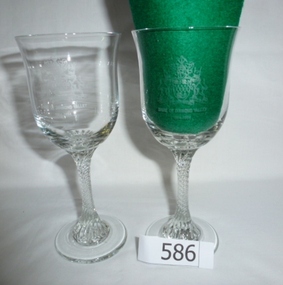 Greensborough Historical Society
Domestic object - Glasses, Shire of Diamond Valley Commemorative glasses, 1994_
... A limited edition glass presented to community volunteers and others associated with the Shire of Diamond Valley. shire of diamond valley greensborough commemorative glasses Etched into bowl "Shire of Diamond Valley 1964-1994" and shire coat of arms. ...These glasses were distributed to commemorate the 30th anniversary of the proclamation of the Shire of Diamond Valley. The Shire of Diamond Valley was a Local Government Area located about 20 kilometres northeast of Melbourne. The shire covered an area of 74.38 square kilometres and existed from 1964 until 1994. A limited edition glass presented to community volunteers and others associated with the Shire of Diamond Valley.Pair of clear glass, stemmed wine glasses. Stem has spiral pattern.Etched into bowl "Shire of Diamond Valley 1964-1994" and shire coat of arms.shire of diamond valley, greensborough, commemorative glasses
