
Showing 728 items matching "w form"
-
 University of Melbourne, Burnley Campus Archives
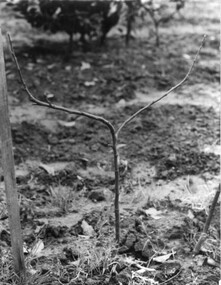
Photograph - Black and white photographs, A.W. Jessep, Espalier Pruning, Unknown
... ...w form...Black and white photographs pasted on cardboard for display purposes. (1) "Commencement of the U or W form. (2) "The Cordon." (3) "Horizontal 'Cordon'." (4) The Espalier with first pair of arms forming." (5) "Espalier Pear-Packham's Triumph. ...u form w form cordon espalier a.w. jessep horizontal cordon Black and white photographs pasted on cardboard for display purposes. (1) "Commencement of the U or W form. (2) "The Cordon." (3) "Horizontal 'Cordon'." (4) The Espalier with first pair of arms forming." (5) "Espalier Pear-Packham's Triumph. ...Black and white photographs pasted on cardboard for display purposes. (1) "Commencement of the U or W form. (2) "The Cordon." (3) "Horizontal 'Cordon'." (4) The Espalier with first pair of arms forming." (5) "Espalier Pear-Packham's Triumph. Reverse, A.W. Jessep c/o Artists Room No 42."u form, w form, cordon, espalier, a.w. jessep, horizontal cordon -
 Melbourne Tram Museum
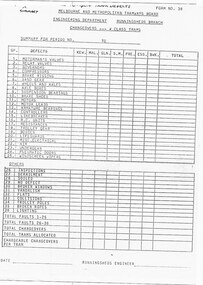
Document - Report, Melbourne & Metropolitan Tramways Board (MMTB), "MMTB - Engineering Department Running sheds Branch - Changeovers W class Trams - Form 3B" "Depot summary form for crews to report tram defects", c1980
... "MMTB - Engineering Department Running sheds Branch - Changeovers W class Trams - Form 3B" "Depot summary form for crews to report tram defects"...Report, single A4 sheet summary for periods showing the type of defects that change overs were made for W class trams, at each depot - titled - "MMTB - Engineering Department Running sheds Branch - Changeovers W class Trams - Form 3B" and hand written in ink on top of the sheet - "Depot summary form for crews to report tram defects". ..."MMTB - Engineering Department Running sheds Branch - Changeovers W class Trams - Form 3B" "Depot summary form for crews to report tram defects" Document Report Melbourne & Metropolitan Tramways Board (MMTB) ...Report, single A4 sheet summary for periods showing the type of defects that change overs were made for W class trams, at each depot - titled - "MMTB - Engineering Department Running sheds Branch - Changeovers W class Trams - Form 3B" and hand written in ink on top of the sheet - "Depot summary form for crews to report tram defects". Gives some 36 reasons why a changeover may have occurred.trams, tramways, preston workshops, w class, reports, depots, faults -
 Stawell Historical Society Inc
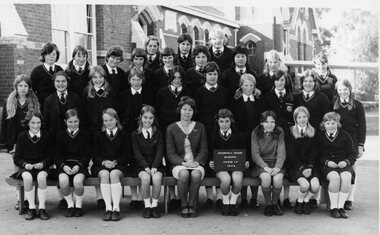
Photograph, Stawell High School Form 1C 1972, 1972
... B/W Form Photograph in front of Brick uilding...Education Class Photo Stawell High Schoool Stawell High School Form 1c 1972 Winter uniform 4 rows female students and demale form Mistress (Teacher) B/W Form Photograph in front of Brick uilding Stawell High School Form 1C 1972 Photograph ...B/W Form Photograph in front of Brick uildingStawell High School Form 1c 1972 Winter uniform 4 rows female students and demale form Mistress (Teacher)education, class photo, stawell high schoool -
 Stawell Historical Society Inc
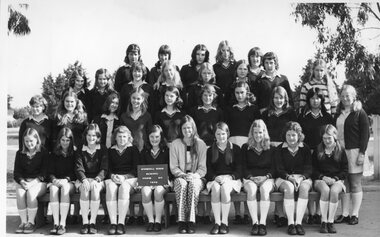
Photograph, Stawell High School Form 2C 1973, 1973
... B/W. Form Photo in front of New Holland Oval. 4 Rows of female students and Teacher. ...Education Stawell High School Class Photo Stawell High School Form 2c 1973 B/W. Form Photo in front of New Holland Oval. 4 Rows of female students and Teacher. ...B/W. Form Photo in front of New Holland Oval. 4 Rows of female students and Teacher. Sumer UniformStawell High School Form 2c 1973education, stawell high school, class photo -
 Stawell Historical Society Inc
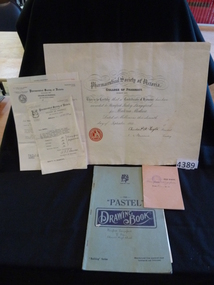
Memorabilia - Realia, 1930
... Stawell High School Terminal Report W. Langsford Form B 1930...Stawell Stawell High School Terminal Report W. Langsford Form B 1930 Memorabilia Realia ...Stawell High School Terminal Report W. Langsford Form B 1930stawell -
 Port Melbourne Historical & Preservation Society
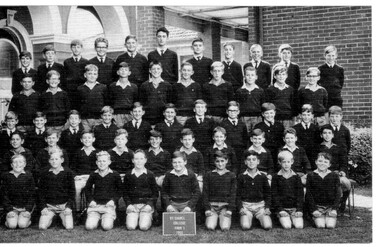
Photograph - Form 1, Mt Carmel College, Beaconsfield Parade, Albert Park, 1966
... B&W photo of Form 1, Mt. Carmel College 1966...education - secondary schools antonio cannatelli mt carmel college B&W photo of Form 1, Mt. Carmel College 1966 Photograph Form 1, Mt Carmel College, Beaconsfield Parade, Albert Park ...B&W photo of Form 1, Mt. Carmel College 1966education - secondary schools, antonio cannatelli, mt carmel college -
 Bendigo Military Museum
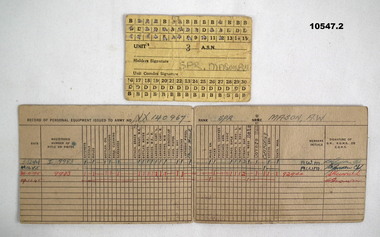
Document - RATION & EQUIPMENT CARDS, Aug 1944
... Cardboard card, khaki colour marked w. Form 91. 2. A.M.F. members personal equipment card. ...Cardboard card, khaki colour marked w. Form 91. 2. A.M.F. members personal equipment card. ...Refer to A.W. Mason collection. See cat No. 3979.2 for service details.1. Ration card. For Spr Mason A.W. This is probably from a troopship. It has 27 heart shaped holes cut into it. Top of card has a row "B", then a row "D", then a row of numbers up to 15. Bottom half card not used. Cardboard card, khaki colour marked w. Form 91. 2. A.M.F. members personal equipment card. For VX140967, Spr Mason A.W. For weapons, webbing and hardware. it is khaki cardboard. Folds outwards. Army form AAF F204.As aboveww2, personal documents, ration card, equipment card -
 Port Melbourne Historical & Preservation Society
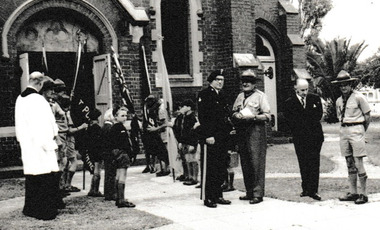
Photograph - Holy Trinity Church with cub scout Guard of Honour, Reverend Donald LANGFORD, c.1971
... B & W photograph cub scouts forming a Guard of Honour outside Holy Trinity Church, Port Melbourne....Religion - Anglican (Holy Trinity) Theodore Thomas (Tom) BUCKINGHAM Port Melbourne Scouts F A W 'Skip' SHORT B & W photograph cub scouts forming a Guard of Honour outside Holy Trinity Church, Port Melbourne. ...A troop of cub scouts for a Guard of Honour outside Holy Trinity Church, Port Melbourne. Cr Tom BUCKINGHAM stands to the left of 'Skip' SHORT.B & W photograph cub scouts forming a Guard of Honour outside Holy Trinity Church, Port Melbourne.religion - anglican (holy trinity), theodore thomas (tom) buckingham, port melbourne scouts, f a w 'skip' short -
 Port Melbourne Historical & Preservation Society
Financial record - Invoice, W Grant, Grocer & Wine & Spirit Merchant, Ross Street, Port Melbourne, 1910
... Invoice form, W Grant, Grocer & Wine & Spirit Merchant 166-168 Ross Street, Port Melbourne, with Ideal Milk logo, found in minutes book of the Sea Bathing Club...business and traders - wine and spirits w grant - grocer someone has been figuring on back in pencil; many figures Invoice form, W Grant, Grocer & Wine & Spirit Merchant 166-168 Ross Street, Port Melbourne, with Ideal Milk logo, found in minutes book of the Sea Bathing Club Financial record Invoice, W Grant, Grocer & Wine & Spirit Merchant, Ross Street, Port Melbourne ...Invoice form, W Grant, Grocer & Wine & Spirit Merchant 166-168 Ross Street, Port Melbourne, with Ideal Milk logo, found in minutes book of the Sea Bathing Clubsomeone has been figuring on back in pencil; many figuresbusiness and traders - wine and spirits, w grant - grocer -
 Daylesford & District Historical Society
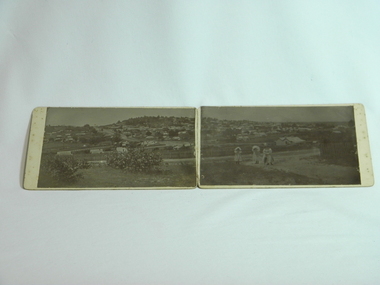
Photograph Daylesford Panorama, J. J. Crawford, Western Avenue to Wombat Hill woman and two girls c1900, Circa 1900
... 2 B&W photos forming panorama of Daylesford township, looking South East to Wombat Hill & beyond with many buildings clearly visible. 3 women/girls in foreground. ...Crawford Mitiamo) (late of Daylesford) D13 2 B&W photos forming panorama of Daylesford township, looking South East to Wombat Hill & beyond with many buildings clearly visible. 3 women/girls in foreground. ...Early panorama of Daylesford circa 1900 with views of Wombat Hill from Western Avenue. Taken by J. J. Crawford of Mitiamo late resident of Daylesford.A unique early view of Daylesford showing large areas of vacant land pre modern development.2 B&W photos forming panorama of Daylesford township, looking South East to Wombat Hill & beyond with many buildings clearly visible. 3 women/girls in foreground. Circa 1900. Mounted on 2 pieces of cardboard, stuck together by sewing red fabrick onto mounting boards. Taken at western Avenue by J. J. Crawford of Mitiamo Victoria photographic studio a late resident of Daylesford. J.J. Crawford Mitiamo (Stamp) Donated to Daylesford & District Historical Society by (J.J. Crawford Mitiamo) (late of Daylesford) D13wombat hill, town views, clothing -
Bendigo Historical Society Inc.
Legal record - George Lansell's Fortuna Renovations, 1875
... Icludes notes and plans of the additions to the building 11217.83b General Terms and Condition form W. Beebe, Architect, Mitchell Street , Bendigo. ...Icludes notes and plans of the additions to the building 11217.83b General Terms and Condition form W. Beebe, Architect, Mitchell Street , Bendigo. ...Emil Mauermann, from Hainewalde in the south-east of Saxony, worked in Bendigo from 1886 to 1894, initially working for Vahland before establishing his own architecture office in 1887. Later he and his German wife moved to Western Australia, where he worked for many years. It is thought likely that he had a significant influence on Vahland’s design for the Colonial Bank in View Street. Many German immigrant architects worked in Bendigo in the 19th century, e.g. Mauermann, Nicolai, Bosselmann and Lehmann, but the two biggest names are Carl Wilhelm Vahland and Robert Getzschmann, who had a considerable effect on the appearance of Bendigo. Vahland was trained as an architect at the Baugewerkschule (School of Building) at Holzminden on the River Weser, not far from his hometown of Nienburg, also on the Weser. Vahland came from a family of builders. At 27, not long after completing his studies, he emigrated to Australia, arriving in Melbourne in September 1854 on the San Francisco. He went to the Bendigo goldfields but had no luck finding gold. For a while he built gold-washing cradles for the alluvial diggers and then started his Australian architectural career which lasted nearly 50 years. Robert Getzschmann, another German, had arrived in Victoria in 1849 and moved to Bendigo in 1857. In 1858 Vahland and Getzschmann established a partnership and opened an architectural office in Pall Mall, Bendigo. This partnership of Vahland and Getzschmann designed many churches, banks, schools, hotels, theatres and private homes in Bendigo, and designed buildings in a wide surrounding area, reaching up into southern NSWLegal Records of George Lansell's Fortuna This item contains the following documents: 11217.83a Legal Records of George Lansell's Fortuna - Contract with L. Mauermann, Architect for Alterations and additions of a mansard story to the private residence of George Lansell's esq, Sandhurst. A mansard roof is a distinctive, multi-sided roof with two distinct slopes on each side. Icludes notes and plans of the additions to the building 11217.83b General Terms and Condition form W. Beebe, Architect, Mitchell Street , Bendigo. For carpenters work in Mrs Lansell's Billiard Room 11217.83c Plans from Vahland and Getzschmann for doors, windows and the staircase 11217.83d General Terms and Condition form W. Beebe, Architect, Mitchell Street , Bendigo. For excavations, brick, stone and concrete work in Mrs Lansell's Billiard Room 11217.83e General Terms and Condition form W. Beebe, Architect, Mitchell Street , Bendigo. For concrete work in Mrs Lansell's Billiard Room 11217.83f General Terms and Condition form W. Beebe, Architect, Mitchell Street , Bendigo. For eplumbing work in Mrs Lansell's Billiard Room 1893 11217.83g plans and notes on the additions and alterations Nov 1890 11217.83h Plans from Vahland and Getzschmann for front elevation of the buiding 1875 11217.83i Tender 03 July 1871 by R.A. Love to erect a tower at Fortuna, includes plansnon-fictionbendigo, fortuna, george lansell, fortuna alterations -
 Bendigo Historical Society Inc.
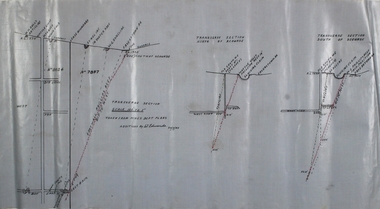
Plan - W.W. Gully and Footwall
... Additions by W. Edwards, 30.7.45, Plan forms part of the Margaret Roberts Collection of mining records. ...Additions by W. Edwards, 30.7.45, Plan forms part of the Margaret Roberts Collection of mining records. ...Wattle Gully Gold Mine was at Chewton. A footwall in mining is the underlying rock mass beneath an inclined fault, vein, or mineral deposit. It is named because miners typically walk on this lower surface while the hanging wall lies above them. In mining operations, it serves as a crucial, stable reference point, often housing underground drives and shafts. Transverse section showing W.W. Gully and Phillips Reef. Seperate transverse diagrams of north and south of xcut. Additions by W. Edwards, 30.7.45, Plan forms part of the Margaret Roberts Collection of mining records. margaret roberts, gold, chewton, shaft, gold mine, phillips reef, w.w. gully, footwall -
 Bendigo Historical Society Inc.
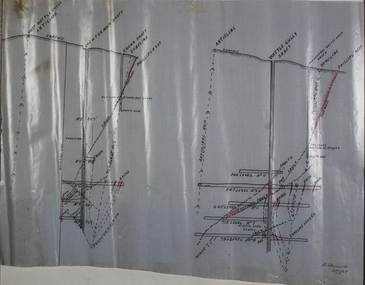
Map - Wattle Gully and Chewton main shafts
... Signature on plan: 'W. Edwards, 20.7.45.' Plan forms part of the Margaret Roberts Collection of mining records. ...Signature on plan: 'W. Edwards, 20.7.45.' Plan forms part of the Margaret Roberts Collection of mining records. ...Cross section plan drawn on waxed paper. Notation on plan: Chewton Main shaft, Crown shaft, Wattle Gully shaft. Signature on plan: 'W. Edwards, 20.7.45.' Plan forms part of the Margaret Roberts Collection of mining records. margaret roberts, gold, chewton, lease holding, shaft, wattle gully -
 Glenelg Shire Council Cultural Collection
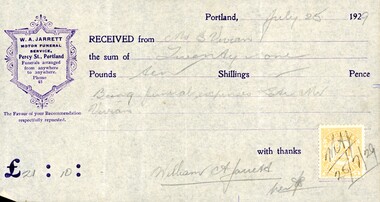
Financial record - Funeral Receipt for William Vivian, 1929
... Vivian, for £21.10.0 in payment for the funeral of W. Vivian. Printed form, details handwritten in black ink, 2d stamp initialled and dated 26/7/29. ...Vivian, for £21.10.0 in payment for the funeral of W. Vivian. Printed form, details handwritten in black ink, 2d stamp initialled and dated 26/7/29. ...Cream paper receipt from W. A. Jarrett to Mr. B. Vivian, for £21.10.0 in payment for the funeral of W. Vivian. Printed form, details handwritten in black ink, 2d stamp initialled and dated 26/7/29. The receipt is signed at the bottom by William A Jarrett. A decorative emblem for W. A. Jarrett Funerals is in the top lefthand corner. The receipt is dated July 25 1929.Emblem: W.A.JARRETT / MOTOR FUNERAL / SERVICE / Percy St., Portland / Funerals arranged / from anywhere / to anywhere / Phone / 43vivian family records, william vivian, funeral expenses, jarrett, bert vivian -
 Geelong RSL Sub Branch
W G 3 Entitlement to War Gratuity, Mid 20th Century
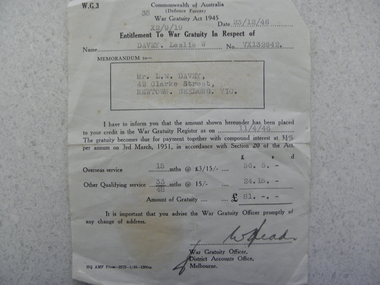
... The Form states the Entitlement to War Gratuity for VX 132642 L W Davey who served in the AIF during WW2...White colour Office Stationery W G 3 AMF Form Entitlement to War Gratuity Ronson Cigarette Lighter engraved L.W. ...The Form states the Entitlement to War Gratuity for VX 132642 L W Davey who served in the AIF during WW2 The Form W G 3 is an original and shows entitlements due to VX 132642 L W Davey aif ww2 gratuity davey Entitlement to War Gratuity for VX 132642 L W Davey White colour Office Stationery W G 3 AMF Form Entitlement to War Gratuity Ronson Cigarette Lighter engraved L.W. ...The Form states the Entitlement to War Gratuity for VX 132642 L W Davey who served in the AIF during WW2The Form W G 3 is an original and shows entitlements due to VX 132642 L W DaveyWhite colour Office Stationery W G 3 AMF Form Entitlement to War Gratuity Ronson Cigarette Lighter engraved L.W. Davey 4-12-47 1948 Clothing and Ration Card CHILD under 6 years at 1 January 1948Entitlement to War Gratuity for VX 132642 L W Daveyaif, ww2, gratuity, davey -
 Melbourne Legacy
Document, Medical Officers Report, 1927
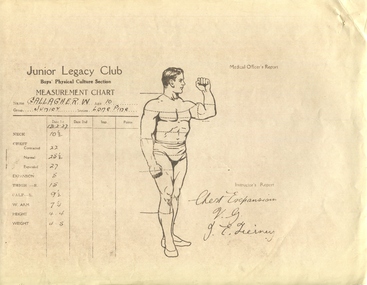
... This was a copy of the form that was kept as an example. The data was of measurements of junior legatee W. ...This was a copy of the form that was kept as an example. The data was of measurements of junior legatee W. ...A chart for taking measurements of the Legacy boys. This was a copy of the form that was kept as an example. The data was of measurements of junior legatee W. Gallagher. The form was signed J. Teirney, which was Jim Teirney who was the first paid employee of Melbourne Legacy, he was the fitness instructor for many years. The date was 1927 so very early in the history of Legacy working with children of deceased servicemen. Shows Legacy was active in record keeping with proper medical supervision for physical activities of the children, in 1927.The method of record keeping was all done by hand, time consuming and the storage of records took up a lot of space.Diagram of a measurement chart with sketch of a male body. Printed in black and white.Medical Officers Report. Junior Legacy Club. Name: Gallagher. W., age 10, Group Junior, section Lone Pine. Measurements of the neck, chest, thigh, calf, arm, height and weight. Signed by J.E. Tierneyjunior legatee, exercise classes -
 Bendigo Historical Society Inc.
Plan - Central Red White and Blue Co
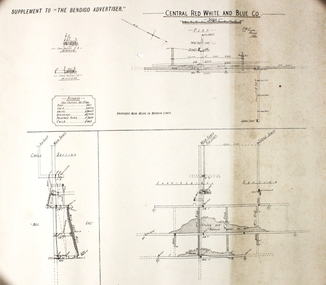
... Also, a list headed RETURNS- First crushing 9th Sept 1910, Tons 13601, Gold 22613oz, Value £90452, Dividends £67200, Reserve Fund £5600, Calls £400. Signed W. H. Cundy. Forms part of the Margaret Roberts Collection ...Also, a list headed RETURNS- First crushing 9th Sept 1910, Tons 13601, Gold 22613oz, Value £90452, Dividends £67200, Reserve Fund £5600, Calls £400. Signed W. H. Cundy. Forms part of the Margaret Roberts Collection Plan Central Red White and Blue Co ...OBITUARY MR. W. H. CUNDY PROMINENT FOOTBALLER. The news of the death in a private hospital at Bendigo (VIC.) on Monday of Mr. William Henry Cundy, a geologist and mining engineer, who was regarded as one of the greatest authorities on the Bendigo gold field, was received in Launceston with deep regret. A native of Hobart, Mr. Cundy, who was 71 years of age, went to Bendigo from Tasmania in 1893 to an appointment in the Mines Department, subsequently, in association with Mr. E. J. Dunn, undertaking the task of making a special report on the Bendigo gold fields, and also of charting the lines of reef. He was keenly interested in mining ventures in Tasmania, and his services were in constant demand to investigate and report on shows, particularly gold and tin. In his younger days, at Hobart, Mr. Cundy was a champion footballer, and brought about the modification of the rules of the game in Tasmania. While in Bendigo he was captain of Sandhurst for many years, and a past-president of the Bendigo Football League. He was a widower. Mercury (Hobart, Tas.: 1860 - 1954), Friday 15 February 1935, page 6) The Central Red White and Blue Gold Mine was Bendigo's leading gold mine from 1910 - 1913. During the mine's operation, the main shaft was sunk 670 metres, and retrieved over 2500KG of gold. The Central Red White and Blue Gold Mine was located on the corner of Chum St and Honeysuckle St in Golden Square Three draftsman's drawing in black ink on off-white paper. Printed at the top- SUPPLEMENT TO "THE BENDIGO ADVERTISER" CENTRAL RED WHITE AND BLUE Co. Three drawings are a plan, a cross section and a longitudinal section showing the main shaft, air shaft and Eadie's shaft to a depth of 400 feet. Also, a list headed RETURNS- First crushing 9th Sept 1910, Tons 13601, Gold 22613oz, Value £90452, Dividends £67200, Reserve Fund £5600, Calls £400. Signed W. H. Cundy. Forms part of the Margaret Roberts Collection bendigo, margaret roberts, gold, map, mine, w h cundy, central red white and blue mine -
 Bendigo Historical Society Inc.
Document - CONNELLY, TATCHELL, DUNLOP COLLECTION: LEGAL PAPERS, 1886
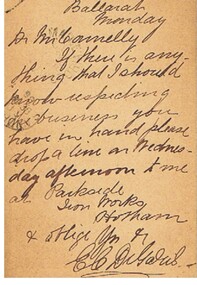
... Connelly, Tatchell & Dunlop - Legal Papers. 1 - 1886 - Letter from Cuthbert & Co, Law & General Stationers, Lithographers & Printers, 55 Chancery Lane. 2 - 1886 - Letter from Bennett, Attenborough, Wilks & Nunn re Hawthorne & Brady. 3 - 1886 - Post Office Telegraph from Bennett 7 Co re Hawthorne & Brady. 4 - 1886 - Letter from Bennett, Attenborough, Wilks & Nunn, Solicitors, Melbourne re Nelson C to Executors of Havlin, deceased. 5 - 1886 - Letter form Holding Palph. 6 - 1886 - Letter form Thomson W B, Solicitor, Bairnsdale re Butterfield Thomas. 7 - 1886 - Post Office Telegraph from Bennett & Co re Hawthorne & Brady. 8 - 1886 - Letter from Bennett, Attenborough, Wilks & Nunn re Thomas John, deceased. 9 - 1886 - Letter from Holloway Edward, Kerang re loan. 10 - 1886 - Post card from De Garis E C, Ballarat....W B Butterfield Thomas Thomas John Holloway Edward De Garis E C Documents. Connelly, Tatchell & Dunlop - Legal Papers. 1 - 1886 - Letter from Cuthbert & Co, Law & General Stationers, Lithographers & Printers, 55 Chancery Lane. 2 - 1886 - Letter from Bennett, Attenborough, Wilks & Nunn re Hawthorne & Brady. 3 - 1886 - Post Office Telegraph from Bennett 7 Co re Hawthorne & Brady. 4 - 1886 - Letter from Bennett, Attenborough, Wilks & Nunn, Solicitors, Melbourne re Nelson C to Executors of Havlin, deceased. 5 - 1886 - Letter form Holding Palph. 6 - 1886 - Letter form Thomson W B, Solicitor, Bairnsdale re Butterfield Thomas. 7 - 1886 - Post Office Telegraph from Bennett & Co re Hawthorne & Brady. 8 - 1886 - Letter from Bennett, Attenborough, Wilks & Nunn re Thomas John, deceased. 9 - 1886 - Letter from Holloway Edward, Kerang re loan. 10 - 1886 - Post card from De Garis E C, Ballarat. ...Documents. Connelly, Tatchell & Dunlop - Legal Papers. 1 - 1886 - Letter from Cuthbert & Co, Law & General Stationers, Lithographers & Printers, 55 Chancery Lane. 2 - 1886 - Letter from Bennett, Attenborough, Wilks & Nunn re Hawthorne & Brady. 3 - 1886 - Post Office Telegraph from Bennett 7 Co re Hawthorne & Brady. 4 - 1886 - Letter from Bennett, Attenborough, Wilks & Nunn, Solicitors, Melbourne re Nelson C to Executors of Havlin, deceased. 5 - 1886 - Letter form Holding Palph. 6 - 1886 - Letter form Thomson W B, Solicitor, Bairnsdale re Butterfield Thomas. 7 - 1886 - Post Office Telegraph from Bennett & Co re Hawthorne & Brady. 8 - 1886 - Letter from Bennett, Attenborough, Wilks & Nunn re Thomas John, deceased. 9 - 1886 - Letter from Holloway Edward, Kerang re loan. 10 - 1886 - Post card from De Garis E C, Ballarat.cottage, miners, connelly, tatchell & dunlop, cuthbert & co, bennett attenborough wilks & nunn, hawthorne, brady, bennett & co, nelson c, havlin, holding ralph, thomson w b, butterfield thomas, thomas john, holloway edward, de garis e c -
 Sunshine and District Historical Society Incorporated
Photograph - St. Albans High School 1961 Class Photographs
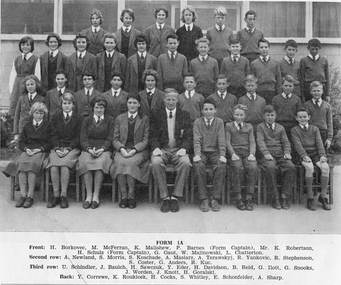
... Cocks (Form Captain), Mr. G. Reid, W. Muc (Form Captain), J. Waring, R. ...Cocks (Form Captain), Mr. G. Reid, W. Muc (Form Captain), J. Waring, R. ...5504.01 - St. Albans High School 1961 Form 1A.jpg Front: H. Borkovec, M. McFerran, K, Mallshew, P. Barnes (Form Captain), Mr. K. Robertson, H. Schulz (Form Captain), G. Gaut, W. Mallinoski, L. Chatteerton Second Row: A. Newland, S. Morris, S. Koschade, A. Masiarz, A. Terawskyj, R. Yankovic, R. Stephens, S. Coster, G. Anders, R. Kuc Third Row: U. Schindler, J. Baulch, H. Sawczuk, Y. Eder, H. Davidon, B. Reid, G. Ilott, G. Snooks, J. Worden, J. Knott, H. Goralski Back: Y. Correwe, K. Roukicek, H. Cocks, S. Whitley, E. Schonfelder, A. Sharp 5504.02 - St. Albans High School 1961 Form 1B.jpg Front: I. Papagianoplous, J. Gattellaro, K. Kubasiewicz, M. Fielder (Form Captain), Mr. I. M. Smith, J. Attard (Form Captain), P. Bayley, J. Belko, A. Pliaskin Second Row: J. Morabito, B. Arnautovic, J. Rothwell, M. Jovanovic, I. Strebs, M. Dejanovic, P. Weston, B. Ward, M. Martignoles, J. Carrick Third Row: M. Tart, L. Kowalczuk, S. Stojanovic, M. Urbaniak, L. White, F. Vyner, M. Gutyj, M. Gangur 5504.03 - St. Albans High School 1961 Form 1C.jpg Front: B. Masurek, A. Gordon, V. Jurasou, R. Orpik, Mr. Scarff, A. Ajayoglu (Form Captain), A. Spivey, M. Ratajszcak, R. Pope, Absert L. Cox (Form Captain) Second Row: C. Schneidruk, V. Brown, C. Koston, J. Robertson, S. Taylor, H. Pryhodia, D. Beyer, F. Janssen, N. Szwed, S. Czyz Third Row: H. Smith, S. Rutkowski, J. Anderson, M. Kosgraber, V. Debeca, P. Nowatschenko, P. Barbopouos, O. Czernik, D. Dusting, G. Kennedy, G. Bleker Back: T. Hovenga, M. Grosik, T. Cubela, C. Mis, l. Peterson, G. Ruffa, J. Simovic, M. Coughlin, J. Ribarow 5504.04 - St. Albans High School 1961 Form 1D.jpg Front: M. Belan, D. Zvaigzne, C. Videnov, I. Wager (Form Captain), Mr. J. Mott, S. Heyne (Form Captain), B. Broadman, A. Couper, J. Binks Second Row: M. Rowley, B. Teichmann, D. Rodgers, N. Skorobogaty, C. Chabiera, Z. Dorosz, A. Van Ree, R. Korver, N. Donaldson, S. Suchodolskiy Third Row: C. Haase, A. Ciesniewski, G. Richards, E. Zylinskifi, S. Kotula, S. Rojek, J. Roszczyk, R. Greig, C. Care Back: Y. Saroz, M. Dore, G. Szypulski, B. Furlan, P. Szarko, G. Wurm 5504.05 - St. Albans High School 1961 Form 1E.jpg Front: A. Zahorjanski, M. Rucinski, N. Agapiou, L. Jovanovic (Form Captain), Miss. G. Coutts, C. Pleban (Form Captain), I. McNab, J. Vella, P. Stojkovic Second row: N. Nikolic, M. Kastunioti, C. Szczepanik, J. Pastusiak, J. Broda, J. Brnjah, J. Dudenas, J. Zdrojewski, V. Galawka Third Row: K. Suhra, A. Grygicerzyk, I. Lepa, R. Landy, R. Bilyj, N. Bilyk, E. Kotula. W. Solomka, M. Cauchi Back: A. Labinas, I. Schoenfelder, M. Hylan, G. Schouten, A. Susota, B. Aralica 5504.06 - St. Albans High School 1961 Form 5.jpg Front: R. Freeland, A. Kasser, N. Carrick, J. Cocks (Form Captain), Mr. G. Reid, W. Muc (Form Captain), J. Waring, R. Priest, J. Rodgers Middle: J. Cox, E. Sesek, V. Kepalas, R. Andrews, E. Bakraszewski, J. Darul, J. McMillen, G. Lambert, L. Labko, J. Castagna Back: B. Vadnjal, D. Richards, F. Honey, E. Hylan, r. Szczudlinski, b. Listopad, A. Kratsis, M. Neskov, T. Ciesnieski, H. Koch 5504.07 - St. Albans High School 1961 Prefects.jpg Front: J. Cox, R. Wiatr, J. Cocks (Head Prefect), Mr. G. H. Strauss, Mr. H. M. Wilkinson, Miss. E. S. Taylor, J. McMillen (Head Prefect), R. Freeland, J. Darul Middle: E. Bajraszewski, P. Clark, P. Tucker, I. Dynak, M. Neskov, N. Carrick, P. Polichovski, R. Kiss Back: A. Kasser, T. Ciesnieswski, V. Kapalas, L. Cameron, R. Andrews, B. listopad, E. Sesek 5504.08 - St. Albans High School 1961 House Captains.jpg Front: M. Nesko (J.), E. Herman (J.), B. Listopad (War.), C. Bile (War.), Mers. J. Fielder, M. McCulloch (Wat.), F. Honey (Wat.), E. Richard (K.), J. Darul (K.) Back: L. Cameron (V.C. J.), J. Ireland (V.C. J.), A. Kratsis (V.C. War.), B. Babicz (V.C. War.), Mr. L. Burchell, C. Grabowski (V.C. Wat.), R. Priest (V.C. Wat.), Demchyshyn (V.C. K.), L. Labko (V.C. K.) 5504.09 - St. Albans High School 1961 School Athletic Team.jpg Front: H. Evangelidis, C. Zorzenon, B. Wyka, P. Bolger, Mrs. J. Fielder, H. Goddard, J. Baulch, N. Axford, G. Dennett Second Row: R. Metha, A. Ajayoglu, ?, G. Kennedy, A. Sharp, H. Jeffery, Mr. L. Burchell, S. Hermann, ?, S. Coster, ?, P. Barnes Third Row: R. Carson, K. Axford, E. Hermann, O. Rowe, J. Iredale, V. Kepalas, C. Grabowski, E. Richards, I. Witon, L. Cox, Y. Correlje Back: G. Ruffa, S. Jurca, J. Darul, A. Ecimovic, P. Tucker, H. Stiegler, R. Szczudlinkski, A. Kratsis, J. Polichovski, D. Prigle, C. Kastanioti, E. McLeod 5504.10 - St. Albans High School 1961 Staff.jpg Front: Mr. G. Reid, Miss. V. Fenelon, Mr. J. Everson, Miss, E. S. Taylor (Senior Mistress), Mr. M. H. Wilkinson (Head Master), Mr. G. H. Strauss (Senior Master), Miss. G. M. Bowles, Mr. L. E. Burchell, Miss. R. Meer (Physc) Second Row: Mrs. J. Cox (Sec), Miss. H. Eadie, Mrs. E. Sturesteps, Mrs. L. Pavlova, Miss. G. E. Coutts, Mrs. J. Fielder. Mrs. L. Cameron, Mrs. Kriksciunas, Mrs. M. Burden. Mrs. S. Hudson (Sec), Miss. R. Bechler (Psyc) Third Row: Mr. E. Youd, Mr. J. Morieson, Mr. D. Hill, Mr. F. Schiller, Mr. P. Pavlov, Mr. L. King, Mr. G. Sacharononk, Mr. I. M. Smith, Mr. T. Walsh, Mr. G. G. Gibson Back: Mr. L. D. Conroy. Mr. N. Bolvari, Mr J. Mott, Mr. J. Hunt, Mr. T. G. Scariff, Mr. R. Robertson. Mr. K. Chilton, Mr. K. Robertson, Mr. E. Ford Absent: Miss. M. T. O'Connor st. albans high school, main road east, st. albans -
 Flagstaff Hill Maritime Museum and Village
Instrument - Clock
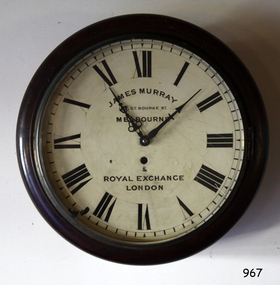
... form the ANZ Bank, which continued operating from its Liebig Street building. Warrnambool City Council purchased the former Bank of Australasia building in 1971 and renovated it, then on 3rd December 1973 it was officially opened as the Art Gallery by Cr. Harold Stephenson and Gallery Director John Welsh. The Gallery transferred to the purpose-built building in Liebig Street in 1986 and the old bank building is now the Gallery club. Staff at the Bank of Australasia in Warrnambool included the following men but others were also involved: Samuel Hannaford, Teller then Manager from 1855-1856; W...form the ANZ Bank, which continued operating from its Liebig Street building. Warrnambool City Council purchased the former Bank of Australasia building in 1971 and renovated it, then on 3rd December 1973 it was officially opened as the Art Gallery by Cr. Harold Stephenson and Gallery Director John Welsh. The Gallery transferred to the purpose-built building in Liebig Street in 1986 and the old bank building is now the Gallery club. Staff at the Bank of Australasia in Warrnambool included the following men but others were also involved: Samuel Hannaford, Teller then Manager from 1855-1856; W ...This wall clock originated from the Bank of Australasia. The label on the base matches other items from the same donor. It was spring powered by winding the key mechanism with the clock's key through the hole in the clock face. The hinged door on the base of the clock's case allows access to the clock's working mechanism. James Murray (son of James Murray 1780-1847) was a maker of clocks and chronometers. He worked at No. 1, Royal Exchange, London and from 1861 at 107 Great Bourke Street, Melbourne. In 1854 William Kerr ordered a clock from James Murray and erected it on the Albert Street frontage of the National Model & Training School in Spring Street Melbourne. It was Melbourne's first turret clock and remained there for 80 years before it was transferred to the Public Library in Melbourne in 1934 (now Museum Victoria). The Bank of Australasia was incorporated by Royal Charter of England in March 1834. It had its Australian beginning on 14th December 1835, opening in Sydney. The Acting Superintendent of the bank at that time was David Charters McArthur. He was Superintendent from 1867-to 1876. The Melbourne branch opened on 28th August 1838 in a two-roomed brick cottage on the north side of Little Collins Street, where two huge mastiff dogs were used at night to guard the bank. The government also provided an armed military sentinel. Due to the bank's rapid growth, a new building for the Melbourne branch was opened in 1840 at 75 Collins Street West. By 1879 the bank had been upgraded to a magnificent two-storey building on the corners of Collins and Queens Streets, with the entry on Collins Street. In 1951 the Bank of Australasia amalgamated with the Union Bank to form the Australia and New Zealand Bank, now known as the ANZ. Then in 1970, the ANZ merged with both the ES&A and the London Bank of Australia to form the ANZ Banking Group Limited. The ANZ Banking Group Ltd kindly donated a variety of historic items from the Bank of Australasia. BANK of AUSTRALASIA, WARRNAMBOOL – In 1854 Warrnambool had two banks, the Union Bank and the Bank of Australasia. Later, completely different bank businesses opened; in 1867 the National Bank of Australasia, then in 1875 the Colonial Bank of Australasia. The original Warrnambool branch of the Bank of Australasia was established in July 1854, and operated from a leased cottage on Merri Street, close to Liebig Street. The bank next bought a stone building previously erected by drapers Cramond & Dickson on the corner of Timor and Gibson Streets. Samuel Hannaford was a teller and then Manager at the Warrnambool branch from 1855 to 1856 and the Warrnambool Council chose that bank for its dealings during 1856-57. In 1859 Roberts & Co. was awarded the contract to build the new Bank of Australasia branch for the sum of £3,000. The land was on a sand hill on the northeast corner of Timor and Kepler Streets and had been bought in 1855 from investor James Cust. The new building opened on May 21, 1860. The bank continued to operate there until 1951 when it merged with the Union Bank to form the ANZ Bank, which continued operating from its Liebig Street building. Warrnambool City Council purchased the former Bank of Australasia building in 1971 and renovated it, then on 3rd December 1973 it was officially opened as the Art Gallery by Cr. Harold Stephenson and Gallery Director John Welsh. The Gallery transferred to the purpose-built building in Liebig Street in 1986 and the old bank building is now the Gallery club. Staff at the Bank of Australasia in Warrnambool included the following men but others were also involved: Samuel Hannaford, Teller then Manager from 1855-1856; W H Palmer, Manager from January 1857 until November 1869 when the Teller Basil Spence was promoted to Manager; H B Chomley, Manager from April 1873 and still there in 1886; A Butt, Manager in 1895-1904; J R McCleary Accountant and Acting Manager for 12 months, until 1900; A Kirk, Manager 1904; J Moore, staff until his transfer to Bendigo in December 1908; J S Bath was Manager until 1915; C C Cox, Manager until April 1923; Richard C Stanley, Manager 1923 to April 1928. The clock has significance through its association with the Bank of Australasia. The early Australian bank was established in 1834 by Royal Charter and opened in Sydney, Australia, in Sydney in 1835. The bank had many Australian offices in November 1877, particularly on the east and south coasts. Victoria had 45 percent of all Offices. The clock is significant for its connection with the quality clockmaker James Murray, originally from Royal Exchange London with a branch that opened in Melbourne in 1861. James Murray is renown for making the first turret clock to be installed in Melbourne. The clock is locally significant for its association with the Warrnambool Bank of Australasia, which was established in 1854. It was Warrnambool Council’s first bank. The bank continued to operate until the organisation's merger in 1951 when it became the ANZ Bank Group today. The Bank was an integral part of the growth of local commerce and the community.Wall clock with a round face behind glass in a wooden case. The painted brass face has Roman numerals, two decorative hands, divisions for minutes and a keyhole. The curved base of the case has a hinged access door with a keyhole and adhesive label. The back of the clock's case has metal mounting brackets. Inscriptions on the rectangular white label. Made by James Murray, Melbourne.Face: "JAMES MURRAY / - GT. BOURKE ST. / MELBOURNE / & / ROYAL EXCHANGE / LONEON" Label: "A M / 40"flagstaff hill, warrnambool, shipwrecked coast, flagstaff hill maritime museum, maritime museum, shipwreck coast, flagstaff hill maritime village, great ocean road, bank of australasia, boa, union bank, australia & new zealand bank, anz bank, james murray, clock, wall clock, great bourke street melbourne, royal exchange london, william kerr, turret clock, old model school, national model & training school, access door, winding key -
 Flagstaff Hill Maritime Museum and Village
Plaque - Insignia, Bank of Australasia, 19th Century
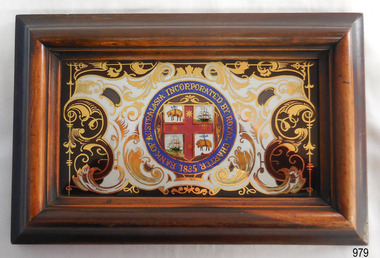
... form the ANZ Bank, which continued operating from its Liebig Street building. Warrnambool City Council purchased the former Bank of Australasia building in 1971 and renovated it, then on 3rd December 1973 it was officially opened as the Art Gallery by Cr. Harold Stephenson and Gallery Director John Welsh. The Gallery transferred to the purpose-built building in Liebig Street in 1986 and the old bank building is now the Gallery club. Staff at the Bank of Australasia in Warrnambool included the following men but others were also involved: Samuel Hannaford, Teller then Manager from 1855-1856; W...form the ANZ Bank, which continued operating from its Liebig Street building. Warrnambool City Council purchased the former Bank of Australasia building in 1971 and renovated it, then on 3rd December 1973 it was officially opened as the Art Gallery by Cr. Harold Stephenson and Gallery Director John Welsh. The Gallery transferred to the purpose-built building in Liebig Street in 1986 and the old bank building is now the Gallery club. Staff at the Bank of Australasia in Warrnambool included the following men but others were also involved: Samuel Hannaford, Teller then Manager from 1855-1856; W ...This decorative plaque displays the insignia of the Bank of Australasia, which was incorporated by the Royal Charter of England in March 1834. The bank began in Australia on 14th December 1835, opening in Sydney. The Acting Superintendent of the bank at that time was David Charters McArthur. He was Superintendent from 1867-to 1876. The Melbourne branch opened on 28th August 1838 in a two-roomed brick cottage on the north side of Little Collins Street, where two huge mastiff dogs were used at night to guard the bank. The government also provided an armed military sentinel. Due to the bank's rapid growth, a new building for the Melbourne branch was opened in 1840 at 75 Collins Street West. By 1879 the bank had been upgraded to a magnificent two-storey building on the corners of Collins and Queens Streets, with the entry on Collins Street. In 1951 the Bank of Australasia amalgamated with the Union Bank to form the Australia and New Zealand Bank, now known as the ANZ. Then in 1970, the ANZ merged with both the ES&A and the London Bank of Australia to form the ANZ Banking Group Limited. The ANZ Banking Group Ltd kindly donated a variety of historic items from the Bank of Australasia. BANK of AUSTRALASIA, WARRNAMBOOL – In 1854 Warrnambool had two banks, the Union Bank and the Bank of Australasia. Later, completely different bank businesses opened; in 1867 the National Bank of Australasia, then in 1875 the Colonial Bank of Australasia. The original Warrnambool branch of the Bank of Australasia was established in July 1854, and operated from a leased cottage on Merri Street, close to Liebig Street. The bank later bought a stone building previously erected by drapers Cramond & Dickson on the corner of Timor and Gibson Streets. Samuel Hannaford was a teller and then Manager at the Warrnambool branch from 1855 to 1856 and the Warrnambool Council chose that bank for its dealings during 1856-57. In 1859 Roberts & Co. was awarded the contract to build the new Bank of Australasia branch for the sum of £3,000. The land was on a sand hill on the northeast corner of Timor and Kepler Streets and had been bought in 1855 from investor James Cust. The new building opened on May 21, 1860. The bank continued to operate there until 1951 when it merged with the Union Bank to form the ANZ Bank, which continued operating from its Liebig Street building. Warrnambool City Council purchased the former Bank of Australasia building in 1971 and renovated it, then on 3rd December 1973 it was officially opened as the Art Gallery by Cr. Harold Stephenson and Gallery Director John Welsh. The Gallery transferred to the purpose-built building in Liebig Street in 1986 and the old bank building is now the Gallery club. Staff at the Bank of Australasia in Warrnambool included the following men but others were also involved: Samuel Hannaford, Teller then Manager from 1855-1856; W H Palmer, Manager from January 1857 until November 1869 when the Teller Basil Spence was promoted to Manager; H B Chomley, Manager from April 1873 and still there in 1886; A Butt, Manager in 1895-1904; J R McCleary Accountant and Acting Manager for 12 months, until 1900; A Kirk, Manager 1904; J Moore, staff until his transfer to Bendigo in December 1908; J S Bath was Manager until 1915; C C Cox, Manager until April 1923; Richard C Stanley, Manager 1923 to April 1928. The plaque has historical significance as it belonged to the Bank of Australasia which was established in Australia in 1835 by Royal Charter. The plaque is significant for its association with the Bank of Australasia in Warrnambool, the first bank in Warrnambool, established in 1854. The bank continued to operate until its merger in 1951 when it became the ANZ Bank, which is still in operation today. The Bank was an integral part of the establishment and growth of commerce in Colonial Warrnambool and throughout Australia.Plaque with insignia on glass in a rectangular varnished wooden frame. Insignia of the Bank of Australasia has been painted onto the glass in a mirror-like fashion. Insignia depicts a heraldic shield with sheep hung up by their waists and ships in full sail. Inscription on insignia. Stamp and handwritten inscription on the rectangular label with a blue border on the reverse.Insignia: "BANK OF AUSTRALASIA INCORPORATED BY ROYAL CHARTER 1835" Label's red oval stamp with "AUSTRALIA AND NEW ZEALAND BANK UNITED ARCHIVES" Label's handwritten black letters "AM1" flagstaff hill, warrnambool, shipwrecked coast, flagstaff hill maritime museum, maritime museum, shipwreck coast, flagstaff hill maritime village, great ocean road, commerce, banking, plaque, insignia, bank of australasia, insignia on glass, union bank, australia & new zealand bank, anz bank, david charters mcarthur, d c mcarthur, sydney, new south wales, currency, banknote, legal tender -
 Flagstaff Hill Maritime Museum and Village
Currency - Bank exchange note, Perkins, Bacon and Perch, 14-10--1847
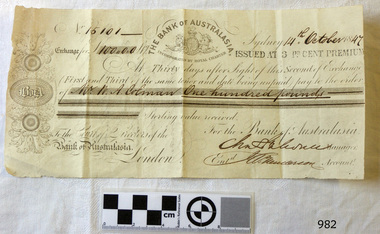
... form the ANZ Bank, which continued operating from its Liebig Street building. Warrnambool City Council purchased the former Bank of Australasia building in 1971 and renovated it, then on 3rd December 1973 it was officially opened as the Art Gallery by Cr. Harold Stephenson and Gallery Director John Welsh. The Gallery transferred to the purpose-built building in Liebig Street in 1986 and the old bank building is now the Gallery club. Staff at the Bank of Australasia in Warrnambool included the following men but others were also involved: Samuel Hannaford, Teller then Manager from 1855-1856; W...form the ANZ Bank, which continued operating from its Liebig Street building. Warrnambool City Council purchased the former Bank of Australasia building in 1971 and renovated it, then on 3rd December 1973 it was officially opened as the Art Gallery by Cr. Harold Stephenson and Gallery Director John Welsh. The Gallery transferred to the purpose-built building in Liebig Street in 1986 and the old bank building is now the Gallery club. Staff at the Bank of Australasia in Warrnambool included the following men but others were also involved: Samuel Hannaford, Teller then Manager from 1855-1856; W ...This exchange note was issued by the Bank of Australasia to Mr N A Coleman for one hundred pounds paid n 14th October 1847 at the Sydney branch. The interest rate was three per cent. This exchange note displays the insignia of the Bank of Australasia, which was incorporated by Royal Charter of England in March 1834. The bank began in Australia on 14th December 1835, opening in Sydney. The Acting Superintendent of the bank at that time was David Charters McArthur. He was Superintendent from 1867-to 1876. The Melbourne branch opened on 28th August 1838 in a two-roomed brick cottage on the north side of Little Collins Street, where two huge mastiff dogs were used at night to guard the bank. The government also provided an armed military sentinel. Due to the bank's rapid growth, a new building for the Melbourne branch was opened in 1840 at 75 Collins Street West. By 1879 the bank had been upgraded to a magnificent two-storey building on the corners of Collins and Queens Streets, with the entry on Collins Street. In 1951 the Bank of Australasia amalgamated with the Union Bank to form the Australia and New Zealand Bank, now known as the ANZ. Then in 1970, the ANZ merged with both the ES&A and the London Bank of Australia to form the ANZ Banking Group Limited. The ANZ Banking Group Ltd kindly donated a variety of historic items from the Bank of Australasia. BANK of AUSTRALASIA, WARRNAMBOOL – In 1854 Warrnambool had two banks, the Union Bank and the Bank of Australasia. Later, completely different bank businesses opened; in 1867 the National Bank of Australasia, then in 1875 the Colonial Bank of Australasia. The original Warrnambool branch of the Bank of Australasia was established in July 1854, and operated from a leased cottage on Merri Street, close to Liebig Street. The bank next bought a stone building previously erected by drapers Cramond & Dickson on the corner of Timor and Gibson Streets. Samuel Hannaford was a teller and then Manager at the Warrnambool branch from 1855 to 1856 and the Warrnambool Council chose that bank for its dealings during 1856-57. In 1859 Roberts & Co. was awarded the contract to build the new Bank of Australasia branch for the sum of £3,000. The land was on a sand hill on the northeast corner of Timor and Kepler Streets and had been bought in 1855 from investor James Cust. The new building opened on May 21, 1860. The bank continued to operate there until 1951 when it merged with the Union Bank to form the ANZ Bank, which continued operating from its Liebig Street building. Warrnambool City Council purchased the former Bank of Australasia building in 1971 and renovated it, then on 3rd December 1973 it was officially opened as the Art Gallery by Cr. Harold Stephenson and Gallery Director John Welsh. The Gallery transferred to the purpose-built building in Liebig Street in 1986 and the old bank building is now the Gallery club. Staff at the Bank of Australasia in Warrnambool included the following men but others were also involved: Samuel Hannaford, Teller then Manager from 1855-1856; W H Palmer, Manager from January 1857 until November 1869 when the Teller Basil Spence was promoted to Manager; H B Chomley, Manager from April 1873 and still there in 1886; A Butt, Manager in 1895-1904; J R McCleary Accountant and Acting Manager for 12 months, until 1900; A Kirk, Manager 1904; J Moore, staff until his transfer to Bendigo in December 1908; J S Bath was Manager until 1915; C C Cox, Manager until April 1923; Richard C Stanley, Manager 1923 to April 1928. The bank exchange note has significance through its association with the Bank of Australasia. The early Australian bank was established in 1834 by Royal Charter and opened in Sydney, Australia, in Sydney in 1835. The bank had many Australian offices in November 1877, particularly on the east and south coasts. Victoria had 45 percent of all Offices. The object is locally significant for its association with the Warrnambool Bank of Australasia, which was established in 1854. It was Warrnambool Council’s first bank. The bank continued to operate until the organisation's merger in 1951 when it became the ANZ Bank Group today. The Bank was an integral part of the growth of local commerce and the community.Bank exchange note for the Bank of Australasia, Sydney, manufactured by Perkins, Bacon and Perch, printed in brown. Insignia depicts a heraldic shield with a lion and unicorn on either side and another insignia with "B of A". Exchange note paid on 14th October 1847. Issued for one hundred pounds and paid to Mr N A Coleman.. Inscriptions include the document number, the date, the amount paid, the receiving person, signatures and a stamp with the interest rate.Handwritten number "15101" "One hundred pounds" "14th October [18] 47" "Mr N A Coleman" Black stamp "ISSUED AT 3 PR CENT PREMIUM" Signatures of [Manager] and [Accountant].flagstaff hill, warrnambool, shipwrecked-coast, flagstaff-hill, flagstaff-hill-maritime-museum, maritime-museum, shipwreck-coast, flagstaff-hill-maritime-village, banknote, currency, exchange note, commerce, banking, finances, bank of australasia, n a coleman, 1847, shipwrecked coast, flagstaff hill maritime museum, maritime museum, shipwreck coast, flagstaff hill maritime village, great ocean road, boa, union bank, australia & new zealand bank, anz bank, david charters mcarthur, d c mcarthur, sydney, new south wales, legal tender -
 Flagstaff Hill Maritime Museum and Village
Currency - Bank cheque, Sands & McDougall Limited, 03-12-1885
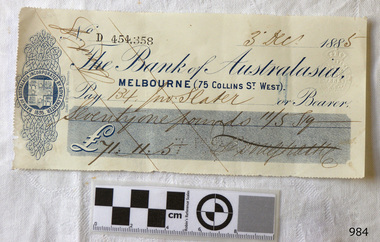
... form the ANZ Bank, which continued operating from its Liebig Street building. Warrnambool City Council purchased the former Bank of Australasia building in 1971 and renovated it, then on 3rd December 1973 it was officially opened as the Art Gallery by Cr. Harold Stephenson and Gallery Director John Welsh. The Gallery transferred to the purpose-built building in Liebig Street in 1986 and the old bank building is now the Gallery club. Staff at the Bank of Australasia in Warrnambool included the following men but others were also involved: Samuel Hannaford, Teller then Manager from 1855-1856; W...form the ANZ Bank, which continued operating from its Liebig Street building. Warrnambool City Council purchased the former Bank of Australasia building in 1971 and renovated it, then on 3rd December 1973 it was officially opened as the Art Gallery by Cr. Harold Stephenson and Gallery Director John Welsh. The Gallery transferred to the purpose-built building in Liebig Street in 1986 and the old bank building is now the Gallery club. Staff at the Bank of Australasia in Warrnambool included the following men but others were also involved: Samuel Hannaford, Teller then Manager from 1855-1856; W ...This bank cheque originated from the Bank of Australasia, Melbourne branch. It was issued on 3rd December 1885 to a person surnamed Slater for £71.11.5 (seventy-one pounds, eleven shillings and five pence). The parallel lines are called Cheque Crossed and mean that only Slater and no one else could receive the payment and that it would have been paid into Slater's bank account, not exchanged for cash. The embossed dots signify that the cheque amount was also paid to be the bearer of the cheque. Slater would have visited the bank to deposit the money into his or her own account. The cheque was printed by Sands & McDougall, a long-standing Melbourne printing and stationery company. It was then Stamped at the bank with its own unique number before it was issued to the customer. From its previously perforated edges, it is presumed that the cheque was part of a page of cheques, likely to be contained within a book of similar cheques ready for use. The Bank of Australia was incorporated by Royal Charter of England in March 1834. It had its Australian beginnings on 14th December 1835, opening in Sydney. The Acting Superintendent of the bank at that time was David Charters McArthur. He was Superintendent from 1867-to 1876. The Melbourne branch opened on 28th August 1838 in a two-roomed brick cottage on the north side of Little Collins Street, where two huge mastiff dogs were used at night to guard the bank. The government also provided an armed military sentinel. Due to the bank's rapid growth, a new building for the Melbourne branch was opened in 1840 at 75 Collins Street West. By 1879 the bank had been upgraded to a magnificent two-storey building on the corners of Collins and Queens Streets, with the entry on Collins Street. In 1951 the Bank of Australasia amalgamated with the Union Bank to form the Australia and New Zealand Bank, now known as the ANZ. Then in 1970, the ANZ merged with both the ES&A and the London Bank of Australia to form the ANZ Banking Group Limited. The ANZ Banking Group Ltd kindly donated a variety of historic items from the Bank of Australasia. BANK of AUSTRALASIA, WARRNAMBOOL – In 1854 Warrnambool had two banks, the Union Bank and the Bank of Australasia. Later, completely different bank businesses opened; in 1867 the National Bank of Australasia, then in 1875 the Colonial Bank of Australasia. The original Warrnambool branch of the Bank of Australasia was established in July 1854, and operated from a leased cottage on Merri Street, close to Liebig Street. The bank next bought a stone building previously erected by drapers Cramond & Dickson on the corner of Timor and Gibson Streets. Samuel Hannaford was a teller and then Manager at the Warrnambool branch from 1855 to 1856 and the Warrnambool Council chose that bank for its dealings during 1856-57. In 1859 Roberts & Co. was awarded the contract to build the new Bank of Australasia branch for the sum of £3,000. The land was on a sand hill on the northeast corner of Timor and Kepler Streets and had been bought in 1855 from investor James Cust. The new building opened on May 21, 1860. The bank continued to operate there until 1951 when it merged with the Union Bank to form the ANZ Bank, which continued operating from its Liebig Street building. Warrnambool City Council purchased the former Bank of Australasia building in 1971 and renovated it, then on 3rd December 1973 it was officially opened as the Art Gallery by Cr. Harold Stephenson and Gallery Director John Welsh. The Gallery transferred to the purpose-built building in Liebig Street in 1986 and the old bank building is now the Gallery club. Staff at the Bank of Australasia in Warrnambool included the following men but others were also involved: Samuel Hannaford, Teller then Manager from 1855-1856; W H Palmer, Manager from January 1857 until November 1869 when the Teller Basil Spence was promoted to Manager; H B Chomley, Manager from April 1873 and still there in 1886; A Butt, Manager in 1895-1904; J R McCleary Accountant and Acting Manager for 12 months, until 1900; A Kirk, Manager 1904; J Moore, staff until his transfer to Bendigo in December 1908; J S Bath was Manager until 1915; C C Cox, Manager until April 1923; Richard C Stanley, Manager 1923 to April 1928. The bank cheque has significance through its association with the Bank of Australasia. The early Australian bank was established in 1834 by Royal Charter and opened in Sydney, Australia, in Sydney in 1835. The bank had many Australian offices in November 1877, particularly on the east and south coasts. Victoria had 45 percent of all Offices. The bank cheque is significant as an early example of financial management of money and money exchange or transfer.Bank cheque of the Bank of Australasia, Melbourne branch. The rectangular paper has three sides that have been perforated. It is printed in blue with bank's Insignia of a heraldic shield of sheep hung by their waists and ships in full sail. Embossed Stamp Duty mark. Embossed dots. Handwritten black ink details Dated 3rd Dec 1885. Printed in Melbourne by Sands & McDougall. Diagonal parallel lines are across the cheque. Printed: "Bank of Australasia, MELBOURNE (75 COLLINS ST. WEST)." "454,358" "Sands & McDougall, Melbourne" Embossed stamp: Symbol of Crown above double oval lines " - STAMP DUTY" "ONE PENNY" Embossed dots forming test "7 PAID T2" Handwritten: "3rd Dec. [188] 5" "134 - Slater" "Seventy one pounds 11/S 5p" "£71.11.5" Signature: (undecipherable) flagstaff hill, warrnambool, shipwrecked-coast, flagstaff-hill, flagstaff-hill-maritime-museum, maritime-museum, shipwreck-coast, flagstaff-hill-maritime-village, bank cheque, shipwrecked coast, flagstaff hill maritime museum, maritime museum, shipwreck coast, flagstaff hill maritime village, great ocean road, bank of australasia, boa, union bank, australia & new zealand bank, anz bank, bank note, melbourne, slater, sands & mcdougall, chrssed cheque, embossed dots, paid cheque, banknote -
 Flagstaff Hill Maritime Museum and Village
Tool - Wood Sample, Before 1878
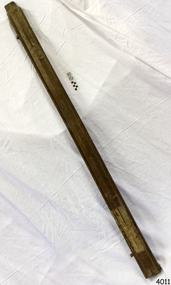
... w[r]ec[k] of the Loch Ard wrecked near Sherbroke River”. The timber is carefully worked with rich dark colouring and a uniformly moulded design, suggesting that it was part of a fitting or furnishing that was publicly visible and prominent. If the artefact is what it is declared to be, then it is possible that it formed...w[r]ec[k] of the Loch Ard wrecked near Sherbroke River”. The timber is carefully worked with rich dark colouring and a uniformly moulded design, suggesting that it was part of a fitting or furnishing that was publicly visible and prominent. If the artefact is what it is declared to be, then it is possible that it formed ...On a piece of paper subsequently glued near one end of its curved upper face, this length of planed and polished hardwood timber bears the inscription: “A [p]iece of w[r]ec[k] of the Loch Ard wrecked near Sherbroke River”. The timber is carefully worked with rich dark colouring and a uniformly moulded design, suggesting that it was part of a fitting or furnishing that was publicly visible and prominent. If the artefact is what it is declared to be, then it is possible that it formed part of the ship’s railings or companionway stairs. The LOCH ARD was a 1,693 ton, 3 masted barque, built on the Clyde in 1873. In an age of increasing competition for the emigrant passenger trade from steam-driven vessels, special attention was paid to her wooden furnishings and fittings. The Loch Line owners prided themselves on their attractive, distinctively painted, sailing ships. Below decks, where cargo and third class passengers were stowed, was made of iron. But everything above deck, and on show to the saloon and second class passengers, was carved and varnished timber. Captain Daish’s 1878 report for the ship’s underwriters notes “a quantity of general Cargo washed up in a confused mass” in the cove and “a number of Cases, Casks and Bales; also deals and boards floating about in some of the gorges” further west of the shipwreck. Contemporary newspaper accounts also reported a large quantity of cargo and timber washed ashore in the days following the LOCH ARD shipwreck, adding “but those were speedily removed by persons who came down from Port Campbell, Scott’s Creek and other places with carts and pack horses”. The appearance and good condition of this wood artefact, and the aged patina and dated hand-writing style of its pasted on inscription, support the suggestion that it was ‘souvenired’ from the floating debris of the LOCH ARD at or near the 1878 date of its foundering off Mutton Bird Island. HISTORY OF THE LOCH ARD The LOCH ARD belonged to the famous Loch Line which sailed many ships from England to Australia. Built in Glasgow by Barclay, Curdle and Co. in 1873, the LOCH ARD was a three-masted square rigged iron sailing ship. The ship measured 262ft 7" (79.87m) in length, 38ft (11.58m) in width, 23ft (7m) in depth and had a gross tonnage of 1693 tons. The LOCH ARD's main mast measured a massive 150ft (45.7m) in height. LOCH ARD made three trips to Australia and one trip to Calcutta before its final voyage. LOCH ARD left England on March 2, 1878, under the command of Captain Gibbs, a newly married, 29 year old. She was bound for Melbourne with a crew of 37, plus 17 passengers and a load of cargo. The general cargo reflected the affluence of Melbourne at the time. On board were straw hats, umbrella, perfumes, clay pipes, pianos, clocks, confectionary, linen and candles, as well as a heavier load of railway irons, cement, lead and copper. There were items included that intended for display in the Melbourne International Exhibition in 1880. The voyage to Port Phillip was long but uneventful. At 3am on June 1, 1878, Captain Gibbs was expecting to see land and the passengers were becoming excited as they prepared to view their new homeland in the early morning. But LOCH ARD was running into a fog which greatly reduced visibility. Captain Gibbs was becoming anxious as there was no sign of land or the Cape Otway lighthouse. At 4am the fog lifted. A man aloft announced that he could see breakers. The sheer cliffs of Victoria's west coast came into view, and Captain Gibbs realised that the ship was much closer to them than expected. He ordered as much sail to be set as time would permit and then attempted to steer the vessel out to sea. On coming head on into the wind, the ship lost momentum, the sails fell limp and LOCH ARD's bow swung back. Gibbs then ordered the anchors to be released in an attempt to hold its position. The anchors sank some 50 fathoms - but did not hold. By this time LOCH ARD was among the breakers and the tall cliffs of Mutton Bird Island rose behind the ship. Just half a mile from the coast, the ship's bow was suddenly pulled around by the anchor. The captain tried to tack out to sea, but the ship struck a reef at the base of Mutton Bird Island, near Port Campbell. Waves broke over the ship and the top deck was loosened from the hull. The masts and rigging came crashing down knocking passengers and crew overboard. When a lifeboat was finally launched, it crashed into the side of LOCH ARD and capsized. Tom Pearce, who had launched the boat, managed to cling to its overturned hull and shelter beneath it. He drifted out to sea and then on the flood tide came into what is now known as LOCH ARD Gorge. He swam to shore, bruised and dazed, and found a cave in which to shelter. Some of the crew stayed below deck to shelter from the falling rigging but drowned when the ship slipped off the reef into deeper water. Eva Carmichael had raced onto deck to find out what was happening only to be confronted by towering cliffs looming above the stricken ship. In all the chaos, Captain Gibbs grabbed Eva and said, "If you are saved Eva, let my dear wife know that I died like a sailor". That was the last Eva Carmichael saw of the captain. She was swept off the ship by a huge wave. Eva saw Tom Pearce on a small rocky beach and yelled to attract his attention. He dived in and swam to the exhausted woman and dragged her to shore. He took her to the cave and broke open case of brandy which had washed up on the beach. He opened a bottle to revive the unconscious woman. A few hours later Tom scaled a cliff in search of help. He followed hoof prints and came by chance upon two men from nearby Glenample Station three and a half miles away. In a state of exhaustion, he told the men of the tragedy. Tom returned to the gorge while the two men rode back to the station to get help. By the time they reached LOCH ARD Gorge, it was cold and dark. The two shipwreck survivors were taken to Glenample Station to recover. Eva stayed at the station for six weeks before returning to Ireland, this time by steamship. In Melbourne, Tom Pearce received a hero's welcome. He was presented with the first gold medal of the Royal Humane Society of Victoria and a £1000 cheque from the Victorian Government. Concerts were performed to honour the young man's bravery and to raise money for those who lost family in the LOCH ARD disaster. Of the 54 crew members and passengers on board, only two survived: the apprentice, Tom Pearce and the young woman passenger, Eva Carmichael, who lost all of her family in the tragedy. Ten days after the LOCH ARD tragedy, salvage rights to the wreck were sold at auction for £2,120. Cargo valued at £3,000 was salvaged and placed on the beach, but most washed back into the sea when another storm developed. The wreck of LOCH ARD still lies at the base of Mutton Bird Island. Much of the cargo has now been salvaged and some was washed up into what is now known as LOCH ARD Gorge. Cargo and artefacts have also been illegally salvaged over many years before protective legislation was introduced. One of the most unlikely pieces of cargo to have survived the shipwreck was a Minton porcelain peacock - one of only nine in the world. The peacock was destined for the Melbourne International Exhibition in 1880. It had been well packed, which gave it adequate protection during the violent storm. Today, the Minton peacock can be seen at the Flagstaff Hill Maritime Museum in Warrnambool. From Australia's most dramatic shipwreck it has now become Australia's most valuable shipwreck artefact and is one of very few 'objects' on the Victorian State Heritage Register. The Loch Ard wreck is of state significance – Victorian Heritage Register S417. However there is a lack of documented provenance that limits the interpretive value of this piece of timber (for example, its potential to interpret nineteenth century souveniring and scavenging from shipwrecks along the south west coast of Victoria). Flagstaff Hill’s collection of artefacts from LOCH ARD is significant for being one of the largest collections of artefacts from this shipwreck in Victoria. It is significant for its association with the shipwreck, which is on the Victorian Heritage Register (VHR S417). The collection is significant because of the relationship between the objects, as together they have a high potential to interpret the story of the LOCH ARD. The LOCH ARD collection is archaeologically significant as the remains of a large international passenger and cargo ship. The LOCH ARD collection is historically significant for representing aspects of Victoria’s shipping history and its potential to interpret sub-theme 1.5 of Victoria’s Framework of Historical Themes (living with natural processes). The collection is also historically significant for its association with the LOCH ARD, which was one of the worst and best known shipwrecks in Victoria’s history. A length of hardwood timber, planed and varnished to smooth finish on three sides, with two unfinished tongues protruding from each end (one broken off), possibly from the wreck of the LOCH ARD. The front or upper face is moulded and routed to a regular, linear (skirting board type) design along its entire length, the two sides flat planed. One side contains two inserted dowel rods that have been broken off. The bottom face has not been finished to the same standard. The sample is good quality wood that has retained its density and weight and shows no evidence of having been submerged in seawater for any length of time. Glued on to the upper face of the length of timber near the right hand end is a deteriorated square of paper bearing an inscription. The paper, peeling back and with torn edges, is stuck over an original wood stain but under a subsequent layer of varnish. The faded ink words are indecipherable where paper is missing, but written carefully in an old fashioned cursive script.The inscription on the paper reads: “A [p]iece of w[r]ec[k] of the Loch Ard wrecked near Sherbroke River”. flagstaff hill, warrnambool, shipwrecked coast, flagstaff hill maritime museum, maritime museum, shipwreck coast, flagstaff hill maritime village, great ocean road, loch line, loch ard, captain gibbs, eva carmichael, tom pearce, glenample station, mutton bird island, loch ard gorge, nineteenth-century souveniring, shipwreck scavenging, loch line sailing ships, wood sample -
 Flagstaff Hill Maritime Museum and Village
Tool - Plane, 20th century
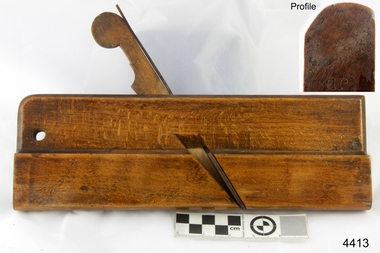
... flagstaff hill warrnambool shipwrecked-coast flagstaff-hill flagstaff-hill-maritime-museum maritime-museum shipwreck-coast flagstaff-hill-maritime-village Moulding Plane plane W Goodell JB hand tool woodworking Woodworking Tool Stamped; "W GOODALL" "JB" "JB" Moulding plane, round type, with a formed hole drilled through it. ...Moulding plane, round type, with a formed hole drilled through it. Stamped with owner's name and inscriptions. Varnish has partly obscured the name.Stamped; "W GOODALL" "JB" "JB"flagstaff hill, warrnambool, shipwrecked-coast, flagstaff-hill, flagstaff-hill-maritime-museum, maritime-museum, shipwreck-coast, flagstaff-hill-maritime-village, moulding plane, plane, w goodell, jb, hand tool, woodworking, woodworking tool -
 Flagstaff Hill Maritime Museum and Village
Tool - Moulding wood Plane, Mid to Late 19th Century
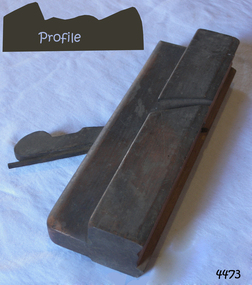
... form the New Street from Cranbourne Street to King Street. In January 1865, William died and Richard continued the business. In 1867, the partnership he had with his son Walker and Thomas Elis Hooker, is dissolved. Richard continued tool making at King Street and Bedford Street. Richard retired somewhere between 1867 and 1871, but the business continued. The business is taken over by W...form the New Street from Cranbourne Street to King Street. In January 1865, William died and Richard continued the business. In 1867, the partnership he had with his son Walker and Thomas Elis Hooker, is dissolved. Richard continued tool making at King Street and Bedford Street. Richard retired somewhere between 1867 and 1871, but the business continued. The business is taken over by W ...A moulding plane is a specialised plane used for making the complex shapes found in wooden mouldings that are used to decorate furniture or other wooden objects. Traditionally, moulding planes were blocks of wear-resistant hardwood, often beech or maple, which were worked to the shape of the intended moulding. The blade or iron was likewise formed to the intended moulding profile and secured in the body of the plane with a wooden wedge. A traditional cabinetmakers shop might have many, perhaps hundreds, of moulding planes for the full range of work to be performed. Large crown mouldings required planes of six or more inches in width, which demanded great strength to push and often had additional peg handles on the sides, allowing the craftsman's apprentice or other workers to pull the plane ahead of the master who guided it. John Moseley & Son: Records indicate that before 1834, the firm is listed at number 16 New Street, London and according to an 1862 advertisement the shop had been established in New Street since 1730, The Sun insurance records from the time show that John Moseley was the possessor of a horse mill in the yard of his premises, which means that some kind of manufacturing was taking place, as the mill would have provided power to run a saw or perhaps a grinding wheel so the probability is that he did not just sell tools, he made them as well. John Moseley died in 1828 and his will he names his four sons: John, Thomas, William and Richard. To complicate matters he also had brothers with the same first names; brothers Richard (of Piccadilly) and William (of Peckham Rye) are named as two of the executors. Brother Thomas is not mentioned in this will, but became a minister and was one of the executors of brother Richard’s estate when he died in 1856. From John’s will, we also learn that, although the shop was in New Street, he resided in Lympstone, Devon. The family must have had a house in that county for quite some time as both sons Richard and William are baptised in Devon, although John and Thomas were baptised in London. In the 1841 and 1851 census records, we just find William in New Street, but in 1861 both William and Richard are listed there as toolmakers. That Richard was staying overnight at New Street was probably just accidental as in 1851 and 1871, we find him with his wife Jane and children in Clapham and Lambeth respectively. In 1851 Richard is listed as “assistant clerk cutlery warehouse” and in 1871 as “retired plane maker and cutler”. Although the actual place of work is not stated, one may assume he worked in the family business. 1862 is a year full of changes for the firm. In that year, William had a new property built at 27 Bedford Street. In the catalogue for the 1862 International Exhibition, 54 Broad Street (later 54-55 Broad Street) is listed for the first time, which may very well coincide with the split of the business into a retail and a wholesale branch. Around the same time, they must have moved from New Street to 17 & 18 King Street because their manufacturing premises had been pulled down to form the New Street from Cranbourne Street to King Street. In January 1865, William died and Richard continued the business. In 1867, the partnership he had with his son Walker and Thomas Elis Hooker, is dissolved. Richard continued tool making at King Street and Bedford Street. Richard retired somewhere between 1867 and 1871, but the business continued. The business is taken over by W M Marples & Sons and tools continued to be made in London until 1904 when manufacturing relocated to Sheffield. A vintage tool made by a well documented company, this item was made commercially for firms and individuals that worked in wood and needed a tool that could produce a ornamental finish to timber. The tool was used before routers and spindle moulders came into use after World War ll, a time when to produce a decorative moulding for a piece of furniture, door trims etc or other items had to be accomplished using hand tools and in particular one of these types of planes. These profiled planes came in various shapes and sizes to achieve a decorative finish. A significant tool from the mid to late 19th century that today is quite rare and sought after by collectors. It gives us a snapshot of how furniture and other decorative finishes were created on timber by the use of hand tools. Tools that were themselves hand made shows the craftsmanship used during this time not only to make a tool such as the subject item but also the craftsmanship needed to produce a decorative finish that was needed to be made for any timber item. Moulding Plane . J Moseley. maker and R Knight & J Heath also stamped stamped (Owners)flagstaff hill, warrnambool, shipwrecked-coast, flagstaff-hill, flagstaff-hill-maritime-museum, maritime-museum, shipwreck-coast, flagstaff-hill-maritime-village, plane moulding, moulding plane, plane, j heath, moseley -
 Federation University Historical Collection
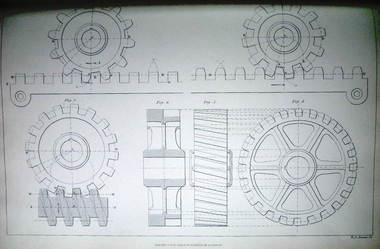
Book, The Engineer and Machinist's Drawing-Book: a complete course of instruction for the practical engineer, Possibly c1887
... forms of gearing projections of shadows spur gearing Bookplate inside front cover titled "The School of Mines (A.D. 1870), Ballarat. No. 1021, Date March 3rd 1890". Under SMB bookplate 'J.F Murphy Nicholson St. North Fitzroy 1887. A large brown cloth hardcover book with black leather spine and corners. Title is engraved in gold on spine. Illustrated by numerous engravings on wood and steel, including select details, and complete machines. Illustrations in b/w ...A large brown cloth hardcover book with black leather spine and corners. Title is engraved in gold on spine. Illustrated by numerous engravings on wood and steel, including select details, and complete machines. Illustrations in b/w. It includes a list of b/w plates, a table of contents, 116 p. of text and 112 p. of plates. This workwork provids instruction on drawing and illustrating heavy machinery including steam engines. It also contains lessons in drawings and examples of approved construction. non-fictionengineer drawings, drawing instruments, the sector, the lines of numbers, drawing of elementary forms, m le blanc, mm armengaud, linear drawing, projection, eccentric curves, machinery sketching, forms of gearing, projections of shadows, spur gearing -
 Federation University Historical Collection
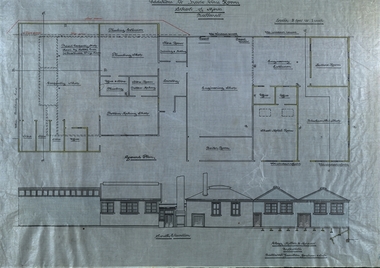
Plan - Plans, Ballarat School of Mines Plans for the Additions to Trades Class Rooms
... formed a partnership with Gilbert who ran the Ballarat Office and later with Kell and Miller. This eventually became Clegg and Miller, then Clegg Miller and Morrow, and finally Clegg and Morrow (1916). From about 1907 up until his resignation in 1918 Clegg taught Architecture and Building Construction at the Ballarat School of Mines. From 1918 he pursues interests in the Eureka Terracotta and Tile Company. ballarat school of mines george clegg george william clegg george w ...Born in Ballarat, George William Clegg F.R.V.I.A. was articled to Tappin, Gilbert and Dennehy who had architectural offices in Melbourne, Sydney and Ballarat, from 1885-1889. Clegg formed a partnership with Gilbert who ran the Ballarat Office and later with Kell and Miller. This eventually became Clegg and Miller, then Clegg Miller and Morrow, and finally Clegg and Morrow (1916). From about 1907 up until his resignation in 1918 Clegg taught Architecture and Building Construction at the Ballarat School of Mines. From 1918 he pursues interests in the Eureka Terracotta and Tile Company.Two plans on linen, relating to additions in the trade classrooms at the Ballarat School of Mines.ballarat school of mines, george clegg, george william clegg, george w. clegg, clegg, miller and morrow, trades, architecture, buildings -
 Federation University Historical Collection
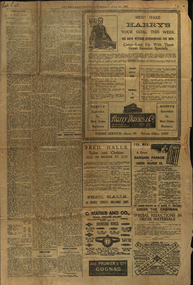
Newspaper, Lal Lal Iron and Coal as reported in the Ballarat Courier, 10/07/1923
... W. Fley Chemist; Bickart and Dawson; Rivers; Allchin Bros; J. Bartam & Son .2) Ballarat Courier, 30 July 1937, page 1 and 2 Page 1 reports Lal Lal's Iron Ore Company being formed. ...W. Fley Chemist; Bickart and Dawson; Rivers; Allchin Bros; J. Bartam & Son .2) Ballarat Courier, 30 July 1937, page 1 and 2 Page 1 reports Lal Lal's Iron Ore Company being formed. ....1) Pages 7 to 10 of the Ballarat Courier, 10 July 1923. Page 7 includes the article 'Cheap electricity' and poses questions such as 'should Ballarat look to Morwell for cheap power?', and should an independent power plant be installed at Crockers, Arnolds, Harry Hall, Ewins, Harry Davies, Fred Halls, The London Drapery there. Page 9 includes articles on Ripon's roads, Mount Cole Springs; Soldier Settlement Rates Beaufort; Creswick brass band Officers; Daylesford Road Deviation to Hepburn Springs; Dereel Public Telephone; State Electricity Supply for Beaufort; Newlyn Valedictory to Mr and Mrs W. E. Bennett Page 9 - Racing at Ascot; Avoca Golf Tournament, Chinese Herbalists Page 10 - Auctions and house sales Advertisements include Harry Davies; Fred Halls; C. Marks and Co., London Drapery, Creer the Cashman; Chamberlain's Cough Remedy; Cornell's Little Liver Pills; Paynes; W. Fley Chemist; Bickart and Dawson; Rivers; Allchin Bros; J. Bartam & Son .2) Ballarat Courier, 30 July 1937, page 1 and 2 Page 1 reports Lal Lal's Iron Ore Company being formed. Page 2 reports the Prospectus of the lal lal Iron and Steel Blast Furnaces Mining Company, No Liability; Mining News - Wattle Gully; Commercial News Advertisements include Crockers, Arnolds, Harry Hall, Ewins, Harry Davies, Fred Halls, The London Drapery electricity, lal lal, lal lal iron, lal lal coalfield, morwell, gippsland, crockers, arnolds, harry hall, ewins, harry davies, fred halls, the london drapery, lal lal brown coal, ripon's roads, mount cole springs, soldier settlement rates beaufort, creswick brass band officers, daylesford road deviation to hepburn springs, dereel public telephone, state electricity supply for beaufort, newlyn, w.e. bennett, ascot, avoca golf tournament, chinese herbalists, c. marks and co., london drapery, creer the cashman, chamberlain's cough remedy, cornell's little liver pills, paynes, w. fley chemist, bickart and dawson, rivers, allchin bros, j. bartam & son, lal lal iron and steel blast furnaces mining company, wattle gully -
 Federation University Historical Collection
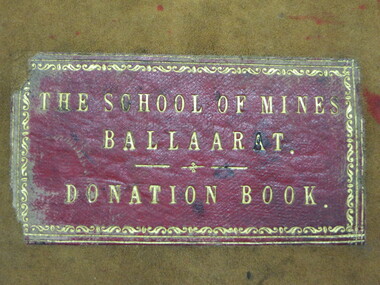
Book - Ledger, Ballarat School of Mines Donation Book, 1878 - 1895, 1878-1895
... form Silverton (Collected by Mrs James Murray)
1442. Henry Sutton, Ballarat - Specimens of fossil fruits collected at Haddon by Charles Brown.
1444. Mining Department - Underground Mine Workings from Band of Hope and others.
1517. W.H. Wooster, Ballarat
1592. Bishop of Ballarat - Stone Axe and other native items
1669. H. McHaffier, Napoleons - 1 Spanish silver coin
1681. James Oddie, Dunedin
1688. W...form Silverton (Collected by Mrs James Murray)
1442. Henry Sutton, Ballarat - Specimens of fossil fruits collected at Haddon by Charles Brown.
1444. Mining Department - Underground Mine Workings from Band of Hope and others.
1517. W.H. Wooster, Ballarat
1592. Bishop of Ballarat - Stone Axe and other native items
1669. H. McHaffier, Napoleons - 1 Spanish silver coin
1681. James Oddie, Dunedin
1688. W ...The Donation Book relates to the Ballarat School of Mines Museum which opened in 1872. Very few of these items are still held by Federation University. The Museum was emptied in the 1960s with items being distrubuted to the Ballarat Historical Society, returned to original lenders (ie Pern Collection), of disposed of. Donations to the Ballarat School of Mines include: 34. M. Hamburger, Ballarat - bunsen burner 41. W.H. Shaw, Phoenix Foundry - 81 nos of 'Engineer' 89. Juvenile Industrial Exhibition Association Committee per Joseph Flude - dies used for striking medals awarded to successful exhibits. 165. Ferdinand Von Mueller 172 Ferdinand Von Mueller o hortus siccus 6 197. James Stoddart 203. Edward Gazzard, North Creswick - Model of safety Cage invented and made by donor 218. E. Morey 222. Alfred Lestor 228. J.J. Sleep, Ballarat, patent Lever escarpment Clock (displayed in laboratories) 237. Bernard Smith (Warden) per favor of James M. Bickett - Bust of Mr John Lynch, Smythesdale. (Note: This item is not in the present Federation University Historical Collection) 241. James Oddie, J.P., Ballarat, Copy of 'the Chemist and Druggist' 267. John Lynch Junior, Smythesdale - Cast of "Golden Age" nugget, found at Browns by Co-operative party, 12 men. Weight 75 oz, 12 dwts, 12 grs.(Note: This item is not in the present Federation University Historical Collection) 270. Isaac Davis, Main Road, Ballarat 294. W. H. Shaw, Ballarat - 94 nos of 'The Engineer' 295. Rivett Henry Bland, Clunes - Specimen of water pipe from the Port Phillip Company's mine encrusted with carbonites of lime and magnesium (Note: This item is not in the present Federation University Historical Collection) 299. D.J. Williams, Queenscliff - 1 case shells from Fiji 305. C. Retallack, Ballarat 314. William Henry Shaw, Ballarat - glass case 323. W. Longley, Ballarat - Botanical Specimen (Note: This item is not in the present Federation University Historical Collection) 327. W. H. Angove, Perth 337. J. Cosmo Newbery, B Sc, Melbourne 343. James Hector, M.D., New Zealand 353. R.S. Mitchell, Ballarat - 8 specimens live plants (medicinal) (for the Ballarat School of Mines Garden) 355. W. Magee, Ballarat - Sugar cane plants and seeds (for the Ballarat School of Mines Garden) 363. James Hector, Wellington, new Zealand 371. William Wesley, 28 Essex St, Strand, London - Scientific book circular 380. Jacob Upfold (deceased) per favor of the trustees - bequest of steam engine indicator and belongings (boothe and case) 381. Joseph Mitchell, 22 Macarthur Street, Ballarat - sod of turf cut from Warboy's High Few, County Huntingdon, England, 1872. 394. W.H. Barnard 401. James Orr 418. F. Ratte, Sydney 440. Alfred Mica Smith, Sandhurst (Bendigo), Inaugural Address, delivered to the Bendigo School of Mines Science Society, June 20. 1881 by P.H. Macgillivray, MA, MRCS, FLS, President. (Note: This item is not in the present Federation University Historical Collection) (Note: This item is not in the present Federation University Historical Collection) 446. C. C. Shoppee, Ballarat 462. Dr Bunce, Ballarat 468. James Black, Mining Manager "Kerrit Bureet' 479. J.S. North, Mining Manager No. 2 Queen Co, Black Hill Ballarat. 505. Smith Tibbitts - A block of ancient leaves from the Nigtingbool Estate near Haddon on the Ballarat district from shaft 80 feet deep. (Note: This item is not in the present Federation University Historical Collection) 512. F.W. Niven, Ballarat - "A Handy Book to Tasmania" 522. James Hector, Wellington, New Zealand 549. C.E. Grainger, Manager Ballarat Woollen Mills - samples of dyed and raw wools 600. (4 July 1882) Henry Sutton, Ballarat - 13th annual report of the Aeronautical Society of Great Britain; 2 papers from the Proceedings of the Royal Society, nos 217 and 218- 1882, "One a new electrical storage battery by Henry Sutton, Ballarat, Victoria. 608. H. Glenny J.P., Ballarat - Specimen of Asbestos from Tasmania 610. M.H. Edelmann, Munich, Germany 674. W.H. Shaw, Phoenix Foundry - Steel boring 95 feet long taken from bed-plate of locomotive engine. 675 - H.R. Hancock J.P. pre favour Mr James Pryor, Moonta Mines 676. Baron Ferdinand Von Mueller KCMG, etc, Melbourne 678. E.F.A. Gaunt, Royal Navy, H.M.S. Nelson, per favour Lyde Gaunt - Specimen of manganese ore from the mines - Russell - New Zealand 728. Dr Pinnock, Ballarat 760. Simon Morrison, Ballarat 784. James Shugg, Hamilton - 1 case fossils from Muddy Creek, near Hamilton. (Note: This item is not in the present Federation University Historical Collection) 786. W. Bolam (inspector of Schools), Melbourne - 2 spears and 1 fishing prong Fijian 806. James Oddie, Ballarat 708. Henry G. Hanks, San Francisco 786. W. Bolam (Inspector of Government Schools Melbourne) - 2 spears and one fishing prong Fijian 824. Henrique Gorceixm Onro Preto, Brazil 840. W. Laplau, Ballarat - Gas furnace with a large assortment of fittings, also large gas holder and oil-heating apparatus 854. Robert Borch, Main Road, Ballarat - Improved safety chain (Note: This item is not in the present Federation University Historical Collection) 928. James Oddie 944. James P. Munroe, Registrar, Massachusetts 952. L.E. Cutter per favour of Mr F.J. Martell - Unexploded bomb shell from the Eureka Stockade 957. H. Glenny, Hobart 962. George Hart, Ballarat - eagle 976. Henry Sutton, Ballarat - 1 volume "Plattner on the Blowpipe" 978. J.W. Flatow, 45 Madeline Street, Carlton, Melbourne 984. Charles C Shoppee Ballarat - Copies of ancient coins 989-95 - Specimens from Moonta, South Australia 985. W.H. Wooster BOlwarra - books microscope related 1179. James Oddie - Live hedgehog 1181 C. Crisp, Bacchus Marsh, Portugal Copper Coin, 1785 1248 James Oddie, Solomon Islands - Bow and arrows & Spears 1285. C. Colyer, Smythesdale 1327. John L. McKenna, Smeaton - Fragment of Stone Axe. 1395. Mrs O. Skoglund, Nerrina 1428. Daniel Brophy, Ballarat - Collection of mineral specimen form Silverton (Collected by Mrs James Murray) 1442. Henry Sutton, Ballarat - Specimens of fossil fruits collected at Haddon by Charles Brown. 1444. Mining Department - Underground Mine Workings from Band of Hope and others. 1517. W.H. Wooster, Ballarat 1592. Bishop of Ballarat - Stone Axe and other native items 1669. H. McHaffier, Napoleons - 1 Spanish silver coin 1681. James Oddie, Dunedin 1688. W. Burbridge, Ballarat - Native Tomahawk from Metung 1708. A. Doepel, Ballarat 1712. Marty Guerin, Ballarat 1735. Bella Guerin. M.A., Ballarat - Copy Wide Awake Vol 1 No 7 May 28th 1887 and The Bulletin, March 19th 1887. 1747. Bella Geurin M.A., Ballarat - Copy Wide Awake Vol 1 No 8 June 4 1887 1751. Bella Geurin M.A., Ballarat - Copy Wide Awake Vol 1 No 9 June 11th 1887 1842. Linnean Society, London England - Charter, By Laws, Proceedings, Transactions, Journals 1853. W.J. Corbould, Silverton, NSW - chloride of silver from Pinnacles, Broken Hill, Silverton 1888. W. J. Corbould, Sample of metallic silver from Silverton, NSW 1928. E. Morey, Ballarat - Steam Engine 1937. Henry Sutton A.S.I.E., Ballarat - Plate Electric Machine, chimes and Sportman (number crossed out) 1951. Henry Sutton A.S.I.E., Ballarat - Plate Electric Machine, chimes and Sportman 1981. Harrie Wood (per W.H.B.[Barnard?), Ballarat 1996. W.H. Shaw, Phoenix Foundry - Papers "The Vict Engineer July 1887, May June July August 1888 and others 2014. Harrie Wood, Sydney - Report Department of Mines, 18872027. W.J. Bechervaise - Copy of Book by Baldwin Spencer 2034. A.G. Randall - Native Hatchet 2045. W.H. Corbould, Silverton, Collection of silver ores 2051. Fowler, Tarnagulla - Native Tomahawk 2123-2131. James Oddie, London 2163. Roff. F. Taplier, Sturt Street - Native Tomahawk 2178. Syd. Johnson, Meredith - Native Tomahawk, Greenstone 2184. Mr Tupp for Hall - Native Spear and Club 2292. Emmanuel Steinfeld, Melbourne 2313. A. Atwood, Rowlands Factory, Dana Street 2361. Dr Pinnock, Ballarat - Collection of Living Sponges 2363. P. Curnow, Ballarat - Piece of wood with stone naturally embedded 2364. R. Dowling, Waubra 2875. Mrs C, Flude, Ballarat - Collection of (5) mineral specimens 3460. Joseph Weir, Ballarat - Sample of rolled Annibar 3466. J. Hart, Ballarat - Native Shield - supposed to have been made by King Billy 4784. Mr. O. Woolnaugh, Pleasant Street - Four Native Tomahawks 6469. L. Balhausen, Ballarat 3472. John English, Smeaton - three samples of auriferous wash dirt 3607. Columbia College, New York - Handbook of Information of the Columbia College in the Ciry of New York 1892-3. 3672. L.A. Samuels, Bendigo 3724. P. Paperhagen 3736. The Late Rivett Henry Bland per John Noble Wilson - Collection of mineral specimens and fossils 3752. G.A. Denny, South Africa 3755. J. Carroll, Ballarat - Specimen of Native bread found in Ballarat East. 4765. J. Donnelly, Springs, Bungaree I. Fowler, Coolgardie, Specimen of Gold Bearing Quartz ballarat school of mines, doantions, museum, ballarat school of mines museum, safety cage, botanical garden, materia medica garden, library, bella guerin, james oddie, phoenix foundry, w.h. shaw, john lynch, henry sutton, aboriginal, stone axe, tomahawk, geological specimens, moonta, fedinand krause, oddie collection of minerals, thomas bath, spears, solomon islands, king billy, bows and arrows, ancient coins, birds eggs, snakes
