
Showing 5 items matching "w. clarke trophy"
-
 Flagstaff Hill Maritime Museum and Village
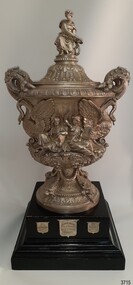
Award - Trophy, c. 1886
... ...W. Clarke Trophy...The first winner of the Sir W. Clarke's Trophy was the Geelong Garrison Battery, with the prize Sir W. ...This is the Sir W. Clarke's Trophy for the Victorian Militia Garrison Artillery, first presented in 1886. ...Front centre large shield; “VICTORIAN MILITIA / GARRISON ARTILLERY / SIR W. CLARKE’S / TROPHY” Left side, right shield; “1886 / WON BY / GEELONG / GARRISON BATTERY / Major J PRICE / COMMANDING OFFICER” Front, right shield; ” 1887 / WON BY / WARRNAMBOOL / GARRISON ARTILLERY / Major W.S. ...Clarke W. Clarke Trophy Sir W. Clarke Trophy Front centre large shield; “VICTORIAN MILITIA / GARRISON ARTILLERY / SIR W. ...This silver trophy is named "Sir W. Clarke's Trophy" after its donor. Sir William John Clarke, Baronet, who was a citizen and philanthropist, well known in Melbourne and throughout Victoria. He gave donations to many public projects, including Melbourne University and was a patron of many and varied sports. He encouraged the defence services with prizes for competitions among both military and naval forces. In colonial Australia in the 1880s, there was an increase in the size of the colonial military forces, rising from 8,000 in 1883 to 22, 000 in 1885. In 1885, there was a return of unpaid volunteer soldiers, along with a fear of a Russian attack on Australia. As a result, the Sir W.J. Clarke's Trophy was given as a prize in 1885 to Victorian Militia Garrison Battery competition winners, for artillery firing target accuracy. On 12th December 1885, the conclusion of the first artillery competition for Sir W. Clarke's Trophy was held at the Williamstown battery. The first winner of the Sir W. Clarke's Trophy was the Geelong Garrison Battery, with the prize Sir W. Clark's Trophy presented to them in 1886. In 1887, Warrnambool Garrison Artillery, under the command of Major W.S. Helpman, was the proud winner of the 'Sir W. Clarke Trophy'. The contest was held at Point Gellibrand, with the trophy formally unveiled at the Warrnambool orderly-room on 3rd August 1887. In June 1892, the annual competition was held at the Gellibrand battery in Williamstown. The canvas targets were moored at sea and fired upon from three breech-loading guns mounted on disappearing carriages. Each team was allowed 4 shots fired from each of the 3 guns. An article in the Portland Guardian stated that "the Warrnambool team is certainly looked upon as the certain winners." The same article reported that in this particular year, the Government withdrew its previous award of 10-pound cash to the men of the winning team, described in the Portland Guardian as a petty economy of the Government. As the Warrnambool Militia Garrison Artillery had won the Trophy, for the third time, they became Absolute Possessors of the prize. On 11th August 2016, during a ceremony at Flagstaff Hill, the Australian Army handed over guardianship of two very significant historical items, the 1885 W. Clarke Trophy and the 1861 Warrnambool Ladies Silver Bugle, to Warrnambool City Council for display at Flagstaff Hill Maritime Museum. Both heritage-listed items are strongly connected to the city of Warrnambool and form an integral part of the history of the Warrnambool Garrison.The Sir W. Clarke Trophy is locally significant to the community of Warrnambool for its connection to the Warrnambool Volunteer Rifle Corps - part of the original Warrnambool Garrison – which was formed to protect the Warrnambool Harbour. The site of the 1888 Warrnambool Garrison and Fortifications is Victorian State Heritage-listed. It is significant for its intact and operational nature, and is one of the best-preserved pieces of Victoria's early colonial heritage.This is the Sir W. Clarke's Trophy for the Victorian Militia Garrison Artillery, first presented in 1886. The silver trophy with a conical lid rests on a square black timber base that displays award shields on each vertical side. Inside the hollow trophy is a removable copper alloy bowl with a wide edge. The inner walls of the trophy are unpolished, and there is a metal bracing plate between the sides, and fitted metal bolts, nuts and washers near the base. The large, elaborately decorated, silver bowl has a conical pedestal, two handles on the top edge of the bowl and a matching fitted lid. Much of the decoration is three-dimensional. Fine, detailed decoration includes a semi-kneeling figure with an upturned face on top of the lid, vine-like handles resting on necks of swans with outspread wings, figures seated on a ridge, two on each side, with ends of limbs hanging over the ridge, two holding lyres, patterns of leaves, flowers and draped ribbons. The timber base is painted black on the outside. The engraved silver shields around its sides have inscriptions of trophy winners and the name of the trophy. There is a handwritten, pencil inscription of the date 1887 under the timber base. The first award was made in 1886 and the last in 1892. The Warrnambool Garrison won this trophy three times, including the last award given.Front centre large shield; “VICTORIAN MILITIA / GARRISON ARTILLERY / SIR W. CLARKE’S / TROPHY” Left side, right shield; “1886 / WON BY / GEELONG / GARRISON BATTERY / Major J PRICE / COMMANDING OFFICER” Front, right shield; ” 1887 / WON BY / WARRNAMBOOL / GARRISON ARTILLERY / Major W.S. Helpman / COMMANDING OFFICER” Left side shield: “1888 / WON BY / NORTH MELBOURNE / Garrison Battery / Major F.R.Y. Goldstein / Commanding Officer” Right side, left shield; “1889. / WON BY / WARRNAMBOOL / Garrison Battery / Major W.S. Helpman / Commanding Officer” Right side, centre shield; “1890 / WON BY / HARBOUR TRUST / BATTERY / Major J.H. Haydon / Commanding Officer” Right side, right shield; “1891 / WON BY / WILLIAMSTOWN / BATTERY /l Major W.H. Hall / Commanding Officer” Back, left shield; “1892 / WON BY / WARRNAMBOOL / Garrison Battery / Major W.S. Helpman / Commanding Officer” In pencil underneath timber base “1887”flagstaff hill, warrnambool, shipwrecked coast, flagstaff hill maritime museum, maritime museum, shipwreck coast, flagstaff hill maritime village, great ocean road, sir w. clarke's trophy, warrnambool volunteer rifle corps, statistics of warrnambool volunteer rifle corps, warrnambool volunteer rifle company, warrnambool rifle volunteers, warrnambool garrison, 1886, 1887, 1888, 1889, 1890, 1891, 1892, trophy, garrison, competition, prize, winners, sir w. clarke, w. clarke trophy, sir w. clarke trophy -
 Flagstaff Hill Maritime Museum and Village
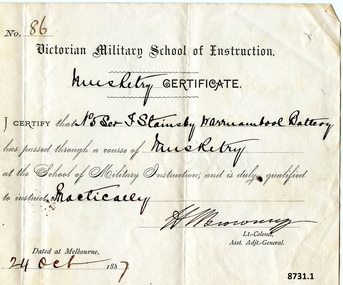
Certificate - Musketry and Sergeant Qualifications, Victorian Military School of Instruction, 1887 - 1894
... ...Sir W. Clarke Trophy...Flagstaff Hill Maritime Museum and Village Warrnambool Great Ocean Road Shipwreck Coast Victorian Garrison Artillery Warrnambool Battery volunteer militia Garrison artillery Artillery detachment Battery competitions Warrnambool Garrison volunteers Sergeant Stainsby Thomas Stainsby Sir W. Clarke Trophy Sir W. J. Clarke Trophy Certificate 8731.1 - "No. 86" /Victorian Military School of Instruction/ Musketry CERTIFICATE. / I CERTIFY that No 5 Ser T Stainsby Warrnambool Battery / has passed through a course of Musketry /at the School of Military Instruction, and is duly qualified/ to instruct Practically/ [illegible signature]/Lt-Colonel/ Asst. ...The Crimean War began in 1854 and many people in colonial Australia were afraid of a Russian attack. In 1854 the Volunteer Act was passed to provide some military defence. In 1858 the Warrnambool Volunteer Rifle Corps was established, disbanded in 1863, then a new Warrnambool Detachment was formed in September 1866. In 1870 Australia became responsible for its own naval and military defence. The Permanent Victorian Artillery force was established. It was disbanded in 1880 then re-formed in 1882 as the Victorian Garrison Artillery Corps. Legislation was passed in 1884 that replaced the volunteers’ corps with a partly paid, permanent Militia Defence Force. Volunteer forces were established to strengthen the British Imperial troops posted here. A battery of artillery was raised in Victoria as well as in other Australian states. The Batteries manning the coastal forts of Victoria were termed Garrison Artillery Companies. When the Army was federated in 1901 there were eight Militia Companies in Victoria. Warrnambool and Port Fairy together were known as 8 Coy AGA (Australian Garrison Artillery). Changes to formation and name continued into the 20th century. In 1895 the Geelong, Warrnambool, Port Fairy and Portland Batteries became part of the Western District Garrison Artillery. Many of the volunteers who served in the Artillery were from rural areas. They belonged to rifle clubs and were experienced horsemen as well. Australia's defence at this time relied on these mounted troops, or Light Horse men. In 1899 the Victorian Garrison Artillery Corps amalgamated with the New South Wales and Queensland Permanent Artillery to become the Victorian Regiment of the Royal Australian Artillery (RAA). Then prior to Federation, the RAA and the Permanent Artillery of South Australia, Western Australia and Tasmania all combined, becoming the Royal Australian Artillery Regiment with two Batteries of Field Artillery; Battery A from Sydney and Battery B from Melbourne. These two certificates were awarded to Sergeant Thomas Stainsby who was a long-time member of the Warrnambool Garrison Artillery detachment during the 1880's and into the 1890's. He is mentioned in several newspaper reports of the era, as being an integral member of the local artillery detachments (as Sergeant-in-Charge, Gun Layer or Orderly) participating in local and statewide "Battery Competitions" that were very popular at this time. In one Annual Battery competition held in 1891 at Port Fairy, a target was moored in the bay and each detachment fired four rounds of "plugged shell" at it (at an estimated distance of 1900 yards). The local newspaper (the Warrnambool Standard) reported "the best work was reserved for the last detachment ... in charge of that old warrior Sergeant Stainsby ... who won the first prize with their four shots." Thomas Stainsby was an important member of the Warrnambool Artillery Battery in the years when it was competing for the "Sir William Clarke Trophy" The Sir William Clarke Trophy (a silver trophy) was given as a prize in 1885 to Victorian Militia Garrison Battery competition winners, for artillery firing target accuracy. A Battery needed to win the competition three times to keep the trophy and the Warrnambool Battery won it in 1887, 1889 and 1892. When the Warrnambool Militia Garrison Artillery had won the Trophy, for the third time, they became Absolute Possessors of the prize. Thomas Stainsby was born on October 25th, 1846, in Melbourne. He married Ellen Priddle in Geelong in 1869, and they moved to Camperdown and then Warrnambool in the 1870's. They had ten children. He was a bootmaker and had a shop in Fairy Street. Thomas died on September 26th, 1914, aged 67. His Obituary in the local paper said he "was very keen on cycling and pedestrianism ... and was actively associated with the old volunteer militia and held the position of Sergeant in the old Battery." Thomas Stainsby features in several photographs of the Warrnambool Battery held in the Flagstaff Hill collection. The Warrnambool Garrison has been added to the Victorian Heritage Register H1250 “for its intact battery and guns, a strong reminder of Victoria’s wealth and determination to protect itself from the perceived threat of invasion in the 1880’s.” The City of Warrnambool is one of several custodians of a collection of artillery pieces of heritage significance at a state, national and international level. These pieces are directly related to the defence of south-west Victoria in the 19th century. The care and preservation come under the Heritage Act 1995. The certificates belonging to Sergeant Thomas Stainsby are a significant example of the work and dedication of a Warrnambool Garrison volunteer.Two paper certificates awarded to Sergeant T. Stainsby. Certificate 8731 is from the "Victorian Military School of Instruction" and was awarded to Sergeant Stainsby of the Warrnambool Battery on 24th October 1887, for passing a course of "Musketry" which enabled him to become a qualified "practical" instructor. The certificate has printed and handwritten sections. Certificate 8732 is from the "Victorian Military Forces", dated 1st July 1894 and certifies that Sergeant Stainsby of the Warrnambool Battery Garrison Artillery passed through a course of Instruction and has qualified for the rank of "Sergeant in the Garrison Artillery, Victoria". The certificate has printed and handwritten sections, is yellowed with age and has some rips and tears along each edge and along its fold lines.Certificate 8731.1 - "No. 86" /Victorian Military School of Instruction/ Musketry CERTIFICATE. / I CERTIFY that No 5 Ser T Stainsby Warrnambool Battery / has passed through a course of Musketry /at the School of Military Instruction, and is duly qualified/ to instruct Practically/ [illegible signature]/Lt-Colonel/ Asst. Adjt.-General / Dated at Melbourne/ 24 Oct 1887." Certificate 8731.2 - "No 480 / Victorian Military Forces - /Re-issue / 2nd Class certificate /I certify that No 1 sergeant/ T Stainsby, Warrnambool Battery G.A. / has passed through a course of instruction / and is qualified for the rank of / Sergeant in the Garrison Artillery, Victoria/ Dated at Melbourne / 1st July 1894 [illegible signature] Lieut-Colonel /Comma? Artillery."flagstaff hill maritime museum and village, warrnambool, great ocean road, shipwreck coast, victorian garrison artillery, warrnambool battery, volunteer militia, garrison artillery, artillery detachment, battery competitions, warrnambool garrison volunteers, sergeant stainsby, thomas stainsby, sir w. clarke trophy, sir w. j. clarke trophy -
 Flagstaff Hill Maritime Museum and Village
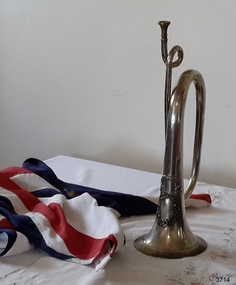
Instrument - Bugle, 1861
... On 11th August 2016, during a ceremony at Flagstaff Hill, the Australian Army handed over guardianship of two very significant historical items, the 1885 W. Clarke Trophy and the 1861 Warrnambool Ladies Silver Bugle, to Warrnambool City Council for display at Flagstaff Hill Maritime Museum. ...On 11th August 2016, during a ceremony at Flagstaff Hill, the Australian Army handed over guardianship of two very significant historical items, the 1885 W. Clarke Trophy and the 1861 Warrnambool Ladies Silver Bugle, to Warrnambool City Council for display at Flagstaff Hill Maritime Museum. ...Bugles have been used for hundreds of years to communicate instructions, particularly in battles and for announcements such as calls to assemble and various other daily routines, especially for infantry and military units. This pure silver bugle was presented to the Warrnambool Rifle Volunteers by Lady Helpman, on behalf of the Ladies of the District of Warrnambool, on June 18th, 1861. Lady Helpman's husband, Captain Benjamin Franklin Helpman, was the Warrnambool Harbour master. The gift of this silver bugle was presented to the commanding officer of the Warrnambool Volunteer Rifle Corps, Captain Bushe, who then passed it on to the Warrnambool Volunteer Band. On 11th August 2016, during a ceremony at Flagstaff Hill, the Australian Army handed over guardianship of two very significant historical items, the 1885 W. Clarke Trophy and the 1861 Warrnambool Ladies Silver Bugle, to Warrnambool City Council for display at Flagstaff Hill Maritime Museum. Both heritage-listed items are strongly connected to the city of Warrnambool and form an integral part of the history of the Warrnambool Garrison.The Silver Bugle is locally significant to the community of Warrnambool for its connection to the Warrnambool Volunteer Rifle Corps - part of the original Warrnambool Garrison – which was formed to protect the Warrnambool Harbour. The site of the 1888 Warrnambool Garrison and Fortifications is Victorian State Heritage-listed. It is significant for its intact and operational nature, and is one of the best-preserved pieces of Victoria's early colonial heritage.Silver alloy Bugle, with a brass mouthpiece, a long tube of metal, narrow at the mouth end and gradually flaring to a wider shape at the bell at the other end. The tube is shaped into three bends. The front of the bell features an elaborate design, including a ribbon banner attached above an oval floral wreath that encloses an inscription. The outer rim of the bell has an impressed ancient Greek geometric border.On ribbon banner “Armed for the Right”. Within the wreath “TO THE / WARRNAMBOOL / VOLUNTEER RIFLE COMPANY / this tribute of due appreciation / is presented by / THE LADIES / of the District / Warrnambool 18th June / 1861”flagstaff hill, warrnambool, shipwrecked coast, flagstaff hill maritime museum, maritime museum, shipwreck coast, flagstaff hill maritime village, great ocean road, silver bugle 1861, bugle musical instrument, lieutenant benjamin helpman, doctor breton, captain bushe, bugler corrigan, drill instructor bernard, warrnambool volunteer rifle corps 1861, statistics of warrnambool volunteer rifle corps 1861, warrnambool volunteer rifle company, warrnambool rifle volunteers, warrnambool volunteer band, armed for the right, wall’s family hotel warrnambool, warrnambool garrison, volunteer corps -
 Bendigo Military Museum
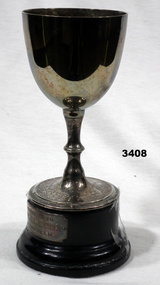
Award - TROPHY, SIGNALLING, c.1926
... trophy award signalling 38th On cup: "WON BY 38TH BATT TEAM, SIGNALING, SEYMOUR 1926, CAPT W L TRESSIDDER, SGT R BEATTIE, PTE D STILLWELL, B SILKE, R CLARKE" On base: "PRESENTED TO CAPT W L TRESSIDDER BY THE TEAM" Metal trophy cup on dark wooden base. ...Metal trophy cup on dark wooden base. Inscription on the cup & small metal plaque attached to the base.On cup: "WON BY 38TH BATT TEAM, SIGNALING, SEYMOUR 1926, CAPT W L TRESSIDDER, SGT R BEATTIE, PTE D STILLWELL, B SILKE, R CLARKE" On base: "PRESENTED TO CAPT W L TRESSIDDER BY THE TEAM"trophy, award, signalling 38th -
 Glen Eira Historical Society
Document - Ormond Amateur Football Club
... W. D. Knowling C. H. Duus E. Evans R. J. Smyth L. C. Clarke W. J. Bishton JA Grant V. Tremills F. S. McFadzean J. D. Marley K. J. McKittrick A. E. Halkyerd C. S. Patience C. E. Lynch K. Occleshaw F. R. Howard R. Chapman C. W. Jones J. A. Evans J. G. Ellsworth G. Coaches Dunbar H. Jones Bill Wright Bill Mooney Mrs. Trophies ...2 articles on Ormond Amateur Football Club, 1933 – 1973: 1/A 12 page document including 3 photocopied photos. Article documents the Premiership coaches for the 1933/34 seasons, a break till 1950 when article then continues to 1973 season. A brief description on the coaches success and mentions successful players who competed in the various team divisions over these years in the document. 2/A pamphlet for season 1935 Ormond Amateur Football Club listing office bearers, patrons, AGM details of business to be discussed, nominations for 1936 and income and expenditure account details.ormond amateur football club, clubs and associations, anthony mick, bentleigh amateur, bols lou, coaches (people), farrell ted, farrell edwin, farrell greg, wood roger, bourne bruce, moran graeme, chisholm andrew, patterson michael, blight bernie, cameron ian m., ferrari brian, kingston jack, foulsham clyde, burdekin e. f., moran graeme f., farrell e. j., graham a., russ jeff, cameron s. m., mcinerney peter j., finlayson brian, grace john, rowse ken, lepage neil, joachim nick, purcell ken, corben bruce f., stock jack, gillespie rob, mcdonald colin, humphries andrew, christie graham, graer david, craig beryl, smith thelma, stock val, johnston j. r., rogers s. w., wood r. j., cameron robert, ladd kevin j., pierce greg, ladd clarrie, meeking john, fitts clive, doble alan, cooper stephen, mclean alan, english graeme, andrew graham, purcell peter, rose mark, borland norm, wood andrew, farrell e. j., logan r. j., morgan peter, faulkner alan, slatter mick, burney cal, stock jack, norris mick/micheal, beecroft barry, crump wayne, humphreys andrew, cameron robert, morris steve, anstee laurie, spence phillip, hand robert, curtis noelene, murphy p. m. peter, foulsham d. a. david, finlayson r. j., roberts r. c., grumpton t. r.-terry, jenkins r. c. ron, mortimer j. i., wood r. j. roger, morgan p. j., graham a. m. alan, curtis r. s., grace j. m., johnston j. r., marshall l. j., logan r. j., jackson d. w., bourne b. k., farrell e. j., sierakowski d. d. peter, dexter p. d., russ j. i., scott d. h., joachim nick, hardham leigh, chapman ray, smith stephen, sterling greg, cramer dean, anstee laurie, barnes ted, barwick john, russell geoff, kozlowski i. a., pearce g. w., roberts r. c., swan g. m., graham a. m., curtis r. s., blight b. f., fitzroy r. m, jackson d. w., farrell e. j., pierce greg, scott david, holman greg, russ steve, mcdonald david, fisher s., o’reilly pat, borland norm, thomas g. t., naylor alan r., lewis m., szylit m., dove s. w., mooney d. j., bevers f. h., gunn e. e., stevens r. a., ellis h., fancett w., grainger v., rermezel y., dawson p., smith r. a., pascoe h., chisholm l. a., jones j. a., juniper p., anderson a. e., ellis r., o’dwyer f., pope a., handcock c., hatton c. h., anthony m., dunbar h., jones w., mckechnie h. j., jennings s., jennings a., porter j. r. dr., hogan j. f., frew g., hassed m. j., ryan rev. father, fethers d. b. dr., hallows bruce, porter j. r., nelson w. t., groves frank, chisholm l. a., vinton j. t., smith w. d., knowling c. h., duus e., evans r. j., smyth l. c., clarke w. j., bishton ja, grant v., tremills f. s., mcfadzean j. d., marley k. j., mckittrick a. e., halkyerd c. s., patience c. e., lynch k., occleshaw f. r., howard r., chapman c. w., jones j. a., evans j. g., ellsworth g., coaches, dunbar h., jones bill, wright bill, mooney mrs., trophies, bishton j. h., manning j., bray h., smyth l., creighton j., wright w., kirchner s., baker n., bevers mrs., gunn mrs., fancett mrs., creighton mrs., stevens mrs., ellis mrs., hatton mrs., mogan mrs., pascoe mrs., frew mrs., phillips mrs., grainger mrs., massed mrs., stillard miss, matt e. g., matt mrs., tremills mrs., cullen l. mrs., parker f. w. mrs., societal events and activities, flags, ormond park trust, sporting clubs, football clubs, football, australian rules football, sports officials, ormond, bentleigh
