
Showing 5 items matching "w.f. waters"
-
 Falls Creek Historical Society
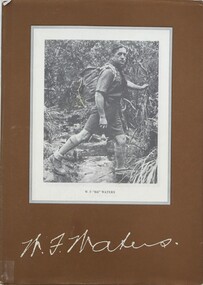
Book - W.F. Waters - A Biography - A Man of the Mountains, Harry Stephenson, 1982
... W.F. Waters - A Biography - A Man of the Mountains...W.F. Waters - A Biography - A Man of the Mountains...A book of 96 pages including maps, illustrations, facsimiles and index W.F. Waters - A Biography - A Man of the Mountains Book W.F. ...A biography of William Francis Waters which outlines his earlier life and sporting success. It details his exploits in hiking and skiing, including being member of the first party to ski across the Bogong High Plains. Becoming a Rover Scout in 1928, his contribution to the scouting movement led to the award of the Silver Wolf, the highest scouting honour in 1961.A book of 96 pages including maps, illustrations, facsimiles and indexnon-fictionA biography of William Francis Waters which outlines his earlier life and sporting success. It details his exploits in hiking and skiing, including being member of the first party to ski across the Bogong High Plains. Becoming a Rover Scout in 1928, his contribution to the scouting movement led to the award of the Silver Wolf, the highest scouting honour in 1961.william francis waters, hiking victoria, scouting victoria -
 Kiewa Valley Historical Society
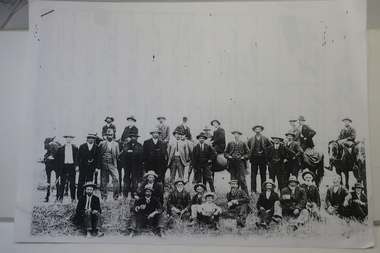
Papers photocopied - photo, list of names, Kiewa Valley Pioneers and Early Activities on the Bogong High Plains
... ...W.F. Waters...Keegan's Crossing W.F. Waters Tawonga and Mullindollongong pastoral runs 1.The photo includes a listing of residents selecting a site for a bridge at Keegans Crossing. 2. ...All Early History of the Kiewa Valley. 1. Photo clear but no date. Men named and are residents selecting a site for a bridge at Keegans Crossing 2. Department of Crown Lands letter - 1841 Tawonga pastoral run - Mr James Roberts and Mullindollingong pastoral run 1846 - Mr Patrick Reynolds 3. An account of the Bogong High Plains by W. F. Waters from the late 1890s to 1930s. Published article in the Schuss magazine. August 1958 History of Keegan's Crossing, Kiewa Valley and surrounding residents with names and photos. Early pastoral runs in the Kiewa Valley and Early activities on the Bogong High Plalns..1.The photo includes a listing of residents selecting a site for a bridge at Keegans Crossing. 2. A letter from the Department of Victorian Lands and Survey re early settlers 3. History written in Schuss magaine, Aug. 1958. "In 1896 ... erection of snow poles from Rocky Valley to Tawonga Hut. keegan's crossing, w.f. waters, tawonga and mullindollongong pastoral runs -
 Falls Creek Historical Society
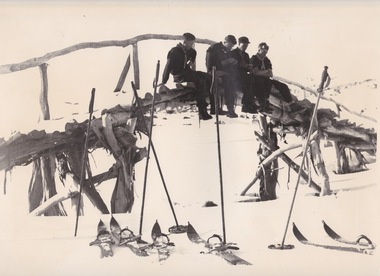
Photograph - Harbour Bridge over Watchbed Creek
... The late W.F. “Bill” Waters, Rover Commissioner of Victoria, was introduced to skiing in November 1930 at the International Scout Chalet at Kandersteg in Switzerland. ...The late W.F. “Bill” Waters, Rover Commissioner of Victoria, was introduced to skiing in November 1930 at the International Scout Chalet at Kandersteg in Switzerland. ...The late W.F. “Bill” Waters, Rover Commissioner of Victoria, was introduced to skiing in November 1930 at the International Scout Chalet at Kandersteg in Switzerland. He believed it would be a good activity for Victorian Rovers to be involved in to learn more about the Victorian Alps The first Rover ski trip to the Bogong High Plains was in the August of 1932 when a group of four crossed the High Plains from Omeo to Harrietville via Tawonga Huts, Cobungra Gap, Mt Loch and Mt Feathertop. In 1933 the Bogong Rover Crew was formed and in 1938 funds were collected and life memberships offered to raise funds to build a Rover Chalet for the purposes of skiing. During February and March1940, the Chalet was built at a cost of £700 using volunteer labour. It was the first ski lodge in the area and was built long before there was a road over Watchbed Creek. After the road to Rocky Valley was finished it was easier for the scouts to walk in from there instead of from Shannonvale. During the spring thaw the creek became almost impassable. Joe Holsten who was an SEC employee who worked with Martin Romuld out of Wilkinson’s Hut built a bridge across the creek made entirely from snow gums which he had to haul about 300 metres from the nearby hills. It became known as the Harbour Bridge as it arched over the water just like the Sydney Harbour Bridge.These images are significant because they depict an early bridge structure to enable easier travelling across the Bogong High Plains.Three black and white photos taken at the Harbour Bridge, Watchbed Creek.harbour bridge bogong high plains, watchbed creek, joe holsten -
 Kiewa Valley Historical Society
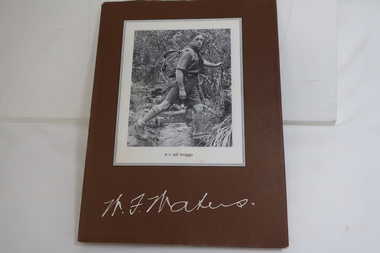
Bogong 3 Items: Rover Scouts Skis x2; Bogong Rover Scout shirt; Book with signature by WF (Bill) Waters, Book: WF "Bill" Waters A Biography A man of the Mountains - Stephenson 1983 Publisher; The Scout Association Carlton 1983
... Rover Scouts and the Bogong High Plains The Bogong Rover Lodge started as an SEC (State Electricity Commission) hut near Langford's Gap and was carried on the backs of Rover Scouts across to its present location on the Southern side of the Bogong High Plains around 1937 under the direction of W.F. (Bill) Waters, a skiing pioneer, synonymous with establishing skiing on the BHP. ...1. These Skis were hand carved in Sweden around 1937 and brought to Australia where they were purchased around 1962 by a Bogong Rover Scout. They were refurbished with steel edging and plastic soles and saw extensive service on the Bogong High Plains between 1962 and 1968. They performed magnificently, riding out the deepest mogul with ease because of their highly curved tips. Of particuular interest is the way the Kandahar toe iron has been attached to the ski. The ski was slotted through its width, the tow iron inserted and then folded vertically to give an integral attachment. In those days skins were used extensively for uphill climbing, hence the yellow plastic patch on the back surface to protect from the skin buckle. Cable bindings were used to enable the boot to lift for climbing. When ready for a downhill run, the cable was slipped under the side-pulls to anchor the heel. The beauty of these bindings in those days was that they were composite downhill and touring skis. These particular skis were of lightweight timber (timber unknown) compared to others of their day, which are often made of Hickory which is much denser and heavier. Rover Scouts and the Bogong High Plains The Bogong Rover Lodge started as an SEC (State Electricity Commission) hut near Langford's Gap and was carried on the backs of Rover Scouts across to its present location on the Southern side of the Bogong High Plains around 1937 under the direction of W.F. (Bill) Waters, a skiing pioneer, synonymous with establishing skiing on the BHP. The Rover Scouts left Melbourne by train to Bairnsdale. They went onto Omeo (bus?) where they stayed overnight at the pub then (bus?) to Fitzgerald's farm on the Omeo Highway. Then on packhorses to the snow line. Then they carried their packs and skis. to the lodge. The Lodge continues to this day (2026) as a base for Scouts skiing and bushwalking on the Bogong High Plains. Rovers, the senior branch of Scouting, are aged between 18 to 25 years. The Bogong Rover Lodge / Chalet / or Scout Hut is open all year round.1. 2 pairs of skis: One pair is hand-crafted Swedish wooden skis circa 1937. Quite a thick ski. Tapered shape with a distinctive pointed toe. Coated with dark brown varnish which is lifting in some parts. The ski has a yellow plastic patch at the rear and a re-inforced foot plate. Bindings are metal and leather. 216 cm long and 7 cm wide. The second pair of skies are red plastic. Possibly Italian with an unusual downhill & touring binding circa 1970. 198 cm long and 7 cm wide Bogong Rover overshirt (winter). Pure wool, long sleeves, 2 front buttons, pockets with insignia include Box Hill District Boy Scouts Alpine Rovers Badge on right top of sleeve. Epaulettes on the left and right shoulders. Left hand side has 8 pieces of coloured tabs attached. Also, Green triangular cotton neck tie with leather toggle.Labels 'pure wool'; 'scout shop' 'size 14'rover scouts, cross country skiing, bill waters, swedish skis, scouts uniform -
 Kiewa Valley Historical Society
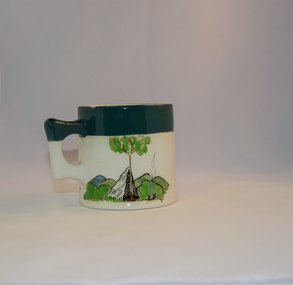
Mug Stoneware
... There is also a water fall named after him Waters Falls on the Bogong High Plains. W.F."Bill" Waters aka "Bill Bogong" (Bogong mountain, were his ashes were scattered), was not only a prominent bush walker (Melbourne Walking Club) of the high country (Victorian Alps) but was instrumental in establishing two Chalets. ...This ceramic mug is titled "Bill Bogong's Mug" in honour of one of Australia's Scouting (Rovers) notable office holders, Mr.W.F."Bill" Waters. He was born on 22nd August 1897 in Taralgon, Victoria, Australia and died 8th October 1968 in Fitzroy, Victoria. He was instrumental in the Rovers building two chalets in the Victorian Alps. The Victorian Award of the National Rover Service Award(1980) has been named after Bill Waters. Bill Waters was also the leader of the first team that climbed Mount Bogong in winter in 1929. Also was part of rescue team of what is now know as the Cleve Cole tragedy on Mt Bogong in the mid 1930's. There is also a water fall named after him Waters Falls on the Bogong High Plains. W.F."Bill" Waters aka "Bill Bogong" (Bogong mountain, were his ashes were scattered), was not only a prominent bush walker (Melbourne Walking Club) of the high country (Victorian Alps) but was instrumental in establishing two Chalets. One of these Chalets was the first one to be built on the Bogong High Plains. This item, "Bill Bogong's Mug" is what the Flinders Petrie(famous English Egyptologist/Archaelogist) Rover Crew(formed in 1940) presented newly invested members of the exclusive(200 membership) Alpine Rover Crew. The Melbourne Walking Club has a long history with the Victorian High Plains area, of which the Kiewa Valley is an integral part of the Victorian Alpine Region. Due to the connections Bill Waters has with the Bogong High Plains and Mt Bogong this cup has a lot of significance to the social history of the area.. Round glazed stoneware mug, white in colour, with a heritage green coloured band covering the top rim and handle. Written inscription on the front "Bill Bogong's Mug" in large print and beneath it, in smaller print, "with compliments from Flinders Petrie Rover Crew" The other side of the mug is a free hand landscaped drawing of green bush and blue hills with a tree supporting a tent and a camp fire (with smoke rising from it).To the left of the inscription is the Scout (Rover) emblem coloured black with an unraveled and unwritten signage scroll fowler ceramics, local alpine history, alpine rovers, scouts, mugs, mt bogong, bogong high plains
