
Showing 50 items matching "wait staff"
-
 Heidelberg Golf Club
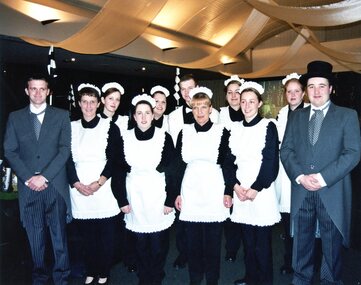
Photograph, Heidelberg Golf Club, Heidelberg Golf Club: 75th anniversary dinner - Wait staff assembled before dinner service, 16/08/2003
... Heidelberg Golf Club: 75th anniversary dinner - Wait staff assembled before dinner service......Wait Staff...Wait staff members in period costume assembled before the 75th anniversary dinner, Heidelberg Golf Club, held on 16 August 2003....Wait staff members in period costume assembled before the 75th anniversary dinner, Heidelberg Golf Club, held on 16 August 2003. ...Wait staff members in period costume assembled before the 75th anniversary dinner, Heidelberg Golf Club, held on 16 August 2003.From a collection of professional photographs taken at the Heidelberg Golf Club's 75th anniversary celebrations in 2003Colour photograph75th anniversary celebrations, office staff, bar staff, wait staff -
 Heidelberg Golf Club
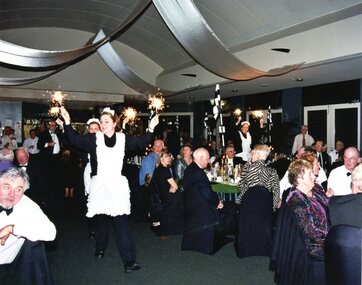
Photograph, Heidelberg Golf Club, Heidelberg Golf Club: 75th anniversary dinner - HGC staff, 16/08/2003
... ...Wait Staff...Club members at the 75th anniversary dinner, Heidelberg Golf Club, held on 16 August 2003. Wait staff enter with sparklers, seated include Phil Lock, Ann Miller and Don Miller...Club members at the 75th anniversary dinner, Heidelberg Golf Club, held on 16 August 2003. Wait staff enter with sparklers, seated include Phil Lock, Ann Miller and Don Miller From a collection of professional photographs taken at the Heidelberg Golf Club's 75th anniversary celebrations in 2003 75th anniversary celebrations HGC Members Wait Staff Colour photograph in photo album Heidelberg Golf Club: 75th anniversary dinner - HGC staff Photograph Photograph Heidelberg Golf Club ...Club members at the 75th anniversary dinner, Heidelberg Golf Club, held on 16 August 2003. Wait staff enter with sparklers, seated include Phil Lock, Ann Miller and Don MillerFrom a collection of professional photographs taken at the Heidelberg Golf Club's 75th anniversary celebrations in 2003Colour photograph in photo album 75th anniversary celebrations, hgc members, wait staff -
 Heidelberg Golf Club
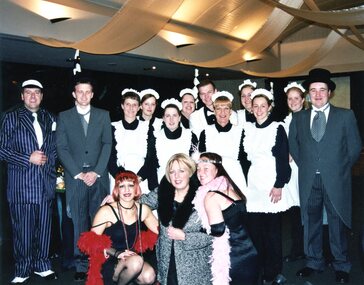
Photograph, Heidelberg Golf Club, Heidelberg Golf Club: 75th anniversary dinner - Staff assembled before dinner service, 16/08/2003
... ...Wait Staff...From a collection of professional photographs taken at the Heidelberg Golf Club's 75th anniversary celebrations in 2003 75th anniversary celebrations Office Staff Bar Staff Wait Staff Colour photograph Heidelberg Golf Club: 75th anniversary dinner - Staff assembled before dinner service Photograph Photograph Heidelberg Golf Club ...Staff members in period costume assembled for a group photograph before the 75th anniversary dinner, Heidelberg Golf Club, held on 16 August 2003.From a collection of professional photographs taken at the Heidelberg Golf Club's 75th anniversary celebrations in 2003Colour photograph75th anniversary celebrations, office staff, bar staff, wait staff -
 Heidelberg Golf Club
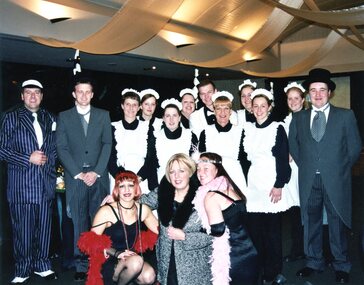
Photograph, Heidelberg Golf Club, Heidelberg Golf Club: 75th anniversary dinner - Staff assembled before dinner service, 16/08/2003
... ...Wait Staff...From a collection of professional photographs taken at the Heidelberg Golf Club's 75th anniversary celebrations in 2003 75th anniversary celebrations Office Staff Bar Staff Wait Staff Colour photograph in photo album Heidelberg Golf Club: 75th anniversary dinner - Staff assembled before dinner service Photograph Photograph Heidelberg Golf Club ...Staff members in period costume assembled for a group photograph, being entertained by Josie before the 75th anniversary dinner, Heidelberg Golf Club, held on 16 August 2003.From a collection of professional photographs taken at the Heidelberg Golf Club's 75th anniversary celebrations in 2003Colour photograph in photo album75th anniversary celebrations, office staff, bar staff, wait staff -
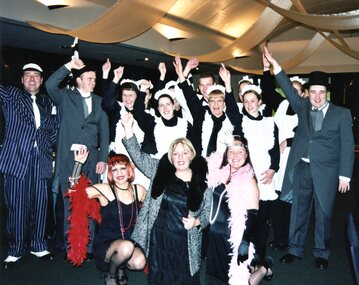 Heidelberg Golf Club
Photograph, Heidelberg Golf Club, Heidelberg Golf Club: 75th anniversary dinner - Staff assembled before dinner service, 16/08/2003
... ...Wait Staff...From a collection of professional photographs taken at the Heidelberg Golf Club's 75th anniversary celebrations in 2003 75th anniversary celebrations Office Staff Bar Staff Wait Staff Colour photograph Heidelberg Golf Club: 75th anniversary dinner - Staff assembled before dinner service Photograph Photograph Heidelberg Golf Club ...Staff members in period costume assembled for a group photograph before the 75th anniversary dinner, Heidelberg Golf Club, held on 16 August 2003.From a collection of professional photographs taken at the Heidelberg Golf Club's 75th anniversary celebrations in 2003Colour photograph75th anniversary celebrations, office staff, bar staff, wait staff -
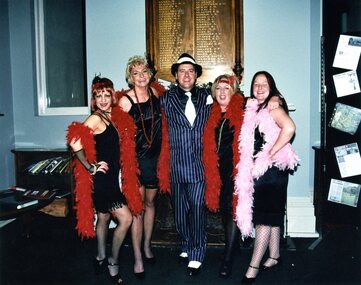 Heidelberg Golf Club
Photograph, Heidelberg Golf Club, Heidelberg Golf Club: 75th anniversary dinner - Office staff assembled before dinner service, 16/08/2003
... ...Wait Staff...From a collection of professional photographs taken at the Heidelberg Golf Club's 75th anniversary celebrations in 2003 75th anniversary celebrations Office Staff Bar Staff Wait Staff Stefan Bazzani Colour photograph in photo album Heidelberg Golf Club: 75th anniversary dinner - Office staff assembled before dinner service Photograph Photograph Heidelberg Golf Club ...Office staff including manager Stefan in period costume assembled for a group photograph before the 75th anniversary dinner, Heidelberg Golf Club, held on 16 August 2003.From a collection of professional photographs taken at the Heidelberg Golf Club's 75th anniversary celebrations in 2003Colour photograph in photo album75th anniversary celebrations, office staff, bar staff, wait staff, stefan bazzani -
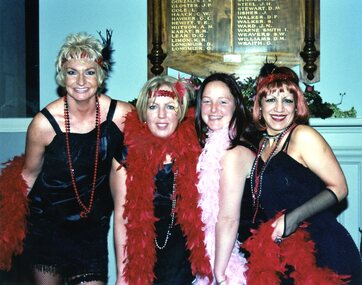 Heidelberg Golf Club
Photograph, Heidelberg Golf Club, Heidelberg Golf Club: 75th anniversary dinner - Office staff assembled before dinner service, 16/08/2003
... ...Wait Staff...From a collection of professional photographs taken at the Heidelberg Golf Club's 75th anniversary celebrations in 2003 75th anniversary celebrations Office Staff Bar Staff Wait Staff Colour photograph in photo album Heidelberg Golf Club: 75th anniversary dinner - Office staff assembled before dinner service Photograph Photograph Heidelberg Golf Club ...Office staff in period costume assembled for a group photograph before the 75th anniversary dinner, Heidelberg Golf Club, held on 16 August 2003.From a collection of professional photographs taken at the Heidelberg Golf Club's 75th anniversary celebrations in 2003Colour photograph in photo album75th anniversary celebrations, office staff, bar staff, wait staff -
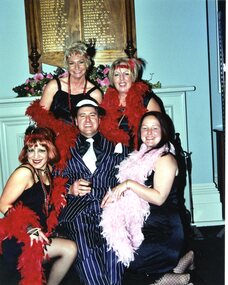 Heidelberg Golf Club
Photograph, Heidelberg Golf Club, Heidelberg Golf Club: 75th anniversary dinner - Office staff assembled before dinner service, 16/08/2003
... ...Wait Staff...From a collection of professional photographs taken at the Heidelberg Golf Club's 75th anniversary celebrations in 2003 75th anniversary celebrations Office Staff Bar Staff Wait Staff Stefan Bazzani Colour photograph in photo album Heidelberg Golf Club: 75th anniversary dinner - Office staff assembled before dinner service Photograph Photograph Heidelberg Golf Club ...Office staff including manager Stefan in period costume assembled for a group photograph before the 75th anniversary dinner, Heidelberg Golf Club, held on 16 August 2003.From a collection of professional photographs taken at the Heidelberg Golf Club's 75th anniversary celebrations in 2003 Colour photograph in photo album75th anniversary celebrations, office staff, bar staff, wait staff, stefan bazzani -
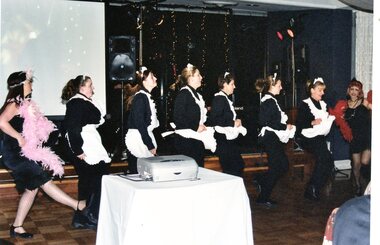 Heidelberg Golf Club
Photograph, Heidelberg Golf Club, Heidelberg Golf Club: 75th anniversary dinner -Staff entertainment, 16/08/2003
... ...Wait Staff...From a collection of professional photographs taken at the Heidelberg Golf Club's 75th anniversary celebrations in 2003 75th anniversary celebrations HGC Members Wait Staff Colour photograph in photo album Heidelberg Golf Club: 75th anniversary dinner -Staff entertainment Photograph Photograph Heidelberg Golf Club ...Club members at the 75th anniversary dinner, Heidelberg Golf Club, held on 16 August 2003. Staff entertain the crowd.From a collection of professional photographs taken at the Heidelberg Golf Club's 75th anniversary celebrations in 2003Colour photograph in photo album 75th anniversary celebrations, hgc members, wait staff -
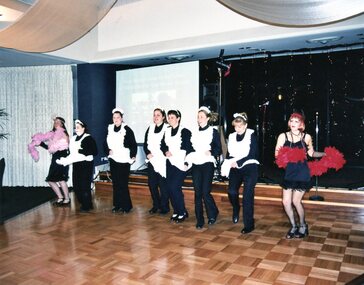 Heidelberg Golf Club
Photograph, Heidelberg Golf Club, Heidelberg Golf Club: 75th anniversary dinner - Staff entertainment, 16/08/2003
... ...Wait Staff...From a collection of professional photographs taken at the Heidelberg Golf Club's 75th anniversary celebrations in 2003 75th anniversary celebrations HGC Members Wait Staff Office Staff Colour photograph in photo album Heidelberg Golf Club: 75th anniversary dinner - Staff entertainment Photograph Photograph Heidelberg Golf Club ...Club members at the 75th anniversary dinner, Heidelberg Golf Club, held on 16 August 2003. Staff entertain the crowd.From a collection of professional photographs taken at the Heidelberg Golf Club's 75th anniversary celebrations in 2003Colour photograph in photo album 75th anniversary celebrations, hgc members, wait staff, office staff -
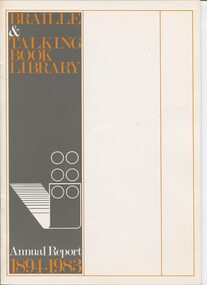 Vision Australia
Administrative record - Text, Braille and Talking Book Library Annual Report 1894-1983, 1983
... Items also included are: the structural re-organisation, increased borrowing has required increase in staffing, the entire share portfolio has been sold however 4 staff were retrenched and remaining staff undertook an 8% pay cut for 8% less hours (with many continuing to work the same hours), decision to phase out Clarke & Smith machines in favour of cassettes, due to lower staffing a waiting list for borrowers need to be established with up to an 8 week delay to join, braille interleaved books developed to allow sighted parents of blind children (or vice versa) to enjoy a book together, establishment of LBA allows for segregation of alternative production and sales of book to other organisations, Braille Book of the Year panel of Barrett Reid, Joyce Nicholson and Lloyd O'Neil, opening of Benalla Studio on 7 December 1982, and as library declared a free public library in May 1980, library receives state government funding at 3% of the state budget....Items also included are: the structural re-organisation, increased borrowing has required increase in staffing, the entire share portfolio has been sold however 4 staff were retrenched and remaining staff undertook an 8% pay cut for 8% less hours (with many continuing to work the same hours), decision to phase out Clarke & Smith machines in favour of cassettes, due to lower staffing a waiting list for borrowers need to be established with up to an 8 week delay to join, braille interleaved books developed to allow sighted parents of blind children (or vice versa) to enjoy a book together, establishment of LBA allows for segregation of alternative production and sales of book to other organisations, Braille Book of the Year panel of Barrett Reid, Joyce Nicholson and Lloyd O'Neil, opening of Benalla Studio on 7 December 1982, and as library declared a free public library in May 1980, library receives state government funding at 3% of the state budget. ...Annual report of the Braille & Talking Book Library including Minutes of the AGM, Board of Director's Report, President's report and financial statements. Items also included are: the structural re-organisation, increased borrowing has required increase in staffing, the entire share portfolio has been sold however 4 staff were retrenched and remaining staff undertook an 8% pay cut for 8% less hours (with many continuing to work the same hours), decision to phase out Clarke & Smith machines in favour of cassettes, due to lower staffing a waiting list for borrowers need to be established with up to an 8 week delay to join, braille interleaved books developed to allow sighted parents of blind children (or vice versa) to enjoy a book together, establishment of LBA allows for segregation of alternative production and sales of book to other organisations, Braille Book of the Year panel of Barrett Reid, Joyce Nicholson and Lloyd O'Neil, opening of Benalla Studio on 7 December 1982, and as library declared a free public library in May 1980, library receives state government funding at 3% of the state budget.1 volume of text and illustrationsannual report, braille and talking book library, jeff conrad, paul korsten, norm fidge, penny crawford, tony lewis, merrie handbury, hector bathurst, anna mcswain, helen hall, race matthews, jane lascala, jan smark, alison jeffrey, hugh jeffrey, louise scott -
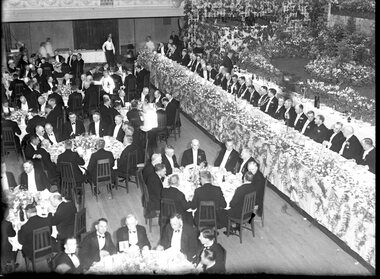 City of Melbourne Libraries
Photograph, Bull, Hugh Jones, 1897-1993, Lord Mayor's Dinner, Melbourne Town Hall
... Tables are laden with food, drink and decorations, and the wait staff (men and women) are also formally dressed, in the manner of Downton Abbey. ...Tables are laden with food, drink and decorations, and the wait staff (men and women) are also formally dressed, in the manner of Downton Abbey. ...Photographer notations on slide: "General View Of Lord Mayor's Dinner At Town Hall Nov 1936 B112" Published: The Age, Tuesday 10 November 1936, page 13 Published title: LORD MAYOR'S BANQUET Published caption: The brilliant scene inside the Melbourne Town Hall last night during the Lord Mayor’s banquet. Trove article identifier: http://nla.gov.au/nla.news-article205939431 Description: 700 guests (all men) are seated around numerous tables in the Melbourne Town Hall for the Lord Mayor's dinner in November 1936. Before the stage is a top table of 35 men, all dressed smartly in black dinner suits, with either a black or white bow tie. Many are wearing their medals. The Lord Mayor has on his Mayoral chains, and to his right is the Governor of Victoria, Lord Huntingfield. The stage is heavily decorated with fresh flowers. Research by project volunteer, Louise McKenzie: This image takes up one quarter of the photographic space on page 13 of The Age on 10 November 1936, reflecting the importance of the event and also the sheer dramatics of the image: 700 guests (all men), a top table of 35, and all dressed smartly in black dinner suits, with either a black or white bow tie. Many are wearing their medals. The Lord Mayor has on his Mayoral chains, and to his right is the Governor of Victoria, Lord Huntingfield. Further to his right is a man with an impressive sash across his chest. It is a very animated, and rather informal, moment. Banks of fresh flowers smother the stage, which is decorated in the manner of a terrace at an English stately home. Tables are laden with food, drink and decorations, and the wait staff (men and women) are also formally dressed, in the manner of Downton Abbey. It is spectacular, dramatic, and luxurious, and perpetuates the proud descriptor of “Marvellous Melbourne” as conferred by London Journalist George Augustus Sala when he visited the city in 1885. During its 1880s boom, Melbourne was the second-largest city in the British Empire, after London, and reputedly the richest city in the world. At times the expression was used with some irony, but "...in Victoria’s centenary year, 1934, with the city mired in another depression, a publisher bravely entitled a book of souvenir photographs Marvellous Melbourne, claiming that the subject ‘still finds apt expression in the happy one-time sobriquet’.” This photo seems to reflect an ongoing pride in Melbourne and a desire for it to live up to its descriptor and celebrate its post-centenary era in style. So it is no surprise to find that on page 11 of The Age on the same day, a second photo is to be found – a cropped view of one table – along with a very detailed description of the night, its purpose, and a surprise announcement. But, who was the Lord Mayor in whose honour the dinner was held? In 1934, the Lord Mayor of Melbourne was Cr. Alexander George Wales, (born Richmond, 11 October 1885, died Elsterwick, 31 May 1962). His father was a contractor and quarry-owner, but was blinded in an industrial accident in 1899. Consequently Alexander, then aged 14, left Brunswick State School to become a railway labourer working at a quarry, and in 1903 joined the Commonwealth public service as a clerk and began studying at night school, determined to improve himself. In 1907 he was appointed secretary of the Albion Quarrying Co. (in which the family had an interest), then its managing director and chairman. As the Australian Dictionary of Biography notes, he was instrumental in expanding the company’s interests, "...becoming director of the Hardware Co. of Australia Pty Ltd, the Twentieth Century Building and Investment Society, the Albion Sand Co. and the Geelong Brick Co.”. His public career began in 1914 when he was elected to the Brunswick council. He was mayor 1917-18, and in 1925 progressed to the Melbourne City Council where he remained for 29 years, being a member of most council committees. He served three successive terms as lord mayor (1934-37), was Chairman of the council’s decorations committee for Melbourne’s centenary, president of the Metropolitan Fire Brigades Board (1936), and Chairman of the Public Works Committee (1937-39). In 1936 he was elected to the Legislative Council with United Australia Party support, but later resigned over possible State government contract tender irregularities. Wales received "the customary reward” of a knighthood and was invested at Buckingham Palace by King George VI whose coronation he attended in 1937. He was an early director of what is now Ampol, and helped the development of the petroleum industry in Australia after visiting the USA in 1943 and 1946. He was impressed by that country’s wartime shipbuilding efforts and supported closer ties with the USA. “While president (1947-48) of the Melbourne Chamber of Commerce, Wales was a vocal critic of the Federal Labor Government, ...a staunch anti-socialist ... and a focus for conservative opposition to the Curtin and Chifley governments...” He is described as “a natural leader in business and civic politics,... a powerful force in the Melbourne City Council... opposing democratic reforms such as the creation of a Greater Melbourne Council and the abolition of plural voting, but advocat[ing] the redevelopment of city-owned property like the Eastern and Western markets...” So, this Lord Mayor’s dinner marks the third successive term in office for Governor Cr. A G Wales. The room is filled with powerful and influential men, and provided a platform for the Premier of Victoria, Albert Dunstan (1882-1950, United Country party) to announce that if the City Council would bear half the cost the State Government would build a bridge at Punt Road “at once”. He announced that the Government proposed to have the bridge built by the Country Roads Board, and allow the City Council to pay its share on convenient terms, and further, it would investigate the shared provision of more Yarra bridges. The proposal for the Punt Road Bridge was met with applause as the Yarra River constituted a serious traffic barrier. On 12 November 1936, two days after the Lord Mayor’s dinner, The Age published an article, “Building without a Plan”. It questions the appropriateness of the next Yarra bridge being the one at Punt Road, and encourages a “proper procedure” to look at the provision of additional Yarra bridges as a whole. But in fact this topic had been canvassed back in August when Melbourne City Council’s public works committee had recommended the replacement of the footbridge at Punt Road with a bridge, and if the Country Roads Board would declare this portion of Punt Road, including the river crossing, a State Highway, this could give the Board authority to construct the bridge and allocate the cost. Hence the reference at the dinner to a shared expense. Still an integral part of traffic management today, the Hoddle Bridge carries Punt Road over the Yarra River between Richmond and South Yarra in Melbourne. It is a five-lane road bridge with narrow footpaths on either side. It is of continuous reinforced concrete T-beam construction with five segmental arched spans, supported on transverse piers, and linked by concrete cross-beams. “The piers terminate in a series of tapered concrete pillars with Art Deco-styled steamlined decoration. Each pillar supports a Victorian-style lamp. The infill railings are geometric-patterned painted metal. Construction began in late 1937, and it was opened by Premier Albert Dunstan on 22 December 1938. It replaced an earlier footbridge, which in turn had replaced a punt service. The bridge (originally referred to as Punt Road Bridge) was named after Robert Hoddle, who planned central Melbourne’s Hoddle Grid, the grid of streets which form Melbourne’s central business district. Hoddle arrived in Australia from the UK in 1823 and went on to carry out surveys in NSW and Queensland before arriving in Melbourne in 1837. He designed layouts for both Melbourne and Williamstown, and later Geelong and other Victorian country areas. He was keen that major streets be at least 30 metres wide. ”With remarkable foresight he provided for wide boulevards from the city to the suburbs, but the subdivisions of early speculators in inner suburbs created the bottle-necks of today. After the separation of the colony in 1851, he became Victoria’s first surveyor-general... and advocated the provision of three-chain (60 m) roads and the widening of all existing main roads from one (20 m) to three chains." However, he was met with constant opposition and in 1853, was eased out of office. As a small and interesting aside: Hoddle was appointed auctioneer for the first sale of crown land in Melbourne on 1 June 1837. His commission was 57 pounds 12s 7d. and he bought two allotments for himself at a cost of 54 pounds. After he died his second wife married Richard Buckhurst Buxton, a member of the family which in 1860s Melbourne established the Australian property dynasty of Buxton Real Estate, Becton, MAB Corporation etc. Returning to the dinner and The Age article of 10 November 1836: Another topic of the after-dinner speeches was a reference to the upcoming Armistice Day. “The Minister of Customs (Mr White) said the proximity of Armistice day reminded us that eighteen years ago we had high hopes of prolonged peace.” The term “Armistice Day” was coined after WWI: “At 11 am on 11 November 1918, the guns on the Western Front fell silent after more than four years of continuous warfare. The Germans called for an armistice (suspension of fighting) in order to secure a peace settlement. They accepted the allied terms on unconditional surrender. Therefore on the 11th hour of the 11th day of the 11th month, a minute’s silence is observed and dedicated to those soldiers who died fighting to protect the nation. Originally known as Armistice Day, it was renamed Remembrance Day after World War Two to commemorate those who were killed in both World Wars. Today it refers to the loss of Australian lives from all wars and conflicts, accompanied by the words, "We will remember them, Lest we forget"." There was comment at the dinner about the need to remain firm in supporting the “democratic government in the British Empire to avoid a “plunge into savagery”. There was a grave responsibility on the British people to keep democracy alive, and that could not be done without adequate defence forces... Many weak governments in non-British countries had been swept aside by strong-fisted dictators, who now were the real threat to peace”. With the benefit of hindsight these were very pertinent comments and tragically prophetic. The Melbourne Shrine of Remembrance had only been dedicated two years earlier, at a ceremony attended by the Duke of Gloucester, son of King George V. Over 300,000 citizens attended: one third of the population of Melbourne. It became the location for the Anzac Day Dawn Service. Originally the march travelled from the Shrine into the city, however, in 1936, this was reversed, and the Shrine became the termination point for Anzac Day Marches. Also significant in 1936, was the installation of a statue in the west forecourt of the Shrine: “The Man with the Donkey” (aka 'Private John Simpson and his Little Donkey'). The work is said to represent the “valour and compassion of the Australian soldier”. Its full citation, according to the City of Melbourne City Collection is: West Side of Base: "The / Man with his Donkey / Gallipoli, April 25 to May 19 / in Commemoration / of the valour and compassion / of the Australian Soldier" AFTER LANDING AT GALLIPOLI, SIMPSON, WITH HIS LITTLE DONKEY, WORKED ALONE, DAY AND NIGHT TAKING WATER TO THE FRONT LINE AND CARRYING THE WOUNDED BACK TO THE DRESSING STATIONS. HE AND HIS DONKEY WERE KILLED BY A SHRAPNEL SHELL ON THE 19TH MAY, 1915. SIMPSON WAS MENTIONED IN DISPATCHES BY SIR IAN HAMILTON, COMMANDER-IN-CHIEF OF THE MEDITERRANEAN EXPEDITIONARY FORCE. / Erected by Public Subscription under auspices of the / Red Cross Society. East Side of Base: Private John Simpson." Their summary in background states: "A bronze figure of Simpson and his donkey with a wounded man on the donkey's back on a granite pedestal. Private John Simpson Kirkpatrick’s intrepid and short-lived exploits during the Gallipoli campaign have made him a popular figure of World War One. He has been mythologised to represent the lauded values of the digger, and he symbolises all those who went into battle unarmed. Born in England in 1892, he came to Australia in 1910. He enlisted to make his way back to England, but as a member of the 3rd Field Ambulance AIA was sent to Gallipoli. After just three weeks of bearing wounded soldiers across Shrapnel Gully on the back of his donkey, Simpson was killed by shrapnel fire. Simpson’s story became a powerful propaganda tool for enlistment in Australia, but following the war he was quickly forgotten. With the Shrine of Remembrance nearing completion in 1933, the memory of Simpson was rekindled to commemorate all who gave their lives to help others during the war. One plaque reads: ‘The / Man with his donkey / Gallipoli … / In commemoration / of the valour and compassion / of the Australian soldier’. In 1935, Wallace Anderson’s design for the memorial was selected though a competition organised by the Australian Red Cross. Anderson had served during the war and worked at the Australian War Memorial after his return. His Man with the Donkey was cast in Italy, and after some debate was sited near the shrine. Unveiled 20th June, 1936." The sculptor, Victorian-born William Wallace Anderson (1888-1975), served in France during WWI and afterwards produced a number of bronze war memorials and memorial portraits, predominantly in Victoria. “His most famous work is that of Simpson and his Donkey (1935), which he completed after winning a competition conducted by the Victorian Division of the Australian Red Cross. Anderson’s fee was 350 pounds; the cast, made by the Chiurazzi Foundry, Naples, Italy, cost 40 pounds. The work... has become well known as a symbol of the Anzac tradition.” A debate as to the siting of the statue arose from a strong view expressed by General Sir John Monash that no representation of individual members of the Australian Defence Force be located on the Shrine itself. Hence its location off to the northwest of the forecourt, in a garden of rosemary. And finally we return to the photo of the grand Lord Mayor’s dinner! An article in The Argus of 4 November 1936 refers to “Brilliant Scene at Lord Mayor’s Ball – Hall Becomes a Garden”. So now it becomes clear why the Town Hall, location of the Lord Mayor’s Dinner on 10 November 1934, only 6 days later, is so lavishly decorated. The floral decorations from the Ball are still in place - an early example of “recycling”, which is gratifying to note at a time of Depression. The reporter has captured the scene with enthusiasm: “Hundreds of tiny rose lights, hidden among pink roses, transformed the Melbourne Town Hall into a magical garden last night, when the Lord Mayor and Lady Mayoress (Councillor A. C. Wales, M.L.C., and Mrs. Wales) entertained about 3,500 guests at a ball. His Excellency the Governor (Lord Huntingfield) and Lady Huntingfield were present, while Rear-Admiral and Mrs. Lane Poole and officers from the visiting squadron were among the special guests. The balconies all round the hall were hidden by a white trellis, covered with pink blossoms and greenery. Rosy flowers were issued up every pillar, and great golden lamps, hanging from the door, were seated in greenery and trails of sweet peas. The organ gallery was converted into a terrace garden with stone steps leading to banks of pink azaleas, pink pelargoniums, masses of calceolarias, and the lovely deep mauve and blue of cinerarias. Slender Japanese maples and poplar trees grew from the higher slopes amid thickets of hostas, while a fascinating illusion was created by the lofty conservatory windows, which formed the background, and which were tinted cerulean blue to simulate the sky seen through glass. Large fern baskets hung from the conservatory roof, and the whole scene was enclosed in trellises of blossom. In the entrance palm green shrubs stood like sentinels round the passed floor, and flowers bloomed in misty golds. The long corridor upstairs leading to the council chamber was lined with an avenue of poplar trees in tubs. In the Lower Town Hall great banks of calceolarias and azaleas decked the upper dais, and each supper table was adorned with a different coloured flower with sprays of roses and Japanese maple laid on the snowy cloths. The adjoining supper-rooms were fragrant with the scent of huge bowls of stock in mauve, purple, and pink, while the white walls were covered with palm leaves and flowers. The roof garden below the clock tower was enclosed as a buffet with rose wreathed walls, and flowers were arranged attractively in the Lady Mayoress's rooms." References: LORD MAYOR'S BANQUET. CENTURY MAKERS AT THE M.C.G. BEFORE THE CHANGE. (1936, November 10). The Age (Melbourne, Vic. : 1854 - 1954), p. 13. Retrieved September 4, 2024, from http://nla.gov.au/nla.news-article205939431 'Portrait of Sir George Wales (Lord Mayor 1934-1937)', City Collection, City of Melbourne, https://citycollection.melbourne.vic.gov.au/portrait-of-sir-george-wales-lord-mayor-1934-37/ Graeme Davison, 'Marvellous Melbourne', eMelbourne, https://www.emelbourne.net.au/biogs/EM00906b.htm THE LORD MAYOR'S BANQUET. (1936, November 10). The Age (Melbourne, Vic. : 1854 - 1954), p. 11. Retrieved September 26, 2024, from http://nla.gov.au/nla.news-article205939643 BRILLIANT SCENE AT LORD MAYOR'S BALL Hall Becomes a Garden (1936, November 4). The Argus (Melbourne, Vic. : 1848 - 1957), p. 14. Retrieved September 26, 2024, from http://nla.gov.au/nla.news-article11932746 'Hoddle Bridge', Wikipedia, https://en.wikipedia.org/wiki/Hoddle_Bridge 'Hoddle Bridge', Victorian Heritage Database Report, Victorian Heritage Council, https://vhd.heritagecouncil.vic.gov.au/places/195689/download-report David Dunstan, 'Wales, Sir Alexander George (1885–1962)', Australian Dictionary of Biography, National Centre of Biography, Australian National University, https://adb.anu.edu.au/biography/wales-sir-alexander-george-8951/text15737, published first in hardcopy 1990, accessed online 26 September 2024. Marjorie J. Tipping, 'Hoddle, Robert (1794–1881)', Australian Dictionary of Biography, National Centre of Biography, Australian National University, https://adb.anu.edu.au/biography/hoddle-robert-2190/text2823, published first in hardcopy 1966, accessed online 26 September 2024. BUILDING WITHOUT A PLAN. (1936, November 12). The Age (Melbourne, Vic. : 1854 - 1954), p. 8. Retrieved September 26, 2024, from http://nla.gov.au/nla.news-article205949762 NEW BRIDGE AT PUNT ROAD (1936, August 12). The Argus (Melbourne, Vic. : 1848 - 1957), p. 10. Retrieved September 26, 2024, from http://nla.gov.au/nla.news-article11902131 'The Shrine of Remembrance', Beaconsfield’s Soldiers: https://beaconsfield.org.au/digitalmemorial/shrine-introduction/ 'Shrine of Remembrance', Wikipedia, https://en.wikipedia.org/wiki/Shrine_of_Remembrance Ken Scarlett, 'Anderson, William Wallace (1888–1975)', Australian Dictionary of Biography, National Centre of Biography, Australian National University, https://adb.anu.edu.au/biography/anderson-william-wallace-9362/text16441, published first in hardcopy 1993, accessed online 26 September 2024. 'Man with the Donkey', City Collection, City of Melbourne, https://citycollection.melbourne.vic.gov.au/man-with-the-donkey-aka-private-john-simpson-and-his-little-donkey/ 'Remembrance Day', Australian Army, https://www.army.gov.au/about-us/history-and-research/traditions/remembrance-day Photographer notations on slide: "General View Of Lord Mayor's Dinner At Town Hall Nov 1936 B112".melbourne town hall, mayors, lord mayors, centenaries, bridges, dinners, clothing and dress, festive decorations, dances and balls, eating and drinking, shrine of remembrance, governors, monuments and memorials, 1930-1939, plants -
 Marysville & District Historical Society
THE TRIANGLE NEWS-VOL 40 NO 35-SEPTEMBER 13 2013
... marysville victoria australia from tinseltown to south america via britain marysville cultural community cafe culture series next show irwell street string band what's on when in september buxton progress assocn agm the committee of management of the gallipoli park precinct marysville community market creative triangle murrindindi shire council payment of rate installments marysville & district chamber of commerce agm church notices marysville & triangle youth agm marysville football & netball club agm bus trip tesselaar tulip festival councillor comment local business feedback sought mayor's chair expressions of interest 2013 open gardens advertisements st john's parish hall dance alexandra buxton hotel curry night local bus tours real estate stage reading crossways inspired by bruno's sculpture garden lit and beyond relocation australian grief and bereavement centre marysville art show fire services property levy now part of 2013/2014 rates notice black spur inn front of house waiting staff reminder for unauthorised organisers and operators narbethong hall movie night THE TRIANGLE NEWS-VOL 40 NO 35-SEPTEMBER 13 2013 ...marysville, victoria, australia, from tinseltown to south america via britain, marysville cultural community, cafe culture series next show, irwell street string band, what's on when in september, buxton progress assocn agm, the committee of management of the gallipoli park precinct, marysville community market, creative triangle, murrindindi shire council, payment of rate installments, marysville & district chamber of commerce agm, church notices, marysville & triangle youth agm, marysville football & netball club agm, bus trip tesselaar tulip festival, councillor comment, local business feedback sought, mayor's chair, expressions of interest, 2013 open gardens, advertisements, st john's parish hall dance alexandra, buxton hotel curry night, local bus tours, real estate, stage reading crossways, inspired by bruno's sculpture garden, lit and beyond relocation, australian grief and bereavement centre, marysville art show, fire services property levy now part of 2013/2014 rates notice, black spur inn front of house waiting staff, reminder for unauthorised organisers and operators, narbethong hall movie night -
Marysville & District Historical Society
THE TRIANGLE NEWS-VOL 40 NO 36-SEPTEMBER 20 2013
... marysville victoria australia national emergency medal recipients honoured what's on when in september buxton progress assocn agm the committee of management of the gallipoli park precinct marysville community market creative triangle murrindindi shire council payment of rate instalments marysville & district chamber of commerce agm church notices triangle community dinner el kanah village marysville & district football & netball agm councillor comment great victorian rail trail marketing opportunities mayor's chair expressions of interest 2013 open gardens advertisements the salvation army community small business funding available dalton fiske foundation grants awards marysville primary school parents club market stalls available buxton hotel curry night local bus tours real estate fire fighting opportunities available across victoria lions triangle tool library council encourages spring clear with free green waste disposal marysville country bakery seeking staff amnesty supports fire prevention efforts black spur inn front of house waiting staff murrindindi shire council tender australian centre for grief and bereavement marysville golf report gallipoli park commitee of management report narbethong history group narbethong hall book launch black spur inn tradie meal & stay deal road management plan review highlights works priorities office manager camp marysville sixteenth annual steam and wood show alexandra timber and tramway museum stage reading crossways inspired by bruno's sculpture garden THE TRIANGLE NEWS-VOL 40 NO 36-SEPTEMBER 20 2013 ...marysville, victoria, australia, national emergency medal recipients honoured, what's on when in september, buxton progress assocn agm, the committee of management of the gallipoli park precinct, marysville community market, creative triangle, murrindindi shire council, payment of rate instalments, marysville & district chamber of commerce agm, church notices, triangle community dinner, el kanah village, marysville & district football & netball agm, councillor comment, great victorian rail trail marketing opportunities, mayor's chair, expressions of interest, 2013 open gardens, advertisements, the salvation army, community small business funding available, dalton fiske foundation grants awards, marysville primary school parents club, market stalls available, buxton hotel curry night, local bus tours, real estate, fire fighting opportunities available across victoria, lions triangle tool library, council encourages spring clear with free green waste disposal, marysville country bakery seeking staff, amnesty supports fire prevention efforts, black spur inn front of house waiting staff, murrindindi shire council tender, australian centre for grief and bereavement, marysville golf report, gallipoli park commitee of management report, narbethong history group, narbethong hall book launch, black spur inn tradie meal & stay deal, road management plan review highlights works priorities, office manager camp marysville, sixteenth annual steam and wood show, alexandra timber and tramway museum, stage reading crossways, inspired by bruno's sculpture garden -
 Federation University Historical Collection
Document - Newsletter, Miners Write: Ballarat School of Mines Staff Newsletter, 1994-1997, 1994-1997
... Wait, Walter Haller, Stewart Moors, Cynthia Jardine, Mark Lynch, R.J. Young Scholarship, David Thomas 22 August 1994 - Wimmera Community College Agreement, SMB/University of Ballarat Affiliation Agreement Signed by Chancellor Geoffrey Blainey, Max Palmer, Matthew Barlow, Mark Dawe, Phillip Lee, John Conaughton, Elizabeth White 05 September 1994 - Employment White Paper, Workcover, Ross Furness, Nance Jeffreys, Keith Chase, Michael Ronaldson, Ron Wild, Paul Jenkins 25 October 1994 - Staff Consultation Committee, Bendix Mintex Award, Rick Williams, Mike Hickey, Sexual Harassment, Ann McCaffrey, Brewery Complex building 07 November 1994 - Karpin Report, Edgar Bartrop Scholarship, Winsome McCaughey 13 June 1995 - Female Participation in TAFE, Lake Bolac Visit, Virginia Fenelon, Hairdressing, Ararat Community College, Brian MCLennan, Forestry Industry Contract, Ararat PRison Education, E.J.T. ...Wait, Walter Haller, Stewart Moors, Cynthia Jardine, Mark Lynch, R.J. Young Scholarship, David Thomas 22 August 1994 - Wimmera Community College Agreement, SMB/University of Ballarat Affiliation Agreement Signed by Chancellor Geoffrey Blainey, Max Palmer, Matthew Barlow, Mark Dawe, Phillip Lee, John Conaughton, Elizabeth White 05 September 1994 - Employment White Paper, Workcover, Ross Furness, Nance Jeffreys, Keith Chase, Michael Ronaldson, Ron Wild, Paul Jenkins 25 October 1994 - Staff Consultation Committee, Bendix Mintex Award, Rick Williams, Mike Hickey, Sexual Harassment, Ann McCaffrey, Brewery Complex building 07 November 1994 - Karpin Report, Edgar Bartrop Scholarship, Winsome McCaughey 13 June 1995 - Female Participation in TAFE, Lake Bolac Visit, Virginia Fenelon, Hairdressing, Ararat Community College, Brian MCLennan, Forestry Industry Contract, Ararat PRison Education, E.J.T. ...The Ballarat School of Mines is a predecessor institution of Federation University Australia. Photocopied newsletters with numerous newspaper clippings. 20 June 1994 - Mission, Women's Policy, Kate Wait, Walter Haller, Stewart Moors, Cynthia Jardine, Mark Lynch, R.J. Young Scholarship, David Thomas 22 August 1994 - Wimmera Community College Agreement, SMB/University of Ballarat Affiliation Agreement Signed by Chancellor Geoffrey Blainey, Max Palmer, Matthew Barlow, Mark Dawe, Phillip Lee, John Conaughton, Elizabeth White 05 September 1994 - Employment White Paper, Workcover, Ross Furness, Nance Jeffreys, Keith Chase, Michael Ronaldson, Ron Wild, Paul Jenkins 25 October 1994 - Staff Consultation Committee, Bendix Mintex Award, Rick Williams, Mike Hickey, Sexual Harassment, Ann McCaffrey, Brewery Complex building 07 November 1994 - Karpin Report, Edgar Bartrop Scholarship, Winsome McCaughey 13 June 1995 - Female Participation in TAFE, Lake Bolac Visit, Virginia Fenelon, Hairdressing, Ararat Community College, Brian MCLennan, Forestry Industry Contract, Ararat PRison Education, E.J.T. Tippett Award, Shane Lake, SMB Graduates 1995, Tony Leonard, Colin McCurry, Steph Pilmore 26 June 1995 - Child Care Centre, computer survey responses, Ellimatta, Sharna Whitehand, Jack Veeken, John Hanmer, Aaron Block, Kirsten Martin, Rowena Worth, Jan Croggon, Andrew McEvoy 24 July 1995 - Teaching, Engineering Liaison, Graham Shearer, Carol Durant, Brian McLennan, Market Research, Ararat Campus, Kevin Martin, Myrtle Muir, Hairdressing, Carol McDonald 07 August 1995 - Childcare, Playgroup, Disabilities, Judy Mills, Former Ballarat Gaol, Private Providers, Equal Opportunity, Equal Employment Opportunity 04 September 1995 - Keith Boast, Barkly Street Campus Library, Barrie Firth, Yuille Street Building, Painting and Decorating, Bricklaying, Disability Forum Committee, Belinda Morgan, Fay Guinane, Olivia Guinane, Robert Clarke Community Centre ceramic Tile Mosaic, Neville French, Annelies Egan, Judith Davies, Tanis Yuille, Margaret Komishon, Ruth Zegir, Ray Isaac 18 September - Competition Policy, Public Sector Reform, Brewery Building contract to S.J. Weir, Ararat Campus, BHP, Peter Bell, Mining Industry, Horticulture Facility (Gillies Street), Creche Fairy Mural, Shellagh Kentish, Daylesford Neighbourhood House and Learning Centre, Jenny Beacham, Tom Bates, Colin Trembath, Alan Scanosio, Zaiga Svanosio 16 October 1995 - Rural Studies Staffing, Robyn Greig, Ross Holton, Virginia Fenelon, Michelle Loader, Christina Elshaug, Cynthia Jardine, Morgan B. John death, Ian Pym, Melissa Cameron, hairdressing, Woolshed, Great Southern Woolshed, Graham Shearer October 1995 - Employment Relations Update, Enterprise Bargaining, Sue Wright, Ron Wild 30 October 1995 - 125th anniversary, 125th anniversary Medallions, Bill Murray (died 28 October 1995), Metal Fabrication, Ron Wild, Gael Ramsay, Paul Keating 20 November 1995 - Ceramics Exhibition, Heather Campbell, Marion Byass, Barry Norman, Helen Knowles, Michael Bracher, Brian McLennan, Rural Studies, Carpark, David Nicholson, Linetter Penhall, Suzanne Brown, Marie Bedggood 27 May 1996 - David Brown Farewell, Keith Boast, Educational Services, Wally Gradkowski, Dzintra Crocker, World Wide Web, Ann McCaffrey 17 June 1996 - Lifelong Learning Through Vocational Education and Training, Lyndal Cooper, Engineering Studies, David Manterfield, Rod MacKinney 19 August 1996 - SMB Strategic Plan 1997-2001, Ian Harris, Ararat Prison Education, Moongate 06 September 1996 - Tom Johnson, Bill Gribble, Ron Wild, INternational Projects Report, Cas Anderson, Court House Theatre, Former Court House, The Moongate 11 November 1996 - Brewery Complex Opening by Prime Minister John Howard on 09 December 1996, Human Resources, Marie Kerr, Fran Kisler, Karen Neale, Trudy Horwoood, Graham Hankin, Engineering Studies, David Manerfied, Sheilagh Kentish, Goroke College 12 May 1997 - Ballarat Group Training, Ballarat Aboriginal Co-operative, SMB Flexible Learning Centre, E.J. Tippett Library, Changing Role of the TAFE Teacher, Maree Greig, Colin Prowse, Performing Arts, Dave Knowles, Karyn Kilroy 20 August 1997 - Amalgamation Update, Graham Paynter, Heather MacLeod, Performing Arts 05 September 1997 - From TAFE to VET, Leoda Atkinson, Daniel James, Ararat campus, Mark Bevelander, computers, Craftsmanship Awards, Koorie Programs Unit, Deanne Jakiel, Stephen Burns, Women's Access Program, Internet 20 October 1997 - amalgamation update, Flexible Learning Centre, Andrea Bateman, Val D'Angri, Leoda Atkinson, Paul Mason, Andrea Bateman 10 November 1997 - Ballarat School of Mines/University of Ballarat Amalgamation, Shenzhen Polytechnic China, Videoconferencing, John Ferrier (Science), Performing Arts 08 December 1997 - Last Edition of Miners' Write Ron Wild, Brian McLennan, Max Palmer, Jeanetter John, Farewell to SMB, Time Capsuleminers write, ballarat school of mines, ron wild -
 Geoffrey Kaye Museum of Anaesthetic History
Container - Bottle, Blood transfusion
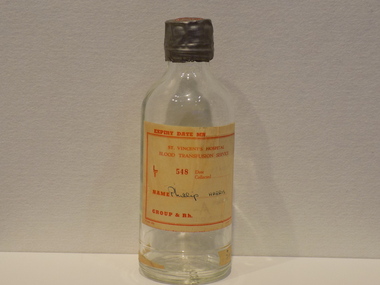
... staff. This team moved out to the wounded, rather than waiting for them to be stretchered back. ...staff. This team moved out to the wounded, rather than waiting for them to be stretchered back. ...Dr Alan Holmes á Court enlisted in the Australian Army in 1916 as a medical officer with the rank of Captain. In 1918, Holmes á Court was promoted to Major and attached to the 4th Australian Field Ambulance on the Western Front. As the front advanced, the Casualty Clearing Stations became further removed from the battlefield, creating an urgent need for immediate resuscitation prior to transfer back to the CCS. In June 1918, Holmes a Court and his colleagues established a forward resuscitation team. The team consisted of one doctor trained in surgery, blood transfusion and resuscitation, another doctor trained in anaesthesia, resuscitation and blood classification, and four other assisting staff. This team moved out to the wounded, rather than waiting for them to be stretchered back. They provided on-the-spot, life-saving resuscitation. The wounded were then transported back to the Casualty Clearing Station or Regimental Aid Post for further treatment. Among the assorted surgical and resuscitation equipment carried by the forward resuscitation team, were a number of Kimpton-Brown flasks. Blood was collected from patients with minor injuries using the flask. It was then administered to those in need, after establishing their blood type. Citrated blood was introduced by the Americans in 1917. This allowed blood administration to be delayed for up to two hours but there were many problems with transport, storage and infection in these early experimental days.Round, clear glass bottle with white [discoloured] paper label, with red printed, and metal screw-top lid.Handwritten on white [discoloured] paper label: Phillip HARRIS Moulded into the top of the screw-top lid in red ink: RED CROSS BLOOD TRANSFUSION SERVICEblood transfusion, red cross, world war one -
 Geoffrey Kaye Museum of Anaesthetic History
Equipment - Cannula, Transfusion
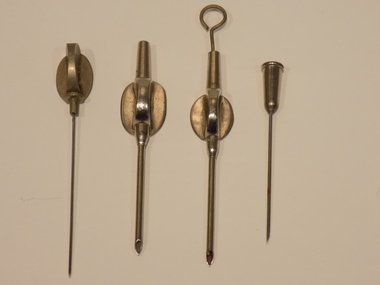
... staff. This team moved out to the wounded, rather than waiting for them to be stretchered back. ...staff. This team moved out to the wounded, rather than waiting for them to be stretchered back. ...Doctors trained in blood transfusion were essential to the development of Forward Resuscitation Teams during World War I. In 1918, Dr Alan Holmes a Court and his colleagues established a resuscitation team and, following their remarkable success at the battle of Hamel on July 4, teams were permanently established at each of the five Australian divisions. Each team consisted of one doctor trained in surgery, blood transfusion and resuscitation, another doctor trained in anaesthesia, resuscitation and blood donor classification, and four other assisting staff. This team moved out to the wounded, rather than waiting for them to be stretchered back. They provided on-the-spot, life-saving resuscitation. The wounded were then transported back to the Casualty Clearing Station or Regimental Aid Post for further treatment.A selection of metal cannula of various designs and sizes.blood, transfusion, intravenous, cannula -
Port Melbourne Historical & Preservation Society
Photograph - Starch factory, 1994
... Donor had this print made for display purposes, from a neg belonging to the PMCC Engineering staff; one of a series shot by a staff member from vantage points relating to 19th C photos belonging to the city (in this case, beside the Lagoon) Built Environment - Industrial Colour photo of 'starch factory' (former Harper's factory) from corner West Esplanade and Beach Street late 1980s/early 1990s- building as shell only, waiting redevelopment Photograph Starch factory ...Donor had this print made for display purposes, from a neg belonging to the PMCC Engineering staff; one of a series shot by a staff member from vantage points relating to 19th C photos belonging to the city (in this case, beside the Lagoon)Colour photo of 'starch factory' (former Harper's factory) from corner West Esplanade and Beach Street late 1980s/early 1990s- building as shell only, waiting redevelopmentbuilt environment - industrial -
 Otway Districts Historical Society
Photograph, Gwen Armistead, Gellibrand Station Master and Tea Room staff, c.1920, c.1920
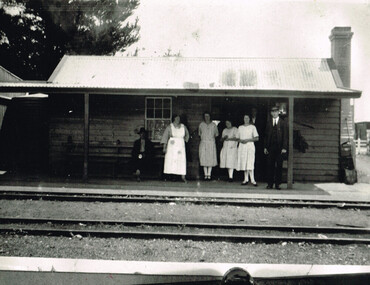
... Gellibrand station was one of the larger and more important stations possessing a waiting room, station office, parcels shed and refreshment room joined by a common verandah. The refreshment room was managed for many years by Mrs. O'Neill who, with her staff...Gellibrand station was one of the larger and more important stations possessing a waiting room, station office, parcels shed and refreshment room joined by a common verandah. The refreshment room was managed for many years by Mrs. O'Neill who, with her staff ...Gellibrand station was one of the larger and more important stations possessing a waiting room, station office, parcels shed and refreshment room joined by a common verandah. The refreshment room was managed for many years by Mrs. O'Neill who, with her staff, around 1920, offered a hot meal for one shilling. In the afternoon, a "cuppa and rock cakes" was available to passengers on the train to Colac. Other patrons were workers from the various establishments in the railway yard.Gellibrand Station Master and Refreshment Room staff, plus two men, under the verandah of the Refreshment Rooms, in front of two railway lines.gellibrand; railways; refreshments; mrs. o'neill; -
 National Vietnam Veterans Museum (NVVM)
Photograph, Gibbons, Denis, Cannon Battery
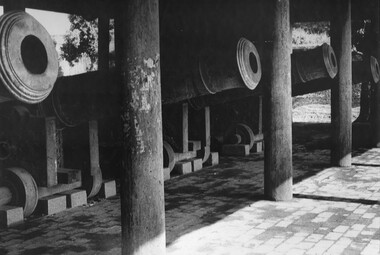
... The cannon appear to be waiting for the warlords' hordes to attach from the north. The cannon are kept in very good order and condition by staff at the palace. ...The cannon appear to be waiting for the warlords' hordes to attach from the north. The cannon are kept in very good order and condition by staff at the palace. ...The cannon appear to be waiting for the warlords' hordes to attach from the north. The cannon are kept in very good order and condition by staff at the palace. ...A black and white photograph of a part of a battery of large cannon sit in their bay at the Imperial Palace Hue, South Vietnam. The cannon appear to be waiting for the warlords' hordes to attach from the north. The cannon are kept in very good order and condition by staff at the palace. (circa April 1966)A black and white photograph of a part of a battery of large cannon sit in their bay at the Imperial Palace Hue, South Vietnam. The cannon appear to be waiting for the warlords' hordes to attach from the north. The cannon are kept in very good order and condition by staff at the palace. (circa April 1966)photograph, imperial palace, hue, gibbons collection catalogue, cannon, denis gibbons -
 National Vietnam Veterans Museum (NVVM)
Photograph, Gibbons, Denis, Medivac Day
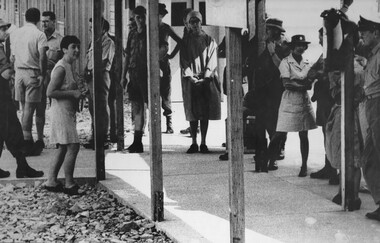
... A black and white photograph of Medivac Day at the 1st Australian Field Hospital, Vung Tau, South Vietnam, hospital staff, females from left, Lt Ruth Page, Capt June Minchow and Dr Shirley Coughlan wait to say farewell to the boys returningto Australia on the RAAF C130 flight....Photograph 1st Australian Field Hospital Vung Tau Lt Ruth Page Capt June Minchow Dr Shirley Coughlan RAAF C130 Medivac Flight Gibbons Collection Catalogue Denis Gibbons A black and white photograph of Medivac Day at the 1st Australian Field Hospital, Vung Tau, South Vietnam, hospital staff, females from left, Lt Ruth Page, Capt June Minchow and Dr Shirley Coughlan wait to say farewell to the boys returningto Australia on the RAAF C130 flight. ...Denis Gibbons (1937 – 2011) Trained with the Australian Army, before travelling to Vietnam in January 1966, Denis stayed with the 1st Australian Task Force in Nui Dat working as a photographer. For almost five years Gibbons toured with nine Australian infantry battalions, posting compelling war images from within many combat zones before being flown out in late November 1970 after sustaining injuries. The images held within the National Vietnam Veterans Museum make up the Gibbons Collection. A black and white photograph of Medivac Day at the 1st Australian Field Hospital, Vung Tau, South Vietnam, hospital staff, females from left, Lt Ruth Page, Capt June Minchow and Dr Shirley Coughlan wait to say farewell to the boys returningto Australia on the RAAF C130 flight.photograph, 1st australian field hospital, vung tau, lt ruth page, capt june minchow, dr shirley coughlan, raaf, c130 medivac flight, gibbons collection catalogue, denis gibbons -
 National Vietnam Veterans Museum (NVVM)
Book, McHugh, Siobhan, Minefields And Miniskirts: Australian Women And The Vietnam War, 2005
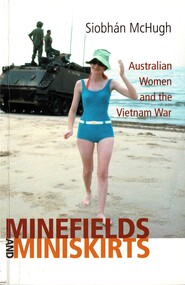
... It tells the gripping and extraordinary real-life stories of thirty-five women who went to Vietnam as nurses, journalists, entertainers, volunteers and consular staff, along with those of women who waited at home for their shatters husbands, fathers, brothers and sons to return. ...Moving, enlightening and sometimes shocking, Minefields and Miniskirts broke new ground when first published in 1993. It tells the gripping and extraordinary real-life stories of thirty-five women who went to Vietnam as nurses, journalists, entertainers, volunteers and consular staff, along with those of women who waited at home for their shatters husbands, fathers, brothers and sons to return.Moving, enlightening and sometimes shocking, Minefields and Miniskirts broke new ground when first published in 1993. It tells the gripping and extraordinary real-life stories of thirty-five women who went to Vietnam as nurses, journalists, entertainers, volunteers and consular staff, along with those of women who waited at home for their shatters husbands, fathers, brothers and sons to return. 1961-1975 - women - australia, vietnam war, 1961-1975- women - interviews, nurses, journalists, entertainers, volunteer workers, consular staff -
 Kiewa Valley Historical Society
Photographs - Tawonga District General Hospital - Set of 21
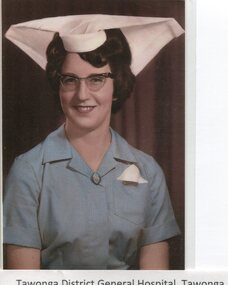
... waiting for patients at Tawonga Hospital. Complete with lovely vases of flowers for every bed. Nice touch by the nurses; 12. Kitchen of Tawonga District General Hospital, Mt Beauty. The hospital kitchen provided meals for patients and a 3 course dinner for Meals on Wheels. In 1977, 11,795 meals were produced at an average cost of $2.60 per meal; 13. Tawonga District General Hospital, Tawonga. Kitchen. Kitchen staff...waiting for patients at Tawonga Hospital. Complete with lovely vases of flowers for every bed. Nice touch by the nurses; 12. Kitchen of Tawonga District General Hospital, Mt Beauty. The hospital kitchen provided meals for patients and a 3 course dinner for Meals on Wheels. In 1977, 11,795 meals were produced at an average cost of $2.60 per meal; 13. Tawonga District General Hospital, Tawonga. Kitchen. Kitchen staff ...In the early stages of the Kiewa Hydro-Electric Scheme the State Electricity Commission took over the financial and construction responsibility of the Tawonga District General Hospital building at a cost of 27,000 pounds. This included the removal and re-erection of the ex-military Bonegilla ward from Wodonga while in addition they carried out all the necessary building works that allowed the hospital to operate as a functional unit. The work was completed and handed over to the Hospital Committee of Management on September 1, 1949. Local residents raised 3,400 pounds through fund raising. The balance was met by the SEC and the Hospital and Charities Commission. The initial project was to provide for a basic temporary hospital which was later to include an Operating Theatre, Offices, Store, Mortuary and a Nurse’s Home, until the establishment of a permanent medical premises. Following the opening, 455 patients were admitted to the Tawonga District General Hospital and 254 operations were performed in the first year. The hospital relocated to Mount Beauty in the former SEC administration offices located in the town centre. Official opening of the 18 bed Tawonga District General Hospital on April 29 in 1961. Alpine Health CEO Mr Lyndon Seys oversaw the opening of the new Mount Beauty Hospital in November 2001 alongside Board of Management President Mr Andrew Randell, other board members and politicians. The Kiewa Hydro-Electric Scheme the State Electricity Commission played a pivotal part in the planning and initial funding of the Tawonga District General Hospital, with a view to providing medical support for its many workers on the Hydro scheme. Later, spouse and family members of workers were also able to access medical assistance The hospital was originally located in Tawonga away from the majority of the patients as the Hospital and Charities Board was not prepared to have it within the SEC controlled area. It was not until the gate at Tawonga South was taken down that the hospital was moved to the main centre of population at Mount Beauty. 1. Early nurses uniform; 2. Hospital Opening Ceremony; 3-7. Nursing Staff; 8. Delivery Room; 9. Mens Ward; 10.Enclosed Veranda; 11. Main Ward; 12-13. Kitchen; 14. Opening Ceremony 1949; 15.Original Hospital at Tawonga; 16-18. Relocated Hospital at Mt Beauty; 19. Rear of hospital and Matron’s quarters; 20. Hospital and Kiewa Valley House; 21. Renovated Hospital in 20001.Tawonga District General Hospital Tawonga; 2. Kiewa construction engineer Mr HHC Williams speaking at the opening of the hospital. Health Minister the Hon CP Gartside performed the official opening. L to R: TH Mitchell MLA; Manager of the hospital Mr RH Kronberg (obscured) Hon CP Gartside; CL McVilley; LT Knevitt; Matron AI Tarnish & W Sealey: 4. Dedicated Nursing Staff; 5. Nurse Campbell (nee Reid); 6. Sister Seager 1955 (nee Janice Burnett. First District Nurse; 7. L to R: Sister F Rosengrove; Sister J Griffiths; Matron AI Tarnish; Nurse D Satori; Nurse D Tregonning; Sister E Hill & Sister S O’Shannessy; 8. In the early years Tawonga District General Hospital had the second highest birth rate in Australia; 9. The men’s ward catered for men only in the early years of the hospitals operation; 10. The enclosed verandah at the original Tawonga District General Hospital allowed for an additional 10 beds; 11. Tawonga District General Hospital, Tawonga Main Ward. Ward ready and waiting for patients at Tawonga Hospital. Complete with lovely vases of flowers for every bed. Nice touch by the nurses; 12. Kitchen of Tawonga District General Hospital, Mt Beauty. The hospital kitchen provided meals for patients and a 3 course dinner for Meals on Wheels. In 1977, 11,795 meals were produced at an average cost of $2.60 per meal; 13. Tawonga District General Hospital, Tawonga. Kitchen. Kitchen staff employed in the old Tawonga District General Hospital 1949-1961; 14. The official opening ceremony of the Tawonga District General Hospital, 1949. The official ceremony was attended by a large number of residents and Tawonga District General Hospital was open for public inspection; 15. Original Tawonga District General Hospital transported form Bonegilla began operations in 1949; 16. In 1961, the Tawonga District General Hospital relocated to take a central position in the town of Mt Beauty in the former SEC Administration building; 19. The rear of the Tawonga District General Hospital and Matron’s house seen from Holland St, Mt Beauty during a snow storm in the mid 1960’s; 21. Tawonga District General Hospital & Kiewa Valley House, 2000. tawonga district hospital, mt beauty hospital, medical, health care, s.e.c. -
 Kiewa Valley Historical Society
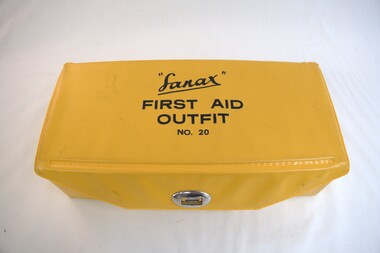
First Aid Kit, 1984
... wait for access to medical assistance. This portable first aid kit was owned by a local Mt Beauty resident, Allan S. Clarke who was a long term staff ...The State Electricity Commission of Victoria supplied First Aid Kits to its employees and 'ran' an ambulance during the construction of the Kiewa Hydro Electric Scheme (KHES). The KHES was constructed at the upper end of the Kiewa Valley in the Victorian mountains on the Bogong High Plains. This area is remote with difficult terrain requiring people working and enjoying recreational activities to carry a first aid kit in case of emergency. This First Aid kit is light and portable enabling the user to 'fix' minor injuries and wait for access to medical assistance.This portable first aid kit was owned by a local Mt Beauty resident, Allan S. Clarke who was a long term staff employee for the State Electricity Commission of Victoria.First Aid Outfit (Kit), No.20 by "Sanax". Yellow plastic covered cardboard box with lid fastened by a metal swivel clasp. Complete with unused original contents displayed on two levels. On the top level - Absorbent lint in clear plastic bag; roll of Johnson's Cotton Wool in soft plastic; Plastic container of Sanax Aspirin tablets; glass bottle with brown plastic lid of Calamine Lotion; and steel scissors, safety pins and tweezers in small clear plastic bag. On the second/ bottom level - in a brown glass jar with brown plastic lid "Kuraburn for the treatment of Minor burns"; in a brown glass jar with brown plastic lid "Zeptic" (antiseptic); Johnson's Bandaids of varying shapes in a clear plastic bag; in a brown glass bottle with a brown plastic lid "Germistatic" (antiseptic); 2 packets of 4 Gauze bandages in clear plastic bags; and 1 large absorbent Gauze bandage in clear plastic bag.first aid kit; kiewa hydro electric scheme; sandax; medical aids; -
 Ballarat Tramway Museum
Film - Movie Film & Box, 1971
... staff. (Sound) 1:36 Sequence varying scenes about the 60th anniversary of trams in Ballarat, including on tram, people, No. 18 leaving the depot with the 60th anniversary dash front panel for the event. 2:16 Courier poster “SEC Says: Trams should be scrapped” 2:23 Lydiard St Nth terminus, ladies waiting at terminus shelter, and No. 43 arriving at terminus 2:36 Front of bus with bus destination roll being scrolled, Creswick, Wendouree, Mt Pleasant, view of a Davis Bus outside the Town Hall, view of people (guests) chatting on the bus, all looking very happy, and view of bus travelling along. 3:15 No. 33 and bus, showing special alongside at Victoria St terminus and back to bus interior shot. 3:25 No. 12 loaded on a truck and leaving from insider the depot and out in Wendouree Parade with jacks on rear of truck. 3:59 No. 33 loaded for Hamilton leaving Ballarat (note without the truck attached), and being backed into position for offloading. 4:42 No. 41 loaded on a truck, being backed into an position to be offloaded 4.54 No. 36 with Tourism Week Sign being prepared and lifted at the depot. 5:29 End. ...staff. (Sound) 1:36 Sequence varying scenes about the 60th anniversary of trams in Ballarat, including on tram, people, No. 18 leaving the depot with the 60th anniversary dash front panel for the event. 2:16 Courier poster “SEC Says: Trams should be scrapped” 2:23 Lydiard St Nth terminus, ladies waiting at terminus shelter, and No. 43 arriving at terminus 2:36 Front of bus with bus destination roll being scrolled, Creswick, Wendouree, Mt Pleasant, view of a Davis Bus outside the Town Hall, view of people (guests) chatting on the bus, all looking very happy, and view of bus travelling along. 3:15 No. 33 and bus, showing special alongside at Victoria St terminus and back to bus interior shot. 3:25 No. 12 loaded on a truck and leaving from insider the depot and out in Wendouree Parade with jacks on rear of truck. 3:59 No. 33 loaded for Hamilton leaving Ballarat (note without the truck attached), and being backed into position for offloading. 4:42 No. 41 loaded on a truck, being backed into an position to be offloaded 4.54 No. 36 with Tourism Week Sign being prepared and lifted at the depot. 5:29 End. ...Yields information in movie film format of Ballarat trams and news stories in the period 1965 to 1971 - BTV6 16mm film format., Yields information in movie film format of Ballarat trams and news stories in the period 1965 to 1971 - BTV6 16mm film format.Movie film - 16mm, approx. 5:29 mins, with grey leader strip on a blue plastic Tuscan Reel, with sound track, leader and timer count down strip; c1965 to 1971. Has been transferred to DVD - see Reg item 4100 as Segment No. 7. Compiled from BTV6 film by Paul McDonald c1990. Synopsis: based on time - Black and white film. Title "Ballarat trams" 0:00 Bogie tram arriving behind another bogie tram at the City Centre, Sturt St nth side, passengers boarding tram, view of destination, Mt. Pleasant, Lydiard St Nth, view of Sturt St, north side, with motor vehicles and building in street, and No. 41 turning from Sturt St into Lydiard St. 0:42 Short sequence of a bogie tram in Sturt St, view from window and a driver working the controller. 0:58 Interview on tram with two ladies about the tram service and the staff. (Sound) 1:36 Sequence varying scenes about the 60th anniversary of trams in Ballarat, including on tram, people, No. 18 leaving the depot with the 60th anniversary dash front panel for the event. 2:16 Courier poster “SEC Says: Trams should be scrapped” 2:23 Lydiard St Nth terminus, ladies waiting at terminus shelter, and No. 43 arriving at terminus 2:36 Front of bus with bus destination roll being scrolled, Creswick, Wendouree, Mt Pleasant, view of a Davis Bus outside the Town Hall, view of people (guests) chatting on the bus, all looking very happy, and view of bus travelling along. 3:15 No. 33 and bus, showing special alongside at Victoria St terminus and back to bus interior shot. 3:25 No. 12 loaded on a truck and leaving from insider the depot and out in Wendouree Parade with jacks on rear of truck. 3:59 No. 33 loaded for Hamilton leaving Ballarat (note without the truck attached), and being backed into position for offloading. 4:42 No. 41 loaded on a truck, being backed into an position to be offloaded 4.54 No. 36 with Tourism Week Sign being prepared and lifted at the depot. 5:29 End. Placed in a blue cardboard box specially made for the item 30/08/2010.trams, tramways, ballarat, city centre, lydiard st nth, buses, davis bus lines, tram disposal, tram 33, tram 41, tram 36, tram 18 -
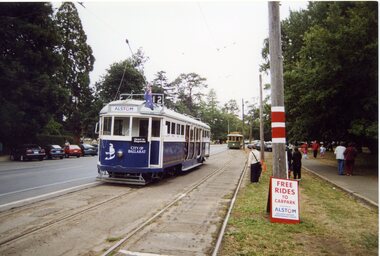 Ballarat Tramway Museum
Photograph - Colour Photograph/s - set of 37, Warren Doubleday, 7/03/2004 12:00:00 AM
... staff. All taken in Wendouree Parade. .1 - 671 waiting for 27 to enter the crossing loop .2 - 671 and 27 in loop .3 - ditto .4 - people boarding No. 27 with Carolyn Dean observing .5 - ditto, with Peter Winspur in background .6 - 671 in loop .7 - 27 and 671 in loop, with people leaving 671 .8 - 661 in Wendouree Parade, at pedestrian crossing .9 - 671, 27 and 661 in loop .10 - ditto with people leaving 661 .11- 661 in loop passengers boarding, John Clowes in photo .12 - 33 and 671 at pedestrian crossing .13 - ditto .14 - 27 side on .15 - 33, 671, 661 and 27 in or near loop .16 - ditto .17 - 33 at pedestrian crossing .18 - 661 side on .19 - 33 at pedestrian crossing with people board .20 - 33 side on .21 - ditto .22 - 661 near crossing .23 - 27 side on .24 - 27 in loop with people leaving .25 - 27 in loop with people waiting to board .26 - Robert Paroissien standing by 27 with 671 in background .27 - ditto .28 - Sam Boon issuing tickets inside 33 .29 - ditto .30 - Sam Boon giving bells .31 - Len Millar and 27 at Depot Junction .32 - 671 at depot junction .33 - Len Millar at 33 at Depot Junction .34 - 33 at Carlton St, with Ben Shields .35 - 27 at Carlton St from the Prisoners of War memorial .36 - ditto .37 - as for .25...staff. All taken in Wendouree Parade. .1 - 671 waiting for 27 to enter the crossing loop .2 - 671 and 27 in loop .3 - ditto .4 - people boarding No. 27 with Carolyn Dean observing .5 - ditto, with Peter Winspur in background .6 - 671 in loop .7 - 27 and 671 in loop, with people leaving 671 .8 - 661 in Wendouree Parade, at pedestrian crossing .9 - 671, 27 and 661 in loop .10 - ditto with people leaving 661 .11- 661 in loop passengers boarding, John Clowes in photo .12 - 33 and 671 at pedestrian crossing .13 - ditto .14 - 27 side on .15 - 33, 671, 661 and 27 in or near loop .16 - ditto .17 - 33 at pedestrian crossing .18 - 661 side on .19 - 33 at pedestrian crossing with people board .20 - 33 side on .21 - ditto .22 - 661 near crossing .23 - 27 side on .24 - 27 in loop with people leaving .25 - 27 in loop with people waiting to board .26 - Robert Paroissien standing by 27 with 671 in background .27 - ditto .28 - Sam Boon issuing tickets inside 33 .29 - ditto .30 - Sam Boon giving bells .31 - Len Millar and 27 at Depot Junction .32 - 671 at depot junction .33 - Len Millar at 33 at Depot Junction .34 - 33 at Carlton St, with Ben Shields .35 - 27 at Carlton St from the Prisoners of War memorial .36 - ditto .37 - as for .25 Photograph Colour Photograph/s - set of 37 Warren Doubleday ...Set of 37 photographs taken or arranged by Warren Doubleday on 7/3/2004 during the 2004 Begonia Festival, which was sponsored by Alstom, featuring on the destination boxes, stop signs and tramcars and clothing worn by BTM staff. All taken in Wendouree Parade. .1 - 671 waiting for 27 to enter the crossing loop .2 - 671 and 27 in loop .3 - ditto .4 - people boarding No. 27 with Carolyn Dean observing .5 - ditto, with Peter Winspur in background .6 - 671 in loop .7 - 27 and 671 in loop, with people leaving 671 .8 - 661 in Wendouree Parade, at pedestrian crossing .9 - 671, 27 and 661 in loop .10 - ditto with people leaving 661 .11- 661 in loop passengers boarding, John Clowes in photo .12 - 33 and 671 at pedestrian crossing .13 - ditto .14 - 27 side on .15 - 33, 671, 661 and 27 in or near loop .16 - ditto .17 - 33 at pedestrian crossing .18 - 661 side on .19 - 33 at pedestrian crossing with people board .20 - 33 side on .21 - ditto .22 - 661 near crossing .23 - 27 side on .24 - 27 in loop with people leaving .25 - 27 in loop with people waiting to board .26 - Robert Paroissien standing by 27 with 671 in background .27 - ditto .28 - Sam Boon issuing tickets inside 33 .29 - ditto .30 - Sam Boon giving bells .31 - Len Millar and 27 at Depot Junction .32 - 671 at depot junction .33 - Len Millar at 33 at Depot Junction .34 - 33 at Carlton St, with Ben Shields .35 - 27 at Carlton St from the Prisoners of War memorial .36 - ditto .37 - as for .25btm, begonia festival, alstom, wendouree parade, tram 33, tram 27, tram 661, tram 671 -
 National Wool Museum
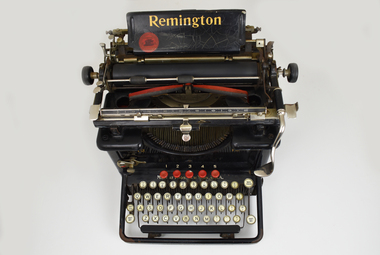
Functional object - Typewriter, Remington Typewriter Company, c.1925
... The office staff did not go home but waited until the first figures came back from the wool sales and the machines went in to action, both human and mechanical, preparing the invoices for the buyers’ firms. ...The office staff did not go home but waited until the first figures came back from the wool sales and the machines went in to action, both human and mechanical, preparing the invoices for the buyers’ firms. ...This Remington No.12 typewriter is of the typebar, front-strike class. It was made by the Remington Typewriter Company of Ilion, New York, U.S.A. in about 1925. The Model No. 12 was introduced in 1922 and was one of the first 'visible writer' machines, in which the typed characters were visible to the operator. Previous models were of the upstrike class in which the characters were typed on the underside of the platen. To see what had been typed the operator had to raise the platen, meaning the typist was typing blind much of the time. This machine was used by Margaret Ganly née Burn in the 1930s. It was purchased for her by one of the sons of William Pride, a famous saddle maker in Geelong, William was Margaret’s grandfather. The typewriter was donated with original sales receipt and servicing tools. Margaret worked at Dennys for 7 years during the 1930s. The typewriter is accompanied with a story written by Margaret about her time working at the company. Margret married Jack Ganly, a fellow employee of Dennys. The Ganly name was well known within Dennys, with three generations of the Ganly family working at the company. WORKING CONDITIONS & OFFICE WORK DUTIES. Written by Margaret Burn in 2021. Worked at Dennys Lascelles in the 1930s. In the 1930s coming out of the Depression, jobs were hard to come by and had to be clung to by efficiency and subserviency. There was no union to protect workers – bosses could be tough and rough. Dennys Lascelles revolved around fortnightly wool sales in the “season” – September to May. Sale day was always a day of suppressed excitement. Preparation from a clerical point of view was complete and we now awaited the aftermath of the actual wool auction. The building teemed with people. There were country people down to see their wool sold, buyers of many nationalities, or from the big cities, who were coming in and out of the building all day. Their role was to inspect the acres of wool bales displayed on the show floors; however, caterers were present to feed clients, and there was plenty of social interactions on top of business. The office staff did not go home but waited until the first figures came back from the wool sales and the machines went in to action, both human and mechanical, preparing the invoices for the buyers’ firms. This comprised of lists of lot numbers, weights, prices per lb., and the total prices paid. A lot of this was done by old-school typewriters, making this work a big, heavy, tiring job. Before the finished lists could be dispatched, they were collated on an “abstract”. The lists had to balance with the catalogue from which the invoices had been prepared. This never happened automatically. All the paperwork had to be split up amongst pairs of workers and checked until discrepancies were found. This would happen until midnight but occasionally went until 2 or 3 am. Once complete, the invoices could then be rushed off to the buyers’ firms usually in Melbourne, and hire cars took the staff home. It was back on the job the next morning, usually around 8.30. The office hours varied according to the size of the sale and work involved. Some days started as early as 8 and could finish around 5.30. The second phase of work began with the account sales to be prepared for the sellers of the wool. These detailed all the weights, descriptions of wool, brands, and prices. One Sales account could have multitudes of lot numbers, all needing to be individually described. Various charges needed to be deducted such as finance for woolpacks, extra stock, or farmers who were given a loan to live on during the season. Details of how payment was to be made was also noted, whether the seller was to be paid by cheque, to a bank, or credited to their account with the company (which often left the seller still in debt). For a couple of months in the winter, things were quieter when staff took holidays and were sometimes given afternoons off. But there were still weekly skin sales and stock sales around the state. The annual end of June figures to be prepared for a big company like Dennys with branches all around the state also kept the staff busy. In good years there was sometimes a bonus. On sale days there was a bar open for the clients and wool buyers. This added to the excitement for the young girls, who were strictly barred from using it, but somehow managed to sneak a gin and tonic. This is how I had my first ever, before the evening meal. There was also the romantic notion in some minds, with all the influx of males, that some of us might end up on a wealthy station, or be noticed by an exotic buyer. To my knowledge, this never happened at Dennys Lascelles Limited. Group staff photo at Dennys Lascelles Limited. Margaret Burn. Age 18 or 19. Jack Ganly (Margaret’s future husband). 22.The typewriter has a black painted metal frame. The top section of the typewriter consists of a cylindrical platen on a carriage featuring plated metal fittings. A curved folding paper guide sits behind the platen and moves on the horizontal axis when the user types on the keyboard. A horizontal semicircular type basket with typebar links the top section to the lower keyboard. The ink ribbon is carried between two spools on a horizontal axis, one on each side of the type-basket. At the rear, a paper tray features gold lettering which reads ‘Remington’. At the front, a four-row QWERTY keyboard is found with 42-character keys total. 'SHIFT LOCK' and 'SHIFT KEY' are to the left of the keyboard, 'BACK SPACER' and 'SHIFT KEY' to the right. All keys are circular, white with black lettering. At the top of the keyboard are five circular red keys with the numbers 1-5 displayed behind their respective keys. A Spacebar is found along the front of the keyboard. The typewriter is accompanied by a cardboard box. This box contains the original sales receipt, on blue paper with grey lead handwriting. It also contains spare parts, a spare ribbon stretched between two spools, and cleaning tools such as brushes of differing sizes. Serial Number. Engraved. "LX45395" Gold lettering. Paper tray. “Remington” Gold Lettering. Behind keyboard. “Made in Ilion, New York, U.S.A. Gold Lettering. Mirrored both sides of type-basket. “12”remington, dennys lascelles ltd, worker conditions 1930s -
 National Wool Museum
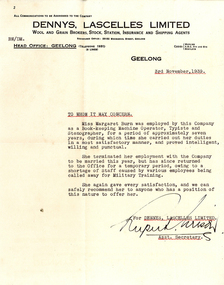
Letter - Letter of reference for Margaret Burn, 03/11/1939
... The office staff did not go home but waited until the first figures came back from the wool sales and the machines went in to action, both human and mechanical, preparing the invoices for the buyers’ firms. ...The office staff did not go home but waited until the first figures came back from the wool sales and the machines went in to action, both human and mechanical, preparing the invoices for the buyers’ firms. ...Letter of Reference for Miss Margaret Burn detailing her work as a bookkeeper, machine operator, typist, and stenographer over seven years at Dennys Lascelles Limited. The letter details her leaving the company as she married in 1939. In the same year, Ms Burn returned to the office owing to the shortage of staff caused by various employees being called away for Military Training. Included in the staff called away for military training was her newlywed husband, Mr Jack Ganly. A fellow employee of Dennys, the Ganly name was well known within the company, with three generations of the Ganly family working at Dennys. Margaret worked at Dennys for 7 years during the 1930s. The Letter of Reference is accompanied with a story written by Margaret about her time working at the company. WORKING CONDITIONS & OFFICE WORK DUTIES. Written by Margaret Burn in 2021. Worked at Dennys Lascelles in the 1930s. In the 1930s coming out of the Depression, jobs were hard to come by and had to be clung to by efficiency and subserviency. There was no union to protect workers – bosses could be tough and rough. Dennys Lascelles revolved around fortnightly wool sales in the “season” – September to May. Sale day was always a day of suppressed excitement. Preparation from a clerical point of view was complete and we now awaited the aftermath of the actual wool auction. The building teemed with people. There were country people down to see their wool sold, buyers of many nationalities, or from the big cities, who were coming in and out of the building all day. Their role was to inspect the acres of wool bales displayed on the show floors; however, caterers were present to feed clients, and there was plenty of social interactions on top of business. The office staff did not go home but waited until the first figures came back from the wool sales and the machines went in to action, both human and mechanical, preparing the invoices for the buyers’ firms. This comprised of lists of lot numbers, weights, prices per lb., and the total prices paid. A lot of this was done by old-school typewriters, making this work a big, heavy, tiring job. Before the finished lists could be dispatched, they were collated on an “abstract”. The lists had to balance with the catalogue from which the invoices had been prepared. This never happened automatically. All the paperwork had to be split up amongst pairs of workers and checked until discrepancies were found. This would happen until midnight but occasionally went until 2 or 3 am. Once complete, the invoices could then be rushed off to the buyers’ firms usually in Melbourne, and hire cars took the staff home. It was back on the job the next morning, usually around 8.30. The office hours varied according to the size of the sale and work involved. Some days started as early as 8 and could finish around 5.30. The second phase of work began with the account sales to be prepared for the sellers of the wool. These detailed all the weights, descriptions of wool, brands, and prices. One Sales account could have multitudes of lot numbers, all needing to be individually described. Various charges needed to be deducted such as finance for woolpacks, extra stock, or farmers who were given a loan to live on during the season. Details of how payment was to be made was also noted, whether the seller was to be paid by cheque, to a bank, or credited to their account with the company (which often left the seller still in debt). For a couple of months in the winter, things were quieter when staff took holidays and were sometimes given afternoons off. But there were still weekly skin sales and stock sales around the state. The annual end of June figures to be prepared for a big company like Dennys with branches all around the state also kept the staff busy. In good years there was sometimes a bonus. On sale days there was a bar open for the clients and wool buyers. This added to the excitement for the young girls, who were strictly barred from using it, but somehow managed to sneak a gin and tonic. This is how I had my first ever, before the evening meal. There was also the romantic notion in some minds, with all the influx of males, that some of us might end up on a wealthy station, or be noticed by an exotic buyer. To my knowledge, this never happened at Dennys Lascelles Limited. Group staff photo at Dennys Lascelles Limited. Margaret Burn. Age 18 or 19. Jack Ganly (Margaret’s future husband). 22. Sheet of paper shorter in length than A4 size, creamed with age. Paper has a header for Dennys, Lascelles Limited’s Head Office at 32 Moorabool Street, Geelong. Body of paper is made up of 3 paragraphs in a typewritten message of black ink with subheadings highlighted with a red underline. The text is finished with a signature at the bottom of the paper. Paper is accompanied by its original envelope. Envelope has typewritten text in black ink with a red underline located at the centre. It also has return to sender instructions to Dennys, Lascelles Limited in the lower left-hand corner.Typewritten text, black and red ink. Multiple. See multimediadennys lascelles ltd, worker conditions 1930s, letter of reference -
Tatura Irrigation & Wartime Camps Museum
Wages Ledger Shire of Rodney, 1950
... Includes office staff, saleyards, abbatoirs, infant welfare sisters, truck drivers tatura shire of rodney wages council martin neill lange french muir mellows hogan mills steen huggard chalker maclennan price clayton forbes burke pell hawking hazelman stagg maskell pyke taylor whitehead willmott colliver connor corrigan glover hinneberg hooper ibbott adams page nelson sheales trevaskis anderson knee barber young dick flintoff dudley coonerty nevett shead gilmore gemmill mclure clarke cantwell mark seamons maclachlan wain macmahon bartlett brown whyte evans cole harten king preece clark gillespie george woodman wheeler hulley steddar thomson neal henderson waites gannon mckenzie gaunt wright jones power dogherty birthisel crawford de lai baldwin pearson carter padgham ponting hargreaves mcwhinney matthews nicholl webb mcphee bennett conley guy dempsey o'brien gundry holden graves thornton hays harding kerrins knott smith williams thomas lindsay mccartney londrigan hall asboth hearn mcinnes collie rodney shire accounts Hard dark green leather cover with beige suede corners and spine. ...Wages ledger for Shire of Rodney from 1950 - 1955. Includes office staff, saleyards, abbatoirs, infant welfare sisters, truck driversHard dark green leather cover with beige suede corners and spine. Title "Shire of Rodney" on red panel with silver lettering on spine. "July 1950 to June 1955" written in pen on spinetatura, shire of rodney, wages, council, martin, neill, lange, french, muir, mellows, hogan, mills, steen, huggard, chalker, maclennan, price, clayton, forbes, burke, pell, hawking, hazelman, stagg, maskell, pyke, taylor, whitehead, willmott, colliver, connor, corrigan, glover, hinneberg, hooper, ibbott, adams, page, nelson, sheales, trevaskis, anderson, knee, barber, young, dick, flintoff, dudley, coonerty, nevett, shead, gilmore, gemmill, mclure, clarke, cantwell, mark, seamons, maclachlan, wain, macmahon, bartlett, brown, whyte, evans, cole, harten, king, preece, clark, gillespie, george, woodman, wheeler, hulley, steddar, thomson, neal, henderson, waites, gannon, mckenzie, gaunt, wright, jones, power, dogherty, birthisel, crawford, de lai, baldwin, pearson, carter, padgham, ponting, hargreaves, mcwhinney, matthews, nicholl, webb, mcphee, bennett, conley, guy, dempsey, o'brien, gundry, holden, graves, thornton, hays, harding, kerrins, knott, smith, williams, thomas, lindsay, mccartney, londrigan, hall, asboth, hearn, mcinnes, collie, rodney shire, accounts -
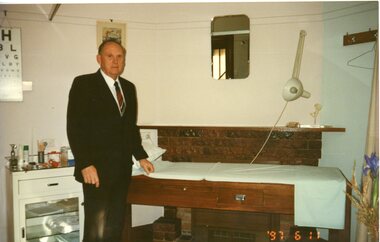 Stawell Historical Society Inc
Photograph, 1985 & 1997 Renovations to 28 Wimmera Street. Stawell Medical Centre
... waiting room. One showing the reception area The other showing some of the staff of the Medical centre ...waiting room. One showing the reception area The other showing some of the staff of the Medical centre Red photo album with Gold Embossing. ...1985 Addition of new wing 1975 Modification and Reception Area Two Photos show Dr Norman Castle One showing the modifications to waiting room. One showing the reception area The other showing some of the staff of the Medical centre Red photo album with Gold Embossing. A Selection of 5 Photographs from the album
