
Showing 21 items matching "wallpapered ceilings"
-
 Villa Alba Museum
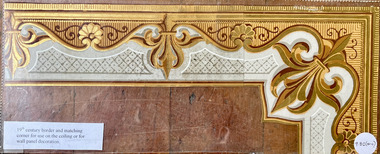
Wallpaper sample - Border and matching corner, 19th century
... ...wallpapered ceilings...Heritage interiors Wallpapers 19th century design wallpaper borders wallpaper corners wallpapered ceilings P. B2 (m-c) 19th century border and matching corner for use as architectural detailing on a ceiling or for wall panel decoration. ...Part of a collection of historic wallpapers collected by Phyllis Murphy, most of whose wallpapers were donated to the collection of Historic Houses Sydney. This wallpaper sample, annotated and encased in mylar was used by Phyllis for educational purposes, and donated by her son to Villa Alba Museum's collection in 2025.19th century border and matching corner for use as architectural detailing on a ceiling or for wall panel decoration. The pattern includes: whiplash curves, botanical inspiration and geometric accents. The central motif resembles a stylised flowerer lily. The flanking diamond mesh pattern (lattice style) provide a structured contrast to the central figure. The middle of the design, to be used as a dado or on a ceiling, simulates varnished planks of wood. P. B2 (m-c)heritage interiors, wallpapers, 19th century design, wallpaper borders, wallpaper corners, wallpapered ceilings -
 Port Melbourne Historical & Preservation Society
Domestic object - Wallpaper, Council meeting room, 1930s
... Three small fragments of wallpaper from the vaulted ceiling of the original council meeting room of the 1882 building (i.e. southern end, first floor)...Port Melbourne Town Hall Built Environment - Civic Stained and faded with age Three small fragments of wallpaper from the vaulted ceiling of the original council meeting room of the 1882 building (i.e. southern end, first floor) Domestic object Wallpaper, Council meeting room ...Three small fragments of wallpaper from the vaulted ceiling of the original council meeting room of the 1882 building (i.e. southern end, first floor)Stained and faded with ageport melbourne town hall, built environment - civic -
 Glen Eira Historical Society
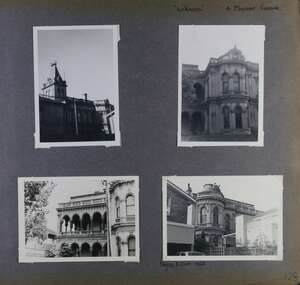
Album - Album page, Labassa, 4 Manor Grove, Circa 1972
... These include wallpapers, ceiling decoration, chimney pieces, mouldings, joinery and decorative glass. ...These include wallpapers, ceiling decoration, chimney pieces, mouldings, joinery and decorative glass. ...This photograph is part of the Caulfield Historical Album 1972. This album was created in approximately 1972 as part of a project by the Caulfield Historical Society to assist in identifying buildings worthy of preservation. The album is related to a Survey the Caulfield Historical Society developed in collaboration with the National Trust of Australia (Victoria) and Caulfield City Council to identify historic buildings within the City of Caulfield that warranted the protection of a National Trust Classification. Principal photographer thought to be Trevor Hart, member of Caulfield Historical Society. Most photographs were taken between 1966-1972 with a small number of photographs being older and from unknown sources. All photographs are black and white except where stated, with 386 photographs over 198 pages. HISTORY:-- From Victorian Heritage Database citation for Labassa https://vhd.heritagecouncil.vic.gov.au/places/278 as at (26/10/2020) Labassa, Caulfield is one of Melbourne's most lavishly decorated nineteenth century mansions. It resulted from the extensive remodelling in 1890, of an earlier house, known as Sylliott Hill, which was begun in 1862-3 for lawyer, Richard A. Billing. The land at the corner of Balaclava and Orrong Roads was first acquired in 1854 by William Lyall, transferred to his partner, John Mickle, in 1859, who also acquired the adjoining allotment in Balaclava Road, and the three allotments were conveyed to Billing. His first eight-roomed house was extended significantly in 1873 into a twenty-roomed house by architects Crouch and Wilson, who were possibly also responsible for the first house. This reflected Billing's success as a barrister, and he resided at this property until his death in 1882. In 1883 prominent Melbourne businessman, Alexander William Robertson, leased the Sylliott Hill property from Billing's widow, and in 1885 he purchased the adjoining allotment in Balaclava Road. He purchased the Billing's property in 1887 and renamed the 6.31 hectare property, Ontario. In 1889-90, Robertson commissioned the German born architect, John A. B. Koch, to extensively remodel the house into a thirty-five roomed mansion. The existing house was extended and altered, largely resulting in the nineteenth century mansion as it now appears. After Robertson's death in 1896, the house was tenanted until it was eventually sold to the mining millionaire, John Boyd Watson, in 1904. He renamed the property Labassa and carried out repair and re-decoration work to the house. In the early twentieth century, many large estates were subdivided into smaller allotments as the demand for land grew and it became difficult to maintain such large estates. After Watson's death in 1911, portions of the Labassa estate were offered for sale, with Mrs Watson retaining a 1.73 hectare portion containing the house. In 1913 forty-six allotments were auctioned at Labassa Estate, with the formation of Labassa Grove and Ontario Street to the east of the property. Labassa was first recorded as containing flats in 1923 and in the late 1920s, the owner, Robert Hannon, built a red brick block of flats adjacent to the house. Subdivision continued, until the National Trust of Australia (Victoria) purchased the house in 1980 and subsequently purchased adjoining sites, one to the south-east in 1984 (house demolished in 1988) and to the west in 1988. Labassa as it now stands is substantially as it appeared when Koch completed the work in 1890. The original two storey house was transformed into a French Renaissance style mansion, with the addition of a two level L-shaped arcaded verandah and two prominent terminating bays to the south and the east. The building is of unpainted cement render with dressed bluestone plinths, balustraded parapet and steep, slate covered, flat topped mansard roofs behind. A truncated conical roof is a feature of the south bay and a helmeted head is incorporated in the parapet over the east bay. The main south and east facades incorporate many cast cement details, including sculptures, elaborate cornices, swagged Corinthian columns and caryatid consoles flanking the entrance porch, as well as pink marble panels and imitation marble, or scagliola, on curved surfaces. At the rear of the building is a two storey wing and a single storey cottage, the former being connected to the main house by a tower. This section of the house was constructed in 1873. The estate at its peak included stables (1873), conservatory (probably 1890) and a tennis pavilion (probably 1890). All of these outbuildings survive, with the stables and conservatory being converted for residential use after 1922. Internally a range of decorative treatments remain from the late nineteenth century and the early twentieth century, both from the Robertson and Watson periods of occupancy. These include wallpapers, ceiling decoration, chimney pieces, mouldings, joinery and decorative glass. From Victorian Heritage Database citation for H0135 Labassa 2/2A Manor Grove Caulfield North https://vhd.heritagecouncil.vic.gov.au/places/278 as at (26/10/2020) HOW IS IT SIGNIFICANT? Labassa, Caulfield is of architectural, aesthetic and historical significance to the State of Victoria. WHY IS IT SIGNIFICANT? Labassa, Caulfield is of architectural significance as the most prominent example of a small number of houses built in Australia in the French Renaissance style. It is of further note due to the German interpretation of the style and the use of Hellenistic sources, via Germany. It is exceptional for its lavish treatment externally, including marble, scagliola, caryatids, swagged columns, mansard roofs and ornamental cresting. Labassa is of architectural significance as the most important surviving example of German architect, John Koch's domestic work. He undertook a large variety of work in Melbourne, including a number of houses, however Labassa is the most lavish example of his work. Labassa is of aesthetic significance for its outstanding assemblage of late nineteenth and early twentieth century European style interior decoration, which remain remarkably intact. These include a trompe l'oeil ceiling, painted ceilings, embossed imitation leather and other papers, chimney pieces, ceramic tilework, oak parquetry and stained glass, including a tripartite window by Ferguson and Urie, probably dating from the 1873 period. Labassa is of historical significance as an illustrative example of the wealth acquired by a number of prominent Victorian families in the second half of the 19th century. The early development of the property, Sylliott Hill, was due to the wealth acquired by Richard Billing, barrister and fifth Victorian to be appointed Queen's Counsel in 1878. The significant development in 1890 of Ontario, is illustrative of the wealth of Alexander Robertson, a partner in Cobb and Co., a director of Goldsborough Mort & Co., and a pastoral speculator. John B. Watson, whose father had acquired great wealth from the goldfields of Bendigo and subsequently invested in city and country properties, was the third resident to impact on the house, particularly the interiors. The Labassa estate is of historical significance as an illustrative example of the development that occurred in such suburbs as Caulfield in the 1880s due to the land boom, its proximity to Melbourne and the establishment of the Melbourne to Gippsland railway in 1879. It is also illustrative of an estate which succumbed to the pressures of subdividing in the early twentieth century, as properties became difficult to maintain and demand for land close to the city grew. It was typically divided into flats in the 1920s and was used as such for about sixty years. It is of historical significance for its associations with the remnants of the earlier estate which remain extant. These include the stables, conservatory (H2005) and tennis pavilion which all remain on separate sites. Also significant are the remains of early electrical wiring and fittings. Labassa was one of the first houses in Caulfield to be electrified and some of the original wires remain. [Online Data Upgrade Project 2004]Page 128 of Photograph Album with four photographs (two portrait and two landscape) of Labassa.Handwritten: "Labassa" 4 Manor Grove [top right] / Neg 232 8 Oct 1966 [under bottom right photo] / 128 [bottom right]trevor hart, bracketed eaves, slate roof, bay windows, decorative brackets, caulfield north, labassa, richard a. billing, balaclava road, orrong road, sylliott hill, william lyall, crouch and wilson, alexander william robertson, ontario, 1880's, john a. b. koch, mansion, john boyd watson, labassa grove, french renaissance style, l-shaped arcaded verandah, bluestone plinths, balustraded parapet, flat topped mansard roofs, conical roof, elaborate cornices, corinthian columns, caryatid consoles, marble panels, imitation marble, scagliola, tower, conservatory, stables, tennis pavilion, mouldings, decorative glass, caryatids, swagged columns, ornamental cresting, trompe l'oeil ceiling, embossed imitation leather, oak parquetry, stained glass, tripartite window, triple window, ferguson and urie, 1870's, flats, 1920's, electric wiring, 1860's, verandahs, curved windows, arched windows, italianate, terraces, gargoyles, ornamentation, ornate entrance, la bassa, manor grove, st kilda east, victorian, cast iron work, john koch, richard billing, architects, electrification, john mickle, land subdivision, mrs watson, labassa estate, robert hannon, national trust of australia (victoria), sculpture -
 Glen Eira Historical Society
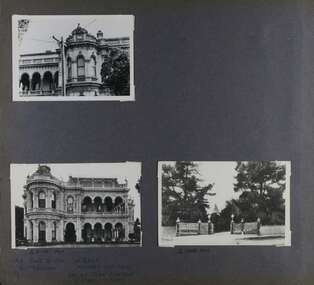
Album - Album page, Labassa, 4 Manor Grove, Circa 1972
... These include wallpapers, ceiling decoration, chimney pieces, mouldings, joinery and decorative glass....These include wallpapers, ceiling decoration, chimney pieces, mouldings, joinery and decorative glass. ...This photograph is part of the Caulfield Historical Album 1972. This album was created in approximately 1972 as part of a project by the Caulfield Historical Society to assist in identifying buildings worthy of preservation. The album is related to a Survey the Caulfield Historical Society developed in collaboration with the National Trust of Australia (Victoria) and Caulfield City Council to identify historic buildings within the City of Caulfield that warranted the protection of a National Trust Classification. Principal photographer thought to be Trevor Hart, member of Caulfield Historical Society. Most photographs were taken between 1966-1972 with a small number of photographs being older and from unknown sources. All photographs are black and white except where stated, with 386 photographs over 198 pages. HISTORY:-- From Victorian Heritage Database citation for Labassa https://vhd.heritagecouncil.vic.gov.au/places/278 as at (26/10/2020) Labassa, Caulfield is one of Melbourne's most lavishly decorated nineteenth century mansions. It resulted from the extensive remodelling in 1890, of an earlier house, known as Sylliott Hill, which was begun in 1862-3 for lawyer, Richard A. Billing. The land at the corner of Balaclava and Orrong Roads was first acquired in 1854 by William Lyall, transferred to his partner, John Mickle, in 1859, who also acquired the adjoining allotment in Balaclava Road, and the three allotments were conveyed to Billing. His first eight-roomed house was extended significantly in 1873 into a twenty-roomed house by architects Crouch and Wilson, who were possibly also responsible for the first house. This reflected Billing's success as a barrister, and he resided at this property until his death in 1882. In 1883 prominent Melbourne businessman, Alexander William Robertson, leased the Sylliott Hill property from Billing's widow, and in 1885 he purchased the adjoining allotment in Balaclava Road. He purchased the Billing's property in 1887 and renamed the 6.31 hectare property, Ontario. In 1889-90, Robertson commissioned the German born architect, John A. B. Koch, to extensively remodel the house into a thirty-five roomed mansion. The existing house was extended and altered, largely resulting in the nineteenth century mansion as it now appears. After Robertson's death in 1896, the house was tenanted until it was eventually sold to the mining millionaire, John Boyd Watson, in 1904. He renamed the property Labassa and carried out repair and re-decoration work to the house. In the early twentieth century, many large estates were subdivided into smaller allotments as the demand for land grew and it became difficult to maintain such large estates. After Watson's death in 1911, portions of the Labassa estate were offered for sale, with Mrs Watson retaining a 1.73 hectare portion containing the house. In 1913 forty-six allotments were auctioned at Labassa Estate, with the formation of Labassa Grove and Ontario Street to the east of the property. Labassa was first recorded as containing flats in 1923 and in the late 1920s, the owner, Robert Hannon, built a red brick block of flats adjacent to the house. Subdivision continued, until the National Trust of Australia (Victoria) purchased the house in 1980 and subsequently purchased adjoining sites, one to the south-east in 1984 (house demolished in 1988) and to the west in 1988. Labassa as it now stands is substantially as it appeared when Koch completed the work in 1890. The original two storey house was transformed into a French Renaissance style mansion, with the addition of a two level L-shaped arcaded verandah and two prominent terminating bays to the south and the east. The building is of unpainted cement render with dressed bluestone plinths, balustraded parapet and steep, slate covered, flat topped mansard roofs behind. A truncated conical roof is a feature of the south bay and a helmeted head is incorporated in the parapet over the east bay. The main south and east facades incorporate many cast cement details, including sculptures, elaborate cornices, swagged Corinthian columns and caryatid consoles flanking the entrance porch, as well as pink marble panels and imitation marble, or scagliola, on curved surfaces. At the rear of the building is a two storey wing and a single storey cottage, the former being connected to the main house by a tower. This section of the house was constructed in 1873. The estate at its peak included stables (1873), conservatory (probably 1890) and a tennis pavilion (probably 1890). All of these outbuildings survive, with the stables and conservatory being converted for residential use after 1922. Internally a range of decorative treatments remain from the late nineteenth century and the early twentieth century, both from the Robertson and Watson periods of occupancy. These include wallpapers, ceiling decoration, chimney pieces, mouldings, joinery and decorative glass.From Victorian Heritage Database citation for H0135 Labassa 2/2A Manor Grove Caulfield North https://vhd.heritagecouncil.vic.gov.au/places/278 as at (26/10/2020) HOW IS IT SIGNIFICANT? Labassa, Caulfield is of architectural, aesthetic and historical significance to the State of Victoria. WHY IS IT SIGNIFICANT? Labassa, Caulfield is of architectural significance as the most prominent example of a small number of houses built in Australia in the French Renaissance style. It is of further note due to the German interpretation of the style and the use of Hellenistic sources, via Germany. It is exceptional for its lavish treatment externally, including marble, scagliola, caryatids, swagged columns, mansard roofs and ornamental cresting. Labassa is of architectural significance as the most important surviving example of German architect, John Koch's domestic work. He undertook a large variety of work in Melbourne, including a number of houses, however Labassa is the most lavish example of his work. Labassa is of aesthetic significance for its outstanding assemblage of late nineteenth and early twentieth century European style interior decoration, which remain remarkably intact. These include a trompe l'oeil ceiling, painted ceilings, embossed imitation leather and other papers, chimney pieces, ceramic tilework, oak parquetry and stained glass, including a tripartite window by Ferguson and Urie, probably dating from the 1873 period. Labassa is of historical significance as an illustrative example of the wealth acquired by a number of prominent Victorian families in the second half of the 19th century. The early development of the property, Sylliott Hill, was due to the wealth acquired by Richard Billing, barrister and fifth Victorian to be appointed Queen's Counsel in 1878. The significant development in 1890 of Ontario, is illustrative of the wealth of Alexander Robertson, a partner in Cobb and Co., a director of Goldsborough Mort & Co., and a pastoral speculator. John B. Watson, whose father had acquired great wealth from the goldfields of Bendigo and subsequently invested in city and country properties, was the third resident to impact on the house, particularly the interiors. The Labassa estate is of historical significance as an illustrative example of the development that occurred in such suburbs as Caulfield in the 1880s due to the land boom, its proximity to Melbourne and the establishment of the Melbourne to Gippsland railway in 1879. It is also illustrative of an estate which succumbed to the pressures of subdividing in the early twentieth century, as properties became difficult to maintain and demand for land close to the city grew. It was typically divided into flats in the 1920s and was used as such for about sixty years. It is of historical significance for its associations with the remnants of the earlier estate which remain extant. These include the stables, conservatory (H2005) and tennis pavilion which all remain on separate sites. Also significant are the remains of early electrical wiring and fittings. Labassa was one of the first houses in Caulfield to be electrified and some of the original wires remain. [Online Data Upgrade Project 2004]Page 129 of Photograph Album with three landscape photographs of Labassa. One of the photographs is of Labassa's drive and gates.Handwritten: 4 JUNE 1910 / SALE JUNE 28 1910 "LA BASSA' / "AUSTRALASIAN" FORMERLY "ONTARIO"/ RES OF JOHN B WATSON / 15 ACRES 3 ROADS [under bottom left photo] / 4 JUNE 1910 [under bottom right photo] / 129 [bottom left]trevor hart, bracketed eaves, intricate lacework, slate roof, bay windows, decorative brackets, caulfield north, labassa, richard a. billing, balaclava road, orrong road, sylliott hill, william lyall, crouch and wilson, alexander william robertson, ontario, 1880's, john a. b. koch, mansion, john boyd watson, labassa grove, french renaissance style, l-shaped arcaded verandah, bluestone plinths, balustraded parapet, flat topped mansard roofs, conical roof, elaborate cornices, corinthian columns, caryatid consoles, marble panels, imitation marble, scagliola, tower, conservatory, stables, tennis pavilion, mouldings, decorative glass, caryatids, swagged columns, ornamental cresting, trompe l'oeil ceiling, embossed imitation leather, oak parquetry, stained glass, tripartite window, triple window, ferguson and urie, 1870's, flats, 1920's, electric wiring, 1860's, verandahs, curved windows, arched windows, italianate, terraces, gargoyles, ornamentation, ornate entrance, la bassa, manor grove, st kilda east, gates, cast iron work, richard billing, architects, john koch, electrification, victorian style, drives, john mickle, land subdivision, mrs watson, labassa estate, robert hannon, national trust of australia (victoria), sculpture -
 City of Melbourne Libraries
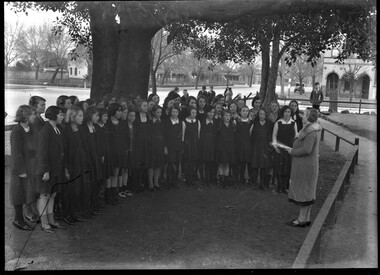
Photograph (item), Bull, Hugh Jones, 1897-1993, Miss Ida Park conducts the North Fitzroy State School Choir
... In 1970, under new management, the Lido was renovated with claret and gold wallpaper, midnight blue ceiling and a computerised fountain with fairy lights and relaunched by “The Tigress from Tiger Bay”, Shirley Bassey. ...In 1970, under new management, the Lido was renovated with claret and gold wallpaper, midnight blue ceiling and a computerised fountain with fairy lights and relaunched by “The Tigress from Tiger Bay”, Shirley Bassey. ...The pupils of Falconer Street Central School No.3918 in North Fitzroy rehearse with conductress Miss Ida Park for their performance at the Temperance Hall, Russell Street Melbourne with proceeds going to the Lord Mayor’s Fund. The house on the right of the photograph is Jubilee House, 126 Michael Street North Fitzroy and is extant. Photographer notations on slide: Choir At Fitzroy State School 1933 B5 While this photograph appears not to have been published, a photograph taken from a different angle of the same event was published in The Age 21 July 1933. SCHOOL CHILDREN SING IN THE OPEN AIR. “A choir of children at North Fitzroy practise their songs for a Pantomime, to be given in the Temperance Hall for the Lord Mayor's Fund on Wednesday next. On the extreme left is the conductress of the Choir (Miss Ida Park).” Reference: http://nla.gov.au/nla.news-article204368572 Research by project volunteer, Fiona Collyer: Children of The Falconer Street Central School Choral Society, trained by conductress Miss Ida Park, along with dance and gymnastics pupils of Misses Dorothy Gibb and Inez Ellis, performed in the “Cinderella” pantomime at the Temperance Hall in Russell Street, Melbourne on 26 July, 1933. The proceeds went to the Lord Mayor’s Fund. Conductress Miss Ida Park (1904- 1952) lived in the North Fitzroy and Clifton Hill area all her life. She was immersed in the music world of Melbourne and was a member of the Musical Society of Victoria. Ida graduated from Melbourne University Conservatorium with a Bachelor of Music degree in 1929 before departing for London where she studied piano and organ at the Royal Academy of Music. Ida returned to Melbourne in 1931, and billed as “The Gifted Young Australian Pianist”, held pianoforte recitals of classical music at Assembly Hall, Collins Street. She also played the organ for services at St Paul’s Independent Church in Delbridge Street, North Fitzroy and later St Luke’s, North Fitzroy. Ida conducted the children of the Falconer Street Central School Choral Society as they competed in the State School Choral Championships and the 85 children of the Fitzroy City Centenary Choir who sang at Melbourne’s Centenary celebrations of 1934/35. In 1945, Ida married Charles Hazeldine, a tenor and returned digger who had served in two world wars. The pair performed together in many concerts over the years. Tragically, both Ida and Charles were badly injured when struck by a car while crossing Queens Parade Clifton Hill in June 1952, with Ida dying from head injuries at St Vincent’s Hospital soon after. She was 48 years old. Charles wrote on Ida’s death notice - “Called home.” The choir were pupils of Falconer Street Central School No. 3918 in North Fitzroy which was built in 1915 to provide upper primary education for grades 5 to 8 for the area. In 1957 it became Fitzroy High School. In 1992, the Kennett Government swept to power, embarking on a program of fiscal austerity and privatisation of government services. 390 government schools were closed, with the land proposed to be sold to developers. 7000 teachers were sacked: 10% of Victoria’s public school teachers. Auxiliary school staff also lost their jobs. Amongst the first to close was Fitzroy High School. Fearful that the land would be sold, hundreds of students, parents, teachers and local residents occupied the building around-the-clock in four hour shifts and overnight for 14 months, sleeping on gym mats in the principal’s office and administrators’ wing. The blockade was lifted when a arrangement was reached to allow Kangan Batman TAFE to use the school from 1993 until 1998. With the election of the Bracks Government in 1999, and construction of new buildings, Fitzroy High School was reopened in 2004 after a 12 year battle. Temperance Hall, at 172 Russell Street, where the children performed “Cinderella”, was built in 1872 by the Melbourne Total Abstinence Society as a venue for lectures, meetings and alcohol-free community concerts and events. From 1934, Temperance Hall was fitted out as a cinema and renamed the Imperial Theatre, showing popular Hollywood films, before closing in 1939 for renovations and reopening as the Savoy Theatre, Melbourne’s first “Continental” talkies cinema. At this time, Australian cinema programming was dominated by American and British films. The lessees, Continental Film Art Theatre began negotiating for theatre properties in Melbourne, Sydney, Adelaide, Brisbane, Perth and Auckland to screen foreign language films, hoping to present the finest productions from France, Germany, Holland and Italy. At the cost of £6000, the theatre was fitted with the latest Mirrophonic sound and projection system and enlarged to seat 800 patrons with luxurious, ultra modern fittings and furnishings in a colour palette of rust and beige. Instead of usherettes, General Manager Peter Dawson, hoping to bring a sophisticated European atmosphere to the theatre, employed attractive, multilingual “Continental hostesses” to assist guests (not patrons) and answer queries relating to the films. Collectively the hostesses spoke English, French, Dutch, German, Russian and Italian. The Age 20 May 1939- “Atmosphere is a very important part of the theatre's scheme. Ushers in the ordinary sense will not be employed; hostesses will look upon patrons as guests. They will be dressed in full evening dress, and the only indication that they are not guests is the little medallion pinned to their evening dress, on which their names are inscribed.” The hostesses were dressed in evening gowns of olive-green velvet, the full skirts embroidered with gold loops, wine velvet bolero jackets and long white kid gloves with silvery tiaras in their hair. For guests worried that they may not understand the plot, the management assured patrons that- “By means of superimposed English translations on the bottom of the screen, the dialogue is perfectly understandable and the whole witty story can be followed with ease.” The Gala opening of the Savoy Theatre, on 31 May 1939 was attended by a “who’s who” of Melbourne Society, the women wearing beautiful gowns, headdresses and furs. Amongst the guests were former premier Sir Stanley Argyle and Lady Argyle, former Lord Mayor Sir Harold Gengoult-Smith and his wife Cynthia, Field Marshall Thomas Blamey and Lady Blamey and Miss Jessie Brookes. The Vice Consul for France, Monsieur Frank Puaux and his wife attended, Madame Puaux dressed in a black satin gown and a musquash fur cape. She was presented with a beautiful bouquet of scarlet carnations and lily of the valley tied with the tricolour of France. In his speech Monsieur Puaux stated that “from the cultural, linguistic and artistic points of view it was excellent that the Australian public should have an opportunity to see foreign film in the original language.” “Letty” writing in Table Talk magazine described the atmosphere of “Continental” gaiety that had permeated Melbourne - “The Letters of Letty”, Table Talk 8 June 1939 “The “foreign influence” is definitely obtruding itself into the even tenor of Melbourne life these days…. but in the pleasantest manner possible! Included in the great number of Continental people who have recently made their homes here, we have stars of the Russian ballet settling in our midst…. and now… we have been presented with our own Continental picture theatre in the attractive shape of The Savoy, which opened its doors on Wednesday night for the exclusive release of foreign films. One could hardly recognise the old Temperance Hall in its adaptation to the smart, comfortable and thoroughly-intriguing Savoy Theatre. Where once this rather draughty old building stood in Russell Street there now greets us an unmistakable “Continental” edifice, living up to its exterior by sustaining within its walls its overseas’ atmosphere. Indeed, one feels as though one has crossed the threshold into a European city, stepping out of the unmistakably Australian street that is Russell into The Savoy lounge to be greeted by polite “messieurs” from the attractive, Continental-looking usherettes and to gaze upon a film as delightfully French in story and presentation as “La Kermesse Heroique.” But successful though “La Kermesse Heroique” proved on its initial presentation inside the theatre, the debut was no more triumphal than that made by the winning and pretty little French lass who had charge of the booking office outside in the foyer. With her attractive accent and Continental flair for making one “feel at home” she was undoubtedly one of the hits of the night-especially with the susceptible males, who spent very much longer in the lounge than is customary, racking their brains for excuses for making conversation with the attractive Parisienne! Those French girls certainly have a way with them!” The opening film, the 1935 French comedy “La Kermesse Heroique”, (The Heroic Sex) starring Francoise Rosay and Jean Murat (film now called “Carnival in Flanders”) was the winner of the Grand Prix du Cinema Francais as the finest picture of 1936 and described in the advertisement as “The Gay French Comedy of Laughter and Romance” The film is set during the 17th century Spanish occupation of Flanders in the Flemish town of Boom at the time of their annual festival. Hearing news of a pending visit to Boom by the commander, the Duke of Olivares and his army, and fearing rape and pillage, the boorish burgomaster feigns his own death, hoping the Spaniards will bypass the grieving town out of respect. The army arrives and the cowardly men of the town flee. The womenfolk decide on a different approach. Lead by the burgomaster’s beautiful wife Cornelia, they set out to to preserve the peace with grace and hospitality only to find the Spaniards attractive and virile, unlike their own husbands. The Sun newspaper described the film as “Mellow as a Stilton cheese, and as ripely suited to adult taste.” Preceding “La Kermesse Heroique” was a Gaumont British newsreel of King George VI and Queen Elizabeth departing for a tour of Canada and the Soviet documentary “Nine Months on a Drifting Ice Floe” During the war “Continental” films became difficult to source, so the Savoy screened Hollywood movies and held fund raisers for the war effort. After World War Two, the Savoy continued to screen “Continental” films, catering to post-war immigrants from Europe and bohemian Melburnians. In 1953, the Savoy had a wildly popular season with queues winding around the block to see Swedish summer romance “One Summer of Happiness” (Hon dansade en sommar) with its nude swimming scenes. The Chief Commonwealth Censor declined to cut the film on the grounds that although it displayed nudity, it was genuinely artistic. According to Wikipedia, film director Fred Schepisi was first exposed to European films such as “Bicycle Thieves”, “Rocco and His Brothers” and “The Wages of Fear” at the Savoy as a teenager, leading to his long career in filmmaking. In 1955, in response to the massive rise in car ownership, the Melbourne City Council recommended that parking stations be built on every block. The Savoy Theatre and adjacent buildings, which included the Golden Fleece Hotel were demolished in 1963 and replaced with Total House, a Brutalist commercial building consisting of a seven storey car park crowned by a four storey office block, shops at street level, and a basement theatre which housed the Lido Theatre Restaurant-Cabaret from 1965. The building was designed by architectural firm Bogle & Banfield Associates and named for the original tenant of the offices, French oil company, Total Oil Products P/L. The Lido Theatre Restaurant was managed by former Tivoli dancer and promoter David Hamilton McIlwraith, presenting dinner and a glamorous cabaret floor show of showgirls, (some topless) to accompany variety acts by local and international actors, singers, comedians and magicians. The interior of the Lido was opulently decorated in deep, lush green with old world gold trim and chandeliers. Handily, patrons could enter and leave via an elevator, straight from the building’s own car park! A four course gourmet dinner with show and dancing cost $8.00 in 1968. The Lido advertised in 1966 that “Every visitor to Melbourne soon discovers the brightest entertainment spot in the Southern Hemisphere with its million dollar decor, dining delights and spectacular stage productions.” Australian Jewish News - 21 April 1967 - “Superb decor and atmosphere, cuisine and service have been readily recognised as the contributing factors to the excellence of stage presentations, staging, costumes, decor and, of course, the actual choice of artists.” The bedazzling ensemble of 40 high-kicking, feathered and sequinned showgirls were advertised as the “Fabulous Lido girls and the controversial Baretop Lido Goddesses” who were described as “Statuesque Beauty as Nature intended” and “…a host of glamorous gals whose favourite shade is flesh pink.” Some of the acts who performed at the Lido were- -Broken Hill’s own - opera singer June Bronhill -1967. -Versatile singer Lovelace Watkins known as “Black Sinatra - 1967. -“Queen of the five-fingered boogie", honky-tonk and rollicking rag-time pianist, Winifred Atwell - 1967. -New Zealand pop duo, Bill and Boyd -1968. -American actress and soprano Kathryn Grayson -1968. -Denise Drysdale in “Say It With Music” -1968. -“Catwoman” Eartha Kitt -1969. -Internationally recognised female impersonator, Sydneysider Tracey Lee, (Maxwell Richie) billed as "controversial impressionist and singing personality from the famous Carousel Nightspot in Paris". -Frances Faye, American comedienne and show-tune singer and pianist-1969. -“Cry Guy” histrionic singer Johnnie Ray -1970. -Risqué revue “Oh Calcutta!” with some segments and the “four letter” words removed-1970. In 1970, under new management, the Lido was renovated with claret and gold wallpaper, midnight blue ceiling and a computerised fountain with fairy lights and relaunched by “The Tigress from Tiger Bay”, Shirley Bassey. The relaunch was short lived however, as later that year the venue became El Toro Espana, a Spanish restaurant and nightclub offering a four course meal for $4.50 while you watched the floorshow. The venue then briefly became the Red Garter Music Hall Theatre from 1972, then in 1974 the site became the 600 seat Total Theatre comprising of a cinema with a stage for live acts. There were also three bars to choose from - the Crush Bar, the Bleachers and the Snake Pit. Total Theatre had the unusual concept of a live music act, or plays, musicals and magicians followed by a film. In 1975 soprano Suzanne Steele featured, followed by the film “The Voyage” starring Sophia Loren and Richard Burton. In 1975, the Total held a rock film festival showing a Jimi Hendrix documentary, “Monterey Pop Festival”, “Pink Floyd in Pompeii” and more. In 1976, 17 year old Chrissy Amphlett, later of rock band Divinyls, played the role of Linda Lips for nine months in the Australian stage production of R-rated “sexual musical”, “Let My People Come” at the Total Theatre. The Total Theatre closed in 1979 and from 1980 to 2014 the venue became Billboard Nightclub, hosting local and international acts, including INXS, Tina Turner and John Farnham, and in 2009, 18 year old Taylor Swift. The venue is now called 170 Russell and presents hundreds of live local and international acts every year. In 2014, after being under threat of demolition, Total House was listed on the Victorian Heritage Register as “a landmark of post-World War II modernist design and…one of the earliest and best expressions of Brutalist architecture in Victoria”. References: RICHARD CROOKS ARRIVES SCHOOL AGAIN VENUE OF ROYAL VISIT (1939, May 31). The Age (Melbourne, Vic. : 1854 - 1954), p. 17. Retrieved November 21, 2025, from http://nla.gov.au/nla.news-article205629696 AMUSEMENTS. (1933, July 27). The Age (Melbourne, Vic. : 1854 - 1954), p. 12. Retrieved September 19, 2025, from http://nla.gov.au/nla.news-article204378853 https://larzra.wordpress.com/origins/ CONTINENTAL HOSTESSES, (1939, May 31). The Sun News-Pictorial (Melbourne, Vic. : 1922 - 1954; 1956), p. 27. Retrieved November 21, 2025, from http://nla.gov.au/nla.news-article278189387 The Letters of Letty (1939, June 8). Table Talk (Melbourne, Vic. : 1885 - 1939), p. 12. Retrieved October 29, 2025, from http://nla.gov.au/nla.news-article149320966 SAVOY THEATRE (1939, June 1). The Age (Melbourne, Vic. : 1854 - 1954), p. 7. Retrieved September 19, 2025, from http://nla.gov.au/nla.news-article205639035 NEW THEATRE OPENED (1939, June 1). The Argus (Melbourne, Vic. : 1848 - 1957), p. 8. Retrieved September 21, 2025, from http://nla.gov.au/nla.news-article12134234 https://en.wikipedia.org/wiki/Total_House Page [?] TOUCH OF SPAIN (1970, December 18). The Australian Jewish News (Melbourne, Vic. : 1935 - 1999), p. 35. Retrieved September 23, 2025, from http://nla.gov.au/nla.news-article262493757 No title (1935, June 11). The Herald (Melbourne, Vic. : 1861 - 1954), p. 27. Retrieved September 29, 2025, from http://nla.gov.au/nla.news-article244840169 Dine, wine, and watch a stage show (1966, November 16). The Australian Women's Weekly (1933 - 1982), p. 6. Retrieved November 9, 2025, from http://nla.gov.au/nla.news-article44025050 http://jonathanbollen.net/2011/02/26/tracey-lee/ LIDO ‘ART’ (1967, April 21). The Australian Jewish News (Melbourne, Vic. : 1935 - 1999), p. 8. Retrieved November 9, 2025, from http://nla.gov.au/nla.news-article263003136 THE FABULOUS LIDO (1965, October 22). The Australian Jewish News (Melbourne, Vic. : 1935 - 1999), p. 17. Retrieved November 9, 2025, from http://nla.gov.au/nla.news-article262983995 No title (1939, May 31). The Argus (Melbourne, Vic. : 1848 - 1957), p. 6. Retrieved November 21, 2025, from http://nla.gov.au/nla.news-article12134144 #NEW THEATRE OPENED (1939, June 1). The Argus (Melbourne, Vic. : 1848 - 1957), p. 8. Retrieved September 29, 2025, from http://nla.gov.au/nla.news-article12134234 https://en.wikipedia.org/wiki/Tracey_Lee_(female_impersonator) https://citycollection.melbourne.vic.gov.au/35b-40h-image-of-a-model-for-the-total-house-offices-and-car-park-on-russell-street/ https://www.theage.com.au/national/victoria/from-the-archives-1990-s-hundreds-of-school-closures-hit-victoria-20190801-p52cwj.html http://jonathanbollen.net/2011/05/29/the-lido-melbourne/Photographer notations on slide: primary schools, schools, music, education, choirs, fitzroy, cars, theatre restaurants, venues, films -
 Bendigo Military Museum
Photograph - Army Survey Regiment - Fortuna Interior, Bendigo, c1985
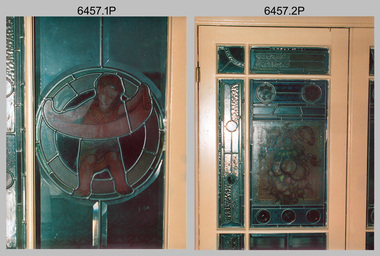
... Fortuna Villa – Billiard room’s timber vaulted ceiling. .20) & .21) - Photo, colour, c1985. Fortuna Villa – Top floor nursery samples of original wallpaper. .22) - Photo, colour, c1985. ...Fortuna Villa – Billiard room’s timber vaulted ceiling. .20) & .21) - Photo, colour, c1985. Fortuna Villa – Top floor nursery samples of original wallpaper. .22) - Photo, colour, c1985. ...This set of 22 photographs was taken inside Army Survey Regiment’s Fortuna Villa circa 1985. The photos feature some of Fortuna Villa’s interior. Unfortunately, the magnificent array of colours and hand-painted features of Fortuna’s leadlight windows are not highlighted with light transmission, as the photographer did not take the photos in the daytime. See item 6456.30P, for photos of Fortuna Villa’s exterior and The Army Survey Regiment’s out-buildings that were taken at the same time.This set of 22 photographs was taken inside Army Survey Regiment’s Fortuna Villa circa 1985. The colour photographs were printed on photographic paper and are part of the Army Survey Regiment’s Collection. The photographs were scanned at 300 dpi. .1) & .2) - Photo, colour, c1985. Fortuna Villa – Reception/Music Room leadlight windows. .3) - Photo, colour, c1985. Fortuna Villa – Entrance foyer door and leadlight windows. .4) - Photo, colour, c1985. Fortuna Villa – Entrance foyer vaulted ceiling. .5) - Photo, colour, c1985. Fortuna Villa – Dressing Room bay leadlight windows. .6) - Photo, colour, c1985. Fortuna Villa – Dressing Room wood panel wardrobe (concealed marble bath inside). .7) - Photo, colour, c1985. Fortuna Villa – Main bathroom’s solid cedar toilet chest and water pitcher set. .8) to .14) - Photo, colour, c1985. Fortuna Villa – Drawing Room bay leadlight windows. .15) to .16) - Photo, colour, c1985. Fortuna Villa – Cupola stairway leadlight windows. .17) - Photo, colour, c1985. Fortuna Villa – Dining/ballroom doorway with velvet wallpaper. .18) - Photo, colour, c1985. Fortuna Villa – Dining/ballroom. .19) - Photo, colour, c1985. Fortuna Villa – Billiard room’s timber vaulted ceiling. .20) & .21) - Photo, colour, c1985. Fortuna Villa – Top floor nursery samples of original wallpaper. .22) - Photo, colour, c1985. Fortuna Villa – Top floor ballroom/gymnasium’s elaborate vaulted ceiling.There are brief descriptions on a note behind each photograph.royal australian survey corps, rasvy, army survey regiment, army svy regt, fortuna, asr -
 Villa Alba Museum
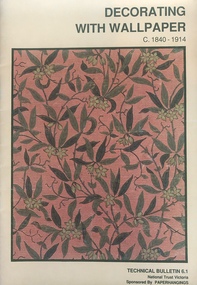
Book, Decorating with wallpaper c.1840–1914 : a guide to assist in the conservation and restoration of buildings, 1987
... wallpaper c.1840–1914 : a guide to assist in the conservation and restoration of buildings. National Trust of Australia (Victoria, 1987. Chapters: 1. Introduction; 2. Mid-nineteenth century; 3. Halls, stairs and passages; 4. 1870s period; 5. 1880s period; 6. 1890s period; 7. Early Twentieth Century; 8. Towards World War I; 9. Ceilings ...Decorating with wallpaper c.1840–1914 : a guide to assist in the conservation and restoration of buildings. National Trust of Australia (Victoria, 1987. Chapters: 1. Introduction; 2. Mid-nineteenth century; 3. Halls, stairs and passages; 4. 1870s period; 5. 1880s period; 6. 1890s period; 7. Early Twentieth Century; 8. Towards World War I; 9. Ceilings; 10. Colour notes; 11. Conservation notesnon-fictionDecorating with wallpaper c.1840–1914 : a guide to assist in the conservation and restoration of buildings. National Trust of Australia (Victoria, 1987. Chapters: 1. Introduction; 2. Mid-nineteenth century; 3. Halls, stairs and passages; 4. 1870s period; 5. 1880s period; 6. 1890s period; 7. Early Twentieth Century; 8. Towards World War I; 9. Ceilings; 10. Colour notes; 11. Conservation noteswallpapers - history, interior decoration - history, wall coverings - history -
 Hymettus Cottage & Garden Ballarat
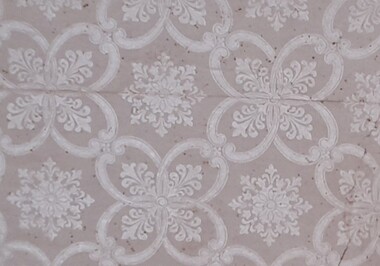
Functional object - Ceiling paper, Victorian ceiling paper
... ceiling Hymettus Ballarat Dining room wallpapers ceiling papers decorative papers Ballarat Victorian ceiling paper Functional object Ceiling paper ...ceiling, hymettus ballarat, dining room, wallpapers, ceiling papers, decorative papers, ballarat -
 Hymettus Cottage & Garden Ballarat
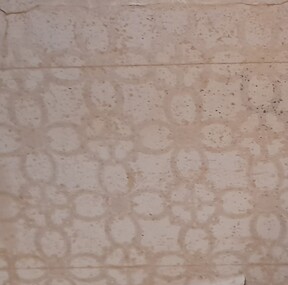
Work on paper - Ceiling paper, Bedroom ceiling paper
... Ceiling paper...wallpaper...Ceiling paper wallpaper Ballarat Hymettus Bedroom ceiling paper Work on paper Ceiling paper ...ceiling paper, wallpaper, ballarat, hymettus, -
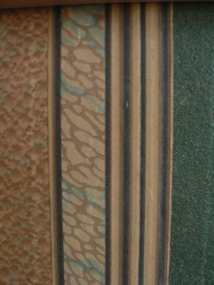 Port Melbourne Historical & Preservation Society
Photograph - Old wallpaper, Port Melbourne Council Chamber, David Thompson, 27 Jun 2006
... to the ceiling and walls in the Council Chamber at Port Melbourne Town Hall exposed what looked like the Art Deco ceiling decoration and wallpaper from the 1938 renovation designed and installed by City Engineer, Fred Cook. ...Digital copy of a colour photograph of a close-up view of old exposed wallpaper in the Council Chamber at Port Melbourne Town Hall after damage to the ceiling and walls....Fred COOK Port Melbourne Town Hall Art Deco Built Environment - Civic Digital copy of a colour photograph of a close-up view of old exposed wallpaper in the Council Chamber at Port Melbourne Town Hall after damage to the ceiling and walls. ...In June 2006, damage (from a leak in the roof?) to the ceiling and walls in the Council Chamber at Port Melbourne Town Hall exposed what looked like the Art Deco ceiling decoration and wallpaper from the 1938 renovation designed and installed by City Engineer, Fred Cook. The Council Chamber was subsequently renovated in a simple style sympathetic to the Victorian period of the Town Hall's original construction.Digital copy of a colour photograph of a close-up view of old exposed wallpaper in the Council Chamber at Port Melbourne Town Hall after damage to the ceiling and walls.fred cook, port melbourne town hall, art deco, built environment - civic -
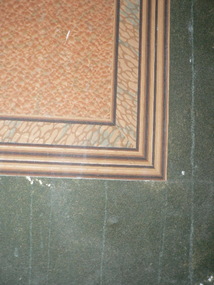 Port Melbourne Historical & Preservation Society
Photograph - Old wallpaper, Port Melbourne Council Chamber, David Thompson, 27 Jun 2006
... to the ceiling and walls in the Council Chamber at Port Melbourne Town Hall exposed what looked like the Art Deco ceiling decoration and wallpaper from the 1938 renovation designed and installed by City Engineer, Fred Cook. ...Digital copy of a colour photograph of a close-up view of old exposed wallpaper in the Council Chamber at Port Melbourne Town Hall after damage to the ceiling and walls....Fred COOK Port Melbourne Town Hall Art Deco Built Environment - Civic Digital copy of a colour photograph of a close-up view of old exposed wallpaper in the Council Chamber at Port Melbourne Town Hall after damage to the ceiling and walls. ...In June 2006, damage (from a leak in the roof?) to the ceiling and walls in the Council Chamber at Port Melbourne Town Hall exposed what looked like the Art Deco ceiling decoration and wallpaper from the 1938 renovation designed and installed by City Engineer, Fred Cook. The Council Chamber was subsequently renovated in a simple style sympathetic to the Victorian period of the Town Hall's original construction.Digital copy of a colour photograph of a close-up view of old exposed wallpaper in the Council Chamber at Port Melbourne Town Hall after damage to the ceiling and walls.fred cook, port melbourne town hall, art deco, built environment - civic -
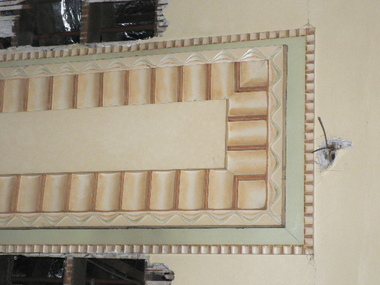 Port Melbourne Historical & Preservation Society
Photograph - Old Art Deco ceiling, Port Melbourne Council Chamber, David Thompson, 27 Jun 2006
... to the ceiling and walls in the Council Chamber at Port Melbourne Town Hall exposed what looked like the Art Deco ceiling decoration and wallpaper from the 1938 renovation designed and installed by City Engineer, Fred Cook. ...to the ceiling and walls in the Council Chamber at Port Melbourne Town Hall exposed what looked like the Art Deco ceiling decoration and wallpaper from the 1938 renovation designed and installed by City Engineer, Fred Cook. ...In June 2006, damage (from a leak in the roof?) to the ceiling and walls in the Council Chamber at Port Melbourne Town Hall exposed what looked like the Art Deco ceiling decoration and wallpaper from the 1938 renovation designed and installed by City Engineer, Fred Cook. The Council Chamber was subsequently renovated in a simple style sympathetic to the Victorian period of the Town Hall's original construction.Digital copy of a colour photograph of old exposed Art Deco ceiling in the Council Chamber at Port Melbourne Town Hall after damage to the ceiling and walls.fred cook, port melbourne town hall, art deco, built environment - civic -
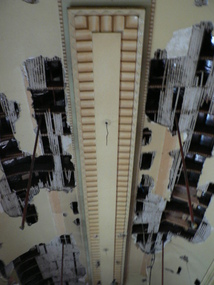 Port Melbourne Historical & Preservation Society
Photograph - Old Art Deco ceiling, Port Melbourne Council Chamber, David Thompson, 27 Jun 2006
... to the ceiling and walls in the Council Chamber at Port Melbourne Town Hall exposed what looked like the Art Deco ceiling decoration and wallpaper from the 1938 renovation designed and installed by City Engineer, Fred Cook. ...to the ceiling and walls in the Council Chamber at Port Melbourne Town Hall exposed what looked like the Art Deco ceiling decoration and wallpaper from the 1938 renovation designed and installed by City Engineer, Fred Cook. ...In June 2006, damage (from a leak in the roof?) to the ceiling and walls in the Council Chamber at Port Melbourne Town Hall exposed what looked like the Art Deco ceiling decoration and wallpaper from the 1938 renovation designed and installed by City Engineer, Fred Cook. The Council Chamber was subsequently renovated in a simple style sympathetic to the Victorian period of the Town Hall's original construction.Digital copy of a colour photograph of old exposed Art Deco ceiling in the Council Chamber at Port Melbourne Town Hall after damage to the ceiling and walls.fred cook, port melbourne town hall, art deco, built environment - civic -
 Port Melbourne Historical & Preservation Society
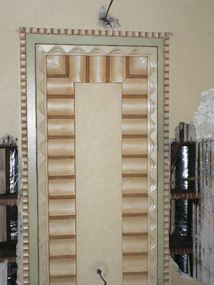
Photograph - Old Art Deco ceiling, Port Melbourne Council Chamber, David Thompson, 27 Jun 2006
... to the ceiling and walls in the Council Chamber at Port Melbourne Town Hall exposed what looked like the Art Deco ceiling decoration and wallpaper from the 1938 renovation designed and installed by City Engineer, Fred Cook. ...to the ceiling and walls in the Council Chamber at Port Melbourne Town Hall exposed what looked like the Art Deco ceiling decoration and wallpaper from the 1938 renovation designed and installed by City Engineer, Fred Cook. ...In June 2006, damage (from a leak in the roof?) to the ceiling and walls in the Council Chamber at Port Melbourne Town Hall exposed what looked like the Art Deco ceiling decoration and wallpaper from the 1938 renovation designed and installed by City Engineer, Fred Cook. The Council Chamber was subsequently renovated in a simple style sympathetic to the Victorian period of the Town Hall's original construction.Digital copy of a colour photograph of old exposed Art Deco ceiling in the Council Chamber at Port Melbourne Town Hall after damage to the ceiling and walls.fred cook, port melbourne town hall, art deco, built environment - civic -
 Port Melbourne Historical & Preservation Society
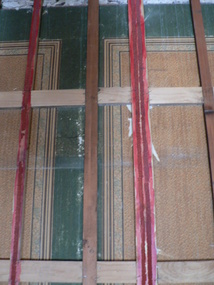
Photograph - Old wallpaper, Port Melbourne Council Chamber, David Thompson, 27 Jun 2006
... to the ceiling and walls in the Council Chamber at Port Melbourne Town Hall exposed what looked like the Art Deco ceiling decoration and wallpaper from the 1938 renovation designed and installed by City Engineer, Fred Cook. ...Digital copy of a colour photograph of old exposed wallpaper in the Council Chamber at Port Melbourne Town Hall after damage to the ceiling and walls....Fred COOK Port Melbourne Town Hall Art Deco Built Environment - Civic Digital copy of a colour photograph of old exposed wallpaper in the Council Chamber at Port Melbourne Town Hall after damage to the ceiling and walls. ...In June 2006, damage (from a leak in the roof?) to the ceiling and walls in the Council Chamber at Port Melbourne Town Hall exposed what looked like the Art Deco ceiling decoration and wallpaper from the 1938 renovation designed and installed by City Engineer, Fred Cook. The Council Chamber was subsequently renovated in a simple style sympathetic to the Victorian period of the Town Hall's original construction.Digital copy of a colour photograph of old exposed wallpaper in the Council Chamber at Port Melbourne Town Hall after damage to the ceiling and walls.fred cook, port melbourne town hall, art deco, built environment - civic -
 Port Melbourne Historical & Preservation Society
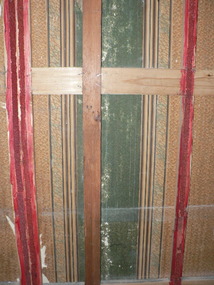
Photograph - Old wallpaper, Port Melbourne Council Chamber, David Thompson, 27 Jun 2006
... to the ceiling and walls in the Council Chamber at Port Melbourne Town Hall exposed what looked like the Art Deco ceiling decoration and wallpaper from the 1938 renovation designed and installed by City Engineer, Fred Cook. ...Digital copy of a colour photograph of old exposed wallpaper in the Council Chamber at Port Melbourne Town Hall after damage to the ceiling and walls....Fred COOK Port Melbourne Town Hall Art Deco Built Environment - Civic Digital copy of a colour photograph of old exposed wallpaper in the Council Chamber at Port Melbourne Town Hall after damage to the ceiling and walls. ...In June 2006, damage (from a leak in the roof?) to the ceiling and walls in the Council Chamber at Port Melbourne Town Hall exposed what looked like the Art Deco ceiling decoration and wallpaper from the 1938 renovation designed and installed by City Engineer, Fred Cook. The Council Chamber was subsequently renovated in a simple style sympathetic to the Victorian period of the Town Hall's original construction.Digital copy of a colour photograph of old exposed wallpaper in the Council Chamber at Port Melbourne Town Hall after damage to the ceiling and walls.fred cook, port melbourne town hall, art deco, built environment - civic -
 Port Melbourne Historical & Preservation Society
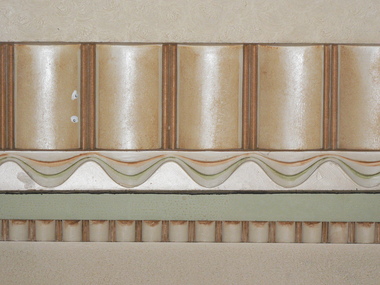
Photograph - Old Art Deco ceiling, Port Melbourne Council Chamber, David Thompson, 27 Jun 2006
... to the ceiling and walls in the Council Chamber at Port Melbourne Town Hall exposed what looked like the Art Deco ceiling decoration and wallpaper from the 1938 renovation designed and installed by City Engineer, Fred Cook. ...to the ceiling and walls in the Council Chamber at Port Melbourne Town Hall exposed what looked like the Art Deco ceiling decoration and wallpaper from the 1938 renovation designed and installed by City Engineer, Fred Cook. ...In June 2006, damage (from a leak in the roof?) to the ceiling and walls in the Council Chamber at Port Melbourne Town Hall exposed what looked like the Art Deco ceiling decoration and wallpaper from the 1938 renovation designed and installed by City Engineer, Fred Cook. The Council Chamber was subsequently renovated in a simple style sympathetic to the Victorian period of the Town Hall's original construction.Digital copy of a colour photograph of a close-up view of the old exposed Art Deco ceiling in the Council Chamber at Port Melbourne Town Hall after damage to the ceiling and walls.fred cook, port melbourne town hall, art deco, built environment - civic -
 Port Melbourne Historical & Preservation Society
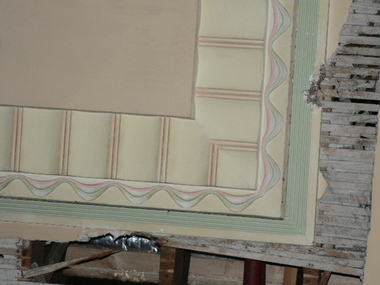
Photograph - Old Art Deco ceiling, Port Melbourne Council Chamber, David Thompson, 27 Jun 2006
... to the ceiling and walls in the Council Chamber at Port Melbourne Town Hall exposed what looked like the Art Deco ceiling decoration and wallpaper from the 1938 renovation designed and installed by City Engineer, Fred Cook. ...to the ceiling and walls in the Council Chamber at Port Melbourne Town Hall exposed what looked like the Art Deco ceiling decoration and wallpaper from the 1938 renovation designed and installed by City Engineer, Fred Cook. ...In June 2006, damage (from a leak in the roof?) to the ceiling and walls in the Council Chamber at Port Melbourne Town Hall exposed what looked like the Art Deco ceiling decoration and wallpaper from the 1938 renovation designed and installed by City Engineer, Fred Cook. The Council Chamber was subsequently renovated in a simple style sympathetic to the Victorian period of the Town Hall's original construction.Digital copy of a colour photograph of a close-up view of the old exposed Art Deco ceiling in the Council Chamber at Port Melbourne Town Hall after damage to the ceiling and walls.fred cook, port melbourne town hall, art deco, built environment - civic -
 Port Melbourne Historical & Preservation Society
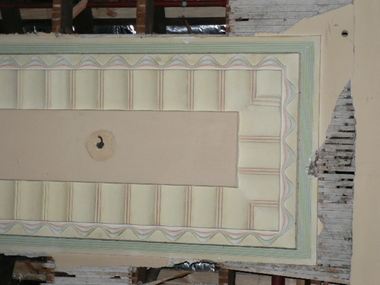
Photograph - Old Art Deco ceiling, Port Melbourne Council Chamber, David Thompson, 27 Jun 2006
... to the ceiling and walls in the Council Chamber at Port Melbourne Town Hall exposed what looked like the Art Deco ceiling decoration and wallpaper from the 1938 renovation designed and installed by City Engineer, Fred Cook. ...to the ceiling and walls in the Council Chamber at Port Melbourne Town Hall exposed what looked like the Art Deco ceiling decoration and wallpaper from the 1938 renovation designed and installed by City Engineer, Fred Cook. ...In June 2006, damage (from a leak in the roof?) to the ceiling and walls in the Council Chamber at Port Melbourne Town Hall exposed what looked like the Art Deco ceiling decoration and wallpaper from the 1938 renovation designed and installed by City Engineer, Fred Cook. The Council Chamber was subsequently renovated in a simple style sympathetic to the Victorian period of the Town Hall's original construction.Digital copy of a colour photograph of old exposed Art Deco ceiling in the Council Chamber at Port Melbourne Town Hall after damage to the ceiling and walls.fred cook, port melbourne town hall, art deco, built environment - civic -
 Port Melbourne Historical & Preservation Society
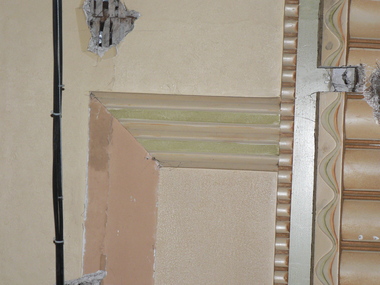
Photograph - Old Art Deco ceiling, Port Melbourne Council Chamber, David Thompson, 27 Jun 2006
... to the ceiling and walls in the Council Chamber at Port Melbourne Town Hall exposed what looked like the Art Deco ceiling decoration and wallpaper from the 1938 renovation designed and installed by City Engineer, Fred Cook. ...to the ceiling and walls in the Council Chamber at Port Melbourne Town Hall exposed what looked like the Art Deco ceiling decoration and wallpaper from the 1938 renovation designed and installed by City Engineer, Fred Cook. ...In June 2006, damage (from a leak in the roof?) to the ceiling and walls in the Council Chamber at Port Melbourne Town Hall exposed what looked like the Art Deco ceiling decoration and wallpaper from the 1938 renovation designed and installed by City Engineer, Fred Cook. The Council Chamber was subsequently renovated in a simple style sympathetic to the Victorian period of the Town Hall's original construction.Digital copy of a colour photograph of a close-up view of the old exposed Art Deco ceiling in the Council Chamber at Port Melbourne Town Hall after damage to the ceiling and walls.fred cook, port melbourne town hall, art deco, built environment - civic -
 Port Melbourne Historical & Preservation Society
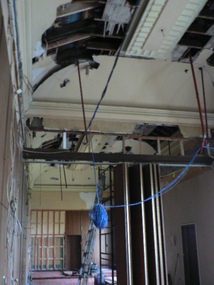
Photograph - Port Melbourne Council Chamber, David Thompson, 27 Jun 2006
... to the ceiling and walls in the Council Chamber at Port Melbourne Town Hall exposed what looked like the Art Deco ceiling decoration and wallpaper from the 1938 renovation designed and installed by City Engineer, Fred Cook. ...to the ceiling and walls in the Council Chamber at Port Melbourne Town Hall exposed what looked like the Art Deco ceiling decoration and wallpaper from the 1938 renovation designed and installed by City Engineer, Fred Cook. ...In June 2006, damage (from a leak in the roof?) to the ceiling and walls in the Council Chamber at Port Melbourne Town Hall exposed what looked like the Art Deco ceiling decoration and wallpaper from the 1938 renovation designed and installed by City Engineer, Fred Cook. The Council Chamber was subsequently renovated in a simple style sympathetic to the Victorian period of the Town Hall's original construction.Digital copy of a colour photograph of the Council Chamber at Port Melbourne Town Hall after damage to the ceiling and walls.fred cook, port melbourne town hall, art deco, built environment - civic
