
Showing 6 items matching "warrnambool club 24"
-
 Flagstaff Hill Maritime Museum and Village
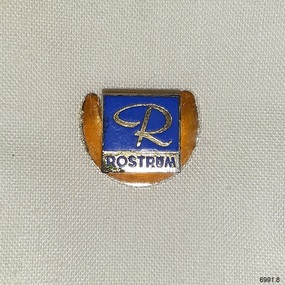
badge - Rostrum badge, Angus & Coote, 1939-1945
... ...Warrnambool Club 24...Rostrum has a Warrnambool branch, Warrnambool Club 24, which currently meets at the rear of the South Warrnambool Presbyterian Church building at 11 MacDonald Street, Warrnambool. ...Rostrum has a Warrnambool branch, Warrnambool Club 24, which currently meets at the rear of the South Warrnambool Presbyterian Church building at 11 MacDonald Street, Warrnambool. ...This Rostrum lapel badge is one of a set of badges collected by Dr W R Angus from the organisations in which he was involved. The set of badges is now part of Flagstaff Hill’s comprehensive W.R. Angus Collection, donated by the family of Dr W R Angus, surgeon and oculist. This badge represents the Rostrum organisation, the longest-running public speaking organisation in the world. Rostrum has a Warrnambool branch, Warrnambool Club 24, which currently meets at the rear of the South Warrnambool Presbyterian Church building at 11 MacDonald Street, Warrnambool. The original Rostrum club was formed in England in 1923 and the first Australian Rostrum meeting was in 1930. The maker, Angus & Coote, is an Australian company that was founded by Edmund James Coote in Sydney in 1895. The firm made insignia during WWII and is famous for its high-quality jewellery. The W.R. Angus Collection includes historical medical equipment, surgical instruments and material belonging to Dr Edward Ryan and Dr Thomas Francis Ryan, (both of Nhill, Victoria) and Dr Angus’ own belongings. The Collection’s history spans the medical practices of the two Doctors Ryan, from 1885-1926 plus that of Dr Angus, up until 1969. It includes historical medical and surgical equipment and instruments from the doctors Edward and Thomas Ryan of Nhill, Victoria. Dr Angus married Gladys in 1927 at Ballarat, the nearest big city to Nhill where he began as a Medical Assistant. He was also Acting House surgeon at the Nhill hospital where their two daughters were born. During World War II He served as a Military Doctor in the Australian Defence Forces. Dr Angus and his family moved to Warrnambool in 1939, where Dr Angus operated his own medical practice. He later added the part-time Port Medical Officer responsibility and was the last person appointed to that position. Both Dr Angus and his wife were very involved in the local community, including the planning stages of the new Flagstaff Hill and the layout of the gardens there. Dr Angus passed away in March 1970.This badge is significant for connecting Doctor Angus with organisations that he supported. The badge also associates Dr Angus with the Rostrum Club in Warrnambool. The badge is of interest as the maker, Angus & Coote, only made badges during WWII. The W.R. Angus Collection is significant for still being located at the site it is connected with, Doctor Angus being the last Port Medical Officer in Warrnambool. The Collection includes historical medical objects that date back to the late 1800s.Lapel badge; a square gold-coloured metal and blue enamel badge. The blue enamel covers three-quarters of the top of the square badge and has a bold 'R' embossed onto it. The remaining quarter is gold with the organisation's name in blue letters. The maker's name is embossed on the back. The Rostrum badge was made by Angus & Coote.This badge is part of a set of badges collected by Dr W R Angus. the set represents organisations that he was involved in, and is part of the W.R. Angus Collection.Front “R” above “ROSTRUM”. Reverse; “ANGUS & COOTE”flagstaff hill, warrnambool, maritime village, maritime museum, shipwreck coast, great ocean road, w.r. angus, badge, organisation badge, flagstaff hill maritime museum and village, badges, buttons, lapel badge, rostrum, warrnambool club 24, angus & coote sydney, rostrum club 24, public speaking club, rostrum lapel badge, wwii badge, 1939-1915 -
 Flagstaff Hill Maritime Museum and Village
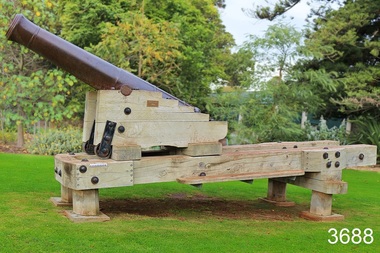
Weapon - Cannon, 1813
... 24 / 1837” . Cascable “CV” and marks with gradations from nought to three in quarters on each side, On the carriage the end of one of the main slide members carries the mark “W symbol (broad arrow) D” incised into the timber. Plaque attached to the carriage by the Warrnambool Tritan Woodworkers club...24 / 1837” . Cascable “CV” and marks with gradations from nought to three in quarters on each side, On the carriage the end of one of the main slide members carries the mark “W symbol (broad arrow) D” incised into the timber. Plaque attached to the carriage by the Warrnambool Tritan Woodworkers club ...This 1813 cannon is classified as a carronade, having been made by the Carron Ironworks foundry in Stirling, Scotland in 1813. It is a large calibre, short range, gun mainly used on ships. The carronade model of cannon was first used when introduced into the British Royal Navy in the American War of the Revolution (1775-1883). This cannon was originally a 28pdr, 48cwt, 8ft gun. The date ‘1837’ on the barrel probably indicates the date that the Board of Ordinance accepted the change in size to a 32pdr. It may originally have been a naval gun and the conversion undertaken when it was brought ashore. It is very probably one of the 15 guns that are known to have constituted the defences of Victoria in 1860. This group of 32pdrs was the shorter model of the 4800width and 8ft length cannon and as such are different from the 32pdrs found in NSW. It was originally located on Cannon Hill in Warrnambool when it was the site of the Warrnambool Battery Western Artillery, formed in 1866. It was obsolete by the time of the 1887 fortifications, and was moved from the Warrnambool Fortifications to the Botanic Gardens in 1910, when the Fortifications were declared obsolete. HISTORIC INFORMATION ABOUT THE CANNON IN THE WARRNAMBOOL AREA In the years following the Crimean War (1854-1857J) there was a great concern in the Colony that Imperial Russia would attempt an invasion. Coastal defences in the colony of Victoria were greatly strengthened by the Government as a result. Warrnambool was originally protected by cannons at Cannon Hill, approximately 1 kilometer west of the Flagstaff Hill Fortifications. The cannons included two 1866 guns, both 80 Pound Rifled Muzzle Loaders (RML) purchased by Victoria’s Colonial Government. They were part of a shipment of 26 such guns sent from England in December 1866. They are registered as No. 23 (80cwt-2qr-0lbs) - Gun 1, and No.13 (81cwt-1qr-12lbs) - Gun 2. They were cast at the Royal Gun Factory, Woolwich Arsenal, in 1866 and have a 6.3 inch bore. Both barrels carry the Royal Cypher of Queen Victoria, Insignia of the Royal Engineers, within the Garter and Motto surmounted by the Crown, with the Royal Cypher of Queen Victoria within the Garter (letters in centre “VR”, motto “HONI SOIT QUI MAL Y PENSE”, "Shame be to him who thinks evil of it."). The guns were originally supplied with wooden carriages. (The Royal Arsenal at Woolwich, England, was established eleven years after the Restoration of King Charles II. It was the principal supplier of armaments to the British and Empire Governments. At the height of its operations during World War One the factory covered 1300 acres and employed very nearly 80,000 workers. Woolwich was the Headquarters of the Royal Artillery since the raising of that Regiment in 1716. The Arsenal was closed in the late 1960’s.) The two 80pdr cannons were transferred to the Warrnambool Garrison Artillery Battery Fortifications erected at Flagstaff Hill in 1887 as part of Victoria’s Coastal Defences. The original wooden carriages were subsequently replaced with the present iron garrison carriages in 1888. They are a “C” pivot. The ‘racers’ or curved track set into the floor of the gun emplacement (which enabled the guns to be traversed more quickly) are as specified for guns up to 10 inch, being of wrought iron 2.78 inches wide. A temporary third gun, now no longer on Flagstaff Hill’s site, was a 5 inch Rifled Breech Loading (BL) Armstrong gun mounted on an Elswick hydro pneumatic disappearing carriage It was faster to load and fire than the 80 pound RMLs and its arrival spelt the end of the older 80 pound guns’ useful life, apart from being used for practice sessions. The 5 inch BL gun was the main defensive weapon of the Warrnambool Battery until the Battery was downgraded in importance and the gun was recalled to Melbourne in 1910. The gun emplacement still remains in place set between the 2 80pdr cannon. The State of Victoria took over the ownership of the guns at the time of Australian Federation in 1901. In about 1901/1902 the Garrison Battery was converted to the Warrnambool Battery of the Australian Field Artillery (No 4 Field Battery). It was equipped with 4.7 inch naval guns mounted on field carriages. They were now a mobile unit but continued to use the Warrnambool Garrison area at Flagstaff Hill for practice. When the Fortifications were declared obsolete the two 80 Pounder RML were relocated to Cannon Hill in 1910. On the outbreak of World War 1 the 4.7 inch guns were recalled to Melbourne, and the Battery was disbanded. Most of the personnel probably re-enlisted in the local 4th Australian Light Horse Regiment. The two 80 Pounder RML were moved back to the Fortifications in 1973. They were both fully restored by Army First Year Apprentices at the Ordinance Factory in Bendigo in time for the centenary year of the fortifications in 1987. The guns are capable of firing 80 pound (32.3kg) armour piercing exploding shells 3.65kms out to sea. They were original manned by volunteers before a paid Garrison was established. Now the Guns are again fired by volunteers on Special Event days. Since restoration the Gun Number 1 had been fired on a regular basis but Gun Number 2 hadn’t been fired since the mid 1990’s. In April 2015 Gun Number 2 was serviced in preparation for the firing of both cannons on the ANZAC Centenary commemorations on April 25th 2015. Other guns from the original Cannon Hill location were obsolete by the time the 1887 Warrnambool Garrison Artillery Battery was built. These guns are (1) a 32 Pounder Muzzle Loading Smooth Bore (SB) cast in 1813 at the famous Carron Foundry, number 80837 and now located in the Warrnambool Botanic Gardens. It is now mounted on a replica carriage due to the original carriage being in a fragile condition (the original carriage stored under cover at Flagstaff Hill). (2) a 68 Pounder Muzzle Loading Smooth Bore cast in 1861 at the equally august Low Moor Foundry, number 10310 and now located on the lawn area at the entrance to Flagstaff Hill Maritime Village. It is still mounted on its original wooden garrison carriage. Its wooden slide compressor mechanism is fragile and now kept in Flagstaff Hill’s storage. There are only seven 32 Pounder SB made by Carron and fifteen 68 Pounder SB made at Low Moor known to exist in the State of Victoria Plaque attached to the carriage “This replica carriage was constructed by the Warrnambool Tritan Woodworkers club in conjunction with the generosity of local businesses and the Warrnambool community. The original carriage (circa 1860) was removed for restoration and is now located at Flagstaff Hill Maritime Village. The timber used for the replica carriage is Monterey Cypress, which was an early planting in the gardens. 2010 marked the centenary of the cannon’s relocation in the Warrnambool Botanic Gardens.” (Reference; Victorian Guns and Cannons, South Western Victoria Assessment, May 2008, item W/B/01; Flagstaff Hill Maritime Village datasheets and archives). There are only seven 32 Pounder SB made by Carron known to exist in the State of Victoria and this is one of them. On a world level, this cannon represents a high level of rarity. Further, as it has been modified (bored up) it is representative of the historical process of amending artillery in order to ensure a longer usefulness of each piece despite rapidly advancing artillery technology. The number of surviving carriages with traversing slides in this group in South Western Victoria is unique in Australia and probably in the World. Out of 10 such platforms surviving in Australia, the South Western Victorian group has half. Several survive around the world but probably not in such a large group. The wooden sliding compressor mechanism belonging to this cannon is extremely rare, and the only one in this South Western Victorian group of Guns and Cannons. As a whole, this cannon has undergone very little restoration or modification, giving it a high level of integrity. The City of Warrnambool is one of several custodians of a collection of artillery pieces of heritage significance at a state, national and international level. These pieces are directly related to the defence of south-west Victoria in the 19th century. The care and preservation come under the Heritage Act 1995. (Reference; Victorian Guns and Cannons, South Western Victoria Assessment, May 2008).Cannon, or carronade, 32pdr with wheels. Muzzle loading smooth bore (SB) cannon. Cannon has original wooden Burmese Teak carriage and slide with wrought iron fittings and iron wheels. Manufactured by Carron in Scotland, in 1813. It has been converted from a 28pdr. There is a loop for a rope on the cascabel, which was part of the original casting. Re-bored in 1837. Marks include Serial Number, Royal Cypher of King George III, broad arrow of proofing, and numbers to represent the weight. NOTE: The cannon is displayed in the Warrnambool Botanic Gardens and is mounted on a replica wooden carriage; the original wooden carriage is now stored under cover at Flagstaff Hill Maritime Village. This carriage has 4 wheels on swivel attachments and a central gear that allows the wheels to turn on rails. Pressed into left trunnion “80837 / CARRON / 1813”, cast on barrel“symbol (Royal Cypher of King George III”, “symbol (broad arrow of proofing)” and numbers “45-3-24 / 1837” . Cascable “CV” and marks with gradations from nought to three in quarters on each side, On the carriage the end of one of the main slide members carries the mark “W symbol (broad arrow) D” incised into the timber. Plaque attached to the carriage by the Warrnambool Tritan Woodworkers club, 2010, marking the centenary of the cannon’s relocation in the Warrnambool Botanic Gardens and the addition of the replica carriage. flagstaff hill, warrnambool, shipwrecked coast, flagstaff hill maritime museum, maritime museum, shipwreck coast, flagstaff hill maritime village, great ocean road, victoria’s coastal defences, warrnambool fortification, warrnambool garrison battery, ordinance, armaments, cannon hill fortifications, victorian colonial government, carron ironwroks foundary, 32pdr smooth bore cannon, 28pdr smooth bore cannon, 1813 cannon, carronade -
 Warrnambool and District Historical Society Inc.
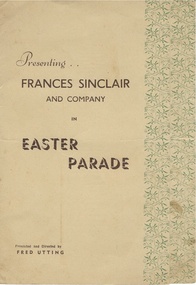
Document, Frances Sinclair Club Warrambool 1978, 1950s
... Warrnambool This is a sheet of paper folded in two to make four pages. The paper has been folded so as to make the first page of a smaller width than the second and third pages. The program is buff-coloured with a decorative green border on the front and third pages. The programme printing is in brown type. The programme contains a list of participants in the concert and the 24 items in the concert. Frances Sinclair Club ...This is the programme of a concert staged in Warrnambool in the 1950s. The production was put on by Frances Sinclair and Company and was presented and directed by Fred Utting. The performers included small children, mainly girls, ballerinas and an orchestra. Frances Sinclair also had a shop in Liebig Street in the 1950s called the Olympic Sportswear.This programme is of interest because it is an example of the type of entertainment provided in Warrnambool in the 1950s with the performers from a local company teaching dance and movement to young local people. The donor of the programme, Lyn Wright, was herself one of the ‘Tiny Tots’ performers. The donor of the programme was Alan Lane, a bus company proprietor in Warrnambool and a well-known businessman and supporter of the arts in the city. This is a sheet of paper folded in two to make four pages. The paper has been folded so as to make the first page of a smaller width than the second and third pages. The program is buff-coloured with a decorative green border on the front and third pages. The programme printing is in brown type. The programme contains a list of participants in the concert and the 24 items in the concert. frances sinclair and company, alan lane, history of warrnambool, warrnambool -
 Warrnambool and District Historical Society Inc.
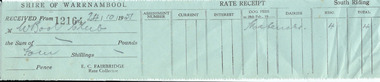
Document, Receipt WCC
... ‘Shire of Warrnambool, received from W’bool Club, the sum of four shillings, E.C.Fairbridge, Rate Collector, 24/10/51’....Warrnambool Club was buying but it could not have been very important as the total cost was only four shillings. The Warrnamnbool Club was (and is) in the City of Warrnambool. This club was a gentlemen’s club established in 1873 and the building that still exists today was built in 1877. This receipt has little significance as it is a 1951 purchase by the Warrnambool Club for an unknown item of little value. warrnambool club shire of warrnambool ‘Shire of Warrnambool, received from W’bool Club, the sum of four shillings, E.C.Fairbridge, Rate Collector, 24/10/51’. ...This receipt issued to the Warrnambool Club by the Shire of Warrnambool is for ‘materials’ supplied. It is not known what type of material the Warrnambool Club was buying but it could not have been very important as the total cost was only four shillings. The Warrnamnbool Club was (and is) in the City of Warrnambool. This club was a gentlemen’s club established in 1873 and the building that still exists today was built in 1877. This receipt has little significance as it is a 1951 purchase by the Warrnambool Club for an unknown item of little value. This is a small green receipt slip issued by the Shire of Warrnambool in 1951 to the Warrnambool Club for materials received. The paper has printed black lines and handwritten information (pencil) and has been torn from a larger receipt book, perhaps leaving a copy for the Shire records. ‘Shire of Warrnambool, received from W’bool Club, the sum of four shillings, E.C.Fairbridge, Rate Collector, 24/10/51’.warrnambool club, shire of warrnambool -
 Warrnambool and District Historical Society Inc.
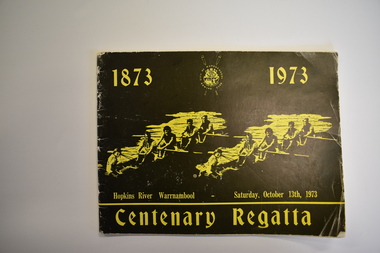
Booklet - Centenary Regatta Programme, Centenary Regatta 1873-1973, 1973
... Warrnambool Rowing Club, founded in 1873. It contains the names of the Warrnambool rowers at that time, including that of the nationally-successful rower, Val Bertrand. This programme is of interest not only because of its association with the Warrnambool Rowing Club (which still operates) but also because of the many advertisements which give us handy information about businesses and institutions in Warrnambool in the 1970s Warrnambool Rowing Club val bertrand rowing Warrnambool Rowing Club Regatta Programme This is a programme of 24 pages with a black cover with black and yellow printing and black and yellow images of rowers.The pages contain printed text, including many advertisements. ...Warrnambool Rowing Club Regatta ProgrammeThis is a programme of 24 pages with a black cover with black and yellow printing and black and yellow images of rowers.The pages contain printed text, including many advertisements. The pages were originally stapled.non-fictionWarrnambool Rowing Club Regatta Programmewarrnambool rowing club, val bertrand, rowing -
 Warrnambool and District Historical Society Inc.
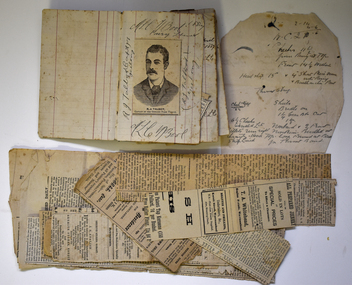
Memorabilia - Newspaper cuttings scrapbook, Martin Carter, Saddler, Warrnambool, late 19th century (1887-1894)
... Warrnambool Bowling Club, a member of the local Volunteer Militia, Secretary of the Progress Association, a football player and umpire and a local cricketer. He was the Secretary of the Warrnambool Town (later City) Band for fifty years and a memorial plaque in his honour was erected at the Band headquarters in Warrnambool. He was also a Warrnambool Councillor (1917-1925) and Warrnambool Mayor (1922-24...Warrnambool Bowling Club, a member of the local Volunteer Militia, Secretary of the Progress Association, a football player and umpire and a local cricketer. He was the Secretary of the Warrnambool Town (later City) Band for fifty years and a memorial plaque in his honour was erected at the Band headquarters in Warrnambool. He was also a Warrnambool Councillor (1917-1925) and Warrnambool Mayor (1922-24 ...This scrapbook contains newspaper cuttings, mainly about football, and other written material from the late 19th century. It belonged to Martin Carter ((1870-1943), a Warrnambool saddler who worked for many years in the saddlery business established by his father, Samuel. Martin Carter was very active in community affairs - President of the Warrnambool Bowling Club, a member of the local Volunteer Militia, Secretary of the Progress Association, a football player and umpire and a local cricketer. He was the Secretary of the Warrnambool Town (later City) Band for fifty years and a memorial plaque in his honour was erected at the Band headquarters in Warrnambool. He was also a Warrnambool Councillor (1917-1925) and Warrnambool Mayor (1922-24). His interest in football can be seen from the great number of football newspaper cuttings in this notebook.This little notebook is most interesting as it provides us with details on football in the Warrnambool district in the late 19th century and gives us an indication of the popularity of the game at that time. It is a valuable research tool.This is a small notebook with a black cover. The pages contain ruled red lines over which have been pasted newspaper cuttings. Some pages have handwritten material and some pages are blank. There are also several loose cuttings. The notebook has been stapled but the staples have been removed.M.L.Carter Warrnambool June 13th 1887 S.Carter Saddler Warrnambool (stamp)warrnambool town band, martin carter warrnambool, football in the warrnambool district, sydney giddings warrnambool saddler
