
Showing 85 items matching "warrnambool fire brigade"
-
 Flagstaff Hill Maritime Museum and Village
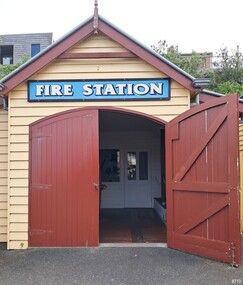
Memorabilia - Fire Brigade Collection, Warrnambool Fire Brigade, 1863-1950s
... ...Warrnambool Fire Brigade...The original replica Fire Station at Flagstaff Hill was constructed in 2006 by members of the CVA Warrnambool Fire Brigade. It was rebuilt in 2015, ironically due to damage from fire in the adjacent building, and now includes a locked display. ...Warrnambool Fire Brigade Collection: a variety of historic objects and equipment used by the firemen of the brigade since 1863. ...Warrnambool Fire Brigade...The objects on loan from the Warrnambool Fire Brigade are significant to local history since its establishment in 1863. ...The original replica Fire Station at Flagstaff Hill was constructed in 2006 by members of the CVA Warrnambool Fire Brigade. It was rebuilt in 2015, ironically due to damage from fire in the adjacent building, and now includes a locked display. The fire station faithfully replicates the designs of the late 1800s fire stations found across Victoria. Every detail, including the type of nails used, adheres to period-correct specifications. The objects on display are on loan from the CFA. They provide a glimpse into the history and evolution of firefighting in Victoria, preserving the heritage and legacy of the brave men and women who have served their communities. Fire Brigade Collection highlights: . Hose reels and equipment: essential firefighting equipment used during the late 19th and early 20th centuries. . Brass helmets: symbolic headgear worn by firefighters for protection and identification. . Photographs: historical images capturing the evolution of firefighting in the region. . Certificates: awards highlighting the skill and dedication of firefighters. A BRIEF HISTORY OF THE WARRNAMBOOL FIRE BRIGADE - [Ref: Quarrell, A, 2013, The Warrnambool Fire Brigade: 1863-2013, Amazon Printing, Warrnambool]: “Since the township of Warrnambool was established in the 1840s, there were several attempts at forming a Fire Brigade. However, many issues hindered progress. Firstly, minimal fires were recorded. Secondly, the town had no money to purchase expensive equipment, including a fire engine, and thirdly and most importantly, there was no infrastructure for accessible running water from pipes, as we know today. But after the expansion and growth of the township, it was time for action. The Warrnambool Fire Brigade was formed in 1863. The Brigade has served Warrnambool on a daily basis ever since. The volunteers of the Brigade were required to fill their water carts each evening from a spring on Cannon Hill and be on standby to deliver water to fire scenes. In 1889, the Warrnambool Council built a new Fire Station at 25 Liebig Street. Today, the Civic Centre is located on this site.” The objects on loan from the Warrnambool Fire Brigade are significant to local history since its establishment in 1863. They tell the story of the Brigade’s history, which is part of Warrnambool and the district’s history.Warrnambool Fire Brigade Collection: a variety of historic objects and equipment used by the firemen of the brigade since 1863. The items are kindly on loan from the Warrnambool Fire Brigade in a building originally erected in the Village by the Fire Brigade to house their historic collection. The items include: EQUIPMENT: 2 fire reels, 3 leather buckets, 1 wooden ladder, 2 old pumps, 2 fire extinguishers, 1 foam nozzle, 2 hydrants, 1 red chest with breathing apparatus, 1 large grey chest, 1 red metal thread gauges box, 2 copper and brass extinguishers, 3 copper and brass branches, 1 canvas bucket, assorted reels of hose, assorted couplings and branches, PHOTOGRAPHS/CERTIFICATES: 3 Discipline Certificates dated 1894, 1893, 1911, Mounted photo of members of the Warrnambool Fire Brigade Football Club, Mounted photos of members of the Warrnambool Fire Brigade in uniform, framed photo of LC Marshall UNIFORMS: 1 Officer’s jacket, 1 blazer, 1 turnout jacket, 1 harness belt, 1 leather helmet, 1 pair of boots, 1 brass helmet, 1 axe belt with axe and plug spanner TROPHIES: 1 clock flagstaff hill maritime museum and village, great ocean road, shipwreck coast, flagstaff hill, warrnambool, maritime village, maritime museum, cfa, fire brigade, warrnambool fire brigade, fire reel, leather bucket, wooden ladder, pump, fire extinguisher, foam nozzle, fireman’s hydrant, breathing apparatus, copper and brass extinguishers, copper and brass branches, canvas bucket, discipline certificates, warrnambool fire brigade football club, l c marshall, officer’s jacket, blazer, turnout jacket, harness belt, leather helmet, pair of boots, brass helmet, axe belt with axe and plug spanner, clock, mantle clock -
 Warrnambool and District Historical Society Inc.
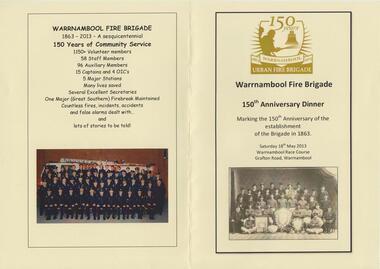
Programme - Warrnambool Fire Brigade 150th Anniversary Dinner, 05/2013
... Warrnambool Fire Brigade 150th Anniversary Dinner...warrnambool...fire brigade...Presented to guests at the 150th Anniversary of Warrnambool Fire brigade....Front cover has gold logo" Warrnambool Urban Fire Brigade". ...The program presents a present day menu and historical photographs. warrnambool fire brigade bryan wills guests official guests michael neoh hans van hammond euan ferguson warrnambool fire brigade Front cover has gold logo" Warrnambool Urban Fire Brigade". ...Presented to guests at the 150th Anniversary of Warrnambool Fire brigade. The celebration of 150 years of the Fire brigade is a significant social event in the city. It shows dedication to an important community service. The program presents a present day menu and historical photographs.Medium card,cream in colour. Box surrounds text "150th Anniversary Dinner" with B/W photograph underneath. Inside pages contains program and menu for the event, with B/W Photograph of Brigade.Back cover gives present day particulars of membership with colour photograph. Front cover has gold logo" Warrnambool Urban Fire Brigade". warrnambool, fire brigade, bryan wills, guests, official guests, michael neoh, hans van hammond, euan ferguson, warrnambool fire brigade -
 Warrnambool and District Historical Society Inc.
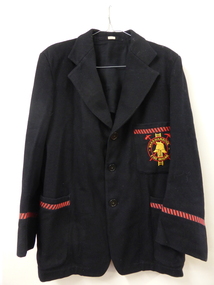
Uniform - Fire Brigade jacket, Jacket Warrnambool Fire Brigade, Mid 20th century Place Made
... Jacket Warrnambool Fire Brigade...Warrnambool Fire Brigade... This blazer was worn by a Warrnambool Fire Brigade member (Jack Sizeland). It was part of the dress uniform for fire brigade members in the 1960s and 70s. ...The top pocket has the badge of the Warrnambool Fire Brigade in red and yellow stitched on. ...This blazer was worn by a Warrnambool Fire Brigade member (Jack Sizeland). It was part of the dress uniform for fire brigade members in the 1960s and 70s. ...This blazer was worn by a Warrnambool Fire Brigade member (Jack Sizeland). It was part of the dress uniform for fire brigade members in the 1960s and 70s. The Warrnambool Fire Brigade was established in the early 1860s after a fire at the Flying Buck Hotel in Liebig Street prompted a public meeting to establish a permanent fire authority in the town. There had been a couple of attempts previously to set up a local fire brigade. The Warrnambool Fire Brigade actively participates in Country Fire Authority Championships and competitions and has been very successful, particularly in the 19th century. John (Jack) Sizeland retired when he was 65 in 1977 (37 years of service).This blazer is of interest as it shows us what fire fighters in Warrnambool were wearing in the mid 20th century (dress uniform). It is also a memento of one long-serving firefighter, Jack SizelandThis is a man’s black blazer with three large black buttons. The sleeve ends and the three pockets have a diagonal red and black patterned braid stitched on. The upper portion of the blazer and the sleeves are lined with black material. The top pocket has the badge of the Warrnambool Fire Brigade in red and yellow stitched on. The badge features a Fire Brigade helmet, a ladder and two axes set in two concentric circles. A printed label with the owner’s name (Sizeland) is stitched inside the collar areaName ‘Sizeland’ stitched inside collar areawarrnambool fire brigade, country fire authority, john sizeland, history of warrnambool -
 Warrnambool and District Historical Society Inc.
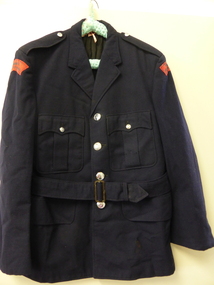
Uniform, Warrnambool Fire Brigade, Mid 20th century
... Warrnambool Fire Brigade...Warrnambool Fire Brigade...This is a complete uniform of the Warrnambool Urban Fire Brigade in the mid 20th century. ...This is a Warrnambool Fire Brigade uniform consisting of:- .1 A black cloth single-breasted jacket lined with black and white material. ...This is a complete uniform of the Warrnambool Urban Fire Brigade in the mid 20th century. ...This is a complete uniform of the Warrnambool Urban Fire Brigade in the mid 20th century. The Warrnambool Fire Brigade, located today in Mortlake Road, Warrnambool, was established in 1863. The formation was prompted by a fire at the Flying Buck Hotel in Liebig Street. The Warrnambool Fire Brigade has a long proud history of service to the people of Warrnambool and district for over 150 years. The uniform belonged to John (Jack) Sizeland, a firefighter for over 37 years. He retired in 1977. This uniform is of some significance as it shows the type of uniform worn by Warrnambool firefighters in the mid 20th century. It is also of importance because it belonged to a local firefighter, Jack Sizeland. This is a Warrnambool Fire Brigade uniform consisting of:- .1 A black cloth single-breasted jacket lined with black and white material. It has four silver metal buttons down the front and two on the top pocket lapels. The buttons have the inscription ‘Country Fire Authority Victoria’. There are two red and black cloth tabs stitched on the top of the sleeves (‘Warrnambool Urban Fire Brigade’). The belt is stitched at the back and loose at the front. .2 Black cloth trousers with a red braid stripe down each leg. .3 Black leather belt with a silver-coloured buckle. .4 Black officer-type hat with red plastic lining, a plastic peaked front with a green backing, a red and black braid around the rim with two metal buttons and a silver-coloured metal badge of the Country Fire Authority. .5 Black cloth (polyester) tie with orange lining. Trousers: ‘C.F.A., I. L. Wise’ Tie: ‘Mark Andrew Made in Australia’ Hat: ‘Emerco, Melbourne, Registered Trademark, This is Your Guarantee for Quality, Made in Australia’ warrnambool fire brigade, jack sizeland, history of warrnambool -
 Warrnambool and District Historical Society Inc.
Clothing, Warrnambool Urban Fire Brigade, Mid 20th century
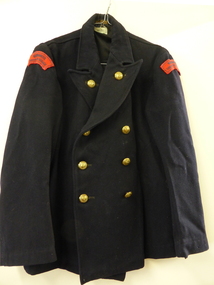
... Warrnambool Urban Fire Brigade...Warrnambool Fire Brigade... This jacket was part of the working uniform of the Warrnambool Urban Fire Brigade in the mid 20th century. ...Fire Authority Victoria’. There are two brass clips on the side to hold a belt. There are two black and red cloth attachments at the top of each sleeve (‘Warrnambool Urban Fire Brigade’). ...‘David Lack Pty Ltd Melbourne’ ‘Warrnambool Urban Fire Brigade’ ...This jacket was part of the working uniform of the Warrnambool Urban Fire Brigade in the mid 20th century. ...This jacket was part of the working uniform of the Warrnambool Urban Fire Brigade in the mid 20th century. It belonged to John (Jack) Sizeland, a member of the Fire Brigade for over 37 years. He retired in 1977. Prompted by a fire at the Flying Buck Hotel in Liebig Street the Warrnambool Fire Brigade was established in the mid 1860s. It has been successful in Victorian Fire Brigade Championships over the years, especially in the 19th century. It is currently situated in Mortlake Road. This jacket is of interest as an example of the clothing worn by firefighters in Victoria in the mid 20th century. It is also of interest because it was worn by Jack Sizeland, a local firefighter for over 37 years. This is a black double-breasted cloth jacket with six brass buttons down the front and two brass buttons on the lapels. The buttons are impressed with a shield and the words ‘Country Fire Authority Victoria’. There are two brass clips on the side to hold a belt. There are two black and red cloth attachments at the top of each sleeve (‘Warrnambool Urban Fire Brigade’). There is some black cloth lining inside the garment across the shoulders. The maker’s label, ‘David Lack Pty Ltd, Melbourne’ is on the inside collar. ‘David Lack Pty Ltd Melbourne’ ‘Warrnambool Urban Fire Brigade’ warrnambool fire brigade, jack sizeland, history of warrnambool -
 Warrnambool and District Historical Society Inc.
Clothing, Warrnambool Urban Fire Brigade Belt, Mid 20th century
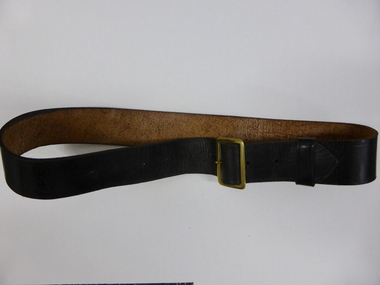
... Warrnambool Urban Fire Brigade Belt...Warrnambool Fire Brigade...The Warrnambool Fire Brigade was formed in 1863 following unsuccessful attempts to establish a permanent fire service in the town. ...This belt is meant to be worn with the Warrnambool Fire Brigade jacket with the brass buttons. ...Warrnambool Fire Brigade Jack Sizeland History of Warrnambool ‘J. ...This belt was worn with the jacket issued to members of the Warrnambool Fire Brigade in the mid 20th century. The jacket was part of the uniform that served both as a dress uniform and a work uniform. The Warrnambool Fire Brigade was formed in 1863 following unsuccessful attempts to establish a permanent fire service in the town. It was prompted by a fire at the Flying Buck Hotel in Liebig Street. The Warrnambool Fire Brigade, now located on the Mortlake Road, has been successful in Victorian Fire Brigade competitions and demonstrations, particularly in the 19th century. The owner of the belt and uniform was John (Jack) Sizeland, a member of the Warrnambool Fire Brigade for over 37 years. This belt is of interest as it was part of a Warrnambool Fire Brigade uniform during the second half of the 20th century. It also has individual local provenance as it belonged to Jack Sizeland, a member of the Warrnambool Fire Brigade who retired in 1977 after 37 years of service. This is a brown leather belt with a gold metal buckle and nine punched holes on the buckle, two of them hand-punched. It has a leather attachment to keep the belt end in place. It has the name of the owner, John Sizeland, written in biro on the inside of the belt. This belt is meant to be worn with the Warrnambool Fire Brigade jacket with the brass buttons. ‘J. Sizeland, W’bool’warrnambool fire brigade, jack sizeland, history of warrnambool -
 Warrnambool and District Historical Society Inc.
Book, Avis Quarrell, Celebrating 150 years of Service, The Warrnambool Fire Brigade 1863-2013, 2013
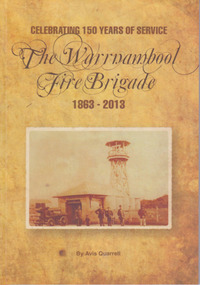
... Celebrating 150 years of Service, The Warrnambool Fire Brigade 1863-2013 ...warrnambool fire brigade...A History of the Warrnambool Fire Brigade from 1863 to 2013....: Printed by Amazon Printing, Text and design Avis Quarrell, Photographs The Fire brigade Archives, Warrnambool Standard, Avis Quarrell, Proofing Margaret Smart, David Ferguson, Research, Max Smart, Cover design Danny Price. ...A History of the Warrnambool Fire Brigade from 1863 to 2013. This book gives an insight into the operations, people and history of the Warrnambool Fire brigade. ...History of the Warrnambool Fire Brigade from 1863 to 2013Paperback light tan in colour with historical photo of Fire Brigade . Text in dark brown above photo. Back cover has stylised drawing with words Ready Aye Ready.non-fictionHistory of the Warrnambool Fire Brigade from 1863 to 2013warrnambool fire brigade, fireman equipment, membership. -
 Warrnambool and District Historical Society Inc.
Medal, Warrnambool Fire Brigade Camperdown, C 1900
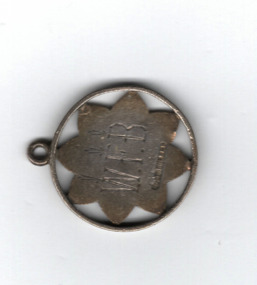
... Warrnambool Fire Brigade Camperdown......warrnambool fire brigade...McKenzie of the Warrnambool Fire Brigade at a Camperdown competition in 1899. ...McKenzie of the Warrnambool Fire Brigade at a Camperdown competition in 1899. ...This is a medal won by J. McKenzie of the Warrnambool Fire Brigade at a Camperdown competition in 1899. A Warrnambool Fire Brigade was first established in 1859 but it lapsed and another Fire Brigade was formed in 1863. This Brigade prospered and entered in, and won many Fire Brigade demonstrations and competitions which were particularly popular in the late 19th century and early 20th century. No information has been found on J. McKenzieThis medal is of considerable interest as a memento of the Warrnambool Fire Brigade in 1899 and of its successes in competitions against other Victorian Fire Brigades.This circular silver coloured light metal medal features an eight petal shaped centrepiece inserted into an outer circle with text on both obverse and reverse. It has a small attached ring at the top. Obverse -CAMPERDOWN 24/5/99 ENGINE3 MEN WON BY J MC KENZIE Reverse W.F.B. Maker's markj. mckenzie, warrnambool fire brigade, warrnambool history -
 Warrnambool and District Historical Society Inc.
Document - Warrnambool Urban Fire Brigade 150 years Calendar, 2012
... Warrnambool Urban Fire Brigade 150 years Calendar ...warrnambool fire brigade...This calendar was produced to commemorate the 150th anniversary of the Warrnambool Fire Brigade. ...Text reads 150 years, 1863 Warrnambool, 2013, Urban Fire Brigade. Spiral bound....Text reads 150 years, 1863 Warrnambool, 2013, Urban Fire Brigade. Spiral bound. Document Warrnambool Urban Fire Brigade 150 years Calendar ...This calendar was produced to commemorate the 150th anniversary of the Warrnambool Fire Brigade. The significance of this item lies in the fact that it is commemorating 150years of the Fire Brigade in Warrnambool and also that it also contains a selection of historic and recent photos including the original fire bell, different fire stations, engines and crews through the years. Cream coloured front and back covers with white, month to a page entries. Each month has either black and white or coloured photos. Front cover has gold coloured emblem of firemen with hose and bell. Text reads 150 years, 1863 Warrnambool, 2013, Urban Fire Brigade. Spiral bound.warrnambool fire brigade, 150 celebration, calendar, fire bell, fire station, pumper truck. -
 Warrnambool and District Historical Society Inc.
Ribbons, Fire brigade, 1920s
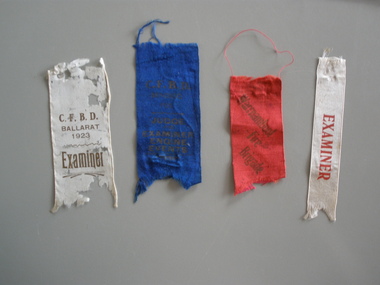
... warrnambool fire brigade...The Warrnambool Fire Brigade, founded in 1863, has been a strong participant in competitions throughout its history and was particularly successful in the 1890s and early 1900s. ...These are four ribbons that come from Fire Brigade demonstrations or competitions. At least one is connected to the Warrnambool Fire Brigade. ...‘Examiner’ ‘Warrnambool Fire Brigade’ ‘C.F.B.D. Ballarat, 1923, Examiner’ (This may stand for ‘Country Fire Brigade Demonstration’ ) ...The Warrnambool Fire Brigade, founded in 1863, has been a strong participant in competitions throughout its history and was particularly successful in the 1890s and early 1900s. ...The Warrnambool Fire Brigade, founded in 1863, has been a strong participant in competitions throughout its history and was particularly successful in the 1890s and early 1900s. It has hosted many State Championships at Junior and Senior level. In the 1920s there were many significant fires in Warrnambool. These ribbons are of minor significance as they are in a poor condition and three of them have no provenance. They are however examples of ribbons used in Fire Brigade competitions in the past. These are four ribbons that come from Fire Brigade demonstrations or competitions. At least one is connected to the Warrnambool Fire Brigade. One is a buff-coloured silk label marked ‘Examiner’ in red printing, fraying at both ends. One is a red silk ribbon marked ‘Warrnambool Fire Brigade’, fraying at both ends. One is a black silk ribbon with no apparent markings and one is a buff-coloured silk ribbon, much frayed with brown printing.‘Examiner’ ‘Warrnambool Fire Brigade’ ‘C.F.B.D. Ballarat, 1923, Examiner’ (This may stand for ‘Country Fire Brigade Demonstration’ ) warrnambool fire brigade -
 Warrnambool and District Historical Society Inc.
Pamphlet - Warrnambool Fire Brigade, 150 years of Service, 2013
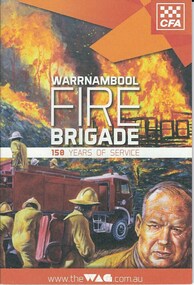
... Warrnambool Fire Brigade, 150 years of Service....warrnambool fire brigade... Brigade , Celebrating 150 years. warrnambool fire brigade fire brigade competitions fire brigade equipment 150 years warrnambool fire brigade warrnambool art gallery CFA logo is on front cover RHS top. ...This brochure was used to accompany a display at the Warrnambool Art Gallery to celebrate the 150th Anniversary. It give a brief outline of the Brigade's history and also equipment used and competitions in which the Brigade took part. It links in with the Book Warrnambool Fire Brigade , Celebrating 150 years.Four pages folding out , with printing and photographs on both side. The information contains a brief outline of the history of the Brigade. The dominant colour of the brochure is red.CFA logo is on front cover RHS top. Warrnambool Art Gallery logo on back cover.warrnambool fire brigade, fire brigade competitions, fire brigade equipment, 150 years warrnambool fire brigade, warrnambool art gallery -
 Warrnambool and District Historical Society Inc.
Medal - 150 Years Warrnambool Fire Brigade, Circa 2013
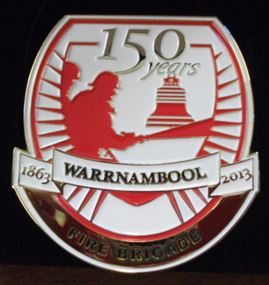
... 150 Years Warrnambool Fire Brigade...warrnambool fire brigade...Fire Brigade. Over that time the Brigade has played an important role in the town, and fighting a number of significant fires in the town and district. Limited numbers produced. warrnambool ...The medallion commemorates 150 years service of the Fire Brigade. Over that time the Brigade has played an important role in the town, and fighting a number of significant fires in the town and district. Limited numbers produced.Red, white, black enamel on gold/ brass metal.Simplified picture of 2 firemen, hose and bell. The text, "1863 Warrnambool 2013" lies inside a banner. Medal is in shape of a shield."29" on the reverse.warrnambool fire brigade, 150 year anniversary -
 Warrnambool and District Historical Society Inc.
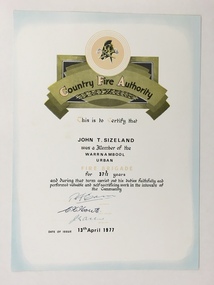
Certificate, Country Fire Authority J T Sizeland, 1977
... ...warrnambool fire brigade...In our collection we have Jack Sizeland’s Fire Brigade uniform and accessories. The Warrnambool Fire Brigade was established in 1863....In our collection we have Jack Sizeland’s Fire Brigade uniform and accessories. The Warrnambool Fire Brigade was established in 1863. ...This is a certificate awarded to John "Jack" Sizeland of Banyan Street Warrnambool for membership of the Warrnambool Urban Fire Brigade. Mr. Sizeland joined the C.F.A. in 1945 and retired at the compulsory age of 65 in 1977 after over 37 years membership. In our collection we have Jack Sizeland’s Fire Brigade uniform and accessories. The Warrnambool Fire Brigade was established in 1863.This certificate is of interest as it records the years of service of a prominent fireman in Warrnambool in the 20th century.A sheet of white card featuring a black printing, photocopied hand signatures and a title in an ornamental scroll, a title and a logo of the Country Fire Authority. The white card has a blue tinge around the edges. It has the emblem of the Country Fire Authority, the name of the Authority in a cream, yellow and black ornate setting and printing in black and yellow. There are three signatures (blue ink) on the certificate.Country Fire Authority John T. Sizeland john t sizeland, warrnambool fire brigade, country fire authority -
 Warrnambool and District Historical Society Inc.
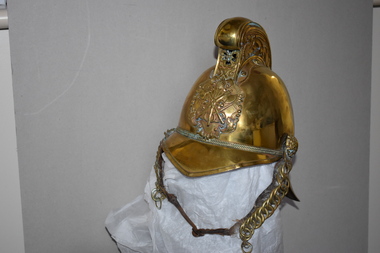
Helmet, Firmin & Sons, Fireman's helmet, Early 20th century
... Warrnambool Fire Brigade...It is regarded as the oldest manufacturing business operating in England today. The Warrnambool Fire Brigade was established in the early 1860s and today has both paid and volunteer firefighters....It is regarded as the oldest manufacturing business operating in England today. The Warrnambool Fire Brigade was established in the early 1860s and today has both paid and volunteer firefighters. ...This fire helmet may have been one used in England or one used in the late 19th century and early 20th century in Australia. It was made by Firmin & Sons of England, a firm which was founded in 1655. It supplies military ceremonial buttons, badges and uniforms and brass and pith helmets of various kinds. It is regarded as the oldest manufacturing business operating in England today. The Warrnambool Fire Brigade was established in the early 1860s and today has both paid and volunteer firefighters.This helmet has no known local provenance but is retained for display purposes.This is a brass helmet with an oval crown with an ornate scrolled curved piece coming over the crown. There is a decoration of a winged dragon breathing fire and on the front side a torch, an axe and a hose with decorative surrounds. There is a breathing hole at the top of the crown in a petal shape. On the sides are metal medallions holding a chin strap which is adjustable. The edge of the crown has a scrolled band. The front peak is angled with a folded metal edge and the rear peak is a concave shape with a brass screw in the middle. Inside the helmet are 8 screws holding the upper decorative arching piece and a black leather band with eyelets tied together to fir the individual head. There is an oval plaque with wording contained within a decorative belt.Firmin & Sons Ltd 108 & 109 St Martins Lane W.C. Late of 153 & 154 Strandwarrnambool fire brigade, history of warrnambool -
 Warrnambool and District Historical Society Inc.
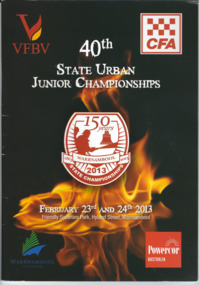
Booklet, CFA 40th Championship, 2003
... warrnambool fire brigade...The Warrnambool Fire Brigade was formed in 1863. The first fire engine house was in Liebig Street and carters were required to carry water to fire scenes. ...The Warrnambool Fire Brigade was formed in 1863. The first fire engine house was in Liebig Street and carters were required to carry water to fire scenes. ...The Warrnambool Fire Brigade was formed in 1863. The first fire engine house was in Liebig Street and carters were required to carry water to fire scenes. In 1889 the Council built a new Fire Station on Liebig Street and Warrnambool hosted its own Annual Demonstration in 1894. In 1891 the volunteer brigade became part of the Country Fire Brigade. The Fire Station relocated to Raglan Parade in 1915 and then to Timor Street in 1961. In 1989 the Brigade moved back to Raglan Parade. This booklet is a memento of the State Championships that were held in Warrnambool to mark 150 years of community service to Warrnambool by the Warrnambool Fire Brigade. (2013)This is a booklet of 63 pages containing printed material, maps, advertisements and photographs. The back cover is red and the front cover has a black background with an image of flames and a badge with the title of the booklet. The pages are stapled.Front Cover: VFBV, CFA, 40th State Urban Junior Championships, February 23rd and 24th 2013, Friendly Societies Park, Hyland Street, Warrnambool, Warrnambool City Council, Powercor Australia Back Cover: Powercor Australia warrnambool fire brigade, state urban junior championships -
 Warrnambool and District Historical Society Inc.
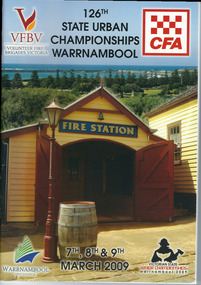
Programme - Booklet, CFA 126 Championship, 2009
... warrnambool fire brigade...The Warrnambool Fire Brigade was formed in 1863. The first fire engine house was in Liebig Street and carters were required to carry water to fire scenes. ...Front Cover: VFBV, Volunteer Fire Brigades Victoria, CWA, 126th State Urban Championships, 7th, 8th and 9th March 2009, Victorian State Senior Championships, Warrnambool 2009, Warrnambool City Council logo...The Warrnambool Fire Brigade was formed in 1863. The first fire engine house was in Liebig Street and carters were required to carry water to fire scenes. ...The Warrnambool Fire Brigade was formed in 1863. The first fire engine house was in Liebig Street and carters were required to carry water to fire scenes. In 1889 the Council built a new Fire Station on Liebig Street and Warrnambool hosted its own Annual Demonstration in 1894. In 1891 the volunteer brigade became part of the Country Fire Brigade. The Fire Station relocated to Raglan Parade in 1915 and then to Timor Street in 1961. In 1989 the Brigade moved back to Raglan Parade. This booklet is a memento of the State Urban Championships that were held in Warrnambool in 2009 (Volunteer Fire Brigades Victoria and Country Fire Authority)This is a booklet of 96 pages containing printed material, maps, advertisements, photographs and tables. The back cover is white with a Powercor Australia symbol in red and printed material. The front cover is multi-coloured with a photograph of the Fire Station at Flagstaff Hill Maritime Village. The pages are stapled.Front Cover: VFBV, Volunteer Fire Brigades Victoria, CWA, 126th State Urban Championships, 7th, 8th and 9th March 2009, Victorian State Senior Championships, Warrnambool 2009, Warrnambool City Council logowarrnambool fire brigade, state urban championships (2009) -
 Ballarat Heritage Services
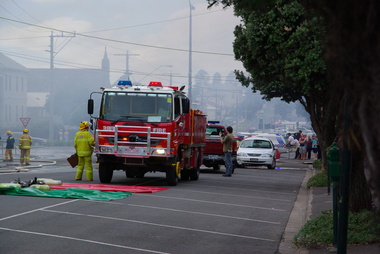
Digital Photograph, L.J. Gervasoni, Criterion Hotel Fire Warrnambool, Feb 2010
... warrnambool...Fire Brigade...criterion hotel fire fire truck smoke cfa warrnambool Fire Brigade Photograph of a fire engine attending a fire at Warrnambool's Criterion Hotel. ...Photograph of a fire engine attending a fire at Warrnambool's Criterion Hotel.criterion hotel, fire, fire truck, smoke, cfa, warrnambool, fire brigade -
 Ballarat Fire Brigade
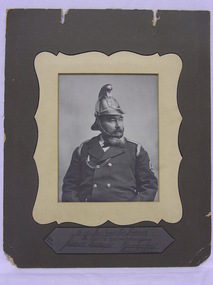
Photograph, just prior to March 1908
... Geilhofer was Honorary Secretary of Ballarat Fire Brigade before moving to Warrnambool...Photo is of Geilhofer during his time as captain of Warrnambool fire brigade....To the Ballarat Fire Brigade / In Kindly rememberance from / Richard Geilhofer Warrnambool / March 1908...Photo is of Geilhofer during his time as captain of Warrnambool fire brigade. Photograph Jordons ...Geilhofer was Honorary Secretary of Ballarat Fire Brigade before moving to WarrnamboolMounted black & white photograph of Richard Geilhofer (ex Brigade Honorary Secretary) presented to the brigade in March 1908. Photograph shows Geilhofer in his Captains uniform with brass helmet and a whistle in his right pocket. Photo is of Geilhofer during his time as captain of Warrnambool fire brigade.To the Ballarat Fire Brigade / In Kindly rememberance from / Richard Geilhofer Warrnambool / March 1908 -
 Warrnambool and District Historical Society Inc.
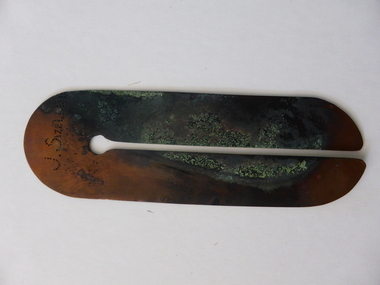
Household, Button Cleaning Shield, C 1960
... This object was used a shield to slide brass button through to enable them to be polished.They were a common object for those who wore military type uniforms with metal buttons The item belonged to John T Sizeland who was a member of the Warrnambool Urban Fire Brigade from 1940 through to 1977....This object was used a shield to slide brass button through to enable them to be polished.They were a common object for those who wore military type uniforms with metal buttons The item belonged to John T Sizeland who was a member of the Warrnambool Urban Fire Brigade from 1940 through to 1977. ...This object was used a shield to slide brass button through to enable them to be polished.They were a common object for those who wore military type uniforms with metal buttons The item belonged to John T Sizeland who was a member of the Warrnambool Urban Fire Brigade from 1940 through to 1977.This is an object which was commonly used by those in the military and those who wore uniforms with brass buttons. This item has strong provenance having belonged to John Sizeland who was a member of the Warrnambool Fire Brigade for over 30 years and was donated along with a number of associated fire brigade items. Long horse shoeshaped piece of copper with narrow slice three quarters through with rounded notch at the end.J Sizeland hammered into one end.warrnambool, button cleaner/protector, button cleaning shield, brass button, john t sizeland, brass button cleaning -
 Warrnambool and District Historical Society Inc.
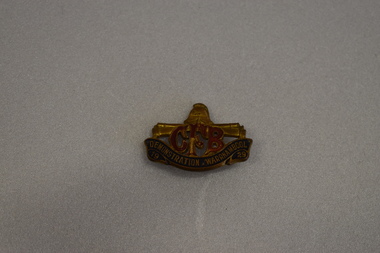
Badge, Country Fire Brigade 1929
... fire brigade...country fire brigade demonstration...warrnambool...The Warrnambool Fire Brigade was formed in 1863 with the first fire engine house in Liebig Street. ...The Warrnambool Fire Brigade was formed in 1863 with the first fire engine house in Liebig Street. ...The Warrnambool Fire Brigade was formed in 1863 with the first fire engine house in Liebig Street. Since then the brigade has been situated in Raglan Parade, Timor Street and today is in Mortlake Road. Fire Brigade demonstrations were a feature of rural Fire Brigades, particularly in the 19th century. At these demonstrations firemen from all over the state were involved in competition using hose reels, pumps and ladders etc. A torch light procession was always part of the demonstration. The state Fire Brigade Demonstration was held in Warrnambool in March 1929. One hundred and nineteen teams entered the Champion Fours and there were ninety one entrants in the one man ladder competition which was won by a fireman from Carrum who was carried shoulder high around the oval. This badge has considerable significance as it is our only memento of the Fire Brigade demonstration held in Warrnambool in 1929. A gold coloured metal badge featuring a profile of a fireman's helmet at the top, a horizontal bar, ornate capital Letters; C F B painted ( the letter F is missing some paint ) in the centre and a dark blue scroll with text at the base. There is a small hook and a small hollow cylinder on the reverse. The clip is missing.1929 DEMONSTRATION WARRNAMBOOL country fire brigade, country fire brigade demonstration, warrnambool -
 Warrnambool and District Historical Society Inc.
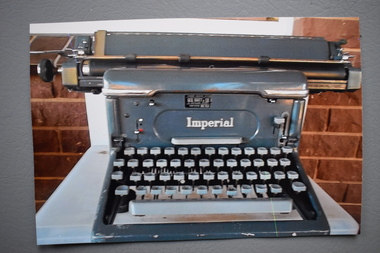
Typewriter & ribbon, Imperial, Mid 20th century
... He was actively involved in community affairs, including the Warrnambool Urban Fire Brigade (life member), the Florado Festival, the Warrnambool Olympic Pool committee and the Merrivale and Terang Football Clubs (player and captain). ...He was actively involved in community affairs, including the Warrnambool Urban Fire Brigade (life member), the Florado Festival, the Warrnambool Olympic Pool committee and the Merrivale and Terang Football Clubs (player and captain). ...This typewriter belonged to Gordon William Toleman (1910-1975). The first known Toleman born in the Western District was born at Mortlake in 1845 and Gordon Toleman was also born in Mortlake. He lived with his family in Warrnambool for many years. He was an accountant the Nestles Factory at Dennington for over 25 years. He was actively involved in community affairs, including the Warrnambool Urban Fire Brigade (life member), the Florado Festival, the Warrnambool Olympic Pool committee and the Merrivale and Terang Football Clubs (player and captain). He was also a life member of the Hampden Football League as a long-term Secretary and Treasurer and a secretary of the Warrnambool Football Club.This typewriter is of interest as one belonging to Gordon Toleman, a Warrnambool 20th century resident and a person well-known for his involvement in community activities..1 This is a metal typewriter with black and grey keys and a red and black typewriting ribbon. It has three gauges or scales. .2 These are two typewriter ribbons in red and black with circular metal covers. ‘Imperial’ ‘Geo Wraitt & Co 15 McKillop Street Repairs MU 7051’ gordon toleman, history of warrnambool -
 Warrnambool and District Historical Society Inc.
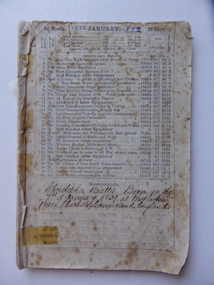
Booklet, Almanac - Advertiser 1873, 1872
... Beattie was heavily involved in community affairs in Warrnambool - the Fire Brigade, the Building Society, the Mechanics' Institute, the Manchester Unity Lodge and the Wesleyan Church. ...Beattie was heavily involved in community affairs in Warrnambool - the Fire Brigade, the Building Society, the Mechanics' Institute, the Manchester Unity Lodge and the Wesleyan Church. ...This Almanac was published by the Warrnambool Advertiser in 1873. The Warrnambool Advertiser was first published in 1868 by the Warrnambool Newspaper Company with James Hider as chairman. The first editor and publisher was Frank Davis who was succeeded in these positions in January 1870 by Daniel Harrison and Daniel George. The plant and goodwill was sold in May1874 to Fairfax and Laurie, the proprietors of the Warrnambool Standard. The owner of this booklet was Christopher Beattie who came to Warrnambool in 1853 and founded, with Henry Phillips, the undertaking firm of Beattie & Phillips in 1865. Beattie was heavily involved in community affairs in Warrnambool - the Fire Brigade, the Building Society, the Mechanics' Institute, the Manchester Unity Lodge and the Wesleyan Church. Several pages of the booklet have personal notes written by Beattie. The booklet remained in the possession of J J Leahy, the successor to Beattie & Phillips in the Fairy Street undertaking business.This booklet is of major importance as it is an original Warrnambool Advertiser Almanac of 1873. This Almanac was published two years before the Warrnambool Standard Almanacs were issued (1875-1930) and thus it contains information not available elsewhere. The association with Christopher Beattie of the firm Beattie & Phillips and the Beattie handwritten material are also of major interest to local historians.This is a booklet of 47 pages, the Warrnambool Advertiser Almanac of 1873. Some of the first and end pages are missing and some of the inside pages are torn or partly missing. Some of the end pages are loose. The booklet contains a monthly calendar with historical dates from Australia and overseas, Town and District Directories of people living in the Warrnambool area, general information on organisations and businesses in Warrnambool and the surrounding district and postal information. It also has many local Warrnambool and district advertisements, some with black and white sketches. There are also several pages with comments handwritten by Christopher Beattie. The pages have been tied together with string.Christopher Beattie Born on the/ 7th of January 1839 at Westlinton/ (near Carlisle), Cumberland, England 1872 [written in different hand at top of page]beattie & phillips, christopher beattie, warrnambool advertiser, history of warrnambool, james hider, frank davis, daniel harrison, daniel george, fairfax & laurie, henry phillips, j j leahy, undertakers -
 Warrnambool and District Historical Society Inc.
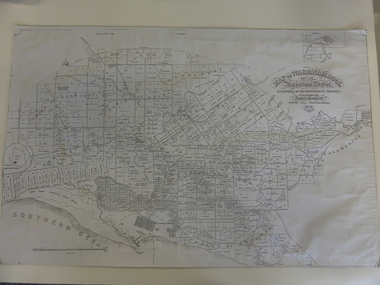
Map, Warrnambool 1859, Late 20th century (copy)
... Bromfield was a prominent resident of Warrnambool (Shire Councillor, Fire Brigade member, Cricket Club member, associated with horse racing etc). ...Bromfield was a prominent resident of Warrnambool (Shire Councillor, Fire Brigade member, Cricket Club member, associated with horse racing etc). ...This is a copy of Bromfield’s 1856 map of Warrnambool and district. James Astley Bromfield was a pioneer settler in Warrnambool. He established a chemist’s shop in 1854, initially situated in Timor Street. He moved his shop to Liebig Street with a new building erected in 1875. Bromfield was a prominent resident of Warrnambool (Shire Councillor, Fire Brigade member, Cricket Club member, associated with horse racing etc). He was interested in preserving the history of Warrnambool and this map he produced in 1856 was an example of this interest.This is a copy only but this 1856 map is of prime importance as it contains the names of the original landowners of land in north Warrnambool and the surrounding district. It is a frequently-used resource by historians.This is a copy of a map of Warrnambool and its agricultural district published by James Astley Bromfield in 1856. The map is mounted on cardboard and has black printing on a white background. ‘Map of Warrnambool and its Agricultural District according to the Government Survey’s published by Astley Bromfield, Medical Hall, Warrnambool 1856, James Ferguson, Lithr., Melbne.’bromfield’s 1856, map, warrnambool and district -
 Warrnambool and District Historical Society Inc.
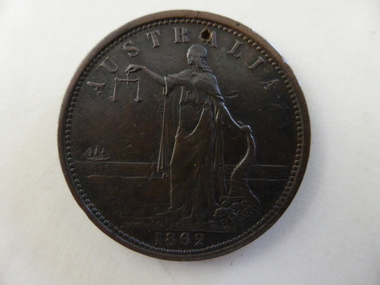
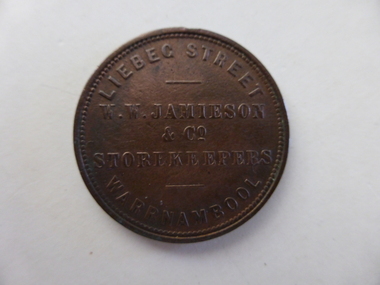
Numismatic, Token coin of WW Jamieson. Issued in W'bool 1862, 1862
... He was active in many local organizations including the Warrnambool Hospital, the Fire Brigade, the Mechanics Institute, the Villiers Building Society, the Bowling Club and the Caledonian Society. ...He was active in many local organizations including the Warrnambool Hospital, the Fire Brigade, the Mechanics Institute, the Villiers Building Society, the Bowling Club and the Caledonian Society. ...This is a token made for William Jamieson of Warrnambool in 1862. Tokens were coins made in the mid 1850s to alleviate the shortage of currency coins in Australia. They usually had the value of one penny and could only be used in the store or business designated on the coin. Two Warrnambool businesses had tokens made – those of William Jamieson and William Bateman, Junior. Born in Scotland, William Wilson Jamieson completed an apprenticeship in the ironmongery trade in that country. He worked in the ironmongery business in Melbourne before establishing ironmongery stores in Koroit and Warrnambool (Liebig Street). He was a Warrnambool Councillor (1862 to1874 & 1877 to1880) and Mayor (1866 to 1868 & 1872 to 1873). He was active in many local organizations including the Warrnambool Hospital, the Fire Brigade, the Mechanics Institute, the Villiers Building Society, the Bowling Club and the Caledonian Society. He died in 1882. This token is of great importance as it is an Australian token issued by William Jamieson and Co. of Warrnambool and so is part of the fiscal history of Australia. It is also important as it comes from one of only two businesses in Warrnambool to issue tokens. It is today a rare token. This is a round metal coin (token) with, on one side, an image of a woman holding the scales of justice in one hand and a cornucopia in the other. The other side has lettering. There is a small dent on one side of the token. Side One: ‘Australia 1862’ Side Two: ‘Liebeg Street W.W. Jamieson & Co. Storekeepers Warrnambool’ (N.B. Note the Warrnambool 1860s spelling of ‘Liebig Street’) william jamieson, australian tokens, history of warrnambool -
 Warrnambool and District Historical Society Inc.
Token, W Jamieson, 1862
... He was active in many local organizations, including the Warrnambool Hospital, the Fire Brigade, the Mechanics’ Institute, the Villiers Building Society the Caledonian Society and the Bowling Club. ...He was active in many local organizations, including the Warrnambool Hospital, the Fire Brigade, the Mechanics’ Institute, the Villiers Building Society the Caledonian Society and the Bowling Club. ...This is a token made for William Jamieson of Warrnambool in 1862. Tokens were coins made in the 19th century to alleviate the shortage of currency coins in Australia. They usually had a value of one penny and could only be used in the store or business designated on the coin. Two Warrnambool businesses had tokens made – those of William Jamieson and William Bateman Junior. Born in Scotland, William Wilson Jamieson completed an apprenticeship in the ironmongery trade in that country. He worked in the ironmongery business in Melbourne before establishing ironmongery stores in Koroit and Warrnambool (Liebig Street) in the late 1850s. He was a Warrnambool Councillor (1862 to 1874 & 1877 to 1880 and was Mayor (1866 to 1868 & 1872 to 1873). He was active in many local organizations, including the Warrnambool Hospital, the Fire Brigade, the Mechanics’ Institute, the Villiers Building Society the Caledonian Society and the Bowling Club. He died in 1882. This token is of great importance as it is an Australian token issued by W.W. Jamieson of Warrnambool in 1862 and so it is part of the fiscal history of Australia. It is also of great local significance as it comes from one of only two businesses in Warrnambool to issue tokens in the 19th century. It is today a rare token. This is a round metal coin (token) with, on one side, an image of a woman holding the scales of justice in one hand and a cornucopia in the other hand. This side of the coin has considerable staining. The other side has printing. Side One: ‘Australia 1862’ Side Two: ‘Liebeg Street W.W. Jamieson & Co. Storekeepers Warrnambool’ (N.B. Note the Warrnambool 1862 spelling of ‘Liebig Street’) william jamieson, australian tokens, history of warrnambool -
 Flagstaff Hill Maritime Museum and Village
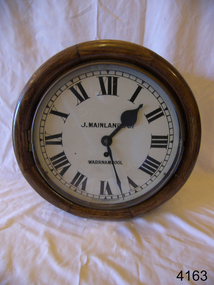
Clock, 1890s
... fire brigade (which he founded). Mary Gall, Johns wife had also migrated with her family from Glasgow Scotland in 1837 at the age of thirteen to New Zealand where she had met and married John Mainland and in 1866 John Gall Mainland the second eldest of their six children was born. After John Gall Mainland Jnr. had trained as a jeweller and watchmaker he also developed itchy feet and left New Zealand for Australia in the late 1880s eventually settling in Walhalla Victoria where he became chief of the fire brigade for ten years before moving to Warrnambool. ...The clock was made by an early Warrnambool business identity who had also made an important contribution to the local community over the years through his involvement with Rotary as a founding member the fire brigade. ...John Gall Mainlands father John Mainland Snr. was born in 1835 in the town of Lerwick in the Shetland Isles off the coast of Scotland. At the age of fifteen, he migrated to the South Island of New Zealand where he trained as a carpenter/builder after settling in Oamaru where he soon became a prominent citizen. He was for many years the Chairman of the Hospital Board and Captain of the fire brigade (which he founded). Mary Gall, Johns wife had also migrated with her family from Glasgow Scotland in 1837 at the age of thirteen to New Zealand where she had met and married John Mainland and in 1866 John Gall Mainland the second eldest of their six children was born. After John Gall Mainland Jnr. had trained as a jeweller and watchmaker he also developed itchy feet and left New Zealand for Australia in the late 1880s eventually settling in Walhalla Victoria where he became chief of the fire brigade for ten years before moving to Warrnambool. Gertrude Emily born 1872 met and married John G Mainland after he had increased his skills to become an optician. In Jan 1892 opened a business in Liebig St Warrnambool the sign outside his premises read, (J Mainland Watchmaker Jeweler and Optician). While he was establishing his business and profession John had set about contributing to the cultural and business life of the Warrnambool community. One of his many community commitments was with the scouting movement where he became a King Scout and an original charter member of the Warrnambool Rotary Club.The clock was made by an early Warrnambool business identity who had also made an important contribution to the local community over the years through his involvement with Rotary as a founding member the fire brigade. Having an item that was made by John Mainland during the early development of Warrnambool and in such good condition is in itself significant, it's provenance is well established and it is another piece of local history that further tells a story of Warrnambool's cultural life and early development in the 1890s. Wall Clock, circular in a wooden case Roman numerals on a twelve hour dialName of maker to dial face "J Mainland & Co Warrnambool"flagstaff hill, warrnambool, shipwrecked-coast, flagstaff-hill, flagstaff-hill-maritime-museum, maritime-museum, shipwreck-coast, flagstaff-hill-maritime-village, warrnambool clock maker, john mainland, john gall mainland, mary gall, clock maker, optician, jeweller -
 Flagstaff Hill Maritime Museum and Village
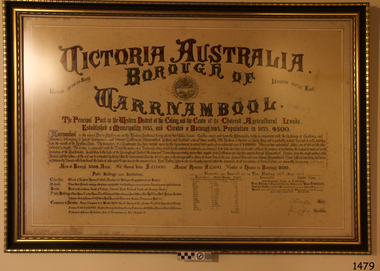
Document - Framed Poster, Borough of Warrnambool, Victoria, Australia, after 30/06/1875
... Fire Brigade &c. --- Exports and Imports for the Year Ending 30th June 1875 –-- --Exports Total Tonnage 27,800 (Calculated at the Current Warrnambool Market Prices) Potatoes Wool Wheat Barley Hides Skins Fowls Butter Cheese Eggs Tallow Leather Ale Pigs Sheep Sundries --Imports 13,000 Tons Of the Estimated Value of £520,000 Total Tonnage of Exports and Imports 40m900 Tons, Value £806,627 Passenger Travels, to ad from Warrnambool during year, 10,000 persons Revenue from all sources paid through Warrnambool Sub Treasury From 1860 to June 1875 £1, 292, 300 Thomas King [signed] Mayor Henry T Read [signed] Town Clerk” - - - - - - - - - - - - - - -- - - - - - - - - - - - - - -- - - - - - - - - - - - - - -- - - - - - - - - - - - - - - ...Fire Brigade &c. --- Exports and Imports for the Year Ending 30th June 1875 –-- --Exports Total Tonnage 27,800 (Calculated at the Current Warrnambool Market Prices) Potatoes Wool Wheat Barley Hides Skins Fowls Butter Cheese Eggs Tallow Leather Ale Pigs Sheep Sundries --Imports 13,000 Tons Of the Estimated Value of £520,000 Total Tonnage of Exports and Imports 40m900 Tons, Value £806,627 Passenger Travels, to ad from Warrnambool during year, 10,000 persons Revenue from all sources paid through Warrnambool Sub Treasury From 1860 to June 1875 £1, 292, 300 Thomas King [signed] Mayor Henry T Read [signed] Town Clerk” - - - - - - - - - - - - - - -- - - - - - - - - - - - - - -- - - - - - - - - - - - - - -- - - - - - - - - - - - - - - The document is of historical, social, economic and local significance in that it summarises activities, business, community, trade, travel and government at a point in time in Warrnambool’s history – 30th June 1875. flagstaff hill warrnambool shipwrecked coast flagstaff hill maritime museum maritime museum shipwreck coast flagstaff hill maritime village great ocean road borough of warrnambool municipality of warrnambool document borough of warrnambool 1875 word picture of warrnambool 1875 tablet of borough of warrnambool 1875 statistics borough of warrnambool 1875 lithograph borough of warrnambool 1875 coat of arms warrnambool warrnambool city motto – in these we flourish establishment of warrnambool warrnambool history thomas king mayor of warrnambool henry t read town clerk of warrnambool warrnambool breakwater warrnambool jetty warrnambool imports and exports 1875 warrnambool agriculture 1875 warrnambool business 1875 warrnambool population 1875 centennial exhibition philadelphia 1876 framed certificate Signatures - "Thomas King" Mayor and "Henry T Read" Town Clerk. ...This document, also referred to as a word picture or Tablet, is framed in glass and timber with gilt trim, is handwritten with colour highlights. The penned letters rest on ruled guide lines, decorated where the lines intersect. The writing gives a description of the state of Borough of Warrnambool around 1875; its location, the area it covers, its population, Harbour and facilities, public buildings and institutions, imports and exports, financial worth, number of houses, connection with other areas of the Colony. A possible reason and origin for the document is found in an article ‘Link with US Exhibition’ from the Warrnambool Standard of December 19, 1981, written by local historian Bruce Morris. The writer mentions that the Warrnambool Borough Council met on 15th June 1875 and recorded a letter from G.C. Levey , secretary to the Melbourne group of commissioners representing the Colony, and Victoria in particular, for the Philadelphia Centennial Exhibition of 1876. The letter asks Council to provide “statistics as to the population, social condition and commercial and industrial state of the district in and around Warrnambool.” A sub committee was formed for the project. The Mayor, Cr. Thomas King, wrote and signed a Report, presented to the council on July 14, 1875, in which “The Committee … begs to recommend that a Tablet be prepared setting for the particulars respecting the following matters relating to the Borough”. The matters included area, population, annual income, churches, schools, other public buildings, societies and companies, general description of houses erected, and returns of exports and imports for 1874. The minutes note that the Report was adopted. The article above also notes the opinion of Warrnambool printers who have examined the document; it is almost certainly to be an old lithograph, which means there could be several copies. It is possible that there may be a copy in Melbourne and another in Philadelphia. It is interesting to note that (1) the quoted location co-ordinates are for an “Unnamed Road, Packsaddle NSW 2880, Australia”, and that the DMS co-ordinates for Warrnambool’s Council Offices differ, being 38.23.9.12 South, 142.28.52.887. (2) the date for “Exports and Imports for the Year Ending 30th June 1875” is different to the period mentioned by Cr. King in the sub committee’s Report of recommendation “returns of exports and imports for 1874”. The information required to have the figures for the end of June 1875 would need to have been compiled very quickly for the Tablet to be ready for the opening of the Philadelphia Exhibition on 10 May 1876. The document/certificate shows the following – - - - - - - - - - - - - - - -- - - - - - - - - - - - - - -- - - - - - - - - - - - - - -- - - - - - - - - - - - - - - “Victoria Australia, Borough of Warrnambool. Latitude, 30.24.50 South, Longitude 142.32 East The Principal Port in the Western District of the Colony and the Centre of its Choicest Agricultural Lands. Established a Municipality in 1855, and Created a Borough 1863. Population in 1875 4,500. Warrnambool is the nearest Port to Melbourne on the Western Seaboard, being about 160 miles distant. Coaches run to and from the Metropolis daily, in connexion [connection] with the Railway of Geelong and Steamers belonging to Local Companies sail between Melbourne, Warrnambool, Belfast [renamed Port Fairy], and Portland several times weekly. The Harbour is known as Lady Bay, and is partially protected by a reef of rocks stretching from the mouth of the Hopkins River. The formation of a Breakwater has been decided upon by the Government, to extend 600 yards, at an estimated cost of £100,000. There are two substantial Jetties, one of 800 and the other of 600 feet in length. The former is connected with the Town by means of a Tramroad, along which Goods, inwards & outwards, are conveyed, & the latter has been constructed solely for the purpose of facilitating the transit of material for the formation of the Breakwater. In addition to the trade of the Borough and District, the principal Townships up country receive their supplies from Melbourne and ship their exports through Warrnambool. Potatoes form the staple produce of the district, and the richness of the soil can be estimated by the fact that the Government Statistics for 1875 give as the average yield a return of Seven Tons to the acre. Several thousand acres between Warrnambool and Tower Hill are now being laid down in Potatoes by Tenants who have leased the lands at rates up to £5 per acre for the season 1875-6. Wool, Tallow, hides &c are also largely exported, while the shipments of all descriptions of Farm Produce are annually increasing. Area of Borough, 3362 Acres. Net Annual Value £27,000. Annual Revenue £5,500. Number of Houses in Borough 800. Public Buildings and Institutions Churches. Church of England, Roman Catholic, Presbyterian, Wesleyan, Congregational and Baptist. Schools. Three State Schools, average attendance nearly 1000. New Building in course of erection. Several private establishments. Banks. Bank of Australasia, Bank of Victoria, National Bank, Colonial Bank and Savings Bank. Public Buildings. Court house, Custom house, Post & Telegraph Offices, Survey & Land Offices, Shire £, Town Hall, Mechanics Institute, Volunteer Orderly Room, Odd Fellows Hall, Hospital & Benevolent Asylum, Temperance Hall &c. Companies & Societies. Steam Navigation Co, Woolen Mill Co, Gas Co, Racing Club, Amateur Turf Club, Agricultural Society, Farmers’ Club, Cricket Club, Anglers’ Society, Building Society, Freemasons Odd Fellows, Foresters, Druids, Hibernians. Protestant Alliance, Rechabites, Sons of Temperance, &c, Fire Brigade &c. --- Exports and Imports for the Year Ending 30th June 1875 –-- --Exports Total Tonnage 27,800 (Calculated at the Current Warrnambool Market Prices) Potatoes Wool Wheat Barley Hides Skins Fowls Butter Cheese Eggs Tallow Leather Ale Pigs Sheep Sundries --Imports 13,000 Tons Of the Estimated Value of £520,000 Total Tonnage of Exports and Imports 40m900 Tons, Value £806,627 Passenger Travels, to ad from Warrnambool during year, 10,000 persons Revenue from all sources paid through Warrnambool Sub Treasury From 1860 to June 1875 £1, 292, 300 Thomas King [signed] Mayor Henry T Read [signed] Town Clerk” - - - - - - - - - - - - - - -- - - - - - - - - - - - - - -- - - - - - - - - - - - - - -- - - - - - - - - - - - - - - The document is of historical, social, economic and local significance in that it summarises activities, business, community, trade, travel and government at a point in time in Warrnambool’s history – 30th June 1875.Document, also referred to as a ‘word picture’ or ‘tablet’. Document is framed in glass and timber with gilt trim, handwritten with colour highlights. The penned letters rest on ruled guide lines, decorated where the lines intersect. Document outlines the establishment of Warrnambool as a Municipality in 1855 and Borough in 1863, with a population of 4,500 in 1875. It states geographic location, public buildings and institutions, harbor facilities and imports and exports for the year ending 30th June 1875. Two signatures "Thomas King" Mayor and "Henry T Read" Town Clerk. It shows the Coat of Arms of the Borough of Warrnambool.Signatures - "Thomas King" Mayor and "Henry T Read" Town Clerk. Warrnambool Coat of Arms; “British Coat of Arms, above sailing vessel and sheaf of wheat in sun, motto “By these we flourish” and around circumference “Borough of Warrnambool 1855”flagstaff hill, warrnambool, shipwrecked coast, flagstaff hill maritime museum, maritime museum, shipwreck coast, flagstaff hill maritime village, great ocean road, borough of warrnambool, municipality of warrnambool, document borough of warrnambool 1875, word picture of warrnambool 1875, tablet of borough of warrnambool 1875, statistics borough of warrnambool 1875, lithograph borough of warrnambool 1875, coat of arms warrnambool, warrnambool city motto – in these we flourish, establishment of warrnambool, warrnambool history, thomas king mayor of warrnambool, henry t read town clerk of warrnambool, warrnambool breakwater, warrnambool jetty, warrnambool imports and exports 1875, warrnambool agriculture 1875, warrnambool business 1875, warrnambool population 1875, centennial exhibition philadelphia 1876, framed certificate -
 Flagstaff Hill Maritime Museum and Village
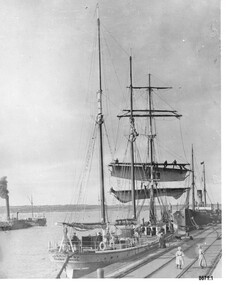
Photograph - Vessels Speculant and S. S. Flinders, Between 1902 and 1907
... Warrnambool and berthed at the Breakwater. The passengers all went ashore - many unaware of the danger they had been in. A telephone message was sent to the local Fire Brigade Station however the fire was extinguished before the firemen and their equipment arrived. ...Warrnambool and berthed at the Breakwater. The passengers all went ashore - many unaware of the danger they had been in. A telephone message was sent to the local Fire Brigade Station however the fire was extinguished before the firemen and their equipment arrived. ...This photograph was one of ten photographs donated to Flagstaff Hill Maritime Museum and Village by Fred Trewartha. Frederick John Fox Trewartha (Fred) was a well-known Warrnambool businessman. He was born in Beeac near Geelong in 1920 and came to Warrnambool with his family as a very young child. He was apprenticed to his father John, as a saddler and later opened his own shop on Raglan Parade. He then moved into working with tarpaulins and canvases for the trucking industry. Fred was keenly interested in photography (and was a member of the Warrnambool Cine Club), yachting and boat building. He kept his yacht moored at Port Fairy for many years and participated in sailing events locally and interstate. He also built boats with his sons. He had the opportunity to meet many older sailors and it's thought this photo (and others in the set) may have been given to him by one of these men. Fred Trewartha died in 2016 in Warrnambool. The two identifiable ships in this picture are the "Speculant" and the "S. S. Flinders" - both coastal trading vessels that regularly came and went from Warrnambool. The third steamer on the left hasn't been identified The barquentine SPECULANT was a steel, three-masted sailing ship built in 1895 in Inverkeithing, Scotland, registered in Warrnambool, Victoria and wrecked at Cape Paton, Victoria, 10th February 1911. The SPECULANT had been involved in the timber trade between the United Kingdom and Russia, until sold to its Warrnambool owners and timber merchants Messrs. P.J. McGennan & Co. (Peter John McGennan) in 1902 for 3000 pounds and had her sailed to Warrnambool as her new port. Peter John McGennan was born in 1844 and worked as a builder and cooper in Holyhead, Anglesea, Wales. He immigrated to Australia in 1869 as a free settler and arrived in Warrnambool in 1871 and undertook management of a property in Grassmere for Mr. Palmer. Peter met his wife Emily in South Melbourne and they married in 1873. They had ten children including Harry who lived to 1965, and Andrew who lived until 1958. (The other children were their four brothers - John who was killed in the Dardenalles aged 35, Frederick who died aged 8, Peter who died aged 28, Frank who died aged 5 weeks - and four sisters - Beatrice who died age 89, Edith who died aged 49, Blanche who died aged 89 and Eveline who died aged 48.) In 1874 Peter starting a boating establishment on the Hopkins River. In 1875 he opened up a Coopers business in Kepler Street next to what was Bateman, Smith and Co., moving to Liebig Street, next to the Victoria Hotel, in 1877. In 1882 he then moved to Lava Street (which in later years was the site of Chandlers Hardware Store). He was associated with the establishment of the Butter Factory at Allansford. He started making Butter Boxes to his own design and cheese batts for the Butter Factory. In 1896 established a Box Factory in Davis Street Merrivale, employing 24 people at its peak, (it was burnt down in 1923); and in Pertobe Road from 1912 (now the Army Barracks building). Peter was a Borough Councillor for Albert Ward from 1885 to 1891, he commenced the Foreshore Trust (including the camping grounds along Pertobe Road), and he was an inaugural Director of the Woollen Mill in Harris Street, buying an extensive share-holding in 1908 from the share trader Edward Vidler. They lobbied the Town Hall to have a formal ‘Cutting’ for the waters of the Merri River to be redirected from its natural opening south of Dennington, to its existing opening near Viaduct Road, in order to have the scourings from the wool at the Woollen Mill discharged into the sea. He sold Butter Boxes around the state, and had to ship them to Melbourne by rail. Peter’s purchase of the SPECULANT in 1902 enabled him to back-load white pine from Kaipara, New Zealand to Warrnambool to make his butter boxes then, to gain profitability, buy and ship potatoes and other primary produce bound to Melbourne. (McGennan & Co. had also owned the LA BELLA, which had traded in timber as well, until she was tragically wrecked with the loss of seven lives, after missing the entrance channel to Warrnambool harbour in 1905. It appears that the SPECULANT was bought to replace the LA BELLA.) In 1911 the SPECULANT had been attempting to depart Warrnambool for almost the entire month of January to undergo docking and overhaul in Melbourne. A month of east and south-easterly winds had forced her to remain sheltered in Lady Bay, Warrnambool apart from one morning of northerlies, when an attempt was made to round Cape Otway; she had to return to shelter in Portland after failing to make any headway. With only 140 tons of sand ballast aboard, the ship would not have been easy to handle. Captain Jacobsen and his crew of nine, mainly Swedes, decided to make for Melbourne, leaving Portland Harbour on 5th February 1911. By the 9th they had reached Cape Otway, where they encountered a moonless night, constant heavy rain, and a heavy sea with a south-easterly wind blowing. After safely rounding Cape Otway the course was changed to east, then north-east to take the vessel to a point six miles off Cape Patton, following the orders of Captain Jacobsen, who told the crew to be very careful with the steering, as the wind and sea was running to leeward. The patent log (used to measure speed) had been out of order for the last four months as no-one in Warrnambool was able to fix it: it was intended to have it repaired in Melbourne. In the meantime the crew measured the vessel's speed by looking over the side and estimating wind strength. This compounded the difficulties of imprecise positioning, as the strong cross wind and sea were acting on the lightly laden vessel to steadily drive it towards the shore. At 3.30am on Friday 10 February 1911 Captain Jacobsen and the first mate were looking over the side of the vessel when they heard the sound of breakers and suddenly struck the rocks. The crew immediately knew they had no chance of getting the SPECULANT off, and attempted to rescue themselves by launching the lifeboat, which was instantly smashed to pieces. One of the crew then volunteered to take a line ashore, and the rest of the crew were all able to drag themselves to shore, some suffering hand lacerations from the rocks. Once ashore they began to walk along the coast towards Lorne, believing it was the nearest settlement. Realising their mistake as dawn broke they returned westwards to Cape Patton, and found a farm belonging to Mr C. Ramsden, who took them in and gave them a change of clothes and food. After resting for a day and returning to the wreck to salvage some of their personal possessions, at 10am on Saturday they set out for Apollo Bay, a voyage that took six hours, sometimes wading through flooded creeks up to their necks. The Age described the wreck as "listed to starboard. All the cabin is gutted and the ballast gone. There is a big rock right through the bottom of her, and there is not the slightest hope of getting her off". A Board of Marine inquiry found that Captain Jacobson was guilty of careless navigation by not taking steps to accurately verify the position of the vessel with respect to Cape Otway when the light was visible and by not setting a safe and proper course with respect to the wind and sea. It suspended his certificate for 6 months and ordered him to pay costs. The location of the wreck site was marked for a long time by two anchors on the shoreline, until in 1970 the larger of the two anchors was recovered by the Underwater Explorers' Club and mounted on the foreshore at Apollo Bay. The bell from the wreck was also donated to the Apollo Bay Surf Lifesaving Club but is recorded to have been stolen. Rusting remains of the wreck can still be found on the shoreline on the southern side of, and directly below Cape Patton. Parts of the SPECULANT site have been buried by rubble from construction and maintenance works to the Great Ocean Road, as well as by naturally occurring landslides. Peter J McGennan passed away in 1920. The Gates in the western wall of the Anglican Church in Henna Street/Koroit St are dedicated to him for his time of community work, which is matched with other prominent Warrnambool citizens; Fletcher Jones, John Younger, J.D.E (Tag) Walter, and Edward Vidler. After Peter J McGennan's death Harry, Andrew and Edith continued to operate the family business until July 11th 1923 when the company was wound up. (Andrew lived in Ryot Street Warrnambool, near Lava Street.) Harry McGennan (Peter and Emily’s son) owned the Criterion Hotel in Kepler Street Warrnambool (now demolished). His son Sid and wife Dot lived in 28 Howard Street (corner of Nelson Street) and Sid managed the Criterion until it was decided by the family to sell, and for he remained Manager for the new owners until he retired. Harry commenced the Foreshore Trust in Warrnambool around 1950. The McGennan Carpark in Pertobe Road is named after Harry and there are Memorial-Stone Gates in his memory. (The Gates were once the original entrance to the carpark but are now the exit.). The Patent Log (also called a Taffrail log) from the SPECULANT, mentioned above, and a number of photographs, are now part of the Collection at Flagstaff Hill Maritime Village.. The S. S. Flinders was built by A. J. Inglis, Ltd, Pointhouse, Glasgow in 1878 for the "Tasmanian Steam Navigation Company', Hobart which merged with the "Union Steamship Company" of New Zealand and it was later sold to the firm "McIlwraith, McEacham and Company". It was built of iron and was 1000 tons and 227 feet, 1 inch long. It was described as "splendidly fitted up for the carriage of passengers and her cargo space was also very large". In the saloon about 130 passengers could be accommodated while the second class had sufficient room for one hundred passengers. In 1890, the S. S. Flinders would leave Melbourne on Mondays and Thursdays at 5 pm and reach Warrnambool the following morning at 8 am. On the return it would leave Warrnambool on Wednesdays and Saturdays at 5 pm and reach Melbourne the following morning. In 1896, the Weekly Times described the "steamer Flinders (otherwise known as "the Warrnambool mailboat") as "as good a sample of a seagoing steamer as there is trading on the Victorian Coast at the present time". In April 1896 newspaper reports noted the S. S. Flinders took 2915 bags of potatoes from Warrnambool to Melbourne (the largest shipment of that season) as well as 50 tons of tinned rabbits from the Hamilton Preserving Factory. It was also noted that particularly during the Christmas period, there were excessive demands for berths from holiday makers wanting to enjoy a holiday in Warrnambool. In May 1903, the S. S. Flinders narrowly escaped destruction when an explosion and subsequent fire occurred during the passage from Melbourne to Warrnambool. A drum (which apparently contained carbide of calcium) exploded and blew off a hatch cover. As the steamer got to within a mile or two of Warrnambool, smoke was seen coming out of the hold and (unknown to the passengers) flames had taken hold. The crew quickly got to work - closing down all the hatches and pumping water into the hold through a hole in the saloon floor. There were 30 or 40 cases of kerosene on board. The Flinders continued on to Warrnambool and berthed at the Breakwater. The passengers all went ashore - many unaware of the danger they had been in. A telephone message was sent to the local Fire Brigade Station however the fire was extinguished before the firemen and their equipment arrived. After the hold was checked, the Flinders was certified as seaworthy and left for Portland. The Flinders continued to transport Western District produce as well as passengers from Warrnambool to Melbourne until 1906 when (due to a decrease in shipping trade during the Winter and the availability of train services) the Flinders was replaced by the smaller steamer "Dawn" and in 1907 when it was sold to the "Adelaide Steamship Company" for use in the Western Australia coastal trade, it was replaced by the "S. S. Barrabool".This photograph is a significant record of two of the well known coastal traders (the "Speculant" and the "Flinders") that sailed along the south west coast of Victoria for many years - transporting goods and passengers between Melbourne and Warrnambool.Black and white photograph of the Breakwater in Warrnambool with two ships docked and another in the bay. On the front boat (the Speculant), men can be seen at the wheel, on the deck and on the bottom two booms where they appear to be furling the sails. The sails of the top booms are already furled. A small boy can be seen on the deck and a young girl, two women and a dog are on the Breakwater. There is a steam ship (the S. S. Flinders) tied up behind the "Speculant" and an unidentified steam ship (with smoke coming from its smokestack) in the bay. There is a blue and black handwritten label on the back of the photo - naming the ships and the owner of the photo.Speculant and Flinders / Passenger ship in / Lady Bay / name of donor and phone numberflagstaff hill maritime museum and village, warrnambool, great ocean road, shipwreck coast, speculant, barque speculant, flinders, s. s. finders, steamship flinders, coastal trader, passenger ship, goods, steamer, breakwater, lady bay, warrnambool mailboat, p. j. mcgennan, peter john mcgennan, butter boxes, captain jacobsen, cape patton, tasmanian steam navigation company -
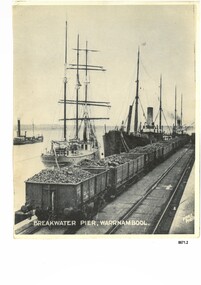 Flagstaff Hill Maritime Museum and Village
Photograph - Vessels at Breakwater Pier, Warrnambool, Foyle Photographic Studio, circa 1906
... Warrnambool and berthed at the Breakwater. The passengers all went ashore - many unaware of the danger they had been in. A telephone message was sent to the local Fire Brigade Station however the fire was extinguished before the firemen and their equipment arrived. ...Warrnambool and berthed at the Breakwater. The passengers all went ashore - many unaware of the danger they had been in. A telephone message was sent to the local Fire Brigade Station however the fire was extinguished before the firemen and their equipment arrived. ...This photograph was one of ten photographs donated to Flagstaff Hill Maritime Museum and Village by Fred Trewartha. Frederick John Fox Trewartha (Fred) was a well-known Warrnambool businessman. He was born in Beeac near Geelong in 1920 and came to Warrnambool with his family as a very young child. He was apprenticed to his father John, as a saddler and later opened his own shop on Raglan Parade. He then moved into working with tarpaulins and canvases for the trucking industry. Fred was keenly interested in photography (and was a member of the Warrnambool Cine Club), yachting and boat building. He kept his yacht moored at Port Fairy for many years and participated in sailing events locally and interstate. He also built boats with his sons. He had the opportunity to meet many older sailors and it's thought this photo (and others in the set) may have been given to him by one of these men. Fred Trewartha died in 2016 in Warrnambool. The three identifiable ships in this picture are the "Speculant", the "S. S. Barrabool" and the "S. S. Flinders" - coastal trading vessels that regularly came and went from Warrnambool. The steamer on the left hasn't been identified. The barquentine SPECULANT was a steel, three-masted sailing ship built in 1895 in Inverkeithing, Scotland, registered in Warrnambool, Victoria and wrecked at Cape Paton, Victoria, 10th February 1911. The SPECULANT had been involved in the timber trade between the United Kingdom and Russia, until sold to its Warrnambool owners and timber merchants Messrs. P.J. McGennan & Co. (Peter John McGennan) in 1902 for 3000 pounds and had her sailed to Warrnambool as her new port. Peter John McGennan was born in 1844 and worked as a builder and cooper in Holyhead, Anglesea, Wales. He immigrated to Australia in 1869 as a free settler and arrived in Warrnambool in 1871 and undertook management of a property in Grassmere for Mr. Palmer. Peter met his wife Emily in South Melbourne and they married in 1873. They had ten children including Harry who lived to 1965, and Andrew who lived until 1958. (The other children were their four brothers - John who was killed in the Dardenalles aged 35, Frederick who died aged 8, Peter who died aged 28, Frank who died aged 5 weeks - and four sisters - Beatrice who died age 89, Edith who died aged 49, Blanche who died aged 89 and Eveline who died aged 48.) In 1874 Peter starting a boating establishment on the Hopkins River. In 1875 he opened up a Coopers business in Kepler Street next to what was Bateman, Smith and Co., moving to Liebig Street, next to the Victoria Hotel, in 1877. In 1882 he then moved to Lava Street (which in later years was the site of Chandlers Hardware Store). He was associated with the establishment of the Butter Factory at Allansford. He started making Butter Boxes to his own design and cheese batts for the Butter Factory. In 1896 established a Box Factory in Davis Street Merrivale, employing 24 people at its peak, (it was burnt down in 1923); and in Pertobe Road from 1912 (now the Army Barracks building). Peter was a Borough Councillor for Albert Ward from 1885 to 1891, he commenced the Foreshore Trust (including the camping grounds along Pertobe Road), and he was an inaugural Director of the Woollen Mill in Harris Street, buying an extensive share-holding in 1908 from the share trader Edward Vidler. They lobbied the Town Hall to have a formal ‘Cutting’ for the waters of the Merri River to be redirected from its natural opening south of Dennington, to its existing opening near Viaduct Road, in order to have the scourings from the wool at the Woollen Mill discharged into the sea. He sold Butter Boxes around the state, and had to ship them to Melbourne by rail. Peter’s purchase of the SPECULANT in 1902 enabled him to back-load white pine from Kaipara, New Zealand to Warrnambool to make his butter boxes then, to gain profitability, buy and ship potatoes and other primary produce bound to Melbourne. (McGennan & Co. had also owned the LA BELLA, which had traded in timber as well, until she was tragically wrecked with the loss of seven lives, after missing the entrance channel to Warrnambool harbour in 1905. It appears that the SPECULANT was bought to replace the LA BELLA.) In 1911 the SPECULANT had been attempting to depart Warrnambool for almost the entire month of January to undergo docking and overhaul in Melbourne. A month of east and south-easterly winds had forced her to remain sheltered in Lady Bay, Warrnambool apart from one morning of northerlies, when an attempt was made to round Cape Otway; she had to return to shelter in Portland after failing to make any headway. With only 140 tons of sand ballast aboard, the ship would not have been easy to handle. Captain Jacobsen and his crew of nine, mainly Swedes, decided to make for Melbourne, leaving Portland Harbour on 5th February 1911. By the 9th they had reached Cape Otway, where they encountered a moonless night, constant heavy rain, and a heavy sea with a south-easterly wind blowing. After safely rounding Cape Otway the course was changed to east, then north-east to take the vessel to a point six miles off Cape Patton, following the orders of Captain Jacobsen, who told the crew to be very careful with the steering, as the wind and sea was running to leeward. The patent log (used to measure speed) had been out of order for the last four months as no-one in Warrnambool was able to fix it: it was intended to have it repaired in Melbourne. In the meantime the crew measured the vessel's speed by looking over the side and estimating wind strength. This compounded the difficulties of imprecise positioning, as the strong cross wind and sea were acting on the lightly laden vessel to steadily drive it towards the shore. At 3.30am on Friday 10 February 1911 Captain Jacobsen and the first mate were looking over the side of the vessel when they heard the sound of breakers and suddenly struck the rocks. The crew immediately knew they had no chance of getting the SPECULANT off, and attempted to rescue themselves by launching the lifeboat, which was instantly smashed to pieces. One of the crew then volunteered to take a line ashore, and the rest of the crew were all able to drag themselves to shore, some suffering hand lacerations from the rocks. Once ashore they began to walk along the coast towards Lorne, believing it was the nearest settlement. Realising their mistake as dawn broke they returned westwards to Cape Patton, and found a farm belonging to Mr C. Ramsden, who took them in and gave them a change of clothes and food. After resting for a day and returning to the wreck to salvage some of their personal possessions, at 10am on Saturday they set out for Apollo Bay, a voyage that took six hours, sometimes wading through flooded creeks up to their necks. The Age described the wreck as "listed to starboard. All the cabin is gutted and the ballast gone. There is a big rock right through the bottom of her, and there is not the slightest hope of getting her off". A Board of Marine inquiry found that Captain Jacobson was guilty of careless navigation by not taking steps to accurately verify the position of the vessel with respect to Cape Otway when the light was visible and by not setting a safe and proper course with respect to the wind and sea. It suspended his certificate for 6 months and ordered him to pay costs. The location of the wreck site was marked for a long time by two anchors on the shoreline, until in 1970 the larger of the two anchors was recovered by the Underwater Explorers' Club and mounted on the foreshore at Apollo Bay. The bell from the wreck was also donated to the Apollo Bay Surf Lifesaving Club but is recorded to have been stolen. Rusting remains of the wreck can still be found on the shoreline on the southern side of, and directly below Cape Patton. Parts of the SPECULANT site have been buried by rubble from construction and maintenance works to the Great Ocean Road, as well as by naturally occurring landslides. Peter J McGennan passed away in 1920. The Gates in the western wall of the Anglican Church in Henna Street/Koroit St are dedicated to him for his time of community work, which is matched with other prominent Warrnambool citizens; Fletcher Jones, John Younger, J.D.E (Tag) Walter, and Edward Vidler. After Peter J McGennan's death Harry, Andrew and Edith continued to operate the family business until July 11th 1923 when the company was wound up. (Andrew lived in Ryot Street Warrnambool, near Lava Street.) Harry McGennan (Peter and Emily’s son) owned the Criterion Hotel in Kepler Street Warrnambool (now demolished). His son Sid and wife Dot lived in 28 Howard Street (corner of Nelson Street) and Sid managed the Criterion until it was decided by the family to sell, and for he remained Manager for the new owners until he retired. Harry commenced the Foreshore Trust in Warrnambool around 1950. The McGennan Carpark in Pertobe Road is named after Harry and there are Memorial-Stone Gates in his memory. (The Gates were once the original entrance to the carpark but are now the exit.). The Patent Log (also called a Taffrail log) from the SPECULANT, mentioned above, and a number of photographs, are now part of the Collection at Flagstaff Hill Maritime Village.. The S. S. Flinders was built by A. J. Inglis, Ltd, Pointhouse, Glasgow in 1878 for the "Tasmanian Steam Navigation Company', Hobart which merged with the "Union Steamship Company" of New Zealand and it was later sold to the firm "McIlwraith, McEacham and Company". It was built of iron and was 1000 tons and 227 feet, 1 inch long. It was described as "splendidly fitted up for the carriage of passengers and her cargo space was also very large". In the saloon about 130 passengers could be accommodated while the second class had sufficient room for one hundred passengers. In 1890, the S. S. Flinders would leave Melbourne on Mondays and Thursdays at 5 pm and reach Warrnambool the following morning at 8 am. On the return it would leave Warrnambool on Wednesdays and Saturdays at 5 pm and reach Melbourne the following morning. In 1896, the Weekly Times described the "steamer Flinders (otherwise known as "the Warrnambool mailboat") as "as good a sample of a seagoing steamer as there is trading on the Victorian Coast at the present time". In April 1896 newspaper reports noted the S. S. Flinders took 2915 bags of potatoes from Warrnambool to Melbourne (the largest shipment of that season) as well as 50 tons of tinned rabbits from the Hamilton Preserving Factory. It was also noted that particularly during the Christmas period, there were excessive demands for berths from holiday makers wanting to enjoy a holiday in Warrnambool. In May 1903, the S. S. Flinders narrowly escaped destruction when an explosion and subsequent fire occurred during the passage from Melbourne to Warrnambool. A drum (which apparently contained carbide of calcium) exploded and blew off a hatch cover. As the steamer got to within a mile or two of Warrnambool, smoke was seen coming out of the hold and (unknown to the passengers) flames had taken hold. The crew quickly got to work - closing down all the hatches and pumping water into the hold through a hole in the saloon floor. There were 30 or 40 cases of kerosene on board. The Flinders continued on to Warrnambool and berthed at the Breakwater. The passengers all went ashore - many unaware of the danger they had been in. A telephone message was sent to the local Fire Brigade Station however the fire was extinguished before the firemen and their equipment arrived. After the hold was checked, the Flinders was certified as seaworthy and left for Portland. The Flinders continued to transport Western District produce as well as passengers from Warrnambool to Melbourne until 1906 when (due to a decrease in shipping trade during the Winter and the availability of train services) the Flinders was replaced by the smaller steamer "Dawn" and in 1907 when it was sold to the "Adelaide Steamship Company" for use in the Western Australia coastal trade, it was replaced by the "S. S. Barrabool". The S. S. Barrabool was a coastal steamer built by "Palmer Shipbuilding and Iron Company Limited" in Jarrow, Durham in 1874. It was bought by "Howard Smith Ltd" who was a pioneer in the coal trade between Melbourne and Newcastle. Howards Smith's early fleet contained ships named after local hills and mountains -"You Yangs", "Macedon", "Dandenongs" and "Barrabool". Later they extended their fleet to include ships that were well known in Warrnambool including the "Dawn" and the "Edina". The S. S. Barrabool had a chequered start and was nicknamed the "Great Australian Ram" because of the numerous accidents it was involved in. Between 1875 and 1883 it collided with three other vessels - sinking the "Queensland" on August 3rd, 1876, near Wilson's Promontory and sinking the "Bonnie Dundee" on 10th March 1879 off Lake Macquarie, New South Wales (with the loss of five lives). In August 1884 the Barrabool collided with the steamer "Birksgate" in Port Jackson causing considerable damage to "Birksgate". However in a newspaper article published in the "Truth" in March 1899 the S. S. Barrabool was described as "one of the fine old type of vessels" and "still a stout a craft as ever". The article was describing the practice of a "two-mate" system on board many ships (the Barrabool being one) whereby the company only employs two men (a first and second mate who must alternate watches of four hours each) rather than three mates who work four hours on and eight hours off. It was suggested that ships employing the "two-mate" system may find their insurance policies "null and void" should an accident occur. However the writer did note that the Barrabool was "officered by a captain and first and second mates .. whom it would be impossible to find more capable officers amongst the maritime fleet of the colonies". Between 1900 and 1909 the Barrabool was making regular trips along the east coast of Australia, carrying coal to Hobsons Bay (Melbourne) from Newcastle, Bellambi and Sydney. In 1907 it was brought in as a temporary replacement on the Melbourne to Warrnambool route for the S.S. Flinders. In 1912 the S. S. Barrabool ran aground off the Fitzroy River in Queensland and was found to be uneconomic to repair. It was brought back to Sydney and converted into a hulk. In August 1952 it was towed 17 miles off Sydney and scuttled. “Foyle” written on the photograph is the name of Foyle’s Photographic studio - originally owned by James Charles Foyle. He owned “Foyle’s Photo Card Studios” in Liebig St, Warrnambool, which operated between 1889 – 1919 At the time of the photograph the studio was owned by both Charles and Lilian Foyle (sometimes known as Lillian or Lily), either of whom could have taken this photograph. They also worked together at a later date on the photographs, sketches and paintings of the famous and historical Pioneers’ Honour Board.This photograph is a significant record of three of the well-known coastal traders (the "Speculant", the "S. S. Barrabool" and the "S. S. Flinders") that sailed along the southwest coast of Victoria for many years - transporting goods and passengers between Melbourne and Warrnambool.A black and white photograph titled "Breakwater Pier, Warrnambool". A line of coal trucks on rails are on the Breakwater. There are three ships (one sailing ship and two steamers) moored at the pier. In the left side of the picture is another ship. The name of the photographer is printed in the lower right corner. On the back of the photograph are the handwritten names of the moored ships written in blue pen. It also has the handwritten name, town and telephone number of the donor. In the bottom right hand corner is an upside down stamped number in black ink.Front of photograph - "BREAKWATER PIER, WARRNAMBOOL." "FOYLE PHOTO" Back of photograph - "Sailing Ship" "Speculant sail ship" "Barrabool coal ship" "Flinders Passenger ship" Name of donor W'Bool (and telephone number) "K-7148 M" (stamped upside down)flagstaff hill maritime museum and village, warrnambool, great ocean road, shipwreck coast, speculant, barque speculant, p. j. mcgennan, peter john mcgennan, speculant wreck, captain jacobsen, s. s. flinders, steamer flinders, a. j. inglis ltd, tasmanian steam navigation company, mcilwraith mceacham and company, warrnambool mailboat, coastal steamer, s. s. barrabool, howard smith ltd, two-mate system, coal ship, dawn, edina, lady bay, breakwater, warrnambool breakwater, foyle, foyle photographic studio warrnambool -
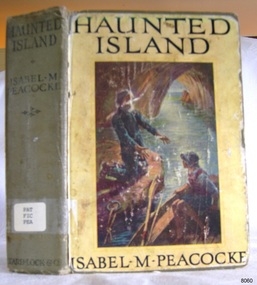 Flagstaff Hill Maritime Museum and Village
Book, Haunted Island
... Warrnambool Town Council takes over Mechanics’ Institute, Art Gallery, Public Library, Museum – and will double the building’s size In 1912 The Age reported in its Warrnambool news section “Considerable improvements are being effected by the town council in the most picturesque part of Liebig Street. Between the fire brigade ...This item is from the ‘Pattison Collection’, a collection of books and records that was originally owned by the Warrnambool Mechanics’ Institute, which was founded in Warrnambool in 1853. By 1886 the Warrnambool Mechanics’ Institute (WMI) had grown to have a Library, Museum and Fine Arts Gallery, with a collection of “… choice productions of art, and valuable specimens in almost every branch and many wonderful national curiosities are now to be seen there, including historic relics of the town and district.” It later included a School of Design. Although it was very well patronised, the lack of financial support led the WMI in 1911 to ask the City Council to take it over. In 1935 Ralph Pattison was appointed as City Librarian to establish and organise the Warrnambool Library as it was then called. When the WMI building was pulled down in 1963 a new civic building was erected on the site and the new Warrnambool Library, on behalf of the City Council, took over all the holdings of the WMI. At this time some of the items were separated and identified as the ‘Pattison Collection’, named after Ralph Pattison. Eventually the components of the WMI were distributed from the Warrnambool Library to various places, including the Art Gallery, Historical Society and Flagstaff Hill. Later some were even distributed to other regional branches of Corangamite Regional Library and passed to and fro. It is difficult now to trace just where all of the items have ended up. The books at Flagstaff Hill Maritime Village generally display stamps and markings from Pattison as well as a variety of other institutions including the Mechanics’ Institute itself. RALPH ERIC PATTISON Ralph Eric Pattison was born in Rockhampton, Queensland, in 1891. He married Maude Swan from Warrnambool in 1920 and they set up home in Warrnambool. In 1935 Pattison accepted a position as City Librarian for the Warrnambool City Council. His huge challenge was to make a functional library within two rooms of the Mechanics’ Institute. He tirelessly cleaned, cleared and sorted a disarrayed collection of old books, jars of preserved specimens and other items reserved for exhibition in the city’s museum. He developed and updated the library with a wide variety of books for all tastes, including reference books for students; a difficult task to fulfil during the years following the Depression. He converted all of the lower area of the building into a library, reference room and reading room for members and the public. The books were sorted and stored using a cataloguing and card index system that he had developed himself. He also prepared the upper floor of the building and established the Art Gallery and later the Museum, a place to exhibit the many old relics that had been stored for years for this purpose. One of the treasures he found was a beautiful ancient clock, which he repaired, restored and enjoyed using in his office during the years of his service there. Ralph Pattison was described as “a meticulous gentleman whose punctuality, floorless courtesy and distinctive neat dress were hallmarks of his character, and ‘his’ clock controlled his daily routine, and his opening and closing of the library’s large heavy doors to the minute.” Pattison took leave during 1942 to 1945 to serve in the Royal Australian Navy, Volunteer Reserve as Lieutenant. A few years later he converted one of the Museum’s rooms into a Children’s Library, stocking it with suitable books for the younger generation. This was an instant success. In the 1950’s he had the honour of being appointed to the Victorian Library Board and received more inspiration from the monthly conferences in Melbourne. He was sadly retired in 1959 after over 23 years of service, due to the fact that he had gone over the working age of council officers. However he continued to take a very keen interest in the continual development of the Library until his death in 1969. WARRNAMBOOL PUBLIC LIBRARY The Warrnambool Mechanics’ Institute (WMI) was formed by a voluntary community group in 1863, within six years of Warrnambool’s beginnings, and its Reading Room opened in 1854. The WMI operated until 1963, at which time it was one of the oldest Mechanics’ Institutes in Victoria. Mechanics’ Institutes offered important services to the public including libraries, reading rooms and places to display and store collections of all sorts such as curiosities and local historical relics. In 1886 a Museum and Fine Arts Gallery were added to the WMI and by the beginning of the 20th century there was also a billiards room and a School of Art. By this time all Mechanics’ Institutes in country Victoria had museums attached. Over the years the Warrnambool Mechanics’ Institute Library was also known as the Warrnambool Public Library the Warrnambool Library and the Free Library. Early funding from the government was for the “Free Library”. The inscription in a book “Science of Man” was for the “Warrnambool Public Library”, donated by Joseph Archibald in 1899. Another inscription in the book “Catalogue of Plants Under Cultivation in the Melbourne Botanic Gardens 1 & 2, 1883” was presented to the “Warrnambool Library” and signed by the author W.R. Guilfoyle. In 1903 the Warrnambool Public Library decided to add a Juvenile Department to library and stock it with hundreds of books suitable for youth. In 1905 the Public Library committee decided to update the collection of books and added 100 new novels plus arrangements for the latest novels to be included as soon as they were available in Victoria. In July 1911 the Warrnambool Council took over the management of the Public Library, Art Gallery, Museum and Mechanics’ Institute and planned to double the size of the then-current building. In 1953, when Mr. R. Pattison was Public Librarian, the Warrnambool Public Library’s senior section 10,000 of the 13,000 books were fiction. The children’s section offered an additional 3,400 books. The library had the equivalent of one book per head of population and served around 33 percent of the reading population. The collection of books was made up of around 60 percent reference and 40 percent fiction. The library was lending 400 books per day. In 1963 the Warrnambool City Council allocated the site of the Mechanics’ Institute building, which included the Public Library, Museum and Art Gallery, for the new Municipal Offices and the Collections were dispersed until 1971. The Warrnambool Library took over the Mechanics’ Institute Library’s holdings on behalf of the Warrnambool City Council. Since the closure of the Warrnambool Mechanics’ Institute the exact location and composition of the original WMI books and items has become unclear. Other materials have been added to the collection, including items from Terang MI, Warrnambool Court House and Customs House. Many of the books have been identified as the Pattison Collection, named after the Librarian who catalogued and numbered the books during his time as Warrnambool Public Librarian in the time before the Mechanics’ Institute closed. It seems that when Warrnambool became part of the Corangamite Regional Library some of the books and materials went to its head office in Colac and then back to Warrnambool where they were stored at the Art Gallery for quite some time. Some then went to the Warrnambool Historical Society, some stayed at the Art Gallery and some were moved to Flagstaff Hill Maritime Village. The various stamps and labels on the books held at Flagstaff Hill show the variety of the collection’s distribution and origin. The books in the collection at Flagstaff Hill Maritime Village date from the 1850’s to the late 1950’s and include rare and valuable volumes. Many of the books are part of the “Pattison Collection” after the Warrnambool’s Public Librarian, Mr. R. Pattison. The Pattison Collection, along with other items at Flagstaff Hill Maritime Village, was originally part of the Warrnambool Mechanics' Institute’s collection. The Warrnambool Mechanics’ Institute Collection is primarily significant in its totality, rather than for the individual objects it contains. Its contents are highly representative of the development of Mechanics' Institute libraries across Australia, particularly Victoria. A diversity of publications and themes has been amassed, and these provide clues to our understanding of the nature of and changes in the reading habits of Victorians from the 1850s to the middle of the 20th century. The collection also highlights the Warrnambool community’s commitment to the Mechanics’ Institute, reading, literacy and learning in the regions, and proves that access to knowledge was not impeded by distance. These items help to provide a more complete picture of our community’s ideals and aspirations. The Warrnambool Mechanics Institute book collection has historical and social significance for its strong association with the Mechanics Institute movement and the important role it played in the intellectual, cultural and social development of people throughout the latter part of the nineteenth century and the early twentieth century. The collection of books is a rare example of an early lending library and its significance is enhanced by the survival of an original collection of many volumes. The Warrnambool Mechanics' Institute’s publication collection is of both local and state significance. The Warrnambool Mechanics' Institute Collection is primarily significant in its totality, rather than for the individual objects it contains. Its contents are highly representative of the development of Mechanics' Institute libraries across Australia, particularly Victoria. A diversity of publications and themes has been amassed, and these provide clues to our understanding of the nature of and changes in the reading habits of Victorians from the 1850s to the middle of the 20th century. The collection also highlights the Warrnambool community’s commitment to the Mechanics’ Institute, and to reading, literacy and learning in the regions, and proves that access to knowledge was not impeded by distance. These items help to provide a more complete picture of our community’s ideals and aspirations. As with many Mechanics' Institutes in Australia, the one which operated in Warrnambool was established and overseen for many years by key individuals associated with the development of the city itself. The WMI publication collection is historically significant because of its association with local people, places and the key historical themes in the development of Warrnambool of rural development, industry, farming, education, and community. The collection documents and illustrates the changing interests, focus and tastes of Victorians, especially those in regional cities. Generally the individual items in the collection are not particularly rare, as examples of all probably exist in other public collections in Victoria. It is primarily because there are so very few surviving Mechanics' Institute collections in Victoria, which lends this overall collection its significance. Many items in the WMI Collection have the potential to support further research, both as individual objects and through the collection in its entirety. This material is significant for its ability to assist in the interpretation of the history of the area and adds to the general understanding of the development of the township. Many components of the WMI publication collection complement and reinforce the Flagstaff Hill Maritime Museum Collection, the Warrnambool Art Gallery Collection, and that in the Warrnambool Historical Society, and also contribute to a clearer understanding of the original Warrnambool Mechanics' Institute collections. This will greatly enhance the appreciation of the few surviving Mechanics' Institute collections across Victoria, and also in New South Wales. The similarities and differences between the small number of collections that have survived can provide further insights into how the people of Victoria in general, and Warrnambool in particular, constructed a civic culture of adult learning to foster an informed citizenry. The Warrnambool Mechanics' Institute publication collection is of both local and state significance. (This Statement of Significance is quoted from the Significance Assessment : Warrnambool Mechanics’ Institute Book Collection at Flagstaff Hill Maritime Museum, February 2009, by Annette Welkamp, Cultural Connections, for Delise Oldfied, FHMV) References Juvenile Department in Warrnambool Public Library In August 1903 The Age newspaper reported in its Warrnambool news section that “With the object of discouraging boys from reading literature of the “penny dreadful” class, the committee of the local public library has decided to open a juvenile department and to stock it with hundreds of suitable books attractive to the youthful mind.” 100 new novels added to Warrnambool Public Library Shelves In November 1905 The Argue newspaper’s Warrnambool news section announced “The committee of the Public Library is bringing the collection of books more up to date. It has recently added 100 new novels to the shelves, and arrangements have been made for a supply of the latest novels immediately they arrive in the state.” Warrnambool Town Council takes over Mechanics’ Institute, Art Gallery, Public Library, Museum – and will double the building’s size In 1912 The Age reported in its Warrnambool news section “Considerable improvements are being effected by the town council in the most picturesque part of Liebig Street. Between the fire brigade station and the mechanics’ institute and art gallery a vacant block of land is being transformed a garden for carpet bedding and flowering plants. The council, which recently took over the control of the art gallery, public library, museum and mechanics’ institute, is doubling the size of the substantial stone building containing these institutions. The new building will contain a supper room for use in conjunction with functions in the town hall, adjoining, and a new reading room.” Mr Pattison, Public Librarian, says Library has a book per head of population In 1953 The Age reported an interview with the Public Librarian, Mr. R. Pattison, who said “Warrnambool has an insatiable thirst for reading. And its reading recipe contains a strong dash of fiction – 73 percent of it. Fiction makes up 10,000 of the 13,000 books in the senior section of the public library. That works out at a book per head of population. Warrnambool today is really book minded. This city has an almost insatiable thirst for knowledge as well as fiction. We’re lending 400 books a day. We supply 33 percent of the reading population of Warrnambool.” The reporter goes on to say “Warrnambool Public Library also has an ultra-modern children’s section of 3,400 books, open to every boy and girl attending school in Warrnambool. Mr Pattison hopes to show travel-talk films and install a radiogram in the children’s section “later on”. But it won’t disturb adult reading next door because the junior section is sound proof. “ Mechanics’ Institutes and Museums Mechanics’ Institutes were important sites for collecting in country Victoria … Warrnambool … all had museums attached to Mechanics’ Institutes before the end of the twentieth century” Warrnambool Mechanics’ Institute Ms Tierney said FHMV holds the collection of the Warrnambool Mechanics’ Institute in three different locations on its site. “The Mechanics’ Institute opened in 1871, was demolished in the 1960s and was one of the oldest in Victoria. “FHMV intends to create a new storage area and bring the collection together in one place which will greatly facilitate access and research. “The collection consists of books and archives dating from the 1850s to 1959s. “Some of the books are rare and valuable but it is unclear as to their relevance to the history of Warrnambool or Victoria,” Ms Tierney said. Warrnambool TAFE History South West TAFE has a long and proud history of providing technical and specialist education, with links back to the formation of the Mechanic’s Institute in 1853. Warrnambool Art Gallery’s History The Warrnambool Art Gallery began in 1886 when retired police officer Joseph Archibald opened its doors in a building behind the mechanics institute in Liebig Street. The Gallery began with an eclectic mix of artworks and museum curios. Before long Archibald mobilised public support and paid for a new gallery annex. Loans and grants allowed the Gallery collection to grow with significant early acquisitions by French, German, and Belgian artists, which were less expensive than British works. Despite its enthusiastic start the economic downturn of the 1890s brought the Collection to a halt. In 1910 the Council took control of the Mechanics Institute and ran the Gallery there until 1963 when the building was allocated for municipal offices. The Collection was dispersed on loan to galleries in Shepparton and Hamilton and not reunited until 1971. In 1986 the Gallery’s Centenary year, a permanent home was built next to the ‘Civic Green’ and named in memory of one its champions Sir Fletcher Jones O.B.E. 2016 Warrnibald Entries Joseph Archibald established the Warrnambool Museum and Art Gallery in 1886 while his son Jules Francois Archibald founded the Archibald Prize through his bequest of 1919. His aim was to foster portraiture, as well as support artists, and perpetuate the memory of great Australians. Haunted Island Author: Isabel Maude Peacocke Publisher: Ward Lock & Co Date: 1930Label on spine cover with typed text PAT FIC PEA Pastedown front endpaper has sticker from Warrnambool Children’s Library covered by a sticker from Corangamite Regional Library Service Front loose endpaper has a stamp from Corangamite Regional Library Service warrnambool, shipwrecked-coast, flagstaff-hill, flagstaff-hill-maritime-museum, maritime-museum, shipwreck-coast, flagstaff-hill-maritime-village, shipwrecked-artefact, book, pattison collection, warrnambool library, warrnambool mechanics’ institute, ralph eric pattison, corangamite regional library service, warrnambool city librarian, mechanics’ institute library, victorian library board, warrnambool books and records, warrnambool children’s library, great ocean road, haunted island, isabel maude peacocke
