
Showing 10 items matching "water soluble"
-
 University of Melbourne, Burnley Campus Archives
Book - Masters Thesis, Zhou Liang, Effect of Water-soluble Chitosan on the Yield and Composition of Volatile Fatty Acids and Gas Production from the In Vitro Fermentation of Hay or Starch Based Diets, 2009
... Effect of Water-soluble Chitosan on the Yield and Composition of Volatile Fatty Acids and Gas Production from the In Vitro Fermentation of Hay or Starch Based Diets...Agricultural Science Masters thesis chitosan Typed and bound Masters thesis Effect of Water-soluble Chitosan on the Yield and Composition of Volatile Fatty Acids and Gas Production from the In Vitro Fermentation of Hay or Starch Based Diets Book Masters Thesis Zhou Liang ...agricultural science, masters thesis, chitosan -
 The Beechworth Burke Museum
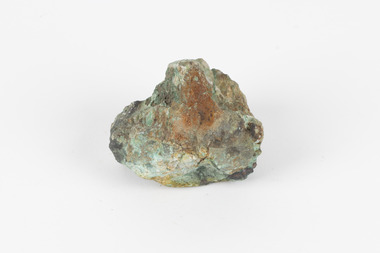
Geological specimen - Malachite, unknown
... ...water soluble...Malachite is a water soluble, crystalline, triphenyl methylene chloride salt. ...Malachite is a water soluble, crystalline, triphenyl methylene chloride salt. ...Malachite is a water soluble, crystalline, triphenyl methylene chloride salt. It has a close relationship to copper because it is common for Malachite and copper to come from the same ore. Malachite often has shades of green, making it also known as Malachite Green. As a result of it's colour, it is known for being a dye and has been used in the dye industry, the textile industry and in medical fields. Cobar in New South Wales is well known for it's mining. This is because of the number of important deposits present in the area and include three important mining belts where most of the materials are found. These are the 'Cobar belt', the 'Canbelego belt' and the 'Girilambone belt'. The 'Cobar belt' runs underneath the main town. Copper was first discovered in Cobar in 1869 and since then, many deposits of other materials have been found, including Malachite.This specimen is significant because it comes from Cobar, NSW and represents the many deposits of materials found there. Cobar has a long history of mining and is a source of Australia's copper minerals. Malachite is often found in copper deposits meaning that it is representative of Cobar's copper production. Malachite is known for it's vivid green colour and as a result, has many uses, such as meaning used as a dye. This makes it a valuable material and highly significant. This specimen is part of a larger collection of geological and mineral specimens collected from around Australia (and some parts of the world) and donated to the Burke Museum between 1868-1880. A large percentage of these specimens were collected in Victoria as part of the Geological Survey of Victoria that begun in 1852 (in response to the Gold Rush) to study and map the geology of Victoria. Collecting geological specimens was an important part of mapping and understanding the scientific makeup of the earth. Many of these specimens were sent to research and collecting organisations across Australia, including the Burke Museum, to educate and encourage further study.A solid hand-sized mineral with shades of brown , white and light green throughout.geological specimen, geology, geology collection, burke museum, beechworth, malachite, copper, water soluble, cobar, cobar mines, cobar mining, cobar nsw, nsw, new south wales, mining belts, ore, copper ore, malachite green, dye, green, dye industry, textile industry, desposits, canbelego, girilambone, alfred selwyn -
 Brimbank City Council Art Collection
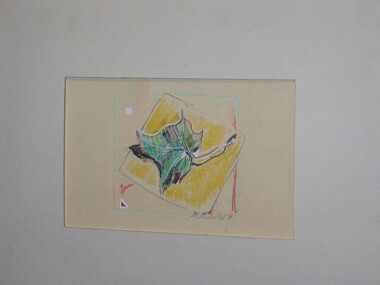
Pencil sketch, Marilyn Mendenbach (Cardinal), Leaf study, 1982
... Water soluble pencil and gouache ...Marilyn Medenbach was a local community craft worker at Deer Park community health centre Water soluble pencil and gouache Leaf study Pencil sketch Marilyn Mendenbach (Cardinal) ...Marilyn Medenbach was a local community craft worker at Deer Park community health centreWater soluble pencil and gouache -
 Brimbank City Council Art Collection
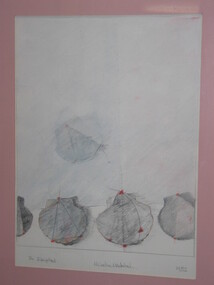
Drawing - Pencil Sketch, The Transplant, 1982
... Mixed media, water soluble pencil and gouche...Marilyn Medenbach was a local community craft worker at Deer Park community health centre marilyn mendenbach 1982 Mixed media, water soluble pencil and gouche The Transplant Drawing Pencil Sketch Marilyn Mendenbach (Cardinal) ...UnknownMendenbach, Marilyn. The Transplant. 1982, pencil sketch, Brimbank City Council Art Collection, BrimbankMixed media, water soluble pencil and gouchemarilyn mendenbach, 1982 -
 Bendigo Historical Society Inc.
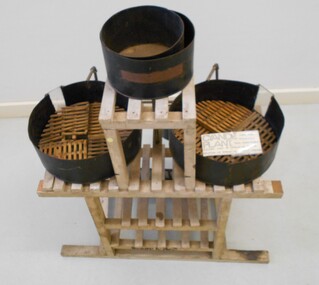
Leisure object - WOODEN MODEL CYANIDE PLANT
... Gold cyanidation (also known as the cyanide process or the MacArthur-Forrest process) is a hydrometallurgical technique for extracting gold from low-grade ore by converting the gold to a water-soluble coordination complex. It is the most commonly used leaching process for gold extraction. ...MINING Equipment cyanide plant Gold cyanidation (also known as the cyanide process or the MacArthur-Forrest process) is a hydrometallurgical technique for extracting gold from low-grade ore by converting the gold to a water-soluble coordination complex. It is the most commonly used leaching process for gold extraction. ...Wooden model of a cyanide plant. A cyanide plant was used for dissolving gold from finely divided ores by means of dilute solutions of sodium or potassium cyanides. The model has five metal bins; there is some rust on the bins and scorch mark on the wooden base.mining, equipment, cyanide plant, gold cyanidation (also known as the cyanide process or the macarthur-forrest process) is a hydrometallurgical technique for extracting gold from low-grade ore by converting the gold to a water-soluble coordination complex. it is the most commonly used leaching process for gold extraction. the ore is comminuted using grinding machinery. depending on the ore, it is sometimes further concentrated by froth flotation or by centrifugal (gravity) concentration. water is added to produce a slurry or pulp. the basic ore slurry can be combined with a solution of sodium cyanide or potassium cyanide, however many operations utilize calcium cyanide, which is more cost effective. to prevent the creation of toxic hydrogen cyanide during processing, slaked lime (calcium hydroxide) or soda (sodium hydroxide) is added to the extracting solution to ensure that the acidity during cyanidation is maintained over ph 10.5 - strongly basic. lead nitrate can improve gold leaching speed and quantity recovered, particularly in processing partially oxidized ores. -
 Embroiderers Guild, Victoria
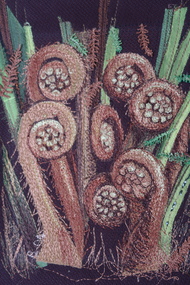
Textile - Machine Embroidery Panel, "Fern Fronds"
... Free machine embroidery on cotton and net. 3D elements and small fronds are machine embroidered on water soluble fabric before applied to panel....Free machine embroidery on cotton and net. 3D elements and small fronds are machine embroidered on water soluble fabric before applied to panel. "Fern Fronds" Textile Machine Embroidery Panel ...Made by member Bev Lane for a machine embroidery Guidance Group challenge, based on Dorothea Mackellar's poem "My Country" in 2004. Displayed in 2020 "60 Stitcher's " Exhibition for EGV Diamond Jubilee.Free machine embroidery on cotton and net. 3D elements and small fronds are machine embroidered on water soluble fabric before applied to panel. -
 Embroiderers Guild, Victoria
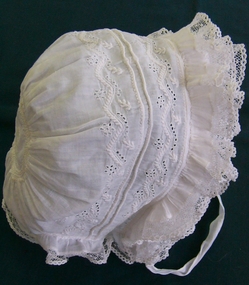
Headwear - Ayrshire Baby Bonnet, Mid 19th century
... She copied the stitches used within the robe and taught them to her outworkers, and she also produced plain muslin that was stamped with a water-soluble blue ink design that made embroidering the designs neater and more efficient. ...She copied the stitches used within the robe and taught them to her outworkers, and she also produced plain muslin that was stamped with a water-soluble blue ink design that made embroidering the designs neater and more efficient. ...Traditionally worked using white thread onto a fine white muslin, Ayrshire embroidery is recognisable by stylised floral motifs with areas of filled in cutwork. Developed from Dresden embroidery (a form of pulled work) and tambour embroidery, it uses a range of stitches, including satin stitch, chain stitch, eyelets and buttonhole edging as well as a range of lace filling stitches. The technique became popular in the early nineteenth century, when the previous fashion of elaborate gowns with hooped skirts was replaced by looser, simpler white cotton muslin garments. Although the elegant simplicity was favoured, women also desired some decoration. However, looms of the time could not create complex designs, so women turned to hand stitching.Using cotton muslin woven in Ayrshire, local women and girls would complete the intricate whitework to help supplement their family income. Mainly produced at home, Ayrshire whitework garments would be initially completed by one person. However, as the technique became more popular and the industry developed, to ensure high quality work, a piece would be passed around so that each embroiderer could focus on completing the stitches they specialised in.It is believed that the designs and motifs used in Ayrshire whitework were inspired by lace filling stitches found within an inset in a French Christening robe that was bought to Scotland by Lady Mary Montgomery, who then lent it to Mrs Jamieson of Ayr. She copied the stitches used within the robe and taught them to her outworkers, and she also produced plain muslin that was stamped with a water-soluble blue ink design that made embroidering the designs neater and more efficient. Ayrshire work became popular quite quickly, and it was incorporated into collars, cuffs and caps as well as children’s clothes and bonnets. Pieces were exported across Europe and the British Empire. As the decades progressed, technology advanced, resulting in looms that could incorporate decoration into the weave of the cloth, reducing the need for hand embroidered Ayrshire whitework.A triple frill of Buckingham lace, followed by two bands of fine embroidery - eyelets and satin stitch, and tucking, with small circle at crown.embroidery, whitework, bonnets, mid 19th century, scotland, garments -
 Flagstaff Hill Maritime Museum and Village
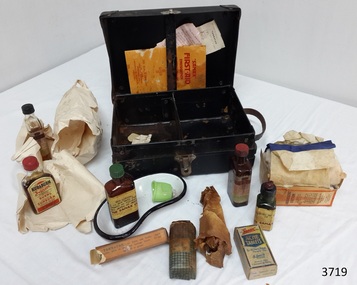
Equipment - First Aid Case, Thomas Urquhart & Son Pty Ltd (Thos. Urquhart), 1930-1939
... Approx., Tannic Acid Jelly, (Tannic Acid with 0.5% Phenol in a water-soluble base) for burns and scalds. A.N. 15050, p188, logo of a unicorn. ...Approx., Tannic Acid Jelly, (Tannic Acid with 0.5% Phenol in a water-soluble base) for burns and scalds. A.N. 15050, p188, logo of a unicorn. ...This small, portable 1930s Sanax First Aid Case has been strongly constructed, with corners reinforced with metal to take knocks and bumps, so it could be quickly transported to the site of an emergency. Having these supplies organised into a kit made them easily accessible and reduces time to take them to the site of the accident. It was possibly designed for use in factories because the booklet in the case states that the kit complies with “Part 1, Victorian Factories Regulations”. The text of the printed brand “Sanax First Aid Case” is right-way up when the case stands vertically on its hinged side. In modern times people are well aware of the importance of quick treatment when accident and injury occur. However, before the first commercial First Aid Kit was made by Johnson & Johnson in 1888, people had little knowledge about treating injuries and lacked information about suitable supplies to keep on hand for emergencies. They were often unaware of how to help in that critical time before the doctor or other assistance arrived, a particularly important time for the many people living in remote areas. A quote from Johnson’s & Johnson’s 1888 price list explains “It is a fact, which is everywhere being recognized, that many lives are lost and much suffering entailed in such accidents on account of the lack of the simple but necessary articles required to afford prompt assistance to the wounded.” One example of the value of First Aid assistance to community groups is shown in an article from the Weekly Times, 29th November 1930. It records a report from the Annuello Branch of the Younger Set (a Country Women’s Organisation), telling that on Armistice Day their president Mrs Jamieson, presented the Annuello School with the gift of a Sanax Red Cross First Aid outfit, which was accepted as being “of great practical use to the scholars.” (Annuello is a remote wheat growing area in the Mallee region of North Western Victoria, which became a soldier settlement area after World War I. There is a strain of wheat named ‘Annuello’ due to its suitability for that area. ) The Sanax Case in our Collection contains instructions, equipment and medical items suitable for use in emergency situations. The Case was one of 42 patterns available from Sanax that conformed to ‘Part 1, Victorian Factories Regulations’. It includes items made by Sanax Company and by Burroughs Wellcome & Co. (Australia) Ltd., Sydney, NSW. A quote at the back of the First Aid Emergency Instructions booklet says: “Sanax products are made in Australia by or under the supervision of qualified chemists, from the highest quality materials. They are dependable for the purposes written on labels.” BOOKLET included in First Aid Case: “SANAX” First-Aid Emergency Instructions has orange cover and white pages, joined in the centre by two staples. Booklet contains First Aid Instructions for general events listed in alphabetical order. It also contains an indexed sections headed “Poisoning, and what to do” written by S.A. Burrows, Ph.C., Vuc and N.Z. There are instructions and diagrams on how to perform Artificial Respiration. There are advertisement for Sanax products throughout the booklet that include; - Sanax Ambulance Stretcher for timber mills, mines, ships and quarries - Saw dust masks (porous rubber) for workers in dust, paint or duco sprayers Inside cover lists Sanax’s Australian made products including - tablets and powders for headaches, neuralgia, influenza, colds - snuff for Catarrh that is “quite harmless” - First Aid Cases that come in a range of 42 patterns - sunburn preventatives and treatments - healing salve for carbuncles, pock, pimples, boils, varicose ulcers etc. - snake bite outfits and kits LEAFLETS included in First Aid Case: (1) Tannafax Tannic Acid Jelly. Tannafax should be kept at hand in every home. It should be applied direct from the tube and used with neither oil nor grease. Where a large area has to be covered the clamped end may be torn or cut off to give a wider mouth to the tube. Collapsible tubes of different sizes. Made in Australia. Burroughs Wellcome & Co. (Australia) Ltd. (Incorporated in England). Sydney, NSW. Assorted Houses, London, New York, Montreal, Cape Town, Milan, Bombay, Shanghai, Buenos Aires. Copyright A. 1817, J. 9463 (2) Tabloid. The strong thing is the just - - . Tabloid marks the wor - - Burroughs Wellcome & Comp. The use of the word is to enab – the prescriber, dispenser and patient to get the right thing with one short word, instead of the firm’s long name. If another maker apply the word to his product, the act is unlawful. Tabloid is our trade mark and brand. If a vendor disregard it in dispensing or selling, the act is unlawful for the same reason. We prosecute both offenders rigorously, in the interest of prescribers, dispensers, patients and the owners of the trade mark. Please inform us of any instance of either offence. Burroughs Wellcome & Co. (Australia) Ltd. (Incorporated in England). Telephone Number - M 4184 (4 lines) All communications to G.P.O. Box No. 1185 DD. Copyright Sy. 20. & J 9894. Medicines and Equipment included in First Aid Case: - Absorbent Cotton, Sanax, for absorbing blood or drying a wound. As a swab for washing wounds; to place above a compress to keep the heat in: or as a pad to protect wounds or fractures. The Sanax Co. Manuf. Chemists, Melbourne. Regd. Office: 5 Brunswick St, Fitzroy. N.6. - ACHE tablets, Sanax, for all aches, pains, fevers etc. Dose: 2 to 3 tablets with a draught of water, every 3 hours. Children in proportion. For influenza or colds, take the bedtime dose with a hot lemon drink or toddy. Recommended for Headaches, Colds, Influenza, Fevers, Neuralgia, Rheumatism, Nerve Pains, Sleeplessness, and Seasickness. Three Sanax Ache tablets equals one Sanax Ache powder. Each tablet contains 1.75grs. each Phenacotinum and Acety acSzilcyl, and .75grs Ammon Brom. Etc.. Sanax brand specialties are prepared by highly qualified pharmaceutical chemists and may be accepted as safe and effective for the purpose indicated on the label. The Sanax Co. Melbourne - Eye lotion, Sanax, “in eye bath full strength or diluted with equal parts of water. Sanax Co. Brunswich St, Fitzroy, Melbourne. - Iodine, Sanax, POISON, with instructions for what to do if swallowed. - Kuraburn, Sanax, Applied to the burn and allowed to dry, the pain and heat instantly disappear, and blistering is prevented. If necessary, apply again in an hours. To safeguard against burning when sunbathing, apply before exposure to the sun. If already sunburnet, use Kuraburn as directions above. Safe and harmless. Sole makers, The Sanax Co. Brunswick St. - - Vic. - Sal Volatile, Sanax, - - stimulant for - - nervous aches - - or as smelling salts Dose - - - - Solution of A- - - 5%, . The Sanax Co. Brunswick St, Melbourne. - Tannafax, Burroughs Wellcome & Co. Australia Ltd. Sydney, N.S.W., 20gm. Approx., Tannic Acid Jelly, (Tannic Acid with 0.5% Phenol in a water-soluble base) for burns and scalds. A.N. 15050, p188, logo of a unicorn. Apply lightly, allow to dry, and bandage loosely. Do not apply oil or grease. - bottle wrapped in brown paper, unknown contents, paper adhered to bottle. - dish, kidney shaped, metal, white enamel with black rim - eye bath, green, plastic or Bakelite SANAX COMPANY The Sanax Company was at the address of 5 Brunswick Street, Fitzroy [Melbourne] at least as early as November 1924, as shown by its advertisement of Ache Powder in the Weekly Times, 8th November 1924. It was still at this address in September 1951, when it advertised First Aid outfits and components in the Post Master General’s section of the Commonwealth of Australia Gazette. REFERENCES: Annuello, Victoria; Wikipedia, https://en.wikipedia.org/wiki/Annuello,_Victoria Annuello Younger Set, Branch Activities and Local Reports, Country Women’s Organisations, Weekly Times, 29 November 1930, Trove http://trove.nla.gov.au/newspaper/article/224921009?searchTerm=%22sanax%22%20and%20%22melbourne%22&searchLimits=# Commonwealth of Australia Gazette, Issue 32, 24th April 1915, https://www.legislation.gov.au/file/1915GN32 [Johnson & Johnson Price List, September 1, 1888, p. 20. From our archives], Celebrating the 125th Birthday of the First Aid Kit , The Story of Johnson & Johnson, , http://www.kilmerhouse.com/2013/06/from-1888-to-2013-celebrating-the-125th-birthday-of-the-first-aid-kit/ Post Master General’s section of the Commonwealth of Australia Gazette, Issue No. 73, Thursday 27th September 1951 http://trove.nla.gov.au/newspaper/article/232185299?searchTerm=%22sanax%22%20and%20%22fitzroy%22&searchLimits= Sanax First Aid Emergency Instructions, by S.A. Burrows, publisher Sanax Ltd. Fitzroy, Victoria, 1930-1939 English, book, Illustrated edition, Trove http://trove.nla.gov.au/version/40948895 Access to emergency medical help in early settlement days of Victoria could take quite some time, especially in remote areas. From 1888 First Aid Kits and instructions became available for work sites, offices, community groups and individuals, helping to bridge the gap between the accident and the arrival of medical assistance. This portable Sanax First Aid Case is an example of portable medical equipment made in Melbourne, Australia, in the 1930’s and available to the public. It contains a range of items plus information to be used in a variety of injuries and emergencies in in factories, households, businesses and local communities, and instructions on their use. First Aid Case, portable, Sanax First Aid Case. First Aid kit in strong black cardboard carry case with metal reinforced corners, metal hinges on lid, metal catch and leather carry handle. Inside lid is a vertical strap with narrow gap behind it. Base is divided into two compartments. Manufactured by Sanax, Fitzroy, Melbourne, C. 1930-1939 Contents include "Sanax" First Aid instructions booklet, 2 leaflets, metal kidney dish enamelled in white with black trim on edge, green plastic or Bakelite eye bath, eye lotion, Tannafax tannic acid jelly, Sal Volitile, Kuraburn, Iodine, Argyrol, ACHE tablets, absorbent cotton in cardboard box, gauze bandage, and UNKNOWN wrapped bottle. Printed in gold on lid of case “SANAX” FIRST AID CASE. Most of the contents, as well as the case, show the “SANAX” brand. Some contents are inscribed Burroughs Wellcome & Co. (Australia) Ltd., flagstaff hill, warrnambool, shipwrecked coast, flagstaff hill maritime museum, maritime museum, shipwreck coast, flagstaff hill maritime village, great ocean road, first aid items, first aid kit, emergency first aid, medical emergency kit, home emergency kit, industrial emergency kit, sanax company fitzroy melbourne, burroughs wellcome & co. (australia) ltd, thos. urquhart & son pty. ltd. melbourne, sanax first aid case, sanax first-aid emergency instructions, part 1 victorian factories regulations, tabloid medical supplies -
 Flagstaff Hill Maritime Museum and Village
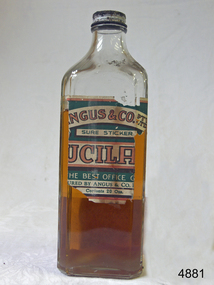
Glue Bottle, Joseph Armstrong Angus & Co, 1920s -1950
... water and food, seed germination, and thickening membranes. Cacti (and other succulents) and flax seeds are especially rich sources of mucilage. Mucilage is edible. It is used in medicine as it relieves irritation of mucous membranes by forming a protective film. It is known to act as a soluble...water and food, seed germination, and thickening membranes. Cacti (and other succulents) and flax seeds are especially rich sources of mucilage. Mucilage is edible. It is used in medicine as it relieves irritation of mucous membranes by forming a protective film. It is known to act as a soluble ...Angus & Co. was a large ink, gum, and paste manufacturing company established in Melbourne in 1896 by Joseph Armstrong Angus (1860-1936.) The company's premises included a bottle works to supply bottles for its many products. The company supplied various inks, gums, and paste too many business and domestic customers. Mucilage is a thick, gluey substance produced by nearly all plants and some microorganisms. These micro-organisms include protists who use it for their locomotion. The direction of their movement is always opposite to that of the secretion of mucilage. It is a polar glycoprotein and an exopolysaccharide. The mucilage in plants plays a role in the storage of water and food, seed germination, and thickening membranes. Cacti (and other succulents) and flax seeds are especially rich sources of mucilage. Mucilage is edible. It is used in medicine as it relieves irritation of mucous membranes by forming a protective film. It is known to act as a soluble, or viscous, dietary fiber that thickens the faecal mass, an example being the consumption of fiber supplements containing Psyllium seed husks. Traditionally, marshmallows were made from the extract of the mucilaginous root of the marshmallow plant (Althaea Officinalis). The inner bark of the slippery elm (Ulmus rubra), a North American tree species, has long been used as a demulcent and cough medicine and is still produced commercially for that purpose. Mucilage mixed with water has been used as a glue, especially for bonding paper items such as labels, postage stamps, and envelope flaps. Differing types and varying strengths of mucilage can also be used for other adhesive applications, including gluing labels to metal cans, wood to china, and leather to pasteboard. An early item from the late 1920s for office use as a glue by a well-known Melbourne manufacturer of office supplies of inks, glues, rubber stamps, and mucilage gums, etc.Bottle of Mucilage. Manufactured by Angus & Co Ltd Aust. Contents 20 Ozflagstaff hill, warrnambool, shipwrecked-coast, flagstaff-hill, flagstaff-hill-maritime-museum, maritime-museum, shipwreck-coast, flagstaff-hill-maritime-village -
 Narre Warren and District Family History Group
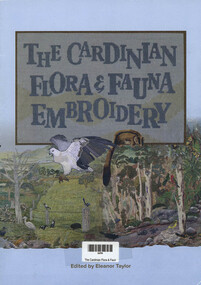
Book, Eleanor Taylor, The Cardinian Flora & Fauna Embroidery, 2017
... Embroidery Cardinia Flora Cardinia Fauna A wide variety of hand embroidery stiches were used, as well as machine embroidery on hand-painted fabric.Tree trunks were mainly appliqued but some some were cross-stiched; distant foliage is free machine embroidery on water-soluble fabric and closer foliage consists of individually embroidered leaves.All 55 embroideries of birds, animals, fish, insects, plants, fence posts, logs, rocks, etc. were worked by 15 people.312 residents, families and friends added their stiches to the canvaswork label panel. 24 pages The Cardinian Flora & Fauna Embroidery Book Eleanor Taylor Friends of the Cardinian Embroidery ...A wide variety of hand embroidery stiches were used, as well as machine embroidery on hand-painted fabric.Tree trunks were mainly appliqued but some some were cross-stiched; distant foliage is free machine embroidery on water-soluble fabric and closer foliage consists of individually embroidered leaves.All 55 embroideries of birds, animals, fish, insects, plants, fence posts, logs, rocks, etc. were worked by 15 people.312 residents, families and friends added their stiches to the canvaswork label panel.24 pagesnon-fictionA wide variety of hand embroidery stiches were used, as well as machine embroidery on hand-painted fabric.Tree trunks were mainly appliqued but some some were cross-stiched; distant foliage is free machine embroidery on water-soluble fabric and closer foliage consists of individually embroidered leaves.All 55 embroideries of birds, animals, fish, insects, plants, fence posts, logs, rocks, etc. were worked by 15 people.312 residents, families and friends added their stiches to the canvaswork label panel. embroidery, cardinia flora, cardinia fauna
