
Showing 139 items matching "watercolour drawing"
-
 Slovenian Association Melbourne
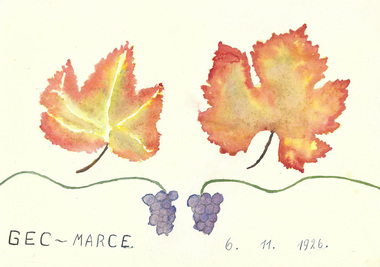
Water colour drawing, Marcela Bole-Gec watercolour drawing of autumn leaves, 1926, 1926
... Marcela Bole-Gec watercolour drawing of autumn leaves, 1926......watercolour drawing...Marcela bole watercolour drawing 1929 autumn leaves Gec Marcela, 6.11.1926 Watercolor drawing Marcela Bole-Gec watercolour drawing of autumn leaves, 1926 Water colour drawing ...Watercolor drawingGec Marcela, 6.11.1926marcela bole, watercolour drawing, 1929, autumn leaves -
 Federation University Art Collection
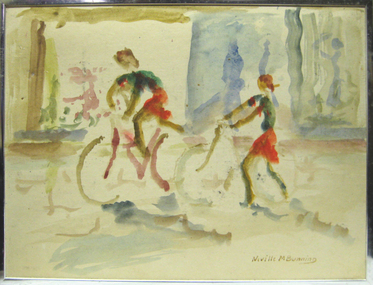
Watercolour drawing, 'Children with Bicycle' by Neville Bunning
... Watercolour drawing...'Children with Bicycle' by Neville Bunning Watercolour drawing Neville Bunning ...This item is part of the Federation University Art Collection. The Art Collection features over 2000 works and was listed as a 'Ballarat Treasure' in 2007.Street scene with two children playing with bicycles.Signed Neville M Bunning lower rightart, artwork, neville bunning, bicycle, needs framing -
 Women's Art Register
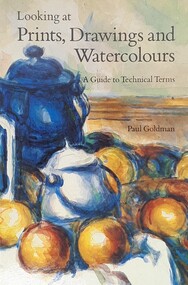
Book, British Museum Publications Ltd, Looking at Prints, Drawings and Watercolours. A Guide to Technical Terms, 1988
... watercolour...printmaking...drawing...Printing, drawing, and watercolours. ...Printing, drawing, and watercolours. Complements other material held in the Women's Art Register watercolour printmaking drawing Mary Delany Beatrix Potter Collection in A-Z of technical terms used for artworks on paper. ...Collection in A-Z of technical terms used for artworks on paper.non-fictionCollection in A-Z of technical terms used for artworks on paper.watercolour, printmaking, drawing, mary delany, beatrix potter -
 Orbost & District Historical Society
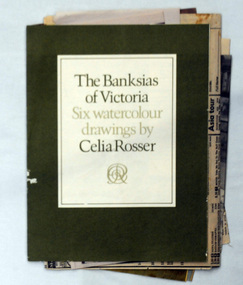
collection of newspaper articles, 1970's - 2000
... The folder has been made especially for this collection of articles .The label is from a box of limited edition signed watercolour drawings by ROSSER, Celia. THE BANKSIAS OF VICTORIA. ...There are six newspaper and magazine articles inside a a folder labelled "The Banksias of Victoria Six Watercolour Drawings by Celia Rosser". The articles are from The Australian Women's Weekly, The Sun, The Sunday Herald and The Herald Sun....The folder has been made especially for this collection of articles .The label is from a box of limited edition signed watercolour drawings by ROSSER, Celia. THE BANKSIAS OF VICTORIA. ...The folder has been made especially for this collection of articles .The label is from a box of limited edition signed watercolour drawings by ROSSER, Celia. THE BANKSIAS OF VICTORIA. Six Watercolour Drawings. Born Celia Elizabeth Prince in 1930, Celia Rosser began painting Australian wildflowers early in her artistic career. She first began painting Banksias after seeing a Banksia serrata near her home in Orbost, Victoria. She lived in Orbost in the 1960's( her husband had been posted to Orbost High School) where she painted and drew native flowers , in particular, banksias. Her first exhibition was at Leveson Gallery in Melbourne in 1965, and included three watercolours of Banksia species. Two years later she published Wildflowers of Victoria.Celia Elizabeth Rosser (born 1930) is a renowned Australian botanical illustrator, best known for having published The Banksias, a three-volume series of monographs containing watercolour paintings of every Banksia species. She began painting Australian wildflowers early in her artistic career. She first began painting Banksias after seeing a Banksia serrata near her home in Orbost, Victoria.A collection of newspaper and magazines articles pertaining to Celia Rosser. There are six newspaper and magazine articles inside a a folder labelled "The Banksias of Victoria Six Watercolour Drawings by Celia Rosser". The articles are from The Australian Women's Weekly, The Sun, The Sunday Herald and The Herald Sun. -
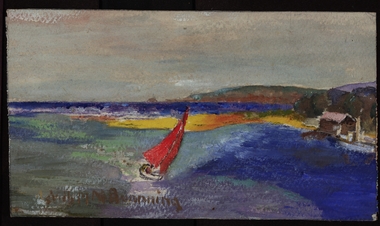 Federation University Art Collection
Painting - Watercolour, Sketches' by Neville Bunning
... A number of unframed watercolour drawings by Neville Bunning...The Art Collection features over 2000 works and was listed as a 'Ballarat Treasure' in 2007. art artwork neville bunning unframed streetscape life drawing birds A number of unframed watercolour drawings by Neville Bunning Sketches' by Neville Bunning Painting Watercolour Neville Bunning ...This item is part of the Federation University Art Collection. The Art Collection features over 2000 works and was listed as a 'Ballarat Treasure' in 2007.A number of unframed watercolour drawings by Neville Bunningart, artwork, neville bunning, unframed, streetscape, life drawing, birds -
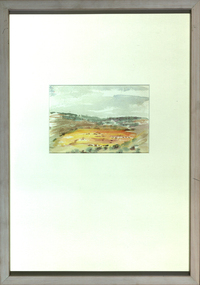 Federation University Art Collection
Painting - Watercolour, [Landscape]
... ...watercolour...drawing...The Art Collection features over 2000 works and was listed as a 'Ballarat Treasure' in 2007. art artwork landscape neville bunning bunning watercolour drawing ballarat technical art school Framed watercolour landscape [Landscape] Painting Watercolour Neville Bunning ...NEVILLE BUNNING Neville Bunning was a teacher of Sculpture and Ceramics at the School of Mines and Industry, Ballarat, 1945-1964. This item is part of the Federation University Art Collection. The Art Collection features over 2000 works and was listed as a 'Ballarat Treasure' in 2007.Gift of Pauline DigginsFramed watercolour landscape art, artwork, landscape, neville bunning, bunning, watercolour, drawing, ballarat technical art school -
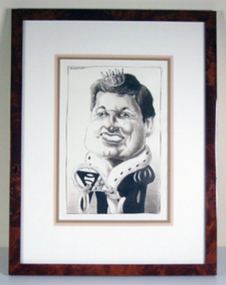 Tennis Australia
Drawing, Watercolour
... Drawing, Watercolour...Materials: Wood, Glass, Cardboard, Paper, Ink Drawing, Watercolour ...Cariacature drawing/painting of unknown person (Geoff Pollard?) holding tennis racquet. Materials: Wood, Glass, Cardboard, Paper, Inktennis -
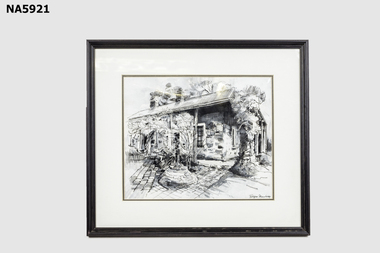 Whitehorse Historical Society Inc.
Artwork, other - Water colour - Schwerkolt Cottage, Bryan Membrey
... Schwerkolt Cottage , ink and watercolour drawing...Schwerkolt Cottage , ink and watercolour drawing Schwerkolt Cottage Water colours Back has Glenn Vardy Professional Picture Framing 874-5122 150 Rooks Road, Nunawading 3131 Framed water colour of Schwerkolt Cottage with 'acetate' covering in black ink. ...Schwerkolt Cottage , ink and watercolour drawingFramed water colour of Schwerkolt Cottage with 'acetate' covering in black ink. Has a black frame with a cream border signed by Began Membrey. See also ND1574Back has Glenn Vardy Professional Picture Framing 874-5122 150 Rooks Road, Nunawading 3131schwerkolt cottage, water colours -
 Port Melbourne Historical & Preservation Society
Print - Sandridge Foreshore, H Gritten, c. 1865
... Black and white lasercopy from the watercolour drawing in the La Trobe Collection, State Library of Victoria of the 1865 watercolour of the Sandridge foreshore...built environment Black and white lasercopy from the watercolour drawing in the La Trobe Collection, State Library of Victoria of the 1865 watercolour of the Sandridge foreshore Print Sandridge Foreshore H Gritten ...Black and white lasercopy from the watercolour drawing in the La Trobe Collection, State Library of Victoria of the 1865 watercolour of the Sandridge foreshorebuilt environment -
Port Melbourne Historical & Preservation Society
Print - Sandridge Foreshore, H Gritten, c. 1865
... Sandridge Foreshore - 1975 National Bank reproduction of 1865 watercolour drawing in the La Trobe Collection, State Library of Victoria, by permission of the Library Council of Victoria....built environment Sandridge Foreshore - 1975 National Bank reproduction of 1865 watercolour drawing in the La Trobe Collection, State Library of Victoria, by permission of the Library Council of Victoria. ...Sandridge Foreshore - 1975 National Bank reproduction of 1865 watercolour drawing in the La Trobe Collection, State Library of Victoria, by permission of the Library Council of Victoria.built environment -
Federation University Historical Collection
Drawing - Architectural by Herbert. L. Coburn, Elevated Plan view of Ballarat School of Mines, 1915
... Large framed watercolour drawing depicting the main buildings making up the Ballarat School of Mines including the Ballarat School of Mines Museum and Technical Art School. ...'Dec 1915' Large framed watercolour drawing depicting the main buildings making up the Ballarat School of Mines including the Ballarat School of Mines Museum and Technical Art School. ...Large framed watercolour drawing depicting the main buildings making up the Ballarat School of Mines including the Ballarat School of Mines Museum and Technical Art School. Signed 'Drawn by Herbert. L. Coburn'. 'Dec 1915'ballarat school of mines, herbert l. coburn -
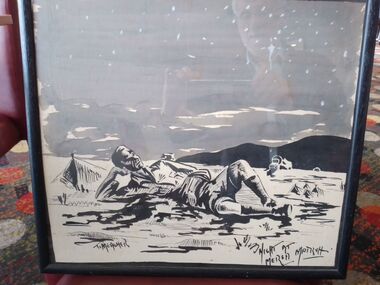 Warrnambool RSL Sub Branch
Artwork, other - Night at Mersa Matruh. Sketch, Night at Mersa Matruh
... Pen, ink, watercolour original drawing...Pen, ink, watercolour original drawing Night at Mersa Matruh Artwork, other Night at Mersa Matruh. ...Framed behind Glass. Pen, ink, watercolour original drawingNight at Mersa Mutrah written bottom Right. T Meagher signature bottom Left. -
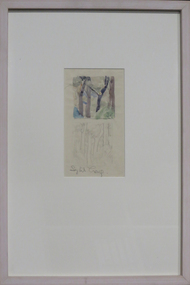 Federation University Art Collection
Drawing - Artwork, [Tree Study] by Sybil Craig
... drawing...watercolour...The Art Collection features over 2000 works and was listed as a 'Ballarat Treasure' in 2007. art artwork sybil craig craig available pencil drawing watercolour Framed pencil and watercolour sketch [Tree Study] by Sybil Craig Drawing Artwork Sybil Craig ...Sybil CRAIG (18 November 1901-09 September 1989) Born London, England Arrived Australia 1902 The National Gallery School, Melbourne, gave Craig a sound training for her popular flower and portrait studies. However, her association with leading modernists between the wars led her to pursue her art in a deliberately experimental and spontaneous way. Sybil Craig was the third woman appointed by the Australian War Memorial as an official war artist. She was the first woman to paint women working in the munitions’ factories. The Castlemaine Art Gallery & Historical Museum, held the first retrospective exhibition of Sybil Craig's in 2006. The exhibition highlighted her wonderful use of colour and design in a diverse range of media, techniques and subject matter. This item is part of the Federation University Art Collection. The Art Collection features over 2000 works and was listed as a 'Ballarat Treasure' in 2007.Framed pencil and watercolour sketchart, artwork, sybil craig, craig, available, pencil drawing, watercolour -
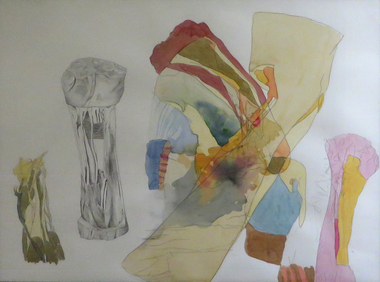 Federation University Art Collection
Pencil and Watercolour, 'Cadaver 2' by Duncan Lannan, 1999
... drawing...watercolour...The Art Collection features over 1000 works and was listed as a 'Ballarat Treasure' in 2007. art artwork duncan lannan lannan pencil drawing watercolour alumni Framed artwork 'Cadaver 2' by Duncan Lannan Pencil and Watercolour Duncan Lannan ...Duncan LANNAN (1972- ) Duncan Lannan undertook a Diploma of Arts (Visual Arts) at RMIT between 1995 and 1996. A further two years study at the University of Ballarat (now Federation University Australia) saw Duncan Lannan awarded a Bachelor of Arts (Visual Arts) in 2000. Ge completed a Graduate Diploma od Education at the University of Melbourne in 2001. This item is part of the Federation University Art Collection. The Art Collection features over 1000 works and was listed as a 'Ballarat Treasure' in 2007.Framed artwork art, artwork, duncan lannan, lannan, pencil, drawing, watercolour, alumni -
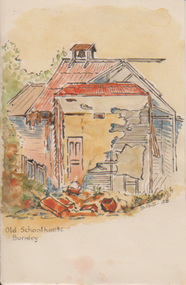 University of Melbourne, Burnley Campus Archives
Drawing - Sketch, watercolour, S.G.S, Old Schoolhouse Burnley S.G.S. 48, 1948
... drawing...watercolour sketch...Old Schoolhouse Burnley S.G.S. 48 Drawing Sketch, watercolour S.G.S ..."The Pavilion"/"Old Schoolhouse" (Burnley Gardens Melbourne) in course of being demolished. The Pavilion was demolished in 1948 tyo make way for the new Administration BuildingColoured ink sketch of the Pavilion in the course of demolition by unidentified artist "S.G.S."Old Schoolhouse Burnley S.G.S. 48pavilion, drawing, watercolour sketch, demolition, schoolhouse building -
 City of Greater Bendigo - Civic Collection
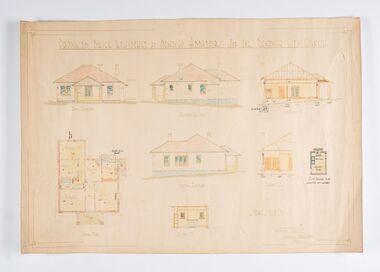
Work on paper - Architectural Drawing, City of Bendigo, Proposed Brick Residence at Bendigo Abbatoirs (sic) for the Bendigo City Council, Not dated
... Ink, pen, pencil and watercolour architectural drawing for the proposed brick residence at Bendigo abattoirs. ...Austen Architect / Commonwealth Bank Chambers / Bendigo Ink, pen, pencil and watercolour architectural drawing for the proposed brick residence at Bendigo abattoirs. ...Situated at 47 Lansell Street, Bendigo, the original 1911-12 Charles D'Ebro designed brick Bendigo Municipal Abattoir, comprising twin slaughter and hanging rooms for cattle, sheep and pigs, and two smaller ancillary brick buildings. After the buildings were acquired by the Country Roads Board in 1945, a substantial but sympathetic addition was made to the south-eastern end of the old cattle abattoir. The abattoir is significant for historic, architectural and technical reasons at a state level. as a rare surviving municipal abattoir, and represents the development of hygienic slaughtering through municipal regulations, thus improving standards of public health in Victoria. It is historically significant to the City of Greater Bendigo as a key to the primary production industry that centred on this precinct from the 1860s to the mid 1990s; they are an important surviving component of one of the largest regional livestock markets in Victoria. D'Ebro was critically influential in the development of industrial and in particular meat processing buildings, designing major freezing works and abattoirs throughout Victoria and Australia.(Source, National Trust Database). The Bendigo facility finally closed in 1945, when all slaughtering for local consumption passed to a joint export and local slaughtering facility at the Bendigo Inland Meat Authority. Ink, pen, pencil and watercolour architectural drawing for the proposed brick residence at Bendigo abattoirs. Proposed Brick Residence at Bendigo Abbatoirs (sic) For The Bendigo City Council. / Front Elevation / Easter Elevation / Section A. D. / Ground Plan / Wester Elevation / Section C.D. / Section I. P. ? Existing Building to be / Converted into Laundry ? Scale 1/8" to 1 FT / Geo. Austen Architect / Commonwealth Bank Chambers / Bendigocity of greater bendigo commerce, charles d'ebro -
 Queenscliffe Maritime Museum
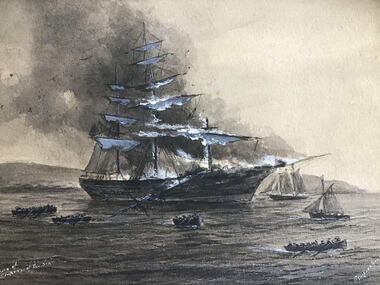
Painting - Painting - watercolour 'Empress of the Sea', Charles Dickson Gregory, 'Burning of the Empress of the Sea'
... Back: Whatmans watercolour drawing board, 36640, C. Dickson Gregory, 41 Albert Street. ...Back: Whatmans watercolour drawing board, 36640, C. Dickson Gregory, 41 Albert Street. ...The Empress of the Sea is historically and archaeologically significant as it was one of Donald Mackay's famous wooden clipper ships ie: representative of a particular design or type. It was also associated with both the Black Ball and White Star Lines of Australian Packets, which carried thousands of immigrants from Britain to Australia.An original watercolour painting of the burning of the sailing ship 'Empress of the Sea' by charles Dickson GregoryFront: Burning of the Empress of the Sea, C. Dickson Gregory. Back: Whatmans watercolour drawing board, 36640, C. Dickson Gregory, 41 Albert Street. Fixed label: 'Destruction of the famous clipper 'Empress of the Sea' at Port Phillip Heads 19th December 1861 Drawing by C. Dickson Gregoryempress of the sea, watercolours -
 City of Greater Bendigo - Civic Collection
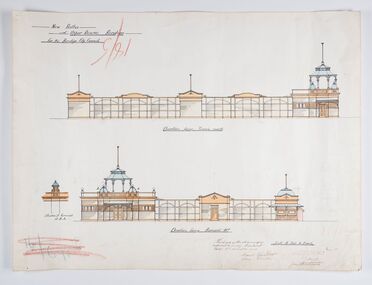
Work on paper - Architectural Drawing, City of Bendigo, New Baths at Upper Reserve Bendigo for the Bendigo City Council, 18th November 1912
... Ink, pen, pencil and watercolour architectural drawing for the proposed new baths at the Upper Reserve on Barnard Street, Bendigo....Bendigo Swimming Club Rosalind Park Upper Reserve Bendigo Faith Leech memorial swimming pool Bendigo Baths City of Greater Bendigo Community Groups New baths / at Upper Reserve Bendigo / for the Bendigo City Council / Elevation facing tennis courts / Elevation of Terminals at A, A, / Elevation facing Barnard Street / This is one of the drawings /referred to in my contract/ dated 18th November 1912 / Signed Robert J Rogers / (unknown) / Mayor Jas Semmens Ink, pen, pencil and watercolour architectural drawing for the proposed new baths at the Upper Reserve on Barnard Street, Bendigo. ...The 'New' City of Bendigo baths also known as 'The Baths' were opened on 26th February,1913 at a cost of £2000. These baths made use of an existing dam and had men only and ladies bathing areas as well as a 'paddling paddock' for young children. This set of plans is for the Men's Bathing shed which serviced the men's bathing area adjacent to the still existing tennis courts on Barnard Street. In 1958 the Municipal Baths were replaced by an Olympic Pool and £17,000 was raised by public subscription towards this pool’s construction. Ink, pen, pencil and watercolour architectural drawing for the proposed new baths at the Upper Reserve on Barnard Street, Bendigo.New baths / at Upper Reserve Bendigo / for the Bendigo City Council / Elevation facing tennis courts / Elevation of Terminals at A, A, / Elevation facing Barnard Street / This is one of the drawings /referred to in my contract/ dated 18th November 1912 / Signed Robert J Rogers / (unknown) / Mayor Jas Semmensbendigo swimming club, rosalind park, upper reserve bendigo, faith leech memorial swimming pool, bendigo baths, city of greater bendigo community groups -
 Federation University Art Collection
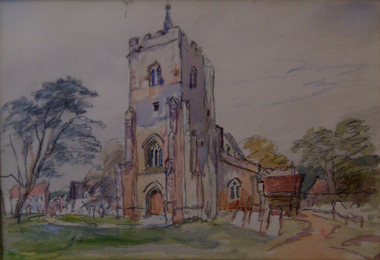
Drawing - Watercolour, Sandy Church Bedfordshire 1854
... Unframed drawing with watercolour detail of Sandy Church Bedfordshire 1854, with matt. ...Sandy Church Bedfordshire 1854 Drawing Watercolour Alexander, David ...This item is part of the Federation University Art Collection. The Art Collection features over 2000 works and was listed as a 'Ballarat Treasure' in 2007.Unframed drawing with watercolour detail of Sandy Church Bedfordshire 1854, with matt. art, artwork, sandy church bedfordshire, watercolour, church, unframed -
 Bendigo Historical Society Inc.
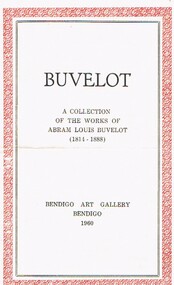
Document - NORMAN PENROSE COLLECTION: CATALOGUE OF BUVELOT ART, 1960
... Lists a number of Buvelot oils, watercolours and pencil drawings at the Bendigo Art Gallery 1960....Lists a number of Buvelot oils, watercolours and pencil drawings at the Bendigo Art Gallery 1960. ...Document. Norman Penrose collection: cream list with red border on the front. Lists a number of Buvelot oils, watercolours and pencil drawings at the Bendigo Art Gallery 1960.Bendigo Art Gallerygovernment, local, bendigo art gallery, norman penrose collection, buvelot collection, bendigo art gallery -
 Bendigo Historical Society Inc.
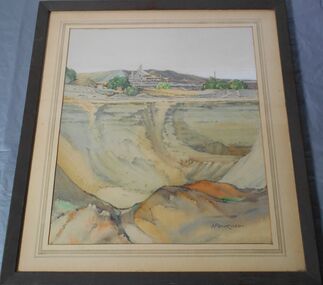
Painting - Sand Pit Fortuna, Norman Penrose
... Title: Sand Pit Fortuna. For: drawing, watercolour and graphic art exhibition. Victorian Artista Society 430 Albert Street, East Melbourne ...Title: Sand Pit Fortuna. For: drawing, watercolour and graphic art exhibition. Victorian Artista Society 430 Albert Street, East Melbourne Watercolour painting by Norman Penrose titled "Sand Pit Fortuna." ...Born in 1903, Norman Penrose studied at the Bendigo School of Mines. A painter and a teacher, he lived in Bendigo most of his life.Watercolour painting by Norman Penrose titled "Sand Pit Fortuna." It shows a mining sand pit and the Fortuna mine in the background. The painting is signed on the bottom right-hand side. The painting is under glass in a dark brown wooden frame. On the back: Penrose Norman William 14 Barkly Terrace east Bendigo. Price: - guineas. Title: Sand Pit Fortuna. For: drawing, watercolour and graphic art exhibition. Victorian Artista Society 430 Albert Street, East Melbourne bendigo, mining, norman penrose, artist, teacher, fortuna -
 Flagstaff Hill Maritime Museum and Village
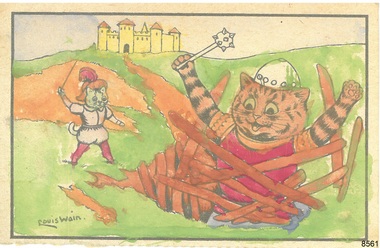
Postcard - Picture Postcard, Louis Wain (illustrator / artist), 1880s to 1930s
... Picture on postcard is outlined in black and coloured in roughly painted watercolours. The drawing has two cats dressed in armour standing and fighting in front of a turreted castle. ...Picture on postcard is outlined in black and coloured in roughly painted watercolours. The drawing has two cats dressed in armour standing and fighting in front of a turreted castle. ...The picture postcard is illustrated in a simple, child-like manner. It has a personal message on the back, perhaps sent by an adult called Lily to a young relative or friend. Its rough edges indicate that it may have been torn out of a book or from a sheet of cards. It is one of the hundreds of illustrations by artist Louis Wain, quoted as being "one of the most popular commercial illustrators in the history of England" (IllustrationChronicles.com). English artist Louis Wain (1860-1939) was famous for his illustrations of cats, many of which he gave human characteristics and personalities. Wain married Emily. They owned a cat called Peter who was a great comfort to Emily through her cancer illness and consequent death after only a few years of marriage. At 22 years old Wain gave up his job as a teacher to work full time as an illustrator. He was able to produce hundreds of drawing a year for journals, books, postcards and advertisements. Later he wrote and illustrated children's books. However he didn't benefit much from copyrighting his work as he sold his work to publishers together with the copyright, so reproductions of his works didn't earn him money. Wain said that he owned his career as a cat artist to Peter. Wain spent over a decade in mental asylums before his death in 1939.This picture postcard is an example of the work of Louis Wain, English artist of the 19th and early 20th century. He is famous for his drawings of cats, which he continued producing throughout his life. He is also known for producing the world's first screen cartoon cat, called "Pussyfoot". In 1972 Wain's work was presented at an exhibition in the Victorian and Albert Museum.Rectangular picture postcard printed on think cream card. Picture on postcard is outlined in black and coloured in roughly painted watercolours. The drawing has two cats dressed in armour standing and fighting in front of a turreted castle. The picture is a black framed outline. The artist's printed signature is in the bottom left corner. The artist is Louis Wain. The reverse has a vertical dividing line and a square outline for a postage stamp's location. It also has printed headings. There is a handwritten Pencil inscription. The postcard's left side and lower edge have rough uneven edges.Signature: "Louis Wain." Printed headings: "POST CARD" "THIS SPACE MAY BE USED FOR COMMUNICATION" "THE ADDRESS TO BE WRITTEN HERE" Handwritten on back: "To Dr R - - - - - - / with love / from Lilly"flagstaff hill maritime museum and village, warrnambool, great ocean road, shipwreck coast, postcard, picture postcard, louis wain, fighting cats, child's postcard, cat artist, animal portraits, national cat club, fencing, illustrator, children's books, children's author, children's illustrator, watercolour, cats dressed as humans, cats dressed as knights, popular art, victorian art -
 Kew Historical Society Inc
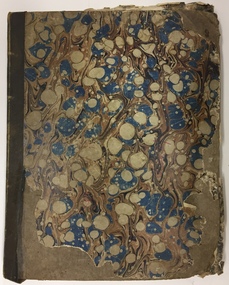
Album, Louisa G Thomas, Victorian Era Sketchbook, 1862
... However the book contains pen and ink and pencil drawings, watercolours, and photographs, which both predate and postdate 1862. ...However the book contains pen and ink and pencil drawings, watercolours, and photographs, which both predate and postdate 1862. ...Louisa Thomas married Henry Gipps (1837-91)in 1863. They had six sons and two daughters. While Louisa and Henry Gipps were to die in Sussex, two of their sons, Frederick George De Visme Gipps (1867-1953) and Richard Brook Woodthorpe Gipps (c.1872-1946) migrated to Queensland, possibly bringing with them their mother’s sketchbook.The collection of artworks that are included in the sketchbook are often of outstanding aesthetic and artistic significance. In the variety of subject matter and the geographical places represented, it is historically significant as a document recording the postings of Colonel Henry Gipps, 9th Norfolk Regiment, and his wife Louisa to locations in the Mediterranean and West Asia. The large bound sketchbook has a marbled cover with blue binding. The name Louisa Goulburn Thomas and the date 1862 are faintly inscribed in pencil on the front page. However the book contains pen and ink and pencil drawings, watercolours, and photographs, which both predate and postdate 1862. The approximately 75 works are loose-leafed items and [currently] do not form a chronological, geographical or thematic sequence. Creators identified on some drawings and watercolours include Mary Julia Wilder Thomas, JFV Wright, ELG (Edward Louis de Bondell Gipps?), L Nicholson, Bertha Isadore Thomas, and HG (Henry Gipps?). Many of the works are signed and dated, and include rural landscapes and seascapes, archaeological sites, animal studies, and portraits. While most of the works were created in the British Isles, others are scenes of Venice, the Ionian Islands, Cape Town, Hong Kong and Japan. [A number of the ‘oriental’ paintings on silk were probably purchased from local artists.] The art works in the book are at various stages of completion and represent a diverse range of artistic skills. What may be the earliest work in the sketchbook is a drawing of three uniformed soldiers. An annotation on the reverse records that the drawing is of a Group of Soldiers after [Philipp Jakob] de Southerbourg 1830. The birth of Louisa Thomas' oldest son, William Henry Houston Meyrick Gipps (1864-1903) in Corfu perhaps explains why a number of scenes and items in the album are of the Ionian Islands. Louisa is probably the creator of a number of still life and botanical studies in the album. These range from floral studies to a bird’s nest. The painting of objects was to remain a socially ‘approved’ specialty of amateur and professional women artists into the 20th century. The complete contents of the album will be uploaded to accompany this record. Some items may be published separately on Victorian Collections, but will acknowledge their origins in the sketchbook."Louisa Goulburn Thomas / 1862"victorian sketchbooks, manuscripts - kew historical society, 9th norfolk regiment, rosemary (gipps) vaughan smith, vaughan-smith collection -
Frankston RSL Sub Branch
Framed Artwork, Sketch of Frankston RSL Clubrooms, Davey Street, 1972
... The artwork is an ink drawing with watercolour tonings and depicts the Frankston RSL Sub Branch clubrooms of the time. ...The artwork is an ink drawing with watercolour tonings and depicts the Frankston RSL Sub Branch clubrooms of the time. ...Framed artwork produced by artist Marie Minton, dated 1972. The artwork is an ink drawing with watercolour tonings and depicts the Frankston RSL Sub Branch clubrooms of the time. The artwork is mounted with a gold coloured wooden frame and glass front. Artist, Marie Minton was apparently the daughter of a member of the time, Laurie Minton. This scene is of a Frankston landmark building on the corner of Davey Street and Young Street, Frankston locally known as the 'Plowman Residence'. Prior to being the clubrooms of the Frankston RSL Sub Branch this building was the family home of Dr Sidney Plowman. In Dr Plowman's time the building was known as the 'The Lofts' and was his residence and operated as a private hospital, the building was constructed ca 1900. Dr Plowman died in May 1932. Title 'Frankston RSL' and the artist's name 'Marie Minton '72' appear on the front lower area of the sketch. The rear has the following note inscribed "Sketch of RSL clubrooms Davey St. by Marie Minton daughter of member (Laurie)" -
 Bendigo Historical Society Inc.
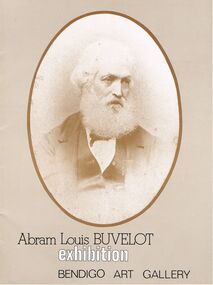
Document - LYDIA CHANCELLOR COLLECTION; ABRAM LOUIS BUVELOT EXHIBITION
... The actual catalogue of the exhibition includes information about Buvelot's 18 oil paintings, 23 watercolours and 9 pencil drawings. There are also Supplementary exhibits - an oil by J.R. ...The actual catalogue of the exhibition includes information about Buvelot's 18 oil paintings, 23 watercolours and 9 pencil drawings. There are also Supplementary exhibits - an oil by J.R. ...A catalogue with a brown front cover and white pages. On the front cover are the words, 'Abram Louis BUVELOT exhibition Bendigo Art Gallery' and a photo of the artist.' On the inside of the catalogue is the acknowledgement 'This exhibition forms part of 'Arts Victoria 75' Festival.' The Bendigo Art Gallery also ' gratefully acknowledges the financial assistance given by the Victorian Ministry for the Arts, which has made the mounting of the exhibition and the production of this catalogue possible. There are also photos of Buvelot's work and an article about 'A Man and his Work.' The actual catalogue of the exhibition includes information about Buvelot's 18 oil paintings, 23 watercolours and 9 pencil drawings. There are also Supplementary exhibits - an oil by J.R. Ashton, a photograph by Louis Buvelot and a pencil drawing by Madame Buvelot. Printed by Cambridge Press, Bendigo.artwork, oil painting, bendigo art gallery, lydia chancellor, collection, art, bendigo art gallery, event, exhibitions, program, programmes, catalogue, abram louis buvelot -
 Flagstaff Hill Maritime Museum and Village
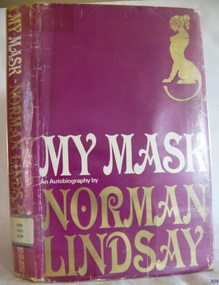
Book - Biography, Norman Lindsay (Artist), My Mask, 1975
... Lindsay is widely regarded as one of Australia's greatest artists, working across pen drawing, etching, watercolour, oil and sculpture in concrete and bronze. ...Lindsay is widely regarded as one of Australia's greatest artists, working across pen drawing, etching, watercolour, oil and sculpture in concrete and bronze. ...My Mask is Norman Lindsay's autobiography, an account written by Lindsay of himself, running to 245 pages with numerous photographic illustrations, published in boards with a dust jacket by Angus & Robertson in Sydney in 1970. Notably, it was actually written in 1957 but wasn't published until after Lindsay's death, and one source specifies it was released by his widow the year after he died. It covers ten pages of front matter plus 205 pages of text and 28 pages of illustrations, bound in blue cloth. It was the last of three autobiographical works Lindsay produced, and his final book overall. The work capped a 56-year writing career that began with his first novel in 1913. As a genre piece, it's a memoir/reflection on his own life and creative persona; the title itself, My Mask, signals that it's presented as a curated self-portrait rather than a full confessional.Hard cover book. My Mask Author: Norman Lindsay Publisher: Angus & Robertson Date: 1970 Further Information: Hardcover with dust jacket lettering and patterning to spine. The spine has a Library label with an inscription.non-fictionMy Mask is Norman Lindsay's autobiography, an account written by Lindsay of himself, running to 245 pages with numerous photographic illustrations, published in boards with a dust jacket by Angus & Robertson in Sydney in 1970. Notably, it was actually written in 1957 but wasn't published until after Lindsay's death, and one source specifies it was released by his widow the year after he died. It covers ten pages of front matter plus 205 pages of text and 28 pages of illustrations, bound in blue cloth. It was the last of three autobiographical works Lindsay produced, and his final book overall. The work capped a 56-year writing career that began with his first novel in 1913. As a genre piece, it's a memoir/reflection on his own life and creative persona; the title itself, My Mask, signals that it's presented as a curated self-portrait rather than a full confessional.shipwrecked-coast, flagstaff-hill, flagstaff-hill-maritime-museum, warrnambool, maritime-museum, shipwreck-coast, flagstaff-hill-maritime-village, shipwrecked-artefact, book, pattison collection, warrnambool library, warrnambool mechanics’ institute, ralph eric pattison, corangamite regional library service, warrnambool city librarian, mechanics’ institute library, victorian library board, warrnambool books and records, warrnambool children’s library, my mask, norman lindsay -
 Ringwood and District Historical Society
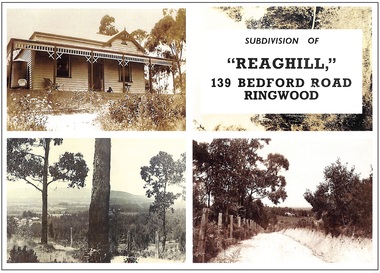
Archive, Richard Carter Collection - REAGHILL Subdivision Research (Parent Record)
... “Every inch of wall space seemed to be crammed from floor to ceiling with oils, watercolours, etchings and drawings of all sorts by well known artists”. ...“Every inch of wall space seemed to be crammed from floor to ceiling with oils, watercolours, etchings and drawings of all sorts by well known artists”. ...This record is the Parent Record for researching the subdivision of Reaghill, 139 Bedford Road, Ringwood, compiled by Richard Carter. "Reaghill" is part of an older larger holding of sixty acres which came to comprise Vista Avenue, Vista Court, Homebush Court, Rawson Court and Wombalano ParkTranscript: Researching “Reaghill" The property “Reaghill” originally stood at 139 Bedford Road, Ringwood East before the property was subdivided in the 1950s and took a new address and frontage to Vista Avenue, Ringwood East. The purpose of these notes is to trace the origins of the property from the year 1900 to the present day. Information in the notes is sourced from the archives of Carter Real Estate, from Land Titles Office records and from the book of the history of Ringwood, “Ringwood, Place of Many Eagles” by Hugh Anderson. “Reaghill” is part of an older larger holding of sixty acres. It Is the story of those 60 acres, which now comprise Vista Avenue, Vista Court, Homebush Court, Rawson Court and Wombalano Park, which Is the subject of these notes. Earlier Times A convenient starting point for these notes Is the year 1900. On 11th June 1900 Wallace Bruce of 68 High Street, Windsor became registered as the proprietor of “sixty acres or thereabouts” (24.28 hectares) being part of Crown Allotment 43 Parish of Ringwood County of Mornington. That title. Volume 2773 Folio 485 did not name the streets to which the property abutted but clearly they were Canterbury Road at its intersection with Bedford Road. Title records a lease of the property from Wallace Bruce to Thomas Oates, with the lease endorsed on title on 22 July 1903 and removed 16 June 1908. Wallace Bruce subsequently subdivided the land Into three parcels, two of which he sold to Dora Stanisforth Davies during 1909 and the balance he sold to Frank Leslie Walker in 1914. The Era of the Davies Wallace Bruce firstly sold the western portion of the property, containing twenty four acres three roods and 20 perches (24.875 acres or 10.0667 hectares) on 6 October 1909. The new title, Volume 3381 Folio 021, records the new proprietor as “Dora Stanisforth Davies, wife of Seymour George Pilkington Davies of Burwood Road, Hawthorn, Bank Manager”. Shortly thereafter, Wallace Bruce sold a further parcel of “ten acres or thereabouts” (4 hectares) being the north eastern portion of his original holding. That title, Volume 3384 Folio 795, showed the purchaser once again as “Dora Stanisforth Davies, wife of Seymour George Pilkington Davies of Burwood Road Hawthorn, Bank Manager”. It is noteable that the second, title which is dated 8 December 1909, had no abuttal to any road, nor was it at any time (even when subdivided in the 1950s) consolidated with Davies' adjoining title. Both titles then recorded that Dora Stanisforth Davies died on 19 February 1945 with probate of her will being granted to John Seymour Davies of 69 Grantham Street West Brunswick, Medical Practitioner, and Hugh Percival Hall of 339 Collins Street Melbourne, Solicitor. Almost two years later, on 6th December 1946, both parcels of land were transferred by the Executors to Geoffrey Francis Seymour Davies of 20 Albert Road Strathfield N.S.W, Medical Practitioner. From this chronology it could be surmised that one of Dora Davies’ executors, John Seymour Davies, was probably her son. Was Geoffrey Francis Seymour Davies another son, or was he her grandson? In any event Geoffrey Francis Seymour Davies set about subdividing what was then the property “Reaghill” and its 34.875 acres (14.11 hectares). The Subdivision of “Reaghill The subdivision of “Reaghill” was made more viable by the subdivision in 1931 of the property to the north and the creation of Scenic Avenue, Vista Avenue and Grandview Avenue, all of which abutted “Reaghill’s” northern boundary. In fact Geoffrey Francis Seymour Davies bought the freehold to Grandview Avenue, Scenic Avenue and Vista Avenue in July 1955 for £84-9-0 to give him legal rights over those roads. Title to those roads and the newly created Vista Avenue, Vista Court and Homebush Court remain in his name to this day. It is particularly interesting to note that whilst those streets had typical allotments of about 1000 square metres, the subdivision of Reaghill was into blocks of one to two acres or more (4000 square metres to about one hectare) except for the blocks fronting Bedford Road. That speaks volumes about Davies’ attitude to the land, its natural beauty, its topography and vegetation. “Reaghill” was subdivided into twenty two lots by Plan of Subdivision LP 41463. The first eleven lots came off Vista Avenue and formed an extension of Vista Avenue and a newly created Vista Court. Lot sizes ranged from 1 acre 1 rood 1½ perches (5097 square metres) to 2 acres 3 roods 21½ perches (1.167 hectares). A further four lots came off Homebush Court, a newly created court off Bedford Road. Those lots ranged from 1 acre 1 rood 29 perches (5792 square metres) to 2 acres 1 rood 39 ®/io perches (1.01 hectares). Seven further lots, parallelogram in configuration, fronted Bedford Road and had a typical area of 1518 square metres. The names of the streets (“Vista” Avenue/Court and “Homebush” Court) give an insight into the elevation of the land, the views it offered and the bushland it featured. The Covenant As evidence of Davies’ desire to maintain the bush setting of the property, covenants were imposed on the transfers of Lots 1 to 15 (the acreage lots). That covenant allowed for only one dwelling house to be erected on each of those lots for a period of 15 years from sale. Effectively it froze subdivision for 15 years. But 15 years came around quickly. The Sales “Reaghill” 139 Bedford Road, Ringwood was offered for Private Sale as “22 Excellent Residential Allotments” by estate agents Anderson & Hickling of 239 Collins Street Melbourne (telephone Central 25!), with a “protective covenant” of one dwelling house only on lots 1-15 for a period of 15 years. Solicitors for the vendor were Messrs Meares, Duigan & Hall of 139 Collins Street Melbourne. Sales commenced in 1955 and went through to 1967. Prices were typically from £1350, the price paid for Lot 13 in 1957. The Role of Frank Leslie Walker These notes have so far recorded that of the sixty acres originally owned by Wallace Bruce in 1900, some 34.875 acres were sold to Dora Davies in 1909 and subdivided and sold by her descendants. The balance of Wallace Bruce’s land was sold on 6th April 1914 to Frank Leslie Walker. This is the land at the south east corner of Bruce’s holding fronting Canterbury Road and which now comprises Rawson Court and Wombalano Park. Frank Leslie Walker “of Albany Chambers, Collins Street Melbourne” was described as an Art Decorator. In “Ringwood - Place of Many Eagles” he is shown as living on his land “in a house which was surrounded by a four foot high brick wall and the long drive of rough cream-coloured Lilydale gravel was entered through handsome wrought iron gates obtained from some building wrecker”. The “old rambling house" had been extended and renovated using secondhand doors, windows and timber. “Every inch of wall space seemed to be crammed from floor to ceiling with oils, watercolours, etchings and drawings of all sorts by well known artists”. On 13th August 1954 Frank Leslie Walker transferred an area of 12 acres 3 rood 21 perches (5.213 hectares) to The Mayor Councillors and Burgesses of the Borough of Ringwood for no consideration as a Gift “for the providing of pleasure grounds on places of public resort or public recreation”. That is now Wombalano Park. The balance of his property, containing 6 acres 1 rood 5 perches (2.54 hectares) and including the original homestead (named Wombalano?) was gifted by Frank Leslie Walker to his nephew on 25 November 1955. It was later subdivided as Rawson Court in 1956. The house no longer survives. The “Reaghill” Homestead The original homestead on Wallace Bruce’s holding, as has just been described fronted Canterbury Road in the area which is now Rawson Court. The age of the house is unknown but is described in 1914 as being “old and rambling”. The “Reaghill” homestead is likely to have been built by the Davies and was retained on Lot 11 of their subdivision. Its date of construction is not known but might have been soon after the Davies bought the land in 1909. Lot 11, with “Reaghill” was not sold in the 1950s as part of the land subdivision and sale. It remained as the family home of Dr. Davies until its sale in 1968 (without the 15 year covenant) to James Hamilton Kelly of New York, USA for $15,000. In time, Lot 11 was resubdivided. The house today remains on a reduced site of 7112 square metres, still on the highest point in the locality with fine views. Further Subdivisions Once the 15 year time frame of the covenant expired, the various owners of the lots, having built homes, proceeded to subdivide their surplus land. Lot 1 was first, followed by Lot 7. Only four of the original 15 acreage lots have not been subdivided. Some subdivisions were less respectful of their environment and neighbourhood than others. Maroondah City Council's planning scheme provides for a minimum lot size of 864 square metres in the locality. But the horse has already bolted. Summary “Reaghill” in its heyday, and the acreage properties which later surrounded it, contributed some of the finest and most exclusive properties in Ringwood East. Notably, the locality was home to a significant number of local medicos over the years. Its location dose to the newly relocated Tintern CEGGS gave it added exclusivity. Subdivision over the years has impinged on the beauty and the environment. However it is still a most important part of Ringwood East, with a rich history. R.A Carter January 2005 -
 Mission to Seafarers Victoria
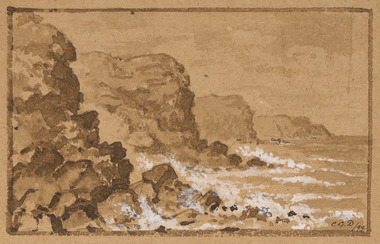
Drawing, Charles George Darvall (1831-1924), 1899
... A watercolour artist, he travelled around the goldfields and later taught at the Sandhurst School of Arts and Design. charles georges darvall (1831-1924) william henry charles darvall (1830-1906) Bottom right corner: C.G.D. 99 Small ink seaside landscape found on the 1896-1902 scrapbook Drawing Charles George Darvall (1831-1924) ...Small illustration by Charles George Darvall (1831-1924), cousin of William Henry Charles Darvall.Born in England in 1831, he arrived in Victoria in 1858. A watercolour artist, he travelled around the goldfields and later taught at the Sandhurst School of Arts and Design.Small ink seaside landscape found on the 1896-1902 scrapbookBottom right corner: C.G.D. 99charles georges darvall (1831-1924), william henry charles darvall (1830-1906) -
 Glenelg Shire Council Cultural Collection
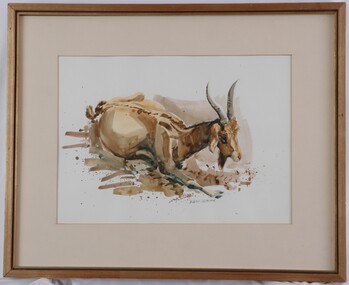
Painting, Robert Ulmann, Goat, c. 1974
... Rob exhibited in Sydney, Melbourne, Adelaide and Perth as well as in the Regional Galleries of Warrnambool, Ballarat, Portland and Horsham, and, among numerous prizes, he won the award for watercolour at six of the annual exhibitions of the Wildlife Art Society of Australasia, between 1978 and 1983. Although his principal interest was in drawing and painting, he retained a fascination with sculpture. ...Rob exhibited in Sydney, Melbourne, Adelaide and Perth as well as in the Regional Galleries of Warrnambool, Ballarat, Portland and Horsham, and, among numerous prizes, he won the award for watercolour at six of the annual exhibitions of the Wildlife Art Society of Australasia, between 1978 and 1983. Although his principal interest was in drawing and painting, he retained a fascination with sculpture. ...Robert Ulmann was born in Zurich, Switzerland, where he studied sculpture and painting, exhibiting annually with the National Art Society of Switzerland and in Paris, Munich and Stockholm. He migrated to Canada in 1956 and became a Canadian citizen. After working on the restoration of sculpture on the west wing of the Parliament Buildings Ottawa, he took up a Government appointment as one of six artist advisers to the Eskimos, initiating handicraft and sculpture programs in isolated settlements across the Central Arctic. He arrived in Australia with his Australian wife, Helen, in 1969, after two adventurous years backpacking and sketching through the United States, Central and South America and the South Pacific. From 1970 to 1972 he was employed by the Northern Territory Administration as a manual arts instructor to the aboriginal people of Docker River, a remote settlement west of Ayers Rock. A series of drawings from this period was exhibited by the Department of the Interior in Canberra, Sydney and Adelaide. Robert Ulmann’s paintings and prints of wildlife from Australia and overseas fill a beautiful studio overlooking the famous Logans Beach whale nursery at Warrnambool in the Western District of Victoria. His previous studio and home, together with 13 years of field sketches and his best work collected together for two books were destroyed by the Ash Wednesday fires at Naringal in 1983. Rob exhibited in Sydney, Melbourne, Adelaide and Perth as well as in the Regional Galleries of Warrnambool, Ballarat, Portland and Horsham, and, among numerous prizes, he won the award for watercolour at six of the annual exhibitions of the Wildlife Art Society of Australasia, between 1978 and 1983. Although his principal interest was in drawing and painting, he retained a fascination with sculpture. His works range from two stone fountains with figures commissioned by the City of Zurich, while he was still a student, to a 4 ½ ton sculpture in bluestone commissioned in 1977 as a memorial to Sir Fletcher Jones., a five metre representation of whale tails in steel, and a life-size bronze of St. John of God commissioned for a private hospital.Image of a goat beginning to rise from a seated position, possible struggling out of mud. Painted in yellow and brown tones, with blue shadows. Earth colours form a rough ground area surrounding the goat. A brown wash provides a cursory background behind the goat's head. Dark cream matt surrounds image. Gold painted wooden frame, with glass.Front: Robert Ulmann (lower centre, paint) Back: (no inscriptions) -
 Orbost & District Historical Society
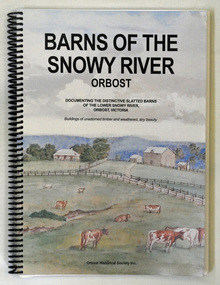
book, Barns of the Snowy River Orbost, 2006
... watercolour, artist unknown. The book documents the distinctive slatted barns of the lower Snowy River, Orbost, Victoria. The book was published by the Orbost Historical Society and was written by May Leatch and Ngaere Donald. It contains B/w photographs, drawings...watercolour, artist unknown. The book documents the distinctive slatted barns of the lower Snowy River, Orbost, Victoria. The book was published by the Orbost Historical Society and was written by May Leatch and Ngaere Donald. It contains B/w photographs, drawings ...This is a book written by a local historian containing historical information pertaining to Orbost and the surrounding district. A spiral bound book of 191pp. On the front and back covers are coloured print of the Morgan Barn c 1900, an original watercolour, artist unknown. The book documents the distinctive slatted barns of the lower Snowy River, Orbost, Victoria. The book was published by the Orbost Historical Society and was written by May Leatch and Ngaere Donald. It contains B/w photographs, drawings and stories of the barns and their histories.history-agriculture-orbost barns-slatted
