
Showing 8 items matching "wattle bark industry"
-
 Bendigo Historical Society Inc.
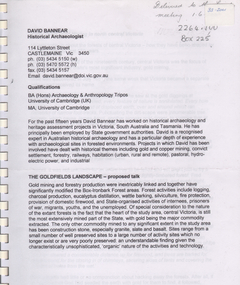
Booklet - The Goldfields Landscape, David Bannear, 2001
... ...Wattle bark industry...Subjects covered in the presentation include: Early 1850's Gold Mining in north central Victoria Botanising diggers Quartz mining Deep lead mining, The state of the forests at the end of the nineteenth century State of the Central Victoria forests Settlement Charcoal production Wattle bark industry The railways Eucalyptus production State nurseries and plantations Thinning of forests Royalty system Creswick School of Forestry and Forestry Commission 1919: Pines and unemployed schemes 1931 - 1940: The Great Depression 1939: Black Friday 1939-45: Alien or interment forestry camps 1939- 45: Second World War charcoal production 1944-45 Prisoner of War Camps 1949-51: Migrant or refugee camps ...Early 1850's Gold Mining in north central Victoria Botanising diggers Quartz mining Deep lead mining The state of the forests at the end of the nineteenth century State of the Central Victoria forests Settlement Charcoal production Wattle bark industry The railways Eucalyptus production State nurseries and plantations Thinning of forests Royalty system Creswick School of Forestry and Forestry Commission 1919: Pines and unemployed schemes 1931 - 1940: The Great Depression 1939: Black Friday 1939-45: Alien or interment forestry camps 1939- 45: Second World War charcoal production 1944-45 Prisoner of War Camps 1949-51: Migrant or refugee camps David Bannear Eleven page typed booklet with clear plastic cover and white plastic ring binding. ...Eleven page typed booklet with clear plastic cover and white plastic ring binding. Booklet contains a presentation delivered to the Bendigo Historical Society on 1st June 2001, by David Bannear, BA, MA (University of Cambridge) Historical Archaeologist. Subjects covered in the presentation include: Early 1850's Gold Mining in north central Victoria Botanising diggers Quartz mining Deep lead mining, The state of the forests at the end of the nineteenth century State of the Central Victoria forests Settlement Charcoal production Wattle bark industry The railways Eucalyptus production State nurseries and plantations Thinning of forests Royalty system Creswick School of Forestry and Forestry Commission 1919: Pines and unemployed schemes 1931 - 1940: The Great Depression 1939: Black Friday 1939-45: Alien or interment forestry camps 1939- 45: Second World War charcoal production 1944-45 Prisoner of War Camps 1949-51: Migrant or refugee camps early 1850's gold mining in north central victoria, botanising diggers, quartz mining, deep lead mining, the state of the forests at the end of the nineteenth century, state of the central victoria forests, settlement, charcoal production, wattle bark industry, the railways, eucalyptus production, state nurseries and plantations, thinning of forests, royalty system, creswick school of forestry and forestry commission, 1919: pines and unemployed schemes, 1931 - 1940: the great depression, 1939: black friday, 1939-45: alien or interment forestry camps, 1939- 45: second world war charcoal production, 1944-45 prisoner of war camps, 1949-51: migrant or refugee camps, david bannear -
 Lakes Entrance Historical Society
Book, Gippsland Heritage Journal No 11, 1991
... Issue 11 of a series of Journals showcasing Gippsland history contains articles on Limestone Creek, Crooked River School, Inverloch, Port Albert, Wattle Bark Industry and dairy farming personalities sister Ellen Mc Carthy, Amos Brazier, John Lardner, Tom...Settlers Schools Agriculture Industrial Issue 11 of a series of Journals showcasing Gippsland history contains articles on Limestone Creek, Crooked River School, Inverloch, Port Albert, Wattle Bark Industry and dairy farming personalities sister Ellen Mc Carthy, Amos Brazier, John Lardner, Tom Gippsland Heritage Journal No 11 Book ...Issue 11 of a series of Journals showcasing Gippsland history contains articles on Limestone Creek, Crooked River School, Inverloch, Port Albert, Wattle Bark Industry and dairy farming personalities sister Ellen Mc Carthy, Amos Brazier, John Lardner, Tomsettlers, schools, agriculture, industrial -
Lakes Entrance Historical Society
Book, Gippsland Heritage Journal - issue 19, 1996
... No 19 of series showcasing aspects of Gippsland Victoria history. this issue has articles on Wonthaggi, Wattle Bark Industry, Bargwanaths, career and wreck of the Shah, Serbs migrants in Latrobe Valley, Briagolong, Aboriginals, Great War Nurses, roadside...No 19 of series showcasing aspects of Gippsland Victoria history. this issue has articles on Wonthaggi, Wattle Bark Industry, Bargwanaths, career and wreck of the Shah, Serbs migrants in Latrobe Valley, Briagolong, Aboriginals, Great War Nurses, roadside Aboriginals Township Ships and Shipping Gippsland Heritage Journal - issue 19 Book ...No 19 of series showcasing aspects of Gippsland Victoria history. this issue has articles on Wonthaggi, Wattle Bark Industry, Bargwanaths, career and wreck of the Shah, Serbs migrants in Latrobe Valley, Briagolong, Aboriginals, Great War Nurses, roadsideaboriginals, township, ships and shipping -
 Halls Gap & Grampians Historical Society
Photograph - B/W, C 1900s
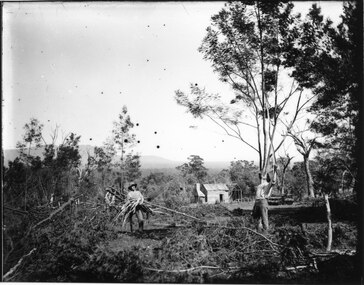
... The photo shows wattle-bark stripping, taking place at Roses Gap (western end). The identity of the men is unknown. TIMBER INDUSTRIES ...The photo shows wattle-bark stripping, taking place at Roses Gap (western end). The identity of the men is unknown.The photo shows three men in a cleared area of bush, one is standing holding a bundle of wattle bark, another is behind and to the left of him also holding bark and a third is standing to the right and is scrapping bark from a tree above his head with a long stick . There is a hut in the background, the right side of which is just a frame. timber industries, wattlebark stripping, scenery, roses gap -
 Halls Gap & Grampians Historical Society
Photograph - B/W, C 1900s
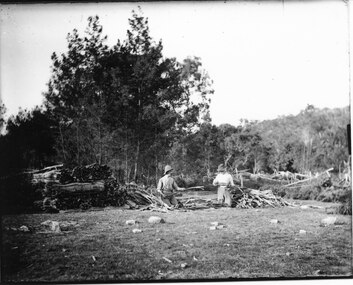
... Wattle-bark stripping (bundling) at Roses Gap. The identity of the men is unknown. TIMBER INDUSTRIES Wattlebark stripping SCENERY Roses Gap The photo shows two men kneeling in a clearing. ...Wattle-bark stripping (bundling) at Roses Gap. The identity of the men is unknown.The photo shows two men kneeling in a clearing. They are both working on pieces of wattle bark and have piles of bark around them. There is thick bush behind the clearing.timber industries, wattlebark stripping, scenery, roses gap -
 Halls Gap & Grampians Historical Society
Photograph - B/W
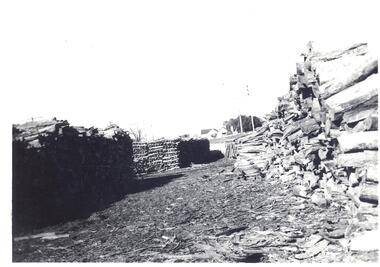
... Reverse----- Stacks of wattle bark bundles TIMBER INDUSTRIES Wattlebark stripping Reverse----- Stacks of wattle bark bundles Black and White photo showing stacks of bundled wattle bark ready for transporting to mill. ...Reverse----- Stacks of wattle bark bundlesBlack and White photo showing stacks of bundled wattle bark ready for transporting to mill. Weather board house in far distance.Reverse----- Stacks of wattle bark bundlestimber industries, wattlebark stripping -
 Orbost & District Historical Society
Work on paper - Book - deposits register, Dept. of Forestry, Victoria
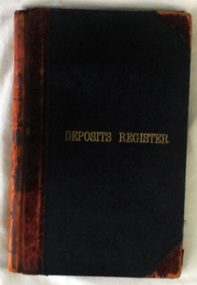
... Wattle Bark Stripping, Saw Mills, Logging Licenses, Sleeper Off-cuts. It contains the names of people involved in these activities, the amounts of money they paid to the Forestry, and dates. This Register appears to start in 1919 and end in 1978. An excellent resource for research into the forestry industry ...This Register has many inscriptions for Forestry activities in the Orbost region, such as Sleeper Cutting Licenses and other licensed activities such as Wattle Bark Stripping, Saw Mills, Logging Licenses, Sleeper Off-cuts. It contains the names of people involved in these activities, the amounts of money they paid to the Forestry, and dates. This Register appears to start in 1919 and end in 1978. An excellent resource for research into the forestry industry in the Orbost district since this Register contains the names of men who paid license fees to the Forestry Dept. to allow them to work in the forests in various activities such as sleeper cutting, wattle bark cutting, saw mills, logging. A hard cover ledger, dark blue/black cover with red binding. The words DEPOSITS REGISTER are printed on the front cover and also on the binding. The ledger's pages are ruled in red for DEPOSITS and REFUNDS. forestry, orbost, sleeper cutting, wattle bark cutting, saw mills, logging -
 Department of Energy, Environment and Climate Action
Victorian School of Forestry (VSF) Regalia
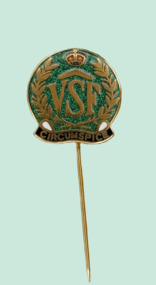
... The plant in the design is acacia mollissima (black wattle) the bark of which was used extensively as a source of tannin used in the leather industry at the time. ...The plant in the design is acacia mollissima (black wattle) the bark of which was used extensively as a source of tannin used in the leather industry at the time. ...The colours and emblem for the Victorian School of Forestry (VSF) were designed in 1916 when Charlie Carter became the Principal. The school opened only a few years earlier in 1910 and he remained as Principal until 1926. The design was a joint effort with the students. The motto "circumspice", which is Latin for “look around you”, was suggested by Mr Carter who believed that foresters should always be observant. The plant in the design is acacia mollissima (black wattle) the bark of which was used extensively as a source of tannin used in the leather industry at the time. The boomerang beneath the crown was incorporated as another Australian element. Lapel pin date unknown.Metal lapel pin with Victorian School of Forestrty emblemCIRCUMSPICEvictorian school of forestry (vsf)
