
Showing 22 items matching "weaving textile art"
-
 National Wool Museum
Book, Sonya's Mob: the life and times of a Polish-Australian family
... Weaving Textile Art...Inludes information about her husband, Wlodek Zakrzewski who made and repaired spinning wheels. Weaving Textile Art Spinning Spinning wheels Carrington wheel Carrington-Zakrzewska Mrs Sonya Zakrzewski Mr Wlodzimierz Weaving Textile Art To the National Wool Museum / with our best wishes / Lois Carrington / George Carrington Sonya's Mob: the life and times of a Polish-Australian family Book ..."Sonya's Mob: the life and times of a Polish-Australian family" - Lois and George Carrington, Canberra, 1996 (self published). Includes a seperately printed index and location guide to Sonya Carrington's khilims. Biography of Sonya Carrington-Zakrzewska, artist and weaver. Inludes information about her husband, Wlodek Zakrzewski who made and repaired spinning wheels.To the National Wool Museum / with our best wishes / Lois Carrington / George Carringtonweaving textile art, spinning, spinning wheels, carrington wheel, carrington-zakrzewska, mrs sonya zakrzewski, mr wlodzimierz, weaving, textile art -
 National Wool Museum
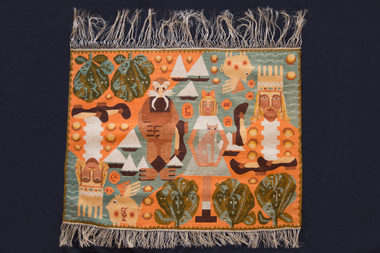
Wall Hanging, The Honourable Walrus, MP
... weaving textile art...Sonya was married to George Wlodek Zakrzewski weaving textile art spinning - hand spinning wheels carrington-zakrzewska mrs sonya carrington mrs lois carrington mr george weaving textile art Large rectangular weaving depicting alice in wonderland characters. ...Made by Sonya Carrington in 1986-88. The weaving depicts characters from Alice in Wonderland. Sonya was married to George Wlodek ZakrzewskiLarge rectangular weaving depicting alice in wonderland characters. Woven on a loom, made of silk, linen and wool. Is attached to a wooden rod. Hanging is entitled The Honorable Walrusweaving textile art, spinning - hand, spinning wheels, carrington-zakrzewska, mrs sonya carrington, mrs lois carrington, mr george, weaving, textile art -
 Ararat Gallery TAMA
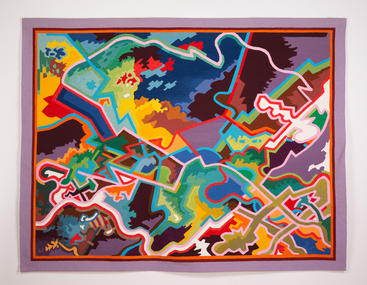
Mike Brown, Untitled (tapestry), 1982
... weaving and painting together to provide a comparison of how artwork is translated into tapestry. The large area of dark blue at the centre top of the tapestry demonstrates how the weavers have used colour changes in the yarn to depict the painterly shading in the original painting. The Australian Tapestry Workshop (ATW) is an international leader in contemporary tapestry, collaborating with a diverse range of international and Australian artists to produce exceptional handwoven works of art. Established in 1976, ATW have created over 500 tapestries in creative collaborations for nearly 50 years, promoting innovation and excellence in tapestry weaving and textile...weaving and painting together to provide a comparison of how artwork is translated into tapestry. The large area of dark blue at the centre top of the tapestry demonstrates how the weavers have used colour changes in the yarn to depict the painterly shading in the original painting. The Australian Tapestry Workshop (ATW) is an international leader in contemporary tapestry, collaborating with a diverse range of international and Australian artists to produce exceptional handwoven works of art. Established in 1976, ATW have created over 500 tapestries in creative collaborations for nearly 50 years, promoting innovation and excellence in tapestry weaving and textile ...Mike Brown is known for his bold use of colour and graffiti-like imagery. Charles Nodrum Gallery describe Brown as ‘a unique leader of alternative avant guard art in Australia, and a true bohemian eccentric. An artistic anarchist and polemicist, during his 30-year career he waged an unwavering war on art world conventions and sensibilities, critiquing mass culture, consumerism, sex, advertising, censorship, and embracing counterculture, alternative lifestyles and socialism.’ This tapestry was produced by the Victorian Tapestry Workshop Melbourne (now known as the Australian Tapestry Workshop) in South Melbourne, based on an original painting by Mike Brown. We have exhibited the weaving and painting together to provide a comparison of how artwork is translated into tapestry. The large area of dark blue at the centre top of the tapestry demonstrates how the weavers have used colour changes in the yarn to depict the painterly shading in the original painting. The Australian Tapestry Workshop (ATW) is an international leader in contemporary tapestry, collaborating with a diverse range of international and Australian artists to produce exceptional handwoven works of art. Established in 1976, ATW have created over 500 tapestries in creative collaborations for nearly 50 years, promoting innovation and excellence in tapestry weaving and textile art. -
 Ararat Gallery TAMA
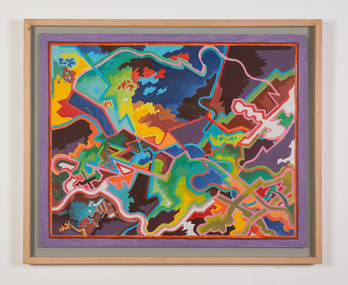
Mike Brown, Untitled (Sketch for tapestry), 1982
... weaving and painting together to provide a comparison of how artwork is translated into tapestry. The large area of dark blue at the centre top of the tapestry demonstrates how the weavers have used colour changes in the yarn to depict the painterly shading in the original painting. The Australian Tapestry Workshop (ATW) is an international leader in contemporary tapestry, collaborating with a diverse range of international and Australian artists to produce exceptional handwoven works of art. Established in 1976, ATW have created over 500 tapestries in creative collaborations for nearly 50 years, promoting innovation and excellence in tapestry weaving and textile...weaving and painting together to provide a comparison of how artwork is translated into tapestry. The large area of dark blue at the centre top of the tapestry demonstrates how the weavers have used colour changes in the yarn to depict the painterly shading in the original painting. The Australian Tapestry Workshop (ATW) is an international leader in contemporary tapestry, collaborating with a diverse range of international and Australian artists to produce exceptional handwoven works of art. Established in 1976, ATW have created over 500 tapestries in creative collaborations for nearly 50 years, promoting innovation and excellence in tapestry weaving and textile ...Mike Brown is known for his bold use of colour and graffiti-like imagery. Charles Nodrum Gallery describe Brown as ‘a unique leader of alternative avant guard art in Australia, and a true bohemian eccentric. An artistic anarchist and polemicist, during his 30-year career he waged an unwavering war on art world conventions and sensibilities, critiquing mass culture, consumerism, sex, advertising, censorship, and embracing counterculture, alternative lifestyles and socialism.’ This tapestry was produced by the Victorian Tapestry Workshop Melbourne (now known as the Australian Tapestry Workshop) in South Melbourne, based on an original painting by Mike Brown. We have exhibited the weaving and painting together to provide a comparison of how artwork is translated into tapestry. The large area of dark blue at the centre top of the tapestry demonstrates how the weavers have used colour changes in the yarn to depict the painterly shading in the original painting. The Australian Tapestry Workshop (ATW) is an international leader in contemporary tapestry, collaborating with a diverse range of international and Australian artists to produce exceptional handwoven works of art. Established in 1976, ATW have created over 500 tapestries in creative collaborations for nearly 50 years, promoting innovation and excellence in tapestry weaving and textile art. -
 National Wool Museum
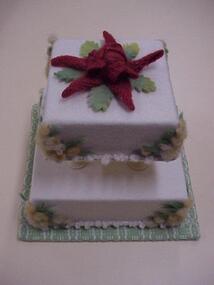
Textile Handcraft, The Afternoon Tea Party: Celebration Cake
... The covering of the cake was woven by Anneli Rickards, the plate woven by Jean Inglis, Mary Donnan and Val Ingeme made and assembled the floral trimmings Agricultural shows Handicrafts Textile Art Knitting Weaving Geelong Handweavers and Spinners Guild Inc. ...The Geelong Handweavers and Spinners Guild Inc. entered "The Afternoon Tea Party", designed by Val Ingeme, into the "Five Articles" Section of the Melbourne Sheep and Woolcraft Show c.1992. To qualify, the entry needed to form a group and be able to demonstrate a number of wool crafts in at least five different items. The covering of the cake was woven by Anneli Rickards, the plate woven by Jean Inglis, Mary Donnan and Val Ingeme made and assembled the floral trimmingsagricultural shows handicrafts textile art knitting weaving, geelong handweavers and spinners guild inc., spinning - hand, felting, weaving, ingeme, mrs val inglis, jean - geelong handweavers and spinners guild inc. rickards, anneli - geelong handweavers and spinners guild inc. donnan, mary - geelong handweavers and spinners guild inc., melbourne, victoria, agricultural shows, handicrafts, textile art, knitting -
 National Wool Museum
Book, Modern Developments in the Australian Wool Industry
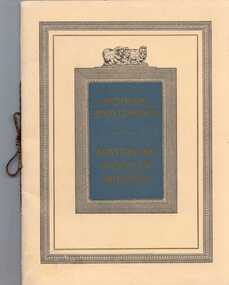
... Weaving Textile Industry - history Textile Production Machine Knitting Textile Mills Yarra Falls Spinning Co. Pty Ltd Australian Knitting Mills Limited Yarn - woollen Cloth - worsted Yarn - worsted Wool Tops Yarn - cashmere Logo Merino: sheep in Australian art and design - Exhibition (29/07/2000 - 04/02/2001) Weaving Textile Industry - history Textile Production Machine Knitting Textile Mills Book, front cover: "Modern Developments in the Australia Woollen Industry" c.1923; Yarra Falls Spinning Co. ..."Modern Developments in the Australian Wool Industry", c.1923. Examines the operations of the Yarra Falls Spinning Co. Pty Ltd and the Australian Knitting Mills Limited (makers of Golden Fleece and Kookaburra knitted underwear). Includes photos of processes and of the buildings.Book, front cover: "Modern Developments in the Australia Woollen Industry" c.1923; Yarra Falls Spinning Co. Pty Ltd and Australian Knitting Mills Limited.weaving textile industry - history textile production machine knitting textile mills, yarra falls spinning co. pty ltd australian knitting mills limited, yarn - woollen, cloth - worsted, yarn - worsted, wool tops, yarn - cashmere, logo merino: sheep in australian art and design - exhibition (29/07/2000 - 04/02/2001), weaving, textile industry - history, textile production, machine knitting, textile mills -
 National Wool Museum
Clothing - Tabard, Jun Tomita, 1970s
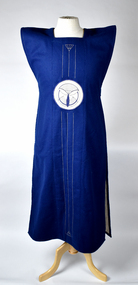
... textile centre of Japan. The technique he uses kasuri (the Japanese term for ikat) is selectively pre-dying yarns before weaving to create pattern. The other decorative features of this garment are based on Japanese family crest designs (kamon). The pointed shoulders of this garment are reminiscent of the stiffened shoulders of kataginu, the upper part of the kamishimo ensemble that was formal wear for samurai men. Tomita was at the Jam factory from 1976-78 and he has works in numerous public collections, including: - Stanthorpe Art...Louis Art Museum, Long House Foundation - Cooper-Hewitt Museum of Art/USA - Victoria and Albert Museum, UK - Toyama Prefectural Museum of Art, Japan The donor purchased this tabard from an exhibition held at Wool House in Parkville Victoria, which was sponsored by the Australian Wool Board to promote the use of Australian Wool in textiles and fashion at that time, around April/May in 1977. At that time (1976-1977) the donor owned and run a retail/display shop for craft products such as ceramics, artworks and jewellery. The donor subsequently retained this in storage with some other items since the business closed. Textile Tabard Japan Art Clothing Weaving ...This tabard is one of a small number that were produced/woven by Japanese master weaver Jun Tomita during the period that he was resident artisan at the Jam Factory in Adelaide. The tabard incorporates Ikat/Kasuri woven central panels. Tomita was born in 1951 in Toyama prefecture, and is based in Kyoto, the textile centre of Japan. The technique he uses kasuri (the Japanese term for ikat) is selectively pre-dying yarns before weaving to create pattern. The other decorative features of this garment are based on Japanese family crest designs (kamon). The pointed shoulders of this garment are reminiscent of the stiffened shoulders of kataginu, the upper part of the kamishimo ensemble that was formal wear for samurai men. Tomita was at the Jam factory from 1976-78 and he has works in numerous public collections, including: - Stanthorpe Art Museum, Art Gallery of South Australia / Australia - Oslo National Gallery / Norway - National Museum of Israel / Israel - Stedelik Museum, Museum of Rotterdam / The Netherlands - Denver Art Museum, St. Louis Art Museum, Long House Foundation - Cooper-Hewitt Museum of Art/USA - Victoria and Albert Museum, UK - Toyama Prefectural Museum of Art, Japan The donor purchased this tabard from an exhibition held at Wool House in Parkville Victoria, which was sponsored by the Australian Wool Board to promote the use of Australian Wool in textiles and fashion at that time, around April/May in 1977. At that time (1976-1977) the donor owned and run a retail/display shop for craft products such as ceramics, artworks and jewellery. The donor subsequently retained this in storage with some other items since the business closed.Double sided reversible tabard featuring woven centrals panels. One side is navy blue with white and blue detail panels, one side is grey with green, brown and cream central panel detail.textile, tabard, japan, art, clothing, weaving, fashion, design, ikat, kasuri -
 Ararat Gallery TAMA
Sera Waters, The Great Australian Bite: Cavernous, 2011
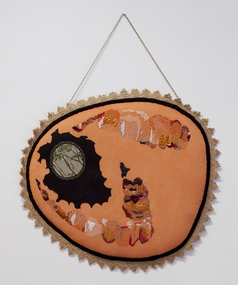
... art practice has been characterised by a darkly stitched meticulousness. Her embroideries and hand-crafted sculptures dwell within the gaps of Australian histories to examine settler-colonial home-making patterns and practices, especially her own genealogical ghostscapes. More recently Waters has been exploring how textile traditions can help navigate a future affected by climate change. These two works by Sera Waters draw on myths, histories, and narratives of the Australian bush and interior, weaving...art practice has been characterised by a darkly stitched meticulousness. Her embroideries and hand-crafted sculptures dwell within the gaps of Australian histories to examine settler-colonial home-making patterns and practices, especially her own genealogical ghostscapes. More recently Waters has been exploring how textile traditions can help navigate a future affected by climate change. These two works by Sera Waters draw on myths, histories, and narratives of the Australian bush and interior, weaving ...Sera Waters is an artist, arts writer and academic living on Kaurna land, South Australia. Since being awarded a Ruth Tuck Scholarship in 2006 to study hand embroidery at the Royal School of Needlework in the UK, Waters’ art practice has been characterised by a darkly stitched meticulousness. Her embroideries and hand-crafted sculptures dwell within the gaps of Australian histories to examine settler-colonial home-making patterns and practices, especially her own genealogical ghostscapes. More recently Waters has been exploring how textile traditions can help navigate a future affected by climate change. These two works by Sera Waters draw on myths, histories, and narratives of the Australian bush and interior, weaving together research into explorers, family stories, popular culture, and folklore. Teeth and wild mouths become portals into different times and experiences: our colonial past, fictional bush tales, and lived encounters with a harsh, unpredictable land. Hand-embroidered and embellished with time-intensive techniques once linked to domestic craft, the works embody both fragility and ferocity. Delicate yet unsettling, these works reflect on survival, risk, and endurance, transforming personal and collective histories into strange offerings that are humorous, dark, and deeply human. -
 Ararat Gallery TAMA
Sera Waters, The Great Australian Bite: Gums, 2011
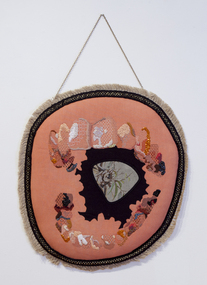
... art practice has been characterised by a darkly stitched meticulousness. Her embroideries and hand-crafted sculptures dwell within the gaps of Australian histories to examine settler-colonial home-making patterns and practices, especially her own genealogical ghostscapes. More recently Waters has been exploring how textile traditions can help navigate a future affected by climate change. These two works by Sera Waters draw on myths, histories, and narratives of the Australian bush and interior, weaving...art practice has been characterised by a darkly stitched meticulousness. Her embroideries and hand-crafted sculptures dwell within the gaps of Australian histories to examine settler-colonial home-making patterns and practices, especially her own genealogical ghostscapes. More recently Waters has been exploring how textile traditions can help navigate a future affected by climate change. These two works by Sera Waters draw on myths, histories, and narratives of the Australian bush and interior, weaving ...Sera Waters is an artist, arts writer and academic living on Kaurna land, South Australia. Since being awarded a Ruth Tuck Scholarship in 2006 to study hand embroidery at the Royal School of Needlework in the UK, Waters’ art practice has been characterised by a darkly stitched meticulousness. Her embroideries and hand-crafted sculptures dwell within the gaps of Australian histories to examine settler-colonial home-making patterns and practices, especially her own genealogical ghostscapes. More recently Waters has been exploring how textile traditions can help navigate a future affected by climate change. These two works by Sera Waters draw on myths, histories, and narratives of the Australian bush and interior, weaving together research into explorers, family stories, popular culture, and folklore. Teeth and wild mouths become portals into different times and experiences: our colonial past, fictional bush tales, and lived encounters with a harsh, unpredictable land. Hand-embroidered and embellished with time-intensive techniques once linked to domestic craft, the works embody both fragility and ferocity. Delicate yet unsettling, these works reflect on survival, risk, and endurance, transforming personal and collective histories into strange offerings that are humorous, dark, and deeply human. -
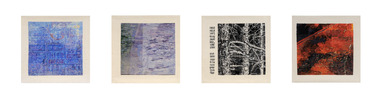 Ararat Gallery TAMA
Marcel Marois, Mutation - Time: Blue, Grey, White, Red, 1994-6
... The TAMA Collection comprises an extensive survey of contemporary (post-1970s) textile and fibre art practices in Australia with key international influences represented from time to time, such as Marcel Marois’ Mutation - Time: Blue, Grey, White, Red. Canadian artist Marcel Marois began his career at the height of a period of innovation and dynamic growth in tapestry weaving in the 1970s. ...The TAMA Collection comprises an extensive survey of contemporary (post-1970s) textile and fibre art practices in Australia with key international influences represented from time to time, such as Marcel Marois’ Mutation - Time: Blue, Grey, White, Red. Canadian artist Marcel Marois began his career at the height of a period of innovation and dynamic growth in tapestry weaving in the 1970s. ...The TAMA Collection comprises an extensive survey of contemporary (post-1970s) textile and fibre art practices in Australia with key international influences represented from time to time, such as Marcel Marois’ Mutation - Time: Blue, Grey, White, Red. Canadian artist Marcel Marois began his career at the height of a period of innovation and dynamic growth in tapestry weaving in the 1970s. Marois is known for his references to pixilated photographic imagery, particularly as seen in newspapers; his weaving recreates the detail of photographic blur. These four tapestries were acquired to commemorate the major contribution of the Gallery’s inaugural director, the late Pamela Gullifer AM, towards the establishment and development of Ararat Gallery in the early 1970s. An extensive and diligent fundraising campaign was undertaken by the local community between 1999 and 2002, challenged by the Canadian dollar strengthening relative to the Australian dollar in that period. Marois’ imagery references political, environmental and social events of his time and location. In this set of woven panels the artist refers to natural elements – air (blue); water (grey); earth (white) and fire (red). -
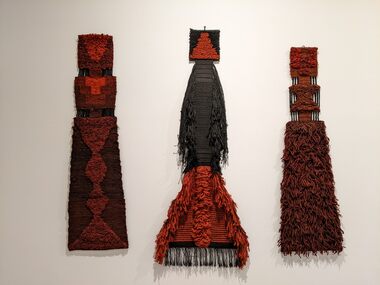 Ararat Gallery TAMA
Ann Greenwood, Untitled (wall hanging)
... textile artist renowned for her innovative use of weaving, felt, and natural fibres. Based in Gippsland, Victoria, she has developed a distinctive practice that merges traditional textile techniques with contemporary art. ...textile artist renowned for her innovative use of weaving, felt, and natural fibres. Based in Gippsland, Victoria, she has developed a distinctive practice that merges traditional textile techniques with contemporary art. ...Ann Greenwood is an Australian textile artist renowned for her innovative use of weaving, felt, and natural fibres. Based in Gippsland, Victoria, she has developed a distinctive practice that merges traditional textile techniques with contemporary art. Greenwood’s work often incorporates hand-spun wool, plant dyes, and materials sourced from her immediate environment, reflecting her deep connection to nature and sustainability. Over five decades, her practice has encompassed sculpture, installation, and performance, expanding the boundaries of textile art. In Three Mamacunas, Greenwood draws on the legacy of the Inca Empire, where Mamacunas were women who served in temples as priestesses, weavers, and caretakers of sacred rituals. Their roles embodied creativity, devotion, and cultural continuity. Today, the term is reinterpreted in contemporary art and writing as a symbol of women’s strength, wisdom, and custodianship of tradition, linking ancestral practices with present-day explorations of identity and resilience. -
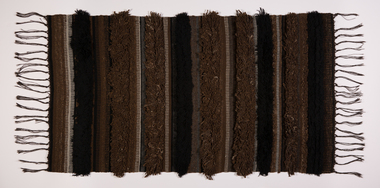 Ararat Gallery TAMA
Ann Greenwood, Rug, 1977-8
... textile artist renowned for her innovative use of weaving, felt, and natural fibres. Based in Gippsland, Victoria, she has developed a distinctive practice that merges traditional textile techniques with contemporary art. ...textile artist renowned for her innovative use of weaving, felt, and natural fibres. Based in Gippsland, Victoria, she has developed a distinctive practice that merges traditional textile techniques with contemporary art. ...Ann Greenwood is an Australian textile artist renowned for her innovative use of weaving, felt, and natural fibres. Based in Gippsland, Victoria, she has developed a distinctive practice that merges traditional textile techniques with contemporary art. Greenwood’s work often incorporates hand-spun wool, plant dyes, and materials sourced from her immediate environment, reflecting her deep connection to nature and sustainability. Over five decades, her practice has encompassed sculpture, installation, and performance, expanding the boundaries of textile art. In Three Mamacunas, Greenwood draws on the legacy of the Inca Empire, where Mamacunas were women who served in temples as priestesses, weavers, and caretakers of sacred rituals. Their roles embodied creativity, devotion, and cultural continuity. Today, the term is reinterpreted in contemporary art and writing as a symbol of women’s strength, wisdom, and custodianship of tradition, linking ancestral practices with present-day explorations of identity and resilience. -
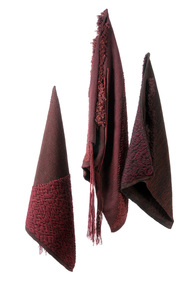 Ararat Gallery TAMA
Three Mamacunas, 1982
... textile artist renowned for her innovative use of weaving, felt, and natural fibres. Based in Gippsland, Victoria, she has developed a distinctive practice that merges traditional textile techniques with contemporary art. ...textile artist renowned for her innovative use of weaving, felt, and natural fibres. Based in Gippsland, Victoria, she has developed a distinctive practice that merges traditional textile techniques with contemporary art. ...Ann Greenwood is an Australian textile artist renowned for her innovative use of weaving, felt, and natural fibres. Based in Gippsland, Victoria, she has developed a distinctive practice that merges traditional textile techniques with contemporary art. Greenwood’s work often incorporates hand-spun wool, plant dyes, and materials sourced from her immediate environment, reflecting her deep connection to nature and sustainability. Over five decades, her practice has encompassed sculpture, installation, and performance, expanding the boundaries of textile art. In Three Mamacunas, Greenwood draws on the legacy of the Inca Empire, where Mamacunas were women who served in temples as priestesses, weavers, and caretakers of sacred rituals. Their roles embodied creativity, devotion, and cultural continuity. Today, the term is reinterpreted in contemporary art and writing as a symbol of women’s strength, wisdom, and custodianship of tradition, linking ancestral practices with present-day explorations of identity and resilience. -
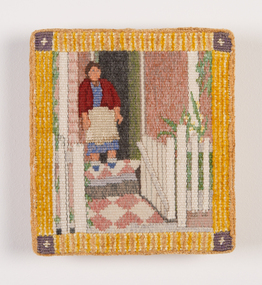 Ararat Gallery TAMA
Sara Lindsay, Rosa, 1978
... Art, held the role of Curator of Textiles at the Tasmanian Museum and Art Gallery, then the position of Production Manager at the Australian Tapestry Workshop. Since 2013 she has mentored three Karen refugee women from Myanmar, assisting in their professional development and furthering their tapestry skills. In 2023 Lindsay began the Ararat New Settlement Weaving...Art, held the role of Curator of Textiles at the Tasmanian Museum and Art Gallery, then the position of Production Manager at the Australian Tapestry Workshop. Since 2013 she has mentored three Karen refugee women from Myanmar, assisting in their professional development and furthering their tapestry skills. In 2023 Lindsay began the Ararat New Settlement Weaving ...Sara Lindsay is a Melbourne-based artist, curator and educator. She worked as a weaver at the Victorian Tapestry Workshop (now the Australian Tapestry Workshop) from its foundation in 1976 until 1990. Alongside her art practice, Lindsay has lectured at the Tasmanian School of Art, held the role of Curator of Textiles at the Tasmanian Museum and Art Gallery, then the position of Production Manager at the Australian Tapestry Workshop. Since 2013 she has mentored three Karen refugee women from Myanmar, assisting in their professional development and furthering their tapestry skills. In 2023 Lindsay began the Ararat New Settlement Weaving Program, teaching and mentoring culturally diverse settlers from refugee and migrant backgrounds in the Ararat region. The artwork exhibited here is part of body of work exploring Lindsay’s family’s historical ties to Sri Lanka. Her British grandfather managed a tea plantation in Ceylon’s hill country during the 1920s and 30s, where her mother was born before returning to England after his early death in 1937. After her first visit to Sri Lanka in 2005, Lindsay developed works that responded to this journey. She chose a quiet, contemplative approach to reflect on the complexity of colonial histories. Research into her family history led her to delve deeper into Sri Lanka’s complex history as a trading nation and to expand her materials to speak to this layered past. The use of cinnamon in this work connects to the story of 17th-century weavers from Southern India who were displaced from the Kingdom of Kandy and sent to the southwest coast to become cinnamon peelers under Portuguese and later Dutch rule. The finely woven ticking strips seen here reference the thick cotton fabric once used to cover mattresses and pillows aboard cargo ships transporting spices from Sri Lanka - a subtle reminder of the human stories woven into trade routes and colonial histories. -
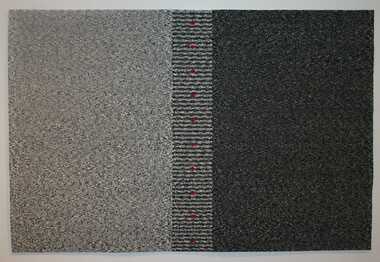 Ararat Gallery TAMA
Sara Lindsay, In-Between #2, 1999
... Art, held the role of Curator of Textiles at the Tasmanian Museum and Art Gallery, then the position of Production Manager at the Australian Tapestry Workshop. Since 2013 she has mentored three Karen refugee women from Myanmar, assisting in their professional development and furthering their tapestry skills. In 2023 Lindsay began the Ararat New Settlement Weaving...Art, held the role of Curator of Textiles at the Tasmanian Museum and Art Gallery, then the position of Production Manager at the Australian Tapestry Workshop. Since 2013 she has mentored three Karen refugee women from Myanmar, assisting in their professional development and furthering their tapestry skills. In 2023 Lindsay began the Ararat New Settlement Weaving ...Sara Lindsay is a Melbourne-based artist, curator and educator. She worked as a weaver at the Victorian Tapestry Workshop (now the Australian Tapestry Workshop) from its foundation in 1976 until 1990. Alongside her art practice, Lindsay has lectured at the Tasmanian School of Art, held the role of Curator of Textiles at the Tasmanian Museum and Art Gallery, then the position of Production Manager at the Australian Tapestry Workshop. Since 2013 she has mentored three Karen refugee women from Myanmar, assisting in their professional development and furthering their tapestry skills. In 2023 Lindsay began the Ararat New Settlement Weaving Program, teaching and mentoring culturally diverse settlers from refugee and migrant backgrounds in the Ararat region. The artwork exhibited here is part of body of work exploring Lindsay’s family’s historical ties to Sri Lanka. Her British grandfather managed a tea plantation in Ceylon’s hill country during the 1920s and 30s, where her mother was born before returning to England after his early death in 1937. After her first visit to Sri Lanka in 2005, Lindsay developed works that responded to this journey. She chose a quiet, contemplative approach to reflect on the complexity of colonial histories. Research into her family history led her to delve deeper into Sri Lanka’s complex history as a trading nation and to expand her materials to speak to this layered past. The use of cinnamon in this work connects to the story of 17th-century weavers from Southern India who were displaced from the Kingdom of Kandy and sent to the southwest coast to become cinnamon peelers under Portuguese and later Dutch rule. The finely woven ticking strips seen here reference the thick cotton fabric once used to cover mattresses and pillows aboard cargo ships transporting spices from Sri Lanka - a subtle reminder of the human stories woven into trade routes and colonial histories. -
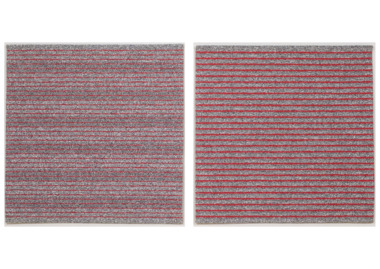 Ararat Gallery TAMA
Sara Lindsay, Pulse (diptych), 2001-2002
... Art, held the role of Curator of Textiles at the Tasmanian Museum and Art Gallery, then the position of Production Manager at the Australian Tapestry Workshop. Since 2013 she has mentored three Karen refugee women from Myanmar, assisting in their professional development and furthering their tapestry skills. In 2023 Lindsay began the Ararat New Settlement Weaving...Art, held the role of Curator of Textiles at the Tasmanian Museum and Art Gallery, then the position of Production Manager at the Australian Tapestry Workshop. Since 2013 she has mentored three Karen refugee women from Myanmar, assisting in their professional development and furthering their tapestry skills. In 2023 Lindsay began the Ararat New Settlement Weaving ...Sara Lindsay is a Melbourne-based artist, curator and educator. She worked as a weaver at the Victorian Tapestry Workshop (now the Australian Tapestry Workshop) from its foundation in 1976 until 1990. Alongside her art practice, Lindsay has lectured at the Tasmanian School of Art, held the role of Curator of Textiles at the Tasmanian Museum and Art Gallery, then the position of Production Manager at the Australian Tapestry Workshop. Since 2013 she has mentored three Karen refugee women from Myanmar, assisting in their professional development and furthering their tapestry skills. In 2023 Lindsay began the Ararat New Settlement Weaving Program, teaching and mentoring culturally diverse settlers from refugee and migrant backgrounds in the Ararat region. The artwork exhibited here is part of body of work exploring Lindsay’s family’s historical ties to Sri Lanka. Her British grandfather managed a tea plantation in Ceylon’s hill country during the 1920s and 30s, where her mother was born before returning to England after his early death in 1937. After her first visit to Sri Lanka in 2005, Lindsay developed works that responded to this journey. She chose a quiet, contemplative approach to reflect on the complexity of colonial histories. Research into her family history led her to delve deeper into Sri Lanka’s complex history as a trading nation and to expand her materials to speak to this layered past. The use of cinnamon in this work connects to the story of 17th-century weavers from Southern India who were displaced from the Kingdom of Kandy and sent to the southwest coast to become cinnamon peelers under Portuguese and later Dutch rule. The finely woven ticking strips seen here reference the thick cotton fabric once used to cover mattresses and pillows aboard cargo ships transporting spices from Sri Lanka - a subtle reminder of the human stories woven into trade routes and colonial histories. -
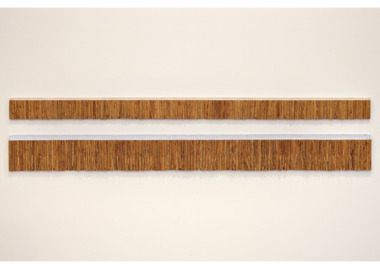 Ararat Gallery TAMA
Sara Lindsay, Cinnamon and Ticking #9, 2008
... Art, held the role of Curator of Textiles at the Tasmanian Museum and Art Gallery, then the position of Production Manager at the Australian Tapestry Workshop. Since 2013 she has mentored three Karen refugee women from Myanmar, assisting in their professional development and furthering their tapestry skills. In 2023 Lindsay began the Ararat New Settlement Weaving...Art, held the role of Curator of Textiles at the Tasmanian Museum and Art Gallery, then the position of Production Manager at the Australian Tapestry Workshop. Since 2013 she has mentored three Karen refugee women from Myanmar, assisting in their professional development and furthering their tapestry skills. In 2023 Lindsay began the Ararat New Settlement Weaving ...Sara Lindsay is a Melbourne-based artist, curator and educator. She worked as a weaver at the Victorian Tapestry Workshop (now the Australian Tapestry Workshop) from its foundation in 1976 until 1990. Alongside her art practice, Lindsay has lectured at the Tasmanian School of Art, held the role of Curator of Textiles at the Tasmanian Museum and Art Gallery, then the position of Production Manager at the Australian Tapestry Workshop. Since 2013 she has mentored three Karen refugee women from Myanmar, assisting in their professional development and furthering their tapestry skills. In 2023 Lindsay began the Ararat New Settlement Weaving Program, teaching and mentoring culturally diverse settlers from refugee and migrant backgrounds in the Ararat region. The artwork exhibited here is part of body of work exploring Lindsay’s family’s historical ties to Sri Lanka. Her British grandfather managed a tea plantation in Ceylon’s hill country during the 1920s and 30s, where her mother was born before returning to England after his early death in 1937. After her first visit to Sri Lanka in 2005, Lindsay developed works that responded to this journey. She chose a quiet, contemplative approach to reflect on the complexity of colonial histories. Research into her family history led her to delve deeper into Sri Lanka’s complex history as a trading nation and to expand her materials to speak to this layered past. The use of cinnamon in this work connects to the story of 17th-century weavers from Southern India who were displaced from the Kingdom of Kandy and sent to the southwest coast to become cinnamon peelers under Portuguese and later Dutch rule. The finely woven ticking strips seen here reference the thick cotton fabric once used to cover mattresses and pillows aboard cargo ships transporting spices from Sri Lanka - a subtle reminder of the human stories woven into trade routes and colonial histories. -
 Federation University Art Collection
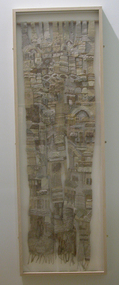
Textile - Artwork, 'Weaving'
... The Art Collection features over 2000 works and was listed as a 'Ballarat Treasure' in 2007. art artwork Asian school woven weaving textiles Framed woven artwork. ...This item is part of the Federation University Art Collection. The Art Collection features over 2000 works and was listed as a 'Ballarat Treasure' in 2007.Framed woven artwork.art, artwork, asian school, woven, weaving, textiles -
 Federation University Art Collection
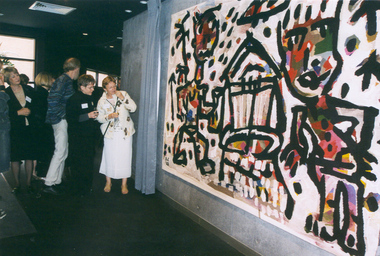
Textile - Tapestry, 'Diggers' by David Larwill and woven by the Victorian Tapestry Workshop, 2004, 2004
... The Art Collection features over 1000 works and was listed as a 'Ballarat Treasure' in 2007. art artwork david larwill victorian tapestry workshop weaving textiles A large tapestry woven from the artwork 'Diggers' by David Larwill. ...This item is part of the Federation University Art Collection. The Art Collection features over 1000 works and was listed as a 'Ballarat Treasure' in 2007.A large tapestry woven from the artwork 'Diggers' by David Larwill. art, artwork, david larwill, victorian tapestry workshop, weaving, textiles -
 Federation University Art Collection
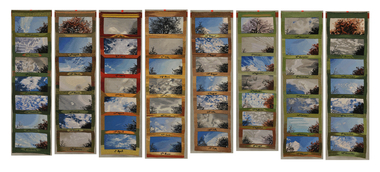
Textile - Artwork, Millicent Reed, 'Wednesday at 10' by Millicent Reed, 2011-2012
... art from the beginning of recorded time. Similarly, the sameness and difference of time itself has become the focus of all her work. (https://americantapestryalliance.org/exhibitions/tex_ata/down-south-tapestry-in-australia/down-south-exhibitors-biographies/, accesed 03 April 2020) weaving seasons tapestry ballarat weather millicent reed Woven tapestry in eight panels, each with seven images in each panel measured 212.0 x 57.5 cm. 'Wednesday at 10' by Millicent Reed Textile ...Artist's Statement: "Every Wednesday at 10 o'clock in the morning, from the beginning of Winter, 2011 to the end of Autumn, 2012, I photographed the same scene in my Ballarat garden. While the main subject is the weather of the moment, it includes a walnut tree killed in the recent drought, and a deciduous ornamental plum. There are 52 Wednesdays recorded in the tapestry; and 4 frames showing the seasonal changes in the plum tree. The colours bordering each panel are those of deciduous leaves on trees in my garden that week. It is said we only know eternity in the pulse of the moment; and permanence in the cycle of the seasons."Millicent REED Initally training in tapestry from Sara Lindsay at an ATW community class Millicent Reed received a Diploma of Art (Tapestry) from South West TAFE in 2009. Her strength and direction comes from being part of the unbroken continuum of tapestry art from the beginning of recorded time. Similarly, the sameness and difference of time itself has become the focus of all her work. (https://americantapestryalliance.org/exhibitions/tex_ata/down-south-tapestry-in-australia/down-south-exhibitors-biographies/, accesed 03 April 2020)Woven tapestry in eight panels, each with seven images in each panel measured 212.0 x 57.5 cm. weaving, seasons, tapestry, ballarat, weather, millicent reed -
 Embroiderers Guild, Victoria
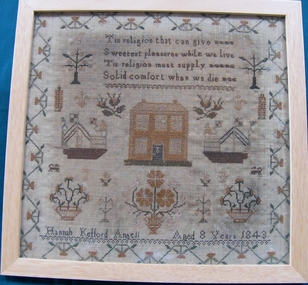
Textile - Hannah Kefford Angell Sampler 1843, Hannah Kefford Angell, 1843
... Art Mistress P.L.C. 1970. See attached letter. Embroidery Samplers Mid 19th Century Cross stitch "Tis religion that can give sweetest pleasures while we live tis religion must supply solid comfort when we die" Hannah Kefford Angell Aged 8 years 1843 Cream even weave linen with cross stitched religious text, house, and ships, flowers and animals. Border of flowers. Pale wooden frame. Textile ...Gifted by P.L.C. School Craft Dept. Melbourne by courtesy of Miss Lexie Luly, Art Mistress P.L.C. 1970. See attached letter.Cream even weave linen with cross stitched religious text, house, and ships, flowers and animals. Border of flowers. Pale wooden frame. "Tis religion that can give sweetest pleasures while we live tis religion must supply solid comfort when we die" Hannah Kefford Angell Aged 8 years 1843embroidery, samplers, mid 19th century, cross stitch -
 Kew Historical Society Inc
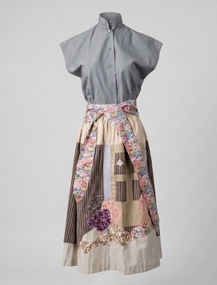
Clothing - Women’s Blouse and Scenic Patchwork Skirt Ensemble, Prue Acton, 1971–1975
... textile collage. Prue Acton Fashion -- Melbourne -- 1970s Label: "Prue Acton" A two-piece daywear ensemble comprising a structured blouse and an elaborate, narrative-driven midi skirt with a coordinating waist sash. Comprised of a semi-fitted blouse of medium-weight slate gray plain-weave fabric. It features brief, extended cap sleeves, a high mandarin-style band collar, and a center-front button closure secured by five self-colored small round buttons. The high-waisted skirt is a full A-line midi-length skirt featuring an intricate, illustrative folk-art ...This ensemble is a highly representative example of the pioneering textile artistry of Prue Acton, an iconic figure in Australian fashion history often celebrated for injecting the energy of the 1960s and '70s "Youthquake" movement into the domestic market. The piece belongs to Acton’s critically acclaimed 1970s "Patch" era. During this period, Acton moved away from the slick synthetics of the Mod era toward natural fibers and whimsical, story-driven collections inspired by the global folk revival and bohemian styles. According to historical archival provenance from similar surviving museum garments, these conversational, pictorial patchwork designs were often ingeniously engineered utilizing high-quality end-of-roll textile remnants. This specific garment beautifully encapsulates the early 1970s pastoral "cottagecore" fantasy, exhibiting how Acton blended commercial garment production with playful, illustrative textile collage.A two-piece daywear ensemble comprising a structured blouse and an elaborate, narrative-driven midi skirt with a coordinating waist sash. Comprised of a semi-fitted blouse of medium-weight slate gray plain-weave fabric. It features brief, extended cap sleeves, a high mandarin-style band collar, and a center-front button closure secured by five self-colored small round buttons. The high-waisted skirt is a full A-line midi-length skirt featuring an intricate, illustrative folk-art narrative applique landscape. The pieced design represents a stylized house or cottage set within a garden. Fabric sections are arranged into vertical stripe configurations mimicking window panes, alongside curved, layered patch elements in multi-colored floral calicos that form bushes and ground structures. The lower tier terminates in a broad, contrasting cream-colored patterned base hem panel. A wide, detachable self-tie waist sash executed in a dense, small-scale floral calico print is intended to be cinched around the high-fitted waistband to form a statement bow at the front.Label: "Prue Acton"prue acton, fashion -- melbourne -- 1970s
