
Showing 29 items matching "what's on when in november"
-
 Marysville & District Historical Society
THE TRIANGLE NEWS-VOL 39 NO 42-NOVEMBER 2 2012
... ...what's on when in november...marysville victoria australia steavenson falls flood lights on steavenson falls committee of management what's on when in november triangle community dinner emotions anonymous international marysville district cricket club annual duck race lions park marysville art show janine ellis boost juice founder visits region speaking event not to be missed at yarck hotel church notices upper goulburn food and wine culture group triangle garden club newsletter remembrance day advertisements adventurous cooks tennis at buxton marysville cricket club training survey for bushfire memorials buxton recreation reserve development works update maryton beer & platter garden maryton park b&b murrindindi shire council australia day awards council fire restriction period starts marysville & triangle bushfire recovery community conversation marysville community centre triangle community dancers taggerty hall movember at marysville golf club triangle parents and friends group prepare for australia day real estate cult discussion at alexandra library marysville & district chamber of commerce vibe hotel & conference centre cathkin clearing sale marysville district football & netball club marysville marathon temporary road closure public meetings maurice blackburn remembrance day services marysville girls guide carboot sale marysville market marysville golf club diddly eyes irish group launch of the cafe culture series 2013 program council welcomes tamara johnson narbethong community garage sale melbourne cup black spur inn celebration THE TRIANGLE NEWS-VOL 39 NO 42-NOVEMBER 2 2012 ...marysville, victoria, australia, steavenson falls flood lights on, steavenson falls committee of management, what's on when in november, triangle community dinner, emotions anonymous international, marysville district cricket club, annual duck race, lions park, marysville art show, janine ellis, boost juice founder visits region, speaking event not to be missed at yarck hotel, church notices, upper goulburn food and wine culture group, triangle garden club newsletter, remembrance day, advertisements, adventurous cooks, tennis at buxton, marysville cricket club training, survey for bushfire memorials, buxton recreation reserve, development works update, maryton beer & platter garden, maryton park b&b, murrindindi shire council, australia day awards, council fire restriction period starts, marysville & triangle bushfire recovery, community conversation, marysville community centre, triangle community dancers, taggerty hall, movember at marysville golf club, triangle parents and friends group, prepare for australia day, real estate, cult discussion at alexandra library, marysville & district chamber of commerce, vibe hotel & conference centre, cathkin clearing sale, marysville district football & netball club, marysville marathon temporary road closure, public meetings maurice blackburn, remembrance day services, marysville girls guide carboot sale, marysville market, marysville golf club, diddly eyes irish group, launch of the cafe culture series 2013 program, council welcomes tamara johnson, narbethong community garage sale, melbourne cup black spur inn celebration -
Marysville & District Historical Society
THE TRIANGLE NEWS-VOL 39 NO 43-NOVEMBER 9 2012
... ...what's on when in november...marysville victoria australia didley eyes irish group marysville cultural community cafe culture series 2012 what's on when in november buxton recreation reserve public committee meeting narbethong community hall agm marysville & district kindergarten assocn marysville community market creative triangle licola camps marysville & district lions club black spur roadhouse emotions anonymous international murrindindi shire council declaration of election results victorian electrol commission marysville triangle men's shed agm church notices carols by candlelight gallipoli park remembrance day friends of the marysville walks agm triangle garden club adventurous cooks tennis at buxton marysville cricket club training marysville golf report alexandra & district dog obedience club toolangi and castella projects to be officially launched opening of tall trees opening of castella central park advertisements maryton beer & platter garden maryton park b & b australia day award mayor's chair marysville & triangle bushfire recovery community conversations marysville community centre triangle community dancers taggerty hall movember at marysville golf club real estate australian mobile libraries conference mops volunteers morning tea position vacant shire council scholarship promotes upskilling in waste management techniques marysville marathon festival old mobiles bring back memories memory muster marysville district football & netball club request for tender marysville & triangle tourism interpretive product murrindindi climate network vibe hotel & conference centre open day australian sparkling wine show council elects mayor & deputy mayor intrepid triangle bushwalkers THE TRIANGLE NEWS-VOL 39 NO 43-NOVEMBER 9 2012 ...marysville, victoria, australia, didley eyes irish group, marysville cultural community, cafe culture series 2012, what's on when in november, buxton recreation reserve, public committee meeting, narbethong community hall agm, marysville & district kindergarten assocn, marysville community market, creative triangle, licola camps, marysville & district lions club, black spur roadhouse, emotions anonymous international, murrindindi shire council, declaration of election results, victorian electrol commission, marysville triangle men's shed agm, church notices, carols by candlelight, gallipoli park, remembrance day, friends of the marysville walks agm, triangle garden club, adventurous cooks, tennis at buxton, marysville cricket club training, marysville golf report, alexandra & district dog obedience club, toolangi and castella projects to be officially launched, opening of tall trees, opening of castella central park, advertisements, maryton beer & platter garden, maryton park b & b, australia day award, mayor's chair, marysville & triangle bushfire recovery community conversations, marysville community centre, triangle community dancers, taggerty hall, movember at marysville golf club, real estate, australian mobile libraries conference, mops volunteers morning tea, position vacant shire council, scholarship promotes upskilling in waste management techniques, marysville marathon festival, old mobiles bring back memories, memory muster, marysville district football & netball club, request for tender, marysville & triangle tourism interpretive product, murrindindi climate network, vibe hotel & conference centre open day, australian sparkling wine show, council elects mayor & deputy mayor, intrepid triangle bushwalkers -
Marysville & District Historical Society
THE TRIANGLE NEWS-VOL 39 NO 44-NOVEMBER 16 2012
... ...what's on when in november...marysville victoria australia marysville art show winners what's on when in november friends of the marysville walkers agm narbethong community hall agm marysville & district kindergarten assocn preschool centre creative triangle marysville community market licola camps black spur roadhouse melbourne concert orchestra comes to narbethong narbethong progress assocn new rose garden for lions park lions of marysville & district church notices carols by candlelight gallipoli park marysville golf report triangle garden club tennis at buxton marysville cricket club training australia day nominations extended australia day awards marysville district football & netball club camp marysville vicforests help children outdoor education group advertisements mayor's chair snakes fight for mating rights department of sustainability and environment swimming pool entry & season tickets triangle community dancers movember at marysville golf club prepare of australia day real estate shortlist of bushfire memorial sites intrepid triangle bushwalkers key community projects in toolangi and castella bridge takes shape at yellow creek taggerty vicforests help gardens rise from black saturday murrindindi shire pools taggerty xmas party request for tender marysville & triangle tourism interpretive product murrindindi climate network new vibe hotel and conference centre cfa sunday buxton fire station buxton home for private sale THE TRIANGLE NEWS-VOL 39 NO 44-NOVEMBER 16 2012 ...marysville, victoria, australia, marysville art show winners, what's on when in november, friends of the marysville walkers agm, narbethong community hall agm, marysville & district kindergarten assocn preschool centre, creative triangle, marysville community market, licola camps, black spur roadhouse, melbourne concert orchestra comes to narbethong, narbethong progress assocn, new rose garden for lions park, lions of marysville & district, church notices, carols by candlelight, gallipoli park, marysville golf report, triangle garden club, tennis at buxton, marysville cricket club training, australia day nominations extended, australia day awards, marysville district football & netball club, camp marysville, vicforests help children, outdoor education group, advertisements, mayor's chair, snakes fight for mating rights, department of sustainability and environment, swimming pool entry & season tickets, triangle community dancers, movember at marysville golf club, prepare of australia day, real estate, shortlist of bushfire memorial sites, intrepid triangle bushwalkers, key community projects in toolangi and castella, bridge takes shape at yellow creek taggerty, vicforests help gardens rise from black saturday, murrindindi shire pools, taggerty xmas party, request for tender, marysville & triangle tourism interpretive product, murrindindi climate network, new vibe hotel and conference centre, cfa sunday, buxton fire station, buxton home for private sale -
Marysville & District Historical Society
THE TRIANGLE NEWS-VOL 39 NO 45-NOVEMBER 23 2012
... ...what's on when in november...marysville victoria australia marysville marathon soldiers on what's on when in november marysville & district kindergarten assocn preschool centre creative triangle marysville community market lions christmas cakes black spur roadhouse buxton community christmas party triangle community christmas dinner church notices taggerty xmas party carols by candlelight lions park request for tender marysville district football & netball club marysville & triangle tourism interpretive product public notice and change of agm date hole in one for marysville golfer rob richards tennis at buxton marysville cricket club training councillor comment advertisements mayor's chair murrindindi shire council audit advisory committee expressions of interest swimming pool entry & season tickets triangle community dancers taggerty hall movember at marysville golf club prepare for australia day 2013 real estate royal botanic gardens cranbourne tour intrepid triangle bushwalkers tourism volunteers get a taste of our attractions lolly shop opens cfa sunday murrindindi shire pools kinglake ranges business network marysville & district chamber of commerce east meets west business network THE TRIANGLE NEWS-VOL 39 NO 45-NOVEMBER 23 2012 ...marysville, victoria, australia, marysville marathon soldiers on, what's on when in november, marysville & district kindergarten assocn preschool centre, creative triangle, marysville community market, lions christmas cakes, black spur roadhouse, buxton community christmas party, triangle community christmas dinner, church notices, taggerty xmas party, carols by candlelight, lions park, request for tender, marysville district football & netball club, marysville & triangle tourism interpretive product, public notice and change of agm date, hole in one for marysville golfer rob richards, tennis at buxton, marysville cricket club training, councillor comment, advertisements, mayor's chair, murrindindi shire council, audit advisory committee expressions of interest, swimming pool entry & season tickets, triangle community dancers, taggerty hall, movember at marysville golf club, prepare for australia day 2013, real estate, royal botanic gardens cranbourne tour, intrepid triangle bushwalkers, tourism volunteers get a taste of our attractions, lolly shop opens, cfa sunday, murrindindi shire pools, kinglake ranges business network, marysville & district chamber of commerce, east meets west business network -
Marysville & District Historical Society
THE TRIANGLE NEWS-VOL 41 NO 44-NOVEMBER 14 2014
... ...what's on when in november...marysville victoria australia taggerty's community projects taking shape what's on when in november the committee of management of the gallipoli park precinct marysville community market creative triangle new general manager joins murrindindi shire marysville golf report church notices mayor's chair by councillor margaret rae murrindindi shire council road closures & event information marysville & triangle community men's shed advertisements mp's visit narbethong to view holly eradication program marysville & district kindergarten assocn preschool agm residential and rural real estate marysville triangle real estate nye at el kanah marysville villains marysville & district football club veterans long day care & kindergarten marysville preschool emotions anonymous international buxton bootcamp marysville district football & netball club fire action week time to get prepared interruption to mobile library service intrepid triangle bushwalkers marysville community golf & bowls club intro to summer real estate the wild woman's show open gardens marysville new marysville water treatment plant works progressing smoothly THE TRIANGLE NEWS-VOL 41 NO 44-NOVEMBER 14 2014 ...marysville, victoria, australia, taggerty's community projects taking shape, what's on when in november, the committee of management of the gallipoli park precinct, marysville community market, creative triangle, new general manager joins murrindindi shire, marysville golf report, church notices, mayor's chair by councillor margaret rae, murrindindi shire council, road closures & event information, marysville & triangle community men's shed, advertisements, mp's visit narbethong to view holly eradication program, marysville & district kindergarten assocn preschool agm, residential and rural real estate, marysville triangle real estate, nye at el kanah, marysville villains, marysville & district football club veterans, long day care & kindergarten, marysville preschool, emotions anonymous international, buxton bootcamp, marysville district football & netball club, fire action week time to get prepared, interruption to mobile library service, intrepid triangle bushwalkers, marysville community golf & bowls club intro to summer, real estate, the wild woman's show, open gardens marysville, new marysville water treatment plant works progressing smoothly -
Marysville & District Historical Society
THE TRIANGLE NEWSLETTER-VOL 41 NO 45-NOVEMBER 21 2014
... ...what's on when in november...marysville victoria australia cafe culture series a wild woman's wild women show what's on when in november the committee of management of the gallipoli park precinct marysville community market creative triangle buxton fire brigade news update maternal and child health centre welcomes new mums marysville golf report church notices triangle community dinner mayor's chair by councillor margaret rae murrindindi shire council councillor comment cr john walsh koriella payment of rates installment advertisements marysville police report great victorian bike ride road closures & event information marysville & district kindergarten assocn preschool agm marysville triangle real estate wanted bees marysville villains marysville & district football club veterans emotions anonymous international made in marysville & surrounds farmers & stock suffer as dogs roam interruption to mobile library service intrepid triangle bushwalkers christmas cake workshop lenny's trip to the art show friends of marysville walks agm murrindindi shire pools fire restrictions now in force regional wellbeing survey marysville & triangle youth excursion the tower motel t bar THE TRIANGLE NEWSLETTER-VOL 41 NO 45-NOVEMBER 21 2014 ...marysville, victoria, australia, cafe culture series, a wild woman's wild women show, what's on when in november, the committee of management of the gallipoli park precinct, marysville community market, creative triangle, buxton fire brigade news update, maternal and child health centre welcomes new mums, marysville golf report, church notices, triangle community dinner, mayor's chair by councillor margaret rae, murrindindi shire council, councillor comment cr john walsh koriella, payment of rates installment, advertisements, marysville police report, great victorian bike ride, road closures & event information, marysville & district kindergarten assocn preschool agm, marysville triangle real estate, wanted bees, marysville villains, marysville & district football club veterans, emotions anonymous international, made in marysville & surrounds, farmers & stock suffer as dogs roam, interruption to mobile library service, intrepid triangle bushwalkers, christmas cake workshop, lenny's trip to the art show, friends of marysville walks agm, murrindindi shire pools, fire restrictions now in force, regional wellbeing survey, marysville & triangle youth excursion, the tower motel t bar -
Marysville & District Historical Society
THE TRIANGLE NEWS-VOL 41 NO 47-NOVEMBER 28 2014
... ...what's on when in november...marysville victoria australia council makes code red policy preparation murrindindi shire council what's on when in november the committee of management of the gallipoli park precinct marysville community market creative triangle marysville cemetary trust buxton post office trading hours marysville golf report church notices triangle community dinner mayor's chair by councillor margaret rae councillor comment cr john kennedy advertisements great victorian bike ride road closures & event information marysville triangle real estate planning & environmental act 1987 murrindindi planning scheme racv marysville marathon festival emotions anonymous international payment of rates installment interruption to mobile library service real estate australia day celebrations 2015 holly eradication program working bee & training days christmas cake workshop nye at the bunker residential & rural real estate council meeting dates 2015 australia day nominations narbethong christmas party narbethong marysville police report new planning scheme directions for murrindindi shire narbethong hall THE TRIANGLE NEWS-VOL 41 NO 47-NOVEMBER 28 2014 ...marysville, victoria, australia, council makes code red policy preparation, murrindindi shire council, what's on when in november, the committee of management of the gallipoli park precinct, marysville community market, creative triangle, marysville cemetary trust, buxton post office trading hours, marysville golf report, church notices, triangle community dinner, mayor's chair by councillor margaret rae, councillor comment cr john kennedy, advertisements, great victorian bike ride, road closures & event information, marysville triangle real estate, planning & environmental act 1987, murrindindi planning scheme, racv marysville marathon festival, emotions anonymous international, payment of rates installment, interruption to mobile library service, real estate, australia day celebrations 2015, holly eradication program, working bee & training days, christmas cake workshop, nye at the bunker, residential & rural real estate, council meeting dates 2015, australia day nominations, narbethong christmas party, narbethong marysville police report, new planning scheme directions for murrindindi shire, narbethong hall -
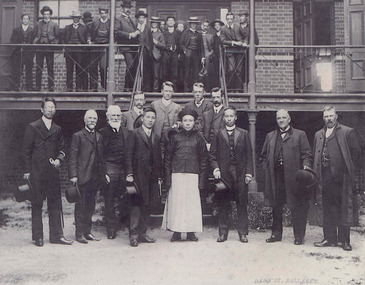 Federation University Historical Collection
Photograph, Visit of the Chinese Commissioner to the Ballarat School of Mines, 13 November 1906, 23/11/1906 (exact)
... No. 436) comes the following which suggests the Commissioner was based in Adelaide) '17th November 1906 His Excellency, Hwang How Cheng Chinese Commission Adelaide May it please your Excellency By this post I have the pleasure in forwarding for your Excellency's kind acceptance (and one for Mr. When) copies of the photograph taken of your recent visit to the School of Mines. I trust they will serve a pleasing memento of what...No. 436) comes the following which suggests the Commissioner was based in Adelaide) '17th November 1906 His Excellency, Hwang How Cheng Chinese Commission Adelaide May it please your Excellency By this post I have the pleasure in forwarding for your Excellency's kind acceptance (and one for Mr. When) copies of the photograph taken of your recent visit to the School of Mines. I trust they will serve a pleasing memento of what ...The Chinese Imperial Commissioner, Hwang How Cheng, visited Australia at the request of the Chinese Emperor for the purpose of establishing Chinese consulates in the Commonwealth. He visited Ballarat at the request of Ballarat’s Chinese community. The newspaper reported that it was hoped the Commissioner would visit the Ballarat School of Mines “where the knowledge he would get would probably be of the utmost usefulness in the development of the great resources of China.” The Commissioner was accompanied by interpreter Ah Ket (Melbourne barrister and solicitor), and met by members of Ballarat’s Chinese community, including Dr Wong Chock Son. Apparently the Chinese Commissioner wanted to visit SMB because of its international fame relating to education in mining. From the SMB Letter book (Cat. No. 436) comes the following which suggests the Commissioner was based in Adelaide) '17th November 1906 His Excellency, Hwang How Cheng Chinese Commission Adelaide May it please your Excellency By this post I have the pleasure in forwarding for your Excellency's kind acceptance (and one for Mr. When) copies of the photograph taken of your recent visit to the School of Mines. I trust they will serve a pleasing memento of what, I hope, was a pleasant visit to our Golden City. Yours Faithfully Fredk Martell Director' The visit was reported in the Ballarat Star in 14 November 1906:- The Chinese Imperial Commissioner, Hwang Hon Cheng, who recently arrived in Victoria on behalf of the Chinese Government, paid a visit to Ballarat last evening, and was entertained by his fellow countrymen at a dinner at the Bow Leong rooms, Main street. The commissioner, who came up by the express, was accompanied by his secretary and Mr Ah Ket, the well-known Chinese barrister, of Melbourne; but some disappointment was expressed by the fact that he did not wear his official robes, being attired in the more sombre European dress. Mr W. D. M’Kee presided at the dinner, on the invitation of the Bow Leong Society, and in addition to representative Chinese residents, three were also present the mayor of the city (Cr. J. J. Brokenshire), Crs. R. Pearse, G. Crocker (City), J. R. Elsworth, A. Mackenzie, J. A. M’Neil, A. Levy, G. Bunting, F. Penhalluriack (Town), Col. Williams, Mr. J. Gent, Messrs. F. J. Martell (director of the School of Mines), A. W. Hager (president of the Orphan Asylum), A. Kenny (superintendent), R. G. Fitzgerald (clerk of courts at Ballarat East), J. Trethowan, A. A. Buley, Serg Dalton, and others. Apologies were received from the mayor of the town Revs. J. West Lau, Dr Cairns, Hon. J. Y. M’Donald, L. Lederman, C. C. Shoppee and others. The gathering was a very cordial one, and the hospitality of the Chinese was greatly appreciated. After the loyal toasts, “The King” and “The Emperor of China,” had been honoured, the chairman extended a hearty welcome on behalf of the society and others to the commissioner. Mr M’Kee said he was privileged to speak in behalf of the Chinese. There was a warm feeling of friendship between them and himself, and his services were always at their command. If he were in China he would desire that a similar compliment would be extended to him. They were all pleased the Emperor of China had sent the commissioner to establish consulates in Australia with a view of the empire understanding the feelings of Australasia better than they did at present. He hoped the commissioner would have opportunity of visiting some of their industries, as they desired him to gain all the scientific and practical knowledge of those industries that he could. The toast of “The Commissioner” was proposed by Col. Williams who expressed pleasure at the visit of a gentleman of education and attainments to look into the condition of the scions of China in Australia. He hoped the commissioner would carry away a correct impression. In Australia they had nothing to conceal; they hoped to be understood. (Applause.) No intelligent man had the temerity to condescend to patronise China, one of the richest countries in the world, with a civilisation dating back thousands of years. In the matter of population alone it was equal to one-third of the world. They heard a lot about the “awakening of China.” They hoped it would be humane, just, and considerate if it had power. He hoped the commissioner would be satisfied with what he saw. The law of filial relation to the children was strictly observed in China, and he did not know whether it would not be a good thing if they had a little more of that religion here. It would be a fair thing to tell the commissioner that while he might inquire into the labour laws, the basis of these laws was not a desire to oppress but to enable every man to obtain the same conditions they expected from their own people. If he gained that impression he felt they would be fairly treated. (Applause.) Mayor Brokenshire supported the toast. They had, he said, in the Chinese a most law-abiding people. Their behaviour was an example to the British citizens. They were quiet, inoffensive men, and they toiled hard, even on Sundays. (Laughter.) Mr Ah Ket; That is what the government does with the railway employees. (Laughter.) The Commissioner replied through Mr Ah Ket, who in a graceful speech acknowledged the toast. The commissioner had, he said been delighted with what he had seen of the country – he believed it to be one of the finest in the world – and he greatly appreciated the hospitality extended to him. (Applause.) The Chairman proposed the toast of “The health of Mr Ah Ket,” and paid a tribute to his ability. It was satisfactory to see that he had risen to such a position, and it might be that in the future he would be asked to occupy a position on the bench. (Applause.) Mr Ah Ket, in response, said he had not come prepared to make a speech. He had come to Ballarat to have a quiet evening with his friends, and as soon as he arrived he had been whirled away in a motor car to a place where he found an aggregation of East and West. He was pleased to see them commingled at the festive board. That suggested the idea that East and West could meet together without friction. Misunderstandings arose only because men were superficial. If they threw off outer garments they would know each other better. He looked forward to the time when nations would understand each other. It was by an interchange of visits that such things could be accomplished, and nations would then live at peace with each other. (Applause.) Other toasts were also honored. Twelve men pose for a photograph on the stairs of a building at the Ballarat School of Mines. Back row left to right: A.D. Gilchrist (Prof. of Engineering), B. Whittington (Mathematics, Physics), Thomas S. Hart (Prof. of Geology and Mining), J.M. Sutherland (Electrical Engineering) Front row left to right: Dr Wong Chock Son (Ballarat), Fred. J. Martell, Alfred Mica Smith, Ah Ket esq (Melbourne Barrister), His Excellency Hwang How Cheng (Chinese Commissioner), Wen Esq (Secretary), Alderman Grase (mayor of Brisbane), Grase Esq (Ballarat).ballarat school of mines, alfred mica smith, fred martell, j m sutherland, a d gilchrist, b whittington, thomas hart, wong chock son, ah ket, hwang how cheng, chinese, chinese commissioner, international, new classrooms, administration building, a building -
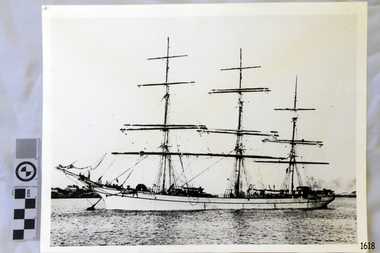 Flagstaff Hill Maritime Museum and Village
Photograph, 1907-1914
... when she was wrecked.. THE ANTARES In mid-November 1914, after the beginning of the First World War, a young local man went one evening to fish near the Bay of Islands, west of Peterborough. He later arrived home hurriedly and in an agitated state declaring: "The Germans are coming!" His family laughed and disbelieved him, as this young fellow was prone to telling fictional tales. About a month later, on December 13th 1914, local farmers Phillip Le Couteur and Peter Mathieson were riding in the vicinity, checking on cattle. Phillip Le Couteur saw what...when she was wrecked.. THE ANTARES In mid-November 1914, after the beginning of the First World War, a young local man went one evening to fish near the Bay of Islands, west of Peterborough. He later arrived home hurriedly and in an agitated state declaring: "The Germans are coming!" His family laughed and disbelieved him, as this young fellow was prone to telling fictional tales. About a month later, on December 13th 1914, local farmers Phillip Le Couteur and Peter Mathieson were riding in the vicinity, checking on cattle. Phillip Le Couteur saw what ...This photograph is of the sailing ship ANTARES at full sail, taken between 1907, when she was named ANTARES, and 1914, when she was wrecked.. THE ANTARES In mid-November 1914, after the beginning of the First World War, a young local man went one evening to fish near the Bay of Islands, west of Peterborough. He later arrived home hurriedly and in an agitated state declaring: "The Germans are coming!" His family laughed and disbelieved him, as this young fellow was prone to telling fictional tales. About a month later, on December 13th 1914, local farmers Phillip Le Couteur and Peter Mathieson were riding in the vicinity, checking on cattle. Phillip Le Couteur saw what he “thought was the hull of a ship below the cliffs.” He rode to Allansford and contacted police. The next day, two Constables and Phillip Le Couteur returned to the site, where they dug a trench near the top of the cliff and sank a log in it. To this they attached a rope, which they threw down the cliff face. Constable Stainsbury and Phillip Le Couteur then made the dangerous descent down the rope on the sheer cliff face. They found wreckage strewn around a small cove and a portion of a man's body under the cliffs. The hull of the ship could be seen about 300 metres out to sea. Some of the wreckage revealed the name Antares and the remains of the ship's dinghy bore the name Sutlej. During the next two weeks and with the help of the Warrnambool lifeboat and crew, two more bodies were found. Later investigations proved that the tragic wreck was indeed that of the Antares, reported overdue on the 207th day of her voyage from Marseilles, France, to Melbourne. She was a three masted, 1749 ton iron clipper, built in Glasgow in 1888 and originally named and launched as the Sutlej. Bought in 1907 by Semider Bros. from Genoa, Italy, she was refitted and renamed Antares. It was later realised that the local lad who a month earlier had declared he had seen German guns being fired, had probably seen distress flares fired from the deck of the Antares the night she was wrecked. She was last sailed under Captain Gazedo and wrecked at what is now known as Antares Rock, near the Bay of Islands. She had been carrying a large cargo of roofing tiles from France to Melbourne, consigned to Mullaly & Byrne. Many of them are now to be seen amongst the battered and scattered remains of the wreck. Some of the timbers were found to be blackened by fire. An Information Board has been erected on the cliff top near to the site of the Antares wreck, at the end of Radfords Rd, west of Peterborough. (Ref: Flagstaff Hill Maritime Village’s “Antares” fact sheet, Victorian Heritage Database, Information Board at Peterborough, Flagstaff Hill Significance Assessment 2010) The Antares was one of the last of the 'tall ships' to be lost along the south west coast of Victoria, and is the only wreck that took the lives of all people on board. She is listed on the Victorian Heritage Register VHS S34. The Antares is significant as a sail trader carrying an international inbound cargo. It is part of the Great Ocean Road Historic Shipwreck Trail. Photograph of the three masted fully rigged Antares at anchor. (ref: Ships A-B SH016.)flagstaff hill, warrnambool, shipwrecked-coast, flagstaff-hill, flagstaff-hill-maritime-museum, maritime-museum, shipwreck-coast, flagstaff-hill-maritime-village, antares, tall ship, peterborough, 1914 shipwreck, phillip le couteur, peter mathieson, constable stainsbury, sutlej, antares rock., bay of islands -
The Beechworth Burke Museum
Audio - Oral History, Jennifer Williams, Mr and Mrs Forrest, 25th September 2000
... November 1916 in Beechworth. Mrs Forrest was also born in Beechworth. Mr and Mrs Forrest's families have strong association with Beechworth's farming community, especially when it came to rearing sheep and cattle. This oral history recording was part of a project conducted by Jennifer Williams in the year 2000 to capture the everyday life and struggles in Beechworth during the twentieth century. This project involved recording seventy oral histories on cassette tapes of local Beechworth residents which were then published in a book titled: Listen to what...November 1916 in Beechworth. Mrs Forrest was also born in Beechworth. Mr and Mrs Forrest's families have strong association with Beechworth's farming community, especially when it came to rearing sheep and cattle. This oral history recording was part of a project conducted by Jennifer Williams in the year 2000 to capture the everyday life and struggles in Beechworth during the twentieth century. This project involved recording seventy oral histories on cassette tapes of local Beechworth residents which were then published in a book titled: Listen to what ...Mr Forrest was born on the 11th of November 1916 in Beechworth. Mrs Forrest was also born in Beechworth. Mr and Mrs Forrest's families have strong association with Beechworth's farming community, especially when it came to rearing sheep and cattle. This oral history recording was part of a project conducted by Jennifer Williams in the year 2000 to capture the everyday life and struggles in Beechworth during the twentieth century. This project involved recording seventy oral histories on cassette tapes of local Beechworth residents which were then published in a book titled: Listen to what they say: voices of twentieth century Beechworth. These cassette tapes were digitised in July 2021 with funds made available by the Friends of the Burke.Although Beechworth is famous for its history in gold, the project by Jennifer Williams is significant as it captures the everyday life and struggles of residents living in Beechworth during the twentieth century. Mr and Mrs Forrest’s story is significant as their story brings to light the life on a farm in Beechworth. It gives insight into not only the Forrest’s role in Beechworth’s farming, but it also gives insight into the changed Beechworth went through during and after the war period.This is a digital copy of a recording that was originally captured on a cassette tape. The cassette tape is black with a horizontal white strip and is currently stored in a clear flat plastic rectangular container. It holds up 40 minutes of recordings on each side.listen to what they say, beechworth, oral history, burke museum, forrest, mr and mrs forrest, farm, farming -
Glenelg Shire Council Cultural Collection
Photograph - Photograph - artist's impression of Kyeema, n.d
... November 1969 the new building was built on land donated by the Portland Town Council at the corner of Lalor Street and Bridgewater Road and was officially opened by the Hon. Malcolm Fraser. This facility provided services to children and adults with intellectual disabilities. Kyeema support services architect artists impression Front: ':KYEEMA:' printed bottom of photo Black and white photo of an artist's impression of what Kyeema would look like when ...On August 19th 1966 a Public meeting was held in the Portland Town Hall with Cr Mibus as Mayor of the town of Portland chairing. From this meeting, a Provisional Committee of ten (10) people was established. At the first meeting of this Committee, it was resolved that a competition to find a name for the Centre was held amongst the local schools. From over two hundred (200) entries the name “Kyeema”, an aboriginal word meaning “dawn” was selected. The Kyeema Centre opened in June 1967 in the Portland Guide Hall. These temporary premises were used until funds could be raised to build on the land the Portland Town Council gave for this project. On 23 November 1969 the new building was built on land donated by the Portland Town Council at the corner of Lalor Street and Bridgewater Road and was officially opened by the Hon. Malcolm Fraser. This facility provided services to children and adults with intellectual disabilities.Black and white photo of an artist's impression of what Kyeema would look like when builtFront: ':KYEEMA:' printed bottom of photokyeema, support services, architect, artists impression -
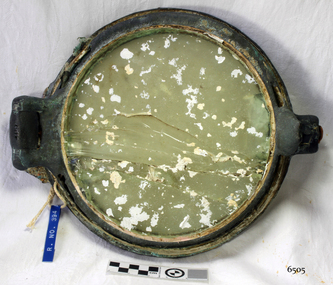 Flagstaff Hill Maritime Museum and Village
Functional object - Porthole, c 1888
... when the Antares was constructed. THE ANTARES In mid-November 1914, after the beginning of the First World War, a young local man went one evening to fish near the Bay of Islands, west of Peterborough. He later arrived home hurriedly and in an agitated state declaring: "The Germans are coming!" His family laughed and disbelieved him, as this young fellow was prone to telling fictional tales. About a month later, on December 13th 1914, local farmers Phillip Le Couteur and Peter Mathieson were riding in the vicinity, checking on cattle. Phillip Le Couteur saw what...when the Antares was constructed. THE ANTARES In mid-November 1914, after the beginning of the First World War, a young local man went one evening to fish near the Bay of Islands, west of Peterborough. He later arrived home hurriedly and in an agitated state declaring: "The Germans are coming!" His family laughed and disbelieved him, as this young fellow was prone to telling fictional tales. About a month later, on December 13th 1914, local farmers Phillip Le Couteur and Peter Mathieson were riding in the vicinity, checking on cattle. Phillip Le Couteur saw what ...This porthole was part of the ship's fittings when the Antares was constructed. THE ANTARES In mid-November 1914, after the beginning of the First World War, a young local man went one evening to fish near the Bay of Islands, west of Peterborough. He later arrived home hurriedly and in an agitated state declaring: "The Germans are coming!" His family laughed and disbelieved him, as this young fellow was prone to telling fictional tales. About a month later, on December 13th 1914, local farmers Phillip Le Couteur and Peter Mathieson were riding in the vicinity, checking on cattle. Phillip Le Couteur saw what he “thought was the hull of a ship below the cliffs.” He rode to Allansford and contacted police. The next day, two Constables and Phillip Le Couteur returned to the site, where they dug a trench near the top of the cliff and sank a log in it. To this they attached a rope, which they threw down the cliff face. Constable Stainsbury and Phillip Le Couteur then made the dangerous descent down the rope on the sheer cliff face. They found wreckage strewn around a small cove and a portion of a man's body under the cliffs. The hull of the ship could be seen about 300 metres out to sea. Some of the wreckage revealed the name Antares and the remains of the ship's dinghy bore the name Sutlej. During the next two weeks and with the help of the Warrnambool lifeboat and crew, two more bodies were found. Later investigations proved that the tragic wreck was indeed that of the Antares, reported overdue on the 207th day of her voyage from Marseilles, France, to Melbourne. She was a three masted, 1749 ton iron clipper, built in Glasgow in 1888 and originally named and launched as the Sutlej. Bought in 1907 by Semider Bros. from Genoa, Italy, she was refitted and renamed Antares. It was later realised that the local lad who a month earlier had declared he had seen German guns being fired, had probably seen distress flares fired from the deck of the Antares the night she was wrecked. She was last sailed under Captain Gazedo and wrecked at what is now known as Antares Rock, near the Bay of Islands. She had been carrying a large cargo of roofing tiles from France to Melbourne, consigned to Mullaly & Byrne. Many of them are now to be seen amongst the battered and scattered remains of the wreck. Some of the timbers were found to be blackened by fire. An Information Board has been erected on the cliff top near to the site of the Antares wreck, at the end of Radfords Rd, west of Peterborough. (Ref: Flagstaff Hill Maritime Village’s “Antares” fact sheet, Victorian Heritage Database, Information Board at Peterborough, Flagstaff Hill Significance Assessment 2010)The Antares was one of the last of the 'tall ships' to be lost along the south west coast of Victoria, and is the only wreck that took the lives of all people on board. She is listed on the Victorian Heritage Register VHS S34. The Antares is significant as a sail trader carrying an international inbound cargo. It is part of the Great Ocean Road Historic Shipwreck Trail. Porthole with glass, brass, screw dog broken off, glass has cracks through it, some encrustation. Artefact Reg No A/5, recovered from the wreck of the Antares.flagstaff hill, warrnambool, shipwrecked-coast, flagstaff-hill, flagstaff-hill-maritime-museum, maritime-museum, shipwreck-coast, flagstaff-hill-maritime-village, porthole, antares., tall ship, peterborough, 1914 shipwreck, phillip le couteur, peter mathieson, constable stainsbury, sutlej, antares rock., bay of islands, ship's fitting -
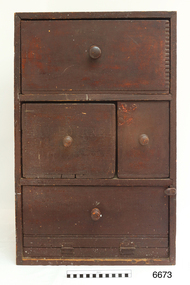 Flagstaff Hill Maritime Museum and Village
Furniture - Cupboard, c. 1890
... November 1860. His father, William Dale, a quarryman from Saddleworth, Yorkshire migrated to Australia in 1852; seven years later - in 1859- he purchased the quarries on twenty acres of land situated in Wangoom at the corner of what is now known as Dales and Aberline Roads. Later, when...November 1860. His father, William Dale, a quarryman from Saddleworth, Yorkshire migrated to Australia in 1852; seven years later - in 1859- he purchased the quarries on twenty acres of land situated in Wangoom at the corner of what is now known as Dales and Aberline Roads. Later, when ...The materials used to build the colonial cupboard have been gathered from various sources and recycled. In those days, it was normal to keep all manner of items 'just in case' they could be repurposed for another item. The brand "Laurel" on one of the wooden panels is from the Mobil Oil company's kerosene. There In the words of the donor, Betty Stone, "Made by Ellis Dale of Latrigg Wangoom, Warrnambool c 1890. The cupboard consists of packing cases stamped with original brand names. One drawer made from a gelignite packing case is of special significance as the Dale family owned a bluestone quarry known as The Dale Bluestone Quarries at Wangoom situated about three miles east of Warrnambool. Ellis Dale, second son of William Dale and Elizabeth (nee Chamberlain) Dale, was born in Wangoom, Warrnambool on 21 November 1860. His father, William Dale, a quarryman from Saddleworth, Yorkshire migrated to Australia in 1852; seven years later - in 1859- he purchased the quarries on twenty acres of land situated in Wangoom at the corner of what is now known as Dales and Aberline Roads. Later, when his two eldest sons, William Jnr and Ellis, reached ten or eleven years of age they worked with their father in the quarries. The work was arduous and dangerous as gelignite was used to blast the bluestone. In 1890 Ellis Dale married Ann Lees, daughter of Lees and Sarah (nee Chamberlain) Lees of Wangoom, Warrnambool. Initially Ellis and Ann Dale resided in a two roomed bluestone cottage which Ellis built a little further up the hill from his parents' home on the Dale family property. A few years later, in order to accommodate their growing family, additional rooms were added making a spacious, comfortable weatherboard home situated in Dales Road which they named Latrigg. Ellis Dale constructed this cupboard soon after he and Ann first set up home in their little stone cottage in 1890. When the home was rebuilt, the home-made cupboard was moved into the larger kitchen, and although Latrigg was well furnished, it remained in the corner between the kitchen door and the large wood stove where it served its purpose very well as it was used for storing ironing utensils. The lower compartment with the hinged drop-door was designed to store the flat irons which were heated on the wood stove, while the ironing blanket and cover, iron holders and other items were stored in the drawers. The Dale quarrying and contracting business existed in Wangoom, Warrnambool for over eighty years as after William Dale’s death. Ellis Dale together with his son lvor, continued on until he died in 1940. (Note: For additional information please refer to Betty Stone’s book “Pioneers and Places - A History of three Warrnambool Pioneering Families” i.e. Chamberlain, Dale and Lees Families)This item is associated with families of Chamberlain, Dale and Lees. These families are listed in the "Pioneers' Register" for Warrnambool Township and Shire, 1835-1900, published by A.I.G.S. Warrnambool Branch.Cupboard, rare example of a Colonial Cupboard, wooden. Made by Ellis Dale from packing cases; several brand names are evident inc. Gelignite and Laurel. Cupboard is lined with newspaper and wallpaper. Panels on left side are braced by attaching a metal scraper. Comprises four compartments, three have round wooden handles, lower compartment has a hinged, drop down door. (From the Chamberlain, Dale and Lees Collection)Brands on wooden panels of cupboard include "Gelignite" and "Laurel" (Laurel is a brand of kerosene)flagstaff hill, warrnambool, shipwrecked coast, flagstaff hill maritime museum, maritime museum, shipwreck coast, flagstaff hill maritime village, great ocean road, chamberlain, dale, lees, stone, betty stone, warrnambool pioneers, dale bluestone quarries, wangoom, cupboard, colonial cupboard, furniture, gelignite, packing crate, ellis dale, laurel -
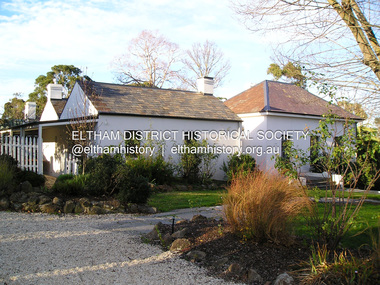 Eltham District Historical Society Inc
Photograph, Fay Bridge, Rosehill Homestead, EDHS Heritage Excursion, 6 July 2019
... what was to become the Shire of Eltham when the Willis brothers arrived in the late 1830s. From the southern part of Cleveland Avenue there are extensive views across and along the Yarra Valley. An article on the history of this area was contained in Newsletter edition 201, November...what was to become the Shire of Eltham when the Willis brothers arrived in the late 1830s. From the southern part of Cleveland Avenue there are extensive views across and along the Yarra Valley. An article on the history of this area was contained in Newsletter edition 201, November ...July Excursion July 6, 2019 - Exploring Lower Plenty The predominant feature of this walk in the Bonds Road area, Lower Plenty is the large number of magnificent old River Red Gums that line the route. These trees are of the spreading woodland form of this species indicating that they must have been originally growing in a reasonably open setting. The walk also includes parts of the historic Cleveland Estate and the homestead “Rosehill” established by pioneer farmer Henry Stooke. This area was the site of the first recorded European settlement in what was to become the Shire of Eltham when the Willis brothers arrived in the late 1830s. From the southern part of Cleveland Avenue there are extensive views across and along the Yarra Valley. An article on the history of this area was contained in Newsletter edition 201, November 2011. The walk will start at the at the corner of Bonds and Stawell Roads, Lower Plenty - EDHS Newsletter No. 246 June 2019fay bridge collection, 2019-07-06, blackburn bricks, eltham district historical society, heritage excursion, rosehill homestead, lower plenty -
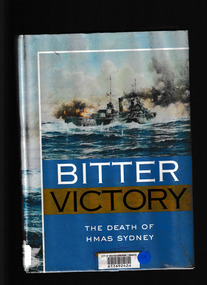 Monbulk RSL Sub Branch
Book, University of Western Australia Press, Bitter victory : the death of H.M.A.S. Sydney, 2000
... World War 1939-1945 - Naval operations - Australia HMAS Sydney What did happen just off the Western Australian coast on 19 November, 1941? Certainly a tragedy: 600 men were killed when the HMAS Sydney was torpedoed by a German cruiser; but why? ...What did happen just off the Western Australian coast on 19 November, 1941? Certainly a tragedy: 600 men were killed when the HMAS Sydney was torpedoed by a German cruiser; but why? Olsen sets out to answer these questions, and in doing so, pulls apart the accepted theories about the causes of Australia's greatest maritime disaster. Title Bitter victory : the death of H.M.A.S. Sydney / Wesley Olson.Index, maps, ill, p.431.non-fictionWhat did happen just off the Western Australian coast on 19 November, 1941? Certainly a tragedy: 600 men were killed when the HMAS Sydney was torpedoed by a German cruiser; but why? Olsen sets out to answer these questions, and in doing so, pulls apart the accepted theories about the causes of Australia's greatest maritime disaster. Title Bitter victory : the death of H.M.A.S. Sydney / Wesley Olson.world war 1939-1945 - naval operations - australia, hmas sydney -
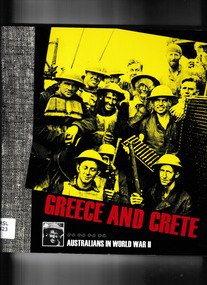 Monbulk RSL Sub Branch
Book, Dept. of Veterans' Affair, Greece and Crete, 2011
... In March 1941, British support became a reality when a military expedition called 'Lustre Force', which included Australian troops, was dispatched to Greece from Egypt. ...more than 60,000 British and Dominion servicemen and women ... fought in Greece between November 1940 and May 1941, among them some 17,000 Australians and 16,700 New Zealanders. What ...During World War II Greek independence was once again threatened. In October 1940, seeking to make Italy the master of the eastern Mediterranean, Benito Mussolini's armies invaded Greece, only to find themselves beaten back by the Greeks. Unfortunately for Greece, this setback for his Italian ally made the German leader, Adolf Hitler, turn his attention to the possible danger to Germany's ambitions from the Greeks, particularly if they should seek support from Britain. In March 1941, British support became a reality when a military expedition called 'Lustre Force', which included Australian troops, was dispatched to Greece from Egypt. ...more than 60,000 British and Dominion servicemen and women ... fought in Greece between November 1940 and May 1941, among them some 17,000 Australians and 16,700 New Zealanders. What circumstances had brought these men and women from half a world away to the aid of the Greeks?Ill, maps, p.220.non-fictionDuring World War II Greek independence was once again threatened. In October 1940, seeking to make Italy the master of the eastern Mediterranean, Benito Mussolini's armies invaded Greece, only to find themselves beaten back by the Greeks. Unfortunately for Greece, this setback for his Italian ally made the German leader, Adolf Hitler, turn his attention to the possible danger to Germany's ambitions from the Greeks, particularly if they should seek support from Britain. In March 1941, British support became a reality when a military expedition called 'Lustre Force', which included Australian troops, was dispatched to Greece from Egypt. ...more than 60,000 British and Dominion servicemen and women ... fought in Greece between November 1940 and May 1941, among them some 17,000 Australians and 16,700 New Zealanders. What circumstances had brought these men and women from half a world away to the aid of the Greeks?world war 1939 – 1945 – campaigns – greece, world war 1939-1945 - pictorial works - australia -
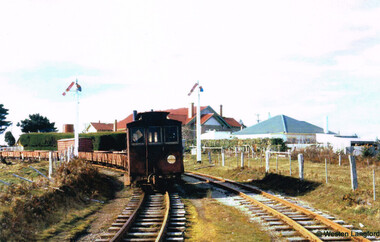 Otway Districts Historical Society
Photograph, Langford, Weston, Goods train arriving at Beech Forest, 1961, 9 August 1961
... what were the first definite steps to close the Colac-Beech Forest line. 1,101 tonnes of freight per year flowed from Colac to Beech Forest because of increasing competition from the roads. From 1 July 1960 onwards, when pulpwood (hardwood) stopped being shipped from Beech Forest, a maximum of only 7,000 tonnes/year would be shipped to Colac. Including special trips passenger revenue earned a little more than $200 per annum. The issue of second-hand sleepers stopped entirely and the two track gangs only patrolled the track and tightened loose bolts. The line did not earn its way and on 4 November...what were the first definite steps to close the Colac-Beech Forest line. 1,101 tonnes of freight per year flowed from Colac to Beech Forest because of increasing competition from the roads. From 1 July 1960 onwards, when pulpwood (hardwood) stopped being shipped from Beech Forest, a maximum of only 7,000 tonnes/year would be shipped to Colac. Including special trips passenger revenue earned a little more than $200 per annum. The issue of second-hand sleepers stopped entirely and the two track gangs only patrolled the track and tightened loose bolts. The line did not earn its way and on 4 November ...From late in 1960 VR took what were the first definite steps to close the Colac-Beech Forest line. 1,101 tonnes of freight per year flowed from Colac to Beech Forest because of increasing competition from the roads. From 1 July 1960 onwards, when pulpwood (hardwood) stopped being shipped from Beech Forest, a maximum of only 7,000 tonnes/year would be shipped to Colac. Including special trips passenger revenue earned a little more than $200 per annum. The issue of second-hand sleepers stopped entirely and the two track gangs only patrolled the track and tightened loose bolts. The line did not earn its way and on 4 November 1960 it was recommended that services over the narrow gauge line be discontinued.The rear of a goods train from Colac arrives at Beech Forest on 9 August 1961. The other line is the former Crowes line truncated at Weeaproinah in January 1955. In the background is the Beech Forest Hall and Shire of Otway offices. Colour.colac; beech forest; railway; -
 Sunshine and District Historical Society Incorporated
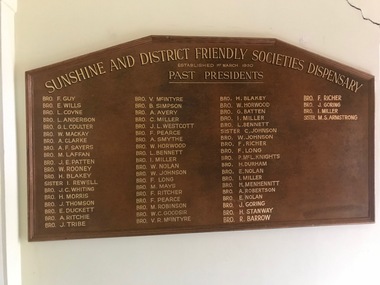
Honour Board - PAST PRESIDENTS of the SUNSHINE and DISTRICT FRIENDLY SOCIETIES DISPENSARY
... November 1950. It also draws on an article written by Elizabeth Willis and published online by the the Department of History (University of Melbourne), and on an article written by Mr. Bill Kelly of the Australian Friendly Societies Pharmacies Association, and also on an article by Museum Victoria Australia. Corrections to what has been written are welcome from interested readers. The Honour Board provides a historical record of the Presidents that served 61 terms on the Board of the Sunshine and District Friendly Societies Dispensary. It also provides a reminder that when ...Friendly Societies originated in the industrial areas of the United Kingdom. The first society in Victoria was formed in 1839 and by 1913 more than half of the Victorian population was insured by Friendly Societies in some fashion. The societies were financed by Members' subscriptions and offered health benefits and other welfare services, before these services were provided by the government. Doctors were paid by the societies to treat members free of charge, and Dispensaries were established to provide members with subsidised quality medicines. The Sunshine and District Friendly Societies Dispensary was established on the 1st of March 1930 with a membership of 896, and it was located in Sun Crescent Sunshine. The membership grew to 1052 within 4.5 years, and the number of prescriptions dispensed in the 6 months prior to November 30,1935 totalled 10,535. The Dispenser was Mr. C. H. Semmens. Most Friendly Societies operated democratically with office bearers changed regularly to prevent power cliques. The Sunshine Dispensary appears to have operated in the same way as the societies that owned it. The Advocate of 10 July 1936 reports that the seven newly elected office bearers or delagates were from the Friendly Societies; A.N.A., M.U.I.O.O.F., P.A.F.S., and G.U.O.O.F. The names of all the seven people can be found on the Honour Board, indicating that they each have served at least one term as President of the Sunshine Dispensary. The health professions and the Labour Governments of the 1940's wanted to see the involvement of Friendly Societies in health care broken. The Commonwealth Free Medicine Plan appears to have been drawing customers away from Friendly Societies Dispensaries in general. The Sunshine Dispensary placed several advertisements in the Sunshine Advocate during late 1950 urging members to remain loyal to it. By the 1980's the increase in entrepreneurial clinics and the availability of take away medicine helped to vastly diminish the involvement of Friendly Societies in health care provision. The 1936 Sunshine Advocate refers to the Sunshine and District United Friendly Societies Dispensary, with the same office bearers as the Presidents on the Honour Board but on which the 'United' is missing from the name of the Dispensary. The 1950 advertisements were placed by Sunshine U.F.S. Dispensary of 23 Sun Crescent. It is thought that all three names refer to the same business, but the writer stands to be corrected. The above is a compilation of information sourced from Sunshine Advocates published in January and July 1936, and in September, October and November 1950. It also draws on an article written by Elizabeth Willis and published online by the the Department of History (University of Melbourne), and on an article written by Mr. Bill Kelly of the Australian Friendly Societies Pharmacies Association, and also on an article by Museum Victoria Australia. Corrections to what has been written are welcome from interested readers.The Honour Board provides a historical record of the Presidents that served 61 terms on the Board of the Sunshine and District Friendly Societies Dispensary. It also provides a reminder that when a government does not adequately look after the welfare needs of its citizens, the people can band together to find ways of helping each other. The Sunshine Dispensary no longer exists, and a more recently established Community Pharmacy which operated in Hampshire Road could not compete against the discount pharmacies that have taken over. These new pharmacies sell a wide range of profitable product lines, as well as dispensing traditional prescription medications.Brown stained wood particle board with picture frame type edging. The board has six straight sides however it is not typical hexagon shaped. The top is composed of three straight short edges to give an almost rounded edge to an otherwise oblong shaped bottom section. On the board in gold coloured lettering are the names of 'brothers' and 'sisters' who served a total of 61 terms as PRESIDENTS of the SUNSHINE AND DISTRICT FRIENDLY SOCIETIES DISPENSARY, which was established on the 1st of March 1930. Eight of the men served more than one term with BRO. I. MILLER serving four terms, and BRO. F. RICHER serving three. The three women SISTER. I. REWELL, SISTER. C. JOHNSON, and SISTER. M.S. ARMSTRONG served one term each. There is no indication of when each person served, but it is believed that the term length was around six months and that the list is in chronological order. This conclusion results from seeing that BRO. W. ROONEY is the 11th listed President, and that the Sunshine Advocate of 10 July 1936 states that he was elected as the new President.sunshine and district friendly societies dispensary, honour board, 1st march 1930, 1/3/1930, sunshine u.f.s. dispensary, semmens, rooney, miller, richer, armstrong, rewell, johnson -
 Kew Historical Society Inc
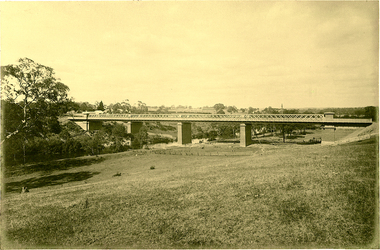
Photograph, J F C Farquhar, Railway Bridge Over the Yarra, 1891
... November 1890, the railway viaduct (now the Chandler Highway Bridge) linked Kew and Fairfield. The viaduct is significant as the most substantial extant engineering remnant of the Outer Circle Railway Line. Opened in March 1891, the viaduct crossed the Yarra River in a single span, atop three supporting brick pillars. Following the closure of the railway line in 1927, and the construction of the Chandler Highway in 1930, the bridge was used for vehicular traffic. In 1891 when this panoramic photograph was taken, the grounds of what...November 1890, the railway viaduct (now the Chandler Highway Bridge) linked Kew and Fairfield. The viaduct is significant as the most substantial extant engineering remnant of the Outer Circle Railway Line. Opened in March 1891, the viaduct crossed the Yarra River in a single span, atop three supporting brick pillars. Following the closure of the railway line in 1927, and the construction of the Chandler Highway in 1930, the bridge was used for vehicular traffic. In 1891 when this panoramic photograph was taken, the grounds of what ...At the beginning of the 1890s, the Kew businessman and Town Councillor, Henry Kellett, commissioned J.F.C. Farquhar to photograph scenes of Kew. These scenes included panoramas as well as pastoral scenes. The resulting set of twelve photographs was assembled in an album, Kew Where We Live, from which customers could select images for purchase.The preamble to the album describes that the photographs used the ‘argentic bromide’ process, now more commonly known as the gelatine silver process. This form of dry plate photography allowed for the negatives to be kept for weeks before processing, hence its value in landscape photography. The resulting images were considered to be finely grained and everlasting. Evidence of the success of Henry Kellett’s venture can be seen today, in that some of the photographs are held in national collections.It is believed that the Kew Historical Society’s copy of the Kellett album is unique and that the photographs in the book were the first copies taken from the original plates. It is the first and most important series of images produced about Kew. The individual images have proved essential in identifying buildings and places of heritage value in the district.Completed in November 1890, the railway viaduct (now the Chandler Highway Bridge) linked Kew and Fairfield. The viaduct is significant as the most substantial extant engineering remnant of the Outer Circle Railway Line. Opened in March 1891, the viaduct crossed the Yarra River in a single span, atop three supporting brick pillars. Following the closure of the railway line in 1927, and the construction of the Chandler Highway in 1930, the bridge was used for vehicular traffic. In 1891 when this panoramic photograph was taken, the grounds of what was then the Kew Lunatic Asylum extended down to the River and eastward beyond the viaduct. The landscape surrounding the Asylum was planted with traditional exotic trees such as Oaks, Pines and Cedars, and landmark trees from northern Australia such as the Hoop Pine. Remnant indigenous trees such as the River Red Gum, Yellow Box and Lightwood were scattered around the site, including beside the Yarra River.Railway Bridge Over the Yarrakew illustrated, kew where we live, photographic books, henry kellett, railway viaduct - - kew (vic) -
 Mt Dandenong & District Historical Society Inc.
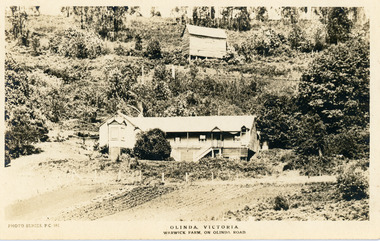
Photograph, Warwick Farm On Olinda Road
... when they saw in the morning paper that the Dandenong Ranges had been thrown open to land release to people. A few days later, having been granted land they headed to Ferntree Gully. From there they walked to the new holding in what would become Olinda. Then George with his sons help had to build a shelter for the family for the night. They chose to name the property "Warwick Farm". Work on the house started a few days later with help from neighbours Mr. Dodd, Mr Beattie, the O'Sheas and others. Come November...when they saw in the morning paper that the Dandenong Ranges had been thrown open to land release to people. A few days later, having been granted land they headed to Ferntree Gully. From there they walked to the new holding in what would become Olinda. Then George with his sons help had to build a shelter for the family for the night. They chose to name the property "Warwick Farm". Work on the house started a few days later with help from neighbours Mr. Dodd, Mr Beattie, the O'Sheas and others. Come November ...Information supplied by Stephen Trembath. Warwick Farm was established by my late grand parents Polly (nee Mary Ann Cole) and George Barratt and their 5 children George Jnr, William, James, John (my maternal Grand Father) and Teddy. Their story is told in a book "The wine of Courage" written in 1977 by N.M. Roberts ISBN 0 7223 1003. Their story started when their bank closed their doors on 13 April 1893 and they lost their cafe business in South Melbourne. Two days later, they were ready to head for a new start in Queensland when they saw in the morning paper that the Dandenong Ranges had been thrown open to land release to people. A few days later, having been granted land they headed to Ferntree Gully. From there they walked to the new holding in what would become Olinda. Then George with his sons help had to build a shelter for the family for the night. They chose to name the property "Warwick Farm". Work on the house started a few days later with help from neighbours Mr. Dodd, Mr Beattie, the O'Sheas and others. Come November, Ruby was born. Then bushfire burnt down the newly built house. Back to a bark hut until another house could be built. The new house became a guest house at the suggestion of a neighbour, when George couldn't sell timber and was waiting for crops. The first guests visited in 1898 and another baby, Percival, was born. ....................................................... It was George's son Jim, who was a skilled carpenter and axeman who extended the home to take from 12 to 30 guests. In 1950 Warwick Farm became the home of distinguished writer and journalist C.E.Sayers for a number of years.Photo Series Pictorial Postcard # 981 showing the property Warwick Farm on Olinda Road.Printed on back: PHOTO SERIES Pictorial Postcards. Published by S. Jamieson Bros. Alphington Vic. Phone Northcote 60warwick farm, olinda, postcard, photo series, olinda road, george barratt, barratt, guest house, guest house -
 Ballarat Heritage Services
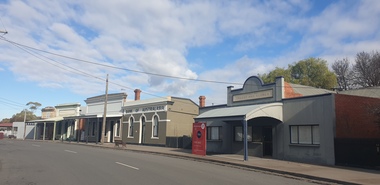
Photograph, Main Street of Talbot, Victoria, 2025, 07/2025
... when gold was found in Daisy Hill, near what is now Amherst Cemetery (2km west of Talbot). News quickly spread and within a few weeks hundreds of miners from the nearby Castlemaine goldfields had arrived to try their luck. The next major gold find was in 1854 at Kangaroo Flat along Back Creek (1km out of Talbot). By November...when gold was found in Daisy Hill, near what is now Amherst Cemetery (2km west of Talbot). News quickly spread and within a few weeks hundreds of miners from the nearby Castlemaine goldfields had arrived to try their luck. The next major gold find was in 1854 at Kangaroo Flat along Back Creek (1km out of Talbot). By November ...Throughout the 1840s there had been rumours of gold found in the area, but the evidence was suppressed. The authorities sought to keep the region as a quiet pastoral district, and feared that a gold rush could spark chaos and lawlessness among the largely convict population. In January 1849, former convict Thomas Chapman found a 38 ounce gold nugget in Daisy Hill Creek (7 km from Talbot) while working as a shepherd. He sold it to Melbourne jeweller Charles Brentani in early 1849. This was the first confirmed finding of gold in Victoria and kicked off a minor rush to the region. By late February 1849 thirty to forty trespassers were reported to have gathered at Thomas's former hut seeking gold before being disbanded by a party of police sent from Melbourne. Meanwhile, Thomas fled to Sydney, fearing trouble after his unauthorised sale of the gold that, according to the law of the time, was illegal. The first major rush in the area around current day Talbot occurred in December 1852 when gold was found in Daisy Hill, near what is now Amherst Cemetery (2km west of Talbot). News quickly spread and within a few weeks hundreds of miners from the nearby Castlemaine goldfields had arrived to try their luck. The next major gold find was in 1854 at Kangaroo Flat along Back Creek (1km out of Talbot). By November 1855 it was reported around 6,000 miners had taken up residence in what became known as Back Creek. But, as the gold dwindled, so too did the population and by end-1857 only a few houses remained. In 1859, a group of miners from Norway and Sweden led by Carl Hallen decided to look in an area just outside of Back Creek, previously thought barren of gold as it was un-forested. Their gamble was rewarded, and as the news spread, miners once again flooded into the area. Within 4 months of the Hallan Party's first shaft being dug, there were 50,000 people in the Back Creek region. To cater for this influx, streets were improvised in the area of the diggings - starting with what became known as "Scandinavian Crescent" along the edge of the actual diggings themselves. It remains to this day and is now the main street of Talbot. (https://www.melbourneplaygrounds.com.au/talbot-heritage-walk accessed 19 July 2025)Colour photograph of shops on Scandinavian Cresent, the Main road of Talbot, Victoriatalbot, back creek, gold mining -
Kew Historical Society Inc
Journal, Kewriosity : February 1986
... What happens when you turn 18? / p8. A peaceful way to start the year / p8. Our archives threatened [Kew Historical Society] / Sue Long p8. Kewriosity was a local newsletter combining Kew Council and community news. It was published between November ...Holiday program banishes boredom! / p1. [Local Government] Restructuring the issue for '86 / p1.Dates for February / p2. Are you new to Kew? / p2. [Community] Notices / p2. Update: Notes from Council {Council amalgamations] / Cr Phyllis Hore, Mayor of Kew p3. Kew Directory 1988 / p3. Traffic Management / p3. In Brief [A question of aesthetics; [Willsmere] Billabong study comes first; Grants allocated; Keeping the noise down; No to powerlines; Eating al fresco] / p4. Profile: Cr Phyllis Hore, Mayor of Kew / p4. Kew Community House [Resource Room; Groups using the house; T.O.P. at home - Tertiary Orientation Programme; Childminding] / p5. An opportunity to improve your English / p6. All about the C.S.C.C. [Children’s Services Consultative Committee] / p6. Care+Force [family support] / p6. Kew and Hawthorn share socialworker [Margaret Barnard]; What's planned for Senior Citizens' Week? / p7. Headway needs volunteers / p7. Who remembers Gladstone College? / p7. What happens when you turn 18? / p8. A peaceful way to start the year / p8. Our archives threatened [Kew Historical Society] / Sue Long p8.Kewriosity was a local newsletter combining Kew Council and community news. It was published between November 1983 and June 1994, replacing an earlier Kewriosity [broad] Sheet (1979-84). In producing Kewriosity, Council aimed to provide a range of interesting and informative articles covering its deliberations and decision making, together with items of general interest and importance to the Kew community and information not generally available through daily media outlets.non-fictionHoliday program banishes boredom! / p1. [Local Government] Restructuring the issue for '86 / p1.Dates for February / p2. Are you new to Kew? / p2. [Community] Notices / p2. Update: Notes from Council {Council amalgamations] / Cr Phyllis Hore, Mayor of Kew p3. Kew Directory 1988 / p3. Traffic Management / p3. In Brief [A question of aesthetics; [Willsmere] Billabong study comes first; Grants allocated; Keeping the noise down; No to powerlines; Eating al fresco] / p4. Profile: Cr Phyllis Hore, Mayor of Kew / p4. Kew Community House [Resource Room; Groups using the house; T.O.P. at home - Tertiary Orientation Programme; Childminding] / p5. An opportunity to improve your English / p6. All about the C.S.C.C. [Children’s Services Consultative Committee] / p6. Care+Force [family support] / p6. Kew and Hawthorn share socialworker [Margaret Barnard]; What's planned for Senior Citizens' Week? / p7. Headway needs volunteers / p7. Who remembers Gladstone College? / p7. What happens when you turn 18? / p8. A peaceful way to start the year / p8. Our archives threatened [Kew Historical Society] / Sue Long p8. publications -- city of kew (vic.), kewriosity, council newsletters, community newsletters -
 Melbourne Legacy
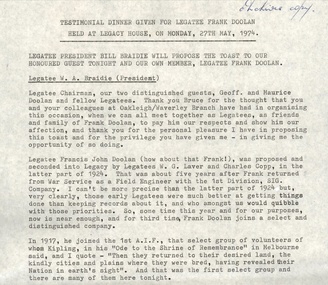
Document - Speech, A tribute to Legatee Frank Doolan
... what the public see today. Legatee Doolan was a very active Legatee, starting within the first year of Legacy when he was nominated by Bill Laver and Charles Copp in 1924. While he never sought 'office but he was always there - in the background - able and willing to actively serve'. In World War 1 he enlisted in November...what the public see today. Legatee Doolan was a very active Legatee, starting within the first year of Legacy when he was nominated by Bill Laver and Charles Copp in 1924. While he never sought 'office but he was always there - in the background - able and willing to actively serve'. In World War 1 he enlisted in November ...Information on the life of Legatee Frank Doolan from a dinner held to celebrate his 50 years of service on 27 May 1974 at the Oakleigh and Waverly Branch. Speakers included President Bill Braidie, Legatee Jim Gillespie and Legatee Frank Doolan. Frank recalls how he delivered the Toast to Legacy at the Perth Conference. In it he likened Legacy to a valuable cloak with foundations of gold and silver laid down by the founders, and additional threads added by successive legatees to become what the public see today. Legatee Doolan was a very active Legatee, starting within the first year of Legacy when he was nominated by Bill Laver and Charles Copp in 1924. While he never sought 'office but he was always there - in the background - able and willing to actively serve'. In World War 1 he enlisted in November 1917 and served with 1st Division Signal Company and in France. After Armistice he attended a course for young AIF surveyors at the British Ordnance Headquarters at South Hampton. Famously it was Frank that proposed that the spirit of Legacy is service to the widows and children. "Here it received its soul. The thoughts transmitted to the Board by this quiet man." He was part of the Legacy team who worked enthusiastically for the establishment of the Shrine. It was his technical skill as a surveyor that enabled the ray of light to shine on the Stone of Remembrance at 11 am on 11th November. Also to solve the complication of daylight saving by positioning two mirrors. For this he was awarded the British Empire Medal. He was involved in the purchase of Legacy House in 1955 and also in the Lone Pine project in 1964. He was also established an archive at Legacy House to try and capture the history of Legacy. The information was part of an album of past presidents from 1965 to 1989. The folder included biographical details and obituaries, eulogies and death notices of prominent Legatees. The items have been catalogued separately.Part of the collection of material held by Melbourne Legacy on Legatee Frank Doolan a prominent member of Legacy. The information was collected to record the lives of prominent legatees in a folder.Typed A4 document x 5 pages of the life of Legatee Frank Doolan. frank doolan, ray of light, shrine of remembrance, lone pine -
 Wodonga & District Historical Society Inc
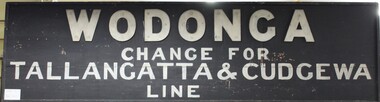
Sign - Wodonga Railway Station
... November 1873 when the section of the train line from Wangaratta to Wodonga was completed. A goods shed was built at this time in 1873 and a permanent train station was completed in 1874. The expansion of the railways to the northeast of Victoria occurred after the Victorian Government took over the railways in 1867 and the trains serviced large towns such as Seymour, Wangaratta and Wodonga, as well as smaller towns along the way. The Tallangatta and Cudgewa train lines from Wodonga were built in stages from the 1880s to the 1920s in what...November 1873 when the section of the train line from Wangaratta to Wodonga was completed. A goods shed was built at this time in 1873 and a permanent train station was completed in 1874. The expansion of the railways to the northeast of Victoria occurred after the Victorian Government took over the railways in 1867 and the trains serviced large towns such as Seymour, Wangaratta and Wodonga, as well as smaller towns along the way. The Tallangatta and Cudgewa train lines from Wodonga were built in stages from the 1880s to the 1920s in what ...The Wodonga train line opened in November 1873 when the section of the train line from Wangaratta to Wodonga was completed. A goods shed was built at this time in 1873 and a permanent train station was completed in 1874. The expansion of the railways to the northeast of Victoria occurred after the Victorian Government took over the railways in 1867 and the trains serviced large towns such as Seymour, Wangaratta and Wodonga, as well as smaller towns along the way. The Tallangatta and Cudgewa train lines from Wodonga were built in stages from the 1880s to the 1920s in what is considered to be some of the most challenging landscape for railways. The Cudgewa line was opened in 1921, so the Wodonga train station sign dates from this period.The Wodonga train station sign has local and state significance due to its use in Wodonga in the late 19th and early 20th centuries, as part of the expansion of the Victorian Railways in the northeast of the state.Old painted wooden sign from the Wodonga train station with the directions for changing to the Tallangatta and Cudgewa train line in light coloured paint on a black painted background."WODONGA / CHANGE FOR / TALLANGATTA & CUDGEWA / LINE" wodonga railway station, wodonga train station, tallangatta train line, cudgewa train line, railway signs, victorian railways signs -
 Melbourne Tram Museum
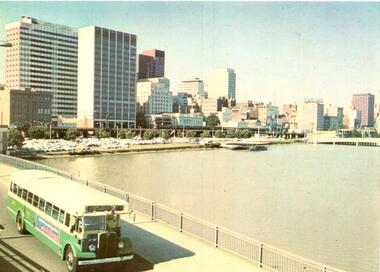
Postcard, Murfett Publishers, MMTB Bus 583 AEC Mk111 no 583, early to mid 1970's
... When: It's what is missing in the photo gives us a the clue. It after 1968 as the new Stock Exchange building at 357 Collins Street is completed. but before 1973 when the new MLC building was open at 303 Collins Street on corner of Elizabeth Street. But the "2" between the destination and route number boxes on bus tells us its after November...When: It's what is missing in the photo gives us a the clue. It after 1968 as the new Stock Exchange building at 357 Collins Street is completed. but before 1973 when the new MLC building was open at 303 Collins Street on corner of Elizabeth Street. But the "2" between the destination and route number boxes on bus tells us its after November ...Postcard - full colour, Divided back type of MMTB Bus 583 AEC Mk111 no 583 Reg : AT083 entered service 1953 body by Martin and King - two man crew, 41 seats. Notes from Rod Atkins 24/5/2019: Bound for : "Fisherman's Bend via Williamtown Road" on Spencer Street Bridge heading south. When: It's what is missing in the photo gives us a the clue. It after 1968 as the new Stock Exchange building at 357 Collins Street is completed. but before 1973 when the new MLC building was open at 303 Collins Street on corner of Elizabeth Street. But the "2" between the destination and route number boxes on bus tells us its after November 1970. Therefore I would date the post card photograph to around 1971-1972 and prior to the start of the third viaduct between Flinders St and Spencer St. Published by National View by Murfett Publishers Australia. Has the details on the rear with place for stamp, address etc and logo.trams, tramways, king st, bridges, railways, buses, fisherman's bend -
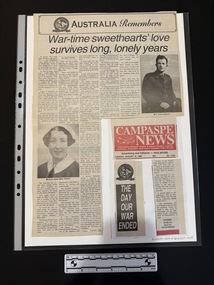 Returned Nurses RSL Sub-branch
Newspaper - Newspaper clipping, [Campaspe News], War-time sweethearts' love survives long, lonely years, [c1995]
... what free time they had together. When Lance found out he was to ship out to Indonesia in January 1942 the couple came to an understanding that they would marry after war. Several weeks after Lance's departure, Mary's unit returned to Australia on the Strathallen, where they nursed in hospitals in Queensland. Lance became a POW of the Japanese, one of the lucky 72 out of 257 Australians in his group to survive the war. Mary and Lance were married in November...what free time they had together. When Lance found out he was to ship out to Indonesia in January 1942 the couple came to an understanding that they would marry after war. Several weeks after Lance's departure, Mary's unit returned to Australia on the Strathallen, where they nursed in hospitals in Queensland. Lance became a POW of the Japanese, one of the lucky 72 out of 257 Australians in his group to survive the war. Mary and Lance were married in November ...Mary Everard met Lance Gibson met in South Australia when Lance and a mate rang the local hospital to see if there were any off duty nurses who would go to the pictures with them. After several other outings the pair both ended up travelling on the Queen Elizabeth I to Egypt, Mary as nurse in the Australian Army Nursing Service and Lance as a lieutenant in the 2/3rd Australian Machine Gun Battalion. After spending much of the three week journey together, they continued to spend what free time they had together. When Lance found out he was to ship out to Indonesia in January 1942 the couple came to an understanding that they would marry after war. Several weeks after Lance's departure, Mary's unit returned to Australia on the Strathallen, where they nursed in hospitals in Queensland. Lance became a POW of the Japanese, one of the lucky 72 out of 257 Australians in his group to survive the war. Mary and Lance were married in November 1946 and now have three children and eight grandchildren.A large newspaper clipping featuring a large title, five columns of text and two black and white photos. One photo is of the face of a nurse in uniform, while the other photo is of a man in uniform.wwii, ww2, world war two, prisoner of war, mary gibson, gaza, middle east, sydney, concorde army hospital, brisbane, hughenden, darwin, atherton tablelands, java, dutch, cycle camp, singapore, japan, formosa, taiwan, nagasaki, american, korean, manchuria, ransom camp, govenor of singapore, russian, manila, red cross, vatican, nanneella -
Returned Nurses RSL Sub-branch
Newspaper - Newspaper clipping, [Campaspe News], War-time sweethearts' love survives long, lonely years, [c1995]
... what free time they had together. When Lance found out he was to ship out to Indonesia in January 1942 the couple came to an understanding that they would marry after war. Several weeks after Lance's departure, Mary's unit returned to Australia on the Strathallen, where they nursed in hospitals in Queensland. Lance became a POW of the Japanese, one of the lucky 72 out of 257 Australians in his group to survive the war. Mary and Lance were married in November...what free time they had together. When Lance found out he was to ship out to Indonesia in January 1942 the couple came to an understanding that they would marry after war. Several weeks after Lance's departure, Mary's unit returned to Australia on the Strathallen, where they nursed in hospitals in Queensland. Lance became a POW of the Japanese, one of the lucky 72 out of 257 Australians in his group to survive the war. Mary and Lance were married in November ...Mary Everard met Lance Gibson met in South Australia when Lance and a mate rang the local hospital to see if there were any off duty nurses who would go to the pictures with them. After several other outings the pair both ended up travelling on the Queen Elizabeth I to Egypt, Mary as nurse in the Australian Army Nursing Service and Lance as a lieutenant in the 2/3rd Australian Machine Gun Battalion. After spending much of the three week journey together, they continued to spend what free time they had together. When Lance found out he was to ship out to Indonesia in January 1942 the couple came to an understanding that they would marry after war. Several weeks after Lance's departure, Mary's unit returned to Australia on the Strathallen, where they nursed in hospitals in Queensland. Lance became a POW of the Japanese, one of the lucky 72 out of 257 Australians in his group to survive the war. Mary and Lance were married in November 1946 and now have three children and eight grandchildren.A large newspaper clipping featuring a large title, five columns of text and two black and white photos. One photo is of the face of a nurse in uniform, while the other photo is of a man in uniform.wwii, ww2, world war two, prisoner of war, mary gibson, gaza, middle east, sydney, concorde army hospital, brisbane, hughenden, darwin, atherton tablelands, java, dutch, cycle camp, singapore, japan, formosa, taiwan, nagasaki, american, korean, manchuria, ransom camp, govenor of singapore, russian, manila, red cross, vatican, nanneella -
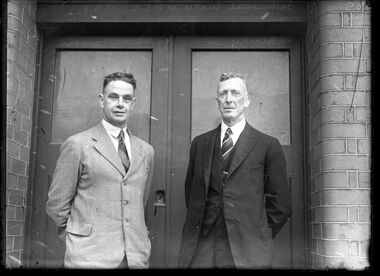 City of Melbourne Libraries
Photograph, Bull, Hugh Jones, 1897-1993, Bert Ironmonger and Don Blackie, Testimonial Cricket at MCC
... Dainty and Rock had an “average” age of 51 years and 273 days when photographed outside the Melbourne Cricket Club on the eve of their joint Testimonial Match on 16 November 1933. Blackie, a PMG linesman by trade, was nicknamed “Rock” because that’s what he’d call people when he inevitably forgot their names. ...Dainty and Rock had an “average” age of 51 years and 273 days when photographed outside the Melbourne Cricket Club on the eve of their joint Testimonial Match on 16 November 1933. Blackie, a PMG linesman by trade, was nicknamed “Rock” because that’s what he’d call people when he inevitably forgot their names. ...Ironmonger and Blackie BERT “DAINTY” IRONMONGER (1882-1971) and DON “ROCK” BLACKIE (1882-1955), the legendary off-spin bowlers, were “spin twins” in real life, born just two days apart. Dainty and Rock had an “average” age of 51 years and 273 days when photographed outside the Melbourne Cricket Club on the eve of their joint Testimonial Match on 16 November 1933. Blackie, a PMG linesman by trade, was nicknamed “Rock” because that’s what he’d call people when he inevitably forgot their names. Ironmonger, employed for over 30 years by St Kilda Council as a gardener, was nicknamed “Dainty” because he wasn’t! These men were famous for making their Test Cricket debuts when they were 46 years, 237 days old (Dainty) and 46 years, 252 days old (Rock). Whilst they only played one Test together, they were selected 24 times in the same Victorian team. It is no coincidence that the golden era of Victorian cricket coincided with their tenure. They played with St Kilda Cricket Club for nine seasons and the grandstand at Junction Oval bears the “Blackie-Ironmonger” name to this day. When on interstate tours, they shared a hotel room, where they plotted the downfall of their batting opponents. Their joint Testimonial Match was played over four days and featured all-star line-ups from three states. The opposing teams were captained by Bill “Wormkiller” Woodfull (memorial statue at Melbourne High School) and Vic “The Guardsman” Richardson (memorial gates at Adelaide Oval). The serious first class game attracted over 40,000 spectators and raised £908 for each man, around $45,000 in today’s money. In a game featuring la crème de la crème of contemporary batsmen – Bill “Ponny” Ponsford, Don “The Don” Bradman, Stan “Napper” McCabe et al – and all time doyens of the art of spin bowling – Clarrie “The Gnome” Grimmett, Bill “Tiger” O’Reilly and “Chuck” Fleetwood Smith – “Rock” topped his side of the bowling scorecard, picking up the best bowling figures of 3 for 69! Unhappily, Dainty’s old knee injury reoccurred and he had to sit out the last two days of play. Featured in "Newsworthy: Melbourne in photographs 1933-1936" exhibition at East Melbourne Library, October to December 2023. Exhibition caption by project volunteer, Ernie Ward. Photographer notations on slide: "Testimonial Cricket at MCC 1933 Blackie Ironmonger B9".cricket -
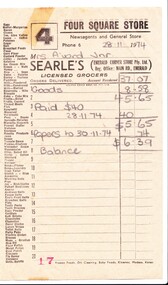 Emerald Museum & Nobelius Heritage Park
Administrative record - Invoice, Emerald Corner Store Pty. Ltd, 28 November 1974
... November 1974 at a time when Searles were the proprietors. It shows the customer was allowed to carry a small debt. The donor recalled that a number of Emerald people, including her parents, were not well off and were allowed to do this by the store. The invoice also has a list of items for sale at that time. This 1970's Emerald general store invoice invites some interesting comparisons with present-day supermarkets in relation to what ...Emerald's first permanent store was built in1898 on the corner of Monbulk and Belgrave-Gembrook Roads on the present-day site of Woolworths. It was known as The Corner Store. The owners in chronological order were Le Juge, Jones, Stewart, Elwood, Searles and Russo. This invoice donated by the daughter of its recipient is dated 28 November 1974 at a time when Searles were the proprietors. It shows the customer was allowed to carry a small debt. The donor recalled that a number of Emerald people, including her parents, were not well off and were allowed to do this by the store. The invoice also has a list of items for sale at that time.This 1970's Emerald general store invoice invites some interesting comparisons with present-day supermarkets in relation to what they stock and how they relate to customers. Four Square Store invoice for customer,Mrs A'Vard. Details are completed in pencil. On the left is a list of goods sold by the shop.At top of invoice printed: 'FOUR SQUARE STORE / Newsagents and General Store / Phone 6 / SEARLE'S / LICENSED GROCERS' [and other information]the corner store, searles, emerald
