
Showing 4 items matching "winchester road"
-
 Whitehorse Historical Society Inc.
Article, Mansion from yesteryear, 2001
... ...Winchester Road...On verso advertisements for Unit 2, 204 Blackburn Road, Blackburn and 1 Winchester Road, Nunawading....On verso advertisements for Unit 2, 204 Blackburn Road, Blackburn and 1 Winchester Road, Nunawading....On verso advertisements for Unit 2, 204 Blackburn Road, Blackburn and 1 Winchester Road, Nunawading. Whitehorse Road Mitcham No 567 Blackburn Road Blackburn No 204 Winchester Road Nunawading No 1 Article on 567 Whitehorse Road, Mitcham. ...Article on 567 Whitehorse Road, Mitcham.Article on 567 Whitehorse Road, Mitcham, 80 year old house of 10 rooms for sale, Agent: K.R. Rose & Co. On verso advertisements for Unit 2, 204 Blackburn Road, Blackburn and 1 Winchester Road, Nunawading.Article on 567 Whitehorse Road, Mitcham. whitehorse road, mitcham, no 567, blackburn road, blackburn, no 204, winchester road, nunawading, no 1 -
 Flagstaff Hill Maritime Museum and Village
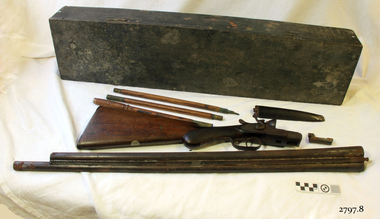
Weapon - Shotgun, Double Barrel, ISAAC HOLLIS & SONS, ca. 1904
... Winchester Street. From 1932 to 1933, the business operated in London as Hollis, Bentley & Playfair. The final closure of Hollis, Bentley & Playfair occurred in Birmingham in 1953. The shotgun was manufactured by Isaac Hollis & Sons, a firm with a strong reputation for producing firearms. This early 1900s example represents a standard pattern that was produced in large quantities for everyday use. Flagstaff Hill Maritime Museum Maritime Village Warrnambool Great Ocean Road ...The proof marks on the barrels (a crown and letters BV) denote that the shotgun design was made from the year 1904, and that it was nitro-proof tested in Birmingham, England. David Melville Carrison (1895 to 1960) of Port MacDonnell was the previous owner of this Isaac Hollis & Sons double-barrel shotgun. His grandfather, Adam Kerrison Carrison (1833-1903), was an early settler who worked as a fisherman in that once-bustling seaport. His uncle John was a a horse-breaker, a boat hand, and a member of the lifeboat crew, receiving a medal for his part in saving the crew of a French barque. Currently, no connection has been made between the gun, its owner, and the note with the word “Enterprise”: a New Zealand-built, two-masted schooner that was wrecked in Lady Bay, Warrnambool, in 1950. Gun makers, ISAAC HOLLIS & SONS: The Hollis Brothers were first recorded as operating from 11 Weaman Row in 1840, although evidence suggests the business may have commenced before then. Over time, the firm became known as Isaac Hollis & Sons, with claims of its establishment dating back to 1814. This earlier date is supported by records of Richard and William Hollis trading in Bath Street, Birmingham, between 1814 and 1818, which raises the possibility that Isaac and Frederick Hollis were their descendants. The principal brothers involved in the business were Isaac Hollis, born in 1815, and Frederick Hollis, whose birth date remains unknown. Frederick’s life was cut short when he died on 20 December 1839. According to the 1841 census, Isaac Hollis resided in Weaman Row and was listed as a 25-year-old gun and pistol maker. He was married to Emma, who was born in 1821, and together they had two children: Isaac, born in 1837, and Henry, born in 1839. Following Frederick’s death, Isaac continued to operate under the name Hollis Brothers until 1845, after which he renamed the business Hollis Brothers & Co. This entity remained active up to 1848. In 1844, Isaac Hollis entered a brief partnership with William Tranter at 10 & 11 Weaman Row, likely to fulfil a specific contract or to supply parts. This partnership continued until 1849. In 1848, Isaac Hollis formed a partnership with Isaac Brentnall Sheath, establishing the firm of Hollis & Sheath and expanding their operations into 10 Weaman Row. The partnership saw Hollis & Sheath become licensed manufacturers of percussion breech-loading guns, positioning the company as a notable presence in the industry. In 1861, Sheath left the partnership and emigrated to New Zealand, where he conducted several enterprises and was elected as a provincial councillor. He died in Christchurch on 19th May 1897. In 1861, after Isaac Sheath left, the business name became Isaac Hollis & Sons. By approximately 1870, Isaac Hollis and Henry Hollis had assumed responsibility for the daily management of the firm, with Isaac overseeing the overall management and marketing of the company's products, and Henry managing the manufacturing processes. During this period, the company became known for producing large volumes of affordable trade guns and sporting guns, catering to customers in South Africa and the British colonies. In 1870, Isaac Hollis & Sons opened a retail location at 44a Cannon Street in London, and in 1871, it operated at 83 Cheapside Street. Isaac Hollis Jnr passed away in October 1875 in Birmingham at the age of 37, having never married. In 1876/1877, Henry Hollis registered a limited liability company under the name Isaac Hollis & Sons Ltd. However, by 1879, trading resumed under the name Isaac Hollis & Sons, and the London shop moved to 6 Great Winchester Street. From 1932 to 1933, the business operated in London as Hollis, Bentley & Playfair. The final closure of Hollis, Bentley & Playfair occurred in Birmingham in 1953. The shotgun was manufactured by Isaac Hollis & Sons, a firm with a strong reputation for producing firearms. This early 1900s example represents a standard pattern that was produced in large quantities for everyday use. This double-barrel shotgun is 12-gauge, complete with a cleaning rod and a wooden storage box. The firearm has been altered from its original configuration: the right barrel has been cut shorter, resulting in sharp edges at the muzzle, and a metal extension has been fitted to the stock. The cleaning rod consists of three separate segments that screw together for use. The shotgun is housed in a black-painted wooden case with a hinged lid showing inscriptions for the maker and Serial Number. Maker was I. HOLLIS & SONS, Serial Number SN 84245. David Melville Carrison of Port MacDonnell was the previous owner. A handwritten note that had the word 'Enterprise' was with the gun. "I. HOLLIS & SONS". SN on stock “84245”. Badge on both sides “Crown [symbol] / BV”. “Crown [symbol] / NP”, “12G inside Diamond [symbol]”, “NITRO PROOF”, “STEEL 84245” Paper note included with gun, written in felt tip pen “ENTERPRISE”. flagstaff hill, maritime museum, maritime village, warrnambool, great ocean road, shipwreck coast, firearm, gun, double-barrel, shotgun, cleaning rod, gunsmith, smithed, 12 gauge, sn 84245, serial number 84245, david melville carrison, early 1900s, richard and william hillis, herbert & co., herbert & co. london, hollis & sons, isaac hollis & sons, isaac hillis & sons ltd., hollis bentley & playfair., isaac hollis, frederick hollis, isaac brentnall sheath, isaac sheath, william tranter, gun manufacturer, pistol manufacturer, gun and pistol maker, birmingham, military supplies, enterprise, 1904 -
 Federation University Historical Collection
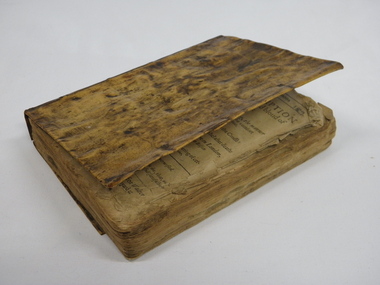
Book, Touching the Full Redemption of Mankind by the Death and Blood of Christ Jesus (human skin cover), 1599
... Findings prove the book is covered with human skin, increasing the rarity of the object. religion bible edward lowe edward lotos thomas bilson anthropodermic bibliopegy james hendy full redemption religious leather wilson winchester jesus puritanical puritans bungey bilson human skin skin human skin cover human skin binding Inside cover - James Hendy No 17 (Fu)gends Road Palmers Village Westminster. ...Anthropodermic Bibliopegy is the name given to the use of human leather to bind books. The name stems from the combination of the Greek root words, human (Anthropos), skin (derma), book (biblion), and fasten (pegia). The practice of creating anthropodermic books was popular throughout the 17th and 18th centuries. Most commonly, anthropodermic books are medical tomes, with the human leather taken from medical cadavers. Others were produced after criminal trials, with the criminal’s skin used to enclose the record of their own death sentences, creating a form of punishment that would surpass death. Other anthropodermic books contain poems or are religious texts. This book was written and printed in 1599 but most probably was rebound later when creation of anthropodermic books became more predominant. The book is a small tome of a religious nature containing the work of Bishop Thomas Bilson, who in a puritanical voice states that the primary argument articulated in this book is that “the metaphorical Calvinist interpretation of Hell as an exclusion from God was accurate then Christ's descent into hell after his crucifixion must refer to an actual existent hell as Christ was neither subject to sin nor able to be separated from the Divine.” The unusual cover of the book has led to many questions, the main being whether the book is covered with human skin. It was confirmed as such in 2014 with DNA testing undertaken by honours student Talanna Buckley at Federation University finding an 100% match to human DNA on the outside cover of the book. This is one of only two confirmed anthropodermic books in Australia, the other is housed at the National Library of Australia. Other forms of testing the leather of books have been found to be more accurate than DNA testing. For example, before DNA testing or PMF (Peptide Mass Fingerprinting) are undertaken many books have been identified as made from human skin through the close examination of the skins patterning. Hair follicles are the focus of the examination as certain patterns and sizes lend themselves to being human. However, many of these books have been proven to not be bound in human skin, the same can be said of books with inscriptions claiming them as anthropodermic. Peptide Mass Fingerprinting (PMF) testing has been found to be the most reliable way of confirming a leather bindings origin. This process involves the sampling of collagen-based materials, cutting the protein to gain specific amino acid combinations which form individual peptide sequences. Each mammal has an individual amino acid sequence in its collagen therefore its peptide mass combination is unique. This form of test can provide a more accurate outcome as collagen will be preserved for longer after the tanning process and will not be damaged in the same way DNA can be by the tanning process. DNA testing can also provide false positives as trace DNA from someone touching the book could be amplified and provide the reading instead of that of the leather itself. However, this book was tested with many controls as well as specific decontamination procedures in order to ensure that it was not trace DNA being tested. This book is historically and spiritually significant because it is a rare example of an early printed English Christian religious tract produced in Old English and Latin.. Its association with Thomas Bilson, who oversaw the final printing and publication of the King James Bible, is important. The covering of this book has been tested for human dna. Findings prove the book is covered with human skin, increasing the rarity of the object.420 page book with unusual leather cover. The book is written in Old English with passages in latin. There is a pressed petal between p.68 and 69. The covering of this book is made of human skin. The practice of binding books in human skin, also known as anthropodermic bibliopegy.Inside cover - James Hendy No 17 (Fu)gends Road Palmers Village Westminster. The gift of his mother Mrs Thomas Hendy. Some notes made through text eg p.112, and a passage written on the last page.religion, bible, edward lowe, edward lotos, thomas bilson, anthropodermic bibliopegy, james hendy, full redemption, religious, leather, wilson, winchester, jesus, puritanical, puritans, bungey, bilson, human skin, skin, human skin cover, human skin binding -
 Orbost & District Historical Society
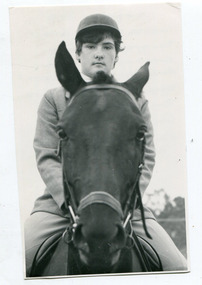
black and white photographs, Snowy River Mail, 1960s
... Some of the Orbost identities pictured include : Russell Crofts, Kevin McDonald, Brian McDonald, Gail & Lee Winchester, Julie & Lisa Drummond, Marion Russell, Sylvia MurrayRod Kleinitz, Rober Morgan, Trevor Perry, Brian Woodlands, anna light, Louella Brunt, Colin Weir, Wendy Pinnock, Raeleen Reed, Margaret Joiner and Jo-anne Mundy. The first meeting to form an Agricultural society in Orbost was convened by the then Orbost Progress Association and held in the Mechanics Hall on Saturday, 10th October 1891. Its first show was held on 3rd March 1904...on a site alongside the Bonang Road...Some of the Orbost identities pictured include : Russell Crofts, Kevin McDonald, Brian McDonald, Gail & Lee Winchester, Julie & Lisa Drummond, Marion Russell, Sylvia MurrayRod Kleinitz, Rober Morgan, Trevor Perry, Brian Woodlands, anna light, Louella Brunt, Colin Weir, Wendy Pinnock, Raeleen Reed, Margaret Joiner and Jo-anne Mundy. The first meeting to form an Agricultural society in Orbost was convened by the then Orbost Progress Association and held in the Mechanics Hall on Saturday, 10th October 1891. Its first show was held on 3rd March 1904...on a site alongside the Bonang Road ...These photographs were taken at the annual Orbost Agricultural Show at the Newmerella Showground. They were probably published in the Snowy River Mail newspaper. Some of the Orbost identities pictured include : Russell Crofts, Kevin McDonald, Brian McDonald, Gail & Lee Winchester, Julie & Lisa Drummond, Marion Russell, Sylvia MurrayRod Kleinitz, Rober Morgan, Trevor Perry, Brian Woodlands, anna light, Louella Brunt, Colin Weir, Wendy Pinnock, Raeleen Reed, Margaret Joiner and Jo-anne Mundy. The first meeting to form an Agricultural society in Orbost was convened by the then Orbost Progress Association and held in the Mechanics Hall on Saturday, 10th October 1891. Its first show was held on 3rd March 1904...on a site alongside the Bonang Road where the present Golf Club stands. It is currently held at the Recreation Reserve at Newmerella. (Ref: In Times Gone By-Deborah Hall)These photographs are associated with the Orbost Agricultural Society 's Annual Show which has been a major event in Orbost for over a century. Agricultural shows are an important part of cultural life in small country towns and the Orbost Show is an integral part of Orbost 's agricultural history. Seventeen black / white phootgraphs which were taken at the Orbost Agricultural Show.orbost-agricultural-show
