
Showing 13 items matching "wodonga racing club"
-
 Wodonga & District Historical Society Inc
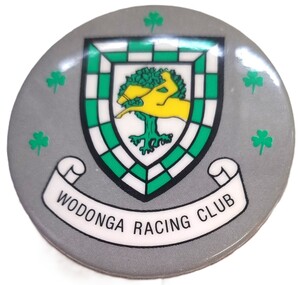
Badge - Wodonga Racing Club
... Wodonga Racing Club ...Wodonga Racing Club ...Wodonga Racing Club...Wodonga Racing club and Wodonga Citizens Racing club amalgamated to become Wodonga Turf Club in November 1901. ...A small metal and plastic badge featuring the emblem of the Wodonga Racing Club. It features a green and white shield on a grey background. ...Wodonga Racing Club...Wodonga Racing club and Wodonga Citizens Racing club amalgamated to become Wodonga Turf Club in November 1901. ...Wodonga Racing club and Wodonga Citizens Racing club amalgamated to become Wodonga Turf Club in November 1901. The Club has operated continuously since then apart from a period during World War II when the racecourse was taken over by the military. During its history the Club has operated under three main names: the Wodonga Racing Club from the1850s until 1901, the Wodonga Turf Club from1901 and the Wodonga & District Turf since 1983. For some traditional events and marketing the name “Wodonga Racing Club” was used. This badge was produced for the Wodonga Racing Club (officially the Wodonga Turf Club) St Patrick’s Day Race meet. It is undated which allowed the Club to use the same design for several years. The celluloid badge design suggests it was produced in the late 1950s until the 1970s. St Patrick’s Day was a highly celebrated event on the racing calendar. The very first horse race specifically organized as a dedicated St. Patrick's Day charity meeting in Wodonga was held on Wednesday, March 17, 1909. In order to secure an annual fixture on the racing calendar the Wodonga St. Patrick's Racing Club was formalised in 1920 and the race became an annual fixture in 1921. It was specifically created to run as an annual charity race day. For over 70 years, the proceeds generated from the gate admissions and the sale of badges such as this went toward supporting local community assets, most notably St. Augustine’s Parish School funds. The last formal horse racing event held under the banner of the Wodonga St. Patrick’s Race Club took place on Sunday, March 5, 2000 This badge is significant because it represents a local Wodonga racing event held to raise funds for St Augustine's Parish School. The event was conducted for over 70 years.A small metal and plastic badge featuring the emblem of the Wodonga Racing Club. It features a green and white shield on a grey background. The background is scattered with green shamrocks. The shield includes a yellow horse and rider in front of a green tree silhouette.Wodonga Racing Clubwodonga racing club, sport and leisure wodonga -
 Wodonga & District Historical Society Inc
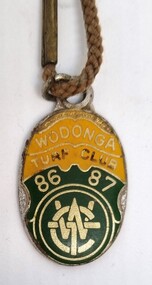
Functional object - Wodonga Turf Club Member's Badge, Perfection Badges, 1986
... , the Wodonga Racing Club, was founded in 1873. In 1901 it was renamed as the Wodonga Federal Racing Club. ..., the Wodonga Racing Club, was founded in 1873. In 1901 it was renamed as the Wodonga Federal Racing Club. ...The first race meetings took place in Wodonga as early as 1859, when there was an annual three-day race meeting known as the Belvoir annual races. More regular racing in Wodonga dates back to 1870. The first formal race club, the Wodonga Racing Club, was founded in 1873. In 1901 it was renamed as the Wodonga Federal Racing Club. In May 1901, the Wodonga Amateur Turf Club was formed. Also in 1901, on 3rd July, another body, the Wodonga Citizens’ Race Club was formed with a view to satisfying a demand for winter racing. At a meeting at the Wodonga Council Chambers in October 1901, it was decided, seemingly by an unanimous vote, that the three Wodonga race clubs then in existence would amalgamate to form the Wodonga Turf Club. A small oval badge showing member details. The front has been enamelled, primarily in green and golf. It bears the Wodonga Turf Club logo and the date in gold paint. It has been attached to a cord through the metal eyelet at the top.On front: Wodonga Turf Club/ 86 87 On back: Member 23 / NOT TRANSFERABLE / PERFECTION SYDNEY 770775wodonga turf club, sport and leisure wodonga, wodonga turf club membership -
 Wodonga & District Historical Society Inc
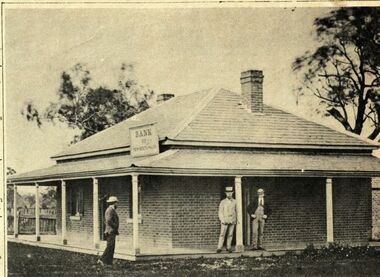
Photograph - Bank of New South Wales, Wodonga
... Organisations banking at the branch included Wodonga Building Society, 1873; Wodonga Mechanics Institute 1875; Wodonga Band Fund 1882; Talgarno Athenaeum, 1888; Talgarno Butter & Cheese Factory 1892; Wodonga Federation League 1893; Wodonga Brass Band 1895; Wodonga Benevolent Society 1895; Wodonga Fire Brigade 1897; Wodonga Rifle Club and Wodonga Racing Club in 1899 and Kiewa Polo Club in 1900. ...Organisations banking at the branch included Wodonga Building Society, 1873; Wodonga Mechanics Institute 1875; Wodonga Band Fund 1882; Talgarno Athenaeum, 1888; Talgarno Butter & Cheese Factory 1892; Wodonga Federation League 1893; Wodonga Brass Band 1895; Wodonga Benevolent Society 1895; Wodonga Fire Brigade 1897; Wodonga Rifle Club and Wodonga Racing Club in 1899 and Kiewa Polo Club in 1900. ...The first Bank of New South Wales building in Wodonga was located in a small cottage. The branch opened on 7 May 1872. At first it was conducted as an agency of the Beechworth branch. In October 1872 premises in Sydney road were purchased from Mr P. L. M. S. Chauncy for £650. When the bank commenced in the cottage the first account was opened in the name of Hillerman & Co, storekeepers, Wodonga. Another early account was in the name of William Huon, squatter of de Kerilleau, Wodonga. On 9 July 1873, the agency was converted into full branch under the management of Mr. Joseph Belcher. Other early accounts included Cronin & Callaghan, storekeepers; John Bassett Jnr, shoemaker; John Jennings, contractor; Ah Soon, tobacco grower, Kergunyah; John de Corney Ireland, collector of customs; Andrew Kyle, fellmonger; Rowan Lockhead, accountant; Alexander McKay, publican; George Pollard, farmer; Thomas Street, farmer; and Edmund Uren, gentleman, Buninyong. Organisations banking at the branch included Wodonga Building Society, 1873; Wodonga Mechanics Institute 1875; Wodonga Band Fund 1882; Talgarno Athenaeum, 1888; Talgarno Butter & Cheese Factory 1892; Wodonga Federation League 1893; Wodonga Brass Band 1895; Wodonga Benevolent Society 1895; Wodonga Fire Brigade 1897; Wodonga Rifle Club and Wodonga Racing Club in 1899 and Kiewa Polo Club in 1900. There were also numerous lodge and church accounts. The cottage was later renovated with a porch added in 1889 and an extension to the residence in 1898. The original house was eventually demolished to make way for a new bank and manager’s residence in Sydney Road in 1906. That building was again remodelled in 1969. It became a branch of the WESTPAC bank when the Bank of NSW and CBA Bank joined to become the Westpac Banking Corporation in 1982. After the building ceased operation as a bank, it has been the home to several businesses including a video store, a travel agency and a clothing store.These images have local significance as they record changes to a building which filled an important role in the commercial life of Wodonga.A series of photos both black and white and coloured which document changes in the former Bank of New South Wales building in Wodonga over time.Photo 1: On sign above verandah "BANK of NEW SOUTH WALES" Photo 2: On sides of building and above door: "BANK OF NEW SOUTH WALES" Photo 3: Above door: "HIRE/ VIDEO MADNESS/ SALES" Photo 4: Above door: "WODONGA TRAVEL"wodonga businesses, banking wodonga, bank nsw wodonga, businesses high street wodonga -
 Wodonga & District Historical Society Inc
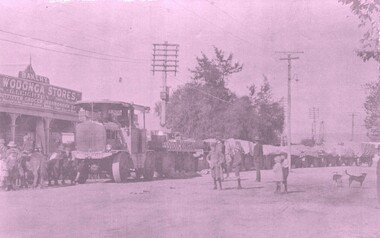
Photograph - Falkiner Electric Road Train in front of George Leighton's Wodonga Store and Bakery Wodonga 1914
... His other involvements including being a Founder of the Wodonga Lodge of Freemasons, Honorary Treasurer of the Wodonga Bulldogs Football Club and Secretary of the Wodonga Racing Club. ...His other involvements including being a Founder of the Wodonga Lodge of Freemasons, Honorary Treasurer of the Wodonga Bulldogs Football Club and Secretary of the Wodonga Racing Club. Mr Leighton passed away in Wodonga in 1916. ...This image of the Ralph Falkiner’s Mueller Petrol-Electric Road Train was taken in Wodonga in February 1914. Imported from Germany by Mr Ralph S Falkiner in late 1913, the train’s inventor, Major W A Mueller with two assistants, came to Melbourne to assemble then commission the train. The train cost Mr Falkiner about £13,000 plus £4,591 import duties. The Falkiner family were sheep breeders in the Western Riverina and he hoped to use the road train primarily to convey wool to the railways for despatch to Sydney. The train was 216 feet long, weighed 43.5 tons with a top speed loaded of 6-8m/h and petrol consumption up to two gallons per mile. Its first Australian journey was to haul 50 tons of cargo to Edmondson & Co at Wagga Wagga, 277 miles away. The journey from Melbourne was plagued with problems including broken cylinders and crank shaft and overheating as it was not designed for Australian climatic conditions. Three months after leaving Melbourne it arrived in Wodonga. A series of problems between Springhurst and Wodonga, including broken cylinders and valves caused an eight day delay. Some of the cargo was off-loaded in Albury, then after repairs the train continued on to Wagga where it arrived in May 1914. After unloading there, the road train was taken to Mr Falkiner's Groongal Station, near Hay and subsequently made several long trips into drought-stricken areas or the Western Riverina. Eventually the dream collapsed when the engines gave out after the train bogged in the sticky black soil of the Hay plain with 251 bales of wool on board. The train was finally railed back to Melbourne and stored but destroyed when the warehouse burnt down. In this photo, the road train is drawn up outside the Wodonga Stores and Bakery owned and operated by George Leighton. Mr Leighton began his business opposite the Terminus Hotel in Sydney Street, Wodonga in 1885. His business included a general store, stocking groceries, ironmongery, drapery, crockeryware, boots and shoes as well as a bakery. He was very actively involved in the community and served on the Wodonga Council for 18 years including three terms as Wodonga Shire President in 1901 – 02, 1910-11 and 1913-14. He was also Chairman of the Wodonga Waterworks Trust for several terms. Mr. Leighton also took a prominent part in the movement to establish a Public Library in Wodonga. His other involvements including being a Founder of the Wodonga Lodge of Freemasons, Honorary Treasurer of the Wodonga Bulldogs Football Club and Secretary of the Wodonga Racing Club. Mr Leighton passed away in Wodonga in 1916.This image is significant because it records a rare event in Wodonga and an experiment in Australian road transport.Black and white images of the Falkiner Road Train in Wodonga and on its first journey from Melbourne to Wagga, NSW It is taken in front of the Wodonga Stores and Bakery operated by George Leighton in Sydney Street, Wodonga.falkiner electric train, early road transport, high street wodonga, george leighton -
 Wodonga & District Historical Society Inc
Negative - Haeusler Glass Negatives Collection - Merry-go-round - A. Weniger's Steam Carousel
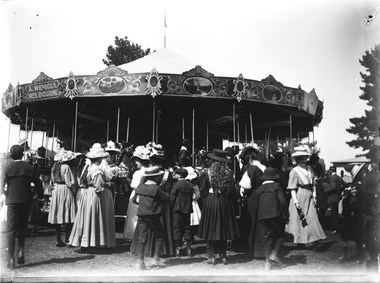
... They featured at events such as Empire Day and Arbor Day celebrations as well as the Wodonga Racing Club meetings, Wodonga Agricultural Shows and Victory Day celebrations at the end of World War 11. ...They featured at events such as Empire Day and Arbor Day celebrations as well as the Wodonga Racing Club meetings, Wodonga Agricultural Shows and Victory Day celebrations at the end of World War 11. ...This digital image was produced from one of the glass negatives that form part of the collection, probably taken by Louis Haeusler (b.1887) with the photographic equipment in the Wodonga Historical Society Haeusler Collection. Merry-Go-Rounds or Carousels were a popular entertainment accompanying many celebrations and events in Albury and Wodonga from as early as the mid 1870s. They featured at events such as Empire Day and Arbor Day celebrations as well as the Wodonga Racing Club meetings, Wodonga Agricultural Shows and Victory Day celebrations at the end of World War 11. They were operated by a variety of travelling showmen and entrepreneurs. Early merry-go-rounds were steam powered. The merry-go-round in this negative was owned by Anton Weniger of Melbourne. From 1909, Mr Weniger operated a shooting gallery and Steam Riding Gallery on the Lower Esplanade, St. Kilda on land he had leased in 1909 from the St. Kilda Foreshore Trust. Weniger also took his carousels by train to many rural areas, including several visits to Albury, Yarrawonga and Benalla. His largest carousel was designed and built in Melbourne by Herbert Thomson in 1915. It has now been restored and has been on show as the Civic Carousel in Canberra, ACT since 1974. Anton Weniger’s steam merry-go-round was definitely in the Albury- Wodonga area in September 1912. As reported in the Border Morning Mail on Saturday 2 November 1912, Mr. Weniger was the victim of a robbery which included some money and his gold watch and chain, stolen from a railway truck in the Wodonga railway yards. The riding gallery and other belongings had been placed on the truck in Albury after the Albury show and sent on to Wodonga in transit to Wangaratta. Whilst in the Wodonga yards the truck was broken into and the goods stolen. Two of Weniger’s former employees, Herbert Backhouse and Edmund Pressard were subsequently charged with the robbery and sentenced to respective sentences of 3 and 9 months imprisonment, both with hard labour. In January 1916, Weniger’s Steam Riding Gallery was attacked by a group of rioting soldiers as a result of rising anti-German sentiment with the onset of World War 1. As a result, Anton Weniger terminated his interest and lease of the Steam Riding Gallery to his partner, William George Kelly. Although he had lived in Victoria for over 25 years and had been a naturalised Australian for 20 years, Anton Weniger was interned for the duration of World War 1 as an enemy alien. Anton Johannes Matthias Weniger died on 14 August 1923 and is buried in the Brighton General Cemetery, Melbourne, Victoria.This item is unique and has well documented provenance and a known owner. It forms part of a significant and representative historical collection which reflects the local history of Wodonga. It contributes to our understanding of domestic and family life in early twentieth century Wodonga, as well as providing interpretative capacity for themes including local history and social history.Digital image created from the Haeusler Glass negative collection. A large group of people standing around a Merry-Go-Round.At top left of Merry-Go-Round "A.WENIGER./MELBOURNE"wodonga pioneers, haeusler family, glass negatives, dry plate photography, carousel, anton weniger -
 Wodonga & District Historical Society Inc
Photograph - Murray Valley Hunt Club opening, 1957
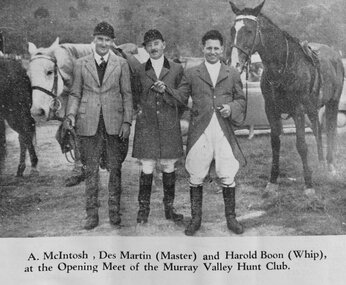
... Murray Valley Hunt Club’s formation stemmed from a conversation between Messrs Ken Crawford, then of "Nooroona", Holbrook, NSW and Des Martin of "Aherlo", Wodonga where they discussed bringing hunting to the people of the district around Wodonga and Albury in 1946. After participating in events and activities in New South Wales with other clubs, the Murray Valley Hunt Club began Point-to-Point racing...Murray Valley Hunt Club’s formation stemmed from a conversation between Messrs Ken Crawford, then of "Nooroona", Holbrook, NSW and Des Martin of "Aherlo", Wodonga where they discussed bringing hunting to the people of the district around Wodonga and Albury in 1946. After participating in events and activities in New South Wales with other clubs, the Murray Valley Hunt Club began Point-to-Point racing ...Murray Valley Hunt Club’s formation stemmed from a conversation between Messrs Ken Crawford, then of "Nooroona", Holbrook, NSW and Des Martin of "Aherlo", Wodonga where they discussed bringing hunting to the people of the district around Wodonga and Albury in 1946. After participating in events and activities in New South Wales with other clubs, the Murray Valley Hunt Club began Point-to-Point racing on "Aherlo" in 1957 at “Aherlo”, the property of Des Martin located on the outskirts of Wodonga in the Huon Creek Valley. Des Martin was the only gentleman rider with permission to ride against professional jockeys within the metropolitan area in any type of jumping race in Victoria, a distinction not since achieved by any other amateur. Des also played a major role in Australia entering an equestrian team in the Melbourne Olympics in 1956 and served as a steward at that event. The Hunt was officially formed with a steering committee of Messrs Crawford, J T Sullivan (Chairman of the North Eastern District Racing Association), Mr Des Martin, Harold Boon and John Hamilton-Smith. Miss Z Cox was appointed Honorary Secretary and Mr J C B Mckenzie McHarg Legal Officer. In 1960 the Hunt Club meets moved to Wodonga Racecourse then in 1967 wet conditions called for a move to Chiltern and in 1968 they successfully applied to re-open the Old Rutherglen Racecourse in 1969. Des Martin died on 12 April 1995. This photograph is significant because it captures key people responsible for the founding of the Murray Valley Hunt Club.A black and white photo of key identities at the opening of the Murray Valley Hunt ClubA. McIntosh , Des Martin (Master) and Harold Boon (Whip), at the Opening Meet of the Murray Valley Hunt Club.murray valley hunt club, des martin, harold boon -
 Wodonga & District Historical Society Inc
Decorative object - Brassware - St Augustines Church, Wodonga, T. Gaunt & Co, c1900
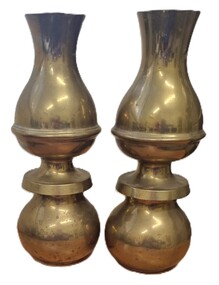
... Racing Club for whom he was official timekeeper. It displayed the time of a race to an accuracy of .25 of a second. Gaunt had strong beliefs and connection to the Catholic Church of supplied much of its ecclesiastical silver and brassware such as this item. After Thomas Gaunt died in 1890, his executors continued the business, which was renamed T. Gaunt & Co. in 1893. The company operated for almost a century before closing in 1960. These items are significant because they were used in an important Wodonga ...St Augustine’s Church, Wodonga The Roman Catholic religion first came to the Wodonga area with travelling clergymen in about 1843. It was not until 4th October that 1860 Bishop Goold of the Chiltern parish visited Wodonga and consecrated St. Francis Chapel, a small weatherboard building which was erected on the site of the present St Augustine’s Church. Wodonga was officially separated from the Chiltern parish in 1899. Father James Ryan became the first Parish Priest of St Augustine's and oversaw the construction of the new church. The present St. Augustine’s was blessed and opened on 27 April 1902. Between 1918–1919 under Father Francis Flynn, the church was extended, and significant features such as the marble altar and stained-glass windows were added. Major refurbishments were completed in 1927, including further extension of the primary school. T. Gaunt & Co. Thomas Gaunt arrived in Melbourne in about 1856. He was a trained clockmaker and opened a business in Bourke Street, later moving to The Royal Arcade. Although he also made and sold wrist watches, jewellery, silver and brassware, Thomas was possibly most well-known for a chronometer he donated to the Victorian Racing Club for whom he was official timekeeper. It displayed the time of a race to an accuracy of .25 of a second. Gaunt had strong beliefs and connection to the Catholic Church of supplied much of its ecclesiastical silver and brassware such as this item. After Thomas Gaunt died in 1890, his executors continued the business, which was renamed T. Gaunt & Co. in 1893. The company operated for almost a century before closing in 1960. These items are significant because they were used in an important Wodonga church.A set of four brass vases manufactured by T Gaunt & Co.Beneath each vase T. GAUNT & Co.church brassware, st augustine's church wodonga, t gaunt & co -
 Wodonga & District Historical Society Inc
Album - Ringer's River by Des Martin - Cast, Credits & Introduction
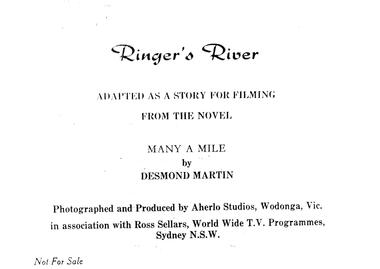
... In 1937 he joined the 8th Light Horse Regiment but in May 1940 led his Wodonga Troop into the 2/2nd Australian Pioneer Battalion, which saw service in Syria, Java, New Guinea and Borneo. After the war, Des returned to Aherlo and his horses. He was granted permission by the Victorian Racing Club...In 1937 he joined the 8th Light Horse Regiment but in May 1940 led his Wodonga Troop into the 2/2nd Australian Pioneer Battalion, which saw service in Syria, Java, New Guinea and Borneo. After the war, Des returned to Aherlo and his horses. He was granted permission by the Victorian Racing Club ...Des Martin lived all his life in Wodonga, except for his years of service during World War Two. He was raised on the family property Aherlo in the Huon Creek Valley. In 1937 he joined the 8th Light Horse Regiment but in May 1940 led his Wodonga Troop into the 2/2nd Australian Pioneer Battalion, which saw service in Syria, Java, New Guinea and Borneo. After the war, Des returned to Aherlo and his horses. He was granted permission by the Victorian Racing Club to participate as an amateur “gentleman” rider. He was a founder of the Victorian Amateur Riders Association and also the Murray Valley Hunt Club, for which he was Master for 21 years. He was a prolific writer, cartoonist, photographer and poet, contributing to The Border Morning Mail, The Age, and the Herald and Weekly Times amongst other publications. Des Martin’s other literary works included Australia Astride (1959), A Tale of Twin Cities, Part One (1981) and Backing up the Boys (1998). In 1976, Des wrote an historical novel, “Many a Mile”, based on a fictional region which highly resembled the Albury-Wodonga and Upper Murray area of Victoria. It was set in the last 10 years leading up to Federation. Throughout this period tensions (caused by fluctuating border duties, including an infamous impost on cattle and horses) occasioned the intermittent posting of heavily armed police detachments along the River Murray. Des also wrote eight 50-minute scripts from “Many a Mile” as a television series and were presented to Michael Pate, one of Australia’s leading actors and producers. Also, funding was sought through the Australian Broadcasting Commission ... unfortunately the series never came to fruition. This album is a pictorial precis, including photos and scene descriptions, created to promote the concept of the series and have it produced locally in North Eastern Victoria featuring local settings, skilled horsemen and actors. It was to be called “Ringer’s River” ... Ringer being the title accorded to either a top cattle hand, or the fastest shearer in the wool shed. Des Martin died on 12th April 1995.These albums and images are significant because they document literature written by a prominent member of the Wodonga community. The presentation of this precis was supported by several significant district families and individuals.Documents written to introduce the concept of "Ringer's River" to gain interest for the development of a television seriesdes martin, many a mile, ringer's river, northeast victoria stories -
 Wodonga & District Historical Society Inc
Book - Bound Manuscript - Many a Mile, Des Martin, 1975
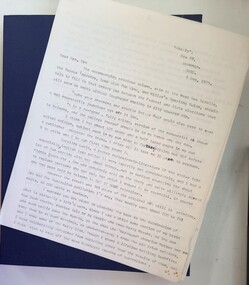
... Wodonga Troop into the 2/2nd Australian Pioneer Battalion, serving in Syria, Java, New Guinea and Borneo. After the war, Des returned to Aherlo and his horses. Amongst other pursuits he became the first President of the Victorian Amateur Riders Association and founded the Murray Valley Hunt Club. Des also played a major role in Australia entering an equestrian team in the Melbourne Olympics in 1956 and served as a Steward at that event. As well as “Many a Mile”, Des also wrote “Australia Astride” in 1959, a history of the Albury Racing...Wodonga Troop into the 2/2nd Australian Pioneer Battalion, serving in Syria, Java, New Guinea and Borneo. After the war, Des returned to Aherlo and his horses. Amongst other pursuits he became the first President of the Victorian Amateur Riders Association and founded the Murray Valley Hunt Club. Des also played a major role in Australia entering an equestrian team in the Melbourne Olympics in 1956 and served as a Steward at that event. As well as “Many a Mile”, Des also wrote “Australia Astride” in 1959, a history of the Albury Racing ...This manuscript and letter represent the connection between two significant people from the North East of Victoria and their common interest in literature and development of the Upper Murray. Des Martin was raised on the family property Aherlo in the Huon Creek Valley. He joined the 8th Light Horse Regiment and in May 1940 led his Wodonga Troop into the 2/2nd Australian Pioneer Battalion, serving in Syria, Java, New Guinea and Borneo. After the war, Des returned to Aherlo and his horses. Amongst other pursuits he became the first President of the Victorian Amateur Riders Association and founded the Murray Valley Hunt Club. Des also played a major role in Australia entering an equestrian team in the Melbourne Olympics in 1956 and served as a Steward at that event. As well as “Many a Mile”, Des also wrote “Australia Astride” in 1959, a history of the Albury Racing Club – a Century of Racing and a “Tale of Twin Cities” as well as collaborating with R. M. Williams to develop the “Hoofs and Horns” publication. From 1969 to 1973, Des Martin also wrote a column for the Border Mail newspaper. Des Martin died on 12th April 1995. Thomas Walter Mitchell was born at "Towong Hill" near Corryong, Victoria and was educated at Cranbrook School, Sydney and Cambridge University. A keen skier, Mitchell founded the Australian National Ski Federation, captained the Australian skiing team and won gold medals in competitions against England and New Zealand. He was an Australian champion in the downhill and long-time member of the Ski Club of Australia. In 1937 he published Australia’s first ski handbook "Ski Heil". Mitchell joined the Second Australian Imperial Force in 1940 and was a Captain in the 2/22nd Battalion and Headquarters 8th Division. He was captured and interned in Changi POW camp until 1945. Tom Mitchell served as the Country Party Member for Benambra in the Victorian Legislative Assembly from 1947 to 1976. He was awarded the C.M.G. “For distinguished services to the Community, particularly in the fields of Politics, Alpine Sports and Safety, and Writing.” He died on 4th February 1984. This volume is significant because it is the manuscript of a book written by a local Wodonga author. The letter written to Tom Mitchell contains anecdotes and details of the writing of the novel, Many a Mile.An original typed manuscript bound in blue coverboard. It is accompanied by a typed letter.des martin, tom mitchell, many a mile -
 Wodonga & District Historical Society Inc
Photograph - Des Martin and his horse
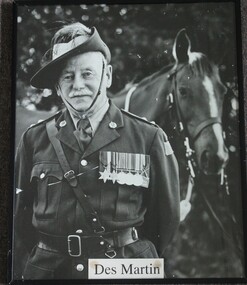
... Wodonga Troop into the 2/2nd Australian Pioneer Battalion. This Battalion saw service in Syria, Java, New Guinea and Borneo. After the war, Des returned to Aherlo and his horses. He was granted permission by the Victorian Racing Club...Racing Club – a Century of Racing, and an historical novel “Many a Mile”. He collaborated with R. M. Williams to develop “Hoofs and Horns” to become a national publication. From 1969 to 1973, Des Martin also wrote a column for the Border Mail newspaper. He was also a member of the RSL for almost 50 years and held several committee positions during that time. Des Martin died on 12 April 1995. This is a portrait of a significant member of the Wodonga ...This image is one from a series of portraits taken by Rob Elliott to record the character of the Border District through the faces if its identities. Des Martin lived all his life in Wodonga, except for his years of service during World War Two. He was raised on the family property Aherlo in the Huon Creek Valley. In 1937 he joined the 8th Light Horse Regiment but in May 1940 led his Wodonga Troop into the 2/2nd Australian Pioneer Battalion. This Battalion saw service in Syria, Java, New Guinea and Borneo. After the war, Des returned to Aherlo and his horses. He was granted permission by the Victorian Racing Club to participate as an amateur “gentleman” rider. He became the first president of the Victorian Amateur Riders Association and founded the Murray Valley Hunt Club. Des also played a major role in Australia entering an equestrian team in the Melbourne Olympics in 1956 and served as a steward at that event. Des also wrote several publications including “Australia Astride” in 1959, a history of the Albury Racing Club – a Century of Racing, and an historical novel “Many a Mile”. He collaborated with R. M. Williams to develop “Hoofs and Horns” to become a national publication. From 1969 to 1973, Des Martin also wrote a column for the Border Mail newspaper. He was also a member of the RSL for almost 50 years and held several committee positions during that time. Des Martin died on 12 April 1995.This is a portrait of a significant member of the Wodonga community who made an outstanding contribution as a farmer, soldier, horseman, author and member of the RSL and other community organisations.A black and white photograph of Des Martin in military uniform with his horse. The photo has been mounted in a metal frame.des martin, murray valley hunt club, 2/2nd australian pioneer battalion, albury racing club -
 Wodonga & District Historical Society Inc
Photograph - Des Martin mounted on his horse, 1986
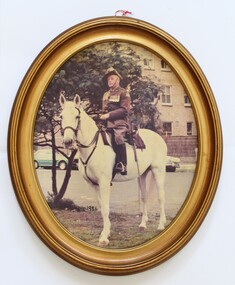
... Wodonga Troop into the 2/2nd Australian Pioneer Battalion. This Battalion saw service in Syria, Java, New Guinea and Borneo. After the war, Des returned to Aherlo and his horses. He was granted permission by the Victorian Racing Club...Racing Club – a Century of Racing, and an historical novel “Many a Mile”. He collaborated with R. M. Williams to develop “Hoofs and Horns” to become a national publication. From 1969 to 1973, Des Martin also wrote a column for the Border Mail newspaper. He was also a member of the RSL for almost 50 years and held several committee positions during that time. Des Martin died on 12 April 1995. This is a portrait of a significant member of the Wodonga ...This image was taken in Melbourne on Anzac Day 1986 where Des had taken place in the annual parade. The photo itself has had a long journey. It was donated to the Star Hotel in Yackandandah, Victoria by Des Martin in 1994. The hotel changed hands so many times that the custodian "Pip" Beatty felt it was best placed at the Light Horse Museum at Bandiana, Victoria. Its journey was complete when the photo was returned to the Wodonga Historical Society. Des Martin lived all his life in Wodonga, except for his years of service during World War Two. He was raised on the family property Aherlo in the Huon Creek Valley. In 1937 he joined the 8th Light Horse Regiment but in May 1940 led his Wodonga Troop into the 2/2nd Australian Pioneer Battalion. This Battalion saw service in Syria, Java, New Guinea and Borneo. After the war, Des returned to Aherlo and his horses. He was granted permission by the Victorian Racing Club to participate as an amateur “gentleman” rider. He became the first president of the Victorian Amateur Riders Association and founded the Murray Valley Hunt Club. Des also played a major role in Australia entering an equestrian team in the Melbourne Olympics in 1956 and served as a steward at that event. Des also wrote several publications including “Australia Astride” in 1959, a history of the Albury Racing Club – a Century of Racing, and an historical novel “Many a Mile”. He collaborated with R. M. Williams to develop “Hoofs and Horns” to become a national publication. From 1969 to 1973, Des Martin also wrote a column for the Border Mail newspaper. He was also a member of the RSL for almost 50 years and held several committee positions during that time. Des Martin died on 12 April 1995.This is a portrait of a significant member of the Wodonga community who made an outstanding contribution as a farmer, soldier, horseman, author and member of the RSL and other community organisations.A coloured photograph of Des Martin in full military uniform mounted on his horse. The photo has been mounted in an oval wooden frame.des martin, murray valley hunt club, 2/2nd australian pioneer battalion, albury racing club -
 Wodonga & District Historical Society Inc
Booklet - History of Wodonga and District Turf Club 1871 - 2003, Colin Hore
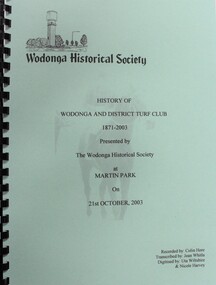
... racing Wodonga...Wodonga Turf Club..., the Wodonga Racing Club, was founded in 1873. In 1901 it was renamed as the Wodonga Federal Racing Club. ...A history of the Wodonga Turf Club produced and presented to the community in 2003. The first race meetings took place in Wodonga as early as 1859, when there was an annual three-day race meeting known as the Belvoir annual races. More regular racing in Wodonga dates back to 1870. The first formal race club, the Wodonga Racing Club, was founded in 1873. In 1901 it was renamed as the Wodonga Federal Racing Club. In May 1901, the Wodonga Amateur Turf Club was formed. Also in 1901, on 3rd July, another body, the Wodonga Citizens’ Race Club was formed with a view to satisfying a demand for winter racing. At a meeting at the Wodonga Council Chambers in October 1901, it was decided, seemingly by an unanimous vote, that the three Wodonga race clubs then in existence would amalgamate to form the Wodonga Turf Club. This publication documents key events and personalities involved in the development of racing in Wodonga since that time until 2003.non-fiction A history of the Wodonga Turf Club produced and presented to the community in 2003. The first race meetings took place in Wodonga as early as 1859, when there was an annual three-day race meeting known as the Belvoir annual races. More regular racing in Wodonga dates back to 1870. The first formal race club, the Wodonga Racing Club, was founded in 1873. In 1901 it was renamed as the Wodonga Federal Racing Club. In May 1901, the Wodonga Amateur Turf Club was formed. Also in 1901, on 3rd July, another body, the Wodonga Citizens’ Race Club was formed with a view to satisfying a demand for winter racing. At a meeting at the Wodonga Council Chambers in October 1901, it was decided, seemingly by an unanimous vote, that the three Wodonga race clubs then in existence would amalgamate to form the Wodonga Turf Club. This publication documents key events and personalities involved in the development of racing in Wodonga since that time until 2003.horse racing wodonga, wodonga turf club, country horse racing victoria -
 Wodonga & District Historical Society Inc
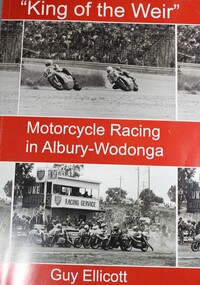
Book - King of the Weir - Motorcycle Racing in Albury Wodonga, Guy Ellicott, 2018
... albury-wodonga motorcycle club...motorcycle racing...hume weir circuit albury-wodonga motorcycle club motorcycle racing motor sports albury “King of the Weir” documents motorcycle racing in the Albury Wodonga region which has a rich history dating back to the 1920’s when speedway was king. ...“King of the Weir” documents motorcycle racing in the Albury Wodonga region which has a rich history dating back to the 1920’s when speedway was king. Speedway gave way to scrambles, and then tarmac racing on aerodromes, army bases and circuits. The Hume Weir circuit held the “King of the Weir” race for ten years attracting such riders as Ron Toombs, Greg Hansford, Murray and Jeff Sayle, and Kenny Blake. Overseas champions Jim Redman, Tom Phillis, Geoff Duke, Bill Lomas and Dickie Dale came to do battle with the locals in the 50’s and 60’s.non-fiction“King of the Weir” documents motorcycle racing in the Albury Wodonga region which has a rich history dating back to the 1920’s when speedway was king. Speedway gave way to scrambles, and then tarmac racing on aerodromes, army bases and circuits. The Hume Weir circuit held the “King of the Weir” race for ten years attracting such riders as Ron Toombs, Greg Hansford, Murray and Jeff Sayle, and Kenny Blake. Overseas champions Jim Redman, Tom Phillis, Geoff Duke, Bill Lomas and Dickie Dale came to do battle with the locals in the 50’s and 60’s.hume weir circuit, albury-wodonga motorcycle club, motorcycle racing, motor sports albury
