
Showing 1322 items matching "women's histories"
-
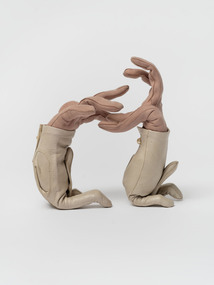 Wyndham Art Gallery (Wyndham City Council)
Sculpture - #59 (trust fall duo), Hannah Gartside, 2015
... ...Women's histories...Textile art Fabric sculpture Soft sculpture Installation art Contemporary sculpture Feminism Women's histories Embodiment The body Sculpture #59 (trust fall duo) Sculpture #59 (trust fall duo) Hannah Gartside ...In this nest of bunnies fashioned from gloves, it’s as if Hannah Gartside has bundled the world’s most tender feelings and given them aesthetic form through droopy ears, leather pot bellies, sweetly curved behinds, comically suggestive poses. Through Bunnies in Love, Lust and Longing, Gartside has taken second-hand leather gloves from the 1950s and 60s, some as early as the 1910s, and curved these once-worn textiles over steel armature, bending animal pelt into warm, playful, living beings. Tiarney Miekus, 2025 textile art, fabric sculpture, soft sculpture, installation art, contemporary sculpture, feminism, women's histories, embodiment, the body, sculpture -
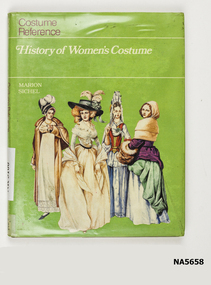 Whitehorse Historical Society Inc.
Book - History of Women's Costume, The Anchor Press Ltd, 1984
... History of Women's Costumes - covers ancient Greek/Roman/Britain/Saxons/Normans, spans from 12th to twentieth centuries. ...Hard cover book "History of Women's Costume" by Marion Sichel. Green background on cover with four drawings of models in historic costumes....Costume Reference History of Women's Costume Marion Sichel...Historic costumes Costume Reference History of Women's Costume Marion Sichel Hard cover book "History of Women's Costume" by Marion Sichel. ...History of Women's Costumes - covers ancient Greek/Roman/Britain/Saxons/Normans, spans from 12th to twentieth centuries. Costumes for various types of occasions, including headwear, handbags and shoes.Hard cover book "History of Women's Costume" by Marion Sichel. Green background on cover with four drawings of models in historic costumes.Costume Reference History of Women's Costume Marion Sichelhistoric costumes -
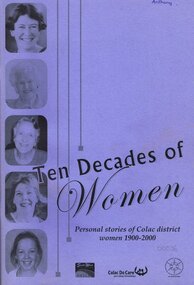 Otway Districts Historical Society
Book, Colac Herald Press, Ten Decades of Women, 2005
... A Women's History Month 2005 project recording the stories of 'ordinary' women born between 1900-2000 from the Colac region in south-west Victoria, Australia....A Women's History Month 2005 project recording the stories of 'ordinary' women born between 1900-2000 from the Colac region in south-west Victoria, Australia. colac district; women; Ten decades of women. ...A Women's History Month 2005 project recording the stories of 'ordinary' women born between 1900-2000 from the Colac region in south-west Victoria, Australia.Ten decades of women. Personal stories of Colac district women 1900-2000. Margaret Evans. Merrill O'Donnell. Kerri Bauer. 1st ed. Colac (Vic); Colac Herald; 2005. iv, 100 p.; illus. Soft cover.colac district; women; -
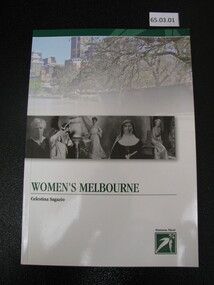 Queen Victoria Women's Centre
Book, National Trust, Women's Melbourne, 2010
... Written to provide a 'walking tour guide' of Melbourne Women's History. Project supported by the City of Melbourne writing about Melbourne Arts Grant Program. ...Written to provide a 'walking tour guide' of Melbourne Women's History. Project supported by the City of Melbourne writing about Melbourne Arts Grant Program. ...Written to provide a 'walking tour guide' of Melbourne Women's History. Project supported by the City of Melbourne writing about Melbourne Arts Grant Program. Project supported by Heritage Victoria Heritage Grants project and Helen McPherson Smith Trust. 96 pages. Cardboard cover with colour and black and white images. Accent of green throughout. Inside pages are paper with black ink, green accents and colour images throughout. women historic sites, historic sites, historic buildings, cultural structures and establishments -
 Queen Victoria Women's Centre
CD-Rom, Victorian Women Vote, c. 2008
... white matte finish CD-rom on which is a visual presentation of the history of Women's participation in democracy in Victoria...Videos sufferage feminist movement voting white matte finish CD-rom on which is a visual presentation of the history of Women's participation in democracy in Victoria Victorian Women Vote CD-Rom ...white matte finish CD-rom on which is a visual presentation of the history of Women's participation in democracy in Victoriavideos, sufferage, feminist movement, voting -
 Eltham District Historical Society Inc
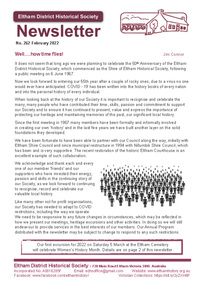
Journal - Newsletter, Newsletter, No. 262 Februray 2022, Feb 2022
... By Jim Connor • Heritage Excursion – Eltham Cemetery – Saturday 5 March 2022, Women’s History Month • Park On Hill Crest (The Herald 5 Feb 1925) • Eltham Licensing Meeting (The Argus 17 December 1883) • That was then …. ...By Jim Connor • Heritage Excursion – Eltham Cemetery – Saturday 5 March 2022, Women’s History Month • Park On Hill Crest (The Herald 5 Feb 1925) • Eltham Licensing Meeting (The Argus 17 December 1883) • That was then …. ...Contents: • Well…..how time flies! By Jim Connor • Heritage Excursion – Eltham Cemetery – Saturday 5 March 2022, Women’s History Month • Park On Hill Crest (The Herald 5 Feb 1925) • Eltham Licensing Meeting (The Argus 17 December 1883) • That was then …. By Liz Pidgeon • Local Road and Street Names by Russell Yeoman • Eltham Races (The Argus 15 December 1855) • A 1863 halfpenny! By Calum Ryan • Frederick Edward Falkiner (1820-1881) by Peter Pidgeon • Contacts for the Eltham District Historical Society The Shire of Eltham Historical Society was formed in October 1967. The first newsletter of the Society was issued May 1978 and has been published continuously ever since on a bi-monthly basis. With the cessation of the Shire of Eltham in late 1994, the Society's name was revised to Eltham District Historical Society and this name first appeared with issue No. 103, July 1995. The collection of the Society's newsletters provides a valuable resource on the history of the Society's activities, office bearers and committee members, guest speakers and subjects of historical interest pertinent to the former Shire of Eltham and the Eltham District.A4 newsletter distributed to members (Digital and A4 photocopy)newsletter, eltham district historical society, covid-19, coronavirus pandemic -
 Ringwood and District Historical Society
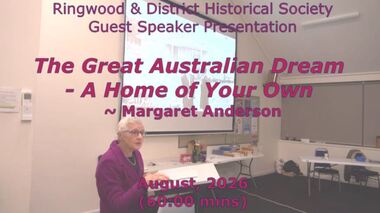
Mixed media - Video, RDHS Guest Speaker Presentation - "The Great Australian Dream - A Home of Your Own" - Margaret Anderson
... Margaret researches and writes on women’s history, the history and demography of the family and on aspects of public history and museums. ...Margaret researches and writes on women’s history, the history and demography of the family and on aspects of public history and museums. ...Digitised video (2.65GB) Duration: 60 minutes. Recorded August, 2026 (Video is available for viewing at Ringwood & District Historical Society Archives by appointment)In this presentation, Margaret Anderson reflects on the highs and lows of home building in Victoria, from boarded-up streets in the Great Depression, through the acute shortages of the post-war years, to the peak of home ownership during the 'long boom' of the 1960s and how homes have changed over the years, from the outside laundry and toilet to the ensuite bathroom and more. RHSV Council Website Extract, 2026: "Margaret Anderson - Margaret Anderson joined the Council of the RHSV in 2016. Margaret researches and writes on women’s history, the history and demography of the family and on aspects of public history and museums. She has held senior positions as a public historian in South Australia, Western Australia and Victoria, and is currently Director of the Old Treasury Building, Melbourne. She is a Fellow of the Federation of Australian Historical Societies and a member of the Board of the History Council of Victoria." -
 Geelong Cycling Club
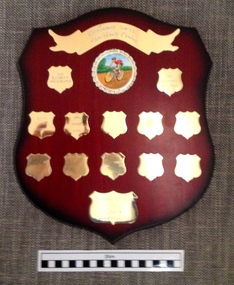
Wooden Shield, 2001
... This shield has an important place in the history of women in cycling. ...This shield has an important place in the history of women in cycling. This shield recognises the emergence of women in cycling. geelong west cycling club; katherine neuschafer; danni hudgell; natalie clark; brittany foster; senior women road aggregate; "Geelong West Cycling Club/2001/Kathryn Neuschafer/2002/Katherine Neuschafer/2003/Danni Hudgell/2004/Natalie Clark/2005/Brittany Foster/ 2006/Brittany Foster/ Senior Women/Road/Aggregate" A mahogany coloured wooden shield with brass plated plaques containing inscriptions of winners of the senior women road aggregate during the years 2001-2006. ...This shield has an important place in the history of women in cycling. This shield recognises the emergence of women in cycling.A mahogany coloured wooden shield with brass plated plaques containing inscriptions of winners of the senior women road aggregate during the years 2001-2006. There is an emblem of a cyclist and a banner at the top centre of the shield."Geelong West Cycling Club/2001/Kathryn Neuschafer/2002/Katherine Neuschafer/2003/Danni Hudgell/2004/Natalie Clark/2005/Brittany Foster/ 2006/Brittany Foster/ Senior Women/Road/Aggregate"geelong west cycling club; katherine neuschafer; danni hudgell; natalie clark; brittany foster; senior women road aggregate; -
 Orbost & District Historical Society
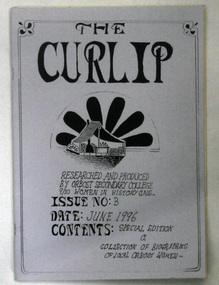
books, The Curlip No. 3, June 1996
... orbost-history-women biographies orbost-secondary-college...This book was researched and produced by Orbost Secondary College 9/10 Women in History Class. It is a collection of biographies of loacl Orbost women. ...This book was researched and produced by Orbost Secondary College 9/10 Women in History Class. It is a collection of biographies of loacl Orbost women. ...This book was researched and produced by Orbost Secondary College 9/10 Women in History Class. It is a collection of biographies of loacl Orbost women. The book was edited and collated by Heather Macalister. Students were tasked with gathering information and interviewing local Orbost women.This is a locally written history book which is a useful reference tool for researching the history of Orbost women.A 37 pp stapled book with a pale mauve cover titled The Curlip Issue No:3. Text is black : DATE ; JUNE 1996 CONTENTS; SPECIAL EDITION OF BIOGRAPHIES OF LOCAL ORBOST WOMEN. in the centre of the front cover in black is a sketch of a large paddle wheel with the P.S. Curlip in front. The book contains biographies and b/w photographs.On cover of 2189.2 : SLAB HUT COPY in red inkorbost-history-women biographies orbost-secondary-college -
 Whitehorse Historical Society Inc.
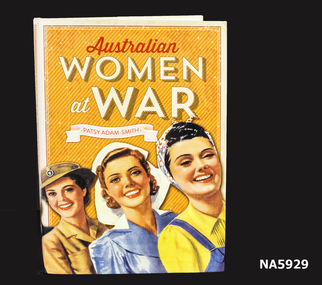
Book - Australian Women At War, Five Mile Press, 2014
... History of women's involvement in various theatres of wars - Australian women Nurses, armed services, Land army...History of women's involvement in various theatres of wars - Australian women Nurses, armed services, Land army Women serving in wars Book Title/Pictures/Author on dust cover - Hard Cover book - stories and - Illustrations of Australian Women at War - All Theatres - Written by Patsy Adam-Smith Book Australian Women At War Five Mile Press ...History of women's involvement in various theatres of wars - Australian women Nurses, armed services, Land army- Hard Cover book - stories and - Illustrations of Australian Women at War - All Theatres - Written by Patsy Adam-SmithBook Title/Pictures/Author on dust coverwomen serving in wars -
 Sunshine and District Historical Society Incorporated
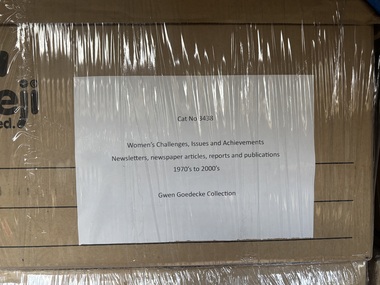
Archive - Gwen Goedecke Collection - Women's challenges, issues and achievements
... Women in Politics/History/Unions|Women in Sport and Recreation|Refugee/immigrant/internationall women|Women's Health|Womens Liberation/ Femnism|Women in Employment/ Equal Opportunity|Women's Occupational Health and Safety / Maternity Leave Working Women's Charter 1977 Publications are listed in each folder...Gwyneth "Gwen" Goedecke Collection Women Women in Politics/History/Unions|Women in Sport and Recreation|Refugee/immigrant/internationall women|Women's Health|Womens Liberation/ Femnism|Women in Employment/ Equal Opportunity|Women's Occupational Health and Safety / Maternity Leave Working Women's Charter 1977 Publications are listed in each folder Newsletters, newspaper clippings, articles, reports, advertising material , correspondence in separate folders from the 1970's to 2000's Archive Gwen Goedecke Collection - Women's challenges, issues and achievements ...Gwyneth "Gwen" Goedecke CollectionWomen in Politics/History/Unions|Women in Sport and Recreation|Refugee/immigrant/internationall women|Women's Health|Womens Liberation/ Femnism|Women in Employment/ Equal Opportunity|Women's Occupational Health and Safety / Maternity Leave Working Women's Charter 1977 Publications are listed in each folderwomen -
 St Vincent's Hospital Melbourne Archives
Book - Ballarat and district 1920-1940, an oral history: women in the community, 1983
... Ballarat and district 1920-1940, an oral history: women in the community. ...Ballarat and District 1920-1940. An oral history. Women in the community. Authors Peter Mansfield, Carole Stoddart, John Murphy, Lloyd Jenkins. ...women seated and standing around a Victorian round table on the front cover. One woman is referencing an open foolscap size book. 90 page bound book in light blue 180gsm paper board. Book Ballarat and district 1920-1940, an oral history ...Peter Mansfield, Librarian, oversaw a project interviewing women in Ballarat in 1983. The chapter on Agnes McLean talks about her lifetime dedication to nursing. There were other chapters about Housewife/Mother, Lucas girl, Teacher/Mercy Nun, Refugee/Migrant, Schoolteacher, Charity Worker, Woollen Mill Worker/Spinner. Daughter of Chinese business and gold trader. The stories of the subjects were transcribed in the way each spoke of their lives. Ballarat and District 1920-1940. An oral history. Women in the community. Authors Peter Mansfield, Carole Stoddart, John Murphy, Lloyd Jenkins. There is a photograph of nine professional women seated and standing around a Victorian round table on the front cover. One woman is referencing an open foolscap size book.agnes mclean, trained visiting nurse, ballarat, peter mansfield, carole stoddart, john murphy, lloyd jenkins -
 Eltham District Historical Society Inc
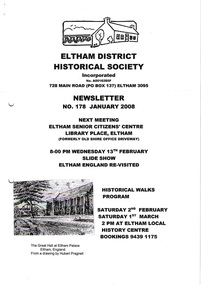
Newsletter, Newsletter, No. 178 January 2008
... Contents: • Next meeting, Slide Show: Eltham England Re-visited • Eltham England Re-visited • Nillumbik Citizen of the Year • Geoff Braithwaite 1913-2007 • Celebrating Nillumbik’s Women • Shillinglaw Family History • Other News • Annual General Meeting ...Contents: • Next meeting, Slide Show: Eltham England Re-visited • Eltham England Re-visited • Nillumbik Citizen of the Year • Geoff Braithwaite 1913-2007 • Celebrating Nillumbik’s Women • Shillinglaw Family History • Other News • Annual General Meeting The Shire of Eltham Historical Society was formed in October 1967. ...Contents: • Next meeting, Slide Show: Eltham England Re-visited • Eltham England Re-visited • Nillumbik Citizen of the Year • Geoff Braithwaite 1913-2007 • Celebrating Nillumbik’s Women • Shillinglaw Family History • Other News • Annual General Meeting The Shire of Eltham Historical Society was formed in October 1967. The first newsletter of the Society was issued May 1978 and has been published continuously ever since on a bi-monthly basis. With the cessation of the Shire of Eltham in late 1994, the Society's name was revised to Eltham District Historical Society and this name first appeared with issue No. 103, July 1995. The collection of the Society's newsletters provides a valuable resource on the history of the Society's activities, office bearers and committee members, guest speakers and subjects of historical interest pertinent to the former Shire of Eltham and the Eltham District.A4 photocopied newsletter distributed to membersnewsletter, eltham district historical society, shire of eltham historical society -
 Women's Art Register
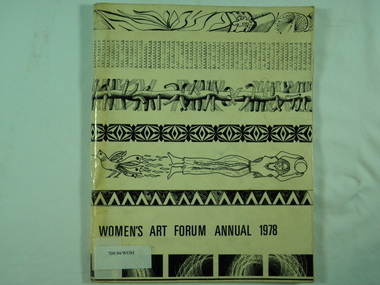
Journal, Women's Art Forum Annual 1978, 27th February 1979
... First issue of the Women's Art Forum, reporting on the state of feminist art in Australia in 1978. 100 pages. B/W text and illustrations. Articles include artist drawings, stories, histories of women artists, and reports, advocating and representing Australian women artists....First issue of the Women's Art Forum, reporting on the state of feminist art in Australia in 1978. 100 pages. B/W text and illustrations. Articles include artist drawings, stories, histories of women artists, and reports, advocating and representing Australian women artists. ...This journal is the first issue of the Women's Art Forum, a women artists' collective established in 1978 (Melbourne, Australia), in connection with the Women's Art Register.The Women's Art Register is an Australian collection of national significance, documenting the work of Australian women artists from the 19th, 20th and 21st centuries.First issue of the Women's Art Forum, reporting on the state of feminist art in Australia in 1978. 100 pages. B/W text and illustrations. Articles include artist drawings, stories, histories of women artists, and reports, advocating and representing Australian women artists.Published by the Women's Art Forum of Victoria. Printed by Sybylla Co-operative Press Ltd. -
 Warrnambool and District Historical Society Inc.
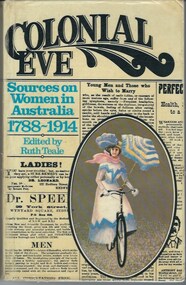
Book, Colonial Eve edited by Ruth Teale, 1978
... women...History of Warrnambool...This book relates the story of women in Australian history from 1788 to 1914. It draws on information from a collection of original documents collected from journals, newspapers, government documents and private accounts. ...This book relates the story of women in Australian history from 1788 to 1914. It draws on information from a collection of original documents collected from journals, newspapers, government documents and private accounts. ...This book relates the story of women in Australian history from 1788 to 1914. It draws on information from a collection of original documents collected from journals, newspapers, government documents and private accounts. It includes a number of black and white illustrations from various sources including the Bulletin. It covers topics such as convict women, women at home in the Victorian age, Women and their Families and Women outside the home.A comprehensive collection of material which gives an interesting insight into various aspects of women’s lives in Early Australia.Paperback yellow in colour with black title and newspaper text. By Line “Sources on Women in Australia 1788-1914 edited by Ruth Teale” in blue. Lady dressed in blue and white, riding a bicycle on back cover. 288 Pages.Oxford University Press Melbourne. First published 1978.colonial eve, ruth teale, convict women, victorian age women australia, early australian women, history of warrnambool -
Glen Eira Historical Society
Book - Glenhuntly Women’s Amateur Athletic Club
... A book, ‘History, Glenhuntly Women’s Amateur Athletic Club, 1929-1979’ by Dorothy Neal (1979) including a typed, one page, bibliography. 2. ...A book, ‘History, Glenhuntly Women’s Amateur Athletic Club, 1929-1979’ by Dorothy Neal (1979) including a typed, one page, bibliography. 2. ...This file contains two items. 1. A book, ‘History, Glenhuntly Women’s Amateur Athletic Club, 1929-1979’ by Dorothy Neal (1979) including a typed, one page, bibliography. 2. A booklet, ‘Glenhuntly Women’s Amateur Athletic Club 1929-1979, 50 years of Photos’.ryan bill, davis bob, ryan patsy, smith doris, mills l. c. miss., quinlan miss., wilkinson mrs., rae b. miss., nicholls miss., hughes beryl, westcott o. mr., glenhuntly, glenhuntly cricket ground, caulfield racecourse, athletic clubs, athletics, neal dorothy, women’s athletics, women athletics, duncan mackinnon reserve -
 Bendigo Historical Society Inc.
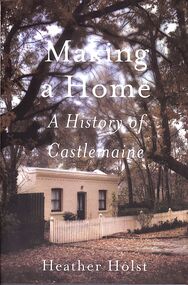
Book - "Making a Home. A History of Castlemaine", 2014
... Discusses the history of the town including Aboriginal history, women's experiences, welfare, charity, and home economics. ...Discusses the history of the town including Aboriginal history, women's experiences, welfare, charity, and home economics. ...The discovery of gold in Australia was a pivotal moment in the nation's history, leading to a series of gold rushes that transformed the Australian colonies. Victoria's goldrush began in Ballarat in 1851 and quickly spread to other parts of the state, including Castlemaine in July, drawing thousands of miners from around the world. The gold rush in Castlemaine began with the discovery of gold in July 1851, which attracted tens of thousands of migrants to the area. By 1852, the population on the Castlemaine Diggings had reached 30,000 people. The town was officially proclaimed a City on 4 December 1965, although it has since declined in population. The town's history is marked by its role in the Victorian gold rush, which was the world's richest shallow alluvial goldfield at its peak. The discovery of gold led to a significant increase in population and economic activity, transforming the area into a bustling town and a key settlement of the Mount Alexander diggings. "Making a Home. A History of Castlemaine" by Heather Holst. Discusses the history of the town including Aboriginal history, women's experiences, welfare, charity, and home economics. Soft cover. Published in Australia by Australian Scholarly Publications in 2014. Front cover features a white brick cottage surrounded by trees, behind fence. Back cover and spine feature map of topographical map of Castlemaine. Title and author's name in white print on front cover. Book includes black and white images. Contains index. 262 pp. ISBN 7981925003406.goldfields, miners, castlemaine, friends of the mount alexander diggings -
 National Wool Museum
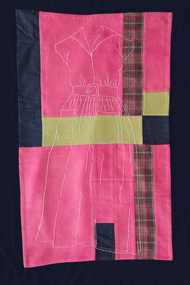
Quilt, Dressed in Memories IV
... Artist statement: 'Dressed in Memories IV is my continued exploration into contemporary quilting by looking back to the history of women, the quilts they made and the memories their work holds. ...Artist statement: 'Dressed in Memories IV is my continued exploration into contemporary quilting by looking back to the history of women, the quilts they made and the memories their work holds. ...Winner of "Expressions 2006: The Wool Quilt Prize". Artist statement: 'Dressed in Memories IV is my continued exploration into contemporary quilting by looking back to the history of women, the quilts they made and the memories their work holds. Layered on the wagga of recycled materials is embroidered a dress that my mother made when she was in her teens. This contemporary quilt celebrates women's domestic work through the generations in Australia.'W7183 'Dressed in Memories IV' Detail of 'Dressed in Memories IV' (full photo in W7183textilefibreforumarticle2007.pdf) CV of Michele Eastwood Article 'Stitched and Bound' by Alvena Hall in "Textile Fibre Forum, vol. 21, issue 1, No. 65 2002. Article 'What is a Contemporary Art Quilt?' from "Popular Patchwork, April 2002, England. Article 'Quilt winner dressed for success' from "The Weekly Times", January 3, 2007 Article 'Expressions 2006: The Wool Quilt Prize' from "Textile Fibre Forum" no 85, 2007 Catalogue worksheet page 1 Catalogueworksheet page 2Dressed in Memories IVquilting textile art wagga, eastwood, ms michele, quilting, textile art, wagga -
Southern Sherbrooke Historical Society Inc.
Information folder - Country Women's Association
... Contents:/Official publication of CWA, February 1994, Vol. 40, No. 1, including article "Dandenong Ranges Half-Yearly Conference" by Althea Meredith, which includes a brief history of local branches./article, "Women of action made history in the Dandenongs" by Heather Ronald, from "Victorian Country Woman" October 2000, Vol. 46, No. 9....Contents:/Official publication of CWA, February 1994, Vol. 40, No. 1, including article "Dandenong Ranges Half-Yearly Conference" by Althea Meredith, which includes a brief history of local branches./article, "Women of action made history in the Dandenongs" by Heather Ronald, from "Victorian Country Woman" October 2000, Vol. 46, No. 9. ...Information folder containing items pertaining to the history of the CWA in the Dandenong Ranges. Contents:/Official publication of CWA, February 1994, Vol. 40, No. 1, including article "Dandenong Ranges Half-Yearly Conference" by Althea Meredith, which includes a brief history of local branches./article, "Women of action made history in the Dandenongs" by Heather Ronald, from "Victorian Country Woman" October 2000, Vol. 46, No. 9. -
 Mission to Seafarers Victoria
Photograph - Digital photograph, colour
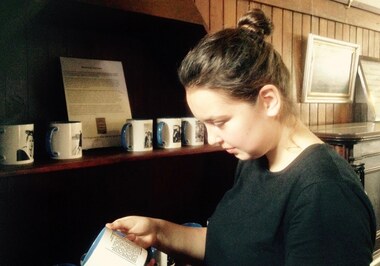
... Pictured here is Cadet Hamer with one of Catherine Bell’s mugs from The Sea-fairer Sex (2017) - an installation that explores the global history of women in seafaring recorded in newspaper articles and sourced from the State Library of Victoria. ...Pictured here is Cadet Hamer with one of Catherine Bell’s mugs from The Sea-fairer Sex (2017) - an installation that explores the global history of women in seafaring recorded in newspaper articles and sourced from the State Library of Victoria. ...As we celebrate #InternationalWomensDay, did you know that to reflect its role as an international organistaion caring for all seafarers regardless of gender, our name was changed from the Mission to Seamen in 2000? Pictured here is Cadet Hamer with one of Catherine Bell’s mugs from The Sea-fairer Sex (2017) - an installation that explores the global history of women in seafaring recorded in newspaper articles and sourced from the State Library of Victoria. #IWD2018women, cadet hamer, seafaring, 2018 -
 Ballarat Tramway Museum
Photograph - Black & White Photograph/s, mid to late 1950's
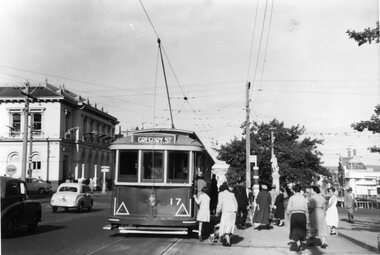
... Note most of the passengers are women. Photographer unknown - see history of object. See Keith Kings, The Bendigo Tramways, re the fitting of reflective tape in 1956, page 59....Note most of the passengers are women. Photographer unknown - see history of object. See Keith Kings, The Bendigo Tramways, re the fitting of reflective tape in 1956, page 59. ...Demonstrates the use of the trams in the city area of Ballarat, late 1950's and their use.Black and white photograph of Ballarat 17, loading passengers at the intersection of Sturt and Lydiard St, City, late in a summer evening. Tram has the destination of Gregory St. Many passengers are or waiting to boarding. Has the Post Office in the background and Robert Burns statue. Note most of the passengers are women. Photographer unknown - see history of object. See Keith Kings, The Bendigo Tramways, re the fitting of reflective tape in 1956, page 59.In the rear in pencil - "Ballarat"trams, tramways, city, sturt st, lydiard st, tram 17 -
 Geoffrey Kaye Museum of Anaesthetic History
Sculpture - Carving, Heke Collier, Mauri Ora, May - July 2016
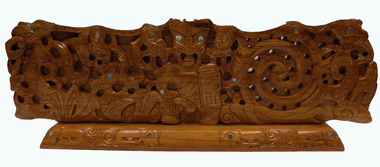
... Women are associated with the land (whenua) because the land gives birth to people and so do women. In tribal history women have had influence over land and men. ...Women are associated with the land (whenua) because the land gives birth to people and so do women. In tribal history women have had influence over land and men. ...Professor Alan Merry commissioned the work from New Zealand artist Heke Collier as a gift to the College at his retirement from Council. This artwork was carved by Heke Collier in May-July 2016. It is made from native New Zealand Rimu timber. Heke named this carving Mauri Ora which translates to vitality, well-being or the healing life-force. Tihei Mauri Ora (breath of life) is a well-known Māori saying that was uttered by the first human being. Māori believe that all people and all things have mauri. This carving symbolises the many shapes and forms of mauri with reference to the Māori creation story, and the spiritual and natural worlds. Māori refer to the heavens as Ranginui the sky-father and according to the Māori creation story, Ranginui was pressed against Papatūānuku the earth mother. Their children did not like living in the cramped, dark space between them. One of their sons Tāne separated Ranginui and Papatūānuku to allow light and life into the world. The central male figure carved into Mauri Ora (above) is Tāne. To his right (far right) is his mother Papatūānuku and to his left (far left) is his father Ranginui. Papatūānuku gives birth to all things including human kind and provides the physical and spiritual basis for life. The takarangi (spiral) design in the carving (to the left of Tāne) symbolises the life cycle. Whenua, the word for land also means placenta - organ that nourishes the baby in the womb. Women are associated with the land (whenua) because the land gives birth to people and so do women. In tribal history women have had influence over land and men. Papatūānuku is depicted in the carving to the right of Tāne. Ranginui played a pivotal role in the birth of the sun, moon, planets, stars and constellations – collectively called Te Whānau Mārama (the family of light). Human life and knowledge were said to originate in the realm of Ranginui. Tāne ascended the heavens to retrieve three baskets of knowledge: te kete-tuatea (basket of light), te kete-tuauri (basket of darkness) and te kete-aronui (basket of pursuit). Ranginui is depicted in the carving to the left of Tāne. Tāne had many different roles, and he was given different names to reflect these roles. He is called Tāne-mahuta as god of the forest, Tāne-te-wānanga as the bringer of knowledge, and Tāne-te-waiora as the bringer of life, prosperity, and welfare. His teachings and knowledge are relevant in contemporary times, and the cell-phone carved into his left hand represents this. Tuatara feature in the Māori creation story and some tribes view Tuatara as kaitiaki (guardians) of knowledge. Given that they have lived for more than 220million years. There are birds or manu surrounding Tāne in the carving, who represent Tane’s voice or the voice of the forest. The flax or harakeke depicted in the carving represent the family unit and reinforce the importance of kinship ties. There are plants, ferns, and birds carved into Mauri Ora play an integral role in the life-cycle which represent rongoa Māori or Māori medicine. Traditional Māori carving in Rimu, a native New Zealand wood, with paua insets.merry, alan, anzca council, collier, heke, kaiwhakairo, master carver, rimu -
 Eltham District Historical Society Inc
Audio - Audio Recording, Dr Geoffrey Sandy - Soldier Welcome Home Committees, 10 Jun. 2023
... The work of these committees is an important part of our war history, and our volunteer history. As women were often well-represented, and active within the SWHCs, it is also important to our history of Australian women. ...The work of these committees is an important part of our war history, and our volunteer history. As women were often well-represented, and active within the SWHCs, it is also important to our history of Australian women. ...EDHS Newsletter No. 270 June 2023 At our next meeting at 2.00pm on Saturday 10th June 2023 we are pleased to have Dr. Geoffrey Sandy to present to us on the WW1 Soldier Welcome Home Committees, with specific reference to Eltham. Geoffrey is an author, parish historian and parish archivist for St Margaret’s Anglican Church in Eltham. Soldier Welcome Home Committees (SWHC) were established throughout Australia during WW1 by the soldier’s local community - their home. Despite WW1 being a well-researched area of Australian history, little has been published on the SWHCs. The work of these committees is an important part of our war history, and our volunteer history. As women were often well-represented, and active within the SWHCs, it is also important to our history of Australian women. Geoff has undertaken a detailed case study of the Soldier Welcome Home Committee at Eltham (SWHCE). During the WW1 period Eltham can be described a small rural community. What is fortunate is that the Minute Books of the SWHC Eltham meetings are extant and readily accessible, as these are held in the archives of Saint Margaret’s Anglican Church Eltham.1:17:13 duration Digital MP3 file; 26.5MBaudio recording, eltham district historical society, meeting, society meeting, eltham, avenue of honour, dr geoffrey sandy, welcome home committee -
 Melbourne Legacy
Book, Mavis Thorpe Clark, No Mean Destiny. The Story of the War Widows' Guild of Australia 1945-85, 1986
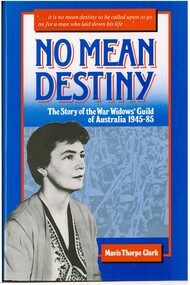
... She brought into being what was to become the most powerful women’s bloc in Australia’s history. Her successful intent was to establish justice and care for Australia’s World War II widows. ...She brought into being what was to become the most powerful women’s bloc in Australia’s history. Her successful intent was to establish justice and care for Australia’s World War II widows. ...A book published in 1986 about the War Widows' Guild and its founder Jessie Vasey, the widow of Major-General George Alan Vasey. Book synopsis: 'Jessie Vasey was truly one of Australia’s great women. She brought into being what was to become the most powerful women’s bloc in Australia’s history. Her successful intent was to establish justice and care for Australia’s World War II widows. At the end of the conflict in 1945, this group of bereaved wives were in the same neglected state as had been the widows of World War I in 1918. Jessie herself was widowed only six months before World War II ended. Her husband died in an aircraft accident off the coast of Cairns. She was 48. But the seeds of compassion and caring for the war widows had been sown before her own loss.' The Victorian War Widows Guild closed in 2021. Some items, including this book, were donated to the Legacy archive for preservation. It was possible for a widow to be members of both Legacy and the War Widows Guild. Both organisations helped war widows in various ways.A record of the work done by Jessie Vasey and the War Widows Guild.Hardcover book with blue dustcover showing a black and white photo of Mrs Vasey.war widows guild, jessie vasey, wwg -
Federation University Historical Collection
Article - Article - Women, Ballarat College of Advanced Education: Women of Note; Dulcie Brooke (1927 - 2023)
... Dulcie Brooke (nee Hoffman) was born in 1927. The history of women and the Wendouree Amateur Athletic Club seems to be very closely linked to that of women's athletics in Ballarat. ...Dulcie Brooke (nee Hoffman) was born in 1927. The history of women and the Wendouree Amateur Athletic Club seems to be very closely linked to that of women's athletics in Ballarat. ...Dulcie Brooke (nee Hoffman) was born in 1927. The history of women and the Wendouree Amateur Athletic Club seems to be very closely linked to that of women's athletics in Ballarat. Club photos of the 1953/54 season are the first to show women to be represented among the numbers who competed for Wendouree. However the Kevin Ruddick book, Always Striving - The Ballarat Harriers First 100 Years, notes that a Ballarat Harriers Women's Club was formed in September 1952 to compete against a Wendouree team and also mentions the Harriers women winning the premiership of 1953. Whatever the chronology, what is for certain is that Wendouree was at the forefront of the development of women's athletics in Ballarat and continued to be so until the unification of the sport for both men and women in 1979. Dulcie was one of those who are thought to be among the original members for Wendouree. Ballarat College of Advanced Education established a Health and Safety course.This became known as the Victorian Institute of Occupational Safety and Health, Australia (VIOSH) beginning in 1979. Max and Dulcie Brooke were members of Staff at Ballarat Institute of Advanced Education and became part of the initial group in presenting the course. Dulcie had science qualifications and was a bacteriologist. She was involved with the library aspect of the course and informed on the selecting of resources. In the early 1990s, Max became ill and Dulcie retired to care for him. Max died in 1992 and Dulcie established the Max Brooke Memorial Shield in his memory. This was presented by Dulcie to the winner of the Award at the Presentation Dinner every year from 1993 to 2010.women of note, dulcie brooke, science, librarian, institute of occupational safety and health, viosh, ballarat college of advanced education, university of ballarat, max brooke, max brooke memorial shield, wendouree amateur athletica club, women of wendouree, dulcie hoffman, 1927-2023, 1979, bacteriologist -
 National Wool Museum
Functional object - Wool Winder, pre. 1950
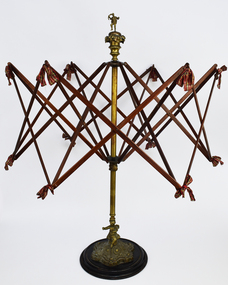
... Utilising medieval embroidery tradition of ‘Punto Assisi, the exhibition was a reflection on the lack of women recorded in history, particularly their contribution to the domestic arts. ...Utilising medieval embroidery tradition of ‘Punto Assisi, the exhibition was a reflection on the lack of women recorded in history, particularly their contribution to the domestic arts. ...Originating from Scotland pre-1950, this wool winder is ornately decorated featuring a male figure at its peak and a cherub at its base. Wool Winders are practical objects typically with minimal decoration; however, Wool Winders with ornate design features do exist. Scrimshaw (whale ivory) was a popular choice of material in the 18th and 19th century. It is smooth, preventing yarn from getting caught when unwinding, as well as having artistic beauty. Wool winders require a heavy base, as to not topple over when in use. It is popular to decorate these bases on more elaborate winders, such as shown in this example. The bows featured to tie the wood segments together is another feature of more elaborate models of wool winders, also highlighted in this example. This winder began life in the possession of Annie Crawford. The Crawford name has a strong connection with the town of Paisley, Scotland, and its Woollen Mills. The Crawford name can be seen working at the Woollen Mills in the 1851 Scotland Census, with Robert and his brother’s James and John working as Wool dyers. Their father Alexander also worked as a Loom Weaver. The winder immigrated with Annie when she, her husband and 3 children travelled to Australia, ready to start a new life. Most of their possessions were left behind in Scotland. This winder accompanied the family on their journey; so it stands to reason that the winder was special to them. Annie Crawford passed the winder onto her eldest daughter Joan Crawford. Joan did not have any children and so she passed the winder onto the eldest female grandchild, Fiona Crawford. Fiona Crawford continued the connection of the Crawford name with textiles, with an exhibition titled "When you go looking for me, I am not there". Utilising medieval embroidery tradition of ‘Punto Assisi, the exhibition was a reflection on the lack of women recorded in history, particularly their contribution to the domestic arts. Her work investigates both the absence of women while also honouring the unknown female makers of this now highly desired art. The Wool Winder was donated to the National Wool Museum in 2021 by Dianne Crawford, the sister of Fiona Crawford. Umbrella swift style wool winder made of metal, wood, and ribbon. Decorated at its highest point with a sculpted man standing on one leg, holding what is perhaps a rolled newspaper as though he may be bidding at an auction. Or perhaps he is holding a hank of wool. The man stands upon a three-tier platform of decreasing size and design which leads to the central metal shaft. At the base, the winder is decorated with an engraved cherub. Both figures have a small hole in one of their hands, indicating that they originally held something. Unfortunately, it is not known what this is. From the central metal shaft, this winder has 2 rows of 6 arms radiating out. These arms cross in the middle to form an X. These arms are also connected horizontally with additional arms which cross. This all forms an intricate web design, tied together with ribbon. The size of the web these arms create is adjustable, to accommodate yarns of different length. Beneath the second row of arms is a locking screw which holds this row at the desired height and width. This entire top section, beginning at the central metal shaft, can be unscrewed from its base for easier storage. The base begins in a wooden circular shape growing into a smaller ornately designed raise on which the cherub sits. From the head of the cherub the central metal shaft begins.paisley, scotland, wool winder, immigration -
 City of Melbourne Libraries
Photograph, Bull, Hugh Jones, 1897-1993, Japanese woodblock prints
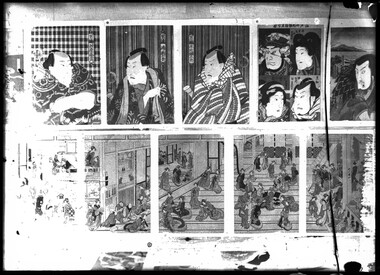
... Retrieved March 2, 2024, from http://nla.gov.au/nla.news-article36723139 Wikipedia: 'Ukiyo-e', https://en.wikipedia.org/wiki/Ukiyo-e Wikipedia: 'Woodblock printing in Japan', https://en.wikipedia.org/wiki/Woodblock_printing_in_Japan Wikipedia: 'Utagawa Toyokuni', https://en.wikipedia.org/wiki/Utagawa_Toyokuni Wikipedia: 'Kabuki', https://en.wikipedia.org/wiki/Kabuki 'Digital Humanities and Japanese History',https://dh.japanese-history.org/2020-spring-women-in-japanese-history/japanese-women-artists-of-the-edo-period/ '25 Famous Painters in Japanese Art', https://dh.japanese-history.org/2020-spring-women-in-japanese-history/japanese-women-artists-of-the-edo-period/ 'Nyk Kamo Maru', https://blog.shipwatcher.com/index.php/nyk-kamo-maru/ The Home : an Australian quarterly Retrieved March 4, 2024, from http://nla.gov.au/nla.obj-386036987 : Volume 17, No. 8, 1 August 1936....Retrieved March 2, 2024, from http://nla.gov.au/nla.news-article36723139 Wikipedia: 'Ukiyo-e', https://en.wikipedia.org/wiki/Ukiyo-e Wikipedia: 'Woodblock printing in Japan', https://en.wikipedia.org/wiki/Woodblock_printing_in_Japan Wikipedia: 'Utagawa Toyokuni', https://en.wikipedia.org/wiki/Utagawa_Toyokuni Wikipedia: 'Kabuki', https://en.wikipedia.org/wiki/Kabuki 'Digital Humanities and Japanese History',https://dh.japanese-history.org/2020-spring-women-in-japanese-history/japanese-women-artists-of-the-edo-period/ '25 Famous Painters in Japanese Art', https://dh.japanese-history.org/2020-spring-women-in-japanese-history/japanese-women-artists-of-the-edo-period/ 'Nyk Kamo Maru', https://blog.shipwatcher.com/index.php/nyk-kamo-maru/ The Home : an Australian quarterly Retrieved March 4, 2024, from http://nla.gov.au/nla.obj-386036987 : Volume 17, No. 8, 1 August 1936. japan prints ships art Photographer notations on slide: "B21". ...A DECK GALLERY FOR JAPANESE PRINTS. A unique exhibition of Japanese Prints was opened yesterday on Japanese ship Kamo Maru.These pictures are the property of the captain of the Kamo Maru Captain T. Takahata, and are displayed in a specially arranged gallery on the deck of the ship now berthed at No. 13 Victoria Dock. A picture on board yesterday after noon. (Inset) - One of many fine works by Utaguard Toyokuni who died in 1825. Photographer notations on slide: "B21" Published: 23 February 1934 Published title: A DECK GALLERY FOR JAPANESE PRINTS. Published caption: A unique exhibition of Japanese Prints was opened yesterday on Japanese ship Kamo Maru.These pictures are the property of the captain of the Kamo Maru Captain T. Takahata, and are displayed in a specially arranged gallery on the deck of the ship now berthed at No. 13 Victoria Dock. A picture on board yesterday after noon. (Inset) - One of many fine works by Utaguard Toyokuni who died in 1825. Trove article identifier: http://nla.gov.au/nla.news-article203376863 Description: Japanese woodblock prints, probably belonging to Captain Takahata of the Japanese passenger and cargo ship Kamo Maru, who displayed his Japanese Woodblock prints in a special on-board gallery when it visited Melbourne during 1933 and 1934. Research by project volunteer, Louise McKenzie: Plate MCK025 shows a number of Japanese woodblock prints. Three are of traditional “samurai” or Kabuki-style Japanese men in traditional dress and hairstyle; one is a composite of four different prints: two men and two women (samurai/geisha) in traditional dress. There are also several prints appearing to depict traditional scenes of indoor and outdoor life in Japan in the Edo period. An article appeared in The Age in February 1934, covering the visit to Melbourne of Captain T Takahata on the Japanese ship the Kamo Maru. An accompanying photo shows several women, in coats and hats, and a man, closely inspecting a gallery hang of Japanese woodblocks. Inset is a single image of a Kabuki theatre performer, a detail from the full photograph as shown in our slide. This work is attributed to Utagawa Toyokuni (1769-1823), who was mostly known for his prints relating to kabuki theatre and the actors’ dramatic postures. Japanese Kabuki theatre features heavily stylised performances, glamorous, highly decorated costumes and elaborate make-up worn by its performers. It was particularly popular in the Edo period (1615-1868), as was woodblock printing, after its earlier introduction from China around 150 years earlier. Woodblock printing in Japan is a technique best known for its use in the ukiyo-e artistic genre of single sheet images (although books were also created) which flourished from the 17th through 19th centuries. Its artists produced woodblock prints and paintings of such subjects as female beauties; kabuki actors and sumo wrestlers; scenes from history and folk tales; travel scenes and landscapes; flora and fauna, and erotica. The term ukiyo-e translates as 'picture[s] of the floating world'. This expression could be confusingly translated as meaning ‘a world of sorrow and grief’, 'erotic’ or ‘stylish’, and later came to describe the hedonistic spirit of the lower classes of the 17th century. Asai Ryōi celebrated this spirit in the novel Ukiyo Monogatari (Tales of the Floating World), c. 1661: “[L]iving only for the moment, savouring the moon, the snow, the cherry blossoms, and the maple leaves, singing songs, drinking sake, and diverting oneself just in floating, unconcerned by the prospect of imminent poverty, buoyant and carefree, like a gourd carried along with the river current: this is what we call ukiyo.” (Wikipedia: 'Ukiyo-e') Mass production of woodblocks during the Edo period was due to high literacy rates: 100% for samurai and 50-60% for farmers. Consequently, cheaper books were produced in large numbers. In the 18th century, Suzuki Harunobu established the technique of multicolor woodblock printing called nishiki-e and greatly developed Japanese woodblock printing culture such as ukiyo-e. Ukiyo-e influenced European Japonisme and Impressionism. Yoshitoshi was called the last great ukiyo-e master, and his cruel depictions and fantastic expressions influenced later Japanese literature and anime. However today the best known exponents from the period are probably Hokusai and Hiroshige.The price of one ukiyo-e at that time was about 20 mon, and the price of a bowl of soba noodles was 16 mon, so the price of one ukiyo-e was several hundred yen to 1000 yen in today's currency. 'Wikipedia: Ukiyo-e' states: “Japanese art, and particularly ukiyo-e prints, came to influence Western art from the time of the early Impressionists. Early painter-collectors incorporated Japanese themes and compositional techniques into their works as early as the 1860s: the patterned wallpapers and rugs in Manet's paintings were inspired by the patterned kimono found in ukiyo-e pictures, and Whistler focused his attention on ephemeral elements of nature as in ukiyo-e landscapes. Van Gogh was an avid collector, and painted copies in oil of prints by Hiroshige and Eisen. Degas and Cassatt depicted fleeting, everyday moments in Japanese-influenced compositions and perspectives. ukiyo-e's flat perspective and unmodulated colours were a particular influence on graphic designers and poster makers. Toulouse-Lautrec's lithographs displayed his interest not only in ukiyo-e's flat colours and outlined forms, but also in their subject matter: performers and prostitutes. He signed much of this work with his initials in a circle, imitating the seals on Japanese prints. Other artists of the time who drew influence from ukiyo-e include Monet, La Farge, Gauguin, and Les Nabis members such as Bonnard and Vuillard. French composer Claude Debussy drew inspiration for his music from the prints of Hokusai and Hiroshige, most prominently in La mer (1905). Imagist poets such as Amy Lowell and Ezra Pound found inspiration in ukiyo-e prints; Lowell published a book of poetry called Pictures of the Floating World (1919) on oriental themes or in an oriental style.” An awareness of and interest in this style of art seems to have been well established by the time Captain Takahata brought his sailing gallery to Australia in the 1930s. The Age article “Colour Prints from Japan” on 22 February 1934 p. 13, consists predominantly of a sophisticated curatorial assessment of the woodblock style and detailed artist and style information, which is remarkable for its in-depth analysis. The writer even draws attention to the existence of female woodprint artists. It has been difficult to verify those noted in this article, but worth drawing attention to the work produced by the daughter of Hokusai, Katsushika Oi, which is documented and has gained attention within Japan and elsewhere. Captain Takahata may have been quite the ambassador: adverts in Australian quarterly magazine, The Home, promoted regular cruises out of Melbourne and Sydney via Queensland, Thursday Island, Phillippines and Hong Kong to Japan at a cost of £90 for a round trip via Yokohama.(The Home, 1 August 1936, pages 76 and 79). It is reported in one of the many newspapers articles printed during 1933/1934 about Captain Takahata and his collection, that he inherited it, and it was not for sale even at an offered £10,000. However, one article makes mention of him scouring antique shops in rural Japan to add to the collection! And even enlisting the help of his children in the hunt. The collection totalled 11,000 prints and apparently 1,500 travelled with him when he sailed. These numbers do differ between reports, but his collection was undoubtedly large, and Captain Takahata enjoyed lecturing on the subject, explaining that each print was handmade. It took painstaking work over months to create the delicate colour tones, with a block being created for each colour used, and transferred onto specially prepared paper. Many of the designs are symbolic, and even those representing figures and scenes have a narrative basis, or represent traditional incidents in the life and history of Japan. (See Japanese Prints, The Sydney Morning Herald, 14 July 1934). In Brisbane in October 1934, The Courier Mail noted that Captain Takahata, now on the Yusen Kaisha steamer ‘Atsuta Mam’ (a sister ship to Kamo Maru) arrived with another 100 prints in his possession, and that he spent his spare time mounting and cataloguing his treasures. One of his new additions dated from 1787 and Captain Takahata “said that it was the only woodcut to depict eyelashes, and with the aid of a magnifying glass, he showed the extremely fine lines around the eyes of the three Japanese ladies on the print.” References: COLOR PRINTS FROM JAPAN. (1934, February 22). The Age (Melbourne, Vic. : 1854 - 1954), p. 13. Retrieved February 29, 2024, from http://nla.gov.au/nla.news-article20338088 A DECK GALLERY FOR JAPANESE PRINTS. (1934, February 23). The Age (Melbourne, Vic. : 1854 - 1954), p. 11. Retrieved February 29, 2024, from http://nla.gov.au/nla.news-article203376863 JAPANESE WOOD-CUTS. (1934, July 14). Daily Commercial News and Shipping List (Sydney, NSW : 1891 - 1954), p. 4. Retrieved February 29, 2024, from http://nla.gov.au/nla.news-article161150580 JAPANESE PRINTS. (1934, July 14). The Sydney Morning Herald (NSW : 1842 - 1954), p. 12. Retrieved February 29, 2024, from http://nla.gov.au/nla.news-article28024038 RARE WOOD-PRINTS FROM JAPAN (1934, July 16). The Herald (Melbourne, Vic. : 1861 - 1954), p. 20. Retrieved March 2, 2024, from http://nla.gov.au/nla.news-article243171208 JAPANESE WOODPRINTS. (1934, July 14). The Sydney Morning Herald (NSW : 1842 - 1954), p. 16. Retrieved March 2, 2024, from http://nla.gov.au/nla.news-article28023902 11,000 RARE WOODCUTS (1934, October 11). The Courier-Mail (Brisbane, Qld. : 1933 - 1954), p. 18. Retrieved March 2, 2024, from http://nla.gov.au/nla.news-article35647690 A DECK GALLERY FOR JAPANESE PRINTS. (1934, February 23). The Age (Melbourne, Vic. : 1854 - 1954), p. 11. Retrieved March 2, 2024, from http://nla.gov.au/nla.news-article203376863 RARE JAPANESE PRINTS (1934, July 11). The Courier-Mail (Brisbane, Qld. : 1933 - 1954), p. 10. Retrieved March 2, 2024, from http://nla.gov.au/nla.news-article36723139 Wikipedia: 'Ukiyo-e', https://en.wikipedia.org/wiki/Ukiyo-e Wikipedia: 'Woodblock printing in Japan', https://en.wikipedia.org/wiki/Woodblock_printing_in_Japan Wikipedia: 'Utagawa Toyokuni', https://en.wikipedia.org/wiki/Utagawa_Toyokuni Wikipedia: 'Kabuki', https://en.wikipedia.org/wiki/Kabuki 'Digital Humanities and Japanese History',https://dh.japanese-history.org/2020-spring-women-in-japanese-history/japanese-women-artists-of-the-edo-period/ '25 Famous Painters in Japanese Art', https://dh.japanese-history.org/2020-spring-women-in-japanese-history/japanese-women-artists-of-the-edo-period/ 'Nyk Kamo Maru', https://blog.shipwatcher.com/index.php/nyk-kamo-maru/ The Home : an Australian quarterly Retrieved March 4, 2024, from http://nla.gov.au/nla.obj-386036987 : Volume 17, No. 8, 1 August 1936.Photographer notations on slide: "B21".japan, prints, ships, art -
 Eltham District Historical Society Inc
Book, Nillumbik Shire Council, Celebrating Nillumbik Women 2008-2013, 2013
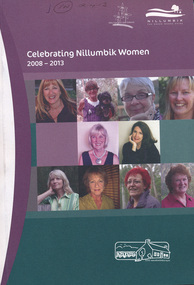
... This book was conceived by the Nillumbik Women's Network as a way of writing women into local history. When seeking nominations for the 2010 editon, the press release stated: Nillumbik Shire’s official histories don’t reflect the important but often unacknowledged contribution of local women to the development of the area. ...This book was conceived by the Nillumbik Women's Network as a way of writing women into local history. When seeking nominations for the 2010 editon, the press release stated: Nillumbik Shire’s official histories don’t reflect the important but often unacknowledged contribution of local women to the development of the area. ...This book was conceived by the Nillumbik Women's Network as a way of writing women into local history. When seeking nominations for the 2010 editon, the press release stated: Nillumbik Shire’s official histories don’t reflect the important but often unacknowledged contribution of local women to the development of the area. To redress this, the Nillumbik Women’s Network (NWN) initiated a small project, Celebrating Nillumbik women in late 2007.( For details of the Nillumbik Women’s Network refer to attachment) The NWN sought nominations of local women who had made, or continue to make, a significant contribution to the social and cultural life of our community. The brief profiles of the nominees were published in a booklet, which was launched at an International Women’s Day celebration in March 2008, and a second publication was produced in 2009. We continue to be inspired by the quality and activism of our local women. Many of the biographies tell of women’s contribution to the building of the ‘social’ infrastructure of the Shire. These stories complement the official historical accounts which primarily document men’s role in building the physical infrastructure of the Shire. One begins to develop a clearer picture of how women went about developing the services which we take for granted today, from the small kindergartens operating out of church halls to the wide ranging network of occasional and long day childcare care to the development of home based services for older frail and disabled residents of the area. They also tell of the bravery and resilience of women in their response to the devastating impact of the Black Saturday bushfires. This volume includes profiles of 23 women, 2013 Nominees in addition to those included since the project was launched in 2008. The 2008 nominations are: Wendy Alexander, Jane Ashton, Sharon Banner, Janet Boddy, Catherine Cervasio, Belinda Clarkson, Helen Coleman, Cathy Dean, Judy Duffy, Gwen Ford, Jenny Graves, Cath Giles, Meera Govil, Ona Henderson, Jill Jameson, Vicki Kaye, Mrs Kimber, Nerida Kirov, Jane Lauber, Pam Lawson, Anne Manne, Chris Marks, Elizabeth Marshall, Dawn McDonnell, Jenny Millar, Grace Mitchell, Jenni Mitchell, Michelle Molinaro, Joy Murphy, Rosie Murphy, Barbara Murray, Tracey Naughton, Josephine Norman, Pamela Pederson, Mary Robertson, Vicki Ruhr, Geraldine Sanderson, Dawn Shaw, Fiona Sievers, Myra Skipper, Selina Sutherland, Barbara Talbot, Marjorie Taylor, Julie Tipene-O’Toole, Susie Walker, Donna Zander. 2009: Jan Aitken, Rosemary Aitken – OAM, Edith Apted, Betty Anderson, Thelma Barkway, Diana Bassett-Smith, Jenneke Bateman-Korteweg, Amy Bryans, Sabi Buehler, Jenni Bundy, Audrey Cahn, Linda Cornelissen, Janice Crosswhite, Elean Dansey, Christine Durham Claire Fitzpatrick, Ailsa Fitzmaurice, Lucinda Flynn, Sheryl Garbutt MP, Fran Gronow, Ev Hales, Irene “Rennie” Harrison, Ena Jarvis, Heather Kaufmann. 1948-2007: Helen Kenney, Margot Knox – Pederson, Lois Loftus-Hills, Nina Mikhailovna Christesen AM (nee Maximov), Penny Mullinar, Gwayne Naug, Nanette Oates, Lisal O’Brien, Stella Reid, Laura Rohricht, Meg Russell, Sonia Skipper, Bronwyn South, Pauline Toner MP, Lisa Walton, Diana Warrell, Rachel Watt. The 2013 nominations are: Roslyn Addison, Sue Aldred, Lucy Anderson, Sue Arnold, Mary Avola, Anna Foletta, Morag Fraser, Danielle Green MP, Colleen Hackett, Pam Hayes, Barbara Joyce, Carol Leeson, Sandra and Bruce Poloni, Many Press, Carolyn Royse, Hannah Sky, Lorna Smith, Lynlee Tozer, Kilanthi Vassiliadis, Kerry Wailes, Gale Weiss, Irma Winton and Alexis Wright.This book is a significant in the recording of the contribution of local women to the development of the Shire of Nillumbik, especially for the time frame 2008 -- 2013. Historically women's stories generally have not been told at all, let alone their contributions acknowledged. This book profiles and documents women's stories that otherwise may not have been told.women, nillumbik women's network -
 City of Melbourne Libraries
Photograph, Bull, Hugh Jones, 1897-1993, Miss Katherine Rymill
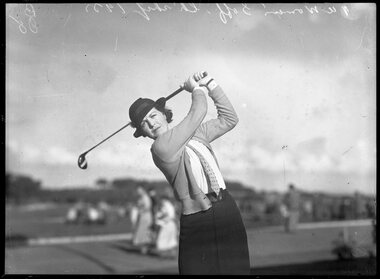
... Published caption: Six State champions for the first time in the history of women’s golf are competing in the matches for the Australian title. — 1. ...Published caption: Six State champions for the first time in the history of women’s golf are competing in the matches for the Australian title. — 1. ...Stylishly dressed in trilby, neck-tie and leather belt, champion Adelaidian golfer Katherine Rymill practises her drive at Royal Melbourne Golf Course. Katherine Rymill (1913-2008) won the Royal Adelaide championships in 1934, 1935 and 1937. Commenting on the NSW “no stockings” controversy of 1935, she said, “In England, players are allowed to appear without stockings in summer and to wear “slacks” in the winter… Playing without stockings makes no difference to one’s performance and it is certainly cooler...” Katherine worked for the Red Cross during WWII and continued to play golf throughout her life. MCK116 Published The Age 29 August 1935 Featured in "Newsworthy: Melbourne in photographs 1933-1936" exhibition at East Melbourne Library, October to December 2023. Exhibition caption by project volunteer, Fiona Collyer. Published: The Age 29 August 1935 p. 11 Published title: SIX STATE CHAMPIONS IN NATIONAL GOLF CHAMPIONSHIP. Published caption: Six State champions for the first time in the history of women’s golf are competing in the matches for the Australian title. — 1. Miss B. Sale (Tas.). 2. Miss J. Hood-Hammond (N.S.W.). 3. Miss J. Gardiner (Qld,) 4. Miss K. Rymill (S.A.). 5. Mrs. O. J. Negus (W.A.). 6. Mrs. S. Morpeth (Vic.) RESEARCHER'S NOTE: The Age listed Golfer 1 as Miss B. Sale and Golfer 4 as Miss K. Rymill. We verified that these should in fact be the other way around: 1 is Miss K. Rymill, 4 is Miss B. Sale. Description: Action shot of woman driving golf ball Research by project volunteer, Fiona Collyer: MISS KATHERINE LUCY RYMILL (1913–2008) Katherine was a champion South Australian golfer. She won the Royal Adelaide championships in 1934, 1935 and 1937. She competed in the Australian Women’s Golf Championships at Royal Melbourne in 1935 against British women golfers and was eliminated by Mrs T S McKay nee Odette Lebebvre. Katherine was from a prominent and wealthy Adelaide family and her social activities and golfing career was closely followed in the local papers. Her mother, Shylee Rymill, was the S.A. Girl Guides’ Commissioner from 1935-1950. Her father H.L. (Cargie) Rymill grew up in a Dutch Renaissance style mansion called “The Firs” in East Terrace, Adelaide (now called Rymill House and State heritage listed), and designed Kooyonga, Seaton, Grange, Glenelg and Mount Lofty golf courses. Both parents were champion golfers and have tournaments named after them. Katherine worked for the Red Cross during WWII. In 1935, for the first time in NSW, the Ladies Golf Union (L.G.V.) enforced their rule regarding the wearing of stockings in official associates’ golf matches. Though the Long Reef competitor’s long skirt and golf socks almost hid her sun-tanned legs from view, an eagle-eyed official had noticed the absence of regulation covering and she and her partner were disqualified. Commenting on the Long Reef “no stockings” controversy, Katherine said “In England, players are allowed to appear without stockings in summer and to wear “slacks” in the winter.” “Playing without stockings makes no difference to one’s performance and it is certainly cooler. However, rules which are formed must be obeyed and that seems all there is to say about it.” Katherine continued to play golf throughout her life and died in 2008.Photographer notations on slide: "Vic Womens Golf Ch'ship 1935 B98".golf, women golfers, royal melbourne golf club -
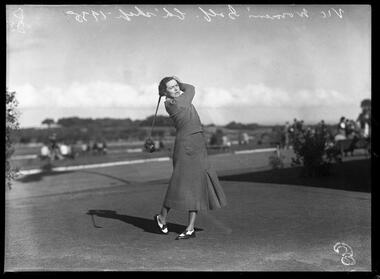 City of Melbourne Libraries
Photograph, Bull, Hugh Jones, 1897-1993, Miss Betty Sale
... Women's Golf Ch'ship 1935 B98" Published: The Age 29 August 1935 p. 11 Published title: SIX STATE CHAMPIONS IN NATIONAL GOLF CHAMPIONSHIP. Published caption: Six State champions for the first time in the history of women’s golf are competing in the matches for the Australian title. — 1. ...Women's Golf Ch'ship 1935 B98" Published: The Age 29 August 1935 p. 11 Published title: SIX STATE CHAMPIONS IN NATIONAL GOLF CHAMPIONSHIP. Published caption: Six State champions for the first time in the history of women’s golf are competing in the matches for the Australian title. — 1. ...Betty Sale (1905-1976) won the Tasmanian State Championship in 1934, 1935 and 1936. She also worked as a car saleswoman in Hobart. In 1939, London reported: “Betty Sale, pretty Tasmanian brunette, will soon leave England for Finland, where she will drive an ambulance behind the Mannerheim Line. With twenty-three English society girls, she volunteered for the job because she wanted to do something for the brave Finns.” Betty volunteered for First Aid Nursing Yeomanry Service (F.A.N.Y.), conveying refugees and casualties to hospitals by ambulance in Finland’s harsh weather. Back in England, as a corporal, she worked during bombings in Plymouth, writing to her brother: “Bombs were dropping all around us, fires are raging, debris everywhere and huge holes around us. When we had got all the live ones, we went and collected dead bodies.” Betty was awarded an MBE and the Winter War Medal for Civilians from Finland Government 1939-40. MCK142 Published The Age 29 August 1935 Featured in "Newsworthy: Melbourne in photographs 1933-1936" exhibition at East Melbourne Library, October to December 2023. Exhibition caption by project volunteer, Fiona Collyer. Photographer notations on slide: "Vic. Women's Golf Ch'ship 1935 B98" Published: The Age 29 August 1935 p. 11 Published title: SIX STATE CHAMPIONS IN NATIONAL GOLF CHAMPIONSHIP. Published caption: Six State champions for the first time in the history of women’s golf are competing in the matches for the Australian title. — 1. Miss B. Sale (Tas.). 2. Miss J. Hood-Hammond (N.S.W.). 3. Miss J. Gardiner (Qld,) 4. Miss K. Rymill (S.A.). 5. Mrs. O. J. Negus (W.A.). 6. Mrs. S. Morpeth (Vic.) RESEARCHER'S NOTE: The Age listed Golfer 1 as Miss B. Sale and Golfer 4 as Miss K. Rymill. We verified that these should in fact be the other way around: 1 is Miss K. Rymill, 4 is Miss B. Sale. Description: Action shot of woman driving golf ball Research by project volunteer, Fiona Collyer: MISS BETTY SALE Mrs Margaret Elizabeth Scott Rigg (1905-1976) MBE Betty Sale grew up in Hobart and attended St Michael’s Collegiate School. She was a champion Tasmania golfer and won the State Championship in 1934, 1935, 1936. Betty competed in the Australian Women’s Golf Championship at Royal Melbourne against the British Women’s Team in 1935. Betty worked as a car saleswoman at Robert Nettleford Pty Ltd at 113 Macquarie Street, Hobart. They were the agent for Austin, Buick, Chevrolet and Vauxhall. In April 1939, Betty sailed on the RMS Orford to London where she worked in sales for Henley’s, an exclusive motor sales firm. In November 1939 she volunteered for the Woman’s Transport Arm of the First Aid Nursing Yeomanry Service (F.A.N.Y.) and was part of the team delivering 10 ambulances to Finland, which had been invaded by the Soviet Union. Betty worked conveying refugees and military casualties to military hospitals, often over tracks with only sleigh marks to guide them. Despite contracting measles she continued to work tirelessly, often for 22-hour shifts. She was awarded the Finland Winter War medal 1939-1940 for civilians by Field-Marshall Mannerheim (later President of Finland). Betty was quoted in the Australian Women’s Weekly 17/1/1940: “I joined the ambulance corp for Finland because I was filled with admiration for the courage and determination of the Finns. I don’t think that there has ever been anything so dramatic in history as the manner in which Finland, a land of 4,000,000 people has resisted the aggression of the teeming millions of Russians.” After six months working in Finland, the FANYs found themselves held up unable to get aid from Britain to escape and they felt a burden on the Finns. Eventually money was sent privately from a neutral country and the 17 FANYs determined to get away. They set off from Helsinki with only the civilian clothes they were wearing and travelled by train and bus to a northern port where they boarded a cargo vessel. For a fortnight they did not change their clothes and slept under tarpaulins in the hatchway. The only choice of food was porridge or pea soup. After two weeks aboard the cargo vessel, a palatial liner approached the ship and in mid-ocean the FANYs were transhipped by rope ladders. The women enjoyed three course meals and other luxuries for three days before arriving back in England. Betty, now a corporal, worked for two years transporting civilian and military casualties during bombings in Plymouth. In a letter to her brother, Mr J Sale of Gerogery NSW, Betty wrote, “We have had a very lively time here as we have been blitzed for two nights. There is literally nothing of Plymouth left. We were out all the first night with the ambulance collecting casualties and have never seen such injuries. Bombs were dropping all around us, fires were raging, debris everywhere, and huge holes in the roads. When we had got all the live ones, we went and collected dead bodies. The people are marvellous.” “Next night, we had a worse blitz. We were not out so long but it was not a pleasant party. I didn’t know I was so brave but could not stand it too long. Mr Menzies was here for the second night’s blitz. We have adopted a homeless and hurt dog – a raid victim – and the poor fellow is completely exhausted.” In 1942, Betty worked in Algeria in charge of 100 specialists and technicians - the first servicewomen to arrive in North Africa. In 1945, she was awarded an MBE in recognition and on behalf of the work this unit was involved in. In 1945, Betty was promoted to Captain and posted to Australia to establish a Signal Station. In 1946, she married Lt-Col H. Henry O. Rigg of the Royal Artillery in Tasmania. The couple had first met in Algeria in 1943. The Australian press closely followed Betty’s wartime activities praising her courage, capability, driving and mechanical knowledge and of course Australian women’s hardiness. After the war, Betty lived in Sheffield, England with her husband, working as an office manager. She continued to play golf until her death aged 71 in 1976.Photographer notations on slide: "Vic. Women's Golf Ch'ship 1935 B98".golf, women golfers, royal melbourne golf club
