
Showing 119 items matching "women's military service"
-
 Wodonga & District Historical Society Inc
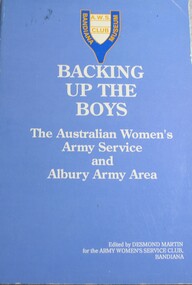
Book - Backing up the Boys - The Australian Women's Army Service and Albury Army area, Desmond Martin, 1988
... service -- history...women soldiers -- australia -- history...albury army area...world war two...women's military...australia. army. australian women's army service -- history women soldiers -- australia -- history albury army area world war two women's military service The detailed history of the Australian Women’s Army Service in the Albury Army area during World War II. ...The detailed history of the Australian Women’s Army Service in the Albury Army area during World War II.non-fictionThe detailed history of the Australian Women’s Army Service in the Albury Army area during World War II.australia. army. australian women's army service -- history, women soldiers -- australia -- history, albury army area, world war two, women's military service -
 Ballarat Clarendon College
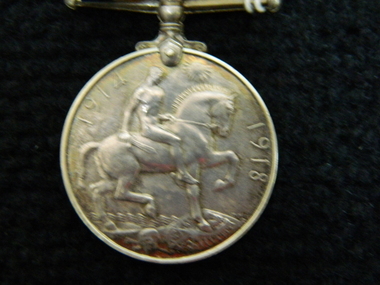
Medal, British War Medal, 1918
... The British War Medal was awarded for service in a theatre of war between 5 August 1914 and 11 November 1918. Those eligible included members of women's organisations; persons on the staffs of military hospitals and members of recognised organisations who handled sick and wounded; and members of other duly recognised or other authorised organisations as specified in medal regulations. ...The British War Medal was awarded for service in a theatre of war between 5 August 1914 and 11 November 1918. Those eligible included members of women's organisations; persons on the staffs of military hospitals and members of recognised organisations who handled sick and wounded; and members of other duly recognised or other authorised organisations as specified in medal regulations. ...The British War Medal 1914-20 was iInstituted by King George V in 1919 to mark the end of World War I and record the service given. The qualification period was later extended to cover post-war mine clearance and service in Russia during 1919 and 1920. The British War Medal was awarded for service in a theatre of war between 5 August 1914 and 11 November 1918. Those eligible included members of women's organisations; persons on the staffs of military hospitals and members of recognised organisations who handled sick and wounded; and members of other duly recognised or other authorised organisations as specified in medal regulations. The qualification period was later extended to cover post-war mine clearance and service in Russia during 1919 and 1920. Lieut E. S. Holgate was mentioned in despatches for Gallantry in the Field 24/25 April 1918. He was killed in action at Villers-Bretonneux, 27 April, 1918. The British War Medal completes a trio of medals awarded to Lieut. E. S. Holgate, including the 1914-15 Star and the Victory Medal. The Holgate medals were the first war medals held by BCC archives. They have historical and social significance for the College.The British War Medal is round and made of cupro-nickel. It features the effigy of George V on the obverse. The reverse has an image of St George on horseback trampling underfoot the eagle shield of the Central Powers, and a skull and cross-bones, the emblems of death. Above this is the risen sun of victory. The British War Medal has a wide central watered stripe of orange, flanked by two narrow white stripes, which are in turn flanked by two black pin-stripes, further flanked by two outer stripes of purple. The colours have no particular significance. Impressed around edge are the recipient's details. Inscribed around outer edge of obverse: 'GEORGEIVS V BRITT. OMN:REX ET IND:IMP:' Impressed around edge of medal: 'LIEUT.E.S.HOLGATE. A.I.F.' Inscribed on the reverse '1914 1918'medal, 1918, world war 1, british war medal, w w 1, holgate, a i f, australian imperial force, holgate e s, holgate medal -
 Ballarat Clarendon College
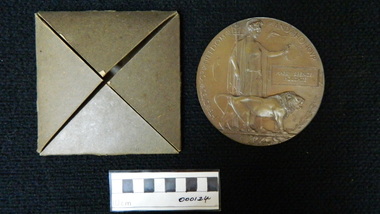
Memorial plaque
... The WWI Death Plaque (Dead Man's Penny) was issued to the next of kin of servicemen/women who had fallen in the Great War between 1914 and 1918.This plaque was given to honour the service of Ballarat College old collegian Harry Spencer Holgate who entered the school in 1894. On leaving school he became an auctioneer at Muswellbrook and Scone. He enlisted on 24 May 1916 and was awarded the Military...The WWI Death Plaque (Dead Man's Penny) was issued to the next of kin of servicemen/women who had fallen in the Great War between 1914 and 1918.This plaque was given to honour the service of Ballarat College old collegian Harry Spencer Holgate who entered the school in 1894. On leaving school he became an auctioneer at Muswellbrook and Scone. He enlisted on 24 May 1916 and was awarded the Military ...The WWI Death Plaque (Dead Man's Penny) was issued to the next of kin of servicemen/women who had fallen in the Great War between 1914 and 1918.This plaque was given to honour the service of Ballarat College old collegian Harry Spencer Holgate who entered the school in 1894. On leaving school he became an auctioneer at Muswellbrook and Scone. He enlisted on 24 May 1916 and was awarded the Military Medal at Polygon Wood in September 1917. He was killed at Zonnebeke on 11 October 1917. His brother Edward Spencer Holgate was also killed while serving his country during World War 1. Of the 305 Ballarat College old collegians who enlisted in WW1 65 gave their lives for their country. This 'death penny' is representative of the incredible sacrifice given by this huge percentage of the school's community. Round disk cast in bronze gunmetal, which incorporates the following; an image of Britannia holding an oak spray with leaves and acorns, an imperial lion, two dolphins representing Britain's sea power, the emblem of Imperial Germany's eagle being torn to pieces by another lion. The medallion is packaged in a heavy card envelope.Inscribed around face of medallion: He died for freedom and honour. A rectangular tablet cast on front of medallion inscribed 'Harry Edward Spencer'. harry-spencer-holgate, ballarat-college, world-war-one, death-penny, -
 Shepparton RSL Sub Branch
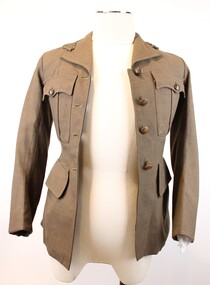
Uniform, Dress Jacket, 1943
... Womens Army Service (AWAS). Dorothy Mortlock was born in Swan Hill and enlisted with the 3rd AUST AWS REC DEPOT. world war ii second world war wwii women australian women's army service Label reads "V 579/1943/SIZE/MADE IN/AUSTRALIA/D. MORTLOCK/VF518245". Rising sun badge reads "AUSTRALIAN COMMONWEALTH/MILITARY ...This jacket belonged to Dorothy May Mortlock (VF518245) who was part of the Australian Womens Army Service (AWAS). Dorothy Mortlock was born in Swan Hill and enlisted with the 3rd AUST AWS REC DEPOT.Khaki-coloured woollen jacket which fastens along the centre via four metal buttons. Two hip-height pockets with external flap; two chest pockets with pleat in centre fastened via a metal button. Fabric belt around waist held in place by two fabric loops on back and fastened through metal buckle and loop. Collar carries two metal rising sun badges on the left and right side. Two epaulettes on either shoulder are held in place by a button and carries a badge reading "AWAS". Colour patch on both left and right side is square, half green and half black. Interior label on base of neck.Label reads "V 579/1943/SIZE/MADE IN/AUSTRALIA/D. MORTLOCK/VF518245". Rising sun badge reads "AUSTRALIAN COMMONWEALTH/MILITARY FORCES." Buttons read "AUSTRALIAN MILITARY FORCES."world war ii, second world war, wwii, women, australian women's army service -
 Shepparton RSL Sub Branch
Uniform, Tie Badge, C. 1943
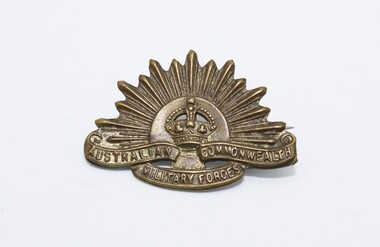
... Womens Army Service (AWAS). Dorothy Mortlock was born in Swan Hill and enlisted with the 3rd AUST AWS REC DEPOT. world war ii second world war wwii women australian women's army service Badge reads "AUSTRALIAN COMMONWEALTH/MILITARY FORCES" Rising sun badge in bronze-coloured metal with pin and loop on reverse for attachment to tie. ...This badge belonged to Dorothy May Mortlock (VF518245) who was part of the Australian Womens Army Service (AWAS). Dorothy Mortlock was born in Swan Hill and enlisted with the 3rd AUST AWS REC DEPOT.Rising sun badge in bronze-coloured metal with pin and loop on reverse for attachment to tie.Badge reads "AUSTRALIAN COMMONWEALTH/MILITARY FORCES"world war ii, second world war, wwii, women, australian women's army service -
 Shepparton RSL Sub Branch
Uniform, Dress, C. 1940s
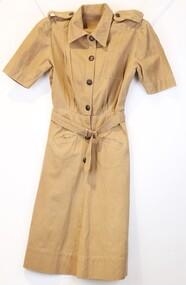
... This dress belonged to Dorothy May Mortlock (VF518245), who served as a Sapper with the Australian Women’s Army Service from 27 July 1945 to 1 August 1946. women wwii world war two second world war australian womens army service awas Ink inscription on interior loop difficult to read, “VF518245” and 5-6 indiscernible characters. Button reads “AUSTRALIAN MILITARY ...This dress belonged to Dorothy May Mortlock (VF518245), who served as a Sapper with the Australian Women’s Army Service from 27 July 1945 to 1 August 1946.Light brown coloured woven cotton dress with button-up front secured by 6 metal buttons. Dress constructed of a skirt element attached to a short sleeve shirt-style torso section, a hook and eye sits on interior of two sections to fasten left and right sides together. One square topstitched pocket on the left chest and two angled hip pockets on front. Fabric belt with metal buckle held in place by fabric loops on both left and right side. Fabric epaulette passes through loop on both left and right side and secured with metal button. Two loops on interior left and right shoulders, left loop with inscription; woven label stitched to interior left side underneath which is a stamped motif.Ink inscription on interior loop difficult to read, “VF518245” and 5-6 indiscernible characters. Button reads “AUSTRALIAN MILITARY FORCES” below an embossed image of Australia with the King George V crown on top. Stamped motif reads “[broad arrow]/S.D.”women, wwii, world war two, second world war, australian womens army service, awas -
 Flagstaff Hill Maritime Museum and Village
Badge - Collection of Organisation Badges, 1920's to 1940's
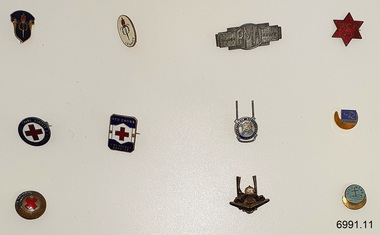
... military service support. The W.R. Angus Collection is significant for still being located at the site it is connected with, Doctor Angus being the last Port Medical Officer in Warrnambool. The Collection includes historical medical objects that date back to the late 1800s. Flagstaff Hill Warrnambool Maritime Museum Maritime Village Great Ocean Road Shipwreck Coast metal badges enamel badges organisation badges Legacy Red Cross Society Red Cross BMA BMA Ladies Badge Ladies Badge ACF Australian Comfort Fund Presbyterian Brotherhood rostrum Australian Legion of Servicemen & Women Oikumene W.R. ...This set of eleven badges was collected from the 1920s to the 1940s by Dr W. R. Angus. It represents various organisations that he had interests in. The set of badges was donated to Flagstaff Hill Maritime Village by the family of Doctor Angus, Surgeon and Oculist. It is part of the “W.R. Angus Collection” which includes historical medical equipment, surgical instruments and material once belonging to Dr Edward Ryan and Dr Thomas Francis Ryan, (both of Nhill, Victoria) as well as Dr Angus’ own belongings. The Collection’s history spans the medical practices of the two Doctors Ryan, from 1885-1926 plus that of Dr Angus, up until 1969. ABOUT THE “W.R.ANGUS COLLECTION” Doctor William Roy Angus M.B., B.S., Adel., 1923, F.R.C.S. Edin.,1928 (also known as Dr Roy Angus) was born in Murrumbeena, Victoria in 1901 and lived until 1970. He qualified as a doctor in 1923 at the University of Adelaide, was Resident Medical Officer at the Royal Adelaide Hospital in 1924 and for a period was a house surgeon to Sir (then Mr.) Henry Simpson Newland. Dr Angus was briefly an Assistant to Dr Riddell of Kapunda, then commenced private practice at Curramulka, Yorke Peninsula, SA, where he was a physician, surgeon and chemist. In 1926, he was appointed as the new Medical Assistant to Dr Thomas Francis Ryan (T.F. Ryan, or Tom), in Nhill, Victoria, where his experiences included radiology and pharmacy. In 1927 he was Acting House Surgeon in Dr Tom Ryan’s absence. Dr Angus had become engaged to Gladys Forsyth and they decided he would take time to further his studies overseas in the UK in 1927. He studied at London University College Hospital and at Edinburgh Royal Infirmary and in 1928, was awarded FRCS (Fellow from the Royal College of Surgeons), Edinburgh. He worked his passage back to Australia as a Ship’s Surgeon on the Australian Commonwealth Line’s T.S.S. Largs Bay. Dr Angus married Gladys in 1929, in Ballarat. (They went on to have one son (Graham 1932, born in SA) and two daughters (Helen (died 12/07/1996) and Berenice (Berry), both born at Mira, Nhill ) Dr Angus was a ‘flying doctor’ for the A.I.M. (Australian Inland Ministry) Aerial Medical Service in 1928. The organisation began in South Australia through the Presbyterian Church in that year, with its first station being in the remote town of Oodnadatta, where Dr Angus was stationed. He was locum tenens there on North-South Railway at 21 Mile Camp. He took up this ‘flying doctor’ position in response to a call from Dr John Flynn; the organisation was later known as the Flying Doctor Service, then the Royal Flying Doctor Service. A lot of his work during this time involved dental surgery also. Between 1928-1932 he was a surgeon at the Curramulka Hospital, Yorke Peninsula, South Australia. In 1933 Dr Angus returned to Nhill where he’d previously worked as Medical Assistant and purchased a share of the Nelson Street practice and Mira hospital from Dr Les Middleton one of the Middleton Brothers, the current owners of what was once Dr Tom Ryan’s practice. Dr L Middleton was House Surgeon to the Nhill Hospital 1926-1933, when he resigned. [Dr Tom Ryan’s practice had originally belonged to his older brother Dr Edward Ryan, who came to Nhill in 1885. Dr Edward saw patients in his rooms, firstly in Victoria Street and in 1886 in Nelson Street, until 1901. The Nelson Street practice also had a 2-bed ward, called Mira Private Hospital ). Dr Edward Ryan was House Surgeon at the Nhill Hospital 1884-1902. He also had occasions where he successfully performed veterinary surgery for the local farmers too. Dr Tom Ryan then purchased the practice from his brother in 1901. Both Dr Edward and Dr Tom Ryan work as surgeons included eye surgery. Dr Tom Ryan performed many of his operations in the Mira private hospital on his premises. He too was House Surgeon at the Nhill Hospital 1902-1926. Dr Tom Ryan had one of the only two pieces of radiology equipment in Victoria during his practicing years – The Royal Melbourne Hospital had the other one. Over the years Dr Tom Ryan gradually set up what was effectively a training school for country general-practitioner-surgeons. Each patient was carefully examined, including using the X-ray machine, and any surgery was discussed and planned with Dr Ryan’s assistants several days in advance. Dr Angus gained experience in using the X-ray machine there during his time as assistant to Dr Ryan. Dr Tom Ryan moved from Nhill in 1926. He became a Fellow of the Royal Australasian College of Surgeons in 1927, soon after its formation, a rare accolade for a doctor outside any of the major cities. He remained a bachelor and died suddenly on 7th Dec 1955, aged 91, at his home in Ararat. Scholarships and prizes are still awarded to medical students in the honour of Dr T.F. Ryan and his father, Dr Michael Ryan, and brother, John Patrick Ryan. ] When Dr Angus bought into the Nelson Street premises in Nhill he was also appointed as the Nhill Hospital’s Honorary House Surgeon 1933-1938. His practitioner’s plate from his Nhill surgery states “HOURS Daily, except Tuesdays, Fridays and Saturday afternoons, 9-10am, 2-4pm, 7-8pm. Sundays by appointment”. This plate is now mounted on the doorway to the Port Medical Office at Flagstaff Hill Maritime Village, Warrnambool. Dr Edward Ryan and Dr Tom Ryan had an extensive collection of historical medical equipment and materials spanning 1884-1926 and when Dr Angus took up practice in their old premises he obtained this collection, a large part of which is now on display at the Port Medical Office at Flagstaff Hill Maritime Village in Warrnambool. During his time in Nhill Dr Angus was involved in the merging of the Mira Hospital and Nhill Public Hospital into one public hospital and the property titles passed on to Nhill Hospital in 1939. In 1939 Dr Angus and his family moved to Warrnambool where he purchased “Birchwood,” the 1852 home and medical practice of Dr John Hunter Henderson, at 214 Koroit Street. (This property was sold in1965 to the State Government and is now the site of the Warrnambool Police Station. ). The Angus family was able to afford gardeners, cooks and maids; their home was a popular place for visiting dignitaries to stay whilst visiting Warrnambool. Dr Angus had his own silk worm farm at home in a Mulberry tree. His young daughter used his centrifuge for spinning the silk. Dr Angus was appointed on a part-time basis as Port Medical Officer (Health Officer) in Warrnambool and held this position until the 1940’s when the government no longer required the service of a Port Medical Officer in Warrnambool; he was thus Warrnambool’s last serving Port Medical Officer. (The duties of a Port Medical Officer were outlined by the Colonial Secretary on 21st June, 1839 under the terms of the Quarantine Act. Masters of immigrant ships arriving in port reported incidents of diseases, illness and death and the Port Medical Officer made a decision on whether the ship required Quarantine and for how long, in this way preventing contagious illness from spreading from new immigrants to the residents already in the colony.) Dr Angus was a member of the Australian Medical Association, for 35 years and surgeon at the Warrnambool Base Hospital 1939-1942, He served as a Surgeon Captain during WWII1942-45, in Ballarat, Victoria, and in Bonegilla, N.S.W., completing his service just before the end of the war due to suffering from a heart attack. During his convalescence he carved an intricate and ‘most artistic’ chess set from the material that dentures were made from. He then studied ophthalmology at the Royal Melbourne Eye and Ear Hospital and created cosmetically superior artificial eyes by pioneering using the intrascleral cartilage. Angus received accolades from the Ophthalmological Society of Australasia for this work. He returned to Warrnambool to commence practice as an ophthalmologist, pioneering in artificial eye improvements. He was Honorary Consultant Ophthalmologist to Warrnambool Base Hospital for 31 years. He made monthly visits to Portland as a visiting surgeon, to perform eye surgery. He represented the Victorian South-West subdivision of the Australian Medical Association as its secretary between 1949 and 1956 and as chairman from 1956 to 1958. In 1968 Dr Angus was elected member of Spain’s Barraquer Institute of Barcelona after his research work in Intrasclearal cartilage grafting, becoming one of the few Australian ophthalmologists to receive this honour, and in the following year presented his final paper on Living Intrasclearal Cartilage Implants at the Inaugural Meeting of the Australian College of Ophthalmologists in Melbourne In his personal life, Dr Angus was a Presbyterian and treated Sunday as a Sabbath, a day of rest. He would visit 3 or 4 country patients on a Sunday, taking his children along ‘for the ride’ and to stay with him. Sunday evenings he would play the pianola and sing Scottish songs to his family. One of Dr Angus’ patients was Margaret MacKenzie, author of a book on local shipwrecks that she’d seen as an eyewitness from the late 1880s in Peterborough, Victoria. In the early 1950’s Dr Angus, painted a picture of a shipwreck for the cover jacket of Margaret’s book, Shipwrecks and More Shipwrecks. She was blind in later life and her daughter wrote the actual book for her. Dr Angus and his wife were very involved in Warrnambool’s community and society. Their interests included organisations such as the Red Cross, Rostrum, Warrnambool and District Historical Society (founding members), Wine and Food Society, Steering Committee for Tertiary Education in Warrnambool, Local National Trust, Good Neighbour Council, Housing Commission Advisory Board, United Services Institute, Legion of Ex-Servicemen, Olympic Pool Committee, Food for Britain Organisation, Warrnambool Hospital, Anti-Cancer Council, Boys’ Club, Charitable Council, National Fitness Council and Air Raid Precautions Group. Dr Angus was also a member of the Steam Preservation Society and derived much pleasure from a steam traction engine on his farm. They were both involved in the creation of Flagstaff Hill, including the layout of the gardens until Dr Angus passed away in March 1970. This set of badges is significant for connecting Doctor Angus with Australian organisations of the early-to-mid 20th century, including those relating to military service support. The W.R. Angus Collection is significant for still being located at the site it is connected with, Doctor Angus being the last Port Medical Officer in Warrnambool. The Collection includes historical medical objects that date back to the late 1800s.The eleven metal and enamel badges were collected by Dr W R Angus. They represent organisations that he was involved in. The set is part of the W.R. Angus Collection. Each badge has inscriptions.flagstaff hill, warrnambool, maritime museum, maritime village, great ocean road, shipwreck coast, metal badges, enamel badges, organisation badges, legacy, red cross society, red cross, bma, bma ladies badge, ladies badge, acf, australian comfort fund, presbyterian brotherhood, rostrum, australian legion of servicemen & women, oikumene, w.r. angus collection -
 Flagstaff Hill Maritime Museum and Village
Badge - BMA Ladies Badge, Stokes, 1935
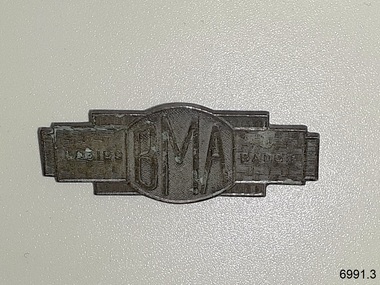
... Military Doctor in the Australian Defence Forces. Dr Angus and his family moved to Warrnambool in 1939, where Dr Angus operated his own medical practice. He later added the responsibility of part-time Port Medical Officer and was the last person appointed to that position. Both Dr Angus and his wife were very involved in the local community, including the planning stages of the new Flagstaff Hill and the layout of the gardens there. Dr Angus passed away in March 1970. This badge is significant for connecting Doctor Angus with organisations that support men and women who performed military service ...The badge was issued by the British Medical Association 'BMA'. It is known as the Female Relative's Bade or Ladies' Badge. It was manufactured in Melbourne in 1935 by Stokes of Melbourne. The BMA badge is one of a set of badges collected by Dr W R Angus from the organisations in which he was involved. They are now part of Flagstaff Hill’s comprehensive W.R. Angus Collection, donated by the family of Dr W R Angus, surgeon and oculist. The W.R. Angus Collection: - The W.R. Angus Collection includes historical medical equipment, surgical instruments and material once belonging to Dr Edward Ryan and Dr Thomas Francis Ryan, (both of Nhill, Victoria) as well as Dr Angus’ own belongings. The Collection’s history spans the medical practices of the two Doctors Ryan, from 1885-1926 plus that of Dr Angus, up until 1969. It includes historical medical and surgical equipment and instruments from the doctors Edward and Thomas Ryan of Nhill, Victoria. Dr Angus married Gladys in 1927 at Ballarat, the nearest big city to Nhill where he began as a Medical Assistant. He was also Acting House surgeon at the Nhill hospital where their two daughters were born. During World War II He served as a Military Doctor in the Australian Defence Forces. Dr Angus and his family moved to Warrnambool in 1939, where Dr Angus operated his own medical practice. He later added the responsibility of part-time Port Medical Officer and was the last person appointed to that position. Both Dr Angus and his wife were very involved in the local community, including the planning stages of the new Flagstaff Hill and the layout of the gardens there. Dr Angus passed away in March 1970.This badge is significant for connecting Doctor Angus with organisations that support men and women who performed military service for Australia. The badge was specifically for a female relative of the person who did service, showing compassion for women. The W.R. Angus Collection is significant for still being located at the site it is connected with, Doctor Angus being the last Port Medical Officer in Warrnambool. The Collection includes historical medical objects that date back to the late 1800's.This BMA badge is an overall rectangular shape made in a silver metal. It has a raised oval section in the centre. The badge has embossed text and a basket weave background pattern within the metal. It is a Ladies Badge, made for the women connected to members of the British Medical Association. It was made in Melbourne in 1935. This badge is part of a set of badges collected by Dr W R Angus. the set represents organisations that he was involved in, and is part of the W.R. Angus Collection.Front embossed; “BMA” “LADIES” “BADGE. Back embossed; “MELBOURNE / 1935 “ “STOKES MELB”flagstaff hill, warrnambool, maritime museum, maritime village, great ocean road, shipwreck coast, w.r. angus, badge, bma, british medical association, ladies’ badge, female relative's badge, military service, stokes, melbourne, w.r. angus collection -
 Flagstaff Hill Maritime Museum and Village
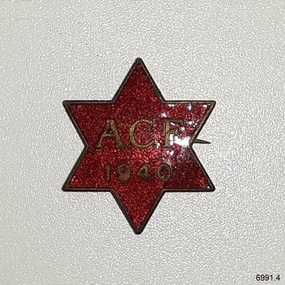
Badge - ACF Australian Comforts Fund badge, P J King Pty Ltd, 1940
... women volunteers in Australia to support the Australian troops overseas in WWI and WWII. This badge is one of a set of significant badges that connects Doctor Angus with Australian organisations of the early-to-mid 20th century, including those relating to military service support. ...This Australian Comforts Fund badge is part of a set of eleven badges collected from the 1920s to the 1940s by Dr W. R. Angus. The badge was sold by the ACF in 1940 to raise funds for gifts to send to the Australian troops serving overseas. The badge is one of a set of badges that represents various organisations that he had interests in. The Australian Comforts Fund was a mostly female, volunteer-run organisation officially recognised by the Government. It began in 1916 as an amalgamation of groups of people who wanted to support the Australian troops abroad with Items of comfort to supplement the essential items provided by the Australian Military Forces. The ACF raised funds to purchase goods, pack them and send them overseas. One of their fund-raising activities was 'button days' where buttons such as this one were given to those who gave donations. The ACF closed down after World War I but was re-formed at the start of World War II. Items that the ACF sent to the troops included personal toiletry items such as toothbrushes and toothpaste, magazines, pyjamas, singlets and socks. They also provided sporting equipment, recreational music, writing materials and postcards. Special hampers were sent to the troops at Christmas time. The maker, P J King, (Percy John King), originally established his engraving and ie casting business in Russell Street, Melbourne in 1893 in partnership with Charles Walder Bridgland, continuing on his own from 1899. Percy and his son John Howard King set up a new business P J King Pty Ltd in 1928 making uniform buttons. In the late 1980s, it merged with two other companies that then became J J Cash, now known as Cash's Australia. The set of badges was donated to Flagstaff Hill Maritime Village by the family of Doctor Angus, Surgeon and Oculist. It is part of the “W.R. Angus Collection” which includes historical medical equipment, surgical instruments and material belonging to Dr Edward Ryan and Dr Thomas Francis Ryan, (both of Nhill, Victoria) and Dr Angus’ own belongings. The Collection’s history spans the medical practices of the two Doctors Ryan, from 1885-1926 plus that of Dr Angus, up until 1969. The W.R. Angus Collection: - The W.R. Angus Collection includes historical medical equipment, surgical instruments and material belonging to Dr Edward Ryan and Dr Thomas Francis Ryan, (both of Nhill, Victoria) and Dr Angus’ own belongings. The Collection’s history spans the medical practices of the two Doctors Ryan, from 1885-1926 plus that of Dr Angus, up until 1969. It includes historical medical and surgical equipment and instruments from the doctors Edward and Thomas Ryan of Nhill, Victoria. Dr Angus married Gladys in 1927 at Ballarat, the nearest big city to Nhill where he began as a Medical Assistant. He was also Acting House surgeon at the Nhill hospital where their two daughters were born. During World War II He served as a Military Doctor in the Australian Defence Force. Dr Angus and his family moved to Warrnambool in 1939, where Dr Angus operated his own medical practice. He later added the part-time Port Medical Officer responsibility and was the last person appointed to that position. Dr Angus and his wife were very involved in the local community, including the planning stages of the new Flagstaff Hill and the layout of the gardens there. Dr Angus passed away in March 1970.This badge represents the efforts of the women volunteers in Australia to support the Australian troops overseas in WWI and WWII. This badge is one of a set of significant badges that connects Doctor Angus with Australian organisations of the early-to-mid 20th century, including those relating to military service support. The W.R. Angus Collection is significant for still being located at the site it is connected with, Doctor Angus being the last Port Medical Officer in Warrnambool. The Collection includes historical medical objects that date back to the late 1800s.The ACF Badge is a star-shaped, gold, glittered red enamel and metal badge. The star has six points. The enamel surface is textured. The border and front inscription of the badge is gold. It is the badge of the Australian Comfort Fund, made by P.J. King and dated 1940. This badge is part of a set of badges collected by Dr W R Angus. the set represents organisations that he was involved in, and is part of the W.R. Angus Collection.Front: “ACF / 1940” Reverse embossed “P.J. KING”flagstaff hill, warrnambool, maritime museum, maritime village, great ocean road, shipwreck coast, metal badges, enamel badges, organisation badges, acf, presbyterian brotherhood, oikumene, w.r. angus, flagstaff hill maritime museum and village, australian comforts fund, button day, volunteer, australian military forces, christmas hamper, 1940 acf badge, fund-raising, p j king pty ltd, percy john king, donor's badge, world war ii, 1939-1945, australians at war, voluntary work, volunteers, home front, w.r. angus collection -
 Flagstaff Hill Maritime Museum and Village
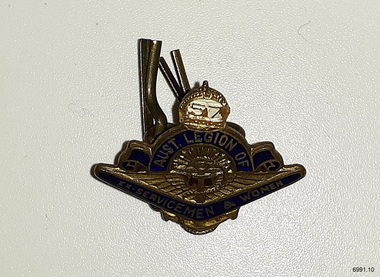
Badge - Australian Legion of Ex-Servicemen and Women, Stokes, Membership badge, 1957
... military service...Stokes...Melbourne...Australian Legion of Ex-Servicemen and Women...The badge was issued by the Victorian branch (indicated by the 'V' on the reverse) of the Australian Legion of Ex-Servicemen and Women and is referred to as The Badge of Unity or Tri-Services badge, uniting the armed services of Australia; the Army (rising sun), the Navy (anchor) and the Air Force (pair of wings). The number '57' on the crown represents the year of paid membership; 1957. The badge belonged to Dr W R Angus, who served in the Australian Army as a military...This Badge of Unity, or Tri-Service badge, is significant for connecting Doctor Angus with organisations that support men and women who performed military service for Australia. ...The badge was issued by the Victorian branch (indicated by the 'V' on the reverse) of the Australian Legion of Ex-Servicemen and Women and is referred to as The Badge of Unity or Tri-Services badge, uniting the armed services of Australia; the Army (rising sun), the Navy (anchor) and the Air Force (pair of wings). The number '57' on the crown represents the year of paid membership; 1957. The badge belonged to Dr W R Angus, who served in the Australian Army as a military doctor during WWII. It was made in Melbourne by Stokes in 1957, around 100 years after the firm was established by Thomas Stokes in Mincing Lane, Melbourne. The firm was operating from Caledonian Lane/Post Office Place in the 1950s. The badge is one of a set of badges collected by Dr W R Angus from the organisations in which he was involved. They are now part of Flagstaff Hill’s comprehensive W.R. Angus Collection, donated by the family of Dr W R Angus, surgeon and oculist. Australian Legion of Ex-Servicemen and Women was formed in 1944 to "entourage fellowship and assist those who have served". The organisation is open to members from Australia, British Commonwealth and Allied ex-service personnel. The W.R. Angus Collection: - The W.R. Angus Collection includes historical medical equipment, surgical instruments and material once belonging to Dr Edward Ryan and Dr Thomas Francis Ryan, (both of Nhill, Victoria) as well as Dr Angus’ own belongings. The Collection’s history spans the medical practices of the two Doctors Ryan, from 1885-1926 plus that of Dr Angus, up until 1969. It includes historical medical and surgical equipment and instruments from the doctors Edward and Thomas Ryan of Nhill, Victoria. Dr Angus married Gladys in 1927 at Ballarat, the nearest big city to Nhill where he began as a Medical Assistant. He was also Acting House surgeon at the Nhill hospital where their two daughters were born. During World War II He served as a Military Doctor in the Australian Defence Force. Dr Angus and his family moved to Warrnambool in 1939, where Dr Angus operated his own medical practice. He later added the responsibility of part-time Port Medical Officer and was the last person appointed to that position. Both Dr Angus and his wife were very involved in the local community, including the planning stages of the new Flagstaff Hill and the layout of the gardens there. Dr Angus passed away in March 1970.This Badge of Unity, or Tri-Service badge, is significant for connecting Doctor Angus with organisations that support men and women who performed military service for Australia. The badge was for membership with the organisation, which supports ex-servicemen and women of the three military forces; Army, Navy and Air Force. The W.R. Angus Collection is significant for still being located at the site it is connected with, Doctor Angus being the last Port Medical Officer in Warrnambool. The Collection includes historical medical objects that date back to the late 1800s.Badge; a gold-coloured metal and enamel badge. The blue boomerang-shaped band is below an arch of blue, below a crown with a number and coloured red, white and blue. There are symbols in the centre; a rising sun, above a pair of wings, with an anchor in the centre of both. There is red and blue scrollwork behind the symbols. Inscriptions are on the front and back of the badge. There are two loops and pins on the back of the badge. It is a membership badge of the Victorian branch of the Australian Legion of Ex-Servicemen and Women and was made by Stokes in 1957. The badge has a Serial Number. This badge is part of a set of badges collected by Dr Angus and is part of the W.R. Angus Collection.FRONT; “AUST. LEGION OF / EX-SERVICEMEN & WOMEN” On crown “57” REVERSE; “V” “13156" "STOKES” flagstaff hill, warrnambool, maritime museum, maritime village, great ocean road, shipwreck coast, w.r. angus, badge, ladies’ badge, military service, stokes, melbourne, australian legion of ex-servicemen and women, membership badge, 1957 membership badge, ex=service personnel, heraldry, world war ii, second world war, tri-services symbol, badge of unity, rising sun, anchor, pair of wings -
 City of Moorabbin Historical Society (Operating the Box Cottage Museum)
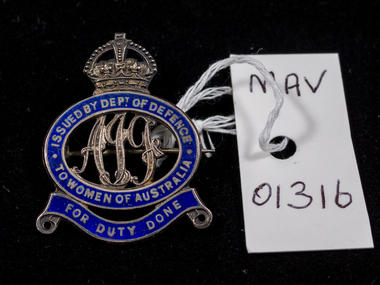
WW1 Medal for Women relatives of serving soldiers, c1914 - 1918
... service outside Australian waters. A bar was suspended below the badge to indicate additional relatives involved in the war effort. The Female Relatives Badge was promulgated under Military Order 280 of 1917 and superseded by Military Order 1818 of 1918. (Australian War Memorial ) So many Moorabbin Shire young men volunteered to serve in 1st AIF during WW1 . This caused great hardship for farming families especially due to the heavy manual labour that the Women ...Female Relative Badges were issued to the nearest female relative (usually wives or mothers) of those who engaged in active service overseas during the First and Second World Wars. Two Female Relative Badges were issued during the First World War. One was issued to the nearest female relative of soldiers, airmen, nurses, and masseuses who left Australia for active service abroad; the other to the nearest female relative of members of the Royal Australian Navy (RAN) who had enlisted for general naval sea service for at least a period of the war, and who performed service outside Australian waters. A bar was suspended below the badge to indicate additional relatives involved in the war effort. The Female Relatives Badge was promulgated under Military Order 280 of 1917 and superseded by Military Order 1818 of 1918. (Australian War Memorial )So many Moorabbin Shire young men volunteered to serve in 1st AIF during WW1 . This caused great hardship for farming families especially due to the heavy manual labour that the Women had to undertake to maintain food production for Australia and overseas . This medal may be associated with Alonzo Sheldrake Box who served at Gallipoli and France Circular Silver medal with Crown , Blue engraving and pin clasp on back . A silver bar is attached Around edge ; Issued by Dept. of Defence to Women of Australia Centre cut out : A I F On Bar : For Duty Done On Back : Stokes & Sons 57691world war 1914-18, moorabbin shire, early settlers, pioneers, box alonzo, box william, australian military medals, anzac, gallipoli, sheldrake martha, box elizabeth, box mary louisa, closter mary, war memorials, a -
 City of Moorabbin Historical Society (Operating the Box Cottage Museum)
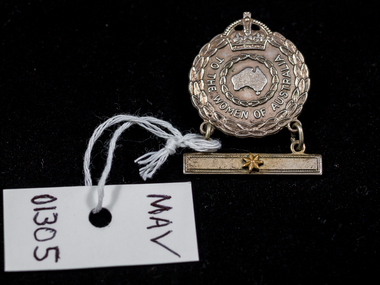
WW2 Medal for Women relatives of serving soldiers, 1942
... Emma Olymphia Roper of Balaclava/ Ripponlea would also have received a medal like this with 4 four stars because her 4 sons were serving in the Australian Army 1939-45 This Military Medal was given to the wives and mothers of Australian Soldiers serving during World War 2 1939-1945 world war 1939-1945, military medals, roper alfred william , roper veronica, moore joan catherine, roper arthur leopold, roper emma olymphia, war memorials, bentleigh, city of moorabbin, totally and permanently invalid, returned service league, victoria barracks, department of defence australia, Around medal : For the Women of Australia Back : Issued by the / C'wealth Govt. / A 135699 / Angus & Coote / 1942 Bar : star/ asterisk Silver medal, engraved wreath of leaves, crown and map of Australia and pin clasp on back . ...Female Relative Badges were issued to the nearest female relative (usually wives or mothers) of those who engaged in active service overseas during the First and Second World Wars. For active service abroad during the Second World War, a single badge was issued to the nearest female relative of members of the RAN, the Australian Imperial Force (including members of the Australian Army Nursing Service), and the Royal Australian Air Force. Stars displayed on a bar suspended below the badge represented the number of relatives involved in the war effort. Authority for the issue of the badge was given under AIF Order 200,14 February 1941. This medal was given to Veronica ( White ) Roper in 1942 because her husband Alfred William Roper was a member of the Australian Army Signals Corp serving in New Guinea. Emma Olymphia Roper of Balaclava/ Ripponlea would also have received a medal like this with 4 four stars because her 4 sons were serving in the Australian Army 1939-45 This Military Medal was given to the wives and mothers of Australian Soldiers serving during World War 2 1939-1945Silver medal, engraved wreath of leaves, crown and map of Australia and pin clasp on back . A bar with one star is suspendedAround medal : For the Women of Australia Back : Issued by the / C'wealth Govt. / A 135699 / Angus & Coote / 1942 Bar : star/ asteriskworld war 1939-1945, military medals, roper alfred william , roper veronica, moore joan catherine, roper arthur leopold, roper emma olymphia, war memorials, bentleigh, city of moorabbin, totally and permanently invalid, returned service league, victoria barracks, department of defence australia, -
 Geelong RSL Sub Branch
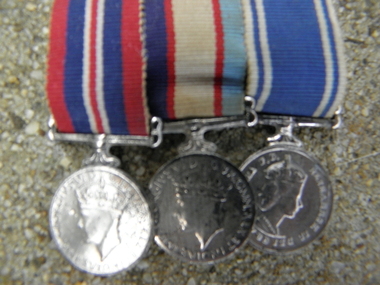
Medals- VF388646 Gwenyth Carr, Mid 20th Century
... Womens Army Service during WW2. VF388646 G Carr served with RA Sigs and obtained the rank of Captain? After her Military...Womens Army Service during WW2. VF388646 G Carr served with RA Sigs and obtained the rank of Captain? After her Military ...VF388646 Gwenyth Carr Served with the Australian Womens Army Service during WW2. VF388646 G Carr served with RA Sigs and obtained the rank of Captain? After her Military Discharge Gwenyth Carr served with the Police after graduating from Police College in 1946 she retired in 1974 with the rank of Senior Sergeant.The medals and badges are the originals belonging to VF388646 GE Carr.Two Australian Military Medals - War Medal 1939-1945 and Australian Service Medal, One Police Long Service and Good Conduct Medal (miniature).Military Medals - VF388646 G E Carr, The Police LS&GC Medal is a miniature and is not inscribed. vf388646 ge carr, rasigs, ww2, police service, awas, war widows guild -
 The Beechworth Burke Museum
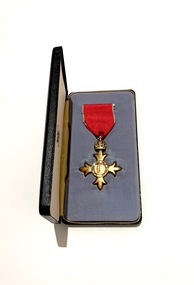
Medal - Order of the British Empire Medal, 01/01/1976
... military and colonial officials. An OBE (or order of the British Empire) is given for an outstanding achievement or service to the community. This will have had a long-term, significant impact and stand out as an example to others. This Order was established by George V in 1917 in response to recognising the thousands of men and women...military and colonial officials. An OBE (or order of the British Empire) is given for an outstanding achievement or service to the community. This will have had a long-term, significant impact and stand out as an example to others. This Order was established by George V in 1917 in response to recognising the thousands of men and women ...David Aloysius Patrick McKenzie-McHarg, L.I.B, O.B.E was born on 20th June 1918 in Albury, NSW to Hugh Patrick McKenzie-McHarg and Laura May (Dunne) McKenzie-McHarg. McKenzie-McHarg served on the Council of the United Shire of Beechworth for more than a decade during the 1960s-70s, including seven years as president. He was renowned as a public speaker and played a significant role in the community. In recognition for his outstanding achievements and services rendered to the Beechworth community he was awarded an Order of the British Empire (OBE) in 1976. David McKenzie-McHarg died on 6th June 1992 and is buried in Beechworth Cemetery. David McKenzie-McHarg’s wife, Marjorie Jean McKenzie McHarg, was well known to the Beechworth community as a brilliant pianist and played at all the balls and house parties. Apparently, she could play without sheet-music and would only have to hear a tune once to play it to near perfection. Together, they were a formidable asset to the Beechworth community over many years The British honours system has various orders, usually relating to the monarchy, military and colonial officials. An OBE (or order of the British Empire) is given for an outstanding achievement or service to the community. This will have had a long-term, significant impact and stand out as an example to others. This Order was established by George V in 1917 in response to recognising the thousands of men and women who served in a variety of non-combatant roles during the First world war who didn’t otherwise receive any formal recognition but were certainly worthy of acknowledgement. Recommendations for appointments to this Order were originally made on the nomination of the United Kingdom, however this soon became available to Commonwealth countries as well. However, Australia officially ceased to recommend the Order of the British Empire in 1989 with the establishment of the Order of Australia. Silver badge suspended from red ribbon with pearl-grey edges. The badge is in the form of a cross patonce (having the arms growing broader and floriated toward the end), the obverse of which bears the same field as the star pictures George V and Queen Mary. The reverse bears George V's Royal and Imperial Cypher. Both are within a ring bearing the motto of the Order: FOR GOD AND THE EMPIRE. The presentation case in which the medal is housed is of a black outer boarder edge leatherette finishing, block letters in gold OBE. The inside has a cream velvet base with a silk padded liner to the roof with the full set of Royal Mint Crest Mark. Obverse: FOR GOD AND THE EMPIRE / burke museum, obe, obe medal, beechworth, david mckenzie-mcharg, british honours system, george v, beechworth community, order of australia., order of the british empire, marjorie jean mckenzie mcharg -
 Phillip Island and District Historical Society Inc.
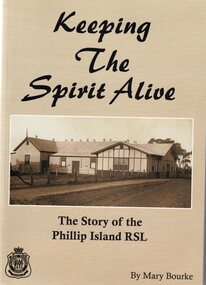
Book, BOURKE, Mary, Keeping the spirit alive : the story of the Phillip Island RSL, 2008
... Veterans stories World War 1 Historical Returned Services League of Australia phillip island sub branch history victoria Mary Bourke Military Vietnam Afghanistan Women's Land Army Gambling Veterans' Stories Part 1 - The Story of Phillip Island RSL Part 2 - The Stories of our Veterans A5 soft covered, beige colour book with black & white & coloured photographs Keeping the spirit alive : the story of the Phillip Island RSL Book Book BOURKE, Mary Phillip Island RSL Sub Branch Inc. ...History of Phillip Island RSL and life on the Island during the War. Veterans stories World War 1HistoricalA5 soft covered, beige colour book with black & white & coloured photographsPart 1 - The Story of Phillip Island RSL Part 2 - The Stories of our Veteransreturned services league of australia, phillip island sub branch, history, victoria, mary bourke, military, vietnam, afghanistan, women's land army, gambling, veterans' stories -
 Montmorency–Eltham RSL Sub Branch
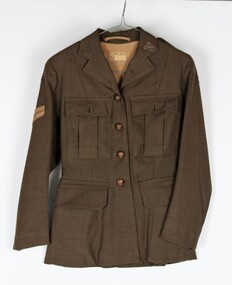
Uniform - Jacket, Khaki, Service Dress WW2 (Womens), 1943
... Australian Military Forces badge on the upper left lapel Two epaulets on the left and right shoulders with two small buttons inscribed Australian Military Forces with a map of Australia in the center with a crown at the top of the map. AWAS (Australian Women's Army Service) badges at the base of each epaulet. ...Australian Military Forces badge on the upper left lapel Two epaulets on the left and right shoulders with two small buttons inscribed Australian Military Forces with a map of Australia in the center with a crown at the top of the map. AWAS (Australian Women's Army Service) badges at the base of each epaulet. ...Dress jacket worn by Corporal Kathleen Phyllis Gill from Toorak Hill, Casterton. Army No. VF345716 Unit LHQ (Mil. Sec)Lined women's khaki dress jacket. Long sleeved. Wool polyester. Four metal buttons down the front with the inscription Australian Military Forces with a map of Australia in the center with a crown at the top of the map. Two hip pockets on the left and right with a flap on each. Two pleated pockets over the left and right breasts with flaps and small metal buttons inscribed Australian Military Forces with a map of Australia in the center with a crown at the top of the map. Australian Military Forces badge on the upper left lapel Two epaulets on the left and right shoulders with two small buttons inscribed Australian Military Forces with a map of Australia in the center with a crown at the top of the map. AWAS (Australian Women's Army Service) badges at the base of each epaulet. Corporal's stripes 6 cm down the right sleeve. Unit patch red over black - LHQ (Mill Sec). Two vertical belt loops at the back on the left and right. Pleat opening at the back. Horizontal strip of material inside the collar at the back of the neck to hang jacket. Tag sewn onto the lining at the back 2.5 cm down from the top stating - V 579 Made in Australia D. broad arrow D. 1943 Size kathleen gill, wool polyester, women's dress jacket -
 Montmorency–Eltham RSL Sub Branch
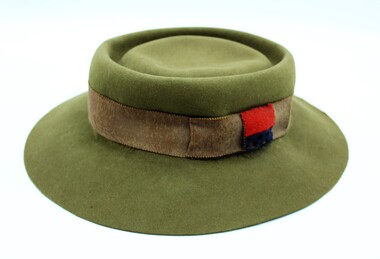
Headwear - Hat, Khaki, Fur Felt, WW2 (Womens), 1943
... Women's khaki felt service hat with brim. Tan band around the hat. Australian Military Forces badge at the center front on the band. ...Women's service hat worn by Corporal Kathleen Phyllis Gill from Toorak Hill, Casterton. Army No. VF345716 Unit LHQ (Mil. Sec) kathleen gill women's service hat felt Women's khaki felt service hat with brim. Tan band around the hat. Australian Military ...Women's service hat worn by Corporal Kathleen Phyllis Gill from Toorak Hill, Casterton. Army No. VF345716 Unit LHQ (Mil. Sec)Women's khaki felt service hat with brim. Tan band around the hat. Australian Military Forces badge at the center front on the band. Red over black unit patch attached to the right side of the band. Tag attached inside the hat stating - V.306 1943 Made in Australia. Size 6 1/2 kathleen gill, women's service hat, felt -
 Eltham District Historical Society Inc
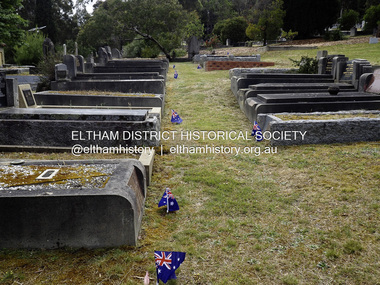
Photograph - Digital Photograph, Jim Connor, Flag tribute, Eltham Cemetery, Remembrance Day, 11 November 2019
... women) and approximately 200 at Kangaroo Ground. As of 2025, staff at Eltham Cemetery have taken over the role from Terry in planting flags at Eltham Cemetery and other volunteers assist at Nillumbuk and Kangaroo Ground cemeteries to honour these service personnel. Jim Connor Collection Terry Beaton Sheila Beaton Eltham Cemetery Australian Military ...Colonel Terry Beaton (Retired), an EDHS member, has been passionate about locating and remembering local service personnel buried in the Eltham, Nillumbik and Kangaroo Ground cemeteries each ANZAC (April 25) and Remembrance Day (November 11, formerly known as Armsitice Day). In many cases Terry has identified service personnel whose service is not formally recognised on their headstones and he and wife Sheila would locate their graves and plant a flag in their memory. In more recent times Terry has been assisted by members of the Eltham District Historical Society as the number of graves identified identified grew. As a result of two years work they have located over 860 veterans at Eltham (744 WW2 - of which 13 were women) and approximately 200 at Kangaroo Ground. As of 2025, staff at Eltham Cemetery have taken over the role from Terry in planting flags at Eltham Cemetery and other volunteers assist at Nillumbuk and Kangaroo Ground cemeteries to honour these service personnel. jim connor collection, terry beaton, sheila beaton, eltham cemetery, australian military service personnel, eltham district historical society, flag tribute, remembrance day -
 Eltham District Historical Society Inc
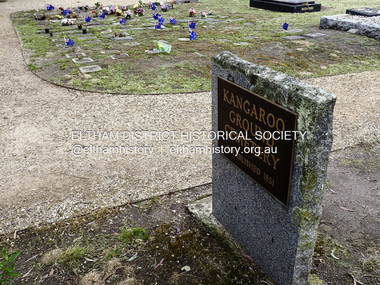
Photograph - Digital Photograph, Jim Connor, Flag tribute, Kangaroo Ground Cemetery, Remembrance Day, 11 November 2019
... women) and approximately 200 at Kangaroo Ground. As of 2025, staff at Eltham Cemetery have taken over the role from Terry in planting flags at Eltham Cemetery and other volunteers assist at Nillumbuk and Kangaroo Ground cemeteries to honour these service personnel. Jim Connor Collection Terry Beaton Sheila Beaton Australian Military ...Colonel Terry Beaton (Retired), an EDHS member, has been passionate about locating and remembering local service personnel buried in the Eltham, Nillumbik and Kangaroo Ground cemeteries each ANZAC (April 25) and Remembrance Day (November 11, formerly known as Armsitice Day). In many cases Terry has identified service personnel whose service is not formally recognised on their headstones and he and wife Sheila would locate their graves and plant a flag in their memory. In more recent times Terry has been assisted by members of the Eltham District Historical Society as the number of graves identified identified grew. As a result of two years work they have located over 860 veterans at Eltham (744 WW2 - of which 13 were women) and approximately 200 at Kangaroo Ground. As of 2025, staff at Eltham Cemetery have taken over the role from Terry in planting flags at Eltham Cemetery and other volunteers assist at Nillumbuk and Kangaroo Ground cemeteries to honour these service personnel. jim connor collection, terry beaton, sheila beaton, australian military service personnel, eltham district historical society, flag tribute, remembrance day, kangaroo ground cemetery -
 Eltham District Historical Society Inc
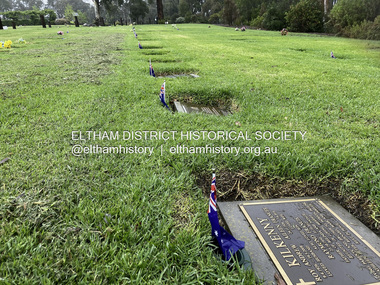
Photograph - Digital Photograph, Jim Connor, Flag tribute, Eltham Cemetery, Remembrance Day, 8 November 2025
... women) and approximately 200 at Kangaroo Ground. As of 2025, staff at Eltham Cemetery have taken over the role from Terry in planting flags at Eltham Cemetery and other volunteers assist at Nillumbuk and Kangaroo Ground cemeteries to honour these service personnel. Jim Connor Collection Terry Beaton Sheila Beaton Australian Military ...Colonel Terry Beaton (Retired), an EDHS member, has been passionate about locating and remembering local service personnel buried in the Eltham, Nillumbik and Kangaroo Ground cemeteries each ANZAC (April 25) and Remembrance Day (November 11, formerly known as Armsitice Day). In many cases Terry has identified service personnel whose service is not formally recognised on their headstones and he and wife Sheila would locate their graves and plant a flag in their memory. In more recent times Terry has been assisted by members of the Eltham District Historical Society as the number of graves identified identified grew. As a result of two years work they have located over 860 veterans at Eltham (744 WW2 - of which 13 were women) and approximately 200 at Kangaroo Ground. As of 2025, staff at Eltham Cemetery have taken over the role from Terry in planting flags at Eltham Cemetery and other volunteers assist at Nillumbuk and Kangaroo Ground cemeteries to honour these service personnel. jim connor collection, terry beaton, sheila beaton, australian military service personnel, eltham district historical society, flag tribute, remembrance day, eltham cemetery -
 Bendigo Military Museum
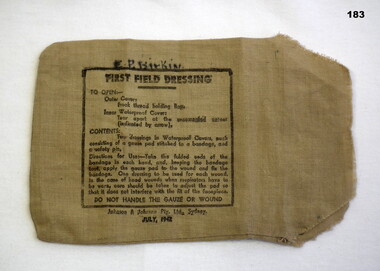
Equipment - COVER, FIELD DRESSING, Johnson & Johnson Pty. Ltd, July 1942
... Women’s Army Service on 26.1.43 age 20 years. At discharge on 1.3.44 she held the rank of Pte. This item was held in the tin 182.2 with the card set 184.54. medicine - first aid military history field dressing In ink - "E.P. ...Edna Phyliss BIRKIN No VF396668 enlisted in the Australian Women’s Army Service on 26.1.43 age 20 years. At discharge on 1.3.44 she held the rank of Pte. This item was held in the tin 182.2 with the card set 184.54.Khaki cloth bag with instructions for use of dressing, printed in black on surface.In ink - "E.P. Birkin"medicine - first aid, military history, field dressing -
 Bendigo Military Museum
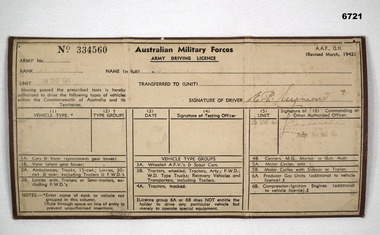
Document - DRIVERS LICENCE, ARMY
... Army Driving Licence issued to service men/women to authorise the driving of military vehicles....Army Driving Licence issued to service men/women to authorise the driving of military vehicles. Passchendaele Barracks Trust Drivers licence 38th Battalion Licence No. 334560. ...Army Driving Licence issued to service men/women to authorise the driving of military vehicles.Brown coloured Army driving licence with white paper and black writing. Folds into 3 to make wallet or pocket size.Licence No. 334560. Unit "38 Inf Bn" stamped, signature of driver, rank and full name too faded to decipher. Signature may be E.P. Seymour. Headed Australian Military Forces Army Driving Licence and lists types of vehicles.passchendaele barracks trust, drivers licence, 38th battalion -
 Bendigo Military Museum
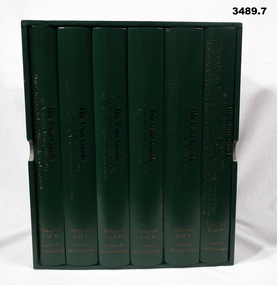
Book - BOOKS, BOXED SET, Graham R McKenzie - Smith, The Unit Guide, 2018
... Womens Services / Volunteer Defence Corps / War Graves, Survey, Labour, Salvage / Military Policing / Recruiting & Training / Dental, Bath & Laundry / Veterinary & Animal / Movements & Transit / Pay, Records & Printing, Postal / Amenities & Canteens Units. 568 pages. ...Womens Services / Volunteer Defence Corps / War Graves, Survey, Labour, Salvage / Military Policing / Recruiting & Training / Dental, Bath & Laundry / Veterinary & Animal / Movements & Transit / Pay, Records & Printing, Postal / Amenities & Canteens Units. 568 pages. ....1) Box open, cardboard, dark green buckram, white paper lining, gold print on sides. .2) - .7) Hard cover book, cardboard, dark green buckram with gold print on front cover & spine. Pages are plain, cut, white, black print, black & white illustrations. .2) Volume 1 of 6. Unit & Location Indexes / Bibliography, Orders of Battle. 483 pages. .3) Volume 2 of 6. Headquarters, Infantry, Cavalry / Armoured & Intelligence Units. 605 pages. .4) Volume 3 of 6. Artillery, Air Defence and Engineer Units. 626 pages. .5) Volume 4 of 6. Medical and Signal Units. Box of 6 books. The Unit Guide / The Australian Army / 1939 - 1945. 654 pages .6) Volume 5 of 6. Aust Army Service Corps, Aust Army Ordnance Corps and Aust Electrical & Mechanical Engineer Units. 706 pages. .7) Volume 6 of 6. Womens Services / Volunteer Defence Corps / War Graves, Survey, Labour, Salvage / Military Policing / Recruiting & Training / Dental, Bath & Laundry / Veterinary & Animal / Movements & Transit / Pay, Records & Printing, Postal / Amenities & Canteens Units. 568 pages. books- military history, unit guide -
 Bendigo Military Museum
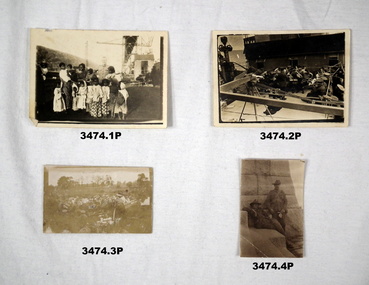
Photograph - PHOTOGRAPHS WW1, c.1915
... service history. Part of the HEWSTON collection re WW1 & WW2. photography-photographs military history - army Four x black & white photos presumable taken by Bert HEWSTON during his war experience. .1) Group of Kaffir women & children. .2) Band playing onboard the ship Wandilla, conveying Bert to Europe. .3) Band playing on Avon River, Durrington. .4) 2 x uniformed soldiers. ...Bert HEWSTON, refer Cat No 2759.2 for his service history. Part of the HEWSTON collection re WW1 & WW2.Four x black & white photos presumable taken by Bert HEWSTON during his war experience. .1) Group of Kaffir women & children. .2) Band playing onboard the ship Wandilla, conveying Bert to Europe. .3) Band playing on Avon River, Durrington. .4) 2 x uniformed soldiers. All different sizes.photography-photographs, military history - army -
 Bendigo Military Museum
Uniform - SLIDE SHOULDER BOARD
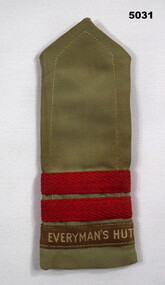
... women. The hut's were also staffed by ministers of religion who had returned to Australia due to war plus volunteers. Everyman's staff wore a military cut uniform and, where appropriate, were given officer status by local commanders. Today, Everyman's Welfare Service...women. The hut's were also staffed by ministers of religion who had returned to Australia due to war plus volunteers. Everyman's staff wore a military cut uniform and, where appropriate, were given officer status by local commanders. Today, Everyman's Welfare Service ...Established during world War Two, the first 'Everyman's Hut' was built at Bonegilla camp to serve army personnel. An 'Everywoman's Hut' was established at Bandianna and was staffed by women. The hut's were also staffed by ministers of religion who had returned to Australia due to war plus volunteers. Everyman's staff wore a military cut uniform and, where appropriate, were given officer status by local commanders. Today, Everyman's Welfare Service caters for the well being of members of the ADF and their families. Part of the Reverend Chaplain Major Thomas Bruce Williams, No556101, Collection.Khaki coloured slide should backgrounder board in poly ester fabric. A label with fawn lettering on a brown background is sewn to the straight end of the board. Above the label are two horizontal red bands in cotton braid.Embroidered on a brown label: 'EVERYMAN'S HUT'.everyman's hut, major thomas b. williams -
 Bendigo Military Museum
Souvenir - CUSHION COVERS and HANDKERCHIEF, C.1941
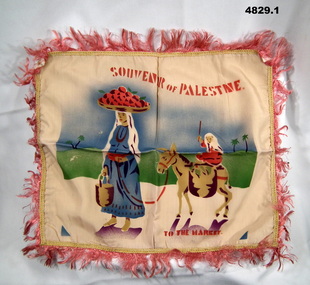
... service details. Cushions handkerchiefs souvenirs .1) “Souvenir of Palestine”, “To the Market”. .2) “Beyroujth”. .3) “Souvenir of Palestine 1941”, “Davids Tower”, “Australian Commonwealth Military Forces”. .1) Cushion cover silk with pink tassels, colour depiction of a women, donkey and child of to the market. .2) handkerchief cotton blue with crochet boarder, flowers and word embroidered. .3) Cushion cover silk yellow tassle edges, green background with depictions of a vehicle, tower, rising sun badge embroidered on. ...Items souvenired by Albert Corrie VX47191, refer Cat No 4847 for service details..1) Cushion cover silk with pink tassels, colour depiction of a women, donkey and child of to the market. .2) handkerchief cotton blue with crochet boarder, flowers and word embroidered. .3) Cushion cover silk yellow tassle edges, green background with depictions of a vehicle, tower, rising sun badge embroidered on..1) “Souvenir of Palestine”, “To the Market”. .2) “Beyroujth”. .3) “Souvenir of Palestine 1941”, “Davids Tower”, “Australian Commonwealth Military Forces”.cushions, handkerchiefs, souvenirs -
 Warrnambool and District Historical Society Inc.
Document, A Service of Intercession, 1915
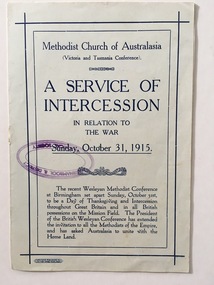
... The service was held to seek Divine intercession and aid for those on active military service in World War One and for the families of these men and women. ...The service was held to seek Divine intercession and aid for those on active military service in World War One and for the families of these men and women. ...This is a programme for a Service of Intercession in Relation to the War. It was held by the Methodist Church (Victoria and Tasmania Conference) in October 1915. The Wesleyan Methodist Conference at Birmingham, England requested that Sunday October 31st 1915 be set aside as a Day of Thanksgiving and Intercession throughout Britain and all other countries in the British Empire. The service was held to seek Divine intercession and aid for those on active military service in World War One and for the families of these men and women. This programme is of interest as the 1915 service would have been held in Methodist Churches throughout Victoria and Tasmania and this would have included the Warrnambool Methodist Church. World War One was a highly significant event in the history of Australia and Warrnambool, along with all other places in Australia, was affected deeply by the war with many young local people enlisting and many dying on active service.These are two sheets of paper folded in two to make eight pages. The pages contain a programme for the Methodist Church service in October 1915. The printing is in blue on a whitish/bluish background. The front cover is edged with blue lines. There is a blue stamp of the Warrnambool & District Historical Society on the front cover. The programme has been stapled but the staples have been removed. methodist church, world war one -
 Bendigo Military Museum
Badge, post WW2
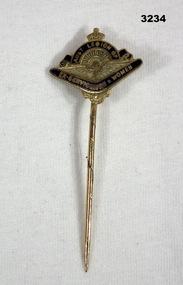
... Item relates to S W ROSS VX78589, refer Cat No 3147 for his service details. numismatics-badges societies-service clubs military history "AUST LEGION OF EX-SERVICEMEN & WOMEN" Australian League of Ex Servicemen & Women badge. ...Item relates to S W ROSS VX78589, refer Cat No 3147 for his service details.Australian League of Ex Servicemen & Women badge. Small lapel pin badge, gold & blue enamel colour. Crown on top of a banner. In centre are stylised Rising Sun, pair of aircraft wings, an anchor and a boomerang."AUST LEGION OF EX-SERVICEMEN & WOMEN"numismatics-badges, societies-service clubs, military history -
 Bendigo Military Museum
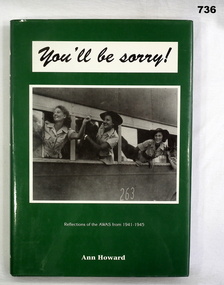
Book, Ann Howard, You'll Be Sorry! Reflections of the AWAS from 1941-1945, 1990
... Details the experiences of members of the Australian Women's Army Service during WWII. books military history On front end paper "Francis W Dean BEM" Green buckram hardcover with dust jacket. ...Details the experiences of members of the Australian Women's Army Service during WWII. Green buckram hardcover with dust jacket. Book has title in gold on spine. Dust cover is green with black and white image of women leaning out of windows. 193 cut edged plain paper pages, with illustrations.On front end paper "Francis W Dean BEM"books, military history -
 Bendigo Military Museum
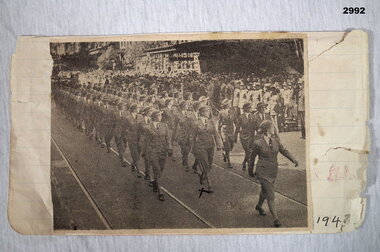
Newspaper - NEWSPAPER CUTTING WW2, C.1942
... Part of the HEWSTON collection WW1 & WW2. military history documents - newspapers Front bottom R corner: “1942” Rear: “Aunty Gert, First Governor of New Guinea” Black & white newspaper cutting showing a march of Service women through a city street. ...Part of the HEWSTON collection WW1 & WW2.Black & white newspaper cutting showing a march of Service women through a city street.Front bottom R corner: “1942” Rear: “Aunty Gert, First Governor of New Guinea” military history, documents - newspapers
