
Showing 19 items matching "women in surgery"
-
 Royal Australasian College of Surgeons Museum and Archives
Photograph - Framed photograph, Women In Surgery Breakfast session RACS ASC Sydney 2018, Women In Surgery Breakfast session RACS ASC Sydney 2018
... Framed photograph, Women In Surgery Breakfast session RACS ASC Sydney 2018...Women In Surgery Breakfast session RACS ASC Sydney 2018...Women In Surgery...Framed photograph, Women In Surgery Breakfast session RACS ASC Sydney 2018...Women In Surgery Framed photograph, Women In Surgery Breakfast session RACS ASC Sydney 2018 Women In Surgery Breakfast session RACS ASC Sydney 2018 Photograph Framed photograph, Women In Surgery Breakfast session RACS ASC Sydney 2018 ...Framed photograph, Women In Surgery Breakfast session RACS ASC Sydney 2018women in surgery -
 Brighton Historical Society
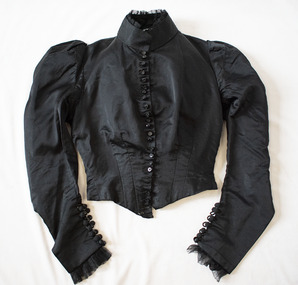
Bodice, circa 1900
... From here, Mary attended Oberwyl Ladies College in St Kilda and later the Australian College of Dentistry, one of only a few women to study dental surgery at the time. She was apprenticed to Ada Tovell (1865-1932), one of Victoria’s first female dentists, who had her own practice in Collins Street. ...From here, Mary attended Oberwyl Ladies College in St Kilda and later the Australian College of Dentistry, one of only a few women to study dental surgery at the time. She was apprenticed to Ada Tovell (1865-1932), one of Victoria’s first female dentists, who had her own practice in Collins Street. ...This bodice belonged to Mary Crombie, an early Victorian dentist, who lived in Brighton while she was studying at the Australian College of Dentistry in the mid-1900s, and later returned to the area in her retirement from 1949-1971. Mary Margaret Crombie (1884-1971) was born at Coan Downs Station near Walgett, northern New South Wales, where her father Henry was station manager. After Henry’s untimely death in 1895, Mary and her mother loved for a few years with family members in St Kilda, before moving into a cottage of their own, ‘Rosewood’, at 42 Asling Street, Brighton around 1899. From here, Mary attended Oberwyl Ladies College in St Kilda and later the Australian College of Dentistry, one of only a few women to study dental surgery at the time. She was apprenticed to Ada Tovell (1865-1932), one of Victoria’s first female dentists, who had her own practice in Collins Street. Mary graduated in 1907 and the following year moved with he mother to Yarram in South Gippsland, where she took over the running of a practice owned by Sale dentist Charles Trood, eventually purchasing it from him in 1915. Speaking to a Brighton newspaper in 1961, Mary said she believed that she was the first woman to start a dental practice in Gippsland. For some locals, this took a little getting used to: “Many were amazed, and had some misgivings, when they found that the local dentist was a woman,” she said. “I always remember a huge farmer (he was about 6 ft. 4 in.), who had fortified himself at the local hotel to face the ordeal of visiting the dentist. He almost turned and ran when he saw me. … He was still more amazed when I pulled out his tooth without undue trouble.” The farmer was the best advertisement she could have asked for, telling everybody about the diminutive lady dentist who had calmly extracted his tooth. Mary practiced in Yarram until her retirement in 1949. After selling her practice she returned to Brighton, where she spent the last two decades of her life residing at 25 Oak Grove. Following her death in 1971, her relatives in Brighton donated a number of items from her home to BHS.Black satin bodice, boned, with black faceted glass buttons down the front. High collar. Both collar and cuffs are edged with a black net ruffle. Two rows of seven black crochet-covered buttons at each cuff, fastening with loops. Stray brown threads poking through fabric around the collar, shoulders and back indicate that these areas may originally have featured lace embellishments.mary crombie, 1900s -
 Flagstaff Hill Maritime Museum and Village
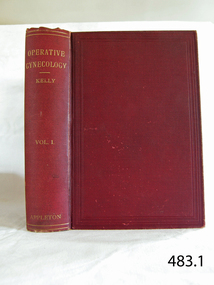
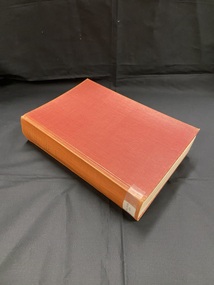
Book - Reference Medical/ Gynaecology, Howard Kelly et al, Operative Gynaecology Vol 1, 1906
... surgery rather than a general medicine text. Its subject is operative treatment, anatomy, instruments, procedures, and surgical technique in women’s diseases, reflecting the early 20th-century development of gynaecology as a specialised surgical field. ...This subject text, Operative Gynaecology, Volume I, is a surgical textbook on diseases and operations involving the female reproductive system, written by Howard A. Kelly and illustrated in part by Max Brödel. The book is a technical, richly illustrated manual for gynaecological surgery rather than a general medicine text. Its subject is operative treatment, anatomy, instruments, procedures, and surgical technique in women’s diseases, reflecting the early 20th-century development of gynaecology as a specialised surgical field.Operative Gynecology Vol 1 Author: Howard Kelly Illustrator: Max Brodel Publisher: D. Appleton & Co. Date: 1906 Further Information: Red Cloth Cover and Spine Lettering to Spine in Gilt.non-fictionThis subject text, Operative Gynaecology, Volume I, is a surgical textbook on diseases and operations involving the female reproductive system, written by Howard A. Kelly and illustrated in part by Max Brödel. The book is a technical, richly illustrated manual for gynaecological surgery rather than a general medicine text. Its subject is operative treatment, anatomy, instruments, procedures, and surgical technique in women’s diseases, reflecting the early 20th-century development of gynaecology as a specialised surgical field.flagstaff hill, warrnambool, shipwrecked-coast, flagstaff-hill, flagstaff-hill-maritime-museum, maritime-museum, shipwreck-coast, flagstaff-hill-maritime-village, operative gynecology vol 1, book, howard kelly -
 Ballarat Clarendon College
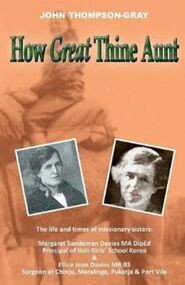
Book, How great thine aunt, 2018
... Jean gave up a promising career in surgery at the Women's Hospital in Melbourne to practise at a mission hospital in Chinju, Korea. ...Jean gave up a promising career in surgery at the Women's Hospital in Melbourne to practise at a mission hospital in Chinju, Korea. ...This is the untold story of Margaret (1904) and Jean (1906) Davies and their uncompromising faith, amazing courage and endless endurance. Margaret was called to Korea as an educator from 1910 to 1940. During the Mansei Uprising, Japanese police arrested her for inciting to riot and drove Kim Il-Sung into Manchuria where he founded Korean Communism. Jean gave up a promising career in surgery at the Women's Hospital in Melbourne to practise at a mission hospital in Chinju, Korea. Sent home as a foreign alien before the attack on Pearl Harbor she practised at outback mission stations in Australia, doubling as the Flying Doctor. She medically examined the population of the New Hebrides (Vanuatu) as a first step to rid the country of leprosy. Jean returned to Pukatja in South Australia during British nuclear bomb testing at Maralinga.Small paperback bookmargaret davies, ellice jean davies, clarendon-presbyterian-ladies-college, 1900s, korea, missionary, surgeon, maralinga, vanuatu -
 Flagstaff Hill Maritime Museum and Village
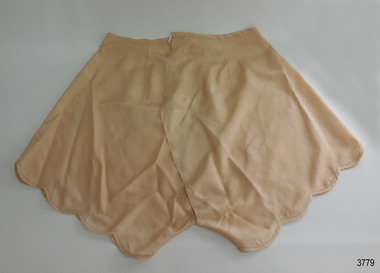
Clothing - Lingerie, Gladys Angus, wife of Dr. W.R. Angus, late 1920's
... Dr Angus assisted Dr Tom Ryan, a pioneer in the use of X-rays and in ocular surgery. flagstaff hill warrnambool flagstaff hill maritime museum maritime museum shipwreck coast flagstaff hill maritime village great ocean road dr w r angus dr ryan handmade lingerie lingerie 1920's silk lingerie split leg drawers split-leg drawers early 20th century ladies underwear women's underwear underwear silk inderwear undergarment Lingerie, split-leg drawers, beige silk, handmade, with scalloped finish on legs and drawer string waist. ...This pair of silk split-leg drawers was handmade by Gladys Angus for her trousseau in 1929 when she married Dr. Angus. The design became popular in the mid-1800's and continued into the early 1900's. It is part of the W.R.Angus Collection and was donated to Flagstaff Hill Maritime Village by the family of Doctor William Roy Angus, Surgeon and Oculist. The Collection that includes historical medical equipment, surgical instruments and material once belonging to Dr Edward Ryan and Dr Thomas Francis Ryan, (both of Nhill, Victoria) as well as Dr Angus’ own belongings. The Collection’s history spans the medical practices of the two Doctors Ryan, from 1885-1926 plus that of Dr Angus, up until 1969. Dr Angus was the last Port Medical Officer in Warrnambool.This garment is an example of the beautiful handmade clothing produced in Australian homes in the early 20th century. The W.R. Angus Collection is significant for still being located at the site it is connected with, Doctor Angus being the last Port Medical Officer in Warrnambool. The collection of medical instruments and other equipment is culturally significant, being an historical example of medicine from late 19th to mid-20th century. Dr Angus assisted Dr Tom Ryan, a pioneer in the use of X-rays and in ocular surgery. Lingerie, split-leg drawers, beige silk, handmade, with scalloped finish on legs and drawer string waist. Each leg is finished separately then drawn together at the waist by a ribbon drawer-string, with the legs overlapping slightly. It is part of the W.R. Angus Collection. flagstaff hill, warrnambool, flagstaff hill maritime museum, maritime museum, shipwreck coast, flagstaff hill maritime village, great ocean road, dr w r angus, dr ryan, handmade lingerie, lingerie 1920's, silk lingerie, split leg drawers, split-leg drawers, early 20th century, ladies underwear, women's underwear, underwear, silk inderwear, undergarment -
 Flagstaff Hill Maritime Museum and Village
Container - Wooden Box, 1930s
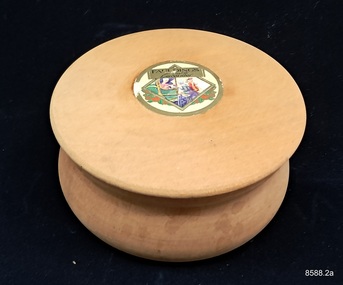
... surgery. Flagstaff Hill Maritime Museum and Village Great Ocean Road Shipwreck Coast Warrnambool Shipwtreck Coast Dr W R Angus Faulding's Lavender Powder Cosmetic Faulding's Old English Lavender, and picture of old English men and women in period costume. ...One pharmaceutical enterprise which put greater emphasis on the manufacturing side of its business and whose successors strengthened this emphasis was Faulding's. A pharmacist, Francis H. Faulding, started his shop in Adelaide in 1841 and formed a partnership with an English physician, L. Scammel, in 1861. From its beginnings the firm showed a flare for innovation. After Simpson's discovery of the anaesthetic properties of chloroform in 1847, Francis Faulding was the first to import chloroform; in 1858 he distributed cocaine preparations; in 1864 he produced the first olive oil from South Australian olives and, after J. Lister's reports in Lancet on the reduction of mortality after surgery with the use of phenol, Faulding began production of antiseptics ('Solyptol') in 1867. Faulding was also the first to utilize the medicinal and antiseptic properties of eucalyptus oil which was obtained from distilleries on Kangaroo Island The Second World War in Europe disrupted the supply of cod liver oil, an important source of Vitamin A. Faulding chemists found an alternative source in white schnapper shark, which sustained supplies in Australia as well as generated exports to the UK . When supplies of I.G. Farben's newly discovered sulpha drugs ran out, Faulding became involved in the national program organised by the Medical Equipment Control Committee (MECC) and, jointly with universities, synthesised sulphanilamide. Following the transfer of American knowhow. Faulding's was also the first private enterprise to produce yet another life saving drug of military importance, penicillin. After the war basic synthesis of antibiotics became difficult to sustain by private enterprise because of the gigantic scale advantages of competing US producers, and competition in the synthesis of new drugs demanded huge investment in R & D; Fauldings maintained their business by a combination of marketing, wholesaling and producing consumer and medical products. In the 1970s, however, Fauldings set a remarkable precedent in research strategy and achievement in the Australian pharmaceutical business. They decided to concentrate their research on drugs which had proven efficacy, but which also suffered from certain shortcomings restricting their clinical usefulness, and to seek advances overcoming these shortcomings. This was an imaginative new strategy, a way of grafting Australian knowhow on to major products, in keeping with local resources and yet offering opportunities for sophisticated skill. At the same time it promised to open internatiSurgeon and onal markets, since the major producers of the basic drugs could hardly ignore significant advances. https://www.samhs.org.au/Virtual%20Museum/Medicine/drugs_nonsurg/Fauldings_drug/Fauldings_drugs.html This decorative gift box once containing Faulding’s Old English Lavender soap or powder belonged to Dr. Angus' wife, Gladys. It was donated to Flagstaff Hill Maritime Village by his daughter, Bernice McDade. It is part of the “W.R. Angus Collection” that includes historical medical equipment, surgical instruments and material once belonging to Dr Edward Ryan and Dr Thomas Francis Ryan, (both of Nhill, Victoria) as well as Dr Angus’ own belongings. The Collection’s history spans the medical practices of the two Doctors Ryan, from 1885-1926 plus that of Dr Angus, up until 1969. Powder or soap in boxes such as this was perfumed and used as part of a women’s personal grooming in the early to mid 20th century. Faulding’s Company began in Adelaide, Australia, in 1845 and made a wide range of cosmetic and perfume products as well as pharmaceuticals. The company is still in operation today. ABOUT THE “W.R.ANGUS COLLECTION” Doctor William Roy Angus M.B., B.S., Adel., 1923, F.R.C.S. Edin.,1928 (also known as Dr Roy Angus) was born in Murrumbeena, Victoria in 1901 and lived until 1970. He qualified as a doctor in 1923 at University of Adelaide, was Resident Medical Officer at the Royal Adelaide Hospital in 1924 and for a period was house surgeon to Sir (then Mr.) Henry Simpson Newland. Dr Angus was briefly an Assistant to Dr Riddell of Kapunda, then commenced private practice at Curramulka, Yorke Peninsula, SA, where he was physician, surgeon and chemist. In 1926, he was appointed as new Medical Assistant to Dr Thomas Francis Ryan (T.F. Ryan, or Tom), in Nhill, Victoria, where his experiences included radiology and pharmacy. In 1927 he was Acting House Surgeon in Dr Tom Ryan’s absence. Dr Angus had become engaged to Gladys Forsyth and they decided he further his studies overseas in the UK in 1927. He studied at London University College Hospital and at Edinburgh Royal Infirmary and in 1928, was awarded FRCS (Fellow from the Royal College of Surgeons), Edinburgh. He worked his passage back to Australia as a Ship’s Surgeon on the on the Australian Commonwealth Line’s T.S.S. Largs Bay. Dr Angus married Gladys in 1929, in Ballarat. (They went on to have one son (Graham 1932, born in SA) and two daughters (Helen (died 12/07/1996) and Berenice (Berry), both born at Mira, Nhill ) According to Berry, her mother Gladys made a lot of their clothes. She was very talented and did some lovely embroidery including lingerie for her trousseau and beautifully handmade baby clothes. Dr Angus was a ‘flying doctor’ for the A.I.M. (Australian Inland Ministry) Aerial Medical Service in 1928 . Its first station was in the remote town of Oodnadatta, where Dr Angus was stationed. He was locum tenens there on North-South Railway at 21 Mile Camp. He took up this ‘flying doctor’ position in response to a call from Dr John Flynn; the organisation was later known as the Flying Doctor Service, then the Royal Flying Doctor Service. A lot of his work during this time involved dental surgery also. Between 1928-1932 he was surgeon at the Curramulka Hospital, Yorke Peninsula, South Australia. In 1933 Dr Angus returned to Nhill and purchased a share of the Nelson Street practice and Mira hospital (a 2 bed ward at the Nelson Street Practice) from Dr Les Middleton one of the Middleton Brothers, the current owners of what previously once Dr Tom Ryan’s practice. Dr Tom and his brother had worked as surgeons included eye surgery. Dr Tom Ryan performed many of his operations in the Mira private hospital on his premises. He had been House Surgeon at the Nhill Hospital 1902-1926. Dr Tom Ryan had one of the only two pieces of radiology equipment in Victoria during his practicing years – The Royal Melbourne Hospital had the other one. Over the years Dr Tom Ryan had gradually set up what was effectively a training school for country general-practitioner-surgeons. Each patient was carefully examined, including using the X-ray machine, and any surgery was discussed and planned with Dr Ryan’s assistants several days in advance. Dr Angus gained experience in using the X-ray machine there during his time as assistant to Dr Ryan. When Dr Angus bought into the Nelson Street premises in Nhill he was also appointed as the Nhill Hospital’s Honorary House Surgeon 1933-1938. His practitioner’s plate from his Nhill surgery is now mounted on the doorway to the Port Medical Office at Flagstaff Hill Maritime Village, Warrnambool. When Dr Angus took up practice in the Dr Edward and Dr Tom Ryan’s old premises he obtained their extensive collection of historical medical equipment and materials spanning 1884-1926. A large part of this collection is now on display at the Port Medical Office at Flagstaff Hill Maritime Village in Warrnambool. In 1939 Dr Angus and his family moved to Warrnambool where he purchased “Birchwood,” the 1852 home and medical practice of Dr John Hunter Henderson, at 214 Koroit Street. (This property was sold in1965 to the State Government and is now the site of the Warrnambool Police Station. and an ALDI sore is on the land that was once their tennis court). The Angus family was able to afford gardeners, cooks and maids; their home was a popular place for visiting dignitaries to stay whilst visiting Warrnambool. Dr Angus had his own silk worm farm at home in a Mulberry tree. His young daughter used his centrifuge for spinning the silk. Dr Angus was appointed on a part-time basis as Port Medical Officer (Health Officer) in Warrnambool and held this position until the 1940’s when the government no longer required the service of a Port Medical Officer in Warrnambool; he was thus Warrnambool’s last serving Port Medical Officer. (Masters of immigrant ships arriving in port reported incidents of diseases, illness and death and the Port Medical Officer made a decision on whether the ship required Quarantine and for how long, in this way preventing contagious illness from spreading from new immigrants to the residents already in the colony.) Dr Angus was a member of the Australian Medical Association, for 35 years and surgeon at the Warrnambool Base Hospital 1939-1942, He served as a Surgeon Captain during WWII1942-45, in Ballarat, Victoria, and in Bonegilla, N.S.W., completing his service just before the end of the war due to suffering from a heart attack. During his convalescence he carved an intricate and ‘most artistic’ chess set from the material that dentures were made from. He then studied ophthalmology at the Royal Melbourne Eye and Ear Hospital and created cosmetically superior artificial eyes by pioneering using the intrascleral cartilage. Angus received accolades from the Ophthalmological Society of Australasia for this work. He returned to Warrnambool to commence practice as an ophthalmologist, pioneering in artificial eye improvements. He was Honorary Consultant Ophthalmologist to Warrnambool Base Hospital for 31 years. He made monthly visits to Portland as a visiting surgeon, to perform eye surgery. He represented the Victorian South-West subdivision of the Australian Medical Association as its secretary between 1949 and 1956 and as chairman from 1956 to 1958. In 1968 Dr Angus was elected member of Spain’s Barraquer Institute of Barcelona after his research work in Intrasclearal cartilage grafting, becoming one of the few Australian ophthalmologists to receive this honour, and in the following year presented his final paper on Living Intrasclearal Cartilage Implants at the Inaugural Meeting of the Australian College of Ophthalmologists in Melbourne In his personal life Dr Angus was a Presbyterian and treated Sunday as a Sabbath, a day of rest. He would visit 3 or 4 country patients on a Sunday, taking his children along ‘for the ride’ and to visit with him. Sunday evenings he would play the pianola and sing Scottish songs to his family. One of Dr Angus’ patients was Margaret MacKenzie, author of a book on local shipwrecks that she’d seen as an eye witness from the late 1880’s in Peterborough, Victoria. In the early 1950’s Dr Angus, painted a picture of a shipwreck for the cover jacket of Margaret’s book, Shipwrecks and More Shipwrecks. She was blind in later life and her daughter wrote the actual book for her. Dr Angus and his wife Gladys were very involved in Warrnambool’s society with a strong interest in civic affairs. He had an interest in people and the community They were both involved in the creation of Flagstaff Hill, including the layout of the gardens. After his death (28th March 1970) his family requested his practitioner’s plate, medical instruments and some personal belongings be displayed in the Port Medical Office surgery at Flagstaff Hill Maritime Village, and be called the “W. R. Angus Collection”.Fauldings Company is a very historical Australian company, still in operating today. The powder box is an example of fashion and grooming in the 1930's in Australia. The W.R. Angus Collection is significant for still being located at the site it is connected with, Doctor Angus being the last Port Medical Officer in Warrnambool. The collection of medical instruments and other equipment is culturally significant, being an historical example of medicine from late 19th to mid-20th century. Dr Angus assisted Dr Tom Ryan, a pioneer in the use of X-rays and in ocular surgery.Container, wooden powder box with separate lid. Round box is made from light coloured timber and was sold containing Faulding’s Old English Lavender cosmetic powder. The wooden bowl is light in colour and the lid has a decal with text and images of two ladies facing each other, a gentleman looking over his shoulder at them, and red roses. From the W.R. Angus Collection.Faulding's Old English Lavender, and picture of old English men and women in period costume.flagstaff hill maritime museum and village, great ocean road, shipwreck coast, warrnambool, shipwtreck coast, dr w r angus, faulding's, lavender, powder, cosmetic -
 Flagstaff Hill Maritime Museum and Village
Book - Reference Medical/ Gynaecology, Howard Kelly et al, Operative Gynaecology Vol 2, 1906
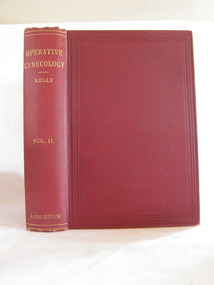
... surgery rather than a general medicine text. Its subject is operative treatment, anatomy, instruments, procedures, and surgical technique in women’s diseases, reflecting the early 20th-century development of gynaecology as a specialised surgical field. ...The subject texts, Operative Gynaecology, Volume I & 2 is a surgical two volume textbook on diseases and operations involving the female reproductive system, written by Howard A. Kelly and illustrated in part by Max Brödel. In the division between Volume 1 and Volume 2 there follows a logical anatomical and procedural split. Whereas Volume 1 concentrates on fundamental surgical principles, diagnostics, and operations on the lower genital/urinary tract. Volume 2 shifts focus to intra-abdominal, pelvic, and major organ surgeries. Volume 2 transitions into major intra-abdominal procedures (laparotomies/celiotomies) involving internal reproductive organs and neighbouring abdominal structures. The books are a technical, richly illustrated manuals for gynaecological surgery rather than a general medicine text. Its subject is operative treatment, anatomy, instruments, procedures, and surgical technique in women’s diseases, reflecting the early 20th-century development of gynaecology as a specialised surgical field.Operative Gynecology Vol 2 Author: Howard Kelly Illustrator: Max Brodel Publisher: D. Appleton & Co. Date: 1906 Further Information: Red Cloth Cover and Spine Lettering to Spine in Gilt.non-fictionThe subject texts, Operative Gynaecology, Volume I & 2 is a surgical two volume textbook on diseases and operations involving the female reproductive system, written by Howard A. Kelly and illustrated in part by Max Brödel. In the division between Volume 1 and Volume 2 there follows a logical anatomical and procedural split. Whereas Volume 1 concentrates on fundamental surgical principles, diagnostics, and operations on the lower genital/urinary tract. Volume 2 shifts focus to intra-abdominal, pelvic, and major organ surgeries. Volume 2 transitions into major intra-abdominal procedures (laparotomies/celiotomies) involving internal reproductive organs and neighbouring abdominal structures. The books are a technical, richly illustrated manuals for gynaecological surgery rather than a general medicine text. Its subject is operative treatment, anatomy, instruments, procedures, and surgical technique in women’s diseases, reflecting the early 20th-century development of gynaecology as a specialised surgical field.flagstaff hill, warrnambool, shipwrecked-coast, flagstaff-hill, flagstaff-hill-maritime-museum, maritime-museum, shipwreck-coast, flagstaff-hill-maritime-village, operative gynecology vol 1, book, howard kelly -
 Flagstaff Hill Maritime Museum and Village
Book - Craft book, Norma Benporath, Tatting, circa 1940's
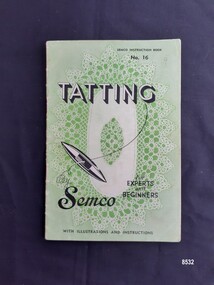
... women's Saturday association. After the war the firm stayed in production until the early 1990's when it was taken over by Coates-Paton Pty Ltd. Norma Benporath (1900 - 1998) was an expert in tatting techniques and taught and published extensively on the subject. She was born in New Zealand with impaired sight but cataract surgery...women's Saturday association. After the war the firm stayed in production until the early 1990's when it was taken over by Coates-Paton Pty Ltd. Norma Benporath (1900 - 1998) was an expert in tatting techniques and taught and published extensively on the subject. She was born in New Zealand with impaired sight but cataract surgery ...Tatting is a form of knotted lace making using thread and a small shuttle. Twisted threads are tied around or through small, pointed shuttles that can be made of bone, mother of pearl, tortoise shell, steel or plastic. This produces a stable, strong lace using simple knots of two half hitches to make rings and chains embellished with picots. The origins of tatting are not clear but early versions of decorative knotting were used by the Egyptians on their ceremonial dress. Tatting also has elements of fishermen's net making techniques and the decorative knotting that was practiced by aristocratic women from the 15th century. Tatting, as we know it today, emerged in the first half of the 19th century. The new availability of mercerised thread from 1835 encouraged a burgeoning of lace crafts of all sorts. It was known in Italy as "occhi" and in France as "la frivolite". Tatting looks fragile but is both strong and durable. An article in a column named "Wives and Daughters" published in the Star newspaper in May 1910 describes the durability of tatting lace - "there is edging and insertion still in existence that have outworn two sets of pillow slips." In the 19th century and well into the 20th century, tatting was used like crochet and knitted lace for decorative edgings, collars, doilies, tray cloths etc. At first, different tatting patterns were passed along by word of mouth from person to person, however in time, patterns regularly appeared in newspapers and magazines well into the 1950's. This book has photographs and detailed instructions for a wide range of tatted edgings and insertions suitable for household linens such as towels, doilies and tablecloths as well as patterns for whole mats. Stanley E. Mullen (a businessman) developed Semco Pty Ltd which began as a Melbourne based importation company in 1907. The first three letters of Semco's name were his initials. In 1915 it began manufacturing women's apparel, whitework and transfer patterns. In 1924 the company moved to Black Rock, Victoria and continued to produce an extensive range of needlework patterns and handcraft instruction booklets, threads etc. up until the late 1970's. Semco had a staff that included many young women. It was noted by E.J. Trait (editor of the local newspaper "Standard News") that the firm provided them with good working conditions and the correct rate of pay for women in a time of war - the starting rate for 15 year olds, mainly girls at Semco was 25 shillings per week. During World War 2, Manpower Regulations could be used to coerce workers to move into jobs that supported the war effort, but Trait argued that being employed at Semco could make this unlikely as the firm made some goods essential for the war effort. He even suggested that women be encouraged to produce needlework items (and play a part in the war effort) by sending them as presents, to the troops up north. He also heaped praise on the Semco workplace - noting that no Saturday work was the norm, allowing employees to shop and have "hair-do's" before enjoying a relaxing weekend! Semco also had a female cricket side in the women's Saturday association. After the war the firm stayed in production until the early 1990's when it was taken over by Coates-Paton Pty Ltd. Norma Benporath (1900 - 1998) was an expert in tatting techniques and taught and published extensively on the subject. She was born in New Zealand with impaired sight but cataract surgery restored 50% vision to one eye. She was inspired to learn tatting whilst watching her aunt tat and being told that tatting did not require as much sharp vision as embroidery. She quickly learnt to design her own patterns and published over 1000 tatted lace patterns between 1929 and 1952. She became a regular contributor to magazines (such as Home Beautiful) and newspapers across Australia. Her designs were also published in New Zealand, South Africa as well as the U.K. and U.S.A. When Semco, a thread manufacturer, noticed a rise in the sale of fine crochet threads, they realized they had an untapped market to explore. Norma designed a collection of tatting patterns for Semco that were used to help promote their threads. Norma also worked with Semco to produce a line of threads and shuttles specifically suited to tatting. In 1997, Norma was inducted into the "Order of Australia" for "Service to the craft of tatting as a designer and through the international publication of her patterns".This item is an excellent example of the needle work being enjoyed by women in the 1940's in Australia and the skills of the Australian designer, Norma Benporath. It is also an example of the trend that emerged for craft companies such as Semco to publish pattern books in order to advertise their own materials.A 32 page soft cover instruction book with green front and back covers showing two tatted doily designs. The book includes black and white photographs and written patterns by Norma Benporath.Front cover - "TATTING" "For / EXPERTS/ and / BEGINNERS" "By/Semco" "SEMCO INSTRUCTION BOOK" "No. 16" "WITH ILLUSTRATIONS AND INSTRUCTIONS" "9" Back cover - "FOR INSTRUCTIONS FOR WORKING SEE PAGE 22" "Published by Semco Pty. Ltd." "BLACK ROCK, 29, VIC"flagstaff hill maritime museum and village, warrnambool, great ocean road, tatting, tatting instruction book, tatting patterns, tatting shuttle, semco, semco pty ltd, norma benporath, needlework, handcrafts, household linen, craftwork -
 Flagstaff Hill Maritime Museum and Village
Equipment - Syringe, Late 19th - early 20th century
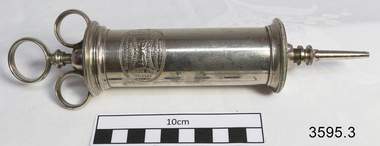
... Dr Angus assisted Dr Tom Ryan, a pioneer in the use of X-rays and in ocular surgery. warrnambool shipwreck coast great ocean road flagstaff hill maritime village maritime museum dr angus w.r. angus dr t f ryan medical instrument surgical equipment warrnambool base hospital nhill base hospital mira hospital flying doctor medical treatment syringe Ear syringe Ear Wax Inscription on oval shaped plaque on barrel "10th / UNIVERSITY COLLEGE HOSPITAL" & "MAYER & MELTZER / MAKERS, LONDON" & " TO THE / HOSPITAL OF DESEASES (SIC) OF THE THROAT"" & "TO THE / HOSPITAL / FOR WOMEN" & "TO THE / MIDDLESEX / HOSPITAL" plus "R" inscribed on each side of the handle Ear syringe from the W.R. ...How to safely syringe ear wax Irrigation, or ear syringing, should be performed only after taking a full history, doing an ear examination and explaining the potential complications to the patient. It is also important to ensure appropriate assembly and use of equipment. Gentle irrigation of the ear canal can be performed with a large syringe (20 mL) and warm water. The use of sterile water or saline as opposed to tap water or bacteriostatic agent (eg dilute hydrogen peroxide) can decrease the risk of infection. Direct visualisation of the ear canal is not necessary for safe and effective syringing. The tip of the syringe should not pass the outer one-third of the ear canal (approximately 8 mm) – the use of a rounded nozzle may assist with this. The jet of water should be aimed towards the edge of the cerumen to enable the debris to flow out of the ear canal. Cease immediately if the patient experiences pain or if bleeding occurs. Mechanical jet irrigators are available and some allow better control of water pressure and direction of spray. After syringing, examine the external canal and tympanic membrane. Document the patient’s consent, procedure, and pre- and post-examination findings. https://www.racgp.org.au/afp/2015/october/ear-wax-management This ear syringe was donated to Flagstaff Hill Maritime Village by the family of Doctor William Roy Angus, Surgeon and Oculist. It is part of the “W.R. Angus Collection” that includes historical medical equipment, surgical instruments and material once belonging to Dr Edward Ryan and Dr Thomas Francis Ryan, (both of Nhill, Victoria) as well as Dr Angus’ own belongings. The Collection’s history spans the medical practices of the two Doctors Ryan, from 1885-1926 plus that of Dr Angus, up until 1969. ABOUT THE “W.R.ANGUS COLLECTION” Doctor William Roy Angus M.B., B.S., Adel., 1923, F.R.C.S. Edin.,1928 (also known as Dr Roy Angus) was born in Murrumbeena, Victoria in 1901 and lived until 1970. He qualified as a doctor in 1923 at University of Adelaide, was Resident Medical Officer at the Royal Adelaide Hospital in 1924 and for a period was house surgeon to Sir (then Mr.) Henry Simpson Newland. Dr Angus was briefly an Assistant to Dr Riddell of Kapunda, then commenced private practice at Curramulka, Yorke Peninsula, SA, where he was physician, surgeon and chemist. In 1926, he was appointed as new Medical Assistant to Dr Thomas Francis Ryan (T.F. Ryan, or Tom), in Nhill, Victoria, where his experiences included radiology and pharmacy. In 1927 he was Acting House Surgeon in Dr Tom Ryan’s absence. Dr Angus had become engaged to Gladys Forsyth and they decided he would take time to further his studies overseas in the UK in 1927. He studied at London University College Hospital and at Edinburgh Royal Infirmary and in 1928, was awarded FRCS (Fellow from the Royal College of Surgeons), Edinburgh. He worked his passage back to Australia as a Ship’s Surgeon on the on the Australian Commonwealth Line’s T.S.S. Largs Bay. Dr Angus married Gladys in 1929, in Ballarat. (They went on to have one son (Graham 1932, born in SA) and two daughters (Helen (died 12/07/1996) and Berenice (Berry), both born at Mira, Nhill ) Dr Angus was a ‘flying doctor’ for the A.I.M. (Australian Inland Ministry) Aerial Medical Service in 1928 . The organisation began in South Australia through the Presbyterian Church in that year, with its first station being in the remote town of Oodnadatta, where Dr Angus was stationed. He was locum tenens there on North-South Railway at 21 Mile Camp. He took up this ‘flying doctor’ position in response to a call from Dr John Flynn; the organisation was later known as the Flying Doctor Service, then the Royal Flying Doctor Service. A lot of his work during this time involved dental surgery also. Between 1928-1932 he was surgeon at the Curramulka Hospital, Yorke Peninsula, South Australia. In 1933 Dr Angus returned to Nhill where he’d previously worked as Medical Assistant and purchased a share of the Nelson Street practice and Mira hospital from Dr Les Middleton one of the Middleton Brothers, the current owners of what was once Dr Tom Ryan’s practice. Dr L Middleton was House Surgeon to the Nhill Hospital 1926-1933, when he resigned. [Dr Tom Ryan’s practice had originally belonged to his older brother Dr Edward Ryan, who came to Nhill in 1885. Dr Edward saw patients at his rooms, firstly in Victoria Street and in 1886 in Nelson Street, until 1901. The Nelson Street practice also had a 2 bed ward, called Mira Private Hospital ). Dr Edward Ryan was House Surgeon at the Nhill Hospital 1884-1902 . He also had occasions where he successfully performed veterinary surgery for the local farmers too. Dr Tom Ryan then purchased the practice from his brother in 1901. Both Dr Edward and Dr Tom Ryan work as surgeons included eye surgery. Dr Tom Ryan performed many of his operations in the Mira private hospital on his premises. He too was House Surgeon at the Nhill Hospital 1902-1926. Dr Tom Ryan had one of the only two pieces of radiology equipment in Victoria during his practicing years – The Royal Melbourne Hospital had the other one. Over the years Dr Tom Ryan gradually set up what was effectively a training school for country general-practitioner-surgeons. Each patient was carefully examined, including using the X-ray machine, and any surgery was discussed and planned with Dr Ryan’s assistants several days in advance. Dr Angus gained experience in using the X-ray machine there during his time as assistant to Dr Ryan. Dr Tom Ryan moved from Nhill in 1926. He became a Fellow of the Royal Australasian College of Surgeons in 1927, soon after its formation, a rare accolade for a doctor outside any of the major cities. He remained a bachelor and died suddenly on 7th Dec 1955, aged 91, at his home in Ararat. Scholarships and prizes are still awarded to medical students in the honour of Dr T.F. Ryan and his father, Dr Michael Ryan, and brother, John Patrick Ryan. ] When Dr Angus bought into the Nelson Street premises in Nhill he was also appointed as the Nhill Hospital’s Honorary House Surgeon 1933-1938. His practitioner’s plate from his Nhill surgery states “HOURS Daily, except Tuesdays, Fridays and Saturday afternoons, 9-10am, 2-4pm, 7-8pm. Sundays by appointment”. This plate is now mounted on the doorway to the Port Medical Office at Flagstaff Hill Maritime Village, Warrnambool. Dr Edward Ryan and Dr Tom Ryan had an extensive collection of historical medical equipment and materials spanning 1884-1926 and when Dr Angus took up practice in their old premises he obtained this collection, a large part of which is now on display at the Port Medical Office at Flagstaff Hill Maritime Village in Warrnambool. During his time in Nhill Dr Angus was involved in the merging of the Mira Hospital and Nhill Public Hospital into one public hospital and the property titles passed on to Nhill Hospital in 1939. In 1939 Dr Angus and his family moved to Warrnambool where he purchased “Birchwood,” the 1852 home and medical practice of Dr John Hunter Henderson, at 214 Koroit Street. (This property was sold in1965 to the State Government and is now the site of the Warrnambool Police Station. ). The Angus family was able to afford gardeners, cooks and maids; their home was a popular place for visiting dignitaries to stay whilst visiting Warrnambool. Dr Angus had his own silk worm farm at home in a Mulberry tree. His young daughter used his centrifuge for spinning the silk. Dr Angus was appointed on a part-time basis as Port Medical Officer (Health Officer) in Warrnambool and held this position until the 1940’s when the government no longer required the service of a Port Medical Officer in Warrnambool; he was thus Warrnambool’s last serving Port Medical Officer. (The duties of a Port Medical Officer were outlined by the Colonial Secretary on 21st June, 1839 under the terms of the Quarantine Act. Masters of immigrant ships arriving in port reported incidents of diseases, illness and death and the Port Medical Officer made a decision on whether the ship required Quarantine and for how long, in this way preventing contagious illness from spreading from new immigrants to the residents already in the colony.) Dr Angus was a member of the Australian Medical Association, for 35 years and surgeon at the Warrnambool Base Hospital 1939-1942, He served as a Surgeon Captain during WWII1942-45, in Ballarat, Victoria, and in Bonegilla, N.S.W., completing his service just before the end of the war due to suffering from a heart attack. During his convalescence he carved an intricate and ‘most artistic’ chess set from the material that dentures were made from. He then studied ophthalmology at the Royal Melbourne Eye and Ear Hospital and created cosmetically superior artificial eyes by pioneering using the intrascleral cartilage. Angus received accolades from the Ophthalmological Society of Australasia for this work. He returned to Warrnambool to commence practice as an ophthalmologist, pioneering in artificial eye improvements. He was Honorary Consultant Ophthalmologist to Warrnambool Base Hospital for 31 years. He made monthly visits to Portland as a visiting surgeon, to perform eye surgery. He represented the Victorian South-West subdivision of the Australian Medical Association as its secretary between 1949 and 1956 and as chairman from 1956 to 1958. In 1968 Dr Angus was elected member of Spain’s Barraquer Institute of Barcelona after his research work in Intrasclearal cartilage grafting, becoming one of the few Australian ophthalmologists to receive this honour, and in the following year presented his final paper on Living Intrasclearal Cartilage Implants at the Inaugural Meeting of the Australian College of Ophthalmologists in Melbourne In his personal life Dr Angus was a Presbyterian and treated Sunday as a Sabbath, a day of rest. He would visit 3 or 4 country patients on a Sunday, taking his children along ‘for the ride’ and to visit with him. Sunday evenings he would play the pianola and sing Scottish songs to his family. One of Dr Angus’ patients was Margaret MacKenzie, author of a book on local shipwrecks that she’d seen as an eye witness from the late 1880’s in Peterborough, Victoria. In the early 1950’s Dr Angus, painted a picture of a shipwreck for the cover jacket of Margaret’s book, Shipwrecks and More Shipwrecks. She was blind in later life and her daughter wrote the actual book for her. Dr Angus and his wife Gladys were very involved in Warrnambool’s society with a strong interest in civic affairs. Their interests included organisations such as Red Cross, Rostrum, Warrnambool and District Historical Society (founding members), Wine and Food Society, Steering Committee for Tertiary Education in Warrnambool, Local National Trust, Good Neighbour Council, Housing Commission Advisory Board, United Services Institute, Legion of Ex-Servicemen, Olympic Pool Committee, Food for Britain Organisation, Warrnambool Hospital, Anti-Cancer Council, Boys’ Club, Charitable Council, National Fitness Council and Air Raid Precautions Group. He was also a member of the Steam Preservation Society and derived much pleasure from a steam traction engine on his farm. He had an interest in people and the community He and his wife Gladys were both involved in the creation of Flagstaff Hill, including the layout of the gardens. After his death (28th March 1970) his family requested his practitioner’s plate, medical instruments and some personal belongings be displayed in the Port Medical Office surgery at Flagstaff Hill Maritime Village, and be called the “W. R. Angus Collection”. Ear wax is an ongoing problem for many people, and its safe and easy removal is important. The W.R. Angus Collection is significant for still being located at the site it is connected with, Doctor Angus being the last Port Medical Officer in Warrnambool. The collection of medical instruments and other equipment is culturally significant, being an historical example of medicine from late 19th to mid-20th century. Dr Angus assisted Dr Tom Ryan, a pioneer in the use of X-rays and in ocular surgery. Ear syringe from the W.R. Angus Collection with barrel, plunger and tip. Inscription on oval shaped plaque on barrel. Inscription on oval shaped plaque on barrel "10th / UNIVERSITY COLLEGE HOSPITAL" & "MAYER & MELTZER / MAKERS, LONDON" & " TO THE / HOSPITAL OF DESEASES (SIC) OF THE THROAT"" & "TO THE / HOSPITAL / FOR WOMEN" & "TO THE / MIDDLESEX / HOSPITAL" plus "R" inscribed on each side of the handlewarrnambool, shipwreck coast, great ocean road, flagstaff hill maritime village, maritime museum, dr angus, w.r. angus, dr t f ryan, medical instrument, surgical equipment, warrnambool base hospital, nhill base hospital, mira hospital, flying doctor, medical treatment, syringe, ear syringe, ear wax -
 Melbourne Water
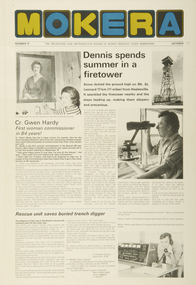
Staff Newsletter, Gwen Hardy, First Woman Commissioner, October, 1975
... women at the time. This was the first time in the 84 year history of the organisation. Hardy had also been a Lilydale Councillor and went on to become the first female Shire President. Along with her work commitments as part of the Board, Hardy was the wife of Dr. Bill and had three children, two sons and a daughter. Next door to her home in Mt Evelyn was her husband’s surgery...women at the time. This was the first time in the 84 year history of the organisation. Hardy had also been a Lilydale Councillor and went on to become the first female Shire President. Along with her work commitments as part of the Board, Hardy was the wife of Dr. Bill and had three children, two sons and a daughter. Next door to her home in Mt Evelyn was her husband’s surgery ...As the Yarra became unsuitable as a source of water, several attempts were made to find alternative sources for the growing population of Melbourne. It was not until 1891 that the efforts to sewer Melbourne came to fruition with the setting up of the Melbourne Metropolitan Board of Works (MMBW), now known as Melbourne Water. From 1891 until 1992, it was the responsibility of the MMBW to safeguard public health by providing a sewerage system and a safe water supply system. In 1992, The MMBW merged with a number of smaller urban water authorities to form Melbourne Water. Born on the 5th of August,1926, Margaret Gwen Hardy was the very first Commissioner of the Melbourne Metropolitan Board of Works (MMBW) and was appointed in 1975, a major victory for women at the time. This was the first time in the 84 year history of the organisation. Hardy had also been a Lilydale Councillor and went on to become the first female Shire President. Along with her work commitments as part of the Board, Hardy was the wife of Dr. Bill and had three children, two sons and a daughter. Next door to her home in Mt Evelyn was her husband’s surgery, where Hardy also worked part-time as a Manager. Hardy was also involved with the Lilydale High School Mother’s Club, she was the President of the Mt. Evelyn Environment Protection and Progress Association, on the Advisory Council of Monbulk High School and was the Secretary of the Lilydale Citizens Advisory Service at the time. This staff newsletter highlights the historically significant achievement of Cr. Gwen Hardy becoming the first female commissioner to work at the Board in 84 years. This captured achievement highlights women's career advancement at the MMBW and within the Victorian public service, whilst having historic and social associations with the many women's rights movements in the 1970s.comissioner, melbourne water, mmbw, melbourne metropolitan board of works, woman, staff, newsletter -
 Royal Australian and New Zealand College of Obstetricians & Gynaecologists (RANZCOG)
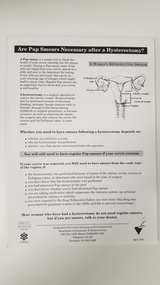
Document - 'Are Pap Smears necessary after a Hysterectomy?' information pad associated with Dr Lachlan Hardy-Wilson
... This is one of a collection of items received from the practice of Dr Lachlan Hardy-Wilson, FRCOG, Launceston, Tasmania. Surgery Women's Health A4 sized paper pad containing a set of single page information sheets about the relevance and usefulness of a papsmear after a hysterectomy. ...This is one of a collection of items received from the practice of Dr Lachlan Hardy-Wilson, FRCOG, Launceston, Tasmania.A4 sized paper pad containing a set of single page information sheets about the relevance and usefulness of a papsmear after a hysterectomy. Designed so that pages can be torn off to be given to patients one by one.surgery, women's health -
 Royal Australian and New Zealand College of Obstetricians & Gynaecologists (RANZCOG)
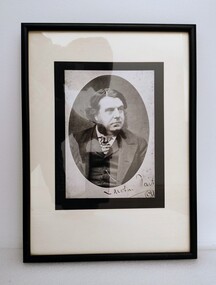
Photograph - Reproduction photograph of Dr Lawson Tait, c.1891
... Tait has been credited "with introducing a number of gynecologic surgeries, or surgeries related to women’s reproductive health. Those included procedures for treating abscesses, removing ovaries, and fallopian tubes, and treatment of the gallbladder." ...Tait has been credited "with introducing a number of gynecologic surgeries, or surgeries related to women’s reproductive health. Those included procedures for treating abscesses, removing ovaries, and fallopian tubes, and treatment of the gallbladder." ...Robert Lawson Tait (1845-1899) was a Scottish doctor and surgeon instrumental in the development of gynaecology as a field during the 19th century. Tait has been credited "with introducing a number of gynecologic surgeries, or surgeries related to women’s reproductive health. Those included procedures for treating abscesses, removing ovaries, and fallopian tubes, and treatment of the gallbladder." He also "argued for strict cleanliness during surgery as well as a more specific focus on performing surgeries to treat diseases of the female reproductive system. Tait’s surgical techniques and advocacy not only aided in the development of hygiene in surgery, increasing patient survival, but also helped develop the field of gynecology, which contributed to a centralized focus on the health of the female reproductive system." (Arizona State University, Embryo Project Encyclopedia)Black and white reproduction of a portrait photograph. Photograph is of a man in a dark coloured three-piece suit, with a white shirt and striped tie. The man has mutton chop sideburns and long, dark hair, which is parted about his right eye. The man is looking to camera right. The image is in an oval cutout on a white background. Handwritten reproduction of signature beneath the photograph reads 'Lawson Tait/1891'. The photograph is mounted in white card and housed in a black wooden frame. There is an old object label attached to the back of the object. A sticker noting the framer of the image (Jarman the Picture Framer) is attached to the back of the work at upper centre. A wire and two hooks have been attached to the back of the frame for hanging. -
 Alfred Hospital Nurses League - Nursing History Collection
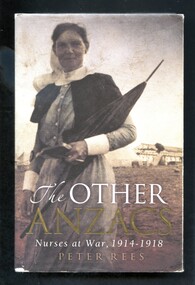
Book - Illustrated book, Peter Rees 1948, The other ANZACS: Nurses at War, 1914-1918, 2008
... Grace Wilson, became matron of the Alfred in 1933 Australia Army-Nurses Military nursing-Australia World War 1914-1918 - Medical Care World War 1914-1918-Female participation Nurses Using diaries and letters the author takes us into the hospital camps, the wards and the tent surgeries on the edge of some of the most horrific battlefronts of human history. He also showed how the friendships and loves of these courageous and compassionate women enriched their experiences. ...Using diaries and letters the author takes us into the hospital camps, the wards and the tent surgeries on the edge of some of the most horrific battlefronts of human history. He also showed how the friendships and loves of these courageous and compassionate women enriched their experiences.Illustrated book with dustjacket. Book has a brown cover with abbreviated title and authors name embossed in gold on spine. Dust jacket has a coloured black and white photograph of a nurse in uniform holding an umbrella, book and pencil with tents in the background: Grace Wilson on the Aegean Island of Lemnos, 1915. Full title is printed in white and gold on front along with the author's name in gold. Abbreviated title is printed in brown and gold on spine, along with the author's name and publishers mark in whitenon-fictionUsing diaries and letters the author takes us into the hospital camps, the wards and the tent surgeries on the edge of some of the most horrific battlefronts of human history. He also showed how the friendships and loves of these courageous and compassionate women enriched their experiences.australia army-nurses, military nursing-australia, world war 1914-1918 - medical care, world war 1914-1918-female participation, nurses -
 Alfred Hospital Nurses League - Nursing History Collection
Magazine - Book review, Yaffa Publishing Group Pty Ltd, 5.30 nurse! :the story of the Alfred nurses (Hospital & Healtcare), August 1996
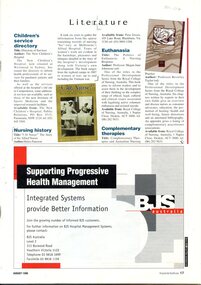
... Surgery Hospial computers Mental Health - Doctors Mental Health - Nurses Book review of '5.30 nurse! :the story of the Alfred nurses', magazine also includes other interesting health care articles Previous catalogue number handwritten [black ink] at top right of front cover and page 17. Article has been marked Illustrated stapled magazine. Front cover in addition to title and listing of main artickes has a coloured photograph of a doctor sitting at a desk, with a women ...Book review of '5.30 nurse! :the story of the Alfred nurses', magazine also includes other interesting health care articlesIllustrated stapled magazine. Front cover in addition to title and listing of main artickes has a coloured photograph of a doctor sitting at a desk, with a women answeing a phone in the background. Page with book review includes a colour photograph of the front cover of '5.30 nurse! :the story of the Alfred nurses'non-fictionBook review of '5.30 nurse! :the story of the Alfred nurses', magazine also includes other interesting health care articles nursing history, alfred hospital alfred hospital school of nursing, hospital infomatics, electronic medical records, day surgery, hospial computers, mental health - doctors, mental health - nurses -
 Royal District Nursing Service (now known as Bolton Clarke)
Photograph - Photograph, Portrait black and white, c.1930
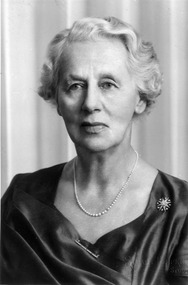
... Women's Welfare Clinic at the MDNS After-Care in 1934. Dame Mary Herring was born in Carlton on the 31st of March 1895. She graduated as a Bachelor of Medicine and Surgery (MB. ...This portrait photograph of Dame Mary Herring is a visual record of her taken during the time she was offering advice to Melbourne District Nursing Society After-Care Home (later Hospital)' as a member of their Committee from 1931. She was a Vice-president from 1943-1957 and acted as President in 1953. As a Medical practitioner she was involved with the formation of the MDNS After-Care Ante-Natal clinic in 1930 and the establishment of the Women's Welfare Clinic at the MDNS After-Care in 1934. Dame Mary Herring was born in Carlton on the 31st of March 1895. She graduated as a Bachelor of Medicine and Surgery (MB. BS) at the University of Melbourne in March 1921. During her training she went out with the Melbourne District Nursing Society (MDNS), where she visited many in poor circumstances and through this decided she wanted to improve the lives of women and children. She married Edmund Herring on the 6th of April 1922 and he supported her to continue her Medical career. She established an Ante-Natal Clinic at the Prahran Health Centre in 1926 and assisted MDNS After-Care Home in the establishment of its Ante-Natal clinic in September 1930. In 1931, as Dr. Mary Herring she became a member of the Committee of the now named ‘Melbourne District Nursing Society After-Care Home’ (later Hospital), and as Lady Herring became a Vice-president from 1943 until 1957 and acted as President in 1953. In 1934, along with Dr. George Simpson and Dr. Victor Wallace, she established the Women’s Welfare Clinic at the MDNS After-Care Hospital for patients of the Society; the first of its kind in Melbourne. After its opening in October 1934 she was the Hon Secretary of the Welfare Clinic, which operated from a room in the Ante-Natal Clinic of the After-Care. Dr. Herring pioneered family planning services. The clinic ran until 1940 when women could now obtain this advice from other establishments. In 1953, as Acting President, Lady Herring was involved with the discussions of the District Division of MDNS relocating to ‘Airlie’, 452 St. Kilda Road, Melbourne and the separation of Melbourne District Nursing Society and After Care Hospital, with the District Division now a separate entity, known as Melbourne District Nursing Service with its Headquarters at 452 St. Kilda Road, Melbourne. In 1966 with Royal patronage, this became the Royal District Nursing Service (RDNS). Though asked to be President of the Hospital division of the MDNS Society, she declined due to her many activities. In 1940 Dr. Mary Herring was a founder of the A.I.F Women’s Association and served on the Women’s Welfare Subcommittee to assist the families of soldiers and now as Lady Herring, she became President from 1943-1946. She was a a founding member and first president of the Victorian Council of Social Service 1946, chairman of the Vera Scantlebury Brown Memorial Trust 1946-1979, Deputy-president of Victorian division of the Australian Red Cross 1944-1963, and of the Victoria League 1945-1972 and the Australian council of the Save the Children Fund from 1962-1967. Lady Herring was a tireless worker for many charities particularly charities for children. On the 10th of July 1953 she was made Commander of the Order of St. John in recognition of her charity work and on the 11th of June 1960 was made Dame Commander of the Order of the British Empire for “services to nursing in Victoria” In 1949 the Argus Newspaper (https://trove.nla.gov.au/newspaper/article/22776603) described her as “one of the finest examples of Australian women in our State, with a record of selfless devotion to the service of others. Calm, kindly, clear-minded, and intensely logical”,..... “she has taken all this in her stride without once stopping out of her aura of cool, unruffled efficiency, an efficiency which is tempered by her warmth and understanding, her approachability, and her human sympathy.” Dame Mary Ranken Herring died in Camberwell on the 26th of October 1981. This black and white photograph is a portrait view of Dame Mary Herring. She has curled light coloured hair. Only a portion of her scooped neck dark coloured frock which falls in soft folds can be seen. There is a light colour brooch attached on the left hand side of her frock near the shoulder. She is wearing a string of pearls around her neck. A curtain can be seen in the background of the photograph.Stuart Tompkin Studiomelbourne district nursing society, ante-natal clinic, women's welfare clinic, rdns, royal district nursing service, dame mary herring -
 Bacchus Marsh & District Historical Society
Photograph, Home and surgery of Doctor Rae, 227-229 Main Street Bacchus Marsh 1883
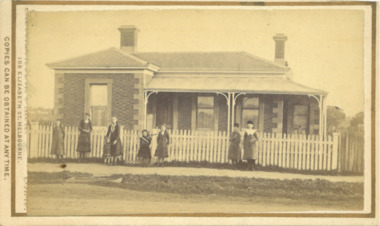
... SURGERY’ can be discerned, indicating that this is the entrance to be used by patients. The building features buff-coloured stone quoins and architraves. A white picket fence runs along the front. Ranged along the footpath in front of the fence stands a group of eight young women...SURGERY’ can be discerned, indicating that this is the entrance to be used by patients. The building features buff-coloured stone quoins and architraves. A white picket fence runs along the front. Ranged along the footpath in front of the fence stands a group of eight young women ...This image is one of a series of photographs taken by Melbourne based photographers Stevenson and McNicoll who visited Bacchus Marsh and its nearby districts between September and November 1883. The photo is of a brick residence, built in 1865-66 as a house and surgery for Dr. Rae, a medical practitioner in Bacchus Marsh 1863-1874. Dr. Rae was influential in community affairs as a Justice of the Peace, a member of the Board of Advice of Bacchus Marsh Common School and a President of the Mechanics’ Institute. After ill health forced him to resign his practice, he built the Bungalow in 1880, where he lived until his death. The house was later purchased by William Anderson (c.1880) who named it “Dunglass”. The people in this photograph are probably members of the Anderson family. The house is now used as an Adult Education Centre. The house is of significance as the embodiment of the importance to the community of its influential figures, such as Dr. Rae, in the late nineteenth and early twentieth centuries. Small sepia 'carte de viste' style unframed photograph on card with gold border framing photograph. Housed in the Jeremeas Family Album which contains photographs of Bacchus Marsh and District in 1883 by the photographers Stevenson and McNicoll. The photo is of a double-fronted brick Classical nineteenth century house with a high hip roof. Two brick chimneys are visible. The left hand bay is set forward, with the central section of the house being set back. A concave return verandah supported by decorative columns runs along the front and side of the house, leading to a separate entry door off the side verandah. On the window set in this door, the word ‘SURGERY’ can be discerned, indicating that this is the entrance to be used by patients. The building features buff-coloured stone quoins and architraves. A white picket fence runs along the front. Ranged along the footpath in front of the fence stands a group of eight young women and girls. A flat stone acts as a bridge over a deep drainage culvert running parallel to the street.Printed On the front: Stevenson & McNicoll. Photo. 108 Elizabeth St. Melbourne. COPIES CAN BE OBTAINED AT ANY TIME. On the back: LIGHT & TRUTH inscribed on a banner surmounted by a representation of the rising sun. Copies of this Portrait can be had at any time by sending the Name and Post Office Money Order or Stamps for the amount of order to STEVENSON & McNICOLL LATE BENSON & STEVENSON, Photographers. 108 Elizabeth Street, MELBOURNE. stevenson and mcnicoll 1883 photographs of bacchus marsh and district, doctors, houses bacchus marsh -
 Returned Nurses RSL Sub-branch
Book, Michael Joseph, The roses of no man's land, 1980
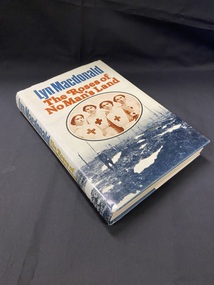
... It was here that young doctors frantically forged new medical techniques - of blood transfusion, dentistry, psychiatry and plastic surgery - in the attempt to save soldiers shattered in body or spirit. And it was here that women achieved a quiet but permanent revolution, by proving beyond question they could do anything. ...'On the face of it, ' writes Lyn Macdonald, 'no one could have been less equipped for the job than these gently nurtured girls who walked straight out of Edwardian drawing rooms into the manifest horrors of the First World War ... ' Yet the volunteer nurses rose magnificently to the occasion. In leaking tents and draughty huts they fought another war, a war against agony and death, as men lay suffering from the pain of unimaginable wounds or diseases we can now cure almost instantly. It was here that young doctors frantically forged new medical techniques - of blood transfusion, dentistry, psychiatry and plastic surgery - in the attempt to save soldiers shattered in body or spirit. And it was here that women achieved a quiet but permanent revolution, by proving beyond question they could do anything. All this is superbly captured in The Roses of No Man's Land, a panorama of hardship, disillusion and despair, yet also of endurance and supreme courage--Summary taken from 2013 edition. [From Trove record]Hardcover book with dust jacket. Title is brown print. Author's name in dark green print above the title (although it appears blue in image). There is a sepia photo of four nurses wearing Red Cross uniforms that overlays a black and white background image of a soldier walking through muddy land with burnt tree trunks behind him. Printed inside the front and back cover is the sheet music to 'The Rose of "NO Man's Land"'non-fiction'On the face of it, ' writes Lyn Macdonald, 'no one could have been less equipped for the job than these gently nurtured girls who walked straight out of Edwardian drawing rooms into the manifest horrors of the First World War ... ' Yet the volunteer nurses rose magnificently to the occasion. In leaking tents and draughty huts they fought another war, a war against agony and death, as men lay suffering from the pain of unimaginable wounds or diseases we can now cure almost instantly. It was here that young doctors frantically forged new medical techniques - of blood transfusion, dentistry, psychiatry and plastic surgery - in the attempt to save soldiers shattered in body or spirit. And it was here that women achieved a quiet but permanent revolution, by proving beyond question they could do anything. All this is superbly captured in The Roses of No Man's Land, a panorama of hardship, disillusion and despair, yet also of endurance and supreme courage--Summary taken from 2013 edition. [From Trove record]ww1, wwi, world war 1, experience of war, battlegrounds, field hospitals, voluntary aid detachments, red cross, army nurses, medical aid -
 Returned Nurses RSL Sub-branch
Book - Hardcover book, Australian War Memorial, Canberra, Clinical problems of war, 1952
... women in the army medical services. WW2 WWII World War 1939-1945 World War 1939-1945 medical care Australian Army medical service Military medicine Armed conflict Military - sanitation The first volume in series 5 (medical) of the 'Australia in the War of 1939-1945' series. This volume is divided into sections on: infectious diseases, systematic and constitutional affections, and disturbances due to nutritional and physical causes. It also looks at medicine and surgery ...The first volume in series 5 (medical) of the 'Australia in the War of 1939-1945' series. This volume is divided into sections on: infectious diseases, systematic and constitutional affections, and disturbances due to nutritional and physical causes. It also looks at medicine and surgery in captivity, dental, rehabilitation, psychiatry, pathology, etc.Worn, red hard-cover book. Title printed in gold across the spine. Spine label taped to base of spine.non-fictionThe first volume in series 5 (medical) of the 'Australia in the War of 1939-1945' series. This volume is divided into sections on: infectious diseases, systematic and constitutional affections, and disturbances due to nutritional and physical causes. It also looks at medicine and surgery in captivity, dental, rehabilitation, psychiatry, pathology, etc.ww2, wwii, world war 1939-1945, world war 1939-1945 medical care, australian army medical service, military medicine, armed conflict, military - sanitation -
Emerald Museum & Nobelius Heritage Park
Instrument - Obstetrical forceps, Milne-Murray, Robert, 1890s-1920s
... Treganowan medical equipment women's health medical practice forceps birth obstetrics Forest Lodge Silver Birches Harry Norris emerald country club and golf course The silver-coloured item is approximately fifteen centimetres long; it has a solid metal handle bar and a stem leading to a flat panel with two holes that are designed to connect it to the body of the forceps. These forceps are from the collection of equipment used by Dr William Bottomley, who practiced in Collins Street in Melbourne after receiving his Bachelor of Surgery ...These Victorian-era obstetrical forceps are from the collection of equipment used by Dr William Bottomley. Dr Bottomley was born in Fitzroy in 1881 and obtained a Bachelor of Surgery from the University of Melbourne in 1906. He lived in South Yarra with a weekend log cabin called Forest Lodge in Emerald and practiced in Collins Street in Melbourne. In the 1920s Dr Bottomley and business partner W.H. Treganowan initiated the Emerald Country Club syndicate to purchase land from Carl Axel Nobelius' Gembrook Nurseries estate, which led to the formation of the golf course and Country Club facilities. Bottomley Drive in Emerald is named after Dr Bottomley; the street is located near Silver Birches, the house commissioned by the doctor from modernist architect Harry Norris. 'Action traction' obstetrical forceps were invented by Dr Robert Milne-Murray, a practicing physician at the Royal Maternity and the Simpson Memorial Pavilion in Edinburgh in 1891. They were designed to allow the attending physician to obtain a secure hold on the infant before pulling backwards on the handle to facilitate the baby's birth. Forceps to extract fetuses from women who would otherwise die during complications in labour have been used as a last resort since 1500 BCE, though it has only been in the last 300-500 years that forceps design has shifted to focusing on saving the lives of both mother and infant. These are fenestrated forceps, with a hollow 'blade' or loop, which have been superseded as a design by solid models that are less likely to cause compression damage to the baby's head.These items are significant as they provide insights into medical practice in the early Twentieth-Century in Melbourne and surrounds. They are also significant because they were used by Dr William Bottomley, who owned property in Emerald and whose business dealings significantly shaped the development of the town.The silver-coloured item is approximately fifteen centimetres long; it has a solid metal handle bar and a stem leading to a flat panel with two holes that are designed to connect it to the body of the forceps. These forceps are from the collection of equipment used by Dr William Bottomley, who practiced in Collins Street in Melbourne after receiving his Bachelor of Surgery from the University of Melbourne in 1906. Dr Bottomley had a weekend residence in Emerald. In the 1920s Dr Bottomley and his business partner W.H. Treganowan initiated the Emerald Country Club syndicate and purchased land from the Gembrook Nurseries estate to build a golf course and Country Club.1890s, 1900s, 1910s william bottomley, w.h. treganowan, medical equipment, women's health, medical practice, forceps, birth, obstetrics, forest lodge, silver birches, harry norris, emerald country club and golf course
