
Showing 244 items matching "wood working"
-
 Kensington Neighbourhood House
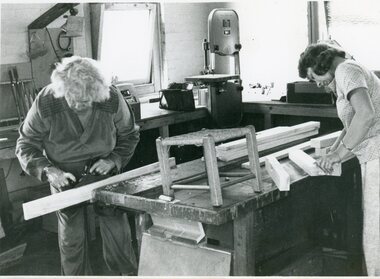
Photograph - KNH 5/7/001 Wood working class circa 1987
... KNH 5/7/001 Wood working class circa 1987...KNH 5/7/001 Wood working class circa 1987...Black & white photograph of woodworking class circa 1987 KNH 5/7/001 Wood working class circa 1987 Photograph KNH 5/7/001 Wood working class circa 1987 ...Black & white photograph of woodworking class circa 1987 -
 Sunshine and District Historical Society Incorporated
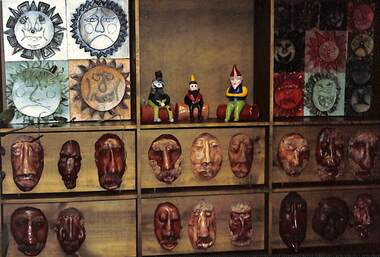
Photograph - Sunshine Technical School Metal Work Wood Working Needle Craft Photos, Possibly in 2013
... Sunshine Technical School Metal Work Wood Working Needle Craft Photos...Sunshine Technical School Metal Work Wood Working Needle Craft Photos...Sunshine Technical School Metal Work Wood Working Needle Craft Photos Possibly taken for commemoration of 100 years of school in 2013...Possibly taken for commemoration of 100 years of school in 2013 Sunshine Technical School Technical School Sunshine Technical School Metal Work Wood Working Needle Craft Photos Possibly taken for commemoration of 100 years of school in 2013 Sunshine Technical School Metal Work Wood Working Needle Craft Photos Photograph Sunshine Technical School Metal Work Wood Working Needle Craft Photos ...Possibly taken for commemoration of 100 years of school in 2013Sunshine Technical School Metal Work Wood Working Needle Craft Photos Possibly taken for commemoration of 100 years of school in 2013sunshine technical school, technical school -
 Bendigo Historical Society Inc.
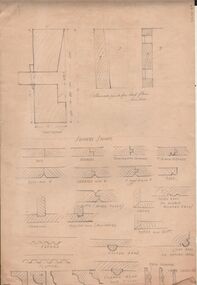
Drawing - NORMAN PENROSE COLLECTION: WOOD WORKING JOINTS
... NORMAN PENROSE COLLECTION: WOOD WORKING JOINTS...... wood working joints...Norman Penrose collection: 3 pages of drawings depicting wood working joins. 1 page of miscellaneous drawings. ...DRAWING Pencil Norman Penrose Collection artwork wood working joints box frame for double hung window Artwork. ...Artwork. Norman Penrose collection: 3 pages of drawings depicting wood working joins. 1 page of miscellaneous drawings. Includes Plan of Box Frame for Double Hung Window.drawing, pencil, norman penrose collection, artwork, wood working joints, box frame for double hung window -
 Sunshine and District Historical Society Incorporated
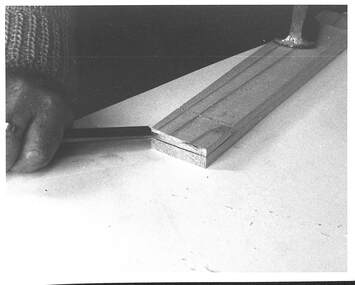
Photograph - Sunshine Technical School Memorabilia - Wood Working Photographs
... Sunshine Technical School Memorabilia - Wood Working Photographs...Collection of 7 black and white photographs of wood working using a chisel...Was part of the Sunshine Technical School Collection Sunshine Technical School Technical School Collection of 7 black and white photographs of wood working using a chisel Photograph Sunshine Technical School Memorabilia - Wood Working Photographs ...Was part of the Sunshine Technical School Collectionsunshine technical school, technical school -
 Emerald Museum & Nobelius Heritage Park
Tool - Tool - wood-working gauge, pre-WWII
... Tool - wood-working gauge...Tool - wood working gauge. For drawing a line before cutting. ...Old and possibly hand-made. Tool Tool - wood-working gauge ...This gauge for woodworking, along with a variety of other tools, was donated from a property in Emerald which was used for mixed farming and was owned by C Alexander (although he did not actually live there but leased it out) who bought it in 1920.This tool is emblematic of the diverse skills required of a farmer including the ability to repair their own farming and domestic equipment. It may be home-made.Tool - wood working gauge. For drawing a line before cutting. Old and possibly hand-made.None discernible.gauge, woodworking, alexander, emerald, victoria, australia, carpentry tool -
 Flagstaff Hill Maritime Museum and Village
Tool - Wood Working Plane, Mathieson and Son, 1880-1900
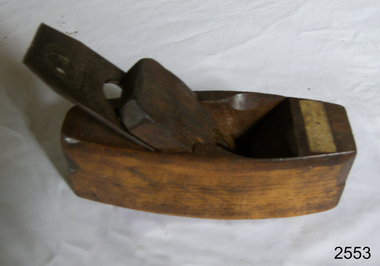
... Wood Working Plane...Smoothing Plane Coffin type. Tool Wood Working Plane Mathieson and Son James Haworth & Sons ...A Mathieson & Son History: In 1792 John Manners had set up a workshop making woodworking planes at 14 Saracens Lane Glasgow. He also had employed an apprentice Alexander Mathieson (1773-1851). But in the following year at Saracen's Lane, the 1841 census describes Alexander Mathieson as a master plane-maker now at 38 Saracen Lane with his son Thomas Adam working with him as a journeyman plane-maker. Presumably, Alexander must have taken over the premises and business of John Manners. Now that the business had Thomas Adam Mathieson working with his father it gradually grew and became more diversified, and it is recorded at the time by the Post-Office Glasgow Annual Directory that by 1847-1848 Alexander Mathieson was a “plane, brace, bit, auger & edge tool maker.” In 1849 the firm of James & William Stewart at 65 Nicolson Street, Edinburgh was taken over and Thomas was put in charge of the business, trading under the name Thomas A. Mathieson & Co. as plane and edge-tool makers. Thomas's company went on to acquire the Edinburgh edge-tool makers “Charles & Hugh McPherson” and took over their premises in Gilmore Street. In the Edinburgh directory of 1856/7, the business is recorded as being Alexander Mathieson & Son, plane and edge-tool makers at 48 Nicolson Street and Paul's Work, Gilmore Street Edinburgh. The 1851 census Alexander is recorded as working as a tool and plane-maker employing eight men. Later that year Alexander died and his son Thomas took over the business. Under the heading of an edge-tool maker in the 1852/3 Post-Office Glasgow Annual Directory the firm is now listed as Alexander Mathieson & Son, with further entries as "turning-lathe and vice manufacturers". By the early 1850s, the business had moved to 24 Saracen Lane. The directory for 1857/8 records that the firm had moved again only a few years later to East Campbell Street, off the Gallowgate area, and that through further diversification was also manufacturing coopers' and tinmen's tools. The ten-yearly censuses report the firm's growth in 1861 stating that Thomas was a tool manufacturer employing 95 men and 30 boys; in 1871 he had 200 men working for him and in 1881 300 men. By 1899 the firm had been incorporated as Alexander Mathieson & Sons Ltd, even though only Alexander's son Thomas appears ever to have joined the firm so the company was still in his fathers' name. In September 1868 Thomas Mathieson put a notice in the newspapers of the Sheffield & Rotherham Independent and the Sheffield Daily Telegraph stating that his firm had used the trade-mark of a crescent and star "for some time" and that "using or imitating the Mark would be proceeded against for infringement". The firm had acquired its interest in the crescent-and-star mark from the heirs of Charles Pickslay, the Sheffield cutler who had registered it with the Cutlers' Company in 1833 and had died in 1852. The year 1868 seems also to be the one in which the name Saracen Tool Works was first adopted; not only does it figure at the foot of the notice in the Sheffield press, it also makes its first appearance in the firm's entry in the Post-Office Glasgow Annual Directory in the 1868/9 edition. As Thomas Mathieson's business grew, so too did his involvement in local public life and philanthropy. One of the representatives of the third ward on the town council of Glasgow, he became a river bailie in 1868, a magistrate in 1870 and a preceptor of Hutcheson's Hospital in 1878. He had a passion for books and was an "ardent Ruskinian". He served on the committee handling the bequest for the setting up of the Mitchell Library in Glasgow. When he died at Coulter Maynes near Biggar in 1899, he left an estate worth £142,764. Company's later years: Both Thomas's sons, James Harper and Thomas Ogilvie were involved in the continuing life of the firm. James followed in his father's footsteps in becoming a local public figure. He was appointed Deputy Lieutenant of the County of the City of Glasgow and was made a deacon of the Incorporation of the Hammermen of Glasgow in 1919. His brother Thomas Ogilvie was recorded as tool manufacturer and employer in the 1911 census. Thomas Ogilvie's son Thomas Alastair Sutherland Ogilvie Mathieson was born in 1908 took a rather different approach to engineering, however, by becoming a racing driver. In 1947 he wed the French film actress Mila Parély. The firm had won many awards at world fairs for their goods. At the Great Exhibition, London, 1851. Prize medal for joiners' tools in the class of Cutlery & Edge Tools, Great London Exposition, 1862. Prize medal honoris causa. International Exhibition, Melbourne, 1880. Gold medal International Exhibition of Industry, Science and Art, Edinburgh, 1886. Prize medal James Haworth & Sons History: James Haworth and Sons, of Broomspring Works, Bath-street Sheffield were among leading manufacturers of edge tools and joiners tools. The business was commenced in 1835, by James Haworth who was joined by his sons in 1863. Haworth manufacture light and heavy edge tools of all kinds, including a variety of joiners’ tools, hammers, skates, augers. The firm soon was extended and began exporting their products to the USA, Canada, Australia, China, and many other overseas destinations as well as to the home market. They were exhibitors at the London Exhibitions of 1851 and 1862, and Paris in 1855, receiving awards. Haworth was primarily operating from Sheffield. J Haworth & Sons produce goods of a very high class and were also engaged in the manufacture of steel, file, saw, and similar trades. Upon the death of James Haworth, the firm was managed by his four sons James, Samuel, Edwin, and John Haworth. The firm was discontinued in 1913, and its trademark was acquired by Robert Sorby and Sons in 1922.A significant tool made in the late 19th century by a known makers and sought after by collectors of vintage wood working tools.Smoothing Plane Coffin type. 2" stamped on one end and Tertius Keen & Co (plane maker.) Blade has James Haworth Warranted Cast Steel Sheffield (maker of blade only.)flagstaff hill, warrnambool, shipwrecked-coast, flagstaff-hill, flagstaff-hill-maritime-museum, maritime-museum, shipwreck-coast, flagstaff-hill-maritime-village -
 Tatura Irrigation & Wartime Camps Museum
Tool - Chisel, 1940's
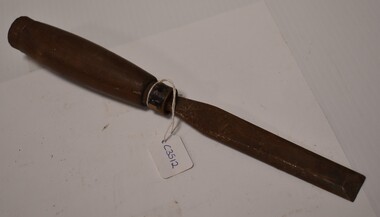
... ...wood working...Made by internees at camp 3, using wood sourced from under the barracks ie : stumps. Used for wood working...Made by internees at camp 3, using wood sourced from under the barracks ie : stumps. Used for wood working kazenwadel blacksmith wood tools camp 3 metal wood working Metal chisel on a wooden handle, with a metal ferrule at each end of the handle. ...Made by internees at camp 3, using wood sourced from under the barracks ie : stumps. Used for wood workingMetal chisel on a wooden handle, with a metal ferrule at each end of the handle. kazenwadel, blacksmith, wood, tools camp 3, metal, wood working -
 Flagstaff Hill Maritime Museum and Village
Tool - Set of Tools, 1930-1955's
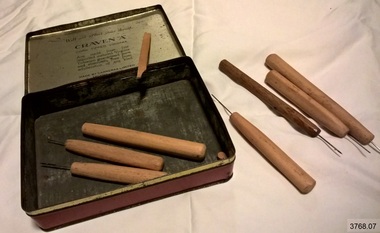
... ...wood working tool...A set of 6 small, fine wood working and carving tools stored in a ‘Craven A’ cigarette tin. ...The Sovereign of the Seas was a historic 17th century English war ship with important maritime heritage. flagstaff hill warrnambool flagstaff hill maritime museum maritime museum shipwreck coast flagstaff hill maritime village great ocean road jim williams james bernard williams ship model hobby ship model tools ship model making equipment ship model making accessories wood working tool model making tool carving tools handmade wood carving tools craven a cigarette tin Sovereign of the sea Ship model Hobby Ship model tool On the tin; “CORK TIPPED / TRADE MARK / CRAVEN “A” / VIRGINIA / CIGARETTES” A set of 6 small, fine wood working and carving tools stored in a ‘Craven A’ cigarette tin. ...This set of handmade tools was made by Jim Williams for his own purposes to make designs and components for the ship model Sovereign of the Seas. It is part of a collection of objects used by Jim Williams, maker of fine ship models from about 1930-1955. Most of the components for the models, as well as many of the tools, were handmade by Jim Williams. Jim’s family has donated the ship model “Sovereign of the Seas” and many tools, accessories and documents used in the making of this and other ship models have been donated to Flagstaff Hill Maritime Village. Ship model of HMS Sovereign of the Seas, scale model of 17th Century English war ship, was handmade and carved from plans, enclosed in airtight glass case. All components of that model, including even the smallest pulleys, were hand crafted using tools designed and made by Jim. Outstanding details include functional rigging and moving cannons. Please see our record 3732 of the mode Sovereign of the Seas for further details of the ship and the maker. This set of handmade tools is connected with the hobby and skill of ship model making that has been crafted as a leisure activity for many generations. The hobby is often chosen by serving and retired mariners who appreciate the connection with maritime history. This set of tools was used by local Warrnambool man, Jim Williams, who was employed at Cramond and Dickson clothing store, and then at Fletcher Jones menswear for 27 years. It was used in making components for the model of the historic ship, the Sovereign of the Seas. The Sovereign of the Seas was a historic 17th century English war ship with important maritime heritage. A set of 6 small, fine wood working and carving tools stored in a ‘Craven A’ cigarette tin. The tools have been handmade by Jim Williams for the purpose of making ship models. This set of tools is part of a collection of tools and accessories once used by Jim Williams, maker of a series of ship models 1930-1955 including “HMS Sovereign of the Seas”. (Also included is a spare handle.)On the tin; “CORK TIPPED / TRADE MARK / CRAVEN “A” / VIRGINIA / CIGARETTES”flagstaff hill, warrnambool, flagstaff hill maritime museum, maritime museum, shipwreck coast, flagstaff hill maritime village, great ocean road, jim williams, james bernard williams, ship model hobby, ship model tools, ship model making equipment, ship model making accessories, wood working tool, model making tool, carving tools, handmade wood carving tools, craven a cigarette tin, sovereign of the sea, ship model, hobby, ship model tool -
 Flagstaff Hill Maritime Museum and Village
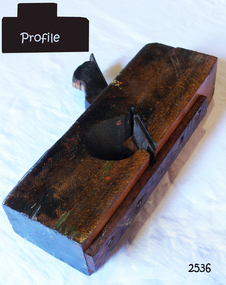
Tool - Plane, 19th century
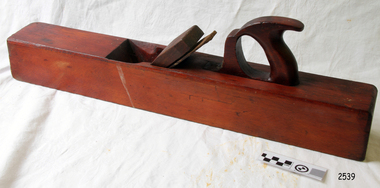
... ...Wood Working...Flagstaff Hill Flagstaff Hill Maritime Museum and Village Warrnambool Maritime Museum Maritime Village Great Ocean Road Shipwreck Coast Wood Working wood working plane wood working tool Jack Plane plane wood plane general purpose plane tool Builders Tool carpenter's tool ship builder's tool Maritime trade Jack Plane; a large oblong shape with an aperture at one end, a long wooden guard that protects the sharp metal blade, and a saw like handle at other end. ...This Jack plane is used for general purposes such as shaving off surplus wood to bring a piece of work down to size and plane the edges of a door to smooth them off. This plane is an example of the tools used by ship builders in the maritime trade from the 19th century to the present day.Jack Plane; a large oblong shape with an aperture at one end, a long wooden guard that protects the sharp metal blade, and a saw like handle at other end. It is stained a red-brown colour.flagstaff hill, flagstaff hill maritime museum and village, warrnambool, maritime museum, maritime village, great ocean road, shipwreck coast, wood working, wood working plane, wood working tool, jack plane, plane, wood plane, general purpose plane, tool, builders tool, carpenter's tool, ship builder's tool, maritime trade -
 Flagstaff Hill Maritime Museum and Village
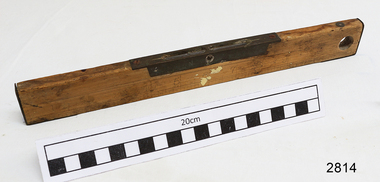
Tool - Plane, 20th century
... ...wood working...It was used for cleaning out the rabbet cut from the head of the stem, and along the keel, to take the ends and edges of the planking - its angle varied according to the ship. flagstaff hill warrnambool shipwrecked-coast flagstaff-hill flagstaff-hill-maritime-museum maritime-museum shipwreck-coast flagstaff-hill-maritime-village rabbet plane. wood working Wood Working Tools hand tool Rabbet plane. ...A special version of the rebate plane, the keel and stem rabbet plane. This was a wider than the usual rebate or rabbet plane, and the blade was set askew to the side to give a slicing action. It was used for cleaning out the rabbet cut from the head of the stem, and along the keel, to take the ends and edges of the planking - its angle varied according to the ship.Rabbet plane. Has a makeshift piece of wood screwed to base to protect it. Made by Sherman Nth York. Blade size 2". A square piece of leather is tacked to top of plane. Red paint markings are on one side.flagstaff hill, warrnambool, shipwrecked-coast, flagstaff-hill, flagstaff-hill-maritime-museum, maritime-museum, shipwreck-coast, flagstaff-hill-maritime-village, rabbet plane., wood working, wood working tools, hand tool -
 Flagstaff Hill Maritime Museum and Village
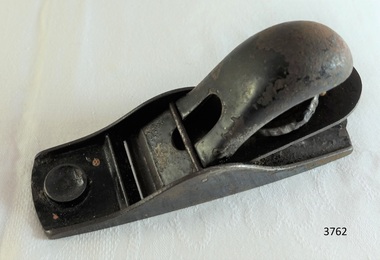
Spirit level
... ...wood working...flagstaff hill warrnambool shipwrecked-coast flagstaff-hill flagstaff-hill-maritime-museum maritime-museum shipwreck-coast flagstaff-hill-maritime-village spirit level cabinet making wood working wood working tool building tool Impreial measurements are impressed into the wood on both sides. ...Spirit level, small, wood with metal around the ends and the glass levels. Comprises both verticle and horizontal levels. Horisontal level is divided into 2 by metal surround. Imperial measurements are impressed into wood on both sides of the ruler.Impreial measurements are impressed into the wood on both sides.flagstaff hill, warrnambool, shipwrecked-coast, flagstaff-hill, flagstaff-hill-maritime-museum, maritime-museum, shipwreck-coast, flagstaff-hill-maritime-village, spirit level, cabinet making, wood working, wood working tool, building tool -
 Flagstaff Hill Maritime Museum and Village
Tool - Plane, 1930-1955's
... ...wood working tool...The Sovereign of the Seas was a historic 17th century English war ship with important maritime heritage. flagstaff hill warrnambool flagstaff hill maritime museum maritime museum shipwreck coast flagstaff hill maritime village great ocean road jim williams james bernard williams ship model hobby ship model tools ship model making equipment ship model making accessories wood working tool wood working plane carpentry plane Sovereign of the sea Ship model Hobby Ship model tool tool "102" Small metal plane with the number impressed in the heel “102”. ...This small plane was used in the making of components for the ship model Sovereign of the Seas. It is part of a collection of objects used by Jim Williams, maker of fine ship models from about 1930-1955. Most of the components for the models, as well as many of the tools, were handmade by Jim Williams. Jim’s family has donated the ship model “Sovereign of the Seas” and many tools, accessories and documents used in the making of this and other ship models have been donated to Flagstaff Hill Maritime Village. Ship model of HMS Sovereign of the Seas, scale model of 17th Century English war ship, was handmade and carved from plans, enclosed in airtight glass case. All components of that model, including even the smallest pulleys, were hand crafted using tools designed and made by Jim. Outstanding details include functional rigging and moving cannons. Please see our record 3732 of the mode Sovereign of the Seas for further details of the ship and the maker. This plane is connected with the hobby and skill of ship model making that has been crafted as a leisure activity for many generations. The hobby is often chosen by serving and retired mariners who appreciate the connection with maritime history. This plane was used by local Warrnambool man, Jim Williams, who was employed at Cramond and Dickson clothing store, and then at Fletcher Jones menswear for 27 years. It was used in making components for the model of the historic ship, the Sovereign of the Seas. The Sovereign of the Seas was a historic 17th century English war ship with important maritime heritage. Small metal plane with the number impressed in the heel “102”. This small plane is part of a collection of tools and accessories once used by Jim Williams, maker of a series of ship models 1930-1955 including “HMS Sovereign of the Seas”."102"flagstaff hill, warrnambool, flagstaff hill maritime museum, maritime museum, shipwreck coast, flagstaff hill maritime village, great ocean road, jim williams, james bernard williams, ship model hobby, ship model tools, ship model making equipment, ship model making accessories, wood working tool, wood working plane, carpentry plane, sovereign of the sea, ship model, hobby, ship model tool, tool -
Yarrawonga and Mulwala Pioneer Museum
Long Jointing Plane
... Wood Working Tools...Wood Working Tools Long Jointing Plane ...Wood Working Tools -
Yarrawonga and Mulwala Pioneer Museum
Moulding Plane --Adjustable
... Wood Working Tools...Wood Working Tools Moulding Plane --Adjustable ...Wood Working Tools -
Yarrawonga and Mulwala Pioneer Museum
Marking Gauge
... Wood Working Tools...Wood Working Tools Marking Gauge ...Wood Working Tools -
Yarrawonga and Mulwala Pioneer Museum
Moulding Plane [1]
... Wood Working Tools...Wood Working Tools Moulding Plane [1] ...Wood Working Tools -
Yarrawonga and Mulwala Pioneer Museum
Moulding Plane [2]
... Wood Working Tools...Wood Working Tools Moulding Plane [2] ...Wood Working Tools -
Yarrawonga and Mulwala Pioneer Museum
Moulding Plane
... Wood Working Tool...Wood Working Tool Moulding Plane ...Wood Working Tool -
Yarrawonga and Mulwala Pioneer Museum
Moulding Plane [4]
... Wood Working Tool...Wood Working Tool Moulding Plane [4] ...Wood Working Tool -
Yarrawonga and Mulwala Pioneer Museum
Wooden Mallet
... Wood Working Tools...Wood Working Tools Wooden Mallet ...Wood Working Tools -
Yarrawonga and Mulwala Pioneer Museum
Jointing Plane
... Wood Working Tools...Wood Working Tools Jointing Plane ...Wood Working Tools -
 Flagstaff Hill Maritime Museum and Village
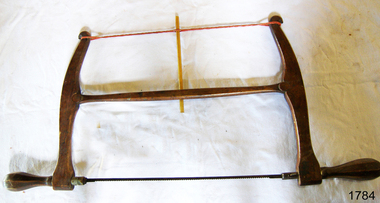
Tool - Bow Saw, 1850 to 1900
... ...Wood Working...A vintage bow saw used in cabinet work by a cabinet maker in the mid to later part of the 19th century probably made in England. flagstaff hill warrnambool flagstaff-hill flagstaff-hill-maritime-museum maritime-museum shipwreck-coast flagstaff-hill-maritime-village bow saw Carpenders Tools Cabinet Makers Tools Wood Working Wood Saw None Bow saw wooden frame and handles. ...The Bow Saw is considered by many to be the most satisfactory saw for cutting shapes since the narrow blade negotiates curves easily, and is held in tension. Both the handle and knob (at the other end of the blade) can be turned so that a cut can be made more or less parallel to the required cut. Obviously the blade must be free of twist when in use. It is available with blade lengths of 25 to 40 cm (10 to 16 in). Generally both hands grips the one handle, hence the bulbous shape with narrow neck, but when thick wood has to be sawn it is helpful to have a person at each side, both sides of the wood having been marked. In this way it is much easier to keep the cut square to the sides of the timber. The rivets holding the blade to the handle can be withdrawn so that the saw can be used for an internal cut, the blade being threaded through a hole drilled through the timber.A vintage bow saw used in cabinet work by a cabinet maker in the mid to later part of the 19th century probably made in England.Bow saw wooden frame and handles. Twine attached to upper section of frame.Noneflagstaff hill, warrnambool, flagstaff-hill, flagstaff-hill-maritime-museum, maritime-museum, shipwreck-coast, flagstaff-hill-maritime-village, bow saw, carpenders tools, cabinet makers tools, wood working, wood saw -
Yarrawonga and Mulwala Pioneer Museum
Granny Tooth Router
... Home made wood working tools...Home made wood working tools Granny Tooth Router ...Home made wood working tools -
 Flagstaff Hill Maritime Museum and Village
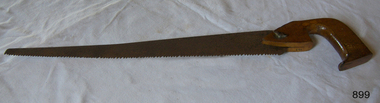
Tool - Compass Saw, Mid to late 20th Century
... ...Wood Working Tools...The maker is unknown but the pattern or design and type of wood used indicate it is a tool of modern manufacture. flagstaff hill warrnambool flagstaff-hill flagstaff-hill-maritime-museum maritime-museum shipwreck-coast flagstaff-hill-maritime-village Wood Cutting Wood Saw Cross Cut Saw Cabinet Makers Tools Wood Working Tools Tool None Compass saw blade with wooden handle attached with wingnut. ...A saw is a tool consisting of a tough blade, wire, or chain with a hard-toothed edge. It is used to cut through material, very often wood, though sometimes metal or stone. The cut is made by placing the toothed edge against the material and moving it forcefully forth and less vigorously back or continuously forward. This force may be applied by hand, or powered by steam, water, electricity or other power sources. An abrasive saw has a powered circular blade designed to cut through metal or ceramic. In ancient Egypt, open (unframed) saws made of copper are documented as early as the Early Dynastic Period, circa 3,100–2,686 BC. Many copper saws were found in tombs dating to the 31st century BC. Models of saws have been found in many contexts throughout Egyptian history. As the saw developed, teeth were raked to cut only on the pull stroke and set with the teeth projecting only on one side, rather than in the modern fashion with an alternating set. Saws were also made of bronze and later iron. In the Iron Age, frame saws were developed holding the thin blades in tension. The earliest known sawmill is the Roman Hierapolis sawmill from the third century AD used for cutting stone.The subject item is believed to date from around the mid to late 20th century and is regarded as a modern item. The maker is unknown but the pattern or design and type of wood used indicate it is a tool of modern manufacture. Compass saw blade with wooden handle attached with wingnut.Noneflagstaff hill, warrnambool, flagstaff-hill, flagstaff-hill-maritime-museum, maritime-museum, shipwreck-coast, flagstaff-hill-maritime-village, wood cutting, wood saw, cross cut saw, cabinet makers tools, wood working tools, tool -
 Flagstaff Hill Maritime Museum and Village
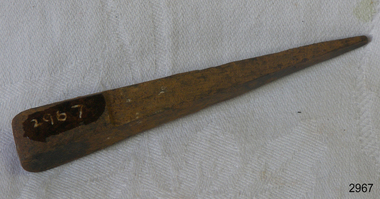
Tool - Wedge
... ...wood working tool...flagstaff hill warrnambool maritime museum maritime Village wood working tool wedge hand tool Metal wedge, for use with a plane, has rounded top and flat sides, and a narrow flat end. ...Metal wedge, for use with a plane, has rounded top and flat sides, and a narrow flat end. flagstaff hill, warrnambool, maritime museum, maritime village, wood working tool, wedge, hand tool -
 Flagstaff Hill Maritime Museum and Village
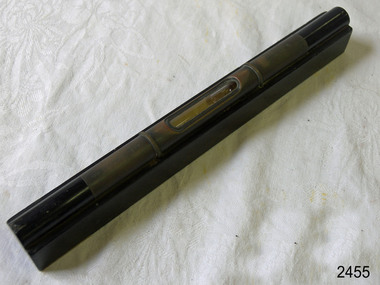
Spirit Level, circa 1880
... ...wood working plane...It also reflected the firm's skill in responding to an unprecedented demand for quality tools by shipyards, cooperage's and other industries, both locally and far and wide. flagstaff hill warrnambool shipwrecked-coast flagstaff-hill flagstaff-hill-maritime-museum maritime-museum shipwreck-coast flagstaff-hill-maritime-village spirit level level mathieson of glasgow builders level Spirit Level Alexander Mathieson & Sons Tool maker wood working plane John Manners Thomas Adam Mathieson James & William Stewart James Harper Thomas Ogilvie Machine manufacturer Has "18C Warranted" stamped on barrel. ...In 1792 John Manners had set up a workshop making woodworking planes at 14 Saracens Lane Glasgow. He also had employed an apprentice Alexander Mathieson (1773-1851). But in the following year at Saracen's Lane, the 1841 census describes Alexander Mathieson as a master plane-maker now at 38 Saracen Lane with his son Thomas Adam working with him as a journeyman plane-maker. Presumably, Alexander must have taken over the premises and business of John Manners. Now that the business had Thomas Adam Mathieson working with his father it gradually grew and became more diversified, and it is recorded at the time by the Post-Office Glasgow Annual Directory that by 1847/8 Alexander Mathieson was a "plane, brace, bit, auger & edge-tool maker". In 1849 the firm of James & William Stewart at 65 Nicolson Street, Edinburgh was taken over and Thomas was put in charge of the business, trading under the name Thomas A. Mathieson & Co. as plane and edge-tool makers. Thomas's company went on to acquire the Edinburgh edge-tool makers “Charles & Hugh McPherson” and took over their premises in Gilmore Street. In the Edinburgh directory of 1856/7, the business is recorded as being Alexander Mathieson & Son, plane and edge-tool makers at 48 Nicolson Street and Paul's Work, Gilmore Street Edinburgh. The 1851 census Alexander is recorded as working as a tool and plane-maker employing eight men. Later that year Alexander died and his son Thomas took over the business. Under the heading of an edge-tool maker in the 1852/3 Post-Office Glasgow Annual Directory the firm is now listed as Alexander Mathieson & Son, with further entries as "turning-lathe and vice manufacturers". By the early 1850s, the business had moved to 24 Saracen Lane. The directory for 1857/8 records that the firm had moved again only a few years later to East Campbell Street, off the Gallowgate area, and that through further diversification was also manufacturing coopers' and tinmen's tools. The ten-yearly censuses report the firm's growth in 1861 stating that Thomas was a tool manufacturer employing 95 men and 30 boys; in 1871 he had 200 men working for him and in 1881 300 men. By 1899 the firm had been incorporated as Alexander Mathieson & Sons Ltd, even though only Alexander's son Thomas appears ever to have joined the firm so the company was still in his fathers' name. In September 1868 Thomas Mathieson put a notice in the newspapers of the Sheffield & Rotherham Independent and the Sheffield Daily Telegraph stating that his firm had used the trade-mark of a crescent and star "for some time" and that "using or imitating the Mark would be proceeded against for infringement". The firm had acquired its interest in the crescent-and-star mark from the heirs of Charles Pickslay, the Sheffield cutler who had registered it with the Cutlers' Company in 1833 and had died in 1852. The year 1868 seems also to be the one in which the name Saracen Tool Works was first adopted; not only does it figure at the foot of the notice in the Sheffield press, it also makes its first appearance in the firm's entry in the Post-Office Glasgow Annual Directory in the 1868/9 edition. As Thomas Mathieson's business grew, so too did his involvement in local public life and philanthropy. One of the representatives of the third ward on the town council of Glasgow, he became a river bailie in 1868, a magistrate in 1870 and a preceptor of Hutcheson's Hospital in 1878. He had a passion for books and was an "ardent Ruskinian". He served on the committee handling the bequest for the setting up of the Mitchell Library in Glasgow. When he died at Coulter Maynes near Biggar in 1899, he left an estate worth £142,764. Company's later years: Both Thomas's sons, James Harper and Thomas Ogilvie were involved in the continuing life of the firm. James followed in his father's footsteps in becoming a local public figure. He was appointed Deputy Lieutenant of the County of the City of Glasgow and was made a deacon of the Incorporation of the Hammermen of Glasgow in 1919. His brother Thomas Ogilvie was recorded as tool manufacturer and employer in the 1911 census. Thomas Ogilvie's son Thomas Alastair Sutherland Ogilvie Mathieson was born in 1908 took a rather different approach to engineering, however, by becoming a racing driver. In 1947 he wed the French film actress Mila Parély. The firm had won many awards at world fairs for their goods. At the Great Exhibition, London, 1851. Prize medal for joiners' tools in the class of Cutlery & Edge Tools, Great London Exposition, 1862. Prize medal honoris causa. International Exhibition, Melbourne, 1880. Gold medal International Exhibition of Industry, Science and Art, Edinburgh, 1886. Prize medalThe firm of Alexander Mathieson & Sons was one of the leading makers of hand tools in Scotland. Its success went hand in hand with the growth of the shipbuilding industries on the Firth of Clyde in the nineteenth century and the emergence of Glasgow as the "second city of the Empire". It also reflected the firm's skill in responding to an unprecedented demand for quality tools by shipyards, cooperage's and other industries, both locally and far and wide.Spirit level, brass in ebony wooden casing.Has "18C Warranted" stamped on barrel.flagstaff hill, warrnambool, shipwrecked-coast, flagstaff-hill, flagstaff-hill-maritime-museum, maritime-museum, shipwreck-coast, flagstaff-hill-maritime-village, spirit level, level, mathieson of glasgow, builders level, spirit level, alexander mathieson & sons, tool maker, wood working plane, john manners, thomas adam mathieson, james & william stewart, james harper, thomas ogilvie, machine manufacturer -
 Flagstaff Hill Maritime Museum and Village
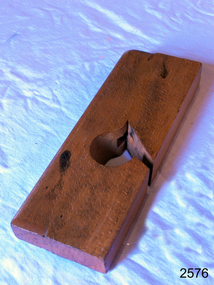
Tool - Plane, A Mathieson & Son, late 19th to early 20th century
... ...wood working tool...flagstaff hill warrnambool shipwrecked-coast flagstaff-hill flagstaff-hill-maritime-museum maritime-museum shipwreck-coast flagstaff-hill-maritime-village flagstaff hill warrnambool shipwrecked-coast flagstaff-hill flagstaff-hill-maritime-museum maritime-museum shipwreck-coast flagstaff-hill-maritime-village rabbit plane wood working tool hand tool Stamped "A MATHIESON & SON / GLASGOW around symbol [Star over crescent] Rabbet plane, without a blade. ...Rabbet plane, without a blade. Made by A Mathieson & Son Glasgow. Size 1.25 inch.Stamped "A MATHIESON & SON / GLASGOW around symbol [Star over crescent]flagstaff hill, warrnambool, shipwrecked-coast, flagstaff-hill, flagstaff-hill-maritime-museum, maritime-museum, shipwreck-coast, flagstaff-hill-maritime-village, flagstaff hill, warrnambool, shipwrecked-coast, flagstaff-hill, flagstaff-hill-maritime-museum, maritime-museum, shipwreck-coast, flagstaff-hill-maritime-village, rabbit plane, wood working tool, hand tool -
 Flagstaff Hill Maritime Museum and Village
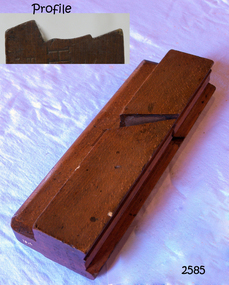
Tool - Plane, A. Mathieson and Son, 20th century
... ...wood working tool...Flagstaff Hill Maritime Museum Maritime Village Warrnambool Great Ocean Road wood working tool plane moulding plane hand tool Stamped; "5/8" "No 101" "E DUNSTAN" "2" ["G N" within "W"] "HIT" "E DUNSTAN" Stamped: "A MATHIESON & SON / GLASGOW & EDINBURGH" with symbol [star above crescent] Has E Dunstan HIT stamped on one end. ...Plane Moulding type, maker Mathieson & Son Glasgow. Number 404 plane. Size 5/8 inch. No wedge or blade. Stamped inscriptions.Stamped; "5/8" "No 101" "E DUNSTAN" "2" ["G N" within "W"] "HIT" "E DUNSTAN" Stamped: "A MATHIESON & SON / GLASGOW & EDINBURGH" with symbol [star above crescent] Has E Dunstan HIT stamped on one end. flagstaff hill, maritime museum, maritime village, warrnambool, great ocean road, wood working tool, plane, moulding plane, hand tool -
 Flagstaff Hill Maritime Museum and Village
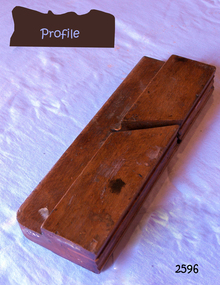
Tool - Plane
... ...wood working tool...flagstaff hill flagstaff hill warrnambool shipwreck-coast flagstaff hill maritime mus Flagstaff Hill Maritime Museum Flagstaff Hill Maritime Museum and Village plane wood working tool hand tool moulding plane Grecian Orgee Quirk plane Quirk Ogees Rabone Bros & Co. ...Plane Moulding Grecian Ogee with bevel. Also called Quirk or Quir Ogees. Made by Rabone Bros & Co. Size 1/2 inch. Stamped "RABONE BROS & CO.", and ["G N" within a large "W"]flagstaff hill, flagstaff hill, warrnambool, shipwreck-coast, flagstaff hill maritime mus, flagstaff hill maritime museum, flagstaff hill maritime museum and village, plane, wood working tool, hand tool, moulding plane, grecian orgee, quirk plane, quirk ogees, rabone bros & co. -
 Flagstaff Hill Maritime Museum and Village
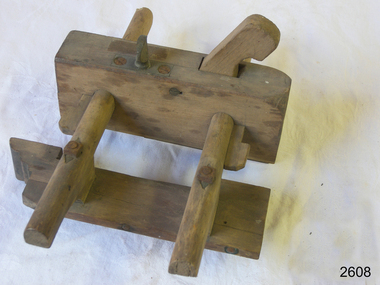
Tool - Complex Moulding Plane, Mid to Late 19th Century
... ...Wood Working...It gives us a snapshot of how furniture and other decorative finishes were created on timber by the use of hand tools. flagstaff hill warrnambool flagstaff-hill-maritime-museum maritime-museum shipwreck-coast flagstaff-hill-maritime-village Wood Working Cabinet Making Complex Moulding Plane J Dixon London Mouldings Stamped "J Dixon London" also has the letter "B" stamped Panel Plough Plane white wood, blade missing. ...A moulding plane is a specialised plane used for making the complex shapes found in wooden mouldings that are used to decorate furniture or other wooden object. Traditionally, moulding planes were blocks of wear resistant hardwood, often beech or maple, which were worked to the shape of the intended moulding. The blade, or iron was likewise formed to the intended moulding profile and secured in the body of the plane with a wooden wedge. A traditional cabinetmakers shop might have many, perhaps hundreds, of moulding planes for the full range of work to be performed. Large crown mouldings required planes of six or more inches in width, which demanded great strength to push and often had additional peg handles on the sides, allowing the craftsman's apprentice or other worker to pull the plane ahead of the master who guided it.A vintage tool made by an unknown maker, this item was made commercially for firms and individuals who worked in wood and needed a tool that could produce a ornamental finish to timber. These profiled planes came in various shapes and sizes to achieve a decorative finish. Although the item is marked J Dixon no reference can be found at this time for a maker of complex moulding planes J Dixon of London. The plane could have been made by an unknown maker and sold through a merchandising agent of which there was one in London at the time. It is this agent J Dixon that could have stamped his mark on the item and then sold the plane on giving the impression J Dixon was the maker, this practice was quite common in the 18th & 19th centuries. This item is still regarded as a significant tool from the mid to late 19th century that today is quite rare and sought after by collectors. It gives us a snapshot of how furniture and other decorative finishes were created on timber by the use of hand tools. Panel Plough Plane white wood, blade missing. Stamped "J Dixon London" also has the letter "B" stamped flagstaff hill, warrnambool, flagstaff-hill-maritime-museum, maritime-museum, shipwreck-coast, flagstaff-hill-maritime-village, wood working, cabinet making, complex moulding plane, j dixon london, mouldings
