
Showing 29 items matching "wool measuring"
-
 National Wool Museum
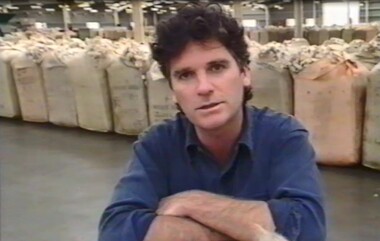
Film - Promotional Films, Australian Wool Corporation, 26 April 1991
... ...Wool Measuring...Film includes colour footage and audio. 00:01 - titles 00:21 - scenes herding sheep 01:18 - titles 'Wool Testing' 01:34 - Hugh Beggs, Chairman of Australian Wool Corporation, speaking about history of wool marketing and measuring of wool in Australia 02:29 - wool bales on truck 02:35 - interior of factory showing process of wool sampling, measuring and testing 04:04 - AWTA Ltd building exterior, and interior scenes of workers testing and measuring wool samples 11:41 - scenes at wool auction 12:14 - factory interior showing wool processing 13:05 - Beggs speaking about wool industry 13:13 - fashion runways 13:52 - end titles 14:17 - end 14:22 - titles 'Contaminants in Wool Processing' 14:42 - fashion runway 14:52 - man speaking on location at a sheep farm 15:04 - Mark Kent, Vice-President Kent Manufacturing, speaking about contamination of wool and Australia's reputation 15:25 - interior scenes of G H Michell & Sons wool mill in South Australia 16:22 - Judy Turk, in office at G H Michell & Sons speaking about problems of contamination 16:36 - interior factory scenes 17:46 - John McIntosh, Aweave Textile Corporation, talking about contaminants 20:02 - scenes in shearing shed 20:42 - Chip Sawers, President Wool Council, talking about contamination 28:46 - end credits 29:04 - end 29:13 - Bill Peach exits car on sheep property, introduces a story about wool 29:46 - titles 'Working for Wool' 30:04 - farm scenes 32:12 - shearing shed scenes, interior 34:28 - Wool Testing Authority labratory, interior scenes 36:44 - wool store interior 38:20 - Australian Wool Corporation office interior and exterior, Parkville, Melbourne 43:26 - end credits 44:00 - end 44:05 - wool advertisement featuring man and woman in car 44:34 - end 44:41 - titles 'Fleece Clean' 44:42 - various scenes, fashion, factories 45:14 - titles 45:15 - fashion runways 45:43 - farm scenes 51:02 - titles 51:10 - scenes of China, including Great Wall 53:44 - textile factories in China, interior scenes 57:46 - fashion runways, Shanghai China 01:00:31 - rural scenes of China 01:02:03 - end 01:02:13 - titles 'Wool Top Making' 01:02:19 - scenes of Williamstown, Victoria 01:02:27 - Port Phillip Mills, interior scenes 01:06:33 - end credits 01:07:08 - end 01:07:11 - titles 'Shearer Fitness' 01:07:21 - shearing shed, interior 01:09:54 - shearers talking about health and fitness 01:19:28 - end credits 01:19:48 - end 01:19:50 - titles 'Shearing Training' 01:19:51 - shearing scenes 01:26:24 - end credits 01:26:45 - end 01:26:50 - titles 'Wool Press Duties' 01:26:58 - wool pressing scenes 01:34:29 - end credits 01:34:51 - end 01:34:54 - woollen carpet advertisement, including carpet scenes and farm scenes 01:35:38 end...Victoria Film Working Life Factory Textile Industry Farming Sheep Australian Wool Corporation Hugh Beggs Wool Testing Wool Measuring AWTA G H Michell & Sons Fashion Runway Contaminants Mark Kent Wool Mills Judy Turk John McIntosh Aweave Textile Corporation Chip Sawers Bill Peach Advertisements China Top Making Shearing Sheds Shearing Health Training Wool Pressers Carpet Label on tape: Australian Wool Corporation / TITLE AWC VIDEOS TAPE 2 / PLAYING TIME / TAPING DATE 26/4/91 / PRODUCTION DATE / SYSTEM / WOOL HOUSE 369 Royal Parade, PARKVILLE, VIC, 3052 Black VHS tape with white and orange stickers and printed text. ...Tape contains ten separate short films created by the Australian Wool Corporation, including promotional videos, advertisements and industry news.Black VHS tape with white and orange stickers and printed text. Tape is housed in a black plastic case. Film includes colour footage and audio. 00:01 - titles 00:21 - scenes herding sheep 01:18 - titles 'Wool Testing' 01:34 - Hugh Beggs, Chairman of Australian Wool Corporation, speaking about history of wool marketing and measuring of wool in Australia 02:29 - wool bales on truck 02:35 - interior of factory showing process of wool sampling, measuring and testing 04:04 - AWTA Ltd building exterior, and interior scenes of workers testing and measuring wool samples 11:41 - scenes at wool auction 12:14 - factory interior showing wool processing 13:05 - Beggs speaking about wool industry 13:13 - fashion runways 13:52 - end titles 14:17 - end 14:22 - titles 'Contaminants in Wool Processing' 14:42 - fashion runway 14:52 - man speaking on location at a sheep farm 15:04 - Mark Kent, Vice-President Kent Manufacturing, speaking about contamination of wool and Australia's reputation 15:25 - interior scenes of G H Michell & Sons wool mill in South Australia 16:22 - Judy Turk, in office at G H Michell & Sons speaking about problems of contamination 16:36 - interior factory scenes 17:46 - John McIntosh, Aweave Textile Corporation, talking about contaminants 20:02 - scenes in shearing shed 20:42 - Chip Sawers, President Wool Council, talking about contamination 28:46 - end credits 29:04 - end 29:13 - Bill Peach exits car on sheep property, introduces a story about wool 29:46 - titles 'Working for Wool' 30:04 - farm scenes 32:12 - shearing shed scenes, interior 34:28 - Wool Testing Authority labratory, interior scenes 36:44 - wool store interior 38:20 - Australian Wool Corporation office interior and exterior, Parkville, Melbourne 43:26 - end credits 44:00 - end 44:05 - wool advertisement featuring man and woman in car 44:34 - end 44:41 - titles 'Fleece Clean' 44:42 - various scenes, fashion, factories 45:14 - titles 45:15 - fashion runways 45:43 - farm scenes 51:02 - titles 51:10 - scenes of China, including Great Wall 53:44 - textile factories in China, interior scenes 57:46 - fashion runways, Shanghai China 01:00:31 - rural scenes of China 01:02:03 - end 01:02:13 - titles 'Wool Top Making' 01:02:19 - scenes of Williamstown, Victoria 01:02:27 - Port Phillip Mills, interior scenes 01:06:33 - end credits 01:07:08 - end 01:07:11 - titles 'Shearer Fitness' 01:07:21 - shearing shed, interior 01:09:54 - shearers talking about health and fitness 01:19:28 - end credits 01:19:48 - end 01:19:50 - titles 'Shearing Training' 01:19:51 - shearing scenes 01:26:24 - end credits 01:26:45 - end 01:26:50 - titles 'Wool Press Duties' 01:26:58 - wool pressing scenes 01:34:29 - end credits 01:34:51 - end 01:34:54 - woollen carpet advertisement, including carpet scenes and farm scenes 01:35:38 endLabel on tape: Australian Wool Corporation / TITLE AWC VIDEOS TAPE 2 / PLAYING TIME / TAPING DATE 26/4/91 / PRODUCTION DATE / SYSTEM / WOOL HOUSE 369 Royal Parade, PARKVILLE, VIC, 3052victoria, film, working life, factory, textile industry, farming, sheep, australian wool corporation, hugh beggs, wool testing, wool measuring, awta, g h michell & sons, fashion, runway, contaminants, mark kent, wool mills, judy turk, john mcintosh, aweave textile corporation, chip sawers, bill peach, advertisements, china, top making, shearing sheds, shearing, health, training, wool pressers, carpet -
 National Wool Museum
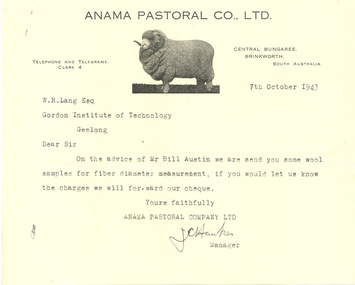
Letter
... Lang re: wool testing and measuring service....Lang re: wool testing and measuring service. Wool - testing World War II Anama Pastoral Co. ...Two letters dating from 1943 from the Anama Pastoral Co. Ltd, Central Bungaree, Brinkworth, South Australia, to W.R. Lang re: wool testing and measuring service.wool - testing world war ii, anama pastoral co., ltd, lang, dr w. roy, wool - testing, world war ii -
 National Wool Museum
Book, Surprise and Enterprise: fifty years of science for Australia
... Looks at various scientific developments made by CSIRO over the past 50 years, including advances in measuring wool, spinning, processing and sheep breeding....Looks at various scientific developments made by CSIRO over the past 50 years, including advances in measuring wool, spinning, processing and sheep breeding. ..."Surprise and Enterprise: fifty years of science for Australia" Andrew McKay, CSIRO, 1977. First published in 1976 and reprinted in 1977. Looks at various scientific developments made by CSIRO over the past 50 years, including advances in measuring wool, spinning, processing and sheep breeding.wool growing sheep breeding textile finishing textile testing, csiro, spinning, wool growing, sheep breeding, textile finishing, textile testing -
 National Wool Museum
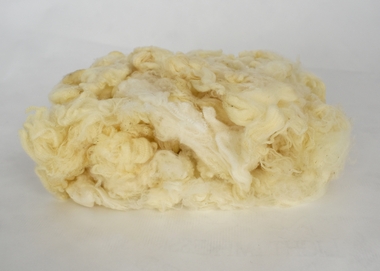
Million Dollar Bale Wool Sample, 1995
... The sale of the first bale of wool measuring below 14 microns was held in the Auction Room here at the National Wool Museum. ...The sale of the first bale of wool measuring below 14 microns was held in the Auction Room here at the National Wool Museum. ...The wool was shorn from sheep of the Wyndarra and Rockbank bloodlines. A flock of 290 sheep were kept undercover at Kadinia, the property of the Appledore family from Brim in the Wimmera district of Victoria. Their record-breaking wool was produced by giving the sheep a special diet and providing each one with a UV-protective coat. Around 180 fleeces were selected for the million dollar bale. The sale of the first bale of wool measuring below 14 microns was held in the Auction Room here at the National Wool Museum. Bidding began at $600/kg and steadily increased until there were only two bidders left. The bidders represented the Japanese firm Aoki International and Loro Piana of Italy. The hammer fell at $10,300/kg, with Aoki International paying $1,194,800 for the 116kg bale. The fleece was scoured (cleaned) at the Goulburn Wool Scour, New South Wales. The degree of preparation and care taken with the task was extreme. The Scour closed production three days before and was extensively cleaned. On the day of scouring 12 tonnes of 17 micron wool was washed to condition the water, then nine bales of extra super fine wool, worth over $300,000 was washed as a trial run. Toabo Agaki Japan was employed to process the scoured wool into suit cloth. Taobo required the scoured wool to contain 0.5% residual grease, 12% moisture and a yield of 83kg. These requirements were met. The entire staff of the Scour wanted to be part of washing the best wool in the world. Without asking for payment both the night shift and afternoon shift crews assisted the day shift in the task. The bale was fed into the scour in seven minutes and fitted into three bowls, half the scour. It completely disappeared into the dryer and the last wool was fed before the first wool was out. The clean wool was hand-packed into cardboard cartons and freighted to Japan. Aoki International, based in Yokohama Japan, cut three suit lengths from the cloth, then blended the remaining wool into an exclusive line of commercially-available suits. These suits are labeled Kadinia.Wool sample from the Million Dollar Balewool sales, million dollar bale -
 National Wool Museum
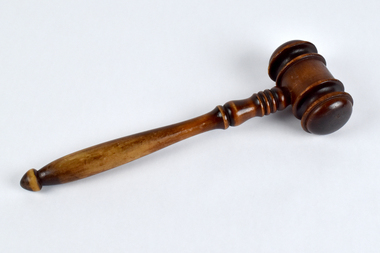
Functional object - Auctioneer's Gavel, c. 1950s
... The sale of the first bale of wool measuring below 14 microns was held in the Auction Room here at the National Wool Museum. ...The sale of the first bale of wool measuring below 14 microns was held in the Auction Room here at the National Wool Museum. ...Michael Crooks was the auctioneer responsible for selling Australia's million dollar wool bale on the 11th January, 1995 in Geelong, using this gavel. The wool was shorn from sheep of the Wyndarra and Rockbank bloodlines. A flock of 290 sheep were kept undercover at Kadinia, the property of the Appledore family from Brim in the Wimmera district of Victoria. Their record-breaking wool was produced by giving the sheep a special diet and providing each one with a UV-protective coat. Around 180 fleeces were selected for the million dollar bale. The sale of the first bale of wool measuring below 14 microns was held in the Auction Room here at the National Wool Museum. Bidding began at 40,000 (cents a kilogram) and steadily increased until there were only two bidders left. The bidders represented the Japanese firm Aoki International and Loro Piana of Italy. The hammer fell at 1,030,000 cents per kilogram, with Aoki International paying $1,194,800 for the 116kg bale. The fleece was scoured (cleaned) at the Goulburn Wool Scour, New South Wales. The degree of preparation and care taken with the task was extreme. The Scour closed production three days before and was extensively cleaned. On the day of scouring 12 tonnes of 17 micron wool was washed to condition the water, then nine bales of extra super fine wool, worth over $300,000 was washed as a trial run. Toabo Agaki Japan was employed to process the scoured wool into suit cloth. Taobo required the scoured wool to contain 0.5% residual grease, 12% moisture and a yield of 83kg. These requirements were met. The entire staff of the Scour wanted to be part of washing the best wool in the world. Without asking for payment both the night shift and afternoon shift crews assisted the day shift in the task. The bale was fed into the scour in seven minutes and fitted into three bowls, half the scour. It completely disappeared into the dryer and the last wool was fed before the first wool was out. The clean wool was hand-packed into cardboard cartons and freighted to Japan. Aoki International, based in Yokohama Japan, cut three suit lengths from the cloth, then blended the remaining wool into an exclusive line of commercially-available suits. These suits are labelled Kadinia.Small wooden hammer, with handle and double sided face.gavel, michael crooks, auctioneer, wool industry, million dollar bale, geelong, auction, kadinia, appledore -
 National Wool Museum
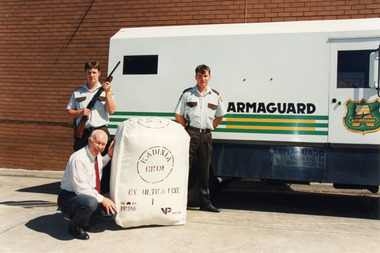
Photograph - Armed Guards with Million Dollar Bale, 11 January 1995
... The sale of the first bale of wool measuring below 14 microns was held in the Auction Room here at the National Wool Museum. ...The sale of the first bale of wool measuring below 14 microns was held in the Auction Room here at the National Wool Museum. ...This photograph shows armed guards and Wool Manager Keith Jackson posing with the million dollar wool bale after it was sold by auctioneer Michael Crooks on the 11th January, 1995 in Geelong. The wool was shorn from sheep of the Wyndarra and Rockbank bloodlines. A flock of 290 sheep were kept undercover at Kadinia, the property of the Appledore family from Brim in the Wimmera district of Victoria. Their record-breaking wool was produced by giving the sheep a special diet and providing each one with a UV-protective coat. Around 180 fleeces were selected for the million dollar bale. The sale of the first bale of wool measuring below 14 microns was held in the Auction Room here at the National Wool Museum. Bidding began at 40,000 (cents a kilogram) and steadily increased until there were only two bidders left. The bidders represented the Japanese firm Aoki International and Loro Piana of Italy. The hammer fell at 1,030,000 cents per kilogram, with Aoki International paying $1,194,800 for the 116kg bale. The fleece was scoured (cleaned) at the Goulburn Wool Scour, New South Wales. The degree of preparation and care taken with the task was extreme. The Scour closed production three days before and was extensively cleaned. On the day of scouring 12 tonnes of 17 micron wool was washed to condition the water, then nine bales of extra super fine wool, worth over $300,000 was washed as a trial run. Toabo Agaki Japan was employed to process the scoured wool into suit cloth. Taobo required the scoured wool to contain 0.5% residual grease, 12% moisture and a yield of 83kg. These requirements were met. The entire staff of the Scour wanted to be part of washing the best wool in the world. Without asking for payment both the night shift and afternoon shift crews assisted the day shift in the task. The bale was fed into the scour in seven minutes and fitted into three bowls, half the scour. It completely disappeared into the dryer and the last wool was fed before the first wool was out. The clean wool was hand-packed into cardboard cartons and freighted to Japan. Aoki International, based in Yokohama Japan, cut three suit lengths from the cloth, then blended the remaining wool into an exclusive line of commercially-available suits. These suits are labelled Kadinia.Colour photograph showing three men with a bale of wool in front of an armaguard truck. Two of the men are armed guards standing either side of the wool bale, one is holding a shotgun. Another man in a suit and tie is crouching near the bale.gavel, michael crooks, auctioneer, wool industry, million dollar bale, geelong, auction, kadinia, appledore, keith jackson, armed guards, armaguard -
 National Wool Museum
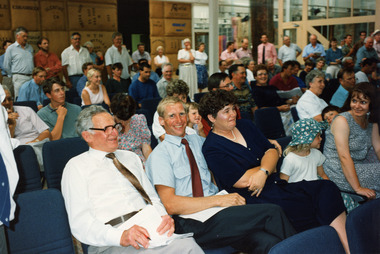
Photograph - Appledore Family, Growers Gallery, National Wool Centre, Geelong, 11 January 1995
... The sale of the first bale of wool measuring below 14 microns was held in the Auction Room here at the National Wool Museum. ...The sale of the first bale of wool measuring below 14 microns was held in the Auction Room here at the National Wool Museum. ...This photograph depicts people gathered in the Growers Gallery on the 11th January, 1995 at the National Wool Centre, Geelong. It shows the emotions of Murray, Ian and Kaye Appledore while bidding took place for the million dollar bale. The wool was shorn from sheep of the Wyndarra and Rockbank bloodlines. A flock of 290 sheep were kept undercover at Kadinia, the property of the Appledore family from Brim in the Wimmera district of Victoria. Their record-breaking wool was produced by giving the sheep a special diet and providing each one with a UV-protective coat. Around 180 fleeces were selected for the million dollar bale. The sale of the first bale of wool measuring below 14 microns was held in the Auction Room here at the National Wool Museum. Bidding began at 40,000 (cents a kilogram) and steadily increased until there were only two bidders left. The bidders represented the Japanese firm Aoki International and Loro Piana of Italy. The hammer fell at 1,030,000 cents per kilogram, with Aoki International paying $1,194,800 for the 116kg bale. The fleece was scoured (cleaned) at the Goulburn Wool Scour, New South Wales. The degree of preparation and care taken with the task was extreme. The Scour closed production three days before and was extensively cleaned. On the day of scouring 12 tonnes of 17 micron wool was washed to condition the water, then nine bales of extra super fine wool, worth over $300,000 was washed as a trial run. Toabo Agaki Japan was employed to process the scoured wool into suit cloth. Taobo required the scoured wool to contain 0.5% residual grease, 12% moisture and a yield of 83kg. These requirements were met. The entire staff of the Scour wanted to be part of washing the best wool in the world. Without asking for payment both the night shift and afternoon shift crews assisted the day shift in the task. The bale was fed into the scour in seven minutes and fitted into three bowls, half the scour. It completely disappeared into the dryer and the last wool was fed before the first wool was out. The clean wool was hand-packed into cardboard cartons and freighted to Japan. Aoki International, based in Yokohama Japan, cut three suit lengths from the cloth, then blended the remaining wool into an exclusive line of commercially-available suits. These suits are labelled Kadinia.Colour photograph showing an interior view of rows of people seated and standing in room.michael crooks, auctioneer, wool industry, million dollar bale, geelong, auction, kadinia, appledore, keith jackson, sale room -
 National Wool Museum
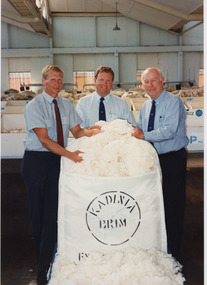
Photograph - Million Dollar Bale, National Wool Centre, Geelong, 11 January 1995
... The sale of the first bale of wool measuring below 14 microns was held in the Auction Room here at the National Wool Museum. ...The sale of the first bale of wool measuring below 14 microns was held in the Auction Room here at the National Wool Museum. ...This photograph shows Grower Ian Appledore, Auctioneer Michael Crooks and Wool Manager Keith Jackson posing with the million dollar bale after it was sold on 11th January 1995 in Geelong. The wool was shorn from sheep of the Wyndarra and Rockbank bloodlines. A flock of 290 sheep were kept undercover at Kadinia, the property of the Appledore family from Brim in the Wimmera district of Victoria. Their record-breaking wool was produced by giving the sheep a special diet and providing each one with a UV-protective coat. Around 180 fleeces were selected for the million dollar bale. The sale of the first bale of wool measuring below 14 microns was held in the Auction Room here at the National Wool Museum. Bidding began at 40,000 (cents a kilogram) and steadily increased until there were only two bidders left. The bidders represented the Japanese firm Aoki International and Loro Piana of Italy. The hammer fell at 1,030,000 cents per kilogram, with Aoki International paying $1,194,800 for the 116kg bale. The fleece was scoured (cleaned) at the Goulburn Wool Scour, New South Wales. The degree of preparation and care taken with the task was extreme. The Scour closed production three days before and was extensively cleaned. On the day of scouring 12 tonnes of 17 micron wool was washed to condition the water, then nine bales of extra super fine wool, worth over $300,000 was washed as a trial run. Toabo Agaki Japan was employed to process the scoured wool into suit cloth. Taobo required the scoured wool to contain 0.5% residual grease, 12% moisture and a yield of 83kg. These requirements were met. The entire staff of the Scour wanted to be part of washing the best wool in the world. Without asking for payment both the night shift and afternoon shift crews assisted the day shift in the task. The bale was fed into the scour in seven minutes and fitted into three bowls, half the scour. It completely disappeared into the dryer and the last wool was fed before the first wool was out. The clean wool was hand-packed into cardboard cartons and freighted to Japan. Aoki International, based in Yokohama Japan, cut three suit lengths from the cloth, then blended the remaining wool into an exclusive line of commercially-available suits. These suits are labelled Kadinia.Colour photograph showing three men standing around a bale of wool.michael crooks, auctioneer, wool industry, million dollar bale, geelong, auction, kadinia, appledore, keith jackson, sale room, geelong wool centre -
 National Wool Museum
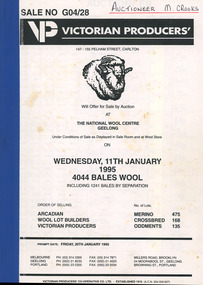
Document - Victorian Producers' Sale Catalogue, National Wool Centre, Geelong, Victorian Producers' Co-operative Limited, 11 January 1995
... The sale of the first bale of wool measuring below 14 microns was held in the Auction Room here at the National Wool Museum. ...The sale of the first bale of wool measuring below 14 microns was held in the Auction Room here at the National Wool Museum. ...This sales catalogue was the one used by Auctioneer Michael Crooks on 11th January 1995 when the million dollar bale was sold at the National Wool Centre, Geelong. The wool was shorn from sheep of the Wyndarra and Rockbank bloodlines. A flock of 290 sheep were kept undercover at Kadinia, the property of the Appledore family from Brim in the Wimmera district of Victoria. Their record-breaking wool was produced by giving the sheep a special diet and providing each one with a UV-protective coat. Around 180 fleeces were selected for the million dollar bale. The sale of the first bale of wool measuring below 14 microns was held in the Auction Room here at the National Wool Museum. Bidding began at 40,000 (cents a kilogram) and steadily increased until there were only two bidders left. The bidders represented the Japanese firm Aoki International and Loro Piana of Italy. The hammer fell at 1,030,000 cents per kilogram, with Aoki International paying $1,194,800 for the 116kg bale. The fleece was scoured (cleaned) at the Goulburn Wool Scour, New South Wales. The degree of preparation and care taken with the task was extreme. The Scour closed production three days before and was extensively cleaned. On the day of scouring 12 tonnes of 17 micron wool was washed to condition the water, then nine bales of extra super fine wool, worth over $300,000 was washed as a trial run. Toabo Agaki Japan was employed to process the scoured wool into suit cloth. Taobo required the scoured wool to contain 0.5% residual grease, 12% moisture and a yield of 83kg. These requirements were met. The entire staff of the Scour wanted to be part of washing the best wool in the world. Without asking for payment both the night shift and afternoon shift crews assisted the day shift in the task. The bale was fed into the scour in seven minutes and fitted into three bowls, half the scour. It completely disappeared into the dryer and the last wool was fed before the first wool was out. The clean wool was hand-packed into cardboard cartons and freighted to Japan. Aoki International, based in Yokohama Japan, cut three suit lengths from the cloth, then blended the remaining wool into an exclusive line of commercially-available suits. These suits are labelled Kadinia.Bound paper booklet, approximately 35 pages, with printed and handwritten text.Front: [handwritten] AUCTIONEER M. CROOKS Front: [printed] SALE NO G04/28 / VICTORIAN PRODUCERS' / 147-155 PELHAM STREET, CARLTON / Will Offer for Sale by Auction / AT / THE NATIONAL WOOL CENTRE / GEELONG / Under Conditions of Sale as Displayed in Sale Room and at Wool Store / ON / WEDNESDAY, 11TH JANUARY / 1995 / 4044 BALES WOOL / INCLUDING 1241 BALES BY SEPARATIONmichael crooks, auctioneer, wool industry, million dollar bale, geelong, auction, kadinia, appledore, keith jackson, sale room, geelong wool centre -
 National Wool Museum
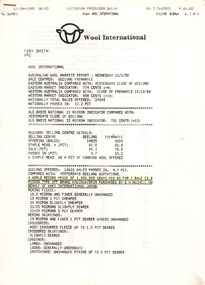
Document - Australian Wool Markets Report, Wool International, 11 January 1995
... The sale of the first bale of wool measuring below 14 microns was held in the Auction Room here at the National Wool Museum. ...The sale of the first bale of wool measuring below 14 microns was held in the Auction Room here at the National Wool Museum. ...Australian Wool Markets Report, featuring details of the sale of the million dollar bale on Wednesday 11th January, 1995 in Geelong. The wool was shorn from sheep of the Wyndarra and Rockbank bloodlines. A flock of 290 sheep were kept undercover at Kadinia, the property of the Appledore family from Brim in the Wimmera district of Victoria. Their record-breaking wool was produced by giving the sheep a special diet and providing each one with a UV-protective coat. Around 180 fleeces were selected for the million dollar bale. The sale of the first bale of wool measuring below 14 microns was held in the Auction Room here at the National Wool Museum. Bidding began at 40,000 (cents a kilogram) and steadily increased until there were only two bidders left. The bidders represented the Japanese firm Aoki International and Loro Piana of Italy. The hammer fell at 1,030,000 cents per kilogram, with Aoki International paying $1,194,800 for the 116kg bale. The fleece was scoured (cleaned) at the Goulburn Wool Scour, New South Wales. The degree of preparation and care taken with the task was extreme. The Scour closed production three days before and was extensively cleaned. On the day of scouring 12 tonnes of 17 micron wool was washed to condition the water, then nine bales of extra super fine wool, worth over $300,000 was washed as a trial run. Toabo Agaki Japan was employed to process the scoured wool into suit cloth. Taobo required the scoured wool to contain 0.5% residual grease, 12% moisture and a yield of 83kg. These requirements were met. The entire staff of the Scour wanted to be part of washing the best wool in the world. Without asking for payment both the night shift and afternoon shift crews assisted the day shift in the task. The bale was fed into the scour in seven minutes and fitted into three bowls, half the scour. It completely disappeared into the dryer and the last wool was fed before the first wool was out. The clean wool was hand-packed into cardboard cartons and freighted to Japan. Aoki International, based in Yokohama Japan, cut three suit lengths from the cloth, then blended the remaining wool into an exclusive line of commercially-available suits. These suits are labelled Kadinia.Three pages held with staple in top left corner with printed black text.Front: [printed] Wool International / TONY SMITH / VPC / WOOL INTERNATIONAL / AUSTRALIAN WOOL MARKETS REPORT: WEDNESDAY 11/1/95michael crooks, auctioneer, wool industry, million dollar bale, geelong, auction, kadinia, appledore, keith jackson, sale room, geelong wool centre -
 National Wool Museum
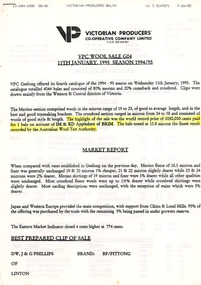
Document - Victorian Producers' Market Report, Victorian Producers' Co-operative Limited, 11 January 1995
... The sale of the first bale of wool measuring below 14 microns was held in the Auction Room here at the National Wool Museum. ...The sale of the first bale of wool measuring below 14 microns was held in the Auction Room here at the National Wool Museum. ...Victorian Producers Market Report, featuring details of the sale of the million dollar bale on Wednesday 11th January, 1995 in Geelong. The wool was shorn from sheep of the Wyndarra and Rockbank bloodlines. A flock of 290 sheep were kept undercover at Kadinia, the property of the Appledore family from Brim in the Wimmera district of Victoria. Their record-breaking wool was produced by giving the sheep a special diet and providing each one with a UV-protective coat. Around 180 fleeces were selected for the million dollar bale. The sale of the first bale of wool measuring below 14 microns was held in the Auction Room here at the National Wool Museum. Bidding began at 40,000 (cents a kilogram) and steadily increased until there were only two bidders left. The bidders represented the Japanese firm Aoki International and Loro Piana of Italy. The hammer fell at 1,030,000 cents per kilogram, with Aoki International paying $1,194,800 for the 116kg bale. The fleece was scoured (cleaned) at the Goulburn Wool Scour, New South Wales. The degree of preparation and care taken with the task was extreme. The Scour closed production three days before and was extensively cleaned. On the day of scouring 12 tonnes of 17 micron wool was washed to condition the water, then nine bales of extra super fine wool, worth over $300,000 was washed as a trial run. Toabo Agaki Japan was employed to process the scoured wool into suit cloth. Taobo required the scoured wool to contain 0.5% residual grease, 12% moisture and a yield of 83kg. These requirements were met. The entire staff of the Scour wanted to be part of washing the best wool in the world. Without asking for payment both the night shift and afternoon shift crews assisted the day shift in the task. The bale was fed into the scour in seven minutes and fitted into three bowls, half the scour. It completely disappeared into the dryer and the last wool was fed before the first wool was out. The clean wool was hand-packed into cardboard cartons and freighted to Japan. Aoki International, based in Yokohama Japan, cut three suit lengths from the cloth, then blended the remaining wool into an exclusive line of commercially-available suits. These suits are labelled Kadinia.Two pages held with staple in top left corner with printed black text.Front: [printed] VP / VICTORIAN PRODUCERS' / CO-OPERATIVE COMPANY LIMITED / A. C. N. 004 059 607 / VPC WOOL SALE G04 / 11TH JANUARY, 1995 SEASON 1994/95michael crooks, auctioneer, wool industry, million dollar bale, geelong, auction, kadinia, appledore, keith jackson, sale room, geelong wool centre -
 National Wool Museum
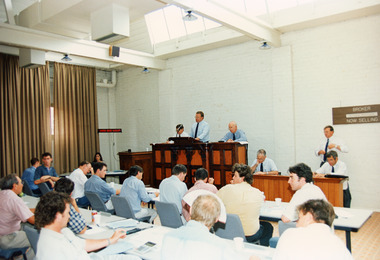
Photograph - Sale Room, National Wool Centre, Geelong, 11 January 1995
... The sale of the first bale of wool measuring below 14 microns was held in the Auction Room here at the National Wool Museum. ...The sale of the first bale of wool measuring below 14 microns was held in the Auction Room here at the National Wool Museum. ...This photograph shows bidding underway for the million dollar bale in the Sale Room on the 11th January, 1995 at the National Wool Centre, Geelong. People depicted include Sale Team Baxter Murray, Auctioneer Michael Crooks and Wool Manager Keith Jackson. The wool was shorn from sheep of the Wyndarra and Rockbank bloodlines. A flock of 290 sheep were kept undercover at Kadinia, the property of the Appledore family from Brim in the Wimmera district of Victoria. Their record-breaking wool was produced by giving the sheep a special diet and providing each one with a UV-protective coat. Around 180 fleeces were selected for the million dollar bale. The sale of the first bale of wool measuring below 14 microns was held in the Auction Room here at the National Wool Museum. Bidding began at 40,000 (cents a kilogram) and steadily increased until there were only two bidders left. The bidders represented the Japanese firm Aoki International and Loro Piana of Italy. The hammer fell at 1,030,000 cents per kilogram, with Aoki International paying $1,194,800 for the 116kg bale. The fleece was scoured (cleaned) at the Goulburn Wool Scour, New South Wales. The degree of preparation and care taken with the task was extreme. The Scour closed production three days before and was extensively cleaned. On the day of scouring 12 tonnes of 17 micron wool was washed to condition the water, then nine bales of extra super fine wool, worth over $300,000 was washed as a trial run. Toabo Agaki Japan was employed to process the scoured wool into suit cloth. Taobo required the scoured wool to contain 0.5% residual grease, 12% moisture and a yield of 83kg. These requirements were met. The entire staff of the Scour wanted to be part of washing the best wool in the world. Without asking for payment both the night shift and afternoon shift crews assisted the day shift in the task. The bale was fed into the scour in seven minutes and fitted into three bowls, half the scour. It completely disappeared into the dryer and the last wool was fed before the first wool was out. The clean wool was hand-packed into cardboard cartons and freighted to Japan. Aoki International, based in Yokohama Japan, cut three suit lengths from the cloth, then blended the remaining wool into an exclusive line of commercially-available suits. These suits are labelled Kadinia.Colour photograph showing an interior view of people seated at rows of tables with an auctioneers stand at front of the room.michael crooks, auctioneer, wool industry, million dollar bale, geelong, auction, kadinia, appledore, keith jackson, sale room -
 National Wool Museum
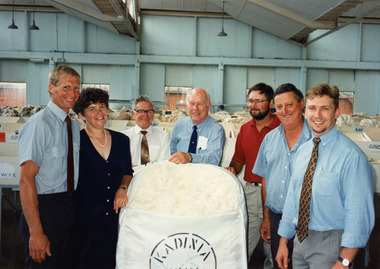
Photograph - Million Dollar Bale, National Wool Centre, Geelong, Gordon Robertson, 11 January 1995
... The sale of the first bale of wool measuring below 14 microns was held in the Auction Room here at the National Wool Museum. ...The sale of the first bale of wool measuring below 14 microns was held in the Auction Room here at the National Wool Museum. ...This photograph shows Growers Ian Appledore, Kaye Appledore and Murray Appledore, Wool Manager Keith Jackson, Wool Classer Phillip Gibson, Geoff Allibon and Brendan Dart posing with the million dollar bale after it was sold on 11th January 1995 in Geelong. The wool was shorn from sheep of the Wyndarra and Rockbank bloodlines. A flock of 290 sheep were kept undercover at Kadinia, the property of the Appledore family from Brim in the Wimmera district of Victoria. Their record-breaking wool was produced by giving the sheep a special diet and providing each one with a UV-protective coat. Around 180 fleeces were selected for the million dollar bale. The sale of the first bale of wool measuring below 14 microns was held in the Auction Room here at the National Wool Museum. Bidding began at 40,000 (cents a kilogram) and steadily increased until there were only two bidders left. The bidders represented the Japanese firm Aoki International and Loro Piana of Italy. The hammer fell at 1,030,000 cents per kilogram, with Aoki International paying $1,194,800 for the 116kg bale. The fleece was scoured (cleaned) at the Goulburn Wool Scour, New South Wales. The degree of preparation and care taken with the task was extreme. The Scour closed production three days before and was extensively cleaned. On the day of scouring 12 tonnes of 17 micron wool was washed to condition the water, then nine bales of extra super fine wool, worth over $300,000 was washed as a trial run. Toabo Agaki Japan was employed to process the scoured wool into suit cloth. Taobo required the scoured wool to contain 0.5% residual grease, 12% moisture and a yield of 83kg. These requirements were met. The entire staff of the Scour wanted to be part of washing the best wool in the world. Without asking for payment both the night shift and afternoon shift crews assisted the day shift in the task. The bale was fed into the scour in seven minutes and fitted into three bowls, half the scour. It completely disappeared into the dryer and the last wool was fed before the first wool was out. The clean wool was hand-packed into cardboard cartons and freighted to Japan. Aoki International, based in Yokohama Japan, cut three suit lengths from the cloth, then blended the remaining wool into an exclusive line of commercially-available suits. These suits are labelled Kadinia.Colour photograph showing three six men and one woman standing around a bale of wool.michael crooks, auctioneer, wool industry, million dollar bale, geelong, auction, kadinia, appledore, keith jackson, sale room, geelong wool centre -
 City of Moorabbin Historical Society (Operating the Box Cottage Museum)
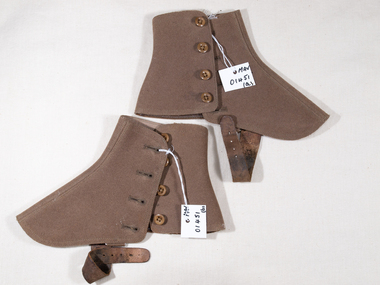
Footwear, Spats, wool, 20thC
... measure of ankle support. These spats are of a type commonly worn to protect good shoes early 20thC and may have been part of a soldiers uniform c 1914 footwear, spats, army uniform, clothing, knitting, craftwork, wool, world war 1 1914-18, world war 2 1939-1945, early settlers, city of moorabbin, bentleigh, mckinnon, ormond, moorabbin, post war settlers, hunt ailsa, MADE IN ENGLAND A pair of khaki wool spats with 4 buttons and leather strap, with metal buckle, to pass under instep. ...Spats, a shortening of spatter guards are a type of classic footwear accessory for outdoor wear, covering the instep and the ankle. Spats are distinct from gaiters, which are garments worn over the lower trouser leg as well as the shoe. Since the mid-19th century, soldiers of various nations, especially infantry, often wore leggings or spats to protect their lower leg, to keep dirt, sand, and mud from entering their shoes, and to provide a measure of ankle support.These spats are of a type commonly worn to protect good shoes early 20thC and may have been part of a soldiers uniform c 1914A pair of khaki wool spats with 4 buttons and leather strap, with metal buckle, to pass under instep.MADE IN ENGLANDfootwear, spats, army uniform, clothing, knitting, craftwork, wool, world war 1 1914-18, world war 2 1939-1945, early settlers, city of moorabbin, bentleigh, mckinnon, ormond, moorabbin, post war settlers, hunt ailsa, -
 Bendigo Historical Society Inc.
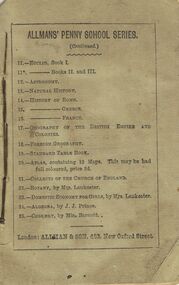
Book - ALLMANS' PENNY SCHOOL SERIES BOOKLET
... Allman's Penny School Series Booklet: A Pocket booklet of Arithmetic, Weights and measures including wine, Ale, Hay, Bread, Cloth and wool etc. Book 19 of 25 in the series. ...Allman's Penny School Series Booklet: A Pocket booklet of Arithmetic, Weights and measures including wine, Ale, Hay, Bread, Cloth and wool etc. Book 19 of 25 in the series. ...BHS CollectionAllman's Penny School Series Booklet: A Pocket booklet of Arithmetic, Weights and measures including wine, Ale, Hay, Bread, Cloth and wool etc. Book 19 of 25 in the series. Box 625London: Allman & Son, 463 New Oxford Street.books, school -
National Wool Museum
Book, Vegetable Matter in Australian Wool
... "Vegetable Matter in Australian Wool" - Australian Wool Testing Authority Ltd, 1986. Produced to help enable standardised measuring and descriptions of wool...."Vegetable Matter in Australian Wool" - Australian Wool Testing Authority Ltd, 1986. Produced to help enable standardised measuring and descriptions of wool. ..."Vegetable Matter in Australian Wool" - Australian Wool Testing Authority Ltd, 1986. Produced to help enable standardised measuring and descriptions of wool.woolclassing, australian wool testing authority ltd, wool clip contamination -
 National Wool Museum
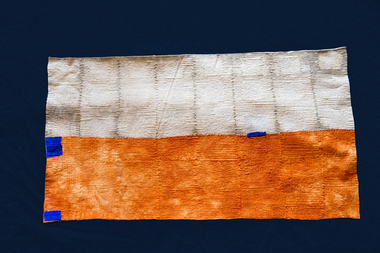
Quilt, Bow Wow Bowerbird
... Winner of Expressions 2004 Wool Quilt prize. The stitch as a measure of time is explored in this quilt. ...Winner of Expressions 2004 Wool Quilt prize. The stitch as a measure of time is explored in this quilt. ...Winner of Expressions 2004 Wool Quilt prize. The stitch as a measure of time is explored in this quilt. It is from a series i have been working on about my local environment. Shaped by time and the elements, Bow Wow Gorge us visited by more than 150 bird species.Quilt is a combination of silk, wool, baft, linen, and rayon thread. Two halves of the quilt have been hand sewn together and are a rusty red and grey in colour with small blue patches using plant dyes. Machine stitched, hand sewn, and applique, the quilt has long pockets and panels added to the back.Bow Wow Bowerbird 2004 Pamela Fitzsimonhandicrafts quilting textile, national wool museum, fitzsimons, ms pamela, geelong, victoria, handicrafts, quilting, textile -
National Wool Museum
Gauge, Knitting needle, Patons Beehive Gauge
... measuring the size of knitting needles. Knitting Handicrafts Patons and Baldwins Limited Knitting Handicrafts PATON'S / BEEHIVE GAUGE / USE PATONS KNITTING WOOLS Patons Beehive Gauge Gauge, Knitting needle ...Patons Beehive Gauge for measuring the size of knitting needles.PATON'S / BEEHIVE GAUGE / USE PATONS KNITTING WOOLSknitting handicrafts, patons and baldwins limited, knitting, handicrafts -
 Embroiderers Guild, Victoria
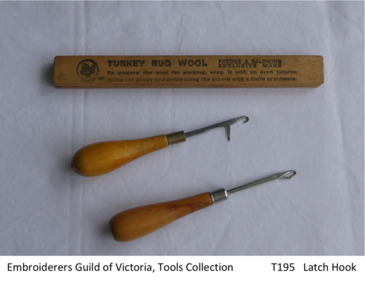
Tool - Turkey rug wool measurer, 1930's (?)
... Wooden measurer, rectangular shape with a groove which is used to guide the scissors or knife cutting the wool wound around it....Tool Turkey rug wool measurer Patons & Baldwins ...From ancient crafts making rugs, in 19th century Europe and USA latch hook rug making was a craft of poverty, initially using scraps of fabrics. In 1920's the latch hook, a tool combining the hand hook and the latch enabled people to make these rugs much more quickly. Patons and Baldwin's were two knitting yarn manufacturers who merged in 1920's and the Turkish rug name used the connotation of traditional and expensive Turkish hand made rugs to sell their tools and yarns to domestic craftersFrom the craft of poverty to one of artistic home decorating latch hook rug making came into its own particularly in 1950's. Wooden measurer, rectangular shape with a groove which is used to guide the scissors or knife cutting the wool wound around it.TURKEY RUG WOOL PATONS & BALDWINS EXCLUSIVE MAKE. To prepare the wool for working, wrap it with an even tension round the gauge and divide along the groove with a knife or scissorswool rug, patons & baldwin, latch hook -
 National Wool Museum
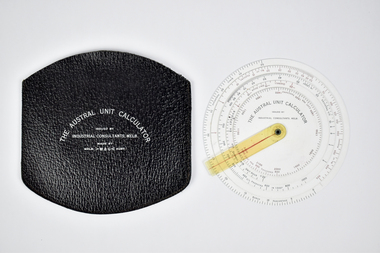
Tool - The Austral Unit Calculator, Industrial Consultants, c.1960
... wool and Australian Made” throughout his whole life. A strong thread that ties through the lifespan of Robert Blake and Kathryn Knitwear is a balance between adopting new innovations without sacrificing the core values of durability, comfort, care and style that had made the brand so well known. Their legacy forms an integral part of both Australian social and manufacturing history. Business Business history Manufacturing History Calculator Textile Fibres Textile History [label on obverse of case] THE AUSTRAL UNIT CALCULATOR ISSUED BY INDUSTRIAL CONSULTANTS, MELB MADE BY MELB >W&G< AUST. Measuring ...Kathryn Knitwear, founded by Robert Blake, manufactured high quality children’s knitwear in Melbourne from the 1940s – 1980s. Robert Blake began manufacturing children’s knitwear in his bedroom in Strathmore using a hand powered machine in the late 1940s. The operation moved to Ascot Vale and Essendon, before eventually establishing a factory in Moonee Ponds in the early 1950s. The business continued to expand, necessitating a move to a new factory in Broadmeadows. By 1962, the Broadmeadows factory was producing an average of 20,000 garments per month, which increased to 24,000 by 1964. Robert Blake’s Son, Brendan recalls that “The Kathryn brand was famous around Australia, anywhere children needed to keep warm and dress smartly. It also won a number of wool fashion awards”, including the 1969 Wool Awards, which was held by the Australian Wool Bureau and published in Women’s Weekly. The Kathryn range was designed for durability, comfort and care, without sacrificing style. They used patterning techniques that increase stretchiness, comfort and fit, as well as integrating decorative elements into the fabric to prevent them from being bulky, uncomfortable or tight. Making longevity of style a priority, Brendan Blake remembers that “there was one particular garment that was in the range for at least thirty years”. He also recalls “In the past, when women have found out that I was associated with Kathryn Knitwear, they would often relate to me the story of a garment they had purchased or received as a gift and, when their child had grown out of it, they would hand it on to another child. Several ladies have told me of purchasing garments for their daughters’ glory box, or saving a particular garment after their daughter had grown out of it. Brendan Blake: “At the peak of their operation they employed approximately two hundred people, mainly women and girls. A family would often seek to send their daughter to work in this company because they knew they would be looked after and safe. One lady wrote to me telling me that working at the Moonee Ponds Factory prior to getting married was the happiest time of her life.” In 1963, workers at the Kathryn factory earned £13 per week, which was 8 shillings and 8 pence higher than the minimum weekly wage for female workers in the textile manufacturing industry (£12 11s 4d). By 1970, the Kathryn Knitwear brand expanded from children’s knitwear into womenswear under the brand name ‘Lady Kathryn’, and for boys and men under ‘Robert Blake’. Continuing to diversify their distribution, they also began exporting ‘Kathryn’ garments to New Zealand, the Pacific Islands, and Japan. ‘Kathryn Knitwear’ was well-known for their early adoption of modern materials and techniques that had broad appeal to their customer base. This is shown in their early use of the acrylic fibre ‘Orlon’ in the 50s and 60s and ‘Superwash’ wool in the 1970s. Many of Kathryn Knitwear’s styles, particularly those that were long running staples of the brand, were available in both wool and Orlon to suit the consumer’s preference. Far from the humble origins of one man in his bedroom with a hand-cranked machine; at its closure in 1980, the Broadmeadows factory of ‘Kathryn’ housed more than 100 machines, including 53 sewing machines and 45 knitting machines. Robert Blake was “a passionate advocate for wool and Australian Made” throughout his whole life. A strong thread that ties through the lifespan of Robert Blake and Kathryn Knitwear is a balance between adopting new innovations without sacrificing the core values of durability, comfort, care and style that had made the brand so well known. Their legacy forms an integral part of both Australian social and manufacturing history.Measuring instrument with five circular white layers and one long transparent plastic ruler on top. Transparent layer is now yellowed, was likely originally clear. All of the layers connected with a metal rivet at the centre, allowing the discs and line indicator to move in relation to each other. Discs are labelled (inside – outside) Cost per Thousand Overall Unit Hour U/S [units] produced in 1000s No. of persons Bonus Percentage 9017.2 Black leather case with white block letter printing [9017.3 - 9017.5] Inside case are three notes (one printed, two handwritten) that provide instructions for using the calculator[label on obverse of case] THE AUSTRAL UNIT CALCULATOR ISSUED BY INDUSTRIAL CONSULTANTS, MELB MADE BY MELB >W&G< AUST.business, business history, manufacturing history, calculator, textile fibres textile history -
 National Wool Museum
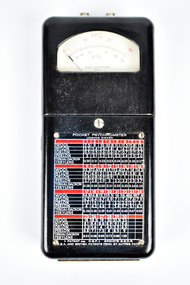
Instrument - Psychrometer, Electronova S.A, c.1965
... wool and Australian Made” throughout his whole life. A strong thread that ties through the lifespan of Robert Blake and Kathryn Knitwear is a balance between adopting new innovations without sacrificing the core values of durability, comfort, care and style that had made the brand so well known. Their legacy forms an integral part of both Australian social and manufacturing history. psychrometer measuring ...Kathryn Knitwear Collection A Psychrometer is an instrument used to measure humidity using two thermometers, one of which is wet and one is dry. A similar example is housed at laboratoire d'histoire des sciences et des techniques (LHST). Inventory number 603.0509 Kathryn Knitwear, founded by Robert Blake, manufactured high quality children’s knitwear in Melbourne from the 1940s – 1980s. Robert Blake began manufacturing children’s knitwear in his bedroom in Strathmore using a hand powered machine in the late 1940s. The operation moved to Ascot Vale and Essendon, before eventually establishing a factory in Moonee Ponds in the early 1950s. The business continued to expand, necessitating a move to a new factory in Broadmeadows. By 1962, the Broadmeadows factory was producing an average of 20,000 garments per month, which increased to 24,000 by 1964. Robert Blake’s Son, Brendan recalls that “The Kathryn brand was famous around Australia, anywhere children needed to keep warm and dress smartly. It also won a number of wool fashion awards”, including the 1969 Wool Awards, which was held by the Australian Wool Bureau and published in Women’s Weekly. The Kathryn range was designed for durability, comfort and care, without sacrificing style. They used patterning techniques that increase stretchiness, comfort and fit, as well as integrating decorative elements into the fabric to prevent them from being bulky, uncomfortable or tight. Making longevity of style a priority, Brendan Blake remembers that “there was one particular garment that was in the range for at least thirty years”. He also recalls “In the past, when women have found out that I was associated with Kathryn Knitwear, they would often relate to me the story of a garment they had purchased or received as a gift and, when their child had grown out of it, they would hand it on to another child. Several ladies have told me of purchasing garments for their daughters’ glory box, or saving a particular garment after their daughter had grown out of it. Brendan Blake: “At the peak of their operation they employed approximately two hundred people, mainly women and girls. A family would often seek to send their daughter to work in this company because they knew they would be looked after and safe. One lady wrote to me telling me that working at the Moonee Ponds Factory prior to getting married was the happiest time of her life.” In 1963, workers at the Kathryn factory earned £13 per week, which was 8 shillings and 8 pence higher than the minimum weekly wage for female workers in the textile manufacturing industry (£12 11s 4d). By 1970, the Kathryn Knitwear brand expanded from children’s knitwear into womenswear under the brand name ‘Lady Kathryn’, and for boys and men under ‘Robert Blake’. Continuing to diversify their distribution, they also began exporting ‘Kathryn’ garments to New Zealand, the Pacific Islands, and Japan. ‘Kathryn Knitwear’ was well-known for their early adoption of modern materials and techniques that had broad appeal to their customer base. This is shown in their early use of the acrylic fibre ‘Orlon’ in the 50s and 60s and ‘Superwash’ wool in the 1970s. Many of Kathryn Knitwear’s styles, particularly those that were long running staples of the brand, were available in both wool and Orlon to suit the consumer’s preference. Far from the humble origins of one man in his bedroom with a hand-cranked machine; at its closure in 1980, the Broadmeadows factory of ‘Kathryn’ housed more than 100 machines, including 53 sewing machines and 45 knitting machines. Robert Blake was “a passionate advocate for wool and Australian Made” throughout his whole life. A strong thread that ties through the lifespan of Robert Blake and Kathryn Knitwear is a balance between adopting new innovations without sacrificing the core values of durability, comfort, care and style that had made the brand so well known. Their legacy forms an integral part of both Australian social and manufacturing history.Black metal measuring instrument with clear window to view gauge for displaying humidity. Reference table listing values for different fibres is printed in red and white on a black metal plate that is screwed onto the front of the psychrometer. The instrument is housed in brown leather case with zip. It includes a printed paper instruction book with black text and greyscale figures.psychrometer, measuring instrument, humidity, textile manufacturing, fashion textile production -
 National Wool Museum
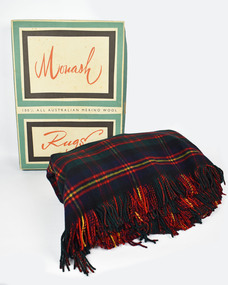
Textile - Rug, Returned Soldiers and Sailors Mill, 1963
... WOOL/ AUSTRALIA/ The John Monash Rug (cursive)/ The Clan Cameron (cursive) Top and bottom of rug has frilled edges. Pattern is titled the 'Clan Cameron' and is repeated in a 7x7 grid. Front of rug has a red background with 4 vertical and horizontal lines. All is surrounded by a yellow boarder. Label is stitched into the bottom right corner. Reverse of rug also has a repeating 7x7 grid. Blue background with thick green horizontal stripe. Yellow and red boarder to the grid with 4 red vertical and horizontal lines making up the interior. Rug measure ...The Returned Soldiers and Sailors Mills was located near the Barwon river on Pakington Street, Geelong, where its building still stands. The mill was established in October 1922 with capital acquired from War Gratuity Bonds. The mill produced fine grade woollen products with its speciality being ‘Retsol’ travelling rugs. The mill first began to run into financial troubles with the ‘Credit Squeeze’ or the ‘Holt Jolt’ of the early 1960s. This saw import restrictions lifted which triggered the start of a minor recession and a rise in unemployment. Included in these troubles was the RS&S Mill which saw the number of employees gradually decrease and business declining with cheaper imports beginning to grab an expanding part of the market share. The mill was eventually purchased by Godfrey Hirst in 1973 who tried to continue operations without success and in June 1975 textile production at the site ceased. Outside of financial considerations contributing to the closure of Woollen Mills in this period was the declining need for heavier fabrics as in-home heating and insulation improved. This need had been replaced for a demand for ever softer, finer and lighter worsted fabrics for more casual clothing. Modern day textile production requires fewer steps in the processing of materials for this use. This meant large factory complexes such as early woollen mills like the RS&S mills were no longer required. Compared to modern textile production which can spin a fine yarn out of synthetic fibre or imported cotton easily, spinning fine yarn from medium quality wool at a textile factory was cumbersome and no longer financially viable to suit new consumer demands. This rug provides context to this statement. It was gifted to Shirley and Gordon Green as a wedding present in November 1963 by one of Gordon's colleagues in the wool industry. Living in areas such as Neutral Bay, the Hornsby area and later in life retiring to the Central Coast, the blanket was too heavy for use in these weather conditions and hence it stayed in its original box for nearly 60 years. Top and bottom of rug has frilled edges. Pattern is titled the 'Clan Cameron' and is repeated in a 7x7 grid. Front of rug has a red background with 4 vertical and horizontal lines. All is surrounded by a yellow boarder. Label is stitched into the bottom right corner. Reverse of rug also has a repeating 7x7 grid. Blue background with thick green horizontal stripe. Yellow and red boarder to the grid with 4 red vertical and horizontal lines making up the interior. Rug measure 1550 x 2040mm, approximately the same size as a queen size mattress.Wording, Bottom right corner. THE GEELONG R.S&S. WOOLEN MILLS/ PURE/ WOOL/ AUSTRALIA/ The John Monash Rug (cursive)/ The Clan Cameron (cursive)rs&s mills, textile manufacture, rug, clan cameron, sydney greasy wool exchange -
 National Wool Museum
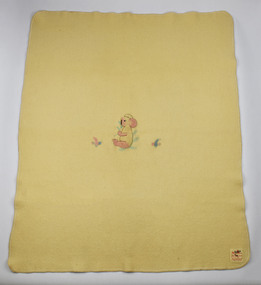
Textile - Blanket, Eagley Mill, 1955-59
... Part of Foy & Gibson, the mill had frontages measuring almost two miles within the area bounded by Little Oxford, Wellington, Stanley and Peel Streets in Collingwood. This was the largest manufacturing plant for wool in the Southern Hemisphere at the time. ...Part of Foy & Gibson, the mill had frontages measuring almost two miles within the area bounded by Little Oxford, Wellington, Stanley and Peel Streets in Collingwood. This was the largest manufacturing plant for wool in the Southern Hemisphere at the time. ...This blanket was owned by the Rosenberg family from the late 1950s onwards. It was the donor Denise’s blanket. Born May 1958, her late mother Elfie kept it safe for many decades after Denise had outgrown it. Elfie returned the blanket to Denise 20 years ago, in its current near new condition. Jacques Rosenberg and Elfie née Naparstek, Denise’s parents, met in Melbourne in the Summer of 1950. They both survived being young and Jewish in Europe during the Second World War. Jacques grew up in France and Elfie in Germany, she was a child of the Kindertransport. They married in 1952 and by 1958 had a son and two daughters. Denise, the youngest daughter, donated the blanket on behalf of the Rosenberg family to the National Wool Museum in 2021. The Kindertransport was a program designed to facilitate the immigration of Jewish children from Nazi Germany before the outbreak of the Second World War. The United Kingdom took in nearly 10,000 predominantly Jewish children from Germany, Austria, Czechoslovakia and Poland. The children were placed in British foster homes, hostels, schools and farms. Tragically, these children were often the only members of their families to survive the tragedies that were to unfold in Europe. Fortunately, Elfie’s parents did survive World War Two by sneaking out of Germany and into the south of France. After Elfie and her sister Serry were Kindertransported, they met up with Salma and Risla Naparstek in Paris in 1947 before migrating to Australia. This blanket originates from the Eagley Mill. They manufactured woollen, worsted and knitwear products from their mill located in Collingwood. Part of Foy & Gibson, the mill had frontages measuring almost two miles within the area bounded by Little Oxford, Wellington, Stanley and Peel Streets in Collingwood. This was the largest manufacturing plant for wool in the Southern Hemisphere at the time. It was also one of the oldest. The first machines for knitting men’s socks were installed in 1896. The site ultimately went into receivership while under new ownership in 1968 and is now high-end real estate. More information about the Mill can be read via Unimelb digitised collection. https://digitised-collections.unimelb.edu.au/bitstream/handle/11343/21262/269411_UDS2010852-85.pdf?sequence=18&isAllowed=y 38”x45” (965 x 1145mm) cream wool blanket. The blanket has white stitching around its edge. Embroidered in the centre of the blanket is a koala eating leaves with accompanying flowers on either side of the marsupial. In the bottom right corner of the blanket a small square label from the Eagley Mills is stitched. This label includes the images of a Sphinx head, a pyramid and a baby’s crib.Eagley / ALL / WOOL / 38”x45” / AWARDED THE CERTIFICATE OF / THE ROYAL INSTITUTE OF / PUBLIC HEALTH & HYGIENE LONDONkindertransport, eagley mill, blanket -
 National Wool Museum
Functional object - Magnifying Lens, c.1930s
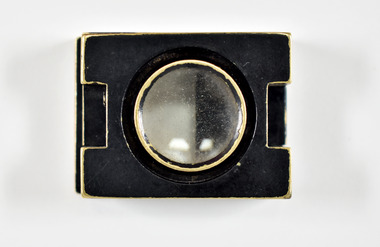
... The wool-buyers needed the sensitivity of their fingers to appraise the suitability of the wool, as buyers had for centuries past, measuring the length of the staple, feeling and counting the crimps in the fibre, its finesse, softness, elasticity and strength, assessing the colour, watching for extraneous matter such as dust or seeds which would not be welcome by manufacturers half-way across the world. ...The wool-buyers needed the sensitivity of their fingers to appraise the suitability of the wool, as buyers had for centuries past, measuring the length of the staple, feeling and counting the crimps in the fibre, its finesse, softness, elasticity and strength, assessing the colour, watching for extraneous matter such as dust or seeds which would not be welcome by manufacturers half-way across the world. ...This item was inherited from the donor's father, René Dupuche. John Dupuche, writes: This magnifying glass was used to remove the burrs and thorns that wool-buyers tended to get in their fingers when examining bales of wool. The open end was placed on the finger since the thorn was sometimes buried under the skin. The buyer looked through the magnifying glass and with tweezers or a pin removed the thorn which had rendered the finger inoperative. The wool-buyers needed the sensitivity of their fingers to appraise the suitability of the wool, as buyers had for centuries past, measuring the length of the staple, feeling and counting the crimps in the fibre, its finesse, softness, elasticity and strength, assessing the colour, watching for extraneous matter such as dust or seeds which would not be welcome by manufacturers half-way across the world. Their skills took years to acquire. Knowledgeable buyers were invaluable to their employers, since they were able to evaluate to the last percentage the yield of a bale. My father, René Dupuche, was the ‘principal buyer’ from 1927-1966 in Victoria, South Australia and Tasmania for the international wool company ‘Masurel Fils’ which was one of the largest wool businesses in Europe. It was based in the north of France, in Tourcoing, one of the major wool centres of the world. He was sent to Australia as a young man at the age of 23 and took part in the ‘golden era’ of wool in Australia, and the eventual replacement of hands-on appraisal by ‘core-testing’. Masurel Fils was one of the dozens of French and Belgian firms operating in Australia. These men from Flanders enjoyed a cosmopolitan society augmented by diplomats, European bankers and shipping-line executives for various countries and a handful of scientists and academics.Small black metal magnifying lens with three fold design and two hinges. One panel contains a circular glass lens, the centre panel has a circular hole, and the third panel has a square hole with three lines on each side.wool buyer, magnifying glass, magnifying lens, burrs, rené dupuche, john dupuche, migrants, masurel fils, french, belgian, flanders, working life, sheep industry, wool industry, agriculture -
 National Wool Museum
Instrument - PH Meter For Use in Woollen Mill, c.1940
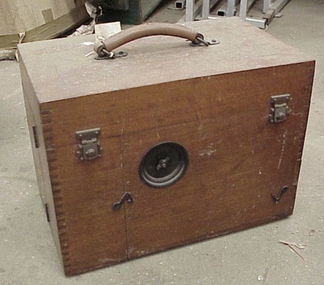
... Without this instrument to measure the pH level of dyes before use, it would be impossible to ensure successful and repeatable results when dyeing wool....Without this instrument to measure the pH level of dyes before use, it would be impossible to ensure successful and repeatable results when dyeing wool. textile testing dyeing woollen mill ph scientific instument pH meter contained within dark wooden box, opened with two brass clasps. ...A complex instrument used to determine the pH factor of liquid samples, in this case, dyes. Without this instrument to measure the pH level of dyes before use, it would be impossible to ensure successful and repeatable results when dyeing wool.pH meter contained within dark wooden box, opened with two brass clasps. Contains dials, an electrode, glass bottle of potassium chloride and instructions for use on card inside lid.textile testing, dyeing, woollen mill, ph, scientific instument -
 National Wool Museum
Sample Book, "Selected Suitings of Crusader Cloth" sample book
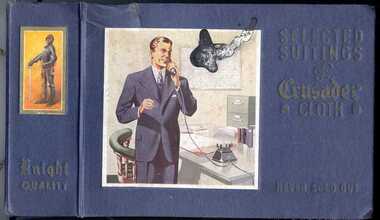
... measure suits. With little money to spare during the austere years of the war, women often acquired these books from tailors when the fabrics were no longer available. They made use of the fabric sample pieces to make quilts. The Australian Woollen Mills was an example of a woollen mill which went into worsted production making good quality English-type suiting. They were very successful until the 1960's when the oversupply of worsted fabrics from Europe and Asia led to the decline of the industry in this country. This book was displayed in the Running Stitch exhibition "Wool...measure suits. With little money to spare during the austere years of the war, women often acquired these books from tailors when the fabrics were no longer available. They made use of the fabric sample pieces to make quilts. The Australian Woollen Mills was an example of a woollen mill which went into worsted production making good quality English-type suiting. They were very successful until the 1960's when the oversupply of worsted fabrics from Europe and Asia led to the decline of the industry in this country. This book was displayed in the Running Stitch exhibition "Wool ...This book dates from the 1940s and was part of the Running Stitch collection of quilts, probably because it was common for women to acquire these books from travelling salesmen. This sample book is an example of the type made by textile mills and given to tailors to sell fabric for made to measure suits. With little money to spare during the austere years of the war, women often acquired these books from tailors when the fabrics were no longer available. They made use of the fabric sample pieces to make quilts. The Australian Woollen Mills was an example of a woollen mill which went into worsted production making good quality English-type suiting. They were very successful until the 1960's when the oversupply of worsted fabrics from Europe and Asia led to the decline of the industry in this country. This book was displayed in the Running Stitch exhibition "Wool Quilts Old and New" of 1985 where it was catalogue entry number 40.Australian Woollen Mills Crusader fabric sample book, c.1940sKnight / QUALITY SELECTED / SUITINGS / of / Crusader / CLOTH / NEVER SOLD OUT Crusader / CLOTH / Makes the best suits "Crusader" / WORSTEDaustralian woollen mills pty ltd running stitch group, cloth - worsted, running stitch collection -
 Beechworth RSL Sub-Branch
Jacket Service Dress, 1999
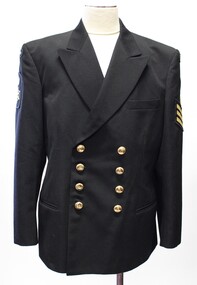
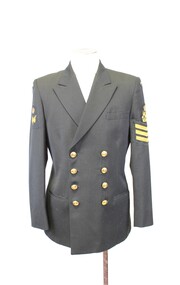
... Manufacturers label measuring 4omm x 80mm showing company logo ADI / 1999 / arrow pointed up /NSN: 8405-66-132-2309 / Wool polyester / size 111S / matching / trouser size 101S / chest 112 / waist 102 / inside leg 78 / No / Name / Dry Clean Only / Made in Australia ...Manufacturers label measuring 4omm x 80mm showing company logo ADI / 1999 / arrow pointed up /NSN: 8405-66-132-2309 / Wool polyester / size 111S / matching / trouser size 101S / chest 112 / waist 102 / inside leg 78 / No / Name / Dry Clean Only / Made in Australia Jacket Double Breasted Service Dress Navy Blue with gold embroided insignia, [Naval Police Coxswain Petty Officer] on right upper arm; gold embroided rank insignia [Petty Officer] above three gold embroided chevrons indicating 12 years service on the left upper arm; shoulder flashes with gold embroided word, "Australia" on both shoulders. 8 gold button with embossed Australian Navy Emblem and the word "Australia" in parallel columns of 4. ...The jacket is indicative of the dress jacket worn by a sailor of the rate of Naval Police Petty Office who has completed 12 years service.Jacket Double Breasted Service Dress Navy Blue with gold embroided insignia, [Naval Police Coxswain Petty Officer] on right upper arm; gold embroided rank insignia [Petty Officer] above three gold embroided chevrons indicating 12 years service on the left upper arm; shoulder flashes with gold embroided word, "Australia" on both shoulders. 8 gold button with embossed Australian Navy Emblem and the word "Australia" in parallel columns of 4. Size 111S (short fit) with 2 small gold button with embossed Australian Navy Emblem and the word "Australia" the cuff of each arm.Manufacturer's identification label on inside right breast.Manufacturers label measuring 4omm x 80mm showing company logo ADI / 1999 / arrow pointed up /NSN: 8405-66-132-2309 / Wool polyester / size 111S / matching / trouser size 101S / chest 112 / waist 102 / inside leg 78 / No / Name / Dry Clean Only / Made in Australia -
 Beechworth RSL Sub-Branch
Jacket, Service Dress, Australian Defence Industries, 1990
... Manufacturers label measuring 4mm x 8mm showing company logo ADA / 1990 / arrow pointed up /NSN:8405-66-132-2314 / 70% 30% Wool Poly / size 99R / match / trouser size 89R / No / Name / Dry Clean Only / Made in Australia/ owner's name written in black by a laundry marking pen...Jacket worn by Brendan Honey when performing the duties of a Petty Officer Radio Supervisor in the Royal Australian Navy from Oct 1979 to Oct 2000 jacket navy jacket service dress jacket petty office radio supervisor Manufacturers label measuring 4mm x 8mm showing company logo ADA / 1990 / arrow pointed up /NSN:8405-66-132-2314 / 70% 30% Wool Poly / size 99R / match / trouser size 89R / No / Name / Dry Clean Only / Made in Australia/ owner's name written in black by a laundry marking pen Jacket Double Breasted Service Dress Navy Blue with gold embroided insignia, [Radio Operator Petty Officer] on right upper arm; gold embroided rank insignia [Petty Officer] above three gold embroided chevrons indicating 12 years service on the left upper arm; shoulder flashes with gold embroided word, "Australia" on both shoulders. 8 gold button with embossed Australian Navy Emblem and the word "Australia" in parallel columns of 4. ...Jacket worn by Brendan Honey when performing the duties of a Petty Officer Radio Supervisor in the Royal Australian Navy from Oct 1979 to Oct 2000Jacket Double Breasted Service Dress Navy Blue with gold embroided insignia, [Radio Operator Petty Officer] on right upper arm; gold embroided rank insignia [Petty Officer] above three gold embroided chevrons indicating 12 years service on the left upper arm; shoulder flashes with gold embroided word, "Australia" on both shoulders. 8 gold button with embossed Australian Navy Emblem and the word "Australia" in parallel columns of 4. Size 99R (Regular fit) with 2 small gold button with embossed Australian Navy Emblem and the word "Australia" the cuff of each arm.Manufacturer's identification label on inside right breast.Manufacturers label measuring 4mm x 8mm showing company logo ADA / 1990 / arrow pointed up /NSN:8405-66-132-2314 / 70% 30% Wool Poly / size 99R / match / trouser size 89R / No / Name / Dry Clean Only / Made in Australia/ owner's name written in black by a laundry marking penjacket, navy, jacket service dress, jacket petty office radio supervisor -
 Mont De Lancey
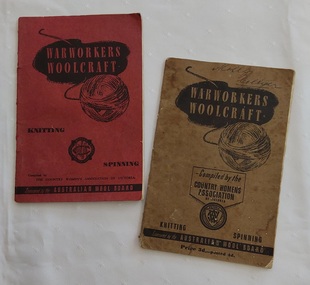
Booklet - Knitting Patterns, The Country Womens Associaotion of Victoria, War Workers' Woolcraft, c.1940's
... wool to support the Empire Forces. The Foreward promotes the CWA in a similar vein. The book has knitting hints, patterns useful for war service members in the navy, army and air force patterns for clothing - caps, sleeveless pullover, waistcoat muffler, armlets, man's socks and mittens, kneecaps, hot water bottle covers and scarves. Inside the back cover is advice on checking your tape measure...wool to support the Empire Forces. The Foreward promotes the CWA in a similar vein. The book has knitting hints, patterns useful for war service members in the navy, army and air force patterns for clothing - caps, sleeveless pullover, waistcoat muffler, armlets, man's socks and mittens, kneecaps, hot water bottle covers and scarves. Inside the back cover is advice on checking your tape measure ...The red covered book is compiled by The Country Women's Association of Victoria and sponsored by the Australian Wool Board. On the back of the front cover is an Introduction by the Chairman of the Australian Wool Board, Sir Dalziel Kelly, K.B., L.L.B. explaining the reason for these books encouraging the use of Australian wool to support the Empire Forces. The Foreward promotes the CWA in a similar vein. The book has knitting hints, patterns useful for war service members in the navy, army and air force patterns for clothing.The khaki covered book is similar, but is compiled by the Country Women's Association of Victoria. It is a Third Edition.Two small copies of War Workers' Woolcraft - Knitting and Spinning books: one with a red paper cover and the other with a faded khaki coloured paper cover. 1. The red front cover book shows the title printed inside a black cloud shape with a black lined illustration of a ball of wool underneath. The Country Women's Assoc. South Aust. is printed on the cover inside a round shaped black crest. It is compiled by The Country Women's Association of Victoria and sponsored by the Australian Wool Board. Inside on the back of the front cover is an Introduction by the Chairman of the Australian Wool Board, Sir Dalziel Kelly, K.B., L.L.B. explaining the reason for these books encouraging the use of Australian wool to support the Empire Forces. The Foreward promotes the CWA in a similar vein. The book has knitting hints, patterns useful for war service members in the navy, army and air force patterns for clothing - caps, sleeveless pullover, waistcoat muffler, armlets, man's socks and mittens, kneecaps, hot water bottle covers and scarves. Inside the back cover is advice on checking your tape measure against the 6 Inch one printed on the page. 2. The khaki covered book is similar, but is compiled by the Country Women's Association of Victoria with Price 3d.- posted 4d. at the bottom of the cover. It is a Third Edition. Both have advertising on the last few pages.non-fictionThe red covered book is compiled by The Country Women's Association of Victoria and sponsored by the Australian Wool Board. On the back of the front cover is an Introduction by the Chairman of the Australian Wool Board, Sir Dalziel Kelly, K.B., L.L.B. explaining the reason for these books encouraging the use of Australian wool to support the Empire Forces. The Foreward promotes the CWA in a similar vein. The book has knitting hints, patterns useful for war service members in the navy, army and air force patterns for clothing.The khaki covered book is similar, but is compiled by the Country Women's Association of Victoria. It is a Third Edition. knitting, knitting patterns, knitting equipment
