
Showing 984 items matching "work box"
-
 Embroiderers Guild, Victoria
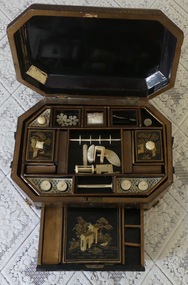
Container - Chinese Lacquer Work and writing box with ivory contents and fittings, Chinese Lacquer Work Box
... Chinese Lacquer Work and writing box with ivory contents and fittings...Chinese Lacquer Work Box...Typical of work boxes made in China for sale to visiting Europeans 1840's...Black lacquerware work box, hexagonal, with bone or ivory fittints. ...Typical of work boxes made in China for sale to visiting Europeans 1840's Chinese lacquerware Workbox Ivory needlework accessories Exterior: Black lacquer with gold and pale green inlay Black lacquerware work box, hexagonal, with bone or ivory fittints. ...Typical of work boxes made in China for sale to visiting Europeans 1840'sBlack lacquerware work box, hexagonal, with bone or ivory fittints. Black all-over lacquered surfaces decorated with Chinese pavilion scenes and motifs with butterflies. Two inner compartments, upper one fitted with bone/ivory lids to compartments for needlework. Lower compartment is a drawer with missing contents. Two metal carrying handles, two metal key holes (no keys). Front feet gilded wood, back feet wooden blocks. Interior has one removable fitted tray with eleven compartments. Two compartment lids match gold and green lacquerware of exterior. Two have removvable inserts. Third compartment has removable pincushion insert. Four narrow compartments fitted with wooden blocks to contain tools. Lower drawer has folding writing slope decorated and five compartments for writing toolsExterior: Black lacquer with gold and pale green inlaychinese lacquerware, workbox, ivory needlework accessories -
 Bright & District Historical Society operating the Bright Museum
Box Work
... Box Work...'Work Box' on lid Inside lid - J. Wraith, Bright...Has a broken lock, no key Box Work ...Used by Miss J. Wraith, BrightWooden box lined with green and white paper depicting a horse drawn sleigh. Top of lid decorated in a red floral design. Lid has a picture of children riding an elephant. Has a broken lock, no key'Work Box' on lid Inside lid - J. Wraith, Brightcraft, box, container, handcraft -
 Whitehorse Historical Society Inc.
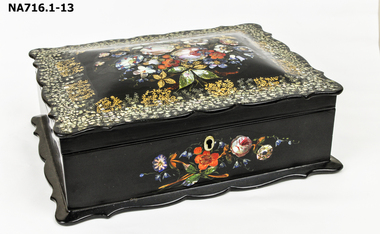
Functional object - Sewing Work Box
... Sewing Work Box...Black paper mache sewing work box. Lid inlaid with abalone. General design has been highlighted in gold paint. ...Functional object Sewing Work Box ...Owned by Jean Young - born Falkirk, Scotland, 1811. Believed to be listed in Falkirk Census in 1851. Married William Hill. Possibly sailed in 'Tempest'. Died at Dunolly, Victoria.Black paper mache sewing work box. Lid inlaid with abalone. General design has been highlighted in gold paint. The box is lined with pale lilac and white satin, lid unlined. Top panel and bottom edge decoratively shaped - slightly domed lid and front panel decorated in a similar manner to lid. Box contains needles, threads, buttons, thimbles and a pin cushion as follows:- Peri-Lusta .03 Crystal Rayon Spun Mending Thread .04 Flora McDonald Needle Packet .0 |Packet of Needles W.Woodfield & Sons .06 Mauve satin needle case .07 Tortice tatting schuttle .08 Round wooden box with 5 pearl buttons and 2 cloth covered buttons .09 Square wooden needle case with red velvet lining and leather strip and brass clip .10 Round lace pin-cushion with very fine ecru crochet dark green lining .11 Unknown handle of black composition with bone end and four inlaid lines with dot at end ,12 Ivory stiletto with screw top. Total of 13 parts to the object.domestic items, sewing, handcrafts, equipment -
 Embroiderers Guild, Victoria
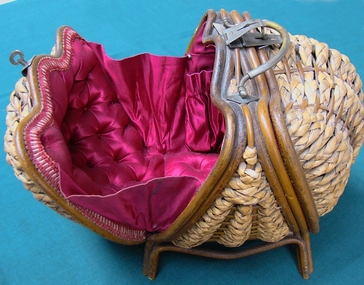
Container - Brown Wicker Work Basket, Early 1900
... Work box...Brown wicker work box with woven wicker braid threaded through sides and lid. ...The basket was given to the donor's mother in New Zealand at the turn of the century (1900) Work box 1900-20 Brown wicker work box with woven wicker braid threaded through sides and lid. ...The basket was given to the donor's mother in New Zealand at the turn of the century (1900)Brown wicker work box with woven wicker braid threaded through sides and lid. Ply wood bottom. Lined with red silk satin, buttoned inside lid.work box, 1900-20 -
 Embroiderers Guild, Victoria
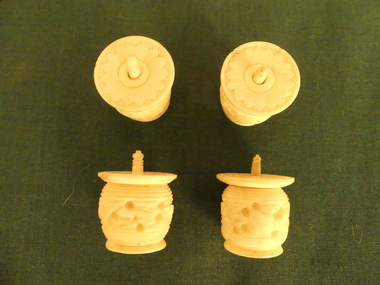
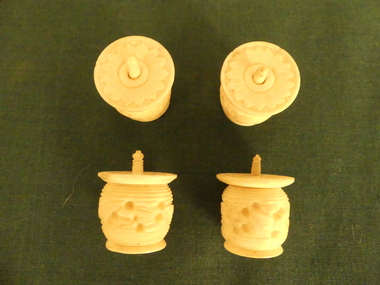
Tool - Bone or Ivory Thread barrel, Thread barrel, 1840's
... Work box contents Thread barrel...Thread barrels ideally kept thread wound, clean and untangled in work box in an era when cotton and threads were sold in skeins or by weight....Decorative Chinese work boxes offered the opportunity to demonstrate one's wealth. ...Thread barrels ideally kept thread wound, clean and untangled in work box in an era when cotton and threads were sold in skeins or by weight.Decorative Chinese work boxes offered the opportunity to demonstrate one's wealth. Not all the contents were quite functional for the European marketBone barrel thread winder with cap and spindle Bone or ivory carved work box contents thread barrel, chinese ivory -
 Embroiderers Guild, Victoria
Tool - Bone or Ivory Thread barrel, Thread barrel, 1840's
... Work box contents Thread barrel...Thread barrels ideally kept thread wound, clean and untangled in work box in an era when cotton and threads were sold in skeins or by weight....Decorative Chinese work boxes offered the opportunity to demonstrate one's wealth. ...Thread barrels ideally kept thread wound, clean and untangled in work box in an era when cotton and threads were sold in skeins or by weight.Decorative Chinese work boxes offered the opportunity to demonstrate one's wealth. Not all the contents were quite functional for the European marketBone barrel thread winder with cap and spindle Bone or ivory carved work box contents thread barrel, chinese ivory -
Bright & District Historical Society operating the Bright Museum
Box Work - Daisy Needle
... Box Work - Daisy Needle...Box Work - Daisy Needle ... -
 Glenelg Shire Council Cultural Collection
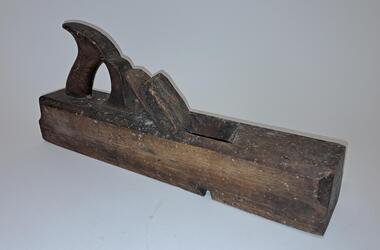
Tool - Joiner or Jack Plane, c.mid to late 1900
... work...Construction...Box...Capenter Wood work Construction Box plane Cabinet Maker Stamp mark on metal plane blade: MITCHLL A........ ...A timber plane , or jack plane (or fore plane) is a carpenters or cabinet makers tool that is used for dressing timber down to the correct size in preparation for truing and/or edge jointing.A significant tool from the mid to late 19th century that is still in use today. It gives context of how furniture and other finishes were created on timber by the use of cutting edged hand tools. Tools that were themselves handmade shows the craftsmanship of the era but also highlights craftsmanship needed to produce a even finish.Carpenters Plane also referred to a Joiner or Jack Plane. Long rectangular shaped timber block with carved timber grip handle, timber block support and blade. Square shaped opening Infront of block and blade, tapers to a small slot to the bottom to allow for the timber shaving to fall through. Stamp mark on metal plane blade: MITCHLL A........(Unable to distinguish further writing) Stamp is in a horse shoe shape with the Mitchll curving around the stop and the word starting with 'A' along the bottom.capenter, wood work, construction, box plane, cabinet maker -
Glenelg Shire Council Cultural Collection
Tool - Joiner or Jack Plane
... work...Construction...Box...Capenter Wood work Construction Box plane Cabinet Maker The initials KB are written on the side of the item Carpenters Plane also referred to a Joiner or Jack Plane. ...A timber plane , or jack plane (or fore plane) is a carpenters or cabinet makers tool that is used for dressing timber down to the correct size in preparation for truing and/or edge jointing.A significant tool from the mid to late 19th century that is still in use today. It gives context of how furniture and other finishes were created on timber by the use of cutting edged hand tools. Tools that were themselves handmade shows the craftsmanship of the era but also highlights craftsmanship needed to produce a even finish.Carpenters Plane also referred to a Joiner or Jack Plane. Long rectangular shaped timber block with carved timber grip handle, timber block support and blade. Square shaped opening Infront of block and blade, tapers to a small slot to the bottom to allow for the timber shaving to fall through. The initials KB are written on the side of the itemcapenter, wood work, construction, box plane, cabinet maker -
Tatura Irrigation & Wartime Camps Museum
Cash Box
... work...cash box...Found in Jim Stewart's shed, Tatura. high school wood work cash box wooden cash box jim stewart boy scouts cubs CUBS Varnished wooden box, silver handle on lid. broken lock. ...Made at Shepparton High School in 1965. Found in Jim Stewart's shed, Tatura.Varnished wooden box, silver handle on lid. broken lock. Holes from original handle. Silver handle added. Lock but no key.CUBShigh school wood work, cash box, wooden cash box, jim stewart, boy scouts, cubs -
 Embroiderers Guild, Victoria
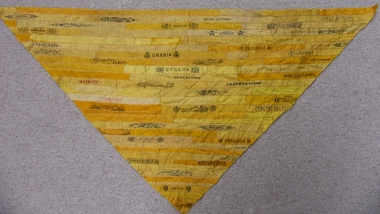
Textile - Cigar Band Ribbon Fragment, Edith Maud Strachan, 1900?
... Found by Donor in her grandmother's work box. Thought to be made by Edith Maud Strachan, donor's grandmother....Found by Donor in her grandmother's work box. Thought to be made by Edith Maud Strachan, donor's grandmother. ...Found by Donor in her grandmother's work box. Thought to be made by Edith Maud Strachan, donor's grandmother.Triangle of yellow silk ribbon cigar bands joined together with rows of feather stitching, backed with fine yellow cotton.patchwork, fragment, late 19th century, australia -
 Colac RSL Sub Branch
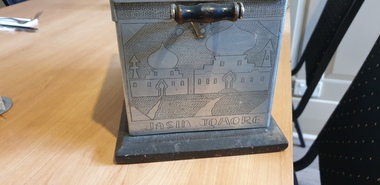
Souvenir - Jewlery Box made by ??? in Changi P.O.W camp, Hand made and engraved, 1942
... HAND MADE ALUMINIUM WORK BOX MADE BY AUSTRALIAN POW IN CHANGI 1942 A SOUVENIR TO "MOLLY" MAYBE WIFE OR GIRLFRIEND...HAND MADE ALUMINIUM WORK BOX MADE BY AUSTRALIAN POW IN CHANGI 1942 A SOUVENIR TO "MOLLY" MAYBE WIFE OR GIRLFRIEND A UNIQUE PIECE OF HAND MADE AUSTRALIAN POW ART WORK FROM CHANGI SINGAPORE 1942 Top: Changi POW Feb 15th 1942. ...HAND MADE ALUMINIUM WORK BOX MADE BY AUSTRALIAN POW IN CHANGI 1942 A SOUVENIR TO "MOLLY" MAYBE WIFE OR GIRLFRIENDA UNIQUE PIECE OF HAND MADE AUSTRALIAN POW ART WORK FROM CHANGI SINGAPORE 1942Hand crafted aluminum presentation box with wooden base. Hinged lid. Small handle on either sideTop: Changi POW Feb 15th 1942. Front: Military Insignia. Malaya. Singapore. Left side: Elephant. Right side. Buildings, Jasin Johore. Back: Workbox Souvenir With Love To Molly -
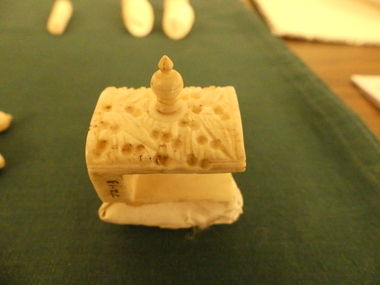 Embroiderers Guild, Victoria
Tool - Carved chinese ivorty or bone clamp wiwth pincushion top, Small ivory sewing clamp with pincushion top, 1840's
... Chinese carved ivory clamps with pincushion tops were common accessories for work boxes. Such as these they were made in the East for sale to European markets where they were a way of showing one's financial status. ...Chinese carved ivory clamps with pincushion tops were common accessories for work boxes. Such as these they were made in the East for sale to European markets where they were a way of showing one's financial status. ...Pins were expensive and so the use of pincushions to keep them safe, to protect them and other items was practical and popular. Chinese carved ivory clamps with pincushion tops were common accessories for work boxes. Such as these they were made in the East for sale to European markets where they were a way of showing one's financial status. Pins were precious sewing tools which needed to be kept safe and sharp, pincushions were an essential sewing tool for keeping pins. Carved bone or ivory clamp with screw through base for attachment.. Topped with pincushion covered with (replacement) embroidered silkclamp, pincushion, ivory carving -
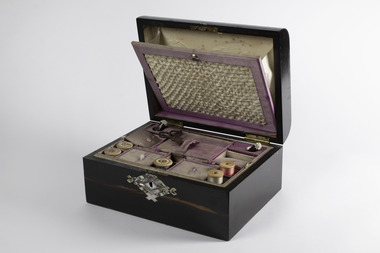 Port Fairy Historical Society Museum and Archives
Domestic object - Sewing Box, C.1850
... This work box belonged to Miss Mary Southcombe who, with her parents Thomas and Mary came from Devon Wales to Portland on the sailing ship "Clara" in 1854. ...This work box belonged to Miss Mary Southcombe who, with her parents Thomas and Mary came from Devon Wales to Portland on the sailing ship "Clara" in 1854. ...This work box belonged to Miss Mary Southcombe who, with her parents Thomas and Mary came from Devon Wales to Portland on the sailing ship "Clara" in 1854. Later that year they settled in Belfast (Port Fairy). Miss Southcombe resided in Port Fairy all her life and carried a wonderful record of citizenship extending over a period of more than 80 years.This workbox used by Miss Mary Southcombe a pioneer of Port Fairy is also a beautiful piece of it's type.Pearl inlaid wooden sewing box with many compartments made of card and covered in purple silk each compartment had a lid made of the same componentsdomestic items, sewing, box, miss mary southcombe -
Glenelg Shire Council Cultural Collection
Photograph - Photograph - Lee Breakwater, Portland, n.d
... Black & white photo of a length of box work surrounding concrete, between sections of rubble. ...Port of Portland Authority Archives Port of Portland Archives Lee Breakwater construction tanker berth Black & white photo of a length of box work surrounding concrete, between sections of rubble. ...Port of Portland Authority Archivesport of portland archives, lee breakwater, construction, tanker berth -
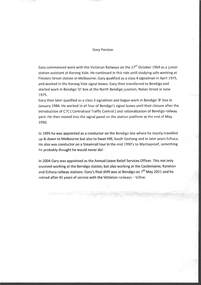 Bendigo Historical Society Inc.
Document - RAILWAYS COLLECTION: LETTER AND DETAILS OF GARY YORSTON'S WORK WITH THE VICTORIAN RAILWAYS
... Railways collection - Cover letter from Alan Yorston and a small article giving details of Gary Yorston's work in signal boxes, as a Conductor and Annual leave Officer with the Victorian Railways from 1969 to 2011....DOCUMENT Victorian Railways Railways collection - Cover letter from Alan Yorston and a small article giving details of Gary Yorston's work in signal boxes, as a Conductor and Annual leave Officer with the Victorian Railways from 1969 to 2011. ...Railways collection - Cover letter from Alan Yorston and a small article giving details of Gary Yorston's work in signal boxes, as a Conductor and Annual leave Officer with the Victorian Railways from 1969 to 2011.document, victorian railways -
Federation University Historical Collection
Object, Citizen Watch Co. Ltd, Hand Held Television - small backlight unit, 1986
... With the change to digital signals this unit would not work without a settop box. ...With the change to digital signals this unit would not work without a settop box. Hand Held Television - small backlight unit Object Citizen Watch Co. ...CITIZEN 06TA: One of the most common Handheld-TVs with a "Solar Projection System" - A mirror reflects the picture from the LCD for viewing. Shown with and without the optional backlight-unit 92TA. 65 mm passive matrix LCD (European versions: 130 * 160 = 20,800 dots, US version: 146 * 160 = 23,360 dots), 190 grams with 4 AAA-size batteries. (http://www.guenthoer.de/e-mini.htm) Small grey analogue television. When the unit is open the image is reflected by a mirror. With the change to digital signals this unit would not work without a settop box. Serial No. 8C6 88053\model No 06TA-OG DC 6V - 0.3W Batt. Supp: 15v x 4 -
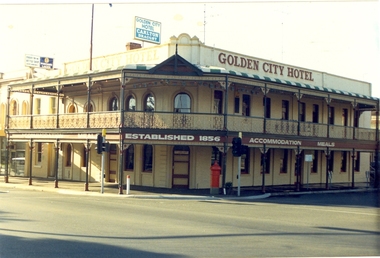 Federation University Historical Collection
Photograph - Photograph - Colour, Golden City Hotel, Ballarat
... The hotel features a verandah with cast iron work. A red pillar box is evident on the corner of Sturt Street and Dawson Street....It was known as GeeCees in 2015. golden city hotel geecees letter box pillar box Photograph of a double storey hotel in Sturt Street Ballarat. The hotel features a verandah with cast iron work. ...The Golden City Hotel was established in 1856. It was known as GeeCees in 2015.Photograph of a double storey hotel in Sturt Street Ballarat. The hotel features a verandah with cast iron work. A red pillar box is evident on the corner of Sturt Street and Dawson Street.golden city hotel, geecees, letter box, pillar box -
 Whitehorse Historical Society Inc.
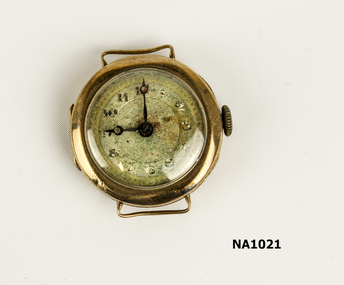
Accessory - Watch, 1930
... This watch was presented by the Shires of Blackburn and Mitcham to Miss Beatrice Neilson in recognition of her work with 'The Box Hill Reporter' 1927-1930 and in particular her faithful reporting of events in these shires. ...This watch was presented by the Shires of Blackburn and Mitcham to Miss Beatrice Neilson in recognition of her work with 'The Box Hill Reporter' 1927-1930 and in particular her faithful reporting of events in these shires. ...This watch was presented by the Shires of Blackburn and Mitcham to Miss Beatrice Neilson in recognition of her work with 'The Box Hill Reporter' 1927-1930 and in particular her faithful reporting of events in these shires. Miss Neilson joined the staff of 'The Age' in 1930 and retired in 1971.Small round gold watch.'Miss B.H. Neilson/from/The President and Councillors/Shire of Blackburn and Mitcham/with best wishes/10.2.199930' (on back)horology, watches, civic mementoes, presentations -
 Box Hill Historical Society
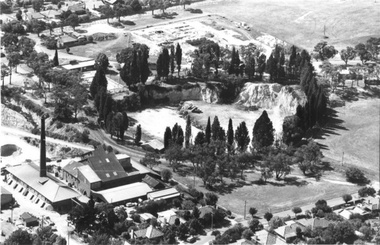
Photograph - Surrey Dive
... Shows Surrey Dive (no water) with Box Hill Brickworks in lower left hand corner. Background shows beginning of work on the Box Hill Recreation Centre. ...Shows Surrey Dive (no water) with Box Hill Brickworks in lower left hand corner. Background shows beginning of work on the Box Hill Recreation Centre. ...Shows Surrey Dive (no water) with Box Hill Brickworks in lower left hand corner. Background shows beginning of work on the Box Hill Recreation Centre. The Brickworks was formerly called Haughton Park Brick Company in 1884 and Box Hill Brick Company in 1886.B&w photosurrey dive, brickworks, recreation centre, sport -
 University of Melbourne, Burnley Campus Archives
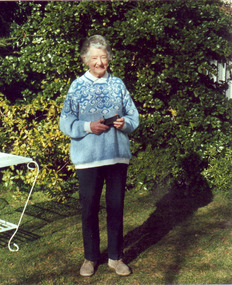
Photograph - Colour print, A.P.Winzenried, Elaine Pearce and Garden Design, 1937-1991
... Elaine Pearce (1937) designed the garden in Hobart, Tasmania, for her parents after her Graduation, when she could not find work. See Elaine Pearce Box 101B for handwritten notes....Elaine Pearce (1937) designed the garden in Hobart, Tasmania, for her parents after her Graduation, when she could not find work. See Elaine Pearce Box 101B for handwritten notes. elaine pearce a.p. winzenried hobart tasmania green grows our garden a.p. winzenried garden design Set of 19 colour photographs. ...Elaine Pearce (1937) designed the garden in Hobart, Tasmania, for her parents after her Graduation, when she could not find work. See Elaine Pearce Box 101B for handwritten notes.Set of 19 colour photographs. One of Elaine Pearce (1937) taken by A.P. Winzenried in 1991 and 18 of the garden in Hobart, Tasmania designed for her parents after graduation when she could not find work. Also taken in 1991. (12) Appears as an illustration in, "Green Grows Our Garden," A.P. Winzenried p 64. Also see her handwritten notes.elaine pearce, a.p. winzenried, hobart, tasmania, green grows our garden, a.p. winzenried, garden design -
 City of Moorabbin Historical Society (Operating the Box Cottage Museum)
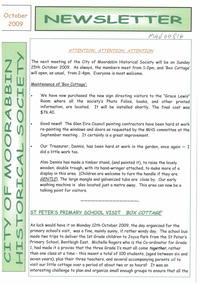
Newsletter, City of Moorabbin Historical Society Oct 2009, October 2009
... 2 x A4 paper printed on 3 sides with attached A4 page of photocopied photographs of St Peter’s Schoolchildren at Box Cottage Issue 14 of the bi-monthly, City of Moorabbin Historical Society Newsletter produced by Society member and Secretary, Mrs Helen Stanley in October 2009. Notices of the meeting October 25th , the purchase of a Sign directing visitors to Grace Lewis Room, the maintenance work on Box Cottage by Glen Eira Council and the construction by Dennis Maynard CMHS of bench for the wash-trough in Barn. ...The Newsletter is an important record of the activities of the CMHS. city of moorabbin historical society stanley helen melbourne moorabbin brighton cheltenham ormond bentleigh market gardeners pioneers early settlers moorabbin shire box cottage museum st peter’s catholic primary school east bentleigh lewis grace John Keys Keys Road CITY of MOORABBIN HISTORICAL SOCIETY / October 2009 NEWSLETTER 2 x A4 paper printed on 3 sides with attached A4 page of photocopied photographs of St Peter’s Schoolchildren at Box Cottage Issue 14 of the bi-monthly, City of Moorabbin Historical Society Newsletter produced by Society member and Secretary, Mrs Helen Stanley in October 2009. Notices of the meeting October 25th , the purchase of a Sign directing visitors to Grace Lewis Room, the maintenance work on Box Cottage by Glen Eira Council and the construction by Dennis Maynard CMHS of bench for the wash-trough in Barn. ...The City of Moorabbin Historical Society was formed c 1960 by a group of Moorabbin residents who were concerned that the history of the area should be preserved. A good response to a call for items related to the historical area of Moorabbin Shire brought donations of a wide variety of artefacts which are now preserved by the current members of CMHS at Box Cottage Museum . Helen Stanley, Secretary of CMHS, began producing a Newsletter for members in April 2007 to provide current information and well researched items of historical interest. Helen Stanley has produced a bi-monthly Newsletter, 2007 - 2013, for the members of the City of Moorabbin Historical Society that contains well researched interesting historical items, notification of upcoming events, current advice from Royal Australian Historical Society , Museums Australia Victoria and activities of Local Historical Societies. The Newsletter is an important record of the activities of the CMHS. 2 x A4 paper printed on 3 sides with attached A4 page of photocopied photographs of St Peter’s Schoolchildren at Box Cottage Issue 14 of the bi-monthly, City of Moorabbin Historical Society Newsletter produced by Society member and Secretary, Mrs Helen Stanley in October 2009. Notices of the meeting October 25th , the purchase of a Sign directing visitors to Grace Lewis Room, the maintenance work on Box Cottage by Glen Eira Council and the construction by Dennis Maynard CMHS of bench for the wash-trough in Barn. A report on the visit by Grade 1 pupils from St Peter’s Primary School, East Bentleigh on October 12th and a page of photographs of the event. CITY of MOORABBIN HISTORICAL SOCIETY / October 2009 NEWSLETTER city of moorabbin historical society, stanley helen, melbourne, moorabbin, brighton, cheltenham, ormond, bentleigh, market gardeners, pioneers, early settlers, moorabbin shire, box cottage museum, st peter’s catholic primary school east bentleigh, lewis grace, john keys, keys road -
 Halls Gap & Grampians Historical Society
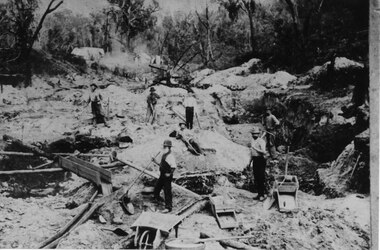
Photograph - Sepia, C 1900
... This claim is about the best fitted up on the field. It is worked with a sluice box with iron ripples and feeder to match. ...This claim is about the best fitted up on the field. It is worked with a sluice box with iron ripples and feeder to match. ...Horton's Reward Claim. This group of miners also worked another area called 'The Heather Bell" approx. 200 yards further up the gully. About half a pennyweight to the dish is obtained from the wash near the creek. They are panning off 3 dwts per day off one man's ground. This claim is about the best fitted up on the field. It is worked with a sluice box with iron ripples and feeder to match. The latter is a great advantage as there is a great fall below the claim for the tailings.Photo shows seven men working a goldfield using shovels and picks.mining, mount william, people -
 Bendigo Historical Society Inc.
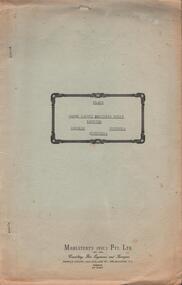
Document - HANRO COLLECTION: PLANS AND REPORT FROM FIRE ENGINEERS AND SURVEYORS, 1954/1960
... Blue print No.1119 of John Brown Industries Ltd Alley Street Bendigo showing work areas. Box 116A...Blue print No.1119 of John Brown Industries Ltd Alley Street Bendigo showing work areas. Box 116A Document HANRO COLLECTION: PLANS AND REPORT FROM FIRE ENGINEERS AND SURVEYORS ...BHS CollectionPlans and Report from Fire Engineers and Surveyors:- Green Card has a rectangular box with an ornate border in the centre of the front page. Inside the border is typed in black *Plans, Hanro (Aust) Knitting Mills Limited, Bendigo Victoria Australia. At the bottom:- Mahlstedt's (Vic) Pty Ltd. (est. 1884). Consulting Fire Engineers and Surveyors. Temple Court, 422 Collins Street., Melbourne C.1. Telephone 673069. Inside the folder is the Key to Detail Block Plans & Fire Surveys. Correspondence from Mahlstedt's Pty Ltd to Edward Lumley and Sons, Insurance Brokers regarding a new survey and the changes to the building with respect to fire hazard. Main report recommendations and general information on the building. Blue print of Shirt Factory, Inglewood Road No. 1061 by Welmar Ltd Bendigo. Small blue print of the main buildings showing different work areas. Blue print No.1119 of John Brown Industries Ltd Alley Street Bendigo showing work areas. Box 116AMahlstedt's (Vic) Pty Ltdhanro, clothing, plans and reports, edward lumley & sons pty ltd. hanro knitting mills. mahlstedt's (vic) pty ltd. welmar ltd bendigo. john brown industries ltd. -
 Federation University Historical Collection
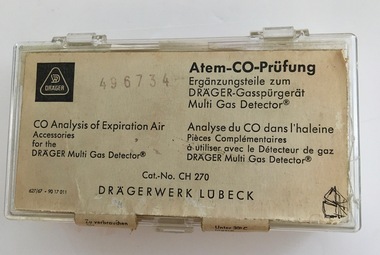
Equipment - Equipment - Monoxide Monitor, VIOSH: Carbon Monoxide Monitor - Dragerwerk Lubeck
... VIOSH accepts people into the Graduate Diploma of Occupational Hazard Management who have no undergraduate degree - on the basis of extensive work experience and knowledge. Box of accessories for the carbon monoxide monitor manufactured by Dragerwerk Lubeck Germany. ...VIOSH accepts people into the Graduate Diploma of Occupational Hazard Management who have no undergraduate degree - on the basis of extensive work experience and knowledge. Box of accessories for the carbon monoxide monitor manufactured by Dragerwerk Lubeck Germany. ...Victorian Institute of Occupational Safety and Health (VIOSH) Australia is the Asia-Pacific centre for teaching and research in occupational health and safety (OHS) and is known as one of Australia's leaders on the field. VIOSH has a global reputation for its innovative approach within the field of OHS management. VIOSH had its first intake of students in 1979. At that time the Institution was known as the Ballarat College of Advanced Education. In 1990 it became known as Ballarat University College, then in 1994 as University of Ballarat. It was 2014 that it became Federation University. VIOSH Australia students are safety managers, senior advisors and experienced OHS professionals. They come from all over Australia and industry. Students are taught active research and enquiry; rather than textbook learning and a one-size fits all approach. VIOSH accepts people into the Graduate Diploma of Occupational Hazard Management who have no undergraduate degree - on the basis of extensive work experience and knowledge. Box of accessories for the carbon monoxide monitor manufactured by Dragerwerk Lubeck Germany. Instructions enclosed are in English German and French Clear perspex container - divided into three sections. Thermometers, plastic bag, rubber tubes. Instruction sheet in German, English and Frenchviosh, victorian institute of occupational safety and health, carbon monoxide monitor, dragerwerk lubeck -
 Ballarat Heritage Services
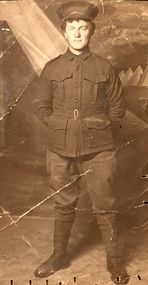
Photograph, Henry William Frisch, c1915
... At the time of his enlistment on 8 June 1915 he had worked as a butter box maker at MvcGennan's of Warrmabool. ...At the time of his enlistment on 8 June 1915 he had worked as a butter box maker at MvcGennan's of Warrmabool. ...Henry William Frisch was born at Warrnambool to H.W. and Sarah Frisch. He iniitally served with the 8th Battallion, was transferred to the 59th Battalion on 26 February 1916, then to the 58th Battalion on 15 May 1916 served with the 59th Battalion during World War One. He had the regimental number 3054. At the time of his enlistment on 8 June 1915 he had worked as a butter box maker at MvcGennan's of Warrmabool. On 26 February 1916 he was at Tel-el-Kebir, Egypt. On 17 June 1916 he embarked on the H.T. Translyvania from Alexandria and disembarked at Marseilles on 23 June 1916. On 14 September 1917 he was furloughed to England, rejoining his battalion on 05 October 1917. On 16 October 1917 Henry Frisch was wounded in the field with shrapnel wounds to the back and neck and multiple shrapnel wounds penetrating the abdomen. He died of wounds received on 17 October 1917 aged 23 yeard. He was buried at Lyssenthoek Military Cemetery (Plot 21. Row H. Grave 19A). The ceetery is south west Poperinghe, Begium. "IN MEMORIAM. ON ACTIVE SERVICE. FRISCH —In loving memory of our dear, son, Private H. W. Frisch, who died of wounds on 17th Oct., 1917, at the 17th Casualty Clearing, Station, France. No one knows how much we miss him, Friends may think the wound is healed; But they cannot see the sorrow, Deep within our hearts concealed. Just when life was brightest, Just when his hopes were best; His country called—he answered, Nows in God's home he rests. (Inserted by his loving parents, West Reserve, Warrnambool, his sisters and Stanley). FRISCH—In loving memory of my dear brother, Pte. H. W. Frisch, who died of wounds on 17th Oct., 1917, at the 17th Casualty Clear-ng Station, France. My hero brother. Sadly a sister is thinking, Of her soldier brother, so brave; Who fought for the cause of freedom, Who lies in a hero's grave. I seem, to see your face, dear Henry, Through a mist of anxious tears; And a sister's heart is broken, For many and many a year. One of Australia's dearest and best. Sadly missed by all. (Inserted by his loving sister, Ethel, East Melbourne). FRISCH—In loving memory of our dear brother, Henry William, who died of wounds in France, on 17th October, 1917. Not for the love of battle, Did he leave his dear homeland; He heard the call of duty, And responded like a man. —(Inserted by his loving sister and brother-in-law, France and Steve Ferrier) . FRISCH—In fond and loving memory of Private Henry Frisch, who died of wounds on active service 17th Oct., 1917. —(Fondly remembered by Mrs. Henry and family). (Warrnambool Standard, Thursday 17 October 1918.)Cut down photographic post card of Henry Wiliam Frisch. The photographer was located at 175 Collins St, Melbourne. Verso "Keith's uncle Henry Frisch killed WW1"world war one, henry frisch, belgium, warrnambool -
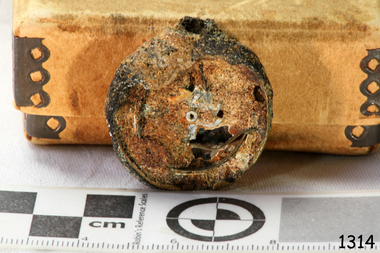 Flagstaff Hill Maritime Museum and Village
Instrument - Fob Watch, ca 1878
... He returned to Melbourne in 1919 and worked in Richmond and Box Hill. He later married Frances Whyburn. ...He returned to Melbourne in 1919 and worked in Richmond and Box Hill. He later married Frances Whyburn. ...The story of this gold fob watch is intriguing. The letter is dated March 6, 1905, 27 years after the Loch Ard was wrecked. It appears to be a quick personal note from a relative or friend who briefly writes the history of the enclosed ‘souvenir’ watch, found in Loch Ard Gorge at Port Campbell. Although the finder is not named, it is likely the letter’s author. The writer mentions that the letter and watch would be sent once photographs of the area where the watch was found had been added. The fancy, lined envelope’s date stamp is October 12th, 1917 (12.10.17), almost 12 years after the letter was written. It has a postmark from Florence (Firenze), Italy. The handwriting on the envelope differs from that of the letter, and there is no further mention of photographs being included. The condition of the watch certainly shows the effects of time in the sea. Some inner workings can be seen through broken encrustations and missing sections of its case. The winding knob on the top is recognisable even though it is covered by sand and other adhesions from the sea. Its dainty size and gold case suggest that it was made for a well-to-do female. The watch, envelope and letter were donated along with a 1971 newspaper cutting, all neatly folded and tucked with the watch into a small, strong cardboard box with metal reinforcing on the corners and a fitted lid. The newspaper article gives context to the watch, telling the story of the Loch Ard shipwreck tragedy and the two survivors, but does not refer to the watch. Perhaps one of the 17 passengers sailing on the Loch Ard, including members of the Carmichael family, owned the watch, or maybe it was amongst the cargo, as the ship’s manifest includes ‘clocks and watches £25’. . Considering the dates of the letter and the envelope, did the finder of the ‘souvenir’ watch take it to Europe? Was it used for good luck during service in the military? . Comparing the different writing on the letter and the envelope, does it suggest that the watch’s finder was overseas and asked someone to send the envelope to the intended recipient, with postage from Italy? ABOUT the address, “Glencove”: The details on the envelope are faint and obscured by stiff creases in the paper. The address appears to be “Mrs J. Mortton, Glencove, Portsea, Victoria, Australia”; though the family at that address had the surname “Morton”. Mrs J. Morton, formerly Elizabeth Ford, married her second husband, James Morton, in 1904, the year before the date of the letter. The couple lived at the Nepean Hotel before they were at “Glencove”. Although they never owned that property, it was their home when James died in 1937. Elizabeth’s nephew, Alfred Sandle Ford (1894-1981), and a nephew-in-law were overseas during World War I. Alfred Ford had moved to Melbourne as a young boy with his father. He entered service as Second Lieutenant in 1915, naming his father, Alfred Sandle Ford, as his next of kin. He served in Egypt, France and Belgium with the Australian Imperial Forces as a member of the Field Artillery Brigades. He returned to Melbourne in 1919 and worked in Richmond and Box Hill. He later married Frances Whyburn. Previously, in 1872, Elizabeth Ford’s sister, Julia Ford, acquired the 1-acre property with a 3-room house that became known as “Glencove”, Portsea. The building was originally the first school in the area, established before Crown Land sales. In the Parish of Nepean, it was first assessed for rates in 1871. Julia Ford (1843-1912) and Elizabeth Ford (1859-1957) were daughters of James Sandle Ford (1811-1890), a well-known pioneer of Portsea, formerly a convict limeburner. James Ford acquired several Crown allotments in Portsea. In 1872, he converted his old hotel into the large residential establishment known as the Nepean Hotel, which his family largely ran until it was demolished in 1971. During those years, different family members lived at the Nepean Hotel or Glencove. In 1877, Julia Ford married a significant landowner, John Cain, a limeburner from Rye. They had five daughters, four of whom were never married; Kathleen (1880-1949), Mabel (1881-1973), who was the last family member to own the house until her death, Hilda (1884-1974) and Julia Ethel (1888-1949). Some of the newspaper records refer to “Glencove”, Portsea, inform that: 1927 - Dr. and Mrs. J. E. Shilliday are staying with Mrs. R. B. Sanderson at Glencove. (Australasian) 1937 - James Morton died at his property, Glencove, Portsea, aged 83 years (Argus) 1949 - Julia Ethel Cain died at Glencove, Portsea. (Argus) 1949 - Probate application by sisters of Julia Ethel Cain, deceased, formerly of Nepean Hotel, Portsea, but late of Glencove, Nepean Highway, Portsea. The connection of the watch with the sands of Loch Ard Gorge and to the ship Loch Ard contributes to our knowledge of personal items brought to Australia in 1878, whether as the belongings of a passenger or as cargo; a gold watch would be intended for a wealthy buyer. The little artefact helps us understand the survival of artefacts in the powerful sea, over a quarter of a century after the wreck of the ship. Although many people would have visited the shipwreck site, the length of time before it was found helps us understand the effects of the sea on shipwreck artefacts. The survival of the carefully packaged watch and related documents shows the respectful understanding of preservation of historic artefacts, even from almost 150 years ago at the time of writing (2025). Ladies' fob watch, thought to be gold. It is now covered in encrustation. A bump on the edge would be the winding mechanism for the watch. A small section of the back of the case has broken away, and an engraved surface can be seen. Face and hands are missing, revealing the spring workings inside. Donated with the watch were two documents and a newspaper cutting about the story of the shipwreck of the Loch Ard. They are all in a strong cardboard box with reinforced corners on the base and lid. Found at Loch Ard Gorge and said to have been from the Loch Ard. The three donated documents are: - 1. A rectangular envelope made of cream waxy paper lined with black and white diagonally striped paper. The top right corner, usually meant for a postage stamp, has been torn off, partly exposing text on a rectangular printed logo. A round black postmark stamp near the top centre shows the post office location and date. The address on the front is handwritten in black ink. The creases on the envelope suggest it has been folded three times. 2. A letter on cream rectangular paper features clear, handwritten script in black ink. The unevenly cut bottom edge has two short black vertical lines, possibly the tops of tall written letters. There are creases where the page has been folded three times. 3. A newspaper clipping featuring text, an illustration, and handwritten details of the newspaper’s source.1. Envelope: - Address: ”Australia (per Postage) / [looks like “Mrs J. Mortton”] / Glencove, (Portsea) / Victoria” Postmark: “FIRENZE” 12 10 17” “ - - - -PORTEN – (illegible)” Logo inside envelope: “BUSTA BRE--- / Earliera Lialia” [Italian; Busta = envelope, Earliera == earlier] 2. Letter: - “I am sending you a ‘souvenir’ from the wreck of the Loch Ard 28 years ago at Port Campbell. It is the remains of a lady’s gold watch found in the gorge where Miss Carmichael & Tom Pearce (the only two saved) were washed up. This souvenir was lying there ever since. I went down into the awful gorge & saw the cave where these two unfortunates (or fortunate perhaps, as they were saved) lived until rescued. I also saw the graves of those who were washed up from the wreck. One grave contains Dr and Mrs Carmichael & six of their children. Later on, when I can get some good views of that wild coast I will send them to you. 6/3/05.” 3. Newspaper cutting: - History of the Lochard. Refer to the Sydney Morning Herald, Nov. 28th, 1971: “Loch Ard: the wreck that became a legend” flagstaff hill, warrnambool, shipwreck coast, flagstaff hill maritime museum, maritime museum, flagstaff hill maritime village, great ocean road, loch ard, eva carmichael, tom pearce, loch ard gorge, loch ard souvenir, port campbell, miss carmichael, mrs carmichael, dr carmichael, 1878, loch ard: the wreck that became a legend, ladies fob watch, gold watch, fob watch, pocket watch, horology, accessory, time keeping, scientific instrument, ladies' watch, ladies' pocket watch, lady's watch, souvenir watch, survivor, clocks and watches, diagonally striped envelope lining, firenze, busta, earliera, florence, italy, glencove, portsea, victoria, 1905, 1917, nepean hotel, moreton, morton, elizabeth morton, mrs j. morton, james morton, elizabeth ford, julia ford, alfred sandle ford, frances whyburn, james sandle ford, john cain, kathleen cain, mabel cain, hilda cain, julia ethel cain, australian imperial forces, field artillery brigades, limeburner -
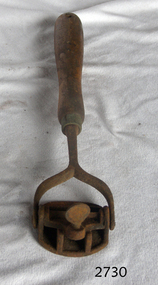 Flagstaff Hill Maritime Museum and Village
Tool - Cabinet Scraper, 1945-1955
... work along the grain. A tool used to finish timber to give a smooth finish and a important tool for a cabinet maker that has been in use for many hundreds of years in different design forms flagstaff hill warrnambool flagstaff hill maritime museum maritime museum shipwreck coast flagstaff hill maritime village great ocean road box scraper scraper woodwork tool cabinet scraper furniture finishing None Box scraper adjustable with long wooden handle. ...A cabinet scraper (sometimes called a ‘card scraper’) is a woodworking tool used for shaping and finishing furniture. The name ‘cabinet’ is used because scrapers are versatile and important tools for cabinet makers to provide a smooth surface to a finished cabinet. The body and the cutting edges of most cabinet scrapers are formed from a single piece of material. The blades are created on each edge of the body. Also, a scraper can have adjustable blades and a wooden handle these are two-handled cabinet scrapers. Cabinet scrapers are used manually to scrape small amounts of material from the surface of the wood to smooth it, shape it, or remove an old finish such as varnish from its surface. They are commonly used on furniture and musical instruments such as guitars and violins. The tools can be used on hardwood or softwood but when using a cabinet scraper on any wood, you should generally work along the grain.A tool used to finish timber to give a smooth finish and a important tool for a cabinet maker that has been in use for many hundreds of years in different design formsBox scraper adjustable with long wooden handle.Noneflagstaff hill, warrnambool, flagstaff hill maritime museum, maritime museum, shipwreck coast, flagstaff hill maritime village, great ocean road, box scraper, scraper, woodwork tool, cabinet scraper, furniture finishing -
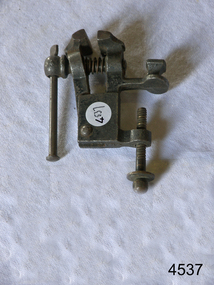 Flagstaff Hill Maritime Museum and Village
Vice
... James S Steele tool box Flagstaff Hill Warrnambool Shipwrecked-coast Flagstaff-Hill Flagstaff-Hill-Maritime-Museum Maritime-Museum Shipwreck-coast Flagstaff-Hill-Maritime-Village Vice small used for very delicate work. ...James S Steele tool boxVice small used for very delicate work. Has a small anvil attached. 90mmL x 65mmW.flagstaff hill, warrnambool, shipwrecked-coast, flagstaff-hill, flagstaff-hill-maritime-museum, maritime-museum, shipwreck-coast, flagstaff-hill-maritime-village -
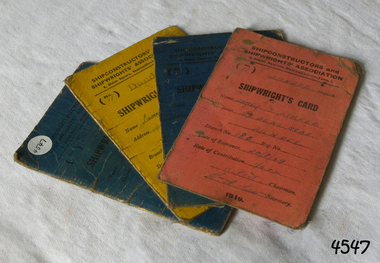 Flagstaff Hill Maritime Museum and Village
Card
... James S Steele tool box flagstaff hill warrnambool shipwrecked-coast flagstaff-hill flagstaff-hill-maritime-museum maritime-museum shipwreck-coast flagstaff-hill-maritime-village Shipwright cards (4) of James S Steele, 1949, 1950, 1951, 1952. Cards are for membership of the Ship constructors and Shipwrights Association. Mr Steele worked ...James S Steele tool boxShipwright cards (4) of James S Steele, 1949, 1950, 1951, 1952. Cards are for membership of the Ship constructors and Shipwrights Association. Mr Steele worked in Dundee.flagstaff hill, warrnambool, shipwrecked-coast, flagstaff-hill, flagstaff-hill-maritime-museum, maritime-museum, shipwreck-coast, flagstaff-hill-maritime-village
