
Showing 45 items matching "work dress shirt."
-
 Bendigo Military Museum
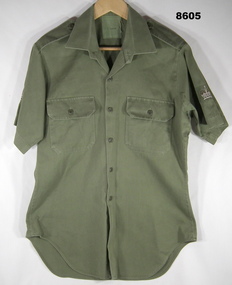
Uniform - SHIRT, WORK DRESS, ARMY, 1987
... SHIRT, WORK DRESS, ARMY......Work Dress shirt....Work dress shirt. Shirt - green colour cotton/polyester fabric, short sleeves, collar, shoulder epaulettes, two front pockets with button down flap. ...Passchendaele Barracks Trust Uniforms Army Work Dress shirt. Manufacturers information - black ink print. ...Work dress shirt. Shirt - green colour cotton/polyester fabric, short sleeves, collar, shoulder epaulettes, two front pockets with button down flap. Green colour plastic buttons. Green colour cotton fabric manufacturers label back below collar. Commonly known as "Greens". Right and left sleeves - Rank Insignia patch - Queen's colour - Warrant Officer Second Class.Manufacturers information - black ink print. "AGCF/ 1987/^/ SIZE 39/81/ 8405.66.093.2434/ service no/ name/ do not boil or wring/ machine washable/ drip dry, iron lightly/ with warm iron" Handwritten in black ink pen "R. HOSKING".passchendaele barracks trust, uniforms, army, work dress shirt. -
 Bendigo Military Museum
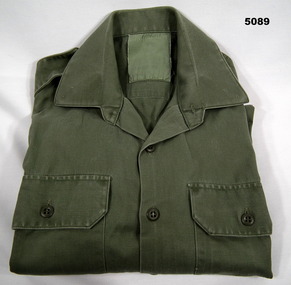
Uniform - SHIRT, WORK DRESS
... SHIRT, WORK DRESS...Green cotton drill long sleeved army work dress shirt featuring epaulettes and two button down breast pockets. a light green manufacturer's label is sewn onto the inside of the shirt's neck. ...Green cotton drill long sleeved army work dress shirt featuring epaulettes and two button down breast pockets. a light green manufacturer's label is sewn onto the inside of the shirt's neck. ...Part of the Reverend Chaplain Major Thomas Bruce Williams, No 556101, Collection.Green cotton drill long sleeved army work dress shirt featuring epaulettes and two button down breast pockets. a light green manufacturer's label is sewn onto the inside of the shirt's neck. Shirt is closed with six buttons.Printed on manufacturer's label: 'illegible, SIZE 40/89, illegible, SERVICE NO., NAME'.army chaplain, uniform, major thomas b. williams -
 Bendigo Military Museum
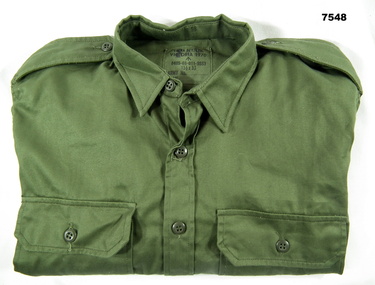
Uniform - SHIRT, ARMY, Australian Defence Industries, 1970
... Black print on inside collar. Army work dress shirt commonly called "Greens"....Black print on inside collar. Army work dress shirt commonly called "Greens". Uniform SHIRT, ARMY Australian Defence Industries ...Shirt - green colour cotton fabric with long sleeves, shoulder epaulettes, two front pockets with button down flap, plastic buttons. Cotton manufacturers label, green colour below collar with black print information. Black print on inside collar. Army work dress shirt commonly called "Greens".Green cotton label information - black ink print "YAKKA PTY LTD/ VICTORIA 1970/ 6 / 8405-66-011-9883/15 1/2 x 33/ ARMY NO./ NAME". Inside collar - black ink print stamp. "S.58/15 1/2 - 33" uniform, army, workwear -
 Ballarat RSL Sub-Branch Inc.
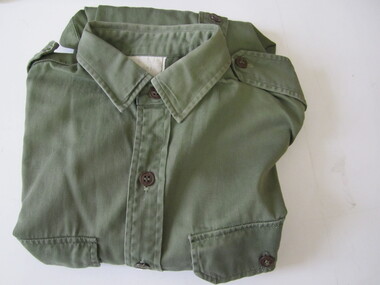
Shirt Green, 1967
... 1XJungle Green Shirt, Work Dress....Vietnam War 1962-75 Uniforms Ballarat RSL Ballarat 1XJungle Green Shirt, Work Dress. Shirt Green ...1XJungle Green Shirt, Work Dress.vietnam war, 1962-75, uniforms, ballarat rsl, ballarat -
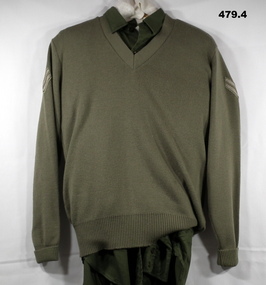 Bendigo Military Museum
Uniform - UNIFORM ARMY, Pelaco Victoria, 1967
... Uniform classed as work dress. Pants & shirt were just called “Greens”...Uniform classed as work dress. Pants & shirt were just called “Greens” Uniform greens Work dress .1) jumper, wool khaki colour with Corporal stripes on upper sleeves. .2)Shirt, green colour long sleeves cotton .2) Belt .4) Trousers, green, cotton. .5&.6) Boots Uniform UNIFORM ARMY Pelaco Victoria ...Uniform classed as work dress. Pants & shirt were just called “Greens”.1) jumper, wool khaki colour with Corporal stripes on upper sleeves. .2)Shirt, green colour long sleeves cotton .2) Belt .4) Trousers, green, cotton. .5&.6) Bootsuniform, greens, work dress -
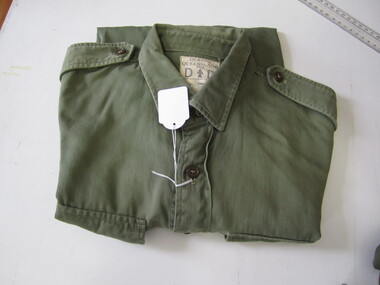 Ballarat RSL Sub-Branch Inc.
Shirt Green, 1967
... 1X Jungle green shirt, work dress....Vietnam War 1962-75 Uniforms Ballarat RSL Ballarat 1X Jungle green shirt, work dress. Shirt Green ...1X Jungle green shirt, work dress.vietnam war, 1962-75, uniforms, ballarat rsl, ballarat -
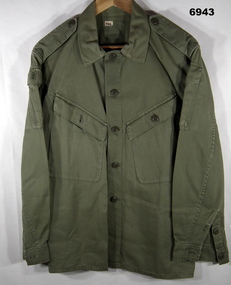 Bendigo Military Museum
Uniform - SHIRT, ARMY, 1971
... Green colour cotton manufacturer's label, with small white label below collar. Army work dress shirt commonly called "GREENS". This shirt has more of an American style. ...Green colour cotton manufacturer's label, with small white label below collar. Army work dress shirt commonly called "GREENS". This shirt has more of an American style. ...Uniform shirt issued to POLWARTH No. 3178035.Shirt - green colour cotton fabric with collar, long sleeves, shoulder epaulettes, two front pockets with button down flap, green colour plastic buttons, two front pockets with button down flap. Green colour cotton manufacturer's label, with small white label below collar. Army work dress shirt commonly called "GREENS". This shirt has more of an American style. Manufacturer's label information - black ink print (some of print illegible) ?? Pty Ltd/ 1971/ ^/ 8405-66-034-5398/ CHEST & SIZE 44-45?/ NAME/ ARMY NO./ ???" handwritten on label - black ink pen "POLWARTH/ 317803". Small white label - handwritten black ink pen "POL".passchendaele barracks trust, uniform, army workdress, polwarth -
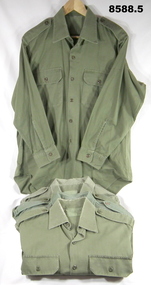 Bendigo Military Museum
Uniform - SHIRTS, ARMY
... Date of Manufacture 1953 to 1982. Army work dress shirt commonly called "Greens". Manufacturing dates from 1953 to 1982. ...Date of Manufacture 1953 to 1982. Army work dress shirt commonly called "Greens". Manufacturing dates from 1953 to 1982. ...1. - 5. Shirt - green colour cotton fabric with long sleeves, shoulder epaulettes, two front pockets with button down flap. Front button closure, sleeve cuffs. plastic buttons, green and brown colour. Manufacturers label, below collar, green colour cotton with black ink print on it. 3. 2, 4, 5. Illegible. Date of Manufacture 1953 to 1982. Army work dress shirt commonly called "Greens". Manufacturing dates from 1953 to 1982. Green cotton label information - black ink print. 1. "A.G.C.F./ VICTORIA/ 1980/ ^/ SIZE 41/81/ 8405.66.093.2443/ SERVICE NO./ NAME ". 3. "Pelaco/ Victoria/ 1953/ D^D". 2. 4. 5. Illegible/ passchendaele barracks trust, uniform, army, workwear -
 Bendigo Military Museum
Uniform - SHIRT, GREEN, 1967
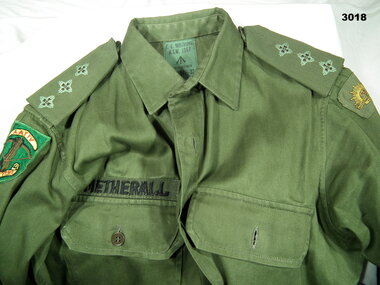
... Shirt, work, dress, green, cotton complete with name sewn on over left pocket, Rising Sun on right shoulder, Unit Patch on left shoulder, Captains Rank epaulette on both shoulders...AATTV: Australian Army Training Team Vietnam. uniforms - army costume - male working AATTV Sewn on: “Metherall” On Unit Patch: “AATTV Persevere” Handwritten: “Metherall” Shirt, work, dress, green, cotton complete with name sewn on over left pocket, Rising Sun on right shoulder, Unit Patch on left shoulder, Captains Rank epaulette on both shoulders Uniform SHIRT, GREEN E E Whitmont ...Items issued to Murray METHERALL 35455. Refer Cat No 590.2 for Service details. AATTV: Australian Army Training Team Vietnam.Shirt, work, dress, green, cotton complete with name sewn on over left pocket, Rising Sun on right shoulder, Unit Patch on left shoulder, Captains Rank epaulette on both shouldersSewn on: “Metherall” On Unit Patch: “AATTV Persevere” Handwritten: “Metherall”uniforms - army, costume - male working, aattv -
 Bendigo Military Museum
Uniform - SHIRT, TROUSERS, WORK DRESS, ARMY, Australian Defence Industries, 1995
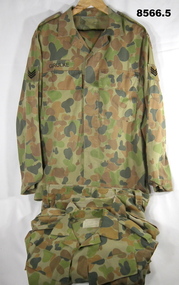
... SHIRT, TROUSERS, WORK DRESS, ARMY...Work dress. Colours light to dark green through to light to dark brown. Cotton/polyester fabric. Khaki colour plastic buttons. 1. 2. & 3. Shirts...Work dress. Colours light to dark green through to light to dark brown. Cotton/polyester fabric. Khaki colour plastic buttons. 1. 2. & 3. Shirts ...DPCU (Disruptive Pattern Camouflage Uniform) Work dress. Colours light to dark green through to light to dark brown. Cotton/polyester fabric. Khaki colour plastic buttons. 1. 2. & 3. Shirts - work dress. Collar, shoulder epaulettes, two front pockets with concealed button closure flaps. Front five buttons with concealed placket. Long sleeves with cuff. 1. Name patch has been sewn on "GRULKE". Rank Insignia on both sleeves - 3 stripes - Sergeant. Australia colour patch - top left sleeve. 4. & 5. Trousers - new style, two side pockets, two large patch side pockets with two button closer flaps. One back patch pocket with button. Belt loops with buttons. Nylon/metal zipper fly. DPCU pocket lining. Manufacturers label on right front pocket lining.Manufacturer's information on label - black ink print. 2. "ADA/ VICTORIA/ 1995/ ^ / 8415-66-130-0027/ SIZE 92s/ SERVICE NO/ NAME/ 50% POLYESTER 50% COTTON/ MACHINE WASHABLE/ DRIP DRY ONLY/ DO NOT IRON DO NOT STARCH/ DO NOT BLEACH/ A1". 4. & 5. "ADI/ VICTORIA/ 1995/ ^ 8415-66-134-8921/ SIZE 95r/ CUT NO 3603/ SERVICE NO/ NAME/ 50% POLYESTER 50% COTTON/ MACHINE WASHABLE DRIP DRY ONLY/ DO NOT IRON DO NOT STARCH/ DO NOT BLEACH"passchendaele barracks trust, uniform, army, work dress, dpcu -
 Bendigo Military Museum
Uniform - SHIRT, TROUSERS, WORKDRESS, ARMY, Australian Defence Industries, 1990 - 1994
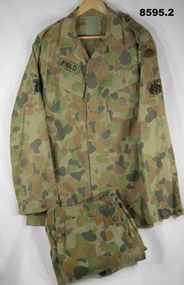
... Khaki colour plastic buttons. 1. Shirt work dress, collar, shoulder epaulettes, two front pockets with concealed button closure flaps. ...work dress. Colours light to dark green through to light to dark brown. Cotton/polyester fabric. Khaki colour plastic buttons. 1. Shirt ...Original owner - 'FIELD'.Shirt and Trousers Word dress. 1. & 2. DPCU (Disruptive Pattern Camouflage Uniform) work dress. Colours light to dark green through to light to dark brown. Cotton/polyester fabric. Khaki colour plastic buttons. 1. Shirt work dress, collar, shoulder epaulettes, two front pockets with concealed button closure flaps. Front - five buttons with concealed placket, long sleeves with cuff. Name patch has been sewn on "FIELD". Australian Army Rising Sun patch, top left sleeve. Rank insignia - Australian Coat of Arms - Warrant officer Class One on both sleeves. Manufacturers label - green cotton fabric - below collar. 2. Trousers - new style. Two side pockets, two large patch side pockets with two button closer flaps. One back patch pocket with button. Belt loops with buttons. Nylon/metal zipper fly. DPCU pocket lining. Manufacturers label - on right front pocket.Manufacturers information - black ink print. 1. "VICTORIA/ 1990/ ^/ ???? 66.130.0039/ SIZE 107L/ NAME/ SERVICE NO/ MACHINE WASHABLE/ DRIP DRY ONLY/ DO NOT IRON/ DO NOT STARCH/ DO NOT BLEACH". 2. "VICTORIA/ 1994/ ^/ 8415.66.134.8920/ SIZE 95L/ CUT NO 2200/ SERVICE NO/ NAME/ 50% POLYESTER 50% COTTON/ MACHINE WASHABLE DRIP DRY ONLY/ DO NOT IRON DO NOT STARCH/ DO NOT BLEACH".uniforms, army, work dress, dpcu, passchendaele barracks trust -
 Bendigo Military Museum
Uniform - SHIRT, TROUSERS, WORK DRESS, ARMY, Australian Defence Industries, 1963, 1986
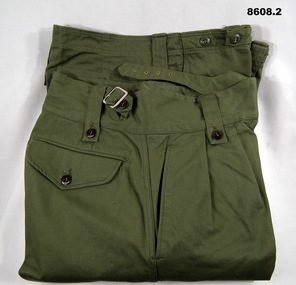
... SHIRT, TROUSERS, WORK DRESS, ARMY...Army Work Dress commonly called "GREENS". Uniform SHIRT, TROUSERS, WORK DRESS, ARMY Australian Defence Industries ...1. & 2. Trousers - green colour cotton twill fabric. Plastic buttons - brown colour. 1. Five button fly with two straps with metal buckles at waist, button down belt loops, two side pockets, two back pockets with button flap. Waist and pocket lining green cotton fabric. Left leg side pocket with button down flap. 2. Four button fly, button down belt loops, two side pockets, two back pockets with buttons. Two front of leg pockets with button down flap. Pocket lining - green polyester fabric. Green cotton manufacturers label inside back waist band. Army Work Dress commonly called "GREENS".Manufacturer's label - black ink print. 1. "C.G.C.F./ VICTORIA/ 1963/ SIZE 15/ ^/ REGIMENTAL NO/ NAME" 2. "A.G.C.F./ VICTORIA/ 1986/ 6 / WAIST AND SIZE/ 89/995/ 8405.66.029.0606/ ARMY NO/ NAME". passchendaele barracks trust, uniforms, army, workdress, trousers -
 Bendigo Military Museum
Uniform - WORKDRESS, ARMY, Australian defence Industry, 2006
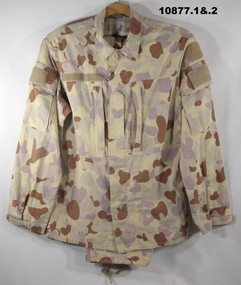
... Work dress DPCU Sarah Webster Manufacturers label. Black ink print on white fabric label. 1. "....../ 2006/ ^ / 8415-66-153-8722/ Size 85S/ NAME / SERVICE NO./ 75% Cotton/ 25% Polyester" with laundry instructions. Handwridtten black ink "WEBSTER". 2. "ADA/ VICTORIA 2006/ ^ / SPECIFICATION ARMY.................542/NSN 8415 66 153 ...41/ Size 80R /NAME/ SERVICE NO. / 75% Cotton/ 25% Polyester". Laundry instructions "MADE IN AUSTRALIA" . 3. “S.O.S.. MARINE/ BATCH # 0303 / MARCH 2003/ ^ / NSN 8415-66-148-9804/ SIZE SML". Army DPCU (Disruptive Pattern Camouflage Uniform) workdress. Colours beige to mid brown, light purple and grey. Cotton polyester fabric. Buttons, plastic, colours beige and khaki. 1.Shirt ...Original owner: "SARAH WEBSTER". ???. Cade Kindness. Army DPCU (Disruptive Pattern Camouflage Uniform) workdress. Colours beige to mid brown, light purple and grey. Cotton polyester fabric. Buttons, plastic, colours beige and khaki. 1.Shirt - workdress. Collar, shoulder epaulettes, two front pockets with concealed plastic zip side closer. Long sleeves with cuffs and velcro strap. Front - six buttons with concealed placket. Sleeves with pocket and concealed two button flap. Manufacturers label, back below collar. 2. Pants - waistband with belt keepers, two side pockets, two large patch pockets with plastic zip and flap. One back pocket with button. Nylon/ metal zipper fly. Draw cord and toggle cuff. DPCU fabric pocket lining. Manufacturer's label right, pocket lining. 3. Hat, workdress bush hat style. Crown, brim, towelling inner sweat band and chinstrap, woven cotton beige cord with plastic toggle and label. Manufacturers label. Black ink print on white fabric label. 1. "....../ 2006/ ^ / 8415-66-153-8722/ Size 85S/ NAME / SERVICE NO./ 75% Cotton/ 25% Polyester" with laundry instructions. Handwridtten black ink "WEBSTER". 2. "ADA/ VICTORIA 2006/ ^ / SPECIFICATION ARMY.................542/NSN 8415 66 153 ...41/ Size 80R /NAME/ SERVICE NO. / 75% Cotton/ 25% Polyester". Laundry instructions "MADE IN AUSTRALIA" . 3. “S.O.S.. MARINE/ BATCH # 0303 / MARCH 2003/ ^ / NSN 8415-66-148-9804/ SIZE SML".uniform, army, work dress, dpcu, sarah webster -
 Bendigo Military Museum
Uniform - UNIFORM, ARMY, Pelaco Australia, C.1967 - 69
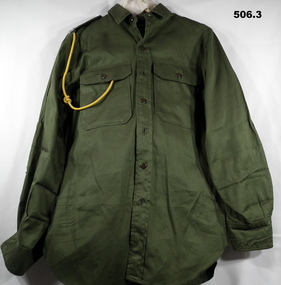
... Mostly worn as a work dress but could be worn parade style. uniforms-army Greens .1) Shirt cotton, green colour, long sleeves, yellow shoulder lanyard, silver colour badges on shoulder epaulettes “AUSTRALIA” .2) Trousers, green colour cotton. .3) Belt webbing black colour with brass buckles and keepers. .4).5) boots GP Uniform UNIFORM, ARMY Pelaco Australia ...Commonly called “Greens”. Mostly worn as a work dress but could be worn parade style..1) Shirt cotton, green colour, long sleeves, yellow shoulder lanyard, silver colour badges on shoulder epaulettes “AUSTRALIA” .2) Trousers, green colour cotton. .3) Belt webbing black colour with brass buckles and keepers. .4).5) boots GPuniforms-army, greens -
 Bendigo Military Museum
Uniform - UNIFORM , CAMOUFLAGE, ARMY, Australian Defence Industries, 1989 - 1990
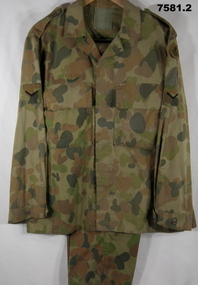
... Work dress\ 1. & 2. Green cotton fabric label information - black ink print. 1. "ADI/VICTORIA 1989/^/ 8415.66.130.0028/ SIZE 100 S/ NAME/ SERVICE NO/ MACHINE WASHABLE/ DRIP DRY ONLY/ DO OT IRON/ DO NOT STARCH/ DO NOT BLEACH" Handwritten red ink "ANGUS" . 2. "ADI P/L/ VICTORIA/ 1996/ 6/ 8415.66.130.004 ?/ SIZE 92S/ NAME/ SERVICE NO/ MACHINE WASHABLE/ DRIP DRY ONLY/ DO NOT IRON/ DO NOT STARCH/ DO NOT BLEACH." 1. Shirt ...Uniformissued to and worn by D. Angus.1. Shirt - camouflage jungle pattern green and brown colours, polyester/cotton fabric with long sleeves, shoulder epaulettes, two front pockets with button down flap, green plastic buttons. Left shoulder patch with Rising Sun, Crown and 'THE AUSTRALIAN ARMY". Two rank insignia on sleeve - one stripe - Lance Corporal, Cotton manufacturers label, green with black print information, very faded. 2. Trousers - camouflage jungle pattern green and brown, polyester/cotton fabric. Green colour plastic buttons. Five button fly, two front inside pockets with two button down flaps. two side pockets, button down belt loops. Waist and pocket lining - polyester/cotton fabric. Green cotton manufacturers label on side pocket lining.1. & 2. Green cotton fabric label information - black ink print. 1. "ADI/VICTORIA 1989/^/ 8415.66.130.0028/ SIZE 100 S/ NAME/ SERVICE NO/ MACHINE WASHABLE/ DRIP DRY ONLY/ DO OT IRON/ DO NOT STARCH/ DO NOT BLEACH" Handwritten red ink "ANGUS" . 2. "ADI P/L/ VICTORIA/ 1996/ 6/ 8415.66.130.004 ?/ SIZE 92S/ NAME/ SERVICE NO/ MACHINE WASHABLE/ DRIP DRY ONLY/ DO NOT IRON/ DO NOT STARCH/ DO NOT BLEACH."uniform, army, camouflage work dress\ -
 Bendigo Military Museum
Uniform - UNIFORM, CAMOUFLAGE, ARMY, Australian Defence Industries, c
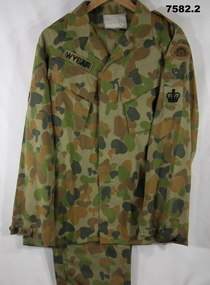
... Uniform shirt and trousers issued to WO1 "Graham Russell WYBAR" Reg No. 317098. Refer Cat No. 6372.25 for photographs of G.R. Wybar. GRAHAM RUSSELL WYBAR Uniform Army Camouflage work dress 1. ...Uniform shirt and trousers issued to WO1 "Graham Russell WYBAR" Reg No. 317098. Refer Cat No. 6372.25 for photographs of G.R. Wybar.1. Shirt - camouflage jungle pattern, green and brown colours, polyester/cotton fabric with long sleeves, shoulder epaulettes, two front pockets with two button down flaps, left sleeve pocket with button down flap, green colour plastic buttons. Left shoulder patch with Rising Sun, crown and " THE AUSTRALIAN ARMY". Two rank insignia on sleeves and crown for WO1. Polyester fabric manufacturers label - no visible print information. 2. Trousers - camouflage jungle pattern green and brown colours, polyester/cotton fabric. Green colour plastic buttons, metal zipper fly, two side pockets, two front to side pockets with two button down flaps, back pocket and button down belt loops. Waist and pocket lining - polyester/cotton fabric. No manufacturers label.graham russell wybar, uniform, army, camouflage work dress -
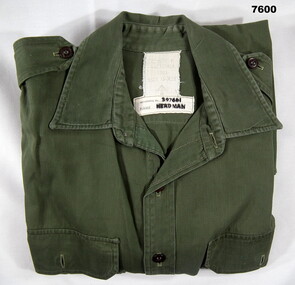 Bendigo Military Museum
Uniform - SHIRT, ARMY, C.G.C.F, 1963
... Shirt...Army...Work dress...See Catalogue No. 5942P for details of his service. Uniform Shirt Army Work dress KEVIN JOHN HERDMAN On manufacturer's label: 'C.G.C.F., VICTORIA, 1963, SIZE 15 1/2, X33 ^. ...Part of the ' Kevin John Herdman', No. 397661, Collection. See Catalogue No. 5942P for details of his service.Jungle green coloured, cotton fabric shirt with long sleeves. Two button down breast pockets with plastic buttons. White cotton fabric manufacturer's label below collar on inside. Name label below manufacturer's label.On manufacturer's label: 'C.G.C.F., VICTORIA, 1963, SIZE 15 1/2, X33 ^. Handwritten in black ink on name label : '397661 HERDMAN'. uniform, shirt, army, work dress, kevin john herdman -
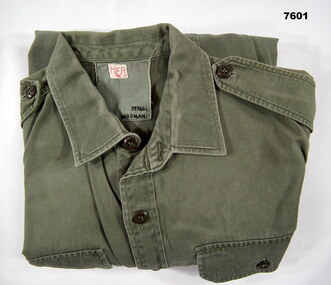 Bendigo Military Museum
Uniform - SHIRT, ARMY
... Shirt...Army...Work dress...See cat No. 5942P for details of his service. Uniform Shirt Army Work dress KEVIN JOHN HERDMAN Handwritten in red on manufacturer's label: 'HER'. ...Part of the "Kevin John Herdman" No. 397661 collection. See cat No. 5942P for details of his service.Jungle green coloured cotton fabric shirt with long sleeves. Two button down breast pockets with plastic buttons. Faded green coloured manufacturer's label sewn on inside below the collar.Handwritten in red on manufacturer's label: 'HER'. Handwritten in black on manufacturer's label: '397661 HERDMAN'uniform, shirt, army, work dress, kevin john herdman -
 Bendigo Military Museum
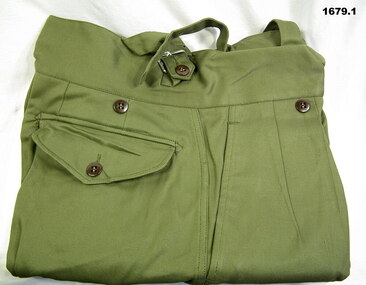
Uniform - GREENS UNIFORM, 1) 1965 .2)1966
... These were daily work dress uniform known commonly as “Greens” uniforms - army Greens .2) “558 17 x 33” (stamped inside collar) .1) “CGGF Victoria Size 15 1965” (stamped inside waist band) .1) Green long leg pants. .2) Green long sleeved shirt. ...These were daily work dress uniform known commonly as “Greens”.1) Green long leg pants. .2) Green long sleeved shirt..2) “558 17 x 33” (stamped inside collar) .1) “CGGF Victoria Size 15 1965” (stamped inside waist band)uniforms - army, greens -
 Bendigo Military Museum
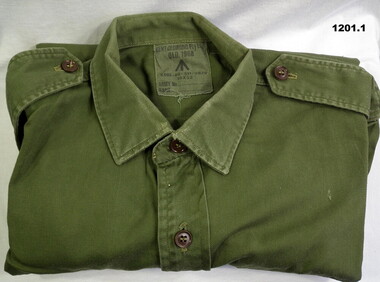
Uniform - UNIFORM, WORK, 1 1968 .2 1969
... Work dress greens Set of green work clothes. .1) Long sleeved green shirt with button down epaulettes & 2 breast pockets. .2) Green trousers, adjustable waist, 2 back pockets, 2 side pockets, 2 thigh pockets Uniform UNIFORM, WORK Kent Clothing Pty Ltd Yakka Pty Ltd ...Commonly called "Greens", issued to Wayne Forbes 3176337 1 Field Sqd RAE. Refer Cat No 754 for service history also 2586. Set of green work clothes. .1) Long sleeved green shirt with button down epaulettes & 2 breast pockets. .2) Green trousers, adjustable waist, 2 back pockets, 2 side pockets, 2 thigh pocketswork dress, greens -
 4th/19th Prince of Wales's Light Horse Regiment Unit History Room
Viet Cong Shirt & Trousers, 1960's
... The village Viet Cong guerilla wore a black shirt and trouser - the usual Vietnamese work-dress everybody wore. ...The village Viet Cong guerilla wore a black shirt and trouser - the usual Vietnamese work-dress everybody wore. ...The village Viet Cong guerilla wore a black shirt and trouser - the usual Vietnamese work-dress everybody wore. The perfect camouflage. In a group of people it was impossible to pick the enemy. They all wore the same and looked the same to the western eye. From a distance, a group of people did not necessarily mean mean a cell of viet cong on the move. They could be a bunch of field workers heading for a padi field or a community effort. At night the black pyjamas blended perfectly with very dark surrounds, but on other occasions they were too black. Main force viet cong wore black shirts and grey trousers. This clothing was hard to detect.Black cotton shirt and trousers. Shirt - collarless, 5 buttons, long sleeve. Trousers - draw cord at waist, no pockets , no fly Size M tag. No maker's label No country of origin tagviet nam war, viet cong, uniforms, black pyjamas -
 Kiewa Valley Historical Society
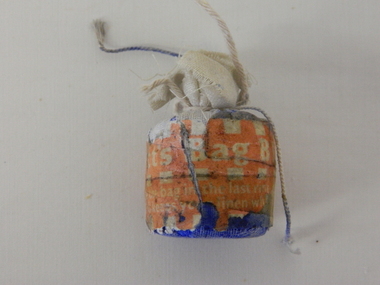
Bag Whitening Agent Reckitts, circa early 1900s
... shirts were the mark cleanliness that those outside of the family judged the family unit by. The best clothes were worn to church on Sundays. Hard and mostly rural activities/work in the Kiewa Valley encompassing farming, crop cultivation, cattle/sheep and "field work" to do with the SEC Vic Hydro Scheme involved provided a stain prone environment. As appearances, of clothing, was on the whole not significant it was a different scenario at social and religious scenes. The ability to attain "brilliant" white shirts, dresses ...This little bag of "whitener" additive for the washing of white clothes was manufactured in Hull in the United Kingdom mid and later 1900's. The Manufacturer, Ricketts, was one of the first manufacturers to employ women in equal proportions with males (a rarity before 1914). This product was used to improve the appearance of white fabrics. This ability to use a product that would "whiten" clothes chemically rather than the "hard boiling" of clothes was a time saver and a lot easier on the fabrics. This is a boon to rural families where time was of the essence (boiling took time). The blue coloring was introduced because the white colour perception is enhanced by the blue (fadeable and not permanent). The "washing machine industry" of the late 1900's emphasised "whitening" agents that were not so haphazard in producing blue stains, and allowed a "gentle" washing action. This item is very significant in detailing the early 1900's rural household domestic "chore" of washing white clothes to a "social" standard of cleanliness. White shirts were the mark cleanliness that those outside of the family judged the family unit by. The best clothes were worn to church on Sundays. Hard and mostly rural activities/work in the Kiewa Valley encompassing farming, crop cultivation, cattle/sheep and "field work" to do with the SEC Vic Hydro Scheme involved provided a stain prone environment. As appearances, of clothing, was on the whole not significant it was a different scenario at social and religious scenes. The ability to attain "brilliant" white shirts, dresses and bonnets by a less drastic method to that of "boiling" of clothes in vats, was a boon of that "era". The anti establishment revolt came later in the 1950's onward took longer to migrate from the cities and larger rural townships to eventually sneak into the Kiewa valley.This "blue bag" is a whitening agent wrapped in flannel or muslin, or sold ready bagged (1 ounce).It was used in the final rinse to "whiten white coloured clothes" The string was used to facilitate finger grip onto the "bag" after the wash had finished for easy removal to stop the hand and other surfaces from being stained by the blue colour residue drips.domestic and commercial laundries, starch and whitening additive, washing brightener -
 Bendigo Historical Society Inc.
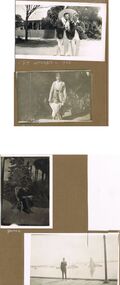
Photograph - HILDA HILL COLLECTION: BLACK AND WHITE PHOTOS, 1922
... Two males dressed in white trousers and shirts with dark jackets, one holds a parasol, the other two tennis racquets, gable roofed house in left background, lace work edging on the veranda, tree on nature strip, bushes and trees to right background, promenading Point Lonsdale Victoria Australia 1922. ...Two males dressed in white trousers and shirts with dark jackets, one holds a parasol, the other two tennis racquets, gable roofed house in left background, lace work edging on the veranda, tree on nature strip, bushes and trees to right background, promenading Point Lonsdale Victoria Australia 1922. ...Series of Black & White Photos Hill Family & Friends Post War Australia 4 in Total. Two males dressed in white trousers and shirts with dark jackets, one holds a parasol, the other two tennis racquets, gable roofed house in left background, lace work edging on the veranda, tree on nature strip, bushes and trees to right background, promenading Point Lonsdale Victoria Australia 1922. Jonah and child. Jonah wears a dark skirt and white blouse with light coloured coat, child wears full length body suit and is holding Jonah hands, garden setting. Doreen reading in garden, she wears dark clothing, sitting in a cane chair, corner of house veranda and garden in background. Herb, dressed in dark suit with white shirt and dark tie, standing on pier, moored yachts and one under full sail in background, St Kilda Pier Victoria Australia.Hilda Hill Personal Collectionaustralia, history, post war life -
 Bendigo Historical Society Inc.
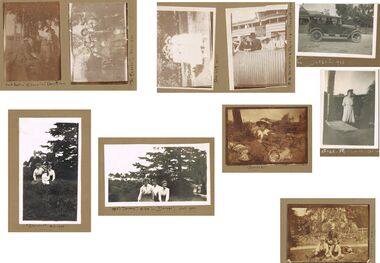
Photograph - HILDA HILL COLLECTION: BLACK AND WHITE PHOTOS, 1919-1923
... Old car, Durant', with fold back canvas roof and without side panels, wooden spoke wheels, running boards, three occupants all male two in front seat wearing black suits and hats, man in rear seat wearing a white shirt, background is gable roofed house with decorative lace work below the gutter, white picket fence, trees right background in front of gable roofed house, 1923. Jonah dressed...Old car, Durant', with fold back canvas roof and without side panels, wooden spoke wheels, running boards, three occupants all male two in front seat wearing black suits and hats, man in rear seat wearing a white shirt, background is gable roofed house with decorative lace work below the gutter, white picket fence, trees right background in front of gable roofed house, 1923. Jonah dressed ...Hilda Hill Collection. Combination of Sepia and Black & White Photographs on double sided card total of 10. Images. Uncle Jack foreground wearing suit and hat and sitting on a stool, lady to the right wearing a light coloured dress and white shirt with dark coat over her shoulders, behind lady on right back of a man in dark clothing, other people behind Jack are indistinguishable, 'Kilmuir' December 19th 1920. Five men standing in a group, all dressed in suits with collar and tie, four men wearing hats other is bare headed, to left is garden bush setting. Two men in dark suits with white shirts and ties bare headed, two ladies wearing white blouses and dark coloured dresses with young girl in white seated on the ground, large tree to right of group, 'Durvol' December 1920. Three young ladies all dressed in white and white large brimmed hats in a bush setting, left background has a number of people playing a game, the girls a standing next to a rocky outcrop, December 27th 1920. Two men in dark suits wearing hats a lady and two young girls wearing white dresses, young girls to the left is looking to her left and wearing a broad brimmed hat with a hat band, the lady is wearing a white broad brimmed hat and the young girls next to her is wearing a black broad brimmed hat, at a swimming carnival December 27th 1920. Moll Doreen Hilda each wearing white blouses and dark coloured skirts seated in a garden setting, large tree to background right with glimpse of a large decorative fence line and roadway, 'Durvol' October 1920. Old car, Durant', with fold back canvas roof and without side panels, wooden spoke wheels, running boards, three occupants all male two in front seat wearing black suits and hats, man in rear seat wearing a white shirt, background is gable roofed house with decorative lace work below the gutter, white picket fence, trees right background in front of gable roofed house, 1923. Jonah dressed in white dress standing at the end of a verandah, verandah post to the left, gable roof and chimney in background showing above the garden enclosure, 'The Ranche' November 1922. Doreen wearing a large brimmed hat dark coat white blouse, sitting on a log, two baskets of flowers one each side, background left show trunk of a large tree, three posts with a wire attached to the top of each, background right shows a tree trunk laying on the ground. Two men and two boys, one man is down on his haunches with his hands clasped together in front, wearing a dark suit with white shirt and black tie, other man is lying on the lawn wearing a dark suit, both boys are sitting on the lawn, black shorts white shirt and dark ties, dark socks and boots, boy on left holding puppy between his legs, background is garden and shrubs, 'Durvol' 14 February 1919.Hilda Hill Private Collectionaustralia, history, post war life, https://en.wikipedia.org/wiki/durant_motors -
 Bendigo Historical Society Inc.
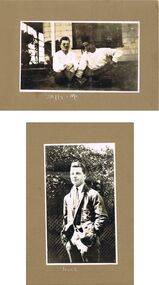
Photograph - HILDA HILL COLLECTION: BLACK AND WHITE PHOTOS, 1920
... Stiffy & Mo Both dressed in white shirts and dark trousers seated on the ground in front of a white brick building, to the left there is a plant growing along a frames work attached to the verandah, window in house wall, Frank dressed in a school suit which has embossing on the pocket, he is standing in front of a trellis covered in shrubbery, both hands are in his pockets. ...Stiffy & Mo Both dressed in white shirts and dark trousers seated on the ground in front of a white brick building, to the left there is a plant growing along a frames work attached to the verandah, window in house wall, Frank dressed in a school suit which has embossing on the pocket, he is standing in front of a trellis covered in shrubbery, both hands are in his pockets. ...Hilda Hill Collection. Black & White Family Photos Total of 5. The 3 photos taken in 1920 depict family gathering at Durvol Kyneton in September, the gentlemen of the family at 'The Ranch' ?Eppalock in November and Mona nursing baby at Kilmore on December 19th. Stiffy & Mo Both dressed in white shirts and dark trousers seated on the ground in front of a white brick building, to the left there is a plant growing along a frames work attached to the verandah, window in house wall, Frank dressed in a school suit which has embossing on the pocket, he is standing in front of a trellis covered in shrubbery, both hands are in his pockets. Four men and a boy, all dressed in dark suits white shirts and dark ties,man in middle has his right hand in his pocket, and the boy has his tie outside of the coat, the four men are all wearing hats, The Ranch November 1920. Mona at Kilmuir December 19th 1920, Mona is wearing a large hat and wearing a dark dress and nursing a baby dressed in white, right background is a white door. Rough, Doreen Vin, Tom Durvol September 1920, Doreen is wearing a white blouse dark skirt and dark stockings with black shoes, Vin wears a dark suit white shirt and dark tie, Tom is wearing a white shirt and dark shorts with braces, also dark socks and shoes, background is steps upon which these folk are sitting and is part of the larger house made of brick .Hilda Hill Personal Collectionaustralia, history, victoria -
 Bendigo Historical Society Inc.
Document - MALONE COLLECTION: GREETING CARDS
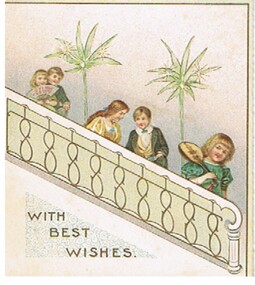
... work on the sides of the stairway.On the stairway are 3 little girls & 2 boys. The girl near the bottom of the stairway is wearing a green dress. She has a musical instrument on her shoulder. She has blond hair. Next is a boy wearing a white shirt...work on the sides of the stairway.On the stairway are 3 little girls & 2 boys. The girl near the bottom of the stairway is wearing a green dress. She has a musical instrument on her shoulder. She has blond hair. Next is a boy wearing a white shirt ...Whitish card with pale green border along the cut edges. Gold line between the green & white. A white, green & grey stairway with gold work on the sides of the stairway.On the stairway are 3 little girls & 2 boys. The girl near the bottom of the stairway is wearing a green dress. She has a musical instrument on her shoulder. She has blond hair. Next is a boy wearing a white shirt, yellow waistcoat & black jacket. He has dark coloured hair. Next is a girl with reddish hair. She is wearing a yellow dress. At the top is a boy & girl together. The girl is holding a blue & red fan in front of her. The boy is half behind her. He is wearing a dark jacket. They both have blond hair. Behind the stairway are two palm type trees. Blue shading behind the children. In the bottom left corner is a blue scroll work triangle with 'With Best Wishes' printed in gold.person, greeting cards, malone collection, malone collection, greeting cards -
 Uniting Church Archives - Synod of Victoria
Uniform - Presbyterian Deaconess' Dress
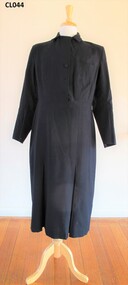
... work in the Queen's birthday honours in 1981. Deaconess Foster was one of the first qualified Mother Christmasses in Australia. [Minutes of the Sixth Synod, Oct 1982] presbyterian deaconess Deaconess Hilda Elizabeth Foster Black woollen long sleeved unlined shirt-waist dress with a side zip, three fabric covered button and two breast pockets. ...Hilda Elizabeth Foster (1890-1982) was commissioned as a Deaconess in 1914 giving a lifetime of service to the church particularly in the social care aspect of the Gospel. She was also a double certified nurse. Deaconess Hilda Foster began her work as a Deaconess in South Melbourne and then served for 13 years with the Presbyterian Sisterhood in North Fitzroy caring for unmarried mothers and their babies. In 1933 she was appointed Matron of the Presbyterian Girls' Home in Elsternwick where she worked for 15 years. She retired in 1948 when it was noted "In complete dedication matron has given herself to this care of souls". Deaconess Foster was awarded the British Empire Medal for her work in the Queen's birthday honours in 1981. Deaconess Foster was one of the first qualified Mother Christmasses in Australia. [Minutes of the Sixth Synod, Oct 1982]Black woollen long sleeved unlined shirt-waist dress with a side zip, three fabric covered button and two breast pockets. The dress has a collar and has two box pleats at the front and back. It has a white cotton lining at the neck.presbyterian deaconess, deaconess hilda elizabeth foster -
 Uniting Church Archives - Synod of Victoria
BW photo, March 1986
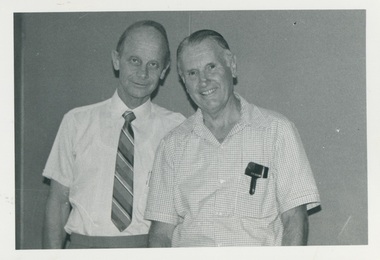
... He worked at Mitchell Brushes (the company owned by Ethel and John Mitchell. rev. jock lavender; mr alex kilgour; methodist, presbyterian, uniting church; synod appointments; moderator C&N 19/3/1986 B&W photograph. The Rev. John C (Jock) Lavender and Mr Alex Kilgour, dressed in shirts ...John (Jock) Corben Lavender Jock was born in Ivanhoe, but spent most of his youth in Northcote where his father was a bank manager, and where he attended primary school, high school and the Methodist church in High Street which became a central point in his life. He took his first job in the dispatch office at McPhersons nut and bolt factory in North Richmond in 1935. After a short time at McPhersons he moved to the Trustees Executors and Agency Company in 1936. While working at the Trustees Jock developed the conviction that his vocation lay with the church. This necessitated studying Matriculation at night school for two years as well as working and studying to become a Local Preacher. The minister at Northcote at the time was the Rev.F.T.Cleverdon who helped him prepare to apply as a candidate for Ordination. Before going to university and Queen’s for his arts degree and theological training, Mr Cleverdon, who was now the minister at Neil Street, Ballarat, offered Jock the opportunity to minister to the small congregation at Brown Hill, Ballarat, which was in his Circuit, and to live with the Cleverdons. He spent a year in Ballarat under the tutelage of Rev.F.T Cleverdon in 1939. Jock was accepted by the 1940 Victorian Methodist Conference as a Candidate for the Ministry and started his studies for his theological training and an arts degree at Melbourne University that year. Because of a shortage of ministers, due to the war, Jock was taken out of Queen’s in 1943 to take charge of two fairly small churches in Caulfield - Hawthorn Road and Bambra Road. Jock was ordained in 1945 & married two days later to Elsie Chipperfield, with whom he had worked at the Trustees Executors and Agency. He had joined the RAAF as a chaplain and was sent to Borneo. Returning to Australia in early 1946, he was then appointed to Orbost for a year, Bracknell in Tasmania in 1948, followed by Reid in Canberra, 1951. The next move was to Portland in 1954. Unfortunately not long after this, Elsie was diagnosed with breast cancer. This necessitated a move back to Melbourne - to Mitcham in 1957. Elsie died in December 1957. This period was a very hard time as Jock had four young daughters but his mother helped out by living in for most of the week until Jock was married to Peg in 1959 and their son was born in 1961. In 1964 Jock was moved to Launceston, his first city church. These years were challenging for Jock as he felt compelled to speak out around social issues, such as the Vietnam War & Aboriginal rights, although many did not agree with his view. In 1969 Jock was moved to Horsham to take up the role of Separated Chairman of the North-Western District responsible for Circuits, ministers and families for policy issues and pastoral concerns over an area from the South Australian border, up to the Murray and over it to Wentworth and Dareton, up river to Swan Hill and south to Ballarat and Daylesford. It was a demanding job but richly rewarding in the relationships made with ministers and their families. In 1971 Jock was elected Secretary of the Methodist Conference and in 1972 was voted President of the Conference. He felt it an honour and a vote of confidence by clergy and lay people The final move was to Geelong in 1976 where Jock was the minister at Wesley until 1983.Jock found Geelong a very satisfying parish in which to finish his active ministry. It was while he was Minister of Wesley Church, Geelong, that the Uniting Church came into being and Jock became the first Chairman of the Barwon Presbytery. There were now two ministers at Wesley – Jock and Alex Peerman, whose joint congregation of St. Giles (Pres) and City Congregational now joined with Wesley to become the City Parish. Jock was very surprised to be elected as the third Moderator of the Uniting Church in Victoria, to take office in 1979/1980 1983 saw retirement to Portarlington several months’ locum in both Canada & Kununurra. When the property at Portarlington became too large to maintain, they moved in 1994 into the current house in Belmont & returned to the Wesley Church here. In the words of Rev. Prof. Norman Young and Rev. Peter Gador-Whyte at Jock’s funeral service: “We are here today to give thanks to God for Jock Lavender; a gentle man of great compassion, humour and humility. We gather to remember the love he shared so generously the faith he lived so graciously, and the hope he expressed both in his preaching and in his presence. As President of the Methodist Conference and Moderator of the Uniting Church Jock held significant leadership roles within the church and did so with great dignity and grace never lording it over people but leading by example with an inner strength and faith that won respect and trust. There was something really special about him that is hard to put your finger on. We have all been blessed by God through Jock. Mr Alexander Kilgour Alex Kilgour was for many years an active elder and layman in the Presbyterian and then Uniting Church. He was involved in many committees at Synod level for many years. He was a Moderator of the Synod of Victoria of the UCA—one of the first laypeople to take on the role in the early years of the UCA. He was for many years Executive Director of the Resources Commission of the Synod. He worked at Mitchell Brushes (the company owned by Ethel and John Mitchell. B&W photograph. The Rev. John C (Jock) Lavender and Mr Alex Kilgour, dressed in shirts, are standing shoulder to shoulder, facing the camera.C&N 19/3/1986rev. jock lavender; mr alex kilgour; methodist, presbyterian, uniting church; synod appointments; moderator -
 Uniting Church Archives - Synod of Victoria
BW photo, December 1987
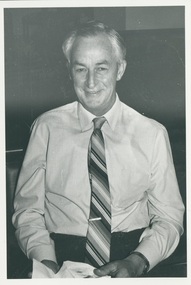
... Alex Gillespie (29/2/1928–1/9/2009) worked for the Presbyterian Church as its Managing Treasurer for many years before then moving to the Uniting Church as the Synod Treasurer. C&N 11/2/1987, p. 33 BW photo of Alex Gillespie dressed in shirt sleaves and tie, upper body. ...Eulogy by John McArthur t seems trite to say that it is a privilege to be able to speak about Alex’s work in the Church, but having known Alex for over 50 years and our various activities having been inextricably intertwined it is indeed an honour as well as a privelge. I first met Alex in the late 1950s when we were members of the PFA State Council – they were halcyon days for the young people in the church with very strong youth groups in most congregations. Alex was the state Treasurer. John Anderson was the President with Maureen Hancock, the secretary, Maureen, who with many others from that Council are here today. Alex was also very active in his local church at Canterbury in all aspects of its life and witness as we have heard from his children, Barrie and Jo, earlier in this service Alex who had trained as an accountant, applied for and been appointed to a position with the PCV and upon the retirement of his mentor, S. K. Williams, was appointed the Financial Secretary of the Church. When I was appointed as a member of the Trusts Corporation, I was very glad to see that Alec was the secretary – most members were nearly twice my age and it waas comforting to be with an old friend of somewhat similar age. The meetings were reasonably formal as one would expect from a gathering of some of the very senior business men in our State. Alex’s records were immaculate – not only did his agendas have the business arising from the previous meeting but there on the side were a list of matters that in Alex’s opinion had not been satisfactorily finalised over the past year. But one matter has stuck in my memory - only the correspondence that required action was considered, many other letters were left to be formally minuted. This time there was a letter from the Government advising that a building on the south side of Collins Street originally owned by the Free Presbyterian Church in the 1800s was to be placed on the Historic Register and this was our first intimation of the matter. One trustee, a knight of the realm, whose chin was always down on his chest, ( I wondered whether he was asleep or something) raised his head and said “If one just stood still in Collins Street for five minutes they would slap a historic citation on you” and back down went his head. I was not sure what would happen next when I looked at Alex and slowly, that recognisable smile appeared on his face – not really a smile , more like a grin as Barrie and Jo said earlier, one that would appear time and time again over the years at meetings which were meant to be quite formal. Alex had an encyclopaedic memory – for example, ask him about bequest funds, say, the W. S. Godfrey Perpetual Bequest, his answer would be, “Ah yes, donated by the man who founded the Grocery business in Carlton, the capital now would be about 53, 250 dollars, been no call on it for 2 ½ years”. If a new project was thought appropriate and needed funding, he would be able to find a fund or a bequest that, with a little tweaking, could be used to seed the programme. His financial presentations at meetings contained all the information one could want – he would choose his words carefully, and one would sometimes think – get on with it Alex - but his purpose was to make it quite clear what funds were available and what was their correct use. He took this financial acumen into other committees of the church, the Stipend Committee dealing with Ministers’ salaries, the Beneficiary Committee, the superannuation fund for both ministers and lay workers. There are many in the church who have had cause to be grateful for his financial input which added to their well being. But his work was not all with financial matters – as the Financial Secretary for the State, Alex was ex-offficio a member of the Presbytery of Maroondah where he was not the Treasurer and although as an ex officio member he was not expected to take that much part in the Presbytery’s activities – but Alex did, he took part in the strategy and pastoral care committees which showed his depth of concern for others in his church life. But I believe it was around this time that Alex produced some of his greatest work for the church – Church Union, not all Presbyterians wanted to be part of the Uniting Church – so a Statutory Commision was established on a national level, to divide the assets of the Church between those desiring to form part of the Uniting Church and those wanting to remain Presbyterian. Each State produced detailed records and submissions for the Commission – and Victoria was always the first to have its documents to the Commission – although Alex had made it quite clear that he would be with the Uniting Church, his work was meticulous, impartial and assisted greatly the work of the Commission relating to Victoria. And this in addition to his normal day to day work which continued over a period of some four or five years. The inauguration of the Uniting Church did present Alex, and indeed the rest of us, with some challenges. There were the financial records of three churches to be merged, properties to be considered, new community programmes required, new administrative structures to be put in place. Alex took these all in his stride – although after the initial planning, his role was to concentrate on financial matters only, the other activities had to be financed. As the chairperson of the Finance Division and the Resources Commission for a large portion of the early years of the Uniting Church, I was more than pleased to have Alex again by my side, reports were prepared, queries answered, it was just like old times. The Rev. Allan Stuart, now retired and living closer to his family in NSW was one on those young people from the Canterbury congregation – emailed me recently “Alex has been a faithful servant of the Church, at all levels from the National Assembly to the local congregation. But times are changing, and Alex had rightly passed the torch onto others” Allan was right but I also think that words of that great Scottish poet, Robert Louis Stevenson, sum up Alex’s life: “A man is a success when he has lived well, laughed often and loved much. One who has gained the respect of intelligent men and the love of children; who has filled his niche and accomplished his task; who leaves the world better than he found it, whether by work, relationships, one who looked for the best in others and gave the best he had.” To me, that is our friend who we remember today - Alexander Robert Gillespie. BW photo of Alex Gillespie dressed in shirt sleaves and tie, upper body.C&N 11/2/1987, p. 33alex gillespie (29/2/1928–1/9/2009) worked for the presbyterian church as its managing treasurer for many years before then moving to the uniting church as the synod treasurer. -
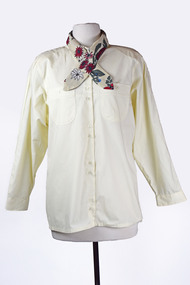 National Wool Museum
Uniform - 1992 Barcelona Olympic Games Women's Official Occasions Cotton Blouse, Wendy Powitt, c. 1992
... work of Australian artist Margaret Preston. This included: Lightweight W/PE shorts by Fletcher Jones in Foster Valley Fabric, socks by Holeproof and footwear by Hush Puppy. 3. Village Clothing was designed to be highly visible garments to make it easy to spot the Aussie and helped to contribute to good team spirit. This included: A pure wool shirt featuring blocks of contrasting colours, and a newly developed stretch 50:50 wool/cotton fabric by Bradmill was made into shorts and jeans by Fletcher Jones. 1992 Barcelona Olympics sport athletes fashion design uniform BARCELONA 1992 A long sleeve cream coloured dress shirt with a detachable printed neck tie. ...About the 1992 Barcelona Olympic Games donor Doug Pleasance wrote- During the 1980's the Australian wool industry was at its most prosperous times with record numbers of sheep producing wool receiving ever increasing values due to the success of the Reserve Price Scheme, and the overall guidance of the Australian Wool Corporation (AWC). As a humble technician, my role was a low profile newly created position of Controller, Technical Marketing where wool was to be marketed on its technical properties, as distinct from the Product Marketing Group which exploited the traditional high profile approach of marketing wool;s superior fashion attributes. The Woolmark was the tool central to this approach. The 1992 Barcelona Olympic Games saw an evolutionary change in designer selection. A Declaration of Interest Form was communicated to over forty potential designers. The task and especially tight timelines that were involved deterred many aspirants, however, there remained eight designers with the potential we were seeking. These eight designers were paid $3,000 per submission and the winning designer, Wendy Powitt, was paid $15,000. For the first time the judging panel included two athletes, one male swimmer and one female basketballer, their influence was pivotal. The ensemble consisted of three elements- 1. The Official Uniform which was used for travel and all official functions. This included: a tailored blazer and trouser/skirt (all water repellent) by Fletcher Jones, pure wool olive-green faille fabric by Foster Valley, cotton PE formal shirt by Pelaco, pure wool knitwear by Spangaro, printed wool tie by TD Noone, wool nylon socks by Holeproof and footwear by Hush Puppy. 2. Opening Ceremony Uniform a lightweight wool fabric printed with floral designs that had been inspired by the work of Australian artist Margaret Preston. This included: Lightweight W/PE shorts by Fletcher Jones in Foster Valley Fabric, socks by Holeproof and footwear by Hush Puppy. 3. Village Clothing was designed to be highly visible garments to make it easy to spot the Aussie and helped to contribute to good team spirit. This included: A pure wool shirt featuring blocks of contrasting colours, and a newly developed stretch 50:50 wool/cotton fabric by Bradmill was made into shorts and jeans by Fletcher Jones.A long sleeve cream coloured dress shirt with a detachable printed neck tie. The neck tie is decorated in an Australian floral design inspired by the artist Margaret Preston. The shirt has two breast pockets and double sets of cream buttons. The rear of the shirt is unadorned. 8124.4 - Floral fabric sample. 8124.5 - Floral fabric sample.BARCELONA 19921992 barcelona olympics, sport, athletes, fashion, design, uniform
