
Showing 110 items matching "world war 1 victory medal"
-
 Colac RSL Sub Branch
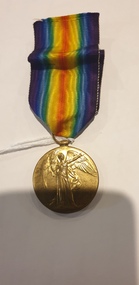
Medal - Victory Medal and Ribbon, World War 1 Medal and Ribbon. Victory Medal awarded to E. E. Connor. Service No:- 2598. 22nd Battalion
... World War 1 Medal and Ribbon. Victory Medal awarded to E. E. ...World War 1 military award for Australian Personnel Highly Significant Military awards Front:- Picture of an Angel Rear:- The Great War for Civilization 1914 -1919 Round bronze coloured medal with a multi coloured ribbon attached (Purple, dark blue, light blue, green, yellow and orange) World War 1 Medal and Ribbon. Victory ...World War 1 military award for Australian PersonnelHighly SignificantRound bronze coloured medal with a multi coloured ribbon attached (Purple, dark blue, light blue, green, yellow and orange)Front:- Picture of an Angel Rear:- The Great War for Civilization 1914 -1919military awards -
 4th/19th Prince of Wales's Light Horse Regiment Unit History Room
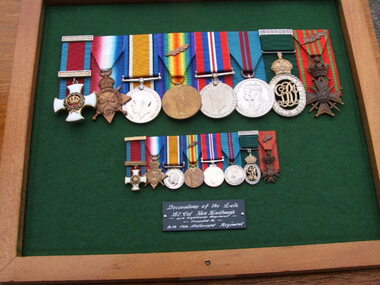
Medal Set, Col S G A Hindhaugh, 1914-1945
... world war...1...victory medal...March 1918 - In action at Passchendaele - Awarded Belgian Croix de Guerre. 7 December 1918 - To 2nd Light Horse Regiment. 2nd ANZAC Mounted Regiment. 15 May 1919 - Returned to Australia. 11 October 1919 - Transferred to Reserve of Officers. 1932 - Commanded 20th Light Horse Regiment. 1934 - Commanded 11th Light Horse Regiment. 15 November 1941 - Retired. medals world war 1 victory medal 4th light horse militia western front dso king george v coronation colonial officers auxiliary decoration 1914 1918 star mid croix de guerrre belgium passchendaele 2nd anzac mounted regiment 20th light horse 11th light horse Plaque in case enscribed: "Decorations of the late Lt Col Stan Hindhaugh 4th Light Horse Regiment. ...Stanley George Allen Hindhaugh (1883-1962), soldier, was born on 12 December 1883 at Camperdown, Victoria. His occupation was Station Manager. 14 April 1904 - Appointed Lieutenant 11th Light Horse Regiment Militia. 3 April 1911 - Promoted to Captain in the Militia. 20 August 1914 - Appointed to the Australian Imperial Forces to A Squadron, 4th Light Horse Regiment at Broadmeadows camp. 19 October 1914 - Embarked for the Middle East from Melbourne with the 4th Light Horse Regiment per Tranport A18 "Wiltshire". 11 December 1914 - Disembarked at Alexandria for camp Mena. 19 May 1915 - Promoted to Major. From 22 May 1915 - On operations at Gallipoli. 6 August 1915 - Noted in the fierce engagement at Leane's Post. 19 August 1915 - Appointed Second in Command 4th Light Horse Regiment. December 1915 - To camp at Tel El Kebir. January 1916 - Acting CO 4th Light Horse Regiment. 21 March 1916 - Embarked Alexandria per "Cestrian" for Marseilles with B Squadron 4th Light Horse Regiment for operations in France and Flanders. 16 February 1917 - Promoted to Lt Colonel. March 1918 - In action at Passchendaele - Awarded Belgian Croix de Guerre. 7 December 1918 - To 2nd Light Horse Regiment. 2nd ANZAC Mounted Regiment. 15 May 1919 - Returned to Australia. 11 October 1919 - Transferred to Reserve of Officers. 1932 - Commanded 20th Light Horse Regiment. 1934 - Commanded 11th Light Horse Regiment. 15 November 1941 - Retired. Full size and miniature sets of medals awarded to Colonel Stanley George Allen Hindhaugh. Comprising: Distinguished Service Order (Flanders 1 June 1918), 1914-1918 Star, British War Medal 1914-1920, Victory Medal (with MID) 1919, War Medal 1939-1945, King George V Coronation 1911, Colonial Officers Auxiliary Forces Decoration, Croix de Guerre (Belgium) 1917. Mounted in glass fronted display case.Plaque in case enscribed: "Decorations of the late Lt Col Stan Hindhaugh 4th Light Horse Regiment. Presented to 4th 19th Motorised Regiment". Adhesive label on case: Alwyn and Barbara Catmore 32 Morrie Crescent Blackburn Vic 3130 (03)8984124 medals, world war, 1, victory medal, 4th light horse, militia, western front, dso, king george v coronation, colonial officers auxiliary decoration, 1914 1918 star, mid, croix de guerrre belgium, passchendaele, 2nd anzac mounted regiment, 20th light horse, 11th light horse -
 Alfred Hospital Nurses League - Nursing History Collection
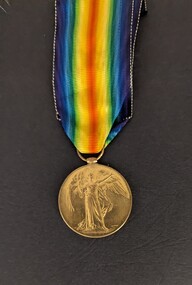
Medal - World War 1 medal, Royal Mint, Victory Medal (Leah Rosenthal), [ca.1919]
... World War 1...Military Medals...World War 1 Victory Medal...This medal was awarded to Leah Rosenthal (Alfred Hospital trained nurse)who served with Queen Alexandra's Nursing Service Reserve in France during World War 1 Of significance to the AHNL as the recipient had trained at the Alfred Hospital, graduating in 1904 World War 1 Military Medals World War 1 Victory Medal Leah Rosenthal Queen Alexandra's Imperial Military Nursing Service Reserve The reverse side bears the inscription "THE GREAT /WAR FOR/CIVILISATION/1914-1919" within a laurel wreath Round bronze medal with attached ring and ribbon. ...This medal was awarded to Leah Rosenthal (Alfred Hospital trained nurse)who served with Queen Alexandra's Nursing Service Reserve in France during World War 1Of significance to the AHNL as the recipient had trained at the Alfred Hospital, graduating in 1904Round bronze medal with attached ring and ribbon. The front of the medal displays a full-length winged figure (Victory) holding a palm leaf in her right hand. The ribbon has vertical stripes of red yellow, green,blue and violet from centre outwards. Has been mounted on a card along with the recipients 1914-1915 Military Star and British War MedalThe reverse side bears the inscription "THE GREAT /WAR FOR/CIVILISATION/1914-1919" within a laurel wreathworld war 1, military medals, world war 1 victory medal, leah rosenthal, queen alexandra's imperial military nursing service reserve -
 Colac RSL Sub Branch
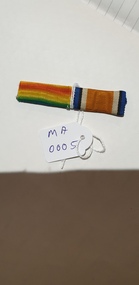
Medal - Campaign Ribbon Bar (Victory Medal Ribbon and British War Ribbon) awarded to Pte William John Baird Service No: 5994, Ribbon Bar
... World War 1 Victory Medal Ribbon (Multi coloured) and British War Medal Ribbon attached to a metal Bar...World War 1 Campaign Ribbons issued with medals awarded to Commonwealth Military Service Personnel High significance Military awards Nil World War 1 Victory Medal Ribbon (Multi coloured) and British War Medal Ribbon attached to a metal Bar Ribbon Bar Medal Campaign Ribbon Bar (Victory Medal Ribbon and British War Ribbon) awarded to Pte William John Baird Service No: 5994 Defence Department Australia ...World War 1 Campaign Ribbons issued with medals awarded to Commonwealth Military Service Personnel High significanceWorld War 1 Victory Medal Ribbon (Multi coloured) and British War Medal Ribbon attached to a metal BarNilmilitary awards -
 Learmonth and District Historical Society Inc.
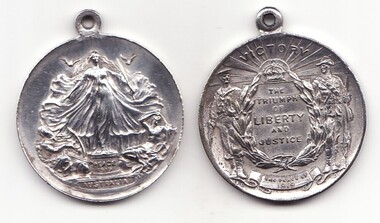
Peace 1919 Medal, Medal Peace 1919, 1919
... world war 1...peace...victory medal.... world war 1 peace victory medal australia Peace with two flying doves on pedestal inscribed, PEACE / 1919 below AUSTRALIA; figure in chains on left and another entangled in bush to right (obverse) Australian sailor and soldier support wreath; above, VICTORY; within, THE / TRIUMPH / OF / LIBERTY / AND / JUSTICE; below on plaque, THE PEACE OF 1919(reverse) Round white metal medals issued to mark the end of WW1. ...Awarded to: School Children of the Commonwealth of Australia Other Details: Of the commemorative medals issued to mark the end of the First World War, the most common was the so-called 'Peace' or 'Victory' medal issued to every child in Australia aged 0-14 years (and aged up to 16 if parents were in the armed forces). The medal was designed by Charles Douglas Richardson, better known for his work as a sculptor. Time constraints as well as pressure from the production of other victory medals meant that no single manufacturer could make the 1,670,000 medals. Six were therefore selected: Amor, Stokes, Schlank, Parkes, Angus & Coote (who later withdrew) and Platers. The medals were silvered bronze, with silver issues for special presentations. The Defence Department supplied a red, white and blue striped ribbon and pin. Distribution began in March 1919. Victorian school children received their medals on Friday 18 July and on 'Peace Day' on Saturday 19 July.To commemorate the end of World War 1.Round white metal medals issued to mark the end of WW1. On the front "PEACE 1919", and on the reverse, "VICTORY", middle of the medal "THE TRIUMPH OF LIBERTY AND JUSTICE". on the bottom "THE PEACE OF 1919". With a plain edge.Peace with two flying doves on pedestal inscribed, PEACE / 1919 below AUSTRALIA; figure in chains on left and another entangled in bush to right (obverse) Australian sailor and soldier support wreath; above, VICTORY; within, THE / TRIUMPH / OF / LIBERTY / AND / JUSTICE; below on plaque, THE PEACE OF 1919(reverse)world war 1, peace, victory medal australia -
 Frankston RSL Sub Branch
Medal Set (set of 3)
... Thomas Richard Cook Service number: 1732 Rank: Private Roll title: 1 Infantry Battalion - 1 to 8 Reinforcements (December 1914 - August 1915) Conflict: First World War, 1914-1918 Date of embarkation: 10 April 1915 Place of embarkation: Sydney Ship embarked on: HMAT Argyllshire Ship number: A8 medals 1914 15 star british war medal victory medal ww1 medals 1) 1914-15 Star: Star with crown on top, with crossed swords, embossed with "1914-15" on obverse side, "1768/ Gnr T R Cook/ 1/Bn. ...Thomas Richard Cook Service number: 1732 Rank: Private Roll title: 1 Infantry Battalion - 1 to 8 Reinforcements (December 1914 - August 1915) Conflict: First World War, 1914-1918 Date of embarkation: 10 April 1915 Place of embarkation: Sydney Ship embarked on: HMAT Argyllshire Ship number: A8 Set of WW1 medals issued to T. R. Cook, note DCM + MM not included. 1) The 1914-1915 Star. Awarded for service on the establishment of a ship or unit in a theatre of war. A member awarded the 1914 Star could not be awarded the 1914-15 Star (this award). 2) British War Medal. Awarded for service as follows: • Navy - for 28 days mobilised service or to those who lost their lives in active operations before completing that period, between 5 August 1914 and 11 November 1918. • Army and Air Force - entry into a theatre of war on duty, or who left places of residence and rendered approved overseas service between 5 August 1914 and 11 November 1918. • Mercantile Marine - at least six months service between 5 August 1914 and 11 November 1918. 3) The Victory medal. Awarded for service as follows: • Navy - those who were mobilised and rendered approved service either at sea between 5 August 1914 and 11 November 1918 or on the establishment of a unit within a theatre of military operations. • Army - those who served on the establishment of a unit in a theatre of war. • Air Force - those who served on the establishment of a unit in a theatre of war outside the UK, served with an operational unit in the UK or overseas and had been actively engaged against the enemy, been employed in flying new aircraft to France or served on the complement of aircraft-carrying ships. A member Mentioned in Dispatches for service during World War 1 wears a bronze oak leaf on the ribbon. Only one emblem is worn no matter how many times a member may have been 'mentioned' 1) 1914-15 Star: Star with crown on top, with crossed swords, embossed with "1914-15" on obverse side, "1768/ Gnr T R Cook/ 1/Bn. A.I.F." 2)King George head and mounted warrioir on obverse. 3)Winged Brittania and obverse "The Great/war for/civilisation/1914-1919"medals, 1914 15 star, british war medal, victory medal, ww1 medals -
Ballarat Clarendon College
Medal, Victory Medal 1914-19, 01/09/1919
... world war one...ballarat college...victory medal...w w 1...War Medal - it was never awarded singly. These three medals were sometimes irreverently referred to as Pip, Squeak and Wilfred. The Holgate medals were the first war medals held by BCC archives. They have historical and social significance for the College. world war one ballarat college victory medal w w 1 ...The Victory Medal (also called the Allied Victory Medal) is a campaign medal - of which the basic design and ribbon was adopted by Belgium, Brazil, Cuba, Czechoslovakia, France, Greece, Italy, Japan, Portugal, Romania, Siam, Union of South Africa and the USA. The medal was issued to all those who received the 1914 Star or the 1914-15 Star, and to most of those who were awarded the British War Medal - it was never awarded singly. These three medals were sometimes irreverently referred to as Pip, Squeak and Wilfred.The Holgate medals were the first war medals held by BCC archives. They have historical and social significance for the College.The Victory Medal is a 36mm diameter circular copper medal, lacquered in bronze. The obverse shows the winged, full-length, full-front, figure of Victory, with her left arm extended and holding a palm branch in her right hand. The reverse has the words ‘THE GREAT / WAR FOR / CIVILISATION / 1914-1919' in four lines, all surrounded by a laurel wreath. The 39mm wide ribbon has a ‘two rainbow' design, with the violet from each rainbow on the outside edges moving through to a central red stripe where both rainbows meet.The reverse has the words ‘THE GREAT / WAR FOR / CIVILISATION / 1914-1919' in four linesworld war one, ballarat college, victory medal, w w 1, e s holgate, allied victory medal -
 Ballarat Clarendon College
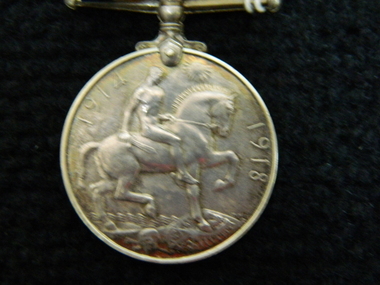
Medal, British War Medal, 1918
... war mine clearance and service in Russia during 1919 and 1920. Lieut E. S. Holgate was mentioned in despatches for Gallantry in the Field 24/25 April 1918. He was killed in action at Villers-Bretonneux, 27 April, 1918. The British War Medal completes a trio of medals awarded to Lieut. E. S. Holgate, including the 1914-15 Star and the Victory Medal. The Holgate medals were the first war medals held by BCC archives. They have historical and social significance for the College. medal 1918 world war 1 ...The British War Medal 1914-20 was iInstituted by King George V in 1919 to mark the end of World War I and record the service given. The qualification period was later extended to cover post-war mine clearance and service in Russia during 1919 and 1920. The British War Medal was awarded for service in a theatre of war between 5 August 1914 and 11 November 1918. Those eligible included members of women's organisations; persons on the staffs of military hospitals and members of recognised organisations who handled sick and wounded; and members of other duly recognised or other authorised organisations as specified in medal regulations. The qualification period was later extended to cover post-war mine clearance and service in Russia during 1919 and 1920. Lieut E. S. Holgate was mentioned in despatches for Gallantry in the Field 24/25 April 1918. He was killed in action at Villers-Bretonneux, 27 April, 1918. The British War Medal completes a trio of medals awarded to Lieut. E. S. Holgate, including the 1914-15 Star and the Victory Medal. The Holgate medals were the first war medals held by BCC archives. They have historical and social significance for the College.The British War Medal is round and made of cupro-nickel. It features the effigy of George V on the obverse. The reverse has an image of St George on horseback trampling underfoot the eagle shield of the Central Powers, and a skull and cross-bones, the emblems of death. Above this is the risen sun of victory. The British War Medal has a wide central watered stripe of orange, flanked by two narrow white stripes, which are in turn flanked by two black pin-stripes, further flanked by two outer stripes of purple. The colours have no particular significance. Impressed around edge are the recipient's details. Inscribed around outer edge of obverse: 'GEORGEIVS V BRITT. OMN:REX ET IND:IMP:' Impressed around edge of medal: 'LIEUT.E.S.HOLGATE. A.I.F.' Inscribed on the reverse '1914 1918'medal, 1918, world war 1, british war medal, w w 1, holgate, a i f, australian imperial force, holgate e s, holgate medal -
Ballarat Clarendon College
Medal, Victory Medal 1914-1919
... world war one...ballarat college...victory medal...w w 1...Victory Medal) is a campaign medal - of which the basic design and ribbon was adopted by Belgium, Brazil, Cuba, Czechoslovakia, France, Greece, Italy, Japan, Portugal, Romania, Siam, Union of South Africa and the USA. This medal was never awarded singly. It ia accompanied by the ribbon of the British War Medal but this medal is not held in the School archive The medal is of historical and social significance for the College. The Holgate medals were the first WW1 medals held by the school archive. world war one ballarat college victory medal w w 1 ...The Victory Medal (also called the Allied Victory Medal) is a campaign medal - of which the basic design and ribbon was adopted by Belgium, Brazil, Cuba, Czechoslovakia, France, Greece, Italy, Japan, Portugal, Romania, Siam, Union of South Africa and the USA. This medal was never awarded singly. It ia accompanied by the ribbon of the British War Medal but this medal is not held in the School archiveThe medal is of historical and social significance for the College. The Holgate medals were the first WW1 medals held by the school archive.The Victory Medal is a 36mm diameter circular copper medal, lacquered in bronze. The obverse shows the winged, full-length, full-front, figure of Victory, with her left arm extended and holding a palm branch in her right hand. The reverse has the words ‘THE GREAT / WAR FOR / CIVILISATION / 1914-1919' in four lines, all surrounded by a laurel wreath. The 39mm wide ribbon has a ‘two rainbow' design, with the violet from each rainbow on the outside edges moving through to a central red stripe where both rainbows meet. The reverse has the words ‘THE GREAT / WAR FOR / CIVILISATION / 1914-1919' in four lines Inscribed around outer edge of medal: '4303 A-CPL. H. S. HOLGATE 29 BN A.I.F.'world war one, ballarat college, victory medal, w w 1, allied victory medal, h s holgate -
Lara RSL Sub Branch
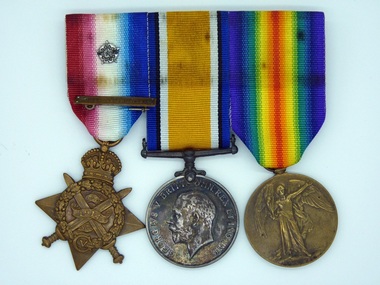
Medals, C T Fleming
... MEDAL ''1'' 1914/15 STAR .....ISSUED 5/8/14TO 31/12 /15. MEDAL ''2'' BRITISH WAR MEDAL......ISSUED AUG 14 TO NOV 18........MEDAL''3''VICTORY MEDAL .......ISSUED AUG 14 TO NOV 18. World ...MEDAL ''1'' 1914/15 STAR .....ISSUED 5/8/14TO 31/12 /15. MEDAL ''2'' BRITISH WAR MEDAL......ISSUED AUG 14 TO NOV 18........MEDAL''3''VICTORY MEDAL .......ISSUED AUG 14 TO NOV 18. World War 1 Medals belonging to C. Fleming Service number 230THREE MEDALS Medal 1 ....731issue SPR/C.Fleming ...2/F CE D6/A I F FACE 1914/15. V........Medal 2Reverse 1914/1918 ....Face Georg..I V SV BRITT.OMN .REX E T IND.IMP ......on rim 230CorporalC T L/C.Fleming Sec.Fce A I F ......Medal 3 Reverse THE GREAT WAR FOR CIVILISATION ......Face.Adepiction of The Angel of Peace.....on rim ...230Corporal. C T L/C.Fleming Sec.Fce A I F.Medalmedal, lara, rsl, world war one, wwi -
 Lara RSL Sub Branch
Medal - Bombardier G.S.Hunt 57473, 1914
... world war 1...army...royal field artillery...1914 star...british war medal...victory...World War 1 Australian Bombardier with the Royal Field Artillery brass hunt g.s hunt christmas 1914 princess mary bombadier ww1 world war 1 army royal field artillery 1914 star british war medal victory medal The lid is embossed with the bust of HRH Princess Mary in a wreath with the letter "M" to either side and the following words "IMPERIUM BRITANNICUM" and "CHRISTMAS 1914" and has the country names "FRANCE", "BELGIUM", "JAPAN", "RUSSIA", MONTENEGRO" and "SERVIA". 189.1 Front of card a crown with M underneath with 1915 under that. ...World War 1 Australian Bombardier with the Royal Field Artillery189 A brass gift box with an embossed hinging lid which was presented to WW1 sailors and soldiers for Christmas 1914. The gift was at the initiative of HRH The Princess Victoria Alexandra Alice Mary the daughter of the then King George V and Queen Mary. 189.1 Small card with paper insert 189.2 Three medals with coloured ribbons, one medal has a small metal badge attached. Items belonging to Bombardier G.S.Hunt, 57473 in the Royal Field Artillery, WW1.The lid is embossed with the bust of HRH Princess Mary in a wreath with the letter "M" to either side and the following words "IMPERIUM BRITANNICUM" and "CHRISTMAS 1914" and has the country names "FRANCE", "BELGIUM", "JAPAN", "RUSSIA", MONTENEGRO" and "SERVIA". 189.1 Front of card a crown with M underneath with 1915 under that. Inside Wreath with sword through it and the words With best wishes for a victorious new year from The Princess Mary and friends at home. 189.2 WW1 Campaign Medals / ribbons 1914-15 Star, British War Medal and Victory Medal.brass, hunt, g.s hunt, christmas, 1914, princess mary, bombadier, ww1, world war 1, army, royal field artillery, 1914 star, british war medal, victory medal -
 Koroit & District Historical Society
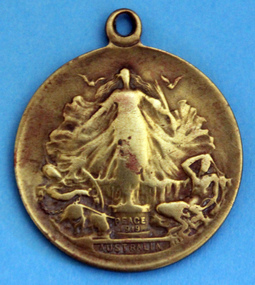
WWI school peace memorial Triumph of Liberty and Justice 1919, Back of Medal, 1919
... Schools victory medal awarded to school children( 0-14 years of age) of the Commonwealth of Australia. This was a commemorative medal to mark the end of world war 1. ...Schools victory medal awarded to school children( 0-14 years of age) of the Commonwealth of Australia. This was a commemorative medal to mark the end of world war 1. ...Schools victory medal awarded to school children( 0-14 years of age) of the Commonwealth of Australia. This was a commemorative medal to mark the end of world war 1. Victorian children received their medals on Friday 14th July and on "Peace Day" on Saturday 19th July.Round with loop, made of silvered bronze1919, peace, medal, school, wwi -
 Orbost & District Historical Society
medals, 1919-1920
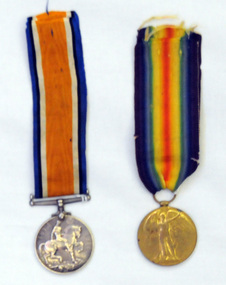
... War Medal was a medal given to people who had fought in the First World War. The Victory Medal (also called the Inter-Allied Victory Medal) is a First World War campaign medal of Britain and her then colonies and dominions which included Australia. These personal documents, photographs, medals and books give an insight into the human element of World War 1 ...These medals are part of the Lawless Collection. The Lawless family lived in Orbost from 1907 - c 1920. John Francis Lawless had a saddlery shop. He died at an early age - 47 years - June 7 1912, leaving his wife, Elizabeth and seven children. The eldest son, Victor Rowland lawless volunteered for serv ice in WW1 but did not leave Australia because of illness. The second son, Edward Vincent Lawless (b 1895 d 1917) worked for McCoy & Co. in Orbost, coachbuilding, undertakers, general blacksmiths and farriers, prior to enlisting in WW!. He was trained as a signaller and was sent to France where he was killed in action on 9.10.1917. Elizabeth Lawless worked as a ladies' nurse (midwife) in Orbost prior to leaving the district in 1920. She lived to 6.6.1975 aged 104 years. The British War Medal was a medal given to people who had fought in the First World War. The Victory Medal (also called the Inter-Allied Victory Medal) is a First World War campaign medal of Britain and her then colonies and dominions which included Australia.These personal documents, photographs, medals and books give an insight into the human element of World War 1 ensuring that those who were part of the Orbost community and died while playing a vital role during this time are remembered.Two medals in recognition of service during WW1. 1846.3 is a silver medal a WW1 1914-18 British War Medal. Obverse: Bare head of King George V facing left; text around, 'GEORGIVS V BRITT: OMN: REX ET IND: IMP:'; the artist's initials 'B.M.' (Bertram MacKennal) are on the neck truncation. Reverse: Naked figure of St. George on horseback advancing right trampling a shield bearing an eagle design and a skull and crossbone. It has a blue/white/orange striped ribbon attached. 1846.4 is a gold coloured medal. The obverse in the medal shows the winged, full-length, full-front, figure of 'Victory' with her left arm extended and holding a palm branch in her right hand. The reverse has the words ‘THE GREAT / WAR FOR / CIVILISATION / 1914-1919' in four lines, all surrounded by a laurel wreath. It has a purple/blue/green/yellow and orange striped ribbon attached.medals ww1 lawless-family -
 Bendigo Military Museum
Award - MEDAL SET WW1 AND BADGES, Post 1919
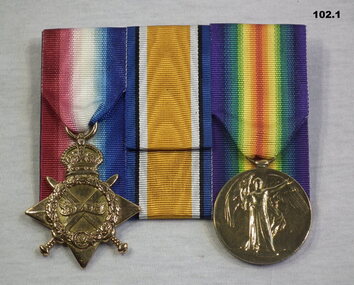
... medals-military badges-military military history-army .1) “1572 Pte W.H.Smith 25 Bn AIF” .3) Front: “TPI 1981. Totally and Permanently Incapacitated Disabled Soldiers Association” .4) Front. “World War I Veterans. Travel Pass1980, 3152” Medals, WWI. Court mounted, set of 2 medals with 3 ribbons. 1914-15 Star, British War Medal 1914 - 18 Ribbon. Victory ...Walter Henry SMITH ( Born London, enlisted Lismore NSW) No 1572 enlisted in C Coy 25th Batt AIF on 9.4.1915. Embarked for Eygpt 29.6.1915, embarked for Gallipoli 4.9.1915. Hospitalised with enteritis on 21.10.1915. Embarked for France 14.3.1916. Transferred to 7th MG Coy on 17.7.1916. WIA 27.8.1916 shell shock and again on 29.7.1917 shell wound left leg. Discharged from the AIF on 26.7.1919 classed Medically unfit. Medals, WWI. Court mounted, set of 2 medals with 3 ribbons. 1914-15 Star, British War Medal 1914 - 18 Ribbon. Victory Medal 1914 - 19 .2) Badge, No. V43195 RSSILA . Red, white & blue enamel, 2 figures in centre. Surmounted with a crown with gold No 80 on red background. Denotes financial member 1980. .3) Badge TPI No 01068. Blue enamel on brass, surmounted with a crown. Centre is black enamel & brass mini-badge with TPI 1981. .4) Medallion, WW1 Veterans Travel Pass for 1980. No. 3152. Black & gold..1) “1572 Pte W.H.Smith 25 Bn AIF” .3) Front: “TPI 1981. Totally and Permanently Incapacitated Disabled Soldiers Association” .4) Front. “World War I Veterans. Travel Pass1980, 3152”numismatics-medals-military, badges-military, military history-army -
 4th/19th Prince of Wales's Light Horse Regiment Unit History Room
Book, Margaret Grant, A Rich Heritage, A Story of Courage and Victory. Elsie and Sloan Bolton, DCM, not dated, about 2006
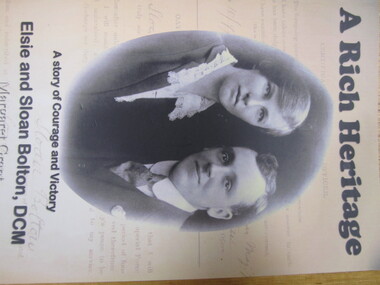
... Medal for his actions in capturing a German field gun at Beersheba on 31st October 1917. In the same action he was instrumental in preventing German engineers from destroying the wells. This biography describes his war service and his family life and considerable achievements after the war world war 1 beersheba 4th light horse regiment sloan scotty bolton elsie bolton margaret grant Inscribed by author: "Margaret Grant daughter of Sloan - proud of that name - Margaret" Soft covered book 216 pages A Rich Heritage, A Story of Courage and Victory. ...Trooper Sloan Bolton DCM enlisted in the 4th Australian Light Horse Regiment and served at Gallipoli and in Palestine. He was awarded the Distinguished Conduct Medal for his actions in capturing a German field gun at Beersheba on 31st October 1917. In the same action he was instrumental in preventing German engineers from destroying the wells. This biography describes his war service and his family life and considerable achievements after the warTrooper Sloan Bolton DCM enlisted in the 4th Australian Light Horse Regiment and served at Gallipoli and in Palestine. He was awarded the Distinguished Conduct Medal for his actions in capturing a German field gun at Beersheba on 31st October 1917. In the same action he was instrumental in preventing German engineers from destroying the wells. This biography describes his war service and his family life and considerable achievements after the warSoft covered book 216 pagesInscribed by author: "Margaret Grant daughter of Sloan - proud of that name - Margaret"world war 1, beersheba, 4th light horse regiment, sloan scotty bolton, elsie bolton, margaret grant -
4th/19th Prince of Wales's Light Horse Regiment Unit History Room
Medal, Australian Peace Medal 1919
... victory medals meant that no single manufacturer could make the 1,670,000 medals. Six were therefore selected: Amor, Stokes, Schlank, Parkes, Angus & Coote (who later withdrew) and Platers. The medals were silvered bronze, with silver issues for special presentations. The Defence Department supplied a red, white and blue striped ribbon and pin. Distribution began in March 1919. Victorian school children received their medals on Friday 18 July and on 'Peace Day' on Saturday 19 July. Peace medal World War 1 ...Awarded to: School Children of the Commonwealth of Australia Other Details: Of the commemorative medals issued to mark the end of the First World War, the most common was the so-called 'Peace' or 'Victory' medal issued to every child in Australia aged 0-14 years (and aged up to 16 if parents were in the armed forces). The medal was designed by Charles Douglas Richardson, better known for his work as a sculptor. Time constraints as well as pressure from the production of other victory medals meant that no single manufacturer could make the 1,670,000 medals. Six were therefore selected: Amor, Stokes, Schlank, Parkes, Angus & Coote (who later withdrew) and Platers. The medals were silvered bronze, with silver issues for special presentations. The Defence Department supplied a red, white and blue striped ribbon and pin. Distribution began in March 1919. Victorian school children received their medals on Friday 18 July and on 'Peace Day' on Saturday 19 July.White metal, circular. Peace with two flying doves on pedestal inscribed, PEACE / 1919 below AUSTRALIA; figure in chains on left and another entangled in bush to right (obverse) Australian sailor and soldier support wreath; above, VICTORY; within, THE / TRIUMPH / OF / LIBERTY / AND / JUSTICE; below on plaque, THE PEACE OF 1919(reverse)peace medal, world war 1 -
4th/19th Prince of Wales's Light Horse Regiment Unit History Room
Medal, Victory Medal
... Victory Medal was authorised in 1919 to commemorate the victory of the Allied Forces over the Central Powers. Each of the Allied nations issued a ‘Victory Medal' to their own nationals with all of these having the figure of Victory on the obverse as a common feature. Australians were awarded the medal issued by Great Britain. A member mentioned in despatches (MID) for service during World War 1...Victory Medal was authorised in 1919 to commemorate the victory of the Allied Forces over the Central Powers. Each of the Allied nations issued a ‘Victory Medal' to their own nationals with all of these having the figure of Victory on the obverse as a common feature. Australians were awarded the medal issued by Great Britain. A member mentioned in despatches (MID) for service during World War 1 ...The Victory Medal was authorised in 1919 to commemorate the victory of the Allied Forces over the Central Powers. Each of the Allied nations issued a ‘Victory Medal' to their own nationals with all of these having the figure of Victory on the obverse as a common feature. Australians were awarded the medal issued by Great Britain. A member mentioned in despatches (MID) for service during World War 1 wears a bronze spray of oak leaves on the Victory Medal ribbon. Only one emblem is worn no matter how many times a member may have been ‘mentioned'. When a ribbon alone is worn a slightly smaller insignia is worn as a ribbon emblem. Eligibility The Victory Medal was awarded to prescribed classes of persons who entered a theatre of war on duty between 5 August 1914 and 11 November 1918. The Medal The Victory Medal is bronze with a winged figure of Victory on the obverse. The reverse has the words ‘THE GREAT WAR FOR CIVILISATION', all surrounded by a laurel wreath. The Ribbon The Victory Medal ribbon has a ‘two rainbow' design, with the violet from each rainbow on the outside edges moving through to a central red stripe where both rainbows meet. No 19 Farrier Sgt William Stephens, a 26 year old station hand of Drouin, Vic, enlisted RHQ 4 LH Regiment on 21 August 1914.Embarked 19 October 1914, A Squadron 17 April 1916, sick (malaria) 10 Aug 1917, 14 Army General Hospital , Abbassia, 18 Aug, rejoined Regiment 11 Jan 1918, Returned to Australia 15 Nov 1918. Militia service with 13 LH Regt Full size medal with ribbon, unmountedSGT W STEPHENS 4 LHR AIFvictory medal, sgt stephens 4 lh -
4th/19th Prince of Wales's Light Horse Regiment Unit History Room
Medals (2), Victory Medal
... World War 1 issues medals victory medal 2 x miniature Victory Medals with ribbons, one with MID oak leaf. ...World War 1 issues2 x miniature Victory Medals with ribbons, one with MID oak leaf.medals, victory medal -
Frankston RSL Sub Branch
Medal Set (set of 3) World War 1
... Set of three service medals issued to Australian Army serviceman Thomas Patrick Flood, number 3757, Private, 8th Battalion, 1st AIF who served during World War 1. Set consists of the 1914-1915 star, the British War Medal and the Allied Victory Medal, these medals are complete with original ribbons and are unmounted. ...Set of three service medals issued to Australian Army serviceman Thomas Patrick Flood, number 3757, Private, 8th Battalion, 1st AIF who served during World War 1. Set consists of the 1914-1915 star, the British War Medal and the Allied Victory Medal, these medals are complete with original ribbons and are unmounted. ...Set of three service medals issued to Australian Army serviceman Thomas Patrick Flood, number 3757, Private, 8th Battalion, 1st AIF who served during World War 1. Set consists of the 1914-1915 star, the British War Medal and the Allied Victory Medal, these medals are complete with original ribbons and are unmounted. A small cardboard box addressed to the recipient is enclosed. Presumably this box was originally used to deliver one of the medals by mail. -
Frankston RSL Sub Branch
Medal Set (set of 3)
... Set of three service medals issued to Australian Army serviceman, Percy Edward Cherry, service number 3278, Private, who served with an Army A.A.M.C. detail during World War 1 (according to records). This set consists of the 1914-1915 star, the British War Medal 1914-1918 and the Victory...Set of three service medals issued to Australian Army serviceman, Percy Edward Cherry, service number 3278, Private, who served with an Army A.A.M.C. detail during World War 1 (according to records). This set consists of the 1914-1915 star, the British War Medal 1914-1918 and the Victory ...Set of three service medals issued to Australian Army serviceman, Percy Edward Cherry, service number 3278, Private, who served with an Army A.A.M.C. detail during World War 1 (according to records). This set consists of the 1914-1915 star, the British War Medal 1914-1918 and the Victory Medal, all medals are complete with ribbons and have been mounted on a common bar for attachment to the wearer's clothing. Note: these medals are all stamped with the number M2-105682 which is presumed to indicate a second issue set of medals to this serviceman. The medals are actually stamped with the unit being A.S.C. -
 Bendigo Historical Society Inc.
Medal - Lyons Collection: Three World War 1 medals
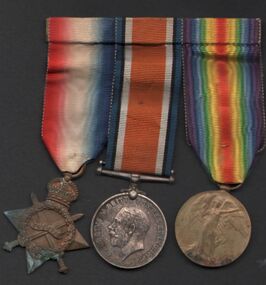
... World War 1 medal set - 1914 -15 Star, British War Medal and Victory Medal belonging to seaman William Terence O'Connor. ...World War 1 medals William T O'Connor World War 1 medal set - 1914 -15 Star, British War Medal and Victory Medal belonging to seaman William Terence O'Connor. ...William O'Connor. Regimental Number 3648. Enlisted 9 August 1915 in Adelaide. Aged 18 years. Born Liverpool. Occupation: Seaman. Address Swigg Street, Birkenhead, SA. NoK Mrs A Gillies of same address. Embarked from Adelaide SA on board RMS Malwa on 2.12.1915. RTA 15.11.1919. In London submitted a Statutory Declaration to correct his name to William Terence O'Connor. Dated 9.9.1919. Made a claim 13.12.1938 for a lost discharge certificate (Lost in a shipwreck July 1921 Beachport South Australia). Died 9.6.1963. Buried Springvale Cemetery. World War 1 medal set - 1914 -15 Star, British War Medal and Victory Medal belonging to seaman William Terence O'Connor. William T O'Connorworld war 1 medals -
 Bendigo Historical Society Inc.
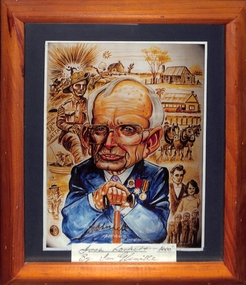
Artwork, other - Jack Lockett Collection: Drawing Jack Lockett 2000, Ian Glanville, 2000
... Jack Lockett Mabel Ingwersen World War 1 France 38th Battalion Legion of Honour Ian Glanville A coloured caricature of Jack Lockett wearing a blue coat with an RSL badge and two medals which are probably A Legion of Honour and a WW1 Victory Medal. ...John Henry Lockett OAM (22 January 1891 – 25 May 2002) was the oldest man ever in Australia when he died aged 111 years, 123 days. As one of the last surviving veterans of World War I, he was acclaimed as a national hero during the last decade of his life. Lockett was born in the small Victorian town of Waanyarra, near Bendigo. He left school aged nine to work on a local farm. Later, he worked for his uncles in the Mallee. On 24 March 1916, he travelled to Mildura to enlist in the Australian Imperial Force. He served in France with the 38th Battalion, earning promotion to sergeant and was discharged on 20 September 1919. https://en.wikipedia.org/wiki/Jack_Lockett After the war, Jack returned to The Mallee and selected a 640 acres (260 ha) block of land in Linga, Victoria, deciding to make his living as a farmer. In 1923, he married Maybell Ingwerson and they had four children together. In 1963, the couple retired to Bendigo, leaving the farmland (which now covered more than 130,000 acres (53,000 ha), in the care of their children and grandchildren. A coloured caricature of Jack Lockett wearing a blue coat with an RSL badge and two medals which are probably A Legion of Honour and a WW1 Victory Medal. His hands are clasped in front of him holding a walking stick. Signed Jack Lockett "MEMORIES" By IAN GLANVILLE Written white paper at the bottom- Jack Lockett 2000 By Ian Glanville The background has numerous sepia tone sketches of various parts of Jack's life. It has dark grey mount with a light brown wooden frame and is behind glass. a jack lockett, mabel ingwersen, world war 1, france, 38th battalion, legion of honour, ian glanville -
 Bendigo Historical Society Inc.
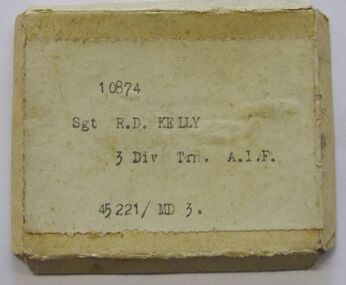
Medal - MEDAL BOX LID - SGT R D KELLY
... medal/s from World War 1. Typed on a paper label pasted on the front is: 10874 Sgt R. D. Kelly 3 Div Trn. A.I.F. 45 221/ MD 3. Seargent Kelly was awarded the British War medal and the Victory Medal...World war 1 medal box lid Medal Box Lid - Sgt R D Kelly White cardboard box lid which contained medal/s from World War 1. Typed on a paper label pasted on the front is: 10874 Sgt R. D. Kelly 3 Div Trn. A.I.F. 45 221/ MD 3. Seargent Kelly was awarded the British War medal and the Victory ...White cardboard box lid which contained medal/s from World War 1. Typed on a paper label pasted on the front is: 10874 Sgt R. D. Kelly 3 Div Trn. A.I.F. 45 221/ MD 3. Seargent Kelly was awarded the British War medal and the Victory Medalmilitary, world war 1, medal box lid, medal box lid - sgt r d kelly -
 Bendigo Historical Society Inc.
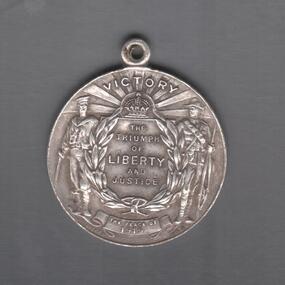
Medal - RAY SMITH COLLECTION: SILVER VICTORY MEDAL 1919
... World war 1 peace medal Circular medalet with a plain edge and integral suspension loop. The obverse features a symbolic female figure of Peace, holding a sword and standing on a plinth marked 'PEACE 1919'. Behind her flies a dove, and at her left and right feet are two figures freed from their shackles. The reverse features a central panel surrounded by laurel leaves, surmounted by the King's Crown with the word 'VICTORY ...Circular medalet with a plain edge and integral suspension loop. The obverse features a symbolic female figure of Peace, holding a sword and standing on a plinth marked 'PEACE 1919'. Behind her flies a dove, and at her left and right feet are two figures freed from their shackles. The reverse features a central panel surrounded by laurel leaves, surmounted by the King's Crown with the word 'VICTORY' over the rays of the rising sun. A sailor and a digger stand at ease on either side of the panel on which is cast 'THE / TRIUMPH / OF / LIBERTY / AND / JUSTICE'. Below the leaves is a very small panel with the words 'THE PEACE OF 1919' and the manufacturer's name.military, world war 1, peace medal -
 Victoria Police Museum
Record of Conduct and Service (Charles Belcher)
... Victoria Police service: Joined: 28/10/1914; Resigned: 3/07/1915 WW1 service: Enlisted: 5 July 1915; Highest rank: Gunner; Regiment: V5A Australian Heavy Trench Mortar Battery; Fate: Died of illness, France, 18 January 1917; Medals: British War and Victory medals world war 1, 1914-1918; victoria police; belcher, charles 6041 Official document Record of Conduct and Service (Charles Belcher) ...When the First World War broke out, Australian men from all backgrounds and professions were called to serve their country. Members of the Victorian Police force were some of the first to answer the call with twenty men joining the first convoy of soldiers who left Australian shores in October 1914. Over the course of four long years, one hundred and thirty-eight Victorian Police enlisted from stations across the state. Of these, twenty-seven lost their lives. Whilst the fate of each man was different, a deep commitment to protecting and serving the public was common to all. Victoria Police service: Joined: 28/10/1914; Resigned: 3/07/1915 WW1 service: Enlisted: 5 July 1915; Highest rank: Gunner; Regiment: V5A Australian Heavy Trench Mortar Battery; Fate: Died of illness, France, 18 January 1917; Medals: British War and Victory medalsOfficial documentworld war 1, 1914-1918; victoria police; belcher, charles 6041 -
 Victoria Police Museum
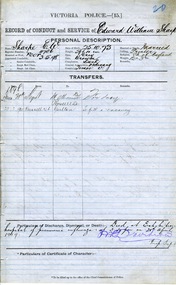
Record of Conduct and Service (Edward William Sharpe)
... Victoria Police service: Joined 3/05/1898; Leave without pay July 1915; Rejoined ca April 1918; Died 28/04/1919 from pneumonic influenza WW1 service: Enlisted 7 July 1915; Highest rank: Sergeant; Regiment: 29th Battalion, A Company; Fate: Returned to Australia 15 April 1918; Medals: 1914-15 Star, British War Medal, Victory Medal world war 1, 1914-1918; victoria police; Sharpe, Edward William 4706 Official document Record of Conduct and Service (Edward William Sharpe) ...When the First World War broke out, Australian men from all backgrounds and professions were called to serve their country. Members of the Victorian Police force were some of the first to answer the call with twenty men joining the first convoy of soldiers who left Australian shores in October 1914. Over the course of four long years, one hundred and thirty-eight Victorian Police enlisted from stations across the state. Of these, twenty-seven lost their lives. Whilst the fate of each man was different, a deep commitment to protecting and serving the public was common to all. Victoria Police service: Joined 3/05/1898; Leave without pay July 1915; Rejoined ca April 1918; Died 28/04/1919 from pneumonic influenza WW1 service: Enlisted 7 July 1915; Highest rank: Sergeant; Regiment: 29th Battalion, A Company; Fate: Returned to Australia 15 April 1918; Medals: 1914-15 Star, British War Medal, Victory MedalOfficial documentworld war 1, 1914-1918; victoria police; sharpe, edward william 4706 -
 Victoria Police Museum
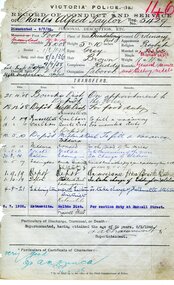
Record of Conduct and Service (Charles Alfred Taylor)
... Victoria Police service: Joined: 28/10/1908; Granted leave without pay: 5/05/1917; Re-joined: 1/10/1919; Retired: 8/02/1946; Highest rank: Inspector WW1 service: Enlisted: 10 May 1917; Highest rank: Corporal; Regiment: 38th Battalion; Fate: Returned to Australia 4 July 1919; Medals: 1914-1915 Star, British War and Victory medals world war 1, 1914-1918; victoria police; taylor, charles alfred 5429 Official document Record of Conduct and Service (Charles Alfred Taylor) ...When the First World War broke out, Australian men from all backgrounds and professions were called to serve their country. Members of the Victorian Police force were some of the first to answer the call with twenty men joining the first convoy of soldiers who left Australian shores in October 1914. Over the course of four long years, one hundred and thirty-eight Victorian Police enlisted from stations across the state. Of these, twenty-seven lost their lives. Whilst the fate of each man was different, a deep commitment to protecting and serving the public was common to all. Victoria Police service: Joined: 28/10/1908; Granted leave without pay: 5/05/1917; Re-joined: 1/10/1919; Retired: 8/02/1946; Highest rank: Inspector WW1 service: Enlisted: 10 May 1917; Highest rank: Corporal; Regiment: 38th Battalion; Fate: Returned to Australia 4 July 1919; Medals: 1914-1915 Star, British War and Victory medalsOfficial documentworld war 1, 1914-1918; victoria police; taylor, charles alfred 5429 -
 Victoria Police Museum
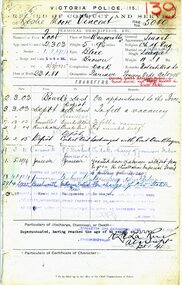
Record of Conduct and Service (Leslie Moore Vincent)
... Victoria Police service: Joined 2/03/1903; Granted leave without pay 1/09/1916; Resumed duties 6/08/1919; Retired 23/01/1941; Highest rank: Sergeant WW1 service: Enlisted 5 May 1916; Highest rank: Lance Sergeant; Regiment: 3rd Australian Divisional Ammunition Column; Fate: Returned to Australia 8 May 1919; Medals: 1914-1915 Star, British War and Victory Medals world war 1, 1914-1918; victoria police; vincent, leslie moore 5080 Official document Record of Conduct and Service (Leslie Moore Vincent) ...When the First World War broke out, Australian men from all backgrounds and professions were called to serve their country. Members of the Victorian Police force were some of the first to answer the call with twenty men joining the first convoy of soldiers who left Australian shores in October 1914. Over the course of four long years, one hundred and thirty-eight Victorian Police enlisted from stations across the state. Of these, twenty-seven lost their lives. Whilst the fate of each man was different, a deep commitment to protecting and serving the public was common to all. Victoria Police service: Joined 2/03/1903; Granted leave without pay 1/09/1916; Resumed duties 6/08/1919; Retired 23/01/1941; Highest rank: Sergeant WW1 service: Enlisted 5 May 1916; Highest rank: Lance Sergeant; Regiment: 3rd Australian Divisional Ammunition Column; Fate: Returned to Australia 8 May 1919; Medals: 1914-1915 Star, British War and Victory MedalsOfficial documentworld war 1, 1914-1918; victoria police; vincent, leslie moore 5080 -
 Kyneton RSL Sub Branch
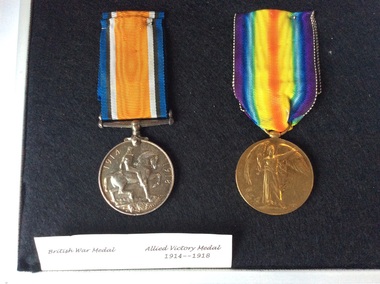
WW1 Medals
... 1 July. The feint was a disastrous failure. Australian and British soldiers assaulted over open ground in broad daylight and under direct observation and heavy fire from the German lines. Over 5,500 Australians became casualties. Almost 2,000 of them were killed in action or died of wounds and some 400 were captured. This is believed to be the greatest loss by a single division in 24 hours during the entire First World War. Some consider Fromelles the most tragic event in Australia’s history. www.awm.gov.au/articles/encyclopedia/fromelles ww1 medals british war medal allied victory ...Pte Simmons was born in Kyneton. Died at the battle of Fromelles, July 1916.Fromelles. The battle of Fromelles on 19 July 1916 was a bloody initiation for Australian soldiers to warfare on the Western Front. Soldiers of the newly arrived 5th Australian Division, together with the British 61st Division, were ordered to attack strongly fortified German front line positions near the Aubers Ridge in French Flanders. The attack was intended as a feint to hold German reserves from moving south to the Somme where a large Allied offensive had begun on 1 July. The feint was a disastrous failure. Australian and British soldiers assaulted over open ground in broad daylight and under direct observation and heavy fire from the German lines. Over 5,500 Australians became casualties. Almost 2,000 of them were killed in action or died of wounds and some 400 were captured. This is believed to be the greatest loss by a single division in 24 hours during the entire First World War. Some consider Fromelles the most tragic event in Australia’s history. www.awm.gov.au/articles/encyclopedia/fromelles Two WW1 War service medals with ribbons in a white presentation case. With black clothe lining. On the rim of each medal is: 4899Pte N T Simmons 59 Bn AIF The medals are labelled British War Medal and Allied Victory Medal 1914- 1918. On the inside of the lid is card inscribed: Posthumus award to 4899 Pte N T Simmons 59 Bn AIF. ww1 medals, british war medal, allied victory medal 1914- 1918, n t simmons, fromelles -
 Alfred Hospital Nurses League - Nursing History Collection
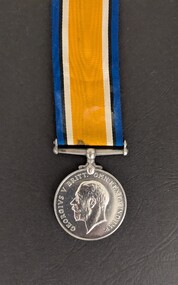
Medal - World War 1 medal, Royal Mint, British War Medal (Leah Rosenthal), 1919
... The British War Medal was awarded to British and Imperial forces for service during World War 1.Recipients also received the Military Star( where applicable) and the Victory Medal. ...The British War Medal was awarded to British and Imperial forces for service during World War 1.Recipients also received the Military Star( where applicable) and the Victory Medal. ...The British War Medal was awarded to British and Imperial forces for service during World War 1.Recipients also received the Military Star( where applicable) and the Victory Medal. Leah Rosenthal volunteered with Queen Alexandra's Imperial Nursing Service Reserve, serving in France, and also was awarded the Associate Royal Red CrossOf significance to the AHNL as Leah Rosental was an Alfred nursing graduateRound silver medal with a straight clasp suspender without swivel. The front of the medal depicts the bare head effigy of King George V facing left. Around the perimeter "GEORGIVS V BRITT: OMN: REX ET IND: IMP:" (George V, King of all the British Isles and Emperor of India). The reverse, designed by William McMillan, shows Saint George naked on horseback and armed with a short sword, an allegory of the physical and mental strength which achieved victory over Prussianism. The horse tramples on the Prussian eagle shield and the emblems of death, a skull and crossbones. In the background are ocean waves and just off-centre near the right upper rim is the risen sun of Victory. The years "1914" and "1918" appear on the perimeter in the left and right fields respectively. The attached ribbon consists of a central broad golden-yellow stripe flanked by white and black stipes with royal blue borders. The medal has been mounted on card along with the 1914-1915 Military Star and The Victory Medalworld war 1, world war 1914-1918, leah rosenthal, queen alexandra's imperial nursing service reserve, military medals, british war medal
