
Showing 271 items matching "world war ii 1939-1945"
-
 Monbulk RSL Sub Branch
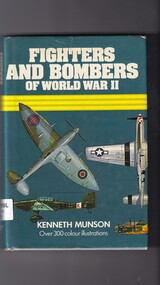
Book, Kenneth Munson, Fighters and bombers of World War II 1939-1945, 1969
... Fighters and bombers of World War II 1939-1945...Fighters and bombers of World War II 1939-1945 Book Kenneth Munson Blandford Press ...An alphabetical listing of combat aircraft from world war IIIndex, ill (col), p.320.non-fictionAn alphabetical listing of combat aircraft from world war IIworld war 1939-1945 - fighter aircraft, world war 1939-1945 bomber aircraft -
 Monbulk RSL Sub Branch
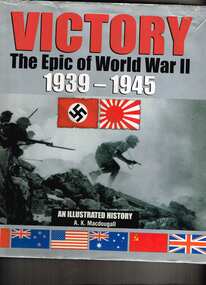
Book, Five Mile, Victory : the epic of World War II 1939-1945, 2005
... Victory : the epic of World War II 1939-1945...World War 1939-1945 - Pictorial works world war 1939-1945 - history Captures and details events of WWII, with stunning photographs and riveting text in this historical reference book for both young and old. Offers previously unknown details in regard to Australia and New Zealand's role within the war. Index, ill, maps, p.320. Victory : the epic of World War II ...Captures and details events of WWII, with stunning photographs and riveting text in this historical reference book for both young and old. Offers previously unknown details in regard to Australia and New Zealand's role within the war.Index, ill, maps, p.320.non-fictionCaptures and details events of WWII, with stunning photographs and riveting text in this historical reference book for both young and old. Offers previously unknown details in regard to Australia and New Zealand's role within the war.world war 1939-1945 - pictorial works, world war 1939-1945 - history -
 Sunshine and District Historical Society Incorporated
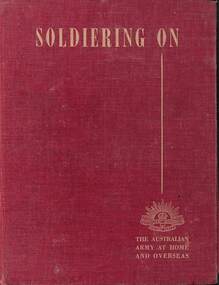
Book - Soldiering On The Australian Army at Home and Overseas, Australian War Memorial, 1942
... World War II (1939 -1945)...World War II (1939–1945) was a global conflict between the Allies and Axis powers, resulting in massive loss of life, geopolitical change, and the foundations of the modern world order. ...World War II (1939–1945) was a global conflict between the Allies and Axis powers, resulting in massive loss of life, geopolitical change, and the foundations of the modern world order. ...'Soldiering On' is a 1942 anthology prepared by members (" some of the boys") of the Australian Army, offering first-hand stories, sketches, poems, and maps that depict the experiences of Australian forces during World War II.A red hard covered book embossed with an illustration of the Australian Army hat badge.non-fiction'Soldiering On' is a 1942 anthology prepared by members (" some of the boys") of the Australian Army, offering first-hand stories, sketches, poems, and maps that depict the experiences of Australian forces during World War II.world war ii (1939 -1945), australian army -
 Lilydale RSL Sub Branch
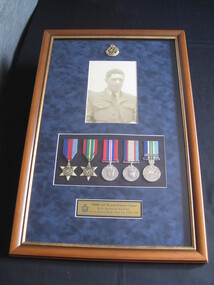
Memorabilia - Framed Photograph and medals of LAC William Downton Thomas
... RAAF badge (LHS) 128683 LAC William Downton Thomas/ Royal Australian Airforce/ Active Service World War II 1939-1945...RAAF badge (LHS) 128683 LAC William Downton Thomas/ Royal Australian Airforce/ Active Service World War II 1939-1945 Frame containing (a) RAAF Badge - (b) photograph of LAC W. ...Frame containing (a) RAAF Badge - (b) photograph of LAC W. D. Thomas RAAF - (c) Service medals WWII L-R (1) 1939-45 Star (2) Pacific Star (3) War Medal 1939-45 (4) Australian Service Medal 1939-1945 (5) Australian Service Medal 1945-1975 (d) Metal tag: RAAF badge and inscriptionRAAF badge (LHS) 128683 LAC William Downton Thomas/ Royal Australian Airforce/ Active Service World War II 1939-1945 -
 Bendigo Military Museum
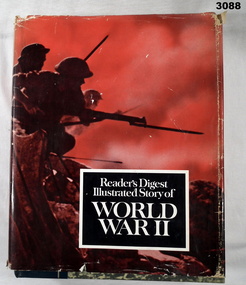
Book - BOOK, READERS DIGEST, The Reader's Digest Assoc Pty Ltd, Readers Digest - Illustrated Story of WWII, c.1970
... Contains illustrations & photos all theatre & World War II 1939 - 1945....Contains illustrations & photos all theatre & World War II 1939 - 1945. Readers Digest - Illustrated Story of WWII Book BOOK, READERS DIGEST The Reader's Digest Assoc Pty Ltd Griffin Press ...Hard covered, illustrated buckram bound book. Red illustrated paper dust cover. 536 cut pages. Contains illustrations & photos all theatre & World War II 1939 - 1945.books-military-history, illustrations, readers digest -
 Flagstaff Hill Maritime Museum and Village
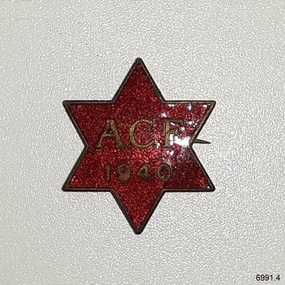
Badge - ACF Australian Comforts Fund badge, P J King Pty Ltd, 1940
... ...World War II...1939-1945...Angus Flagstaff Hill Maritime Museum and Village Australian Comforts Fund button day volunteer Australian Military Forces Christmas hamper 1940 ACF badge fund-raising P J King Pty Ltd Percy John King donor's badge World War II 1939-1945 Australians at War Voluntary Work Volunteers home front W.R. ...This Australian Comforts Fund badge is part of a set of eleven badges collected from the 1920s to the 1940s by Dr W. R. Angus. The badge was sold by the ACF in 1940 to raise funds for gifts to send to the Australian troops serving overseas. The badge is one of a set of badges that represents various organisations that he had interests in. The Australian Comforts Fund was a mostly female, volunteer-run organisation officially recognised by the Government. It began in 1916 as an amalgamation of groups of people who wanted to support the Australian troops abroad with Items of comfort to supplement the essential items provided by the Australian Military Forces. The ACF raised funds to purchase goods, pack them and send them overseas. One of their fund-raising activities was 'button days' where buttons such as this one were given to those who gave donations. The ACF closed down after World War I but was re-formed at the start of World War II. Items that the ACF sent to the troops included personal toiletry items such as toothbrushes and toothpaste, magazines, pyjamas, singlets and socks. They also provided sporting equipment, recreational music, writing materials and postcards. Special hampers were sent to the troops at Christmas time. The maker, P J King, (Percy John King), originally established his engraving and ie casting business in Russell Street, Melbourne in 1893 in partnership with Charles Walder Bridgland, continuing on his own from 1899. Percy and his son John Howard King set up a new business P J King Pty Ltd in 1928 making uniform buttons. In the late 1980s, it merged with two other companies that then became J J Cash, now known as Cash's Australia. The set of badges was donated to Flagstaff Hill Maritime Village by the family of Doctor Angus, Surgeon and Oculist. It is part of the “W.R. Angus Collection” which includes historical medical equipment, surgical instruments and material belonging to Dr Edward Ryan and Dr Thomas Francis Ryan, (both of Nhill, Victoria) and Dr Angus’ own belongings. The Collection’s history spans the medical practices of the two Doctors Ryan, from 1885-1926 plus that of Dr Angus, up until 1969. The W.R. Angus Collection: - The W.R. Angus Collection includes historical medical equipment, surgical instruments and material belonging to Dr Edward Ryan and Dr Thomas Francis Ryan, (both of Nhill, Victoria) and Dr Angus’ own belongings. The Collection’s history spans the medical practices of the two Doctors Ryan, from 1885-1926 plus that of Dr Angus, up until 1969. It includes historical medical and surgical equipment and instruments from the doctors Edward and Thomas Ryan of Nhill, Victoria. Dr Angus married Gladys in 1927 at Ballarat, the nearest big city to Nhill where he began as a Medical Assistant. He was also Acting House surgeon at the Nhill hospital where their two daughters were born. During World War II He served as a Military Doctor in the Australian Defence Force. Dr Angus and his family moved to Warrnambool in 1939, where Dr Angus operated his own medical practice. He later added the part-time Port Medical Officer responsibility and was the last person appointed to that position. Dr Angus and his wife were very involved in the local community, including the planning stages of the new Flagstaff Hill and the layout of the gardens there. Dr Angus passed away in March 1970.This badge represents the efforts of the women volunteers in Australia to support the Australian troops overseas in WWI and WWII. This badge is one of a set of significant badges that connects Doctor Angus with Australian organisations of the early-to-mid 20th century, including those relating to military service support. The W.R. Angus Collection is significant for still being located at the site it is connected with, Doctor Angus being the last Port Medical Officer in Warrnambool. The Collection includes historical medical objects that date back to the late 1800s.The ACF Badge is a star-shaped, gold, glittered red enamel and metal badge. The star has six points. The enamel surface is textured. The border and front inscription of the badge is gold. It is the badge of the Australian Comfort Fund, made by P.J. King and dated 1940. This badge is part of a set of badges collected by Dr W R Angus. the set represents organisations that he was involved in, and is part of the W.R. Angus Collection.Front: “ACF / 1940” Reverse embossed “P.J. KING”flagstaff hill, warrnambool, maritime museum, maritime village, great ocean road, shipwreck coast, metal badges, enamel badges, organisation badges, acf, presbyterian brotherhood, oikumene, w.r. angus, flagstaff hill maritime museum and village, australian comforts fund, button day, volunteer, australian military forces, christmas hamper, 1940 acf badge, fund-raising, p j king pty ltd, percy john king, donor's badge, world war ii, 1939-1945, australians at war, voluntary work, volunteers, home front, w.r. angus collection -
 Monbulk RSL Sub Branch
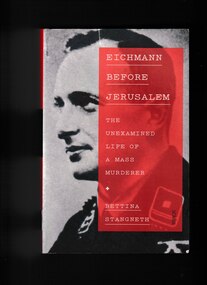
Book, Bettina Stagneth et al, Eichmann before Jerusalem: The unexamined life of a mass murderer, 2014
... ...world war ii...1939-1945...Though once widely known by nicknames such as 'Manager of the Holocaust', he was able to portray himself, from the defendant's box in Jerusalem in 1960, as an overworked bureaucrat who had been following orders - no more, he said, than 'just a small cog in Adolf Hitler's extermination machine'. war criminals - germany - biography world war ii 1939-1945 - atrocities A total re-assessment of the life of Adolf Eichmann that reveals his activities and notoriety amongst a global network of national socialists following the collapse of the third Reich, and that permanently undermines Hannah Arendt's often-cited notion of the 'banality of evil'. ...A total re-assessment of the life of Adolf Eichmann that reveals his activities and notoriety amongst a global network of national socialists following the collapse of the third Reich, and that permanently undermines Hannah Arendt's often-cited notion of the 'banality of evil'.Bibliography, index, notes, p.424.non-fictionA total re-assessment of the life of Adolf Eichmann that reveals his activities and notoriety amongst a global network of national socialists following the collapse of the third Reich, and that permanently undermines Hannah Arendt's often-cited notion of the 'banality of evil'. war criminals - germany - biography, world war ii, 1939-1945 - atrocities -
 Returned Nurses RSL Sub-branch
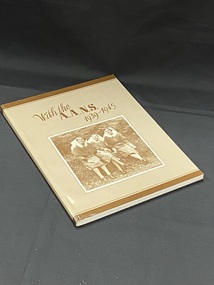
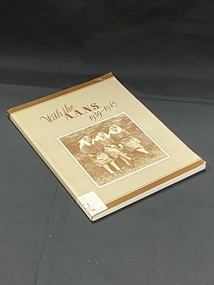
Book - Paperback book, Edith D.K. Eadie, With the A.A.N.S. 1939-1945, 1995
... ...World War II 1939-1945.... - Australian Army Nursing Service Australian Army Nursing Service WWII World War II 1939-1945 A detailed account of the nurses of the Australian Army Nursing Service (AANS) during World War Two. ...A detailed account of the nurses of the Australian Army Nursing Service (AANS) during World War Two. They served in all theatres of war where Australian soldiers fought.Light brown book with dark brown line across the top and bottom and the title printed in dark brown across the top. There is a sepia toned photo of three nurses sitting by some ferns below the title.non-fiction A detailed account of the nurses of the Australian Army Nursing Service (AANS) during World War Two. They served in all theatres of war where Australian soldiers fought. australian army nursing service, wwii, world war ii 1939-1945 -
 Returned Nurses RSL Sub-branch
Book - Paperback book, Edith D.K. Eadie, With the A.A.N.S. 1939-1945, 1995
... ...World War II 1939-1945.... - Australian Army Nursing Service Australian Army Nursing Service WWII World War II 1939-1945 A detailed account of the nurses of the Australian Army Nursing Service (AANS) during World War Two. ...A detailed account of the nurses of the Australian Army Nursing Service (AANS) during World War Two. They served in all theatres of war where Australian soldiers fought.Light brown book with dark brown line across the top and bottom and the title printed in dark brown across the top. There is a sepia toned photo of three nurses sitting by some ferns below the title. There is a white sticker wrapped around the bottom of the spine with B134 handwritten in red ink.non-fiction A detailed account of the nurses of the Australian Army Nursing Service (AANS) during World War Two. They served in all theatres of war where Australian soldiers fought. australian army nursing service, wwii, world war ii 1939-1945 -
 Returned Nurses RSL Sub-branch
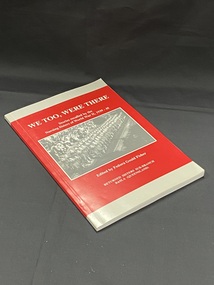
Book - Paperback book, Fedora Gould Fisher, We too, were there: stories recalled by the Nursing Sisters of World War II, 1939-45, 1995
... ...World War II 1939-1945...WWII World War II 1939-1945 Nurses Queensland WWII medical care Australian Army Nurses The stories of the nurses of the Australian Army Nursing Service (AANS) during World War Two. ...The stories of the nurses of the Australian Army Nursing Service (AANS) during World War Two. They served in all theatres of war where Australian soldiers fought.Red cover with a grey strip across the top and bottom. There is a black and white image of nurses in uniform marching along a street lined with crowds of people, in the centre. The title and editor details are printed in white text.non-fictionThe stories of the nurses of the Australian Army Nursing Service (AANS) during World War Two. They served in all theatres of war where Australian soldiers fought. wwii, world war ii 1939-1945, nurses queensland, wwii medical care, australian army nurses -
 Returned Nurses RSL Sub-branch
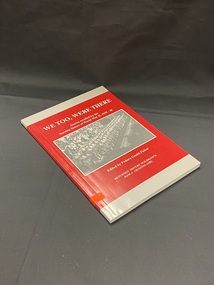
Book - Paperback book, Fedora Gould Fisher, We too, were there: stories recalled by the Nursing Sisters of World War II, 1939-45, 1995
... ...World War II 1939-1945...WWII World War II 1939-1945 Nurses Queensland WWII medical care Australian Army Nurses The stories of the nurses of the Australian Army Nursing Service (AANS) during World War Two. ...The stories of the nurses of the Australian Army Nursing Service (AANS) during World War Two. They served in all theatres of war where Australian soldiers fought.Red cover with a grey strip across the top and bottom. There is a black and white image of nurses in uniform marching along a street lined with crowds of people, in the centre. The title and editor details are printed in white text.non-fictionThe stories of the nurses of the Australian Army Nursing Service (AANS) during World War Two. They served in all theatres of war where Australian soldiers fought. wwii, world war ii 1939-1945, nurses queensland, wwii medical care, australian army nurses -
 Monbulk RSL Sub Branch
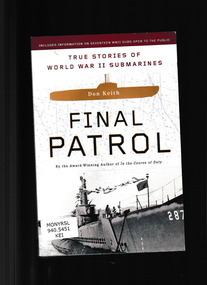
Book, NAL Caliber, Final patrol : true stories of World War II submarines, 2006
... World war II...World War 1939-1945 - Naval operations - United States...Submarine warfare - World war II World War 1939-1945 - Naval operations - United States During World War II, the U.S. ...During World War II, the U.S. Navy's submarine service suffered the highest percentage of casualties of any branch of the American armed forces. One in five submariners was lost. But despite the odds, these underwater warriors accounted for almost sixty percent of Japanese shipping losses and were a major factor in winning the war.Index, ill, p.331.During World War II, the U.S. Navy's submarine service suffered the highest percentage of casualties of any branch of the American armed forces. One in five submariners was lost. But despite the odds, these underwater warriors accounted for almost sixty percent of Japanese shipping losses and were a major factor in winning the war.submarine warfare - world war ii, world war 1939-1945 - naval operations - united states -
 Monbulk RSL Sub Branch
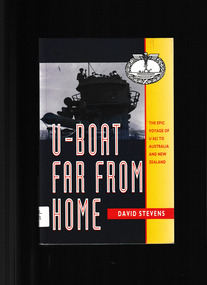
Book, Allen & Unwin, U-boat far from home : the epic voyage of U862 to Australia and New Zealand /, 1997
... World war II...World War 1939-1945 - Naval operations - Germany...Submarine warfare - World war II World War 1939-1945 - Naval operations - Germany The operations of U 862 in Australian and New Zealand waters in World War Two Index, bib, ill, maps, p.282. ...The operations of U 862 in Australian and New Zealand waters in World War TwoIndex, bib, ill, maps, p.282.non-fictionThe operations of U 862 in Australian and New Zealand waters in World War Two submarine warfare - world war ii, world war 1939-1945 - naval operations - germany -
 Monbulk RSL Sub Branch
Book, Australian War Memorial, The role of science and industry, 1958
... World war II...World War 1939-1945 - Australia - Science and industry...Australian economy - World war II World War 1939-1945 - Australia - Science and industry Describes the role of science and industry in the Australian economy between 1939-1945 Index, ill, maps, p.737 The role of science and industry Book Australian War Memorial D P Mellor ...Describes the role of science and industry in the Australian economy between 1939-1945Index, ill, maps, p.737non-fictionDescribes the role of science and industry in the Australian economy between 1939-1945australian economy - world war ii, world war 1939-1945 - australia - science and industry -
 Monbulk RSL Sub Branch
Book, Heinemann, Submarine!, 1953
... World war II...World war 1939-1945 - Personal narratives...Submarine warfare - World war II World war 1939-1945 - Personal narratives A personal account by an American submariner of operations in the pacific in World War Two p.274. ...A personal account by an American submariner of operations in the pacific in World War Twop.274.A personal account by an American submariner of operations in the pacific in World War Twosubmarine warfare - world war ii, world war 1939-1945 - personal narratives -
 Monbulk RSL Sub Branch
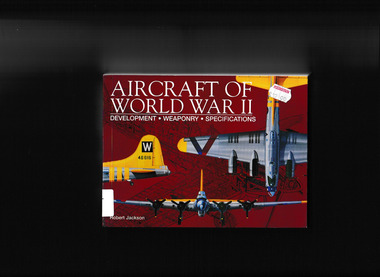
Book, Amber Books, Aircraft of world war two: Development, weaponry, specifications, 2006
... World war II...world war 1939-1945 bomber aircraft...Fighter aircraft - World war II world war 1939-1945 bomber aircraft Details of the fighting aircraft of World War Two Index, ill, p.313. ...Details of the fighting aircraft of World War TwoIndex, ill, p.313.Details of the fighting aircraft of World War Twofighter aircraft - world war ii, world war 1939-1945 bomber aircraft -
 Mont De Lancey
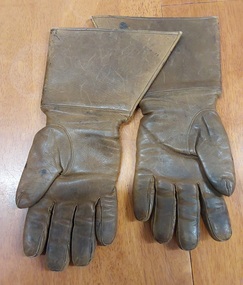
Uniform - Flying Gauntlets, 1940's
... World War II 1939-1945 Luftwaffe leather flying gauntlets were protective hand wear designed for military aviators to guard against high-altitude freezing temperatures and severe flash burns. ...World War II 1939-1945 Luftwaffe leather flying gauntlets were protective hand wear designed for military aviators to guard against high-altitude freezing temperatures and severe flash burns. ...World War II 1939-1945 Luftwaffe leather flying gauntlets were protective hand wear designed for military aviators to guard against high-altitude freezing temperatures and severe flash burns. They shielded aircrews from instrument burns and cockpit fires. Long gauntlet cuffs protected the wrists and forearms from drafts and cold air. They were favored by bomber and maritime patrol crews in unheated aircraft, German aircrew gauntlets used thin brown kid leather with raised ridges and expanding wrist gussets. Fighter pilots usually rejected them in favor of shorter gloves for better mobility.A pair of WW11 Luftwaffe flying gauntlets. They are light brown leather, fur lined, tapered at the wrist, and fitted with a narrow expandable wristband which closes with a dark brown press stud. There are three detailed stitching lines on the back of each gauntlet.gloves, gauntlet gloves, ww2 flying gloves, uniforms -
 Kiewa Valley Historical Society
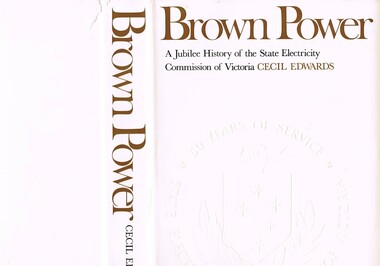
Book - Reference S.E.C. History x4, Brown Power A Jubilee History of the State Electricity Commission of Victoria, first published 1969
... This area was believed to be far away from aerial bombardment should the coastal power stations be attacked by air in World War II(1939 -1945). After the war, post 1945, the demand for a continual power supply, not affected by seasonal coastal flooding was together with a lower cost of hydro electricity power the major incentive for the Victoria Government of the day to proceed (in the 1940s) with The Kiewa Hydro Electricity Scheme. ...This area was believed to be far away from aerial bombardment should the coastal power stations be attacked by air in World War II(1939 -1945). After the war, post 1945, the demand for a continual power supply, not affected by seasonal coastal flooding was together with a lower cost of hydro electricity power the major incentive for the Victoria Government of the day to proceed (in the 1940s) with The Kiewa Hydro Electricity Scheme. ...Although this book revolves around the supply of power(Electricity) from brown coal it does cover the period 1937 onwards when the Kiewa Hydro Electricity Scheme was first mooted. This area was believed to be far away from aerial bombardment should the coastal power stations be attacked by air in World War II(1939 -1945). After the war, post 1945, the demand for a continual power supply, not affected by seasonal coastal flooding was together with a lower cost of hydro electricity power the major incentive for the Victoria Government of the day to proceed (in the 1940s) with The Kiewa Hydro Electricity Scheme. In 1946 Victorian government sought greater independence from the New South Wales black coal supplies.The significance of this book to the Kiewa Valley and its outlying regions is that it details why the development of an Alpine region was and now still is pocketed with a European flavour both in buildings and in town vegetation(trees and flowers). European (post World War II refugees) where attracted to these alpine areas not only for hard labouring positions but also for their technical skills and some street names offer a distinct European lineage rather than convict or of earlier English settler. The construction phase accommodation continued after completion of the Kiewa Hydro Electricity Scheme to become popular venues for an increasing winter tourism industry. This book has a brown hard cover encapsulated by a cream sleeve with brown and black print. On the front of the sleeve is an embossed circular motif with centre piece S.E.C. emblem and around this the words "50 YEARS OF SERVICE" and below this" STATE ELECTRICITY COMMISSION OF VICTORIA". The book contains 313 double sided pages of black print and black and white photographs.On front of paper sleeve "Brown Power A Jubilee History of the State Electricity Commission of Victoria Cecil Edwards". On the second page, below the Title "Brown Power" there is a pasted, printed presentation certificate, with the S.E.C. emblem and these printed words " Presented by the Chairman and Commissioners to A.G. MILLIST, ESQ. in recognition of long and valued service with the Commission"electricity, victorian power supplies, hydro electricity, brown coal, cecil edwards -
 Bendigo Military Museum
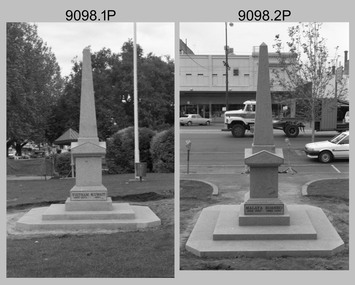
Photograph - Post- WW1 Campaigns Monument, Soldiers Memorial Institute Bendigo, 1992
... The following tributes are inscribed on the four sides of the grey granite obelisk – Front of monument: THIS MONUMENT HAS BEEN ERECTED BY THE CITIZENS OF BENDIGO & DISTRICT AS A TRIBUTE TO THE MEN & WOMEN WHO SERVED THEIR COUNTRY IN ALL CAMPAIGNS SINCE THE GREAT WAR 1914 – 1918. WORLD WAR II 1939 – 1945, MALAYA 1948 – 1960. Back of monument: BORNEO 1962– 1966. ...The following tributes are inscribed on the four sides of the grey granite obelisk – Front of monument: THIS MONUMENT HAS BEEN ERECTED BY THE CITIZENS OF BENDIGO & DISTRICT AS A TRIBUTE TO THE MEN & WOMEN WHO SERVED THEIR COUNTRY IN ALL CAMPAIGNS SINCE THE GREAT WAR 1914 – 1918. WORLD WAR II 1939 – 1945, MALAYA 1948 – 1960. Back of monument: BORNEO 1962– 1966. ...This is a set of six photographs of the Grey granite monument located at the front of the Soldiers Memorial Institute Military Museum, 37-39 Pall Mall, Bendigo taken in November 1991. The following tributes are inscribed on the four sides of the grey granite obelisk – Front of monument: THIS MONUMENT HAS BEEN ERECTED BY THE CITIZENS OF BENDIGO & DISTRICT AS A TRIBUTE TO THE MEN & WOMEN WHO SERVED THEIR COUNTRY IN ALL CAMPAIGNS SINCE THE GREAT WAR 1914 – 1918. WORLD WAR II 1939 – 1945, MALAYA 1948 – 1960. Back of monument: BORNEO 1962– 1966. Left side of monument: KOREA 1950 – 1953. Right side of monument: VIETNAM 1962 – 1973, KUWAIT 1991. Refer to item 8245.2 for more information on the planning processes prior to construction. This set of six photographs of the monument located at the front of the Soldiers Memorial Institute Military Museum, 37-39 Pall Mall, Bendigo was taken in November 1992. The black and white photographs are on 35mm negative film and scanned at 2400 dpi. They are part of the Army Survey Regiment’s Collection. .1) to .6) - Photo, black & white, 1992, Soldiers Memorial Institute Post- WW1 Campaigns Monument. ‘New RSL War Monument Nov 1992’ is annotated on the negative sleeve.rasvy, army survey regiment, army svy regt, fortuna, royal australian survey corps, soldiers memorial institute military museum -
 Wangaratta RSL Sub Branch
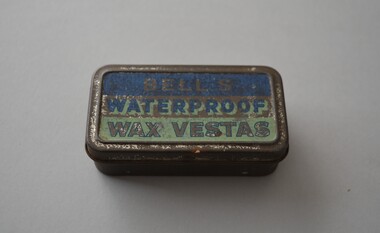
Container - Waterproof Wax Vestas, R Bell & Co, C1939-45
... Widely known for supplying troops during World War II (1939–1945), specifically utilized in Australian military emergency ration packs and by personnel on the Kokoda Track. ...Widely known for supplying troops during World War II (1939–1945), specifically utilized in Australian military emergency ration packs and by personnel on the Kokoda Track. ...Container of small wax coated matches designed to resist moisture. Widely known for supplying troops during World War II (1939–1945), specifically utilized in Australian military emergency ration packs and by personnel on the Kokoda Track. Item belonged to Robert Francis ISKOV VX15237 served with the 59th Battalion/Hume Regiment CMF before joining the 2/14th Battalion at Caulfield in September 1940. He disembarked for the Middle East in November, 1940 and fought in the Syrian campaign in 1941. In 1942 the 2/14th Battalion returned to Australia and sent to Papua where he fought at the Battle of Isurava before the battalion was sent to Gona. On 1943 Bob returned to Australia to undertake officer training and in 1945 with the 2/23rd Battalion sailed to Morotai and served with the battalion on Tarakan. He returned to Australia in November, 1945 and discharged a month laterRectangular tin with hinged lid containing small timber matches with wax heads. The tin is plain metal apart from two tone blue lid with lettering. Underneath is a serrated patch used to strike the match. Bell's Waterproof Wax Vestas ww2, bob iskov, amf, new guinea, vestas -
 Marysville & District Historical Society
Photograph (item) - Colour photograph, Unknown
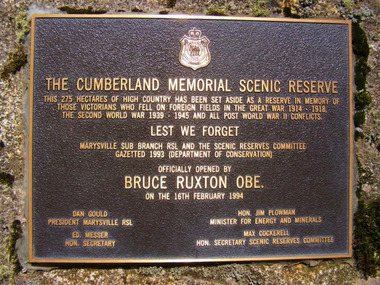
... THE CUMBERLAND MEMORIAL SCENIC RESERVE THIS 275 HECTARES OF HIGH COUNTRY HAS BEEN SET ASIDE AS A RESERVE IN MEMORY OF/ THOSE VICTORIANS WHO FELL ON FOREIGN FIELDS IN THE GREAT WAR 1914 - 1918,/ THE SECOND WORLD WAR 1939 - 1945 AND ALL POST WAR II CONFLICTS LEST WE FORGET MARYSVILLE SUB BRANCH RSL AND THE SCENIC RESERVES COMMITTEE GAZETTED 1993 (DEPARTMENT OF CONSERVATION) OFFICIALLY OPENED BY BRUCE RUXTON OBE. ...World War One, World War Two, and conflicts since 1945. The reserve is situated on the Marysville-Wood's Point Road. cumberland memorial scenic reserve marysville victoria marysville-woods point road THE CUMBERLAND MEMORIAL SCENIC RESERVE THIS 275 HECTARES OF HIGH COUNTRY HAS BEEN SET ASIDE AS A RESERVE IN MEMORY OF/ THOSE VICTORIANS WHO FELL ON FOREIGN FIELDS IN THE GREAT WAR 1914 - 1918,/ THE SECOND WORLD WAR 1939 - 1945 AND ALL POST WAR II CONFLICTS LEST WE FORGET MARYSVILLE SUB BRANCH RSL AND THE SCENIC RESERVES COMMITTEE GAZETTED 1993 (DEPARTMENT OF CONSERVATION) OFFICIALLY OPENED BY BRUCE RUXTON OBE. ...A colour photograph of the plaque commemorating Victorian veterans who have lost their lives in various conflicts in world history which was placed in the Cumberland Memorial Scenic Reserve on 16th February 1994, the day of the opening of the reserve.The Cumberland Memorial Scenic Reserve comprises of 275 hectares set aside as a reserve to commemorate Victorians who have died in service or were killed in action in World War One, World War Two, and conflicts since 1945. The reserve is situated on the Marysville-Wood's Point Road.THE CUMBERLAND MEMORIAL SCENIC RESERVE THIS 275 HECTARES OF HIGH COUNTRY HAS BEEN SET ASIDE AS A RESERVE IN MEMORY OF/ THOSE VICTORIANS WHO FELL ON FOREIGN FIELDS IN THE GREAT WAR 1914 - 1918,/ THE SECOND WORLD WAR 1939 - 1945 AND ALL POST WAR II CONFLICTS LEST WE FORGET MARYSVILLE SUB BRANCH RSL AND THE SCENIC RESERVES COMMITTEE GAZETTED 1993 (DEPARTMENT OF CONSERVATION) OFFICIALLY OPENED BY BRUCE RUXTON OBE. ON THE 16TH FEBRUARY 1994 DAN GOULD/ PRESIDENT MARYSVILLE RSL ED MESSER/ HON SECRETARY HON. JIM PLOWMAN/ MINISTER FOR ENERGY AND MINERALS MAX COCKERERLL/ HON. SECRETARY SCENIC RESERVES COMMITTEEcumberland memorial scenic reserve, marysville, victoria, marysville-woods point road -
 Lara RSL Sub Branch
Metal Badge, 1945 RSL Membership Badge, 1945
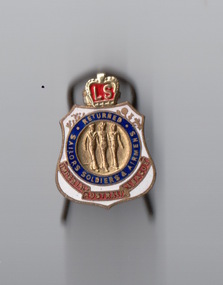
... 1939, and served on the HMAS Kuttabul II. He was discharged in 1948. Forms part of a collection of Ronald Leslie's belongings that were donated to the Lara RSL in 2006. world war two 1945 rsl badge 45 returned sailors, soldiers and airmens imperial australia league B25448 Sydney RSL membership badge. ...Ronald Leslie Gregory (R/22961) served in the Australian Royal Navy. Born 5th August 1921, he enlisted on the 7th March 1939, and served on the HMAS Kuttabul II. He was discharged in 1948. Forms part of a collection of Ronald Leslie's belongings that were donated to the Lara RSL in 2006.RSL membership badge. White background, faded red and blue detailed with rusted metal background. the crown atop the badge has a blue background and says '45' 45 returned sailors, soldiers and airmens imperial australia league B25448 Sydneyworld war two, 1945, rsl, badge -
 Lara RSL Sub Branch
Photograph, Set 4 photographs. and others for Torquay Light Horse camp, 1940
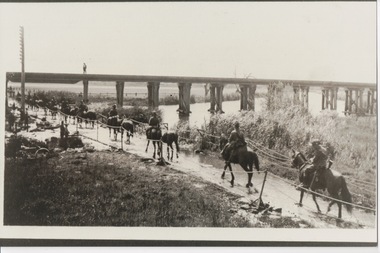
... World War II, Australia’s 6th Cavalry Regiment formed a mounted unit they called “The Kelly Gang” which did valuable scouting work. In New Guinea, a mounted Light Horse Troop did patrol duty and helped carry supplies. Some fully equipped walers were flown into Borneo for reconnaissance in rugged mountain country. But by the end of the war, in 1945, the horse had disappeared from the Australian Army. References: Australian Light Horse Association www.lighthorse.org.au National Australia Archives Australian War Memorial Surf Coast Shire WW1 memorials www.togethertheyserved.com The Light horse- a Cavalry under Canvas Light Horse, Training Camp, Torquay, WW2 Late in 1939...World War II, Australia’s 6th Cavalry Regiment formed a mounted unit they called “The Kelly Gang” which did valuable scouting work. In New Guinea, a mounted Light Horse Troop did patrol duty and helped carry supplies. Some fully equipped walers were flown into Borneo for reconnaissance in rugged mountain country. But by the end of the war, in 1945, the horse had disappeared from the Australian Army. References: Australian Light Horse Association www.lighthorse.org.au National Australia Archives Australian War Memorial Surf Coast Shire WW1 memorials www.togethertheyserved.com The Light horse- a Cavalry under Canvas Light Horse, Training Camp, Torquay, WW2 Late in 1939 ...These images capture for all time Light Horsemen travelling through Geelong on their way to camp at Torquay for the last Group meeting in Australia . information following - details obtained from .........https://torquayhistory.com/light-horse-brigade/ On Australia Day, 1997, Sir John Young unveiled this plaque on Point Danger, Torquay. Torquay history, Light Horse Training Camp, WW2 Plaque at Pt. Danger Note----- (See images to view plaque) The plaque identifies a significant event in Torquay’s history and the sentiments of ‘change’ for the Light Horse Brigade – from horses to machines. In 1940 the four Light Horse Regiments (4th, 8th, 13th and 20th), some 5000 Light Horse and 2000 horses camped and trained at Torquay. Three other regiments, formerly mounted on horses, were also at Torquay ‘mounted’ on privately owned trucks and cars. Division troops included Artillery, Engineers, Signals, Field Ambulance and other branches of the Army necessary to enable a Division to function. It wasn’t just the sheer numbers of men coming to this little town that made the event significant, it was also the fact that the men of the Light Horse were dramatic, almost glamorous figures and it is easy to see their exploits as some splendid adventure. Horses have played a special role in the story of Australia. They were the only means of transport across this huge country, so it was necessary for everyone to have the ability to ride a horse. When war broke out in 1899 between Britain and the Boers of South Africa (“Boer” was Dutch for “farmer”) Australia sent troops to fight. At first Britain was wary of using untried, unprofessional colonial cavalrymen but soon saw that the slouch-hatted Australian “bushmen” were a match for the fast-moving and unconventional mounted commandos of the Boers. The Australians proved themselves to be expert rough-riding horsemen and good shots. Bush life had hardened them to go for long periods with little food and water. They also showed remarkable ability to find their way in a strange country and use its features for cover, in both attack and defence. By 1914, when Australia joined the war against Germany, there were 23 Light Horse regiments of militia volunteers. Many men from these units joined the Light Horse regiments of the Australian Imperial Force (AIF). Men were given remounts (if not using their own horses) – army horses bought by Commonwealth purchasing officers from graziers and breeders. These were called “walers” because they were a New South Wales stockhorse type – strong, great-hearted animals with the strains of the thoroughbred and semi-draught to give them speed, strength and stamina. On 1st November, 1914, Australia’s First Infantry Division and the first four Light Horse regiments sailed for England in a fleet of transport ships. The first of the Light Horse arrived at Gallipoli in May without their horses. Back with their horses after Gallipoli, they were formidable combatants across the Sinai and Palestine. Some British commanders observed that the light horseman moved with a “lazy, slouching gait, like that of a sleepy tiger” but described how the promise of battle “changes that careless gait, into a live athletic swing that takes him over the ground much quicker than other troops”. They had Light Horse, Torquay, training campdeveloped a reputation as formidable infantrymen. The Turks called them “the White Ghurkas” – a reference to their deadly skill with the bayonet. The Arabs called them “The Kings of the Feathers”. The plume had originally been a battle honour of the Queensland Mounted Infantry for their work in the shearer’s strike of 1891. During WW1 it was adopted by almost all the Light Horse Regiments. It was the proud badge of the light horseman. The most famous of their battles was the attack on Beersheba- the charge of the 4th Light Horse Brigade. Mounted infantrymen and their superb walers had carried out one of the most successful cavalry charges in history – against what seemed impossible odds. They surprised the Turks by charging cavalry-style, when they would normally have ridden close to an objective then dismounted to fight. The fall of Beersheba swung the battle tide against the Turks in Palestine; and changed the history of the Middle East. While 19 men from the Surf Coast Shire served with the 4th Light Horse over the course of WW1, only four were involved in the charge of Beersheba- John GAYLARD, Philip QUINN.(Winchelsea); Wallace FINDLAY (Anglesea); Harry TRIGG (Bambra). After the war, Light Horse units played a key role in the Australian Government’s compulsory military training programme. The Citizen Military Forces (C.M.F.) thrived on the glamour of the wartime Light Horse tradition, ignoring the possibility that motor vehicles would soon replace the horses. When training was no longer compulsory, the C.M.F. regiments declined and horses became more of a luxury during the 1930s depression years of poverty and unemployment. Some regiments were motorised. Then, in 1939, Australia joined Britain in another world war. Training was increased for the militia at both home bases and regional training camps. The camp at Torquay in 1940, commanded by Major General Rankin, was at Divisional strength. By the end of the camp some felt that the Division was ready for active service. Gradually, over the next four years, the Australian Light Horse units were mounted on wheels and tracks and the horses were retired. Six men enlisted at the Torquay camp and another 57 men and women enlisted at Torquay for service in WW2. Those who served in the Militia provided valuable Officers and NCOs and men for the armed services during the war. Each infantry division of the 2nd AIF had a Light Horse regiment attached to it. But the day of the Australian mounted soldier hadn’t quite passed. During World War II, Australia’s 6th Cavalry Regiment formed a mounted unit they called “The Kelly Gang” which did valuable scouting work. In New Guinea, a mounted Light Horse Troop did patrol duty and helped carry supplies. Some fully equipped walers were flown into Borneo for reconnaissance in rugged mountain country. But by the end of the war, in 1945, the horse had disappeared from the Australian Army. References: Australian Light Horse Association www.lighthorse.org.au National Australia Archives Australian War Memorial Surf Coast Shire WW1 memorials www.togethertheyserved.com The Light horse- a Cavalry under Canvas Light Horse, Training Camp, Torquay, WW2 Late in 1939 it was decided to set up a Lighthorse training camp in Torquay to train both men and horses for the battles of the Second World War. Horses, men and equipment came on special trains from all over Victoria and NSW, and as you would expect horseman came from areas such as Omeo and Sale, the Wimmera and the Western District. They arrived at the Geelong racecourse for watering in the Barwon River and then were ridden across the ford at the breakwater and began their 11 mile trek to Torquay. Light Horse, Training Camp, Torquay, WW2 Tent city By the end of January 1940 the camp at Torquay accommodated some 5000 men and 2500 horses of the Second Cavalry Division. The rows of horses, tents and huts near Blackgate Road were quite a sight. While the cavalrymen engaged in exercises on the land and on the beaches, many of the troops took over the Torquay School for special training of men and officers. Mr Bob Pettit local farmer and Councillor for the Barrabool Shire, wrote about the Light horse in the Surf Coast Community News in 1985 saying “They used to travel about the district riding four abreast in one long convoy. To my annoyance they went through my property and shut all the gates behind them. I had certain gates open to let stock in to the water holes and it would take me three -quarters of an hour to follow the horsemen up and put all the gates right again” he continued “the men from the Light Horse were here when the fire went through in March 1940. He recalled an incident when early one morning, as some one blew the bugle, a soldier putting a white sheet on the line frightened the horses. They panicked and ran off in all directions. Six went over the cliff near Bird Rock, five were never found, and the rest were gathered up after nearly a fortnight in the bush around Addiscott and Anglesea" Light Horse, Training Camp, Torquay, WW2, Geelong Parade Geelong parade The training camp culminated in a parade through the streets of Geelong on March 12th 1940. The salute was given at the Town Hall and the troops continued on a route to the You Yang’s for a training exercise. Note-----(see media section for photograph) The Camp was abandoned in mid 1940 as it was deemed unsuitable for training during winter and the cost of a permanent camp could not be justified if it could not be used all year. Historic.......Rare,,,Interpretive.Sepia photographs.set of four ....post card size ....Horses &LighthorsemenNo 1, Lighthorsemen Regiment Geelong 1940......No 2 Light Horse at Breakwater Geelong 1938 to 1940....No 3 Light Horse at Breakwater Geelong 1938 to 1940.....No 4 Light Horse crossing Breakwater camped at Geelong Showgrounds. These markings are on reverse of photographs.light horsemengeelong 1940., world war 2 -
 Lara RSL Sub Branch
Book, Australia in the War of 1939-1945 - The Final Campaigns Volume VII by Gavin Long, 1963 - first published
... World War II List of Events from September 1944 to September 1945 A book in a series of WWII books which includes maps, photographs, illustrations, order of battles, POWs in Cowra, Historical WWII record of the final campaigns gavin long corowa pows bougainville final campaigns army tarakan borneo balikpapan slater's knoll stretcher bearers of the 2/23rd Australia in the War of 1939-45 ARMY The Final Campaigns LONG Australian War Memorial. ...World War II List of Events from September 1944 to September 1945 A book in a series of WWII books which includes maps, photographs, illustrations, order of battles, POWs in Cowra,Historical WWII record of the final campaignsAustralia in the War of 1939-1945 - The Final Campaigns Maps, Photographs, IllustrationsAustralia in the War of 1939-45 ARMY The Final Campaigns LONG Australian War Memorial.gavin long, corowa pows, bougainville, final campaigns, army, tarakan, borneo, balikpapan, slater's knoll, stretcher bearers of the 2/23rd -
 Flagstaff Hill Maritime Museum and Village
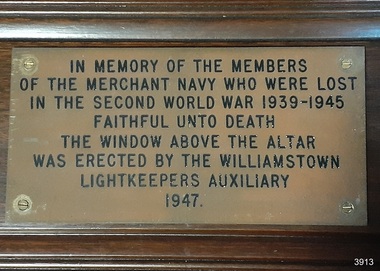
Plaque - Commemorative Plaque, circa August 1947
... . & a. bank williamstown christ directing a sailor christ showing the helmsman the way quartermaster’s hand on the wheel stained glass window church window religious window sanctuary window memorial window war memorial window victorian war heritage inventory victorian heritage database merchant navy ww2 1939-1945 anglican church bishop mckie flying angel club williamstown lightkeepers' auxiliary ladies' harbour lights guild commemorative window memorial plaque merchant navy WW II St. Nicholas Seamen's Church “IN MEMORY OF THE MEMBERS / OF THE MERCHANT NAVY WHO WERE LOST / IN THE SECOND WORLD ...This commemorative plaque was made for the round, stained glass memorial window titled “Christ showing the helmsman the way”, originally installed at the St Nicholas Seamen’s Church in Williamstown. The window was donated as a memorial to the members of the Merchant Navy whose lives were lost in the Second World War, 1939-1945. The donor was the Williamstown Lightkeepers Auxiliary, an independent ladies' association that worked with the Williamstown Missions to Seamen (renamed the Mission to Seafarers in 2000). The window was officially dedicated on December 14, 1947, by Geelong's Anglican Bishop, Rt. Rev. J.D. McKie. In the early months of 1948, this bronze plaque was also placed in the chapel above the altar. The Williamstown St Nicholas Seamen’s Church ceased operation in 1966. In 1979, the Victoria Missions to Seamen donated this round, stained glass window and the memorial plaque to Flagstaff Hill Maritime Village, along with many other items and furnishings. These items have been used to simulate the Williamstown Mission and Chapel as much as possible. THE MISSIONS TO SEAMEN: - The Missions to Seamen was an Anglican charity that served seafarers since 1856 in Great Britain. Its symbol is a Flying Angel, inspired by a Bible verse. Today, there are centres in over 200 ports worldwide where seamen of all backgrounds are offered a warm welcome and provided with a wide range of facilities. In Victoria, the orgainsation began in Williamstown in 1857 as a Sailors’ Church, also known as ‘Bethel’ or the ‘Floating Church’ in an old hulk floating in Hobson’s Bay, Port of Melbourne. It soon became part of the Missions to Seamen, Victoria. In the year 2000, the organisation, now named Mission to Seafarers, still operated locally in Melbourne, Portland, Geelong and Hastings. The Ladies’ Harbour Lights Guild was formed in 1906 to support the Missions to Seamen in Melbourne and other centres such as Williamstown. Two of the most significant ladies of the Guild were founder Ethel Augusta Godfrey and foundation member Alice Sibthorpe Tracy (who established a branch of the Guild in Warrnambool in 1920). The Guild continued its work until the 1960s. In 1943, a former Williamstown bank was purchased for the Missions to Seamen Club. The chapel was named St Nicholas’ Seamen’s Church and was supported by the Ladies’ Harbour Lights Guild, the Williamstown Lightkeepers’ Auxiliary and the League of Soldiers’ and Sailors’ Friends. It ceased operation in 1966. A Missions to Seamen Chapel and Recreation Room was a significant feature of ports during the late 1800s and into the 1900s. It seemed appropriate for Flagstaff Hill to include such a representation within the new Maritime Village, so the Melbourne Board of Management of Missions to Seamen Victoria gave its permission on 21st May 1979 for the entire furnishings of the Williamstown chapel to be transferred to Flagstaff Hill. The St Nicholas Seamen’s Church was officially opened on October 11, 1981 and closely resembles the Williamstown chapel. This plaque is significant for its connection with the round Sanctuary window above the altar in the chapel at Flagstaff Hill. The window was originally installed at the chapel of the St Nicholas Seamen’s Church in Williamstown in 1947, and is listed on the Victorian War Heritage Inventory No. 196973 as an object of significance. The plaque is also significant for its recognition of the members of the Merchant Navy who lost their lives in service to our country during World War II. The plaque is important for its connection with the Williamstown Lightkeepers’ Auxiliary and Missions to Seamen, which were dedicated to supporting seafarers from all over the world. The funds the group raised helped to furnish the St Nicholas Seamen’s Church in Williamstown, including the Sanctuary window, pews, carpets and hangings. These items are now part of the St Nicholas Seamen's Church Williamstown Collection at Flagstaff Hill Maritime Village, Warrnambool. Plaque: rectangular brass commemorative plaque. Each corner has a round hole. Inscription impressed into the metal and filled in with black paint. Plaque refers to the memorial, a stained glass window titled "Christ Showing the Helmsman the Way," donated by the Williamstown Lightkeepers' Auxiliary to the Willimastown Missions to Seamen. This plaque is part of the St. Nicholas Seamen's Church Collection. “IN MEMORY OF THE MEMBERS / OF THE MERCHANT NAVY WHO WERE LOST / IN THE SECOND WORLD WAR 1939-1945 / FAITHFUL UNTO DEATH / THE WINDOW ABOVE THE ALTAR / WAS ERECTED BY THE WILLIAMSTOWN / LIGHTKEEPERS AUXILIARY / 1947.”flagstaff hill, warrnambool, flagstaff hill maritime museum, maritime museum, shipwreck coast, flagstaff hill maritime village, mission to seamen williamstown, st nicholas seaman’s church williamstown, missions to seamen victoria, mission to seafarers, lightkeepers auxiliary, ladies harbour light guild, 139 nelson place williamstown, religion, religious service, sailors rest, bethel sailors’ church, bethel floating church, e. s. & a. bank williamstown, christ directing a sailor, christ showing the helmsman the way, quartermaster’s hand on the wheel, stained glass window, church window, religious window, sanctuary window, memorial window, war memorial window, victorian war heritage inventory, victorian heritage database, merchant navy ww2, 1939-1945, anglican church, bishop mckie, flying angel club, williamstown lightkeepers' auxiliary, ladies' harbour lights guild, commemorative window, memorial plaque, merchant navy, ww ii, st. nicholas seamen's church -
 Greensborough Historical Society
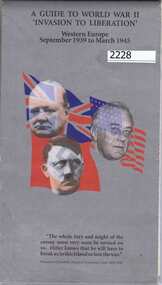
Map, Scotprint, A Guide to World War II 'Invasion or Liberation': Western Europe Sept 1939 to March 1945, 1999_
... A Guide to World War II 'Invasion or Liberation': Western Europe Sept 1939 to March 1945...Notes of battles, military leaders, cemeteries and other features of World War 11 Western Europe. world war ii Double sided col. maps, with notes of battles, military leaders, cemeteries and other features of World War 11 Western Europe. A Guide to World War II 'Invasion or Liberation': Western Europe Sept 1939 to March 1945 ...Notes of battles, military leaders, cemeteries and other features of World War 11 Western Europe.Double sided col. maps, with notes of battles, military leaders, cemeteries and other features of World War 11 Western Europe.world war ii -
 Orbost & District Historical Society
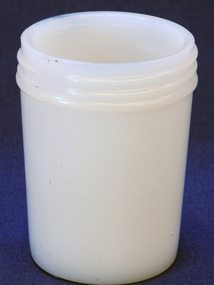
jar, 1935-1945
... 1939 Vegemite was officially endorsed by the British Medical Association as a good source of Vitamin B and was included in Australian Army rations during World War II. Buyers were now assured of the nutritional value of Vegemite, which has been a market leader ever since. The Fred Walker Company became the Kraft Walker Cheese Co. Pty Ltd in 1926 and Kraft Foods Limited in 1950. (from Powerhouse Museum) This type of jar was used to package Vegemite between 1935 and 1945 ...Vegemite hit the market in 1923 but failed to sell. In 1928 the company renamed its spread Parwill to compete against the top-selling British import, Marmite but Parwill flopped too. In 1922 the Fred Walker Company hired a chemist, Percy Callister, to develop a useful food from vitamin-rich used yeast being dumped by breweries. Using enzymes to split open the yeast cells, Callister extracted the contents and blended them with vegetables and salt into a sticky black paste with a sharp taste. They tried the Vegemite name again and gave the product away with Walker cheese products and a couple of cars as prizes before Australians finally fell for it. In 1939 Vegemite was officially endorsed by the British Medical Association as a good source of Vitamin B and was included in Australian Army rations during World War II. Buyers were now assured of the nutritional value of Vegemite, which has been a market leader ever since. The Fred Walker Company became the Kraft Walker Cheese Co. Pty Ltd in 1926 and Kraft Foods Limited in 1950. (from Powerhouse Museum) This type of jar was used to package Vegemite between 1935 and 1945. Vegemite has been an 'Australian icon' since World War II when it was recognised as one of the world's highest food sources of vitamin B. It was sent to war with the troops and rationed at home. The marketing strategy that put Vegemite in 9 out of every 10 Australian homes in the 1940s, 50s and 60s emphasised the value of Vegemite to children's health. A cylindrical Vegemite jar made of white opal glass. It has a threaded rim and two mould seams. On the base - AGM Vegemite V879 -
 Mission to Seafarers Victoria
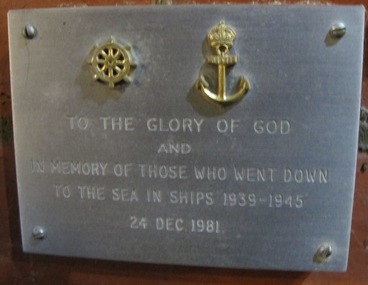
Plaque - Memorial Plaque, 1981
... World War II period in the merchant and navy services. The chapel originally designed as a Memorial to the Great War 1914-18 continues to be a place of commemoration for both merchant and naval services of WW2 and other conflicts. second world war world war two navy merchant plaque 1981 ww2 merchant navy To the glory of God and In memory of those who went down to the sea in ships 1939-1945 24 Dec, 1981. ...The plaque accompanying the stained glass window by Gerry Cummins was dedicated in 1981 to the men who gave their lives during the World War II period in the merchant and navy services.The chapel originally designed as a Memorial to the Great War 1914-18 continues to be a place of commemoration for both merchant and naval services of WW2 and other conflicts.Small rectangular plaque made of steel mounted on wood. The plaque features helm representing Merchant seamen and an anchor with a crown on top representing the Navy. Both are gold plated. To the glory of God and In memory of those who went down to the sea in ships 1939-1945 24 Dec, 1981.second world war, world war two, navy, merchant, plaque, 1981, ww2, merchant navy -
![Book, Commonwealth War Graves Commission, Their name liveth: some pictures of Commonwealth war cemeteries, 1914-1918 [and] 1939-1945. Volume VI Part 1, 1965](/media/collectors/4f729f5697f83e03086015b8/items/61f1fee6ff25d250155d267f/item-media/61f792992062ed2a3f229351/item-fit-380x285.jpg?cb=6) Greensborough Historical Society
Greensborough Historical SocietyBook, Commonwealth War Graves Commission, Their name liveth: some pictures of Commonwealth war cemeteries, 1914-1918 [and] 1939-1945. Volume VI Part 1, 1965
... This volume covers descriptions and photographs of cemeteries in Gallipoli and Greece world war I world war II war graves commonwealth war graves commission 50 p paperback, text and black and white photographs, red cover with gold lettering Their name liveth: some pictures of Commonwealth war cemeteries, 1914-1918 [and] 1939-1945. ...This volume covers descriptions and photographs of cemeteries in Gallipoli and Greece50 p paperback, text and black and white photographs, red cover with gold letteringworld war i, world war ii, war graves, commonwealth war graves commission -
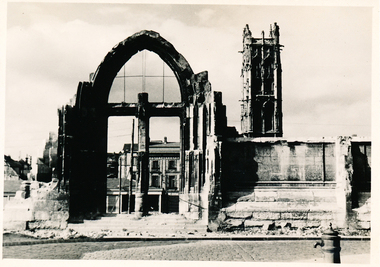 Mission to Seafarers Victoria
Photograph - Photograph, Black and white, Allan Charles Quinn, 5 June 1949
... This is a photograph from the Allan Charles Quinn collection which is a collection of letters and photograph depicting aspects of life at sea for a young man in the era immediately following World War II. allan quinn photograph france ruins church letters-from-abroad rouen normandy ww2 wwii world war two 1939-1945 battle of normandy st vincent church On reverse: ROUEN 5-6-49 handwritten in blue ink. ...This photograph was taken on the 5th of June, 1946, and shows the ruins of the St intent church built between 1490 and 1556 in a Gothic style and was known for its vast dimensions. The church also had the uniqueness of owning a bell tower that had not been completed. The building was heavily damaged by a bomb fell in the choir level May 31, 1944 during the Allied strikes announcing the landing. The ruins are still standing today. Allan has also written letters home from this period, describing France as a "mess" at this time. This photograph was exhibited by the Mission to Seafarers as part of the exhibition "Letters from Abroad" in 2012.This is a photograph from the Allan Charles Quinn collection which is a collection of letters and photograph depicting aspects of life at sea for a young man in the era immediately following World War II.Black and white photograph of the ruins of a gothic church bombed during the Battle of Normandy in 1944. It shows the arch of the church left standing in the foreground, with a tower in the background. There is a narrow white boarder about the image.On reverse: ROUEN 5-6-49 handwritten in blue ink. Below this is a mark "ItI" in pencil.allan quinn, photograph, france, ruins, church, letters-from-abroad, rouen, normandy, ww2, wwii, world war two, 1939-1945, battle of normandy, st vincent church
