
Showing 12 items matching "worship devices"
-
 Great Stupa of Universal Compassion
Ceremonial object - Indian pandit mask
... ...worship devices...Representing the original Indian pandits (Hindu scholars) who brought Buddhism to Tibet; used in the Cham Dances performed by monks during the Monlam Prayer Festival. tibetan buddhism worship devices Rituals A solid wood mask carved in a Tibetan style Ceremonial object Indian pandit mask ...Representing the original Indian pandits (Hindu scholars) who brought Buddhism to Tibet; used in the Cham Dances performed by monks during the Monlam Prayer Festival. A solid wood mask carved in a Tibetan styletibetan buddhism, worship devices, rituals -
 Great Stupa of Universal Compassion
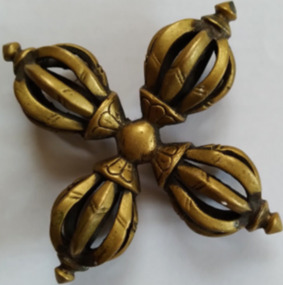
Ceremonial object - Double dorje
... ...worship devices...The Double Dorje is often associated with stability and protection, symbolizing the indestructible nature of the universe. tibetan buddhism holy objects worship devices This double dorje is a cross of two dorjes, which look like a small scepter with multiple prongs at each end. ...In Tibetan Buddhism a "dorje" (also known as "vajra" in Sanskrit) symbolizes the indestructible nature of reality, spiritual power, and enlightenment, often depicted as a thunderbolt or diamond scepter, representing the ability to cut through illusion and achieve ultimate wisdom; it is a key ritual object in the Vajrayana school of Tibetan Buddhism, signifying the union of compassion and wisdom through its male principle association when used with a bell (female principle). The Double Dorje (Vishvavajra), is a powerful Buddhist symbol. It consists of two crossed vajras (dorjes) and represents the foundation of the physical world. The Double Dorje is often associated with stability and protection, symbolizing the indestructible nature of the universe. This double dorje is a cross of two dorjes, which look like a small scepter with multiple prongs at each end.tibetan buddhism, holy objects, worship devices -
 Great Stupa of Universal Compassion
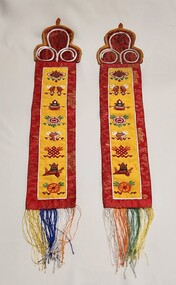
Artwork, other - Auspicious symbols hangings
... ...worship devices...Holy objects worship devices Two identical hangings feature the eight auspicious symbols of Buddhist iconography: the precious parasol, white conch shell, two golden fish, eternal knot, treasure vase, victory banner, lotus flower and dharma wheel. ...These types of wall hangings are commonly used in homes, temples and meditation spaces to bring blessings, good fortune and to remind practitioners of the Buddhist teachings.The eight auspicious symbols represent blessings, spiritual qualities and the path to enlightenment. They symbolise the totality of the Buddha’s teachings and the harmony of the universe.Two identical hangings feature the eight auspicious symbols of Buddhist iconography: the precious parasol, white conch shell, two golden fish, eternal knot, treasure vase, victory banner, lotus flower and dharma wheel.holy objects, worship devices -
 Great Stupa of Universal Compassion
Ceremonial object - Hand-held prayer wheel
... ...worship devices...They believe that turning the wheel with a pure, compassionate intention releases the mantras into the universe, which purifies negative karma, accumulates merit, and radiates compassion to all living beings. tibetan buddhism worship devices holy objects "Om Mani Padme Hum" in Tibetan script This prayer wheel consists of a hollow metal cylinder attached to a wooden handle. ...As Buddhism spread to Tibet in the 7th century, prayer wheels became an essential attribute of Tibetan Buddhist practice. This practice is linked to teachings attributed to Nagarjuna (ca. 150 –250 CE), who emphasised the power of mantra recitation and visualisation. A prayer wheel, used for personal worship, allowed to release the spiritual power contained within the mantras, enabling practitioners, including those who could not read, to generate spiritual merit.Prayer wheels are used by Tibetan practitioners every day, sometimes hours at a time. They believe that turning the wheel with a pure, compassionate intention releases the mantras into the universe, which purifies negative karma, accumulates merit, and radiates compassion to all living beings. This prayer wheel consists of a hollow metal cylinder attached to a wooden handle. Inside the cylinder is a tightly wound scroll printed with numerous mantras and wrapped around a central spindle. A chain with a small weight attached to its end is affixed to the cylinder, allowing it to be spun with a slight rotation of the wrist."Om Mani Padme Hum" in Tibetan script tibetan buddhism, worship devices, holy objects -
 Great Stupa of Universal Compassion
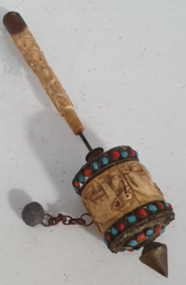
Ceremonial object - Hand-held prayer wheel
... ...worship devices...They believe that turning the wheel with a pure, compassionate intention releases the mantras into the universe, which purifies negative karma, accumulates merit, and radiates compassion to all living beings. tibetan buddhism holy objects worship devices This prayer wheel has a hollow metal cylinder inside covered with a layer of ivory with carved elephants. ...As Buddhism spread to Tibet in the 7th century, prayer wheels became an essential attribute of Tibetan Buddhist practice. This practice is linked to teachings attributed to Nagarjuna (ca. 150 –250 CE), who emphasised the power of mantra recitation and visualisation. A prayer wheel, used for personal worship, allowed to release the spiritual power contained within the mantras, enabling practitioners, including those who could not read, to generate spiritual merit.Prayer wheels are used by Tibetan practitioners every day, sometimes hours at a time. They believe that turning the wheel with a pure, compassionate intention releases the mantras into the universe, which purifies negative karma, accumulates merit, and radiates compassion to all living beings.This prayer wheel has a hollow metal cylinder inside covered with a layer of ivory with carved elephants. The cylinder is inlaid with coral and turquoise and attached to an ivory handle. It contains a tightly wound scroll printed with numerous mantras, wrapped around a spindle. A chain with a small weight attached to its end is affixed to the cylinder, allowing it to be spun with a slight rotation of the wrist.tibetan buddhism, holy objects, worship devices -
 Great Stupa of Universal Compassion
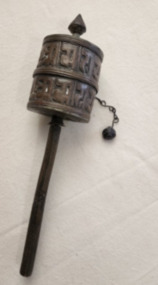
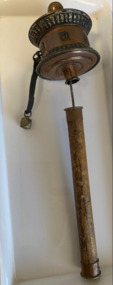
Ceremonial object - Hand-held prayer wheel
... ...worship devices...They believe that turning the wheel with a pure, compassionate intention releases the mantras into the universe, which purifies negative karma, accumulates merit, and radiates compassion to all living beings. tibetan buddhism holy objects worship devices “Om Mani Padme Hum” This prayer wheel consists of a hollow metal cylinder embossed with the “Om Mani Padme Hum” in Tibetan script and attached to a wooden handle. ...As Buddhism spread to Tibet in the 7th century, prayer wheels became an essential attribute of Tibetan Buddhist practice. This practice is linked to teachings attributed to Nagarjuna (ca. 150 –250 CE), who emphasised the power of mantra recitation and visualisation. A prayer wheel, used for personal worship, allowed to release the spiritual power contained within the mantras, enabling practitioners, including those who could not read, to generate spiritual merit.Prayer wheels are used by Tibetan practitioners every day, sometimes hours at a time. They believe that turning the wheel with a pure, compassionate intention releases the mantras into the universe, which purifies negative karma, accumulates merit, and radiates compassion to all living beings.This prayer wheel consists of a hollow metal cylinder embossed with the “Om Mani Padme Hum” in Tibetan script and attached to a wooden handle. Inside the cylinder is a tightly wound scroll printed with numerous hand-written mantras and wrapped around a central spindle. A chain with a small weight attached to its end by a leather strip is affixed to the cylinder, allowing it to be spun with a slight rotation of the wrist.“Om Mani Padme Hum” tibetan buddhism, holy objects, worship devices -
 Great Stupa of Universal Compassion
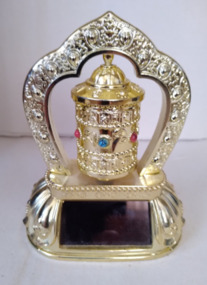
Ceremonial object - Solar-powered prayer wheel
... ...worship devices...Turning the wheel with a pure, compassionate intention is believed to release the mantras into the universe, resulting in purification of negative karma of the practitioner, accumulation of merit, and spreading compassion to all living beings. tibetan buddhism holy objects worship devices This modern adaptation of the traditional Tibetan Buddhist prayer wheel has a mantra-filled drum which rotates automatically using solar power when exposed to light. ...This solar-powered prayer wheel is based on the traditional Tibetan prayer wheel design. However, it uses solar power to rotate the wheel containing mantras, disseminating the blessings to all. Often used by Buddhist practitioners on a windowsill or car dashboard. Prayer wheels have been used in Tibetan Buddhism for personal worship since the 7th century. Turning the wheel with a pure, compassionate intention is believed to release the mantras into the universe, resulting in purification of negative karma of the practitioner, accumulation of merit, and spreading compassion to all living beings.This modern adaptation of the traditional Tibetan Buddhist prayer wheel has a mantra-filled drum which rotates automatically using solar power when exposed to light. The ornate gold-coloured frame and prayer wheel in the centre (embellished with small faux gemstones) reflect the aesthetic traditions associated with Tibetan Buddhist sacred objects. The solar panel is concealed in the base. tibetan buddhism, holy objects, worship devices -
 Great Stupa of Universal Compassion
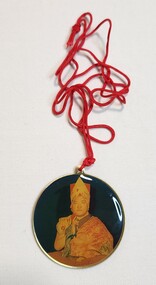
Memorabilia - Amulet pendant with a portrait of the 16th Karmapa
... Worship device...These sacred objects are believed to offer protection, attract good fortune and connect the wearer with enlightened energies. Worship device A two-sided amulet with a red cord for wearing. ...Buddhist protection amulets are deeply rooted in spiritual traditions across Asia, especially in countries like Thailand, Tibet and Nepal. These sacred objects are believed to offer protection, attract good fortune and connect the wearer with enlightened energies.A two-sided amulet with a red cord for wearing. The front features a portrait of the 16th Karmapa, the spiritual leader of the Karma Kagyu lineage in Tibetan Buddhism, in ceremonial robes and a distinctive hat. The reverse side features the image of a wrathful deity Mahakala. The rim of the amulet is shaded in gold.worship device -
 Great Stupa of Universal Compassion
Memorabilia - Long mala with dorje, half dorje and yellow tassels
... Worship device...The 108 beads signify the 108 afflictions to be overcome and the 108 Buddhas. Worship device Long mala with a dorje on a string with ten beads, and a half dorje (or bell) on a string with ten beads. ...Malas are used to help focus awareness and concentration during spiritual practice of reciting mantras. Traditionally made from wood, bone, seeds from the Bodhi tree or gemstones. They may include silk or cotton tassels.Malas are used like a Christian rosary, often supporting the counting of mantras and held whilst reciting prayers. A long mala is a set of 108 strung beads, plus a Guru bead which serves as a tactile reminder of the conclusion of the current round of chanting mantra. The guru bead represents the relationship between the student and the guru or spiritual teacher. The 108 beads signify the 108 afflictions to be overcome and the 108 Buddhas.Long mala with a dorje on a string with ten beads, and a half dorje (or bell) on a string with ten beads. After each dorje is a yellow tassel. The guru bead is slightly larger and is followed by knotted thread.worship device -
 Great Stupa of Universal Compassion
Memorabilia - Long mala with three divider beads and two tassels each with five beads
... Worship device...The 108 beads signifies the 108 afflictions to be overcome and the 108 Buddhas. Worship device Long mala with three smaller (yellow) divider beads and two strands of five beads each after the guru bead. ...Malas are used to help focus awareness and concentration during spiritual practice of reciting mantras. Traditionally made from wood, bone, seeds from the Bodhi tree or gemstones. They may include silk or cotton tassels.Malas are used like a Christian rosary, often supporting the counting of mantras and held whilst reciting prayers. A long mala is a set of 108 strung beads, plus a guru bead which serves as a tactile reminder of the conclusion of the current round of chanting mantra. The guru bead represents the relationship between the student and the guru or spiritual teacher. The 108 beads signifies the 108 afflictions to be overcome and the 108 Buddhas.Long mala with three smaller (yellow) divider beads and two strands of five beads each after the guru bead.worship device -
 Great Stupa of Universal Compassion
Memorabilia - Long mala with dharma wheel
... Worship device...The 108 beads signifies the 108 afflictions to be overcome and the 108 Buddhas. Worship device Long mala with a threaded dharma wheel attached from the guru bead. ...Malas are used to help focus awareness and concentration during spiritual practice of reciting mantras. Traditionally made from wood, bone, seeds from the Bodhi tree or gemstones. They may include silk or cotton tassels.Malas are used like a Christian rosary, often supporting the counting of mantras and held whilst reciting prayers. A long mala is a set of 108 strung beads, plus a Guru bead which serves as a tactile reminder of the conclusion of the current round of chanting mantra. The guru bead represents the relationship between the student and the guru or spiritual teacher. The 108 beads signifies the 108 afflictions to be overcome and the 108 Buddhas.Long mala with a threaded dharma wheel attached from the guru bead. On the end of the wheel there are two strands of five beads each.worship device -
 Great Stupa of Universal Compassion
Memorabilia - Pale pink long mala
... Worship device...The 108 beads signifies the 108 afflictions to be overcome and the 108 Buddhas. Worship device A long mala, possibly made from angel skin coral with a larger brown guru bead. ...Malas are used to help focus awareness and concentration during spiritual practice of reciting mantras. Traditionally made from wood, bone, seeds from the Bodhi tree or gemstones. They may include silk or cotton tassels.Malas are used like a Christian rosary, often supporting the counting of mantras and held whilst reciting prayers. A long mala is a set of 108 strung beads, plus a Guru bead which serves as a tactile reminder of the conclusion of the current round of chanting mantra. The guru bead represents the relationship between the student and the guru or spiritual teacher. The 108 beads signifies the 108 afflictions to be overcome and the 108 Buddhas.A long mala, possibly made from angel skin coral with a larger brown guru bead. worship device
