

Historical information
As Buddhism spread to Tibet in the 7th century, prayer wheels became an essential attribute of Tibetan Buddhist practice. This practice is linked to teachings attributed to Nagarjuna, who emphasized the power of mantra recitation and visualization.
Significance
Tibetans believe that spinning the prayer wheel which has thousands or millions of mantras inside is equal to saying that many mantras, while being done in a fraction of the time. This helps accumulate merits, purify negative karma and obstacles on the path to enlightenment.
Physical description
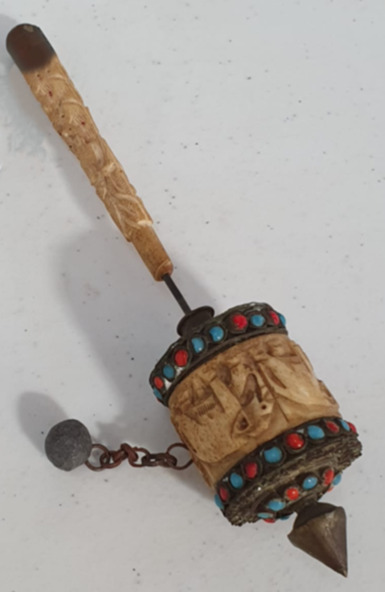
This wheel has a hollow metal cylinder attached to a rod handle, made of ivory (with carved elephants), inlaid with coral and turquoise. Inside the cylinder is a tightly wound scroll printed with numerous mantras and wrapped around a spindle. The cylinder is embossed and decorated with inlaid coral and turquoise. A chain with a small weight at the end (made out of copper alloy) is affixed to the cylinder, allowing it to be spun by a slight rotation of the wrist.
