
Showing 211 items matching "ww2 hospitals"
-
 Ringwood RSL Sub-Branch
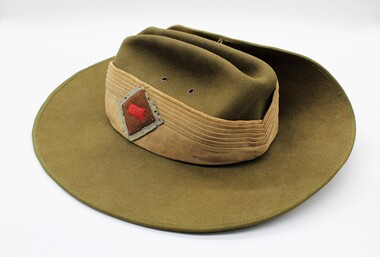
Headgear Slouch Hat, Unknown
... Hat from 2/2nd Aust General Hospital WW2...puggaree with colour patch 2/2nd AGH ww2 2/2nd australian general hospital ww2, ...Hat from 2/2nd Aust General Hospital WW2 puggaree with colour patch 2/2nd AGH ww2 2/2nd australian general hospital ww2, Headgear Slouch Hat ...Hat from 2/2nd Aust General Hospital WW2puggaree with colour patch 2/2nd AGH ww2 2/2nd australian general hospital ww2, -
 Returned Nurses RSL Sub-branch
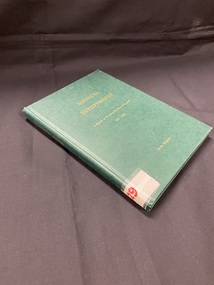
Book - Hardcover book, Sheila Simpson, Medical pathfinders : a history of 2/1 Australian General Hospital, 1990
... Hospital...Military Hospitals...WWII hospitals...WW2...2/1 Australian General Hospital Military Hospitals WWII hospitals WW2 hospitals World War II History of 2/1 Australian General Hospital 1939-1945 Ingleburn to Gaza -- Gaza Ridge 1940 -- Gaza Ridge 1941 -- Gaza Ridge 1942 - homeward bound -- Photographs - Middle East -- Western Australia 1942-1943 -- Photographs - Western Australia -- New Guinea 1943-1944 -- Bougainville 1944-1945 -from Trove record 'B129' [Handwritten in pencil on the top of the first page] 'B129' [Handwritten in red texta on a white label taped around the bottom of the spine] 'with best wishes / Sheila Simpson / 27.2.1991' [Handwritten in black ink on the third page] Green hardcover book with gold lettering on the front and spine showing the title and author. ...History of 2/1 Australian General Hospital 1939-1945 Ingleburn to Gaza -- Gaza Ridge 1940 -- Gaza Ridge 1941 -- Gaza Ridge 1942 - homeward bound -- Photographs - Middle East -- Western Australia 1942-1943 -- Photographs - Western Australia -- New Guinea 1943-1944 -- Bougainville 1944-1945 -from Trove recordGreen hardcover book with gold lettering on the front and spine showing the title and author. There is a white label taped around the bottom of the spine with B129 written in red texta ink.non-fictionHistory of 2/1 Australian General Hospital 1939-1945 Ingleburn to Gaza -- Gaza Ridge 1940 -- Gaza Ridge 1941 -- Gaza Ridge 1942 - homeward bound -- Photographs - Middle East -- Western Australia 1942-1943 -- Photographs - Western Australia -- New Guinea 1943-1944 -- Bougainville 1944-1945 -from Trove record2/1 australian general hospital, military hospitals, wwii hospitals, ww2 hospitals, world war ii -
 Returned Nurses RSL Sub-branch
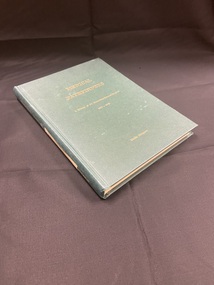
Book - Hardcover book, Sheila Simpson, Medical pathfinders : a history of 2/1 Australian General Hospital, 1990
... Hospital...Military Hospitals...WWII hospitals...WW2...2/1 Australian General Hospital Military Hospitals WWII hospitals WW2 hospitals World War II 2/1 AGH History of 2/1 Australian General Hospital (AGH) 1939-1945 Ingleburn to Gaza -- Gaza Ridge 1940 -- Gaza Ridge 1941 -- Gaza Ridge 1942 - homeward bound -- Photographs - Middle East -- Western Australia 1942-1943 -- Photographs - Western Australia -- New Guinea 1943-1944 -- Bougainville 1944-1945 -from Trove record 'With best wishes / Sheila Simpson / 27.2.1991' [Handwritten on the third page] 'PROPERTY OF VICTORIAN BRANCH RSL' [Stamped in red ink on the third page] Green hardcover book with gold lettering on the front and spine showing the title and author. ...History of 2/1 Australian General Hospital (AGH) 1939-1945 Ingleburn to Gaza -- Gaza Ridge 1940 -- Gaza Ridge 1941 -- Gaza Ridge 1942 - homeward bound -- Photographs - Middle East -- Western Australia 1942-1943 -- Photographs - Western Australia -- New Guinea 1943-1944 -- Bougainville 1944-1945 -from Trove recordGreen hardcover book with gold lettering on the front and spine showing the title and author. There is a white label taped along the spine with 2/1 AGH written faintly.non-fictionHistory of 2/1 Australian General Hospital (AGH) 1939-1945 Ingleburn to Gaza -- Gaza Ridge 1940 -- Gaza Ridge 1941 -- Gaza Ridge 1942 - homeward bound -- Photographs - Middle East -- Western Australia 1942-1943 -- Photographs - Western Australia -- New Guinea 1943-1944 -- Bougainville 1944-1945 -from Trove record2/1 australian general hospital, military hospitals, wwii hospitals, ww2 hospitals, world war ii, 2/1 agh -
 Returned Nurses RSL Sub-branch
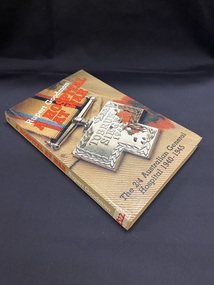
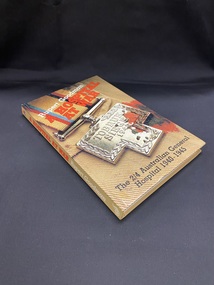
Book - Hardcover book, Rupert Goodman, A hospital at war : the story of 2/4 Australian General Hospital 1940-1945, 1983
... 2/4th Australian General Hospital...WW2...WWII World War II 2/4th Australian General Hospital WW2 Military Hospitals The story of 2/4 Australian General Hospital during World War II. ...The story of 2/4 Australian General Hospital during World War II. Over 6 years some 43,000 casualties were treated at Tobruk, Redbank, Jerusalem, Colombo and Labuan. [From Trove]Light brown cover and spine. The title is printed diagonally near the top of the cover in red print, with the author's name above that in white print. At the bottom of the cover is the sub-title in black print. The background of the entire cover is a close-up image of the fabric of a soldier's uniform with a bullet wound and a silver medallion that reads 'Tobruk siege 1941'.non-fictionThe story of 2/4 Australian General Hospital during World War II. Over 6 years some 43,000 casualties were treated at Tobruk, Redbank, Jerusalem, Colombo and Labuan. [From Trove]wwii, world war ii, 2/4th australian general hospital, ww2, military hospitals -
 Returned Nurses RSL Sub-branch
Book - Hardcover book, Rupert Goodman, A hospital at war : the story of 2/4 Australian General Hospital 1940-1945, 1983
... 2/4th Australian General Hospital...WW2...WWII World War II 2/4th Australian General Hospital WW2 Military Hospitals The story of 2/4 Australian General Hospital during World War II. ...The story of 2/4 Australian General Hospital during World War II. Over 6 years some 43,000 casualties were treated at Tobruk, Redbank, Jerusalem, Colombo and Labuan. [From Trove]Light brown cover and spine. The title is printed diagonally near the top of the cover in red print, with the author's name above that in white print. At the bottom of the cover is the sub-title in black print. The background of the entire cover is a close-up image of the fabric of a soldier's uniform with a bullet wound and a silver medallion that reads 'Tobruk siege 1941'.non-fictionThe story of 2/4 Australian General Hospital during World War II. Over 6 years some 43,000 casualties were treated at Tobruk, Redbank, Jerusalem, Colombo and Labuan. [From Trove]wwii, world war ii, 2/4th australian general hospital, ww2, military hospitals -
 Tatura Irrigation & Wartime Camps Museum
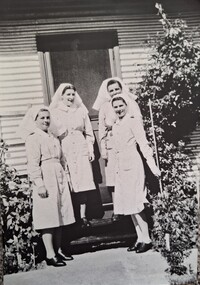
Photograph, Sisters Patterson, Tootell, Powell and Steed, Original 1943 copy 1989
... May 1943. WW2 internment camp hospital. A.A.N.S....May 1943. WW2 internment camp hospital. A.A.N.S. Camp 1 A.A.N.S. ...May 1943. WW2 internment camp hospital. A.A.N.S.Four A.A.N.S. nurses - Sisters Patterson, Totell, Powell and Steed in front of army hut doorway. Shrubs either side of stepscamp 1, a.a.n.s., sister patterson, sister totell, sister powell, sister steed, internment camp -
 Returned Nurses RSL Sub-branch
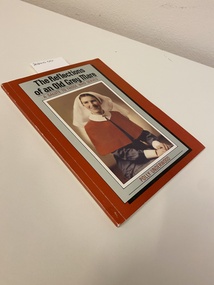
Book, Polly Underwood, The Reflections of an old grey mare : A salute to those who served
... The book is important because it records the experience of a nurse working in different kinds of medical facitilities during WW2 - tented hospitals, Casualty clearing stations, ambulance trains....The book is important because it records the experience of a nurse working in different kinds of medical facitilities during WW2 - tented hospitals, Casualty clearing stations, ambulance trains. ...A record of nursing service in the second world war, from enlistment to peace.Soft cover, red and grey, containing a portrait of the author in army nurses' uniform. Australian Army Nursing Service uniform. Back cover, white with a facsimile of the Instrument of Surrender.non-fictionA record of nursing service in the second world war, from enlistment to peace.world war two, ww2, finschhafen, ambulance trains, wwii -
 Returned Nurses RSL Sub-branch
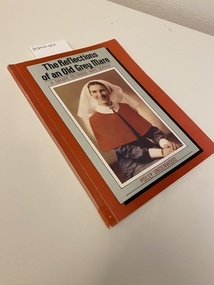
Book, Polly Underwood, The Reflections of an old grey mare : A salute to those who served
... The book is important because it records the experience of a nurse working in different kinds of medical facitilities during WW2 - tented hospitals, Casualty clearing stations, ambulance trains....The book is important because it records the experience of a nurse working in different kinds of medical facitilities during WW2 - tented hospitals, Casualty clearing stations, ambulance trains. ...A record of nursing service in the second world war, from enlistment to peace.Soft cover, red and grey, containing a portrait of the author in army nurses' uniform. Australian Army Nursing Service uniform. Back cover, white with a facsimile of the Instrument of Surrender.non-fictionA record of nursing service in the second world war, from enlistment to peace.world war two, ww2, finschhafen, ambulance trains, wwii -
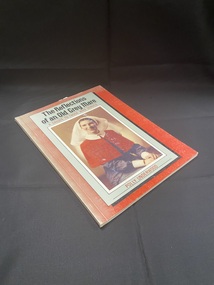 Returned Nurses RSL Sub-branch
Book - Illustrated paperback book, Polly Underwood, The Reflections of an old grey mare : A salute to those who served
... The book is important because it records the experience of a nurse working in different kinds of medical facitilities during WW2 - tented hospitals, Casualty clearing stations, ambulance trains....The book is important because it records the experience of a nurse working in different kinds of medical facitilities during WW2 - tented hospitals, Casualty clearing stations, ambulance trains. ...A record of nursing service in the second world war, from enlistment to peace.Paperback with faded cover. Plain white spine with a red front cover. Most of the cover contains a large pale green rectangle with a shadow behind it, inside it is the title and author details and a picture of an Army Nurse in uniform.non-fictionA record of nursing service in the second world war, from enlistment to peace.world war two, ww2, finschhafen, ambulance trains, wwii -
 Tatura Irrigation & Wartime Camps Museum
Photograph - copy, Original May 1945, copy 1989
... WW2 internment camp 1 hospital...WW2 internment camp 1 hospital A.A.N.S. Camp 1 Internee camp Camp hospitals Two A.A.N.S. sisters in front of galvanized iron huts. ...WW2 internment camp 1 hospitalTwo A.A.N.S. sisters in front of galvanized iron huts. Garden beds mid distance.a.a.n.s., camp 1, internee camp, camp hospitals -
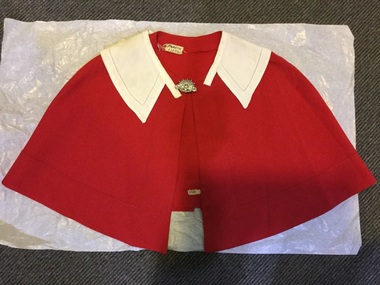 Running Rabbits Military Museum operated by the Upwey Belgrave RSL Sub Branch
WW2 NURSES CAPE, 1943
... Worn by Nurses while serving in Hospitals during WW2...Worn by Nurses while serving in Hospitals during WW2 Worn by Nurses during WW2 as part of their Uniform JACKSON 13017 GH . ...Worn by Nurses while serving in Hospitals during WW2Worn by Nurses during WW2 as part of their Uniform RED SHOULDER CAPE With WHITE COLLAR AND RISING SUN BADGEJACKSON 13017 GH . V310 Made in Australia 1943 Size -
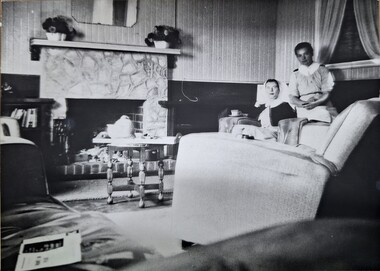 Tatura Irrigation & Wartime Camps Museum
Photograph, Sisters sitting room, Original 1943, copy 1989
... WW2 internment camp 1 hospital nursing staff...WW2 internment camp 1 hospital nursing staff Nursing staff Internment Camp 1 A.A.N.S. ...WW2 internment camp 1 hospital nursing staffTwo A.A.N.S. sisters. Off duty nurses sitting room, local stone fireplace. Centre left wall with low white bowls of flowers. Books in book case. L/coffee table (round) with tray, teapot, etc. centre. Large armchair, right foreground.nursing staff, internment camp 1, a.a.n.s. -
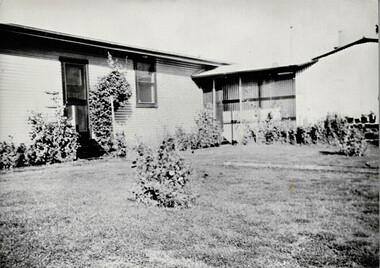 Tatura Irrigation & Wartime Camps Museum
Photograph, Sisters Quarters Garden, Original 1942, copy 1989
... WW2 Internment Camp hospital nursing staff garden at sisters quarters, Tatura Hospital Camp 1, May 1943 (Army huts). ...WW2 Internment Camp hospital nursing staff garden at sisters quarters, Tatura Hospital Camp 1, May 1943 (Army huts). ...WW2 Internment Camp hospital nursing staff garden at sisters quarters, Tatura Hospital Camp 1, May 1943 (Army huts). Foam backed copy in folder.Black and white photograph of the gardens in front of a hut in L shape. Dark door on left hand side.camp hospitals, camp 1, internment camps, tatura -
 Mission to Seafarers Victoria
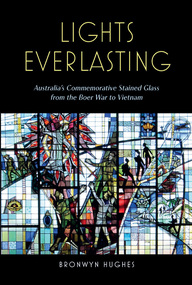
Book, Australian Scholarly Publishing, Lights Everlasting: Australia’s commemorative stained glass from the Boer War to Vietnam, 2023
... Bronwyn Hughes is the stained glass specialist in Australia and has a long connection with the Mission as she helped identifies the chapel windows' origins. australian history ww1 ww2 boer war vietnam war stained glass windows bronwyn hughes Almost hidden within religious buildings, hospitals, school chapels and civic buildings, stained-glass windows tell of Australians at war. ...Almost hidden within religious buildings, hospitals, school chapels and civic buildings, stained-glass windows tell of Australians at war. Bronwyn Hughes focuses on commemorative stained glass—an overlooked art form—describing its rich artistic and architectural heritage and the artists and firms who created it. Memorial stained glass serves to depict and illuminate the men and women who fought and died for their faith and their country. It has a tragic beauty. The book includes stained glass windows from the St Peter chapel of the Mission to Seafarers.255 pages with colour and black and white illustrations; notes, bibliography, index.non-fictionAlmost hidden within religious buildings, hospitals, school chapels and civic buildings, stained-glass windows tell of Australians at war. Bronwyn Hughes focuses on commemorative stained glass—an overlooked art form—describing its rich artistic and architectural heritage and the artists and firms who created it. Memorial stained glass serves to depict and illuminate the men and women who fought and died for their faith and their country. It has a tragic beauty. The book includes stained glass windows from the St Peter chapel of the Mission to Seafarers.australian history, ww1, ww2, boer war, vietnam war, stained glass windows, bronwyn hughes -
 Morwell RSL Sub Branch
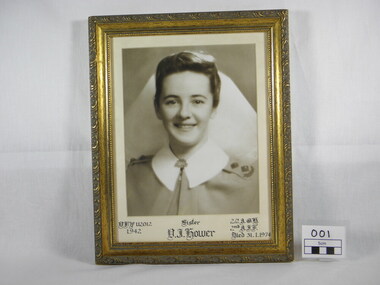
framed photograph, portrait of Sister of D.J. Hower
... hospital...2nd a i f...sister d j hower...ww2...Hower framed in uniform, with nurses vail, cloack(white Collar) rising sun badge at neck, uniform underneath cloak, australia shoulder badges, details underneath the photo miltary-portrait, photo, framed, 1942, 2/2-Army-General-Hospital, 2nd-A.I.F., Sister-D.J.-Hower, WW2, a4-sized, gold-painted-frame, military, nurse, world-war-2,inscription under photo. 112012 Sister 2\2 A.G.H/ 1942 2nd A.I.F./ D.J. ...Hower framed in uniform, with nurses vail, cloack(white Collar) rising sun badge at neck, uniform underneath cloak, australia shoulder badges, details underneath the photo miltary-portrait, photo, framed, 1942, 2/2-Army-General-Hospital, 2nd-A.I.F., Sister-D.J.-Hower, WW2, a4-sized, gold-painted-frame, military, nurse, world-war-2,inscription under photo. 112012 Sister 2\2 A.G.H/ 1942 2nd A.I.F./ D.J. ...Portrait black and white, Nursing Sister 2nd Leiutenant D.J. Hower framed in uniform, with nurses vail, cloack(white Collar) rising sun badge at neck, uniform underneath cloak, australia shoulder badges, details underneath the photo miltary-portrait, photo, framed, 1942, 2/2-Army-General-Hospital, 2nd-A.I.F., Sister-D.J.-Hower, WW2, a4-sized, gold-painted-frame, military, nurse, world-war-2,inscription under photo. 112012 Sister 2\2 A.G.H/ 1942 2nd A.I.F./ D.J. Hower Died 31.1.1974Portrait black and white, Nursing Sister 2nd Leiutenant D.J. Hower framed in uniform, with nurses vail, cloack(white Collar) rising sun badge at neck, uniform underneath cloak, australia shoulder badges, details underneath the photo inscription under photo. 112012 Sister 2\2 A.G.H/ 1942 2nd A.I.F./ D.J. Hower Died 31.1.1974military, photo, 1942, nurse, miltary portrait, framed, 2 2 army general hospital, 2nd a i f, sister d j hower, ww2, a4 sized, gold painted frame, world war 2 -
 Lara RSL Sub Branch
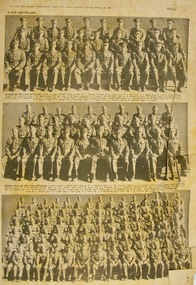
Newspaper, 17th Australian Infantry Brigade, February 22nd 1940
... The photographs are of national significance as they may reflect the only known photographs of individuals from WW2. aif army 17th brigade second aif 2/5th battalion australian army australian infantry brigade 2/2nd field aumbulance 2/2nd australian general hospital 6th divisional australian army medical corps 6th divisional engineers The Argus 17th Australian Infantry Brigade, Second AIF, Souvenir Supplement, Thursday, February 22, 1940 Page 1 2/5th Battalion - Picture 1 Officers of the 2/5th Battalion; Picture 2 Senior NCO's of the 2/5th Battalion; Picture 3 A Company 2/5th Battalion Page 2 B Company 2/5th Battalion; C Company 2/5th Battalion; D Company 2/5th Battalion Page 3 Headquarters 2/2nd Field Regiment 6th Divisional Artillery; 3rd Battery 2/2nd Field Regiment 6th Divisional Artillery Page 4 Officers, NCO's and men of 2/2nd Field Company, 6th Divisional Engineers; Officers NCO's and men 2/2nd Field Ambulance and 2/2nd Australian General Hospital 6th Divisional Australian Army Medical Corps 4 page newspaper pictures of 17th Brigade, Second AIF 17th Australian Infantry Brigade Newspaper ...The 17th Australian Infantry Brigade was an infantry brigade in the Australian Army. First formed in 1917 during World War I, it did not see any action. Reformed during World War II, before being disbanded in 1946. Today, its name is perpetuated by the 17th Combat Service Support Brigade, which was raised as a logistics formation in May 2006. The 17th Brigade was reformed on 13 October 1939, again as part of the 6th Division, recruited from Victoria. The 17th Brigade fought in the Western Desert Campaign in Libya, the Battle of Greece, the Battle of Wau, the Salamaua-Lae campaign in Papua, and in the Aitape-Wewak campaign in New Guinea. The photographs are of national significance as they may reflect the only known photographs of individuals from WW2.4 page newspaper pictures of 17th Brigade, Second AIFThe Argus 17th Australian Infantry Brigade, Second AIF, Souvenir Supplement, Thursday, February 22, 1940 Page 1 2/5th Battalion - Picture 1 Officers of the 2/5th Battalion; Picture 2 Senior NCO's of the 2/5th Battalion; Picture 3 A Company 2/5th Battalion Page 2 B Company 2/5th Battalion; C Company 2/5th Battalion; D Company 2/5th Battalion Page 3 Headquarters 2/2nd Field Regiment 6th Divisional Artillery; 3rd Battery 2/2nd Field Regiment 6th Divisional Artillery Page 4 Officers, NCO's and men of 2/2nd Field Company, 6th Divisional Engineers; Officers NCO's and men 2/2nd Field Ambulance and 2/2nd Australian General Hospital 6th Divisional Australian Army Medical Corpsaif, army, 17th brigade, second aif, 2/5th battalion, australian army, australian infantry brigade, 2/2nd field aumbulance, 2/2nd australian general hospital, 6th divisional australian army medical corps, 6th divisional engineers -
 Shepparton RSL Sub Branch
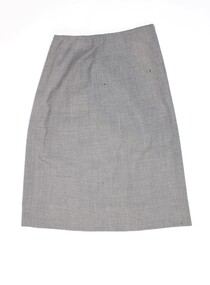
Uniform, Skirt
... WW2...World War 2...World War Two...WWII...Second world war...Nurse...Military...Heidelberg Military Hospital...Sister Danson was born in Numurkah and served as Leiutentant with the Heidelberg Military Hospital before embarking for Japan in 1947. japan ww2 occupation force British Commonwealth Occupational Forces WW2 World War 2 World War Two WWII Second world war Nurse Military Heidelberg Military Hospital VFX151507 Sister danson "L Danson" Grey slim line with side 5 press studs and 2 hook and eyes Uniform, Skirt J. ...This skirt is part of an official uniform by Sister Danson (VFX151507) during the British presence in Japan following the end of the Second World War. About 16,000 Australians served in the British Commonwealth Occupation Forces, including 130 from the Australian General Hospital with whom Sister Danson presumably served. Sister Danson was born in Numurkah and served as Leiutentant with the Heidelberg Military Hospital before embarking for Japan in 1947.Grey slim line with side 5 press studs and 2 hook and eyes "L Danson"japan ww2, occupation force, british commonwealth occupational forces, ww2, world war 2, world war two, wwii, second world war, nurse, military, heidelberg military hospital, vfx151507, sister danson -
 Shepparton RSL Sub Branch
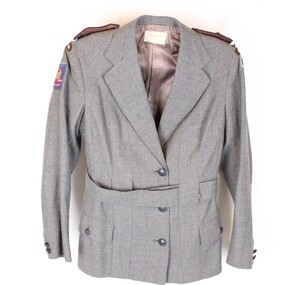
Uniform, Jacket, J Ravensdale and Sons
... WW2...WWII...World War Two...World War II...World War 2...Second World War...Australian General Hospital...Sister Danson was born in Numurkah and served as Leiutentant with the Heidelberg Military Hospital before embarking for Japan in 1947. Military British Commonwealth Occupational Forces Sidter Danson VFX151507 WW2 WWII World War Two World War II World War 2 Second World War Australian General Hospital Heidelberg Military Hospital 10 moth holes One grey linen single 3 button breasted coat. 2 button pocket. 2 buttons on each sleeve. 2 shoulder flash buttons with 2 pips on each. 2 Australia 1 occupation forces lapel. ...This jacket is part of an official uniform by Sister Danson (VFX151507) during the British presence in Japan following the end of the Second World War. About 16,000 Australians served in the British Commonwealth Occupation Forces, including 130 from the Australian General Hospital with whom Sister Danson presumably served. Sister Danson was born in Numurkah and served as Leiutentant with the Heidelberg Military Hospital before embarking for Japan in 1947.One grey linen single 3 button breasted coat. 2 button pocket. 2 buttons on each sleeve. 2 shoulder flash buttons with 2 pips on each. 2 Australia 1 occupation forces lapel. Shoulder pads 10 moth holesmilitary, british commonwealth occupational forces, sidter danson, vfx151507, ww2, wwii, world war two, world war ii, world war 2, second world war, australian general hospital, heidelberg military hospital -
 Shepparton RSL Sub Branch
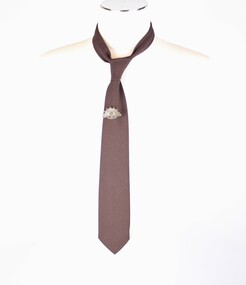
Uniform, Tie, Nurses
... Hospital before embarking for Japan in 1947. This tie holds historic and representative significance, as a piece of standard military uniform that would have been worn by a nurse in the second military district of the occupational forces, presumably in Japan shortly after WW2. military uniform tie nurse second military district occupational forces ww2 wwii world war two world war 2 second world war VFX151507 Sister Danson Brown synthetic fabric tie (formerly tied in simple Windsor knot) with peach lining. ...This tie is part of an official uniform by Sister Danson (VFX151507) during the British presence in Japan following the end of the Second World War. About 16,000 Australians served in the British Commonwealth Occupation Forces, including 130 from the Australian General Hospital with whom Sister Danson presumably served. Sister Danson was born in Numurkah and served as Leiutentant with the Heidelberg Military Hospital before embarking for Japan in 1947.This tie holds historic and representative significance, as a piece of standard military uniform that would have been worn by a nurse in the second military district of the occupational forces, presumably in Japan shortly after WW2. Brown synthetic fabric tie (formerly tied in simple Windsor knot) with peach lining. military, uniform, tie, nurse, second military district, occupational forces, ww2, wwii, world war two, world war 2, second world war, vfx151507, sister danson -
 Flagstaff Hill Maritime Museum and Village
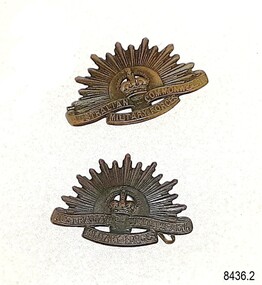
Badge - Australian Military badge, Australian Commonwealth Military Forces, 1914-to possibly 1940s
... hospital...Flying Doctor...W.R. Angus Collection...Australian Army...Surgeon Captain...Ballarat...Bonegilla...badge...insignia...Australian Commonwealth Military Forces...World War 1...First World War...1914-1918...badge collection...World War 2...Second World War...Great War...Australian Defence Forces...WWI...WW2...hospital Flying Doctor W.R. Angus Collection Australian Army Surgeon Captain Ballarat Bonegilla badge insignia Australian Commonwealth Military Forces World War 1 First World War 1914-1918 badge collection World War 2 Second World War Great War Australian Defence Forces WWI WW2 World War II World War I "AUSTRALIAN COMMONWEALTH MILITARY FORCES" Badges; a pair of collar badges from the Australian Commonwealth Military Forces badges. ...The two badges belonged to Dr William Roy Angus and are now part of Flagstaff Hill’s comprehensive W.R. Angus Collection, donated by the family of Dr W R Angus, 1901-1970, surgeon and oculist. The badges date to the World War I era, when Dr Angus was a youth. These badges were also used in World War II it seems, and could have belonged to Dr Angus when he was a Surgeon Captain for the Australian Defence Forces during World War II when he was in his forties. Some resources say that this badge was also used in WWII The W.R. Angus Collection: - The W.R. Angus Collection includes historical medical equipment, surgical instruments and material belonging to Dr Edward Ryan and Dr Thomas Francis Ryan, (both of Nhill, Victoria) and Dr Angus’ own belongings. The Collection’s history spans the medical practices of the two Doctors Ryan, from 1885-1926 plus that of Dr Angus, up until 1969. It includes historical medical and surgical equipment and instruments from the doctors Edward and Thomas Ryan of Nhill, Victoria. Dr Angus married Gladys in 1927 at Ballarat, the nearest big city to Nhill where he began as a Medical Assistant. He was also Acting House surgeon at the Nhill hospital where their two daughters were born. During World War II He served as a Military Doctor in the Australian Defence Forces. Dr Angus and his family moved to Warrnambool in 1939, where Dr Angus operated his own medical practice. He later added the part-time Port Medical Officer responsibility and was the last person appointed to that position. Dr Angus and his wife were very involved in the local community, including the planning stages of the new Flagstaff Hill and the layout of the gardens there. Dr Angus passed away in March 1970.Dr W R Angus (1901-1970), surgeon and oculist, collected a range of military objects including those he personally used during his time as Surgeon Captain in the Australian Defence Forces in World War II. The objects allow insight into military life in the early-to-mid 20th century. The W.R. Angus Collection is significant for still being located at the site it is connected with, Doctor Angus being the last Port Medical Officer in Warrnambool. The Collection includes historical medical objects that date back to the late 1800s.Badges; a pair of collar badges from the Australian Commonwealth Military Forces badges. Brass with the logo of a crown within a rising sun, above ribbons with embossed text. WWI era. The badges are part of the W. R. Angus Collection."AUSTRALIAN COMMONWEALTH MILITARY FORCES"flagstaff hill, warrnambool, maritime village, maritime museum, shipwreck coast, great ocean road, flagstaff hill maritime museum and village, dr w r angus, dr ryan, warrnambool base hospital, nhill base hospital, mira hospital, flying doctor, w.r. angus collection, australian army, surgeon captain, ballarat, bonegilla, badge, insignia, australian commonwealth military forces, world war 1, first world war, 1914-1918, badge collection, world war 2, second world war, great war, australian defence forces, wwi, ww2, world war ii, world war i -
 Geelong RSL Sub Branch
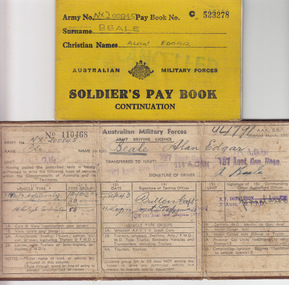
Documents NX200845 A E Beale, circa 1940
... The Pay Book and the Driving Licence belong to NX 200845 A E Beale who served during WW2 with the AIF 101 and 114 Australia General Hospitals....The Pay Book and the Driving Licence belong to NX 200845 A E Beale who served during WW2 with the AIF 101 and 114 Australia General Hospitals. The document are the originals belonging to NX 200845 A E Beale. ...The Pay Book and the Driving Licence belong to NX 200845 A E Beale who served during WW2 with the AIF 101 and 114 Australia General Hospitals.The document are the originals belonging to NX 200845 A E Beale.Soldier's Pay Book Form WF 5(a) Revised July, 1944 - Oblong yellow covered book with grey pages, Pay Book Number C523278. AMF Army Driving Licence AAF G11, Revised March,1943 - Oblong brown covered book, folds into three, a white page pasted to the inside cover with Pte Beal's authority to drive military vehicles.Pay Book and Driving Licence - NX 200845 Pte Alan Edgar Beale.aif, ww2 nx 200845 pte a e beale, driving licence, paybook, 101 agh, 114 agh -
 Geelong RSL Sub Branch
Nurses Cape V10909 Margaret A Brown, There are no makers marks, All items circa 1940
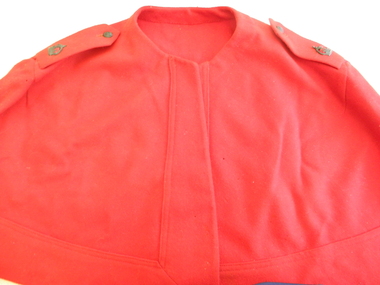
... WW2. Margaret A Brown enlisted on 17 September 1940 and was discharged with the rank of Major on 28 July 1944. Margaret Brown worked at the Heidelberg Hospital and also as Matron at Puckapunyal. ...WW2. Margaret A Brown enlisted on 17 September 1940 and was discharged with the rank of Major on 28 July 1944. Margaret Brown worked at the Heidelberg Hospital and also as Matron at Puckapunyal. ...The Cape belonged to V10909 Margaret Annie Brown who served with the AMF during WW2. Margaret A Brown enlisted on 17 September 1940 and was discharged with the rank of Major on 28 July 1944. Margaret Brown worked at the Heidelberg Hospital and also as Matron at Puckapunyal. Margaret Brown missed out on a posting to Hospital Ships working in the Pacific because of her age at the time - 40 - the cut off for the assignment was 40. One of Margarets co-workers at Heidelberg Vivian Bullwinkle - late 20ish at the time - gained a posting oversees.This is the original Nurses Cape that belonged to V10909 Margaret A Brown. The Soldiers Paybook and Appointment Certificate are originals belonging to V10909 Margaret A Brown.A Scarlett Nurses Cape. There are two Major Badges of Rank on the epaulettes and two Australian Military Forces buttons holding the epaulettes to the shoulders. Soldiers Pay Book, Continuation. Cardboard Cover, buff colour with paper pages. Appointment Certificate. Paper.The are no inscriptions or markings on the Cape. Pay Book No C81010, Army No. V10909, Name Brown, Christian Names Margaret Anne.nurses cape, v10909 m a brown, ww2, heidelberg, puckpunyal, pay book, appointment certificate -
 Geelong RSL Sub Branch
Documents & Photographs 6454 James F Fry, Early 20th Century
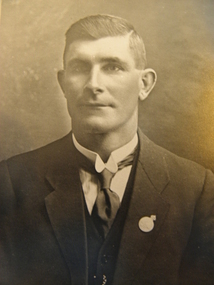
... The medals are the originals belonging to 6454 James F Fry. ww1 24 battalion 6454 james f fry ww2 On the back of the hospital photograph only, St Leonards by the Sea, England. ...6454 James F Fry enlisted in the AIF on 27 October 1916 and served in France during WW1. 6454 James F Fry embarked Australia on the HMAT Hororata on 23 November 1916 and returned to Australia on HMAT Runic on 22 March 1918. James F Fry also served in the Volunteer Defence Corps during WW2 his regimental number was V361385.The photographs and documents are copies of the originals belonging to 6454 James F Fry. The medals are the originals belonging to 6454 James F Fry.Black and white photographs, oblong, on photo paper. The photographs include those of 6454 James F Fry, a unit photograph, photographs of the hospital St Leonards by the Sea, England, discharge Certififate, Recognition Certificate from Balliang RSL. Medals - British War Medal and Victory Medal with ribbons., silver colour, round, gold colour round. On the back of the hospital photograph only, St Leonards by the Sea, England. The Meds are inscribed around the edge - 6454 J F Fry AIF 24 Battalion.ww1, 24 battalion, 6454 james f fry, ww2 -
 City of Moorabbin Historical Society (Operating the Box Cottage Museum)
Badge - WWI Red Cross Buttons
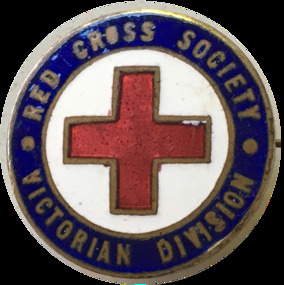
... WW2 Red Cross raised funds selling buttons. Early settlers in Moorabbin Shire held fundraising events for the support of Red Cross Victoria and made cakes and knitted socks, gloves and scarves for distribution to serving men and women red cross fund raising buttons wwi wwii french red cross british red cross market gardeners early settlers moorabbin shire bentleigh cheltenham caulfield repatriation hospital Red Cross Metal buttons with printing on them Badge WWI Red Cross Buttons ...The International Committee of the Red Cross was formed in 1862. Initially its purpose was to try and find ways of overcoming the inadequacy of army medical services so as to alleviate the suffering of those wounded in armed conflict. Over time it has extended its work to include many forms of humanitarian aid in times of peace and war. The Australian Red Cross Society (ARCS) was formed just after the outbreak of the First World War in August 1914, originally as a branch of the British Red Cross. It is especially remembered in the provision of “comforts” for soldiers overseas. Enormous sums of money were raised, and thousands of women volunteers contributed their time by making vast quantities of clothing: socks, vests, mittens, mufflers, pyjamas and a variety of linen. Items were sent to headquarters located in the state capitals, often using government houses as depots, where, after being sorted and packed by yet more volunteers, they were sent to Britain or the front. The effect of this work for the recipients was to bring comfort in its truest sense, for a seemingly trivial gift of a bar of chocolate of a pair of dry socks could bring the most profound relief for a soldier on the Western Front. From the date of its inception until the armistice the ARCS dispatched 395,695 food parcels and 36,339 clothing parcels Between 1914 and 1918 more than £3,500,00 was collected and spent on Red Cross services to the Australian Forces and Empire Forces. During WW1 and WW2 Red Cross raised funds selling buttons.Early settlers in Moorabbin Shire held fundraising events for the support of Red Cross Victoria and made cakes and knitted socks, gloves and scarves for distribution to serving men and women Metal buttons with printing on themRed Crossred cross, fund raising buttons, wwi, wwii, french red cross, british red cross, market gardeners, early settlers, moorabbin shire, bentleigh, cheltenham, caulfield repatriation hospital -
 Mission to Seafarers Victoria
Photograph - Photograph, Black and white, Herald, Captain R. Sunter of the M.S. Manunda , at the invitation of the War memorial in Melbourne, plants a tree, 04 August 1934
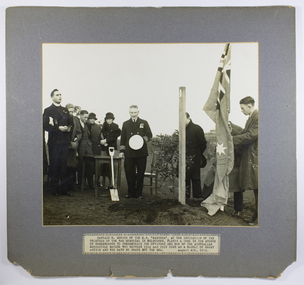
... Depicts one of the few memorials specifically commissioned for Merchant seamen of WW1 and in later years also a focus for those who died in WW2 and other conflicts. padre oliver captain robert sunter m.s. manunda war memorial mercantile marine memorial tree melbourne shrine of remembrance wandilla hospital ship adelaide steamship company memorial trees queensland kauri Typed caption in upper case: CAPTAIN R. ...On the 4 August 1934, to mark the 20th anniversary of the Great Britain declaration of war on Germany, 106 trees were planted, during a ceremony, on the lawns of the newly created garden of the Shrine of Remembrance. The Shrine of Remembrance was built to provide a place to grieve and remember Victorians killed in the First World War (1914-18). Prince Henry, the Duke of Gloucester and son of King George V, officially opened the Shrine before a crowd of 300,000 people in November 1934. Captain Robert Sunter, commander of the coastal liner Manunda, Adelaide Steamship Company, was chosen to plant a Queensland kauri (tree - number 100) on the main avenue from Domain Rd leading to the Shrine of Remembrance. The photograph was published in the Herald (4 August 1934, p. 40). In the Argus (Melbourne, Vic. : 1848 - 1957), Friday 3 August 1934, page 8 In Memory of the Merchant Service- Captain Sunter to Plant Tree at the Shrine Tomorrow will be the 20th anniversary of Great Britain's declaration of war on Germany, and at 10 and. Captain R. Sunter, the commander of the coastal liner Manunda, will plant a tree in the Shrine! of Remembrance reserve In memory of the officers and men of the Australian merchant service who gave their lives during the war. The tree, , which will be No.100 in the reserve, will bear the following inscription based on the wording of the ' British Mercantile Marine memorial at Tower Hill. London: "1914-1918. In remembrance of the officers and men of the Australian Mercantile Marine who died for King and Country and have no grave but the sea. Planted August 4, 1934." During the war 12 ships of the Australian merchant service were sunk and 95 officers and men lost their lives.The Shrine of Remembrance committee recently asked the director of navigation (Captain J. K. Davis) to nominate a member of the mercantile marine to plant a tree in the reserve. Captain Davis passed on the request to the secretary of the Merchant Service Guild of Australia (Captain T. D. Snape) and, after having conferred with various sections of the sea-going service, Captain Snape announced yesterday that Captain Sunter had been chosen unanimously. Captain Sunter has a distinguished war record as commander of the hospital ship Wandilla. Born at South Shields, in England, in 1878, he is a son of the late Canon Sunter, of Adelaide. He served an apprenticeship in sailing ships, and soon after obtaining his master a certificate entered the service of the Adelaide Steamship Company, where he has remained. In the Wandilla during the war Captain Sunter became known to thousands of wounded soldiers and troops." Padre Frank Oliver of MtS can be seen assisting with dedication at far left. Captain Robert Sunter who also served in WW1, a friend of the seamen and the mission, died a month later in Cairns. A window funded by crew of the Manunda and friends was dedicated to his memory in St Peter's Chapel, MtSV in February 1936 by Padre Oliver. (see item 0038).Depicts one of the few memorials specifically commissioned for Merchant seamen of WW1 and in later years also a focus for those who died in WW2 and other conflicts. Mounted black and white photograph of a group of people at a tree planting, minister of religion at far left, on dark grey mount with typed caption label on the lower edge of mountTyped caption in upper case: CAPTAIN R. SUNTER OF THE M.S. “MANUNDA”, AT THE INVITATION OF THE TRUSTEES OF THE WAR MEMORIAL IN MELBOURNE , PLANTS A TREE IN THE AVENUE OF REMEMBRANCE TO COMMEMORATE THE OFFICERS AND MEN OF THE AUSTRALIAN MERCANTILE MARINE WHO BETWEEN 1914 AND 1918 DIED AS A RESULT OF ENEMY ACTION AND WHO HAVE NO GRAVE BUT THE SEA. AUGUST 4TH 1934padre oliver, captain robert sunter, m.s. manunda, war memorial, mercantile marine memorial tree, melbourne, shrine of remembrance, wandilla, hospital ship, adelaide steamship company, memorial trees, queensland kauri -
 Montmorency–Eltham RSL Sub Branch
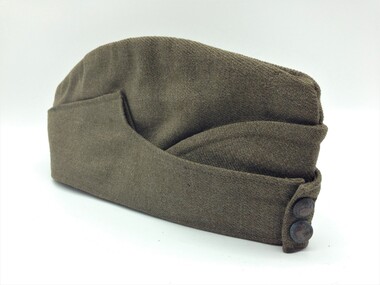
Uniform - Forage Cap, Australian Military Forces WW2
... Hospital. Discharged 20 MAY 1947. (Ref: NAA: B883, VX21885) The ownership of this cap is clear and the service of this local ex-serviceman can be established. The usage of this cap is unknown as there is no evidence that it has been worn with any kind of cap badge. Headgear Regimental No. VX21885 NAME L.C.CARROLL Stamp E 9or F, broad arrow, S Khaki serge forage cap with two 12mm diameter AMF metal buttons. No cap badge. Cotton khaki lining. Cotton off-white label sewn to lining Forage Cap, Australian Military Forces WW2 ...Cap issued to WO2 Leonard Charles CARROLL VX21885 of West Heidelberg, Vic., born in Manchester UK on 01 JAN 1907. An X-ray technician, he enlisted on 07 JUN 1940 at Caulfield, Vic. and served in the Middle East, Ceylon and Australia mainly with 2/4th Aust. General Hospital. Discharged 20 MAY 1947. (Ref: NAA: B883, VX21885) The ownership of this cap is clear and the service of this local ex-serviceman can be established. The usage of this cap is unknown as there is no evidence that it has been worn with any kind of cap badge.Khaki serge forage cap with two 12mm diameter AMF metal buttons. No cap badge. Cotton khaki lining. Cotton off-white label sewn to liningRegimental No. VX21885 NAME L.C.CARROLL Stamp E 9or F, broad arrow, S headgear -
 Flagstaff Hill Maritime Museum and Village
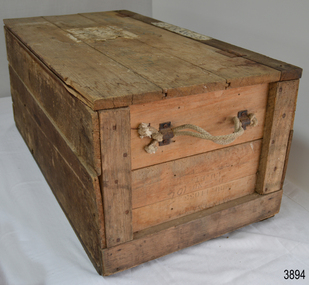
Container - Trunk, Doctor William Roy Angus M.B., B.S., Adel., 1923, F.R.C.S. Edin.,1928, c. late 1930's
... hospital...flying doctor...medical treatment...surgeon captain w.r. angus...ww2...Dr Angus assisted Dr Tom Ryan, a pioneer in the use of X-rays and in ocular surgery. flagstaff hill warrnambool shipwrecked coast flagstaff hill maritime museum maritime museum shipwreck coast flagstaff hill maritime village great ocean road dr w r angus t.s.s. largs bay warrnambool base hospital flying doctor medical treatment surgeon captain w.r. angus ww2 service ballarat ww2 service bonegilla wooden trunk military service trunk for personal effects storage Metal label “Captain W. ...This trunk was donated to Flagstaff Hill Maritime Village by the family of Doctor William Roy Angus, Surgeon and Oculist. It is part of the “W.R. Angus Collection” that includes historical medical equipment, surgical instruments and material once belonging to Dr Edward Ryan and Dr Thomas Francis Ryan, (both of Nhill, Victoria) as well as Dr Angus’ own belongings. The Collection’s history spans the medical practices of the two Doctors Ryan, from 1885-1926 plus that of Dr Angus, up until 1969. The trunk was used by Dr. Angus when he served as Surgeon Captain for the Australian Army during WW2. At that time his residence was in Warrnambool. His time of service was spent in Ballarat, Victoria, and in Bonegilla, N.S.W. The portion of the paper label on the trunk that ends in an 'a' is possible the end of the word 'Bonegilla', where his trunk could have been sent. ABOUT THE “W.R.ANGUS COLLECTION” Doctor William Roy Angus M.B., B.S., Adel., 1923, F.R.C.S. Edin.,1928 (also known as Dr Roy Angus) was born in Murrumbeena, Victoria in 1901 and lived until 1970. He qualified as a doctor in 1923 at University of Adelaide, was Resident Medical Officer at the Royal Adelaide Hospital in 1924 and for a period was house surgeon to Sir (then Mr.) Henry Simpson Newland. Dr Angus was briefly an Assistant to Dr Riddell of Kapunda, then commenced private practice at Curramulka, Yorke Peninsula, SA, where he was physician, surgeon and chemist. In 1926, he was appointed as new Medical Assistant to Dr Thomas Francis Ryan (T.F. Ryan, or Tom), in Nhill, Victoria, where his experiences included radiology and pharmacy. In 1927 he was Acting House Surgeon in Dr Tom Ryan’s absence. Dr Angus had become engaged to Gladys Forsyth and they decided he further his studies overseas in the UK in 1927. He studied at London University College Hospital and at Edinburgh Royal Infirmary and in 1928, was awarded FRCS (Fellow from the Royal College of Surgeons), Edinburgh. He worked his passage back to Australia as a Ship’s Surgeon on the on the Australian Commonwealth Line’s T.S.S. Largs Bay. Dr Angus married Gladys in 1929, in Ballarat. (They went on to have one son (Graham 1932, born in SA) and two daughters (Helen (died 12/07/1996) and Berenice (Berry), both born at Mira, Nhill ) Dr Angus was a ‘flying doctor’ for the A.I.M. (Australian Inland Ministry) Aerial Medical Service in 1928 . Its first station was in the remote town of Oodnadatta, where Dr Angus was stationed. He was locum tenens there on North-South Railway at 21 Mile Camp. He took up this ‘flying doctor’ position in response to a call from Dr John Flynn; the organisation was later known as the Flying Doctor Service, then the Royal Flying Doctor Service. A lot of his work during this time involved dental surgery also. Between 1928-1932 he was surgeon at the Curramulka Hospital, Yorke Peninsula, South Australia. In 1933 Dr Angus returned to Nhill and purchased a share of the Nelson Street practice and Mira hospital (a 2 bed ward at the Nelson Street Practice) from Dr Les Middleton one of the Middleton Brothers, the current owners of what previously once Dr Tom Ryan’s practice. Dr Tom and his brother had worked as surgeons included eye surgery. Dr Tom Ryan performed many of his operations in the Mira private hospital on his premises. He had been House Surgeon at the Nhill Hospital 1902-1926. Dr Tom Ryan had one of the only two pieces of radiology equipment in Victoria during his practicing years – The Royal Melbourne Hospital had the other one. Over the years Dr Tom Ryan had gradually set up what was effectively a training school for country general-practitioner-surgeons. Each patient was carefully examined, including using the X-ray machine, and any surgery was discussed and planned with Dr Ryan’s assistants several days in advance. Dr Angus gained experience in using the X-ray machine there during his time as assistant to Dr Ryan. When Dr Angus bought into the Nelson Street premises in Nhill he was also appointed as the Nhill Hospital’s Honorary House Surgeon 1933-1938. His practitioner’s plate from his Nhill surgery is now mounted on the doorway to the Port Medical Office at Flagstaff Hill Maritime Village, Warrnambool. When Dr Angus took up practice in the Dr Edward and Dr Tom Ryan’s old premises he obtained their extensive collection of historical medical equipment and materials spanning 1884-1926. A large part of this collection is now on display at the Port Medical Office at Flagstaff Hill Maritime Village in Warrnambool. In 1939 Dr Angus and his family moved to Warrnambool where he purchased “Birchwood,” the 1852 home and medical practice of Dr John Hunter Henderson, at 214 Koroit Street. (This property was sold in1965 to the State Government and is now the site of the Warrnambool Police Station. and an ALDI sore is on the land that was once their tennis court). The Angus family was able to afford gardeners, cooks and maids; their home was a popular place for visiting dignitaries to stay whilst visiting Warrnambool. Dr Angus had his own silk worm farm at home in a Mulberry tree. His young daughter used his centrifuge for spinning the silk. Dr Angus was appointed on a part-time basis as Port Medical Officer (Health Officer) in Warrnambool and held this position until the 1940’s when the government no longer required the service of a Port Medical Officer in Warrnambool; he was thus Warrnambool’s last serving Port Medical Officer. (Masters of immigrant ships arriving in port reported incidents of diseases, illness and death and the Port Medical Officer made a decision on whether the ship required Quarantine and for how long, in this way preventing contagious illness from spreading from new immigrants to the residents already in the colony.) Dr Angus was a member of the Australian Medical Association, for 35 years and surgeon at the Warrnambool Base Hospital 1939-1942, He served as a Surgeon Captain during WWII1942-45, in Ballarat, Victoria, and in Bonegilla, N.S.W., completing his service just before the end of the war due to suffering from a heart attack. During his convalescence he carved an intricate and ‘most artistic’ chess set from the material that dentures were made from. He then studied ophthalmology at the Royal Melbourne Eye and Ear Hospital and created cosmetically superior artificial eyes by pioneering using the intrascleral cartilage. Angus received accolades from the Ophthalmological Society of Australasia for this work. He returned to Warrnambool to commence practice as an ophthalmologist, pioneering in artificial eye improvements. He was Honorary Consultant Ophthalmologist to Warrnambool Base Hospital for 31 years. He made monthly visits to Portland as a visiting surgeon, to perform eye surgery. He represented the Victorian South-West subdivision of the Australian Medical Association as its secretary between 1949 and 1956 and as chairman from 1956 to 1958. In 1968 Dr Angus was elected member of Spain’s Barraquer Institute of Barcelona after his research work in Intrasclearal cartilage grafting, becoming one of the few Australian ophthalmologists to receive this honour, and in the following year presented his final paper on Living Intrasclearal Cartilage Implants at the Inaugural Meeting of the Australian College of Ophthalmologists in Melbourne In his personal life Dr Angus was a Presbyterian and treated Sunday as a Sabbath, a day of rest. He would visit 3 or 4 country patients on a Sunday, taking his children along ‘for the ride’ and to visit with him. Sunday evenings he would play the pianola and sing Scottish songs to his family. One of Dr Angus’ patients was Margaret MacKenzie, author of a book on local shipwrecks that she’d seen as an eye witness from the late 1880’s in Peterborough, Victoria. In the early 1950’s Dr Angus, painted a picture of a shipwreck for the cover jacket of Margaret’s book, Shipwrecks and More Shipwrecks. She was blind in later life and her daughter wrote the actual book for her. Dr Angus and his wife Gladys were very involved in Warrnambool’s society with a strong interest in civic affairs. He had an interest in people and the community They were both involved in the creation of Flagstaff Hill, including the layout of the gardens. After his death (28th March 1970) his family requested his practitioner’s plate, medical instruments and some personal belongings be displayed in the Port Medical Office surgery at Flagstaff Hill Maritime Village, and be called the “W. R. Angus Collection”. The W.R. Angus Collection is significant for still being located at the site it is connected with, Doctor Angus being the last Port Medical Officer in Warrnambool. The collection of medical instruments and other equipment is culturally significant, being an historical example of medicine from late 19th to mid-20th century. Dr Angus assisted Dr Tom Ryan, a pioneer in the use of X-rays and in ocular surgery. Trunk, handmade, from the W.R. Angus Collection. Wooden trunk, rope handles on ends, metal hinges, previously closed by nails. Trunk has labels with names and destinations. Stamped into wood on end is text from original timber. One paper label is peeling off.Metal label “Captain W. R. Angus” (black writing on white metal label). On lid in blue writing “Captain W.R. Angus”. Paper label “Captain W.R. Angus, 214 Koroit Street, Warrnambool, Victoria. V 141633 (looks like)”. Obscured label “ - - a Rail Station”.flagstaff hill, warrnambool, shipwrecked coast, flagstaff hill maritime museum, maritime museum, shipwreck coast, flagstaff hill maritime village, great ocean road, dr w r angus, t.s.s. largs bay, warrnambool base hospital, flying doctor, medical treatment, surgeon captain w.r. angus, ww2 service ballarat, ww2 service bonegilla, wooden trunk, military service, trunk for personal effects storage -
 Phillip Island and District Historical Society Inc.
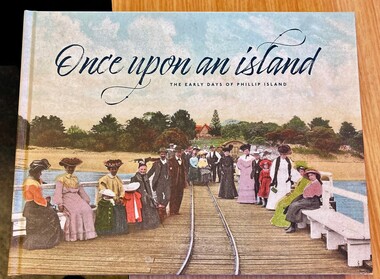
Book, Once upon an Island: the early days of Phillip Island, 2023
... WW2...Warley Hospital...Historical phillip Island history Phillip Island & San Remo Advertiser Ferries shipwrecks motor racing Wollemi chicory Golden cyprus trees sharks Guesthouses Army WW1 WW2 Warley Hospital Football Olive Justice Summerland Churchill Island Erosion Once upon an island : the early days of Phillip Island Collated by Anne Oswin, Eleanor McKAy and Sarah Hudson. ...Series of articles collected by the Advertiser for the celebration in 2018 of 150 years of European settlement of Phillip Island. Printed by Chicory Publshing, division of The Phillip Island and San Remo .Advertiser.HistoricalColoured hardcover book, 229 pages, with photos, stories and recollections of early settlement of Phillip IslandOnce upon an island : the early days of Phillip Island Collated by Anne Oswin, Eleanor McKAy and Sarah Hudson.phillip island history, phillip island & san remo advertiser, ferries, shipwrecks, motor racing, wollemi, chicory, golden cyprus trees, sharks, guesthouses, army ww1, ww2, warley hospital, football, olive justice, summerland, churchill island, erosion -
 Bendigo Military Museum
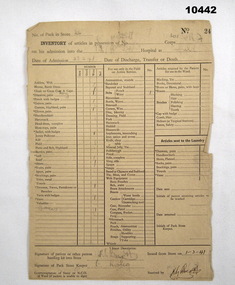
Administrative record - INDUCTION ADMISSION LIST, WW2, 1 Mar 1941
... Yellow single sheet of paper listing items belonging to patient (signature is unreadable) being admitted into hospital on 23.2.41 during WW2. Items primarily related to uniform. ...Collection of William (Bill) Thomason Admin record WW2 Dated admission “23-2-41” Yellow single sheet of paper listing items belonging to patient (signature is unreadable) being admitted into hospital on 23.2.41 during WW2. ...Admin record to show what patients had when being admitted. Part of the collection of William (Bill) Thomason. Refer Cat No. 4136P.Yellow single sheet of paper listing items belonging to patient (signature is unreadable) being admitted into hospital on 23.2.41 during WW2. Items primarily related to uniform. Most writing and signatures indecipherable.Dated admission “23-2-41”collection of william (bill) thomason, admin record, ww2 -
 Bendigo Military Museum
Postcard - CHRISTMAS GREETING, Australian Military Forces, 23 Dec 1941
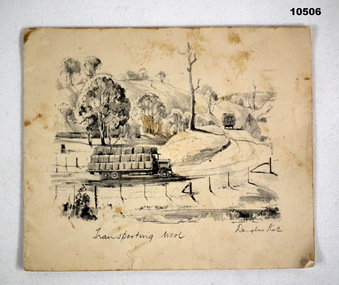
... WW2 Postcard Artillery Christmas John A Torpie Front Title - Transporting wool. Inner left - To Greet You Sincerely at Christmas and wish you Happiness in the New Year. Inner Right - Australian Military Forces. "I don't appear in the picture, not being a skite, I am hiding behind the gun. J.T.". Rear Page - 7th Inf. Brigade, Chermside Camp, Brisbane 23.12.41. Dear Ted & George. Wishing you both a Happy Christmas and a Prosperous New Year. Have been in camp hospital ..."John Ahem Torpie" QX39522 (Q119806) Enlisted 14/9/42 (2nd AIF) Discharged 6/11/46. Rank Captain. Black and white card formed by folding a sheet of paper two ways. The front depicts a pen and ink drawing of civilian trucks hauling wool bales in an Australian Rural scene. On the inside of the card there is an illustration of a soldier standing to attention and a 25 Pdr gun crew in action. The right side shows a heavy A.A. gun in action - mobile type of gun. Beside it are two artillery signallers, prone, working a radio set. The rear page has the actual letter greetings.Front Title - Transporting wool. Inner left - To Greet You Sincerely at Christmas and wish you Happiness in the New Year. Inner Right - Australian Military Forces. "I don't appear in the picture, not being a skite, I am hiding behind the gun. J.T.". Rear Page - 7th Inf. Brigade, Chermside Camp, Brisbane 23.12.41. Dear Ted & George. Wishing you both a Happy Christmas and a Prosperous New Year. Have been in camp hospital for ten days as a result of encounter with muma (?) - shall hardly land the M.C. but then so very few get their deserts. Often think of C.V.M.S. & wonder how you all are doing. Remember me to the boys. John A Torpie. ww2, postcard, artillery, christmas, john a torpie
