Showing 7 items matching "ww2. new guinea. war's end."
-
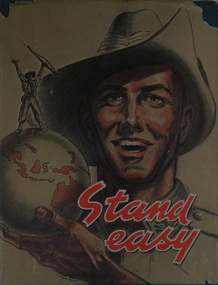
Warrnambool RSL Sub BranchBook, Stand Easy
... WW2. New Guinea. War's End....Warrnambool RSL Sub Branch Cnr Merri & Liebig Streets Warrnambool great-ocean-road WW2. New Guinea. War's End. Published for the Australian Military Forces By Australian War Memorial Canberra, ACT. 1945 Hard Cover with colourfully Illustrated Dust Cover. ...Hard Cover with colourfully Illustrated Dust Cover.Published for the Australian Military Forces By Australian War Memorial Canberra, ACT. 1945ww2. new guinea. war's end. -
Bendigo Military MuseumPhotograph - PHOTOGRAPHS WW2, Possibly 1945
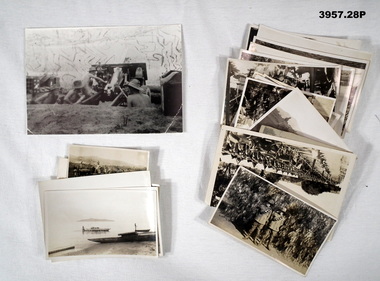
... New Britain up to & at wars end in 1945. One photo is in New Guinea. Many have been written on the back in pen. Photos are various sizes. Average noted. .16) Men & Bren gun carriers .17) Men & bulldozer .18) 7 men with machine gun .19) Native boats .20) Soldier & natives with canoe .21) Soldier & natives with canoe .22) 2 soldiers with POW .23) Soldier with plane wreckage .24) 3 soldiers with natives .25) 8 soldiers in group .26) Soldier sitting in plane wreck .27) Soldier in native canoe .28) Artillery unit in position firing, 4 men Photograph PHOTOGRAPHS WW2 ...Photos labelled Jack are John Alfred TAYLOR NX102933 21st Guard Battalion. .28) This is Roy TAYLOR NX 94268 21st Field Regiment. Roy is on the left of photos. These men were brothers.Collection of photos, black / white & sepia. Some in Australia re Light Horse pre war. Most are presumably taken in New Britain up to & at wars end in 1945. One photo is in New Guinea. Many have been written on the back in pen. Photos are various sizes. Average noted. .16) Men & Bren gun carriers .17) Men & bulldozer .18) 7 men with machine gun .19) Native boats .20) Soldier & natives with canoe .21) Soldier & natives with canoe .22) 2 soldiers with POW .23) Soldier with plane wreckage .24) 3 soldiers with natives .25) 8 soldiers in group .26) Soldier sitting in plane wreck .27) Soldier in native canoe .28) Artillery unit in position firing, 4 men Handwritten on the back in pen: .1) “Jack Taylor” .2) “Jap Prisoners” .3) “After surrender, jap prisoners on New Britain” .4) “Camp on New Britain” .5) “Jap prisoners of war” .6) Jacks collection of photos New Britain .7) Jack New Britain 1945 .8) Jap Working Party New Britain .9) Camp probably New Britain .10) Wrecked jap planes on New Britain .11) Jack & mates with Jap Sword (Jack centre) .12) More japs .13) Jack & group, probably some of 21st Guard Battalion .14) 21st Light Horse Regt in Camp Wagga? .15) Two Light Horsemen, Jacks matesphotographs, japs, new britain, native -
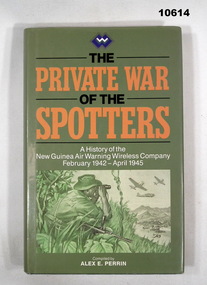
Bendigo Military MuseumBook - MILITARY HISTORY, WW2, Alex E. Perrin, "THE PRIVATE WAR OF THE SPOTTERS", 1990
... WW2 New Guinea Military History AIF Handwritten details - blue ink pen. "Len Burke" Hard cover book with dust cover. Hard cover - cardboard, with green colour buckram, gold colour print on spine. Dustcover - paper. black, orange and white print on green colour background. Illustrated - front, copy of an artwork depicting a soldier within jungle foliage holding binoculars, aircraft and camp structures in the background. Flaps with printed information. 296 pages, cut, plain, off white paper. Illustrated black and white photography, drawings and maps - including front and back end papers. Inscription noted on front end paper. "THE PRIVATE WAR ...From the title page: "THE/ PRIVATE WAR/ OF THE / SPOTTERS/ A HISTORY OF THE/ NEW GUINEA AIR WARNING WIRELESS COMPANY/ February 1942-April 1945"Hard cover book with dust cover. Hard cover - cardboard, with green colour buckram, gold colour print on spine. Dustcover - paper. black, orange and white print on green colour background. Illustrated - front, copy of an artwork depicting a soldier within jungle foliage holding binoculars, aircraft and camp structures in the background. Flaps with printed information. 296 pages, cut, plain, off white paper. Illustrated black and white photography, drawings and maps - including front and back end papers. Inscription noted on front end paper. Handwritten details - blue ink pen. "Len Burke" publications, books, ww2, new guinea, military history, aif -
Lara RSL Sub BranchPhotograph, Set 4 photographs. and others for Torquay Light Horse camp, 1940
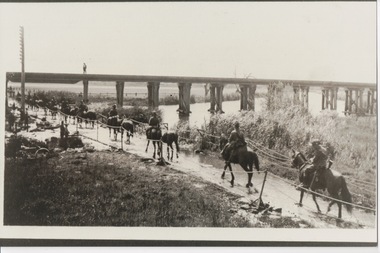
... WW2. Those who served in the Militia provided valuable Officers and NCOs and men for the armed services during the war. Each infantry division of the 2nd AIF had a Light Horse regiment attached to it. But the day of the Australian mounted soldier hadn’t quite passed. During World War II, Australia’s 6th Cavalry Regiment formed a mounted unit they called “The Kelly Gang” which did valuable scouting work. In New Guinea, a mounted Light Horse Troop did patrol duty and helped carry supplies. Some fully equipped walers were flown into Borneo for reconnaissance in rugged mountain country. But by the end...WW2. Those who served in the Militia provided valuable Officers and NCOs and men for the armed services during the war. Each infantry division of the 2nd AIF had a Light Horse regiment attached to it. But the day of the Australian mounted soldier hadn’t quite passed. During World War II, Australia’s 6th Cavalry Regiment formed a mounted unit they called “The Kelly Gang” which did valuable scouting work. In New Guinea, a mounted Light Horse Troop did patrol duty and helped carry supplies. Some fully equipped walers were flown into Borneo for reconnaissance in rugged mountain country. But by the end ...These images capture for all time Light Horsemen travelling through Geelong on their way to camp at Torquay for the last Group meeting in Australia . information following - details obtained from .........https://torquayhistory.com/light-horse-brigade/ On Australia Day, 1997, Sir John Young unveiled this plaque on Point Danger, Torquay. Torquay history, Light Horse Training Camp, WW2 Plaque at Pt. Danger Note----- (See images to view plaque) The plaque identifies a significant event in Torquay’s history and the sentiments of ‘change’ for the Light Horse Brigade – from horses to machines. In 1940 the four Light Horse Regiments (4th, 8th, 13th and 20th), some 5000 Light Horse and 2000 horses camped and trained at Torquay. Three other regiments, formerly mounted on horses, were also at Torquay ‘mounted’ on privately owned trucks and cars. Division troops included Artillery, Engineers, Signals, Field Ambulance and other branches of the Army necessary to enable a Division to function. It wasn’t just the sheer numbers of men coming to this little town that made the event significant, it was also the fact that the men of the Light Horse were dramatic, almost glamorous figures and it is easy to see their exploits as some splendid adventure. Horses have played a special role in the story of Australia. They were the only means of transport across this huge country, so it was necessary for everyone to have the ability to ride a horse. When war broke out in 1899 between Britain and the Boers of South Africa (“Boer” was Dutch for “farmer”) Australia sent troops to fight. At first Britain was wary of using untried, unprofessional colonial cavalrymen but soon saw that the slouch-hatted Australian “bushmen” were a match for the fast-moving and unconventional mounted commandos of the Boers. The Australians proved themselves to be expert rough-riding horsemen and good shots. Bush life had hardened them to go for long periods with little food and water. They also showed remarkable ability to find their way in a strange country and use its features for cover, in both attack and defence. By 1914, when Australia joined the war against Germany, there were 23 Light Horse regiments of militia volunteers. Many men from these units joined the Light Horse regiments of the Australian Imperial Force (AIF). Men were given remounts (if not using their own horses) – army horses bought by Commonwealth purchasing officers from graziers and breeders. These were called “walers” because they were a New South Wales stockhorse type – strong, great-hearted animals with the strains of the thoroughbred and semi-draught to give them speed, strength and stamina. On 1st November, 1914, Australia’s First Infantry Division and the first four Light Horse regiments sailed for England in a fleet of transport ships. The first of the Light Horse arrived at Gallipoli in May without their horses. Back with their horses after Gallipoli, they were formidable combatants across the Sinai and Palestine. Some British commanders observed that the light horseman moved with a “lazy, slouching gait, like that of a sleepy tiger” but described how the promise of battle “changes that careless gait, into a live athletic swing that takes him over the ground much quicker than other troops”. They had Light Horse, Torquay, training campdeveloped a reputation as formidable infantrymen. The Turks called them “the White Ghurkas” – a reference to their deadly skill with the bayonet. The Arabs called them “The Kings of the Feathers”. The plume had originally been a battle honour of the Queensland Mounted Infantry for their work in the shearer’s strike of 1891. During WW1 it was adopted by almost all the Light Horse Regiments. It was the proud badge of the light horseman. The most famous of their battles was the attack on Beersheba- the charge of the 4th Light Horse Brigade. Mounted infantrymen and their superb walers had carried out one of the most successful cavalry charges in history – against what seemed impossible odds. They surprised the Turks by charging cavalry-style, when they would normally have ridden close to an objective then dismounted to fight. The fall of Beersheba swung the battle tide against the Turks in Palestine; and changed the history of the Middle East. While 19 men from the Surf Coast Shire served with the 4th Light Horse over the course of WW1, only four were involved in the charge of Beersheba- John GAYLARD, Philip QUINN.(Winchelsea); Wallace FINDLAY (Anglesea); Harry TRIGG (Bambra). After the war, Light Horse units played a key role in the Australian Government’s compulsory military training programme. The Citizen Military Forces (C.M.F.) thrived on the glamour of the wartime Light Horse tradition, ignoring the possibility that motor vehicles would soon replace the horses. When training was no longer compulsory, the C.M.F. regiments declined and horses became more of a luxury during the 1930s depression years of poverty and unemployment. Some regiments were motorised. Then, in 1939, Australia joined Britain in another world war. Training was increased for the militia at both home bases and regional training camps. The camp at Torquay in 1940, commanded by Major General Rankin, was at Divisional strength. By the end of the camp some felt that the Division was ready for active service. Gradually, over the next four years, the Australian Light Horse units were mounted on wheels and tracks and the horses were retired. Six men enlisted at the Torquay camp and another 57 men and women enlisted at Torquay for service in WW2. Those who served in the Militia provided valuable Officers and NCOs and men for the armed services during the war. Each infantry division of the 2nd AIF had a Light Horse regiment attached to it. But the day of the Australian mounted soldier hadn’t quite passed. During World War II, Australia’s 6th Cavalry Regiment formed a mounted unit they called “The Kelly Gang” which did valuable scouting work. In New Guinea, a mounted Light Horse Troop did patrol duty and helped carry supplies. Some fully equipped walers were flown into Borneo for reconnaissance in rugged mountain country. But by the end of the war, in 1945, the horse had disappeared from the Australian Army. References: Australian Light Horse Association www.lighthorse.org.au National Australia Archives Australian War Memorial Surf Coast Shire WW1 memorials www.togethertheyserved.com The Light horse- a Cavalry under Canvas Light Horse, Training Camp, Torquay, WW2 Late in 1939 it was decided to set up a Lighthorse training camp in Torquay to train both men and horses for the battles of the Second World War. Horses, men and equipment came on special trains from all over Victoria and NSW, and as you would expect horseman came from areas such as Omeo and Sale, the Wimmera and the Western District. They arrived at the Geelong racecourse for watering in the Barwon River and then were ridden across the ford at the breakwater and began their 11 mile trek to Torquay. Light Horse, Training Camp, Torquay, WW2 Tent city By the end of January 1940 the camp at Torquay accommodated some 5000 men and 2500 horses of the Second Cavalry Division. The rows of horses, tents and huts near Blackgate Road were quite a sight. While the cavalrymen engaged in exercises on the land and on the beaches, many of the troops took over the Torquay School for special training of men and officers. Mr Bob Pettit local farmer and Councillor for the Barrabool Shire, wrote about the Light horse in the Surf Coast Community News in 1985 saying “They used to travel about the district riding four abreast in one long convoy. To my annoyance they went through my property and shut all the gates behind them. I had certain gates open to let stock in to the water holes and it would take me three -quarters of an hour to follow the horsemen up and put all the gates right again” he continued “the men from the Light Horse were here when the fire went through in March 1940. He recalled an incident when early one morning, as some one blew the bugle, a soldier putting a white sheet on the line frightened the horses. They panicked and ran off in all directions. Six went over the cliff near Bird Rock, five were never found, and the rest were gathered up after nearly a fortnight in the bush around Addiscott and Anglesea" Light Horse, Training Camp, Torquay, WW2, Geelong Parade Geelong parade The training camp culminated in a parade through the streets of Geelong on March 12th 1940. The salute was given at the Town Hall and the troops continued on a route to the You Yang’s for a training exercise. Note-----(see media section for photograph) The Camp was abandoned in mid 1940 as it was deemed unsuitable for training during winter and the cost of a permanent camp could not be justified if it could not be used all year. Historic.......Rare,,,Interpretive.Sepia photographs.set of four ....post card size ....Horses &LighthorsemenNo 1, Lighthorsemen Regiment Geelong 1940......No 2 Light Horse at Breakwater Geelong 1938 to 1940....No 3 Light Horse at Breakwater Geelong 1938 to 1940.....No 4 Light Horse crossing Breakwater camped at Geelong Showgrounds. These markings are on reverse of photographs.light horsemengeelong 1940., world war 2 -

Tatura Irrigation & Wartime Camps MuseumDocument - Memoir, Hermine Wedel, Memories of Tatura, July 2014
... War 2. The author's parents (author Hermine Wedel, nee Strauss) were of German nationality & practicing as missionaries in New Guinea. Upon the outbreak of WW2, those German nationals were ordered to the coast by the Australian authorities and the men were transported to internment camps in Australia. The women remained behind, reporting regularly to the authorities, until they too were brought to camps in Australia at the end...War 2. The author's parents (author Hermine Wedel, nee Strauss) were of German nationality & practicing as missionaries in New Guinea. Upon the outbreak of WW2, those German nationals were ordered to the coast by the Australian authorities and the men were transported to internment camps in Australia. The women remained behind, reporting regularly to the authorities, until they too were brought to camps in Australia at the end ...An account of the author's family background & early life, more particularly those events leading to their internment in Tatura, Victoria, Australia during World War 2. The author's parents (author Hermine Wedel, nee Strauss) were of German nationality & practicing as missionaries in New Guinea. Upon the outbreak of WW2, those German nationals were ordered to the coast by the Australian authorities and the men were transported to internment camps in Australia. The women remained behind, reporting regularly to the authorities, until they too were brought to camps in Australia at the end of 1941. They were eventually reunited in a family camp for internees, Camp 3 at Tatura, in 1943. They were released from the camp to work in Australia in 1947 and the family returned to New Guinea in 1949, and eventually went back to Germany. The author also briefly recounts her marriage & married life in Brazil & Germany. 13 page document, A4 paper. 7 pages of English translation, 6 pages German original. world war ii, internee camps, civilian internees, german internees, camp 3, tatura, new guinea, strauss, stuerzenhofecker -
Returned Nurses RSL Sub-branchNewspaper - Newspaper clipping, [Western Independent], Looking back without anger, [25th April 1989]
... war, Jean worked at various Victoria hospitals and tutured at the Darley Army training camp. Her nursing career ended at the Williamstown Hospital, where she was matron until her retirement in 1971. World War 2 WWII WW2 World War II Army nurse Middle East Papua New Guinea ...The news story is about the recollections of Miss Jean Hardham, as she attended the a reunion of war nurses at ANZAC House, Melbourne. Former Williamstown Hospital matron and Army nurse, Jean said that although the hardships and horrors of the battlefields in the Middle East are almost as vivid today as when they actually happened forty-four years ago, she would go through the experience again if she lived her life over. Jean had never wanted to do anything other than nurse, so she left Australia in 1940 as a member of the Ambulance Sea Transport Unit of a ship carrying 15,000 soldiers to the battlefields of Palestine and Egypt. 1941 saw her headed to Asia, fleeing the Japanese during the fall of Singapore. After the war, Jean worked at various Victoria hospitals and tutured at the Darley Army training camp. Her nursing career ended at the Williamstown Hospital, where she was matron until her retirement in 1971. A newspaper clipping with a large title along the top, a large column of text on the left hand side and a large black and white photo of a seated older woman with a photo album.'Western Independent _ Sunshine - 24th April 1989' [blue ink, along top of paper]world war 2, wwii, ww2, world war ii, army nurse, middle east, papua new guinea, greece, syria, gaza ridge, israel, italian, german -
Returned Nurses RSL Sub-branchNewspaper - Photocopy of newspaper clipping, [The Newcastle Herald], Tender loving care in the war zone, [21 Feb 1987]
... ended the service of the 2/9th AGH in what is now Papua New Guinea and they briefly returned to Tamworth, Australia, before closing temporarily for a few months. March1945, the 2/9th AGH were sent to assist in the Borneo campaign at Morotai, where they saw out the war. Joan Crouch worked as a nurse with 2/9th AGH, during World War II, continued afterwards in the Army Nursing Service (ANS) and was later involved in the Korean War, working in Japan and Seoul. WWII World War Two WW2 ...Book review of "A special kind of service" by Joan Crouch. The book is about a wartime field hospital, the 2/9th Australian General Hospital (AGH). It was a portable group of about 300 nurses, doctors and support servicemen. The 2/9th AGH started it's life by heading by sea for the Middle East, where it was to care for ill and injured troops. It operate with a minimum of 600 bed, with 4000 at times of stress. Sister Joan Crouch has collected dairies, correspondence, official records, recollections and photos from people who served with the 2/9th for her book, told chronologically. The book begins with the first passage as a unit, via India, to the Middle East. They established the 2/9th AGH near the Arab village of Amiriya, where sand storms penetrated everything, including the operating theatre, but the staff were able to go sightseeing at the Pyramids. Next they moved to a monastery in Nazareth, where it snowed over Christmas 1941. The 2/9th AGH was recalled after Pearl Harbour to assist in South-East Asia, but Singapore fell so they came back to Northfield, Australia for a few months. They were then moved to a site 30km out of Port Moresby, called Seventeen-Mile. There they bore the brunt of casualties from the Kokoda Trail, with December 1942 seeing them looking after 4000 with a staff of twenty-nine doctors, 112 sisters and about 300 others. The 'walking wounded' were known to help nurse the bedridden. In September 1943 the first group of the Australian Army Medical Womens Service (AAMWS) arrived to assist the 2/9th AGH. March 1944 ended the service of the 2/9th AGH in what is now Papua New Guinea and they briefly returned to Tamworth, Australia, before closing temporarily for a few months. March1945, the 2/9th AGH were sent to assist in the Borneo campaign at Morotai, where they saw out the war. Joan Crouch worked as a nurse with 2/9th AGH, during World War II, continued afterwards in the Army Nursing Service (ANS) and was later involved in the Korean War, working in Japan and Seoul. A photocopy of a large newspaper clipping consisting of a title, eight columns of text and a black and white photo of a group of women sitting outside'THE NEWCASTLE HERALD / 21 FEB 1987' [photocopied ink, top left]wwii, world war two, ww2, korea, alternative publishing co-operative, adelaide, alexandria, tobruk, crete, merewether beach, red cross, bbc world service, big ben, red cross radio, syria, 7th australian division, casa nova monastery, terra santa monastery, rouna falls, laloki river, loribaiwa, church of the nativity, bethlehem, westmead hospital, new south wales, south australia, molucca group, macarthur, philippines, japanese emperor, potsdam agreement, nagasaki, american, america, pows, prisoners of war