
Showing 9 items matching "ycw melbourne"
-
 Young Christian Workers (YCW Australia) Archive and Research Centre
Bush Fire Working Party Registration Form (Blank), 1962
... ...YCW Melbourne...St Andrews was one of the places affected, and the Melbourne YCW (Boys) contributed to the re-building effort by providing skilled trades on a voluntary basis. ...St Andrews was one of the places affected, and the Melbourne YCW (Boys) contributed to the re-building effort by providing skilled trades on a voluntary basis. ...In 1962, bushfires in the Dandenong Ranges (Melbourne, Victoria) took the lives of 32 people and saw the destruction of many homes. St Andrews was one of the places affected, and the Melbourne YCW (Boys) contributed to the re-building effort by providing skilled trades on a voluntary basis. In the days before online communication, this proforma was distributed to YCW members either by post or through the channel of the branch meeting to garner volunteers to the bushfire recovery effort. The document reveals the coordinating role of the diocesan team based at headquarters, and how the YCW (Boys) in Melbourne understood it's role as a service organisation. This document is part of a broader set of documents exploring this effort, including a subsequent report evaluating the effort and letters of thanks. Document printed on pink paperycw boys, ycw melbourne, bushfire recovery, st andrews bushfires, volunteering -
 Young Christian Workers (YCW Australia) Archive and Research Centre
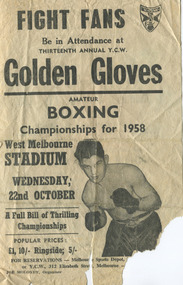
Newspaper Advertisement (withdrawn), Golden Gloves 1958
... ...ycw melbourne...The Australian YCW ran a number of sporting services throughout its history. One of these was the amateur boxing Golden Gloves competition in Melbourne between 1945 and c.1960. ...This promotional flyer produced for the 1958 competition was withdrawn from distribution due to a typesetting error on the reverse page, where it suggests accommodation could be found at Mulqueen and Sons rather than the Lomond Hotel. boxing ycw melbourne sport Golden Gloves 1958 Newspaper Advertisement (withdrawn) ...The Australian YCW ran a number of sporting services throughout its history. One of these was the amateur boxing Golden Gloves competition in Melbourne between 1945 and c.1960. This promotional flyer produced for the 1958 competition was withdrawn from distribution due to a typesetting error on the reverse page, where it suggests accommodation could be found at Mulqueen and Sons rather than the Lomond Hotel. boxing, ycw melbourne, sport -
 Young Christian Workers (YCW Australia) Archive and Research Centre
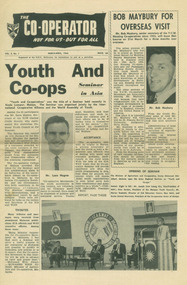
Two Copies of The Co-operator Newspaper, The Co-operator, 1962/64
... ...YCW Melbourne...Co-operatives YCW Melbourne Third Sector One complete edition of The Co-Operator newspaper published March-April 1964 and a fragment of an edition dated 1962. ...The YCW had established cooperatives in the late 1940s, a manifestation of the movement's commitment to deliver a service for every need. The Co-Ooperator was a newspaper produced by the YCW sharing information regarding its activities in the co-operative sector. The extended publication details of the newspaper are unknown and this complete copy and fragment are the only surviving editions collected by the Archive.One complete edition of The Co-Operator newspaper published March-April 1964 and a fragment of an edition dated 1962. co-operatives, ycw melbourne, third sector -
 Young Christian Workers (YCW Australia) Archive and Research Centre
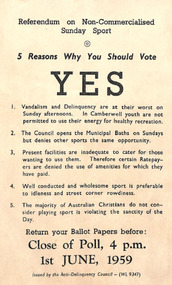
Sunday Sport Campaign Collection 1959 - 1961, 1959 to 1962
... Between 1959 and 1962, the Melbourne YCW (Boys) participated in local campaigns to allow sports to be played on municipal ovals on a Sunday. ...Between 1959 and 1962, the Melbourne YCW (Boys) participated in local campaigns to allow sports to be played on municipal ovals on a Sunday. ...Between 1959 and 1962, the Melbourne YCW (Boys) participated in local campaigns to allow sports to be played on municipal ovals on a Sunday. A key battleground was in the suburb of Camberwell in 1959. This collection of material relates to the campaign and includes newspaper clippings, leaflets and internal reports and memos. It is a sample of the materials held in collection (Contact the Archive to access MO_4_24). It features materials produced by the YCW and other parties involved in the campaign. The debate around Sunday sport campaign revealed Victoria's growing suburban sporting culture, the developing concept of youth, and the YCW position on leisure as a break from work rather than 'dour' Sabbatarianism. Discoloured newspaper clippings and documents. Some with sharp cut edges and others attached to non-related articles. -
 Young Christian Workers (YCW Australia) Archive and Research Centre
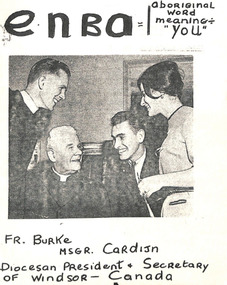
Enba Newsletters, YCW (Girls), Enba, 1963/64
... Enba was a newsletter produced by the Melbourne Executive of the YCW (Girls) distributed to members in the Melbourne Diocese in 1963 - 1965.Throughout its history, the YCW movement produced numerous publications for members and for the wider community. ...Enba was a newsletter produced by the Melbourne Executive of the YCW (Girls) distributed to members in the Melbourne Diocese in 1963 - 1965.Throughout its history, the YCW movement produced numerous publications for members and for the wider community. ...Enba was a newsletter produced by the Melbourne Executive of the YCW (Girls) distributed to members in the Melbourne Diocese in 1963 - 1965.Throughout its history, the YCW movement produced numerous publications for members and for the wider community. Some of these were regular papers or newsletters with high production values. Others were short lived efforts, produced 'in house' on low budgets. Reading across the collections, these public expressions of YCW communication provide insight into the movement's methods, the concerns of young women and men of the period, and how these shifted over time and across location. Enba contains references to campaigns on work; reports from branches in the city of Melbourne including sport and social events; profiles of Diocesan Executive Members and Presidents; letters from Chaplains including a report from Fr Brian Burke; dates regarding Pre-Cana Seminars and Summer Schools. Five editions of newsletter -
 Young Christian Workers (YCW Australia) Archive and Research Centre
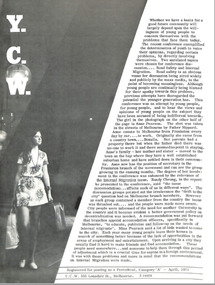
YCW Newsletter April 1971, YCW Newsletter, April 1971
... This four page document reveals the key concerns of the YCW movement in Melbourne in 1971; internal migration from regional Australia to the cities and road safety. ...Throughout its history, the YCW movement produced numerous publications for members and for the wider community. Some of these were regular papers or newsletters with high production values. Others were short lived efforts, produced 'in house' on low budgets. Reading across the collections, these public expressions of YCW communication provide insight into the movement's methods, the concerns of young women and men of the period, and how these shifted over time and across location.This four page document reveals the key concerns of the YCW movement in Melbourne in 1971; internal migration from regional Australia to the cities and road safety. It features photographs taken by chaplain Jim Nippard. Black and white printed newsletter with photos over four pages. -
 Young Christian Workers (YCW Australia) Archive and Research Centre
Black and White Photograph
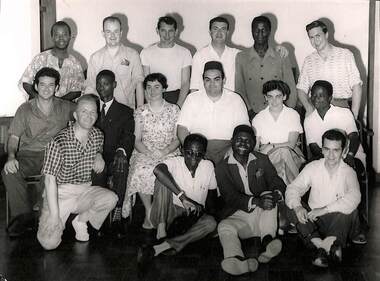
... YCW delegates the WAY 1960. Father Ernie Smith, initiated the establishment of the Sacred Heart Mission in St Kilda, Melbourne. ...In 1960, the World Assembly of Youth (WAY) conference was held in Accra, Ghana. The Australian YCW sent two delegates to the conference, Ernie Smith (back row, end right) and Betty King (second row, third from left). Around 400 representatives of youth organisations - including national YCW movements - from around the globe attended the conference. This photograph shows the YCW delegates the WAY 1960. Father Ernie Smith, initiated the establishment of the Sacred Heart Mission in St Kilda, Melbourne. This photograph is copied from his personal collection. -
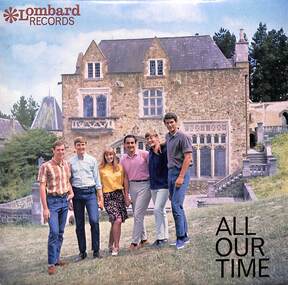 Young Christian Workers (YCW Australia) Archive and Research Centre... To mark Cardinal Cardijn's visit in 1966, the YCW produced a commemorative record featuring Melbourne singer Judy Jacques. ...To mark Cardinal Cardijn's visit in 1966, the YCW produced a commemorative record featuring Melbourne singer Judy Jacques. ...To mark Cardinal Cardijn's visit in 1966, the YCW produced a commemorative record featuring Melbourne singer Judy Jacques. The record was sold through YCW branches as a fund raising exercise. Unplayed Vinyl Record (Single) including cover
 -
 Carlton Football Club
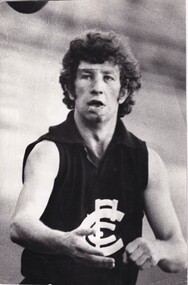
Black & White Photos x 2, John O'Connell
... O’Connell’s journey to Premiership glory began during his school days at St Mark’s in Melbourne’s outer north, then at Glenroy YCW and Fawkner. In 1967, aged 17, he joined Carlton’s Under-19s, and by midway through 1969 he was playing Reserves football in guernsey number 50. ...Two Pictures of 1972 Premiership Player John O'ConnellCareer : 1970 - 1976 Debut : Round 3, 1970 vs Richmond, aged 18 years, 361 days Carlton Player No. 818 Games : 111 Goals : 0 Guernsey Nos. 50 (1970-71) and No. 19 (1972-76) Last Game : Preliminary Final, 1976 vs North Melbourne, aged 25 years, 149 days Height : 183 cm (6 ft. 0 in.) Weight : 82 kg (12 stone, 13 lbs.) DOB : April 22, 1951 Premiership Player 1972 After starting his career at Carlton as a centreman or ruck-rover at Under-19 and Reserves level, John Michael “Jack” O’Connell found his niche in defence for the Blues and was a creative back pocket in Carlton’s record-breaking 1972 Grand Final victory over Richmond. A dasher who loved to take off on bouncing runs, Jack spent much of his career alongside champion full-back Geoff Southby, with either Vin Waite or David McKay in the opposite pocket. Together, they created a full-back line regarded as among the best in club history. O’Connell’s journey to Premiership glory began during his school days at St Mark’s in Melbourne’s outer north, then at Glenroy YCW and Fawkner. In 1967, aged 17, he joined Carlton’s Under-19s, and by midway through 1969 he was playing Reserves football in guernsey number 50. Early in the following year, a couple of strong showings saw him banging on the door of senior selection, and he was duly rewarded by being named on the bench for his senior debut against Richmond at the MCG in round 3, 1970. For the Blues and their supporters, the game was a forgettable one, because Carlton surrendered a big half-time lead to be beaten by 13 points, and O’Connell wasn’t called on until the dying minutes. Sent back to the Reserves after that one brief taste if the big time, Jack honed his skills and bided his time - for more than a year – while Carlton went on to win the 1970 Premiership. Eventually, he earned a recall midway through 1971, but with a bevy of stars standing in his way, he was a regular reserve until late in the year, when coach John Nicholls – aware that incumbent Ian Collins intended to retire – offered O’Connell a chance in the back pocket. Jack grasped his opportunity with both hands. At 183 cm and 82 kg he was bigger than the average specialist back-pocket of that era, but he gave nothing away in agility. An excellent mark and an accurate kick off either foot, he had settled in beside Southby by the end of that season, playing the last ten games straight. As season 1972 dawned and Collins retired, O'Connell inherited the Blues’ number 19 guernsey and began marking his mark in the Carlton defence. Inspired by Southby’s creativity and Waite’s aggression, Jack was soon a headache for every opposition club. An ankle injury sustained in round 5, 1972 against Collingwood cost him five matches, but he was back to top form by finals time, when Carlton finished the regular season on top of the ladder. In their first final together – the Second Semi Final - O’Connell, Southby and Waite were resolute in a thrilling draw. Richmond won the replay, then Carlton conquered St Kilda in the Preliminary Final to earn another crack at the Tigers in the Grand Final. Opting for a strategy of all-out attack in the flag decider, the Blues blasted off the blocks to kick 8 goals in the first quarter, 10 in the second and 7 in the third to put the game right out of Richmond’s grasp with a full quarter remaining. After coasting to the final siren, the Blues collected their eleventh VFL Premiership by 27 points. Waite was missing from the match, having been injured in the Preliminary Final, but David McKay was a more than adequate replacement, and all three defenders on the last line completed an excellent final series. On the way to another consistent season in 1973, O’Connell strained a thigh in Carlton’s surprise loss to Fitzroy at the Junction Oval in round 16, and wasn’t recalled to the senior side until the Grand Final, when Carlton and Richmond met once more in the 48th match of Jack’s career. A few days beforehand, Barry Armstrong had been ruled out when he was hit by appendicitis, so O’Connell took over Armstrong’s assigned role of negating the Tigers’ star centreman Ian Stewart. Jack stuck to his task all match, but neither he nor his team could hold back a ferocious Richmond side that crashed and bashed its way to victory. O’Connell went on to play in two more finals campaigns in 1975 and ’76 but was denied the joy of another September victory. He brought up game number 100 at Princes Park in June 1976, when Carlton ended a five-game losing sequence to beat Essendon, before calling time on his VFL career after the Blues suffered a heart-breaking 1-point loss to North Melbourne in that season’s Preliminary Final. In 1977 O'Connell was cleared to WAFL club Subiaco. Later he came back to Victoria and coached Diamond Creek to a Premiership in the Diamond Valley League. Then in 1987, the football world was rocked by the news that Jack had been diagnosed with a virulent form of cancer. He fought hard for 18 months, but tragically passed away on the 5th November, 1989 aged just 38. Career Highlights 1971 - 3rd Reserves Best & Fairest 1971 - Reserves Most Improved Player 1972 - Premiership Player Milestones 50 Games : Round 2, 1974 vs Geelong 100 Games :Round 13, 1976 vs Essendon Footnotes Off the field, O’Connell was a quiet, reserved character who, by 1973 had struck a warm friendship with another man of few words in his champion team-mate Bruce Doull. The pair could often be seen together sharing a beer after Sunday morning recovery sessions, and club folklore has it that the only regular conversation to be heard between them was, “it’s your shout.” In 1997, John's son Luke O'Connell joined Carlton, playing eight Reserves games and kicking three goals.2 x Black & White PhotosThe Sun Articles pasted on back of each photo
