

Artists statement
'A Series of Unwarranted Events' shares four stories of frontier violence faced by the Gunditjmara people, highlighting the brutal realities of the invasion and colonisation of their land. The European invasion of western Victoria was marked by violence, including countless killings and massacres of Aboriginal people. Stories of skulls nailed to doorways and rivers running red serve as haunting reminders of an unforgivable past, standing as witnesses to the strength and resilience of the Gunditjmara people.
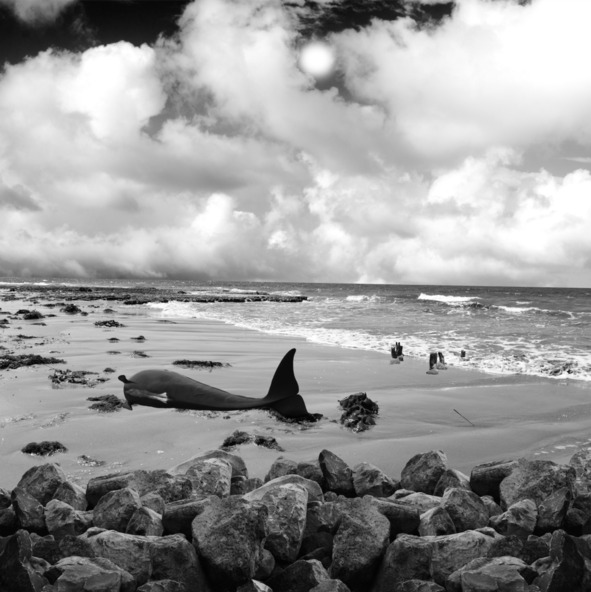
The collaged landscapes deliberately avoid showing the actual sites of violence. They remove all signs of physical trauma, focusing instead on the silence and emptiness of a scarred land and a painful history that demands acknowledgement. The work honours the resilience that endures, even as the land and collective memory bear the marks of past wounds.
The Convincing Ground massacre took place between a group of sailors and the Gunditjmara - Kilcarer clan circa 1833, however the exact date is uncertain, and some international theorists consider the Convincing Ground massacre a myth. Portland shore served the Gunditjmara people as a place of ocean abundance. The circumstances are that a whale had come on shore and a Gunditjmara clan went to collect the meat as they had for thousands of years. A group of sailors protested that they had ownership of the whale as Portland now ‘belonged’ to them, and so a violent and devastating conflict started. 'Untitled (The circumstances are that a whale had come on shore)' speaks to the murders of the Kilcarer Gunditj clan over the ownership of whale meat. All members, bar two, of the Kilcarer Gunditj clan were slain.
Artist Bio
Hayley Millar-Baker is a Gunditjmara woman from Victoria, Australia. Through contemporary approaches to photography, she draws strength from her Gunditjmara bloodlines, history, and the landscape – confronting and crafting past, present, and future stories of South-East Aboriginal existence, and honouring the connectedness of intergenerational experiences of Aboriginality.
Millar-Baker’s works draw from her grandfather’s archive, family albums, and her own treasured moments captured on and off Country. Meticulously layering, cutting, and repositioning imagery – she depicts a coexistence of times, of cultures, of transformation.
Through the application of digital technologies, Millar-Baker aligns disparate times and places – melding the collected imagery from her extensive archive together as one, to tell alternative stories and histories. What would it have been like if Southeast culture had thrived in coexistence with colonisation?
Through both materiality and process, Millar-Baker’s assemblages critically explore cultural practices and knowledge’s and investigate notions of blood memory, the evolution of cultural practices, and south-east Australian history, in relation to her own Aboriginal heritage.
Millar-Baker’s reflective narrative process enacts a powerful social commentary that acknowledges the strength and resilience of Aboriginal Australia, reimagines what could have been, and reveals the complexities of Aboriginality now.
Mounting & framing
Framed
