

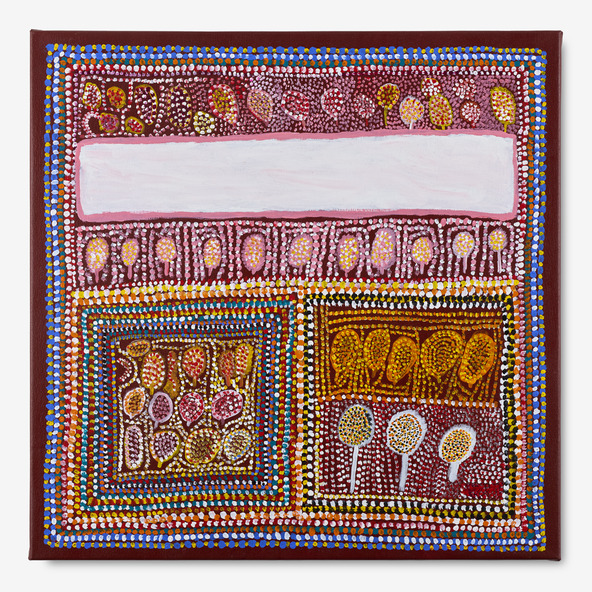
Artists statement
An esteemed elder and matriarch in her community, Loongkoonan was born around 1910 at Mount Anderson Station, Western Australia. Her artwork concerns - repeatedly and with uninterrupted focus - Nyikina country. These are the lands abutting the lower stretches of Mardoowarra, the majestic waterway that in 1837 would be renamed by European colonists the Fitzroy River. The First Peoples inhabitants of these lands call themselves Yimardoowarra—the people of the river—reflecting not just their habitation of this place, but their belonging to this country.
During her travels across country, Loongkoonan collected bush tucker, plants used for medicinal purposes and spinifex wax in the wet season. More than a botanical reference, her ‘bush tucker’ renderings are composed as metaphors for a complex mapping of extensive, accumulated cultural knowledge.
Loongkoonan explained, "Footwalking is the only proper way to learn about country, and remember it. That is how I got to know all of the bush tucker and medicine. … In my paintings I show all types of bush tucker – good tucker that we lived off in the bush. I paint Nyikina country the same way eagles see country when they are high up in the sky."
It is this idiosyncratic representation of her country in aerial perspective that contributes to Loongkoonan’s individuality and significance as an artist. The landscape is depicted as a complex composition with multiple simultaneous viewpoints. These colourful, directly painted works are innovative, joyous and without apparent precedent.
Loongkoonan began painting at the age of 95. Her work is held in a number of prominent Australian collections and was featured in the 2016 Adelaide Biennale.
Mounting & framing
Stretched canvas
