

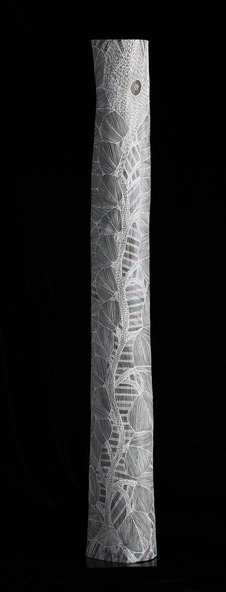
Artists statement
Malaluba Gumana dedicates most of her artworks to portraying her mother Marratj Gurruwiwi’s Gälpu clan designs of dhatam (waterlilly), djari (rainbow), djaykun (filesnake) and wititj (olive python or rainbow serpent). Gumana demonstrates a very fine ‘marwat’, a cross hatching technique that utilises a fine brush of human hair, applied to bark and memorial poles.
The title 'Garrimala' refers to a billabong close to Malaluba’s homeland of Gängan. Dominating this work are realistic representations of dhatam, the waterlily plant. The Gälpu clan miny’tji – the sacred clan design behind the lillies – represents djari (rainbows) and the power of the lightning within them. It also refers to the force of the storm created by the python Wititj, living amongst the waterlilies causing ripples and rainbows on the surface of the water. The dynamic diagonal lines symbolise trees that have been knocked down as Wititj moves from place to place.
Historical information
Ceremonial hollow log poles
Arnhem Land, Northern Territory
The people of Central and Eastern Arnhem Land refer to themselves collectively as Yolngu, meaning human beings. The Yolngu traditionally use logs naturally hollowed out by termites in a funerary and ceremonial functions, principally as an ossuary. In an Australian contemporary art context however hollow log sculptures are purely memorial in function and made explicitly for public display.
In Arnhem Land hollow logs are known as larrakitj; hollow logs known by other names are used in burial practices by a number of Aboriginal peoples in the north of Australia. The logs can also represent the deceased person, as the designs applied are the same as those painted on the body during the burial rites. All Yolngu clans belong to a moiety, one of two complementary halves of society: Dhuwa and Yirritja. All such affiliations play a part in Aboriginal artists' inherited right to paint an established set of designs belonging to their social group; this inheritance is, in fact, the artist's copyright over imagery.
