
Historical information
Maidstone began as an 1858 speculative township on Ballarat Road, grew slowly due to isolation from rail transport, then expanded rapidly in the 20th century through tram extensions, defence industries, migrant hostels, and Housing Commission estates.Today it is a diverse, residential‑industrial suburb shaped by waves of working‑class settlement, post‑war migration, and late‑20th‑century redevelopment.
Early Foundations (1840s–1860s- The broader district saw activity from the 1840s, including Joseph Raleigh’s meat‑preserving works on the Maribyrnong River, which sat on the boundary of what became Maidstone.
- Land speculator J.W. Thompson launched the township with great fanfare, including a German band and a banner proclaiming “Every man his own landlord.”
- Despite the marketing, by 1860 only about ten homes existed.
- - Maidstone grew slowly because it was isolated from the railway, relying instead on punts across the Maribyrnong River.
- A National School opened in 1858, but the area remained sparsely settled.
- The district’s early industrial landscape included:
- Raleigh’s meat works (1843)
- Victorian Powder Magazine, later expanded for military use
These sites later became part of Pipemakers Park and the Living Museum of the West.
- The arrival of trams from Footscray in 1921 finally unlocked residential growth.
- A Progress Association formed, and the suburb gained amenities including its own cinema in the 1940s.
- Housing stock from this era included weatherboard, Art Deco, and Californian Bungalow homes.
Physical description
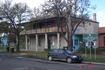
Digital color photographs
Inscriptions & markings
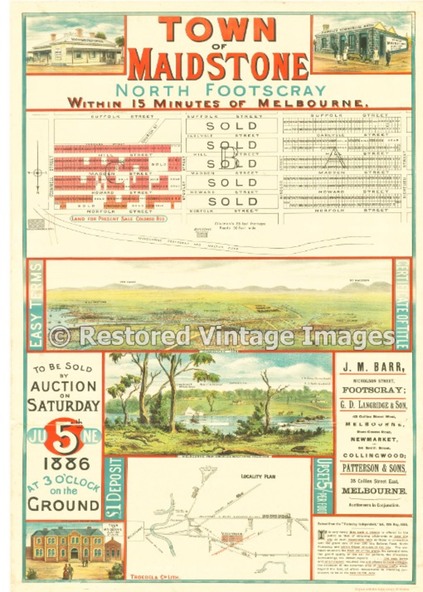
Town of Maidstone North Footscray Within 15 Minutes of Melbourne
To be sold by Auction on Saturday 5th June 1886 at 3 O'Clock on the ground
J. M. Barr Nicholson Street Footscray
