
Historical information
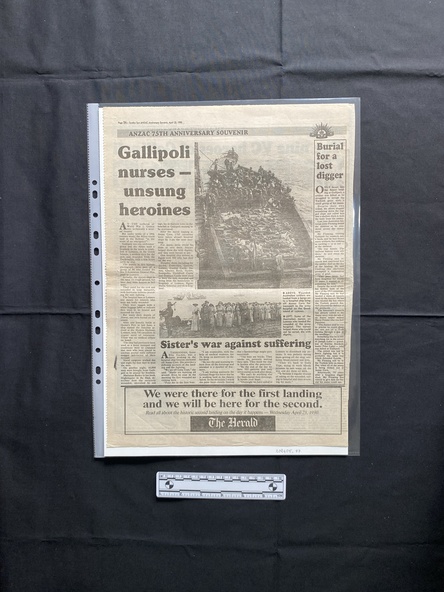
Gallipoli nurses - unsung heroines
During World War One the Allies used a loophole to establish a medical base at Lemnos, in the Greek Islands. A group of ninety-six formed the No. 3 Australian General Hospital (AGH). The hospital at Lemnos was meant for soldiers who were not badly wounded, they were to be treated and then returned to duty. However, many died.
After one horrific battle at Quinn's Post, Gallipoli, Turkey, 700 casualties arrived on a ship that had no medical officer and had been used to transport horses, with the unclean conditions contributing to the men's suffering.
After the initial landing at Anzac Cove, Galllipoli, 1700 casualties were taken aboard hospital ships. For many of them nothing could be done, so the nurses helped them die with dignity.
Sister's war against suffering
A Tasmanian nurse, Sister Ella Tucker, was working on the hospital ship, Gascon, anchored off Anzac Cove, Gallipoli, Turkey. She provides her accoun tof the landing and fighting: "...Even by nine in the morning the first wounded are coming back... I am responsible, with the help of medical students for seventy-six... by two the next morning we have done all the dressings and hace attended to a number of fractures... The boys are bricks... the think the ship is heaven after the peninsula... by the end of the day we have 557 patients and only seven nurses to look after them.... we can't do anything elses for them except their dressings..."
Balkans
Dardenelles
Mudros Harbour, Lemnos
SS Saturnia
Egypt
Hospital ships HMHS Sicilia, HMHS Franconia, HMHS Gascon, HMT Lutzow, HMHS Dunbar Castle, HMAT Itonus, SF Charles Roux, HMHS Assaye, HMHS Essequibo, HMHS Guildford Castle, HMHS Dunluce Castle
Malta
Gibraltar
England
Marianne Barker book 'Nightingales in the Mud'
Gaba Tepe, Turkey
Colonel Hugo
Physical description
A large newspaper page showing two relevant stories. The first story has a large title, two columns of text and two black and white photos. The large photo is of a barge with many wounded laying on it with other wounded standing. The smaller photo shows lines of women standing behind a piper next to the sea. The second story has a title and four small columns of text.
