

Historical information
Wooden fence droppers were used in traditional post-and-wire agricultural fencing to maintain the correct spacing between horizontal fence wires. The principal fence posts were placed at intervals and carried the tension of the wires. Droppers were installed between these posts and attached to each horizontal wire. Their purpose was to keep the wires evenly separated and working together as a fence, rather than allowing individual strands to move independently. When livestock pushed against a fence, the droppers helped distribute the movement across several wires and reduced the likelihood of animals forcing their way between them. Before commercially manufactured steel droppers became widespread, farmers could make wooden droppers from locally available timber, drilling holes or otherwise fastening them at the required wire spacing. Wooden droppers were particularly suited to rural properties where timber was readily available and fencing materials were often fabricated or repaired on the farm.
Physical description
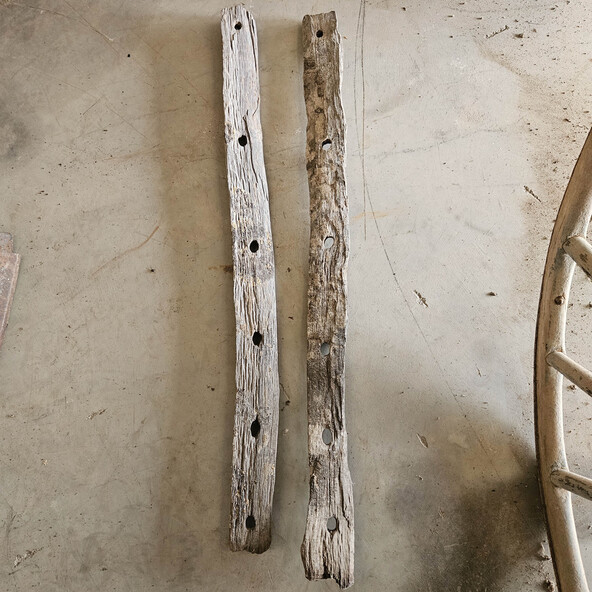
Two long, narrow wooden fence droppers, rectangular in section and fitted with a series of regularly spaced holes along their length. The droppers are made from narrow lengths of timber with slightly irregular, weathered surfaces. Each has multiple holes corresponding with the positions of the horizontal wires in a conventional wire fence. Unlike a fence post, a dropper was not intended to carry the main tension of the fence or necessarily be driven deeply into the ground. Instead, it was positioned vertically between the main posts and attached to the horizontal fence wires. The droppers kept the wires evenly spaced and tied them together vertically, helping prevent individual wires from spreading apart when pressure was applied by livestock. The two examples differ slightly in width, shape and hole arrangement, suggesting they may have been individually or locally made.
