

Historical information
Edith Lunn (nee Bishop) was born in Bendigo in July, 1907, and has lived all her life in the city and its immediate environs. Edith long interest and involvement in the community was recognised in 2002 when she was awarded the Order of Australia medal for her services to, and interest in, Bendigo's history. This book records some of her recollections of Bendigo in its earlier days.
Bendigo (/ˈbɛndɪɡoʊ/ BEN-dig-oh), formerly known as Sandhurst, is an Australian city in north-central Victoria. The city is located in the Bendigo Valley near the geographical centre of the state and approximately 150 kilometres (93 mi) north-west of Melbourne, the state capital.
Bendigo is administered by the City of Greater Bendigo. The council area encompasses roughly 3,000 square kilometres. The city is surrounded by smaller towns such as Castlemaine, Heathcote, Kyneton, Maryborough, Elmore, Rochester, Goornong and Axedale.
The traditional owners of the area are the Dja Dja Wurrung (Djaara) people. The discovery of gold on Bendigo Creek in 1851 transformed the area from a sheep station into one of colonial Australia's largest boomtowns. News of the finds intensified the Victorian gold rush, bringing an influx of migrants from around the world, particularly Europe and China. Bendigo became eastern Australia's largest 19th-century gold-mining economy, and the wealth generated during this period is reflected today in the city's Victorian architectural heritage. From 1853 until 1891, Bendigo was officially named Sandhurst.
Bendigo's boom period lasted until the early 20th century and after a temporary decline in population and employment, renewed growth occurred from the 1930s as the city consolidated as a manufacturing and regional service centre. Although gold mining continues, recent population growth has been most heavily concentrated in suburban areas.
Physical description
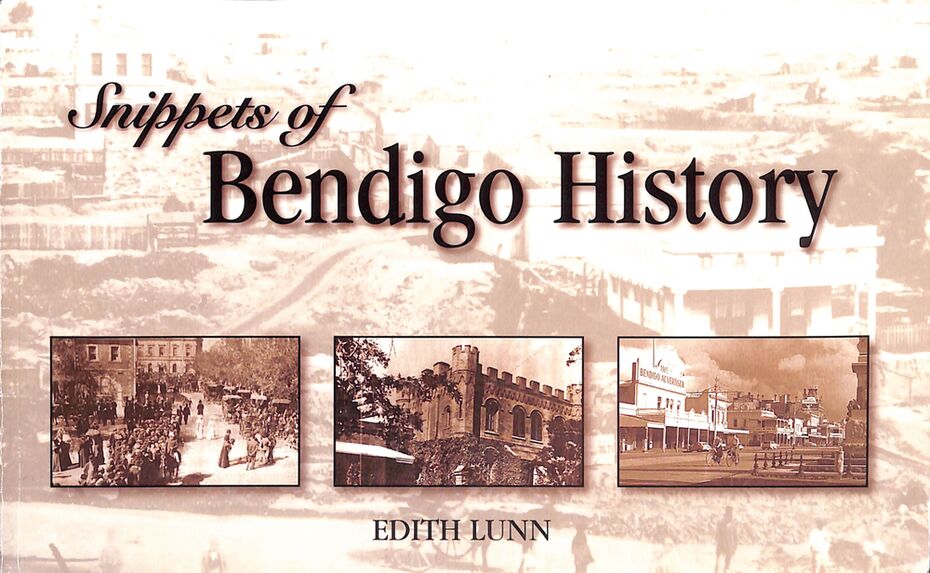
"Snippets of Bendigo History" by Edith Lunn. Soft cover. 65 PP. Sepia historic images of Bendigo on front and back covers. Three small sepia images inset into front cover. Title and authoresses' name on front cover and spine in black. Color and black and white images throughout. This edition 500 copies.
