



Historical information
Gillies Bros Timeline
1929 Leslie Graham Gillies is born on July 12, 1929 in Charlton, Victoria, son of Donald John and Agnes Maud Gillies.
1943 At age 14, Les Gillies goes to work at the Aunt Sally Milk Bar. His employer is Les McClure of Dad’n’Dave Café and Four’n’Twenty pie fame.
1950 Les Gillies, with brothers Alan and Norm, opens a bakery and the Rosebud Tea Rooms in Mitchell Street, Bendigo.
1951 The Gillies brothers. open on the corner of Hargreaves and Mitchell Streets. Over fifty six years of trading this corner becomes known as the Gillies Pie corner. The brothers also run the Kentucky Café from this site.
1954 Les Gillies marries 3CV radio announcer, Yvonne Smith.
1958 The Gillies brothers purchase the Black Swan Hotel in McCrae Street and turn it into a factory and retail outlet.
1976 The Gillies brothers open up a new factory in Garsed Street, Bendigo.
1985 The Gillies brothers purchase Kay’s Cakes in Geelong and the pie making part of the business relocates to Geelong. The Garsed Street factory is used for packaging and distribution.
2007- The Gillies business is sold. The Pie corner changes hands and the Garsed Street factory becomes empty.
2015- Les Gillies passes away at the age of 86 years.
2026 The Garsed Street factory is empty and derelict. The pie window in Hargreaves Street is still operating under the banner of the ‘Bendigo Original Pie Shop’.
Physical description
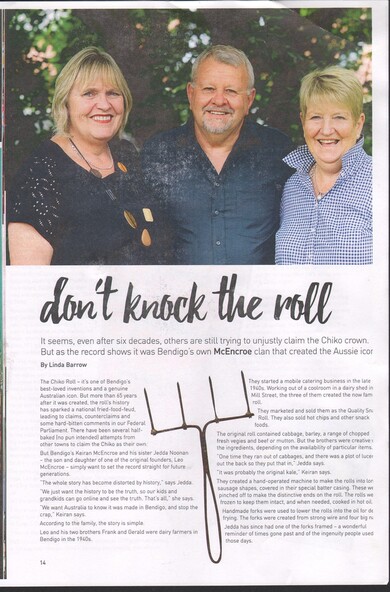
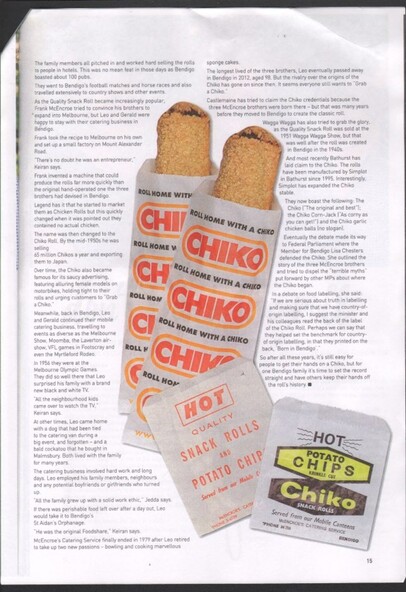
A two-page article called "don't knock the roll" from an unknown magazine; on Bendigo's own Chiko Roll. The article notes that three brothers Leo, Frank and Gerald McEncroe; started a mobile catering business in the late 19840s. The three of them created the now famous roll. They marketed and sold the rolls as a quality snack; they also sold hot chips and other snacks foods.
The original roll contained cabbage, barley, a range of chopped fresh vegetables and beef or mutton. But the brothers were creating the rolls from ingredients, depending upon availability of particular items. They created a hand-operated machine to make the rolls into long sausage shapes, covered in their special batter casing. These were pinched off to create the distinctive ends of the rolls. The rolls were frozen to keep them intact, and when needed, cooked in hot oil.
Handmade forks were used to lower the rolls into the oil for deep frying.
Legend has it that Frank started to market the roils as chicken rolls but this quickly changed when it was pointed out they contained on actual chicken. The name was changed to Chiko Roll. By mid-1950s they were selling 65 million Chiko Rolls a year and exporting them to Japan.
