

Historical information
The proposal to establish a tramway network at Bendigo was first discussed in a conference between the Borough of Eaglehawk and the Sandhurst City Council in May 1887. Several options were explored with horse trams, cable trams, battery trams, and electric trams being considered. After much negotiation it was decided to introduce a battery tram system.
In October 1888 the Sandhurst & Eaglehawk Tramway Company was formed. Construction of a 6.4km long tram line between Eaglehawk and the Bendigo Railway Station commenced soon afterwards. Half-hourly services using battery powered trams commenced in June 1890.
Although the battery tram service operated daily, it proved to be an unsuccessful venture. Passengers were no doubt unhappy at being stranded far from their destination. After only 13 weeks in operation the battery trams were removed from service in September 1890.
After 13 months in existence the Sandhurst & Eaglehawk Tramway Company went into voluntary liquidation. Its assets were sold off to the Bendigo Tramway Company Ltd which opted to use steam trams. Although the local councils were eager to continue having a tramway system they were firmly against installing an overhead electric wire system as they were convinced that it would spoil the view of the landscape. Steam traction was therefore proposed as the alternative.
Five steam tram motors were ordered from the Baldwin Locomotive Works in the U.S.A. whilst the battery trams were rebuilt by the Bendigo Rolling Stock Company as bogie trailers that were towed behind the steam tram motors. Steam tram services commenced in February 1892, operating out of the Mollison Street tram depot and travelling over the same route as the battery trams.
Steam trams quicky emerged as a safe and reliable means of public transportation between Bendigo and Eaglehawk. With the onset of the 1890’s banking crisis and economic depression the Bendigo Tramway Company felt the impact of decreasing passenger numbers and rising costs. The company struggled to make a profit and so in 1896 the steam tramway was put up for sale. No offers were forthcoming thus it was decided to keep the service running as it would be more attractive to sell it as a going concern.
In the decades following World War 2 declining passenger numbers and revenue heavily impacted on the Bendigo Tramways. The introduction of television meant less travel to theatres, privately owned vehicles became affordable, and urban sprawl meant that schools and shops were being built away from the city centre. At the same time ongoing maintenance costs to keep the ageing rolling stock and rail infrastructure operational resulted in major revenue losses.
In 1899 an English company, the British Insulated Wire Company bought out the struggling Bendigo Tramway Company and incorporated the Electric Supply Company of Victoria (ESCV) to operate the Bendigo tram network. The ESCV held a 30-year franchise to install and operate an electric tram network that was powered by an overhead wire system and linked the centre of Bendigo with the surrounding suburbs of Golden Square, Quarry Hill, White Hills and Eaglehawk.
Bendigo’s new electric tram network was officially opened in April 1903 with the inaugural tram fleet consisting of twelve Brill single-truck Californian combination tram cars that were manufactured by Duncan & Fraser of Adelaide. The introduction of an electric tram system heralded a new era in public transportation at Bendigo, providing a cheap and reliable means of transportation. As well as operating the tramway system the ESCV also provided street lighting along the tram routes, as well as supplying electricity throughout Bendigo, Eaglehawk, and surrounding suburbs.
At the end of World War 1 the Victorian Government worked towards improving the standard of living amongst Victoria’s regional population by increasing the availability of electricity. To achieve this the State Electricity Commission of Victoria (SECV) was formed to assume exclusive control over the generation and distribution of electricity throughout the state. Prior to this, electricity generation and distribution in regional centres such as Bendigo, Ballarat and Geelong was the job of municipal councils and private electricity companies.
As Bendigo’s electricity grid was closely linked to the tram network it was only natural for the SECV to take ownership of the Bendigo Tramways. Whilst the SECV was reluctant to accept responsibility for the tramways system this became an unavoidable part of the deal. As the ESCV had a 30-year franchise on the Bendigo Tramways it continued to operate the tram network under SECV supervision until the franchise expired in mid-1934.
Keen to divest itself of the financial burden of operating and maintaining a costly tramway system the SECV obtained approval from the Victorian Government to shut down the Bendigo Tramways in July 1970. In March 1972 the North Bendigo – Golden Square route was shut down followed by the Eaglehawk – Quarry Hill route on Sunday 16 April 1972, thus marking the closure of Bendigo Tramways as a public transportation system after 82 years of operation. At the time of the closure the SECV had a fleet of 23 tram cars in operation.
Physical description
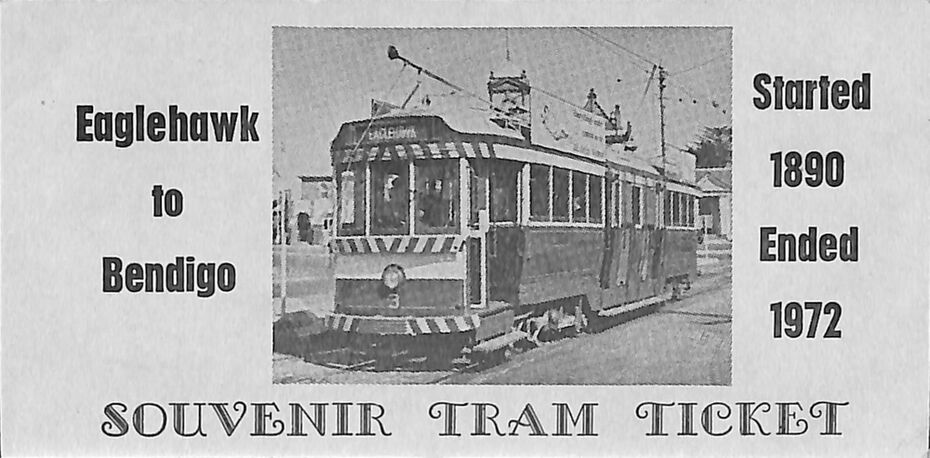
Tram ticket. Eaglehawk to Bendigo. Light blue in color. Black and white image of tram at centre of ticket. Labelled 'Souvenir Tram Ticket'. Black ink used for text and image. Ticket number B401024. Ticket has not been hole punched. Cost of ticket was 5c. Reverse of ticket headed 'State Electricity Commission of Victoria'.
