
Showing 11 items matching "costume"
-
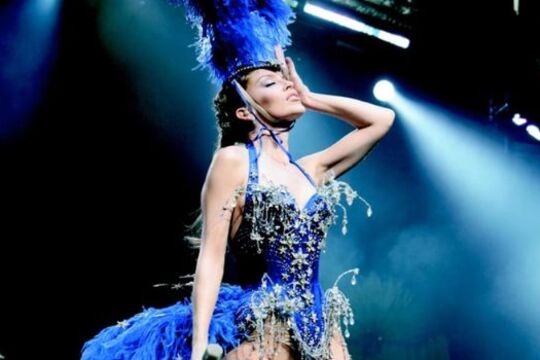
Kylie's Costumes
... ...costume design...Costume: 'I Should Be So Lucky' [1987] video from the album Kylie, 1988...The costumes featured in this section date from 1990-1999, reflecting Kylie Minogue's career highlights and her varying taste in style over the years.......Costume from TV Week Logie Awards, Hyatt On Collins Ballroom, Melbourne, March 1989. Gift of Kylie Minogue, 2004...From Neighbours character, Charlene, to international pop sensation, Kylie Minogue’s costumes chart her rise, her style, and her creative energy. The Kylie Costume Collection at the Arts Centre, Melbourne, shows the range and development of Kylie's persona through costume, and her collaborations with international and national designers. ...From Neighbours character, Charlene, to international pop sensation, Kylie Minogue’s costumes chart her rise, her style, and her creative energy.
The Kylie Costume Collection at the Arts Centre, Melbourne, shows the range and development of Kylie's persona through costume, and her collaborations with international and national designers.
As Kylie donates her costumes to the Arts Centre directly, curators are able to keep an extensive, chronological and very complete material record of Kylie's career, across her tours, album cover shoots, music videos, and red carpet and special events.
-
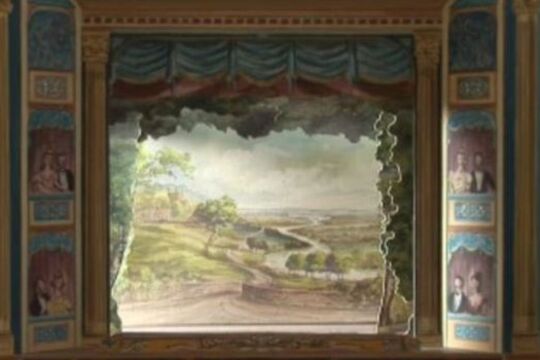
Set and costume design
... ...costume design...Set and costume design...Curator Margaret Marshall introduces us to a Williamson scenebook from the 1920s, and to costume designs from the late 19th and early 20th century, and Paul invites us to explore his craft and his career with major theatre companies for the past 50 years. ...By exploring aspects of the J. C. Williamson Archive at the Arts Centre, and interviewing scenic artist Paul Kathner, we get a sense of the behind the scenes work involved in creating the visual effect of theatre.
Curator Margaret Marshall introduces us to a Williamson scenebook from the 1920s, and to costume designs from the late 19th and early 20th century, and Paul invites us to explore his craft and his career with major theatre companies for the past 50 years.
-
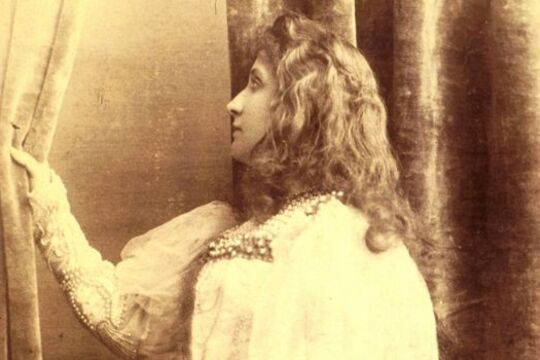
Dame Nellie Melba
... ...Costume: Costume worn by Nellie Melba as Desdemona in Otello, c.1924...Dame Nellie Melba performed in a large number of operas and theatrical performances. This section highlights a range of costumes worn by Melba and now held by the Victorian Arts Centre.......Costume worn by Nellie Melba as Desdemona in Otello, [detail], c.1924 Gift of Pamela, Lady Vestey, 1977...Dame Nellie Melba (1861 – 1931), was Australia’s opera superstar, performing in the great opera houses of the world - the Paris Opera, La Scala, the Metropolitan Opera House, and the Royal Opera House, Covent Garden, where she became prima donna, returning season after season. The extensive Melba Collection at the Victorian Arts Centre includes costumes, records, accessories, letters, programs, photographs, opera scores and other personal effects. Other holdings of interest include 78rpm disks at the State Library of Victoria. ...“...the voice, pure and limpid, with an adorable timbre and perfect accuracy, emerges with the greatest ease.” Arthur Pougin, in Le Ménestral (Paris), May 12, 1889.
Dame Nellie Melba (1861 – 1931), was Australia’s opera superstar, performing in the great opera houses of the world - the Paris Opera, La Scala, the Metropolitan Opera House, and the Royal Opera House, Covent Garden, where she became prima donna, returning season after season.
The extensive Melba Collection at the Victorian Arts Centre includes costumes, records, accessories, letters, programs, photographs, opera scores and other personal effects. Other holdings of interest include 78rpm disks at the State Library of Victoria.
-
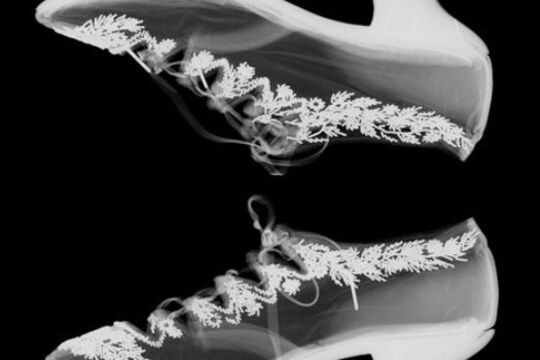
The Fashion Detective
... costume......Costume: Sheet music, fan (1)......This charming fancy-dress costume was purchased from a private collector in 1974 as part of a larger group of nineteenth-century garments and accessories. At the time of acquisition, this information was recorded: This dress was worn to a fancy dress ball at Mena House, Cairo, in 1907 by a Miss Geddes. ...The NGV’s fashion archive contains countless works about which we know little.
We don’t know who made them, who wore them, when or why, or indeed, what happened in them! For the curator, such works are endlessly intriguing; a form of ‘material evidence’ to examine and explicate.
In 2014, the NGV’s Fashion Detective exhibition took a selection of unattributed nineteenth century garments and accessories from the Australian fashion and textiles collection as the starting point for a series of investigations. Using forensics and fiction as alternate interpretative methods, the exhibition considered the detective work that curators and conservators do and where this can lead, as well as the role of storytelling in making visible the social life of clothes.
From fakes and forgeries to poisonous dyes, concealed clues and mysterious marks to missing persons, Fashion Detective was a series of ‘cases’ that each followed a different path of analysis.
Some relied on empirical study and science to reach conclusions, others were purposefully speculative - the inspired hypothesis of leading crime writers Garry Disher, Kerry Greenwood, Sulari Gentill and Lili Wilkinson.
A playful exhibition about modes of enquiry, Fashion Detective considered the different ways in which we can decode objects in order to reveal what is normally concealed, and challenged the visitor to reappraise what they see and what they know.
-
Migrants Enriching Australia
... ...costume...He carried his portable projector on a train and visited small country towns and even a farmhouse around Victoria, in order to share this dynamic Greek heritage with Greek expatriates.Janina Archabuz (Pani Babscha) is a Polish grandmother who carefully designed and sewed multiple copies of intricate costumes for a Polish dance troupe in Ardeer, in Melbourne’s west. Janina is self-taught, however the costumes are exquisitely sewn and meticulously detailed. These costumes gave the Polish group visibility when performing traditional dances in the community, and contributed to their community’s transition from being Poles to being Australians of Polish origin.The research for the Multicultural Communities’ Collection Project revealed incredibly rich collections – their photographs, documents, costumes and memorabilia from their countries of origin, their community members’ journeys to Australia and the process of settlement into this country and this state - held by community groups, each different and many reliant on individuals who valued their history and their community identity. ...Migrants Enriching Australia was born of a project to assist ethnic community groups preserve and manage their material heritage.
This story consists of 21 story objects - including videos, audio recordings, images and text - and two educational resources available at the bottom of the page.
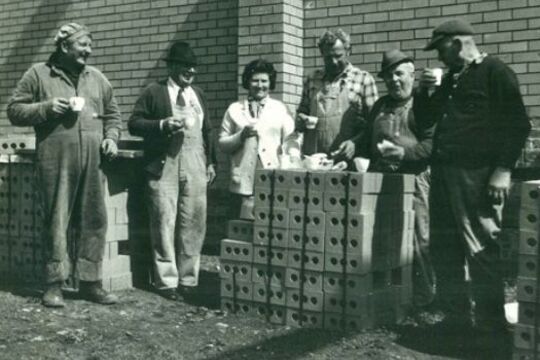
During the research a few people emerged who vividly carried a particular story about immigration and settlement to Victoria. These included Peter Yiannoudes who introduced Greek films to Melbourne in the 1950s. He carried his portable projector on a train and visited small country towns and even a farmhouse around Victoria, in order to share this dynamic Greek heritage with Greek expatriates.
Janina Archabuz (Pani Babscha) is a Polish grandmother who carefully designed and sewed multiple copies of intricate costumes for a Polish dance troupe in Ardeer, in Melbourne’s west. Janina is self-taught, however the costumes are exquisitely sewn and meticulously detailed. These costumes gave the Polish group visibility when performing traditional dances in the community, and contributed to their community’s transition from being Poles to being Australians of Polish origin.
The research for the Multicultural Communities’ Collection Project revealed incredibly rich collections – their photographs, documents, costumes and memorabilia from their countries of origin, their community members’ journeys to Australia and the process of settlement into this country and this state - held by community groups, each different and many reliant on individuals who valued their history and their community identity. The project was based on the idea that understanding of and control over community heritage strengthens community identity, which in turn contributes to an Australia which is enriched by diverse ethnic groups living side by side harmoniously.
The Multicultural Communities’ Collection Project began in 2011 - firstly as a project of the then Arts Victoria and later Museums Australia (Victoria). It involved visiting up to 40 ethno specific community groups and providing them with professional assistance to preserve and store their material heritage. There was also training in the documentation and digitisation of these collections, and including them in the web based cataloguing system, Victorian Collections.
Ethnic Communities Council of Victoria (ECCV) is the peak body for Victoria’s multicultural communities and have been advocating their needs and concerns to government for 40 years. It is the principle liaison point between multicultural communities, the government and the wider community. The ECCV welcomed the opportunity to facilitate these two films for Culture Victoria, to share more broadly these stories about immigrants and how they have enriched our community.
-
 Wind & Sky Productions
Many Roads: Stories of the Chinese on the goldfields
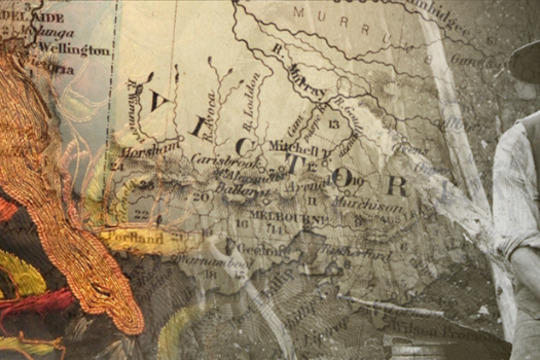
... ...costume......Clothing: Chinese parade costume...Photograph caption: This picture (above) is a close up of an embroidered section of a theatrical costume which was made in China and imported by the Bendigo Chinese community in the 1880s. It was used in parade festivities, for theatrical performances, for fundraising events and for entertainment until the 1930s. ...In the 1850s tens of thousands of Chinese people flocked to Victoria, joining people from nations around the world who came here chasing the lure of gold.
Fleeing violence, famine and poverty in their homeland Chinese goldseekers sought fortune for their families in the place they called ‘New Gold Mountain’. Chinese gold miners were discriminated against and often shunned by Europeans. Despite this they carved out lives in this strange new land.
The Chinese took many roads to the goldfields. They left markers, gardens, wells and place names, some which still remain in the landscape today. After a punitive tax was laid on ships to Victoria carrying Chinese passengers, ship captains dropped their passengers off in far away ports, leaving Chinese voyagers to walk the long way hundreds of kilometres overland to the goldfields. After 1857 the sea port of Robe in South Australia became the most popular landing point. It’s estimated 17,000 Chinese, mostly men, predominantly from Southern China, walked to Victoria from Robe following over 400kms of tracks.
At the peak migration point of the late 1850s the Chinese made up one in five of the male population in fabled gold mining towns of Victoria such as Ballarat, Bendigo, Castlemaine, Beechworth and Ararat. It was not just miners who took the perilous journey. Doctors, gardeners, artisans and business people voyaged here and contributed to Victoria’s economy, health and cultural life. As the nineteenth century wore on and successful miners and entrepreneurs returned home, the Chinese Victorian population dwindled. However some chose to settle here and Chinese culture, family life, ceremony and work ethic became a distinctive feature of many regional Victorian towns well into the twentieth century.
By the later twentieth century many of the Chinese relics, landscapes and legacy of the goldrush era were hidden or forgotten. Today we are beginning to unearth and celebrate the extent of the Chinese influence in the making of Victoria, which reaches farther back than many have realised.
-
Goldfields Stories: Dai gum san, big gold mountain
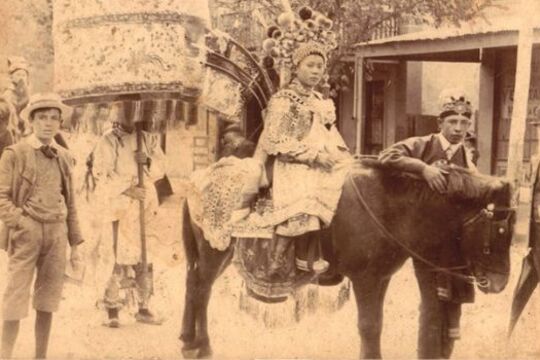
... ...Headdress: 'General's Costume, Front', China, c. 1880......This man’s head-dress, part of the General's costume, with mirrors around the front and gold dragons on top, features red and green pom-poms, a silk cloth drop at the back with cotton lining, and mother of pearl decorations. ...Their position as the main attraction at the Fair was confirmed by 1879. All of the costumes, flags and musical instruments were imported from China, with no expense spared. For the 1882 Fair, 100 cases of processional regalia were imported. In 1892 a further 200 cases arrived, along with Loong, the Imperial five-clawed dragon, who made his first appearance that year. ...It may come as a surprise to some that the oldest Imperial Dragon in the world, Loong, is to be found in Bendigo, Victoria.
In 1851 gold was found in the Bendigo region. News reached China and by 1853 Chinese miners started to arrive at Dai Gum San (Big Gold Mountain). By 1855 there were up to 4000 Chinese in the Bendigo goldfields, about one fifth of the population.
By the 1860s, Bendigo was becoming a wealthy and established town, and in 1869 The Bendigo Easter Fair and Procession was initiated to raise funds for the Bendigo Benevolent Asylum and Hospital. By 1871, the Chinese, keen to support the wider community, joined the procession, providing music, theatre and acrobatic displays. Their position as the main attraction at the Fair was confirmed by 1879.
All of the costumes, flags and musical instruments were imported from China, with no expense spared. For the 1882 Fair, 100 cases of processional regalia were imported. In 1892 a further 200 cases arrived, along with Loong, the Imperial five-clawed dragon, who made his first appearance that year.
The traditions established in the 1860s by the Bendigo Chinese community continue to this day. As well as providing the main attraction in the Bendigo Easter Festival, ceremonies such as the Awakening of the Dragon are conducted. These traditions reflect uniquely preserved traditions, many of which were lost or discontinued in mainland China. They also reflect traditions, such as the main celebration taking place at Easter rather than Chinese New Year, that trace the history of the Chinese in Victoria.
The remarkable collection of 19th Century processional regalia that has been preserved by the Chinese community in Bendigo is held in the Golden Dragon Museum. It is not only a collection of world significance but, importantly, it contextualises and preserves the living heritage of both Victoria and China.
-
The Apinis Loom
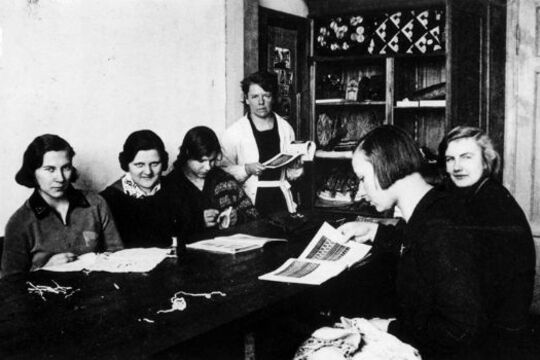
... ...Anna made this belt for her daughter to wear as part of a Zemgale national costume when she finished high school. The ornateness of this belt indicates that it is part of a woman's costume. It was woven on a hand-made back-strap loom using the ‘pick-up’ technique. ...When Latvian refugees Anna and Ervins Apinis arrived in Australia in 1950 they brought with them a loom built of wood salvaged from bombed out German ruins, along with Anna's precious notebooks full of traditional fabric designs.
Anna Strauss was born in 1913 in Latvia. She attended weaving lessons in Leipaja from 1930 to 1933 and spent hours at the nearby Ethnographic Museum recording traditional fabric designs in her notebooks.
She married Ervins Apinis, an engineer, in 1938 and they had a son but soon World War II changed their lives. Ervins was conscripted into the German army while Anna fled Latvia, finally ending up in Memmingen Displaced Persons camp in Germany in 1945. There, they were finally reunited, remaining in the camp for five years until they migrated to Australia in 1950.
When they arrived at Parkes Holding Centre in New South Wales, they were so exhausted from their long journey, they slept on a huge wooden crate containing the traditional Latvian loom they had brought with them, built of wood scavenged from bombed German ruins. This loom is now at the Immigration Museum in Melbourne.
Anna continued her weaving traditions, passing her knowledge to her daughter Anita.
-
Theatrical Families
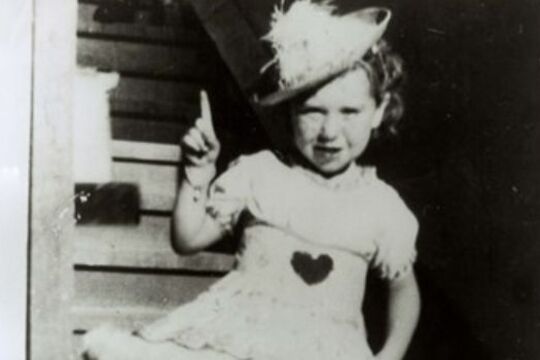
... Perryman joined her father Bill, mother Dorothy Duval and sister Diana on stage as a 'goat girl' dressed in a costume made from tiny scraps of material found backstage. The costume now forms part of the Arts Centre’s Performing Arts Collection. From the turn of the century until the 1970s, the Australian cultural landscape was dominated by two theatrical managements: J C Williamson Ltd (The Firm) and the Tivoli Circuit. ...Born in a Trunk and Living in a Suitcase
Whether bonded by blood or shared experience, family strongly underpins the foundations of the performing arts industry. "I was born in a trunk" is a familiar introductory phrase used by those born of theatrical parents.
This story tells of the great Australian theatrical managements of J.C. Williamson Ltd (The Firm), and the Tivoli Circuit.
It also provides insights into Australian theatrical families such as: Tony Sheldon, his mother Toni Lamond, father Frank Sheldon, grandparents Max Reddy and Stella Lamond, and aunt Helen Reddy; and Val Jellay and her husband Maurie Fields, who met and married while touring together in the travelling company Sorlie's.
In the theatrical industry people like Irene Mitchell, artistic director of the Little Theatre which became St Martin's Youth Arts Centre, Gertrude Johnson, artistic director of the National Theatre, and Betty Pounder, choreographer and casting agent for J.C. Williamson, provided role models and mentoring for a generation of Melbourne actors and performers.
The text above has been abstracted from an essay Born in a trunk and living out of a suitcase written by Carolyn Laffan for the publication The Australian Family: Images and Essays. The full text of the essay is available as part of this story.
The Performing Arts Museum (now known as The Arts Centre, Melbourne, Performing Arts Collection) produced the exhibition Kindred Spirits - The Performing Arts Family as part of The Australian Familyproject, which involved 20 Victorian museums and galleries. The full series of essays and images are available in The Australian Family: Images and Essays published by Scribe Publications, Melbourne 1998, edited by Anna Epstein. The book comprises specially commissioned and carefully researched essays with accompanying artworks and illustrations from each participating institution.
-
Postcards: Stories from the Mornington Peninsula
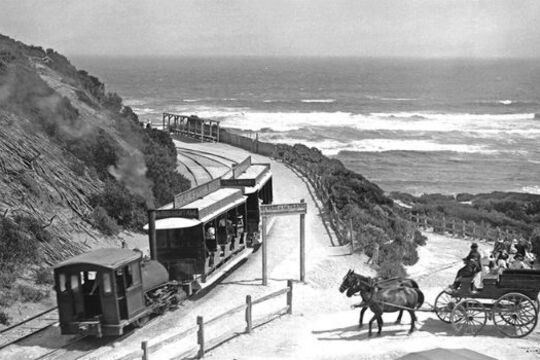
... TRANSCRIPT Shire of Flinders & Kangerong.REGULATION No. 4In the pursuance of the powers conferred by Part IX of 13th Schedule of the "Local Government Act 1903", the President, Councillors and Rate-payers of the Shire of Flinders and Kangerong order as follows:BATHING PLACES.No person over Ten years of age shall bathe within 200 yards of either side of the Dromana Pier without the Consent of Council.No person over Ten years of age shall bathe from the foreshore, commencing at a point distant 200 yards north west of the Sorrento Pier, thence along the Foreshore to the Bathing Boxes at Webster's Corner, without the Consent of the Council.DRESS.No person over Ten years of age shall bathe from any beach within the Shire, unless dressed in a Canadian Bathing Costume, or some similar costume, which shall effectively cover the body from the neck to the knee, so as to observe proper decency.No person in bathing costume shall sit, lie, loiter on, or run along any part of the beach or seashore within the Shire, but shall proceed in a direct line to and from the dressing place.No person in bathing costume shall walk, ride, or drive through any streets or thoroughfares of the Shire. ...Stories of a time in history when holidaying was a grand pastime, and when special and unique places in Victoria began to be appreciated, celebrated and shared in that iconic mode of communication: the picture postcard.
Inspired by postcards in their collections, eight historical societies developed themes to explore the history of the Mornington Peninsula.
This story is based on a touring exhibition which was initiated by the Mornington Peninsula Local History Network and the Mornington Peninsula Shire.
-
Against the Odds: The victory over conscription in World War One
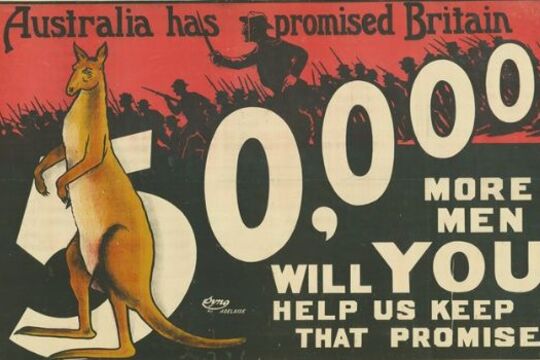
... Madge was dressed in white, holding a dove, and marched underneath a banner proclaiming “And a little child shall lead them”. The march included other costumes, and a number of artistic displays and signs on the back of lorries. May Boquest, on horseback, and Cecilia John acted as marshals. At the corner of Bourke and Swanston Streets a crowd of returned soldiers attempt to disrupt the procession, rushing in and snatching some of the banners being carried. ...In October 1916 and December 1917 two contentious referendums were held in Australia, asking whether the Commonwealth government should be given the power to conscript young men into military service and send them to war overseas.
These campaigns were momentous and their legacy long-lasting. This is the only time in history that citizens of a country have been asked their opinion about such a question, and the decisive 'No' vote that was returned remains the greatest success of the peace movement in Australia to date. Yet the campaigns split families, workplaces and organisations, and left an imprint on Australian politics that lasted for decades.
Many of the actors and events that were central to these campaigns were based in the northern Melbourne suburbs of Brunswick and Coburg. In many ways, these localities were a microcosm of the entire campaign. Against the Odds: The Victory Over Conscription in World War One tells the story of the anti-conscription movement in Australia during World War 1 through this lens.
