
Showing 73 items matching "satire"
-
 Flagstaff Hill Maritime Museum and Village
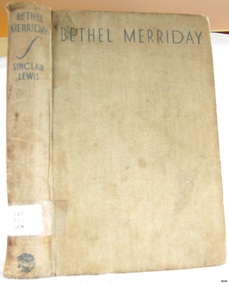
Book, Jonathan Cape, Bethel Merriday, 1940
... He was a prolific writer, publishing dozens of works and numerous articles, and became popular for his satire. Lewis married and divorced twice and died alone from a heart attack due to advanced alcoholism) near Rome on 10th January 1951, aged 66. ...He was a prolific writer, publishing dozens of works and numerous articles, and became popular for his satire. Lewis married and divorced twice and died alone from a heart attack due to advanced alcoholism) near Rome on 10th January 1951, aged 66. ...This book “Bethel Merriday” is a novel written by Sinclair Lewis and published in 1940. It is part of Flagstaff Hill’s group of books belonging to the Pattison Collection. About SINCLAIR LEWIS (1885-1951) The author was born as Harry Sinclair Lewis in 1885 in Sauk Centre, Minnesota. He was renowned as an American novelist, playwright and short story writer. His first writings were romantic poems and short stories. Six of his novels were published by the time Lewis was 36. Lewis won the 1926 Pulitzer Prize for his book “Arrowsmith” but declined because he had been helped in the writing of it by science writer Paul de Kruif, who received 25% of royalties on the sales. However, Lewis is listed as the sole author. Lewis received the Nobel Prize for Literature in 1930 for his “vigorous and graphic art of description and his ability to create, with wit and humour, new types of characters." He was the first author from the United States to receive this award. Lewis graduated from university in 1907. He worked as a reporter and editor for several publications. He was a prolific writer, publishing dozens of works and numerous articles, and became popular for his satire. Lewis married and divorced twice and died alone from a heart attack due to advanced alcoholism) near Rome on 10th January 1951, aged 66. This book was part of a large group of books referred to as the Pattison Collection, which belonged to the Warrnambool Public Library, part of the Warrnambool Mechanics’ Institute. About RALPH ERIC PATTISON and the ‘PATTISON COLLECTION’ The ‘Pattison Collection’ is a collection of books and records that was originally owned by the Warrnambool Mechanics’ Institute, founded in Warrnambool in 1853. By 1886 the Warrnambool Mechanics’ Institute (WMI) had grown to have a Library, Museum and Fine Arts Gallery, with a collection of “… choice productions of art and valuable specimens in almost every branch and many wonderful national curiosities are now to be seen there, including historic relics of the town and district.” It later included a School of Design. Although it was very well patronised, the WMI was led to ask the City Council to take it over in 1911 due to lack of financial support. In 1935 Ralph Pattison was appointed as City Librarian to establish and organise the Warrnambool Public Library as it was then called. Ralph Eric Pattison was born in Rockhampton, Queensland, in 1891. He married Maude Swan from Warrnambool in 1920 and they set up home in Warrnambool. In 1935 when Pattison accepted the position as City Librarian for the Warrnambool City Council his huge challenge was to make a functional library within two rooms of the Mechanics’ Institute. He tirelessly cleaned, cleared and sorted a disarrayed collection of old books, jars of preserved specimens and other items reserved for exhibition in the city’s museum. He developed and updated the library with a wide variety of books for all tastes, including reference books for students; a difficult task to fulfil during the years following the Depression. He converted all of the lower areas of the building into a library, reference room and reading room for members and the public. The books were sorted and stored using a cataloguing and card index system that he had developed himself. He also prepared the upper floor of the building and established the Art Gallery and later the Museum, a place to exhibit the many old relics that had been stored for years for this purpose. One of the treasures he found was a beautiful ancient clock, which he repaired, restored and enjoyed using in his office during the years of his service there. Ralph Pattison was described as “a meticulous gentleman whose punctuality, floorless courtesy and distinctive neat dress were hallmarks of his character, and ‘his’ clock controlled his daily routine and his opening and closing of the library’s large heavy doors to the minute.” Pattison took leave from 1942 to 1945 to serve in the Royal Australian Navy, Volunteer Reserve as Lieutenant. A few years later he converted one of the Museum’s rooms into a Children’s Library, stocking it with suitable books for the younger generation. This was an instant success. In the 1950’s he had the honour of being appointed to the Victorian Library Board and received more inspiration from the monthly conferences in Melbourne. He was sadly retired in 1959 after over 23 years of service, due to the fact that he had gone over the working age of council officers. However, he continued to take a very keen interest in the continual development of the Library until his death in 1969. THE NEW WARRNAMBOOL LIBRARY When the WMI building was pulled down in 1963 a new civic building was erected on the site and the new Warrnambool Library, on behalf of the City Council, took over all the holdings of the WMI. At this time some of the items were separated and identified as the ‘Pattison Collection’, named after Pattison. Eventually, the components of the WMI were distributed from the Warrnambool Library to various places, including the Art Gallery, Historical Society and Flagstaff Hill. Later some were even distributed to other regional branches of Corangamite Regional Library and passed to and fro. It is difficult now to trace just where all of the items have ended up. The books at Flagstaff Hill Maritime Village generally display stamps and markings from Pattison as well as a variety of other institutions including the Mechanics’ Institute itself.Lewis’s book is significant for its association with the writer, who was the first American to be awarded the Nobel Prize for Literature (1930). This book is significant for its connection with the Pattison Collection which, along with other items at Flagstaff Hill Maritime Village, was originally part of the Warrnambool Mechanics' Institute’s collection. The Warrnambool Mechanics’ Institute collection is primarily significant in its totality, rather than for the individual objects it contains. Its contents are highly representative of the development of Mechanics' Institute libraries across Australia, particularly Victoria. A diversity of publications and themes has been amassed, and these provide clues to our understanding of the nature of and changes in the reading habits of Victorians from the 1850s to the middle of the 20th century. The collection also highlights the Warrnambool community’s commitment to the Mechanics’ Institute, reading, literacy and learning in the regions, and proves that access to knowledge was not impeded by distance. These items help to provide a more complete picture of our community’s ideals and aspirations. The Warrnambool Mechanics Institute book collection has historical and social significance for its strong association with the Mechanics Institute movement and the important role it played in the intellectual, cultural and social development of people throughout the latter part of the nineteenth century and the early twentieth century. The collection of books is a rare example of an early lending library and its significance is enhanced by the survival of an original collection of many volumes. The Warrnambool Mechanics' Institute’s publication collection is of both local and state significance. Title: Bethel Merriday Author: Sinclair Lewis Publisher: Jonathan Cape, London Date: 1940 Hardback board book covered with cream-brown linen. The author’s name is printed in black on the front cover and on the spine. The spine also has the book’s title, a symbol and a white adhesive label with a typed library call number. Inside the front cover pasted down endpaper are two printed labels. On the front loose endpaper is an imprint of a stamp. The book, a novel, is part of the Pattison Collection originally belonging to the Warrnambool Public Library.Adhesive label - “PAT / FIC / LEW” Front pasted down endpaper has a printed label from Corangamite Regional Library Service Front pasted down endpaper has a printed label from the Warrnambool Public Library Front loose endpaper has a stamp from the Corangamite Regional Library Serviceflagstaff hill, warrnambool, shipwrecked coast, flagstaff hill maritime museum, maritime museum, shipwreck coast, flagstaff hill maritime village, great ocean road, book, pattison collection, warrnambool library, warrnambool public library, warrnambool mechanics’ institute, ralph eric pattison, warrnambool books and records, corangamite regional library service, warrnambool city librarian, mechanics’ institute library, victorian library board, warrnambool children’s library, american novel, jonathan cape, sinclair lewis, harry sinclair lewis, 1930 nobel prize for literature, bethel merriday -
 Flagstaff Hill Maritime Museum and Village
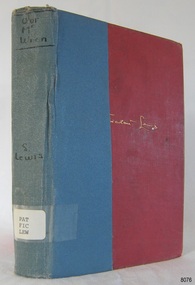
Book - Fiction, Jonathan Cape, Our Mr. Wrenn, 1930
... He was a prolific writer, publishing dozens of works and numerous articles, and became popular for his satire. Lewis married and divorced twice and died alone from a heart attack due to advanced alcoholism) near Rome on 10th January 1951, aged 66. ...He was a prolific writer, publishing dozens of works and numerous articles, and became popular for his satire. Lewis married and divorced twice and died alone from a heart attack due to advanced alcoholism) near Rome on 10th January 1951, aged 66. ...The fictional novel “Our Mr. Wrenn: The Romantic Adventures of a Gentle man” was written by Sinclair Lewis. It was originally published in America in 1914 by Harper & Brothers. It was the first of Sinclair Lewis’ novels published in his real name. His first published book, “Hike and the Aeroplane was” published in 1912 using the pseudonym of Tom Graham. Flagstaff Hill’s copy of “Our Mr. Wrenn” was published in 1930 by Jonathan Cape of London. About SINCLAIR LEWIS (1885-1951) The author was born Harry Sinclair Lewis in 1885 in Sauk Centre, Minnesota. He was renowned as an American novelist, playwright and short story writer. His first writings were romantic poems and short stories. Six of his novels were published by the time Lewis was 36. Lewis won the 1926 Pulitzer Prize for his book “Arrowsmith” but declined because he had been helped in the writing of it by science writer Paul de Kruif, who received 25% of royalties on the sales. However, Lewis is listed as the sole author. Lewis received the Nobel Prize for Literature in 1930 for his “vigorous and graphic art of description and his ability to create, with wit and humour, new types of characters." He was the first author from the United States to receive this award. Lewis graduated from university in 1907. He worked as a reporter and editor for several publications. He was a prolific writer, publishing dozens of works and numerous articles, and became popular for his satire. Lewis married and divorced twice and died alone from a heart attack due to advanced alcoholism) near Rome on 10th January 1951, aged 66. This book is part of a large group of books referred to as the Pattison Collection, which belonged to the Warrnambool Public Library, part of the Warrnambool Mechanics’ Institute. About RALPH ERIC PATTISON and the ‘PATTISON COLLECTION’ The ‘Pattison Collection’ is a collection of books and records that was originally owned by the Warrnambool Mechanics’ Institute, founded in Warrnambool in 1853. By 1886 the Warrnambool Mechanics’ Institute (WMI) had grown to have a Library, Museum and Fine Arts Gallery, with a collection of “… choice productions of art and valuable specimens in almost every branch and many wonderful national curiosities are now to be seen there, including historic relics of the town and district.” It later included a School of Design. Although it was very well patronised, the WMI was led to ask the City Council to take it over in 1911 due to a lack of financial support. In 1935 Ralph Pattison was appointed as City Librarian to establish and organise the Warrnambool Public Library as it was then called. Ralph Eric Pattison was born in Rockhampton, Queensland, in 1891. He married Maude Swan from Warrnambool in 1920 and they set up a home in Warrnambool. In 1935 when Pattison accepted the position as City Librarian for the Warrnambool City Council his huge challenge was to make a functional library within two rooms of the Mechanics’ Institute. He tirelessly cleaned, cleared and sorted a disarrayed collection of old books, jars of preserved specimens and other items reserved for exhibition in the city’s museum. He developed and updated the library with a wide variety of books for all tastes, including reference books for students; a difficult task to fulfil during the years following the Depression. He converted all of the lower areas of the building into a library, reference room and reading room for members and the public. The books were sorted and stored using a cataloguing and card index system that he had developed himself. He also prepared the upper floor of the building and established the Art Gallery and later the Museum, a place to exhibit the many old relics that had been stored for years for this purpose. One of the treasures he found was a beautiful ancient clock, which he repaired, restored and enjoyed using in his office during the years of his service there. Ralph Pattison was described as “a meticulous gentle man whose punctuality, floorless courtesy and distinctive neat dress were hallmarks of his character, and ‘his’ clock controlled his daily routine and his opening and closing of the library’s large heavy doors to the minute.” Pattison took leave from 1942 to 1945 to serve in the Royal Australian Navy, Volunteer Reserve as Lieutenant. A few years later he converted one of the Museum’s rooms into a Children’s Library, stocking it with suitable books for the younger generation. This was an instant success. In the 1950’s he had the honour of being appointed to the Victorian Library Board and received more inspiration from the monthly conferences in Melbourne. He was sadly retired in 1959 after over 23 years of service because he had gone over the working age of council officers. However, he continued to take a very keen interest in the continual development of the Library until his death in 1969. THE NEW WARRNAMBOOL LIBRARY When the WMI building was pulled down in 1963 a new civic building was erected on the site and the new Warrnambool Library, on behalf of the City Council, took over all the holdings of the WMI. At this time some of the items were separated and identified as the ‘Pattison Collection’, named after Pattison. Eventually, the components of the WMI were distributed from the Warrnambool Library to various places, including the Art Gallery, Historical Society and Flagstaff Hill. Later some were even distributed to other regional branches of Corangamite Regional Library and passed to and fro. It is difficult now to trace just where all of the items have ended up. The books at Flagstaff Hill Maritime Village generally display stamps and markings from Pattison as well as a variety of other institutions including the Mechanics’ Institute itself.Lewis’s book is significant for its association with the writer, who was the first American to be awarded the Nobel Prize for Literature (1930). This book is also significant for its connection with the Pattison Collection which, along with other items at Flagstaff Hill Maritime Village, was originally part of the Warrnambool Mechanics' Institute’s collection. The Warrnambool Mechanics’ Institute collection is primarily significant in its totality, rather than for the individual objects it contains. Its contents are highly representative of the development of Mechanics' Institute libraries across Australia, particularly Victoria. A diversity of publications and themes has been amassed, and these provide clues to our understanding of the nature of and changes in the reading habits of Victorians from the 1850s to the middle of the 20th century. The collection also highlights the Warrnambool community’s commitment to the Mechanics’ Institute, reading, literacy and learning in the regions, and proves that access to knowledge was not impeded by distance. These items help to provide a more complete picture of our community’s ideals and aspirations. The Warrnambool Mechanics Institute book collection has historical and social significance for its strong association with the Mechanics Institute movement and the important role it played in the intellectual, cultural and social development of people throughout the latter part of the nineteenth century and the early twentieth century. The collection of books is a rare example of an early lending library and its significance is enhanced by the survival of an original collection of many volumes. The Warrnambool Mechanics' Institute’s publication collection is of both local and state significance. Title: Our Mr. Wrenn: the romantic adventures of a gentle man Author: Sinclair Lewis Publisher: Jonathan Cape, London Date: 1930 Hardback board book covered with red linen, spine reinforced with blue. The author’s name is embossed in gold on the front cover. On the spine is a handwritten title and author, and a white adhesive label with a typed library call number. Inside the front cover are pasted labels and stamps. The book is part of the Pattison Collection originally belonging to the Warrnambool Public Library. It was once held by the Warrnambool Mechanics Institute and Free Library and the Corangamite Regional Library Service.Label on spine cover with typed text “PAT / FIC / LEW” Black handwriting on the spine “Our M- Wren” and “s. Lewis” Pastedown front endpaper has a label from Warrnambool Mechanics Institute and Free Library, covered by another from the Corangamite Regional Library Service Front loose endpaper has a stamp from Corangamite Regional Library Serviceflagstaff hill, warrnambool, shipwrecked coast, flagstaff hill maritime museum, maritime museum, shipwreck coast, flagstaff hill maritime village, great ocean road, book, pattison collection, warrnambool library, warrnambool public library, warrnambool mechanics’ institute, ralph eric pattison, warrnambool books and records, corangamite regional library service, warrnambool city librarian, mechanics’ institute library, victorian library board, warrnambool children’s library, american novel, jonathan cape, harry sinclair lewis, sinclair lewis, tom graham, 1930 nobel prize for literature, sinclair lewis’ debut novel, fiction, romance, our mr wrenn -
 Flagstaff Hill Maritime Museum and Village
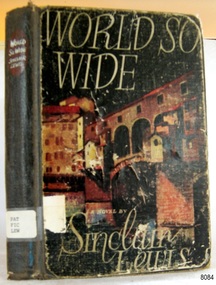
Book, William Heinemann Ltd, World So Wide, 1951
... He was a prolific writer, publishing dozens of works and numerous articles, and became popular for his satire. Lewis married and divorced twice and died alone from a heart attack due to advanced alcoholism) near Rome on 10th January 1951, aged 66. ...He was a prolific writer, publishing dozens of works and numerous articles, and became popular for his satire. Lewis married and divorced twice and died alone from a heart attack due to advanced alcoholism) near Rome on 10th January 1951, aged 66. ...This book “World So Wide” is a novel written by Sinclair Lewis. It is part of Flagstaff Hill’s historic book collection, known as the Pattison Collection. About SINCLAIR LEWIS (1885-1951) The author was born as Harry Sinclair Lewis in 1885 in Sauk Centre, Minnesota. He was renowned as an American novelist, playwright and short story writer. His first writings were romantic poems and short stories. Six of his novels were published by the time Lewis was 36. Lewis won the 1926 Pulitzer Prize for his book “Arrowsmith” but declined because he had been helped in the writing of it by science writer Paul de Kruif, who received 25% of royalties on the sales. However, Lewis is listed as the sole author. Lewis received the Nobel Prize for Literature in 1930 for his “vigorous and graphic art of description and his ability to create, with wit and humour, new types of characters." He was the first author from the United States to receive this award. Lewis graduated from university in 1907. He worked as a reporter and editor for several publications. He was a prolific writer, publishing dozens of works and numerous articles, and became popular for his satire. Lewis married and divorced twice and died alone from a heart attack due to advanced alcoholism) near Rome on 10th January 1951, aged 66. This book was part of a large group of books referred to as the Pattison Collection, which belonged to the Warrnambool Public Library, part of the Warrnambool Mechanics’ Institute. About RALPH ERIC PATTISON and the ‘PATTISON COLLECTION’ The ‘Pattison Collection’ is a collection of books and records that was originally owned by the Warrnambool Mechanics’ Institute, founded in Warrnambool in 1853. By 1886 the Warrnambool Mechanics’ Institute (WMI) had grown to have a Library, Museum and Fine Arts Gallery, with a collection of “… choice productions of art and valuable specimens in almost every branch and many wonderful national curiosities are now to be seen there, including historic relics of the town and district.” It later included a School of Design. Although it was very well patronised, the WMI was led to ask the City Council to take it over in 1911 due to lack of financial support. In 1935 Ralph Pattison was appointed as City Librarian to establish and organise the Warrnambool Public Library as it was then called. Ralph Eric Pattison was born in Rockhampton, Queensland, in 1891. He married Maude Swan from Warrnambool in 1920 and they set up home in Warrnambool. In 1935 when Pattison accepted the position as City Librarian for the Warrnambool City Council his huge challenge was to make a functional library within two rooms of the Mechanics’ Institute. He tirelessly cleaned, cleared and sorted a disarrayed collection of old books, jars of preserved specimens and other items reserved for exhibition in the city’s museum. He developed and updated the library with a wide variety of books for all tastes, including reference books for students; a difficult task to fulfil during the years following the Depression. He converted all of the lower areas of the building into a library, reference room and reading room for members and the public. The books were sorted and stored using a cataloguing and card index system that he had developed himself. He also prepared the upper floor of the building and established the Art Gallery and later the Museum, a place to exhibit the many old relics that had been stored for years for this purpose. One of the treasures he found was a beautiful ancient clock, which he repaired, restored and enjoyed using in his office during the years of his service there. Ralph Pattison was described as “a meticulous gentleman whose punctuality, floorless courtesy and distinctive neat dress were hallmarks of his character, and ‘his’ clock controlled his daily routine and his opening and closing of the library’s large heavy doors to the minute.” Pattison took leave from 1942 to 1945 to serve in the Royal Australian Navy, Volunteer Reserve as Lieutenant. A few years later he converted one of the Museum’s rooms into a Children’s Library, stocking it with suitable books for the younger generation. This was an instant success. In the 1950’s he had the honour of being appointed to the Victorian Library Board and received more inspiration from the monthly conferences in Melbourne. He was sadly retired in 1959 after over 23 years of service, due to the fact that he had gone over the working age of council officers. However, he continued to take a very keen interest in the continual development of the Library until his death in 1969. THE NEW WARRNAMBOOL LIBRARY When the WMI building was pulled down in 1963 a new civic building was erected on the site and the new Warrnambool Library, on behalf of the City Council, took over all the holdings of the WMI. At this time some of the items were separated and identified as the ‘Pattison Collection’, named after Pattison. Eventually, the components of the WMI were distributed from the Warrnambool Library to various places, including the Art Gallery, Historical Society and Flagstaff Hill. Later some were even distributed to other regional branches of Corangamite Regional Library and passed to and fro. It is difficult now to trace just where all of the items have ended up. The books at Flagstaff Hill Maritime Village generally display stamps and markings from Pattison as well as a variety of other institutions including the Mechanics’ Institute itself.Lewis’s book is significant for its association with the writer, who was the first American to be awarded the Nobel Prize for Literature (1930). This book is significant for its connection with the Pattison Collection which, along with other items at Flagstaff Hill Maritime Village, was originally part of the Warrnambool Mechanics' Institute’s collection. The Warrnambool Mechanics’ Institute collection is primarily significant in its totality, rather than for the individual objects it contains. Its contents are highly representative of the development of Mechanics' Institute libraries across Australia, particularly Victoria. A diversity of publications and themes has been amassed, and these provide clues to our understanding of the nature of and changes in the reading habits of Victorians from the 1850s to the middle of the 20th century. The collection also highlights the Warrnambool community’s commitment to the Mechanics’ Institute, reading, literacy and learning in the regions, and proves that access to knowledge was not impeded by distance. These items help to provide a more complete picture of our community’s ideals and aspirations. The Warrnambool Mechanics Institute book collection has historical and social significance for its strong association with the Mechanics Institute movement and the important role it played in the intellectual, cultural and social development of people throughout the latter part of the nineteenth century and the early twentieth century. The collection of books is a rare example of an early lending library and its significance is enhanced by the survival of an original collection of many volumes. The Warrnambool Mechanics' Institute’s publication collection is of both local and state significance. Title: World So Wide Author: Sinclair Lewis Publisher: William Heinemann Ltd Date: 1951 Hardback board book covered with dark linen, and a coloured picture pasted onto front cover. The book title and author’s name is on the coloured picture on the front cover along with a picture of buildings and a dark sky. The spine also has the title and author’s name, handwritten in white. On the spine is a white adhesive label with a typed library call number. Inside the front cover is a printed label. The front pasted down endpaper has one label covering another label. The front loose endpaper as a purple stamp impression. The book, a novel, is part of the Pattison Collection originally belonging to the Warrnambool Public Library.Adhesive label - “PAT / FIC / LEW” Handwritten on spine “WORLD SO WIDE” and “SINCLAIR LEWIS” Printed labels on front endpaper of both the Corangamite Regional Library Service and the Warrnambool Public Library. Stamp in purple ink on inside front loose endpaper of the Corangamite Regional Library Serviceflagstaff hill, warrnambool, shipwrecked coast, flagstaff hill maritime museum, maritime museum, shipwreck coast, flagstaff hill maritime village, great ocean road, book, pattison collection, warrnambool library, warrnambool public library, warrnambool mechanics’ institute, ralph eric pattison, warrnambool books and records, corangamite regional library service, warrnambool city librarian, mechanics’ institute library, victorian library board, warrnambool children’s library, american novel, jonathan cape, sinclair lewis, harry sinclair lewis, 1930 nobel prize for literature, world so wide, william heinemann ltd -
 Flagstaff Hill Maritime Museum and Village
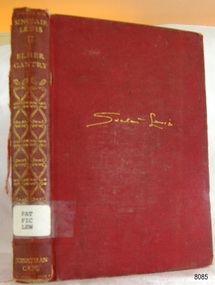
Book, Jonathan Cape, Elmer Gantry, 1930
... He was a prolific writer, publishing dozens of works and numerous articles, and became popular for his satire. Lewis married and divorced twice and died alone from a heart attack due to advanced alcoholism) near Rome on 10th January 1951, aged 66. ...He was a prolific writer, publishing dozens of works and numerous articles, and became popular for his satire. Lewis married and divorced twice and died alone from a heart attack due to advanced alcoholism) near Rome on 10th January 1951, aged 66. ...This book “Elmer Gantry” is a novel written by Sinclair Lewis. It was first published in America in 1927. It was published in various languages including French. About SINCLAIR LEWIS (1885-1951) The author was born as Harry Sinclair Lewis in 1885 in Sauk Centre, Minnesota. He was renowned as an American novelist, playwright and short story writer. His first writings were romantic poems and short stories. Six of his novels were published by the time Lewis was 36. Lewis won the 1926 Pulitzer Prize for his book “Arrowsmith” but declined because he had been helped in the writing of it by science writer Paul de Kruif, who received 25% of royalties on the sales. However, Lewis is listed as the sole author. Lewis received the Nobel Prize for Literature in 1930 for his “vigorous and graphic art of description and his ability to create, with wit and humour, new types of characters." He was the first author from the United States to receive this award. Lewis graduated from university in 1907. He worked as a reporter and editor for several publications. He was a prolific writer, publishing dozens of works and numerous articles, and became popular for his satire. Lewis married and divorced twice and died alone from a heart attack due to advanced alcoholism) near Rome on 10th January 1951, aged 66. This book was part of a large group of books referred to as the Pattison Collection, which belonged to the Warrnambool Public Library, part of the Warrnambool Mechanics’ Institute. About RALPH ERIC PATTISON and the ‘PATTISON COLLECTION’ The ‘Pattison Collection’ is a collection of books and records that was originally owned by the Warrnambool Mechanics’ Institute, founded in Warrnambool in 1853. By 1886 the Warrnambool Mechanics’ Institute (WMI) had grown to have a Library, Museum and Fine Arts Gallery, with a collection of “… choice productions of art and valuable specimens in almost every branch and many wonderful national curiosities are now to be seen there, including historic relics of the town and district.” It later included a School of Design. Although it was very well patronised, the WMI was led to ask the City Council to take it over in 1911 due to lack of financial support. In 1935 Ralph Pattison was appointed as City Librarian to establish and organise the Warrnambool Public Library as it was then called. Ralph Eric Pattison was born in Rockhampton, Queensland, in 1891. He married Maude Swan from Warrnambool in 1920 and they set up home in Warrnambool. In 1935 when Pattison accepted the position as City Librarian for the Warrnambool City Council his huge challenge was to make a functional library within two rooms of the Mechanics’ Institute. He tirelessly cleaned, cleared and sorted a disarrayed collection of old books, jars of preserved specimens and other items reserved for exhibition in the city’s museum. He developed and updated the library with a wide variety of books for all tastes, including reference books for students; a difficult task to fulfil during the years following the Depression. He converted all of the lower areas of the building into a library, reference room and reading room for members and the public. The books were sorted and stored using a cataloguing and card index system that he had developed himself. He also prepared the upper floor of the building and established the Art Gallery and later the Museum, a place to exhibit the many old relics that had been stored for years for this purpose. One of the treasures he found was a beautiful ancient clock, which he repaired, restored and enjoyed using in his office during the years of his service there. Ralph Pattison was described as “a meticulous gentleman whose punctuality, floorless courtesy and distinctive neat dress were hallmarks of his character, and ‘his’ clock controlled his daily routine and his opening and closing of the library’s large heavy doors to the minute.” Pattison took leave from 1942 to 1945 to serve in the Royal Australian Navy, Volunteer Reserve as Lieutenant. A few years later he converted one of the Museum’s rooms into a Children’s Library, stocking it with suitable books for the younger generation. This was an instant success. In the 1950’s he had the honour of being appointed to the Victorian Library Board and received more inspiration from the monthly conferences in Melbourne. He was sadly retired in 1959 after over 23 years of service, due to the fact that he had gone over the working age of council officers. However, he continued to take a very keen interest in the continual development of the Library until his death in 1969. THE NEW WARRNAMBOOL LIBRARY When the WMI building was pulled down in 1963 a new civic building was erected on the site and the new Warrnambool Library, on behalf of the City Council, took over all the holdings of the WMI. At this time some of the items were separated and identified as the ‘Pattison Collection’, named after Pattison. Eventually, the components of the WMI were distributed from the Warrnambool Library to various places, including the Art Gallery, Historical Society and Flagstaff Hill. Later some were even distributed to other regional branches of Corangamite Regional Library and passed to and fro. It is difficult now to trace just where all of the items have ended up. The books at Flagstaff Hill Maritime Village generally display stamps and markings from Pattison as well as a variety of other institutions including the Mechanics’ Institute itself.Lewis’s book is significant for its association with the writer, who was the first American to be awarded the Nobel Prize for Literature (1930). This book is significant for its connection with the Pattison Collection which, along with other items at Flagstaff Hill Maritime Village, was originally part of the Warrnambool Mechanics' Institute’s collection. The Warrnambool Mechanics’ Institute collection is primarily significant in its totality, rather than for the individual objects it contains. Its contents are highly representative of the development of Mechanics' Institute libraries across Australia, particularly Victoria. A diversity of publications and themes has been amassed, and these provide clues to our understanding of the nature of and changes in the reading habits of Victorians from the 1850s to the middle of the 20th century. The collection also highlights the Warrnambool community’s commitment to the Mechanics’ Institute, reading, literacy and learning in the regions, and proves that access to knowledge was not impeded by distance. These items help to provide a more complete picture of our community’s ideals and aspirations. The Warrnambool Mechanics Institute book collection has historical and social significance for its strong association with the Mechanics Institute movement and the important role it played in the intellectual, cultural and social development of people throughout the latter part of the nineteenth century and the early twentieth century. The collection of books is a rare example of an early lending library and its significance is enhanced by the survival of an original collection of many volumes. The Warrnambool Mechanics' Institute’s publication collection is of both local and state significance. Title: Elmer Gantry: a novel Author: Sinclair Lewis Publisher: Jonathan Cape, London Date: 1930 Hardback board book covered with red linen. The author’s name is embossed in gold on the front cover. The spine has an embossed gold pattern and text, with the author’s name, book’s title and publisher’s details on it. Also on the spine is a white adhesive label with a typed library call number. Inside the front cover is a printed label covering another label. The book, a novel, is part of the Pattison Collection originally belonging to the Warrnambool Mechanics’ Institute and the Warrnambool Public Library. Embossed on front cover in script ‘Sinclair Lewis’ Embossed on the sping “SINCLAIR / LEWIS”, “ELMER / GANTRY” and “JONATHAN / CAPE” Adhesive label - “PAT / FIC / LEW” Printed label on front endpaper of the Corangamite Regional Library Service Printed label on front endpaper of the Warrnambool Public Library Stamp on front loose endpaper two stamps: “CORANGAMITE REGIONAL LIBRARY SERVICE” and “WARRNAMBOOL MECHANICS’ INSTITUTE”flagstaff hill, warrnambool, shipwrecked coast, flagstaff hill maritime museum, maritime museum, shipwreck coast, flagstaff hill maritime village, great ocean road, book, pattison collection, warrnambool library, warrnambool public library, warrnambool mechanics’ institute, ralph eric pattison, warrnambool books and records, corangamite regional library service, warrnambool city librarian, mechanics’ institute library, victorian library board, warrnambool children’s library, american novel, jonathan cape, sinclair lewis, harry sinclair lewis, 1930 nobel prize for literature, elmer gantry by sinclair lewis -
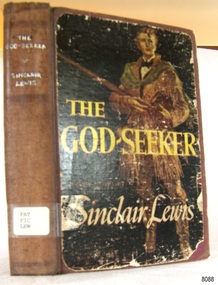 Flagstaff Hill Maritime Museum and Village
Book, William Heinemann Ltd, The God-Seeker, 1949
... He was a prolific writer, publishing dozens of works and numerous articles, and became popular for his satire. Lewis married and divorced twice and died alone from a heart attack due to advanced alcoholism) near Rome on 10th January 1951, aged 66. ...He was a prolific writer, publishing dozens of works and numerous articles, and became popular for his satire. Lewis married and divorced twice and died alone from a heart attack due to advanced alcoholism) near Rome on 10th January 1951, aged 66. ...This book “The God-Seeker” is a novel written by Sinclair Lewis. It is part of Flagstaff Hill’s historic book collection, known as the Pattison Collection. About SINCLAIR LEWIS (1885-1951) The author was born as Harry Sinclair Lewis in 1885 in Sauk Centre, Minnesota. He was renowned as an American novelist, playwright and short story writer. His first writings were romantic poems and short stories. Six of his novels were published by the time Lewis was 36. Lewis won the 1926 Pulitzer Prize for his book “Arrowsmith” but declined because he had been helped in the writing of it by science writer Paul de Kruif, who received 25% of royalties on the sales. However, Lewis is listed as the sole author. Lewis received the Nobel Prize for Literature in 1930 for his “vigorous and graphic art of description and his ability to create, with wit and humour, new types of characters." He was the first author from the United States to receive this award. Lewis graduated from university in 1907. He worked as a reporter and editor for several publications. He was a prolific writer, publishing dozens of works and numerous articles, and became popular for his satire. Lewis married and divorced twice and died alone from a heart attack due to advanced alcoholism) near Rome on 10th January 1951, aged 66. This book was part of a large group of books referred to as the Pattison Collection, which belonged to the Warrnambool Public Library, part of the Warrnambool Mechanics’ Institute. About RALPH ERIC PATTISON and the ‘PATTISON COLLECTION’ The ‘Pattison Collection’ is a collection of books and records that was originally owned by the Warrnambool Mechanics’ Institute, founded in Warrnambool in 1853. By 1886 the Warrnambool Mechanics’ Institute (WMI) had grown to have a Library, Museum and Fine Arts Gallery, with a collection of “… choice productions of art and valuable specimens in almost every branch and many wonderful national curiosities are now to be seen there, including historic relics of the town and district.” It later included a School of Design. Although it was very well patronised, the WMI was led to ask the City Council to take it over in 1911 due to lack of financial support. In 1935 Ralph Pattison was appointed as City Librarian to establish and organise the Warrnambool Public Library as it was then called. Ralph Eric Pattison was born in Rockhampton, Queensland, in 1891. He married Maude Swan from Warrnambool in 1920 and they set up home in Warrnambool. In 1935 when Pattison accepted the position as City Librarian for the Warrnambool City Council his huge challenge was to make a functional library within two rooms of the Mechanics’ Institute. He tirelessly cleaned, cleared and sorted a disarrayed collection of old books, jars of preserved specimens and other items reserved for exhibition in the city’s museum. He developed and updated the library with a wide variety of books for all tastes, including reference books for students; a difficult task to fulfil during the years following the Depression. He converted all of the lower areas of the building into a library, reference room and reading room for members and the public. The books were sorted and stored using a cataloguing and card index system that he had developed himself. He also prepared the upper floor of the building and established the Art Gallery and later the Museum, a place to exhibit the many old relics that had been stored for years for this purpose. One of the treasures he found was a beautiful ancient clock, which he repaired, restored and enjoyed using in his office during the years of his service there. Ralph Pattison was described as “a meticulous gentleman whose punctuality, floorless courtesy and distinctive neat dress were hallmarks of his character, and ‘his’ clock controlled his daily routine and his opening and closing of the library’s large heavy doors to the minute.” Pattison took leave from 1942 to 1945 to serve in the Royal Australian Navy, Volunteer Reserve as Lieutenant. A few years later he converted one of the Museum’s rooms into a Children’s Library, stocking it with suitable books for the younger generation. This was an instant success. In the 1950’s he had the honour of being appointed to the Victorian Library Board and received more inspiration from the monthly conferences in Melbourne. He was sadly retired in 1959 after over 23 years of service, due to the fact that he had gone over the working age of council officers. However, he continued to take a very keen interest in the continual development of the Library until his death in 1969. THE NEW WARRNAMBOOL LIBRARY When the WMI building was pulled down in 1963 a new civic building was erected on the site and the new Warrnambool Library, on behalf of the City Council, took over all the holdings of the WMI. At this time some of the items were separated and identified as the ‘Pattison Collection’, named after Pattison. Eventually, the components of the WMI were distributed from the Warrnambool Library to various places, including the Art Gallery, Historical Society and Flagstaff Hill. Later some were even distributed to other regional branches of Corangamite Regional Library and passed to and fro. It is difficult now to trace just where all of the items have ended up. The books at Flagstaff Hill Maritime Village generally display stamps and markings from Pattison as well as a variety of other institutions including the Mechanics’ Institute itself.Lewis’s book is significant for its association with the writer, who was the first American to be awarded the Nobel Prize for Literature (1930). This book is significant for its connection with the Pattison Collection which, along with other items at Flagstaff Hill Maritime Village, was originally part of the Warrnambool Mechanics' Institute’s collection. The Warrnambool Mechanics’ Institute collection is primarily significant in its totality, rather than for the individual objects it contains. Its contents are highly representative of the development of Mechanics' Institute libraries across Australia, particularly Victoria. A diversity of publications and themes has been amassed, and these provide clues to our understanding of the nature of and changes in the reading habits of Victorians from the 1850s to the middle of the 20th century. The collection also highlights the Warrnambool community’s commitment to the Mechanics’ Institute, reading, literacy and learning in the regions, and proves that access to knowledge was not impeded by distance. These items help to provide a more complete picture of our community’s ideals and aspirations. The Warrnambool Mechanics Institute book collection has historical and social significance for its strong association with the Mechanics Institute movement and the important role it played in the intellectual, cultural and social development of people throughout the latter part of the nineteenth century and the early twentieth century. The collection of books is a rare example of an early lending library and its significance is enhanced by the survival of an original collection of many volumes. The Warrnambool Mechanics' Institute’s publication collection is of both local and state significance. Title: The God-Seeker Author: Sinclair Lewis Publisher: William Heinemann Ltd Date: 1949 Hardback board book covered with brown linen, and a coloured picture pasted onto front cover. The book title and author’s name is on the coloured picture on the front cover along with a picture of a man standing. The spine also has the title and author’s name, handwritten in white. On the spine is a white adhesive label with a typed library call number. Inside the front cover is a printed label. The front pasted down endpaper has one label covering another label. The front loose endpaper as a purple stamp impression. The book, a novel, is part of the Pattison Collection originally belonging to the Warrnambool Public Library.Adhesive label - “PAT / FIC / LEW” Printed labels on front endpaper of both the Corangamite Regional Library Service and the Warrnambool Public Library. Stamp in purple ink on inside front loose endpaper “WARRNAMBOOL PUBLIC LIBRARY”flagstaff hill, warrnambool, shipwrecked coast, flagstaff hill maritime museum, maritime museum, shipwreck coast, flagstaff hill maritime village, great ocean road, book, pattison collection, warrnambool library, warrnambool public library, warrnambool mechanics’ institute, ralph eric pattison, warrnambool books and records, corangamite regional library service, warrnambool city librarian, mechanics’ institute library, victorian library board, warrnambool children’s library, american novel, jonathan cape, sinclair lewis, harry sinclair lewis, 1930 nobel prize for literature, the god-seeker, william heinemann ltd -
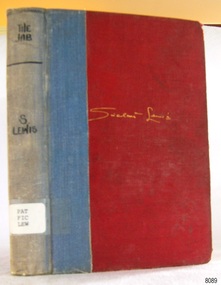 Flagstaff Hill Maritime Museum and Village
Book, Jonathan Cape, The Job, 1929
... He was a prolific writer, publishing dozens of works and numerous articles, and became popular for his satire. Lewis married and divorced twice and died alone from a heart attack due to advanced alcoholism) near Rome on 10th January 1951, aged 66. ...He was a prolific writer, publishing dozens of works and numerous articles, and became popular for his satire. Lewis married and divorced twice and died alone from a heart attack due to advanced alcoholism) near Rome on 10th January 1951, aged 66. ...This book “The Job” is a novel written by Sinclair Lewis. It was first published in America in 1916 and in England in 1926. It is Lewis’ third book. There are 320 numbered pages, divided into three parts, each part is divided into chapters, which are in turn divided into sections. This particular book is one of a Collected Edition published in 1929. A note from the publisher included within the book states “It has been corrected in some small details but no revision or rewriting has been attempted by the author who wishes it to be made clear that it is an early and not a new work.” About SINCLAIR LEWIS (1885-1951) The author was born as Harry Sinclair Lewis in 1885 in Sauk Centre, Minnesota. He was renowned as an American novelist, playwright and short story writer. His first writings were romantic poems and short stories. Six of his novels were published by the time Lewis was 36. Lewis received the Nobel Prize for Literature in 1930 for his “vigorous and graphic art of description and his ability to create, with wit and humour, new types of characters." He was the first author from the United States to receive this award. Lewis graduated from university in 1907. He worked as a reporter and editor for several publications. He was a prolific writer, publishing dozens of works and numerous articles, and became popular for his satire. Lewis married and divorced twice and died alone from a heart attack due to advanced alcoholism) near Rome on 10th January 1951, aged 66. This book was part of a large group of books referred to as the Pattison Collection, which belonged to the Warrnambool Public Library, part of the Warrnambool Mechanics’ Institute. There is a remnant of the library’s label inside the back page of the book. About RALPH ERIC PATTISON and the ‘PATTISON COLLECTION’ The ‘Pattison Collection’ is a collection of books and records that was originally owned by the Warrnambool Mechanics’ Institute, founded in Warrnambool in 1853. By 1886 the Warrnambool Mechanics’ Institute (WMI) had grown to have a Library, Museum and Fine Arts Gallery, with a collection of “… choice productions of art, and valuable specimens in almost every branch and many wonderful national curiosities are now to be seen there, including historic relics of the town and district.” It later included a School of Design. Although it was very well patronised, the WMI was led to ask the City Council to take it over in 1911 due to lack of financial support. In 1935 Ralph Pattison was appointed as City Librarian to establish and organise the Warrnambool Public Library as it was then called. Ralph Eric Pattison was born in Rockhampton, Queensland, in 1891. He married Maude Swan from Warrnambool in 1920 and they set up home in Warrnambool. In 1935 when Pattison accepted the position as City Librarian for the Warrnambool City Council his huge challenge was to make a functional library within two rooms of the Mechanics’ Institute. He tirelessly cleaned, cleared and sorted a disarrayed collection of old books, jars of preserved specimens and other items reserved for exhibition in the city’s museum. He developed and updated the library with a wide variety of books for all tastes, including reference books for students; a difficult task to fulfil during the years following the Depression. He converted all of the lower areas of the building into a library, reference room and reading room for members and the public. The books were sorted and stored using a cataloguing and card index system that he had developed himself. He also prepared the upper floor of the building and established the Art Gallery and later the Museum, a place to exhibit the many old relics that had been stored for years for this purpose. One of the treasures he found was a beautiful ancient clock, which he repaired, restored and enjoyed using in his office during the years of his service there. Ralph Pattison was described as “a meticulous gentleman whose punctuality, floorless courtesy and distinctive neat dress were hallmarks of his character, and ‘his’ clock controlled his daily routine, and his opening and closing of the library’s large heavy doors to the minute.” Pattison took leave from 1942 to 1945 to serve in the Royal Australian Navy, Volunteer Reserve as Lieutenant. A few years later he converted one of the Museum’s rooms into a Children’s Library, stocking it with suitable books for the younger generation. This was an instant success. In the 1950’s he had the honour of being appointed to the Victorian Library Board and received more inspiration from the monthly conferences in Melbourne. He was sadly retired in 1959 after over 23 years of service, due to the fact that he had gone over the working age of council officers. However he continued to take a very keen interest in the continual development of the Library until his death in 1969. THE NEW WARRNAMBOOL LIBRARY When the WMI building was pulled down in 1963 a new civic building was erected on the site and the new Warrnambool Library, on behalf of the City Council, took over all the holdings of the WMI. At this time some of the items were separated and identified as the ‘Pattison Collection’, named after Pattison. Eventually the components of the WMI were distributed from the Warrnambool Library to various places, including the Art Gallery, Historical Society and Flagstaff Hill. Later some were even distributed to other regional branches of Corangamite Regional Library and passed to and fro. It is difficult now to trace just where all of the items have ended up. The books at Flagstaff Hill Maritime Village generally display stamps and markings from Pattison as well as a variety of other institutions including the Mechanics’ Institute itself. Lewis’s book is significant for its association with the writer, who was the first American to be awarded the Nobel Prize for Literature (1930). This book is significant for its connection with the Pattison Collection which, along with other items at Flagstaff Hill Maritime Village, was originally part of the Warrnambool Mechanics' Institute’s collection. The Warrnambool Mechanics’ Institute collection is primarily significant in its totality, rather than for the individual objects it contains. Its contents are highly representative of the development of Mechanics' Institute libraries across Australia, particularly Victoria. A diversity of publications and themes has been amassed, and these provide clues to our understanding of the nature of and changes in the reading habits of Victorians from the 1850s to the middle of the 20th century. The collection also highlights the Warrnambool community’s commitment to the Mechanics’ Institute, reading, literacy and learning in the regions, and proves that access to knowledge was not impeded by distance. These items help to provide a more complete picture of our community’s ideals and aspirations. The Warrnambool Mechanics Institute book collection has historical and social significance for its strong association with the Mechanics Institute movement and the important role it played in the intellectual, cultural and social development of people throughout the latter part of the nineteenth century and the early twentieth century. The collection of books is a rare example of an early lending library and its significance is enhanced by the survival of an original collection of many volumes. The Warrnambool Mechanics' Institute’s publication collection is of both local and state significance. Title: The Job Author: Sinclair Lewis Publisher: Jonathan Cape, London Date: 1929 Hardback board book covered with red linen, spine reinforced with blue. The author’s name is embossed in gold on the front cover. There is a logo impressed into the centre of the back cover with the printer’s initials “J C”. On the spine is a white adhesive label with a typed library call number. Inside the front cover is a printed label. Inside front and back covers are a black stamp and handwritten characters in pen and pencil. Inside the back cover and facing page are various date stamps dating from 1942 to 1963. The book, a novel, is one of a Collected Edition published in 1929. It also belongs to the Pattison Collection originally belonging to the Warrnambool Public Library.Logo “J” over “C” Adhesive label - “PAT / FIC / LEW” Printed label “Corangamite Regional Library Service / Warrnambool City Library / Pattison Collection” Stamp on inside front page and inside back page “CORANGAMITE REGIONAL LIBRARY SERVICE / WARRNAMBOOL LIBRARY” Handwritten on the inside page facing cover “1083” and “M 73” Handwritten on inside page facing back cover “1083” Date stamps facing back cover “1958” – “1963”, and on inside back cover “1942” – “195-“ Remnants of a torn out paper “ - - - - - - PU - - - C LIBRAR- / ……” flagstaff hill, warrnambool, shipwrecked coast, flagstaff hill maritime museum, maritime museum, shipwreck coast, flagstaff hill maritime village, great ocean road, book, pattison collection, warrnambool library, warrnambool public library, warrnambool mechanics’ institute, ralph eric pattison, warrnambool books and records, corangamite regional library service, warrnambool city librarian, mechanics’ institute library, victorian library board, warrnambool children’s library, the job by sinclair lewis, collection edition sinclair lewis, american novel 1929, jonathan cape, sinclair lewis, harry sinclair lewis, 1930 nobel prize for literature -
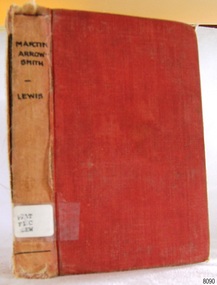 Flagstaff Hill Maritime Museum and Village
Book, Jonathan Cape, Martin Arrowsmith, 1930
... He was a prolific writer, publishing dozens of works and numerous articles, and became popular for his satire. Lewis married and divorced twice and died alone from a heart attack due to advanced alcoholism) near Rome on 10th January 1951, aged 66. ...He was a prolific writer, publishing dozens of works and numerous articles, and became popular for his satire. Lewis married and divorced twice and died alone from a heart attack due to advanced alcoholism) near Rome on 10th January 1951, aged 66. ...This book “Martin Arrowsmith” is a novel written by Sinclair Lewis. It was first published in 1925. Lewis won the 1926 Pulitzer Prize for this book but he declined the Prize. He had been helped in the writing of it by science writer Paul de Kruif, who received 25% of royalties on the sales. However, Lewis is listed as the sole author. About SINCLAIR LEWIS (1885-1951) The author was born as Harry Sinclair Lewis in 1885 in Sauk Centre, Minnesota. He was renowned as an American novelist, playwright and short story writer. His first writings were romantic poems and short stories. Six of his novels were published by the time Lewis was 36. Lewis received the Nobel Prize for Literature in 1930 for his “vigorous and graphic art of description and his ability to create, with wit and humour, new types of characters." He was the first author from the United States to receive this award. Lewis graduated from university in 1907. He worked as a reporter and editor for several publications. He was a prolific writer, publishing dozens of works and numerous articles, and became popular for his satire. Lewis married and divorced twice and died alone from a heart attack due to advanced alcoholism) near Rome on 10th January 1951, aged 66. This book was part of a large group of books referred to as the Pattison Collection, which belonged to the Warrnambool Public Library, part of the Warrnambool Mechanics’ Institute. About RALPH ERIC PATTISON and the ‘PATTISON COLLECTION’ The ‘Pattison Collection’ is a collection of books and records that was originally owned by the Warrnambool Mechanics’ Institute, founded in Warrnambool in 1853. By 1886 the Warrnambool Mechanics’ Institute (WMI) had grown to have a Library, Museum and Fine Arts Gallery, with a collection of “… choice productions of art and valuable specimens in almost every branch and many wonderful national curiosities are now to be seen there, including historic relics of the town and district.” It later included a School of Design. Although it was very well patronised, the WMI was led to ask the City Council to take it over in 1911 due to lack of financial support. In 1935 Ralph Pattison was appointed as City Librarian to establish and organise the Warrnambool Public Library as it was then called. Ralph Eric Pattison was born in Rockhampton, Queensland, in 1891. He married Maude Swan from Warrnambool in 1920 and they set up home in Warrnambool. In 1935 when Pattison accepted the position as City Librarian for the Warrnambool City Council his huge challenge was to make a functional library within two rooms of the Mechanics’ Institute. He tirelessly cleaned, cleared and sorted a disarrayed collection of old books, jars of preserved specimens and other items reserved for exhibition in the city’s museum. He developed and updated the library with a wide variety of books for all tastes, including reference books for students; a difficult task to fulfil during the years following the Depression. He converted all of the lower areas of the building into a library, reference room and reading room for members and the public. The books were sorted and stored using a cataloguing and card index system that he had developed himself. He also prepared the upper floor of the building and established the Art Gallery and later the Museum, a place to exhibit the many old relics that had been stored for years for this purpose. One of the treasures he found was a beautiful ancient clock, which he repaired, restored and enjoyed using in his office during the years of his service there. Ralph Pattison was described as “a meticulous gentleman whose punctuality, floorless courtesy and distinctive neat dress were hallmarks of his character, and ‘his’ clock controlled his daily routine and his opening and closing of the library’s large heavy doors to the minute.” Pattison took leave from 1942 to 1945 to serve in the Royal Australian Navy, Volunteer Reserve as Lieutenant. A few years later he converted one of the Museum’s rooms into a Children’s Library, stocking it with suitable books for the younger generation. This was an instant success. In the 1950’s he had the honour of being appointed to the Victorian Library Board and received more inspiration from the monthly conferences in Melbourne. He was sadly retired in 1959 after over 23 years of service, due to the fact that he had gone over the working age of council officers. However, he continued to take a very keen interest in the continual development of the Library until his death in 1969. THE NEW WARRNAMBOOL LIBRARY When the WMI building was pulled down in 1963 a new civic building was erected on the site and the new Warrnambool Library, on behalf of the City Council, took over all the holdings of the WMI. At this time some of the items were separated and identified as the ‘Pattison Collection’, named after Pattison. Eventually, the components of the WMI were distributed from the Warrnambool Library to various places, including the Art Gallery, Historical Society and Flagstaff Hill. Later some were even distributed to other regional branches of Corangamite Regional Library and passed to and fro. It is difficult now to trace just where all of the items have ended up. The books at Flagstaff Hill Maritime Village generally display stamps and markings from Pattison as well as a variety of other institutions including the Mechanics’ Institute itself. About BUTLER & TANNER LTD, Printers The company Butler & Tanner Ltd, of Great Britain, was established in France in 1845 as W.T. Butler, and in 1857 ran a steam printing works. The company was also known as B&T, and Butler, Tanner and Dennis. They continued in business for almost 170 years, sadly going into liquidation in 2014. The company was Britains ‘oldest and foremost colour printer’. Lewis’s book is significant for its association with the writer, who was the first American to be awarded the Nobel Prize for Literature (1930). This book is significant for its connection with the Pattison Collection which, along with other items at Flagstaff Hill Maritime Village, was originally part of the Warrnambool Mechanics' Institute’s collection. The Warrnambool Mechanics’ Institute collection is primarily significant in its totality, rather than for the individual objects it contains. Its contents are highly representative of the development of Mechanics' Institute libraries across Australia, particularly Victoria. A diversity of publications and themes has been amassed, and these provide clues to our understanding of the nature of and changes in the reading habits of Victorians from the 1850s to the middle of the 20th century. The collection also highlights the Warrnambool community’s commitment to the Mechanics’ Institute, reading, literacy and learning in the regions, and proves that access to knowledge was not impeded by distance. These items help to provide a more complete picture of our community’s ideals and aspirations. The Warrnambool Mechanics Institute book collection has historical and social significance for its strong association with the Mechanics Institute movement and the important role it played in the intellectual, cultural and social development of people throughout the latter part of the nineteenth century and the early twentieth century. The collection of books is a rare example of an early lending library and its significance is enhanced by the survival of an original collection of many volumes. The Warrnambool Mechanics' Institute’s publication collection is of both local and state significance. Title: Martin Arrowsmith Author: Sinclair Lewis Publisher: Jonathan Cape, London Date: 1930 Edition: Hardback board book covered with red linen. Linen on the spine has faded to orange-brown. On the spine is a hand printed title and author, and a white adhesive label with a typed library call number. Inside the front cover is a printed label. On the book’s fly page is an oval stamp impression in purple ink, and handwritten pencilled numbers and letters. The book, a novel, is one of a Collected Edition published in 1929. It also belongs to the Pattison Collection originally belonging to the Warrnambool Mechanics’ Institute, and the Warrnambool Public Library.Adhesive label on the spine - “PAT / FIC / LEW” Hand printed on the spine in black “MARTIN / ARROW - / SMITH” and “LEWIS” Purple stamp on fly page “WARRNAMBOOL / MECHANICS’ / INSTITUTE” Pencil text on fly page “PL (underlined) / W / 14217A” Printed label inside front cover from the Warrnambool Public Libraryflagstaff hill, warrnambool, shipwrecked coast, flagstaff hill maritime museum, maritime museum, shipwreck coast, flagstaff hill maritime village, great ocean road, book, pattison collection, warrnambool library, warrnambool public library, warrnambool mechanics’ institute, ralph eric pattison, warrnambool books and records, corangamite regional library service, warrnambool city librarian, mechanics’ institute library, victorian library board, warrnambool children’s library, american novel, jonathan cape, sinclair lewis, harry sinclair lewis, 1930 nobel prize for literature, pulitzer prize, bitler & tanner ltd, b & t -
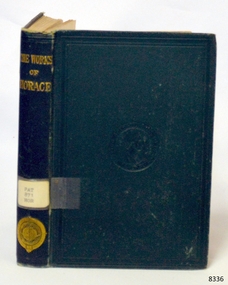 Flagstaff Hill Maritime Museum and Village
Book - Lyrical Poems, Samuel Lee (Translator), The Works of Horace, 1890
... It also features his Satires, which offer humorous commentaries on Roman life, and his Epistles, or letters in verse, which include his highly influential work on literary criticism, the Ars Poetica (or The Art of Poetry). ...The original author of this work was Quintus Horatius Flaccus, one of the leading Roman lyric poets during the time of Augustus Caesar (1st century BCE). This volume features the complete surviving works of Horace, rendered entirely into English prose. It includes his famous Odes, or lyrical poems, as well as his earlier poems on politics and social issues of the time. It also features his Satires, which offer humorous commentaries on Roman life, and his Epistles, or letters in verse, which include his highly influential work on literary criticism, the Ars Poetica (or The Art of Poetry).The Works of Horace Author: James Lonsdale and Samuel Lee Publisher: Macmillan And Co Date: 1890 Further Information: non-fictionThe original author of this work was Quintus Horatius Flaccus, one of the leading Roman lyric poets during the time of Augustus Caesar (1st century BCE). This volume features the complete surviving works of Horace, rendered entirely into English prose. It includes his famous Odes, or lyrical poems, as well as his earlier poems on politics and social issues of the time. It also features his Satires, which offer humorous commentaries on Roman life, and his Epistles, or letters in verse, which include his highly influential work on literary criticism, the Ars Poetica (or The Art of Poetry).flagstaff hill, warrnambool, shipwrecked coast, flagstaff hill maritime museum, maritime museum, shipwreck coast, flagstaff hill maritime village, great ocean road, book, pattison collection, warrnambool library, warrnambool mechanics’ institute, ralph eric pattison, corangamite regional library service, warrnambool city librarian, mechanics’ institute library, victorian library board, warrnambool books and records, warrnambool children’s library, the works of horace, samuel lee, james lonsdale, latin translated text -
 Flagstaff Hill Maritime Museum and Village
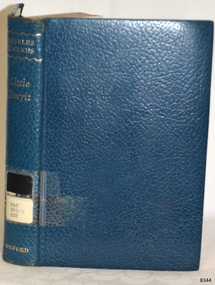
Book - A Fictional story, Chapman & Hall Ltd, Little Dorrit, 1890s
... Although not as widely read today as Oliver Twist or David Copperfield, it is considered a key work of the later Dickens works and praised for its sardonic satire of the British state and its subtle, almost spiritual meditation on guilt, responsibility, and compassion. ...Charles Dickens (1812–1870) was one of the great English novelists of the Victorian era, famous for vivid characters, social criticism, and stories that were first published in serial form. He began as a journalist, rose to enormous popularity during his lifetime, and wrote major works such as Oliver Twist, David Copperfield, and Great Expectations. Little Dorrit is about Amy “Little” Dorrit, a gentle, selfless woman born and raised in the Marshalsea debtors’ prison where her father, William Dorrit, has been imprisoned for unpaid debts. The story follows her as she works as a seamstress outside the prison, gradually becoming entangled with Arthur Clennam, a businessman returning from abroad. Dickens interweaves a sharp critique of Victorian bureaucracy, finance, and class throughout the story. The theme centres around Amy Dorrit who lives her whole early life in Marshalsea, supporting her family with quiet dignity while her father clings to fragile genteel pretensions. Arthur Clennam, disillusioned after years in China, becomes involved with the Dorrits and uncovers a web of secrets involving his own mother, a hidden inheritance, and shady business dealings. William Dorrit suddenly inherits a fortune and is able to lift the family out of poverty and into fashion conscious society.The novel shows how money distorts their characters and relationships, while Amy remains the moral centre.Little Dorrit. Author: Charles Dickens. Publisher: Chapman & Hall Ltd, London. Date: 1890s. (See note section this document for more information on Edition). Green cloth hardcover with Authors name to front cover in gold. Spine has gold title lettering. The spine has a Library label.fictionCharles Dickens (1812–1870) was one of the great English novelists of the Victorian era, famous for vivid characters, social criticism, and stories that were first published in serial form. He began as a journalist, rose to enormous popularity during his lifetime, and wrote major works such as Oliver Twist, David Copperfield, and Great Expectations. Little Dorrit is about Amy “Little” Dorrit, a gentle, selfless woman born and raised in the Marshalsea debtors’ prison where her father, William Dorrit, has been imprisoned for unpaid debts. The story follows her as she works as a seamstress outside the prison, gradually becoming entangled with Arthur Clennam, a businessman returning from abroad. Dickens interweaves a sharp critique of Victorian bureaucracy, finance, and class throughout the story. The theme centres around Amy Dorrit who lives her whole early life in Marshalsea, supporting her family with quiet dignity while her father clings to fragile genteel pretensions. Arthur Clennam, disillusioned after years in China, becomes involved with the Dorrits and uncovers a web of secrets involving his own mother, a hidden inheritance, and shady business dealings. William Dorrit suddenly inherits a fortune and is able to lift the family out of poverty and into fashion conscious society.The novel shows how money distorts their characters and relationships, while Amy remains the moral centre. flagstaff hill, warrnambool, shipwrecked coast, flagstaff hill maritime museum, maritime museum, shipwreck coast, flagstaff hill maritime village, great ocean road, book, pattison collection, warrnambool library, warrnambool mechanics’ institute, ralph eric pattison, corangamite regional library service, warrnambool city librarian, mechanics’ institute library, victorian library board, warrnambool books and records, warrnambool children’s library, little dorrit, charles dickens -
 Flagstaff Hill Maritime Museum and Village
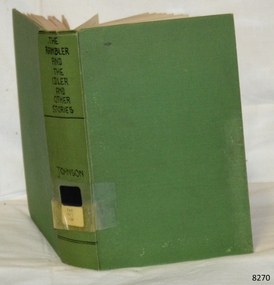
Book - Periodical Essays, Dr. Samuel Johnson et al, The Rambler, The Idler, The Adventurer & The Connoisseur, 1876
... The collection covers three themes: morality and human nature, with a focus on reflections relating to the disappointments of life, the inevitability of death, managing one's passions, and the search for true happiness, featuring mainly in The Rambler; social satire and manners, with lighthearted and witty take downs of London high society, modern trends, vanity, and standard eccentric characters of the town; and literary criticism, with essays that analyse contemporary poetry and the theatre, along with the evolving English language. ...This single 1876 volume combines four of the most influential weekly and semi weekly periodical essay series of the mid-18th century. Despite the phrasing of the era, these are not fiction stories or novels. They are periodical essays brief, single-topic pieces written to critique, educate, and entertain 18th-century readers. The collection covers three themes: morality and human nature, with a focus on reflections relating to the disappointments of life, the inevitability of death, managing one's passions, and the search for true happiness, featuring mainly in The Rambler; social satire and manners, with lighthearted and witty take downs of London high society, modern trends, vanity, and standard eccentric characters of the town; and literary criticism, with essays that analyse contemporary poetry and the theatre, along with the evolving English language.Hard cover book,The Rambler & The Idler Author: Dr. Samuel Johnson, Mr. Town, John Hawkesworth Publisher: William P Nimmo, 14 King William St, The Strand, London. W1. Date: 1876 Further Information: The flyleaf reads The Rambler and the Idler. By Samuel Johnson. The Adventurer. By John Hawkesworth. The Connoisseur. By (Mr. Town Pen Name) Green Cloth hardcover with a green spine and lettering in black texter. The spine has a Library label with an inscription.non-fictionThis single 1876 volume combines four of the most influential weekly and semi weekly periodical essay series of the mid-18th century. Despite the phrasing of the era, these are not fiction stories or novels. They are periodical essays brief, single-topic pieces written to critique, educate, and entertain 18th-century readers. The collection covers three themes: morality and human nature, with a focus on reflections relating to the disappointments of life, the inevitability of death, managing one's passions, and the search for true happiness, featuring mainly in The Rambler; social satire and manners, with lighthearted and witty take downs of London high society, modern trends, vanity, and standard eccentric characters of the town; and literary criticism, with essays that analyse contemporary poetry and the theatre, along with the evolving English language.flagstaff hill, warrnambool, shipwrecked coast, flagstaff hill maritime museum, maritime museum, shipwreck coast, flagstaff hill maritime village, great ocean road, book, pattison collection, warrnambool library, warrnambool mechanics’ institute, ralph eric pattison, corangamite regional library service, warrnambool city librarian, mechanics’ institute library, victorian library board, warrnambool books and records, warrnambool children’s library, the rambler and the idler, john hawkesworth., mr. town, samuel johnson -
 Flagstaff Hill Maritime Museum and Village
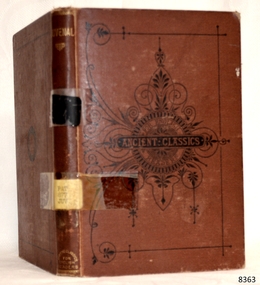
Book - Reference Book / Classics, Rev. W. Lucas Collins, Juvenal, 1872
... Juvenal is renowned for his Satires, which fiercely attacked the corruption, decadence, vice, and hypocrisy of Roman society under the Empire. ...The subject book is a specific volume from a highly popular Victorian series called "Ancient Classics for English Readers." While Rev. W. Lucas Collins was the overarching editor of the entire 28-volume series (which explains why his name is prominently attached to it), the specific volume on Juvenal published in 1872 was actually written by a scholar named Edward Walford, M.A. The book is an introduction to Juvenal (Decimus Iunius Iuvenalis), a famous Roman poet active in the late 1st and early 2nd centuries AD. Juvenal is renowned for his Satires, which fiercely attacked the corruption, decadence, vice, and hypocrisy of Roman society under the Empire. In line with the rest of the series, this volume provides a translated, summarized, and curated overview of Juvenal's work. Because Juvenal's raw, unedited Latin can be incredibly explicit and vulgar, the Victorian authors heavily sanitized ("bowdlerized") the text, smoothing over the more scandalous elements to make his brilliant satire safe for a general English audience.Juvenal Author: Edward Walford, M.A. Editor:Rev. W. Lucas Collins Publisher: William Blackwood & Sons Date: 1872non-fictionThe subject book is a specific volume from a highly popular Victorian series called "Ancient Classics for English Readers." While Rev. W. Lucas Collins was the overarching editor of the entire 28-volume series (which explains why his name is prominently attached to it), the specific volume on Juvenal published in 1872 was actually written by a scholar named Edward Walford, M.A. The book is an introduction to Juvenal (Decimus Iunius Iuvenalis), a famous Roman poet active in the late 1st and early 2nd centuries AD. Juvenal is renowned for his Satires, which fiercely attacked the corruption, decadence, vice, and hypocrisy of Roman society under the Empire. In line with the rest of the series, this volume provides a translated, summarized, and curated overview of Juvenal's work. Because Juvenal's raw, unedited Latin can be incredibly explicit and vulgar, the Victorian authors heavily sanitized ("bowdlerized") the text, smoothing over the more scandalous elements to make his brilliant satire safe for a general English audience.flagstaff hil, warrnambool, flagstaff hill maritime museum, maritime museum, shipwreck coast, flagstaff hill maritime village, great ocean road, book, pattison collection, warrnambool library, warrnambool mechanics’ institute, ralph eric pattison, corangamite regional library service, warrnambool city librarian, mechanics’ institute library, victorian library board, warrnambool books and records, warrnambool children’s library, juvenal, lucas collins -
 Flagstaff Hill Maritime Museum and Village
Book - A Fictional Story, Charles Dickens, Little Dorrit, 1968
... Although not as widely read today as Oliver Twist or David Copperfield, it is considered a key work of the later Dickens works and praised for its sardonic satire of the British state and its subtle, almost spiritual meditation on guilt, responsibility, and compassion. ...Charles Dickens (1812–1870) was one of the great English novelists of the Victorian era, famous for vivid characters, social criticism, and stories that were first published in serial form. He began as a journalist, rose to enormous popularity during his lifetime, and wrote major works such as Oliver Twist, David Copperfield, and Great Expectations. Little Dorrit is about Amy “Little” Dorrit, a gentle, selfless woman born and raised in the Marshalsea debtors’ prison where her father, William Dorrit, has been imprisoned for unpaid debts. The story follows her as she works as a seamstress outside the prison, gradually becoming entangled with Arthur Clennam, a businessman returning from abroad. Dickens interweaves a sharp critique of Victorian bureaucracy, finance, and class throughout the story. The theme centres around Amy Dorrit who lives her whole early life in Marshalsea, supporting her family with quiet dignity while her father clings to fragile genteel pretensions. Arthur Clennam, disillusioned after years in China, becomes involved with the Dorrits and uncovers a web of secrets involving his own mother, a hidden inheritance, and shady business dealings. William Dorrit suddenly inherits a fortune and is able to lift the family out of poverty and into fashion conscious society.The novel shows how money distorts their characters and relationships, while Amy remains the moral centre.Little Dorrit Author: Charles Dickens Publisher: Collins Further Information: We do have 2 more copies of this same book. All have been published by different companies. ( R.N. 8159 and R.N. 8344)fictionCharles Dickens (1812–1870) was one of the great English novelists of the Victorian era, famous for vivid characters, social criticism, and stories that were first published in serial form. He began as a journalist, rose to enormous popularity during his lifetime, and wrote major works such as Oliver Twist, David Copperfield, and Great Expectations. Little Dorrit is about Amy “Little” Dorrit, a gentle, selfless woman born and raised in the Marshalsea debtors’ prison where her father, William Dorrit, has been imprisoned for unpaid debts. The story follows her as she works as a seamstress outside the prison, gradually becoming entangled with Arthur Clennam, a businessman returning from abroad. Dickens interweaves a sharp critique of Victorian bureaucracy, finance, and class throughout the story. The theme centres around Amy Dorrit who lives her whole early life in Marshalsea, supporting her family with quiet dignity while her father clings to fragile genteel pretensions. Arthur Clennam, disillusioned after years in China, becomes involved with the Dorrits and uncovers a web of secrets involving his own mother, a hidden inheritance, and shady business dealings. William Dorrit suddenly inherits a fortune and is able to lift the family out of poverty and into fashion conscious society.The novel shows how money distorts their characters and relationships, while Amy remains the moral centre. flagstaff hil, warrnambool, flagstaff hill maritime museum, maritime museum, shipwreck coast, flagstaff hill maritime village, great ocean road, book, pattison collection, warrnambool library, warrnambool mechanics’ institute, ralph eric pattison, corangamite regional library service, warrnambool city librarian, mechanics’ institute library, victorian library board, warrnambool books and records, warrnambool children’s library, little dorrit, charles dickens -
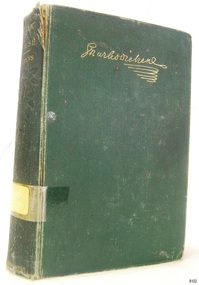 Flagstaff Hill Maritime Museum and Village
Book - A Fictional Story, Charles Dickens, Bleak House, 1873-1900
... Critics often rank Bleak House as one of Dickens’s most important novels, notable for its harsh satire of the English legal system, its ambitious dual narrative structure (omniscient narrator third person, plus Esther’s first person account), along with its large, interconnected cast of characters. ...Charles Dickens (1812–1870) was one of the great English novelists of the Victorian era, famous for vivid characters, social criticism, and stories that were first published in serial form. He began as a journalist, rose to enormous popularity during his lifetime, and wrote major works such as Oliver Twist, David Copperfield, and Great Expectations. Bleak House is one of Charles Dickens’s major novels, a sprawling, multi plot story built around the endless Court of Chancery lawsuit known as “Jarndyce and Jarndyce” and its ruinous effect on several families. It is widely regarded as among his finest and most complex works, central to any serious study of his fiction.Bleak House. Author: Charles Dickens. Publisher: Chapman & Hall Ltd, London. Date: 1873-1900. (See note section this document for more information on Edition). Blue leather hardcover with title on spine in gold lettering, Charles Dickens signature on front cover written in gold lettering. The spine has a Library label.fictionCharles Dickens (1812–1870) was one of the great English novelists of the Victorian era, famous for vivid characters, social criticism, and stories that were first published in serial form. He began as a journalist, rose to enormous popularity during his lifetime, and wrote major works such as Oliver Twist, David Copperfield, and Great Expectations. Bleak House is one of Charles Dickens’s major novels, a sprawling, multi plot story built around the endless Court of Chancery lawsuit known as “Jarndyce and Jarndyce” and its ruinous effect on several families. It is widely regarded as among his finest and most complex works, central to any serious study of his fiction.book, the old curiosity shop, charles dickens, shipwrecked-coast, flagstaff-hill, flagstaff-hill-maritime-museum, warrnambool, maritime-museum, flagstaff-hill-maritime-village, pattison collection, warrnambool library, warrnambool mechanics’ institute, ralph eric pattison, corangamite regional library service, warrnambool city librarian, mechanics’ institute library, victorian library board, warrnambool books and records, warrnambool children’s library, great ocean road -
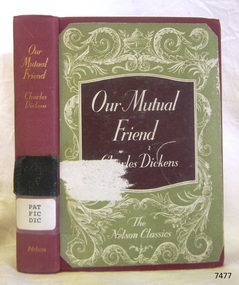 Flagstaff Hill Maritime Museum and Village
Book - A Fictional Story, Charles Dickens, Our Mutual Friend, 1900
... “Our Mutual Friend” is Charles Dickens’s final completed novel, and it’s a dark social satire about money, greed, inheritance, identity, and moral redemption in Victorian London. ...Charles Dickens (1812–1870) was one of the great English novelists of the Victorian era, famous for vivid characters, social criticism, and stories that were first published in serial form. He began as a journalist, rose to enormous popularity during his lifetime, and wrote major works such as Oliver Twist, David Copperfield, and Great Expectations. “Our Mutual Friend” is Charles Dickens’s final completed novel, and it’s a dark social satire about money, greed, inheritance, identity, and moral redemption in Victorian London. The plot begins with an apparent drowning, a dust heap fortune, and a marriage condition in a will. It then expands into a tangled set of stories involving the river Thames, corrupt social climbers, and several characters who are tested and changed by wealth.Our Mutual Friend. Author: Charles Dickens. Publisher: Nelson & Sons, London. Date: 1900. (See note section this document for more information on Edition). Red cloth hardcover with green patterned paper stick on title to front cover. Spine has gold lettering. The spine has a Library label and no Volume information.fictionCharles Dickens (1812–1870) was one of the great English novelists of the Victorian era, famous for vivid characters, social criticism, and stories that were first published in serial form. He began as a journalist, rose to enormous popularity during his lifetime, and wrote major works such as Oliver Twist, David Copperfield, and Great Expectations. “Our Mutual Friend” is Charles Dickens’s final completed novel, and it’s a dark social satire about money, greed, inheritance, identity, and moral redemption in Victorian London. The plot begins with an apparent drowning, a dust heap fortune, and a marriage condition in a will. It then expands into a tangled set of stories involving the river Thames, corrupt social climbers, and several characters who are tested and changed by wealth.book, the old curiosity shop, charles dickens, shipwrecked-coast, flagstaff-hill, flagstaff-hill-maritime-museum, warrnambool, maritime-museum, flagstaff-hill-maritime-village, pattison collection, warrnambool library, warrnambool mechanics’ institute, ralph eric pattison, corangamite regional library service, warrnambool city librarian, mechanics’ institute library, victorian library board, warrnambool books and records, warrnambool children’s library, great ocean road -
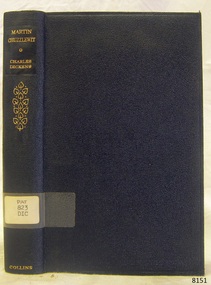 Flagstaff Hill Maritime Museum and Village
Book - A Fictional Story, Charles Dickens, Martin Chuzzlewit, 1910
... It is significant for its satire including a harsh portrait of America after Dickens’s 1842 visit. ...Charles Dickens (1812–1870) was one of the great English novelists of the Victorian era, famous for vivid characters, social criticism, and stories that were first published in serial form. He began as a journalist, rose to enormous popularity during his lifetime, and wrote major works such as Oliver Twist, David Copperfield, and Great Expectations. “Martin Chuzzlewit” is Charles Dickens’s sixth novel serialised 1843-1844, with a novel published in 1844 by Chapman and Hall. The themes are about selfishness, hypocrisy, and moral reform, its plot follows young Martin, his proud grandfather, the hypocritical architect Pecksniff, the loyal Tom Pinch, and the good humoured Mark Tapley. There is also a criminal subplot around Jonas Chuzzlewit. The core plot in short is where Martin becomes at odds with his miserly grandfather as he works for Pecksniff, becomes friends with Tom Pinch. He travels to America, is nearly ruined by a swindle, eventually returning to England. Several villains are ultimately exposed and punished while virtuous characters are rewarded.Martin Chuzzlewit. Author: Charles Dickens. Introduction by Kenneth Hayens. Publisher: Collins, London & Glasgow. Date: 1953. (See note section this document for more information on Edition). Blue leather hardcover with title on spine in gold lettering and pattern. The spine has a Library label and no Volume information only title and author.fictionCharles Dickens (1812–1870) was one of the great English novelists of the Victorian era, famous for vivid characters, social criticism, and stories that were first published in serial form. He began as a journalist, rose to enormous popularity during his lifetime, and wrote major works such as Oliver Twist, David Copperfield, and Great Expectations. “Martin Chuzzlewit” is Charles Dickens’s sixth novel serialised 1843-1844, with a novel published in 1844 by Chapman and Hall. The themes are about selfishness, hypocrisy, and moral reform, its plot follows young Martin, his proud grandfather, the hypocritical architect Pecksniff, the loyal Tom Pinch, and the good humoured Mark Tapley. There is also a criminal subplot around Jonas Chuzzlewit. The core plot in short is where Martin becomes at odds with his miserly grandfather as he works for Pecksniff, becomes friends with Tom Pinch. He travels to America, is nearly ruined by a swindle, eventually returning to England. Several villains are ultimately exposed and punished while virtuous characters are rewarded.book, the old curiosity shop, charles dickens, shipwrecked-coast, flagstaff-hill, flagstaff-hill-maritime-museum, warrnambool, maritime-museum, flagstaff-hill-maritime-village, pattison collection, warrnambool library, warrnambool mechanics’ institute, ralph eric pattison, corangamite regional library service, warrnambool city librarian, mechanics’ institute library, victorian library board, warrnambool books and records, warrnambool children’s library, great ocean road -
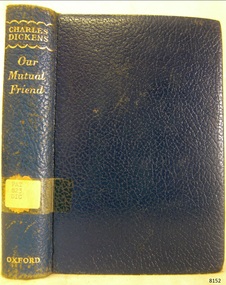 Flagstaff Hill Maritime Museum and Village
Book - A Fictional Story, Charles Dickens et al, Our Mutual Friend, 1987
... “Our Mutual Friend” is Charles Dickens’s final completed novel, and it’s a dark social satire about money, greed, inheritance, identity, and moral redemption in Victorian London. ...Charles Dickens (1812–1870) was one of the great English novelists of the Victorian era, famous for vivid characters, social criticism, and stories that were first published in serial form. He began as a journalist, rose to enormous popularity during his lifetime, and wrote major works such as Oliver Twist, David Copperfield, and Great Expectations. “Our Mutual Friend” is Charles Dickens’s final completed novel, and it’s a dark social satire about money, greed, inheritance, identity, and moral redemption in Victorian London. The plot begins with an apparent drowning, a dust heap fortune, and a marriage condition in a will. It then expands into a tangled set of stories involving the river Thames, corrupt social climbers, and several characters who are tested and changed by wealth.Our Mutual Friend. Author: Charles Dickens. Publisher: Oxford University Press, London. Date: 1987 (See note section this document for more information on Edition). Blue leather hardcover, Spine has Author and Title in gold lettering. The spine has a Library label and no Volume information.fictionCharles Dickens (1812–1870) was one of the great English novelists of the Victorian era, famous for vivid characters, social criticism, and stories that were first published in serial form. He began as a journalist, rose to enormous popularity during his lifetime, and wrote major works such as Oliver Twist, David Copperfield, and Great Expectations. “Our Mutual Friend” is Charles Dickens’s final completed novel, and it’s a dark social satire about money, greed, inheritance, identity, and moral redemption in Victorian London. The plot begins with an apparent drowning, a dust heap fortune, and a marriage condition in a will. It then expands into a tangled set of stories involving the river Thames, corrupt social climbers, and several characters who are tested and changed by wealth.book, the old curiosity shop, charles dickens, shipwrecked-coast, flagstaff-hill, flagstaff-hill-maritime-museum, warrnambool, maritime-museum, flagstaff-hill-maritime-village, pattison collection, warrnambool library, warrnambool mechanics’ institute, ralph eric pattison, corangamite regional library service, warrnambool city librarian, mechanics’ institute library, victorian library board, warrnambool books and records, warrnambool children’s library, great ocean road -
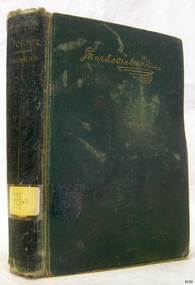 Flagstaff Hill Maritime Museum and Village
Book - A Fictional Story, Charles Dickens, Little Dorrit, 1890s
... Although not as widely read today as Oliver Twist or David Copperfield, it is considered a key work of the later Dickens works and praised for its sardonic satire of the British state and its subtle, almost spiritual meditation on guilt, responsibility, and compassion. ...Charles Dickens (1812–1870) was one of the great English novelists of the Victorian era, famous for vivid characters, social criticism, and stories that were first published in serial form. He began as a journalist, rose to enormous popularity during his lifetime, and wrote major works such as Oliver Twist, David Copperfield, and Great Expectations. Little Dorrit is about Amy “Little” Dorrit, a gentle, selfless woman born and raised in the Marshalsea debtors’ prison where her father, William Dorrit, has been imprisoned for unpaid debts. The story follows her as she works as a seamstress outside the prison, gradually becoming entangled with Arthur Clennam, a businessman returning from abroad. Dickens interweaves a sharp critique of Victorian bureaucracy, finance, and class throughout the story. The theme centers around Amy Dorrit who lives her whole early life in Marshalsea, supporting her family with quiet dignity while her father clings to fragile genteel pretensions. Arthur Clennam, disillusioned after years in China, becomes involved with the Dorrits and uncovers a web of secrets involving his own mother, a hidden inheritance, and shady business dealings. William Dorrit suddenly inherits a fortune and is able to lift the family out of poverty and into fashion conscious society.The novel shows how money distorts their characters and relationships, while Amy remains the moral centre.Little Dorrit. Author: Charles Dickens. Publisher: Chapman & Hall Ltd, London. Date: 1890s. (See note section this document for more information on Edition). Green cloth hardcover with Authors name to front cover in gold. Spine has gold title lettering. The spine has a Library label.fictionCharles Dickens (1812–1870) was one of the great English novelists of the Victorian era, famous for vivid characters, social criticism, and stories that were first published in serial form. He began as a journalist, rose to enormous popularity during his lifetime, and wrote major works such as Oliver Twist, David Copperfield, and Great Expectations. Little Dorrit is about Amy “Little” Dorrit, a gentle, selfless woman born and raised in the Marshalsea debtors’ prison where her father, William Dorrit, has been imprisoned for unpaid debts. The story follows her as she works as a seamstress outside the prison, gradually becoming entangled with Arthur Clennam, a businessman returning from abroad. Dickens interweaves a sharp critique of Victorian bureaucracy, finance, and class throughout the story. The theme centers around Amy Dorrit who lives her whole early life in Marshalsea, supporting her family with quiet dignity while her father clings to fragile genteel pretensions. Arthur Clennam, disillusioned after years in China, becomes involved with the Dorrits and uncovers a web of secrets involving his own mother, a hidden inheritance, and shady business dealings. William Dorrit suddenly inherits a fortune and is able to lift the family out of poverty and into fashion conscious society.The novel shows how money distorts their characters and relationships, while Amy remains the moral centre. book, the old curiosity shop, charles dickens, shipwrecked-coast, flagstaff-hill, flagstaff-hill-maritime-museum, warrnambool, maritime-museum, flagstaff-hill-maritime-village, pattison collection, warrnambool library, warrnambool mechanics’ institute, ralph eric pattison, corangamite regional library service, warrnambool city librarian, mechanics’ institute library, victorian library board, warrnambool books and records, warrnambool children’s library, great ocean road -
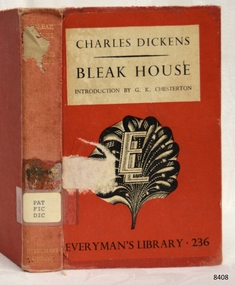 Flagstaff Hill Maritime Museum and Village
Book - A Fictional Story, Charles Dickens, Bleak House, 1925
... Critics often rank Bleak House as one of Dickens’s most important novels, notable for its harsh satire of the English legal system, its ambitious dual narrative structure (omniscient narrator third person, plus Esther’s first person account), along with its large, interconnected cast of characters. ...Charles Dickens (1812–1870) was one of the great English novelists of the Victorian era, famous for vivid characters, social criticism, and stories that were first published in serial form. He began as a journalist, rose to enormous popularity during his lifetime, and wrote major works such as Oliver Twist, David Copperfield, and Great Expectations. Bleak House is one of Charles Dickens’s major novels, a sprawling, multi plot story built around the endless Court of Chancery lawsuit known as “Jarndyce and Jarndyce” and its ruinous effect on several families. It is widely regarded as among his finest and most complex works, central to any serious study of his fiction.Bleak House. Author: Charles Dickens. Publisher: Chapman & Hall Ltd, London. Date: 1925. (See note section this document for more information on Edition). Cloth hardcover with title on spine in gold lettering, Front cover has a paper stick on title. The spine has a Library label.fictionCharles Dickens (1812–1870) was one of the great English novelists of the Victorian era, famous for vivid characters, social criticism, and stories that were first published in serial form. He began as a journalist, rose to enormous popularity during his lifetime, and wrote major works such as Oliver Twist, David Copperfield, and Great Expectations. Bleak House is one of Charles Dickens’s major novels, a sprawling, multi plot story built around the endless Court of Chancery lawsuit known as “Jarndyce and Jarndyce” and its ruinous effect on several families. It is widely regarded as among his finest and most complex works, central to any serious study of his fiction.book, the old curiosity shop, charles dickens, shipwrecked-coast, flagstaff-hill, flagstaff-hill-maritime-museum, warrnambool, maritime-museum, flagstaff-hill-maritime-village, pattison collection, warrnambool library, warrnambool mechanics’ institute, ralph eric pattison, corangamite regional library service, warrnambool city librarian, mechanics’ institute library, victorian library board, warrnambool books and records, warrnambool children’s library, great ocean road -
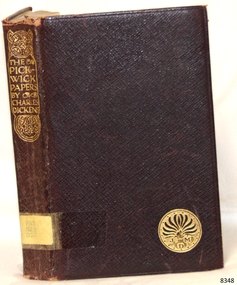 Flagstaff Hill Maritime Museum and Village
Book - A Fictional Story, Charles Dickens, The Posthumous Papers of The Pickwick Club (Pickwick Papers), 1910-1912
... It is significant because it was Dickens’s first novel that helped establish his reputation, and is widely praised for its lively characters, satire, and its strong focus on the absurdities of the legal system. ...Charles Dickens (1812–1870) was one of the great English novelists of the Victorian era, famous for vivid characters, social criticism, and stories that were first published in serial form. He began as a journalist, rose to enormous popularity during his lifetime, and wrote major works such as Oliver Twist, David Copperfield, and Great Expectations. The “Pickwick Papers” is a comic novel about Samuel Pickwick and the members of his club as they travel around England, recording amusing adventures, misunderstandings, lawsuits, and mishaps.The theme gradually becomes a story about friendship, folly, and social life in early Victorian England. It is significant because it was Dickens’s first novel that helped establish his reputation, and is widely praised for its lively characters, satire, and its strong focus on the absurdities of the legal system.The Posthumous Papers of The Pickwick Club. Author: Charles Dickens. Publisher: J M Dent & Sons Ltd, London. Date: 1910-1912. (See note section this document for more information on Edition). Brown leather hardcover with title and a design on spine in gold lettering, Front has round publishers logo in gold embossing. The spine has a Library label and no Volume information.fictionCharles Dickens (1812–1870) was one of the great English novelists of the Victorian era, famous for vivid characters, social criticism, and stories that were first published in serial form. He began as a journalist, rose to enormous popularity during his lifetime, and wrote major works such as Oliver Twist, David Copperfield, and Great Expectations. The “Pickwick Papers” is a comic novel about Samuel Pickwick and the members of his club as they travel around England, recording amusing adventures, misunderstandings, lawsuits, and mishaps.The theme gradually becomes a story about friendship, folly, and social life in early Victorian England. It is significant because it was Dickens’s first novel that helped establish his reputation, and is widely praised for its lively characters, satire, and its strong focus on the absurdities of the legal system.book, the old curiosity shop, charles dickens, shipwrecked-coast, flagstaff-hill, flagstaff-hill-maritime-museum, warrnambool, maritime-museum, flagstaff-hill-maritime-village, pattison collection, warrnambool library, warrnambool mechanics’ institute, ralph eric pattison, corangamite regional library service, warrnambool city librarian, mechanics’ institute library, victorian library board, warrnambool books and records, warrnambool children’s library, great ocean road -
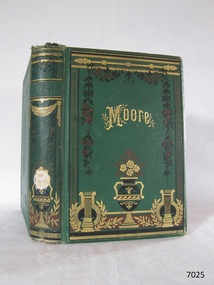 Flagstaff Hill Maritime Museum and Village
Book - Poetical Writings, Thomas Moore, The Poetical Works of Thomas Moore, 1878–1890s
... The work features his famous Irish Melodies (containing classic songs like "The Last Rose of Summer" and "The Minstrel Boy"), his Oriental romance epic Lalla Rookh, satire, and light verse, along with a biographical summary ("With Life") and steel-engraved illustrations. ...This subject volume is a comprehensive collection of the works of Irish poet and songwriter Thomas Moore (1779–1852). The work features his famous Irish Melodies (containing classic songs like "The Last Rose of Summer" and "The Minstrel Boy"), his Oriental romance epic Lalla Rookh, satire, and light verse, along with a biographical summary ("With Life") and steel-engraved illustrations.Hard cover book. The Poetical Works of Thomas Moore Author: Thomas Moore Publisher: Gall & Inglis Date: 1878–1890s Further Information: Highly decorated green Cloth hardcover with lettering and patterning to spine in gilt. The spine has a Library label with an inscription.fictionThis subject volume is a comprehensive collection of the works of Irish poet and songwriter Thomas Moore (1779–1852). The work features his famous Irish Melodies (containing classic songs like "The Last Rose of Summer" and "The Minstrel Boy"), his Oriental romance epic Lalla Rookh, satire, and light verse, along with a biographical summary ("With Life") and steel-engraved illustrations.warrnambool, shipwrecked-coast, flagstaff-hill, flagstaff-hill-maritime-museum, maritime-museum, shipwreck-coast, flagstaff-hill-maritime-village, shipwrecked-artefact, book, the poetical works of thomas moore, thomas moore, warrnambool mechanics’ institute, pattison collection, warrnambool library, ralph eric pattison, corangamite regional library service, warrnambool city librarian, mechanics’ institute library, victorian library board, warrnambool books and records, warrnambool children’s library -
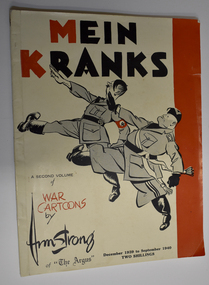 Warrnambool and District Historical Society Inc.
Book - World War Two Armstrong Cartoons, Harold Armstrong, Mein Kranks, c 1940
... The artist uses humour and satire to elaborate on the political situation and in doing so contributed greatly to boosting the morale of both servicemen and women and the general public in Australia at a time of great distress and anxiety. ...World War Two Armstrong CartoonsThis is a book of 48 pages. The cover has a cream background with a red strip on the front side cover. The front cover has a sketch in grey, black, white and red and printing in red and black. The pages are stapled and have an adhesive tape binding added to the outside spine. The pages contain sketches in black, white and grey shading.fictionWorld War Two Armstrong Cartoonsworld war two cartoonist armstrong, world war two -
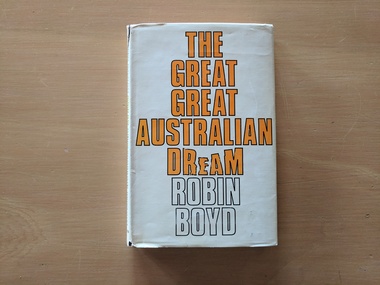 Robin Boyd Foundation
Book, Robin Boyd, The Great Great Australian Dream, 1972
... Included, for example, were chapters on the peculiarities of the Australian accent, the prevalence of blowflies, and the unrealistic dreams of a fictional post-war architect Gordon Hope. Australian satire National characteristics Humor Walsh St library Written by Boyd, with printed inscription "It compensates for half-recognized inadequacies in the sunny, wideawake life." ...Published posthumously in 1972, “The Great Great Australian Dream” was Robin Boyd’s satirical review of Australian culture at the end of the 1960s. Included, for example, were chapters on the peculiarities of the Australian accent, the prevalence of blowflies, and the unrealistic dreams of a fictional post-war architect Gordon Hope.Hardcover w/ Dust JacketWritten by Boyd, with printed inscription "It compensates for half-recognized inadequacies in the sunny, wideawake life."australian satire, national characteristics, humor, walsh st library -
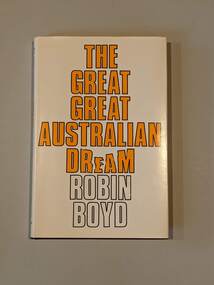 Robin Boyd Foundation
Book, Robin Boyd, The Great Great Australian Dream, 1972
... Included, for example, were chapters on the peculiarities of the Australian accent, the prevalence of blowflies, and the unrealistic dreams of a fictional post-war architect Gordon Hope. Australian satire National characteristics Humor Walsh St library RBF Acquisition Hardcover with Dust Jacket The Great Great Australian Dream Book Robin Boyd Pergamon Press (Australia) Pty Ltd ...Published posthumously in 1972, “The Great Great Australian Dream” was Robin Boyd’s satirical review of Australian culture at the end of the 1960s. Included, for example, were chapters on the peculiarities of the Australian accent, the prevalence of blowflies, and the unrealistic dreams of a fictional post-war architect Gordon Hope.Hardcover with Dust JacketRBF Acquisitionaustralian satire, national characteristics, humor, walsh st library -
 Robin Boyd Foundation
Book, Robin Boyd, The Great Great Australian Dream, 1972
... Included, for example, were chapters on the peculiarities of the Australian accent, the prevalence of blowflies, and the unrealistic dreams of a fictional post-war architect Gordon Hope. Australian satire National characteristics Humor Walsh St library RBF Acquisition Hardcover with Dust Jacket The Great Great Australian Dream Book Robin Boyd Pergamon Press (Australia) Pty Ltd ...Published posthumously in 1972, “The Great Great Australian Dream” was Robin Boyd’s satirical review of Australian culture at the end of the 1960s. Included, for example, were chapters on the peculiarities of the Australian accent, the prevalence of blowflies, and the unrealistic dreams of a fictional post-war architect Gordon Hope.Hardcover with Dust JacketRBF Acquisitionaustralian satire, national characteristics, humor, walsh st library -
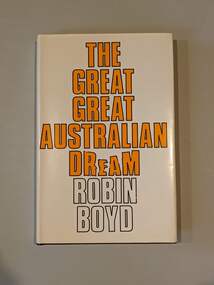 Robin Boyd Foundation
Book, Robin Boyd, The Great Great Australian Dream, 1972
... Included, for example, were chapters on the peculiarities of the Australian accent, the prevalence of blowflies, and the unrealistic dreams of a fictional post-war architect Gordon Hope. Australian satire National characteristics Humor Walsh St library RBF Acquisition Hardcover with Dust Jacket The Great Great Australian Dream Book Robin Boyd Pergamon Press (Australia) Pty Ltd ...Published posthumously in 1972, “The Great Great Australian Dream” was Robin Boyd’s satirical review of Australian culture at the end of the 1960s. Included, for example, were chapters on the peculiarities of the Australian accent, the prevalence of blowflies, and the unrealistic dreams of a fictional post-war architect Gordon Hope.Hardcover with Dust JacketRBF Acquisitionaustralian satire, national characteristics, humor, walsh st library -
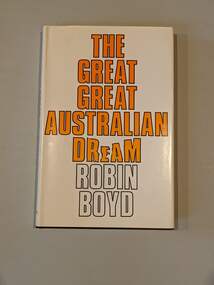 Robin Boyd Foundation
Book, Robin Boyd, The Great Great Australian Dream, 1972
... Included, for example, were chapters on the peculiarities of the Australian accent, the prevalence of blowflies, and the unrealistic dreams of a fictional post-war architect Gordon Hope. Australian satire National characteristics Humor Walsh St library RBF Acquisition Hardcover with Dust Jacket The Great Great Australian Dream Book Robin Boyd Pergamon Press (Australia) Pty Ltd ...Published posthumously in 1972, “The Great Great Australian Dream” was Robin Boyd’s satirical review of Australian culture at the end of the 1960s. Included, for example, were chapters on the peculiarities of the Australian accent, the prevalence of blowflies, and the unrealistic dreams of a fictional post-war architect Gordon Hope.Hardcover with Dust JacketRBF Acquisitionaustralian satire, national characteristics, humor, walsh st library -
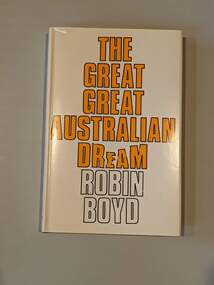 Robin Boyd Foundation
Book, Robin Boyd, The Great Great Australian Dream, 1972
... Included, for example, were chapters on the peculiarities of the Australian accent, the prevalence of blowflies, and the unrealistic dreams of a fictional post-war architect Gordon Hope. Australian satire National characteristics Humor Walsh St library RBF Acquisition Hardcover with Dust Jacket The Great Great Australian Dream Book Robin Boyd Pergamon Press (Australia) Pty Ltd ...Published posthumously in 1972, “The Great Great Australian Dream” was Robin Boyd’s satirical review of Australian culture at the end of the 1960s. Included, for example, were chapters on the peculiarities of the Australian accent, the prevalence of blowflies, and the unrealistic dreams of a fictional post-war architect Gordon Hope.Hardcover with Dust JacketRBF Acquisitionaustralian satire, national characteristics, humor, walsh st library -
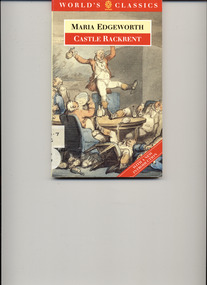 The Celtic Club
Book, Maria Edgeworth, Castle Rackrent, 1964
... Irish fiction With her satire on Anglo-Irish landlords in Castle Rackrent (1800), Maria Edgeworth pioneered the regional novel and inspired Sir Walter Scott's Waverley (1814). ...With her satire on Anglo-Irish landlords in Castle Rackrent (1800), Maria Edgeworth pioneered the regional novel and inspired Sir Walter Scott's Waverley (1814). Politically risky, stylistically innovative, and wonderfully entertaining, the novel changes the focus of conflict in Ireland from religion to class, and boldly predicts the rise of the Irish Catholic bourgeoisie.Bib, notes, p.127.fictionWith her satire on Anglo-Irish landlords in Castle Rackrent (1800), Maria Edgeworth pioneered the regional novel and inspired Sir Walter Scott's Waverley (1814). Politically risky, stylistically innovative, and wonderfully entertaining, the novel changes the focus of conflict in Ireland from religion to class, and boldly predicts the rise of the Irish Catholic bourgeoisie. 3. ireland - social life and customs., irish fiction -
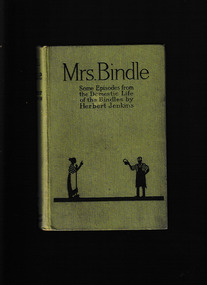 Mrs Aeneas Gunn Memorial Library
Book, Herbert Jenkins, Mrs Bindle : some incidents from the domestic life of the Bindles, 1940
... England - Fiction Satire - England Among other things this book narrates how Mrs Bindle caught a chill, how a nephew was born to her and what effect it had upon her outlook. p.312. ...Among other things this book narrates how Mrs Bindle caught a chill, how a nephew was born to her and what effect it had upon her outlook.p.312.fictionAmong other things this book narrates how Mrs Bindle caught a chill, how a nephew was born to her and what effect it had upon her outlook.england - fiction, satire - england -
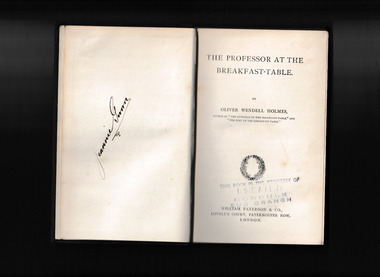 Mrs Aeneas Gunn Memorial Library
Book, Oliver Wendell Holmes, The professor at the breakfast-table, 19??
... American fiction American satire Fictional stories of American life p.288 The professor at the breakfast-table Book Oliver Wendell Holmes William Patterson and Co ...Fictional stories of American lifep.288fictionFictional stories of American lifeamerican fiction, american satire
