
Showing 620 items matching " english history"
-
 National Wool Museum
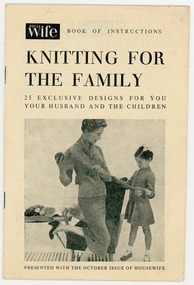
Book, Knitting, Housewife: Knitting for the Family
... This knitting book was given away with the English magazine, "Housewife" and contains knitting patterns for mens, womens and childrens garments. Knitting Handicrafts - history Housewife Knitting Handicrafts - history HOUSE / wife / BOOK OF INSTRUCTIONS / KNITTING FOR / THE FAMILY / 25 EXCLUSIVE DESIGNS FOR YOU / YOUR HUSBAND AND THE CHILDREN / PRESENTED WITH THE OCTOBER ISSUE OF HOUSEWIFE Housewife: Knitting for the Family Book, Knitting ...This book was owned by the late Dr Elizabeth Kerr and was donated to the Museum by the executor of her estate, Margaret Cameron. This knitting book was given away with the English magazine, "Housewife" and contains knitting patterns for mens, womens and childrens garments.HOUSE / wife / BOOK OF INSTRUCTIONS / KNITTING FOR / THE FAMILY / 25 EXCLUSIVE DESIGNS FOR YOU / YOUR HUSBAND AND THE CHILDREN / PRESENTED WITH THE OCTOBER ISSUE OF HOUSEWIFEknitting handicrafts - history, housewife, knitting, handicrafts - history -
 National Wool Museum
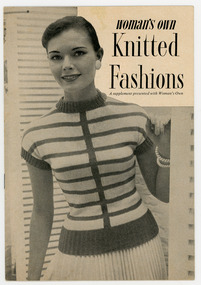
Book, Knitting, Woman's Own Knitted Fashions
... It was produced as a supplement with the English womens magazine, "Woman's Own", and contains knitting patterns for womens garments. Knitting Handicrafts - history Woman's Own Knitting Handicrafts - history woman's own / Knitted Fashions / A supplement presented with Woman's Own Woman's Own Knitted Fashions Book, Knitting ...This book was owned by the late Dr Elizabeth Kerr and was donated to the Museum by the executor of her estate, Margaret Cameron. It was produced as a supplement with the English womens magazine, "Woman's Own", and contains knitting patterns for womens garments.woman's own / Knitted Fashions / A supplement presented with Woman's Ownknitting handicrafts - history, woman's own, knitting, handicrafts - history -
 National Wool Museum
Book, Pattern, Fashion and Knitting Patterns no. 7
... It is an English periodical from Nov. 1965 containing knitting and sewing patterns for womens garments. Knitting Handicrafts - history Sewing Fashion Knitting Handicrafts - history Sewing Fashion FASHION and KNITTING / Patterns / NUMBER 7 / 2'6 / Wonderful / cut-out offers / A fur hat / for 26s. / Presents / to make / Sewing / and / knitting / fashions Fashion and Knitting Patterns no. 7 Book, Pattern ...This book was owned by the late Dr Elizabeth Kerr and was donated to the Museum by the executor of her estate, Margaret Cameron. It is an English periodical from Nov. 1965 containing knitting and sewing patterns for womens garments.FASHION and KNITTING / Patterns / NUMBER 7 / 2'6 / Wonderful / cut-out offers / A fur hat / for 26s. / Presents / to make / Sewing / and / knitting / fashionsknitting handicrafts - history sewing fashion, knitting, handicrafts - history, sewing, fashion -
 National Wool Museum
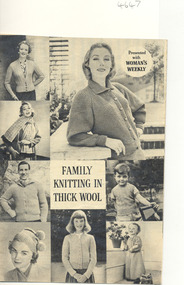
Book, Knitting, English Woman's Weekly booklet: Family Knitting in Thick Wool
... Handicrafts - history Knitting...English...This book was produced by the English Woman's Weekly and given away free with a copy of that magazine. It was owned by Billie Rech, the aunt of the donor, who was a great knitter. Handicrafts - history ...This book was produced by the English Woman's Weekly and given away free with a copy of that magazine. It was owned by Billie Rech, the aunt of the donor, who was a great knitter.Presented / with / WOMAN'S / WEEKLY / FAMILY / KNITTING IN / THICK WOOLhandicrafts - history knitting, english woman's weekly, handicrafts - history, knitting -
 National Wool Museum
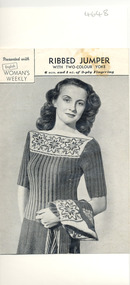
Book, Knitting, English Woman's Weekly leaflet: Ribbed Jumper with two-colour yoke
... Handicrafts - history Knitting...English...This book was produced by the English Woman's Weekly and given away free with a copy of that magazine. It was owned by Billie Rech, the aunt of the donor, who was a great knitter. Handicrafts - history ...This book was produced by the English Woman's Weekly and given away free with a copy of that magazine. It was owned by Billie Rech, the aunt of the donor, who was a great knitter.Presented with / English / WOMAN'S / WEEKLY / RIBBED JUMPER / WITH TWO-COLOUR YOKE / 6ozs. and 1oz. of 3-ply Fingeringhandicrafts - history knitting, english woman's weekly, handicrafts - history, knitting -
National Wool Museum
Book, Textile Machines
... This book provides a brief history and overview of English textile machinery, machinery makers and factories....This book provides a brief history and overview of English textile machinery, machinery makers and factories. ...This book provides a brief history and overview of English textile machinery, machinery makers and factories.SHIRE / ALBUM / 103 / Textile Machines / ANNA P. BENSONtextile machinery -
 Stawell Historical Society Inc
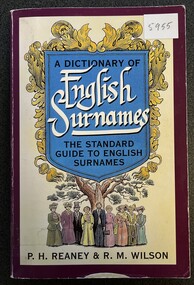
Book - Family History, A Dictionary of English Surnames, 1995
... Title Black and White A Dictionary of English Surnames Book Family History ...Reffers to surnames and variants. i.e. Tangey not in dictionary: Tangay, Tangye, see v. TINGAYPaperback: Purple: Pale yellow background. Ornament leaves and tassles. Brown wand green tree. Men and Women in old Attire. Long Dresses, frock coats. Shield Blue. Title Black and WhitePurchased 21/02/1998 by the Stawell Biarri Group for Geneology Inc. from GSV following a Mini Seminar at the Stawell regional Library. Speakers Eleanor Pugsley & Joy Rog -
 Chiltern Athenaeum Trust
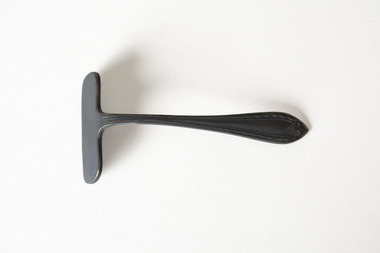
Domestic object - Child's food pusher, J. Biggin & Co, Unknown
... history for "The Federal Standard" newspaper in Chiltern. He was a member of the Chiltern Athenaeum. He died in 1960. This child's eating utensil is significant for the detail it conveys of ordinary domestic life in the household of a significant Victorian writer with special reference to Chiltern and the surrounding region. It may also be significant in understanding the customs and practices of English ...This children's eating utensil is believed to belong to the household of Chiltern writer and historian, W.C. Busse. The level of tarnish and the mark 'EPNS' may indicate it is electroplated. The blade also contains the maker's mark 'APEX', which was used by John Biggin & Co, Sheffield, United Kingdom. Pushers such as these were a common utensil in Victorian and early twentieth-century households. They were used to help children too young to use knives learn to eat politely at the table - the blunt blade was used to push food onto the fork. Pushers could also be used to pull food from a serving platter onto an individual plate. Wilfred Clarence Busse was born in Chiltern in 1898. He went to school at Wesley College in Melbourne, studied law at the University of Melbourne and became a barrister. Additionally, after spending time on a Victorian station in his early twenties, he wrote two historical novels about bush life. His first novel was 'The Blue Beyond: a Romance of the Early Days in South Eastern Australia', written in 1928 and published in 1930. Busse's second novel was titled 'The Golden Plague: A Romance of the Early Fifties'. The judges of the Henry Lawson Society's T.E. Rofe competition to advance Australian literature unanimously awarded it the Gold Medal in 1931 for the best historical novel of 1930. Newspaper articles about the award mention the writer's meticulous documentary and oral history research regarding life on the Gold Fields in the 1850s. It became a best-seller. Busse also wrote a series of articles about local history for "The Federal Standard" newspaper in Chiltern. He was a member of the Chiltern Athenaeum. He died in 1960.This child's eating utensil is significant for the detail it conveys of ordinary domestic life in the household of a significant Victorian writer with special reference to Chiltern and the surrounding region. It may also be significant in understanding the customs and practices of English-speaking nations in the early Twentieth Century. The object is a metal food pusher, a child's eating utensil with a blunt lozenge at right angles to the handle. The metal is tarnished, indicating that it may be silver or silverplated. APEX EPNS AI w.c. busse, wilfred clarence busse, chiltern, indigo shire, north-east victoria, gold fields, gold mining, gold rush, table manners, etiquette, children, childhood, john biggin & co, sheffield, golden plague, blue beyond, historical fiction, 1930s, 1850s, t.e. rofe, henry lawson society, electroplate, tableware, cutlery -
Victorian Aboriginal Corporation for Languages
DVD, Suzy Bates, Nothing rhymes with Ngapartji, 2010
... English, it raises the important issue of stories needing to be told in languages that are central to different Australians' understanding of the world. The film is part of Big hART?s Ngapartji Ngapartji project, which is a collaborative work in progress between Indigenous and white Australians that pools their skills, experiences and resources to tell an important story about Indigenous history, culture, language and the experience of several generations....English, it raises the important issue of stories needing to be told in languages that are central to different Australians' understanding of the world. The film is part of Big hART?s Ngapartji Ngapartji project, which is a collaborative work in progress between Indigenous and white Australians that pools their skills, experiences and resources to tell an important story about Indigenous history, culture, language and the experience of several generations. ...Nothing Rhymes with Ngapartji follows the journey of acclaimed Pitjantjatjara actor Trevor Jamieson, as he returns to his traditional country to perform his hit stage show Ngapartji Ngapartji to an all-Indigenous audience in the remote Australian Aboriginal community of Ernabella, South Australia. Nothing Rhymes with Ngapartji is a film about performing a multi-faceted drama to audiences who speak different languages, who are of different cultures and who have varying expectations. Offers an insight into Indigenous perspectives on the consequences of white settlement for Aboriginal cultures. In presenting the material in both Pitjantjatjara and English, it raises the important issue of stories needing to be told in languages that are central to different Australians' understanding of the world. The film is part of Big hART?s Ngapartji Ngapartji project, which is a collaborative work in progress between Indigenous and white Australians that pools their skills, experiences and resources to tell an important story about Indigenous history, culture, language and the experience of several generations.DVD, online study guidepitjantjatjara, theatre, music performance, big hart -
Victorian Aboriginal Corporation for Languages
Kit, Western Australia Department of Education et al, Ways of being, ways of talk, 2002
... Aboriginal education Aboriginal English cultural awareness school curriculum language and literacy bilingualism two way learning b&w illustrations, colour illustrations, b&w photographs, colour photographs, videocassette, book Kit produced by a Primary and Senior Secondary School in Western Australia dealing with communication, language and Aboriginal History. ...Kit produced by a Primary and Senior Secondary School in Western Australia dealing with communication, language and Aboriginal History. Video 1. Moving Into Other Worlds Video 2. Two Way Learning and Two Kinds of Power Video 3. Now You See It, Now You Don?t Video 4. A Shared World of Communicationb&w illustrations, colour illustrations, b&w photographs, colour photographs, videocassette, bookaboriginal education, aboriginal english, cultural awareness, school curriculum, language and literacy, bilingualism, two way learning -
 Victorian Aboriginal Corporation for Languages
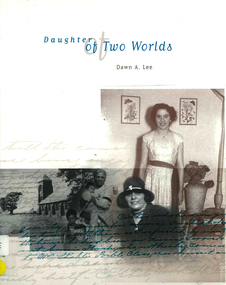
Book, Dawn A Lee, Daughter of two worlds, 2002
... history maps, b&w photographs The biography of a Victorian Koori woman who traced her family lineage back to the first contact between Indigenous Victorians and the founder of Melbourne. Daughter of Two Worlds by Dawn Lee begins with a tragic affair between Eliza Batman, the wife of Melbourne pioneer John Batman, and William Willoughby, Batman's right-hand man and a pillar of Melbourne's early Wesleyan church. The book also unearths the remarkable truth behind a family legend that Dawn Lee's great grandfather was a mysterious white English ...The biography of a Victorian Koori woman who traced her family lineage back to the first contact between Indigenous Victorians and the founder of Melbourne. Daughter of Two Worlds by Dawn Lee begins with a tragic affair between Eliza Batman, the wife of Melbourne pioneer John Batman, and William Willoughby, Batman's right-hand man and a pillar of Melbourne's early Wesleyan church. The book also unearths the remarkable truth behind a family legend that Dawn Lee's great grandfather was a mysterious white English lord who met her great grandmother, Susannah, a full tribal Gunditjmara woman.maps, b&w photographsgunditjmara, dawn a lee, aboriginal victorians, victorian history -
 Victorian Aboriginal Corporation for Languages
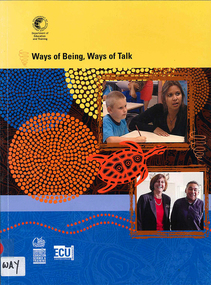
Book with DVD, Western Australia Department of Education and Training, Ways of being, ways of talk, 2007
... Aboriginal education Aboriginal English cultural awareness school curriculum language and literacy bilingualism two way learning b&w illustrations, colour illustrations, b&w photographs, colour photographs, DVD Part of original kit produced by a Primary and Senior Secondary School in Western Australia dealing with communication, language and Aboriginal History. ...Part of original kit produced by a Primary and Senior Secondary School in Western Australia dealing with communication, language and Aboriginal History. Video 1. Moving Into Other Worlds Video 2. Two Way Learning and Two Kinds of Power Video 3. Now You See It, Now You Don?t Video 4. A Shared World of Communicationb&w illustrations, colour illustrations, b&w photographs, colour photographs, DVDaboriginal education, aboriginal english, cultural awareness, school curriculum, language and literacy, bilingualism, two way learning -
 Uniting Church Archives - Synod of Victoria
BW photo, Undated
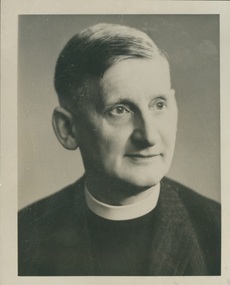
... History at Cambridge and a Fellowship at Emmanuel College. He retired from Wesley House in 1974 and from the Professorship three years later. He published extensively and was an active ecumenist, one of the founders of the Cambridge Theological Federation, a member of the Central Committee of the World Council of Churches and an official Observer at the Second Vatican Council. He was elected President of the Methodist Conference in 1968 and was made a Fellow of the British Academy in 1970. Rev. Professor Gordon Rupp; English ...E Gordon Rupp, 1910-1986, was one of the leading historians of his generation, specialising in the Protestant Reformation (particularly Luther) and eighteenth-century England. After a degree in history at King’s College, London he prepared for ministry at Wesley House from 1933 to 1937. After further study in Strasbourg and Basel and a period of circuit ministry he taught at Richmond College from 1947 to 1952, when he became a lecturer in Divinity at Cambridge University, taking his Doctorate in Divinity in 1955. In 1956 he became the first Professor of Ecclesiastical History at Manchester University before moving to Wesley House as Principal in 1967. The following year he combined that appointment with the Dixie Professorship of Ecclesiastical History at Cambridge and a Fellowship at Emmanuel College. He retired from Wesley House in 1974 and from the Professorship three years later. He published extensively and was an active ecumenist, one of the founders of the Cambridge Theological Federation, a member of the Central Committee of the World Council of Churches and an official Observer at the Second Vatican Council. He was elected President of the Methodist Conference in 1968 and was made a Fellow of the British Academy in 1970.Rev. Professor E. Gordon Rupp, head and shoulders portrait, wearing clerical collar and dark coat.Rev. Professor E. Gordon Rupp; Office of Public Affairs, Drew University, New Jerseyrev. professor gordon rupp; english protestant historian -
 Victorian Aboriginal Corporation for Languages
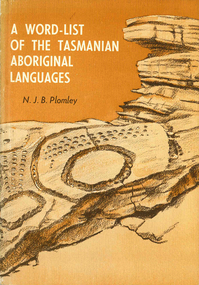
Book, NJB Plomley, A word-list of the Tasmanian Aboriginal Languages, 1976
... Contains a good introduction to the history of recording Tasmanian languages, including Bible translations, songs, and sentence lists. The wordlist, which covers all languages, is organised under English headwords organised according to semantics, followed by all of the known spellings and different language/dialect words known from differnt wordlists. ...Tasmanian history word lists Contains a good introduction to the history of recording Tasmanian languages, including Bible translations, songs, and sentence lists. The wordlist, which covers all languages, is organised under English headwords organised according to semantics, followed by all of the known spellings and different language/dialect words known from differnt wordlists. ...Contains a good introduction to the history of recording Tasmanian languages, including Bible translations, songs, and sentence lists. The wordlist, which covers all languages, is organised under English headwords organised according to semantics, followed by all of the known spellings and different language/dialect words known from differnt wordlists. Sources are indicated with each word, along with the specific translations given in the original lists. An index to English words is given but there is none for the Tasmanian words.word liststasmanian history -
 Victorian Aboriginal Corporation for Languages
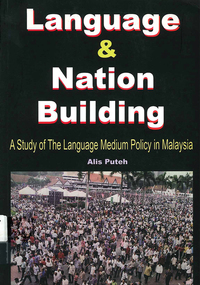
Book, Alis Puteh, Language &? nation building : a study of the language medium policy in Malaysia, 2006
... The history of medium of instruction policy in the Malaysian education system. The implementation process and its challenges from 1970-1983. The implementation of English...language policy education Malaysia Tables The history of medium of instruction policy in the Malaysian education system. The implementation process and its challenges from 1970-1983. The implementation of English ...The history of medium of instruction policy in the Malaysian education system. The implementation process and its challenges from 1970-1983. The implementation of English language policy in the Malaysian education system.Tableslanguage policy, education, malaysia -
 Victorian Aboriginal Corporation for Languages
Book, Jakelin Troy, Australian Aboriginal contact with the English Language in New South Wales : 1788 to 1845, 1990
... Looks at the history of the area and explorationa dn pastoralists. Australian Aboriginal contact with the English Language in New South Wales : 1788 to 1845 Book Jakelin Troy ...Early language contacts between Aboriginals and Colonists. Looks at the history of the area and explorationa dn pastoralists.Maps, word listscolonisation, pidgin -
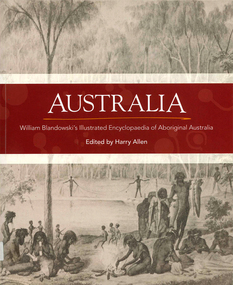 Victorian Aboriginal Corporation for Languages
Book, Harry Allen, Australia : William Blandowski's illustrated encyclopaedia of Aboriginal Australia, 2010
... Aboriginal Australian history pictorial histories William Blandowski Maps, b&w illustrations William Blandowski was an explorer, natural scientist and artist who led a Victorian government expedition to the junction of the Murray and Darling Rivers from 1856 to 1857. This is the first publication in English ...William Blandowski was an explorer, natural scientist and artist who led a Victorian government expedition to the junction of the Murray and Darling Rivers from 1856 to 1857. This is the first publication in English of his nineteenth century illustrated encyclopaedia of Aboriginal life.Maps, b&w illustrationsaboriginal australian history, pictorial histories, william blandowski -
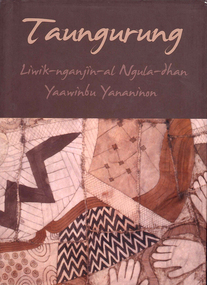 Victorian Aboriginal Corporation for Languages
Book, Taungurung : liwik-nganjin-al ngula-dhan yaawinbu yananinon, 2011
... History of project My journey Foreword /? by VACL community linguist Introduction Pronouns and and pronoun word-endings Word endings Language in use from the Old People Taungurung to English English to Taungurung....History of project My journey Foreword /? by VACL community linguist Introduction Pronouns and and pronoun word-endings Word endings Language in use from the Old People Taungurung to English English to Taungurung. ...An analysed dictionary of the Taungurung language. Contents: Symbols of the cloak Foreword /? by Lee Healy History of project My journey Foreword /? by VACL community linguist Introduction Pronouns and and pronoun word-endings Word endings Language in use from the Old People Taungurung to English English to Taungurung.word lists, b&w illustrations, b&w photographs, colour photographstaungurung, dictionaries, glossaries -
Victorian Aboriginal Corporation for Languages
Book, Taungurung : liwik-nganjin-al ngula-dhan yaawinbu yananinon, 2011
... History of project My journey Foreword /? by VACL community linguist Introduction Pronouns and and pronoun word-endings Word endings Language in use from the Old People Taungurung to English English to Taungurung....History of project My journey Foreword /? by VACL community linguist Introduction Pronouns and and pronoun word-endings Word endings Language in use from the Old People Taungurung to English English to Taungurung. ...An analysed dictionary of the Taungurung language. Contents Symbols of the cloak Foreword /? by Lee Healy History of project My journey Foreword /? by VACL community linguist Introduction Pronouns and and pronoun word-endings Word endings Language in use from the Old People Taungurung to English English to Taungurung.word lists, b&w illustrations, b&w photographs, colour photographs -
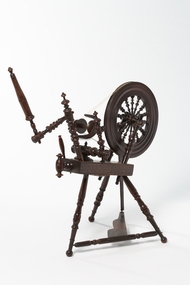 National Wool Museum
Spinning Wheel
... English, dating from the late 18th century. It was acquired from Margaret and Joan Mellor who had earlier acquired it from Kosminskis. handicrafts - history spinning wheels highlights of the national wool museum: the zakrzewski spinning wheel collection - exhibition (28/07/2001 - 02/12/2001) zakrzewski mr wlodzimierz Part of the Zakrzewski Spinning Wheel collection. ...Part of the Zakrzewski Collection of spinning wheels donated to the National Wool Museum by Mr Wlodzimierz Zakrzewski. For many years, Mr Zakrzewski collected, researched and repaired spinning wheels from all over the world. This wheel is made from oak and is English, dating from the late 18th century. It was acquired from Margaret and Joan Mellor who had earlier acquired it from Kosminskis.Part of the Zakrzewski Spinning Wheel collection.handicrafts - history, spinning wheels, highlights of the national wool museum: the zakrzewski spinning wheel collection - exhibition (28/07/2001 - 02/12/2001), zakrzewski, mr wlodzimierz -
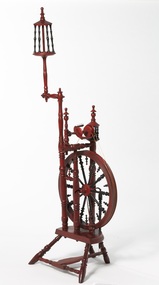 National Wool Museum
Spinning Wheel
... English and is made mainly from oak. It dates from the late 19th century and has elements of Chinoiserie in its design. It was originally bought from Portobello Road, London in quite poor condition and was later exchanged by Mr Eric Corran (a manufacturer of looms and spinning wheels) for a spinning wheel in working order. Mr Corran later sold it to Mr Zakrzewski who restored it. handicrafts - history ...Part of the Zakrzewski Collection of spinning wheels donated to the National Wool Museum by Mr Wlodzimierz Zakrzewski. For many years, Mr Zakrzewski collected, researched and repaired spinning wheels from all over the world. This spinning wheel is English and is made mainly from oak. It dates from the late 19th century and has elements of Chinoiserie in its design. It was originally bought from Portobello Road, London in quite poor condition and was later exchanged by Mr Eric Corran (a manufacturer of looms and spinning wheels) for a spinning wheel in working order. Mr Corran later sold it to Mr Zakrzewski who restored it.Part of the Zakrzewski Spinning Wheel collection.handicrafts - history, spinning wheels, highlights of the national wool museum: the zakrzewski spinning wheel collection - exhibition (28/07/2001 - 02/12/2001), zakrzewski, mr wlodzimierz -
 National Wool Museum
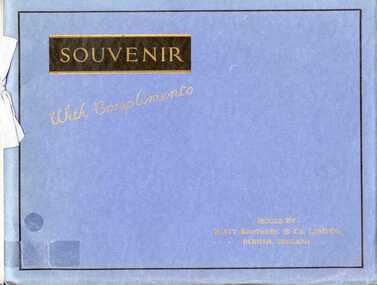
Book, Souvenir edition progress of the cotton industry and textile machinary making
... Offers an overview of the cotton industry including its history, examples of English cotton mills and textile machinery for cotton....Offers an overview of the cotton industry including its history, examples of English cotton mills and textile machinery for cotton. ..."Souvenir with Compliments: progress of the cotton industry and textile machinery making" issued by Platt Brothers and Co. Limited, 1929. Offers an overview of the cotton industry including its history, examples of English cotton mills and textile machinery for cotton.Book: "Souvenir with compliments from Platt Brothers and Co. Ltd - progess of the cotton industry and textile machinery making" 1929.cotton, textile machinery, textile mills history, platt brothers and co. limited, textile mills - history -
 National Wool Museum
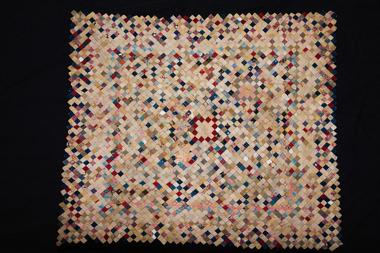
Textile - Patchwork Quilt, c.1900
... English. Was being used as packing material when found. quilting history patchwork history running stitch group running stitch collection england quilting - history patchwork - history Quilt, patchwork. ...Part of the " Wagga collection" donated by the Running Stitch group. Maker unknown. c.1900. Possibly English. Was being used as packing material when found.Quilt, patchwork. Made from tiny hand worked patchwork squares reminiscent of medallion style quilts.quilting history, patchwork history, running stitch group, running stitch collection, england, quilting - history, patchwork - history -
 Nillumbik Shire Council
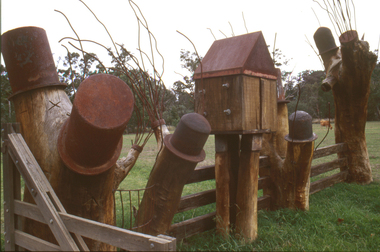
Sculpture: Tony Trembath (b.1946 Sale, Victoria), Tony Trembath, The Fences Act 1968 - Location: Edendale Farm (entrance) 30 Gastons Road, Eltham, 1989 - 1994
... English gentleman's residence and was used for grazing. It consists of 5.6 hectares, with the Diamond Creek meandering through the property. The Victorian Fences Act 1968 governs liability of occupiers of adjoining lands to fence, and deals with disputes between neighbours regarding boundaries fences and costs. This work took into consideration ideas and suggestions from residents and committees, who required the use of recycled materials and that the work celebrate man's relationship with nature, animals and the earth, as well as relate to the fence-line on the far side of the carpark. Trembath also absorbed significant aspects of local history...English gentleman's residence and was used for grazing. It consists of 5.6 hectares, with the Diamond Creek meandering through the property. The Victorian Fences Act 1968 governs liability of occupiers of adjoining lands to fence, and deals with disputes between neighbours regarding boundaries fences and costs. This work took into consideration ideas and suggestions from residents and committees, who required the use of recycled materials and that the work celebrate man's relationship with nature, animals and the earth, as well as relate to the fence-line on the far side of the carpark. Trembath also absorbed significant aspects of local history ...Eltham Council (now the Shire of Nillumbik) commissioned this work in 1989 to create an entrance / gateway to Edendale Community Farm. It was also aided by a grant from the Ministry of the Arts (now Arts Victoria). The former name of this work was "Gateway to Edendale Farm". Edendale Farm is a demonstration farm modelling sustainable environmental practices, providing support to the local residents of Nillumbik. Established in 1986, the land was purchased in 1970. It was previously an English gentleman's residence and was used for grazing. It consists of 5.6 hectares, with the Diamond Creek meandering through the property. The Victorian Fences Act 1968 governs liability of occupiers of adjoining lands to fence, and deals with disputes between neighbours regarding boundaries fences and costs. This work took into consideration ideas and suggestions from residents and committees, who required the use of recycled materials and that the work celebrate man's relationship with nature, animals and the earth, as well as relate to the fence-line on the far side of the carpark. Trembath also absorbed significant aspects of local history, making references to Eltham's agricultural past, the clearing of the land, the destruction of trees, the ruthless pruning of trees by suburban Councils and incorporated such Australian features as the post and rail fence. 'The Fences Act 1968' is significant for aesthetic, historic and social reasons at a regional level. It makes prominent the historical and social significance of Edendale and the rural aspects of Nillumbik. The use of existing tree stumps and salt pots in the work explores the iconography of the countryside such as the isolated farmhouse, pioneering farming practices, post and rail fencing and the regrowth of lopped trees. The title of the work, as well as the extensive community involvement in its creation, also makes reference to the Victorian Fences Act 1968, which makes neighbours jointly responsible for the cost of construction and maintenance of fences in the partitioning of land for settlement. 'The Fences Act 1968' has been classified as of regional significance by the National Trust of Australia. The work is an installation of wood and metal, approximately twenty five meters long. The design is very informal and rustic and runs the full width of the fence-line. It comprises groups of recycled tree trunks fitted with metal caps (chrome-nickel 'salt pots' that are shaped like tall bowler / top hats). Metal rods protrude from the trunks and some of these rods have metal birds. Two larger, sentinel-like stumps at the two outer ends have metal flame-like wings, which bend inward. To the left of the entrance, a simple architectural element indicates an isolated farmhouse. The rustic fence runs between the groups of tree trunks with native planting in clumps along it. The fence-line incorporates a functional engineered double gate and post and rail fencing. There may be many interpretations of the work and the intention is to stimulate interest and imagination rather than alienate. Interpretation is based on the personal experience that a visitor brings. The artist recommended that no explanation of the design logic be positioned with the work. N/Apublic art, sculpture, edendale, recycled, wood, metal, fences act 1968, gate, trembath, salt pot, tree stumps -
 Sunshine and District Historical Society Incorporated
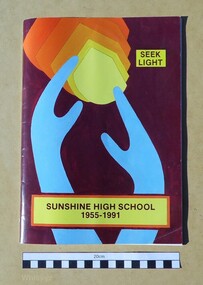
Book - Seek Light Sunshine High School 1955 to 1991, Barry Rayner, 1991
... history of the school, the book has a comprehensive list of the staff and students that were at the school. Researchers will be able to determine the numbers of students commencing each year, the ethnic backgrounds of staff and students, and especially in the early years determine the spelling of the Surnames and Christian names of many students with overseas backgrounds. In the 1950's some Primary School teachers had the habit of changing students European Christian names to the English ...In December 1954 the Parents Association was formed and met at the Sunshine State School. In February 1955 classes commenced with First and Second Form students accommodated in several local Halls. In May 1955 the students transferred to the new building. Over the years many children with overseas background attended the school. The school ceased to exist in its own right in 1991, and amalgamated with five other local secondary schools to form the multi campus Sunshine College in 1992. The former Sunshine High School buildings on Ballarat Road are now part of the Sunshine Campus of Victoria University. The book contains photographs and written articles from the school years as well as photographs of those attending the 1991 reunion. The history of the school is covered in this book under the headings: (1) Beginnings, (2) The Sixties, (3) The Seventies, (4) The Final Years, and (5) Vale. The major historical feature of this book is however the 17 pages of Staff and Student names, and the years they were at the school.This book is of historic and research significance. As well as providing some of the history of the school, the book has a comprehensive list of the staff and students that were at the school. Researchers will be able to determine the numbers of students commencing each year, the ethnic backgrounds of staff and students, and especially in the early years determine the spelling of the Surnames and Christian names of many students with overseas backgrounds. In the 1950's some Primary School teachers had the habit of changing students European Christian names to the English versions, and so the new names may have carried on to High School enrolment. For example some students named Ryszard were enrolled as Richard. Many students however were enrolled with correct ethnic spelling of their names. Although the list of students names appears to be comprehensive until about 1985, it appears to fail after that. It is known that some students names are missing in the final years.Front cover has a maroon coloured background with a pair of diagrammatic light blue hands reaching towards an orange and yellow source of light. The words SEEK LIGHT and SUNSHINE HIGH SCHOOL 1955-1991 are also on the front cover. The rear cover is plain white coloured. The book contains 68 pages plus the covers.Inside the front cover is an acknowledgement by John Scott to the work of the 1991 Reunion Committee for the production of the book, with eight people and their roles specifically named. The secondary title of the book as written inside on page 1 appears to be "Sunshine High Reflections 1954 - 91"sunshine high school -
 Sunshine and District Historical Society Incorporated
Administrative record - The University of Melbourne/ The Victorian Universities and School Examinations Board, University of Melbourne
... - dated 1964|The University of Melbourne Matriculation Examination - English Expression - November 1964|Matriculation Test Examination, Modern History , 2 sheets - October 1965|The Victoian Universities and Schools Examinations Board Matriculation Examination - English Expression - December 1965...- dated 1964|The University of Melbourne Matriculation Examination - English Expression - November 1964|Matriculation Test Examination, Modern History , 2 sheets - October 1965|The Victoian Universities and Schools Examinations Board Matriculation Examination - English Expression - December 1965 Examination papers for Intermediate, Leaving and Matriculation Subjects Administrative record The University of Melbourne/ The Victorian Universities and School Examinations Board University of Melbourne ...The University of Melbourne Matriculation Examination - English Expression Paper dated December 1958| The University of Melbourne Matriculation Examination - French , Second Paper dated December 1958| The University of Melbourne Intermediate and Leaving Examinations - various subjects - November 1962 and December 1962 in booklet form| The University of Mebourne School Leaving Examination Paper - Economics - dated December 1962| The University of Melbourne School leaving Examination Paper - English Literature - 1963| The University of Melbourne School Leaving Examination Paper - English, First Paper - November 1963| The University of Melbourne School Leaving Examination Paper - French - November 1963| The University of Melbourne Schoool leaving Examination Paper - Economics - November 1963|The University of Melbourne Modern History Examination - one page, untitled, grade level? - dated 1964|The University of Melbourne Matriculation Examination - English Expression - November 1964|Matriculation Test Examination, Modern History , 2 sheets - October 1965|The Victoian Universities and Schools Examinations Board Matriculation Examination - English Expression - December 1965educarion -
 Plutarch Project
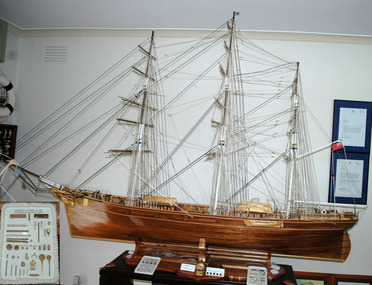
English wooden ship model, Cutty Sark replica, circa 1997
... history of the Cutty Sark vessel by Maria Paraskevatos in one of the attachments provided with this exhibit. This model along with a large number of others was constructed by the Master craftsman Denis Paraskevatos, in Melbourne and has a historic, artistic significance because of the time and artist efforts in construction. replica ship art model cutty sark Greek artist Paraskevatos Παρασκευάτος πανομοιότυπο CUTTY SARK LONDON The English Cutty Sark replica model is a wooden replica scaled at 1:25. ...This replica ship was modelled to exact scale by Denis Paraskevatos with the original basic kit enhanced by a large number of brass and mahogany wooden parts used and showing on two labels positioned at the base of the model. These replica parts were specifically designed and constructed by D. Paraskevatos with the help of his family. This model along a large number of others have been displayed at the Victorian Parliament for ten days from the 18th March 2002 (Queens Hall) to the 28th March 2002, and the Melbourne Town Hall from 19th to 27th August 2004. The history of the 65 meter British vessel named Cutty Sark is as follows: THE CUTTY SARK (history) The “Cutty Sark” was a British clipper ship, aptly named of course as a [clipper for its speed ], which was built in 1869 on the [river Clyde in Scotland ] by the Jock Willis Shipping Corporation. It was primarily used to transport tea from China to Great Britain, as well to a lesser extent later in its life, wool from Australia; however, with the advent of the steam engines and the creation also of the Suez Canal in 1869, its days of operation as a sailing vessel were numbered, as the steam ships were now prevailing as technologically advanced cargo carriers through the shorter route by the Suez Canal to China. In fact, within a few years of its operation, as its delegation in the tea industry was declining, it was assigned primarily the duty of transporting wool from Australia to England, but this activity was thwarted again by the steam ships, as they were enabled by their technologies to travel faster to Australia. Eventually, the “Cutty Sark” in 1895 was sold to a Portuguese company called “Ferreira and Co.”, where it continued to operate as a cargo ship until 1922, when it was purchased on that year by the retired sea captain Wilfred Dowman, who used it as a training ship in the town of Falmouth in Cornwall. After his death, the ship was conferred as a gesture of good will to the “Thames Nautical Training College” in Greenhithe in 1938, where it became an auxiliary cadet training ship, outliving its usefulness as a training vessel by 1954, and permanently [being dry docked in Greenwich, London, ] for public viewing. Of course, the “Cutty Sark” was not the only tea clipper constructed and owned by the Jock Willis Corporation, as there were others who were also used for the transportation of tea from China to Great Britain. Noteworthy additionally in its impressive resume is the fact that, the “Cutty Sark” was not only valued and admired for its speed, but also for its prestige that it afforded to its owners, [as media coverage was insatiable during a tea race that was regarded a national sporting event, with fiscal bets being placed on a predicted winning ship ]. Disappointingly, even though the English tea clippers were the best in the world at the time in terms of marine design, they had never won a tea race, and Jock Willis was certainly determined to achieve this goal, as the American clippers were considered the fastest in the tea trade. Nonetheless, the British clippers were proven to be formidable opponents to their American counterparts in the tea trade, when in 1868 a British tea clipper called [“Thermopylae”, managed to travel from the port of London to Melbourne, in only sixty one (61) days, which Jock Willis was hoping to improve on such a feat with the “Cutty Sark” ] . Remarkably, the maximum speed that the “Cutty Sark” could achieve was 17.5 knots in spite of the challenges of the unpredictable winds, if any at times, and the high seas or ferocious storms. Interestingly, [the “Cutty Sark’s” greatest recorded achievement in distance in twenty four (24) hours was three hundred and sixty three (363) nautical miles ], which meant that it was averaging approximately fifteen (15) knots; much faster obviously than the recorded twenty four (24) hour distance of the “Thermopylae” which had accomplished three hundred and fifty (358) nautical miles. .... ______________ -*- Please read the complete history of the Cutty Sark vessel by Maria Paraskevatos in one of the attachments provided with this exhibit. This model along with a large number of others was constructed by the Master craftsman Denis Paraskevatos, in Melbourne and has a historic, artistic significance because of the time and artist efforts in construction.The English Cutty Sark replica model is a wooden replica scaled at 1:25. The wood is mahogany and it is normally displayed in a glass covered enclosure. It has three masts and it is the largest vessel of Denis Paraskevatos collectionCUTTY SARK LONDONreplica, ship, art, model, cutty, sark, greek, artist, paraskevatos, παρασκευάτος, πανομοιότυπο -
 Tatura Irrigation & Wartime Camps Museum
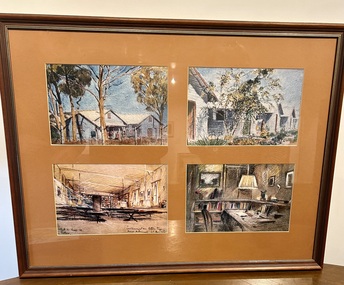
Artwork, other - Carl von Brandenstein Collection, Tatura Camp 1A
... history of religion at Berlin University (1928-1934) and Leipzig (1938-1939). His doctoral thesis was a dissertation on the iconography of Hittite gods. He was arrested in Persia in 1941 and sent to Australia where he was interned at Loveday Camp South Australia and in Camp 1 Tatura from January 1945 until his release in August 1946. Camp 1 Tatura Carl von Brandenstein Internment camp Loveday Waranga Hospital Library Hans Wulff Item 2: "am letzten Tage deiner Internierung dem lieben Hans Wulff fur Errinnerung an gemeinsam gebautes" (English ...Dr Carl von Brandenstein was born in 1909 in Hanover, Germany. He studied oriental languages and the history of religion at Berlin University (1928-1934) and Leipzig (1938-1939). His doctoral thesis was a dissertation on the iconography of Hittite gods. He was arrested in Persia in 1941 and sent to Australia where he was interned at Loveday Camp South Australia and in Camp 1 Tatura from January 1945 until his release in August 1946.Four artworks in a dark wood frame with terracotta coloured matte. Item 1: Hospital Waranga. Tall gum trees in foreground, blue sky . Staff standing under the veranda and a red cross vehicle parked in front. A barbed wire fence surrounds the hospital. Item 2: Inside the Library. Item 3: Camp Barracks. Four huts in a row . A tree and garden in front. Item 4: Reading Room. A table in centre of the room with a single chair. Books and stationery items on the table. A lamp hangs from the ceiling. Bookshelves along the walls and paintings on the wall. Item 2: "am letzten Tage deiner Internierung dem lieben Hans Wulff fur Errinnerung an gemeinsam gebautes" (English Translation: On the last day of your internment to dear Hans Wiulff for remembrance of what we built together. camp 1, tatura, carl von brandenstein, internment camp loveday, waranga hospital, library, hans wulff -
Tatura Irrigation & Wartime Camps Museum
Folio, "Humour Behind Barbed Wire" by Johann Streicher, c.1945
... Written in Internment Camp 3, translated in Germany by Mairie Berkei and her English language students. books history local Blue multi ringer plastic folder with typed sheets on plastic sleeves containing translations of humorous poem. ...Written in Internment Camp 3, translated in Germany by Mairie Berkei and her English language students.Blue multi ringer plastic folder with typed sheets on plastic sleeves containing translations of humorous poem.books, history, local -
Tatura Irrigation & Wartime Camps Museum
DVD, John Burgan, Friendly Enemy Alien, 2006
... Filmed by John Burgan, an English documentary maker for Berlin TV History Channel. Filmed in Sydney, Melbourne, Narua, Dunera Jewish refugee internees and Afghan illegal boat people. ...Filmed by John Burgan, an English documentary maker for Berlin TV History Channel. Filmed in Sydney, Melbourne, Narua, Dunera Jewish refugee internees and Afghan illegal boat people. ...Filmed by John Burgan, an English documentary maker for Berlin TV History Channel. Filmed in Sydney, Melbourne, Narua, Dunera Jewish refugee internees and Afghan illegal boat people. Discussing circumstances and treatment of coming Enemy Aliens coming to Australia in 1940 and 2001.Clear plastic large DVD case. DVD is sky blue with silver pattern and textjohn burgan, berlin tv history channel, jewish refugees, afghan illegal boat people, documentaries
