
Showing 470 items matching "horse parade"
-
 Bendigo Historical Society Inc.
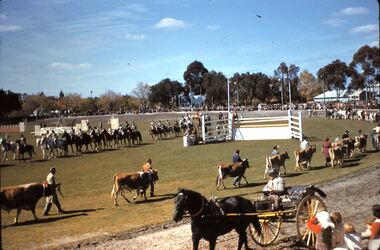
Slide - FLEMING COLLECTION: 1950S BENDIGO SLIDE, 1950s
... View of the Bendigo Show Grounds (now Tom Flood Centre). Horses and cattle parading around the ring, horse and gig on the track....View of the Bendigo Show Grounds (now Tom Flood Centre). Horses cattle parading ring horse gig track Kodachrome Bendigo 1950s. ...Bendigo 1950s. Bendigo Easter Procession. Easter Monday was 7 April 1958. View of the Bendigo Show Grounds (now Tom Flood Centre). Horses and cattle parading around the ring, horse and gig on the track.Kodachromeevent, easter fair, bendigo easter fair, bendigo 1950s. bendigo easter procession. easter monday was 7 april 1958. view of the bendigo show grounds (now tom flood centre). horses cattle parading ring, horse gig track -
 8th/13th Victorian Mounted Rifles Regimental Collection
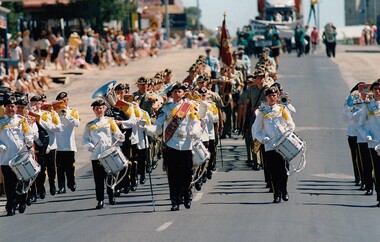
Photograph
... Two colour photographs of Regimental Band of ath/19th Prince of Wales Light Horse at Australia Day parade, Corowa NSW on 23 January 1994....Two colour photographs of Regimental Band of ath/19th Prince of Wales Light Horse at Australia Day parade, Corowa NSW on 23 January 1994. ...in 1991, 8/13 Victorian Mounted Rifles and 4/19 Prince of Wales Light Horse linked to form a new Regiment.Two colour photographs of Regimental Band of ath/19th Prince of Wales Light Horse at Australia Day parade, Corowa NSW on 23 January 1994. -
 8th/13th Victorian Mounted Rifles Regimental Collection
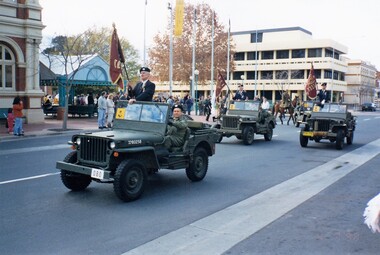
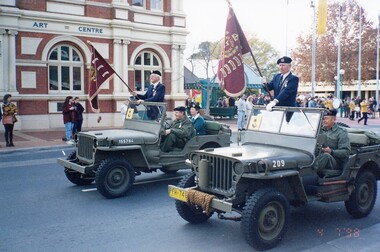
Photograph - Reserve Forces Day march
... Three jeeps carrying flag bearers holding guidons of 8th, 13th & 20th Light Horse, Reserve Forces Day parade Albury 4 July 1998....military - reserve forces - albury - guidons military reserve forces albury guidons parade Three jeeps carrying flag bearers holding guidons of 8th, 13th & 20th Light Horse, Reserve Forces Day parade Albury 4 July 1998. ...Three jeeps carrying flag bearers holding guidons of 8th, 13th & 20th Light Horse, Reserve Forces Day parade Albury 4 July 1998.military - reserve forces - albury - guidons, military, reserve forces, albury, guidons, parade -
 Wangaratta RSL Sub Branch
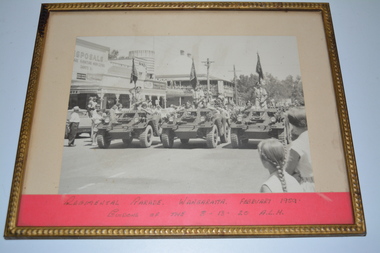
Memorabilia - Photograph, Regimental Parade, 1959
... Black and white image of three armoured vehicles each with soldier escorting large guidon/flags of the 8th/13th/20th Australian Light Horse regiments on parade through township of Wangaratta in February 1959 ...Black and white image of three armoured vehicles each with soldier escorting large guidon/flags of the 8th/13th/20th Australian Light Horse regiments on parade through township of Wangaratta in February 1959 1959 guidons wangaratta 8/13/20 ALH Regimental Parade Wangaratta February 1959 Guidons of the 8th/13th/20th ALH Black and white photograph depicting three armoured vehicles each with soldier standing holding a guidon/flag Regimental Parade Memorabilia Photograph ...Black and white image of three armoured vehicles each with soldier escorting large guidon/flags of the 8th/13th/20th Australian Light Horse regiments on parade through township of Wangaratta in February 1959 Black and white photograph depicting three armoured vehicles each with soldier standing holding a guidon/flag Regimental Parade Wangaratta February 1959 Guidons of the 8th/13th/20th ALH1959, guidons, wangaratta, 8/13/20 alh -
 8th/13th Victorian Mounted Rifles Regimental Collection
Photograph - Reserve Forces Day march
... Staff - Sergeant Maurie Miles and WO 2 Lou Madjeric standing in Jeeps carrying guidons of 8th and 13th Light Horse, Reserve Forces Day Parade, Albury, 4 July 1998....reserve forces parade albury guidon military Staff - Sergeant Maurie Miles and WO 2 Lou Madjeric standing in Jeeps carrying guidons of 8th and 13th Light Horse, Reserve Forces Day Parade, Albury, 4 July 1998. ...Staff - Sergeant Maurie Miles and WO 2 Lou Madjeric standing in Jeeps carrying guidons of 8th and 13th Light Horse, Reserve Forces Day Parade, Albury, 4 July 1998.reserve forces, parade, albury, guidon, military -
 Ballarat Tramway Museum
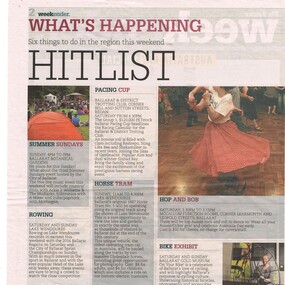
Newspaper, The Courier Ballarat, "What's Happening - Hitlist", 23/01/2016 12:00:00 AM
... Newspaper clipping from The Courier, Monday 23/1/2016, titled "What's Happening - Hitlist" in an item advertising the BTM's operation of the horse tram in Wendouree Parade on Sunday. Gives details of the operation times and fares....Horse Tram BTM Events Newspaper clipping from The Courier, Monday 23/1/2016, titled "What's Happening - Hitlist" in an item advertising the BTM's operation of the horse tram in Wendouree Parade on Sunday. Gives details of the operation times and fares. ...Newspaper clipping from The Courier, Monday 23/1/2016, titled "What's Happening - Hitlist" in an item advertising the BTM's operation of the horse tram in Wendouree Parade on Sunday. Gives details of the operation times and fares.horse tram, btm, events -
 Ballarat and District Irish Association
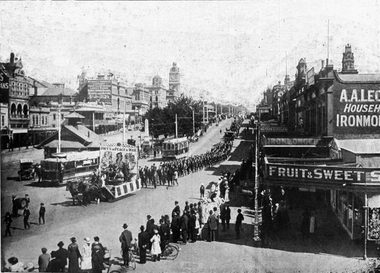
Image, St Patrick's Day Parade, Ballarat, 1916, 1916
... A band leads the parade, a horse drawn float carries a banner "Unity of Peace & War" with hundreds following as part of the parade. ...A band leads the parade, a horse drawn float carries a banner "Unity of Peace & War" with hundreds following as part of the parade. ...St Patrick's Day is celebrated on 17 March. A St Patrick's Day March was held in Ballarat. According to the Ballarat Courier of 03 February 1916 a festival was organised in Ballarat to celebrate St Patrick's Day: "ST PATRICK'S DAY FESTIVAL - There was an excellent attendance last night at St. Patrick's Hall to make a rangments for the annual celebration of St. Patrick's Day Festival. Mr A. W. Hager occupied the chair. The date allotted by the V.R.C. committee, Friday, 24th March, was accepted, and the festival will take place on that date, with the usual race meeting on the Miners' Racecourse, and entertainment at Her Majesty's Theatre in the evening. The secretary was instructed to appeal for the hearty co-operation of the different societies, and to ask for a holiday on 24th March. The amount of stakes and the racing programme were left in the hands of racing committee, whose report will be dealt with at the next meeting. The following officials were appointed to carry out the celebrations:--Chairman, Very Rev. Father Kennelly; vice-chairmen, Rev. Father Henneberry, T. J. O'Loughlin, and A. W. Hager; general manager, Mr M. Newton; Secretary; Mr F. T. Kierce; treasurer, Mr William White; collecting secretaries, Revs. Fathers Kennelly and Henneberry; entertainment. Mesers D. J.Ward, J. Morrisey, Fraser Hussy, Chris Hager, Shelly, Dr Spring, Dr Kelly, J.J. Coglan, P. Thornton, Jasper Coghlan, Jas Early; finance committee, Revs. Kennelly, Henneberry, Messrs White, T. Foley, Dr Spring, Brophy, Shelley. All present with power to add wore appointed a general committee. A vote of thanks to the chair concluded the meeting."Black and white photographic reproduction of the 1916 St Patrick's Day March in Sturt Street, Ballarat. A band leads the parade, a horse drawn float carries a banner "Unity of Peace & War" with hundreds following as part of the parade. ballarat irish, st patrick's day, st patrick's day march, ballarat, hager, kennelly, henneberry, o'loughlin, kierce, white, ward, morrisey, fraser, hussy, shelly, kelly, spring, coglan, foley, brophy -
 Lilydale RSL Sub Branch
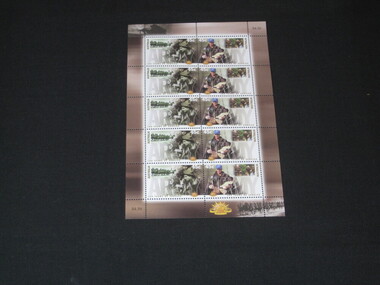
Stamps, 100 Years of Service, 00/02/2001
... Historical on left: Charles Byrne and G Walker 29th/46th Btn New Guinea 1943 (AWM #16297) smaller image on left Light Horse on parade 1940 (AWM #001329). Contemporary on right: Trooper Jon Church carrying a child in Rwanda (1995) smaller image upper right Officers on Commando Officer Selection course Jul 1997. ...Historical on left: Charles Byrne and G Walker 29th/46th Btn New Guinea 1943 (AWM #16297) smaller image on left Light Horse on parade 1940 (AWM #001329). Contemporary on right: Trooper Jon Church carrying a child in Rwanda (1995) smaller image upper right Officers on Commando Officer Selection course Jul 1997. ...Photographers: Historical Norman Brown, Contemporary George GitttoesSheetlet of 10x45c stamps. Historical on left: Charles Byrne and G Walker 29th/46th Btn New Guinea 1943 (AWM #16297) smaller image on left Light Horse on parade 1940 (AWM #001329). Contemporary on right: Trooper Jon Church carrying a child in Rwanda (1995) smaller image upper right Officers on Commando Officer Selection course Jul 1997. Selvedge features images of 13th Australian Light Horse in France 1918 (AWM #EO2979) and a soldier greeting the dawn in Balibo and the Rising Sun badge. -
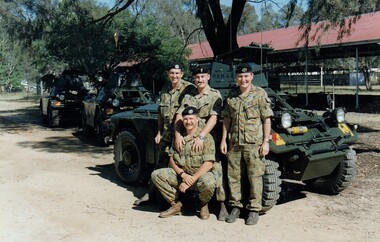 8th/13th Victorian Mounted Rifles Regimental Collection
Photograph
... Colour photograph of 4 soldiers of VMR Squadron 4/19 Prince of Wales's Light Horse at Australia Day Parade Corowa NSW 23 January 1994 . ...Colour photograph of 4 soldiers of VMR Squadron 4/19 Prince of Wales's Light Horse at Australia Day Parade Corowa NSW 23 January 1994 . ...Vehicles are of the VMR heritage Vehicle Section. In 1991 8/13 VMR and 4/19 PWLH linked to form a new Regiment of two squadrons: VMR squadron and PWLH Squadron.Colour photograph of 4 soldiers of VMR Squadron 4/19 Prince of Wales's Light Horse at Australia Day Parade Corowa NSW 23 January 1994 . Standing at right Sergeant Gary Wynn; seated Corporal Neil Ray. -
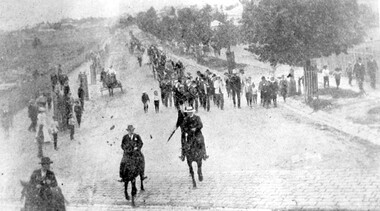 Surrey Hills Historical Society Collection
Photograph, Parade in celebration of King Edward VII's birthday, 1902, 1902
... Black and white photo of a number of men on horses leading a parade down Station Street (Windsor Crescent) to Union Road. ...He had 3 sons: Edward Allan (1854-1932); George Henry (1858-1921) and William John (1865-1945). parades and processions bands german band windsor crescent william saunders maling mrs hannah maling miss hannah miller constable hill perc venman george robinson sam kellett alexander mcneill rowland coe harry pollard william percival reginald venman Black and white photo of a number of men on horses leading a parade down Station Street (Windsor Crescent) to Union Road. ...The parade was held in celebration of King Edward VII's birthday on 4 July 1902. This was the first public appearance of the German Band formed on 30 May 1902. The leading horseman is Mr Rowland Coe. He is followed by Mr George Robinson, a butcher of Canterbury Road. The man in the white hat is Mr Sam Kellett, businessman of Erasmus Street. Behind him on foot and partly obscured is Mr Alexander McNeill of the Surrey Family Hotel. Band master is Harry Pollard, painter and paper-hanger, and next to him is Constable Hill. The small boy in the sailor suit is Perc Venman of Essex Road and in the buggy near the footpath is Mr and Mrs William Maling. Information came from David Staig senior. Further research: William Saunders Maling, a son of John Butler Maling, was a builder who lived at 17 Balwyn Road, Canterbury. Rowland Coe, a butcher and son of James and Elizabeth Coe of Sunbury Crescent enlisted in AIF in WW1. He later lived at 233 Elgar Road, Box Hill. William Percival Reginald (Perc) Venman was born in Surrey Hills in 1894; he died in Surrey Hills in 1951 and lived at 27 Essex Street for much of his life. He and his wife are buried in Box Hill Cemetery. The identity of Sam Kellett of Erasmus Street is questioned. Edward Kellett built 'Yielma' in Erasmus Street but was deceased by 1902. He had 3 sons: Edward Allan (1854-1932); George Henry (1858-1921) and William John (1865-1945).Black and white photo of a number of men on horses leading a parade down Station Street (Windsor Crescent) to Union Road. Street trees on the RHS are mature whilst the ones on the LHS look to be newly planted. They have wooden guards around them. The area to the left is blurry but would be the railway line and station surrounds. Roads are well formed with bluestone channels.parades and processions, bands, german band, windsor crescent, william saunders maling, mrs hannah maling, miss hannah miller, constable hill, perc venman, george robinson, sam kellett, alexander mcneill, rowland coe, harry pollard, william percival reginald venman -
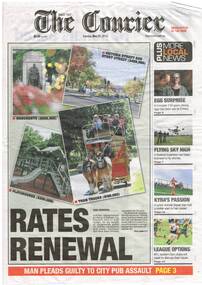 Ballarat Tramway Museum
Newspaper, The Courier Ballarat, "Rates Renewal", 27/05/2014 12:00:00 AM
... Includes a photograph of the horse tram in Wendouree Parade on page 1...BTM Museum City Of Ballarat Wendouree Parade Trackwork Newspaper clipping from The Courier, Friday 27/5/2014, pages 1, 4 and 5 about the renewal of City of Ballarat Infrastructure and the Council rates proposals. Included $100,000 for renewal of tram tracks. Includes a photograph of the horse ...Newspaper clipping from The Courier, Friday 27/5/2014, pages 1, 4 and 5 about the renewal of City of Ballarat Infrastructure and the Council rates proposals. Included $100,000 for renewal of tram tracks. Includes a photograph of the horse tram in Wendouree Parade on page 1btm, museum, city of ballarat, wendouree parade, trackwork -
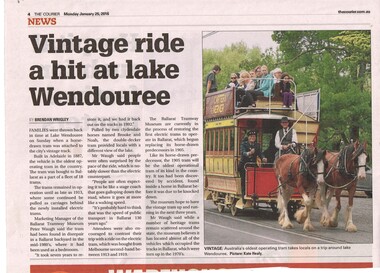 Ballarat Tramway Museum
Newspaper, The Courier Ballarat, "Vintage ride a hit at lake Wendouree", 25/01/2016 12:00:00 AM
... Newspaper clipping from The Courier, Monday 25/1/2016, titled "Vintage ride a hit at lake Wendouree" in an item reporting the BTM's operation of the horse tram in Wendouree Parade the previous day. Quotes Peter Waugh as Marketing Manager. ...Horse Tram BTM Events Newspaper clipping from The Courier, Monday 25/1/2016, titled "Vintage ride a hit at lake Wendouree" in an item reporting the BTM's operation of the horse tram in Wendouree Parade the previous day. Quotes Peter Waugh as Marketing Manager. ...Newspaper clipping from The Courier, Monday 25/1/2016, titled "Vintage ride a hit at lake Wendouree" in an item reporting the BTM's operation of the horse tram in Wendouree Parade the previous day. Quotes Peter Waugh as Marketing Manager. Item written by Brendan Wrigley, photo Kate Healy with Len Millar on the brake.horse tram, btm, events -
 Warrnambool and District Historical Society Inc.
Household, Ceremonial Regalia, 1930s
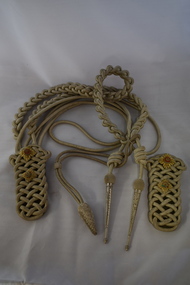
... Charles Rogers was a well-known Warrnambool identity in the 1930s, 40s and 50s as a horseman and Army identity and he and his horse frequently led parades and celebrations in the city. ...Charles Rogers was a well-known Warrnambool identity in the 1930s, 40s and 50s as a horseman and Army identity and he and his horse frequently led parades and celebrations in the city. ...This ceremonial regalia belonged to Captain Charles Rogers of the Australian Army (Light Horse Regiment). He wore this regalia when he was part of the mounted Guard of Honour during the visit of the Duke of Gloucester in 1934. The visit was part of Victoria’s Centenary celebrations and the Duke officially opened the Melbourne Shrine of Remembrance. Charles Rogers was a well-known Warrnambool identity in the 1930s, 40s and 50s as a horseman and Army identity and he and his horse frequently led parades and celebrations in the city. He was a long-serving Warrnambool Agricultural Show official as a judge of equine events. Rogers died in 1961. These items are of great interest as examples of the regalia worn by Australian military personnel in the 1930s. They are also good mementos of Charles Rogers, a notable personality in Warrnambool in the 1930s, 40s and 50s.1 This is a piece of ceremonial regalia worn over the shoulder and called an aigullette. It has a plaited silver-coloured cord ending in silver metal tagged points. The metal points or stakes are highly decorated. The cords also have an accompanying smaller silver-coloured cord and another attachment of cord with an end of interwoven material in the shape of an elongated pear or acorn. The item is a little tarnished. .2 These are epaulettes worn on the shoulder. One is attached to the aigullette and the other is detached. They are made of silver plaited cord with a brown felt backing and have two star-shaped gold and yellow badges indicating the rank captain charles rogers, duke of gloucester visit, centenary of victoria, history of warrnambool -
 Ballarat Tramway Museum
Ephemera - Ticket/s, Milldean Press, BTM Horse tram tickets, c2014
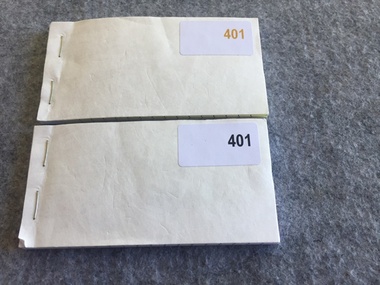
... Has a photo of the horse tram in Wendouree Parade on the rear. .1 - Adult - white paper numbered 401 to 420 .2 - Concession - yellow paper, numbered 401 to 420...Has a photo of the horse tram in Wendouree Parade on the rear. .1 - Adult - white paper numbered 401 to 420 .2 - Concession - yellow paper, numbered 401 to 420 BTM Horse tram tickets Ephemera Ticket/s Milldean Press ...Two block of tickets for use on the horse tram produced c2014, by Milldean Press for the BTM. Printed on a light weight card, in an all universal date style, stapled in blocks of 20 with white paper on the front, card board back. Has a photo of the horse tram in Wendouree Parade on the rear. .1 - Adult - white paper numbered 401 to 420 .2 - Concession - yellow paper, numbered 401 to 420trams, tramways, btm, tickets, horse tram -
 Ballarat Tramway Museum
Photograph - Colour Print/s - set of 7, Carolyn Cleak, 15/01/2012 12:00:00 AM
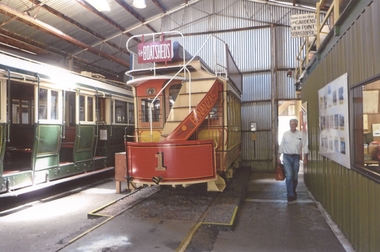
... Set of seven colour photographs taken by Carolyn or Graeme Cleak on 15/1/2012 of the depot and No. 33 in Wendouree Parade. .1 - Horse Tram with Peter Winspur walking alongside .2 - No. 8 on No. 5 road with tower truck in background .3 - No. 661 on No. 4 road .4 - No. 26 on No. 5 road .5 - No. 671 on No. 3 road .6 - No. 33 at Carlton St terminus .7 - No. 33 at St Aidans Driver terminus. ...Set of seven colour photographs taken by Carolyn or Graeme Cleak on 15/1/2012 of the depot and No. 33 in Wendouree Parade. .1 - Horse Tram with Peter Winspur walking alongside .2 - No. 8 on No. 5 road with tower truck in background .3 - No. 661 on No. 4 road .4 - No. 26 on No. 5 road .5 - No. 671 on No. 3 road .6 - No. 33 at Carlton St terminus .7 - No. 33 at St Aidans Driver terminus. ...Yields information about the BTM Tram fleet and operations in Jan. 2012.Set of seven colour photographs taken by Carolyn or Graeme Cleak on 15/1/2012 of the depot and No. 33 in Wendouree Parade. .1 - Horse Tram with Peter Winspur walking alongside .2 - No. 8 on No. 5 road with tower truck in background .3 - No. 661 on No. 4 road .4 - No. 26 on No. 5 road .5 - No. 671 on No. 3 road .6 - No. 33 at Carlton St terminus .7 - No. 33 at St Aidans Driver terminus. Printed on Fujichrome Crystal Archive paper.On rear of each photograph is date "15.1.12" and who the photo taken by in ink.trams, tramways, btm, depot, wendouree parade, carlton st, st aidans drive, tram 33, tram 1, tram 26, tram 8, tram 671, tram 661 -
 Ballarat Tramway Museum
Domestic Object - Fridge Magnet, Ballarat Tramway Museum (BTM), Jan. 2018
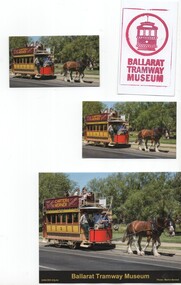
... Set of three souvenir items printed for the 2018 operation of the Horse Tram, Jan 2018. .1 - Postcard with a photo by Martin Bennet, of the horse tram in Wendouree Parade, near Fairyland. 2017. ...Trams tramways BTM Sales Souvenirs Set of three souvenir items printed for the 2018 operation of the Horse Tram, Jan 2018. .1 - Postcard with a photo by Martin Bennet, of the horse tram in Wendouree Parade, near Fairyland. 2017. Has museum name contact and photographer's name. ...Set of three souvenir items printed for the 2018 operation of the Horse Tram, Jan 2018. .1 - Postcard with a photo by Martin Bennet, of the horse tram in Wendouree Parade, near Fairyland. 2017. Has museum name contact and photographer's name. Plain back. .2 - Card with the same photograph, no details with or without the red Museum stamp on the rear. .3 - Fridge magnet with the same photograph. Carl Mahoney as the brakeman, Alan Bradley (in sunnies) as a passenger and Arthur Adams as the upstairs conductor.trams, tramways, btm, sales, souvenirs -
 Ballarat Tramway Museum
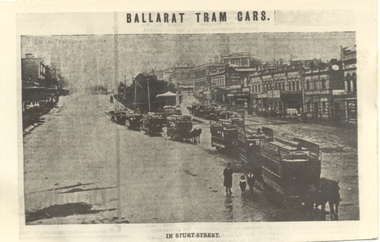
Photograph - Ballarat - line up of horse trams Sturt St, The Bendigonian, Mar. 1903
... Appears that this photo was taken on the same day as the group of horse trams in Wendouree Parade to show the directors of ESCo what they owned. ...Appears that this photo was taken on the same day as the group of horse trams in Wendouree Parade to show the directors of ESCo what they owned. ...Photograph of a line of horse trams in Sturt St at Grenville. Photo copied by Keith Kings from the "The Bendigonian" 31-3-1903. Keith Kings No. SA 276. Appears that this photo was taken on the same day as the group of horse trams in Wendouree Parade to show the directors of ESCo what they owned. See Reg Item 800. Note the group of horse trams and other objects on the north side of Sturt St in the background. Original print made by Keith Kings. .1 - copy print made by Keith Kings. (see image i3 and i4)Yields information about the trams and horses owned by the Ballaarat Tramway Co.Digital image from the Wal Jack Ballarat Album trams, tramways, horse trams, sturt st, esco, ballaarat tramway company -
 Bendigo Historical Society Inc.
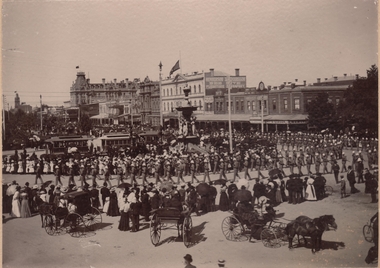
Photograph - QUEEN VICTORIA MEMORIAL PROCESSION IN PALL MALL BENDIGO
... Commemorative service for death of Queen Victoria, early 1901, which was held in Rosalind Park following parade. Three horse drawn vehicles are in the foreground. ...Commemorative service for death of Queen Victoria, early 1901, which was held in Rosalind Park following parade. Three horse drawn vehicles are in the foreground. ...Black and white photograph showing Pall Mall with Beehive Building, Shamrock Hotel, Alexandra Fountain. Military parade. Crowd watching, some in horse drawn vehicles. Trams at Fountain. Flags at half mast. Commemorative service for death of Queen Victoria, early 1901, which was held in Rosalind Park following parade. Three horse drawn vehicles are in the foreground. One building has Henderson & Doolsson Furniture & Drapery painted on the side. There are two copies, the original glued on cardboard, the other in a black paper folder.bendigo, streetscape, pall mall -
 Ballarat Tramway Museum
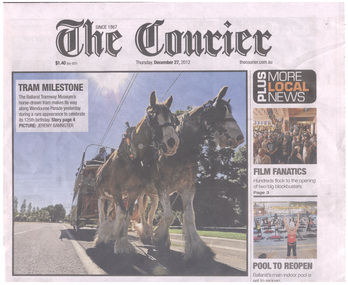
Newspaper, The Courier Ballarat, "Tram Milestone", "Still the number one", 27/12/2012 12:00:00 AM
... Horse Tram... BTM... 125 years... Wendouree Parade... - Front page has the title "Tram Milestone", with a photograph of horse tram in Wendouree Parade, north end. Photo by Jeremy Bannister. ... - Front page has the title "Tram Milestone", with a photograph of horse tram in Wendouree Parade, north end. Photo by Jeremy Bannister. ...Yields information about the 125th anniversary celebrations of the opening of Ballarat Tramways by the Ballarat Tramway Museum.Newspaper clippings from The Courier, 27/12/2012 about the operation of the horse tram on Box Day, 2012, to celebrate 125 years since the opening of the tramways in Ballarat by the BTM. - Front page has the title "Tram Milestone", with a photograph of horse tram in Wendouree Parade, north end. Photo by Jeremy Bannister. Refers to the story on page 4. - Page 4 - title "Still the number one", with a photo by Jeremy Bannister, with horse master Bruce Hill with Clydesdales Katie and Hank at the pick up point and Mia May enjoying the experience. Story written by Fiona Henderson quotes Richard Gilbert, about the event.horse tram, btm, 125 years, wendouree parade -
 Ballarat Tramway Museum
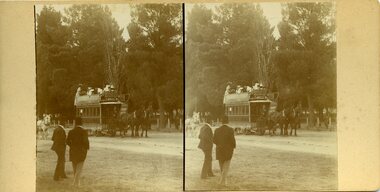
Photograph - Stereo Pair, Rose Stereograph Co, 7 window horse tram, c1900
... Stereo pair of photos, black and white, of a 7 window horse tram in Wendouree Parade, possibly near Windmill Drive, Nth end, mounted on heavy card. ...Stereo pair of photos, black and white, of a 7 window horse tram in Wendouree Parade, possibly near Windmill Drive, Nth end, mounted on heavy card. ...Yields information about the seven window horse tram and passengers and streetscape in the gardens at the time. Only known photograph of this type of tramcar.Stereo pair of photos, black and white, of a 7 window horse tram in Wendouree Parade, possibly near Windmill Drive, Nth end, mounted on heavy card. Photographed and published by Geo Rose. Has many lady passengers on the top deck of the tramcar. Tram has the destination of "Boatsheds". Possibly around 1900. Only known photo as at 2/96 of these seven 7 window horse tram in Ballarat. For a print of one of these photos - see Reg. Item 258. Was borrowed and returned 5/18 by Bob Carmichael, Stereograph collector, PO Box 1349, Ballarat Mail Centre, 0418 528 270, George Rose Specialist. Use print - Reg. No. 258 for displayIn ink on rear "Horse Tram at Botanical Gardens Ballarat Vic."trams, tramways, ballaarat tramway company, horse trams, 7 window horse tram, gardens, stereo photograph -
 Ballarat Tramway Museum
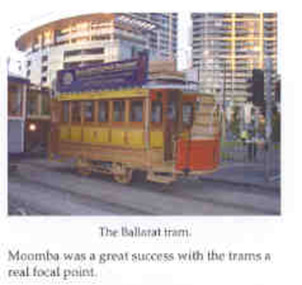
Memorabilia - Event Materials, Arts Project Vic, Melbourne Moomba Trams on Parade, 1/04/2002 12:00:00 AM
... Also sheet listing trams in Parade (black and white), Assembly information, and a plan of the tram assembly area showing the location of the various display trams. .2 - Colour A4 sheet of the trams on parade in order of appearance and details of the street party that followed. .3 - Photocopy of a letter from the organisers (Arts Projects Australia) thanking the BTM for participating. .4 - Copy of National Express Group company newsletter for Week 11, 15/3/2002, titled "Weekly Update" with a photograph of the horse tram in the parade with the South Melbourne skyline in the background. ...Also sheet listing trams in Parade (black and white), Assembly information, and a plan of the tram assembly area showing the location of the various display trams. .2 - Colour A4 sheet of the trams on parade in order of appearance and details of the street party that followed. .3 - Photocopy of a letter from the organisers (Arts Projects Australia) thanking the BTM for participating. .4 - Copy of National Express Group company newsletter for Week 11, 15/3/2002, titled "Weekly Update" with a photograph of the horse tram in the parade with the South Melbourne skyline in the background. ...Set of papers collected for the archives relevant to the visit of BTM Horse Tram No. 1 for the 2002, Melbourne Moomba trams on Parade. .1 - "Call Sheet" - four A4 sheets, giving details of the participant, times, assembly area, parking, contact and notes. Also sheet listing trams in Parade (black and white), Assembly information, and a plan of the tram assembly area showing the location of the various display trams. .2 - Colour A4 sheet of the trams on parade in order of appearance and details of the street party that followed. .3 - Photocopy of a letter from the organisers (Arts Projects Australia) thanking the BTM for participating. .4 - Copy of National Express Group company newsletter for Week 11, 15/3/2002, titled "Weekly Update" with a photograph of the horse tram in the parade with the South Melbourne skyline in the background. See pdf file for full copy.trams, tramways, moomba, trams on parade, melbourne, btm -
 Federation University Historical Collection
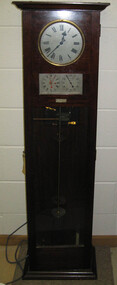
Object, Synchronome Co. Ltd, Synchronome Frequency Checking Master Clock No. 2191, c1930
... horse drawn to DC electricity. The use of electricity increased with the main power station located on Wendouree Parade, near Webster Street, under the ownership of The Electric Supply Company of Victoria. ...horse drawn to DC electricity. The use of electricity increased with the main power station located on Wendouree Parade, near Webster Street, under the ownership of The Electric Supply Company of Victoria. ...Information from Norman F. Dalton: Ballarat had a reticulated DC supply in the early part of last century and in 1905 had sufficient generating capacity to enable the trams to be changed from horse drawn to DC electricity. The use of electricity increased with the main power station located on Wendouree Parade, near Webster Street, under the ownership of The Electric Supply Company of Victoria. AC generating plant was installed in 1925 and conversion to AC proceeded. In 1934 the company was taken over by the State Electricity Commission Victoria (SECV) and more AC generation was installed and the changeover of customers was accelerated. This is around the time that the Synchronome Frequency Checking Mast Clock was installed at the Wendouree Parade Power Station. The SECV Annual Report of 1921 states: ::Section 11 of the act directed the COmmission to enquire into the question of securing the adoption of such standards of plant and equipment of a system, frequency and pressure for the generation and distribution of electricity as will admit of the efficient interconnection of undertakings throughout the State. In 1934 when the SECV took over the Ballarat operations the question of linking with the State grid had been a planned operation for some years but due to financial considerations had hindered it and in fact would continue to do so for a further 10 years. So while the need for close frequency control for interconnection was hardly an issue, the need to keep electric clocks correct was important, particularly as this item was a frequent sales point to cover the inconvenience and sometimes expense of converting from DC to AC. The clock is a very accurate pendulum clock with provision for varying effective length during operation for precise time regulation. There are two normal time dials and one is controlled by the pendulum and the other is operated by the system frequency. When the clock was in use it was installed by the MEter and Tests Laboratory and the time was checked daily by radio time signals. The two dials were repeated in the operators control panel in the Power Station. A maximum deviation between the two dials was set in the operating instructions (eg 5 seconds) and the operator would correct this when necessary by remote manual alteration of the turbine governor set point. The clock was used to drive and regulate a system of "slave" clocks which were used to display the time in various locations around the power station. A slave clock is a simple clock which is driven by a small electric motor, its accuracy is regulated by the master clock every 30 seconds to ensure that it and all the other slave clocks in the station are on exactly the right time; slave clocks were placed in various locations, from common rooms to workshops. A master clock could potentially run thousands of slave clocks at one plant. The clock also contains a rectifier. A rectifier is a device that is used to convert AC power to more stable DC current.Two clocks in a timber case. Both are electric, one is powered by the main pendulum mechanism, the other is a self contained electric clock. The main mechanism is of the gravity arm and roller type, which sends an impulse to the slave clocks every 30 seconds. The This Synchronome Frequency Checking Master Clock was used at the Ballarat Power Station. Below the main section of the case is a smaller cabinet containing a rectifier to provide consistent DC power for the clock. The rectifier was made by the Victorian company Hilco, which was located in Burwood. There is a high chance this is not the original rectifier from this clock as there appears to be brackets to hold a larger device in the space the rectifier occupies.Front below main clock face on front of case: "Patented Sychronome Brisbane" Lower left-hand clock face: "Frequency time" Lower right-hand clock face: "Standard Seconds" Synchronous electric clock mechanism on door (Frequency time clock): >200/250 V. 50~ >"Synchronomains" Made in England >Direction indicator for clock starting switch >"To start move lever in direction of arrow and release" >"Patent applied for" Mechanism for "standard seconds" clock: >"English Made" >"Patented" >Serial number "321" >0 above right-hand pillar on front-plate Mechanism for "standard seconds" clock: >"English Made" >"Patented" >Serial number "321" >0 above right-hand pillar on front-plate Mechanism for main clock face: >"English Made" >"Patented" >Serial number "8751" >0 above right-hand pillar on front-plate Inside case, back panel, top enamel plate: >Seconds Battery + Pos. > Battery Common or - Neg. >1/2 min dials Inside case, back panel, bottom enamel plate: external seconds dial Inside case, right hand side, electrical knobs: two switches, both "A.C. mains" Pendulum rod, below suspension spring: Serial number (?) 0000005 Rectifier in bottom cabinet: >"Hilco Rectifier" >"A.C. Volts 230/240" >"Model 1060/S" >"A.C. Amperes" >"Serial No. 1060/S >"Phases 1" >"D.C. Volts 6" >"C.P.S. 50" >"D.C. Amperes 1" >"Made in Australia by Hilco Transformers McIntyre St., Burwood, Victoria." Bakelite electrical plug: makers mark Lower cabinet, RH side panel, pressed tin plate: "AC" (upside down) Brass speed adjustment, outer right RH side: "S" and "F" Ivory and wood pendulum beat ruler: >Ruler, with 0 in centre and numbers 1-5 in ascending order from centre on left and right. > "Synchronome Patent." Steel plate, back panel, inside case, right hand side: >N R A" (descending) >"2191" serial number/part number Face of main clock: "Synchronome Electric" synchronome frequency checking master clock, electricity, state electricity commission, wendouree parade power station, secv, clock, time, pendulum, electric supply company of victoria, norman f. dalton, ballarat power station, rectifier, slave clock -
 Federation University Historical Collection
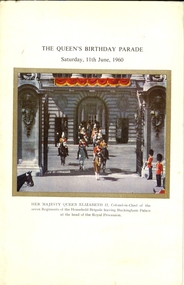
Booklet, Gale & Polden Ltd, The Wellington Press, The Queen's Birthday Parade, 1960, June 1960
... horse at the head of the Royal Procession. On page 18 is the Programme of Music showing a piece written by Frank Wright, "Whitehall". The booklet is for the Queen's Birthday Parade...The Frank Wright Medal at the Royal South Street competition is awarded to an individual recognized as making an outstanding contribution to brass music in Australia. queen elizabeth ii queens birthday parade trooping the colour frank wright whitehall royalty Printed 20 page booklet with black type and with some coloured and some black and white photographs. The cover photograph shows Queen Elizabeth II leaving Buckingham Palace on her horse at the head of the Royal Procession. ...Frank Wright was a renown resident of Smeaton, where he was born. He lived at Laura Villa, and attended Smeaton State School. His father William was a gold miner and his mother's name was Sarah. Their family won many singing and instrumental awards. Frank was tutored by Percy Code and was awarded a gold medal for the highest marks in the ALCM examinations in the British Colonies at the age of seventeen years. He became the Australian Open Cornet Champion by the age of eighteen. A year later, Frank conducted the City of Ballarat Band, and later the Ballarat Soldiers’ Memorial Band. He formed the Frank Wright Frisco Band and Frank Wright and his Coliseum Orchestra. These bands won many South Street awards, and Frank as conductor won many awards in the Australian Band Championship contest. In 1933 Frank Wright sailed to England to conduct the famous St Hilda’s Band and was appointed in 1934 as the Musical Director of the London County Council (the GLC or Greater London Council), where he organized many amazing concerts in most of the 150 parks, in and around the London district. He was also responsible for some of London’s major concerts at Kenwood, the Crystal Palace and Holland Park. He was made Professor of Brass and Military Band Scoring and Conducting and was a Fellow of the Guildhall School of Music and Drama. Frank was often invited to adjudicate Brass Band Championships around Europe, in Australia, including South Street and in New Zealand. Frank was awarded an M.B.E. in 1967. The Frank Wright Medal at the Royal South Street competition is awarded to an individual recognized as making an outstanding contribution to brass music in Australia.Printed 20 page booklet with black type and with some coloured and some black and white photographs. The cover photograph shows Queen Elizabeth II leaving Buckingham Palace on her horse at the head of the Royal Procession. On page 18 is the Programme of Music showing a piece written by Frank Wright, "Whitehall". The booklet is for the Queen's Birthday Parade of 1960 and the Trooping of the Colour.queen elizabeth ii, queens birthday parade, trooping the colour, frank wright, whitehall, royalty -
 Lara RSL Sub Branch
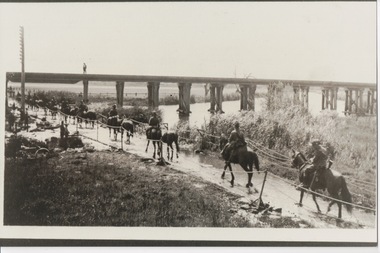
Photograph, Set 4 photographs. and others for Torquay Light Horse camp, 1940
... Six went over the cliff near Bird Rock, five were never found, and the rest were gathered up after nearly a fortnight in the bush around Addiscott and Anglesea" Light Horse, Training Camp, Torquay, WW2, Geelong Parade Geelong parade The training camp culminated in a parade through the streets of Geelong on March 12th 1940. ...Six went over the cliff near Bird Rock, five were never found, and the rest were gathered up after nearly a fortnight in the bush around Addiscott and Anglesea" Light Horse, Training Camp, Torquay, WW2, Geelong Parade Geelong parade The training camp culminated in a parade through the streets of Geelong on March 12th 1940. ...These images capture for all time Light Horsemen travelling through Geelong on their way to camp at Torquay for the last Group meeting in Australia . information following - details obtained from .........https://torquayhistory.com/light-horse-brigade/ On Australia Day, 1997, Sir John Young unveiled this plaque on Point Danger, Torquay. Torquay history, Light Horse Training Camp, WW2 Plaque at Pt. Danger Note----- (See images to view plaque) The plaque identifies a significant event in Torquay’s history and the sentiments of ‘change’ for the Light Horse Brigade – from horses to machines. In 1940 the four Light Horse Regiments (4th, 8th, 13th and 20th), some 5000 Light Horse and 2000 horses camped and trained at Torquay. Three other regiments, formerly mounted on horses, were also at Torquay ‘mounted’ on privately owned trucks and cars. Division troops included Artillery, Engineers, Signals, Field Ambulance and other branches of the Army necessary to enable a Division to function. It wasn’t just the sheer numbers of men coming to this little town that made the event significant, it was also the fact that the men of the Light Horse were dramatic, almost glamorous figures and it is easy to see their exploits as some splendid adventure. Horses have played a special role in the story of Australia. They were the only means of transport across this huge country, so it was necessary for everyone to have the ability to ride a horse. When war broke out in 1899 between Britain and the Boers of South Africa (“Boer” was Dutch for “farmer”) Australia sent troops to fight. At first Britain was wary of using untried, unprofessional colonial cavalrymen but soon saw that the slouch-hatted Australian “bushmen” were a match for the fast-moving and unconventional mounted commandos of the Boers. The Australians proved themselves to be expert rough-riding horsemen and good shots. Bush life had hardened them to go for long periods with little food and water. They also showed remarkable ability to find their way in a strange country and use its features for cover, in both attack and defence. By 1914, when Australia joined the war against Germany, there were 23 Light Horse regiments of militia volunteers. Many men from these units joined the Light Horse regiments of the Australian Imperial Force (AIF). Men were given remounts (if not using their own horses) – army horses bought by Commonwealth purchasing officers from graziers and breeders. These were called “walers” because they were a New South Wales stockhorse type – strong, great-hearted animals with the strains of the thoroughbred and semi-draught to give them speed, strength and stamina. On 1st November, 1914, Australia’s First Infantry Division and the first four Light Horse regiments sailed for England in a fleet of transport ships. The first of the Light Horse arrived at Gallipoli in May without their horses. Back with their horses after Gallipoli, they were formidable combatants across the Sinai and Palestine. Some British commanders observed that the light horseman moved with a “lazy, slouching gait, like that of a sleepy tiger” but described how the promise of battle “changes that careless gait, into a live athletic swing that takes him over the ground much quicker than other troops”. They had Light Horse, Torquay, training campdeveloped a reputation as formidable infantrymen. The Turks called them “the White Ghurkas” – a reference to their deadly skill with the bayonet. The Arabs called them “The Kings of the Feathers”. The plume had originally been a battle honour of the Queensland Mounted Infantry for their work in the shearer’s strike of 1891. During WW1 it was adopted by almost all the Light Horse Regiments. It was the proud badge of the light horseman. The most famous of their battles was the attack on Beersheba- the charge of the 4th Light Horse Brigade. Mounted infantrymen and their superb walers had carried out one of the most successful cavalry charges in history – against what seemed impossible odds. They surprised the Turks by charging cavalry-style, when they would normally have ridden close to an objective then dismounted to fight. The fall of Beersheba swung the battle tide against the Turks in Palestine; and changed the history of the Middle East. While 19 men from the Surf Coast Shire served with the 4th Light Horse over the course of WW1, only four were involved in the charge of Beersheba- John GAYLARD, Philip QUINN.(Winchelsea); Wallace FINDLAY (Anglesea); Harry TRIGG (Bambra). After the war, Light Horse units played a key role in the Australian Government’s compulsory military training programme. The Citizen Military Forces (C.M.F.) thrived on the glamour of the wartime Light Horse tradition, ignoring the possibility that motor vehicles would soon replace the horses. When training was no longer compulsory, the C.M.F. regiments declined and horses became more of a luxury during the 1930s depression years of poverty and unemployment. Some regiments were motorised. Then, in 1939, Australia joined Britain in another world war. Training was increased for the militia at both home bases and regional training camps. The camp at Torquay in 1940, commanded by Major General Rankin, was at Divisional strength. By the end of the camp some felt that the Division was ready for active service. Gradually, over the next four years, the Australian Light Horse units were mounted on wheels and tracks and the horses were retired. Six men enlisted at the Torquay camp and another 57 men and women enlisted at Torquay for service in WW2. Those who served in the Militia provided valuable Officers and NCOs and men for the armed services during the war. Each infantry division of the 2nd AIF had a Light Horse regiment attached to it. But the day of the Australian mounted soldier hadn’t quite passed. During World War II, Australia’s 6th Cavalry Regiment formed a mounted unit they called “The Kelly Gang” which did valuable scouting work. In New Guinea, a mounted Light Horse Troop did patrol duty and helped carry supplies. Some fully equipped walers were flown into Borneo for reconnaissance in rugged mountain country. But by the end of the war, in 1945, the horse had disappeared from the Australian Army. References: Australian Light Horse Association www.lighthorse.org.au National Australia Archives Australian War Memorial Surf Coast Shire WW1 memorials www.togethertheyserved.com The Light horse- a Cavalry under Canvas Light Horse, Training Camp, Torquay, WW2 Late in 1939 it was decided to set up a Lighthorse training camp in Torquay to train both men and horses for the battles of the Second World War. Horses, men and equipment came on special trains from all over Victoria and NSW, and as you would expect horseman came from areas such as Omeo and Sale, the Wimmera and the Western District. They arrived at the Geelong racecourse for watering in the Barwon River and then were ridden across the ford at the breakwater and began their 11 mile trek to Torquay. Light Horse, Training Camp, Torquay, WW2 Tent city By the end of January 1940 the camp at Torquay accommodated some 5000 men and 2500 horses of the Second Cavalry Division. The rows of horses, tents and huts near Blackgate Road were quite a sight. While the cavalrymen engaged in exercises on the land and on the beaches, many of the troops took over the Torquay School for special training of men and officers. Mr Bob Pettit local farmer and Councillor for the Barrabool Shire, wrote about the Light horse in the Surf Coast Community News in 1985 saying “They used to travel about the district riding four abreast in one long convoy. To my annoyance they went through my property and shut all the gates behind them. I had certain gates open to let stock in to the water holes and it would take me three -quarters of an hour to follow the horsemen up and put all the gates right again” he continued “the men from the Light Horse were here when the fire went through in March 1940. He recalled an incident when early one morning, as some one blew the bugle, a soldier putting a white sheet on the line frightened the horses. They panicked and ran off in all directions. Six went over the cliff near Bird Rock, five were never found, and the rest were gathered up after nearly a fortnight in the bush around Addiscott and Anglesea" Light Horse, Training Camp, Torquay, WW2, Geelong Parade Geelong parade The training camp culminated in a parade through the streets of Geelong on March 12th 1940. The salute was given at the Town Hall and the troops continued on a route to the You Yang’s for a training exercise. Note-----(see media section for photograph) The Camp was abandoned in mid 1940 as it was deemed unsuitable for training during winter and the cost of a permanent camp could not be justified if it could not be used all year. Historic.......Rare,,,Interpretive.Sepia photographs.set of four ....post card size ....Horses &LighthorsemenNo 1, Lighthorsemen Regiment Geelong 1940......No 2 Light Horse at Breakwater Geelong 1938 to 1940....No 3 Light Horse at Breakwater Geelong 1938 to 1940.....No 4 Light Horse crossing Breakwater camped at Geelong Showgrounds. These markings are on reverse of photographs.light horsemengeelong 1940., world war 2 -
 Lara RSL Sub Branch
Belt, Leather Belt
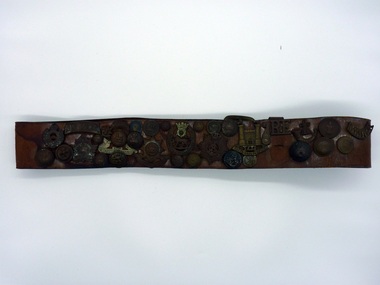
... All units at that time had horses on their establishment and those soldiers told off to attend them reported for Stable Parade in Stable Dress which consisted of very high waisted and pocket less breeches, or trousers, held up by braces and collarless, woollen flannel shirts with sleeves rolled up. ...All units at that time had horses on their establishment and those soldiers told off to attend them reported for Stable Parade in Stable Dress which consisted of very high waisted and pocket less breeches, or trousers, held up by braces and collarless, woollen flannel shirts with sleeves rolled up. ...This belt belonged to a WW1 Australian Anzac who most probably, because of the buttons and badges, served on the Western Front. Records destroyed in 1969 bush fires at Lara means we are unable to determine who owned this in the RSL. The belts is called a 'stable belt' and the one you have acquired is an early example with a leather pocket. It became common in WW1 for both, leather belts (especially that from the 1903 bandolier equipment as worn by those in the Boer War), and stable belts to be used to hold badges collected from fellow soldiers and for that reason it was often known as a 'souvenir belt'. The evolution of the stable belt: It seems that stable belts began to become popular across the Army as a whole around the turn of the 20th century, although they probably originated with the cavalry a little earlier sometime in the 1880s/1890s. All units at that time had horses on their establishment and those soldiers told off to attend them reported for Stable Parade in Stable Dress which consisted of very high waisted and pocket less breeches, or trousers, held up by braces and collarless, woollen flannel shirts with sleeves rolled up. This was to facilitate the rigorous physical effort and flexibility of movement necessary for mucking out and grooming. Braces at that time had no elastic as rubber was expensive, they were made of cotton with no 'give' whatsoever and so soldiers commonly allowed the braces to flop down from the waist so that they could bend over freely. For trousers that fitted loosely (due to the high waist) this meant that they tended to slip down and at first soldiers cinched them in with leather belts. Later on the regimental saddlers began to make belts from the same, plain canvas or wool strapping used for the horses Surcingle and utilising the same double leather strap and buckle arrangement for security (if one strap broke the other would hold and prevent the saddle from coming unseated). One particular feature of these early stable belts was a sewn on (or in) pocket, secured by a stud or clip, within which loose change could be kept, or a pocket watch, as there were no pockets in the breeches. As you might imagine these became very popular as the pocket was useful and the extra breadth afforded by the canvas strapping made them very comfortable. Around about the turn of the 20th century it began to be popular for officers to wear neckties in regimental colours both for sport and less formal, country dress. This habit probably began with the Queens Household troops and Line Cavalry, but quickly spread throughout the Army and it appears as if this use of regimental colours spread to the canvas or wool strapping used to make stable belts. For this reason the stable belts invariably followed the same colour scheme (but not always the same pattern arrangement) of regimental neck ties. This belt is an example of what Australian troops collected when on the Western Front during WW1 and when on leave.Leather Belt with 31 Badges and Buttons from WW1 attachedSee Mediaww1, world war 1, australian army, badges, button, belt, stable belt -
 Lara RSL Sub Branch
Belt, Webbing Belt
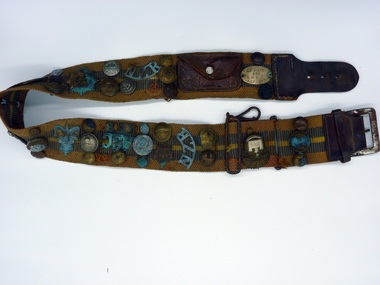
... All units at that time had horses on their establishment and those soldiers told off to attend them reported for Stable Parade in Stable Dress which consisted of very high waisted and pocket less breeches, or trousers, held up by braces and collarless, woollen flannel shirts with sleeves rolled up. ...All units at that time had horses on their establishment and those soldiers told off to attend them reported for Stable Parade in Stable Dress which consisted of very high waisted and pocket less breeches, or trousers, held up by braces and collarless, woollen flannel shirts with sleeves rolled up. ...This belt belonged to a WW1 Australian Anzac who most probably, because of the buttons and badges, served on the Western Front. Records destroyed in 1969 bush fires at Lara means we are unable to determine who owned this in the RSL. The belts is called a 'stable belt' and the one you have acquired is an early example with a leather pocket. It became common in WW1 for both, leather belts (especially that from the 1903 bandolier equipment as worn by those in the Boer War), and stable belts to be used to hold badges collected from fellow soldiers and for that reason it was often known as a 'souvenir belt'. The evolution of the stable belt: It seems that stable belts began to become popular across the Army as a whole around the turn of the 20th century, although they probably originated with the cavalry a little earlier sometime in the 1880s/1890s. All units at that time had horses on their establishment and those soldiers told off to attend them reported for Stable Parade in Stable Dress which consisted of very high waisted and pocket less breeches, or trousers, held up by braces and collarless, woollen flannel shirts with sleeves rolled up. This was to facilitate the rigorous physical effort and flexibility of movement necessary for mucking out and grooming. Braces at that time had no elastic as rubber was expensive, they were made of cotton with no 'give' whatsoever and so soldiers commonly allowed the braces to flop down from the waist so that they could bend over freely. For trousers that fitted loosely (due to the high waist) this meant that they tended to slip down and at first soldiers cinched them in with leather belts. Later on the regimental saddlers began to make belts from the same, plain canvas or wool strapping used for the horses Surcingle and utilising the same double leather strap and buckle arrangement for security (if one strap broke the other would hold and prevent the saddle from coming unseated). One particular feature of these early stable belts was a sewn on (or in) pocket, secured by a stud or clip, within which loose change could be kept, or a pocket watch, as there were no pockets in the breeches. As you might imagine these became very popular as the pocket was useful and the extra breadth afforded by the canvas strapping made them very comfortable. Around about the turn of the 20th century it began to be popular for officers to wear neckties in regimental colours both for sport and less formal, country dress. This habit probably began with the Queens Household troops and Line Cavalry, but quickly spread throughout the Army and it appears as if this use of regimental colours spread to the canvas or wool strapping used to make stable belts. For this reason the stable belts invariably followed the same colour scheme (but not always the same pattern arrangement) of regimental neck ties.This belt is an example of what Australian troops collected when on the Western Front during WW1 and when on leave.Webbing Belt with Badges and Buttons WW1See Mediaarmy, australian army, western front, aif, s.w.ellis, service number 640, 2 m.g.c., buttons, badges, belt, stable belt -
 Flagstaff Hill Maritime Museum and Village
Container - Horse trough, Annis & George Bills, circa Dec. 1932
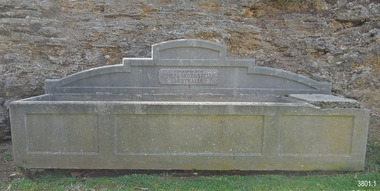
... This horse trough is the only survivor of the two troughs originally installed in Raglan Parade, Warrnambool, in 1932. ...This horse trough is the only survivor of the two troughs originally installed in Raglan Parade, Warrnambool, in 1932. ...This horse trough is the only survivor of the two troughs originally installed in Raglan Parade, Warrnambool, in 1932. It was later moved to the Pony Club at Albert Part, near the north corner of Coulstock and Craig Streets. Over the time there its purpose was changed from a horse watering trough to a colourful garden bed of agapanthus plants. By February 2013 the horse trough had been transferred to Flagstaff Hill for display in the Maritime Village’s grounds. This trough is one of hundreds provided by the Annis and George Bills Estate Trust since 1927 for the welfare of working horses and dogs. The original concrete cap over the small compartment is still retained. There are also markings on the right side of the trough where it probably had a birdbath, tap or a dish for the horseman’s dog, similar to other troughs donated elsewhere by the Trust. Less than half of the troughs produced for the Annis and George Bills Trust still survive. In 2017 Felicity Watson, National Trust Victoria’s advocacy manager, said that the troughs were treasures and becoming rare, with more than a dozen across Victoria now being heritage protected. ABOUT ANNIS AND GEORGE BILLS The 1927 Will of George Bills included setting up the Annis and George Bills Estate Trust, which provided for hundreds of horse troughs to be supplied and installed throughout Australia, Britain, USA and other parts of the world for the welfare of horses. Town and city councils could apply to the Trustees for a horse trough for their communities. George “Joe” Bills was born in Brighton, England, in 1859. The family migrated first to New Zealand then to Australia in 1873, settling in the Echuca-Moama district. George moved to Brisbane in 1882 where he met Annis Swann, formerly from Sheffield. Both were animal lovers. George and Annis married 1885 and moved to Sydney to join George’s brother Henry in his mattress wire weaving business, later known as the Bills Brothers. They patented their own machine in 1893 and the business became very profitable. George was able to donate to charities that supported his passion to improve animal welfare. He and Annis joined the Victorian Society for the Protection of Animals and in 1924 George received a Life Membership with the RSPCA. George retired in 1908. The couple moved to Hawthorn, Victoria, in 1910, where they donated troughs for the work horses of Melbourne. During a visit to England Annis passed away. In 1927 George moved from Hawthorn to Camberwell, where he passed away at the end of that year. George had requested in his Will that a trust fund be set up from his estate "…construct and erect and pay for horse troughs wherever they may be of the opinion that such horse troughs are desirable for the relief of horses and other dumb animals either in Australasia, in the British Islands or in any other part of the world subject to the consent of the proper authorities being obtained." The troughs were to bear a plaque inscribed “Donated by Annis and George Bills, Australia”. In 1927 the cost to make a trough was about £13 (which converts to about $1079 in 2020 ), plus transport and installation costs. Most of the troughs were installed between 1930 and 1939 in Victoria and New South Wales. It is estimated that over that time around 500-700 Bills Horse Troughs were installed in Australia and another 50 overseas. Most of the troughs made in Victoria had three moulded front panels like this trough, and no panels moulded on the rear, whereas troughs made in NSW had four panels on the front and five on the back. Victorian troughs were made by a Bills’ relative, J H Phillips. Later, other manufactures for the Trust’s troughs included Rocla Concrete Pipes Ltd, in Auburn Road, Hawthorn, Victoria, who produced to the same original design. No further troughs produced after the end of World War II. A memorial to Annis and George Bills was first erected in Hawthorn in 1929. It included a drinking fountain and a dog dish. Its current location is unknown. In 1964 the George Bills RSPCA Resource Centre opened in Burwood East. This Bills horse trough is nationally significant as one of the surviving examples of the standard Bills memorial horse troughs that still has its compartment cap and evidence of it once having had attached fittings, possibly for a birdbath or dog dish. This trough has State historical significance for being produced in the early 1930s by a business in Hawthorn, Victoria. This example of a Bills horse trough is significant for being in comparatively good condition. The trough is locally significant for being the sole survivor of the two Bills horse troughs installed in the City of Warrnambool in 1932, originally installed on Raglan Parade and continued to be used in the community at the Pony Club, then finally transferred to its current location at Flagstaff Hill by early 2013. It is culturally significant as it represents the community’s dependence on horses for travel and transportation previous to motorised vehicles. It is morally significant as a generous gift from a couple concerned with the welfare of animals.Horse trough; a long narrow rectangular container used for storing water. Trough is made from pre-cast concrete with one large open compartment and a small covered compartment. The base of the small compartment is raised slightly above the base of the trough and is covered by a removable concrete cap. The design of the front of the trough includes three panels moulded into it that align with the shape of the back pediment (panel). The pediment is shaped with side arcs that step up to a wide centre arc. A rectangular concrete plaque is cast into the centre of the pediment and is engraved with the names of the original donors, Annis and George Bills. The trough was made in Hawthorn, Victoria, by J H Phillips circa 1932. “DONATED BY / ANNIS & GEORGE BILLS / AUSTRALIA”flagstaff hill, warrnambool, shipwrecked coast, flagstaff hill maritime museum, maritime museum, shipwreck coast, flagstaff hill maritime village, great ocean road, annis and george bills, bills trust, j h phillips, rocla concrete pipes ltd, hawthorn, water trough, watering trough, horse trough, animal welfare, bills horse trough -
 Flagstaff Hill Maritime Museum and Village
Equipment - Foot Grip, Frank McDowell, Early 20th century
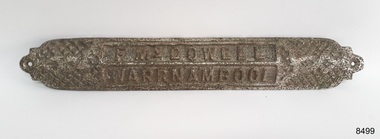
... His workshop was on the corner of Cramer Street and Raglan Parade in Warrnambool., previously the site of Fotheringhams, and after McDowell's, and still in 2023, occupied by Reece Plumbing Fred's workplace prior to retiring was at Bryant & Waterson's in Kepler Street, opposite the Criterian Hotel, making rubber tyred horse-driven farm wagons....His workshop was on the corner of Cramer Street and Raglan Parade in Warrnambool., previously the site of Fotheringhams, and after McDowell's, and still in 2023, occupied by Reece Plumbing Fred's workplace prior to retiring was at Bryant & Waterson's in Kepler Street, opposite the Criterian Hotel, making rubber tyred horse-driven farm wagons. ...This foot grip was made and owned by Frederick William McDowell (Fred) (1880 to 15-6-1967). It would be been joined to the stafe or frame of a jinker and used to step up from the ground and onto the seat. He was a wheelwright by trade. He made and repaired vehicles such gigs, buggies, jinkers, sulkeys, spring carts and farm wagons. His workshop was on the corner of Cramer Street and Raglan Parade in Warrnambool., previously the site of Fotheringhams, and after McDowell's, and still in 2023, occupied by Reece Plumbing Fred's workplace prior to retiring was at Bryant & Waterson's in Kepler Street, opposite the Criterian Hotel, making rubber tyred horse-driven farm wagons.This jinker's foot grip id part of a jinker or two-wheeled carriage. It is a rare item, made by a local wheelwright Frank McDowell who operated his buggy making and repair business in Warrnambool's CBD in the early twentieth century. It is an example of the equipment used on horse-drawn vehicles for safety and convenience.Foot grip, iron with silver plate finish. Rectangular metal plate with textured crossed over diagonal lines on the top surface and inset rectangles with impressed text. the curved and shaped ends have a drilled round hole. the length of the plate is an inverted 'v' shape towards the base. Made by F. McDowell, Warrnambool."F McDOWELL" "WARRNAMBOOL"flagstaff hill, warrnambool, flagstaff hill maritime museum, maritime museum, shipwreck coast, flagstaff hill maritime village, great ocean road, fred mcdowell, frederick mcdowell, wheelwright, gig, buggy, jinker, sulkey, spring cart, farm wagon, 2-wheeled cart, horse cart, horse cart parts, jinker buggy, transport, vehicle, horse drawn, horse jinker, bryant & waterson, jinker part, jinker foot grip, step, foot plate, horse cart part, stafe, 2-wheeled carriage -
 City of Moorabbin Historical Society (Operating the Box Cottage Museum)
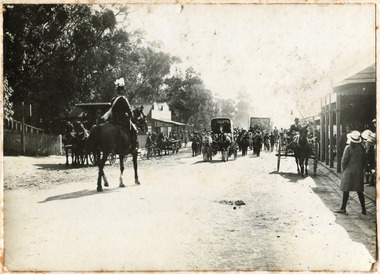
Photograph - Photograph, G.T Allnutt leading off the 1916 Easter Carnival, G.T Allnutt leading off the 1916 Easter Carnival, c1900
... Allnutt, in uniform, and on horseback, is leading the parade down Charman Road, from the Cheltenham Temperance Hall, where the parade commenced, to the Mentone Recreation Ground. 1916 easter carnival g.t. allnutt horseback temperance hall mentone mentone recreation ground charman road parade cheltenham horses Photo mount ; Charman Rd Early 1900 / Cheltenham A black and white photograph. ...This photograph is of the 1916 Easter Carnival. G.T. Allnutt, in uniform, and on horseback, is leading the parade down Charman Road, from the Cheltenham Temperance Hall, where the parade commenced, to the Mentone Recreation Ground.A black and white photograph. G.T Allnutt is riding on his horse along the Charman road from Cheltenham on the left of this photograph. There are several people along the Charman road with also 5 horse carriages and a marching band. You can see in this photograph that there are a few shops on either side of the road, such as a shop called Tobacconist, which is on the left. Photo mount ; Charman Rd Early 1900 / Cheltenham 1916, easter carnival, g.t. allnutt, horseback, temperance hall, mentone, mentone recreation ground, charman road, parade, cheltenham, horses -
 City of Moorabbin Historical Society (Operating the Box Cottage Museum)
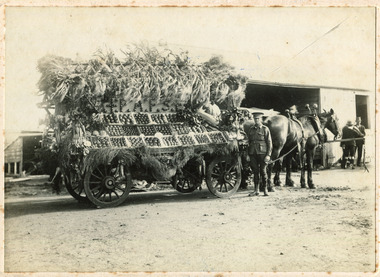
Photograph, Black & White, Fruit & Vegetable display Float Easter Parade c1917, c1916
... .; bent thomas, o'shannassy john, king richard, charman stephen, highett william, ormond francis, maynard dennis, market gardeners, vineyards, orchards Handwritten ; Decorated wagon possibly part of a procession of market gardeners carts Black & White photograph of a horse drawn wagon displaying Fruit and Vegetables for a procession c 1916 Photograph, Black & White, Fruit & Vegetable display Float Easter Parade c1917 ...The Friendly Societies Carnival at Mentone 1916 during WW1 was arranged to showcase the local activities and raise funds for the 'Discharged Wounded Soldiers Fund' = £140 was raised. As elsewhere in Australia most of the local young men had enlisted in the AIF and some were coming home wounded - many were killed on overseas battlefields. This Parade was led by the Cheltenham Brass Band with the following Friendly Societies AOF, IOR, HACBS, PAFS, and ANA. The PAFS - Protestant Alliance Friendly Society - had 2 entries 'Fruit & Vegetable Display' and 'The Murder of Nurse Edith Cavell' both floats won their category. The Carnival gave prizes for sports events on the Mentone Oval and a concert was held at night at the Mentone Ice Skating Rink.World War 1 1914-1918 had a devastating impact on many early settler families whose sons had volunteered to serve in AIF. 1916 many of these young men were returning injured or had been killed overseas The Community rallied around to support these men and their families by holding fund raising events like the CarnivalBlack & White photograph of a horse drawn wagon displaying Fruit and Vegetables for a procession c 1916Handwritten ; Decorated wagon possibly part of a procession of market gardeners cartsfriendly societies cheltenham 1916, nurse edith cavell, cheltenham brass band 1916, ww1 1914-1918, wounded soldiers fund, allnutt ella, smith j l; smith mary ann, stanley helen, smith vic, chaff cutter, horse drawn carts, toll gates brighton, motor cars 1900, steam engines, early settlers, bentleigh, mckinnon, parish of moorabbin, city of moorabbin, county of bourke, moorabbin roads board, shire of moorabbin, henry dendy's special survey 1841, were j.b.; bent thomas, o'shannassy john, king richard, charman stephen, highett william, ormond francis, maynard dennis, market gardeners, vineyards, orchards
