
Showing 1542 items matching "handmade."
-
 Kew Historical Society Inc
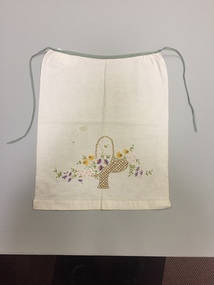
Clothing - Hand-Embroidered Cotton Apron, 1945-1955
... While the collection includes some examples of international fashion, most items were handmade or purchased in Melbourne. ...While the collection includes some examples of international fashion, most items were handmade or purchased in Melbourne. clothing - women's aprons protective wear fashion design fashion -- 1940s Rectangular white cotton apron, hand embroidered with a design of a basket of flowers. ...The Fashion & Design collection of Kew Historical Society includes examples of women’s, men’s, children’s and infants' clothing from the 18th, 19th and 20th centuries. While the collection includes some examples of international fashion, most items were handmade or purchased in Melbourne. Rectangular white cotton apron, hand embroidered with a design of a basket of flowers. The apron may be created from a Semco pattern.clothing - women's, aprons, protective wear, fashion design, fashion -- 1940s -
 Kew Historical Society Inc
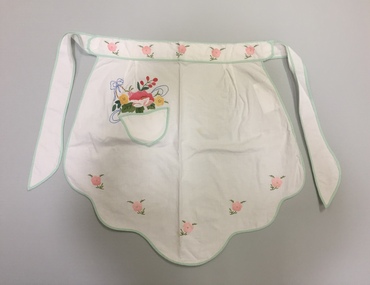
Clothing - Appliqued Apron, 1960s
... While the collection includes some examples of international fashion, most items were handmade or purchased in Melbourne. ...While the collection includes some examples of international fashion, most items were handmade or purchased in Melbourne. clothing - women's aprons fashion & design collection - kew historical society protective wear fashion design fashion -- 1960s White cotton apron decorated with machine embroidery and appliqué. ...The Fashion & Design collection of Kew Historical Society includes examples of women’s, men’s, children’s and infants' clothing from the 18th, 19th and 20th centuries. While the collection includes some examples of international fashion, most items were handmade or purchased in Melbourne. White cotton apron decorated with machine embroidery and appliqué. The apron is a commercially created item produced in China for the European market. clothing - women's, aprons, fashion & design collection - kew historical society, protective wear, fashion design, fashion -- 1960s -
 Kew Historical Society Inc
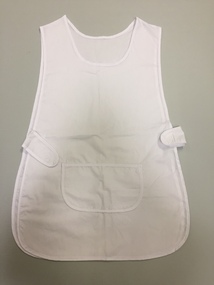
Clothing - White Cotton Pinafore, 1960s
... While the collection includes some examples of international fashion, most items were handmade or purchased in Melbourne....While the collection includes some examples of international fashion, most items were handmade or purchased in Melbourne. clothing - women's aprons protective wear White cotton apron, covering clothing front and back and joined by two buttoned tabs. ...The Fashion & Design collection of Kew Historical Society includes examples of women’s, men’s, children’s and infants' clothing from the 18th, 19th and 20th centuries. While the collection includes some examples of international fashion, most items were handmade or purchased in Melbourne.White cotton apron, covering clothing front and back and joined by two buttoned tabs. Based on an examination of the sewing it is presumed that it is a hand-made item.clothing - women's, aprons, protective wear -
 Kew Historical Society Inc
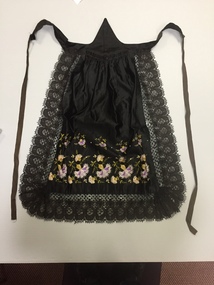
Clothing - Embroidered Cotton & Lace Hostess Apron, 1960s
... While the collection includes some examples of international fashion, most items were handmade or purchased in Melbourne....While the collection includes some examples of international fashion, most items were handmade or purchased in Melbourne. clothing - women's aprons protective wear fashion design fashion -- 1960s Black silk hostess apron embroidered with sprays of flowers using multi-coloured silk thread. ...The Fashion & Design collection of Kew Historical Society includes examples of women’s, men’s, children’s and infants' clothing from the 18th, 19th and 20th centuries. While the collection includes some examples of international fashion, most items were handmade or purchased in Melbourne.Black silk hostess apron embroidered with sprays of flowers using multi-coloured silk thread. The apron is bordered by black commercial lace. Based on an examination of the embroidery, it has been deemed to be a commercially produced item made in India.clothing - women's, aprons, protective wear, fashion design, fashion -- 1960s -
 Kew Historical Society Inc
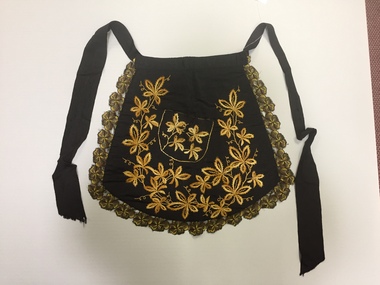
Clothing - Embroidered Hostess Apron, 1950s
... While the collection includes some examples of international fashion, most items were handmade or purchased in Melbourne....While the collection includes some examples of international fashion, most items were handmade or purchased in Melbourne. clothing - women's aprons protective wear fashion design fashion -- 1950s Black hostess apron embroidered with sprays of leaves using orange and yellow silk thread. ...The Fashion & Design collection of Kew Historical Society includes examples of women’s, men’s, children’s and infants' clothing from the 18th, 19th and 20th centuries. While the collection includes some examples of international fashion, most items were handmade or purchased in Melbourne.Black hostess apron embroidered with sprays of leaves using orange and yellow silk thread. The apron is bordered by commercial guipure lace. The apron is backed by the same black fabric. While the leaves are embroidered on the upper layer only, the pocket is embroidered on/through both layers.clothing - women's, aprons, protective wear, fashion design, fashion -- 1950s -
 Kew Historical Society Inc
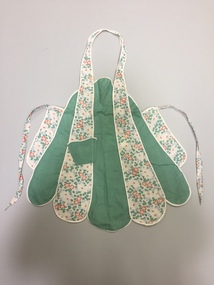
Clothing - Cotton Pinafore, 1950s
... While the collection includes some examples of international fashion, most items were handmade or purchased in Melbourne....While the collection includes some examples of international fashion, most items were handmade or purchased in Melbourne. clothing - women's aprons protective wear fashion design fashion -- 1950s Cotton apron comprised of scalloped panels of plain green and white floral patterned fabric. ...The Fashion & Design collection of Kew Historical Society includes examples of women’s, men’s, children’s and infants' clothing from the 18th, 19th and 20th centuries. While the collection includes some examples of international fashion, most items were handmade or purchased in Melbourne.Cotton apron comprised of scalloped panels of plain green and white floral patterned fabric.clothing - women's, aprons, protective wear, fashion design, fashion -- 1950s -
 Kew Historical Society Inc
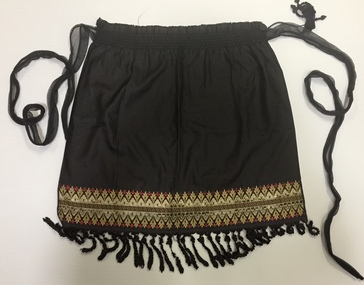
Clothing - Cotton apron embroidered with gold and red silk thread, 1960s
... While the collection includes some examples of international fashion, most items were handmade or purchased in Melbourne....While the collection includes some examples of international fashion, most items were handmade or purchased in Melbourne. clothing - women's aprons protective wear fashion design fashion -- 1960s Black hostess apron created from a black silk southeast asian textile featuring a stylised woven band of red, black and gold silk. ...The Fashion & Design collection of Kew Historical Society includes examples of women’s, men’s, children’s and infants' clothing from the 18th, 19th and 20th centuries. While the collection includes some examples of international fashion, most items were handmade or purchased in Melbourne.Black hostess apron created from a black silk southeast asian textile featuring a stylised woven band of red, black and gold silk. The fabric is gathered at the waist. The strap includes a black silk tassel. clothing - women's, aprons, protective wear, fashion design, fashion -- 1960s -
 Kew Historical Society Inc
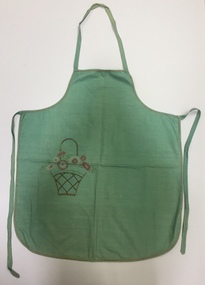
Clothing - Embroidered Green Pinafore, 1950s
... While the collection includes some examples of international fashion, most items were handmade or purchased in Melbourne....While the collection includes some examples of international fashion, most items were handmade or purchased in Melbourne. clothing - women's aprons protective wear fashion design fashion -- 1950s Green cotton apron, hand embroidered with a basket of flowers in coloured threads. ...The Fashion & Design collection of Kew Historical Society includes examples of women’s, men’s, children’s and infants' clothing from the 18th, 19th and 20th centuries. While the collection includes some examples of international fashion, most items were handmade or purchased in Melbourne.Green cotton apron, hand embroidered with a basket of flowers in coloured threads. clothing - women's, aprons, protective wear, fashion design, fashion -- 1950s -
 Kew Historical Society Inc
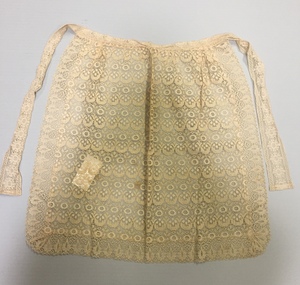
Clothing - Lace Apron, 1950s
... While the collection includes some examples of international fashion, most items were handmade or purchased in Melbourne....While the collection includes some examples of international fashion, most items were handmade or purchased in Melbourne. clothing - women's aprons fashion design fashion -- 1950s Coffee-coloured decorative lace apron. ...The Fashion & Design collection of Kew Historical Society includes examples of women’s, men’s, children’s and infants' clothing from the 18th, 19th and 20th centuries. While the collection includes some examples of international fashion, most items were handmade or purchased in Melbourne.Coffee-coloured decorative lace apron.clothing - women's, aprons, fashion design, fashion -- 1950s -
 Kew Historical Society Inc
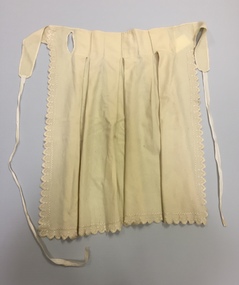
Clothing - Cream Flannel Apron, 1950s
... While the collection includes some examples of international fashion, most items were handmade or purchased in Melbourne....While the collection includes some examples of international fashion, most items were handmade or purchased in Melbourne. clothing - women's aprons protective wear fashion design fashion -- 1950s Home made cream flannel apron featuring wide box pleats. ...The Fashion & Design collection of Kew Historical Society includes examples of women’s, men’s, children’s and infants' clothing from the 18th, 19th and 20th centuries. While the collection includes some examples of international fashion, most items were handmade or purchased in Melbourne.Home made cream flannel apron featuring wide box pleats.clothing - women's, aprons, protective wear, fashion design, fashion -- 1950s -
 Kew Historical Society Inc
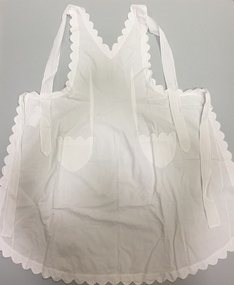
Clothing - White Cotton Pinafore, 1950s
... While the collection includes some examples of international fashion, most items were handmade or purchased in Melbourne. ...While the collection includes some examples of international fashion, most items were handmade or purchased in Melbourne. clothing - women's aprons porective wear fashion & design collection - kew historical society Large white cotton apron. ...The Fashion & Design collection of Kew Historical Society includes examples of women’s, men’s, children’s and infants' clothing from the 18th, 19th and 20th centuries. While the collection includes some examples of international fashion, most items were handmade or purchased in Melbourne. Large white cotton apron. Halter neck. Added scalloped border and decorative pockets.clothing - women's, aprons, porective wear, fashion & design collection - kew historical society -
 Kew Historical Society Inc
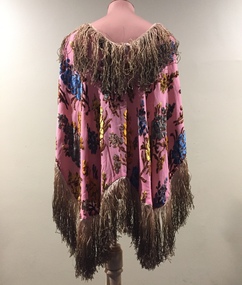
Clothing - Fringed Cut Velvet & Chenille Evening Cape, 1890s
... While the collection includes some examples of international fashion, most items were handmade or purchased in Melbourne. ...While the collection includes some examples of international fashion, most items were handmade or purchased in Melbourne. women's clothing outerwear -- capes fashion -- 1890s fashion design Cut velvet pelerine featuring multicoloured garlands of flowers in shades of gold, brown and blue on a pink ground. ...The Fashion & Design collection of Kew Historical Society includes examples of women’s, men’s, children’s and infants' clothing from the 18th, 19th and 20th centuries. While the collection includes some examples of international fashion, most items were handmade or purchased in Melbourne. Cut velvet pelerine featuring multicoloured garlands of flowers in shades of gold, brown and blue on a pink ground. Chenille trim and long silk fringe, Centre front hook and eye closure, Lined with pale pink silk.women's clothing, outerwear -- capes, fashion -- 1890s, fashion design -
 Kew Historical Society Inc
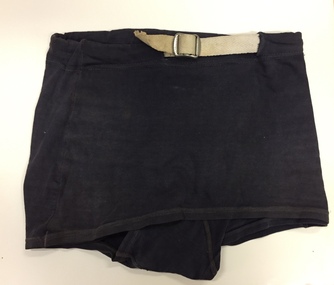
Clothing - Mens swimsuit, Alpha, 1937-39
... While the collection includes some examples of international fashion, most items were handmade or purchased in Melbourne. ...While the collection includes some examples of international fashion, most items were handmade or purchased in Melbourne. An early example of swimwear from when men were able to legally swim topless in the 1930s. ...The Fashion & Design collection of Kew Historical Society includes examples of women’s, men’s, children’s and infants' clothing from the 18th, 19th and 20th centuries. While the collection includes some examples of international fashion, most items were handmade or purchased in Melbourne. An early example of swimwear from when men were able to legally swim topless in the 1930s. The fashion originated in France in the early 1930s, and slowly caught on in other countries, although was often controversial. In Australia this was less so, and by 1940 it was common attire at the beach. Pair of dark blue, woollen bathing trunks. Front skirted flap. White woollen belt with silver-coloured metal buckle. White label with blue stitched text attached to rear. Label: "Alpha" Size: SMswimwear - men's, alpha swimwear, alpha - menswear designer -
 Flagstaff Hill Maritime Museum and Village
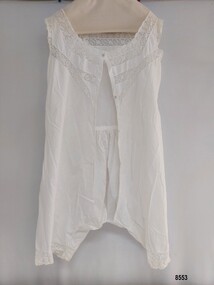
Clothing - Combination Undergarment, late 19th or early 20th century
... Lady’s white lawn and lace all-In-one combination undergarment. The handmade underwear is a combined chemise and bloomers. ...Flagstaff Hill Maritime Museum and Village Great Ocean Road combinations lady's combinations undergarment lingerie handsewn underwear clothing Victorian era undergarments lady's garment Susan Henry OAM Vedmore Foundation Lady’s white lawn and lace all-In-one combination undergarment. The handmade underwear is a combined chemise and bloomers. ...This item of underclothing, called a "combination" is one of several linen and clothing items belonging to the deceased estate of Susan Henry OAM (nee Vedmore 1944 - 2021) that was donated to Flagstaff Hill Maritime Museum and Village. Susan's family (Harold and Gladys Vedmore) immigrated to Australia from Wales in 1955 and settled in Warrnambool. Susan was well known in the Warrnambool community for her work supporting children and families across the district - particular those with disabilities, or those who were homeless, unemployed or isolated. Susan was the founding trustee of the "Vedmore Foundation" - a Warrnambool philanthropic trust set up in 2010 to support a range of charitable and not-for-profit causes by providing grant assistance. In 2021, she was awarded a Medal of the Order of Australia for services to the community. Combination undergarments combined the chemise and drawers into one garment. The combination is divided, or bifurcated, from the waist to the crotch for easier urinating. This one-piece type of underwear was worn by females from the 1860s and into the early 1900s. The 19th Century garments had front button closures like this one, and those made in the 1900s more often had back closures. Combination underwear was popular because the all-in-one design had far fewer gathers and bulk, making the other clothing look much smoother. Their primary use was to protect clothing from perspiration and because they were made with cotton or linen, were easy to wash. This particular item is made with lawn (a very lightweight fabric) and is sleeveless, making it suitable for hot weather. Although they were worn under the corset next to the skin (and therefore not meant to be seen), they were often decorated with lace or embroidery. This item is an example of the needlework skills of women in the late 19th century - using machine stitching and lace to personalise and embellish a practical item of clothing. It is also significant as an example of a practical solution to the difficulties that women of this era faced with regard to the washing of clothes and household linens.Lady’s white lawn and lace all-In-one combination undergarment. The handmade underwear is a combined chemise and bloomers. It has four buttons in the front and is trimmed with lace on the neckline, armholes, bodice (in a diagonal design) and legs. The left and right sides are divided from the waist to the crutch. The back of the garment is plain with a gathered section at the lower back.flagstaff hill maritime museum and village, great ocean road, combinations, lady's combinations, undergarment, lingerie, handsewn, underwear, clothing, victorian era undergarments, lady's garment, susan henry oam, vedmore foundation -
 Flagstaff Hill Maritime Museum and Village
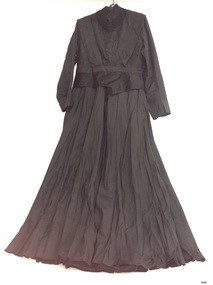
Clothing - Mourning Outfit, Late 19th to early-20th centuries
... Items have been machine-sown and hand-sewn by a dressmaker. The skirt has handmade buttons of the same fabric....Items have been machine-sown and hand-sewn by a dressmaker. The skirt has handmade buttons of the same fabric. Clothing Mourning Outfit ...This Edwardian-era mourning outfit was worn by a wealthy woman from the rural area of Willaura, southeast of the Grampians. It was inherited by the donor from his mother, who had purchased it from a clearing sale in the 1960s. The jacket has a peplum or flounce below the waistline, a fashion that was seen in the 1860s and is still around in the 1900s. The outfit represents the female mourning fashion and wardrobe from the late 19th to early 20th centuries. Such garments were a necessary inclusion as death often occurred to the young, due to illness, accidents and hard work - it was a regular part of life in rural Victoria. Mourning outfits were part of a person’s wardrobe and often passed from one generation to the next. This particular outfit appears to have been adjusted at some stage to allow for a wider waistline. The original skirt may have been replaced by the one that is now part of this outfit; the skirt is all machine-sewn, unlike the jacket and petticoat. The fabric of the skirt may be silk or it could be a synthetic fibre such as artificial silk or rayon; both were available in the 1800s,but nylon wasn’t invented until the 1930s. This skirt has sunray pleating, which was advertised on skirts for sale in the 1890s, and 1909, and was part of a fashionable bridal gown train in the 1930s. The mourning of death was part of both family and community life, particularly in rural and remote areas. People were bonded through work, religion, disasters, tragedy and social activities, supporting one another. They came together from near and far on such an occasion, giving each other the care that was needed and showing respect for the member who had passed away.This three-piece silk Edwardian mourning outfit is significant historically for its connection with rural Victoria and the social and religious customs surrounding the death of a family or community member. The high-quality outfit is also significant for representing the financial management of the times, being tailored by a dressmaker for a person of means and then adjusted to fit at least one different-sized person. Ladies’ Edwardian mourning outfit; three-piece tailored suit comprising of a black silk long sleeve, short-waist fitted and lined Jacket, a long sunray pleated skirt and long, lined petticoat. Items have been machine-sown and hand-sewn by a dressmaker. The skirt has handmade buttons of the same fabric.Handwritten in ballpoint pen “Jenny” and “Mrs Sheila Handscombe, Wallaura, Jenny”flagstaff hill maritime museum and village, warrnambool, shipwreck coast, edwardian era, tailor-made, dressmaker, mourning outfit, handmade garment, mourning dress, death mourning, sunray pleats, western district victoria -
 Bendigo Military Museum
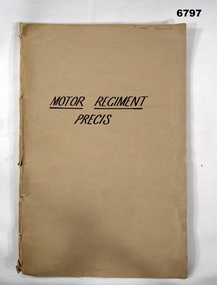
Manual - MOTOR REGIMENT PRECIS, Aust Army - A.F.V. School, Motor Regiment Wing, August 1942
... This is a handmade folder holding foolscap sheets. The sheets are printed on both sides. ...JWS M36". This is a handmade folder holding foolscap sheets. The sheets are printed on both sides. ...Items in the collection re Lt. Col. Swatton, refer Cat No 6719.2P for his service details.This is a handmade folder holding foolscap sheets. The sheets are printed on both sides. Some of the sheets have drawings of patrol formations, maps and how to make booby traps. It has several pages of Japanese Battle procedures. The book is bound with 2 metal clips. It has R.T. Procedures, Land Mines and barbed wire entanglements.Written on front is "MAJ. Priddle". Inside front cover, on a sticky label is "On loan from the estate of Colonel J. W. Swatton Ref No. JWS M36". passchendaele barracks trust, battle procedures -
 Bendigo Historical Society Inc.
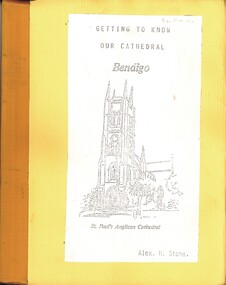
Book - GETTING TO KNOW OUR CATHEDRAL BENDIGO ST PAUL'S ANGLICAN CATHEDRAL, 1991
... Dedicated to the memory of his wife, Mary Stone. Handmade with gestetner printed pages. Staple spine bound with tape....Dedicated to the memory of his wife, Mary Stone. Handmade with gestetner printed pages. Staple spine bound with tape. ...'Getting to know our Cathedral, Bendigo, St. Paul's Anglican Cathedral' Collection of information papers. History of cathedral, windows, ministers, chapel. 93 pages with photos. Signed by Mr. Alexander H. Stone. Dedicated to the memory of his wife, Mary Stone. Handmade with gestetner printed pages. Staple spine bound with tape.Alexander H. Stone.church, history, st. pauls' anglican cathedral, bendigo, anglican church, history. -
 Tatura Irrigation & Wartime Camps Museum
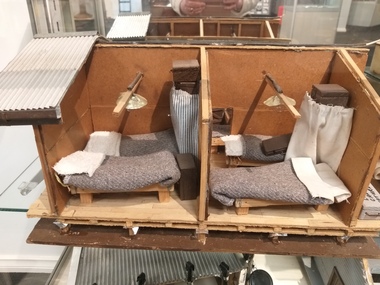
Model Hut, Camp Hut, 1990's
... Handmade model of typical camp hut with section of roof removed to show interior. ...Made by former internment Camp internee Lothar Streker. model hut tatura ww 2 camp handcrafts Lothar Streker Handmade model of typical camp hut with section of roof removed to show interior. ...Made by former internment Camp internee Lothar Streker.Handmade model of typical camp hut with section of roof removed to show interior. Comprises 4 rooms with beds, bedroom furniture (suitcases, wardrobes, blankets, pillows, sheets). Has central light in each room. 2 windows in front wall, steps to entrance doors. Roof made with match sticks and covered with paper.model, hut, tatura, ww 2 camp, handcrafts, lothar streker -
 Whitehorse Historical Society Inc.
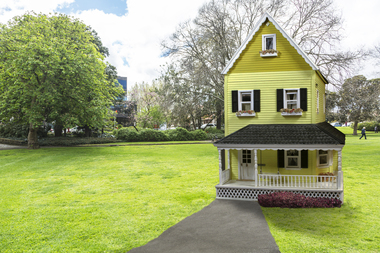
Leisure object - Dolls House, Yvonne Fitzmaurice, 1974
... A lot of the furniture is handmade and the rest is collected from various shops....A lot of the furniture is handmade and the rest is collected from various shops. ...THE DOLL HOUSE _ Yvonne Fitzmaurice The ten room fully furnished American farmhouse was created from an idea by former Mitcham resident, Yvonne Fitzmaurice and was constructed between 1976 and 1978 as a birthday present for her daughter, Susan. The house is a unique interpretation of early American architecture and inferior design. It is also a representation of one woman's ability to create and complete a details snapshot of a lifestyle long gone and give pleasure to family, friends and now the community. Yvonne has had an interesting and full life, born in New Zealand where was a State Registered Nurse and she specialised in hospital theatre work. Later her curiosity bought her to Australia where she worked at the Sydney hospital and with the Australia Flying Doctors service flying in and out of Wilcannia, western New South Wales. On returning to New Zealand Yvonne acted as part of a Medical cover team for the different armed services. one session in the Nary involved pursuing submarines which she described as being very exciting. In 1958 she travelled by sea through the Suez Canal to England and as a member of British Services served in the post WWII Germany for three year in the QARANC and also worked at The London Clinic with some high-profile specialists. Yvonne was introduced to her husband-to-be at a tennis party and they lived in Cambridge, UK, where their two children, Alastair and Susan, were born. On coming to Australia in 1965 as "£10 poms" (Yvonne's words) she worked in casualty at the Box Hill hospital. Initially the family lived at Blackburn South before moving to Mitcham in 1968. To help establish a new life with her family in Australia, Yvonne worked in many different positions from nursing, machine knitting for a Prahran shop, making Christmas Cards and as a commercial traveller. As a hobby she also sold a number of pastel paintings. Following the publishing of her first family history in 1994, Yvonne became a member and volunteer at the Whitehorse Historical Society where she has contributed in producing local history publication, articles for the Newsletter and has improved access to the files by creating the detailed "green files". Her interests include art, crafts and writing. Yvonne has a great philosophy, 'each day I must achieve something - no matter how small'.Hand-made child's doll's house. Built by Mrs Yvonne Fitzmaurice and finished in 1979. This house was built as a 1:12 scale and is a model of a Californian house called Peppercorn farm. House was built by Yvonne and her family and took a period of three years. A lot of the furniture is handmade and the rest is collected from various shops. "Susan Fitzmaurice" name on front of building. Date on plaque on top of front wall.na5059, na5061, na5063, na5065, na5068, na5071, na5073, na5075, na5077, na5079, na5081, na5083 -
 Mont De Lancey
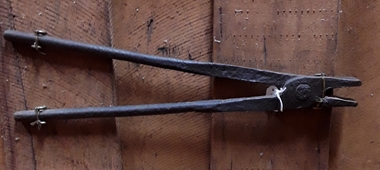
Tool - Blacksmith Tongs, Unknown
... A pair of small vintage handmade blacksmith tongs with two handles called reins, which are riveted together to form a hinge joint for the flat edged tongs. ...Blacksmithing tools Forging tools Metalworking tools Furnace tongs Tools A pair of small vintage handmade blacksmith tongs with two handles called reins, which are riveted together to form a hinge joint for the flat edged tongs. ...A pair of small vintage handmade blacksmith tongs with two handles called reins, which are riveted together to form a hinge joint for the flat edged tongs. The blacksmith opens and closes the tongs using the handles. They are made of flat mild steel. They were used for holding steel in position and turning it over during forging operations.blacksmithing tools, forging tools, metalworking tools, furnace tongs, tools -
 Bendigo Military Museum
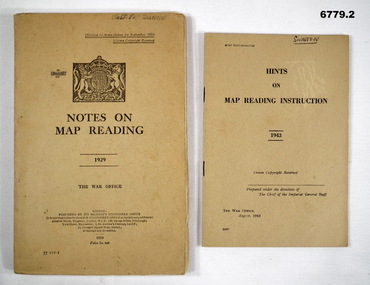
Manual - MAP READING, British War Office, 1929 - 1943
... Inside front cover is handmade amendment chart. Daily entry is dated April 1938. ...Inside front cover is handmade amendment chart. Daily entry is dated April 1938. ...Items in the collection re Col J. Swatton, refer Cat No 6719.2P for his service details. 1. This is an Army Training Manual. on the front is the British Coat of Arms. The book's title dated 1929. Khaki cardboard cover. Printed in black ink. It has 93 pages of text, maps and drawings. 2. Small booklet, Khaki cover, Prtinted in black ink dated 1943. British War Office.1. On front cover is "Illegible" and W. Swatton. Inside front cover is handmade amendment chart. Daily entry is dated April 1938. On rear cover is a sticky label with the words "On loan from the Estate of Colonel J, W. Swatton" Ref No JWS M18. 2. On front cover is written name "Swatton". On rear cover is a sticky label with words..."On loan from the Estate of Colonel J. W. Swatton." Ref No JWS M19.map reading, j. w. swatton, passchendaele barracks trust -
 Bialik College
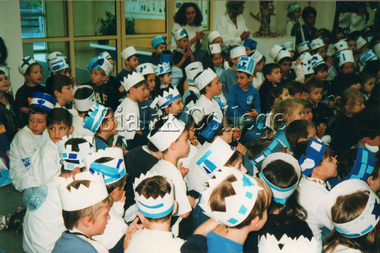
Photograph (item) - Yom Yerushalayim, 2001
... Includes students in blue and white handmade hats, and staff and students at a commemorative ceremony featuring a flag procession, musical and dance performances and the release of birds into the sky. ...Includes students in blue and white handmade hats, and staff and students at a commemorative ceremony featuring a flag procession, musical and dance performances and the release of birds into the sky. ...Photographs of Yom Yerushalayim at Bialik College, 2001. Includes students in blue and white handmade hats, and staff and students at a commemorative ceremony featuring a flag procession, musical and dance performances and the release of birds into the sky. Please contact [email protected] to request access to this record.judaism, 2000s, chagim -
 Flagstaff Hill Maritime Museum and Village
Accessory - Diamond ring, about 1855
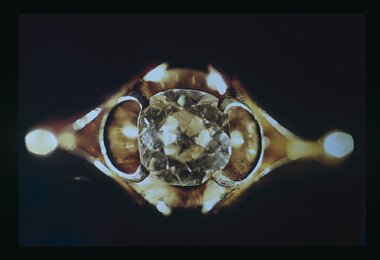
... Colour is classified as 'J', clarity SII. The setting is handmade. ...Colour is classified as 'J', clarity SII. The setting is handmade. Accessory Diamond ring Europe ...In 1975, 120 years after the sailing ship Schomberg was wrecked, Flagstaff Hill divers (Peter Ronald, Colin Goodall and Gary Hayden) found an ornate communion set amongst the wreckage. The set comprised a jug, ciborium, lid, chalice and plate. The items, apart from the lid, were then displayed at Flagstaff Hill Maritime Village. The lid had etchings that did not match the chalice and sat in storage for several years. Then in 1978, while the marine concretion inside the lid was being examined, a surface layer came loose and revealed a glint of gold that was assumed to be a piece of brass. The layers of concretion were carefully removed and a ring-like band emerged. Further treatment exposed a 'large faceted stone in an intricate gold setting. Weeks later a detailed examination estimated the value of the ring, known as the Schomberg Diamond, to be $7000. When the Schomberg was launched in 1855, she was considered the "Noblest” ship that ever floated on the water. Schomberg's owners, the Black Ball Line had commissioned the ship for their fleet of passenger liners. She was built by Alexander Hall of Aberdeen at a cost of £43,103 and constructed with 3 skins. One planked fore and aft and two diagonally planked, fastened together with screw-threaded trunnels (wooden rails). Her First Class accommodation was simply luxurious with velvet pile carpets, large mirrors, rosewood, birds-eye maple and mahogany timbers throughout, soft furnishings of satin damask, an oak-lined library with a piano. Overall she had accommodation for 1000 passengers. At the launch, the Schomberg's 34-year-old master, Captain 'Bully' Forbes, had promised to reach Melbourne in sixty days stating, "with or without the help of God." Captain James Nicol Forbes was born in Aberdeen in 1821 and rose to fame with his record-breaking voyages on the famous Black Ball Line ships; Marco Polo and Lightning. In 1852 in the Marco Polo, he made the record passage from London to Melbourne in 68 days. Unfortunately there were 53 deaths on the voyage, but the great news was off the record passage by Captain Forbes. In 1854 he took the clipper “Lighting” to Melbourne in 76 days and back in 63 days, this record was never beaten by a sailing ship. He often drove his crew and ship to breaking point to beat his previous records. He cared little for the comfort of the passengers. On this, the Schomberg's maiden voyage, he was determined to break existing records. Schomberg departed Liverpool on her maiden voyage on 6th October 1855 flying a sign that read "Sixty Days to Melbourne". She departed with 430 passengers and 3000 tons cargo including iron rails and equipment intended to build the Melbourne to Geelong Railway and a bridge over the Yarra from Melbourne to Hawthorn. She also carried a cow for fresh milk, pens for fowls and pigs, 90,000 gallons of water for washing and drinking. She also carried 17,000 letters and 31,800 newspapers. The ship and cargo were insured for $300,000 a fortune for the time. The winds were poor as she sailed across the equator, slowing Schomberg's journey considerably. Land was first sighted on Christmas Day, at Cape Bridgewater near Portland, Captain Forbes followed the coastline towards Melbourne. Forbes was said to be playing cards when called by the third mate Henry Keen, who reported land about 3 miles off. Due in large part to the captain's regarding a card game as more important than his ship, it eventually ran aground on a sand spit near Curdie's Inlet (about 56 km west of Cape Otway) on 26th December 1855, 78 days after leaving Liverpool. The sand spit and the currents were not marked on Forbes's map. Overnight, the crew launched a lifeboat to find a safe place to land the ship’s passengers. The scouting party returned to Schomberg and advised Forbes that it was best to wait until morning because the rough seas could easily overturn the small lifeboats. The ship’s Chief Officer spotted the SS Queen at dawn and signaled the steamer. The master of the Queen approached the stranded vessel and all of Schomberg’s passengers and crew disembarked safely. The Black Ball Line's Melbourne agent sent a steamer to retrieve the passengers' baggage from the Schomberg. Other steamers helped unload her cargo until the weather changed and prevented the salvage teams from accessing the ship. Later one plunderer found a case of Wellington boots, but alas, all were for the left foot. Local merchants Manifold & Bostock bought the wreck and cargo but did not attempt to salvage the cargo still on board the ship. They eventually sold it on to a Melbourne businessman and two seafarers. In 1864 after two of the men drowned when they tried to reach Schomberg, salvage efforts were abandoned. In 1870, nearly 15 years after the wreck parts of the Schomberg had washed ashore on the south island of New Zealand. The wreck now lies in almost 9 meters of water and although the woodwork is mostly disintegrated the shape of the ship can still be determined due to the remaining railway irons, girders and the ship’s frame. A variety of goods and materials can be seen scattered about nearby. The actual lid in which the ring was found has not yet been completely identified and could belong to a coffee pot, sugar bowl or maybe a jug or something similar. Although all survived the wreck no-one came forward to claim the valuable diamond. The Schomberg Diamond is currently on display in the Great Circle Gallery. Flagstaff Hill Maritime Village along with the rest of the communion set. Other artefacts salvaged from the wreck include ship fittings and equipment, personal effects, a lithograph, tickets and photographs from the Schomberg. One of the Schomberg bells is in the Warrnambool Library.The Schomberg Diamond is particularly significant in that it played a crucial part in having the legislation changed to protect shipwrecks, with far tighter control over the salvaging of items from wreck sites. This ring is registered as Artefact S/105 in the Schomberg collection, the Schomberg collection as a whole is of historical and archaeological significance at a State level. Flagstaff Hill’s collection of artefacts from the Schomberg is also significant for its association with the Victorian Heritage Registered shipwreck (VHR S 612). The collection is of prime significant because of the relationship between the objects salvaged, as together they help us to interpret the story of the Schomberg. The collection as a whole is historically significant for representing aspects of Victoria's maritime history and its potential to interpret social and historical themes. A mid-Victorian gentleman's solitaire diamond dress ring with a Brazilian cut diamond (cushion cut), one and one-third carat set within an 18 carat yellow gold ring consisting of four claws within an open scroll setting and a divided scroll shank. Colour is classified as 'J', clarity SII. The setting is handmade. warrnambool, shipwrecked-coast, flagstaff-hill, flagstaff-hill-maritime-museum, maritime-museum, shipwreck-coast, flagstaff-hill-maritime-village, schomberg, shipwrecked-artefact, clipper ship, black ball line, 1855 shipwreck, aberdeen clipper ship, captain forbes, peterborough shipwreck, ss queen, ciborium, ring, schomberg-diamond, schomberg-ring, gentleman's ring, dress ring -
 Glenelg Shire Council Cultural Collection
Sculpture - Collaborative sculpture, Rory Carter, October 2025
... Sculpture is a tower that consists of a square base and 18 different stackable handmade ceramic pieces which when threaded onto a timber dowel rod form a tower sculpture. ...Sculpture is a tower that consists of a square base and 18 different stackable handmade ceramic pieces which when threaded onto a timber dowel rod form a tower sculpture. ...The collaborative sculpture was created for the Annual Portland Arts Centre Inside Out Exhibition 2025. The ceramics were created during a series of workshops. Participants were able to lean new creative practices in a safe supportive space whist creating original works for the exhibition. The ceramics workshop was led by Angela Ryks and Rory Carter.Sculpture was created to be acquired into the Glenelg Shire Council Cultural Collection.Collaborative sculpture created for the Annual Portland Arts Centre Inside Out Exhibition 2026. Sculpture is a tower that consists of a square base and 18 different stackable handmade ceramic pieces which when threaded onto a timber dowel rod form a tower sculpture. Each piece is unique in shape, style and finish. 19 pieces in total.all abilities -
 Kiewa Valley Historical Society
Tobacco Grading Dividers x 6, 1962
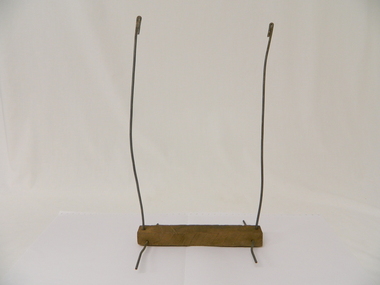
... There are 6 dividers and because they are handmade the measurements vary slightly. ...There are 6 dividers and because they are handmade the measurements vary slightly. Tobacco Grading Dividers x 6 ...Tobacco farming began circa 1960 in the Kiewa Valley and consequently became one of its major industries. Many of the Italian families were involved in tobacco farming.Historical: This equipment was used on one of the first tobacco farms in the Kiewa Valley at Mongans Bridge. The dividers were home-made showing the resourcefulness of farmers living in the Kiewa Valley. Provenance: This tobacco farmer came from Italy and was sponsored to visit a tobacco farmer in Myrtleford to learn how to grow tobacco so that he could transfer those skills to his own farm in the Kiewa Valley.Wood plank with wire attached through a hole at each end in from side edge to create a stand. Another piece of wire stands vertically and is folded over to create blunt edge at the top. At the bottom it goes through the wood and along a bit to hold the wire in place. There are 6 dividers and because they are handmade the measurements vary slightly. tobacco. kiewa valley. mongans bridge. parmeson. rossaro, lorenzi brothers. grading dividers. -
 Bendigo Historical Society Inc.
Textile - Lingerie Garment Bags
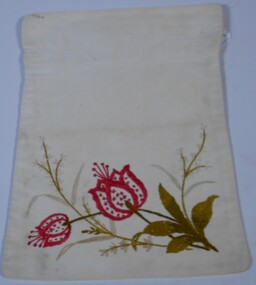
... Two handmade embroidered laundry bags. 6575.1 Red flowers with green leaves and white foliage embroidered on a cream cotton front, back of bag is undecorated. ...Late Victorian Needlework Handmade embroidery Lingerie Bag Garment bags Cleary A L 4 embroidered in top left hand corner of 6575.1 in yellow thread. ...Donor believes items were completed by her great aunts Lydia, Rosa, Olivia and Isabelle Pollard when the sisters were young girls. They were completed in Country Durham, England. The items have been passed down through the family by the girls' mother or aunt.Two handmade embroidered laundry bags. 6575.1 Red flowers with green leaves and white foliage embroidered on a cream cotton front, back of bag is undecorated. Hand and machine stitching evident. 6575.2 Gold flowers, green leaves and some white foliage. Four rings attached with gold and cream stitching on top of bag for hanging.A L 4 embroidered in top left hand corner of 6575.1 in yellow thread. A L embroidered at top L H corner of 6575.2 in red thread.late victorian needlework, handmade embroidery, lingerie bag, garment bags, cleary -
 Bendigo Historical Society Inc.
Document - BASIL WATSON COLLECTION: HANDMADE GREETING CARD (FROM 'VE'), 1915
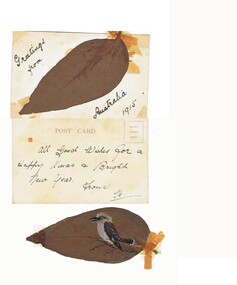
... Handmade Greeting Card (from 'Ve', possibly Verona, Basil Watson's sister born 1896 ) - hand painted kookaburra on a brown painted leaf attached to a card - yellow ribbon attached to leaf. ...On front of card: 'Greetings from Australia 1915' Document BASIL WATSON COLLECTION: HANDMADE GREETING CARD (FROM 'VE') ...Handmade Greeting Card (from 'Ve', possibly Verona, Basil Watson's sister born 1896 ) - hand painted kookaburra on a brown painted leaf attached to a card - yellow ribbon attached to leaf. Handwritten in ink on reverse: 'All good wishes for a happy Xmas and bright New Year'. On front of card: 'Greetings from Australia 1915'communication, postal, card -
Cobram Historical Society Inc
Mourning Dress
... Handmade, black silk, fully lined full length full sleeved waisted mourning dress. ...No visible makers markings. Handmade, black silk, fully lined full length full sleeved waisted mourning dress. ...High quality dress in excellent condition. Indicative of period and purpose.Handmade, black silk, fully lined full length full sleeved waisted mourning dress. Circa mid 18c. Hook and eye back closure. Full skirted with gathering and pleats. Back of skirt is designed to accomodate a bustle. Black gimp and jet square and rectangular beading on top of sleeves and back of bodice. Excellent condition.No visible makers markings. -
 Friends of Westgarthtown
Functional object - Coolgardie Safe, Carl Ziebell, direct descendant, c. 1915
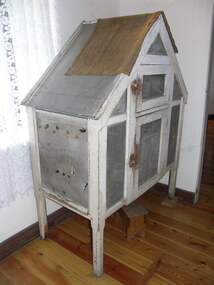
... Handmade food safe with white painted wooden frame and perforated zinc screen panels. ...As an early form of sustainable refrigeration, it contributes valuable interpretive depth to domestic, rural and goldfields history. domestic items food storage and preservation food safe storage pantry carl ziebell No visible markings Handmade food safe with white painted wooden frame and perforated zinc screen panels. ...This Coolgardie safe is a significant example of late-19th-century Australian ingenuity and domestic adaptation in response to the challenges of life in remote and harsh environments. Invented in the late 1890s by Arthur Patrick McCormick at Coolgardie, then the center of a major Western Australian gold rush, the safe represents an important technological response to the need for preserving perishable foods in extreme heat before the availability of mechanical refrigeration. Using the same evaporative principles employed by explorer’s canvas water bags, the Coolgardie safe utilised a timber frame, zinc metal sheets, wire mesh panels and wet hessian cloth to create a naturally cooled storage chamber. When placed in a draught or breeze, evaporation lowered the internal temperature, allowing miners, settlers and later rural households to keep meat, dairy and vegetables safe for longer periods. Sylvia Schultz (nee Ziebell) remembers the Coolgardie safe at Ziebell’s Farmhouse “was always positioned in the pantry where it is today, near the window to allow the breeze in”. Items the Ziebell’s stored in the safe included meats, milk and cream, and home-made goods. This object embodies a pivotal moment in Australia’s social and technological history, illustrating resourcefulness, adaptation to climate, and the lived realities of those who settled and worked in remote regions. As an early form of sustainable refrigeration, it contributes valuable interpretive depth to domestic, rural and goldfields history. Handmade food safe with white painted wooden frame and perforated zinc screen panels. Galvanised sheet roof. Raised four beveled legs. Two rectangular doors, bottom door large, opens to main area with one shelf. top door small, opens to triangular roof section. Movable latches of wood on both doors.No visible markingsdomestic items, food storage and preservation, food, safe, storage, pantry, carl ziebell -
 Tennis Australia
Figurine, 1999
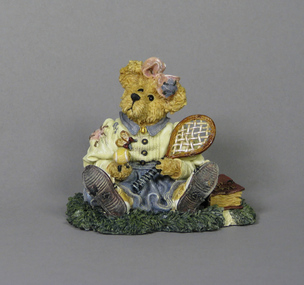
... Text on base states: 'BOYD'S BEARS AND FRIENDS/THE BEARSTONE COLLECTION/"LOVE MEANS NEVER WINNING A GAME"/-E.E.SMITH/EDITION/PC IE/3330/STYLE # 227717 CHRISSIE...GAME SET, MATCH/1999 THE BOYDS COLLECTION LTD/HANDMADE IN CHINA'. Materials: Ceramic, Pigment...Text on base states: 'BOYD'S BEARS AND FRIENDS/THE BEARSTONE COLLECTION/"LOVE MEANS NEVER WINNING A GAME"/-E.E.SMITH/EDITION/PC IE/3330/STYLE # 227717 CHRISSIE...GAME SET, MATCH/1999 THE BOYDS COLLECTION LTD/HANDMADE IN CHINA'. Materials: Ceramic, Pigment Figurine ...Small ornamental figurine of seated bear holding a racquet and ball. Text on base states: 'BOYD'S BEARS AND FRIENDS/THE BEARSTONE COLLECTION/"LOVE MEANS NEVER WINNING A GAME"/-E.E.SMITH/EDITION/PC IE/3330/STYLE # 227717 CHRISSIE...GAME SET, MATCH/1999 THE BOYDS COLLECTION LTD/HANDMADE IN CHINA'. Materials: Ceramic, Pigmenttennis
