
Showing 952 items matching "a.i.f"
-
 Magnet Galleries Melbourne Inc
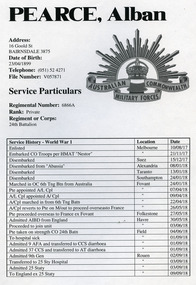
Alban Pearce details, alban pearce-05.tif
... ...A.I.F...Details of Alban Pearce service record Alban Pearce Soldier A.I.F Australian Infantry Force Australia ww1 world war 1 Army war Details of Alban Pearce service record alban pearce-05.tif Alban Pearce details ...Details of Alban Pearce service recordDetails of Alban Pearce service recordalban pearce, soldier, a.i.f, australian infantry force, australia, ww1, world war 1, army, war -
 Magnet Galleries Melbourne Inc
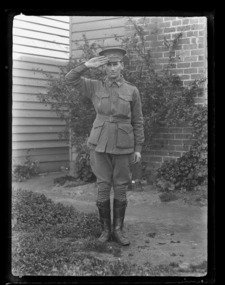
Les Chandler posing, les chandler_372.tif
... ...A.I.F...Les Chandler melbourne malvern 1915 light horse ww1 aif A.I.F world war 1 les chandler_372.tif Les Chandler posing ...A newly enlisted Les Chandler of Malvern, Melbourne in 1915. Initially 27 years old Chandler joined the light Horse, Hence the leather leggings.les chandler, melbourne, malvern, 1915, light horse, ww1, aif, a.i.f, world war 1 -
 Magnet Galleries Melbourne Inc
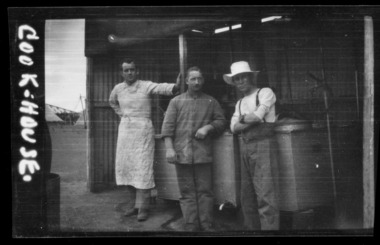
Cooking house at training camp in Seymour, les chandler_a00107d.tif
... ...a.i.f...Cooking house at training camp in Seymour. kitchen cooking ww1 world war 1 Seymour Army Camp training camp seymour aif a.i.f les chandler_a00107d.tif Cooking house at training camp in Seymour. ...Cooking house at training camp in Seymour.kitchen, cooking, ww1, world war 1, seymour army camp, training camp, seymour, aif, a.i.f -
 Magnet Galleries Melbourne Inc
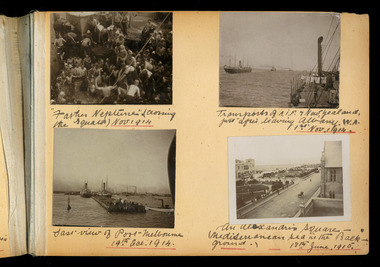
ship scenes, alexandria, albany wa, port melbourne, red cliffs00161.tif
... ...a.i.f...ww1 world war 1 a.i.f 1914 1915 port melbourne albany western australia alexandria Four photos on a page from an album red cliffs00161.tif ship scenes, alexandria, albany wa, port melbourne ...Four photos on a page from an albumww1, world war 1, a.i.f, 1914, 1915, port melbourne, albany, western australia, alexandria -
 Magnet Galleries Melbourne Inc
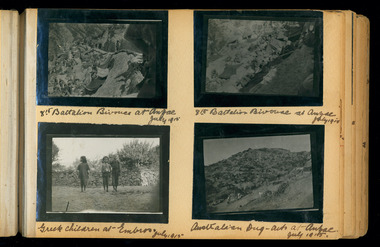
Anzac bivouac / greek children, red cliffs00164.tif
... ...A.I.F...ww1 world war 1 A.I.F imbros island greece children bivouac anzac 1915 Four photos on a page from an album red cliffs00164.tif Anzac bivouac / greek children ...Four photos on a page from an albumww1, world war 1, a.i.f, imbros island, greece, children, bivouac, anzac, 1915 -
 Magnet Galleries Melbourne Inc
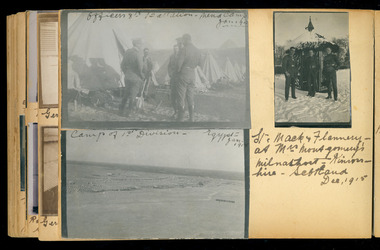
soldiers in camp, red cliffs00186.tif
... ...A.I.F...ww1 world war 1 aif A.I.F mena camp egypt 1915 8th battalion 1st division red cliffs00186.tif soldiers in camp ...ww1, world war 1, aif, a.i.f, mena camp, egypt, 1915, 8th battalion, 1st division -
 Magnet Galleries Melbourne Inc
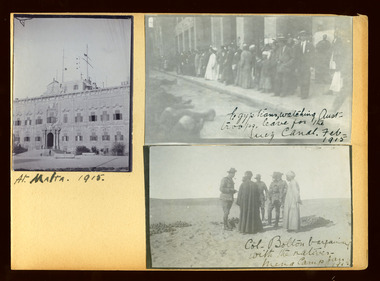
malta / egyptians wathcing aus troops leave / with natives, robertson thomas180.tif
... ...A.I.F...aif A.I.F ww1 world war 1 malta mena camp natives egypt 1915 Three photos on a page from an album robertson thomas180.tif malta / egyptians wathcing aus troops leave / with natives ...Three photos on a page from an albumaif, a.i.f, ww1, world war 1, malta, mena camp, natives, egypt, 1915 -
 Magnet Galleries Melbourne Inc
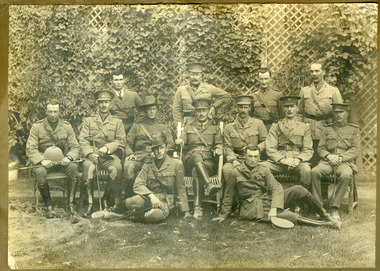
Australian Vetinary Officers including Banjo Paterson, mountjoy018b.tif
... ...A.I.F...Banjo Paterson far left middle row Cairo 1915 Banjo Paterson vets Vetinary Officers War Ww1 World war 1 Australia A.I.F Australian Imperial Forces Banjo Paterson far left middle row Cairo 1915 mountjoy018b.tif Australian Vetinary Officers including Banjo Paterson ...Banjo Paterson far left middle row Cairo 1915Banjo Paterson far left middle row Cairo 1915banjo paterson, vets, vetinary officers, war, ww1, world war 1, australia, a.i.f, australian imperial forces -
 Magnet Galleries Melbourne Inc
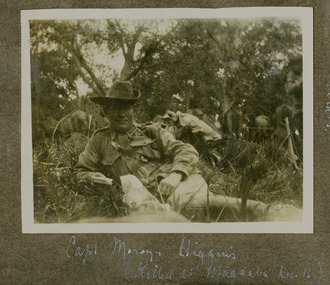
Captain M Higgins, mountjoy034.tif
... ...A.I.F...war Army world war 1 ww1 Australia Australian Infantry Force A.I.F Soldier Captain M Higgins Capt M Higgins (Killed at Magdhaba Dec 1916) mountjoy034.tif Captain M Higgins ...Capt M Higgins (Killed at Magdhaba Dec 1916)war, army, world war 1, ww1, australia, australian infantry force, a.i.f, soldier, captain m higgins -
 Magnet Galleries Melbourne Inc
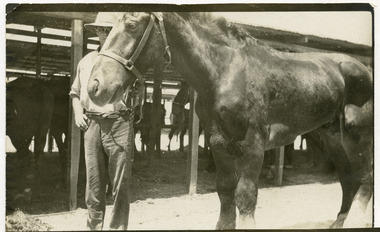
Light horse, mountjoy037.tif
... ...A.I.F...light horse horse Australia ww1 world war 1 Army war A.I.F Australian Infantry Force mountjoy037.tif Light horse ...light horse, horse, australia, ww1, world war 1, army, war, a.i.f, australian infantry force -
 Magnet Galleries Melbourne Inc
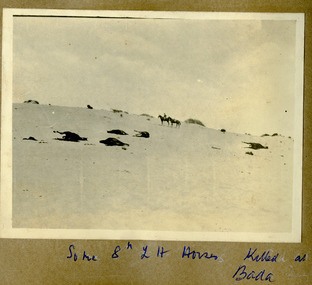
dead horses on battlefield, mountjoy080.tif
... ...A.I.F...Horses, their carcases swelling in the hot sun, killed during a skirmish at Bada, Egypt. bada egypt aif A.I.F 8th light horse ww1 world war 1 battlefield horses mountjoy080.tif dead horses on battlefield ...The carnage of war. Horses, their carcases swelling in the hot sun, killed during a skirmish at Bada, Egypt.bada, egypt, aif, a.i.f, 8th light horse, ww1, world war 1, battlefield, horses -
 Magnet Galleries Melbourne Inc
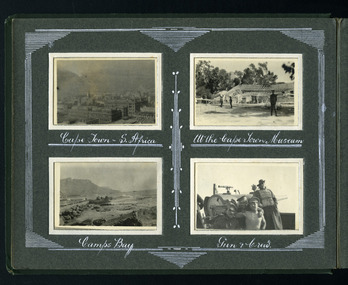
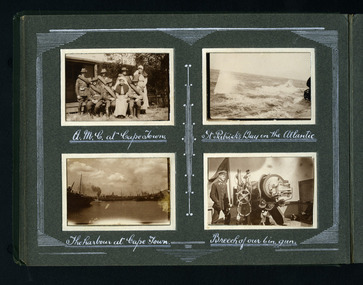
cape town scenes, gun & crew
... ...A.I.F...cape town south africa camps bay cape town museum ww1 world war 1 aif A.I.F gun cape town scenes, gun & crew ...cape town, south africa, camps bay, cape town museum, ww1, world war 1, aif, a.i.f, gun -
 Magnet Galleries Melbourne Inc
cape town, gun, atlantic ocean
... ...A.I.F...aif A.I.F ww1 world war 1 cape town cape town harbour gun soldiers nurses cape town, gun, atlantic ocean ...aif, a.i.f, ww1, world war 1, cape town, cape town harbour, gun, soldiers, nurses -
 Bendigo Military Museum
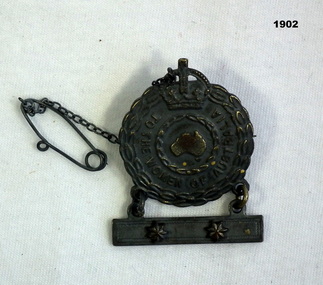
Badge - FEMALE RELATIVE BADGE WW2, G&E Rodd, 1940
... Two stars on the badge showed she had two sons in the 2nd A.I.F, Ted & Robert. Ted (short for Edward) is believed to be George Edward BALDWIN No VX120046. ...Two stars on the badge showed she had two sons in the 2nd A.I.F, Ted & Robert. Ted (short for Edward) is believed to be George Edward BALDWIN No VX120046. ...The badge belonged to Mrs May BALDWIN. Two stars on the badge showed she had two sons in the 2nd A.I.F, Ted & Robert. Ted (short for Edward) is believed to be George Edward BALDWIN No VX120046. He enlisted in the 2nd AIF on 10.7.1942 age 20 years. On discharge from the Army on 2.4.1946 he was a Pte in the 29/46th Aust Infantry Battalion. Robert is believed to be Walter Robert BALDWIN No VX55835. He enlisted in the 2nd AIF on 14.5.1941 age 20 years. He was in the 2/29th Batt and is listed in their history as being in D Coy. He was taken POW and is listed as died while a POW on 27.5.1943. Refer 1895.Badge, metal, "To the Women of Australia". Centre section is round with a crown over two circular wreaths with a map of Australia Centre. Attached by 2 rings is a clasp with 2 stars. A fine chain and pin attached at the top. Rear has 2 lugs and pin."ISSUED BY THE C'WLTH GOVT A77484"numismatics - badges, metalcraft -
 Myrtleford and District Historical Society
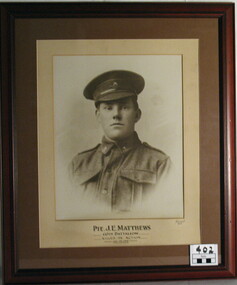
Portrait of Soldier, Talma & Co, James E. Matthews, 60th Battalion, Killed in Action, 19 July, 1916, Circa 1915
... He was in the 60th Battalion, A.I.F. action at Fromelles, France, and was killed in action, aged 19 years, on July 19,1916. ...He was in the 60th Battalion, A.I.F. action at Fromelles, France, and was killed in action, aged 19 years, on July 19,1916. ...Private James Edward Matthews (3174) was one of four first cousins living in the Myrtleford district killed during World War 1. He was in the 60th Battalion, A.I.F. action at Fromelles, France, and was killed in action, aged 19 years, on July 19,1916. He was the son of Richard and James Matthews of Myrtleford and has no known grave, but is "Remembered with Honour" at V.C. Corner, Australian Cemetery and Memorial, Fromelles. James attended Myrtleford State School 955; his death is recorded on honour boards at the Uniting (formerly Methodist) Church, the school honour board and at the Soldier's memoral Square. A memorial window at the church includes names of the four cousins.The portrait reminds viewers of the youth of many A.I.F. volunteers, the outcome of actions such as that at Fromelles in 1916 and the impact on families in small communities. It also relates to the ongoing search for identifiable remains of those personnel without a known resting place. Framed original sepia photograph, head and shoulders, of World War 1 soldier in full dress uniform.James E. Matthews, 60th Battalion, Killed in Action, 19 July, 1916. Photography: Talma & Co., Melb.james matthews 60th battalion fromelles -
 Federation University Art Collection
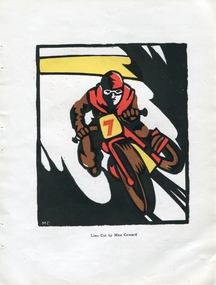
Work on paper - Printmaking - Linocut, [Motorcyclist] by Max Coward, c1937
... He enlisted in the A.I.F. and was a Naval Trainee at Flinders Naval Depot in 1941. ...He enlisted in the A.I.F. and was a Naval Trainee at Flinders Naval Depot in 1941. ...Max COWARD ( -1991) Born Ballarat Maxwell (Max) Maurice Coward was training to be an art teacher at the Ballarat Technical Art School from 1937 to 1941. He enlisted in the A.I.F. and was a Naval Trainee at Flinders Naval Depot in 1941. During these years Max Coward was described as a cartoonist and illustrator, and was attached to the Naval Intelligence Division in 1945, producing stories and drawings for the Navy newspaper Dit. His work was reproduced in the Christmas annual, HMAS Mk IV and the Army educational journal, Salt. Coward was active as a printmaker in the 1970s. This item is part of the Federation University Art Collection. The Art Collection features over 2000 works and was listed as a 'Ballarat Treasure' in 2007.Llinocut showing a cyclist on a motorbike.art, artwork, max coward, coward, alumni, motorbike, motorcyclist, cyclist, ballarat technical art school, motorcycle -
 Federation University Art Collection
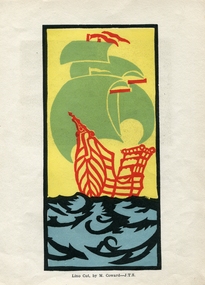
Work on paper - Printmaking - Linocut, [Sailing Ship] by Max Coward, c1937
... He enlisted in the A.I.F. and was a Naval Trainee at Flinders Naval Depot in 1941. ...He enlisted in the A.I.F. and was a Naval Trainee at Flinders Naval Depot in 1941. ...Max COWARD Born Ballarat Maxwell (Max) Maurice Coward was training to be an art teacher at the Ballarat Technical Art School from 1937 to 1941. He enlisted in the A.I.F. and was a Naval Trainee at Flinders Naval Depot in 1941. During these years Max Coward was described as a cartoonist and illustrator, and was attached to the Naval Intelligence Division in 1945, producing stories and drawings for the Navy newspaper Dit. His work was reproduced in the Christmas annual, HMAS Mk IV and the Army educational journal, Salt. Coward was active as a printmaker in the 1960s and 1970s. This item is part of the Federation University Art Collection. The Art Collection features over 2000 works and was listed as a 'Ballarat Treasure' in 2007.Llinocut showing a stylized sailing ship on the sea. This work was undertaken while Max Coward was a student of the Ballarat Junior Technical School.art, artwork, max coward, coward, alumni, sailing ship, boat, ballarat junior technical school -
 Federation University Art Collection
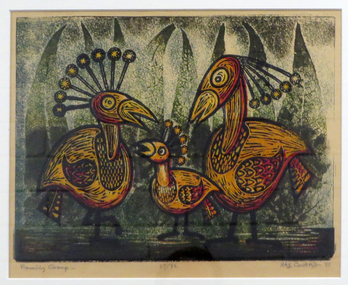
Work on paper - Printmaking - Linocut, 'Family Group' by Max Coward, 1965
... He enlisted in the A.I.F. and was a Naval Trainee at Flinders Naval Depot in 1941. ...He enlisted in the A.I.F. and was a Naval Trainee at Flinders Naval Depot in 1941. ...Max COWARD ( -1991) Born Ballarat Max Coward was training to be an art teacher at the Ballarat Technical Art School from 1937 to 1941. He enlisted in the A.I.F. and was a Naval Trainee at Flinders Naval Depot in 1941. During these years Max Coward was described as a cartoonist and illustrator, and was attached to the Naval Intelligence Division in 1945, producing stories and drawings for the Navy newspaper Dit. His work was reproduced in the Christmas annual, HMAS Mk IV and the Army educational journal, Salt. Coward was active as a printmaker in the 1970s. This item is part of the Federation University Art Collection. The Art Collection features over 2000 works and was listed as a 'Ballarat Treasure' in 2007.Framed limited edition linocut print showing a family of birdslls 'Family Group; lc edition '27/32' lrs 'Max Coward 65'art, artwork, max coward, coward, alumni, birds, chicken -
 Melbourne Legacy
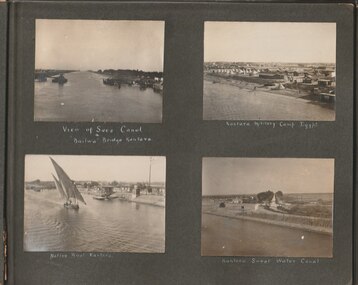
Album - Photo album, JB McLean, 1920
... At the end of the war he worked for a year at the A.I.F. Headquarters in London before returning to Australia on the 'Ceramic', arriving Portsea in 1920....At the end of the war he worked for a year at the A.I.F. Headquarters in London before returning to Australia on the 'Ceramic', arriving Portsea in 1920. ...An album of photos from the ship that brought returned servicemen, including JB McLean, home from World War 1 in 1920. Photos include Suez Canal, Kantara military camp Egypt, onboard life boat drills, onboard baby competition, boxing and a visit to Bombay. The Ceramic departed Tillbury, UK 12th March and docked in Freemantle on 27th April 1920 and then went onto Adelaide, Melbourne and Sydney. The Ceramic was a transport vessel built in Belfast in 1913 for the White Star Line to transport frozen produce and apples from Australia to UK. It was taken over by the Australian Government for troop transport in October 1914 and could carry over 3,000 troops. This trip in 1920 there were 1467 on board, there were women and children as well as 439 soldiers returning home, one of whom was John 'Basil' McLean. Was with other World War 1 memorabilia that has come from Private John Basil McLean, 2nd Reinforcements, 37th Battalion, A.I.F. There was a large collection of postcards so he may have been collecting them as souvenirs. J.B. McLean (Service No. 13824) was from near Maffra, Victoria and enlisted on 22 January 1916. He embarked on 16 December 1916 for Europe. His full war record is available from AWM. He spent time with the Australian Field Artillery (Pack Section). At the end of the war he worked for a year at the A.I.F. Headquarters in London before returning to Australia on the 'Ceramic', arriving Portsea in 1920.A collection of items from John Basil McLean is in the archive. Kept as an indication of what founding legatees experienced in World War One.Black cardboard pages x 5 with photos glued to them, contained in black cardboard cover tied with a black string.Cover is printed with 'Photographs'. Photos have white ink handwritten captions.souvenir, world war one, jb mclean, ship, ceramic -
 Melbourne Legacy
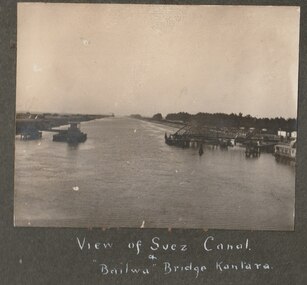
Photograph, Suez Canal, 1920
... At the end of the war he worked for a year at the A.I.F. Headquarters in London before returning to Australia on the 'Ceramic', arriving Portsea in 1920....At the end of the war he worked for a year at the A.I.F. Headquarters in London before returning to Australia on the 'Ceramic', arriving Portsea in 1920. ...One photo from an album belonging to JB McLean, of his voyage home from World War 1 in 1920 on the Ceramic. The photo shows the Suez Canal at Kantara (now called El-Qantara) in Egypt and a bridge called the Bailwa Bridge. The Ceramic departed Tillbury, UK 12th March and docked in Freemantle on 27th April 1920 and then went onto Adelaide, Melbourne and Sydney. The Ceramic was a transport vessel built in Belfast in 1913 for the White Star Line to transport frozen produce and apples from Australia to UK. It was taken over by the Australian Government for troop transport in October 1914 and could carry over 3,000 troops. This trip in 1920 there were 1467 on board, there were women and children as well as 439 soldiers returning home, one of whom was John 'Basil' McLean. Was with other World War 1 memorabilia that has come from Private John Basil McLean, 2nd Reinforcements, 37th Battalion, A.I.F. There was a large collection of postcards so he may have been collecting them as souvenirs. J.B. McLean (Service No. 13824) was from near Maffra, Victoria and enlisted on 22 January 1916. He embarked on 16 December 1916 for Europe. His full war record is available from AWM. He spent time with the Australian Field Artillery (Pack Section). At the end of the war he worked for a year at the A.I.F. Headquarters in London before returning to Australia on the 'Ceramic', arriving Portsea in 1920.A collection of items from John Basil McLean is in the archive. Kept as an indication of what founding legatees experienced in World War One and what they saw on the way home.Sepia photo of the Suez Canal glued to black cardboard in an album of photos from 1920.Handwritten caption 'View of Suez Canal and Bailwa Bridge Kantara' in white ink.souvenir, world war one, jb mclean, ship, suez, kantara, ceramic -
 Melbourne Legacy
Photograph, Ceramic, 1920
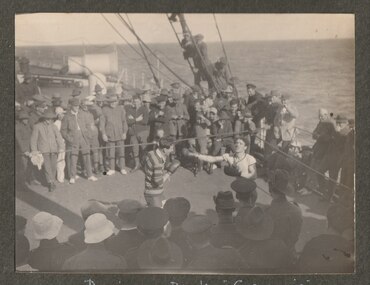
... At the end of the war he worked for a year at the A.I.F. Headquarters in London before returning to Australia on the 'Ceramic', arriving Portsea in 1920....At the end of the war he worked for a year at the A.I.F. Headquarters in London before returning to Australia on the 'Ceramic', arriving Portsea in 1920. ...One photo from an album belonging to JB McLean, of his voyage home from World War 1 in 1920 on the Ceramic. The photo shows two men boxing on the deck of the Ceramic being watched by soldiers and passengers. It shows one of the activities on board ship. The Ceramic departed Tillbury, UK 12th March and docked in Freemantle on 27th April 1920 and then went onto Adelaide, Melbourne and Sydney. The Ceramic was a transport vessel built in Belfast in 1913 for the White Star Line to transport frozen produce and apples from Australia to UK. It was taken over by the Australian Government for troop transport in October 1914 and could carry over 3,000 troops. This trip in 1920 there were 1467 on board, there were women and children as well as 439 soldiers returning home, one of whom was John 'Basil' McLean. Was with other World War 1 memorabilia that has come from Private John Basil McLean, 2nd Reinforcements, 37th Battalion, A.I.F. There was a large collection of postcards so he may have been collecting them as souvenirs. J.B. McLean (Service No. 13824) was from near Maffra, Victoria and enlisted on 22 January 1916. He embarked on 16 December 1916 for Europe. His full war record is available from AWM. He spent time with the Australian Field Artillery (Pack Section). At the end of the war he worked for a year at the A.I.F. Headquarters in London before returning to Australia on the 'Ceramic', arriving Portsea in 1920.A collection of items from John Basil McLean is in the archive. Kept as an indication of what founding legatees experienced in World War One and what they saw on the way home.Sepia photo of two men boxing on deck of the Ceramic being watched by soldiers and passengers, glued to black cardboard in an album of photos from 1920.Handwritten caption 'Boxing on deck Ceramic' in white ink.souvenir, world war one, jb mclean, ship, ceramic, suez -
 Melbourne Legacy
Photograph, Ceramic, 1920
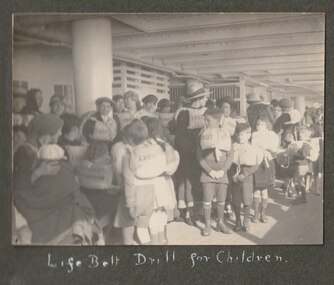
... At the end of the war he worked for a year at the A.I.F. Headquarters in London before returning to Australia on the 'Ceramic', arriving Portsea in 1920....At the end of the war he worked for a year at the A.I.F. Headquarters in London before returning to Australia on the 'Ceramic', arriving Portsea in 1920. ...One photo from an album belonging to JB McLean, of his voyage home from World War 1 in 1920 on the Ceramic. The photos show passengers on the deck of the Ceramic dressed in life jackets. It shows the type of life preservers and clothing worn at the time. The Ceramic departed Tillbury, UK 12th March and docked in Freemantle on 27th April 1920 and then went onto Adelaide, Melbourne and Sydney. The Ceramic was a transport vessel built in Belfast in 1913 for the White Star Line to transport frozen produce and apples from Australia to UK. It was taken over by the Australian Government for troop transport in October 1914 and could carry over 3,000 troops. This trip in 1920 there were 1467 on board, there were women and children as well as 439 soldiers returning home, one of whom was John 'Basil' McLean. Was with other World War 1 memorabilia that has come from Private John Basil McLean, 2nd Reinforcements, 37th Battalion, A.I.F. There was a large collection of postcards so he may have been collecting them as souvenirs. J.B. McLean (Service No. 13824) was from near Maffra, Victoria and enlisted on 22 January 1916. He embarked on 16 December 1916 for Europe. His full war record is available from AWM. He spent time with the Australian Field Artillery (Pack Section). At the end of the war he worked for a year at the A.I.F. Headquarters in London before returning to Australia on the 'Ceramic', arriving Portsea in 1920.A collection of items from John Basil McLean is in the archive. Kept as an indication of what founding legatees experienced in World War One and what they saw on the way home.Sepia photo of passengers on deck of the Ceramic dressed in life jackets glued to black cardboard in an album of photos from 1920.Handwritten caption 'Life boat drill from children' in white ink.souvenir, world war one, jb mclean, ship, ceramic, passengers -
 Melbourne Legacy
Photograph, Ceramic, 1920
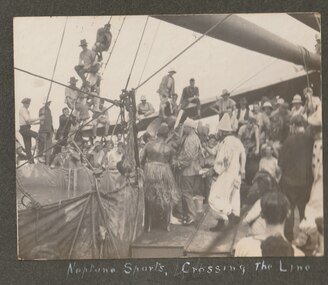
... At the end of the war he worked for a year at the A.I.F. Headquarters in London before returning to Australia on the 'Ceramic', arriving Portsea in 1920....At the end of the war he worked for a year at the A.I.F. Headquarters in London before returning to Australia on the 'Ceramic', arriving Portsea in 1920. ...Two photos from an album belonging to JB McLean, of his voyage home from World War 1 in 1920 on the Ceramic. The photos are of the sports on board when the ship crossed the equator. From the caption it was called Neptune sports and there are people dressed in different costumes. The Ceramic departed Tillbury, UK 12th March and docked in Freemantle on 27th April 1920 and then went onto Adelaide, Melbourne and Sydney. The Ceramic was a transport vessel built in Belfast in 1913 for the White Star Line to transport frozen produce and apples from Australia to UK. It was taken over by the Australian Government for troop transport in October 1914 and could carry over 3,000 troops. This trip in 1920 there were 1467 on board, there were women and children as well as 439 soldiers returning home, one of whom was John 'Basil' McLean. Was with other World War 1 memorabilia that has come from Private John Basil McLean, 2nd Reinforcements, 37th Battalion, A.I.F. There was a large collection of postcards so he may have been collecting them as souvenirs. J.B. McLean (Service No. 13824) was from near Maffra, Victoria and enlisted on 22 January 1916. He embarked on 16 December 1916 for Europe. His full war record is available from AWM. He spent time with the Australian Field Artillery (Pack Section). At the end of the war he worked for a year at the A.I.F. Headquarters in London before returning to Australia on the 'Ceramic', arriving Portsea in 1920.A collection of items from John Basil McLean is in the archive. Kept as an indication of what founding legatees experienced in World War One and what they saw on the way home.Sepia photo x 2 of Neptune sports on the Ceramic glued to black cardboard in an album of photos from 1920.Handwritten caption 'Neptune Sports, Crossing the Line' in white ink.souvenir, world war one, jb mclean, ship, ceramic -
 Melbourne Legacy
Photograph, Ceramic, 1920
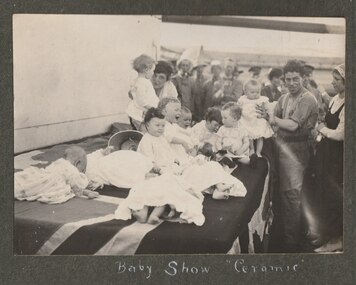
... At the end of the war he worked for a year at the A.I.F. Headquarters in London before returning to Australia on the 'Ceramic', arriving Portsea in 1920....At the end of the war he worked for a year at the A.I.F. Headquarters in London before returning to Australia on the 'Ceramic', arriving Portsea in 1920. ...Two photos from an album belonging to JB McLean, of his voyage home from World War 1 in 1920 on the Ceramic. Two photos of a baby show on board. The babies are sitting on a Union Jack flag. It shows one of the activities on board during the journey. The Ceramic departed Tillbury, UK 12th March and docked in Freemantle on 27th April 1920 and then went onto Adelaide, Melbourne and Sydney. The Ceramic was a transport vessel built in Belfast in 1913 for the White Star Line to transport frozen produce and apples from Australia to UK. It was taken over by the Australian Government for troop transport in October 1914 and could carry over 3,000 troops. This trip in 1920 there were 1467 on board, there were women and children as well as 439 soldiers returning home, one of whom was John 'Basil' McLean. Was with other World War 1 memorabilia that has come from Private John Basil McLean, 2nd Reinforcements, 37th Battalion, A.I.F. There was a large collection of postcards so he may have been collecting them as souvenirs. J.B. McLean (Service No. 13824) was from near Maffra, Victoria and enlisted on 22 January 1916. He embarked on 16 December 1916 for Europe. His full war record is available from AWM. He spent time with the Australian Field Artillery (Pack Section). At the end of the war he worked for a year at the A.I.F. Headquarters in London before returning to Australia on the 'Ceramic', arriving Portsea in 1920.A collection of items from John Basil McLean is in the archive. Kept as an indication of what founding legatees experienced in World War One and what they saw on the way home.Sepia photo x 2 of a baby show onboard the Ceramic glued to black cardboard in an album of photos from 1920.Handwritten caption 'Baby Show Ceramic' in white ink.souvenir, world war one, jb mclean, ship, ceramic, babies -
 Melbourne Legacy
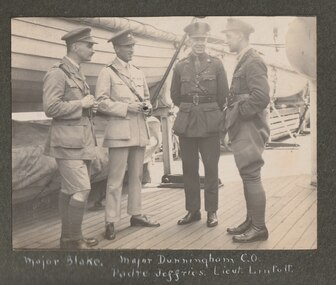
Photograph, Ceramic, 1920
... At the end of the war he worked for a year at the A.I.F. Headquarters in London before returning to Australia on the 'Ceramic', arriving Portsea in 1920....At the end of the war he worked for a year at the A.I.F. Headquarters in London before returning to Australia on the 'Ceramic', arriving Portsea in 1920. ...One photo from an album belonging to JB McLean, of his voyage home from World War 1 in 1920 on the Ceramic. The photo is of some officers on board, including the Padre Jefferies, the CO was Major Dunningham and also Major Blake.The style of life boats is also visible. The Ceramic departed Tillbury, UK 12th March and docked in Freemantle on 27th April 1920 and then went onto Adelaide, Melbourne and Sydney. The Ceramic was a transport vessel built in Belfast in 1913 for the White Star Line to transport frozen produce and apples from Australia to UK. It was taken over by the Australian Government for troop transport in October 1914 and could carry over 3,000 troops. This trip in 1920 there were 1467 on board, there were women and children as well as 439 soldiers returning home, one of whom was John 'Basil' McLean. Was with other World War 1 memorabilia that has come from Private John Basil McLean, 2nd Reinforcements, 37th Battalion, A.I.F. There was a large collection of postcards so he may have been collecting them as souvenirs. J.B. McLean (Service No. 13824) was from near Maffra, Victoria and enlisted on 22 January 1916. He embarked on 16 December 1916 for Europe. His full war record is available from AWM. He spent time with the Australian Field Artillery (Pack Section). At the end of the war he worked for a year at the A.I.F. Headquarters in London before returning to Australia on the 'Ceramic', arriving Portsea in 1920.A collection of items from John Basil McLean is in the archive. Kept as an indication of what founding legatees experienced in World War One and what they saw on the way home.Sepia photo of officers onboard the Ceramic glued to black cardboard in an album of photos from 1920.Handwritten caption 'Baby Show Ceramic' in white ink.souvenir, world war one, jb mclean, ship, ceramic, soliders -
 Melbourne Legacy
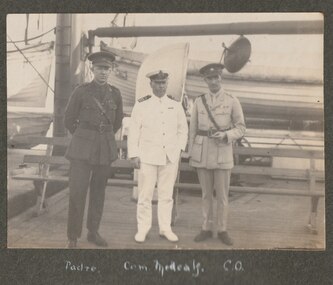
Photograph, Ceramic, 1920
... At the end of the war he worked for a year at the A.I.F. Headquarters in London before returning to Australia on the 'Ceramic', arriving Portsea in 1920....At the end of the war he worked for a year at the A.I.F. Headquarters in London before returning to Australia on the 'Ceramic', arriving Portsea in 1920. ...One photo from an album belonging to JB McLean, of his voyage home from World War 1 in 1920 on the Ceramic. The photo is of the Commanding Officer Major Dunningham and also Padre Jefferies and the Commander of the ship Com. Metcalf. The style of life boats is also visible. The Ceramic departed Tillbury, UK 12th March and docked in Freemantle on 27th April 1920 and then went onto Adelaide, Melbourne and Sydney. The Ceramic was a transport vessel built in Belfast in 1913 for the White Star Line to transport frozen produce and apples from Australia to UK. It was taken over by the Australian Government for troop transport in October 1914 and could carry over 3,000 troops. This trip in 1920 there were 1467 on board, there were women and children as well as 439 soldiers returning home, one of whom was John 'Basil' McLean. Was with other World War 1 memorabilia that has come from Private John Basil McLean, 2nd Reinforcements, 37th Battalion, A.I.F. There was a large collection of postcards so he may have been collecting them as souvenirs. J.B. McLean (Service No. 13824) was from near Maffra, Victoria and enlisted on 22 January 1916. He embarked on 16 December 1916 for Europe. His full war record is available from AWM. He spent time with the Australian Field Artillery (Pack Section). At the end of the war he worked for a year at the A.I.F. Headquarters in London before returning to Australia on the 'Ceramic', arriving Portsea in 1920.A collection of items from John Basil McLean is in the archive. Kept as an indication of what founding legatees experienced in World War One and what they saw on the way home.Sepia photo of officers onboard the Ceramic glued to black cardboard in an album of photos from 1920.Handwritten caption 'Baby Show Ceramic' in white ink.souvenir, world war one, jb mclean, ship, ceramic, soliders -
 Melbourne Legacy
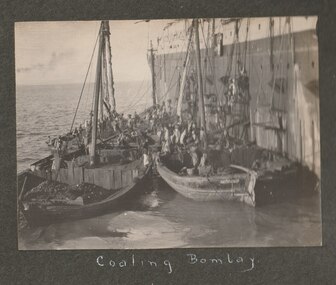
Photograph, Bombay, 1920
... At the end of the war he worked for a year at the A.I.F. Headquarters in London before returning to Australia on the 'Ceramic', arriving Portsea in 1920....At the end of the war he worked for a year at the A.I.F. Headquarters in London before returning to Australia on the 'Ceramic', arriving Portsea in 1920. ...Three photos from an album belonging to JB McLean, of his voyage home from World War 1 in 1920 on the Ceramic. The photos are of small boats providing coal to the Ceramic in Bombay, India and the type of manual labour it required with the men lifting it up the side of the ship. The visit to Bombay was a stop over point for the Ceramic on its way to Australia. The Ceramic departed Tillbury, UK 12th March and docked in Freemantle on 27th April 1920 and then went onto Adelaide, Melbourne and Sydney. The Ceramic was a transport vessel built in Belfast in 1913 for the White Star Line to transport frozen produce and apples from Australia to UK. It was taken over by the Australian Government for troop transport in October 1914 and could carry over 3,000 troops. This trip in 1920 there were 1467 on board, there were women and children as well as 439 soldiers returning home, one of whom was John 'Basil' McLean. Was with other World War 1 memorabilia that has come from Private John Basil McLean, 2nd Reinforcements, 37th Battalion, A.I.F. There was a large collection of postcards so he may have been collecting them as souvenirs. J.B. McLean (Service No. 13824) was from near Maffra, Victoria and enlisted on 22 January 1916. He embarked on 16 December 1916 for Europe. His full war record is available from AWM. He spent time with the Australian Field Artillery (Pack Section). At the end of the war he worked for a year at the A.I.F. Headquarters in London before returning to Australia on the 'Ceramic', arriving Portsea in 1920.A collection of items from John Basil McLean is in the archive. Kept as an indication of what founding legatees experienced in World War One and what they saw on the way home.Sepia photo x 2 of Indians providing coal to the Ceramic in Bombay glued to black cardboard in an album of photos from 1920.Handwritten caption 'Coaling Bombay' in white ink.souvenir, world war one, jb mclean, ceramic, bombay -
 Melbourne Legacy
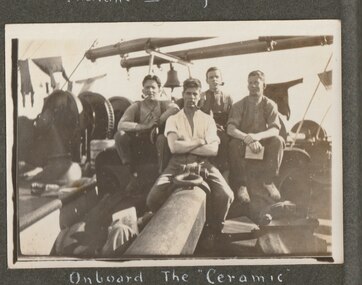
Photograph, Ceramic, 1920
... At the end of the war he worked for a year at the A.I.F. Headquarters in London before returning to Australia on the 'Ceramic', arriving Portsea in 1920....At the end of the war he worked for a year at the A.I.F. Headquarters in London before returning to Australia on the 'Ceramic', arriving Portsea in 1920. ...One photo from an album belonging to JB McLean, of his voyage home from World War 1 in 1920 on the Ceramic. The photo is of a group of four returning soldiers. Presumably JB McLean is one of them. It is the only photo in the album that is likely to contain an image of him. The Ceramic departed Tillbury, UK 12th March and docked in Freemantle on 27th April 1920 and then went onto Adelaide, Melbourne and Sydney. The Ceramic was a transport vessel built in Belfast in 1913 for the White Star Line to transport frozen produce and apples from Australia to UK. It was taken over by the Australian Government for troop transport in October 1914 and could carry over 3,000 troops. This trip in 1920 there were 1467 on board, there were women and children as well as 439 soldiers returning home, one of whom was John 'Basil' McLean. Was with other World War 1 memorabilia that has come from Private John Basil McLean, 2nd Reinforcements, 37th Battalion, A.I.F. There was a large collection of postcards so he may have been collecting them as souvenirs. J.B. McLean (Service No. 13824) was from near Maffra, Victoria and enlisted on 22 January 1916. He embarked on 16 December 1916 for Europe. His full war record is available from AWM. He spent time with the Australian Field Artillery (Pack Section). At the end of the war he worked for a year at the A.I.F. Headquarters in London before returning to Australia on the 'Ceramic', arriving Portsea in 1920.A collection of items from John Basil McLean is in the archive. Kept as an indication of what founding legatees experienced in World War One and what they saw on the way home.Sepia photo of officers onboard the Ceramic glued to black cardboard in an album of photos from 1920.Handwritten caption 'On board the Ceramic' in white ink.souvenir, world war one, jb mclean, ship, ceramic, soliders -
 Melbourne Legacy
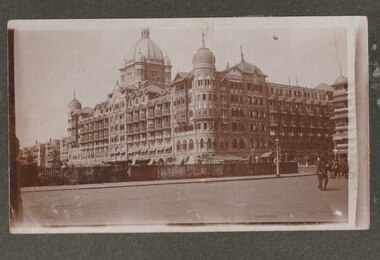
Photograph, Bombay, 1920
... At the end of the war he worked for a year at the A.I.F. Headquarters in London before returning to Australia on the 'Ceramic', arriving Portsea in 1920....At the end of the war he worked for a year at the A.I.F. Headquarters in London before returning to Australia on the 'Ceramic', arriving Portsea in 1920. ...One photo from an album belonging to JB McLean, of his voyage home from World War 1 in 1920 on the Ceramic. The photo is of the Taj Mahal Palace Hotel, which opened in 1903. There are many photos of Bombay in the album when the Ceramic had a stopover on its way back to the Australia. The Ceramic departed Tillbury, UK 12th March and docked in Freemantle on 27th April 1920 and then went onto Adelaide, Melbourne and Sydney. The Ceramic was a transport vessel built in Belfast in 1913 for the White Star Line to transport frozen produce and apples from Australia to UK. It was taken over by the Australian Government for troop transport in October 1914 and could carry over 3,000 troops. This trip in 1920 there were 1467 on board, there were women and children as well as 439 soldiers returning home, one of whom was John 'Basil' McLean. Was with other World War 1 memorabilia that has come from Private John Basil McLean, 2nd Reinforcements, 37th Battalion, A.I.F. There was a large collection of postcards so he may have been collecting them as souvenirs. J.B. McLean (Service No. 13824) was from near Maffra, Victoria and enlisted on 22 January 1916. He embarked on 16 December 1916 for Europe. His full war record is available from AWM. He spent time with the Australian Field Artillery (Pack Section). At the end of the war he worked for a year at the A.I.F. Headquarters in London before returning to Australia on the 'Ceramic', arriving Portsea in 1920.A collection of items from John Basil McLean is in the archive. Kept as an indication of what founding legatees experienced in World War One and what they saw on the way home.Sepia photo of the Taj Mahal Palace Hotel in Bombay glued to black cardboard in an album of photos from 1920.souvenir, world war one, jb mclean, ship, ceramic, bombay -
 Melbourne Legacy
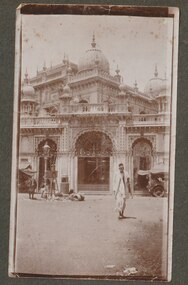
Photograph, Bombay, 1920
... At the end of the war he worked for a year at the A.I.F. Headquarters in London before returning to Australia on the 'Ceramic', arriving Portsea in 1920....At the end of the war he worked for a year at the A.I.F. Headquarters in London before returning to Australia on the 'Ceramic', arriving Portsea in 1920. ...Four photos from an album belonging to JB McLean, of his voyage home from World War 1 in 1920 on the Ceramic. The photos show buildings around Bombay. There are many photos of Bombay in the album when the Ceramic had a stopover on its way back to the Australia. The Ceramic departed Tillbury, UK 12th March and docked in Freemantle on 27th April 1920 and then went onto Adelaide, Melbourne and Sydney. The Ceramic was a transport vessel built in Belfast in 1913 for the White Star Line to transport frozen produce and apples from Australia to UK. It was taken over by the Australian Government for troop transport in October 1914 and could carry over 3,000 troops. This trip in 1920 there were 1467 on board, there were women and children as well as 439 soldiers returning home, one of whom was John 'Basil' McLean. Was with other World War 1 memorabilia that has come from Private John Basil McLean, 2nd Reinforcements, 37th Battalion, A.I.F. There was a large collection of postcards so he may have been collecting them as souvenirs. J.B. McLean (Service No. 13824) was from near Maffra, Victoria and enlisted on 22 January 1916. He embarked on 16 December 1916 for Europe. His full war record is available from AWM. He spent time with the Australian Field Artillery (Pack Section). At the end of the war he worked for a year at the A.I.F. Headquarters in London before returning to Australia on the 'Ceramic', arriving Portsea in 1920.A collection of items from John Basil McLean is in the archive. Kept as an indication of what founding legatees experienced in World War One and what they saw on the way home.Sepia photo of the Taj Mahal Palace Hotel in Bombay glued to black cardboard in an album of photos from 1920.souvenir, world war one, jb mclean, ship, ceramic, bombay
